

Positive psychology interventions: a meta-analysis of randomized controlled studies
Open accessThe DOI matches its Crossref record; 109 of the 115 references it cites were found in a registry or an index; 10 of the 22 sources its claims cite were checked for support.
Abstract
BACKGROUND: The use of positive psychological interventions may be considered as a complementary strategy in mental health promotion and treatment. The present article constitutes a meta-analytical study of the effectiveness of positive psychology interventions for the general public and for individuals with specific psychosocial problems. METHODS: We conducted a systematic literature search using PubMed, PsychInfo, the Cochrane register, and manual searches. Forty articles, describing 39 studies, totaling 6,139 participants, met the criteria for inclusion. The outcome measures used were subjective well-being, psychological well-being and depression. Positive psychology interventions included self-help interventions, group training and individual therapy. RESULTS: The standardized mean difference was 0.34 for subjective well-being, 0.20 for psychological well-being and 0.23 for depression indicating small effects for positive psychology interventions. At follow-up from three to six months, effect sizes are small, but still significant for subjective well-being and psychological well-being, indicating that effects are fairly sustainable. Heterogeneity was rather high, due to the wide diversity of the studies included. Several variables moderated the impact on depression: Interventions were more effective if they were of longer duration, if recruitment was conducted via referral or hospital, if interventions were delivered to people with certain psychosocial problems and on an individual basis, and if the study design was of low quality. Moreover, indications for publication bias were found, and the quality of the studies varied considerably. CONCLUSIONS: The results of this meta-analysis show that positive psychology interventions can be effective in the enhancement of subjective well-being and psychological well-being, as well as in helping to reduce depressive symptoms. Additional high-quality peer-reviewed studies in diverse (clinical) populations are needed to strengthen the evidence-base for positive psychology interventions.
Overview
CoChat Summary
## TL;DR
This meta-analysis of 39 randomized studies (40 articles; 6,139 participants) found that positive psychology interventions had small but significant benefits for subjective well-being, psychological well-being, and depressive symptoms. Effects were somewhat sustained at 3–6 months for well-being outcomes, but study heterogeneity and publication bias were notable.
## Key findings
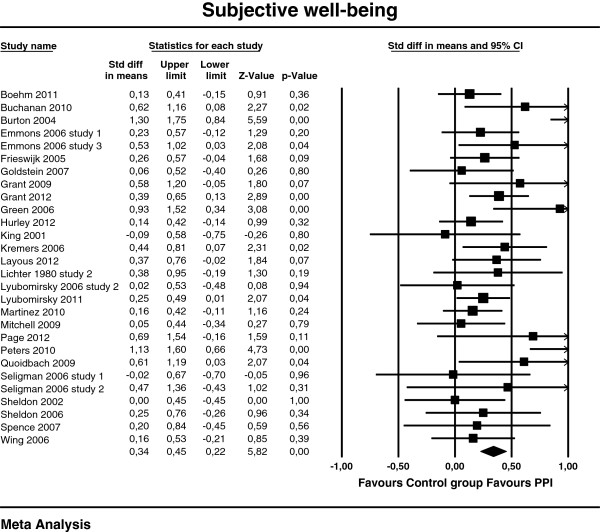
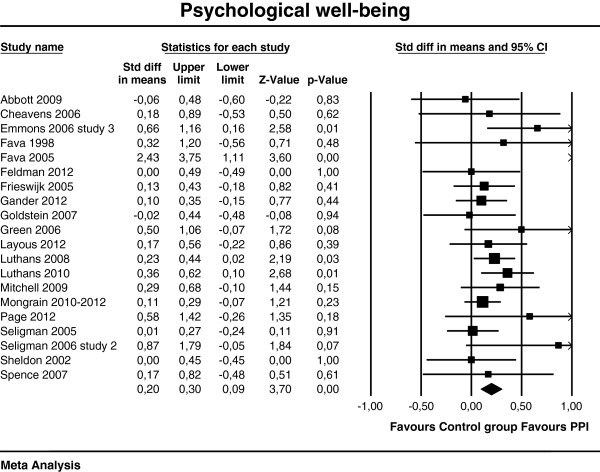
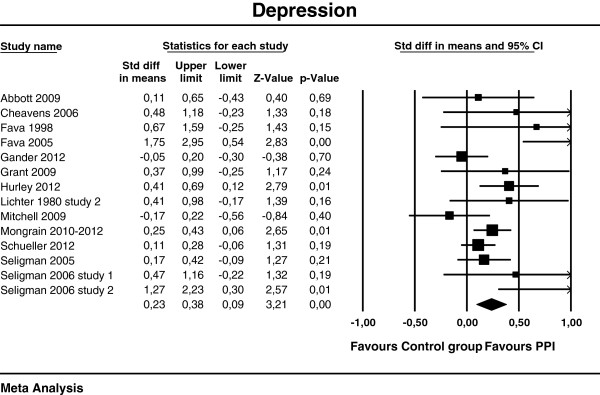
- Across all included studies, the pooled standardized mean differences were 0.34 for subjective well-being, 0.20 for psychological well-being, and 0.23 for depression, which the authors describe as small effects.
- At follow-up of 3–6 months (10 studies), effects remained significant for subjective well-being (d = 0.22, 95% CI [0.05, 0.38], p<.01) and psychological well-being (d = 0.16, 95% CI [0.02, 0.30], p=.03), but not for depression (d = 0.17, 95% CI [-0.06, 0.39], p=.15).
- Heterogeneity was moderate for subjective well-being (I² = 49.5%) and depression (I² = 47.0%), and low for psychological well-being (I² = 29.0%); effect sizes ranged from below 0 to as high as 2.4.
- For depression, larger effects were associated with longer duration, individual delivery, referral/hospital recruitment, inclusion of people with specific psychosocial problems, and lower study quality.
## Methods
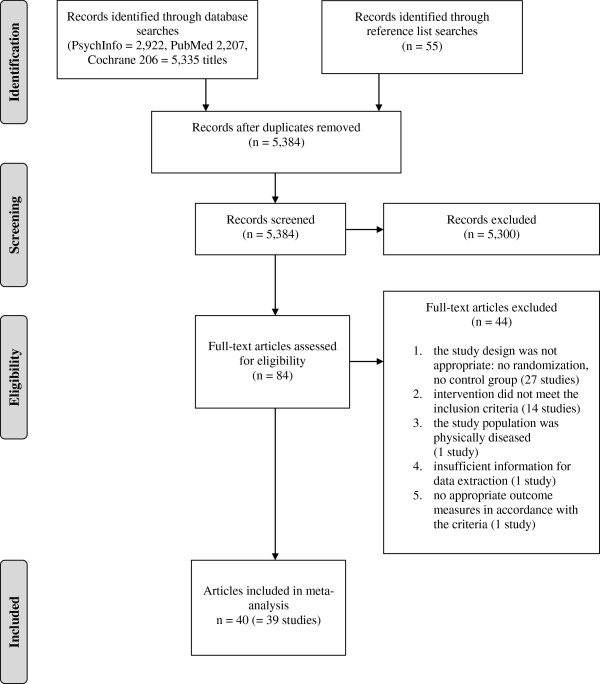
- Systematic review and meta-analysis of randomized controlled studies of positive psychology interventions, using PubMed, PsychInfo, the Cochrane Central Register of Controlled Trials, manual searches, and reference checking, covering 1998 to November 2012.
- Included 40 articles describing 39 studies with 6,139 participants; intervention formats included self-help, group training, and individual therapy.
- Main analysis used Cohen’s d under a random-effects model for three outcomes: subjective well-being, psychological well-being, and depression, with subgroup analyses and checks for heterogeneity and publication bias.
## Limitations
- The paper states that study quality was not high: no study met all quality criteria, randomization was often unclear, intention-to-treat analysis was rare (3/39 studies), and none reported an adequate power analysis.
- The authors note that heterogeneity was rather high because the included studies were diverse, and that the follow-up findings should be treated with caution because of the small number of studies and high attrition rates at follow-up.
- The text makes evident that publication bias is a limitation: funnel plots were asymmetric, fail-safe numbers were below the required thresholds, and Egger’s test suggested bias for psychological well-being and depression.
Model-written summary. Check it against the paper before relying on it.
Integrity signals
Registry
Cites
Statistics
Figures
Verification
Claims the paper makes
8 Valid · 2 Not valid · 9 Not checked · 90 Own results and interpretations
The cited sources that could be checked couldn’t confirm or dispute this claim.
In the paper
“First, the meta-analysis included both randomized studies and quasi-experimental studies.”
§ Positive psychology interventions: a meta-analysis of randomized controlled studies > Background
What the sources say
- Could not verifycites Sin and Lyubomirsky (2009) matched to “Enhancing well-being and alleviating depressive symptoms with positive psychology interventions: a practice-friendly meta-analysis” (2009) sourceExperimental — accuracy not yet measured
The Literature Search section requires included studies to have a comparison group, and Data Recorded distinguishes self-selected from non-self-selected participants. Neither passage establishes whether the meta-analysis included both randomized and quasi-experimental studies; searches for those design terms and for random assignment found no decisive passage. Page numbers were unavailable in our copy. (LLM, conf=0.72)
plain- Asserted: passes — The authors put it forward as true.
- Checkable: passes — It can be checked against evidence.
- Load-bearing: unclear — It is unclear whether the paper’s conclusions depend on it.
- Based: passes — The paper gives a reason why it holds.
- Could not verify
The cited sources support only part of this claim — read each source’s verdict below.
In the paper
“Their results show that PPIs can indeed be effective in enhancing well-being (r = 0.29, standardized mean difference Cohen’s d = 0.61) and help to reduce depressive symptom levels in clinical populations (r = 0.31, Cohen’s d = 0.65).”
§ Positive psychology interventions: a meta-analysis of randomized controlled studies > Background
What the sources say
- Partly supportedcites Sin and Lyubomirsky (2009) matched to “Enhancing well-being and alleviating depressive symptoms with positive psychology interventions: a practice-friendly meta-analysis” (2009) sourceExperimental — accuracy not yet measured
The Depression section reports that PPIs reduced depressive symptoms across 25 studies, with a mean effect of r = .31. The Participant Moderators section distinguishes depressed from nondepressed participants, so .31 is not an estimate specifically for clinical populations. The paper reports the effect as r, not as Cohen’s d = .65. (LLM, conf=0.87)
plainstates a cause- Asserted: passes — The authors put it forward as true.
- Checkable: passes — It can be checked against evidence.
- Load-bearing: unclear — It is unclear whether the paper’s conclusions depend on it.
- Based: passes — The paper gives a reason why it holds.
- Partly supported
Every source the paper cites for this claim was checked and supports it.
In the paper
“Their results show that PPIs can indeed be effective in enhancing well-being (r = 0.29, standardized mean difference Cohen’s d = 0.61) and help to reduce depressive symptom levels in clinical populations (r = 0.31, Cohen’s d = 0.65).”
§ Positive psychology interventions: a meta-analysis of randomized controlled studies > Background
What the sources say
- Supportedcites Sin and Lyubomirsky (2009) matched to “Enhancing well-being and alleviating depressive symptoms with positive psychology interventions: a practice-friendly meta-analysis” (2009) source
The Well-Being section reports that PPIs significantly improved well-being across 49 studies, with a mean r of .29. The paper reports r rather than Cohen’s d; converting .29 to d gives approximately .61, so the cited figures are consistent. (LLM, conf=0.90)
plainstates a cause- Asserted: passes — The authors put it forward as true.
- Checkable: passes — It can be checked against evidence.
- Load-bearing: passes — The paper’s conclusions depend on it.
- Based: passes — The paper gives a reason why it holds.
- Supported
Every source the paper cites for this claim was checked and supports it.
In the paper
“Second, study quality was not addressed as a potential effect moderator.”
§ Positive psychology interventions: a meta-analysis of randomized controlled studies > Background
What the sources say
- Supportedcites Sin and Lyubomirsky (2009) matched to “Enhancing well-being and alleviating depressive symptoms with positive psychology interventions: a practice-friendly meta-analysis” (2009) source
The Data Recorded section lists the variables coded for moderator analysis: participant characteristics, intervention format and duration, and comparison-group type. It does not include study quality, and the Methodological Moderators section discusses those methodological variables rather than study quality. Page numbers are unavailable in our copy. (LLM, conf=0.88)
plain- Asserted: passes — The authors put it forward as true.
- Checkable: passes — It can be checked against evidence.
- Load-bearing: unclear — It is unclear whether the paper’s conclusions depend on it.
- Based: passes — The paper gives a reason why it holds.
- Supported
Every source the paper cites for this claim was checked and supports it.
In the paper
“Remarkably, effect sizes in the current meta-analysis are around 0.3 points lower than the effect sizes in the meta-analysis by Sin and Lyubomirsky (2009) [37].”
§ Positive psychology interventions: a meta-analysis of randomized controlled studies > Discussion > Main findings
What the sources say
- Supportedcites Sin and Lyubomirsky (2009) [37] matched to “Enhancing well-being and alleviating depressive symptoms with positive psychology interventions: a practice-friendly meta-analysis” (2009) source
The Well-Being and Depression results report mean effect sizes of r = .29 and r = .31, respectively, establishing the values attributed to Sin and Lyubomirsky’s meta-analysis. The difference from the current meta-analysis is the citing authors’ comparison, not a finding this source could report. (LLM, conf=0.88)
plain- Asserted: passes — The authors put it forward as true.
- Checkable: passes — It can be checked against evidence.
- Load-bearing: passes — The paper’s conclusions depend on it.
- Based: passes — The paper gives a reason why it holds.
- Supported
70 more claims · 1 with their cited sources checked
Create a free account to see all 109 claims and to verify the 1 reference still open.
- Probably not a substantial claim. 14
- It may state two separate claims as one. 23
Claims other papers make about this one
Each is checked against this paper’s own text: does it say what the citing paper says it does?
The source backs part of the claim, not all of it — or backs it for a different population, condition or comparison.
In the citing paper
“In contrast to complex multicomponent health behavior or psychology interventions, PP exercises are simple, can be delivered remotely (e.g., by phone), and require minimal training of providers [34, 41, 42].”
From Positive Psychological Interventions for Patients with Type 2 Diabetes: Rationale, Theoretical Model, and Intervention Development (2015) · cites this paper as [41]
Experimental — accuracy not yet measuredThe source backs part of the claim, not all of it — or backs it for a different population, condition or comparison.
In the citing paper
“Studies supporting the efficacy of positive activity interventions (PAIs) have been primarily conducted in unselected (non-clinical) community samples and examined single positive activities in isolation (for a meta-analysis, see66, 67).”
From Upregulating the positive affect system in anxiety and depression: Outcomes of a positive activity intervention: Taylor et al. (2017) · cites this paper as [67]
Experimental — accuracy not yet measuredThe source backs part of the claim, not all of it — or backs it for a different population, condition or comparison.
In the citing paper
“Two meta-analyses of PPIs for depression and well-being found that these interventions have small to moderate effects in enhancing well-being and decreasing depressive symptoms and that effects are stronger for individual vs. group formats [30, 31].”
From Skills to Enhance Positivity in adolescents at risk for suicide: Protocol for a randomized controlled trial (2023) · cites this paper as [31]
Experimental — accuracy not yet measuredThe source backs part of the claim, not all of it — or backs it for a different population, condition or comparison.
In the citing paper
“Bolier and Abello (Bolier et al., 2013) reviewed digital PPIs and found that the majority of the included studies showed improvement in well-being or reduction of distress in the intervention group, compared to the control group.”
From Strength Back – A qualitative study on the co-creation of a positive psychology digital health intervention for spinal surgery patients (2023) · cites this paper as Bolier et al., 2013
Experimental — accuracy not yet measuredThe source backs part of the claim, not all of it — or backs it for a different population, condition or comparison.
In the citing paper
“PPIs may support patients to notice and savour positive experiences (Bolier et al., 2013). This may strengthen their commitment to value-based action.”
From Strength Back – A qualitative study on the co-creation of a positive psychology digital health intervention for spinal surgery patients (2023) · cites this paper as Bolier et al., 2013
Experimental — accuracy not yet measured
24 more claims about this paper
Create a free account to see every claim other papers make about this one.
Statistics recomputed
Every reported test result, recomputed from its test statistic and degrees of freedom. A result shows as not adding up only once an independent check has confirmed it.
- Consistentz = 6.43reported p < .01 · recomputed p < .001
“Z=6.43, p < .01”
- Consistentz = 4.18reported p < .01 · recomputed p < .001
“Z=4.18, p < .01”
- Consistentz = 3.33reported p < .01 · recomputed p < .001
“Z=3.33, p < .01”
Self-check
Percentages, sums and reported differences re-computed from the paper’s own numbers.
Self-check results appear here once an independent check has confirmed them.
Citations
Cites
Preferred Reporting Items for Systematic Reviews and Meta-Analyses: the PRISMA statement
Moher, D., Liberati, A., Tetzlaff, J., Altman, D. G., & for the PRISMA Group (2009) · BMJ · doi:10.1136/bmj.b2535 · Cited by 83,823
Preferred Reporting Items for Systematic Reviews and Meta-Analyses: The PRISMA Statement
Moher, D., Liberati, A., Tetzlaff, J., Altman, D. G., & The PRISMA Group (2009) · PLoS Medicine · doi:10.1371/journal.pmed.1000097 · Cited by 64,042 · cited 1×
“For the reporting of the results of this meta-analysis, we applied Preferred Reporting Items for Systematic Reviews and Meta-Analyses (PRISMA) guidelines [50].”
Measuring inconsistency in meta-analyses
Higgins, J. P. T., Thompson, S. G., Deeks, J. J., & Altman, D. G. (2003) · BMJ · doi:10.1136/bmj.327.7414.557 · Cited by 63,139 · cited 1×
“A value of 0% indicates an absence of dispersion, and larger values show increasing levels of heterogeneity where 25% can be considered as low, 50% as moderate and 75% as a high level of heterogeneity [46].”
Preferred reporting items for systematic reviews and meta-analyses: the PRISMA Statement.
(2009) · PubMed Central · Cited by 44,859
Cochrane Handbook for Systematic Reviews of Interventions: Cochrane Book Series
(2008) · doi:10.1002/9780470712184 · Cited by 25,048
Preferred Reporting Items for Systematic Reviews and Meta-Analyses: The PRISMA Statement
Moher, D., Liberati, A., Tetzlaff, J., & Altman, D. G. (2009) · Journal of Clinical Epidemiology · doi:10.1016/j.jclinepi.2009.06.005 · Cited by 19,575
Happiness is everything, or is it? Explorations on the meaning of psychological well-being.
Ryff, C. D. (1989) · Journal of Personality and Social Psychology · doi:10.1037/0022-3514.57.6.1069 · Cited by 14,847 · cited 1×
“Psychological well-being focuses on the optimal functioning of the individual and includes concepts such as mastery, hope and purpose in life [13,14].”
Borenstein, M., Hedges, L. V., Higgins, J. P. T., & Rothstein, H. R. (2009) · doi:10.1002/9780470743386 · Cited by 14,225
Duval, S., & Tweedie, R. (2000) · Biometrics · doi:10.1111/j.0006-341x.2000.00455.x · Cited by 14,099 · cited 1×
“If asymmetry is found in the funnel plot, the Trim and Fill method adjusts the pooled effect size for the outcomes of missing studies [49].”
Subjective well-being: Three decades of progress.
Diener, E., Suh, E. M., Lucas, R. E., & Smith, H. L. (1999) · Psychological Bulletin · doi:10.1037/0033-2909.125.2.276 · Cited by 12,910 · cited 2×
“Although the basic concepts of well-being, happiness and human flourishing have been studied for some decades [12,25-27], there was a lack of evidence-based interventions [24].”
Research works printed but not linked: 3
- Rupke SJ Blecke D Renfrow M Cognitive Therapy for Depression Am Fam Physician 2006 73 83 86 16417069
- Veenhoven R Gezond geluk: Effecten van geluk op gezondheid en wat dat kan betekenen voor de preventieve gezondheidszorg (Healthy happiness: effect of happiness on health and what this could mean for preventive public health) 2006 Rotterdam: Erasmus Universiteit
- Lamers S Bolier L Westerhof GJ Smit F Bohlmeijer E The impact of emotional well-being on long-term recovery and survival in physical illness: a meta-analysis J Behav Med 2012 5 538 547 21918889 PMC3439612 · DOI · Paper page
Cited by
Items 601–700 of 2,037
Long-term effects and impact of a positive psychology intervention for Brazilian retirees
Durgante, H. B., Bedin, L. M., de Lima, M. P., & Dell’Aglio, D. D. (2020) · Current Psychology · doi:10.1007/s12144-020-00683-7 · Cited by 18
“the improvement of general health, also in the treatment and alleviation of psychopathology (Bolier et al. 2013; Knapp and Beck 2008; McGrath 2016; Seligman et al. 2005; Sin and Lyubomirsky 2009; Sutipan et al. 2016).”
BackgroundInfluentialHoppen, T. H., & Morina, N. (2021) · BMJ Open · doi:10.1136/bmjopen-2020-046017 · Cited by 33
Görges, F., Oehler, C., von Hirschhausen, E., Hegerl, U., & Rummel‐Kluge, C. (2018) · Internet Interventions · doi:10.1016/j.invent.2018.03.001 · Cited by 23
Walsh, S., Kaselionyte, J., Taylor, S. J. C., & Priebe, S. (2018) · BMC Psychiatry · doi:10.1186/s12888-018-1812-x · Cited by 19
Kraiss, J. T., ten Klooster, P. M., Chrispijn, M., Trompetter, H. R., Stevens, A. W. M. M., Neutel, E., Kupka, R., & Bohlmeijer, E. T. (2018) · BMC Psychiatry · doi:10.1186/s12888-018-1916-3 · Cited by 23
Self-citationImproving the Capacity to Treat Depression using Talking Therapies
Dunn, B. D., & Roberts, H. (2016) · Wiley eBooks · doi:10.1002/9781118468197.ch13 · Cited by 29
Form Matters: Design Creativity in Positive Psychological Interventions
Desmet, P., & Sääksjärvi, M. (2016) · Psychology of Well-Being Theory Research and Practice · doi:10.1186/s13612-016-0043-5 · Cited by 22
“Although the study of PPIs is relatively new, there is growing evidence that they are effective in boosting long-term wellbeing (see two recently published meta-analyses: Bolier et al. 2013; Sin and Lyubomirsky 2009). While traditional PPIs require a one-to-one interaction between a client and a coach or therapist, in…”
BackgroundNeuromodulation as a cognitive enhancement strategy in healthy older adults: promises and pitfalls
Martins, A. R. S., Fregni, F., Simis, M., & Almeida, J. (2016) · Aging Neuropsychology and Cognition · doi:10.1080/13825585.2016.1176986 · Cited by 25
“Furthermore, the random effects model is more conservative, as it lends relatively more weight to smaller studies and allows wider confidence intervals, thus reducing the likelihood of errors, namely type-II errors (Bolier et al., 2013).”
BackgroundPark, K. H., Kam, B. S., Yune, S. J., Lee, S. Y., & Im, S. J. (2022) · PLoS ONE · doi:10.1371/journal.pone.0262250 · Cited by 28
Tagalidou, N., Baier, J., & Laireiter, A. (2019) · Internet Interventions · doi:10.1016/j.invent.2019.100242 · Cited by 25
Solanes, A., Albajes-Eizagirre, A., Fullana, M. A., Fortea, L., Fusar-Poli, P., Torrent, C., Solé, B., Bonnín, C. M., Shin, J. I., Vieta, E., et al. (2021) · Revista de Psiquiatría y Salud Mental · doi:10.1016/j.rpsm.2020.08.002 · Cited by 19
Affect and Low Back Pain: More to Consider Than the Influence of Negative Affect Alone
Hassett, A. L., Goesling, J., Mathur, S., Moser, S. E., Brummett, C. M., & Sibille, K. T. (2016) · Clinical Journal of Pain · doi:10.1097/ajp.0000000000000350 · Cited by 20
Mak, V. W. M., & Chan, C. K. Y. (2018) · Criminal Behaviour and Mental Health · doi:10.1002/cbm.2047 · Cited by 19
“Among mainstream psychological interventions, positive psychological intervention (PPI) is considered to be a promising approach that emphasises the cultivation of positive cognition, feelings and behaviours (Parks-Sheiner, 2009; Sin and Lyubomirsky, 2009; Bolier et al., 2013).”
BackgroundYuan, Q., Liu, S., Tang, S. W., & Zhang, D. (2014) · BMC Public Health · doi:10.1186/1471-2458-14-685 · Cited by 26
“3 or larger comparing the intervention group with the control group [14].”
BackgroundReprint of: Positive Psychological Well-Being and Cardiovascular Disease
Kubzansky, L. D., Huffman, J. C., Boehm, J. K., Hernández, R., Kim, E. S., Koga, H. K., Feig, E. H., Lloyd‐Jones, D. M., Seligman, M. E. P., & Labarthe, D. R. (2018) · Journal of the American College of Cardiology · doi:10.1016/j.jacc.2018.10.023 · Cited by 27
“In healthy individuals, such activities have been found to improve indicators of psychological well-being such as optimism (99,100) in the short term, with some suggestion of sustained effect.”
BackgroundFeasibility of an online well-being intervention for people with spinal cord injury: a pilot study
Verwer, J. H., van Leeuwen, C. V., Bolier, L., & Post, M. (2015) · Spinal Cord · doi:10.1038/sc.2015.165 · Cited by 23
Self-citationHappiness Goal Orientations and their Associations with Well-Being
Krasko, J., Schweitzer, V. M., & Luhmann, M. (2020) · Journal of Well-Being Assessment · doi:10.1007/s41543-020-00029-x · Cited by 23
Iddon, J., Dickson, J. M., & Unwin, J. (2016) · International Journal of Applied Positive Psychology · doi:10.1007/s41042-016-0003-6 · Cited by 21
“The effectiveness of such interventions has been evaluated in two meta-analyses to date (Sin & Lyubomirsky 2009; Bolier et al. 2013) with results demonstrating enhancements in subjective and psychological well-being and a reduction in depressive symptoms.”
BackgroundMethodInfluentialAnxiety and excitement in the fourth industrial revolution: A systems- psychodynamic perspective
Mayer, C., & Oosthuizen, R. M. (2021) · SA Journal of Industrial Psychology · doi:10.4102/sajip.v47i0.1813 · Cited by 18
“Meta-analyses of the impacts of mediations found that such interventions have noteworthy impacts on positive influence or the related development of happiness (Bolier et al., 2013; Sin & Lyubomirsky, 2009).”
BackgroundMurphy, S. L., Chen, Y. T., Alore, M., Hicks, S., Pape, A., Hassett, A. L., Kratz, A. L., Whibley, D., Harper, A. E., Huang, S., et al. (2024) · Arthritis Care & Research · doi:10.1002/acr.25253 · Cited by 23
“23,25,26 Second, program materials, including the RENEW website and app, were developed in partnership with individuals with SSc at the forefront to counter the typical provider – patient power dynamic.”
BackgroundVella‐Brodrick, D., Patrick, K., Jacques-Hamilton, R., Ng, A., Chin, T., O’Connor, M., Rickard, N. S., CROSS, D. S., & Hattie, J. (2023) · Oxford Review of Education · doi:10.1080/03054985.2023.2194621 · Cited by 22
Mohammadi, R. K., Bozorgi, S. A., Shariat, S., & Hamidi, M. (2019) · Social Behavior Research & Health · doi:10.18502/sbrh.v2i2.285 · Cited by 19
Weiss, L., Westerhof, G. J., & Bohlmeijer, E. T. (2013) · Health and Quality of Life Outcomes · doi:10.1186/1477-7525-11-159 · Cited by 22
“First of all, the study belongs to the 10% of the largest studies in the field of positive psychology [16,27].”
BackgroundInfluentialSelf-citationMoscovitch, D. A., White, K., & Hudd, T. (2023) · Clinical Psychological Science · doi:10.1177/21677026231195792 · Cited by 23
“…years, which are conceptualized as purposeful strategies that can be self-administered in daily life for the purpose of temporarily boosting subjective psychological well-being (Bolier et al., 2013; Bryant et al., 2005; Meyers et al., 2013; Miguel-Alvaro et al., 2021; Sin & Lyubomirsky, 2009).”
BackgroundAutobiographical Memory, Gratitude, Forgiveness and Sense of Humor: An Intervention in Older Adults
Chamorro, A., Fernández, E. R., & Martínez, A. R. O. (2021) · Frontiers in Psychology · doi:10.3389/fpsyg.2021.731319 · Cited by 26
Lu, L., Ye, C., Xu, R.-A., Feng, H., & Liu, B. (2024) · BMC Medical Education · doi:10.1186/s12909-024-06287-0 · Cited by 35
“Our recommendations relate to the efficacy of positive psychology interventions, which are associated with improved well-being and positive psychological traits [95].”
Development of an Online Well-Being Intervention for Young People: An Evaluation Protocol
Antezana, G., Bidargaddi, N. P., Blake, V., Schrader, G. D., Kaambwa, B., Quinn, S. J., Orlowski, S., Winsall, M., & Battersby, M. (2015) · JMIR Research Protocols · doi:10.2196/resprot.4098 · Cited by 22
“There is evidence that depression is a significant covariate in analyses of changes in well-being in multiple studies [16,19,42].”
BackgroundAlexiou, E., Kotsoni, A., & Stalikas, A. (2021) · Psychology · doi:10.4236/psych.2021.123025 · Cited by 23
Resilience mediates the association between impulsivity and self-harm in Chinese adolescents
Ran, H., Fang, D., Che, Y., Donald, A. R., Peng, J., Chen, L., Wang, S., & Xiao, Y. (2021) · Journal of Affective Disorders · doi:10.1016/j.jad.2021.12.077 · Cited by 25
Improving the Wellbeing of Female Prisoners via Psychological Skills Training: A Feasibility Study
Lo, L., Iasiello, M. P., Carey, M., & van Agteren, J. E. (2020) · International Journal of Offender Therapy and Comparative Criminology · doi:10.1177/0306624x20928029 · Cited by 28
“com), which combines content derived from positive psychology interventions (Bolier et al., 2013; Hone et al., 2015) and psychological treatment methods such as Cognitive Behavioural Therapy (A.”
MethodResultIllness perception and resilience in patients with cancer: a cross-sectional study
Shabanloei, R., Ghasempour, M., Zamanesazi, R., Purabdollah, M., & Asghari-Jafarabadi, M. (2025) · BMC Psychology · doi:10.1186/s40359-025-02572-9 · Cited by 23
“It is a malle-able state within individuals that allows them to maintain, enhance, or restore relatively stable psychological and physical functioning in the face of stressful life events [11, 15].”
Developing authentic happiness: Growth curve models to assess lifelong happiness
Tanzer, J. R. (2019) · The Journal of Positive Psychology · doi:10.1080/17439760.2019.1689419 · Cited by 22
Hobbs, C., Jelbert, S. A., Santos, L. R., & Hood, B. M. (2022) · PLoS ONE · doi:10.1371/journal.pone.0263514 · Cited by 23
“Systematic reviews have concluded that PPIs are effective in promoting psychological well-being across a range of settings [31].”
BackgroundO’Brien, N., Lawlor, M. P., Chambers, F. C., & O’Brien, W. (2020) · International Journal of Environmental Research and Public Health · doi:10.3390/ijerph17155530 · Cited by 25
“Effective positive mental health interventions generally include components such as mental health literacy [30,31], personal strengths [32], mindfulness [33–35], optimism [36], and goal setting [37,38].”
BackgroundAmonoo, H. L., Kurukulasuriya, C. E., Chilson, K., Onstad, L., Huffman, J. C., & Lee, S. J. (2020) · Transplantation and Cellular Therapy · doi:10.1016/j.bbmt.2020.02.013 · Cited by 23
Humanization of social relations: Nourishing health and resilience through greater humanity.
Castro, S. A., & Zautra, A. (2016) · Journal of Theoretical and Philosophical Psychology · doi:10.1037/teo0000040 · Cited by 22
Proverbial positive psychology: can we leverage African ancient wisdom to promote flourishing?
Appiah, R. (2023) · The Journal of Positive Psychology · doi:10.1080/17439760.2023.2282771 · Cited by 20
“…also integrated psychosocial skills (e.g., problem-solving, goal setting), creativity, and optimism to facilitate personal growth and development (Bolier et al., 2013), and to help individuals avoid harmful experiences (e.g., addiction) that decrease well-being (Carr et al., 2021; van Agteren et…”
School-based outdoor education and teacher subjective well-being: An exploratory study
Deschamps, A., SCRUTTON, R. A., & Ayotte‐Beaudet, J. (2022) · Frontiers in Education · doi:10.3389/feduc.2022.961054 · Cited by 38
Appiah, R., Fadiji, A. W., Wissing, M. P., & Schutte, L. (2021) · International Journal of Qualitative Studies on Health and Well-Being · doi:10.1080/17482631.2021.1891760 · Cited by 28
Positive psychological interventions and cognition
Stone, B. M., & Schmidt, K. (2020) · The Journal of Positive Psychology · doi:10.1080/17439760.2020.1789714 · Cited by 17
Positive Psychology and Well-Being at Sea
McVeigh, J., MacLachlan, M., Stilz, R., Cox, H., Doyle, N. M., Fraser, A., & Dyer, M. (2017) · Springer eBooks · doi:10.1007/978-3-319-45430-6_2 · Cited by 30
“For example, in a meta-analytical study of the effectiveness of positive psychology interventions, Bolier and colleagues reported that positive psychology interventions significantly enhanced subjective and psychological well-being and reduced depressive symptoms (Bolier et al. 2013).”
BackgroundMichalski, C. A., Diemert, L. M., Hurst, M., Goel, V., & Rosella, L. C. (2022) · BMJ Open · doi:10.1136/bmjopen-2021-050057 · Cited by 21
Elyasi, F., Douki, H. E., & Hasanzadeh, R. (2019) · Journal of Nursing and Midwifery Sciences · doi:10.4103/jnms.jnms_33_18 · Cited by 28
From Unemployment to Employment and Back: Professional Trajectories and Well-Being
Gander, F., Hofmann, J., & Ruch, W. (2019) · Applied Research in Quality of Life · doi:10.1007/s11482-019-09797-y · Cited by 23
Springfield, S., Qin, F., Hedlin, H., Eaton, C. B., Rosal, M. C., Taylor, H. A., Staudinger, U. M., & Stefanick, M. L. (2022) · International Journal of Environmental Research and Public Health · doi:10.3390/ijerph19127089 · Cited by 21
The say ‘yes’ to life (SYTL) program: A positive psychology group intervention for depression
Carr, A., & Finnegan, L. (2015) · Journal of Contemporary Psychotherapy · doi:10.1007/s10879-014-9269-9 · Cited by 18
Interventions efficaces en psychologie positive: Une revue systématique.
Sitbon, A., Shankland, R., & Martin‐Krumm, C. (2019) · Canadian Psychology/Psychologie canadienne · doi:10.1037/cap0000163 · Cited by 30
“…les interventions de psychologie positive auto-administrées ainsi que les précédentes, qui incluaient d’autres modes d’administration des exercices (Bolier et al., 2013a; Sin & Lyubomirsky, 2009), ont montré que ces interventions sont susceptibles d’améliorer le bien-être et de contribuer à…”
BackgroundInfluentialHappiness vs. mindfulness exercises for individuals vulnerable to depression
Mongrain, M., Komeylian, Z., & Barnhart, R. (2015) · The Journal of Positive Psychology · doi:10.1080/17439760.2015.1092569 · Cited by 18
“Notwithstanding important issues with attrition (see Parks, 2014), empirical data demonstrate that active participation and completion of online positive psychology exercises are associated with significant gains in subjective well-being (Bolier et al., 2013).”
BackgroundGander, F., Proyer, R. T., & Ruch, W. (2018) · Journal of Happiness Studies · doi:10.1007/s10902-017-9909-3 · Cited by 15
“Two recent meta-analyses support the notion that such interventions are effective strategies for increasing well-being and ameliorating depression (Bolier et al., 2013; Sin & Lyubomirsky, 2009).”
BackgroundCheer* in Health Care Practice: What It Excludes and Why It Matters
Setchell, J., Abrams, T., McAdam, L. C., & Gibson, B. E. (2019) · Qualitative Health Research · doi:10.1177/1049732319838235 · Cited by 22
Chua, J. Y. X., Choolani, M. A., Chee, C. Y. I., Yi, H., Chan, Y. H., Lalor, J., Chong, Y. S., & Shorey, S. (2024) · International Journal of Nursing Studies · doi:10.1016/j.ijnurstu.2024.104906 · Cited by 21
Enko, J., Behnke, M., Dziekan, M., Kosakowski, M., & Kaczmarek, L. D. (2020) · Journal of Happiness Studies · doi:10.1007/s10902-020-00218-8 · Cited by 18
Well-Being Science for Teaching and the General Public
Tov, W., Wirtz, D., Kushlev, K., Biswas‐Diener, R., & Diener, E. (2022) · Perspectives on Psychological Science · doi:10.1177/17456916211046946 · Cited by 28
van Zyl, L. V., Zondervan-Zwijnenburg, M., Dickens, L. R., & Hulshof, I. L. (2020) · International Review of Psychiatry · doi:10.1080/09540261.2020.1809357 · Cited by 18
“Psychological interventions rarely show significant immediate effects, and those that are shown are rarely sustained over time (Bolier et al., 2013; Donaldson et al., 2019; Roll et al., 2019) Further, the true effect of the intervention can only be seen over an extended period (Van Zyl, Efendic, et…”
BackgroundPositive Psychology Approaches to Interventions for Cancer Dyads: A Scoping Review
Otto, A. K., Ketcher, D., Reblin, M., & Terrill, A. L. (2022) · International Journal of Environmental Research and Public Health · doi:10.3390/ijerph192013561 · Cited by 27
“PPAs have been effectively applied to various populations [16–18], and have been shown to significantly increase well-being and decrease depressive symptoms [10,11,14] with long-lasting effects [19].”
BackgroundInfluentialWell-Being and Generalized Anxiety in Japanese Undergraduates: A Prospective Cohort Study
Takebayashi, Y., Tanaka, K., Sugiura, Y., & Sugiura, T. (2017) · Journal of Happiness Studies · doi:10.1007/s10902-017-9852-3 · Cited by 24
Design for Engagement of Online Positive Psychology Interventions
Kelders, S. M. (2019) · Springer eBooks · doi:10.1007/978-3-030-20020-6_13 · Cited by 28
Evans, T. S., Dhir, P., Radley, D., Duarte, C., Keyworth, C., Homer, C. V., Hill, A. J., Hawkes, R. E., Matu, J., McKenna, J., et al. (2022) · Diabetic Medicine · doi:10.1111/dme.15022 · Cited by 19
Bakker, A. B., Burger, M., van Haren, P., Oerlemans, W. G. M., & Veenhoven, R. (2020) · International Journal of Applied Positive Psychology · doi:10.1007/s41042-020-00032-w · Cited by 23
“Sin and Lyubomirsky (2009), Bolier et al. (2013) and Weiss et al.”
BackgroundInfluentialVos, L. M. W., Habibovic, M., Nyklíček, I., Smeets, T., & Mertens, G. (2020) · doi:10.31234/osf.io/eqx4y · Cited by 152
Psychosocial factors associated with flourishing among Australian HIV-positive gay men
Lyons, A., Heywood, W., & Rozbroj, T. (2016) · BMC Psychology · doi:10.1186/s40359-016-0154-z · Cited by 21
“A range of studies has now demonstrated that higher levels of mental health can be increased through positive psychological interventions such as individual therapy, group training, and self-help interventions [56, 57].”
Weijers, A., Rasing, S. P. A., Creemers, D. H. M., Vermulst, A. A., Schellekens, A., & Westerhof, G. J. (2020) · Journal of Clinical Psychology · doi:10.1002/jclp.23083 · Cited by 19
“…that positive psychology interventions (PPIs) are effective in improving well ‐ being as well as in alleviating common psychological symptoms, including depression, in clinical samples with psychiatric and somatic disorders (Bolier et al., 2013; Chakhssi et al., 2018; Sin & Lyubomirsky, 2009).”
BackgroundSelf-citationCultivating Gratitude with a Chatbot
Lee, M., Alejandro, J. C., & IJsselsteijn, W. A. (2023) · International Journal of Human-Computer Interaction · doi:10.1080/10447318.2023.2231277 · Cited by 23
“There is a strong link between positive psychology interventions and well-being according to a meta-analysis of 39 studies (Bolier et al., 2013).”
McTiernan, K., Gullon-Scott, F., & Dudley, R. E. J. (2021) · Journal of Contemporary Psychotherapy · doi:10.1007/s10879-021-09522-7 · Cited by 20
“This reiterates previous findings regarding the methodological issues within PPI research (Bolier et al., 2013; Macaskill, 2016).”
BackgroundResultInfluentialLeclaire, K. N., Cecil, A., LaRussa, A., Stuart, F., Hemond, C. C., Healy, B. C., Chitnis, T., Weiner, H. L., Huffman, J. C., & Glanz, B. I. (2017) · International Journal of MS Care · doi:10.7224/1537-2073.2017-002 · Cited by 21
García, P. Á. C., & Ruiz, S. S. (2025) · Journal of Intelligence · doi:10.3390/jintelligence13040042 · Cited by 43
“…found that they are effective and improve EI (Quílez-Robres et al. 2023; Taylor et al. 2022), SWB (Ye et al. 2024; Suárez and Marrero 2020), and AA (Bolier et al. 2013; Caballero-García and Sánchez-Ruiz 2018, 2021, 2024; Caballero-García et al. 2019; Sánchez-Ruiz 2020; Puertas-Molero et al. 2020).”
A qualitative study on the attributes of nurses' workplace social capital in Japan
Norikoshi, K., Kobayashi, T., & Tabuchi, K. (2017) · Journal of Nursing Management · doi:10.1111/jonm.12525 · Cited by 22
“Moreover, positive mental health activities, such as expressing appreciation, not only contribute to alleviating depression but also contribute to improved well- being (Bolier et al., 2013).”
BackgroundReinventing mental health care in youth through mobile approaches: Current status and future steps
Marciano, L., & Saboor, S. (2023) · Frontiers in Psychology · doi:10.3389/fpsyg.2023.1126015 · Cited by 21
“Mobile interventions based on positive psychology are still fairly nascent, however, conclusions from offline trials are promising (Bolier et al., 2013; Meyers et al., 2013; Kaplan et al., 2014).”
BackgroundSadlonova, M., Kermani, M. B., Huffman, J. C., Nikrahan, G. R., Sadeghi, M., & Celano, C. M. (2022) · Journal of the Academy of Consultation-Liaison Psychiatry · doi:10.1016/j.jaclp.2022.03.004 · Cited by 19
Ciampolini, V., Milistetd, M., Kramers, S., & do Nascimento, J. V. (2020) · journal of physical education · doi:10.4025/jphyseduc.v31i1.3150 · Cited by 28
Trom, P., & Burke, J. (2021) · Coaching An International Journal of Theory Research and Practice · doi:10.1080/17521882.2021.1936585 · Cited by 27
“Two meta-analyses about the effect of PPIs on wellbeing concluded that indeed, PPIs are associated with enhancement of both hedonic and eudaimonic well-being (Bolier et al., 2013; Sin & Lyubomirsky, 2009).”
BackgroundPavani, J., Berna, G., Andreotti, E., Guiller, T., Antoine, P., Dauvier, B., & Congard, A. (2019) · Applied Psychology Health and Well-Being · doi:10.1111/aphw.12189 · Cited by 16
“4 therapy (Beck, 2011)(1), positive psychology interventions (Bolier et al., 2013), and mindfulness meditation interventions (Schumer, Lindsay, & Creswell, 2018)(2).”
BackgroundInfluentialYou can do it! An experimental evaluation of an encouragement intervention for female students
Wong, Y. J., Zounlomè, N. O. O., Mitts, N. G., & Murphy, E. A. (2019) · The Journal of Positive Psychology · doi:10.1080/17439760.2019.1651887 · Cited by 17
“Indeed, most positive psychological interventions that have been studied empirically have been self-help interventions (Bolier et al., 2013; Sin & Lyubomirsky, 2009).”
BackgroundArt‐of‐Living Training: Developing an Intervention for Students to Increase Art‐of‐Living
Lang, J., & Schmitz, B. (2016) · Applied Psychology Health and Well-Being · doi:10.1111/aphw.12072 · Cited by 20
Kim, J., & Na, H. (2017) · Journal of Korean Academy of Nursing · doi:10.4040/jkan.2017.47.5.638 · Cited by 16
Damreihani, N., Behzadipour, S., Haghpanh, S., & Bordbar, M. (2018) · Journal of Psychosocial Oncology · doi:10.1080/07347332.2018.1427173 · Cited by 23
“A review of the literature in the past decade has shown that depression, stress, anxiety, emotional well-being, and hope are impacted by positive psychology interventions (Bolier et al., 2013, Casellas Grau, Font, & Vives, 2014, Giannopoulos & Ta bl e 3.”
BackgroundYap, A. U., Tan, S. H. X., & Marpaung, C. D. (2022) · Journal of Oral Rehabilitation · doi:10.1111/joor.13340 · Cited by 18
Tejada‐Gallardo, C., Blasco‐Belled, A., & Alsinet, C. (2021) · Journal of Youth and Adolescence · doi:10.1007/s10964-021-01562-5 · Cited by 24
“…meta-analyses have established that as more sessions the program has the more prolonged effects will be reported (i.e., more than six sessions; Bolier et al., 2013; Tejada-Gallardo et al., 2020), including more sessions in the program may have resulted in more pronounced long-term effects…”
BackgroundEmpowering Well-Being: Validation of a Locus of Control Scale Specific to Well-Being
Farnier, J., Shankland, R., Kotsou, I., Inigo, M., Rosset, E., & Leys, C. (2021) · Journal of Happiness Studies · doi:10.1007/s10902-021-00380-7 · Cited by 26
Lee, J. M., Choi, H. H., Lee, H., Park, J., & Lee, J. (2022) · Journal of Aggression Maltreatment & Trauma · doi:10.1080/10926771.2022.2136554 · Cited by 18
“, happiness, satisfaction, and pride) promote positive outcomes, such as healthy social relationships, longevity, success, and well-being despite stressful events, which otherwise can lead people to hopelessness (Bolier et al., 2013; Gana et al., 2016).”
BackgroundRusso‐Netzer, P., & Cohen, G. L. (2022) · The Journal of Positive Psychology · doi:10.1080/17439760.2022.2036794 · Cited by 20
“PPIs can serve in both clinical and nonclinical settings as preventive, accessible, and non-stigmatizing tools (Bolier et al 2013; Sin & Lyubomirsky, 2009).”
BackgroundPeeters, M. C. W., van Steenbergen, E. F., & Ybema, J. F. (2020) · Frontiers in Psychology · doi:10.3389/fpsyg.2020.00275 · Cited by 27
“Two major meta-analyses (Sin and Lyubomirsky, 2009; Bolier et al., 2013) showed that self-selected volunteers derive greater well-being benefits (average r = 0.”
BackgroundNawa, N. E., & Yamagishi, N. (2024) · BMC Psychology · doi:10.1186/s40359-024-01606-y · Cited by 37
“To address this knowledge gap, we examined how 3 psychological constructs that have been frequently associated with individual well-being [6, 26–29], i.e., gratitude, self-esteem, and optimism, relate to 2 conceptualizations of well-being, i.e., subjective well-being and psychological well-being,…”
BackgroundPrograma de psicología positiva sobre el bienestar psicológico aplicado a personal educativo
García-Álvarez, D., Soler, M. J., Achard-Braga, L., & Cobo‐Rendón, R. (2019) · Revista Electrónica Educare · doi:10.15359/ree.24-1.19 · Cited by 38
“…en contextos laborales educacionales y sobre todo en población docente acerca de la efectividad de las intervenciones basadas en psicología positiva, por ejemplo, en la revisión sistemática de Bolier et al. (2013) excluyeron en sus criterios de análisis las intervenciones en contexto educacional.”
BackgroundShin, J. Y., Chaar, D., Kedroske, J., Vue, R., Chappell, G., Mazzoli, A., Hassett, A. L., Hanauer, D. A., Park, S. Y., Debra, B., et al. (2020) · JAMIA Open · doi:10.1093/jamiaopen/ooaa053 · Cited by 22
Mindfulness and Nondual Well-Being – What is the Evidence that We Can Stay Happy?
Jones, P. M. (2022) · Review of General Psychology · doi:10.1177/10892680221093013 · Cited by 26
“However, it is reasonable to ask if there is a function for being ‘three-quarters satisfied’ and, in view of the research that interventions can have an enduring impact upon wellbeing levels (Bolier et al., 2013), can we ever be fully satisfied.”
BackgroundHeekerens, J. B., & Heinitz, K. (2018) · Journal of Happiness Studies · doi:10.1007/s10902-018-9999-6 · Cited by 18
Positive psychological well-being and clinical characteristics in IBS: A systematic review
Madva, E. N., Sadlonova, M., Harnedy, L. E., Longley, R. M., Amonoo, H. L., Feig, E. H., Millstein, R. A., Zambrano, J., Amaris, A. R., Jurayj, J., et al. (2023) · General Hospital Psychiatry · doi:10.1016/j.genhosppsych.2023.01.004 · Cited by 21
Madva, E. N., Gomez-Bernal, F., Millstein, R. A., Celano, C. M., Park, E. R., Mastromauro, C. A., Albanese, A. M., Beale, E. E., & Huffman, J. C. (2017) · Psychology Health & Medicine · doi:10.1080/13548506.2017.1384554 · Cited by 16
“Interventions to promote positive affect in medical patients (Bolier et al., 2013; Huffman et al., 2016; Peterson et al., 2012) may therefore be well-suited to mid-life persons with CMCs given their low positive affect and numerous stressors.”
BackgroundKwok, S. Y. C. L., Gu, M., & Tam, N. W. Y. (2022) · Journal of Happiness Studies · doi:10.1007/s10902-021-00487-x · Cited by 32
“Two meta-analyses showed that PPIs significantly enhance well-being and alleviate mental health problems in both Western (Bolier et al., 2013) and non-Western countries (Hendriks et al., 2018).”
BackgroundInfluentialPositive Psychotherapy: Clinical and Cross-cultural Applications of Positive Psychology
Rashid, T., & Baddar, M. K. A.-H. (2019) · Springer eBooks · doi:10.1007/978-3-030-13921-6_15 · Cited by 27
Ke, G. N., Grajfoner, D., Carter, S., De-Lima, N., Khairudin, R., Lau, W., Kamal, K. A., & Lee, S. C. (2022) · Frontiers in Public Health · doi:10.3389/fpubh.2022.907797 · Cited by 22
“Furthermore, cultivating these positive human traits through positive psychology coaching and interventions has been found to enhance wellbeing, as well as reduce stress, anxiety and depressive symptoms (77, 78, 93, 94).”
BackgroundThe Welfare Effects of Social MediaPreprint
Allcott, H., Braghieri, L., Eichmeyer, S., & Gentzkow, M. A. (2018) · SSRN Electronic Journal · doi:10.2139/ssrn.3308640 · Cited by 27
Dealing with conflict: Reducing goal ambivalence using the best-possible-self intervention
Heekerens, J. B., Eid, M., & Heinitz, K. (2019) · The Journal of Positive Psychology · doi:10.1080/17439760.2019.1610479 · Cited by 23
“Whereas many positive interventions have been demonstrated to be effective (see Bolier et al., 2013; Sin & Lyubomirsky, 2009, for two independent meta-analyses), little is known about their underlying mechanisms.”
BackgroundMethodResultInfluentialGörges, F., Oehler, C., von Hirschhausen, E., Hegerl, U., & Rummel‐Kluge, C. (2020) · Journal of Clinical Psychology · doi:10.1002/jclp.22886 · Cited by 16
YANIK, D., & Budak, F. K. (2023) · Journal of Reproductive and Infant Psychology · doi:10.1080/02646838.2023.2206853 · Cited by 19
“It was demonstrated that positive psychology interventions are effective in increasing subjective well-being and psychological well-Table being and in decreasing the depressive symptoms (Bolier et al., 2013; Schueller & Parks, 2012 Martínez-Martí et al., & World Health Organization, 2010).”
BackgroundDesign Implications for One-Way Text Messaging Services that Support Psychological Wellbeing
Bhattacharjee, A., Pang, J., Liu, A., Mariakakis, A. T., & Williams, J. J. (2023) · ACM Transactions on Computer-Human Interaction · doi:10.1145/3569888 · Cited by 23
“We borrowed from literature on CBT with a specific focus on principles of gratitude, social connectedness, and positive activities [17, 23, 49, 52, 97].”
BackgroundMethodHappy Days: Resolving the Structure of Daily Subjective Well-Being, Between and Within Individuals
Busseri, M. A., & Newman, D. B. (2022) · Social Psychological and Personality Science · doi:10.1177/19485506221125416 · Cited by 19
“…that is trait-like and varying between individuals, and yet also state-like and varying within individuals over time are in need of further clarification, including with respect to intervention efforts aimed at boosting individuals’ SWB (e.g., Bolier et al., 2013; Heintzelman et al., 2020).”
ResultAkintunde, T. Y., Isangha, S. O., Iwuagwu, A. O., & Adedeji, A. (2023) · Global Social Welfare · doi:10.1007/s40609-023-00310-w · Cited by 18
“In addition, other studies consider psychological health as an integral part of measuring subjective well-being (Bolier et al., 2013; Qi et al., 2022).”
Mayer, C. (2020) · International Review of Psychiatry · doi:10.1080/09540261.2020.1803220 · Cited by 20
Metadata
- Authors
- Bolier, L., Haverman, M., Westerhof, G. J., Riper, H., Smit, F., & Bohlmeijer, E.
- Affiliations
- Trimbos Institute (NL)
- University of Twente (NL)
- Leuphana University of Lüneburg (DE)
- Corresponding author
- Bolier, Linda
- Venue
- BMC Public Health
- Published
- 2013-02-08
- Volume
- 13
- Issue
- 1
- Pages
- 119-119
- ISSN
- 1471-2458 (ISSN-L)
- PMC
- PMC3599475
- OpenAlex
- W2120582212
- Semantic Scholar
- 45fd44e9cff6334f80a54b3d327ced46d9b2d444
- Cited by
- 1,996
- References
- 115
- Citations by year
- 2026: 97 · 2025: 134 · 2024: 155 · 2023: 197 · 2022: 190 · 2021: 208 · 2020: 231 · 2019: 201 · 2018: 182 · 2017: 153 · 2016: 117 · 2015: 76 · 2014: 40 · 2013: 12
- FWCI
- 10.79
- Type
- journal article
- Language
- en
- Open access
- gold
- doi.org
- Licence
- Locations
- BMC Public Health (publishedVersion, cc-by)
- Europe PMC (PubMed Central) (publishedVersion, cc-by)
- PubMed Central (publishedVersion, cc-by)
- PubMed (publishedVersion)
- Pure Amsterdam UMC (publishedVersion, other-oa)
- Amsterdam UMC (VU Amsterdam) - Institutional Repository (publishedVersion, other-oa)
- Multilingual Matters (Channel View Publications) (acceptedVersion, cc-by)
- University of Twente Research Information (acceptedVersion, cc-by)
- Data Archiving and Networked Services (DANS) (submittedVersion, other-oa)
- Digital Academic REpository of VU University Amsterdam (Vrije Universiteit Amsterdam) (submittedVersion)
- VU Research Portal (submittedVersion, other-oa)
- University of Twente Research Information (submittedVersion, cc-by)
- Topics
- Social Sciences › Psychology › Social Psychology › Psychological Well-being and Life Satisfaction
- Social Sciences › Psychology › Clinical Psychology › Mindfulness and Compassion Interventions
- Social Sciences › Psychology › Applied Psychology › Optimism, Hope, and Well-being
- Keywords
- positive psychology interventions, subjective well-being, psychological well-being, depression, self-help intervention, group training, individual psychotherapy, mental health promotion, intervention effectiveness, publication bias, study quality
- MeSH terms
- Depression, Health Promotion, Humans, Psychotherapy, Randomized Controlled Trials as Topic, Treatment Outcome
About these checks
Registry, retraction, Cites and statistics results are computed, not judged, with one exception: a printed reference that no index lists is read once by a model before it counts as a citation error. Claims are extracted by a model and kept only when their quote appears verbatim in the text; each cited source is then checked, with a model’s help, for whether it says what the claim relies on. Those verdicts can be wrong — read the claim’s quote and the cited source before relying on one.
The claim verdicts this report counts are experimental: their accuracy is not yet measured.
A language model drew the claims from the paper on 2026-10-10, under version 3 of the claim definition (model deepseek-v4.1-flash, prompt extract-v3).
A second model labelled each claim on 2026-10-10 (model jev-1.13-20260917, definition revision gold-guideline-v0.2).
Cited sources are checked with a language model’s help (gpt-6-sol).
Statistics and arithmetic are recomputed, not judged.
Confidence bands are shown only for fields calibrated on our annotated test set. None is calibrated yet, so no band is shown.
What counts as a claim ›How we measure confidence ›How we check this ›
Are you an author, or do you see a problem with this page? Request a review
Data sources
Bibliographic data: Semantic Scholar, OpenAlex, Crossref.
Contains information from the Semantic Scholar Academic Graph Datasets, made available under the ODC Attribution License (ODC-BY 1.0).
Semantic Scholar’s data is described in: Kinney, R., et al. (2023). The Semantic Scholar Open Data Platform. arXiv:2301.10140.
