

Positive psychology interventions: a meta-analysis of randomized controlled studies
Open accessThe DOI matches its Crossref record; 109 of the 115 references it cites were found in a registry or an index; 10 of the 22 sources its claims cite were checked for support.
Abstract
BACKGROUND: The use of positive psychological interventions may be considered as a complementary strategy in mental health promotion and treatment. The present article constitutes a meta-analytical study of the effectiveness of positive psychology interventions for the general public and for individuals with specific psychosocial problems. METHODS: We conducted a systematic literature search using PubMed, PsychInfo, the Cochrane register, and manual searches. Forty articles, describing 39 studies, totaling 6,139 participants, met the criteria for inclusion. The outcome measures used were subjective well-being, psychological well-being and depression. Positive psychology interventions included self-help interventions, group training and individual therapy. RESULTS: The standardized mean difference was 0.34 for subjective well-being, 0.20 for psychological well-being and 0.23 for depression indicating small effects for positive psychology interventions. At follow-up from three to six months, effect sizes are small, but still significant for subjective well-being and psychological well-being, indicating that effects are fairly sustainable. Heterogeneity was rather high, due to the wide diversity of the studies included. Several variables moderated the impact on depression: Interventions were more effective if they were of longer duration, if recruitment was conducted via referral or hospital, if interventions were delivered to people with certain psychosocial problems and on an individual basis, and if the study design was of low quality. Moreover, indications for publication bias were found, and the quality of the studies varied considerably. CONCLUSIONS: The results of this meta-analysis show that positive psychology interventions can be effective in the enhancement of subjective well-being and psychological well-being, as well as in helping to reduce depressive symptoms. Additional high-quality peer-reviewed studies in diverse (clinical) populations are needed to strengthen the evidence-base for positive psychology interventions.
Overview
CoChat Summary
## TL;DR
This meta-analysis of 39 randomized studies (40 articles; 6,139 participants) found that positive psychology interventions had small but significant benefits for subjective well-being, psychological well-being, and depressive symptoms. Effects were somewhat sustained at 3–6 months for well-being outcomes, but study heterogeneity and publication bias were notable.
## Key findings
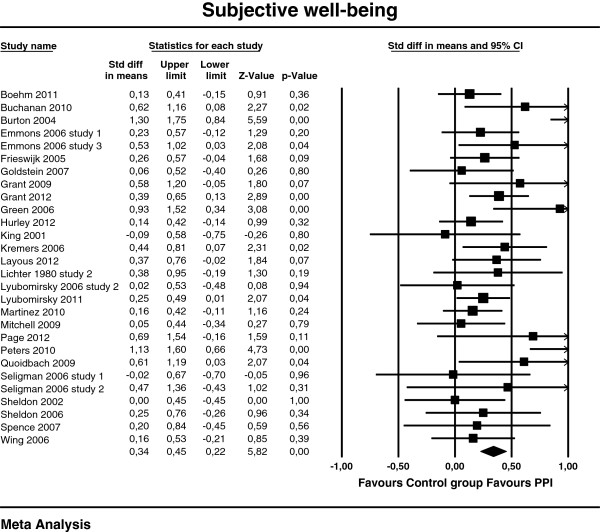
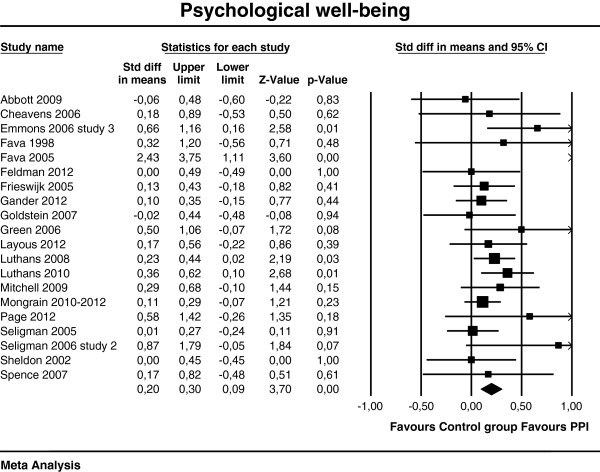
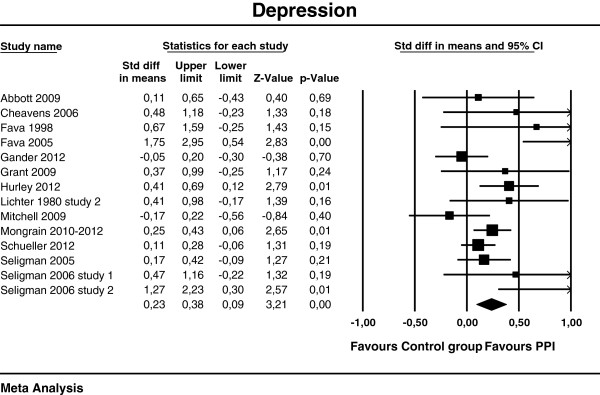
- Across all included studies, the pooled standardized mean differences were 0.34 for subjective well-being, 0.20 for psychological well-being, and 0.23 for depression, which the authors describe as small effects.
- At follow-up of 3–6 months (10 studies), effects remained significant for subjective well-being (d = 0.22, 95% CI [0.05, 0.38], p<.01) and psychological well-being (d = 0.16, 95% CI [0.02, 0.30], p=.03), but not for depression (d = 0.17, 95% CI [-0.06, 0.39], p=.15).
- Heterogeneity was moderate for subjective well-being (I² = 49.5%) and depression (I² = 47.0%), and low for psychological well-being (I² = 29.0%); effect sizes ranged from below 0 to as high as 2.4.
- For depression, larger effects were associated with longer duration, individual delivery, referral/hospital recruitment, inclusion of people with specific psychosocial problems, and lower study quality.
## Methods
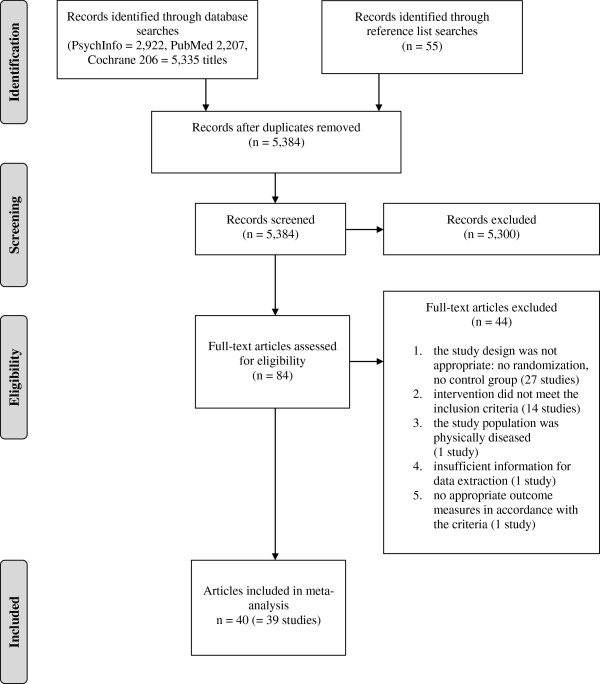
- Systematic review and meta-analysis of randomized controlled studies of positive psychology interventions, using PubMed, PsychInfo, the Cochrane Central Register of Controlled Trials, manual searches, and reference checking, covering 1998 to November 2012.
- Included 40 articles describing 39 studies with 6,139 participants; intervention formats included self-help, group training, and individual therapy.
- Main analysis used Cohen’s d under a random-effects model for three outcomes: subjective well-being, psychological well-being, and depression, with subgroup analyses and checks for heterogeneity and publication bias.
## Limitations
- The paper states that study quality was not high: no study met all quality criteria, randomization was often unclear, intention-to-treat analysis was rare (3/39 studies), and none reported an adequate power analysis.
- The authors note that heterogeneity was rather high because the included studies were diverse, and that the follow-up findings should be treated with caution because of the small number of studies and high attrition rates at follow-up.
- The text makes evident that publication bias is a limitation: funnel plots were asymmetric, fail-safe numbers were below the required thresholds, and Egger’s test suggested bias for psychological well-being and depression.
Model-written summary. Check it against the paper before relying on it.
Integrity signals
Registry
Cites
Statistics
Figures
Verification
Claims the paper makes
8 Valid · 2 Not valid · 9 Not checked · 90 Own results and interpretations
The cited sources that could be checked couldn’t confirm or dispute this claim.
In the paper
“First, the meta-analysis included both randomized studies and quasi-experimental studies.”
§ Positive psychology interventions: a meta-analysis of randomized controlled studies > Background
What the sources say
- Could not verifycites Sin and Lyubomirsky (2009) matched to “Enhancing well-being and alleviating depressive symptoms with positive psychology interventions: a practice-friendly meta-analysis” (2009) sourceExperimental — accuracy not yet measured
The Literature Search section requires included studies to have a comparison group, and Data Recorded distinguishes self-selected from non-self-selected participants. Neither passage establishes whether the meta-analysis included both randomized and quasi-experimental studies; searches for those design terms and for random assignment found no decisive passage. Page numbers were unavailable in our copy. (LLM, conf=0.72)
plain- Asserted: passes — The authors put it forward as true.
- Checkable: passes — It can be checked against evidence.
- Load-bearing: unclear — It is unclear whether the paper’s conclusions depend on it.
- Based: passes — The paper gives a reason why it holds.
- Could not verify
The cited sources support only part of this claim — read each source’s verdict below.
In the paper
“Their results show that PPIs can indeed be effective in enhancing well-being (r = 0.29, standardized mean difference Cohen’s d = 0.61) and help to reduce depressive symptom levels in clinical populations (r = 0.31, Cohen’s d = 0.65).”
§ Positive psychology interventions: a meta-analysis of randomized controlled studies > Background
What the sources say
- Partly supportedcites Sin and Lyubomirsky (2009) matched to “Enhancing well-being and alleviating depressive symptoms with positive psychology interventions: a practice-friendly meta-analysis” (2009) sourceExperimental — accuracy not yet measured
The Depression section reports that PPIs reduced depressive symptoms across 25 studies, with a mean effect of r = .31. The Participant Moderators section distinguishes depressed from nondepressed participants, so .31 is not an estimate specifically for clinical populations. The paper reports the effect as r, not as Cohen’s d = .65. (LLM, conf=0.87)
plainstates a cause- Asserted: passes — The authors put it forward as true.
- Checkable: passes — It can be checked against evidence.
- Load-bearing: unclear — It is unclear whether the paper’s conclusions depend on it.
- Based: passes — The paper gives a reason why it holds.
- Partly supported
Every source the paper cites for this claim was checked and supports it.
In the paper
“Their results show that PPIs can indeed be effective in enhancing well-being (r = 0.29, standardized mean difference Cohen’s d = 0.61) and help to reduce depressive symptom levels in clinical populations (r = 0.31, Cohen’s d = 0.65).”
§ Positive psychology interventions: a meta-analysis of randomized controlled studies > Background
What the sources say
- Supportedcites Sin and Lyubomirsky (2009) matched to “Enhancing well-being and alleviating depressive symptoms with positive psychology interventions: a practice-friendly meta-analysis” (2009) source
The Well-Being section reports that PPIs significantly improved well-being across 49 studies, with a mean r of .29. The paper reports r rather than Cohen’s d; converting .29 to d gives approximately .61, so the cited figures are consistent. (LLM, conf=0.90)
plainstates a cause- Asserted: passes — The authors put it forward as true.
- Checkable: passes — It can be checked against evidence.
- Load-bearing: passes — The paper’s conclusions depend on it.
- Based: passes — The paper gives a reason why it holds.
- Supported
Every source the paper cites for this claim was checked and supports it.
In the paper
“Second, study quality was not addressed as a potential effect moderator.”
§ Positive psychology interventions: a meta-analysis of randomized controlled studies > Background
What the sources say
- Supportedcites Sin and Lyubomirsky (2009) matched to “Enhancing well-being and alleviating depressive symptoms with positive psychology interventions: a practice-friendly meta-analysis” (2009) source
The Data Recorded section lists the variables coded for moderator analysis: participant characteristics, intervention format and duration, and comparison-group type. It does not include study quality, and the Methodological Moderators section discusses those methodological variables rather than study quality. Page numbers are unavailable in our copy. (LLM, conf=0.88)
plain- Asserted: passes — The authors put it forward as true.
- Checkable: passes — It can be checked against evidence.
- Load-bearing: unclear — It is unclear whether the paper’s conclusions depend on it.
- Based: passes — The paper gives a reason why it holds.
- Supported
Every source the paper cites for this claim was checked and supports it.
In the paper
“Remarkably, effect sizes in the current meta-analysis are around 0.3 points lower than the effect sizes in the meta-analysis by Sin and Lyubomirsky (2009) [37].”
§ Positive psychology interventions: a meta-analysis of randomized controlled studies > Discussion > Main findings
What the sources say
- Supportedcites Sin and Lyubomirsky (2009) [37] matched to “Enhancing well-being and alleviating depressive symptoms with positive psychology interventions: a practice-friendly meta-analysis” (2009) source
The Well-Being and Depression results report mean effect sizes of r = .29 and r = .31, respectively, establishing the values attributed to Sin and Lyubomirsky’s meta-analysis. The difference from the current meta-analysis is the citing authors’ comparison, not a finding this source could report. (LLM, conf=0.88)
plain- Asserted: passes — The authors put it forward as true.
- Checkable: passes — It can be checked against evidence.
- Load-bearing: passes — The paper’s conclusions depend on it.
- Based: passes — The paper gives a reason why it holds.
- Supported
70 more claims · 1 with their cited sources checked
Create a free account to see all 109 claims and to verify the 1 reference still open.
- Probably not a substantial claim. 14
- It may state two separate claims as one. 23
Claims other papers make about this one
Each is checked against this paper’s own text: does it say what the citing paper says it does?
The source backs part of the claim, not all of it — or backs it for a different population, condition or comparison.
In the citing paper
“In contrast to complex multicomponent health behavior or psychology interventions, PP exercises are simple, can be delivered remotely (e.g., by phone), and require minimal training of providers [34, 41, 42].”
From Positive Psychological Interventions for Patients with Type 2 Diabetes: Rationale, Theoretical Model, and Intervention Development (2015) · cites this paper as [41]
Experimental — accuracy not yet measuredThe source backs part of the claim, not all of it — or backs it for a different population, condition or comparison.
In the citing paper
“Studies supporting the efficacy of positive activity interventions (PAIs) have been primarily conducted in unselected (non-clinical) community samples and examined single positive activities in isolation (for a meta-analysis, see66, 67).”
From Upregulating the positive affect system in anxiety and depression: Outcomes of a positive activity intervention: Taylor et al. (2017) · cites this paper as [67]
Experimental — accuracy not yet measuredThe source backs part of the claim, not all of it — or backs it for a different population, condition or comparison.
In the citing paper
“Two meta-analyses of PPIs for depression and well-being found that these interventions have small to moderate effects in enhancing well-being and decreasing depressive symptoms and that effects are stronger for individual vs. group formats [30, 31].”
From Skills to Enhance Positivity in adolescents at risk for suicide: Protocol for a randomized controlled trial (2023) · cites this paper as [31]
Experimental — accuracy not yet measuredThe source backs part of the claim, not all of it — or backs it for a different population, condition or comparison.
In the citing paper
“Bolier and Abello (Bolier et al., 2013) reviewed digital PPIs and found that the majority of the included studies showed improvement in well-being or reduction of distress in the intervention group, compared to the control group.”
From Strength Back – A qualitative study on the co-creation of a positive psychology digital health intervention for spinal surgery patients (2023) · cites this paper as Bolier et al., 2013
Experimental — accuracy not yet measuredThe source backs part of the claim, not all of it — or backs it for a different population, condition or comparison.
In the citing paper
“PPIs may support patients to notice and savour positive experiences (Bolier et al., 2013). This may strengthen their commitment to value-based action.”
From Strength Back – A qualitative study on the co-creation of a positive psychology digital health intervention for spinal surgery patients (2023) · cites this paper as Bolier et al., 2013
Experimental — accuracy not yet measured
24 more claims about this paper
Create a free account to see every claim other papers make about this one.
Statistics recomputed
Every reported test result, recomputed from its test statistic and degrees of freedom. A result shows as not adding up only once an independent check has confirmed it.
- Consistentz = 6.43reported p < .01 · recomputed p < .001
“Z=6.43, p < .01”
- Consistentz = 4.18reported p < .01 · recomputed p < .001
“Z=4.18, p < .01”
- Consistentz = 3.33reported p < .01 · recomputed p < .001
“Z=3.33, p < .01”
Self-check
Percentages, sums and reported differences re-computed from the paper’s own numbers.
Self-check results appear here once an independent check has confirmed them.
Citations
Cites
Preferred Reporting Items for Systematic Reviews and Meta-Analyses: the PRISMA statement
Moher, D., Liberati, A., Tetzlaff, J., Altman, D. G., & for the PRISMA Group (2009) · BMJ · doi:10.1136/bmj.b2535 · Cited by 83,823
Preferred Reporting Items for Systematic Reviews and Meta-Analyses: The PRISMA Statement
Moher, D., Liberati, A., Tetzlaff, J., Altman, D. G., & The PRISMA Group (2009) · PLoS Medicine · doi:10.1371/journal.pmed.1000097 · Cited by 64,042 · cited 1×
“For the reporting of the results of this meta-analysis, we applied Preferred Reporting Items for Systematic Reviews and Meta-Analyses (PRISMA) guidelines [50].”
Measuring inconsistency in meta-analyses
Higgins, J. P. T., Thompson, S. G., Deeks, J. J., & Altman, D. G. (2003) · BMJ · doi:10.1136/bmj.327.7414.557 · Cited by 63,139 · cited 1×
“A value of 0% indicates an absence of dispersion, and larger values show increasing levels of heterogeneity where 25% can be considered as low, 50% as moderate and 75% as a high level of heterogeneity [46].”
Preferred reporting items for systematic reviews and meta-analyses: the PRISMA Statement.
(2009) · PubMed Central · Cited by 44,859
Cochrane Handbook for Systematic Reviews of Interventions: Cochrane Book Series
(2008) · doi:10.1002/9780470712184 · Cited by 25,048
Preferred Reporting Items for Systematic Reviews and Meta-Analyses: The PRISMA Statement
Moher, D., Liberati, A., Tetzlaff, J., & Altman, D. G. (2009) · Journal of Clinical Epidemiology · doi:10.1016/j.jclinepi.2009.06.005 · Cited by 19,575
Happiness is everything, or is it? Explorations on the meaning of psychological well-being.
Ryff, C. D. (1989) · Journal of Personality and Social Psychology · doi:10.1037/0022-3514.57.6.1069 · Cited by 14,847 · cited 1×
“Psychological well-being focuses on the optimal functioning of the individual and includes concepts such as mastery, hope and purpose in life [13,14].”
Borenstein, M., Hedges, L. V., Higgins, J. P. T., & Rothstein, H. R. (2009) · doi:10.1002/9780470743386 · Cited by 14,225
Duval, S., & Tweedie, R. (2000) · Biometrics · doi:10.1111/j.0006-341x.2000.00455.x · Cited by 14,099 · cited 1×
“If asymmetry is found in the funnel plot, the Trim and Fill method adjusts the pooled effect size for the outcomes of missing studies [49].”
Subjective well-being: Three decades of progress.
Diener, E., Suh, E. M., Lucas, R. E., & Smith, H. L. (1999) · Psychological Bulletin · doi:10.1037/0033-2909.125.2.276 · Cited by 12,910 · cited 2×
“Although the basic concepts of well-being, happiness and human flourishing have been studied for some decades [12,25-27], there was a lack of evidence-based interventions [24].”
Research works printed but not linked: 3
- Rupke SJ Blecke D Renfrow M Cognitive Therapy for Depression Am Fam Physician 2006 73 83 86 16417069
- Veenhoven R Gezond geluk: Effecten van geluk op gezondheid en wat dat kan betekenen voor de preventieve gezondheidszorg (Healthy happiness: effect of happiness on health and what this could mean for preventive public health) 2006 Rotterdam: Erasmus Universiteit
- Lamers S Bolier L Westerhof GJ Smit F Bohlmeijer E The impact of emotional well-being on long-term recovery and survival in physical illness: a meta-analysis J Behav Med 2012 5 538 547 21918889 PMC3439612 · DOI · Paper page
Cited by
Items 1,001–1,100 of 2,037
Zambrano, J., Celano, C. M., Chung, W., Massey, C. N., Feig, E. H., Millstein, R. A., Healy, B. C., Wexler, D. J., Park, E. R., Golden, J., et al. (2020) · Health Psychology and Behavioral Medicine · doi:10.1080/21642850.2020.1815538 · Cited by 6
“, 2013), are particularly promising, as they can be delivered remotely, require minimal provider training (Bolier et al., 2013; Huffman et al., 2011; Schueller & Parks, 2012), and have led to improved well-being and increases in physical activity and other health behaviors among patients with medical illness (Ogedegbe…”
BackgroundInfluentialShekhar, A., Saurombe, M. D., & Joseph, R. M. (2025) · Frontiers in Public Health · doi:10.3389/fpubh.2025.1627464 · Cited by 12
Krentzman, A. R., Hoeppner, S. S., Hoeppner, B. B., & Barnett, N. P. (2024) · Journal of Substance Use and Addiction Treatment · doi:10.1016/j.josat.2024.209410 · Cited by 12
On the correlation between gratitude and resilience in medical students
Hahn, N., Brzoska, P., & Kiessling, C. (2024) · GMS journal for medical education · doi:10.3205/zma001663 · Cited by 15
“Allerdings ist die Evidenzlage für Dank-barkeitsinterventionen eher schwach [88].”
BackgroundGisch, U. A., Robert, M., Berlin, N., Nebout, A., Étilé, F., Teyssier, S., Andreeva, V. A., Herçberg, S., Touvier, M., & Péneau, S. (2022) · Frontiers in Nutrition · doi:10.3389/fnut.2022.871669 · Cited by 8
“, goal setting or using personal strengths (6)] and represent important avenues to foster health over and above the absence of illness (7).”
Veenhoven, R. (2021) · Frontiers in Psychology · doi:10.3389/fpsyg.2021.758623 · Cited by 11
Evaluation of two short-term stress interventions in the context of mobility
Krahnen, L. S., Bauernfeind, G., Leiber, P., & Jipp, M. (2021) · Transportation Research Part F Traffic Psychology and Behaviour · doi:10.1016/j.trf.2021.11.006 · Cited by 8
Choubisa, R., & Singh, K. K. (2018) · Cogent Psychology · doi:10.1080/23311908.2018.1488512 · Cited by 7
“In contrast, the area of “well-being” or “wellness” promotion is less explored and to some extent limited research in this domain has thwarted the growth prospects of positive psychological interventions (see Bolier et al., 2013; Sin & Lyubomirsky, 2009 for a meta-analysis). Of all the significant wellness promotion a…”
BackgroundInfluentialDas, A., Clerkin, E. M., Tolin, D. F., Assaf, M., & Diefenbach, G. J. (2020) · Journal of Nervous & Mental Disease · doi:10.1097/nmd.0000000000001228 · Cited by 7
Vulnerable Dispositional Traits and Chronic Pain: Predisposing but not Predetermining
Sambuco, N., Mickle, A. M., GARVAN, C. W., Cardoso, J. S., Johnson, A. J., Kusko, D. A., Addison, A., Glover, T. L., Staud, R. M., Redden, D. T., et al. (2021) · Journal of Pain · doi:10.1016/j.jpain.2021.11.007 · Cited by 7
What mental health promotion do university students need?
Sokołowska, E., Zabłocka‐Żytka, L., Kluczyńska, S., & Wojda-Kornacka, J. (2016) · Polish Journal of Applied Psychology · doi:10.1515/pjap-2015-0062 · Cited by 8
Design and evaluation of a positive intervention to cultivate mental health: preliminary findings
Gorbeña, S., Govillard, L., Marroquín, I. G., Sarrionandia, S., Macía, P., Penas, P., & Castillo, I. I. (2021) · Psicologia Reflexão e Crítica · doi:10.1186/s41155-021-00172-1 · Cited by 13
Addison, L., & Shapiro, J. (2023) · Coaching An International Journal of Theory Research and Practice · doi:10.1080/17521882.2023.2216776 · Cited by 16
“The results shown in our case study help to connect the theories and interventionmethods of PPIs/POPIs to practical, hands-on professional coaching within an organisation that was struggling with key performance indicators and overall leadership and employee well-being during one of the most unprecedented events in ou…”
BackgroundMethodInfluentialUsability Testing of a Gratitude Application for Promoting Mental Well-Being
Alqahtani, F., Alslaity, A., & Orji, R. (2022) · Lecture notes in computer science · doi:10.1007/978-3-031-05412-9_21 · Cited by 11
Hanssen, I., ten Klooster, P. M., Kraiss, J. T., Huijbers, M. J., Regeer, E. J., Kupka, R., Bohlmeijer, E. T., & Speckens, A. E. M. (2024) · Journal of Affective Disorders · doi:10.1016/j.jad.2024.05.110 · Cited by 9
Self-citationSchürmann‐Vengels, J., Teismann, T., Margraf, J., & Willutzki, U. (2022) · Journal of Clinical Psychology · doi:10.1002/jclp.23352 · Cited by 11
Mohammad-Najar, N., Khoshnevis, E., & Banisi, P. (2017) · Europe PMC (PubMed Central) · Cited by 8
Addington, E. L., Cheung, E. O., & Moskowitz, J. T. (2020) · The Journal of Positive Psychology · doi:10.1080/17439760.2020.1789702 · Cited by 9
“(3) This RCT compares a PPI to an active control, rather than waitlist or no additional intervention, as is common in many PPI trials (Bolier et al., 2013; Sin & Lyubomirsky, 2009).”
BackgroundInfluentialPositive Psychological Characteristics and Substance Use in First Nation Adolescents
Schick, M. R., Spillane, N. S., Breines, J. G., & Kahler, C. (2022) · Substance Use & Misuse · doi:10.1080/10826084.2022.2069266 · Cited by 5
“Meta-analytic reviews have found promising results for the efficacy of PPIs in increasing subjective and psychological well-being (Sin & Lyubomirsky, 2009), and that these effects last over time (Bolier et al., 2013).”
BackgroundNa, H., Lee, C., & Jung, Y. (2023) · ALPHA PSYCHIATRY · doi:10.5152/alphapsychiatry.2023.221055 · Cited by 9
Greene, T., Contractor, A. A., Dicker‐Oren, S. D., Fentem, A., & Sznitman, S. R. (2024) · JMIR Research Protocols · doi:10.2196/51838 · Cited by 9
“PPMT draws from positive psychology interventions (eg, sharing positive narratives with others and using mental imagery to re-expereince positive events) [19-21] and from interventions that increase memory retrieval to improve mental health [22].”
BackgroundAledeh, S., Sokan‐Adeaga, A. A., Adam, H., Aledeh, M., & Kotera, Y. (2024) · Psychology International · doi:10.3390/psycholint6020037 · Cited by 9
“Self-compassion training interventions [82] can be delivered as integrative positive psychological interventions (PPIs) [83,84] and can be provided as psychoeducational programmes [85,86].”
BackgroundCurrent Situation of Agricultural Soil Pollution in Jiangsu Province: A Meta-Analysis
Zhang, R., Chen, T., Pu, L., Qie, L., Huang, S., & Chen, D. (2023) · Land · doi:10.3390/land12020455 · Cited by 11
Meaninglessness, Depression and Suicidality: A Review of the Evidence
Allen, A. R. (2022) · Springer eBooks · doi:10.1007/978-3-031-06932-1_16 · Cited by 17
Rezaei, H., Woodham, R. D., Ghazi-Noori, A.-R., Ritter, P. S., Bauer, M., Young, A. H., Bramon, E., & Fu, C. H. Y. (2025) · BMC Psychiatry · doi:10.1186/s12888-025-06948-4 · Cited by 6
“Gratitude fosters positive emotions and enhances individuals’ sense of connection and resilience, particularly when engaging with meaningful and supportive experiences [34–36].”
Good Work: The Meaning-Centered Approach (MCA)
Wong, P. T. P., Ivtzan, I., & Lomas, T. (2016) · doi:10.1002/9781118977620.ch14 · Cited by 7
Shagiwal, S. S., Schop-Etman, A., Bergwerff, I., Vrencken, W., & Denktaş, S. (2018) · BMC Public Health · doi:10.1186/s12889-018-5728-7 · Cited by 7
“Results from two meta-analyses show that PPIs can be effective in improving wellbeing [37, 38].”
BackgroundEvidence review: The primary prevention of mental health conditions
VicHealth (2020) · doi:10.37309/2020.po906 · Cited by 13
The Effectiveness of Positive Psychology Intervention in Turkey: A Meta-Analysis
Gürgân, U., & Ulubay, G. (2020) · Journal of History Culture and Art Research · doi:10.7596/taksad.v9i1.2395 · Cited by 8
Gutierrez, I. A., & Adler, A. B. (2022) · Occupational Health Science · doi:10.1007/s41542-022-00120-0 · Cited by 10
“…interest in bolstering positive psychological outcomes is not simply the converse of reducing psychiatric symptoms; instead, the field of positive psychology has expanded to include an array of positive outcomes, including optimism, gratitude, kindness, and positive thinking (Bolier et al., 2013).”
BackgroundCostantini, A., de Beer, L. D., ten Klooster, P. T., Zondervan-Zwijnenburg, M., Vera, M., & van Zyl, L. V. (2022) · Frontiers in Psychology · doi:10.3389/fpsyg.2022.1020653 · Cited by 4
“, 2018) or with other cognitive and affective appraisals of one’s life as a whole (Bolier et al., 2013; Hendriks et al., 2019; Moskowitz et al., 2021).”
BackgroundMcKee, L. G., Algoe, S. B., Faro, A. L., & O’Leary, J. L. (2020) · The Journal of Positive Psychology · doi:10.1080/17439760.2020.1789697 · Cited by 9
Tavakoli, R., Müller, R., Jeske, E., Schäfbuch, N., & Schmitz, B. (2022) · Zeitschrift für Psychologie · doi:10.1027/2151-2604/a000501 · Cited by 7
Assessing depression improvement with the remission evaluation and mood inventory tool (REMIT)
Bushey, M. A., Kroenke, K., Baye, F. M., & Lourens, S. G. (2019) · General Hospital Psychiatry · doi:10.1016/j.genhosppsych.2019.07.007 · Cited by 5
Liu, I., Xiao, Y., Liu, F., Wu, S., & Ni, S. (2022) · International Symposium of Chinese CHI (Chinese CHI) · doi:10.1145/3565698.3565789 · Cited by 8
“Studies have found empirical evidence to support the use of simple cognitive and behavioral exercises, such as the Three Good Things (TGT), Best Possible Self (BPS), and grat-itude exercises, to increase well-being and reduce negative symptoms [20–23].”
BackgroundThumbs up! A Pilot Study of a Positive Psychology Intervention for Children in Greece
Raftopoulou, G., Karakasidou, E., Daoultzis, K. C., Kanellakis, K., & Stalikas, A. (2022) · Psychology · doi:10.4236/psych.2022.138084 · Cited by 9
The Psychology of Positivity at Work
Green, S., McQuaid, M., Purtell, A., & Dulagil, A. (2016) · doi:10.1002/9781118977620.ch2 · Cited by 6
Heath, G., Screti, C., Pattison, H. M., & Knibb, R. C. (2021) · Journal of Child Health Care · doi:10.1177/13674935211016712 · Cited by 6
“Evidence suggests that positive psychology interventions are considered feasible and acceptable by patients (Ghosh and Deb, 2017) and can enhance psychological well-being as well as reduce negative symptoms (Bolier et al. 2013; Sin and Lyubomirsky, 2009).”
BackgroundPositive Psychology in India: A Review
Singh, K. K., Junnarkar, M., & Kaur, J. (2016) · Springer eBooks · doi:10.1007/978-81-322-3631-3_1 · Cited by 6
Sanders, C. A., Schueller, S. M., Parks, A. C., & Howell, R. T. (2019) · Journal of Medical Internet Research · doi:10.2196/13253 · Cited by 8
“Meta-analyses have revealed that most studies, be it Web-based or computer-based PPIs, have evaluated only the immediate impact of the intervention [15,16], comparing baseline reports of happiness with assessments of happiness made immediately following the intervention.”
Iwata, Y., Yokoyama, A., Oe, N., Ito, E., Arimoto, A., Tanaka, Y., & Tadaka, E. (2023) · Healthcare · doi:10.3390/healthcare11233070 · Cited by 6
Janssen, M., Heerkens, Y. F., HEIJDEN, B. I. J. M. V. D., Korzilius, H. P. L. M., Peters, P., & Engels, J. A. (2024) · Mindfulness · doi:10.1007/s12671-024-02477-5 · Cited by 12
“A positive approach, for instance by emphasizing work pleasure instead of stress, was a great stimulation when recruiting teachers for the study (Bolier et al., 2013; Carr et al., 2021; Schueller, 2010).”
Dambi, J. M., Cowan, F. M., Martin, F., Sibanda, S., Simms, V. M., Willis, N., Bernays, S., & Mavhu, W. M. (2024) · PLOS Global Public Health · doi:10.1371/journal.pgph.0002255 · Cited by 7
Otimismo, burnout e estados de humor em desportos de competição
Berengüí, R., Montero, F. J. O., Fayos, E. J. G. D. L., Gullón, J. M. L., & Pinto, A. (2015) · Análise Psicológica · doi:10.14417/ap.1019 · Cited by 6
Sahar, N. U., Baranovich, D.-L., & Tharbe, I. H. A. (2022) · Journal of Muslim Mental Health · doi:10.3998/jmmh.430 · Cited by 14
“Positive Psychological Interventions (PPIs) may apply in this regard as they comprise several activities and recommendations theoretically based, empirically validated, and connected to philosophical aspects narrated by different religions (Bolier et al., 2013).”
Ali, S. B., Ahmad, M. J., Ramzan, I., Ali, M., & Khan, K. (2022) · Frontiers in Psychology · doi:10.3389/fpsyg.2022.915667 · Cited by 13
“As clinical psychologists and researchers have endorsed the importance of using positive psychology techniques in treating many psychological disorders (Bolier et al., 2013; Hanson, 2019; Özdemir and Kavak Budak, 2021) and enhancing wellbeing to decrease psychopathology (Grant et al.”
BackgroundKim, K., Lim, H. J., Moon, E., & Moon, S. I. (2023) · Psychiatry Investigation · doi:10.30773/pi.2022.0243 · Cited by 8
Using health psychology to help patients: promoting wellbeing
Barley, E. A., & Lawson, V. (2016) · British Journal of Nursing · doi:10.12968/bjon.2016.25.15.852 · Cited by 8
“…that these simple interventions have a significant effect on improving mental health and wellbeing (Bolier et al, 2013) A review of positive psychology interventions aimed at the general public and at people with specific psychosocial problems identified 39 studies, n = 6,139 (Bolier et al, 2013).”
BackgroundInfluentialMental illness, mental health, and mental well-being
VanderWeele, T. J., Johnson, B. R., Bradshaw, M., Goodman, D., Kubzansky, L. D., Lomas, T., Moreira‐Almeida, A., Okafor, C. N., Ouyang, S. T., & Patel, V. (2026) · npj Mental Health Research · doi:10.1038/s44184-026-00193-7 · Cited by 18
“Relatedly, such a broadening of scope might also expand the set of resources being considered within psychiatry 46,47,50,73 .”
Randall, N., Saga, T., Kamino, W., Tsui, K. M., Šabanović, S., & Nagata, S. (2023) · IEEE RO-MAN · doi:10.1109/ro-man57019.2023.10309496 · Cited by 9
“Therefore, we design a robot to use with older adults to promote self-reflection, as reflective exercises have been shown to increase various aspects of well-being [7], [8].”
MethodMYTHS OF POSITIVE PSYCHOLOGY: DECEPTIVE MANOEUVRES AND PSEUDOSCIENCE
Ríos, L. F., & Vázquez, M. V. (2016) · Zaguan (University of Zaragoza Repository) · Cited by 6
Hung, J. W., Hartanto, A., Goh, A. Y. H., Eun, Z. K. Y., Kasturiratna, K. T. A. S., Lee, Z. X., & Majeed, N. M. (2025) · Computers in Human Behavior Artificial Humans · doi:10.1016/j.chbah.2025.100151 · Cited by 16
Lambert, L., Draper, Z. A., Warren, M. A., & Lepe, R. M. (2022) · International Journal of Applied Positive Psychology · doi:10.1007/s41042-022-00080-4 · Cited by 10
“symptoms, negative affect, or cultural dimensions were observed, contrary to expectation and the prevailing literature (Basurrah et al., 2021, 2022; Bolier et al., 2013; Carr et al., 2020; Chakhssi et al., 2018; Hendriks et al., 2020; Hoppen & Morina, 2021; Koydemir et al., 2021; Sin & Lyubomirsky,…”
BackgroundResultInfluentialRoberts, M., & Appiah, R. (2025) · International Journal of Qualitative Studies on Health and Well-Being · doi:10.1080/17482631.2025.2508946 · Cited by 10
“Research has shown that PPIs improve subjective well-being, making them a valuable tool for mental health initiatives (Appiah et al., 2020; Bolier et al., 2013).”
Tomczyk, S., Marlinghaus, L., Schmidt, S., & Bartha, S. (2023) · The Journal of Positive Psychology · doi:10.1080/17439760.2023.2297213 · Cited by 6
“As previous research has pointed out, persons who are more affected by mental health distress may also benefit more from PPIs (c. Bolier et al., 2013; Carr et al., 2021; Chakhssi et al., 2018).”
Technological Unemployment and Psychological Well-being—Curse or Benefit?
Frude, N. (2019) · Springer eBooks · doi:10.1007/978-981-13-6225-5_7 · Cited by 5
Ochoa, C., & Casellas‐Grau, A. (2017) · Papeles del Psicólogo - Psychologist Papers · doi:10.23923/pap.psicol2017.2815 · Cited by 12
“En cuanto a la evidencia de la PsiPos aplicada en diversos problemas clínicos los estudios metaanalíticos muestran que son efectivas (Bolier et al., 2013; Sin & Lyubomirsky, 2009), aunque se requieren más estudios que empleen mejores grupos control, y seguimientos más largos.”
BackgroundEickholt, J., Baker, F. A., & Clark, I. N. (2022) · Brain Sciences · doi:10.3390/brainsci12050626 · Cited by 6
“The effects of positive psychology interventions on subjective experiences, psychological wellbeing, and depression were investigated in a meta-analysis by Bolier, Haverman [8].”
BackgroundOkabe‐Miyamoto, K., Margolis, S., & Lyubomirsky, S. (2021) · The Journal of Positive Psychology · doi:10.1080/17439760.2021.2006760 · Cited by 8
“H1: Based on previous research on the general efficacy of positive activity interventions (Bolier et al., 2013; Sin & Lyubomirsky, 2009; White et al., 2019), we expected wellbeing scores to increase over time, on average.”
BackgroundResultSystematic Review and Meta-Analysis of Positive Psychology Interventions in Workplace Settings
Martínez-Martínez, K., Cruz-Ortiz, V., Llorens, S., Salanova, M., & Bianchi, M. L. (2025) · Social Sciences · doi:10.3390/socsci14080481 · Cited by 16
“The benefit for SWB identified here is higher than that in most earlier reviews (for instance, Sin and Lyubomirsky 2009, reported r ≈ 0.29; Bolier et al. 2013, r ≈ 0.17; White 2016, r ≈ 0.10; Koydemir et al. 2021, d = 0.22), positioning the current effect for SWB in the higher range of observed…”
InfluentialPotgieter, I. L. (2021) · Springer eBooks · doi:10.1007/978-3-030-70228-1_4 · Cited by 8
Nielsen, T. W., & Ma, J. S. (2016) · International Education Research · doi:10.12735/ier.v4n2p01 · Cited by 7
“Based on meta-analytic studies that show that positive psychology interventions significantly enhance wellbeing (Bolier et al., 2013; Sin & Lyubomirsky, 2009), it was hypothesised that the students’ scores on the FS would increase from baseline (pre-trip); however, it was unknown to the researchers…”
BackgroundCarissoli, C., Corno, G., Montanelli, S., & Villani, D. (2019) · Lecture notes of the Institute for Computer Sciences, Social Informatics and Telecommunications Engineering · doi:10.1007/978-3-030-25872-6_21 · Cited by 7
A digital positive psychology intervention for college student mental health and health behaviors
Biber, D., & Davis, A. (2024) · Mental Health and Digital Technologies · doi:10.1108/mhdt-02-2024-0007 · Cited by 10
POSITIVE PSYCHOLOGY AND ITS ENEMIES: A REPLY BASED ON SCIENTIFIC EVIDENCE
Vázquez, C. (2013) · DOAJ (DOAJ: Directory of Open Access Journals) · Cited by 6
Nelson, S. K., Bohlmeijer, E. T., & Schotanus-Dijkstra, M. (2021) · Frontiers in Psychology · doi:10.3389/fpsyg.2021.741546 · Cited by 10
Self-citationIntegrating Positive Psychology into Substance Use Treatments
Stone, B. M. (2023) · Encyclopedia · doi:10.3390/encyclopedia3030082 · Cited by 9
“Given the emerging empirical evidence, meta-analyses were able to demonstrate small to medium effect sizes [34].”
BackgroundGander, F., Proyer, R. T., & Ruch, W. (2022) · Applied Psychology Health and Well-Being · doi:10.1111/aphw.12338 · Cited by 10
Setia, S., Furtner, D., Bendahmane, M., & Tichy, M. L. (2022) · JMIR Research Protocols · doi:10.2196/38463 · Cited by 10
“Positive psychology interventions (PPIs) lead to an increase in positive emotions, promote positive functioning, and lead to a reduction in stress and anxiety levels [16,17].”
Escala breve de compaixão Santa Clara: propriedades psicométricas para o contexto brasileiro
Marchetti, E., Bertolino, C. D. O., Schiavon, C. C., Gurgel, L. G., Kato, S. K., Menezes, C. B., & Reppold, C. T. (2018) · Revista Avaliação Psicológica · doi:10.15689/ap.2018.1703.15208.10 · Cited by 15
“…à Psicologia Positiva, cujo foco é a compreensão das forças e virtudes humanas e dos atributos que aumentam o bem-estar, levando os indivíduos a terem uma vida mais engajada, com maior propósito, realização, otimismo e emoções positivas (Bolier et al., 2013; Seligman & Csikszentmihalyi, 2000).”
BackgroundHabibović, M., Broers, E., Heumen, D., Widdershoven, J. W. M. G., Pedersen, S. S., & Denollet, J. (2017) · General Hospital Psychiatry · doi:10.1016/j.genhosppsych.2017.10.005 · Cited by 9
Magill, M., Martino, S., & Wampold, B. E. (2024) · Journal of Substance Use and Addiction Treatment · doi:10.1016/j.josat.2024.209398 · Cited by 8
Boucher, E., Moskowitz, J. T., Kackloudis, G. M., Stafford, J. L., Kwok, I., & Parks, A. C. (2020) · JMIR Research Protocols · doi:10.2196/18578 · Cited by 6
“Mindfulness and positive psychology (PP) interventions, which are effective in reducing depression and increasing well-being in the general population [29], have shown promise in improving depression, diabetes-related distress, and HbA1c levels among people with type 1 or 2 diabetes [30].”
BackgroundSchlatter, S., Berland, A., Lutz, A., Shankland, R., Barret, N., Guillaumée, T., Duclos, A., Cortet, M., Rimmelé, T., Rode, G., et al. (2025) · Medical Teacher · doi:10.1080/0142159x.2024.2431137 · Cited by 8
“PPI has shown to be effective in increasing well-being and reducing stress levels [42,43].”
Strengths in the elderly as a factor that increases wellbeing
Ramírez, E., Martínez, A. R. O., & Martos, R. (2015) · European Journal of Investigation in Health Psychology and Education · doi:10.1989/ejihpe.v5i2.111 · Cited by 9
Franken, K., ten Klooster, P. M., Bohlmeijer, E. T., Westerhof, G. J., & Kraiss, J. T. (2023) · Frontiers in Psychiatry · doi:10.3389/fpsyt.2023.1236551 · Cited by 7
“The importance of monitoring both the level of psychopathology and well-being in patients with mental health problems has been demonstrated more often (81, 114–118).”
BackgroundSelf-citationPozitív pszichológia: Az elmélettől a gyakorlatig
Nagy, H. (2019) · Magyar Pszichológiai Szemle · doi:10.1556/0016.2019.74.3.2 · Cited by 16
Positive Psychotherapy: A Wellbeing Approach to Recovery
Rashid, T., Howes, R. N., & Louden, R. (2017) · Cambridge University Press eBooks · doi:10.1017/9781316339275.011 · Cited by 9
Łakuta, P., Krankowska, D. C., Marcinkiewicz, P., Bociąga‐Jasik, M., & Komorska‐Błażewicz, A. (2022) · Applied Psychology Health and Well-Being · doi:10.1111/aphw.12357 · Cited by 7
Jun, W. H. (2023) · Western Journal of Nursing Research · doi:10.1177/01939459231206046 · Cited by 5
“12,13 Toepfer’s study found that writing a gratitude letter can be an effective strategy to strengthen family emotional involvement.”
BackgroundMockałło, Z., Stachura-Krzyształowicz, A., & Kapica, Ł. (2025) · Acta Psychologica · doi:10.1016/j.actpsy.2025.104826 · Cited by 6
Sun, Y., Ho, S. Y., Chan, C. S., Wang, M. P., Wan, A., Xu, Y., Lai, A. Y. K., & Lam, T. H. (2024) · Journal of Primary Care & Community Health · doi:10.1177/21501319241281567 · Cited by 8
“12,13 14-18 Given the importance of family in Chinese culture 19 and the family’s role in mental illness prevention, 20 this trial adopted a positive psychology-based intervention model to promote SME and mental well-being of adults through involving families and collaborating with community…”
BackgroundBartos, L. J., Posadas, M. P., Wrapson, W., & Krägeloh, C. (2024) · Journal of Humanistic Psychology · doi:10.1177/00221678241233991 · Cited by 11
Models of Change and Well-Being from Behavioral Health Disorders
Mancini, M. A. (2020) · Springer eBooks · doi:10.1007/978-3-030-59659-0_3 · Cited by 5
Gil, M., & Kim, S. (2022) · International Journal of Environmental Research and Public Health · doi:10.3390/ijerph19042142 · Cited by 9
“In addition, it may be a cost-effective intervention for reducing depression [10,11].”
BackgroundHarte, R., Norton, L., Whitehouse, C., Lorincz, I., Jones, D., Gerald, N., Estrada, I., Sabini, C., Mitra, N., Long, J. A., et al. (2022) · Contemporary Clinical Trials Communications · doi:10.1016/j.conctc.2021.100878 · Cited by 5
Shankland, R., & André, C. (2017) · Revue québécoise de psychologie · doi:10.7202/1040770ar · Cited by 10
Byrne, K. H., & Gustafsson, B. M. (2024) · Behavior Modification · doi:10.1177/01454455241269842 · Cited by 9
“…of randomized controlled studies of positive psychology interventions have shown small but significant effect sizes for subjective wellbeing and psychological wellbeing, as well as in helping to reduce depressive symptoms indicating that the effects are fairly sustainable (Boiler et al., 2013).”
Numasawa, M., Nawa, N., Yamaguchi, K., Akita, K., & Yamawaki, M. (2024) · Medical Education Online · doi:10.1080/10872981.2024.2373523 · Cited by 8
“Thus, interventions focusing on positive psychological aspects have attracted much attention [17–20].”
BackgroundThe Role of Positivity on Depressive Symptoms in Women Seeking Help for Intimate Partner Violence
Crapolicchio, E., Cinquegrana, V., & Regalia, C. (2023) · International Journal of Environmental Research and Public Health · doi:10.3390/ijerph20227078 · Cited by 9
Family functioning and its relationship to adolescent mental health
Butler, C. W. (2015) · Cited by 11
Terrill, A. L., Gordon, S., Sparks, C., Baucom, B., Cardell, B., MacKenzie, J. J., Majersik, J. J., Reblin, M., & Richards, L. G. (2025) · Trials · doi:10.1186/s13063-025-08891-x · Cited by 7
“There is ample evidence to support the efficacy of PPIs for decreasing depression/distress and improving well-being in general [35, 43–45], in psychiatric [46], and in neurorehabilitation populations [47, 48].”
Association between age, distress, and orientations to happiness in individuals with disabilities.
Terrill, A. L., Müller, R., Jensen, M. P., Molton, I. R., Ipsen, C., & Ravesloot, C. (2015) · Rehabilitation Psychology · doi:10.1037/rep0000016 · Cited by 10
McDonald, I., & Nanni, A. (2023) · Psychology in the Schools · doi:10.1002/pits.22930 · Cited by 10
Lee, C. S. (2020) · Perspectives of science and education · doi:10.32744/pse.2020.6.26 · Cited by 11
“The results of previous studies on the relationship between gratitude and happiness showed that appreciation has a positive effect on personal physical and mental health, interpersonal relationships, pro-social behavior, and improvement of happiness [17; 18].”
Wasil, A. R., Franzen, R. E., Gillespie, S., Steinberg, J. S., Malhotra, T., & DeRubeis, R. J. (2020) · PsyArXiv (OSF Preprints) · doi:10.31234/osf.io/6wj85 · Cited by 5
Hu, Y., Wu, X. C., Li, S., Liu, P., & Wang, D. (2024) · International Journal of Clinical and Health Psychology · doi:10.1016/j.ijchp.2024.100455 · Cited by 5
“Also, this positive training is beneficial to decrease negative symptoms and avoid the re-experiencing and spreading of negative emotions during the training (Bolier et al., 2013; Stone & Schmidt, 2020).”
BackgroundO’Leary, K. (2015) · Arrow@dit (Dublin Institute of Technology) · Cited by 14
Shang, X., Gu, F., Bian, Q., Wang, M., & Lin, Z. (2021) · Gastroenterology Nursing · doi:10.1097/sga.0000000000000594 · Cited by 6
“It has been suggested that the duration of PPI programs should be at least 4 weeks, and that programs of 8 weeks or longer are more effective in achieving optimal intervention effectiveness (Bolier et al., 2013).”
BackgroundDevelopment of a Positive Psychology Well-Being Intervention in a Community Pharmacy Setting
Ward, J. L., Sparkes, A., Marie, R., Hewlett, P., Prior, A.-L., Hallingberg, B., & James, D. H. (2023) · Pharmacy · doi:10.3390/pharmacy11010014 · Cited by 6
“One approach found to be effective for recruiting in primary care settings has been to involve the healthcare practitioner in the process and this has also been the case for PPIs studies [71].”
Background
Metadata
- Authors
- Bolier, L., Haverman, M., Westerhof, G. J., Riper, H., Smit, F., & Bohlmeijer, E.
- Affiliations
- Trimbos Institute (NL)
- University of Twente (NL)
- Leuphana University of Lüneburg (DE)
- Corresponding author
- Bolier, Linda
- Venue
- BMC Public Health
- Published
- 2013-02-08
- Volume
- 13
- Issue
- 1
- Pages
- 119-119
- ISSN
- 1471-2458 (ISSN-L)
- PMC
- PMC3599475
- OpenAlex
- W2120582212
- Semantic Scholar
- 45fd44e9cff6334f80a54b3d327ced46d9b2d444
- Cited by
- 1,996
- References
- 115
- Citations by year
- 2026: 97 · 2025: 134 · 2024: 155 · 2023: 197 · 2022: 190 · 2021: 208 · 2020: 231 · 2019: 201 · 2018: 182 · 2017: 153 · 2016: 117 · 2015: 76 · 2014: 40 · 2013: 12
- FWCI
- 10.79
- Type
- journal article
- Language
- en
- Open access
- gold
- doi.org
- Licence
- Locations
- BMC Public Health (publishedVersion, cc-by)
- Europe PMC (PubMed Central) (publishedVersion, cc-by)
- PubMed Central (publishedVersion, cc-by)
- PubMed (publishedVersion)
- Pure Amsterdam UMC (publishedVersion, other-oa)
- Amsterdam UMC (VU Amsterdam) - Institutional Repository (publishedVersion, other-oa)
- Multilingual Matters (Channel View Publications) (acceptedVersion, cc-by)
- University of Twente Research Information (acceptedVersion, cc-by)
- Data Archiving and Networked Services (DANS) (submittedVersion, other-oa)
- Digital Academic REpository of VU University Amsterdam (Vrije Universiteit Amsterdam) (submittedVersion)
- VU Research Portal (submittedVersion, other-oa)
- University of Twente Research Information (submittedVersion, cc-by)
- Topics
- Social Sciences › Psychology › Social Psychology › Psychological Well-being and Life Satisfaction
- Social Sciences › Psychology › Clinical Psychology › Mindfulness and Compassion Interventions
- Social Sciences › Psychology › Applied Psychology › Optimism, Hope, and Well-being
- Keywords
- positive psychology interventions, subjective well-being, psychological well-being, depression, self-help intervention, group training, individual psychotherapy, mental health promotion, intervention effectiveness, publication bias, study quality
- MeSH terms
- Depression, Health Promotion, Humans, Psychotherapy, Randomized Controlled Trials as Topic, Treatment Outcome
About these checks
Registry, retraction, Cites and statistics results are computed, not judged, with one exception: a printed reference that no index lists is read once by a model before it counts as a citation error. Claims are extracted by a model and kept only when their quote appears verbatim in the text; each cited source is then checked, with a model’s help, for whether it says what the claim relies on. Those verdicts can be wrong — read the claim’s quote and the cited source before relying on one.
The claim verdicts this report counts are experimental: their accuracy is not yet measured.
A language model drew the claims from the paper on 2026-10-10, under version 3 of the claim definition (model deepseek-v4.1-flash, prompt extract-v3).
A second model labelled each claim on 2026-10-10 (model jev-1.13-20260917, definition revision gold-guideline-v0.2).
Cited sources are checked with a language model’s help (gpt-6-sol).
Statistics and arithmetic are recomputed, not judged.
Confidence bands are shown only for fields calibrated on our annotated test set. None is calibrated yet, so no band is shown.
What counts as a claim ›How we measure confidence ›How we check this ›
Are you an author, or do you see a problem with this page? Request a review
Data sources
Bibliographic data: Semantic Scholar, OpenAlex, Crossref.
Contains information from the Semantic Scholar Academic Graph Datasets, made available under the ODC Attribution License (ODC-BY 1.0).
Semantic Scholar’s data is described in: Kinney, R., et al. (2023). The Semantic Scholar Open Data Platform. arXiv:2301.10140.
