

Patient engagement in research: a systematic review
Open accessThe DOI matches its Crossref record; 44 of the 50 references it cites were found in a registry or an index.
Abstract
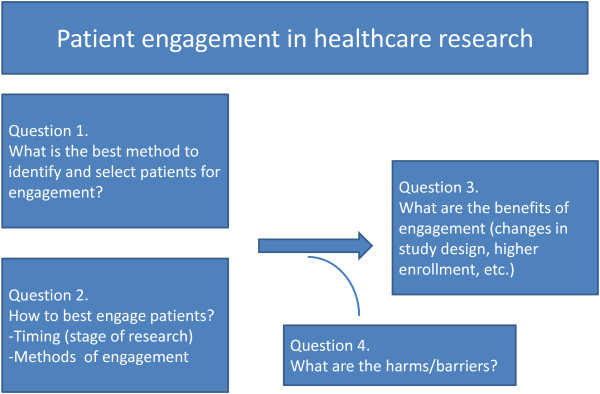
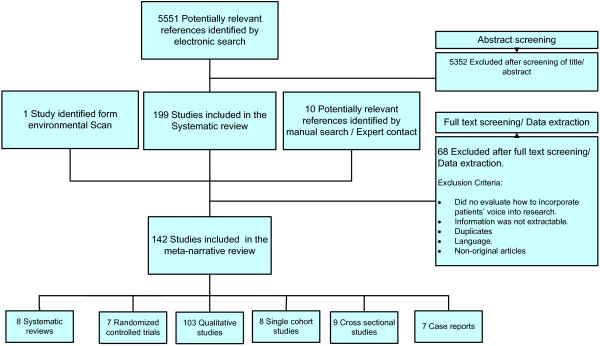
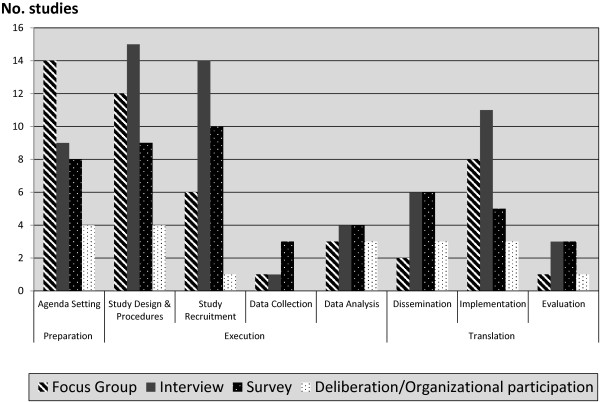
BACKGROUND: A compelling ethical rationale supports patient engagement in healthcare research. It is also assumed that patient engagement will lead to research findings that are more pertinent to patients' concerns and dilemmas. However; it is unclear how to best conduct this process. In this systematic review we aimed to answer 4 key questions: what are the best ways to identify patient representatives? How to engage them in designing and conducting research? What are the observed benefits of patient engagement? What are the harms and barriers of patient engagement? METHODS: We searched MEDLINE, EMBASE, PsycInfo, Cochrane, EBSCO, CINAHL, SCOPUS, Web of Science, Business Search Premier, Academic Search Premier and Google Scholar. Included studies were published in English, of any size or design that described engaging patients or their surrogates in research design. We conducted an environmental scan of the grey literature and consulted with experts and patients. Data were analyzed using a non-quantitative, meta-narrative approach. RESULTS: We included 142 studies that described a spectrum of engagement. In general, engagement was feasible in most settings and most commonly done in the beginning of research (agenda setting and protocol development) and less commonly during the execution and translation of research. We found no comparative analytic studies to recommend a particular method. Patient engagement increased study enrollment rates and aided researchers in securing funding, designing study protocols and choosing relevant outcomes. The most commonly cited challenges were related to logistics (extra time and funding needed for engagement) and to an overarching worry of a tokenistic engagement. CONCLUSIONS: Patient engagement in healthcare research is likely feasible in many settings. However, this engagement comes at a cost and can become tokenistic. Research dedicated to identifying the best methods to achieve engagement is lacking and clearly needed.
Overview
The claims and statistics of this paper haven’t been checked yet.
Free: it reads the open-access text and checks the first 5 claims that cite a source we can check. Create a free account to check every claim.
Integrity signals
Registry
Cites
Statistics
Figures
Verification
Claims the paper makes
The claims and statistics of this paper haven’t been checked yet.
Free: it reads the open-access text and checks the first 5 claims that cite a source we can check. Create a free account to check every claim.
Claims other papers make about this one
Each is checked against this paper’s own text: does it say what the citing paper says it does?
The source backs part of the claim, not all of it — or backs it for a different population, condition or comparison.
In the citing paper
“The present study confirms that, with regard to the conduct of research trials in primary dental care, research dedicated to identifying the best methods to achieve engagement with patients as potential participants is lacking and clearly needed [50].”
From Parental attitudes to randomised controlled trials in primary dental care: A qualitative study (2026) · cites this paper as [50]
Experimental — accuracy not yet measuredThe source backs part of the claim, not all of it — or backs it for a different population, condition or comparison.
In the citing paper
“Engaging patients in the process of designing the review protocol and in reviewing the findings increase the applicability and relevance of the findings of this study.”
From Systematic review of mind‐body interventions to treat myalgic encephalomyelitis/chronic fatigue syndrome (2021) · cites this paper as [36]
Experimental — accuracy not yet measuredThe source backs part of the claim, not all of it — or backs it for a different population, condition or comparison.
In the citing paper
“Previous studies indicated that engaging the target group increases study enrollment and may enhance the uptake and the acceptance of interventions [67, 68].”
From A blended psychosocial support program for partners of patients with amyotrophic lateral sclerosis and progressive muscular atrophy: Protocol of a randomized controlled trial (2018) · cites this paper as [67]
Experimental — accuracy not yet measuredThe check wasn’t confident either way, so it gives no verdict — never disputed.
In the citing paper
“This is consistent with review findings of empirical studies in PPI whereby short‐term, individual‐level outcomes were more represented in the literature. 43 , 91 , 92”
From A systematic review of theories, models and frameworks used for youth engagement in health research (2024) · cites this paper as [91]
Experimental — accuracy not yet measured
Self-check
Percentages, sums and reported differences re-computed from the paper’s own numbers.
The self-check needs the paper’s full text.
Citations
Cites
Preferred Reporting Items for Systematic Reviews and Meta-Analyses: the PRISMA statement
Moher, D., Liberati, A., Tetzlaff, J., Altman, D. G., & for the PRISMA Group (2009) · BMJ · doi:10.1136/bmj.b2535 · Cited by 83,823
Preferred reporting items for systematic reviews and meta-analyses: the PRISMA Statement.
(2009) · PubMed Central · Cited by 44,859
Preferred reporting items for systematic reviews and meta-analyses: The PRISMA statement
Moher, D., Liberati, A., Tetzlaff, J., Altman, D. G., & the PRISMA Group* (2009) · Annals of Internal Medicine · doi:10.7326/0003-4819-151-4-200908180-00135 · Cited by 37,554
Preferred Reporting Items for Systematic Reviews and Meta-Analyses: The PRISMA Statement
Moher, D., Liberati, A., Tetzlaff, J., & Altman, D. G. (2009) · Journal of Clinical Epidemiology · doi:10.1016/j.jclinepi.2009.06.005 · Cited by 19,575
(2005) · PubMed · Cited by 7,011
Enhancing transparency in reporting the synthesis of qualitative research: ENTREQ
Tong, A., Flemming, K., McInnes, E., Oliver, S., & Craig, J. (2012) · BMC Medical Research Methodology · doi:10.1186/1471-2288-12-181 · Cited by 3,569 · cited 1×
“Differences in studies settings and characteristics can be used to explain differences in results (heterogeneity) [16].”
BackgroundCommunity-based participatory research: assessing the evidence.
Viswanathan, M., Ammerman, A., Eng, E. M., Garlehner, G., Lohr, K. N., Griffith, D. M., Rhodes, S. D., Samuel‐Hodge, C. D., Maty, S. C., Lux, L. J., et al. (2004) · PubMed Central · Cited by 1,053
Campbell, R., Pound, P., Pope, C., Britten, N., Pill, R., Morgan, M., & Donovan, J. (2003) · Social Science & Medicine · doi:10.1016/s0277-9536(02)00064-3 · Cited by 921 · cited 3×
“[http://www.casp-uk.net/wp-content/uploads/ 2011/11/CASP-Qualitative-Research-Checklist-31.05.13.pdf] 19.”
MethodInfluentialStorylines of research in diffusion of innovation: a meta-narrative approach to systematic review
Greenhalgh, T., Robert, G., Macfarlane, F., Bate, P., Kyriakidou, O., & Peacock, R. (2005) · Social Science & Medicine · doi:10.1016/j.socscimed.2004.12.001 · Cited by 913 · cited 1×
“Instead, data extracted from the included studies were analyzed using a meta-narrative approach [14].”
MethodPatient and service user engagement in research: a systematic review and synthesized framework
Shippee, N. D., Domecq Garces, J. P., Prutsky Lopez, G. J., Wang, Z., Elraiyah, T. A., Nabhan, M., Brito, J. P., Boehmer, K., Hasan, R., Firwana, B., et al. (2015) · Health Expectations · doi:10.1111/hex.12090 · Cited by 628 · cited 2×
“We also categorized the research engagement from each study into three different research phases proposed for patient engagement [17]:”
BackgroundMethodSelf-citation
Cited by
Items 201–300 of 1,002
Early-career researchers’ views on ethical dimensions of patient engagement in research
Bélisle‐Pipon, J., Rouleau, G., & Birko, S. (2018) · BMC Medical Ethics · doi:10.1186/s12910-018-0260-y · Cited by 54
“This concern was shared by the panelists, the CIHR, and other researchers [11, 32, 35].”
A Novel Stakeholder Engagement Approach for Patient-centered Outcomes Research
Kim, K. K., Khodyakov, D., Marie, K., TARAS, H. L., Meeker, D., Campos, H., & Lucila Ohno-machado, A. (2018) · Medical Care · doi:10.1097/mlr.0000000000000790 · Cited by 54
Barger, S., Sullivan, S. D., Bell‐Brown, A., Bott, B., Mercurio, A. M., Golenski, J. D., Gorman, M., Johnson, J., Kreizenbeck, K. L., Kurttila, F., et al. (2019) · BMC Medical Research Methodology · doi:10.1186/s12874-019-0764-2 · Cited by 48
“Consistent engagement requires a significant investment of time and resources from both researchers and stakeholders [13, 15].”
BackgroundFinderup, J., Lomborg, K. E., Jensen, J. D., & Stacey, D. (2020) · BMC Nephrology · doi:10.1186/s12882-020-01956-w · Cited by 60
Evaluation Tools for Assistive Technologies: A Scoping Review
Tao, G., Charm, G., Kabacińska, K., Miller, W. C., & Robillard, J. M. (2020) · Archives of Physical Medicine and Rehabilitation · doi:10.1016/j.apmr.2020.01.008 · Cited by 53
Hovén, E., Eriksson, L. E., D’Souza, Å. M., Sörensen, J., Hill, D. W., Viklund, C., Wettergren, L., & Lampic, C. (2020) · Research Involvement and Engagement · doi:10.1186/s40900-020-00207-4 · Cited by 51
“In line with what has been shown in the literature on PPI in a range of health and social care research [3, 5, 9, 30], the participants in this long-term collaboration acknowledged that the PRPs contributed by assessing the appropriateness of research questions, study design, working material and outcome measures.”
Patient involvement in rheumatology outpatient service design and delivery: a case study
de Souza, S., Galloway, J. B., Simpson, C., Chura, R., Dobson, J., Gullick, N., Steer, S. E., & Lempp, H. K. (2016) · Health Expectations · doi:10.1111/hex.12478 · Cited by 52
Staley, K., & Doherty, C. L. (2016) · Research Involvement and Engagement · doi:10.1186/s40900-016-0018-y · Cited by 47
“The findings have been supported by three subsequent reviews [11–13].”
The role of patient organizations in the rare disease ecosystem in India: an interview based study
Choudhury, M. C., & Saberwal, G. (2019) · Orphanet Journal of Rare Diseases · doi:10.1186/s13023-019-1093-6 · Cited by 51
Wilund, K., Thompson, S., & Bennett, P. N. (2019) · Journal of Renal Nutrition · doi:10.1053/j.jrn.2019.08.004 · Cited by 46
Patient Engagement in Health Research: Perspectives from Patient Participants
Easley, J., Wassersug, R. J., Matthias, S., Tompson, M., Schneider, N. D., O’Brien, M. A., Vick, B., & Fitch, M. I. (2023) · Current Oncology · doi:10.3390/curroncol30030210 · Cited by 53
“Systematic reviews of PE in research have shown that many efforts to engage patients are generally quite tokenistic and are frequently poorly reported [21,23].”
BackgroundPatient engagement in a national research network: barriers, facilitators, and impacts
González, M., Ogourtsova, T., Zerbo, A., Lalonde, C., Spurway, A., Gavin, F., Shikako‐Thomas, K., Weiss, J. A., & Majnemer, A. (2023) · Research Involvement and Engagement · doi:10.1186/s40900-023-00418-5 · Cited by 48
“Patient engagement in research aims to: (1) enhance research relevance, (2) improve patient health outcomes and healthcare delivery, and (3) facilitate uptake of results by intended audiences [1, 5, 6].”
BackgroundResultHyde, C., Dunn, K. M., Higginbottom, A., & Chew-Graham, C. A. (2016) · Health Expectations · doi:10.1111/hex.12458 · Cited by 48
Happell, B., Gordon, S., Bocking, J., Ellis, P., Roper, C., Liggins, J., Scholz, B., & Platania‐Phung, C. (2018) · Journal of Mental Health · doi:10.1080/09638237.2018.1466051 · Cited by 46
“These barriers seem to reflect tokenistic responses to policy-backed requirements for more consumer research (Domecq et al., 2014; Patterson et al., 2014; Wallcraft et al., 2009).”
Backgroundon behalf of the BRIGHTLIGHT Team, Taylor, R. M., (YAP), Y. A. P., Whelan, J., Gibson, F., Morgan, S. J., & Fern, L. A. (2018) · Research Involvement and Engagement · doi:10.1186/s40900-018-0135-x · Cited by 49
Partnering with frail or seriously ill patients in research: a systematic review
Ludwig, C., Graham, I. D., Gifford, W., Lavoie, J. G., & Stacey, D. (2020) · Research Involvement and Engagement · doi:10.1186/s40900-020-00225-2 · Cited by 51
Patient-Centered Outcomes Research
(2017) · doi:10.25302/67.2017.1 · Cited by 45
The overlooked burden of persistent physical symptoms: a call for action in European healthcare
Toussaint, A., Weigel, A., Löwe, B., Blanch, J., Bogaerts, K., Boye, B., Burton, C., Cosci, F., Engelmann, P., Fink, P., et al. (2025) · The Lancet Regional Health - Europe · doi:10.1016/j.lanepe.2024.101140 · Cited by 44
Taveras, E. M., Marshall, R., Sharifi, M., Avalon, E., Fiechtner, L. G., Horan, C. M., Orav, E. J., Price, S. N., Sequist, T. D., & Slater, D. W. (2015) · Contemporary Clinical Trials · doi:10.1016/j.cct.2015.09.022 · Cited by 48
Khodyakov, D., Stockdale, S. E., Smith, N., Booth, M. S., Altman, L., & Rubenstein, L. V. (2016) · Health Expectations · doi:10.1111/hex.12444 · Cited by 50
Patient involvement in medical research: what patients and physicians learn from each other
Young, K., Kaminstein, D. S., Olivos, A., Burroughs, C., Lee, C. C., Kullman, J. A., McAlear, C. A., Shaw, D. G., Sreih, A. G., Casey, G. C., et al. (2019) · Orphanet Journal of Rare Diseases · doi:10.1186/s13023-018-0969-1 · Cited by 47
Jewell, A., Pritchard, M., Barrett, K., Green, P. A., Markham, S., McKenzie, S., Oliver, R., Wan, M., Downs, J. M., & Stewart, R. J. (2019) · Research Involvement and Engagement · doi:10.1186/s40900-019-0152-4 · Cited by 50
“In terms of benefits to researchers, patient engagement has been found to aid in securing funding, designing study protocols, and selecting relevant outcomes [11].”
BackgroundGfeller, K. E., Driscoll, V. D., & Schwalje, A. T. (2019) · Frontiers in Neuroscience · doi:10.3389/fnins.2019.01229 · Cited by 56
Evaluation of an advisory committee as a model for patient engagement
Kendell, C., Urquhart, R., Petrella, J., MacDonald, S., & McCallum, M. (2014) · Patient Experience Journal · doi:10.35680/2372-0247.1032 · Cited by 42
Jelinek, L., Moritz, S., & Hauschildt, M. (2017) · Journal of Affective Disorders · doi:10.1016/j.jad.2017.06.003 · Cited by 52
Framework for Advancing the Reporting of Patient Engagement in Rheumatology Research Projects
Hamilton, C. B., Leese, J., Hoens, A. M., & LI, L. C. (2017) · Current Rheumatology Reports · doi:10.1007/s11926-017-0666-4 · Cited by 47
Richards, T., & Godlee, F. (2014) · BMJ · doi:10.1136/bmj.g3726 · Cited by 48
Béland, S., Lambert, M., Delahunty‐Pike, A., Howse, D., Schwarz, C. M., Chouinard, M., Aubrey‐Bassler, K., Burge, F., Doucet, S. A., Danish, A., et al. (2022) · Health Expectations · doi:10.1111/hex.13542 · Cited by 48
“In addition, several reviews have begun to map the benefits of patient engagement that affect all stages of research, including producing more relevant research topics; improved participant recruitment and retention; creation of data collection tools better suited to target populations; and enriched interpretations of…”
BackgroundApplying Patient and Public Involvement in preclinical research: A co‐created scoping review
Carroll, P., Dervan, A. G., Maher, A., McCarthy, C., Woods, I., Kavanagh, R., Beirne, C., Harte, G., O’Flynn, D., O’Connor, C., et al. (2022) · Health Expectations · doi:10.1111/hex.13615 · Cited by 49
Vangeepuram, N., Fei, K., Goytia, C. N., Madden, D. A., Corbie-Smith, G. M., & Horowitz, C. R. (2023) · Journal of Participatory Research Methods · doi:10.35844/001c.77399 · Cited by 54
Evaluating Patient-Centered Mobile Health Technologies: Definitions, Methodologies, and Outcomes
Bruce, C. R., Harrison, P., Giammattei, C., Desai, S.-N., Sol, J. R., Jones, S. L., & Schwartz, R. L. (2020) · JMIR mhealth and uhealth · doi:10.2196/17577 · Cited by 53
“Patient participation is a central tenet of ethically driven research and product development [81-83].”
Backgroundvan Muilekom, M. M., Teela, L., van Oers, H. A., van Goudoever, J. B., Grootenhuis, M. A., & Haverman, L. (2021) · Quality of Life Research · doi:10.1007/s11136-021-02950-x · Cited by 50
The Impact of Patient and Family Engagement in Child Health Research: A Scoping Review
Vanderhout, S. M., Bhalla, M., van, A. C. B., Fergusson, D. A., Potter, B. K., Karoly, A., Ly, V., & Macarthur, C. (2022) · The Journal of Pediatrics · doi:10.1016/j.jpeds.2022.09.030 · Cited by 46
Vinnicombe, S., Bianchim, M. S., & Noyes, J. (2023) · BMC Public Health · doi:10.1186/s12889-023-15937-9 · Cited by 48
Chan, R. J., Knowles, R., Ashbury, F. D., Bowen, J. M., Chan, A., Chin, M., Olver, I., Taylor, C. D., Tinianov, S., Alberti, P., et al. (2024) · EClinicalMedicine · doi:10.1016/j.eclinm.2024.102825 · Cited by 48
“18 Patient and family caregiver engagement in research has been recognized as critical to designing studies that are relevant to the patient population 19,20 and effectively translate research into practice.”
BackgroundFinderup, J., Buur, L. E., Tscherning, S. C., Jensen, A. L., Kristensen, A. W., Petersen, A. P., Toft, B. S., Rasmussen, G. S., Skovlund, P. C., Vedelø, T. W., et al. (2022) · Research Involvement and Engagement · doi:10.1186/s40900-022-00378-2 · Cited by 44
“1 PPI approaches – facts Identification and selection of relevant PPI approaches [4]”
BackgroundBenizri, N., Hallot, S., Burns, K. E. A., & Goldfarb, M. (2022) · JAMA Network Open · doi:10.1001/jamanetworkopen.2022.30858 · Cited by 42
Patient, caregiver and clinician views on engagement in comparative effectiveness research
Forsythe, L. P., Frank, L. B., Workman, T. A., Hilliard, T. S., Harwell, D., & Fayish, L. (2017) · Journal of Comparative Effectiveness Research · doi:10.2217/cer-2016-0062 · Cited by 40
Introducing PIONEER: a project to harness big data in prostate cancer research
Omar, M. I., Roobol, M. J., Ribal, M. J., Abbott, T., Agapow, P., Araujo, S., Asiimwe, A., Auffray, C., Balaur, I., Beyer, K., et al. (2020) · Nature Reviews Urology · doi:10.1038/s41585-020-0324-x · Cited by 44
“However, active engagement of patients in the planning and execution of research is lacking, as the traditional health system does not facilitate active patient engagement; thus, research findings and priorities might not reflect outcomes that are important from a patient perspective 15 .”
BackgroundVat, L. E., Warren, M., Goold, S. D., Davidge, E., Porter, N., Schuitmaker‐Warnaar, T. J., Broerse, J. E. W., & Etchegary, H. (2020) · Research Involvement and Engagement · doi:10.1186/s40900-020-00206-5 · Cited by 45
“Patients had contributed mostly to the initial stages, in line with systematic reviews [35].”
BackgroundTaffere, G. R., Abebe, H. T., Zerihun, Z., Mallen, C. D., Price, H. P., & Mulugeta, A. (2023) · Journal of Public Health · doi:10.1007/s10389-022-01799-9 · Cited by 51
“Moreover, logistics related to extra time and funding needed for engagement were also the most commonly cited challenges (Domecq et al. 2014).”
Haroutounian, S., Holzer, K. J., Kerns, R. D., Veasley, C., Dworkin, R. H., Turk, D. C., Carman, K. L., Chambers, C. T., Cowan, P., Edwards, R. R., et al. (2023) · Pain · doi:10.1097/j.pain.0000000000003121 · Cited by 53
“28,53,120 An approach that has been developing over the past 30 years, 22,25,48,51,80,115,130,131,177 and has emerged in the past decade, is the engagement of patients, their caregivers, and individuals or communities who represent them, in the various components of clinical research.”
BackgroundPatient engagement in research with older adults with cancer
Puts, M. T. E., Sattar, S., Ghodraty-Jabloo, V., Hsu, T., Fitch, M., Szumacher, E., Ayala, A. P., & Alibhai, S. M. H. (2017) · Journal of Geriatric Oncology · doi:10.1016/j.jgo.2017.05.002 · Cited by 45
Bishop, A. C., Elliott, M. J., & Cassidy, C. E. (2018) · Research Involvement and Engagement · doi:10.1186/s40900-018-0110-6 · Cited by 39
Perspectives and Experiences with Engaging Youth and Families in Research
Nguyen, T., Palisano, R. J., & Graham, I. D. (2018) · Physical & Occupational Therapy In Pediatrics · doi:10.1080/01942638.2018.1496966 · Cited by 45
Identity boxes: using materials and metaphors to elicit experiences
Brown, N. (2019) · International Journal of Social Research Methodology · doi:10.1080/13645579.2019.1590894 · Cited by 61
Gunatillake, T., Shadbolt, C., Gould, D. J., Lam, M., Glanville-Hearst, M., Vleeskens, C., Choong, P., & Dowsey, M. M. (2020) · Research Involvement and Engagement · doi:10.1186/s40900-020-00241-2 · Cited by 45
Yadav, U. N., Lloyd, J. E., Baral, K. P., Bhatta, N., Mehata, S., & Harris, M. (2021) · BMJ Open · doi:10.1136/bmjopen-2020-045175 · Cited by 43
Munce, S., Gray, C. S., Pomeroy, B. C., Bayley, M. T., Kokorelias, K. M., Luong, D., Biddiss, E. A., Cave, T., Bragge, P., Chew-Graham, C. A., et al. (2023) · JMIR Research Protocols · doi:10.2196/50463 · Cited by 45
Lammons, W., Buffardi, A. L., & Marks, D. (2025) · Research Involvement and Engagement · doi:10.1186/s40900-025-00748-6 · Cited by 42
Exploring patient and family involvement in the lifecycle of an orphan drug: a scoping review
Young, A., Menon, D., Street, J., Al‐Hertani, W., & Stafinski, T. (2017) · Orphanet Journal of Rare Diseases · doi:10.1186/s13023-017-0738-6 · Cited by 38
Patient and family perspectives in resilient healthcare studies: A question of morality or logic?
O'Hara, J. K., Canfield, C., & Aase, K. (2019) · Safety Science · doi:10.1016/j.ssci.2019.06.024 · Cited by 43
Kim, C., Berta, W. B., & Gagliardi, A. R. (2020) · Patient Education and Counseling · doi:10.1016/j.pec.2020.10.001 · Cited by 46
The Ecology of Engagement: Fostering cooperative efforts in health with patients and communities
Boivin, A., Dumez, V., Castonguay, G., & Berkesse, A. (2022) · Health Expectations · doi:10.1111/hex.13571 · Cited by 47
Foster, M., Fergusson, D. A., Hawrysh, T., Presseau, J., Kekre, N. K., Schwartz, S., Castillo, G., Asad, S. S., Fox, G., Atkins, H. L., et al. (2020) · Research Involvement and Engagement · doi:10.1186/s40900-020-00230-5 · Cited by 40
“An iKT approach, where patients joined the team as equal partners (see Methods for further details), was chosen to ensure patients were meaningfully and actively engaged throughout the research program, while avoiding tokenistic engagement (“false appearance of inclusiveness”) [14].”
InfluentialChudyk, A. M., Stoddard, R., McCleary, N., Duhamel, T. A., Shimmin, C., Hickes, S., & Schultz, A. S. H. (2022) · Research Involvement and Engagement · doi:10.1186/s40900-022-00376-4 · Cited by 46
“Current evidence tends to focus on the impact of patient engagement within the research process, including facilitating recruitment and study enrollment, contributing to data collection and analysis, and dissemination and presentation of study findings [4, 17, 18].”
BackgroundCOVID-19: Public and patient involvement, now more than ever
Murphy, E., Tierney, E., Shé, É. N., Killilea, M., Donaghey, C., Daly, A., Roche, M. T., Loughlin, D. M., Panel, P. I. @. N. G. P. A., & Dinneen, S. (2020) · HRB Open Research · doi:10.12688/hrbopenres.13067.1 · Cited by 37
“Drawing on the lived experience of PPI contributors to shape the research, good quality PPI can enhance the quality and relevance of the research undertaken (Domecq et al., 2014).”
BackgroundImpact of involving people with dementia and their care partners in research: a qualitative study
Miah, J., Parsons, S., Lovell, K., Starling, B., Leroi, I., & Dawes, P. (2020) · BMJ Open · doi:10.1136/bmjopen-2020-039321 · Cited by 49
Janssen, I. M., Gerhardus, A., von Gersdorff, G., Schaller, M., Barth, C., Scheibler, F., & Baldamus, C. A. (2015) · Patient Preference and Adherence · doi:10.2147/ppa.s79559 · Cited by 53
Tembo, D., Morrow, E. M., Worswick, L., & Lennard, D. (2019) · Frontiers in Sociology · doi:10.3389/fsoc.2019.00050 · Cited by 42
Frakking, T. T., Michaels, S., Orbell‐Smith, J., & Ray, L. L. (2020) · BMJ Open Quality · doi:10.1136/bmjoq-2019-000823 · Cited by 47
“101 Increased implementation of PFCC practices into Australian hospital facilities are more likely to occur when there are financial rewards and/or components of healthcare funding to motivate hospital facilities to implement PFCC. Future funding allocation models could consider a balance between DRGs, level of consum…”
InfluentialLessons Learned from Developing a Patient Engagement Panel: An OCHIN Report
Arkind, J., Likumahuwa-Ackman, S., Warren, N., Dickerson, K., Robbins, L. P., Norman, K., & DeVoe, J. E. (2015) · The Journal of the American Board of Family Medicine · doi:10.3122/jabfm.2015.05.150009 · Cited by 37
“Although engaging stakeholders in research and clinical activities is not a new concept, recent efforts by PCORI and others to necessitate meaningful engagement require better ways of defining and measuring patient engagement.(15) This renewed interest has led to an increasing number of excellent reviews and conceptua…”
BackgroundA systematic review of theories, models and frameworks used for youth engagement in health research
Sanchez, S., Thorburn, R., Rea, M., Kaufman, P., Schwartz, R., Selby, P., & Chaiton, M. (2024) · Health Expectations · doi:10.1111/hex.13975 · Cited by 35
“43,91,92 Of the four types of frameworks, equity ‐ focused frameworks represent the most recent development.”
BackgroundTeela, L., Verhagen, L. E., van Oers, H. A., Kramer, E. E. W., Daams, J. G., Gruppen, M. P., Santana, M., Grootenhuis, M. A., & Haverman, L. (2023) · Journal of Patient-Reported Outcomes · doi:10.1186/s41687-023-00566-y · Cited by 41
“Different methods were used to involve patients, with the individual interview being the most common method [9].”
BackgroundMethodInfluentialKnowledge, experiences and attitudes concerning genetics among retinoblastoma survivors and parents
Hill, J. A., Gedleh, A., Lee, S., Hougham, K. A., & Dimaras, H. (2018) · European Journal of Human Genetics · doi:10.1038/s41431-017-0027-9 · Cited by 35
“Involving the patient community in the research process has proven benefits, such as: increased applicability and credibility of results; a heightened sense of autonomy and self-worth among patients; and more effective translation of research results into clinical practice and public policy [15, 16].”
BackgroundYu, R., Hanley, B., Denegri, S., Ahmed, J., & McNally, N. (2021) · BMJ Open · doi:10.1136/bmjopen-2020-047995 · Cited by 37
Rising to the Challenges of Clinical Trial Improvement in Parkinson’s Disease
Mathur, S., DeWitte, S., Robledo, I., Isaacs, T., & Stamford, J. (2015) · Journal of Parkinson s Disease · doi:10.3233/jpd-150541 · Cited by 35
“In fact, the importance of patient engagement in healthcare research has been shown previously to assist with increasing enrollment rates, securing funding for researchers, choosing study outcomes and designing research protocols [11].”
BackgroundGiving voice to the voiceless: how to involve vulnerable migrants in healthcare research
van den Muijsenbergh, M. E. T. C., Teunissen, E., van Weel-Baumgarten, E. M., & van Weel, C. (2016) · British Journal of General Practice · doi:10.3399/bjgp16x685321 · Cited by 35
A home for patient-oriented research
Patrick, K. L., Kebbe, M., & Aubin, D. (2018) · Canadian Medical Association Journal · doi:10.1503/cmaj.180587 · Cited by 35
Rudisill, C., Eicken, M. G., Gupta, D., Macauda, M. M., Self, S. C. W., Kennedy, A. B., Thomas, D., Kao, E., Jeanty, M., & Hartley, J. (2023) · JAMA Network Open · doi:10.1001/jamanetworkopen.2023.45444 · Cited by 45
Russell, D. J., Sprung, J., McCauley, D., de Camargo, O. K., Buchanan, F., Gulko, R., Martens, R., & Gorter, J. W. (2016) · Journal of Medical Internet Research · doi:10.2196/jmir.5994 · Cited by 35
“Although the importance of and need for engagement have been acknowledged, little evidence exists about the best way to actively engage families to provide input that is valuable to clinicians and researchers [6,10,11].”
A Critical Discussion of Patient Engagement in Research
Bombak, A. E., & Hanson, H. M. (2017) · Journal of patient-centered research and reviews · doi:10.17294/2330-0698.1273 · Cited by 37
“3 The reviewers found that patient engagement could reduce attrition, improve enrollment and help produce more comprehensible and relevant materials for patients.”
InfluentialUsing qualitative research perspectives to inform patient engagement in research
Phoenix, M. P., Nguyen, T., Gentles, S. J., VanderKaay, S., Cross, A., & Nguyen, L. (2018) · Research Involvement and Engagement · doi:10.1186/s40900-018-0107-1 · Cited by 50
“the literature on patient engagement in research Domecq and colleagues [5] identified three main areas of concern”
BackgroundInfluentialResearch priorities of women at risk for preterm birth: findings and a call to action
Franck, L. S., McLemore, M. R., Williams, S., Millar, K., Gordon, A. Y., Williams, S., Woods, N., Edwards, L., Pacheco, T., Padilla, A., et al. (2020) · BMC Pregnancy and Childbirth · doi:10.1186/s12884-019-2664-1 · Cited by 37
Levelink, M., Voigt‐Barbarowicz, M., & Brütt, A. L. (2020) · Health Expectations · doi:10.1111/hex.13090 · Cited by 38
Patient and public involvement for ethnic minority research: an urgent need for improvement
Ekezie, W. C., Routen, A. C., Denegri, S., & Khunti, K. K. (2021) · Journal of the Royal Society of Medicine · doi:10.1177/0141076821994274 · Cited by 34
“Ethnic minority patient and public involvement needs to go beyond just inclusion in research design, but to encompass active involvement in setting research questions, helping shape study design, being co-applicants, actively informing study implementation, data analysis and interpretation, and dissemination of findin…”
BackgroundLundell, S., Toots, A., Sönnerfors, P., Halvarsson, A., & Wadell, K. (2022) · BMC Medical Informatics and Decision Making · doi:10.1186/s12911-022-01806-9 · Cited by 41
“Sufficient time to build reciprocal relationships, for discussions [42, 43], and repeated meetings to build group dynamics [43] have also been reported important for engagement.”
BackgroundMethodNewhouse, R. P. (2017) · doi:10.25302/67.2017 · Cited by 42
Factors influencing patient experience in hospital wards: a systematic review
Guan, T., Chen, X., Junfei, L. I., & Zhang, Y. (2024) · BMC Nursing · doi:10.1186/s12912-024-02054-0 · Cited by 60
“Therefore, understanding these antecedents can help characterize different types of patients’ preferences for medical services, recognize their preferred modes of interaction, and encourage them to co-design the healthcare delivery process, thereby optimizing patient experience [163, 164].”
BackgroundPearce, S., Brownsdon, A., Fern, L. A., Gibson, F., Whelan, J., & Lavender, V. (2016) · European Journal of Cancer Care · doi:10.1111/ecc.12476 · Cited by 35
“However, there is concern that patient and public engagement in research, for example attending research advisory board meetings to discuss acceptability of the design of research studies, can be tokenistic and better methods of engaging stakeholders in research are still needed (Domecq et al. 2014).”
BackgroundGarcía, L. M., Hernandez, H. P., Superchi, C., de Guzmán, E. N., Ballesteros, M., Ibargoyen-Roteta, N., McFarlane, E., Posso, M., Figuls, M. R. I., del Campo, R. R., et al. (2017) · Journal of Clinical Epidemiology · doi:10.1016/j.jclinepi.2017.05.008 · Cited by 38
Chasing cures: Rewards and risks for rare disease patient organisations involved in research
Pinto, D., Martin, D., & Chenhall, R. D. (2017) · BioSocieties · doi:10.1057/s41292-017-0061-4 · Cited by 34
Gohel, M., Heatley, F., Liu, X., Bradbury, A. W., Bulbulia, R. A., Cullum, N. A., Epstein, D. M., Nyamekye, I. K., Poskitt, K. R., Renton, S. C., et al. (2019) · Health Technology Assessment · doi:10.3310/hta23240 · Cited by 38
Lazarou, I., Stavropoulos, T. G., Μεδίτσκος, Γ., Andreadis, S. T., Kompatsiaris, I. Y., & Tsolaki, M. (2019) · Journal of Alzheimer s Disease · doi:10.3233/jad-190423 · Cited by 43
“Inparticu-lar Inparticu-lar,patientengagementisinthespotlightofclinical researchinthelastfewyears[115–117]andhasbeen consideredofhighimportanceinclinicalresearch.”
Warren, M., Leamon, T., Hall, A., Twells, L., Street, C., Stordy, A., Majumdar, K., Breault, L., Fiest, K., Rasiah, J., et al. (2020) · Journal of Patient Experience · doi:10.1177/2374373520909598 · Cited by 33
Experiences of First Nations adolescents living with type 2 diabetes: a focus group study
Wicklow, B. A., Dart, A. B., McKee, J., Griffiths, A., Malik, S., Quoquat, S., & Bruce, S. G. (2021) · Canadian Medical Association Journal · doi:10.1503/cmaj.201685 · Cited by 41
Aguayo, G., Goetzinger, C., Scibilia, R., Fischer, A., Seuring, T., Tran, V.-T., Ravaud, P., Bereczky, T., Huiart, L., & Fagherazzi, G. (2021) · Journal of Medical Internet Research · doi:10.2196/25743 · Cited by 37
“Domecq et al [138] in a systematic review described some barriers to PPI.”
InfluentialGutman, T., Kelly, A., Scholes-Robertson, N. J., Craig, J. C., Jesudason, S., & Tong, A. (2022) · Clinical Journal of the American Society of Nephrology · doi:10.2215/cjn.05960521 · Cited by 37
Merker, V. L., Hyde, J. K., Herbst, A. N., Solch, A. K., Mohr, D. C., Gaj, L., Dvorin, K., & Dryden, E. M. (2022) · Journal of General Internal Medicine · doi:10.1007/s11606-021-06987-z · Cited by 38
Conneely, M., Boland, P., O’Neill, A., Byrne, D., Cronin, S., Quinn, D., Trépel, D., Leahy, S., Salsberg, J., Galvin, R., et al. (2020) · HRB Open Research · doi:10.12688/hrbopenres.12979.1 · Cited by 34
on behalf of the aHUS Registry SAB, Woodward, L., Johnson, S. A., Walle, J. V., Beck, J., Gasteyger, C., Licht, C. P. B., & Ariceta, G. (2016) · Orphanet Journal of Rare Diseases · doi:10.1186/s13023-016-0537-5 · Cited by 33
“In order to promote changing the role of the patient in a registry from passive (patient is a data point) to active (patient is a researcher), [24] the participation of patients in the Global aHUS Registry is now actively supported by a patient representative working alongside the SAB.”
BackgroundMafuta, E. M., Dieleman, M. A., Essink, L., Khomba, P. N., Zioko, F. M., Mambu, T. N. M., Kayembe, P. K., & Buning, T. D. C. (2017) · Global Health Research and Policy · doi:10.1186/s41256-017-0024-0 · Cited by 36
“The fairness was warranted through the open and respectful participation and the consideration of their inputs in the final proposal [20, 32].”
BackgroundInfluentialMapping Strategies for Reaching Socioeconomically Disadvantaged Populations in Clinical Trials
Florez, M. I., Botto, E., & Kim, J. (2024) · JAMA Network Open · doi:10.1001/jamanetworkopen.2024.13962 · Cited by 29
Anderson, K. D., Cowan, R. E., & Horsewell, J. (2015) · Journal of Neurotrauma · doi:10.1089/neu.2015.4064 · Cited by 33
Engaging Stakeholders to Develop a Patient-centered Research Agenda
Haynes, S. C., Rudov, L., Nauman, E., Hendryx, L., Angove, R., & Carton, T. W. (2018) · Medical Care · doi:10.1097/mlr.0000000000000785 · Cited by 32
“There has been considerable discussion about “tokenism” in patient engagement, characterized by low levels of engagement and lack of meaningful participation by patient stakeholders.(1,18,26,27) We took several measures to ensure genuine and meaningful engagement of patients.”
BackgroundMethodBuilding Meaningful Patient Engagement in Research
Warren, N. T., Gaudino, J. A., Likumahuwa-Ackman, S., Dickerson, K., Robbins, L., Norman, K., Lind, J., D’Amato, S., Foley, P. B., Gold, R. B., et al. (2018) · Medical Care · doi:10.1097/mlr.0000000000000791 · Cited by 32
Shields, G., Brown, L., Wells, A., Capobianco, L., & Vass, C. (2020) · Patient · doi:10.1007/s40271-020-00439-2 · Cited by 36
“There are challenges associated with PPI activity, typically focused on time and funding requirements [5, 52].”
BackgroundChudyk, A. M., Ragheb, S. M., Kent, D. E., Duhamel, T. A., Hyra, C., Dave, M. G., Arora, R. C., & Schultz, A. S. H. (2021) · JMIR Perioperative Medicine · doi:10.2196/26597 · Cited by 31
Bergin, R. J., Short, C. E., Davis, N., Marker, J., Dawson, M. T., Milton, S., McNamara, M., Druce, P., Milley, K. M., Karnchanachari, N., et al. (2022) · Preventive Medicine · doi:10.1016/j.ypmed.2022.107412 · Cited by 37
Ellis, L. E., & KASS, N. E. (2017) · Journal of Comparative Effectiveness Research · doi:10.2217/cer-2016-0075 · Cited by 36
Metadata
- Authors
- Domecq, J. P., Prutsky, G., Elraiyah, T., Wang, Z., Nabhan, M., Shippee, N., Brito, J. P., Boehmer, K., Hasan, R., Firwana, B., Erwin, P., Eton, D., Sloan, J., Montori, V., Asi, N., Abu Dabrh, A. M., & Murad, M. H.
- Affiliations
- Mayo Clinic (US)
- Corresponding author
- Murad, Mohammad Hassan
- ORCID
- Venue
- BMC Health Services Research
- Published
- 2014-02-26
- Volume
- 14
- Issue
- 1
- Pages
- 89-89
- ISSN
- 1472-6963 (ISSN-L)
- PMC
- PMC3938901
- OpenAlex
- W2100905299
- Cited by
- 1,773
- References
- 50
- Citations by year
- 2026: 122 · 2025: 147 · 2024: 219 · 2023: 198 · 2022: 200 · 2021: 202 · 2020: 202 · 2019: 144 · 2018: 138 · 2017: 101 · 2016: 53 · 2015: 39 · 2014: 8
- FWCI
- 11.40
- Type
- journal article
- Language
- en
- Open access
- gold
- doi.org
- Licence
- Locations
- BMC Health Services Research (publishedVersion, cc-by)
- Europe PMC (PubMed Central) (publishedVersion, cc-by)
- PubMed Central (publishedVersion, cc-by)
- PubMed (publishedVersion)
- NORA - Norwegian Open Research Archives (submittedVersion, cc-by)
- Funders
- Patient-Centered Outcomes Research Institute
- National Institutes of Health
- Topics
- Health Sciences › Health Professions › General Health Professions › Mental Health and Patient Involvement
- Health Sciences › Medicine › Public Health, Environmental and Occupational Health › Ethics in Clinical Research
- Health Sciences › Medicine › Public Health, Environmental and Occupational Health › Community Health and Development
- Keywords
- patient engagement, patient and public involvement, research ethics, patient representatives, research design, barriers to engagement, study enrollment, research funding
- MeSH terms
- Humans, Patient Participation, Randomized Controlled Trials as Topic, Advisory Committees, Research Subjects, Biomedical Research
About these checks
Registry, retraction, Cites and statistics results are computed, not judged, with one exception: a printed reference that no index lists is read once by a model before it counts as a citation error. Claims are extracted by a model and kept only when their quote appears verbatim in the text; each cited source is then checked, with a model’s help, for whether it says what the claim relies on. Those verdicts can be wrong — read the claim’s quote and the cited source before relying on one.
Statistics and arithmetic are recomputed, not judged.
Confidence bands are shown only for fields calibrated on our annotated test set. None is calibrated yet, so no band is shown.
What counts as a claim ›How we measure confidence ›How we check this ›
Are you an author, or do you see a problem with this page? Request a review
Data sources
Bibliographic data: Semantic Scholar, OpenAlex, Crossref.
Contains information from the Semantic Scholar Academic Graph Datasets, made available under the ODC Attribution License (ODC-BY 1.0).
Semantic Scholar’s data is described in: Kinney, R., et al. (2023). The Semantic Scholar Open Data Platform. arXiv:2301.10140.
