

Patient engagement in research: a systematic review
Open accessThe DOI matches its Crossref record; 44 of the 50 references it cites were found in a registry or an index.
Abstract
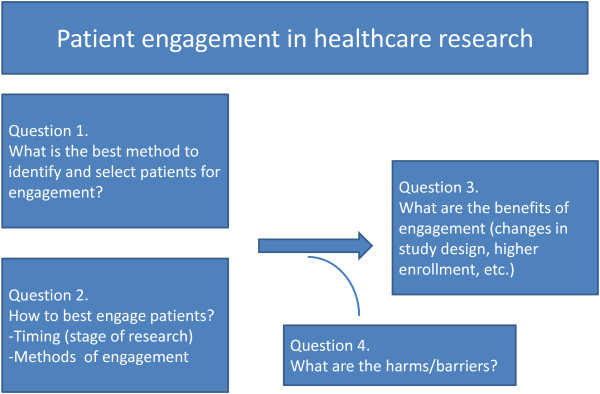
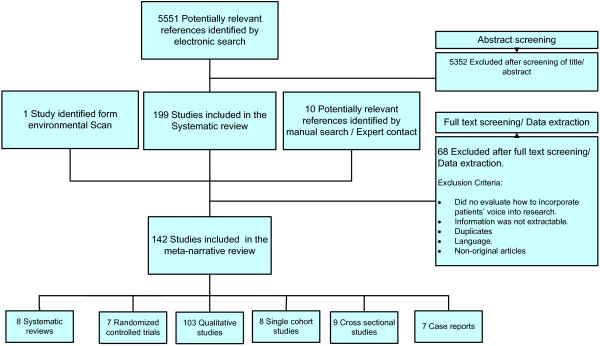
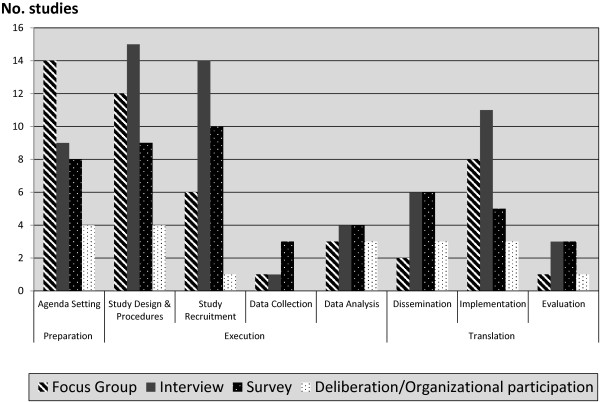
BACKGROUND: A compelling ethical rationale supports patient engagement in healthcare research. It is also assumed that patient engagement will lead to research findings that are more pertinent to patients' concerns and dilemmas. However; it is unclear how to best conduct this process. In this systematic review we aimed to answer 4 key questions: what are the best ways to identify patient representatives? How to engage them in designing and conducting research? What are the observed benefits of patient engagement? What are the harms and barriers of patient engagement? METHODS: We searched MEDLINE, EMBASE, PsycInfo, Cochrane, EBSCO, CINAHL, SCOPUS, Web of Science, Business Search Premier, Academic Search Premier and Google Scholar. Included studies were published in English, of any size or design that described engaging patients or their surrogates in research design. We conducted an environmental scan of the grey literature and consulted with experts and patients. Data were analyzed using a non-quantitative, meta-narrative approach. RESULTS: We included 142 studies that described a spectrum of engagement. In general, engagement was feasible in most settings and most commonly done in the beginning of research (agenda setting and protocol development) and less commonly during the execution and translation of research. We found no comparative analytic studies to recommend a particular method. Patient engagement increased study enrollment rates and aided researchers in securing funding, designing study protocols and choosing relevant outcomes. The most commonly cited challenges were related to logistics (extra time and funding needed for engagement) and to an overarching worry of a tokenistic engagement. CONCLUSIONS: Patient engagement in healthcare research is likely feasible in many settings. However, this engagement comes at a cost and can become tokenistic. Research dedicated to identifying the best methods to achieve engagement is lacking and clearly needed.
Overview
The claims and statistics of this paper haven’t been checked yet.
Free: it reads the open-access text and checks the first 5 claims that cite a source we can check. Create a free account to check every claim.
Integrity signals
Registry
Cites
Statistics
Figures
Verification
Claims the paper makes
The claims and statistics of this paper haven’t been checked yet.
Free: it reads the open-access text and checks the first 5 claims that cite a source we can check. Create a free account to check every claim.
Claims other papers make about this one
Each is checked against this paper’s own text: does it say what the citing paper says it does?
The source backs part of the claim, not all of it — or backs it for a different population, condition or comparison.
In the citing paper
“The present study confirms that, with regard to the conduct of research trials in primary dental care, research dedicated to identifying the best methods to achieve engagement with patients as potential participants is lacking and clearly needed [50].”
From Parental attitudes to randomised controlled trials in primary dental care: A qualitative study (2026) · cites this paper as [50]
Experimental — accuracy not yet measuredThe source backs part of the claim, not all of it — or backs it for a different population, condition or comparison.
In the citing paper
“Engaging patients in the process of designing the review protocol and in reviewing the findings increase the applicability and relevance of the findings of this study.”
From Systematic review of mind‐body interventions to treat myalgic encephalomyelitis/chronic fatigue syndrome (2021) · cites this paper as [36]
Experimental — accuracy not yet measuredThe source backs part of the claim, not all of it — or backs it for a different population, condition or comparison.
In the citing paper
“Previous studies indicated that engaging the target group increases study enrollment and may enhance the uptake and the acceptance of interventions [67, 68].”
From A blended psychosocial support program for partners of patients with amyotrophic lateral sclerosis and progressive muscular atrophy: Protocol of a randomized controlled trial (2018) · cites this paper as [67]
Experimental — accuracy not yet measuredThe check wasn’t confident either way, so it gives no verdict — never disputed.
In the citing paper
“This is consistent with review findings of empirical studies in PPI whereby short‐term, individual‐level outcomes were more represented in the literature. 43 , 91 , 92”
From A systematic review of theories, models and frameworks used for youth engagement in health research (2024) · cites this paper as [91]
Experimental — accuracy not yet measured
Self-check
Percentages, sums and reported differences re-computed from the paper’s own numbers.
The self-check needs the paper’s full text.
Citations
Cites
Preferred Reporting Items for Systematic Reviews and Meta-Analyses: the PRISMA statement
Moher, D., Liberati, A., Tetzlaff, J., Altman, D. G., & for the PRISMA Group (2009) · BMJ · doi:10.1136/bmj.b2535 · Cited by 83,823
Preferred reporting items for systematic reviews and meta-analyses: the PRISMA Statement.
(2009) · PubMed Central · Cited by 44,859
Preferred reporting items for systematic reviews and meta-analyses: The PRISMA statement
Moher, D., Liberati, A., Tetzlaff, J., Altman, D. G., & the PRISMA Group* (2009) · Annals of Internal Medicine · doi:10.7326/0003-4819-151-4-200908180-00135 · Cited by 37,554
Preferred Reporting Items for Systematic Reviews and Meta-Analyses: The PRISMA Statement
Moher, D., Liberati, A., Tetzlaff, J., & Altman, D. G. (2009) · Journal of Clinical Epidemiology · doi:10.1016/j.jclinepi.2009.06.005 · Cited by 19,575
(2005) · PubMed · Cited by 7,011
Enhancing transparency in reporting the synthesis of qualitative research: ENTREQ
Tong, A., Flemming, K., McInnes, E., Oliver, S., & Craig, J. (2012) · BMC Medical Research Methodology · doi:10.1186/1471-2288-12-181 · Cited by 3,569 · cited 1×
“Differences in studies settings and characteristics can be used to explain differences in results (heterogeneity) [16].”
BackgroundCommunity-based participatory research: assessing the evidence.
Viswanathan, M., Ammerman, A., Eng, E. M., Garlehner, G., Lohr, K. N., Griffith, D. M., Rhodes, S. D., Samuel‐Hodge, C. D., Maty, S. C., Lux, L. J., et al. (2004) · PubMed Central · Cited by 1,053
Campbell, R., Pound, P., Pope, C., Britten, N., Pill, R., Morgan, M., & Donovan, J. (2003) · Social Science & Medicine · doi:10.1016/s0277-9536(02)00064-3 · Cited by 921 · cited 3×
“[http://www.casp-uk.net/wp-content/uploads/ 2011/11/CASP-Qualitative-Research-Checklist-31.05.13.pdf] 19.”
MethodInfluentialStorylines of research in diffusion of innovation: a meta-narrative approach to systematic review
Greenhalgh, T., Robert, G., Macfarlane, F., Bate, P., Kyriakidou, O., & Peacock, R. (2005) · Social Science & Medicine · doi:10.1016/j.socscimed.2004.12.001 · Cited by 913 · cited 1×
“Instead, data extracted from the included studies were analyzed using a meta-narrative approach [14].”
MethodPatient and service user engagement in research: a systematic review and synthesized framework
Shippee, N. D., Domecq Garces, J. P., Prutsky Lopez, G. J., Wang, Z., Elraiyah, T. A., Nabhan, M., Brito, J. P., Boehmer, K., Hasan, R., Firwana, B., et al. (2015) · Health Expectations · doi:10.1111/hex.12090 · Cited by 628 · cited 2×
“We also categorized the research engagement from each study into three different research phases proposed for patient engagement [17]:”
BackgroundMethodSelf-citation
Cited by
Staniszewska, S., Brett, J., Simera, I., Seers, K., Mockford, C., Goodlad, S., Altman, D. G., Moher, D., Barber, R., Denegri, S., et al. (2017) · BMJ · doi:10.1136/bmj.j3453 · Cited by 1,983
Staniszewska, S., Brett, J., Simera, I., Seers, K., Mockford, C., Goodlad, S., Altman, D. G., Moher, D., Barber, R., Denegri, S., et al. (2017) · Research Involvement and Engagement · doi:10.1186/s40900-017-0062-2 · Cited by 1,643
Research co-design in health: a rapid overview of reviews
Slattery, P., Saeri, A. K., & Bragge, P. (2020) · Health Research Policy and Systems · doi:10.1186/s12961-020-0528-9 · Cited by 1,313
“[5] as focus groups, interviews, surveys and deliberative methods (e.”
BackgroundMethodInfluentialGreenhalgh, T., Hinton, L., Finlay, T., Macfarlane, A., Fahy, N., Clyde, B., & Chant, A. (2019) · Health Expectations · doi:10.1111/hex.12888 · Cited by 1,059
Rating the certainty in evidence in the absence of a single estimate of effect
Murad, M. H., Mustafa, R. A., Schünemann, H. J., Sultan, S., & Santesso, N. (2017) · Evidence Based Medicine · doi:10.1136/ebmed-2017-110668 · Cited by 717
Self-citationManafo, E., Petermann, L., Mason-Lai, P., & Vandall-Walker, V. (2018) · Health Research Policy and Systems · doi:10.1186/s12961-018-0282-4 · Cited by 482
“As demonstrated [10, 15, 41], existing efforts to engage the patient are often limited to preliminary activities that are not sustained across the research activity lifecycle [10, 15, 26, 36].”
BackgroundMethodInfluentialOcloo, J., Garfield, S., Franklin, B. D., & Dawson, S. (2021) · Health Research Policy and Systems · doi:10.1186/s12961-020-00644-3 · Cited by 460
“, representation, demographics) in different studies varied [60]; only a few reviews reported PPI contributor characteristics [80] and the characteristics of those who influenced participation decisions in research [75]; participant [outcomes] reported were limited and primarily to do with English-speaking, literate a…”
BackgroundResultInfluentialPatient Engagement In Research: Early Findings From The Patient-Centered Outcomes Research Institute
Forsythe, L. P., Carman, K. L., Szydlowski, V., Fayish, L., Davidson, L., Hickam, D. H., Hall, C., Bhat, G., Neu, D., Stewart, L., et al. (2019) · Health Affairs · doi:10.1377/hlthaff.2018.05067 · Cited by 438
Murad, M. H. (2017) · Mayo Clinic Proceedings · doi:10.1016/j.mayocp.2017.01.001 · Cited by 386
“Guideline developers can obtain information on patient values from surveys, from qualitative studies, or by engaging patients in the process of guideline development.(32,33) Frameworks for engaging patients and other stakeholders in guideline”
BackgroundMethodSelf-citation‘Is it worth doing?’ Measuring the impact of patient and public involvement in research
Staley, K. (2015) · Research Involvement and Engagement · doi:10.1186/s40900-015-0008-5 · Cited by 364
“A number of systematic literature reviews have reported the various ways in which involvement makes a difference to research, the people involved and the researchers [1–4].”
BackgroundPatient involvement in clinical research: why, when, and how
Sacristan, J. A., Aguaron, A., Avendaño, C., Garrido, P., Carrion, J., Gutierrez, A., Kroes, R., & Flores, A. (2016) · Patient Preference and Adherence · doi:10.2147/ppa.s104259 · Cited by 363
“these end up being merely tokenistic.(7) This paper analyzes the reasons why patients should be more actively involved in research and designates the phases in which they could participate (Figure 1).”
The PCORI Engagement Rubric: Promising Practices for Partnering in Research
Sheridan, S., Schrandt, S., Forsythe, L., Hilliard, T. S., & Paez, K. A. (2017) · The Annals of Family Medicine · doi:10.1370/afm.2042 · Cited by 358
“PCORI then revised the Rubric by: (1) separating descriptions of engagement practices that exemplified the PCOR Engagement Principles under a set of “global principles” instead of sprinkling examples throughout the Rubric; (2) categorizing engagement activities into 3 broad categories of study phases (ie, planning, co…”
MethodPanel, S. G. P. C., Hoekstra, F., Mrklas, K. J., Khan, M., McKay, R. C., Vis-Dunbar, M., Sibley, K. M., Nguyen, T., Graham, I. D., & Gainforth, H. L. (2020) · Health Research Policy and Systems · doi:10.1186/s12961-020-0544-9 · Cited by 343
Out of the laboratory and into the classroom: the future of artificial intelligence in education
Schiff, D. (2021) · AI & SOCIETY · doi:10.1007/s00146-020-01033-8 · Cited by 334
“For example, the healthcare research community is currently working through the micro- and macrochallenges of incorporating patients as co-equal researchers, and has valuable lessons and models from which the computing and AI communities could learn (Domecq et al. 2014).”
BackgroundPatient and Stakeholder Engagement in the PCORI Pilot Projects: Description and Lessons Learned
Forsythe, L. P., Ellis, L. E., Edmundson, L., Sabharwal, R., Rein, A., Konopka, K., & Frank, L. (2016) · Journal of General Internal Medicine · doi:10.1007/s11606-015-3450-z · Cited by 323
“Increased access to study populations or settings suggests that engagement may mitigate commonly encountered challenges with recruitment and retention.(3,18,22,43) These results are consistent with available evidence on positive impacts of engaged research on research process and dissemination of results.”
ResultBird, M., Ouellette, C., Whitmore, C., Li, L., Nair, K., McGillion, M. H., Yost, J., Banfield, L., Campbell, E., & Carroll, S. L. (2020) · Health Expectations · doi:10.1111/hex.13040 · Cited by 310
Smits, D.-W., van Meeteren, K., Klem, M., Alsem, M., & Ketelaar, M. (2020) · Research Involvement and Engagement · doi:10.1186/s40900-020-00188-4 · Cited by 295
Nguyen, T., Graham, I. D., Mrklas, K. J., Bowen, S., Cargo, M., Estabrooks, C. A., Kothari, A., Lavis, J., Macaulay, A. C., MacLeod, M., et al. (2020) · Health Research Policy and Systems · doi:10.1186/s12961-020-0539-6 · Cited by 286
“We recognise that there is also growing interest in ‘patient engagement’ (PE) and ‘patient and public involvement’ (PPI) in health services and, to a lesser extent, in research generation [38, 39]; however, these concepts were excluded.”
BackgroundPatient and public engagement in priority setting: A systematic rapid review of the literature
Manafò, E., Petermann, L., Vandall-Walker, V., & Mason-Lai, P. (2018) · PLOS ONE · doi:10.1371/journal.pone.0193579 · Cited by 285
Harrison, J. D., Auerbach, A. D., Anderson, W., Fagan, M., Carnie, M., Hanson, C., Banta, J., Symczak, G., Robinson, E., Schnipper, J., et al. (2019) · Health Expectations · doi:10.1111/hex.12873 · Cited by 286
Boivin, A., L'Espérance, A., Gauvin, F., Dumez, V., Macaulay, A. C., Lehoux, P., & Abelson, J. (2018) · Health Expectations · doi:10.1111/hex.12804 · Cited by 285
Lancet Commission: Stem cells and regenerative medicine
Cossu, G., Birchall, M., Brown, T., De Coppi, P., Culme-Seymour, E., Gibbon, S., Hitchcock, J., Mason, C., Montgomery, J., Morris, S., et al. (2018) · The Lancet · doi:10.1016/s0140-6736(17)31366-1 · Cited by 272
Bloem, B. R., Henderson, E. J., Dorsey, E. R., Okun, M. S., Okubadejo, N., Chan, P., Andrejack, J., Darweesh, S. K. L., & Munneke, M. (2020) · The Lancet Neurology · doi:10.1016/s1474-4422(20)30064-8 · Cited by 242
Patient and public involvement in the design of clinical trials: An overview of systematic reviews
Price, A., Albarqouni, L., Kirkpatrick, J., Clarke, M., Liew, S. M., Roberts, N., & Burls, A. (2018) · Journal of Evaluation in Clinical Practice · doi:10.1111/jep.12805 · Cited by 234
Patients as Partners: A Qualitative Study of Patients’ Engagement in Their Health Care
Pomey, M.-P., Ghadiri, D. P., Karazivan, P., Fernandez, N., & Clavel, N. (2015) · PLOS ONE · doi:10.1371/journal.pone.0122499 · Cited by 228
“Patient participation, or engagement, is only recently receiving greater attention [7] as it becomes increasingly evident that it can be an innovative and viable approach to ensuring appropriate care in the current environment strained by limited resources [8, 9].”
BackgroundRussell, J., Fudge, N., & Greenhalgh, T. (2020) · Research Involvement and Engagement · doi:10.1186/s40900-020-00239-w · Cited by 219
Practical Guidance for Involving Stakeholders in Health Research
for the Multi Stakeholder Engagement (MuSE) Consortium, Concannon, T. W., Grant, S., Welch, V., Petkovic, J., Selby, J., Crowe, S., Synnot, A., Greer-Smith, R., Mayo-Wilson, E., et al. (2019) · Journal of General Internal Medicine · doi:10.1007/s11606-018-4738-6 · Cited by 220
Shen, S., Doyle‐Thomas, K. A. R., Beesley, L., Karmali, A., Williams, L., Tanel, N., & McPherson, A. C. (2017) · Health Expectations · doi:10.1111/hex.12490 · Cited by 215
Forsythe, L., Heckert, A., Margolis, M. K., Schrandt, S., & Frank, L. (2018) · Quality of Life Research · doi:10.1007/s11136-017-1581-x · Cited by 214
Patient and Public Engagement in Integrated Knowledge Translation Research: Are we there yet?
Banner, D., Bains, M., Carroll, S., Kandola, D. K., Rolfe, D. E., Wong, C., & Graham, I. D. (2019) · Research Involvement and Engagement · doi:10.1186/s40900-019-0139-1 · Cited by 212
Evaluating patient and public involvement in research
Boivin, A., Richards, T., Forsythe, L., Grégoire, A., L’Espérance, A., Abelson, J., & Carman, K. L. (2018) · BMJ · doi:10.1136/bmj.k5147 · Cited by 208
An empirically based conceptual framework for fostering meaningful patient engagement in research
Hamilton, C. B., Hoens, A. M., Backman, C. L., McKinnon, A. M., McQuitty, S., English, K., & Li, L. C. (2018) · Health Expectations · doi:10.1111/hex.12635 · Cited by 207
Engaging youth in research planning, design and execution: Practical recommendations for researchers
Hawke, L. D., Relihan, J., Miller, J., McCann, E., Rong, J., Darnay, K., Docherty, S., Chaim, G., & Henderson, J. L. (2018) · Health Expectations · doi:10.1111/hex.12795 · Cited by 205
Woolley, J. P., McGowan, M. L., Teare, H. J. A., Coathup, V., Fishman, J. R., Settersten, R. A., Sterckx, S., Kaye, J., & Juengst, E. T. (2016) · BMC Medical Ethics · doi:10.1186/s12910-016-0117-1 · Cited by 201
“This is particularly noteworthy if the primary motivations for research groups to adopt engagement and involvement interventions include improving likelihood of funding, and subsequent recruitment of the required cohort [37]—which chimes directly with financial opportunity as a priority of citizen science, as identifi…”
BackgroundBagley, H. J., Short, H., Harman, N. L., Hickey, H. R., Gamble, C. L., Woolfall, K., Young, B., & Williamson, P. R. (2016) · Research Involvement and Engagement · doi:10.1186/s40900-016-0029-8 · Cited by 200
“may contribute to the successful delivery of trials by increasing the likelihood of recruitment to time and target together with improving participant retention [6, 7].”
BackgroundCrocker, J. C., Boylan, A., Bostock, J., & Locock, L. (2017) · Health Expectations · doi:10.1111/hex.12479 · Cited by 194
The prevalence of patient engagement in published trials: a systematic review
Fergusson, D., Monfaredi, Z., Pussegoda, K., Garritty, C., Lyddiatt, A., Shea, B., Duffett, L., Ghannad, M., Montroy, J., Murad, M. H., et al. (2018) · Research Involvement and Engagement · doi:10.1186/s40900-018-0099-x · Cited by 186
“Domecq and colleagues raised the concern about a lack of comparative effectiveness research in their 2014 review [8].”
BackgroundInfluentialSelf-citationImmersive virtual reality health games: a narrative review of game design
Tao, G., Garrett, B., Taverner, T., Cordingley, E., & Sun, C. (2021) · Journal of NeuroEngineering and Rehabilitation · doi:10.1186/s12984-020-00801-3 · Cited by 179
Stakeholder involvement in systematic reviews: a scoping review
Pollock, A., Campbell, P., Struthers, C., Synnot, A., Nunn, J., Hill, S., Goodare, H., Morris, J., Watts, C., & Morley, R. (2018) · Systematic Reviews · doi:10.1186/s13643-018-0852-0 · Cited by 180
Role of patient and public involvement in implementation research: a consensus study
Gray-Burrows, K. A., Willis, T. A., Foy, R., Rathfelder, M., Bland, P., Chin, A., Hodgson, S., Ibegbuna, G., Prestwich, G., Samuel, K., et al. (2018) · BMJ Quality & Safety · doi:10.1136/bmjqs-2017-006954 · Cited by 176
Patient engagement in research related to dementia: A scoping review
Bethell, J., Commisso, E., Rostad, H. M., Puts, M., Babineau, J., Grinbergs-Saull, A., Wighton, M. B., Hammel, J., Doyle, E., Nadeau, S., et al. (2018) · Dementia · doi:10.1177/1471301218789292 · Cited by 174
“For the former, the lack of specific indexing terms in bibliographic databases has been identified as a barrier to identifying and evaluating patient engagement in research (Domecq et al., 2014; Shippee et al., 2015).”
BackgroundMethodInfluentialVat, L. E., Finlay, T., Jan Schuitmaker‐Warnaar, T., Fahy, N., Robinson, P., Boudes, M., Diaz, A., Ferrer, E., Hivert, V., Purman, G., et al. (2020) · Health Expectations · doi:10.1111/hex.12951 · Cited by 173
Patient engagement: What partnering with patient in research is all about
Duffett, L. (2017) · Thrombosis Research · doi:10.1016/j.thromres.2016.10.029 · Cited by 170
“[8] – Inclusion: original studies reporting any engagement with patients (or ‘surrogates’)”
BackgroundInfluentialHarrington, R. L., Hanna, M. L., Oehrlein, E. M., Camp, R., Wheeler, R., Cooblall, C., Tesoro, T., Scott, A. M., von Gizycki, R., Nguyen, F., et al. (2020) · Value in Health · doi:10.1016/j.jval.2020.01.019 · Cited by 172
“Stageofactivity (the “when”)was conceptualized as a timeline.(33) Stages were identified (from earliest to latest) as: “Strategy & Priority Setting,” “Design & Planning,” “Conduct & Operation,” “Dissemination & Communication,” and “In Practice/In Use.”
Current trends in patient and public involvement in cancer research: A systematic review
Pii, K. H., Schou, L. H., Piil, K., & Jarden, M. (2019) · Health Expectations · doi:10.1111/hex.12841 · Cited by 169
Blackburn, S., McLachlan, S., Jowett, S., Kinghorn, P., Gill, P., Higginbottom, A., Rhodes, C., Stevenson, F., & Jinks, C. (2018) · Research Involvement and Engagement · doi:10.1186/s40900-018-0100-8 · Cited by 168
“In contrast, reported negative impacts are PPI contributors’ frustration with the lengthy process and lack of feedback, the extra time needed to complete research, time constraints of patients and researchers, and the increased financial costs [10].”
BackgroundInfluentialA Systematic Review of Approaches for Engaging Patients for Research on Rare Diseases
Forsythe, L. P., Szydlowski, V., Murad, M. H., Ip, S., Wang, Z., Elraiyah, T. A., Fleurence, R., & Hickam, D. H. (2014) · Journal of General Internal Medicine · doi:10.1007/s11606-014-2895-9 · Cited by 166
Self-citationThe Science of Using Science: Researching the Use of Research Evidence in Decision-Making
Langer, L., Tripney, J., & Gough, D. (2016) · UCL Discovery (University College London) · Cited by 299
Tembo, D., Hickey, G., Montenegro, C., Chandler, D., Nelson, E., Porter, K., Dikomitis, L., Chambers, M., Chimbari, M., Mumba, N., et al. (2021) · BMJ · doi:10.1136/bmj.n178 · Cited by 163
Patients as partners in Enhanced Recovery After Surgery: A qualitative patient-led study
Gillis, C., Gill, M., Marlett, N., MacKean, G., GermAnn, K., Gilmour, L., Nelson, G., Wasylak, T., Nguyen, S., Araujo, E., et al. (2017) · BMJ Open · doi:10.1136/bmjopen-2017-017002 · Cited by 159
Youth engagement in mental health research: A systematic review
McCabe, E., Amarbayan, M. (., Rabi, S., Mendoza, J., Naqvi, S. F., Thapa Bajgain, K., Zwicker, J. D., & Santana, M. (2023) · Health Expectations · doi:10.1111/hex.13650 · Cited by 155
Levitan, B., Getz, K., Eisenstein, E. L., Goldberg, M., Harker, M., Hesterlee, S., Patrick-Lake, B., Roberts, J. N., & DiMasi, J. (2018) · Therapeutic Innovation & Regulatory Science · doi:10.1177/2168479017716715 · Cited by 157
“It has been argued that, while the moral case for patient engagement has been made, evidence of the value of patient engagement is mostly anecdotal.(11-16) For the impact of patient engagement to be fully realized, robust and rigorous study of its quantitative effects on R&D is needed.”
BackgroundPrice, A., Schroter, S., Snow, R., Hicks, M., Harmston, R., Staniszewska, S., Parker, S., & Richards, T. (2018) · BMJ Open · doi:10.1136/bmjopen-2017-020452 · Cited by 157
“However, The Agency for Healthcare Research and Quality Evidence-based Practice Centres, the Institute of Medicine, the Cochrane Collaboration and others have recommended PPI when conducting systematic reviews, we used this justification to include them.(14) We recognise that many studies are secondary analyses of exi…”
BackgroundMethodBoylan, A., Locock, L., Thomson, R., & Staniszewska, S. (2019) · Health Expectations · doi:10.1111/hex.12883 · Cited by 153
Patients as partners in health research: A scoping review
McCarron, T. L., Clement, F. M., Rasiah, J., Moran, C., Moffat, K., González, A., Wasylak, T., & Santana, M. (2021) · Health Expectations · doi:10.1111/hex.13272 · Cited by 164
Maurer, M. E., Mangrum, R., Hilliard, T. S., Amolegbe, A., Carman, K. L., Forsythe, L. P., Mosbacher, R., Lesch, J. K., & Woodward, K. P. (2022) · Journal of General Internal Medicine · doi:10.1007/s11606-021-07104-w · Cited by 208
“Findings confirm earlier analyses of the benefits of patient and other stakeholder engagement in research and that active influence of partners most often improved studies’ feasibility and acceptability.(2,6) Findings also offer new insights about how influence happens, show the diversity of influences that stakeholde…”
ResultNaidoo, N., Nguyen, V. T., Ravaud, P., Young, B., Amiel, P., Schanté, D., Clarke, M., & Boutron, I. (2020) · BMC Medicine · doi:10.1186/s12916-019-1476-5 · Cited by 144
Kwon, S. C., Tandon, S. D., Islam, N., Riley, L., & Trinh-Shevrin, C. (2018) · Translational Behavioral Medicine · doi:10.1093/tbm/ibx026 · Cited by 139
“required for a truly fruitful partnership [24].”
BackgroundEngagement in online health communities: Channel expansion and social exchanges
Mirzaei, T., & Esmaeilzadeh, P. (2020) · Information & Management · doi:10.1016/j.im.2020.103404 · Cited by 166
Pomey, M., Hihat, H., Khalifa, M., Lebel, P., Néron, A., & Dumez, V. (2015) · Patient Experience Journal · doi:10.35680/2372-0247.1064 · Cited by 184
“These criteria are different from those found in other articles, 45,46,47 particularly with regard to the reflexive capacity of the patients involved.”
Rolfe, D. E., Ramsden, V. R., Banner, D., & Graham, I. D. (2018) · Research Involvement and Engagement · doi:10.1186/s40900-018-0129-8 · Cited by 134
Janssen, E. M., Marshall, D. A., Hauber, B., & Bridges, J. F. P. (2017) · Expert Review of Pharmacoeconomics & Outcomes Research · doi:10.1080/14737167.2017.1389648 · Cited by 158
“In recent years, there has been a general trend toward patient involvement in treatment [1,2], research [3,4], and regulatory decision-making [5,6].”
BackgroundWhat constitutes meaningful engagement for patients and families as partners on research teams?
Black, A., Strain, K., Wallsworth, C., Charlton, S.-G., Chang, W., McNamee, K., & Hamilton, C. B. (2018) · Journal of Health Services Research & Policy · doi:10.1177/1355819618762960 · Cited by 153
“We gave priority to themes that were more common and themes the PRPs on our team felt were crucial to the viewpoints of PRPs.”
BackgroundInfluentialPatient and Family Engagement in the ICU: Untapped Opportunities and Underrecognized Challenges
Burns, K. E. A., Misak, C., Herridge, M. S., Meade, M. O., & Oczkowski, S. J. W. (2018) · American Journal of Respiratory and Critical Care Medicine · doi:10.1164/rccm.201710-2032ci · Cited by 157
“To this end, a systematic review found that engaging patients in research improved patient enrollment and retention in clinical studies (81).”
BackgroundHamilton, C. B., Hoens, A. M., McQuitty, S., McKinnon, A., English, K., Backman, C. L., Azimi, T., Khodarahmi, N., & LI, L. C. (2018) · PLoS ONE · doi:10.1371/journal.pone.0206588 · Cited by 142
Patient and public involvement in dementia research in the European Union: a scoping review
Miah, J., Dawes, P., Edwards, S., Leroi, I., Starling, B., & Parsons, S. (2019) · BMC Geriatrics · doi:10.1186/s12877-019-1217-9 · Cited by 148
“PPI may also increase the effectiveness of research by making recruitment materials easy to understand, advising on appropriate recruitment strategies, and suggesting implementation and dissemination strategies [4, 5].”
BackgroundBlack and minority ethnic group involvement in health and social care research: A systematic review
Dawson, S., Campbell, S. M., Giles, S. J., Morris, R. L., & Cheraghi‐Sohi, S. (2018) · Health Expectations · doi:10.1111/hex.12597 · Cited by 128
Heckert, A., Forsythe, L. P., Carman, K. L., Frank, L., Hemphill, R., Elstad, E. A., Esmail, L., & Lesch, J. K. (2020) · Research Involvement and Engagement · doi:10.1186/s40900-020-00227-0 · Cited by 130
Edlow, B. L., Sanz, L. R. D., Polizzotto, L., Pouratian, N., Rolston, J. D., Snider, S. B., Thibaut, A., Stevens, R. D., Gosseries, O., members, T. C. C. C. A. I. C., et al. (2021) · Neurocritical Care · doi:10.1007/s12028-021-01227-y · Cited by 143
Involving stakeholders in research priority setting: a scoping review
Grill, C. (2021) · Research Involvement and Engagement · doi:10.1186/s40900-021-00318-6 · Cited by 144
Building an evidence base for stakeholder engagement
Lavery, J. V. (2018) · Science · doi:10.1126/science.aat8429 · Cited by 123
Cook, N., Siddiqi, N., Twiddy, M., & KENYON, R. L. (2019) · BMJ Open · doi:10.1136/bmjopen-2018-026514 · Cited by 133
“Our review identified that most PPIs in LMICs take place during the planning stage of research, which is in contrast to a similar review, not focused on LMIC, which found more examples of PPI in the execution phase.(40) It is difficult to say definitively why this might be the case, but it may be related to non-LMIC r…”
ResultMalterud, K., & Elvbakken, K. T. (2019) · Scandinavian Journal of Public Health · doi:10.1177/1403494819863514 · Cited by 131
Modigh, A., Sampaio, F., Moberg, L., & Fredriksson, M. (2021) · Health Policy · doi:10.1016/j.healthpol.2021.07.008 · Cited by 140
Baines, R. L., & Regan de Bere, S. (2018) · Health Expectations · doi:10.1111/hex.12618 · Cited by 116
Peters, S., Guccione, L., Francis, J., Best, S., Tavender, E. J., Curran, J., Davies, K., Rowe, S., Palmer, V. J., & Klaic, M. (2024) · Implementation Science · doi:10.1186/s13012-024-01394-4 · Cited by 158
“Several reviews on conducting research co-design have concluded that co-design can be feasible, though predominantly used in the early phases of research, for example formulating research questions and developing a study protocol [6, 11–19].”
BackgroundMethodKelly, S., Lafortune, L., Hart, N. J., Cowan, K., Fenton, M., & Brayne, C. (2015) · Age and Ageing · doi:10.1093/ageing/afv143 · Cited by 128
Doria, N. A., Condran, B. R., Boulos, L., Maillet, D. C., Dowling, L., & Levy, A. R. (2018) · Research Involvement and Engagement · doi:10.1186/s40900-018-0102-6 · Cited by 133
“In patient engagement, focus groups are not used to collect research data, but instead are used as a method to direct and inform research decisions by consulting with patients and applying their expertise [5, 6].”
MethodRodríguez-Torres, E., González-Pérez, M. M., & Díaz-Pérez, C. (2021) · Contemporary Clinical Trials Communications · doi:10.1016/j.conctc.2021.100829 · Cited by 133
Vaughn, L. M., Whetstone, C. M., Boards, A., Busch, M. D., Magnusson, M., & Määttä, S. (2018) · Health & Social Care in the Community · doi:10.1111/hsc.12562 · Cited by 138
Carroll, S. L., Embuldeniya, G., Abelson, J., McGillion, M. H., Berkesse, A., & Healey, J. S. (2017) · Patient Preference and Adherence · doi:10.2147/ppa.s135457 · Cited by 114
“The full embrace of patient engagement by researchers is also hindered by concerns about tokenism, logistics, and fear of patient bias; lack of clarity about best practices;(8) practical concerns around defining and representing the community whose engagement is sought;(10) and a perceived lack of evidence of impact.(…”
BackgroundPower to the people: To what extent has public involvement in applied health research achieved this?
Green, G. (2016) · Research Involvement and Engagement · doi:10.1186/s40900-016-0042-y · Cited by 110
“There are also at least three recently published systematic reviews [34–36].”
BackgroundPublic involvement in research: making sense of the diversity
Oliver, S., Liabo, K., Stewart, R., & Rees, R. (2015) · Journal of Health Services Research & Policy · doi:10.1177/1355819614551848 · Cited by 109
“These are increasingly captured by systematic reviews of the patient and public involvement literature, albeit with relatively little conceptualization or theoretical development, and few comparative studies.(1,2) We need to make sense of this diversity if we are to share learning across different areas, choose wisely…”
BackgroundCarman, K. L., & Workman, T. A. (2017) · Patient Education and Counseling · doi:10.1016/j.pec.2016.07.009 · Cited by 107
From Subject to Participant: Ethics and the Evolving Role of Community in Health Research
Bromley, E., Mikesell, L., Jones, F., & Khodyakov, D. (2015) · American Journal of Public Health · doi:10.2105/ajph.2014.302403 · Cited by 277
Skovlund, P. C., Nielsen, B. K., Thaysen, H. V., Schmidt, H., Finset, A., Hansen, K. A., & Lomborg, K. E. (2020) · Research Involvement and Engagement · doi:10.1186/s40900-020-00214-5 · Cited by 123
Consensus Statement on Public Involvement and Engagement with Data-Intensive Health Research
Aitken, M., Tully, M. P., Porteous, C., Denegri, S., Cunningham-Burley, S., Banner, N., Black, C., Burgess, M., Cross, L., Van Delden, J., et al. (2019) · International Journal of Population Data Science · doi:10.23889/ijpds.v4i1.586 · Cited by 95
“There is now broad recognition of the value of public knowledge and expertise in relation to science, technology and medicine [4, 5] and PI&E is increasingly part of the contemporary landscape of health research and health care innovation [6, 7].”
BackgroundEntradas, M., Bauer, M. W., O’Muircheartaigh, C. A., Marcinkowski, F., Okamura, A., Pellegrini, G., Besley, J. C., Massarani, L., Russo, P., Dudo, A. D., et al. (2020) · PLoS ONE · doi:10.1371/journal.pone.0235191 · Cited by 151
“In contrast, the medical and health sciences may not have faced such stimuli towards public engagement, which while not entirely clear for us, may find some explanation in their communication focusing around the individual doctor-patient relationship [47].”
BackgroundFarooqi, A., Jutlla, K., Raghavan, R., Wilson, A. M., Uddin, M. S., Akroyd, C., Patel, N., Campbell-Morris, P. P., & Farooqi, A. (2022) · BMC Medical Research Methodology · doi:10.1186/s12874-021-01489-2 · Cited by 121
“They can also share ideas of what is the best way to achieve project aims, and to help identify or foresee any potential challenges or problems and how to overcome them [26].”
Facilitating public and patient involvement in basic and preclinical health research
Maccarthy, J., Guérin, S., Wilson, A. G., & Dorris, E. (2019) · PLoS ONE · doi:10.1371/journal.pone.0216600 · Cited by 102
Hawke, L. D., Darnay, K., Relihan, J., Khaleghi‐Moghaddam, M., Barbic, S. P., Lachance, L., Ben‐David, S., Brown, M., Iyer, S. N., Chaim, G., et al. (2020) · Health Expectations · doi:10.1111/hex.13032 · Cited by 101
Lund, H., Juhl, C. B., Nørgaard, B., Draborg, E., Henriksen, M., Andreasen, J., Christensen, R., Nasser, M., Ciliska, D. K., Clarke, M. J., et al. (2020) · Journal of Clinical Epidemiology · doi:10.1016/j.jclinepi.2020.07.019 · Cited by 109
“Thus, many health researchers have chosen to obtain end users’ perspectives by inviting them to be a member of a panel, committee, board, or even of the research group itself [63].”
Engaging children and families in pediatric Health Research: a scoping review
Flynn, R., Walton, S., & Scott, S. D. (2019) · Research Involvement and Engagement · doi:10.1186/s40900-019-0168-9 · Cited by 101
Methods for Involving Older People in Health Research—A Review of the Literature
Schilling, I., & Gerhardus, A. (2017) · International Journal of Environmental Research and Public Health · doi:10.3390/ijerph14121476 · Cited by 102
“In the last years there has been a growing awareness that patients and the public should be more actively involved in the design, conduct and dissemination of health-related studies [1,2].”
BackgroundMethodInfluentialDahan‐Oliel, N., Cachecho, S., Barnes, D., Bedard, T., Davison, A., Dieterich, K. D., Donohoe, M., Fąfara, A., Hamdy, R. C., Hjartarson, H. T., et al. (2019) · American Journal of Medical Genetics Part C Seminars in Medical Genetics · doi:10.1002/ajmg.c.31721 · Cited by 92
Dawson, S., Ruddock, A., Parmar, V., Morris, R., Cheraghi‐Sohi, S., Giles, S. J., & Campbell, S. (2020) · Research Involvement and Engagement · doi:10.1186/s40900-020-00201-w · Cited by 110
“There are numerous examples of the impact of PPI such as securing funding, designing study protocols, choosing relevant outcomes and success in achieving recruitment targets of participants [16, 17].”
BackgroundPellicano, E., Lawson, W., Hall, G., Mahony, J., Lilley, R., Heyworth, M., Clapham, H., & Yudell, M. (2022) · Autism in Adulthood · doi:10.1089/aut.2021.0039 · Cited by 91
“29 They report the valuable contribution of community partners to the research process, including on setting the research agenda, study recruitment and retention rates, research design and measurement selection, and on securing funding.”
Reflections on patient engagement by patient partners: how it can go wrong
Richards, D. P., Poirier, S., Mohabir, V., Proulx, L., Robins, S., & Smith, J. R. L. (2023) · Research Involvement and Engagement · doi:10.1186/s40900-023-00454-1 · Cited by 92
Adus, S., Macklin, J. A., & Pinto, A. D. (2023) · BMC Health Services Research · doi:10.1186/s12913-023-10098-2 · Cited by 120
“The notion of employing recruitment practices that purposely sample patients from marginalized communities is important; however, it is critical to avoid tokenistic practices when doing so [15].”
BackgroundThe Dimensions of Tokenism in Patient and Family Engagement: A Concept Analysis of the Literature
Majid, U. (2020) · Journal of Patient Experience · doi:10.1177/2374373520925268 · Cited by 102
“Previous research has found that although patients engage in a variety of activities, there are a lack of methods, mechanisms, and approaches to meaningful engagement (5,6).”
Metadata
- Authors
- Domecq, J. P., Prutsky, G., Elraiyah, T., Wang, Z., Nabhan, M., Shippee, N., Brito, J. P., Boehmer, K., Hasan, R., Firwana, B., Erwin, P., Eton, D., Sloan, J., Montori, V., Asi, N., Abu Dabrh, A. M., & Murad, M. H.
- Affiliations
- Mayo Clinic (US)
- Corresponding author
- Murad, Mohammad Hassan
- ORCID
- Venue
- BMC Health Services Research
- Published
- 2014-02-26
- Volume
- 14
- Issue
- 1
- Pages
- 89-89
- ISSN
- 1472-6963 (ISSN-L)
- PMC
- PMC3938901
- OpenAlex
- W2100905299
- Cited by
- 1,773
- References
- 50
- Citations by year
- 2026: 122 · 2025: 147 · 2024: 219 · 2023: 198 · 2022: 200 · 2021: 202 · 2020: 202 · 2019: 144 · 2018: 138 · 2017: 101 · 2016: 53 · 2015: 39 · 2014: 8
- FWCI
- 11.40
- Type
- journal article
- Language
- en
- Open access
- gold
- doi.org
- Licence
- Locations
- BMC Health Services Research (publishedVersion, cc-by)
- Europe PMC (PubMed Central) (publishedVersion, cc-by)
- PubMed Central (publishedVersion, cc-by)
- PubMed (publishedVersion)
- NORA - Norwegian Open Research Archives (submittedVersion, cc-by)
- Funders
- Patient-Centered Outcomes Research Institute
- National Institutes of Health
- Topics
- Health Sciences › Health Professions › General Health Professions › Mental Health and Patient Involvement
- Health Sciences › Medicine › Public Health, Environmental and Occupational Health › Ethics in Clinical Research
- Health Sciences › Medicine › Public Health, Environmental and Occupational Health › Community Health and Development
- Keywords
- patient engagement, patient and public involvement, research ethics, patient representatives, research design, barriers to engagement, study enrollment, research funding
- MeSH terms
- Humans, Patient Participation, Randomized Controlled Trials as Topic, Advisory Committees, Research Subjects, Biomedical Research
About these checks
Registry, retraction, Cites and statistics results are computed, not judged, with one exception: a printed reference that no index lists is read once by a model before it counts as a citation error. Claims are extracted by a model and kept only when their quote appears verbatim in the text; each cited source is then checked, with a model’s help, for whether it says what the claim relies on. Those verdicts can be wrong — read the claim’s quote and the cited source before relying on one.
Statistics and arithmetic are recomputed, not judged.
Confidence bands are shown only for fields calibrated on our annotated test set. None is calibrated yet, so no band is shown.
What counts as a claim ›How we measure confidence ›How we check this ›
Are you an author, or do you see a problem with this page? Request a review
Data sources
Bibliographic data: Semantic Scholar, OpenAlex, Crossref.
Contains information from the Semantic Scholar Academic Graph Datasets, made available under the ODC Attribution License (ODC-BY 1.0).
Semantic Scholar’s data is described in: Kinney, R., et al. (2023). The Semantic Scholar Open Data Platform. arXiv:2301.10140.
