

Modeling causes of death: an integrated approach using CODEm
Open accessThe DOI matches its Crossref record; 105 of the 107 references it cites were found in a registry or an index; 8 of the 74 sources its claims cite were checked for support.
Abstract
Background: Data on causes of death by age and sex are a critical input into health decision-making. Priority setting in public health should be informed not only by the current magnitude of health problems but by trends in them. However, cause of death data are often not available or are subject to substantial problems of comparability. We propose five general principles for cause of death model development, validation, and reporting. Methods: We detail a specific implementation of these principles that is embodied in an analytical tool - the Cause of Death Ensemble model (CODEm) - which explores a large variety of possible models to estimate trends in causes of death. Possible models are identified using a covariate selection algorithm that yields many plausible combinations of covariates, which are then run through four model classes. The model classes include mixed effects linear models and spatial-temporal Gaussian Process Regression models for cause fractions and death rates. All models for each cause of death are then assessed using out-of-sample predictive validity and combined into an ensemble with optimal out-of-sample predictive performance. Results: Ensemble models for cause of death estimation outperform any single component model in tests of root mean square error, frequency of predicting correct temporal trends, and achieving 95% coverage of the prediction interval. We present detailed results for CODEm applied to maternal mortality and summary results for several other causes of death, including cardiovascular disease and several cancers. Conclusions: CODEm produces better estimates of cause of death trends than previous methods and is less susceptible to bias in model specification. We demonstrate the utility of CODEm for the estimation of several major causes of death.
Overview
CoChat Summary
TL;DR
CODEm is an integrated cause-of-death modeling environment built on five principles: comprehensive data identification, comparability/quality improvement, diverse plausible models, out-of-sample predictive validity, and selection of the best model or ensemble. It produces better estimates of cause-of-death trends than single component models and is illustrated for maternal mortality and several other causes.
Key findings
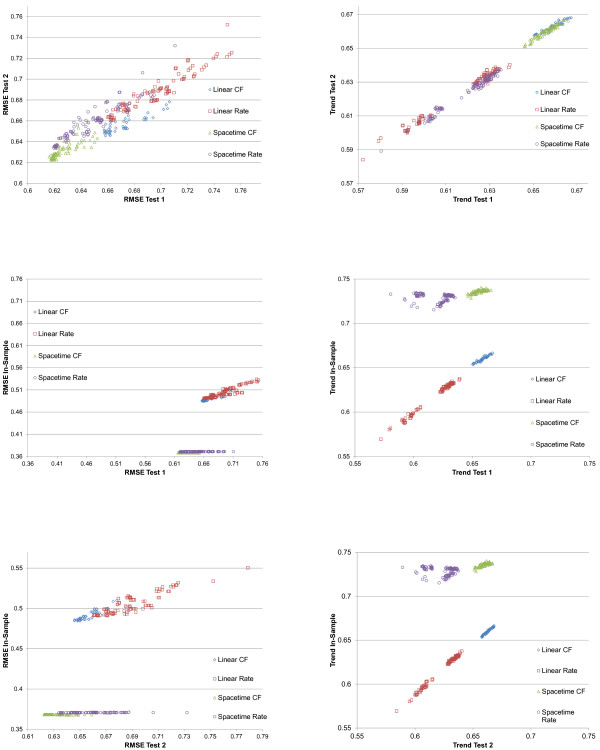
- For maternal mortality, the final CODEm ensemble outperformed the top component model on test 2: RMSE 0.626 vs 0.636, trend test 0.665 vs 0.663, and 95% prediction-interval coverage 97.3% vs 96.9% (Table 6).
- Maternal mortality covariate selection began with 1,984 possible models each for rates and cause fractions; after running 261 rate regressions and 226 cause-fraction regressions, 98 rate models and 71 cause-fraction models fulfilled all priors, yielding 338 total component models. The top 88 slots were spatial-temporal models on logit(cause fraction).
- Across selected causes, ensembles generally matched or improved on the best component model; for male cardiovascular disease, test-2 RMSE was 0.290 for the ensemble vs 0.292 for the best component, and coverage was 0.853 vs 0.822. Male lung cancer was an exception with slightly worse RMSE and trend for the ensemble, but coverage improved from 0.800 to 0.841.
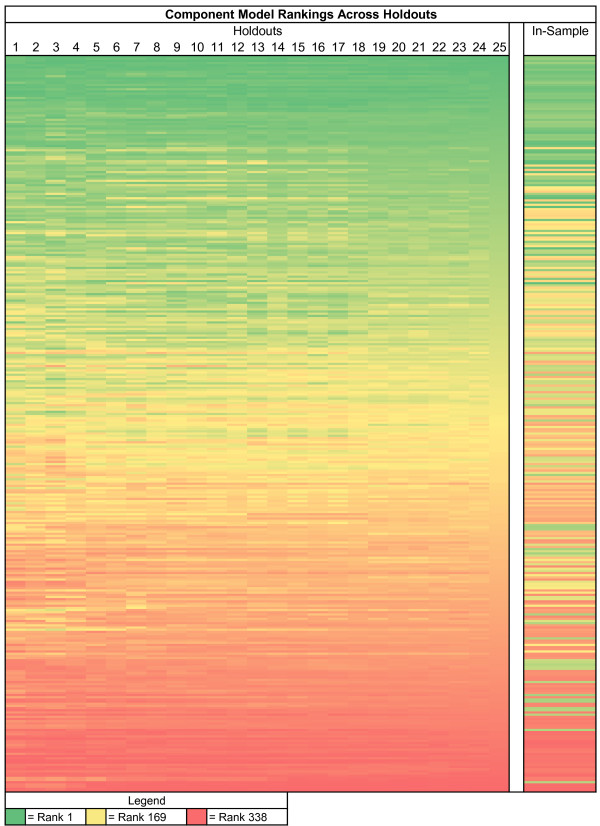
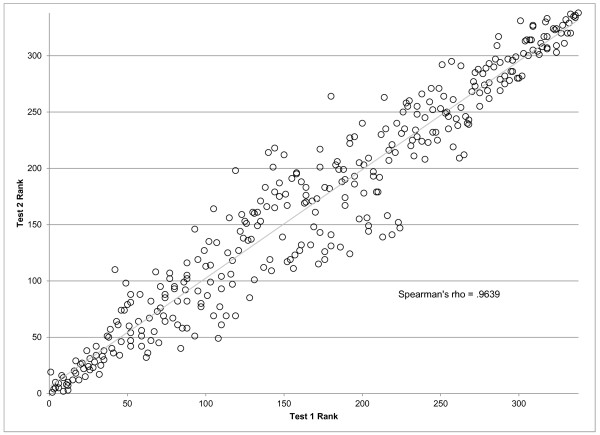
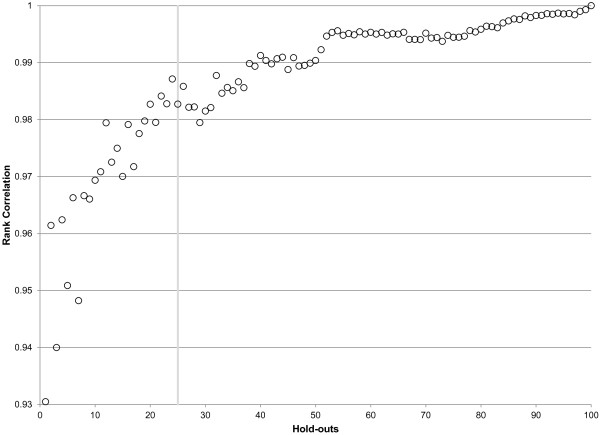
- Test-retest stability was high: the Pearson correlation for final mean log rates across two runs with 25 hold-outs was 0.9998; rankings stabilized after 25 hold-outs with rank correlation exceeding .98, and 40 hold-outs yielded rank correlations above 0.99.
Methods
- The paper proposes five principles for cause-of-death model development, validation, and reporting: identify all available data; maximize comparability and quality; develop a diverse set of plausible models; assess out-of-sample predictive validity; and choose the model or ensemble with the best performance.
- CODEm implements these principles using a covariate selection algorithm with level 1–3 covariates and directional priors, four model families (linear mixed effects and spatial-temporal Gaussian Process Regression models for ln death rates and logit cause fractions), and ensemble weighting based on out-of-sample performance.
- Predictive validity uses train–test 1–test 2 datasets (70%/15%/15%), 25 hold-outs, and metrics for RMSE of log death rates, correct temporal trend direction, and 95% prediction-interval coverage. The application uses the IHME cause-of-death database; maternal mortality had 4,563 site-years available for analysis.
Limitations
- Stated: the current implementation is limited to four modeling families; expanding the model pool would likely improve prediction but is constrained by computational power and time, with each model run taking approximately 600 hours of processor time (about 5,000 GFlops on their cluster). The approach cannot yet capture uncertainty from bias correction, outlier exclusion, or covariate measurement/forecasting, and garbage-code redistribution remains largely expert-opinion based.
- Stated: it is computationally intractable to compute full confidence intervals for every component model, and simultaneous modeling of all causes is infeasible due to computational restrictions, limitations on data usability, and analysis infeasibility.
- Evident: the paper notes that the exact set of top-performing models can vary between stochastic runs even when predictions are highly consistent, and that the approach depends critically on the database, covariate quality, and evidence on expected covariate relationships. Some cause-specific test-2 coverage values remain below 95% (e.g., male cardiovascular disease 0.853 and male lung cancer 0.841), though ensembles improved coverage over component models.
Model-written summary. Check it against the paper before relying on it.
Integrity signals
Registry
Cites
Statistics
Figures
Verification
Claims the paper makes
4 Valid · 1 Not valid · 18 Not checked · 82 Own results and interpretations
The cited sources support only part of this claim — read each source’s verdict below.
In the paper
“Instead, out-of-sample predictive validity is the appropriate measure [66,68-72].”
§ Modeling causes of death: an integrated approach using CODEm > Background > Principles for cause of death model development
What the sources say
- Partly supportedcites [66] 66. Hoeting JA Madigan D Raftery AE Volinsky CT Bayesian Model Averaging: A Tutorial Statistical Science 1999 14 382 401 10.1214/ss/1009212519 sourceExperimental — accuracy not yet measured
Section 6 (Predictive Performance) of Hoeting et al. (1999) endorses out-of-sample prediction as a way of judging modelling strategies, but hedges it as 'one way to judge the efficacy of a BMA strategy', not 'the appropriate measure'; Draper's discussion (Section 1, comment item 4) justifies the build/test framework as the way to evaluate predictive utility for future data. Nothing in our copy ties out-of-sample predictive validity to sparse or missing data — the 'when data are sparse or missing' condition in the citing sentence is not attributable to this source (our copy's only remarks on small samples concern n/p ratios and overfitting of the full model, not the choice of validation measure). (LLM, conf=0.72)
- Partly supportedcites [68] 68. King G "Truth" Is Stranger than Prediction, More Questionable than Causal Inference American Journal of Political Science 1991 35 1047 1053 10.2307/2111506 sourceExperimental — accuracy not yet measured
The 'Prediction' section (p. 4) of our copy does state that prediction supplies 'an unambiguous and uncontroversial standard for judging success' — comparing one's forecasts to future realizations, i.e. out-of-sample validation — and that R² and the specification tests are therefore irrelevant for that purpose. However, King attaches this to the purpose of forecasting generally, not to a condition of sparse or missing data; he nowhere conditions the standard on data scarcity (searches for 'sparse data / missing data / small samples' returned only unrelated discussion of leverage and observation counts, p. 3). The 'when data are sparse or missing' qualifier in the citing sentence is not supported by this source; indeed King adds that political scientists rarely forecast, so he sets the point aside. (LLM, conf=0.78)
- Not checked yetcites [69] 69. Power M The predictive validation of ecological and environmental models Ecological Modelling 1993 68 33 50 10.1016/0304-3800(93)90106-3 source
- Not checked yetcites [70] 70. Snee RD Validation of Regression Models: Methods and Examples Technometrics 1977 19 415 428 10.2307/1267881 source
- Not checked yetcites [71] 71. Dey DK Gelfand AE Swartz TB Vlachos PK A simulation-intensive approach for checking hierarchical models Test 1998 7 325 346 10.1007/BF02565116 source
- Not checked yetcites [72] 72. Tashman LJ Out-of-sample tests of forecasting accuracy: an analysis and review International Journal of Forecasting 16 437 450 source
plain- Asserted: passes — The authors put it forward as true.
- Checkable: passes — It can be checked against evidence.
- Load-bearing: passes — The paper’s conclusions depend on it.
- Based: passes — The paper gives a reason why it holds.
- Partly supported
The cited sources support only part of this claim — read each source’s verdict below.
In the paper
“In-sample fit is not a robust measure of prediction when data are sparse or missing.”
§ Modeling causes of death: an integrated approach using CODEm > Background > Principles for cause of death model development
What the sources say
- Partly supportedcites [66] 66. Hoeting JA Madigan D Raftery AE Volinsky CT Bayesian Model Averaging: A Tutorial Statistical Science 1999 14 382 401 10.1214/ss/1009212519 sourceExperimental — accuracy not yet measured
Section 6 (page not available) evaluates prediction on test data rather than the data used to fit the model. A commentary passage in “Model Uncertainty, Yes, Discrete Model Averaging, Maybe” (page not available) describes a 251-observation example in which a model overfits estimation cases and underperforms out of sample. This supports the concern about in-sample fit with limited data, but the passages do not establish the claim for missing data. (LLM, conf=0.82)
- Partly supportedcites [68] 68. King G "Truth" Is Stranger than Prediction, More Questionable than Causal Inference American Journal of Political Science 1991 35 1047 1053 10.2307/2111506 sourceExperimental — accuracy not yet measured
The Prediction section (p. 4) says that R² is irrelevant to judging predictive success and that a high R² can accompany poor out-of-sample predictions. It does not tie this point to sparse or missing data, so the claim’s condition is unsupported. (LLM, conf=0.86)
- Not checked yetcites [69] 69. Power M The predictive validation of ecological and environmental models Ecological Modelling 1993 68 33 50 10.1016/0304-3800(93)90106-3 source
- Not checked yetcites [70] 70. Snee RD Validation of Regression Models: Methods and Examples Technometrics 1977 19 415 428 10.2307/1267881 source
- Not checked yetcites [71] 71. Dey DK Gelfand AE Swartz TB Vlachos PK A simulation-intensive approach for checking hierarchical models Test 1998 7 325 346 10.1007/BF02565116 source
- Not checked yetcites [72] 72. Tashman LJ Out-of-sample tests of forecasting accuracy: an analysis and review International Journal of Forecasting 16 437 450 source
plain- Asserted: passes — The authors put it forward as true.
- Checkable: passes — It can be checked against evidence.
- Load-bearing: passes — The paper’s conclusions depend on it.
- Based: passes — The paper gives a reason why it holds.
- Partly supported
A result the paper reports from its own data — it cites no other source for it, so there is none to check. The quote shows it is in the paper.
In the paper
“Ensemble models for cause of death estimation outperform any single component model in tests of root mean square error, frequency of predicting correct temporal trends, and achieving 95% coverage of the prediction interval.”
§ Modeling causes of death: an integrated approach using CODEm > Abstract > Results
plain- Asserted: passes — The authors put it forward as true.
- Checkable: passes — It can be checked against evidence.
- Load-bearing: passes — The paper’s conclusions depend on it.
- Based: passes — The paper gives a reason why it holds.
A result the paper reports from its own data — it cites no other source for it, so there is none to check. The quote shows it is in the paper.
In the paper
“However, out of sample, the cause fraction models perform substantially better than the rates models.”
§ Modeling causes of death: an integrated approach using CODEm > Results
plainn = 2- Asserted: passes — The authors put it forward as true.
- Checkable: passes — It can be checked against evidence.
- Load-bearing: unclear — It is unclear whether the paper’s conclusions depend on it.
- Based: passes — The paper gives a reason why it holds.
A result the paper reports from its own data — it cites no other source for it, so there is none to check. The quote shows it is in the paper.
In the paper
“Extra hold-outs tend to further stabilize the ranking of the poorer performing models rather than change the order of the top models in this case.”
§ Modeling causes of death: an integrated approach using CODEm > Results
hedgedstates a cause- Asserted: passes — The authors put it forward as true.
- Checkable: passes — It can be checked against evidence.
- Load-bearing: unclear — It is unclear whether the paper’s conclusions depend on it.
- Based: passes — The paper gives a reason why it holds.
58 more claims
Create a free account to see all 105 claims and to verify the 66 references still open.
- It may state two separate claims as one. 26
- Probably not a substantial claim. 23
Claims other papers make about this one
Each is checked against this paper’s own text: does it say what the citing paper says it does?
The source backs part of the claim, not all of it — or backs it for a different population, condition or comparison.
In the citing paper
“This modelling approach has been used extensively in GBD to estimate time-varying risk factors.”
From Spatial, temporal, and demographic patterns in prevalence of smoking tobacco use and attributable disease burden in 204 countries and territories, 1990–2019: a systematic analysis from the Global Burden of Disease Study 2019 (2021) · cites this paper as [28]
Experimental — accuracy not yet measuredThe cited source says what the claim attributes to it.
In the citing paper
“we have changed our analytical approach (see below) to an ensemble modelling strategy to generate more realistic uncertainty intervals (UIs) and more accurate predictions.38”
In the citing paper
“For each neurological cause except dementia, we used the GBD Cause of Death Ensemble model (CODEm) strategy.10, 11”
From Global, regional, and national burden of neurological disorders during 1990–2015: a systematic analysis for the Global Burden of Disease Study 2015 (2017) · cites this paper as [11]
Self-check
Percentages, sums and reported differences re-computed from the paper’s own numbers.
Each contradiction between two passages listed here was confirmed by an independent check.
Rated major: it would touch a result — a value a result rests on, reported and recomputed p-values on opposite sides of the significance level, two passages that conflict with no sign which is right, or a cited work retracted before this paper was published.
In the paper
§ Modeling causes of death: an integrated approach using CODEm > Methods > Assessing predictive validity
“We similarly rank the ensemble models for different values of ψ on these two metrics and compute the sum of their ranks across hold-outs for test 2. We choose the value of ψ that minimizes the sum of ranks and use it to make our final set of predictions.”
§ Modeling causes of death: an integrated approach using CODEm > Methods > Assessing predictive validity
“The ensemble weighting scheme that achieves the best predictive validity metrics on test 1 is then used to create the final predictions. Its predictive validity is assessed along with the component models on the test 2 data.”
Rated major: it would touch a result — a value a result rests on, reported and recomputed p-values on opposite sides of the significance level, two passages that conflict with no sign which is right, or a cited work retracted before this paper was published.
In the paper
§ Modeling causes of death: an integrated approach using CODEm > Abstract > Results
“Ensemble models for cause of death estimation outperform any single component model in tests of root mean square error, frequency of predicting correct temporal trends, and achieving 95% coverage of the prediction interval.”
§ Modeling causes of death: an integrated approach using CODEm > Results
“| Lung cancer (male) | Ensemble | 0.359 | 0.769 | 0.714 | 0.599 | 0.993 | 0.841 | | | Best component model | 0.330 | 0.759 | 0.738 | 0.617 | 0.993 | 0.800 |”
Rated minor: it would not touch a result — a value no result rests on, a p-value that stays on the same side of the significance level, or a conflict that is clerical, resolved elsewhere in the paper, or outside its own findings.
In the paper
§ Modeling causes of death: an integrated approach using CODEm > Results
“The covariates for the best ranked model included the natural log of the total fertility rate, skilled birth attendance coverage, and the natural log of lag-distributed income per capita.”
§ Modeling causes of death: an integrated approach using CODEm > Results
“the best component model (the spatial-temporal model on logit(cause fraction) with covariates of age-specific fertility rate, the natural log of total fertility rate, and the natural log of lag-distributed income per capita)”
Citations
Cites
Regularization and Variable Selection Via the Elastic Net
Zou, H., & Hastie, T. (2005) · Journal of the Royal Statistical Society Series B: Statistical Methodology · doi:10.1111/j.1467-9868.2005.00503.x · Cited by 20,957
(1996) · Cited by 6,884
Self-citationStrictly Proper Scoring Rules, Prediction, and Estimation
Gneiting, T., & Raftery, A. E. (2007) · Journal of the American Statistical Association · doi:10.1198/016214506000001437 · Cited by 5,793 · cited 1×
“Ensemble models that are weighted combinations of the posterior distributions of component models provide lower error for the point estimate and more accurate uncertainty intervals [62-66].”
BackgroundGaussian Processes in Machine Learning
Rasmussen, C. E. (2004) · Lecture Notes in Computer Science · doi:10.1007/978-3-540-28650-9_4 · Cited by 5,397
Hoeting, J. A., Madigan, D., Raftery, A. E., & Volinsky, C. T. (1999) · Statistical Science · doi:10.1214/ss/1009212519 · Cited by 4,118
Finucane, M. M., Stevens, G. A., Cowan, M. J., Danaei, G., Lin, J. K., Paciorek, C. J., Singh, G. M., Gutierrez, H. R., Lu, Y., Bahalim, A. N., et al. (2011) · The Lancet · doi:10.1016/s0140-6736(10)62037-5 · Cited by 4,050
Gompertz, B. (1825) · Philosophical Transactions of the Royal Society of London · doi:10.1098/rstl.1825.0026 · Cited by 3,816
Danaei, G., Finucane, M. M., Lu, Y., Singh, G. M., Cowan, M. J., Paciorek, C. J., Lin, J. K., Farzadfar, F., Khang, Y.-H., Stevens, G. A., et al. (2011) · The Lancet · doi:10.1016/s0140-6736(11)60679-x · Cited by 3,568
Global Burden of Disease and Risk Factors
(2006) · World Bank, Washington, DC eBooks · doi:10.1596/978-0-8213-6262-4 · Cited by 2,605
Self-citationHigh dimensional graphs and variable selection with the Lasso
Meinshausen, N., & Bühlmann, P. (2006) · Cited by 2,539
Research works printed but not linked: 4
- 7. Jougla E Pavillon G Rossollin F De Smedt M Bonte J Improvement of the quality and comparability of causes-of-death statistics inside the European Community Rev Epidemiol Sante Publique 1998 46 447 56 9950045
- 9. World Health Organization Manual of the International Statistical Classification of Diseases, Injuries, and Causes of Death, 1975 Revision 1977 Geneva: World Health Organization
- 13. Rooney C Griffiths C Cook L The implementation of ICD-10 for cause of death coding-some preliminary results from the bridge coding study Health Statistics Quarterly 2002 13 31 41
- 53. Mathers C Bernard C Iburg K Inoue M Ma Fat D Shibuya K Stein C Tomijima N Xu H Global burden of disease in 2002: data sources, methods and results 2003 Geneva: GPE Discussion PAper- No. 54-World Health Organization
Cited by
Lozano, R., Naghavi, M., Foreman, K., Lim, S., Shibuya, K., Aboyans, V., Abraham, J., Adair, T., Aggarwal, R., Ahn, S. Y., et al. (2012) · The Lancet · doi:10.1016/s0140-6736(12)61728-0 · Cited by 14,070
Self-citationLim, S. S., Vos, T., Flaxman, A. D., Danaei, G., Shibuya, K., Adair-Rohani, H., AlMazroa, M. A., Amann, M., Anderson, H. R., Andrews, K. G., et al. (2012) · The Lancet · doi:10.1016/s0140-6736(12)61766-8 · Cited by 11,805
Wang, H., Naghavi, M., Allen, C., Barber, R. M., Bhutta, Z. A., Carter, A., Casey, D. C., Charlson, F. J., Chen, A. Z., Coates, M. M., et al. (2016) · The Lancet · doi:10.1016/s0140-6736(16)31012-1 · Cited by 6,596
Self-citationGlobal Burden of Disease Cancer Collaboration, Fitzmaurice, C., Allen, C., Barber, R. M., Barregard, L., Bhutta, Z. A., Brenner, H., Dicker, D. J., Chimed-Orchir, O., Dandona, R., et al. (2017) · JAMA Oncology · doi:10.1001/jamaoncol.2016.5688 · Cited by 6,215
Self-citationFeigin, V. L., Nichols, E., Alam, T., Bannick, M. S., Beghi, E., Blake, N., Culpepper, W. J., Dorsey, E. R., Elbaz, A., Ellenbogen, R. G., et al. (2019) · The Lancet Neurology · doi:10.1016/s1474-4422(18)30499-x · Cited by 5,644
Self-citationWorldwide Epidemiology of Atrial Fibrillation: A Global Burden of Disease 2010 Study
Chugh, S. S., Havmoeller, R., Narayanan, K., Singh, D., Rienstra, M., Benjamin, E. J., Gillum, R. F., Kim, Y.-H., McAnulty, J. H., Zheng, Z.-J., et al. (2014) · Circulation · doi:10.1161/circulationaha.113.005119 · Cited by 4,506
“External validity criteria were used to rank all models and to produce ensemble results.(23) The covariates and external validity of the ensemble model are reported in Appendix IV (Tables I and II in the online-only Data Supplement).”
Self-citationKyu, H. H., Abate, D., Abate, K. H., Abay, S. M., Abbafati, C., Abbasi, N., Abbastabar, H., Abd-Allah, F., Abdela, J., Abdelalim, A., et al. (2018) · The Lancet · doi:10.1016/s0140-6736(18)32335-3 · Cited by 4,081
Feigin, V. L., Forouzanfar, M. H., Krishnamurthi, R., Mensah, G. A., Connor, M., Bennett, D. A., Moran, A. E., Sacco, R. L., Anderson, L., Truelsen, T., et al. (2014) · The Lancet · doi:10.1016/s0140-6736(13)61953-4 · Cited by 3,899
Self-citationThe Global Burden of Cancer 2013
Fitzmaurice, C., Dicker, D., Pain, A., Hamavid, H., Moradi-Lakeh, M., MacIntyre, M. F., Allen, C., Hansen, G., Woodbrook, R., Wolfe, C., et al. (2015) · JAMA Oncology · doi:10.1001/jamaoncol.2015.0735 · Cited by 2,707
Global Burden of Disease Cancer Collaboration, Fitzmaurice, C., Abate, D., Abbasi, N., Abbastabar, H., Abd-Allah, F., Abdel-Rahman, O., Abdelalim, A., Abdoli, A., Abdollahpour, I., et al. (2019) · JAMA Oncology · doi:10.1001/jamaoncol.2019.2996 · Cited by 2,501
Nichols, E., Szoeke, C. E. I., Vollset, S. E., Abbasi, N., Abd-Allah, F., Abdela, J., Aichour, M. T. E., Akinyemi, R. O., Alahdab, F., Asgedom, S. W., et al. (2019) · The Lancet Neurology · doi:10.1016/s1474-4422(18)30403-4 · Cited by 2,412
Self-citationFeigin, V. L., Abajobir, A. A., Abate, K. H., Abd-Allah, F., Abdulle, A. M., Abera, S. F., Abyu, G. Y., Ahmed, M. B., Aichour, A. N., Aichour, I., et al. (2017) · The Lancet Neurology · doi:10.1016/s1474-4422(17)30299-5 · Cited by 2,275
Self-citationGlobal Burden of Disease 2019 Cancer Collaboration, Kocarnik, J. M., Compton, K., Dean, F. E., Fu, W., Gaw, B. L., Harvey, J. D., Henrikson, H. J., Lu, D., Pennini, A., et al. (2022) · JAMA Oncology · doi:10.1001/jamaoncol.2021.6987 · Cited by 2,026
Troeger, C., Blacker, B., Khalil, I. A., Rao, P. C., Cao, J., Zimsen, S. R. M., Albertson, S. B., Deshpande, A., Farag, T., Abebe, Z., et al. (2018) · The Lancet Infectious Diseases · doi:10.1016/s1473-3099(18)30310-4 · Cited by 1,968
Self-citationJames, S. L., Theadom, A., Ellenbogen, R. G., Bannick, M. S., Montjoy-Venning, W., Lucchesi, L. R., Abbasi, N., Abdulkader, R., Abraha, H. N., Adsuar, J. C., et al. (2019) · The Lancet Neurology · doi:10.1016/s1474-4422(18)30415-0 · Cited by 2,001
Global Burden of Disease Liver Cancer Collaboration, Akinyemiju, T., Abera, S., Ahmed, M., Alam, N., Alemayohu, M. A., Allen, C., Al-Raddadi, R., Alvis-Guzman, N., Amoako, Y., et al. (2017) · JAMA Oncology · doi:10.1001/jamaoncol.2017.3055 · Cited by 1,987
Self-citationMurray, C. J. L., Barber, R. M., Foreman, K. J., Ozgoren, A. A., Abd-Allah, F., Abera, S. F., Aboyans, V., Abraham, J. P., Abubakar, I., Abu-Raddad, L. J., et al. (2015) · The Lancet · doi:10.1016/s0140-6736(15)61340-x · Cited by 1,964
Self-citationInhorn, M. C., & Patrizio, P. (2015) · Human Reproduction Update · doi:10.1093/humupd/dmv016 · Cited by 1,926
Measuring the global burden of disease
Murray, C. J. L., & Lopez, A. D. (2013) · New England Journal of Medicine · doi:10.1056/nejmra1201534 · Cited by 1,818
Self-citationReitsma, M. B., Kendrick, P. J., Ababneh, E., Abbafati, C., Abbasi-Kangevari, M., Abdoli, A., Abedi, A., Abhilash, E. S., Abila, D. B., Aboyans, V., et al. (2021) · The Lancet · doi:10.1016/s0140-6736(21)01169-7 · Cited by 1,759
Self-citationSepanlou, S. G., Safiri, S., Bisignano, C., Ikuta, K. S., Merat, S., Saberifiroozi, M., Poustchi, H., Tsoi, D., Colombara, D. V., Abdoli, A., et al. (2020) · The Lancet Gastroenterology & Hepatology · doi:10.1016/s2468-1253(19)30349-8 · Cited by 1,714
Self-citationKassebaum, N. J., Bertozzi-Villa, A., Coggeshall, M. S., Shackelford, K. A., Steiner, C., Heuton, K. R., Gonzalez-Medina, D., Barber, R., Huynh, C., Dicker, D., et al. (2014) · The Lancet · doi:10.1016/s0140-6736(14)60696-6 · Cited by 1,644
Self-citationTroeger, C., Blacker, B. F., Khalil, I. A., Rao, P. C., Cao, S., Zimsen, S. R., Albertson, S. B., Stanaway, J. D., Deshpande, A., Abebe, Z., et al. (2018) · The Lancet Infectious Diseases · doi:10.1016/s1473-3099(18)30362-1 · Cited by 1,476
Self-citationGlobal Burden of Disease Cancer Collaboration, Fitzmaurice, C., Akinyemiju, T. F., Al Lami, F. H., Alam, T., Alizadeh-Navaei, R., Allen, C., Alsharif, U., Alvis-Guzman, N., Amini, E., et al. (2018) · JAMA Oncology · doi:10.1001/jamaoncol.2018.2706 · Cited by 1,518
Self-citationZhou, M., Wang, H., Zhu, J., Chen, W., Wang, L., Liu, S., Li, Y., Wang, L., Liu, Y., Yin, P., et al. (2016) · The Lancet · doi:10.1016/s0140-6736(15)00551-6 · Cited by 1,464
Self-citationXie, Y., Bowe, B., Mokdad, A. H., Xian, H., Yan, Y., Li, T., Maddukuri, G., Tsai, C.-Y., Floyd, T., & Al-Aly, Z. (2018) · Kidney International · doi:10.1016/j.kint.2018.04.011 · Cited by 1,391
Troeger, C., Forouzanfar, M., Rao, P. C., Khalil, I., Brown, A., Reiner, R. C., Fullman, N., Thompson, R. L., Abajobir, A., Ahmed, M., et al. (2017) · The Lancet Infectious Diseases · doi:10.1016/s1473-3099(17)30276-1 · Cited by 1,398
Self-citationGlobal malaria mortality between 1980 and 2010: a systematic analysis
Murray, C. J., Rosenfeld, L. C., Lim, S. S., Andrews, K. G., Foreman, K. J., Haring, D., Fullman, N., Naghavi, M., Lozano, R., & Lopez, A. D. (2012) · The Lancet · doi:10.1016/s0140-6736(12)60034-8 · Cited by 1,452
Self-citationKrishnamurthi, R. V., Feigin, V. L., Forouzanfar, M. H., Mensah, G. A., Connor, M., Bennett, D. A., Moran, A. E., Sacco, R. L., Anderson, L. M., Truelsen, T., et al. (2013) · The Lancet Global Health · doi:10.1016/s2214-109x(13)70089-5 · Cited by 1,350
Self-citationDemographic and epidemiologic drivers of global cardiovascular mortality
Roth, G. A., Forouzanfar, M. H., Moran, A. E., Barber, R., Nguyen, G., Feigin, V. L., Naghavi, M., Mensah, G. A., & Murray, C. J. L. (2015) · New England Journal of Medicine · doi:10.1056/nejmoa1406656 · Cited by 1,188
Self-citationThe global burden of dengue: an analysis from the Global Burden of Disease Study 2013
Stanaway, J. D., Shepard, D. S., Undurraga, E. A., Halasa, Y. A., Coffeng, L. E., Brady, O. J., Hay, S. I., Bedi, N., Bensenor, I. M., Castañeda-Orjuela, C. A., et al. (2016) · The Lancet Infectious Diseases · doi:10.1016/s1473-3099(16)00026-8 · Cited by 1,124
Self-citationHotez, P. J., Alvarado, M., Basáñez, M.-G., Bolliger, I., Bourne, R., Boussinesq, M., Brooker, S. J., Brown, A. S., Buckle, G., Budke, C. M., et al. (2014) · PLoS Neglected Tropical Diseases · doi:10.1371/journal.pntd.0002865 · Cited by 1,082
Self-citationLiver cirrhosis mortality in 187 countries between 1980 and 2010: a systematic analysis
Mokdad, A. A., Lopez, A. D., Shahraz, S., Lozano, R., Mokdad, A. H., Stanaway, J., Murray, C. J., & Naghavi, M. (2014) · BMC Medicine · doi:10.1186/s12916-014-0145-y · Cited by 1,129
“For each retained covariate combination, we developed four statistical models: (1) mixed effects linear models of the log of the death rate; (2) mixed effects linear models of the logit of the cause fraction; (3) spatial-temporal Gaussian process regression (ST-GPR) models of the log of the death rate; and (4) ST-GPR…”
BackgroundMethodInfluentialSelf-citationMurray, C. J. L., Ortblad, K. F., Guinovart, C., Lim, S. S., Wolock, T. M., Roberts, D. A., Dansereau, E. A., Graetz, N., Barber, R. M., Brown, J. C., et al. (2014) · The Lancet · doi:10.1016/s0140-6736(14)60844-8 · Cited by 975
Self-citationTran, K. B., Lang, J. J., Compton, K., Xu, R., Acheson, A. R., Henrikson, H. J., Kocarnik, J. M., Penberthy, L., Aali, A., Abbas, Q., et al. (2022) · The Lancet · doi:10.1016/s0140-6736(22)01438-6 · Cited by 954
Global and Regional Patterns in Cardiovascular Mortality From 1990 to 2013
Roth, G. A., Huffman, M. D., Moran, A. E., Feigin, V., Mensah, G. A., Naghavi, M., & Murray, C. J. L. (2015) · Circulation · doi:10.1161/circulationaha.114.008720 · Cited by 889
Self-citationTroeger, C., Khalil, I. A., Rao, P. C., Cao, S., Blacker, B. F., Ahmed, T., Armah, G., Bines, J. E., Brewer, T. G., Colombara, D. V., et al. (2018) · JAMA Pediatrics · doi:10.1001/jamapediatrics.2018.1960 · Cited by 849
Self-citationThe Global Burden of Disease Study at 30 years
Murray, C. J. L. (2022) · Nature Medicine · doi:10.1038/s41591-022-01990-1 · Cited by 856
Self-citationSheena, B. S., Hiebert, L., Han, H., Ippolito, H., Abbasi-Kangevari, M., Abbasi-Kangevari, Z., Abbastabar, H., Abdoli, A., Abubaker Ali, H., Adane, M. M., et al. (2022) · The Lancet Gastroenterology & Hepatology · doi:10.1016/s2468-1253(22)00124-8 · Cited by 805
Momtazmanesh, S., Moghaddam, S. S., Ghamari, S.-H., Rad, E. M., Rezaei, N., Shobeiri, P., Aali, A., Abbasi-Kangevari, M., Abbasi-Kangevari, Z., Abdelmasseh, M., et al. (2023) · eClinicalMedicine · doi:10.1016/j.eclinm.2023.101936 · Cited by 810
Paik, J. M., Golabi, P., Younossi, Y., Mishra, A., & Younossi, Z. M. (2020) · Hepatology · doi:10.1002/hep.31173 · Cited by 788
Troeger, C., Forouzanfar, M., Rao, P. C., Khalil, I., Brown, A., Swartz, S., Fullman, N., Mosser, J., Thompson, R. L., Reiner, R. C., et al. (2017) · The Lancet Infectious Diseases · doi:10.1016/s1473-3099(17)30396-1 · Cited by 764
Self-citationWang, H., Bhutta, Z. A., Coates, M. M., Coggeshall, M., Dandona, L., Diallo, K., Franca, E. B., Fraser, M., Fullman, N., Gething, P. W., et al. (2016) · The Lancet · doi:10.1016/s0140-6736(16)31575-6 · Cited by 770
Self-citationKhalil, I. A., Troeger, C., Blacker, B. F., Rao, P. C., Brown, A., Atherly, D. E., Brewer, T. G., Engmann, C. M., Houpt, E. R., Kang, G., et al. (2018) · The Lancet Infectious Diseases · doi:10.1016/s1473-3099(18)30475-4 · Cited by 710
Self-citationThomson, A. M., McHugh, T. A., Oron, A. P., Teply, C., Lonberg, N., Vilchis Tella, V., Wilner, L. B., Fuller, K., Hagins, H., Aboagye, R. G., et al. (2023) · The Lancet Haematology · doi:10.1016/s2352-3026(23)00118-7 · Cited by 747
Pourshams, A., Sepanlou, S. G., Ikuta, K. S., Bisignano, C., Safiri, S., Roshandel, G., Sharif, M., Khatibian, M., Fitzmaurice, C., Nixon, M. R., et al. (2019) · The Lancet Gastroenterology & Hepatology · doi:10.1016/s2468-1253(19)30347-4 · Cited by 658
Patel, A. P., Fisher, J. L., Nichols, E., Abd-Allah, F., Abdela, J., Abdelalim, A., Abraha, H. N., Agius, D., Alahdab, F., Alam, T., et al. (2019) · The Lancet Neurology · doi:10.1016/s1474-4422(18)30468-x · Cited by 647
Self-citationEtemadi, A., Safiri, S., Sepanlou, S. G., Ikuta, K., Bisignano, C., Shakeri, R., Amani, M., Fitzmaurice, C., Nixon, M., Abbasi, N., et al. (2020) · The Lancet Gastroenterology & Hepatology · doi:10.1016/s2468-1253(19)30328-0 · Cited by 635
Self-citationKamangar, F., Nasrollahzadeh, D., Safiri, S., Sepanlou, S. G., Fitzmaurice, C., Ikuta, K. S., Bisignano, C., Islami, F., Roshandel, G., Lim, S. S., et al. (2020) · The Lancet Gastroenterology & Hepatology · doi:10.1016/s2468-1253(20)30007-8 · Cited by 641
Self-citationGlobal Burden of Disease Pediatrics Collaboration, Kyu, H. H., Pinho, C., Wagner, J. A., Brown, J. C., Bertozzi-Villa, A., Charlson, F. J., Coffeng, L. E., Dandona, L., Erskine, H. E., et al. (2016) · JAMA Pediatrics · doi:10.1001/jamapediatrics.2015.4276 · Cited by 618
Self-citationGlobal Burden of Multiple Myeloma: A Systematic Analysis for the Global Burden of Disease Study 2016
Cowan, A. J., Allen, C., Barac, A., Basaleem, H., Bensenor, I., Curado, M. P., Foreman, K., Gupta, R., Harvey, J., Hosgood, H. D., et al. (2018) · JAMA Oncology · doi:10.1001/jamaoncol.2018.2128 · Cited by 631
Self-citationBurden of Neurological Disorders Across the US From 1990-2017: A Global Burden of Disease Study
Collaborators, G. 2. U. N. D., Feigin, V. L., Vos, T., Alahdab, F., Amit, A. M. L., Bärnighausen, T. W., Beghi, E., Beheshti, M., Chavan, P. P., Criqui, M. H., et al. (2021) · JAMA Neurology · doi:10.1001/jamaneurol.2020.4152 · Cited by 622
Self-citationTroeger, C. E., Blacker, B. F., Khalil, I. A., Zimsen, S. R. M., Albertson, S. B., Abate, D., Abdela, J., Adhikari, T. B., Aghayan, S. A., Agrawal, S., et al. (2019) · The Lancet Respiratory Medicine · doi:10.1016/s2213-2600(18)30496-x · Cited by 576
Self-citationJames, S. L., Lucchesi, L. R., Bisignano, C., Castle, C. D., Dingels, Z. V., Fox, J. T., Hamilton, E. B., Henry, N. J., Krohn, K. J., Liu, Z., et al. (2020) · Injury Prevention · doi:10.1136/injuryprev-2019-043286 · Cited by 566
Self-citationBender, R. G., Sirota, S. B., Swetschinski, L. R., Dominguez, R.-M. V., Novotney, A., Wool, E. E., Ikuta, K. S., Vongpradith, A., Rogowski, E. L. B., Doxey, M., et al. (2024) · The Lancet Infectious Diseases · doi:10.1016/s1473-3099(24)00176-2 · Cited by 596
Self-citationMoran, A. E., Forouzanfar, M. H., Roth, G. A., Mensah, G. A., Ezzati, M., Murray, C. J. L., & Naghavi, M. (2014) · Circulation · doi:10.1161/circulationaha.113.004042 · Cited by 575
Self-citationLozano, R., Fullman, N., Abate, D., Abay, S. M., Abbafati, C., Abbasi, N., Abbastabar, H., Abd-Allah, F., Abdela, J., Abdelalim, A., et al. (2018) · The Lancet · doi:10.1016/s0140-6736(18)32281-5 · Cited by 538
Self-citationLi, N., Deng, Y., Zhou, L., Tian, T., Yang, S., Wu, Y., Zheng, Y., Zhai, Z., Hao, Q., Song, D., et al. (2019) · Journal of Hematology & Oncology · doi:10.1186/s13045-019-0828-0 · Cited by 462
Chang, A. Y., Cowling, K., Micah, A. E., Chapin, A., Chen, C. S., Ikilezi, G., Sadat, N., Tsakalos, G., Wu, J., Younker, T., et al. (2019) · The Lancet · doi:10.1016/s0140-6736(19)30841-4 · Cited by 520
Self-citationKhalil, I. A., Troeger, C., Rao, P. C., Blacker, B. F., Brown, A., Brewer, T. G., Colombara, D. V., De Hostos, E. L., Engmann, C., Guerrant, R. L., et al. (2018) · The Lancet Global Health · doi:10.1016/s2214-109x(18)30283-3 · Cited by 483
Doxsey-Whitfield, E., MacManus, K., Adamo, S. B., Pistolesi, L., Squires, J., Borkovska, O., & Baptista, S. R. (2015) · Papers in Applied Geography · doi:10.1080/23754931.2015.1014272 · Cited by 480
Childhood cancer burden: a review of global estimates
Bhakta, N., Force, L. M., Allemani, C., Atun, R., Bray, F., Coleman, M. P., Steliarova-Foucher, E., Frazier, A. L., Robison, L. L., Rodriguez-Galindo, C., et al. (2019) · The Lancet Oncology · doi:10.1016/s1470-2045(18)30761-7 · Cited by 488
Dhillon, P. K., Mathur, P., Nandakumar, A., Fitzmaurice, C., Kumar, G. A., Mehrotra, R., Shukla, D. K., Rath, G. K., Gupta, P. C., Swaminathan, R., et al. (2018) · The Lancet Oncology · doi:10.1016/s1470-2045(18)30447-9 · Cited by 491
Self-citationForce, L. M., Kocarnik, J. M., May, M. L., Bhangdia, K., Crist, A., Penberthy, L., Pritchett, N., Acheson, A., Deitesfeld, L., A, B., et al. (2025) · The Lancet · doi:10.1016/s0140-6736(25)01635-6 · Cited by 494
Self-citationYadgir, S., Johnson, C. O., Aboyans, V., Adebayo, O. M., Adedoyin, R. A., Afarideh, M., Alahdab, F., Alashi, A., Alipour, V., Arabloo, J., et al. (2020) · Circulation · doi:10.1161/circulationaha.119.043391 · Cited by 490
Weiss, D. J., Lucas, T. C. D., Nguyen, M., Nandi, A. K., Bisanzio, D., Battle, K. E., Cameron, E., Twohig, K. A., Pfeffer, D. A., Rozier, J. A., et al. (2019) · The Lancet · doi:10.1016/s0140-6736(19)31097-9 · Cited by 469
Self-citationThe global burden of melanoma: results from the Global Burden of Disease Study 2015
Karimkhani, C., Green, A. C., Nijsten, T., Weinstock, M. A., Dellavalle, R. P., Naghavi, M., & Fitzmaurice, C. (2017) · British Journal of Dermatology · doi:10.1111/bjd.15510 · Cited by 436
Kyu, H. H., Maddison, E. R., Henry, N. J., Ledesma, J. R., Wiens, K. E., Reiner, R., Biehl, M. H., Shields, C., Osgood-Zimmerman, A., Ross, J. M., et al. (2018) · The Lancet Infectious Diseases · doi:10.1016/s1473-3099(18)30625-x · Cited by 437
Self-citationSafiri, S., Kolahi, A., Cross, M., Hill, C., Smith, E., Carson‐Chahhoud, K., Mansournia, M. A., Almasi‐Hashiani, A., Ashrafi‐Asgarabad, A., Kaufman, J., et al. (2021) · Arthritis & Rheumatology · doi:10.1002/art.41571 · Cited by 385
Force, L. M., Abdollahpour, I., Advani, S. M., Agius, D., Ahmadian, E., Alahdab, F., Alam, T., Alebel, A., Alipour, V., Allen, C. A., et al. (2019) · The Lancet Oncology · doi:10.1016/s1470-2045(19)30339-0 · Cited by 401
Self-citationGlobal Burden of Urologic Cancers, 1990–2013
Dy, G. W., Gore, J. L., Forouzanfar, M. H., Naghavi, M., & Fitzmaurice, C. (2017) · European Urology · doi:10.1016/j.eururo.2016.10.008 · Cited by 373
Degenhardt, L., Charlson, F., Mathers, B., Hall, W. D., Flaxman, A. D., Johns, N., & Vos, T. (2014) · Addiction · doi:10.1111/add.12551 · Cited by 396
The global burden of tuberculosis: results from the Global Burden of Disease Study 2015
Kyu, H. H., Maddison, E. R., Henry, N. J., Mumford, J. E., Barber, R., Shields, C., Brown, J. C., Nguyen, G., Carter, A., Wolock, T. M., et al. (2018) · The Lancet Infectious Diseases · doi:10.1016/s1473-3099(17)30703-x · Cited by 376
Newton, J. N., Briggs, A. D. M., Murray, C. J. L., Dicker, D., Foreman, K. J., Wang, H., Naghavi, M., Forouzanfar, M. H., Ohno, S. L., Barber, R. M., et al. (2015) · The Lancet · doi:10.1016/s0140-6736(15)00195-6 · Cited by 345
Self-citationMensah, G., Roth, G., Sampson, U., Moran, A., Feigin, V., Forouzanfar, M., Naghavi, M., & Murray, C. (2015) · Cardiovascular Journal Of Africa · doi:10.5830/cvja-2015-036 · Cited by 331
Kyu, H. H., Vongpradith, A., Sirota, S. B., Novotney, A., Troeger, C. E., Doxey, M. C., Bender, R. G., Ledesma, J. R., Biehl, M. H., Albertson, S. B., et al. (2022) · The Lancet Infectious Diseases · doi:10.1016/s1473-3099(22)00510-2 · Cited by 330
Trends in Life Expectancy and Lifespan Variation by Educational Attainment: United States, 1990–2010
Sasson, I. (2016) · Demography · doi:10.1007/s13524-015-0453-7 · Cited by 299
Golding, N., Burstein, R., Longbottom, J., Browne, A. J., Fullman, N., Osgood-Zimmerman, A., Earl, L., Bhatt, S., Cameron, E., Casey, D. C., et al. (2017) · The Lancet · doi:10.1016/s0140-6736(17)31758-0 · Cited by 304
Self-citationDegenhardt, L., Charlson, F., Stanaway, J., Larney, S., Alexander, L. T., Hickman, M., Cowie, B., Hall, W. D., Strang, J., Whiteford, H., et al. (2016) · The Lancet Infectious Diseases · doi:10.1016/s1473-3099(16)30325-5 · Cited by 305
Sampson, U. K. A., Norman, P. E., Fowkes, F. G. R., Aboyans, V., Song, Y., Harrell Jr., F. E., Forouzanfar, M. H., Naghavi, M., Denenberg, J. O., McDermott, M. M., et al. (2014) · Global Heart · doi:10.1016/j.gheart.2013.12.010 · Cited by 298
Self-citationAlvarez, E. M., Force, L. M., Xu, R., Compton, K., Lu, D., Henrikson, H. J., Kocarnik, J. M., Harvey, J. D., Pennini, A., Dean, F. E., et al. (2022) · The Lancet Oncology · doi:10.1016/s1470-2045(21)00581-7 · Cited by 286
Sampson, U. K. A., Fowkes, F. G. R., McDermott, M. M., Criqui, M. H., Aboyans, V., Norman, P. E., Forouzanfar, M. H., Naghavi, M., Song, Y., Harrell Jr., F. E., et al. (2014) · Global Heart · doi:10.1016/j.gheart.2013.12.008 · Cited by 289
Self-citationKim, M. S., Hwang, J., Yon, D. K., Lee, S. W., Jung, S. Y., Park, S., Johnson, C. O., Stark, B. A., Razo, C., Abbasian, M., et al. (2023) · The Lancet Global Health · doi:10.1016/s2214-109x(23)00355-8 · Cited by 268
Martinez, R., Lloyd-Sherlock, P., Soliz, P., Ebrahim, S., Vega, E., Ordunez, P., & McKee, M. (2020) · The Lancet Global Health · doi:10.1016/s2214-109x(20)30035-8 · Cited by 244
Dieleman, J. L., Sadat, N., Chang, A. Y., Fullman, N., Abbafati, C., Acharya, P., Adou, A. K., Ahmad Kiadaliri, A., Alam, K., Alizadeh-Navaei, R., et al. (2018) · The Lancet · doi:10.1016/s0140-6736(18)30697-4 · Cited by 240
Self-citationMboi, N., Murty Surbakti, I., Trihandini, I., Elyazar, I., Houston Smith, K., Bahjuri Ali, P., Kosen, S., Flemons, K., Ray, S. E., Cao, J., et al. (2018) · The Lancet · doi:10.1016/s0140-6736(18)30595-6 · Cited by 233
Self-citationGBD 2010: a multi-investigator collaboration for global comparative descriptive epidemiology
Murray, C. J., Ezzati, M., Flaxman, A. D., Lim, S., Lozano, R., Michaud, C., Naghavi, M., Salomon, J. A., Shibuya, K., Vos, T., et al. (2012) · The Lancet · doi:10.1016/s0140-6736(12)62134-5 · Cited by 240
Self-citationEbrahimi, H., Aryan, Z., Saeedi Moghaddam, S., Bisignano, C., Rezaei, S., Pishgar, F., Force, L. M., Abolhassani, H., Abu-Gharbieh, E., Advani, S. M., et al. (2021) · The Lancet Respiratory Medicine · doi:10.1016/s2213-2600(21)00164-8 · Cited by 237
Self-citationNational spending on health by source for 184 countries between 2013 and 2040
Dieleman, J. L., Templin, T., Sadat, N., Reidy, P., Chapin, A., Foreman, K., Haakenstad, A., Evans, T., Murray, C. J. L., & Kurowski, C. (2016) · The Lancet · doi:10.1016/s0140-6736(16)30167-2 · Cited by 232
Self-citationFranklin, R. C., Peden, A. E., Hamilton, E. B., Bisignano, C., Castle, C. D., Dingels, Z. V., Hay, S. I., Liu, Z., Mokdad, A. H., Roberts, N. L. S., et al. (2020) · Injury Prevention · doi:10.1136/injuryprev-2019-043484 · Cited by 221
Self-citationZhang, S., Gong, T.-T., Liu, F.-H., Jiang, Y.-T., Sun, H., Ma, X.-X., Zhao, Y.-H., & Wu, Q.-J. (2019) · Frontiers in Oncology · doi:10.3389/fonc.2019.01440 · Cited by 229
Estimates of Global and Regional Premature Cardiovascular Mortality in 2025
Roth, G. A., Nguyen, G., Forouzanfar, M. H., Mokdad, A. H., Naghavi, M., & Murray, C. J. L. (2015) · Circulation · doi:10.1161/circulationaha.115.016021 · Cited by 225
“The methods for GBD 2013 have been published elsewhere.(1,5,6) In brief, the GBD 2013 study used all available data, including vital records and sample vital registration, to estimate age-, sex-, and cause-specific mortality in 188 countries resulting from 240 diseases for the years 1990 to 2013.”
MethodSelf-citationDieleman, J. L., Campbell, M., Chapin, A., Eldrenkamp, E., Fan, V. Y., Haakenstad, A., Kates, J., Li, Z., Matyasz, T., Micah, A., et al. (2017) · The Lancet · doi:10.1016/s0140-6736(17)30873-5 · Cited by 221
Self-citationWunrow, H. Y., Bender, R. G., Vongpradith, A., Sirota, S. B., Swetschinski, L. R., Novotney, A., Gray, A. P., Ikuta, K. S., Sharara, F., Wool, E. E., et al. (2023) · The Lancet Neurology · doi:10.1016/s1474-4422(23)00195-3 · Cited by 219
James, S. L., Castle, C. D., Dingels, Z. V., Fox, J. T., Hamilton, E. B., Liu, Z., S Roberts, N. L., Sylte, D. O., Henry, N. J., LeGrand, K. E., et al. (2020) · Injury Prevention · doi:10.1136/injuryprev-2019-043494 · Cited by 219
Kyu, H. H., Vongpradith, A., Dominguez, R.-M. V., Ma, J., Albertson, S. B., Novotney, A., Khalil, I. A., Troeger, C. E., Doxey, M. C., Ledesma, J. R., et al. (2025) · The Lancet Infectious Diseases · doi:10.1016/s1473-3099(24)00691-1 · Cited by 217
Nomura, S., Sakamoto, H., Glenn, S., Tsugawa, Y., Abe, S. K., Rahman, M. M., Brown, J. C., Ezoe, S., Fitzmaurice, C., Inokuchi, T., et al. (2017) · The Lancet · doi:10.1016/s0140-6736(17)31544-1 · Cited by 216
Self-citationSharma, R. (2019) · Breast Cancer · doi:10.1007/s12282-018-00941-4 · Cited by 215
Troeger, C. E., Khalil, I. A., Blacker, B. F., Biehl, M. H., Albertson, S. B., Zimsen, S. R. M., Rao, P. C., Abate, D., Ahmadi, A., Ahmed, M. L. C. B., et al. (2020) · The Lancet Infectious Diseases · doi:10.1016/s1473-3099(19)30401-3 · Cited by 210
Self-citation
Metadata
- Authors
- Foreman, K. J., Lozano, R., Lopez, A. D., & Murray, C. J.
- Affiliations
- University of Washington (US)
- Corresponding author
- Murray, Christopher JL
- Venue
- Population Health Metrics
- Published
- 2012-01-06
- Volume
- 10
- Issue
- 1
- Pages
- 1-1
- ISSN
- 1478-7954 (ISSN-L)
- PMC
- PMC3315398
- OpenAlex
- W2136007084
- Semantic Scholar
- eb3d44dbe8e0cd3d6ab02e5c108c8de2752ec010
- Cited by
- 564
- References
- 107
- Citations by year
- 2026: 52 · 2025: 63 · 2024: 64 · 2023: 35 · 2022: 48 · 2021: 44 · 2020: 38 · 2019: 38 · 2018: 38 · 2017: 46 · 2016: 31 · 2015: 27 · 2014: 22 · 2013: 11 · 2012: 5
- FWCI
- 52.27
- Type
- journal article
- Language
- en
- Open access
- gold
- doi.org
- Licence
- Locations
- Population Health Metrics (publishedVersion, cc-by)
- Europe PMC (PubMed Central) (publishedVersion, cc-by)
- PubMed Central (publishedVersion, cc-by)
- PubMed (publishedVersion)
- Minerva Access (University of Melbourne) (submittedVersion, cc-by)
- DOAJ (DOAJ: Directory of Open Access Journals) (submittedVersion)
- Funders
- Bill and Melinda Gates Foundation
- Topics
- Social Sciences › Demography › Insurance, Mortality, Demography, Risk Management
- Physical Sciences › Mathematics › Statistics and Probability › Statistical Methods in Epidemiology
- Health Sciences › Medicine › Epidemiology › Healthcare Systems and Public Health
- Keywords
- causes of death, ensemble learning, covariate selection, linear mixed models, out-of-sample forecasting, model validation, maternal mortality, cardiovascular mortality, cancer mortality, age and sex differences in mortality, health priority setting
About these checks
Registry, retraction, Cites and statistics results are computed, not judged, with one exception: a printed reference that no index lists is read once by a model before it counts as a citation error. Claims are extracted by a model and kept only when their quote appears verbatim in the text; each cited source is then checked, with a model’s help, for whether it says what the claim relies on. Those verdicts can be wrong — read the claim’s quote and the cited source before relying on one.
The claim verdicts this report counts are experimental: their accuracy is not yet measured.
A language model drew the claims from the paper on 2026-10-04, under version 3 of the claim definition (model deepseek-v4.1-flash, prompt extract-v3).
A second model labelled each claim on 2026-10-04 (model jev-1.13-20260917, definition revision gold-guideline-v0.2).
Cited sources are checked with a language model’s help (qwen3.8-omni-flash and gpt-6-sol).
Statistics and arithmetic are recomputed, not judged.
Confidence bands are shown only for fields calibrated on our annotated test set. None is calibrated yet, so no band is shown.
What counts as a claim ›How we measure confidence ›How we check this ›
Are you an author, or do you see a problem with this page? Request a review
Data sources
Bibliographic data: Semantic Scholar, OpenAlex, Crossref.
Contains information from the Semantic Scholar Academic Graph Datasets, made available under the ODC Attribution License (ODC-BY 1.0).
Semantic Scholar’s data is described in: Kinney, R., et al. (2023). The Semantic Scholar Open Data Platform. arXiv:2301.10140.
