

Reconstructing the ups and downs of primate brain evolution: implications for adaptive hypotheses and Homo floresiensis
Open accessThe DOI matches its Crossref record; 128 of the 128 references it cites were found in a registry or an index.
Abstract
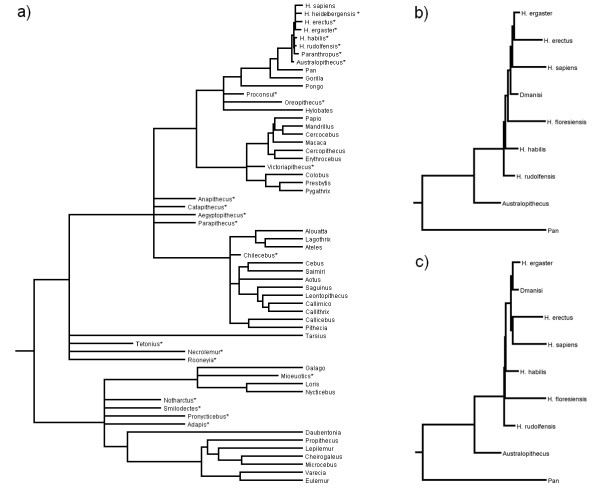
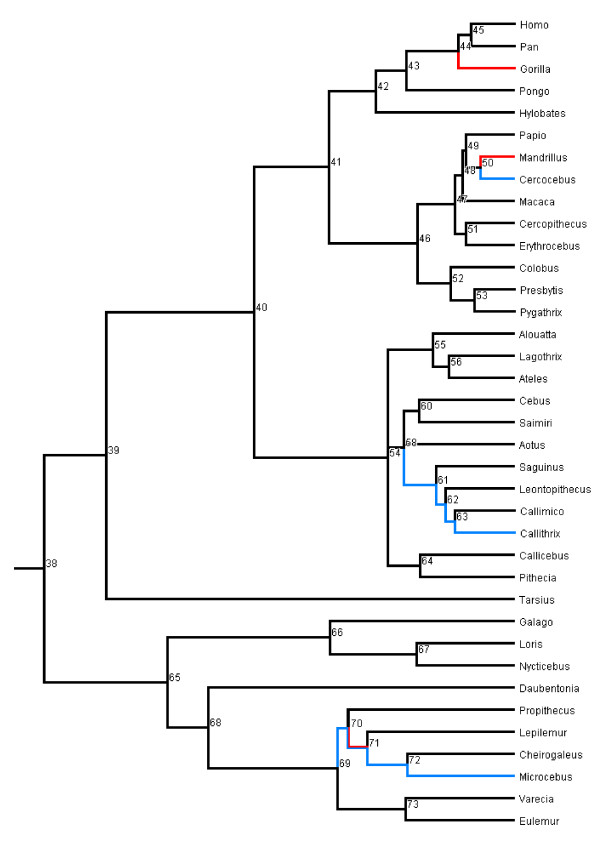
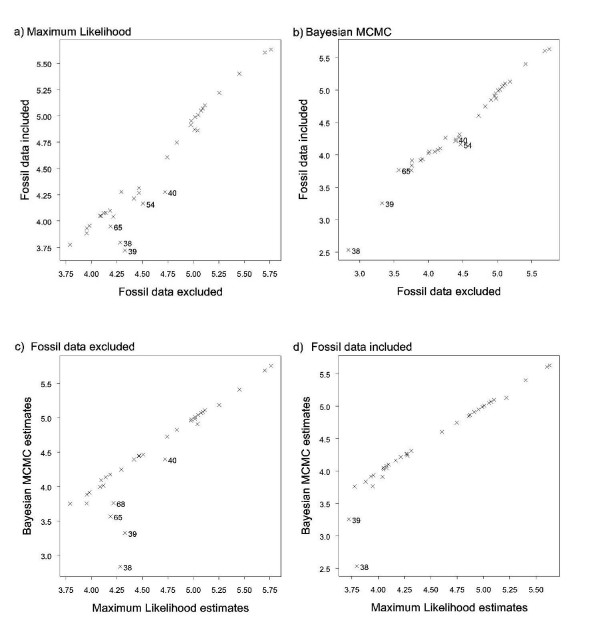
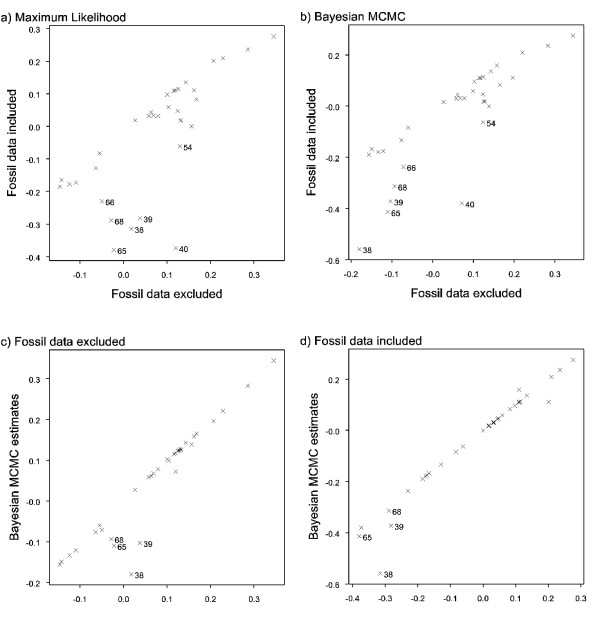
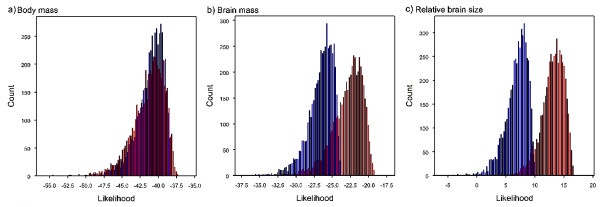
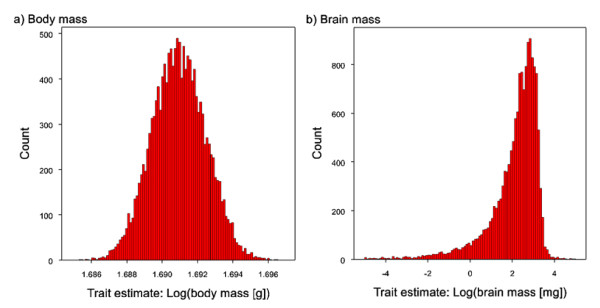
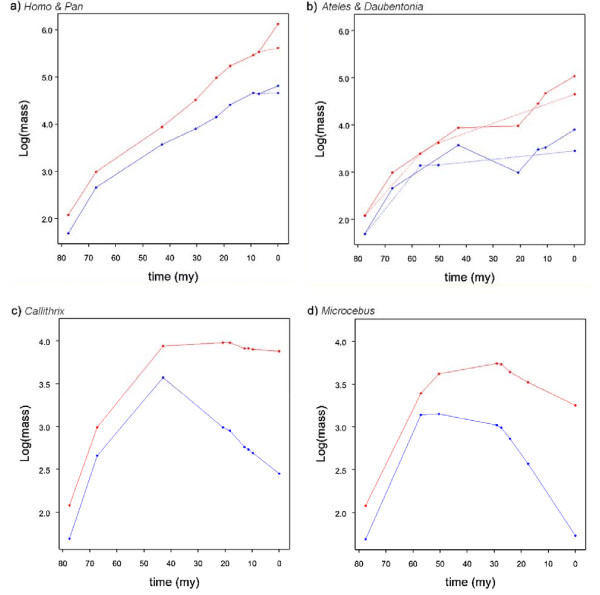
Background: Brain size is a key adaptive trait. It is often assumed that increasing brain size was a general evolutionary trend in primates, yet recent fossil discoveries have documented brain size decreases in some lineages, raising the question of how general a trend there was for brains to increase in mass over evolutionary time. We present the first systematic phylogenetic analysis designed to answer this question. Results: We performed ancestral state reconstructions of three traits (absolute brain mass, absolute body mass, relative brain mass) using 37 extant and 23 extinct primate species and three approaches to ancestral state reconstruction: parsimony, maximum likelihood and Bayesian Markov-chain Monte Carlo. Both absolute and relative brain mass generally increased over evolutionary time, but body mass did not. Nevertheless both absolute and relative brain mass decreased along several branches. Applying these results to the contentious case of Homo floresiensis, we find a number of scenarios under which the proposed evolution of Homo floresiensis'small brain appears to be consistent with patterns observed along other lineages, dependent on body mass and phylogenetic position. Conclusions: Our results confirm that brain expansion began early in primate evolution and show that increases occurred in all major clades. Only in terms of an increase in absolute mass does the human lineage appear particularly striking, with both the rate of proportional change in mass and relative brain size having episodes of greater expansion elsewhere on the primate phylogeny. However, decreases in brain mass also occurred along branches in all major clades, and we conclude that, while selection has acted to enlarge primate brains, in some lineages this trend has been reversed. Further analyses of the phylogenetic position of Homo floresiensis and better body mass estimates are required to confirm the plausibility of the evolution of its small brain mass. We find that for our dataset the Bayesian analysis for ancestral state reconstruction is least affected by inclusion of fossil data suggesting that this approach might be preferable for future studies on other taxa with a poor fossil record.
Overview
The claims and statistics of this paper haven’t been checked yet.
Free: it reads the open-access text and checks the first 5 claims that cite a source we can check. Create a free account to check every claim.
Integrity signals
Registry
Cites
Statistics
Figures
Verification
Claims the paper makes
The claims and statistics of this paper haven’t been checked yet.
Free: it reads the open-access text and checks the first 5 claims that cite a source we can check. Create a free account to check every claim.
Claims other papers make about this one
Each is checked against this paper’s own text: does it say what the citing paper says it does?
The source backs part of the claim, not all of it — or backs it for a different population, condition or comparison.
In the citing paper
“Whereas cetacean brain:body allometry is predominantly altered during three key periods (the origin of crown cetaceans, the origin of odontocetes, and the origin of mysticetes), primate brain and body mass evolved under contrasting selective regimes across longer periods of time resulting in a continuous allometric change and the expansion of relative brain size (Montgomery et al. 2010).”
From THE EVOLUTIONARY HISTORY OF CETACEAN BRAIN AND BODY SIZE: CETACEAN BRAIN EVOLUTION (2013) · cites this paper as Montgomery et al. 2010
Experimental — accuracy not yet measuredThe cited source says what the claim attributes to it.
In the citing paper
“In primates, the evolution of brain size (both in terms of absolute size and relative to body size) shows complex patterns of change involving both increases and decreases along different branches of the primate phylogeny [6,7].”
From Brain reorganization, not relative brain size, primarily characterizes anthropoid brain evolution (2013) · cites this paper as [6]
The cited source says what the claim attributes to it.
In the citing paper
“Including data from extinct taxa may improve such analyses (Finarelli and Flynn 2006;Montgomery et al. 2010;Slater et al. 2012).”
From THE EVOLUTIONARY HISTORY OF CETACEAN BRAIN AND BODY SIZE: CETACEAN BRAIN EVOLUTION (2013) · cites this paper as Montgomery et al. 2010
The cited source says what the claim attributes to it.
In the citing paper
“Primates are one order that shows a strong trend for directional increases in relative brain size (Montgomery et al. 2010).”
From THE EVOLUTIONARY HISTORY OF CETACEAN BRAIN AND BODY SIZE: CETACEAN BRAIN EVOLUTION (2013) · cites this paper as Montgomery et al. 2010
The cited source says what the claim attributes to it.
In the citing paper
“Increases in relative brain size are almost ubiquitous across the primate tree and are produced by directional evolution of increased brain mass in a background of body mass evolution that shows no significant trend to increase through time (Montgomery et al. 2010).”
From THE EVOLUTIONARY HISTORY OF CETACEAN BRAIN AND BODY SIZE: CETACEAN BRAIN EVOLUTION (2013) · cites this paper as Montgomery et al. 2010
2 more claims about this paper
Create a free account to see every claim other papers make about this one.
Self-check
Percentages, sums and reported differences re-computed from the paper’s own numbers.
The self-check needs the paper’s full text.
Citations
Cites
Phylogenies and the Comparative Method
Felsenstein, J. (1985) · The American Naturalist · doi:10.1086/284325 · Cited by 9,793 · cited 1×
“It is important to incorporate both topology and branch length information during reconstruction analyses as species are part of a hierarchically structured phylogeny, therefore not statistically independent, and differences in time since divergence from the common ancestors determines differential potential for evolu…”
BackgroundMarkov Chain Monte Carlo in Practice
(1995) · Chapman & Hall/CRC eBooks · doi:10.1201/b14835 · Cited by 7,757
(2009) · Cited by 6,571
The Ecological Implications of Body Size
Peters, R. H. (1983) · Cambridge University Press eBooks · doi:10.1017/cbo9780511608551 · Cited by 5,649 · cited 2×
“Finally, our analyses add to the growing number of studies that conclude that the evolution of the human brain size has not been anomalous when compared to general primate brain evolution [59,61,91,62-94].”
BackgroundInferring the historical patterns of biological evolution
Pagel, M. (1999) · Nature · doi:10.1038/44766 · Cited by 5,200 · cited 24×
“BayesTraits first identifies the best fitting evolutionary model (see below) to the species data, and then uses such model to infer unknown ancestral states at internal nodes along the tree.”
BackgroundMethodInfluentialThe comparative method in evolutionary biology
(1992) · Choice Reviews Online · doi:10.5860/choice.29-5104 · Cited by 4,931 · cited 1×
“They enable historical evolutionary processes, and the function and evolution of specific traits, to be inferred from patterns of diversity in extant species [1-3].”
BackgroundThe Comparative Method in Evolutionary Biology
Harvey, P. H., & Pagel, M. D. (1991) · doi:10.1093/oso/9780198546412.001.0001 · Cited by 4,337
Scaling: Why is Animal Size so Important?
Schmidt-Nielsen, K. (1984) · doi:10.1017/cbo9781139167826 · Cited by 2,677
Scaling Why is animal size so important?
Schmidt‐Nielsen, K. (1984) · Cited by 2,654
Kass, R. E., & Raftery, A. E. (1995) · Journal of the American Statistical Association · doi:10.2307/2291091 · Cited by 2,312
Research works printed but not linked: 1
- 81. Smuts BB, Cheney DL, Seyfarth RM, Wrangham RW, Struhsaker TT: Primate Societies. University of Chicago Press 1987.
Cited by
The evolution of self-control.
MacLean, E. L., Hare, B., Nunn, C. L., Addessi, E., Amici, F., Anderson, R. C., Aureli, F., Baker, J. M., Bania, A. E., Barnard, A. M., et al. (2014) · Proceedings of the National Academy of Sciences · doi:10.1073/pnas.1323533111 · Cited by 819
“increased over time in primates, whereas body mass has not (187).”
Gomes, N. M. V., Ryder, O. A., Houck, M. L., Charter, S. J., Walker, W., Forsyth, N. R., Austad, S. N., Venditti, C., Pagel, M., Shay, J. W., et al. (2011) · Aging Cell · doi:10.1111/j.1474-9726.2011.00718.x · Cited by 464
“It has been shown to outperform other methods of ancestral state reconstruction as the model of evolution estimated across the whole tree is used to infer the ancestral states (Montgomery et al., 2010).”
Primate brain size is predicted by diet but not sociality
DeCasien, A. R., Williams, S. A., & Higham, J. P. (2017) · Nature Ecology & Evolution · doi:10.1038/s41559-017-0112 · Cited by 475
Rapid evolution of the cerebellum in humans and other great apes
Barton, R. A., & Venditti, C. (2014) · Current Biology · doi:10.1016/j.cub.2014.08.056 · Cited by 291
“We us BayesTraits following the protocol outlined in Organ et al [34] to impute the ancestral sizes as this approach has been show to outperform other methods for reconstruction ancestral states for continuously varying data [35].”
Self-citationWhy are there so many explanations for primate brain evolution?
Dunbar, R. I. M., & Shultz, S. (2017) · Philosophical Transactions of the Royal Society B: Biological Sciences · doi:10.1098/rstb.2016.0244 · Cited by 261
Allomaternal care, life history and brain size evolution in mammals
Isler, K., & van Schaik, C. P. (2012) · Journal of Human Evolution · doi:10.1016/j.jhevol.2012.03.009 · Cited by 242
“, Nievergelt andMartin, 1999) that relative brain size was reduced, even relative to ancestral values in the callithrichid lineage (Montgomery et al., 2010).”
BackgroundBODDY, A. M., McGOWEN, M. R., SHERWOOD, C. C., GROSSMAN, L. I., GOODMAN, M., & WILDMAN, D. E. (2012) · Journal of Evolutionary Biology · doi:10.1111/j.1420-9101.2012.02491.x · Cited by 207
“…solely on evolutionary trends of increasing brain mass, there is also evidence that relative brain mass has been reduced within multiple lineages (Niven, 2005; Safi et al., 2005; Montgomery et al., 2010) including particular clades of bats (Safi et al., 2005) and primates (Montgomery et al., 2010).”
BackgroundInfluentialFonseca-Azevedo, K., & Herculano-Houzel, S. (2012) · Proceedings of the National Academy of Sciences · doi:10.1073/pnas.1206390109 · Cited by 196
“The trend toward a larger brain size in primate evolution (20), particularly in the hominin lineage, has thus presumably occurred in the face of limitations imposed by the increasing metabolic cost of larger brains.”
BackgroundThe evolution of mammalian brain size
Smaers, J. B., Rothman, R. S., Hudson, D. R., Balanoff, A. M., Beatty, B., Dechmann, D. K. N., de Vries, D., Dunn, J. C., Fleagle, J. G., Gilbert, C. C., et al. (2021) · Science Advances · doi:10.1126/sciadv.abe2101 · Cited by 164
Adaptive evolution of four microcephaly genes and the evolution of brain size in anthropoid primates
Montgomery, S. H., Capellini, I., Venditti, C., Barton, R. A., & Mundy, N. I. (2011) · Molecular Biology and Evolution · doi:10.1093/molbev/msq237 · Cited by 143
“…in lineages leading to humans does not significantly differ from that in other lineages (table 2a), which is congruent with the fact that the proportional change in brain mass along this lineage is also not exceptional compared with the rest of primate brain size evolution (Montgomery et al. 2010).”
BackgroundMethodResultInfluentialSelf-citationSteiper, M. E., & Seiffert, E. R. (2012) · Proceedings of the National Academy of Sciences · doi:10.1073/pnas.1119506109 · Cited by 161
“Our results support the hypothesis that the first crown primates were small (approximately the size of the smallest mouse lemurs) with relatively small brains (25, 27, 28), a phenotype that generally persisted along the haplorhine and anthropoid stem lineages (29, 30).”
MethodResultBrain evolution and development: adaptation, allometry and constraint
Montgomery, S. H., Mundy, N. I., & Barton, R. A. (2016) · Proceedings of the Royal Society B: Biological Sciences · doi:10.1098/rspb.2016.0433 · Cited by 125
“Importantly, some of these cases indicate specific selection on brain mass, not body mass [8,35].”
BackgroundSelf-citationBeyond brain size: Uncovering the neural correlates of behavioral and cognitive specialization
Logan, C. J., Avin, S., Boogert, N., Buskell, A., Cross, F. R., Currie, A., Jelbert, S., Lukas, D., Mares, R., Navarrete, A. F., et al. (2018) · Comparative Cognition & Behavior Reviews · doi:10.3819/ccbr.2018.130008 · Cited by 122
Self-citationBrain reorganization, not relative brain size, primarily characterizes anthropoid brain evolution
Smaers, J. B., & Soligo, C. (2013) · Proceedings of the Royal Society B: Biological Sciences · doi:10.1098/rspb.2013.0269 · Cited by 112
“In primates, the evolution of brain size (both in terms of absolute size and relative to body size) shows complex patterns of change involving both increases and decreases along different branches of the primate phylogeny [6,7].”
BackgroundBrain size of Homo floresiensis and its evolutionary implications
Kubo, D., Kono, R. T., & Kaifu, Y. (2013) · Proceedings of the Royal Society B: Biological Sciences · doi:10.1098/rspb.2013.0338 · Cited by 111
Genetic architecture supports mosaic brain evolution and independent brain-body size regulation
Hager, R., Lu, L., Rosen, G. D., & Williams, R. W. (2012) · Nature Communications · doi:10.1038/ncomms2086 · Cited by 108
THE EVOLUTIONARY HISTORY OF CETACEAN BRAIN AND BODY SIZE: CETACEAN BRAIN EVOLUTION
Montgomery, S. H., Geisler, J. H., McGowen, M. R., Fox, C., Marino, L., & Gatesy, J. (2013) · Evolution · doi:10.1111/evo.12197 · Cited by 106
Self-citationFleagle, J. G. (2013) · Elsevier eBooks · doi:10.1016/b978-0-12-378632-6.00009-4 · Cited by 105
McInerney, C. E., Maurice, L. D., Robertson, A. L., Knight, L. R. F. D., Arnscheidt, J., Venditti, C., Dooley, J. S. G., Mathers, T. C., Matthijs, S., Eriksson, K., et al. (2014) · Molecular Ecology · doi:10.1111/mec.12664 · Cited by 105
“The method was chosen because of its superior performance with phylogenetic trees that span millions of years (Montgomery et al. 2010).”
MethodHerculano-Houzel, S., & Kaas, J. H. (2011) · Brain, Behavior and Evolution · doi:10.1159/000322729 · Cited by 93
“Cellular Composition of Gorilla, Orangutan and Hominin Brains Brain Behav Evol 2011;77:33–44 41 [1983], Riska and Atchley [1985], Byrne [1995] and Deacon [1997] – a trend that is not found in the chimpanzee and hominin lineage [Montgomery et al., 2010].”
BackgroundResultInfluentialKaifu, Y., Baba, H., Sutikna, T., Morwood, M. J., Kubo, D., Saptomo, E. W., Jatmiko, Awe, R. D., & Djubiantono, T. (2011) · Journal of Human Evolution · doi:10.1016/j.jhevol.2011.08.008 · Cited by 86
Smaers, J. B., Dechmann, D. K. N., Goswami, A., Soligo, C., & Safi, K. (2012) · Proceedings of the National Academy of Sciences · doi:10.1073/pnas.1212181109 · Cited by 79
“S6), particularly because relative brain size is reported to have increased independently in different primate lineages through time (40).”
BackgroundReconsidering the evolution of brain, cognition, and behavior in birds and mammals
Willemet, R. (2013) · Frontiers in Psychology · doi:10.3389/fpsyg.2013.00396 · Cited by 89
“This finding, if confirmed, is interesting given that the method used here does not distinguish between changes in relative brain size that are due to enlargement of the brain and changes that are due to reduction of the body (but see Montgomery et al., 2010 and Smaers et al., 2012a).”
BackgroundMethodLarger brain size indirectly increases vulnerability to extinction in mammals
González‐Voyer, A., González‐Suárez, M., Vilà, C., & Revilla, E. (2016) · Evolution · doi:10.1111/evo.12943 · Cited by 87
“Despite these constraints, mammalian brain size has increased over evolutionary time as species diversified to fill a variety of ecological niches (Montgomery et al. 2010; Rowe et al. 2011).”
Quantitative uniqueness of human brain evolution revealed through phylogenetic comparative analysis
Miller, I. F., Barton, R. A., & Nunn, C. L. (2019) · eLife · doi:10.7554/elife.41250 · Cited by 70
“Montgomery et al. (2010) used ancestral state reconstruction with fossil data to demonstrate a directional trend in primate brain size evolution and to identify branches in the primate phylogeny along which exceptional evolutionary change occurred.”
Self-citationThe domesticated brain: genetics of brain mass and brain structure in an avian species
Henriksen, R., Johnsson, M., Andersson, L., Jensen, P., & Wright, D. (2016) · Scientific Reports · doi:10.1038/srep34031 · Cited by 66
Bigger Brains Led to Bigger Bodies?: The Correlated Evolution of Human Brain and Body Size
Grabowski, M. (2016) · Current Anthropology · doi:10.1086/685655 · Cited by 63
Püschel, H. P., Bertrand, O., O’Reilly, J. E., Bobe, R. L., & Püschel, T. A. (2021) · Nature Ecology & Evolution · doi:10.1038/s41559-021-01431-1 · Cited by 75
Co-evolutionary dynamics of mammalian brain and body size
Venditti, C., Baker, J., & Barton, R. A. (2024) · Nature Ecology & Evolution · doi:10.1038/s41559-024-02451-3 · Cited by 65
“This trend set the stage for rapid increase in hominins, leading ultimately to modern humans’ unprecedentedly large brains 34,38 .”
Self-citationThe serpent and the egg: unidirectional evolution of reproductive mode in vipers?
Fenwick, A. M., Greene, H. W., & Parkinson, C. L. (2011) · Journal of Zoological Systematics & Evolutionary Research · doi:10.1111/j.1439-0469.2011.00646.x · Cited by 64
“state reconstruction in only a few studies (see Ekman et al. 2008; Xiang and Thomas 2008; Montgomery et al. 2010; Rasmussen and Cameron 2010), and it has not yet been applied to tests of unidirectional evolution.”
BackgroundLife history of the most complete fossil primate skeleton: exploring growth models forDarwinius
López‐Torres, S., Schillaci, M. A., & Silcox, M. T. (2015) · Royal Society Open Science · doi:10.1098/rsos.150340 · Cited by 50
“[54–64]).”
Evolution of the Primate Brain
Falk, D. (2013) · Springer eBooks · doi:10.1007/978-3-642-27800-6_37-4 · Cited by 48
First virtual endocasts of adapiform primates
Harrington, A. R., Silcox, M. T., Yapuncich, G., Boyer, D., & Bloch, J. I. (2016) · Journal of Human Evolution · doi:10.1016/j.jhevol.2016.06.005 · Cited by 50
Parallel episodes of phyletic dwarfism in callitrichid and cheirogaleid primates
Montgomery, S. H., & Mundy, N. I. (2013) · Journal of Evolutionary Biology · doi:10.1111/jeb.12097 · Cited by 50
Self-citationDo monkeys have a theory of mind? How to answer the question?
Meunier, H. (2016) · Neuroscience & Biobehavioral Reviews · doi:10.1016/j.neubiorev.2016.11.007 · Cited by 58
Automatic generation of evolutionary hypotheses using mixed Gaussian phylogenetic models
Mitov, V., Bartoszek, K., & Stadler, T. (2019) · Proceedings of the National Academy of Sciences · doi:10.1073/pnas.1813823116 · Cited by 55
EVOLUTION OF ASPM IS ASSOCIATED WITH BOTH INCREASES AND DECREASES IN BRAIN SIZE IN PRIMATES
Montgomery, S. H., & Mundy, N. I. (2012) · Evolution · doi:10.1111/j.1558-5646.2011.01487.x · Cited by 45
Self-citationFalk, D. (2012) · Progress in brain research · doi:10.1016/b978-0-444-53860-4.00012-x · Cited by 54
“(As an aside, Montgomery et al. (2010) analyzed brain and body size in the tiny type specimen for Homo floresiensis (LB1) and concluded that the data fit within the broader context of primate phylogeny (Falk et al., 2009).)”
BackgroundBrain Size Growth and Life History in Human Evolution
Leigh, S. R. (2012) · Evolutionary Biology · doi:10.1007/s11692-012-9168-5 · Cited by 43
Primate brains, the ‘island rule’ and the evolution of Homo floresiensis
Montgomery, S. H. (2013) · Journal of Human Evolution · doi:10.1016/j.jhevol.2013.08.006 · Cited by 42
“…decrease in H. floresiensis’ brain size during 104 descent from African H. erectus is within the range observed in dwarfed Hippos, whilst 105 Montgomery et al. (2010) found it was within the range observed in primate genera in which 106 body mass decreased, if H. floresiensis was a…”
BackgroundMethodResultInfluentialSelf-citationShi, L., Li, M., Lin, Q., Qi, X., & Su, B. (2013) · BMC Biology · doi:10.1186/1741-7007-11-62 · Cited by 41
“Along the two branches we focused on in this analysis, absolute brain volume increased from 70 to 152 ml to 230 to 565 ml during the transition between lesser apes and great apes [30,31], and from 230 to 565 ml to 1,129 to 1,685 ml during the transition between great apes and humans [30,31].”
Backgroundde Sousa, A. A., Beaudet, A., Calvey, T., Bardo, A., Benoît, J., Charvet, C. J., Dehay, C., Gómez‐Robles, A., Gunz, P., Heuer, K., et al. (2023) · Communications Biology · doi:10.1038/s42003-023-04803-4 · Cited by 45
Microcephaly genes evolved adaptively throughout the evolution of eutherian mammals
Montgomery, S. H., & Mundy, N. I. (2014) · BMC Evolutionary Biology · doi:10.1186/1471-2148-14-120 · Cited by 38
“In our phylogeny three episodes of brain expansion are relatively well documented in the fossil record and form taxon-pairs with smaller brain species; the expansion of human [40,41], dolphin [42,43] and elephant brain sizes”
Self-citationEvidence of a chimpanzee-sized ancestor of humans but a gibbon-sized ancestor of apes
Grabowski, M. W., & Jungers, W. L. (2017) · Nature Communications · doi:10.1038/s41467-017-00997-4 · Cited by 44
Variation in the strength of allometry drives rates of evolution in primate brain shape
Sansalone, G., Allen, K. L., Ledogar, J. A., Ledogar, S. H., Mitchell, D. R., Profico, A., Castiglione, S., Melchionna, M., Serio, C., Mondanaro, A., et al. (2020) · Proceedings of the Royal Society B Biological Sciences · doi:10.1098/rspb.2020.0807 · Cited by 43
“Due to the presence of possible biases when estimating ancestral states, this approach provides biologically meaningful results under the assumption that the root phenotypic estimate is a good representation of the ancestral mean shape, which is expected under non-directional evolution [6,31].”
BackgroundMacroevolutionary trends of brain mass in Primates
Melchionna, M., Mondanaro, A., Serio, C., Castiglione, S., Febbraro, M. D., Rook, L., Diniz‐Filho, J. A. F., Manzi, G., Profico, A., Sansalone, G., et al. (2019) · Biological Journal of the Linnean Society · doi:10.1093/biolinnean/blz161 · Cited by 34
The red island and the seven dwarfs: body size reduction in Cheirogaleidae
Masters, J. C., Génin, F., Silvestro, D., Lister, A. M., & Delpero, M. (2014) · Journal of Biogeography · doi:10.1111/jbi.12327 · Cited by 36
“The main problem invoked by viewing the Cheirogaleidae and their life histories as primitive is that small size may also be adaptive and may evolve secondarily and convergently in different lineages: a phenomenon termed ‘dwarfism’ and frequently associated with island habitats as part of a syndrome known as the ‘islan…”
BackgroundInfluentialFour errors and a fallacy: pitfalls for the unwary in comparative brain analyses
Dunbar, R., & Shultz, S. (2023) · Biological reviews/Biological reviews of the Cambridge Philosophical Society · doi:10.1111/brv.12953 · Cited by 34
Island Rule, quantitative genetics and brain–body size evolution inHomo floresiensis
Diniz‐Filho, J. A. F., & Raia, P. (2017) · Proceedings of the Royal Society B Biological Sciences · doi:10.1098/rspb.2017.1065 · Cited by 33
Evolutionary shifts dramatically reorganized the human hippocampal complex
Schilder, B. M., Petry, H. M., & Hof, P. R. (2019) · The Journal of Comparative Neurology · doi:10.1002/cne.24822 · Cited by 32
Angielczyk, K. D., & Feldman, C. R. (2013) · Biological Journal of the Linnean Society · doi:10.1111/bij.12010 · Cited by 35
Scaling of cerebral blood perfusion in primates and marsupials
Seymour, R. S., Angove, S. E., Snelling, E. P., & Cassey, P. (2015) · Journal of Experimental Biology · doi:10.1242/jeb.124826 · Cited by 27
“5) (Martin, 2001).”
BackgroundEvolutionary Change in the Brain Size of Bats
Lu, Y., Brown, J. P., Stampanoni, M., Marone, F., Isler, K., & Martin, R. D. (2012) · Brain Behavior and Evolution · doi:10.1159/000338324 · Cited by 30
“The testing procedures are described in detail by Montgomery et al. [2010], who conducted an analogous analysis in primates.”
BackgroundMethodNadkarni, N. A., Bougacha, S., Garin, C. M., Dhénain, M., & Picq, J. (2018) · NeuroImage · doi:10.1016/j.neuroimage.2018.10.010 · Cited by 27
“Mouse lemurs can also be used to shed light on primate brain evolution (Montgomery et al., 2010).”
Evidence of a Conserved Molecular Response to Selection for Increased Brain Size in Primates
Boddy, A. M., Harrison, P. W., Montgomery, S. H., Caravas, J., Raghanti, M. A., Phillips, K. A., Mundy, N. I., & Wildman, D. E. (2017) · Genome Biology and Evolution · doi:10.1093/gbe/evx028 · Cited by 33
“For example, the mass of capuchin monkey (Cebus sp.) brains are approximately four times larger than expected for a mammal of its body mass, ranking capuchins among the most highly encephalized nonhuman mammals (Jerison 1973; Montgomery et al. 2010; Boddy et al. 2012).”
BackgroundInfluentialSelf-citationBoyer, D., Kirk, E. C., Silcox, M. T., Gunnell, G. F., Gilbert, C. C., Yapuncich, G., Allen, K. L., Welch, E., Bloch, J. I., Gonzales, L. A., et al. (2016) · Journal of Human Evolution · doi:10.1016/j.jhevol.2016.06.002 · Cited by 25
Positive selection on NIN , a gene involved in neurogenesis, and primate brain evolution
Montgomery, S. H., & Mundy, N. I. (2012) · Genes Brain & Behavior · doi:10.1111/j.1601-183x.2012.00844.x · Cited by 20
“The phylogeny of these species was taken from Montgomery et al. (2010) and is shown in Fig.”
MethodSelf-citationResting state functional atlas and cerebral networks in mouse lemur primates at 11.7 Tesla
Garin, C. M., Nadkarni, N. A., Landeau, B., Chételat, G., Picq, J., Bougacha, S., & Dhénain, M. (2020) · NeuroImage · doi:10.1016/j.neuroimage.2020.117589 · Cited by 19
19. Evolutionary Demography of the Great Apes
Thompson, M. E., & Sabbi, K. H. (2024) · Open Book Publishers · doi:10.11647/obp.0251.19 · Cited by 21
Diniz‐Filho, J. A. F., Jardim, L., Mondanaro, A., & Raia, P. (2019) · Evolutionary Biology · doi:10.1007/s11692-019-09471-z · Cited by 20
“Recent analyses of such pattern span across several hierarchical levels, from refined quantitative genetic analyses at the population level, to the comparison of closely-related species’ brain size (e.g., Diniz-Filho and Raia 2017; Gómez-Robles et al. 2017; Grabowski 2016; Montgomery et al. 2010; Schroeder and von Cra…”
BackgroundYoung, C. B. (2020) · Journal of Human Evolution · doi:10.1016/j.jhevol.2020.102899 · Cited by 16
Herculano‐Houzel, S. (2019) · Progress in brain research · doi:10.1016/bs.pbr.2019.06.001 · Cited by 17
Avin, S., Currie, A., & Montgomery, S. H. (2021) · BMC Biology · doi:10.1186/s12915-021-01024-1 · Cited by 16
“While this will reliably reflect periods of directional 562 changes in brain, or component, size (36,37), the close correlation between brain and body size, 563”
BackgroundSelf-citationHidden Markov Models for Evolution and Comparative Genomics Analysis
Bykova, N. A., Favorov, A. V., & Mironov, A. A. (2013) · PLoS ONE · doi:10.1371/journal.pone.0065012 · Cited by 15
Signatures of adaptive evolution in platyrrhine primate genomes
Byrne, H., Webster, T. H., Brosnan, S. F., Izar, P., & Lynch, J. W. (2022) · Proceedings of the National Academy of Sciences · doi:10.1073/pnas.2116681119 · Cited by 16
Jungers, W. L. (2013) · doi:10.1002/9781118332344.ch30 · Cited by 14
The Use (and Misuse) of Phylogenetic Trees in Comparative Behavioral Analyses
Pozzi, L., Bergey, C. M., & Burrell, A. S. (2013) · International Journal of Primatology · doi:10.1007/s10764-013-9701-0 · Cited by 15
“The ability to reconstruct ancestral phenotypes (either morphological or behavioral), for instance, can be affected by taxon representation and phylogenetic uncertainties (Finarelli and Flynn 2006; Montgomery et al. 2010).”
BackgroundAncient volcanos as species pumps: A case study of freshwater amphipods in Northeast Asia
Hu, Y., Li, S., Liu, H., Kim, S. T., Константинович, К. Д., & Hou, Z. (2021) · Molecular Ecology · doi:10.1111/mec.16223 · Cited by 12
“This method possessed outstanding performance in analyzing phylogenetic trees that span million years (Montgomery et al., 2010).”
MethodEvolution of the Primate Brain
Falk, D. (2014) · Springer eBooks · doi:10.1007/978-3-642-39979-4_37 · Cited by 11
Avian telencephalon and cerebellum volumes can be accurately estimated from digital brain endocasts
Keirnan, A. R., Cunha, F., Citron, S., Prideaux, G. J., Iwaniuk, A. N., & Weisbecker, V. (2025) · Biology Letters · doi:10.1098/rsbl.2024.0596 · Cited by 7
“Our knowledge of evolutionary patterns in brain size [13,19], shape [6,20] and composition [21] has advanced substantially over the past century through endocast comparisons [13,22].”
Brain Allometry Across Macroevolutionary Scales in Squamates Suggests a Conserved Pattern in Snakes
Lara, L. C. E., Young, J., Schliep, K. P., & León, L. F. D. (2021) · Zoology · doi:10.1016/j.zool.2021.125926 · Cited by 8
Evolution of Large Brain and Body Size in Mammals
Montgomery, S. H. (2016) · Elsevier eBooks · doi:10.1016/b978-0-12-804042-3.00034-8 · Cited by 7
Self-citationHerculano‐Houzel, S. (2012) · Elsevier eBooks · doi:10.1016/b978-0-12-374236-0.10001-x · Cited by 9
Early Evolution of the Brain in Primates and Their Close Kin
Silcox, M. T., Bertrand, O., Harrington, A. R., Lang, M. M., Martin‐Flores, G. S., & López‐Torres, S. (2022) · Springer eBooks · doi:10.1007/978-3-031-13983-3_12 · Cited by 6
Evolutionary history of hominin brain size and phylogenetic comparative methods
Pestana, C., de Sousa, A. A., Todorov, O. S., Beaudet, A., & Benoît, J. (2023) · Progress in brain research · doi:10.1016/bs.pbr.2022.12.014 · Cited by 7
Memory retrieval and harshness of conflict in the hawk–dove game
Bilancini, E., Boncinelli, L., Ille, S., & Vicario, E. (2022) · Economic Theory Bulletin · doi:10.1007/s40505-022-00237-z · Cited by 4
Barton, R. A., & Capellini, I. (2016) · Brain Behavior and Evolution · doi:10.1159/000443716 · Cited by 6
Self-citationMeunier, H. (2018) · Organizational Research Methods · doi:10.1177/1094428118756741 · Cited by 5
Equivocal evidence for a link between megalencephaly-related genes and primate brain size evolution
DeCasien, A. R., Trujillo, A. E., Janiak, M. C., Harshaw, E. P., Caes, Z. N., Galindo, G. A., Petersen, R. M., & Higham, J. P. (2022) · Scientific Reports · doi:10.1038/s41598-022-12953-4 · Cited by 3
“Interestingly, previous work suggests that the expression levels of multiple genes analyzed here: (1) are differentially expressed between human and rhesus macaque brains during the prenatal and early postnatal periods65; (2) are differentially expressed between human and chimpanzee cerebral organoids66; and (3) exhib…”
BackgroundEvolution of the Mammalian Brain with a Focus on the Whale Olfactory Bulb
Kishida, T. (2017) · Diversity and commonality in animals · doi:10.1007/978-4-431-56469-0_14 · Cited by 3
Brain Size and Innovation in Primates
Navarrete, A. F., & Laland, K. N. (2015) · Elsevier eBooks · doi:10.1016/b978-0-12-800648-1.00009-7 · Cited by 5
The Evolution of Brain and Body Size in Genus Homo
Monson, T. A., Weitz, A. P., & Brasil, M. F. (2026) · Humans · doi:10.3390/humans6020012 · Cited by 3
“They demonstrated that decreases in absolute body mass are actually associated with increases in relative brain size, hinting at an allometric relationship between these traits even in smaller hominids (Montgomery et al., 2010).”
InfluentialArístide, L. (2026) · Brain Behavior and Evolution · doi:10.1159/000552655 · Cited by 1
Fleagle, J. G., Baden, A. L., & Gilbert, C. C. (2025) · Elsevier eBooks · doi:10.1016/b978-0-12-815809-8.00009-6 · Cited by 2
Proximate mechanisms underlying the coevolution of diet quality and relative brain size in primates
Teja, V., Shao, Y., Wu, D., Banda, N., DeCasien, A. R., & Umapathy, G. (2025) · Philosophical Transactions of the Royal Society B Biological Sciences · doi:10.1098/rstb.2024.0126 · Cited by 3
Social and Physical Cognition in Old World Monkeys - A Comparative Perspective
Schmitt, V. (2012) · eDiss (Georg-August-Universität Göttingen) · doi:10.53846/goediss-1461 · Cited by 1
Insight into human brain evolution through phylogenetic analysis and comparative genomics
Boddy, A. M. (2013) · Human Biology
Social and Physical Cognition in Old World Monkeys
Schmitt, V. (2012)
Adaptive Evolution of Microcephaly Genes
Montgomery, S. H. (2019) · Wiley eBooks · doi:10.1002/9780470015902.a0028393
Self-citationYoung, C. B. (2021) · MOspace Institutional Repository (University of Missouri) · doi:10.32469/10355/88062
Faculty Opinions recommendation of The evolution of mammalian brain size.
Витальевич, П. В. (2021) · Faculty Opinions – Post-Publication Peer Review of the Biomedical Literature · doi:10.3410/f.740012939.793585350
Guerrero‐Bosagna, C., Pértille, F., Moradinour, Z., Katajamaa, R., Cerezo, M. L. M., Henriksen, R., Jensen, P., & Wright, D. (2025) · Molecular Ecology · doi:10.1111/mec.17788 · Cited by 1
“However, the use of allometric scaling (always presenting brain size in respect to body size) is now not always considered strictly correct (Willemet 2013; Schoenemann 2006; Montgomery et al. 2010), and this can bias results.”
Diet and social factors selecting for increased encephalization in primates
DeCasien, A. R. (2025) · Elsevier eBooks · doi:10.1016/b978-0-443-27380-3.00055-5
Avin, S., Currie, A., & Montgomery, S. H. (2021) · Figshare · doi:10.6084/m9.figshare.14570474
Self-citationCognitive mediation of social complexity–brain volume associations in a population-based sample
Roozen, M. C., & Kas, M. J. (2026) · Evolution and Human Behavior · doi:10.1016/j.evolhumbehav.2026.106866
Characterization of Mouse Lemur Brain by Anatomical, Functional and Glutamate MRI
Garin, C. M. (2019) · theses.fr (ABES) · doi:10.70675/6d5989a9z80f7z43d7z9e2ez516b192d7313
The Lateralisation of Emotion in Social Mammals
Milligan, A. D. S. (2013) · Stirling Online Research Repository (University of Stirling) · Cited by 1
The Ordered Origin of the Brain
Lima-de-Faria, A. (2014) · Springer eBooks · doi:10.1007/978-3-319-06056-9_19
Metadata
- Authors
- Montgomery, S. H., Capellini, I., Barton, R. A., & Mundy, N. I.
- Affiliations
- University of Cambridge (GB)
- Durham University (GB)
- Corresponding author
- Mundy, Nicholas I
- Venue
- BMC Biology
- Published
- 2010-01-27
- Volume
- 8
- Issue
- 1
- Pages
- 9-9
- ISSN
- 1741-7007 (ISSN-L)
- PMC
- PMC2825212
- OpenAlex
- W2103126314
- Cited by
- 98
- References
- 126
- Citations by year
- 2026: 3 · 2025: 5 · 2024: 2 · 2023: 3 · 2022: 4 · 2021: 8 · 2020: 3 · 2019: 8 · 2018: 3 · 2017: 6 · 2016: 9 · 2015: 3 · 2014: 7 · 2013: 15 · 2012: 13
- FWCI
- 14.68
- Type
- journal article
- Language
- en
- Open access
- gold
- doi.org
- Licence
- cc-by
- Locations
- BMC Biology (publishedVersion, cc-by)
- PubMed Central (publishedVersion, cc-by)
- PubMed (publishedVersion)
- Bristol Research (University of Bristol) (publishedVersion)
- Durham Research Online (Durham University) (acceptedVersion, other-oa)
- Durham Research Online (Durham University) (submittedVersion, cc-by)
- Repository@Hull (Worktribe) (University of Hull) (submittedVersion, cc-by)
- DOAJ (DOAJ: Directory of Open Access Journals) (submittedVersion)
- UCL Discovery (University College London) (submittedVersion)
- Research Portal (Queen's University Belfast) (submittedVersion)
- Apollo (University of Cambridge) (submittedVersion, cc-by)
- Funders
- Leverhulme Trust
- Biotechnology and Biological Sciences Research Council (BB/E014593/1)
- Natural Environment Research Council
- Topics
- Life Sciences › Agricultural and Biological Sciences › Ecology, Evolution, Behavior and Systematics › Primate Behavior and Ecology
- Physical Sciences › Earth and Planetary Sciences › Paleontology › Evolution and Paleontology Studies
- Social Sciences › Anthropology › Pleistocene-Era Hominins and Archaeology
- Keywords
- primate brain evolution, brain size, body mass, ancestral state reconstruction, Homo floresiensis, brain size reduction, phylogenetic analysis, human evolution, brain expansion, fossil primates
- MeSH terms
- Animals, Bayes Theorem, Brain, Biological Evolution, Humans, Phylogeny, Primates, Hominidae, Likelihood Functions
About these checks
Registry, retraction, Cites and statistics results are computed, not judged, with one exception: a printed reference that no index lists is read once by a model before it counts as a citation error. Claims are extracted by a model and kept only when their quote appears verbatim in the text; each cited source is then checked, with a model’s help, for whether it says what the claim relies on. Those verdicts can be wrong — read the claim’s quote and the cited source before relying on one.
Statistics and arithmetic are recomputed, not judged.
Confidence bands are shown only for fields calibrated on our annotated test set. None is calibrated yet, so no band is shown.
What counts as a claim ›How we measure confidence ›How we check this ›
Are you an author, or do you see a problem with this page? Request a review
Data sources
Bibliographic data: Semantic Scholar, OpenAlex, Crossref.
Contains information from the Semantic Scholar Academic Graph Datasets, made available under the ODC Attribution License (ODC-BY 1.0).
Semantic Scholar’s data is described in: Kinney, R., et al. (2023). The Semantic Scholar Open Data Platform. arXiv:2301.10140.
