

Skeletal muscle protein metabolism in the elderly: Interventions to counteract the 'anabolic resistance' of ageing
Open accessThe DOI matches its Crossref record; 110 of the 111 references it cites were found in a registry or an index.
Abstract
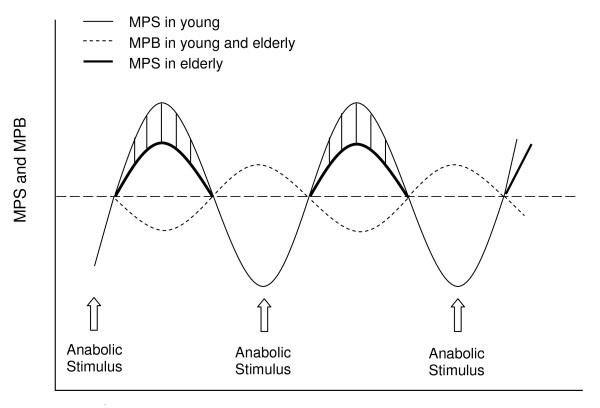
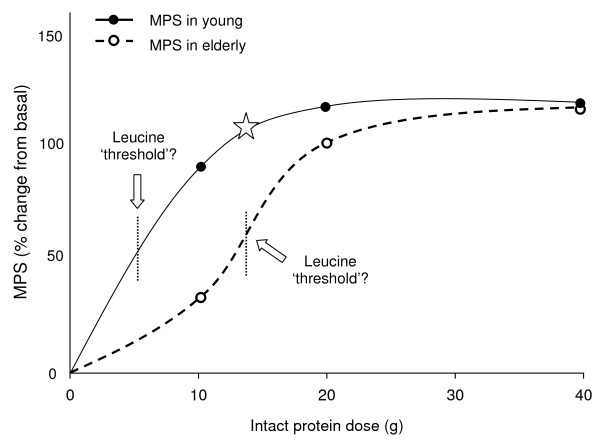
Age-related muscle wasting (sarcopenia) is accompanied by a loss of strength which can compromise the functional abilities of the elderly. Muscle proteins are in a dynamic equilibrium between their respective rates of synthesis and breakdown. It has been suggested that age-related sarcopenia is due to: i) elevated basal-fasted rates of muscle protein breakdown, ii) a reduction in basal muscle protein synthesis (MPS), or iii) a combination of the two factors. However, basal rates of muscle protein synthesis and breakdown are unchanged with advancing healthy age. Instead, it appears that the muscles of the elderly are resistant to normally robust anabolic stimuli such as amino acids and resistance exercise. Ageing muscle is less sensitive to lower doses of amino acids than the young and may require higher quantities of protein to acutely stimulate equivalent muscle protein synthesis above rest and accrue muscle proteins. With regard to dietary protein recommendations, emerging evidence suggests that the elderly may need to distribute protein intake evenly throughout the day, so as to promote an optimal per meal stimulation of MPS. The branched-chain amino acid leucine is thought to play a central role in mediating mRNA translation for MPS, and the elderly should ensure sufficient leucine is provided with dietary protein intake. With regards to physical activity, lower, than previously realized, intensity high-volume resistance exercise can stimulate a robust muscle protein synthetic response similar to traditional high-intensity low volume training, which may be beneficial for older adults. Resistance exercise combined with amino acid ingestion elicits the greatest anabolic response and may assist elderly in producing a 'youthful' muscle protein synthetic response provided sufficient protein is ingested following exercise.
Overview
The claims and statistics of this paper haven’t been checked yet.
Free: it reads the open-access text and checks the first 5 claims that cite a source we can check. Create a free account to check every claim.
Integrity signals
Registry
Cites
Statistics
Figures
Verification
Claims the paper makes
The claims and statistics of this paper haven’t been checked yet.
Free: it reads the open-access text and checks the first 5 claims that cite a source we can check. Create a free account to check every claim.
Claims other papers make about this one
Each is checked against this paper’s own text: does it say what the citing paper says it does?
The source backs part of the claim, not all of it — or backs it for a different population, condition or comparison.
In the citing paper
“Nevertheless, a higher daily protein intake (1.2–1.6 g/kg BW/day) has been suggested to improve lean body mass gain or maintain muscle mass in young and old healthy adults.”
From Systematic review and meta-analysis of protein intake to support muscle mass and function in healthy adults (2022) · cites this paper as [19]
Experimental — accuracy not yet measuredThe source backs part of the claim, not all of it — or backs it for a different population, condition or comparison.
In the citing paper
“Recommendations for leucine consumption—around 3–4 g per meal, which equates to 25–30 g of high quality protein and 1.0–1.6 g/kg/day distributed into 3–4 daily meals—aim to promote greater MPS stimulation in older adults [131,132,133,134].”
From Impact of Protein Intake in Older Adults with Sarcopenia and Obesity: A Gut Microbiota Perspective (2020) · cites this paper as [131]
Experimental — accuracy not yet measuredThe source backs part of the claim, not all of it — or backs it for a different population, condition or comparison.
In the citing paper
“Aging represents the most profound naturally occurring model of impaired translational capacity, clinically manifesting as sarcopenia and “anabolic resistance” [46].”
From Ribosome Biogenesis as a Putative Bottleneck to Skeletal Muscle Hypertrophy: Mechanisms, Human Evidence, and Practical Modulators (2026) · cites this paper as [46]
Experimental — accuracy not yet measuredThe source backs part of the claim, not all of it — or backs it for a different population, condition or comparison.
In the citing paper
“Because the aged nucleolus is highly resistant to standard loading, Breen and Phillips have hypothesized that older adults require a significantly higher relative mechanical threshold to elicit the same molecular spark observed in the young [46,110].”
From Ribosome Biogenesis as a Putative Bottleneck to Skeletal Muscle Hypertrophy: Mechanisms, Human Evidence, and Practical Modulators (2026) · cites this paper as [46]
Experimental — accuracy not yet measuredThe cited source says what the claim attributes to it.
In the citing paper
“evidence suggests that young muscles are more sensitive to the anabolic action of EAAs compared to aging muscles [62].”
From Animal Protein versus Plant Protein in Supporting Lean Mass and Muscle Strength: A Systematic Review and Meta-Analysis of Randomized Controlled Trials (2021) · cites this paper as [62]
2 more claims about this paper
Create a free account to see every claim other papers make about this one.
Self-check
Percentages, sums and reported differences re-computed from the paper’s own numbers.
The self-check needs the paper’s full text.
Citations
Cites
Garber, C. E., Blissmer, B., Deschenes, M. R., Franklin, B. A., Lamonte, M. J., Lee, I.-M., Nieman, D. C., & Swain, D. P. (2011) · Medicine & Science in Sports & Exercise · doi:10.1249/mss.0b013e318213fefb · Cited by 9,319
Acute-Phase Proteins and Other Systemic Responses to Inflammation
Gabay, C., & Kushner, I. (1999) · New England Journal of Medicine · doi:10.1056/nejm199902113400607 · Cited by 6,734 · cited 1×
“TNF-a, which is one of the main inducers of the acute-phase response [39], plays an important role in alterations of muscle protein metabolism in this model of sepsis [38].”
BackgroundHigh-Intensity Strength Training in Nonagenarians: Effects on Skeletal Muscle
Fiatarone, M. A. (1990) · JAMA · doi:10.1001/jama.1990.03440220053029 · Cited by 1,593
Strength conditioning in older men: skeletal muscle hypertrophy and improved function
Frontera, W. R., Meredith, C. N., O'Reilly, K. P., Knuttgen, H. G., & Evans, W. J. (1988) · Journal of Applied Physiology · doi:10.1152/jappl.1988.64.3.1038 · Cited by 1,384
Anabolic signaling deficits underlie amino acid resistance of wasting, aging muscle
Cuthbertson, D., Smith, K., Babraj, J., Leese, G., Waddell, T., Atherton, P., Wackerhage, H., Taylor, P. M., & Rennie, M. J. (2005) · The FASEB Journal · doi:10.1096/fj.04-2640fje · Cited by 1,211 · cited 11×
“Resistance exercise acutely increases MPS [22,29,48] and, when practiced frequently over time, promotes muscle hypertrophy in older adults [75-78], although the anabolic response is generally blunted compared with younger adults [47,79,80].”
BackgroundMethodResultInfluentialSkeletal Muscle Cutpoints Associated with Elevated Physical Disability Risk in Older Men and Women
Janssen, I. (2004) · American Journal of Epidemiology · doi:10.1093/aje/kwh058 · Cited by 1,190
Mixed muscle protein synthesis and breakdown after resistance exercise in humans
Phillips, S. M., Tipton, K. D., Aarsland, A., Wolf, S. E., & Wolfe, R. R. (1997) · American Journal of Physiology-Endocrinology and Metabolism · doi:10.1152/ajpendo.1997.273.1.e99 · Cited by 1,132 · cited 2×
“Thus, protein feeding during late exercise recovery still maintains the capacity to be synergistic to exercise-mediated rates that have been shown to exist in the fasted-state during this time [14,98].”
BackgroundSelf-citationTang, J. E., Moore, D. R., Kujbida, G. W., Tarnopolsky, M. A., & Phillips, S. M. (2009) · Journal of Applied Physiology · doi:10.1152/japplphysiol.00076.2009 · Cited by 998
Self-citationMoore, D. R., Robinson, M. J., Fry, J. L., Tang, J. E., Glover, E. I., Wilkinson, S. B., Prior, T., Tarnopolsky, M. A., & Phillips, S. M. (2009) · The American Journal of Clinical Nutrition · doi:10.3945/ajcn.2008.26401 · Cited by 973 · cited 2×
“Previously, we have shown that maximal post-exercise stimulation of MPS can be achieved with ingestion of 20 g of egg protein in young adults [63].”
BackgroundSelf-citationKatsanos, C. S., Kobayashi, H., Sheffield-Moore, M., Aarsland, A., & Wolfe, R. R. (2006) · American Journal of Physiology-Endocrinology and Metabolism · doi:10.1152/ajpendo.00488.2005 · Cited by 923 · cited 3×
“The resistance of elderly muscles to a physiological dose of amino acids was subsequently confirmed by others [35-37] and is presented in Figure 1.”
BackgroundResult
Research works printed but not linked: 1
- Dickinson JM Fry CS Drummond MJ Gundermann DM Walker DK Glynn EL Timmerman KL Dhanani S Volpi E Rasmussen BB Mammalian Target of Rapamycin Complex 1 Activation Is Required for the Stimulation of Human Skeletal Muscle Protein Synthesis by Essential Amino Acids J Nutr 2011 PMC3077888 21430254
Cited by
Items 601–622 of 622
Jiang, Y., Gao, Y., Wang, R., & Liu, B. (2026) · Muscle & Nerve · doi:10.1002/mus.70396
“In community-dwelling older adults, muscle loss is commonly related to age-associated anabolic resistance and reduced activity [42, 43].”
Yoon, T.-H., & Jee, Y. (2026) · PeerJ · doi:10.7717/peerj.21714
“…and observational studies suggest that prolonged muscle unloading and reduced neuromuscular activation associated with sitting time may accelerate muscle atrophy, impair muscle quality, and compromise physical performance, thereby contributing to sarcopenic impairments ( Breen & Phillips, 2011 ).”
Pang, B. W. J., Yang, Y., & Cheon, B. K. (2026) · Nutrients · doi:10.3390/nu18193255
“…and metabolic health indicators during weight loss remain particularly uncertain in older adults, who have been shown to require even more protein [22] and leucine [23] intake than young adults for similar MPS, due to an age-associated ‘anabolic resistance’ to protein and amino acid ingestion.”
Takeda, R., Hirono, T., Nishikawa, T., Ueda, S., Igawa, K., Uchida, K., Mita, Y., & Watanabe, K. (2026) · Physiology International · doi:10.1556/2060.2026.00836
Ojima, M., Matsuura, M., Deguchi, M., & Kim, D.-H. (2026) · Biology · doi:10.3390/biology15181629
Costa, J. S., Pinheiro, J. P., Cabral, L., Santos-Faria, J., Ribeiro, F., Caetano, M., Batista, J., Alexandrino, H., & Branco, J. P. (2026) · Nutrients · doi:10.3390/nu18193122
“These processes are likely to be particularly consequential in older adults, in whom reduced baseline muscle reserve and age-related impairments in anabolic responsiveness and regenerative capacity may limit recovery from severe catabolic stress [1,63].”
Sarcopenia como enfermedad endocrinológica
Heredia, L. A. B. (2019) · Archivos del Hospital Universitario "General Calixto García" · Cited by 1
MATHEW, A. M., Colaco, M. J., & Srinivasaiah, M. G. (2022) · International Journal of Allied Medical Sciences and Clinical Research
Corsetti, G., & Pasini, E. (2026) · Frontiers in Nutrition · doi:10.3389/fnut.2026.1970280
More than just adipose: the impact of GLP1RA on lean tissue
Julien, M., Jeromson, S., & Wright, D. C. (2026) · American Journal of Physiology-Cell Physiology · doi:10.1152/ajpcell.90062.2026
Prokopidis, K., Joshi, A. S., Gam, S., Norman, K., Müller‐Werdan, U., Doehner, W., & Langer, H. T. (2026) · Current Heart Failure Reports · doi:10.1007/s11897-026-00780-x
Zhang, J., Su, W., Duan, J., Sun, Y., & Liu, B. (2026) · The Innovation Life · doi:10.59717/j.xinn-life.2026.100262
Kim, Y.-M., Jung, E.-S., & Kim, B. (2026) · Journal of Functional Morphology and Kinesiology · doi:10.3390/jfmk11040427
Zhao, Y., Zhao, J., Xie, C., Yang, X., & 李建英 (2026) · Frontiers in Immunology · doi:10.3389/fimmu.2026.1931736
Ben-David, R., Sarvin, N., Carmeli, E., Dahan, N., Shlomi, T., & Shemer, S. (2026) · American Journal of Physiology-Cell Physiology · doi:10.1152/ajpcell.00315.2026
Cheng, C., Zhang, J., Zhao, Y., Bai, J., He, Y., & Xiao, X. (2026) · Food & Function · doi:10.1039/d6fo03345h
Farsi, D. N., Ward, N. A., Neville, C. E., Scott, A., McKay, G. J., McEvoy, C. T., McGuinness, B., Cotter, P. D., & O’Sullivan, Ó. (2026) · European Journal of Nutrition · doi:10.1007/s00394-026-04150-0
Kubra, S., Badshah, F., & Abdi, G. (2026) · Experimental Gerontology · doi:10.1016/j.exger.2026.113373
Khatami, S. H., Rasi, A. M., Ehtiati, S., Abdashti, A. A., Ariannik, M., Gouhari, F., Rafienejad, D., Heidari, P., & Zandi, R. (2026) · Food Reviews International · doi:10.1080/87559129.2026.2759103
Zebrafish models for investigating skeletal muscle aging and sarcopenia
이승은, Lee, H., Park, S., Kim, S.-H., & Choe, S. (2026) · Experimental Gerontology · doi:10.1016/j.exger.2026.113382
Nalbandian, M., & Blau, H. M. (2026) · Philosophical Transactions of the Royal Society B Biological Sciences · doi:10.1098/rstb.2026.0156
Patterns of protein consumption throughout adulthood and physical capability in later life
Munro, C. A. (2014) · Cited by 1
Metadata
- Authors
- Breen, L., & Phillips, S. M.
- Affiliations
- McMaster University (CA)
- Corresponding author
- Phillips, Stuart M
- Venue
- Nutrition & Metabolism
- Published
- 2011
- Volume
- 8
- Issue
- 1
- Pages
- 68
- ISSN
- 1743-7075 (ISSN-L)
- PMC
- PMC3201893
- OpenAlex
- W2096840621
- Cited by
- 576
- References
- 111
- Citations by year
- 2026: 71 · 2025: 49 · 2024: 34 · 2023: 37 · 2022: 36 · 2021: 51 · 2020: 53 · 2019: 40 · 2018: 33 · 2017: 39 · 2016: 32 · 2015: 34 · 2014: 23 · 2013: 20 · 2012: 21
- FWCI
- 10.13
- Type
- journal article
- Language
- en
- Open access
- gold
- doi.org
- Licence
- cc-by
- Locations
- Nutrition & Metabolism (publishedVersion, cc-by)
- Europe PMC (PubMed Central) (publishedVersion, cc-by)
- PubMed Central (publishedVersion, cc-by)
- PubMed (publishedVersion)
- DOAJ (DOAJ: Directory of Open Access Journals) (submittedVersion)
- University of Birmingham Research Portal (University of Birmingham) (submittedVersion, other-oa)
- Topics
- Health Sciences › Nursing › Nutrition and Dietetics › Muscle metabolism and nutrition
- Health Sciences › Medicine › Physiology (medical) › Nutrition and Health in Aging
- Life Sciences › Biochemistry, Genetics and Molecular Biology › Molecular Biology › Muscle Physiology and Disorders
- Keywords
- sarcopenia, muscle protein synthesis, muscle protein degradation, anabolic resistance, aging, older adults, dietary protein, branched-chain amino acids, leucine, resistance training, amino acid ingestion, muscle atrophy
About these checks
Registry, retraction, Cites and statistics results are computed, not judged, with one exception: a printed reference that no index lists is read once by a model before it counts as a citation error. Claims are extracted by a model and kept only when their quote appears verbatim in the text; each cited source is then checked, with a model’s help, for whether it says what the claim relies on. Those verdicts can be wrong — read the claim’s quote and the cited source before relying on one.
Statistics and arithmetic are recomputed, not judged.
Confidence bands are shown only for fields calibrated on our annotated test set. None is calibrated yet, so no band is shown.
What counts as a claim ›How we measure confidence ›How we check this ›
Are you an author, or do you see a problem with this page? Request a review
Data sources
Bibliographic data: Semantic Scholar, OpenAlex, Crossref.
Contains information from the Semantic Scholar Academic Graph Datasets, made available under the ODC Attribution License (ODC-BY 1.0).
Semantic Scholar’s data is described in: Kinney, R., et al. (2023). The Semantic Scholar Open Data Platform. arXiv:2301.10140.
