

The DOI matches its Crossref record; 54 of the 56 references it cites were found in a registry or an index; none of the 49 sources its claims cite is checked for support yet.
Changing distribution patterns of canine vector borne diseases in Italy: leishmaniosis vs. dirofilariosis
Open accessAbstract
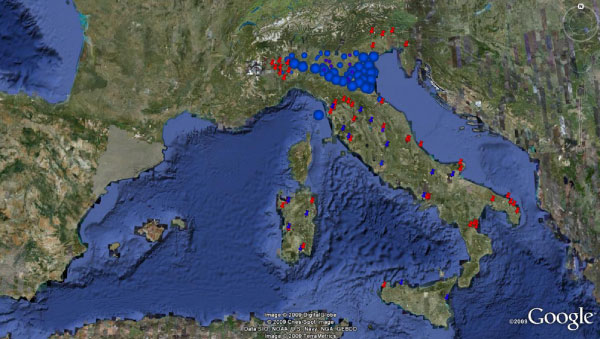
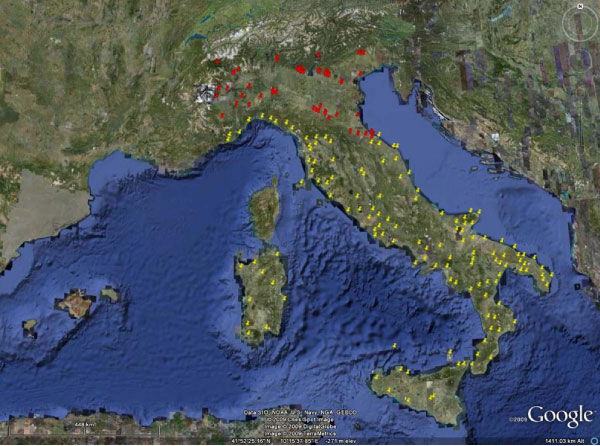
Ecological and climatic changes, human and animal population dynamics are among the several factors that have favoured the spread or the (re)introduction and establishment of "novel" vector species and pathogens they transmit in previously disease-free geographical areas. As key examples of the changing pattern of distribution of canine vector borne diseases (CVBDs), the current distribution of canine leishmaniosis (CanL) by Leishmania infantum and dirofilariosis by Dirofilaria immitis causing heart worm disease (HW) in Italy is discussed on the basis of retrospective historical reports until the 90's and later on until 2009. For long time, D. immitis has been considered mainly present along the Po River Valley and northward areas, while L. infantum in south-central Italy and Sicily and Sardinia. Comparison of current available and historical data (up to 1989) confirms that HW and CanL, although with different prevalence rates, have been changing their distribution patterns in Italy as a result of many biological and ecological factors, including those related to vector distribution and introduction of new species (e.g. the Asian tiger mosquito Aedes albopictus, a competent vector of D. immitis). New autochthonous foci of HW in southern Italy (i.e. Apulia and Calabria regions) have recently been reported.Although analysing retrospective data may represent a difficult task, the "paradigm" about the dual distribution of HW and CanL in northern and southern Italy cannot yet be considered valid. The research needs for managing HW and CanL in previously uninfected areas are discussed.
Overview
AI snapshot
Written from the paper’s full text.
TL;DR
This review compares historical (up to the 1990s) and contemporary (to 2009) distributions of canine heartworm disease (Dirofilaria immitis) and canine leishmaniosis (Leishmania infantum) in Italy, arguing that the traditional north–south duality no longer holds. It reports new autochthonous heartworm foci in southern Italy and northward expansion of leishmaniosis, linked to changing vector distributions.
Key findings
- The historical pattern was “dual”: D. immitis mainly along the Po River Valley and northward areas, while L. infantum was in south-central Italy, Sicily, and Sardinia. A 1986 review/questionnaire defined 50% of northern provinces and only 15% of central and southern provinces as infected by D. immitis.
- D. immitis has expanded: it is now endemic in central regions (Tuscany, Umbria) with prevalences of 1–21%; Tuscany showed a more than 7-fold prevalence increase in 10 years; Sardinia reached peaks up to 17%; and new autochthonous foci were reported in Apulia and Calabria. In a 2005–2008 survey of 1,447 autochthonous dogs in southern Italy, 20 dogs were positive (1.61%), including 18 for D. immitis and 2 for D. repens; site positivity was 0.24%, 0.23%, 2.57%, and 3.43%.
- CanL has spread northward: until the 1990s it was sporadic in northern regions and mainly linked to travel; 7 autochthonous foci were retrospectively identified from 1990–2002, and later investigations identified 16 possible new foci across northern regions with low cumulative prevalence (2.1%). In southern endemic regions, serologically positive animals reached up to 53.1%.
- Aedes albopictus, introduced in 1990, is a competent vector of D. immitis and D. repens and likely contributed to the changing distribution of dirofilariosis.
Methods
- Narrative review/discussion comparing retrospective historical reports until the 1990s with current available data until 2009 on canine vector-borne disease distribution in Italy, including prevalence reports and vector records.
- Included a recent southern Italy survey from January 2005 to January 2008: 1,447 autochthonous dogs from four areas in Apulia and Calabria were sampled; serum was tested for D. immitis antigen, and blood from two sites was examined by modified Knott method for microfilariae.
- Main analysis was descriptive comparison of historical versus current distribution and prevalence, plus discussion of vector species and ecological factors; no formal meta-analysis is stated.
Limitations
- Stated: retrospective data analysis is difficult because of problems retrieving local reports published in national journals and differences in diagnostic tools and methodologies across surveys.
- Stated: epidemiological data on D. immitis in southern Italy are scant and limited to sporadic case reports.
- Evident: the review relies on heterogeneous published reports and foci maps rather than standardized nationwide surveillance, and the paper itself notes improved diagnostics and higher researcher/practitioner awareness as factors that may affect apparent distribution changes.
Model-written summary. Check it against the paper before relying on it.
Integrity signals
Registry
Cites
Statistics
Figures
Verification
Claims the paper makes
36 Not checked yet · 6 Own interpretation
In the paper
“New autochthonous foci of HW in southern Italy (i.e. Apulia and Calabria regions) have recently been reported.”
§ Changing distribution patterns of canine vector borne diseases in Italy: leishmaniosis vs. dirofilariosis > Abstract
What the sources say
- Not checked yetcites [47]
plain- Asserted: passes — The authors put it forward as true.
- Checkable: passes — It can be checked against evidence.
- Load-bearing: passes — The paper’s conclusions depend on it.
- Based: passes — The paper gives a reason why it holds.
In the paper
“After parasitological examination, 4 animals were positive for microfilaria in both sites C and D.”
§ Changing distribution patterns of canine vector borne diseases in Italy: leishmaniosis vs. dirofilariosis > Changing distribution patterns: one Italy for two diseases
What the sources say
- Not checked yetcites [47]
plainn = 4- Asserted: passes — The authors put it forward as true.
- Checkable: passes — It can be checked against evidence.
- Load-bearing: unclear — It is unclear whether the paper’s conclusions depend on it.
- Based: passes — The paper gives a reason why it holds.
In the paper
“After serological examination, 2 animals (one for each of sites A and B) and 8 from sites C and D were diagnosed positive for the D. immitis.”
§ Changing distribution patterns of canine vector borne diseases in Italy: leishmaniosis vs. dirofilariosis > Changing distribution patterns: one Italy for two diseases
What the sources say
- Not checked yetcites [47]
plainn = 2- Asserted: passes — The authors put it forward as true.
- Checkable: passes — It can be checked against evidence.
- Load-bearing: passes — The paper’s conclusions depend on it.
- Based: passes — The paper gives a reason why it holds.
In the paper
“Historically, the distribution of canine leishmaniosis (CanL) by Leishmania infantum and dirofilariosis by D. immitis in Italy was considered to be”
§ Changing distribution patterns of canine vector borne diseases in Italy: leishmaniosis vs. dirofilariosis > Background
What the sources say
- Not checked yetcites [10]
plain- Asserted: passes — The authors put it forward as true.
- Checkable: passes — It can be checked against evidence.
- Load-bearing: passes — The paper’s conclusions depend on it.
- Based: passes — The paper gives a reason why it holds.
In the paper
“and L. infantum in south-central Italy and Sicily and Sardinia [11].”
§ Changing distribution patterns of canine vector borne diseases in Italy: leishmaniosis vs. dirofilariosis > Background
What the sources say
- Not checked yetcites [11]
plain- Asserted: passes — The authors put it forward as true.
- Checkable: passes — It can be checked against evidence.
- Load-bearing: passes — The paper’s conclusions depend on it.
- Based: passes — The paper gives a reason why it holds.
In the paper
“Similarly, in Piedmont, an extensive survey carried out in the 1990s [34] reported a spread of both D. immitis and D. repens westward and south-westward of the traditional endemic area.”
§ Changing distribution patterns of canine vector borne diseases in Italy: leishmaniosis vs. dirofilariosis > Changing distribution patterns: one Italy for two diseases
What the sources say
- Not checked yetcites [34]
plain- Asserted: passes — The authors put it forward as true.
- Checkable: passes — It can be checked against evidence.
- Load-bearing: unclear — It is unclear whether the paper’s conclusions depend on it.
- Based: passes — The paper gives a reason why it holds.
In the paper
“In particular, Phlebotumus perniciosus and Phlebotumus neglectus were the most represented species whose population have increased in density in northern Italy when compared with historical data [26].”
§ Changing distribution patterns of canine vector borne diseases in Italy: leishmaniosis vs. dirofilariosis > Changing distribution patterns: one Italy for two diseases
What the sources say
- Not checked yetcites [26]
plain- Asserted: passes — The authors put it forward as true.
- Checkable: passes — It can be checked against evidence.
- Load-bearing: unclear — It is unclear whether the paper’s conclusions depend on it.
- Based: passes — The paper gives a reason why it holds.
In the paper
“the classical hyperendemic areas for D. immitis were along the Po River Valley [17].”
§ Changing distribution patterns of canine vector borne diseases in Italy: leishmaniosis vs. dirofilariosis > Dirofilariosis and leishmaniosis: two diseases for two "Italys"
What the sources say
- Not checked yetcites [17]
plain- Asserted: passes — The authors put it forward as true.
- Checkable: passes — It can be checked against evidence.
- Load-bearing: unclear — It is unclear whether the paper’s conclusions depend on it.
- Based: passes — The paper gives a reason why it holds.
In the paper
“Since the 1990s there has been an increase in the number of cases of CanL reported in Italy.”
§ Changing distribution patterns of canine vector borne diseases in Italy: leishmaniosis vs. dirofilariosis > Changing distribution patterns: one Italy for two diseases
What the sources say
- Not checked yetcites [26]
plain- Asserted: passes — The authors put it forward as true.
- Checkable: passes — It can be checked against evidence.
- Load-bearing: passes — The paper’s conclusions depend on it.
- Based: passes — The paper gives a reason why it holds.
None of the sources cited for this claim have been checked yet.
In the paper
“In the Lazio region, where only D. repens infection was recorded [43], D. immitis was recently found for the first time in culicid vectors [32].”
§ Changing distribution patterns of canine vector borne diseases in Italy: leishmaniosis vs. dirofilariosis > Changing distribution patterns: one Italy for two diseases
What the sources say
- Not checked yetcites [32]
- Not checked yetcites [43]
plain- Asserted: passes — The authors put it forward as true.
- Checkable: passes — It can be checked against evidence.
- Load-bearing: unclear — It is unclear whether the paper’s conclusions depend on it.
- Based: passes — The paper gives a reason why it holds.
- It may state two separate claims as one. 18
- Probably not a substantial claim. 1
In the paper
“Out of the total number of 20 positive dogs (1.61% of the whole study population), 18 dogs were positive for D. immitis and 2 for D. repens.”
§ Changing distribution patterns of canine vector borne diseases in Italy: leishmaniosis vs. dirofilariosis > Changing distribution patterns: one Italy for two diseases
What the sources say
- Not checked yetcites [47]
plain- Asserted: passes — The authors put it forward as true.
- Checkable: passes — It can be checked against evidence.
- Load-bearing: unclear — It is unclear whether the paper’s conclusions depend on it.
- Based: passes — The paper gives a reason why it holds.
It may state two separate claims as one.
In the paper
“Hence, percentages of positivity referring to both parasitological and serological tests were: 0.24% from site A, 0.23% from site B, 2.57% from site C and 3.43% from site D.”
§ Changing distribution patterns of canine vector borne diseases in Italy: leishmaniosis vs. dirofilariosis > Changing distribution patterns: one Italy for two diseases
What the sources say
- Not checked yetcites [47]
plainn = 4- Asserted: passes — The authors put it forward as true.
- Checkable: passes — It can be checked against evidence.
- Load-bearing: passes — The paper’s conclusions depend on it.
- Based: passes — The paper gives a reason why it holds.
It may state two separate claims as one.
A conclusion the paper draws from its own results — it cites no other source for it, so there is none to check. The quote shows it is in the paper.
In the paper
“Comparison of current available and historical data (up to 1989) confirms that HW and CanL, although with different prevalence rates, have been changing their distribution patterns in Italy as a result of many biological and ecological factors, including those related to vector distribution and introduction of new species (e.g. the Asian tiger mosquito Aedes albopictus, a competent vector of D. im”
§ Changing distribution patterns of canine vector borne diseases in Italy: leishmaniosis vs. dirofilariosis > Abstract
boosteddirect- Asserted: passes — The authors put it forward as true.
- Checkable: passes — It can be checked against evidence.
- Load-bearing: passes — The paper’s conclusions depend on it.
- Based: passes — The paper gives a reason why it holds.
It may state two separate claims as one.
- Rests on an assumption: Historical and current data on canine vector borne disease distribution in Italy are comparable enough to allow valid conclusions about changes in distribution patterns, despite differences in diagnostic tools and methodologies.
In the paper
“Such was the case of the Asian tiger mosquito Aedes albopictus which is a competent vector of Dirofilaria immitis to dogs [4] and of West Nile virus, Japanese B encephalitis, chikungunya virus and other arboviruses to humans [5].”
§ Changing distribution patterns of canine vector borne diseases in Italy: leishmaniosis vs. dirofilariosis > Background
What the sources say
- Not checked yetcites [4]
plaindirect- Asserted: passes — The authors put it forward as true.
- Checkable: passes — It can be checked against evidence.
- Load-bearing: fails — The paper’s conclusions may not depend on it.
- Based: passes — The paper gives a reason why it holds.
Probably not a substantial claim. The paper’s conclusions may not depend on it.
None of the sources cited for this claim have been checked yet.
In the paper
“The spread of Ae. albopictus populations, coupled with its proven role as a suitable biological vector of both D. repens and D. immitis under experimental and field conditions [32,50-52], may further account for the current wide distribution of dirofilarioses.”
§ Changing distribution patterns of canine vector borne diseases in Italy: leishmaniosis vs. dirofilariosis > Final considerations and research needs
What the sources say
- Not checked yetcites [32]
- Not checked yetcites [50]
- Not checked yetcites [51]
- Not checked yetcites [52]
hedgedconditional- Asserted: passes — The authors put it forward as true.
- Checkable: passes — It can be checked against evidence.
- Load-bearing: passes — The paper’s conclusions depend on it.
- Based: passes — The paper gives a reason why it holds.
It may state two separate claims as one.
- Rests on an assumption: Vector competence established under experimental and field conditions reflects the natural role of Aedes albopictus in transmitting Dirofilaria immitis and Dirofilaria repens.
In the paper
“In north-eastern Italy, new imported cases of CanL are regularly notified outside the original area of first infection, and established foci have been recently detected [48].”
§ Changing distribution patterns of canine vector borne diseases in Italy: leishmaniosis vs. dirofilariosis > Changing distribution patterns: one Italy for two diseases
What the sources say
- Not checked yetcites [48]
plain- Asserted: passes — The authors put it forward as true.
- Checkable: passes — It can be checked against evidence.
- Load-bearing: passes — The paper’s conclusions depend on it.
- Based: passes — The paper gives a reason why it holds.
It may state two separate claims as one.
None of the sources cited for this claim have been checked yet.
In the paper
“Canine dirofilariosis caused by D. immitis is considered endemic in northern regions with prevalence rates ranging from 22 to 80% [16,34].”
§ Changing distribution patterns of canine vector borne diseases in Italy: leishmaniosis vs. dirofilariosis > Dirofilariosis and leishmaniosis: two diseases for two "Italys"
What the sources say
- Not checked yetcites [16]
- Not checked yetcites [34]
plain- Asserted: passes — The authors put it forward as true.
- Checkable: passes — It can be checked against evidence.
- Load-bearing: unclear — It is unclear whether the paper’s conclusions depend on it.
- Based: passes — The paper gives a reason why it holds.
It may state two separate claims as one.
In the paper
“As far as identification is concerned, A. reconditum was the most prevalent species identified (16.5%) followed by D. repens (1.4%) and D. immitis (0.5%) [35].”
§ Changing distribution patterns of canine vector borne diseases in Italy: leishmaniosis vs. dirofilariosis > Dirofilariosis and leishmaniosis: two diseases for two "Italys"
What the sources say
- Not checked yetcites [35]
plain- Asserted: passes — The authors put it forward as true.
- Checkable: passes — It can be checked against evidence.
- Load-bearing: unclear — It is unclear whether the paper’s conclusions depend on it.
- Based: passes — The paper gives a reason why it holds.
It may state two separate claims as one.
In the paper
“Indeed, since its introduction in 1990 Ae. albopictus adapted well to the relatively low winter temperatures of Italy by rapidly increasing its populations through the country, developing insects generations over the whole year in central and southern regions and overwintering as eggs in colder northern regions [49].”
§ Changing distribution patterns of canine vector borne diseases in Italy: leishmaniosis vs. dirofilariosis > Final considerations and research needs
What the sources say
- Not checked yetcites [49]
boosteddirect- Asserted: passes — The authors put it forward as true.
- Checkable: passes — It can be checked against evidence.
- Load-bearing: passes — The paper’s conclusions depend on it.
- Based: passes — The paper gives a reason why it holds.
It may state two separate claims as one.
None of the sources cited for this claim have been checked yet.
In the paper
“In Sardinia, a non-endemic area until 1960s, canine dirofilarioses have shown an increasing pattern of prevalence with peaks up to 17% [45] and cases have also been also reported in Sicily. [46].”
§ Changing distribution patterns of canine vector borne diseases in Italy: leishmaniosis vs. dirofilariosis > Changing distribution patterns: one Italy for two diseases
What the sources say
- Not checked yetcites [45]
- Not checked yetcites [46]
plaindirect- Asserted: passes — The authors put it forward as true.
- Checkable: passes — It can be checked against evidence.
- Load-bearing: unclear — It is unclear whether the paper’s conclusions depend on it.
- Based: passes — The paper gives a reason why it holds.
It may state two separate claims as one.
A conclusion the paper draws from its own results — it cites no other source for it, so there is none to check. The quote shows it is in the paper.
In the paper
“Without any doubt, the increase in the prevalence in previous endemic areas and the colonization of contiguous environments has been due to an increased density of the vectors and to a change in the composition of mosquito population (i.e. a predominance of mosquito species more efficient in Dirofilaria spp. transmission).”
§ Changing distribution patterns of canine vector borne diseases in Italy: leishmaniosis vs. dirofilariosis > Final considerations and research needs
boosteddirect- Asserted: passes — The authors put it forward as true.
- Checkable: passes — It can be checked against evidence.
- Load-bearing: passes — The paper’s conclusions depend on it.
- Based: passes — The paper gives a reason why it holds.
It may state two separate claims as one.
None of the sources cited for this claim have been checked yet.
In the paper
“Nowadays, HW infection is endemic in central regions (Toscana, Umbria) with prevalences ranging from 1 to 21% [41-43].”
§ Changing distribution patterns of canine vector borne diseases in Italy: leishmaniosis vs. dirofilariosis > Changing distribution patterns: one Italy for two diseases
What the sources say
- Not checked yetcites [41]
- Not checked yetcites [42]
- Not checked yetcites [43]
plain- Asserted: passes — The authors put it forward as true.
- Checkable: passes — It can be checked against evidence.
- Load-bearing: unclear — It is unclear whether the paper’s conclusions depend on it.
- Based: passes — The paper gives a reason why it holds.
It may state two separate claims as one.
In the paper
“In 1986 a review of the literature along with a questionnaire sent to public and private laboratories and clinics [39], defined as infected by D. immitis, 50% of the northern provinces and only 15% of the provinces of central and southern Italy.”
§ Changing distribution patterns of canine vector borne diseases in Italy: leishmaniosis vs. dirofilariosis > Changing distribution patterns: one Italy for two diseases
What the sources say
- Not checked yetcites [39]
plain- Asserted: passes — The authors put it forward as true.
- Checkable: passes — It can be checked against evidence.
- Load-bearing: unclear — It is unclear whether the paper’s conclusions depend on it.
- Based: passes — The paper gives a reason why it holds.
It may state two separate claims as one.
In the paper
“Seven leishmaniosis autochthonous foci were retrospectively identified from 1990 to 2002, whereas prospective investigations in the following years in dogs, identified other 16 possible foci all over northern regions, with low cumulative prevalence (2.1%) either from serological tests or as clinical cases [26].”
§ Changing distribution patterns of canine vector borne diseases in Italy: leishmaniosis vs. dirofilariosis > Changing distribution patterns: one Italy for two diseases
What the sources say
- Not checked yetcites [26]
plain- Asserted: passes — The authors put it forward as true.
- Checkable: passes — It can be checked against evidence.
- Load-bearing: passes — The paper’s conclusions depend on it.
- Based: passes — The paper gives a reason why it holds.
It may state two separate claims as one.
None of the sources cited for this claim have been checked yet.
In the paper
“More recently, D. immitis has become endemic in central regions such as Tuscany, where the prevalence increased more than 7-fold in 10 years [16], and Umbria which was considered a non-endemic area until 1999 [41,42].”
§ Changing distribution patterns of canine vector borne diseases in Italy: leishmaniosis vs. dirofilariosis > Changing distribution patterns: one Italy for two diseases
What the sources say
- Not checked yetcites [16]
- Not checked yetcites [41]
- Not checked yetcites [42]
plain- Asserted: passes — The authors put it forward as true.
- Checkable: passes — It can be checked against evidence.
- Load-bearing: passes — The paper’s conclusions depend on it.
- Based: passes — The paper gives a reason why it holds.
It may state two separate claims as one.
A conclusion the paper draws from its own results — it cites no other source for it, so there is none to check. The quote shows it is in the paper.
In the paper
“The above phenomena might have ultimately contributed in favouring the establishment into previously free areas or in increasing insect density into already colonized areas of phlebotomine competent species of L. infantum and might represent an important issue to be considered while predicting the spreading of sandflies northward through central European continental countries.”
§ Changing distribution patterns of canine vector borne diseases in Italy: leishmaniosis vs. dirofilariosis > Final considerations and research needs
hedgedconditional- Asserted: passes — The authors put it forward as true.
- Checkable: passes — It can be checked against evidence.
- Load-bearing: passes — The paper’s conclusions depend on it.
- Based: passes — The paper gives a reason why it holds.
It may state two separate claims as one.
A conclusion the paper draws from its own results — it cites no other source for it, so there is none to check. The quote shows it is in the paper.
In the paper
“Similarly, the reports of CanL here reviewed, when compared with historical data, confirm the likely expansion of L. infantum infection in northern Italy which now should be considered an endemic area.”
§ Changing distribution patterns of canine vector borne diseases in Italy: leishmaniosis vs. dirofilariosis > Final considerations and research needs
hedgedcorrelational- Asserted: passes — The authors put it forward as true.
- Checkable: passes — It can be checked against evidence.
- Load-bearing: passes — The paper’s conclusions depend on it.
- Based: passes — The paper gives a reason why it holds.
It may state two separate claims as one.
- Rests on an assumption: Historical and current data on canine vector borne disease distribution in Italy are comparable enough to allow valid conclusions about changes in distribution patterns, despite differences in diagnostic tools and methodologies.
In the paper
“The occurrence of large numbers of asymptomatic dogs in CanL [28] and HW infected populations and the long incubation periods, in which they are able to infect sandflies and mosquitoes, should be considered as an important issues when planning control measures for both diseases.”
§ Changing distribution patterns of canine vector borne diseases in Italy: leishmaniosis vs. dirofilariosis > Final considerations and research needs
What the sources say
- Not checked yetcites [28]
plaindirect- Asserted: passes — The authors put it forward as true.
- Checkable: passes — It can be checked against evidence.
- Load-bearing: passes — The paper’s conclusions depend on it.
- Based: passes — The paper gives a reason why it holds.
It may state two separate claims as one.
In the paper
“The increasing of population density rate and the expansion of P. perniciosus and P. neglectus was confirmed by comparing recent entomological surveys with available historical data [26].”
§ Changing distribution patterns of canine vector borne diseases in Italy: leishmaniosis vs. dirofilariosis > Final considerations and research needs
What the sources say
- Not checked yetcites [26]
plaincorrelational- Asserted: passes — The authors put it forward as true.
- Checkable: passes — It can be checked against evidence.
- Load-bearing: passes — The paper’s conclusions depend on it.
- Based: passes — The paper gives a reason why it holds.
It may state two separate claims as one.
The paper relies on this without support.
Historical and current data on canine vector borne disease distribution in Italy are comparable enough to allow valid conclusions about changes in distribution patterns, despite differences in diagnostic tools and methodologies.
“Thus, despite the complexity in analysing retrospective data (e.g. difficulties in retrieving local reports published on national journals, differences in diagnostic tools and methodologies employed in different surveys), the”
The paper relies on this without support.
Vector competence established under experimental and field conditions reflects the natural role of Aedes albopictus in transmitting Dirofilaria immitis and Dirofilaria repens.
“The spread of Ae. albopictus populations, coupled with its proven role as a suitable biological vector of both D. repens and D. immitis under experimental and field conditions [32,50-52], may further account for the current wide distribution of dirofilarioses.”
Claims other papers make about this one
Each is checked against this paper’s own text: does it say what the citing paper says it does?
The cited source doesn’t support the claim as written.
In the citing paper
“In Italy, D. immitis is endemic in northern Italy and has now spread all over the country, which shows a current change of distribution of this parasite throughout the Italian territory while canine and feline heartworm infection is more frequently diagnosed in southern regions of Italy (Otranto et al., 2009; Traversa et al., 2010a).”
From Heartworm Disease (Dirofilaria immitis) and Their Vectors in Europe – New Distribution Trends (2012) · cites this paper as Otranto et al., 2009
Checked by a reasoning model — may be wrong.
Experimental — accuracy not yet measuredThe source backs part of the claim, not all of it — or backs it for a different population, condition or comparison.
In the citing paper
“In a recent survey dogs from four different areas of southern Italy were sampled (Apulia and Calabria regions), and prevalences between 0.24 and 2.57% were found in Apulia region while prevalence of 3.43% was found in Calabria region (Otranto et al., 2009).”
From Heartworm Disease (Dirofilaria immitis) and Their Vectors in Europe – New Distribution Trends (2012) · cites this paper as Otranto et al., 2009
Experimental — accuracy not yet measuredIn the citing paper
“Similarly, also in Apulia and Calabria regions D. immitis was found in autochthonous dogs [17].”
From Dirofilaria immitis and Angiostrongylus vasorum: the contemporaneous detection in kennels (2015) · cites this paper as [17]
In the citing paper
“Indeed, the number of positive serum samples of L. infantum in northern Italy increased in the examined 10 years’ period (2009–2019) from 2.1% (1999–2009; [1, 16]) to 21.6%.”
From Leishmania infantum and Dirofilaria immitis infections in Italy, 2009–2019: Changing distribution patterns (2020) · cites this paper as [1]
In the citing paper
“In fact, chemopreventatives reduce the abundance of reservoirs, as shown in some areas of Northern Italy [155], thus they could be useful in reducing the spread of D. immitis also where the infection has a low prevalence and/or the nematode has emerged recently [2,156].”
From Fleas infesting pets in the era of emerging extra-intestinal nematodes (2013) · cites this paper as [155]
In the citing paper
“In the past decade, there has been an increase in the distribution of extra-intestinal nematodes of dogs, e.g. cardiopulmonary D. immitis and A. vasorum in both endemic areas and previously-free regions of Europe [12,77].”
From Are we paying too much attention to cardio-pulmonary nematodes and neglecting old-fashioned worms like Trichuris vulpis? (2011) · cites this paper as [77]
In the citing paper
“A key example for Europe is Italy, where D. immitis is not only stable in hyper-endemic areas (i.e. Northern regions) where T. vulpis has been recently reported in both dogs and in the environment [54,56-58], but also in new autochthonous foci in the south and the center of the Country [12,77,83].”
From Are we paying too much attention to cardio-pulmonary nematodes and neglecting old-fashioned worms like Trichuris vulpis? (2011) · cites this paper as [77]
Self-check
Percentages, sums and reported differences re-computed from the paper’s own numbers.
Rated major: it would touch a result — a value a result rests on, reported and recomputed p-values on opposite sides of the significance level, two passages that conflict with no sign which is right, or a cited work retracted before this paper was published.
In the paper
“Out of the total number of 20 positive dogs (1.61% of the whole study population)”
§ Changing distribution patterns of canine vector borne diseases in Italy: leishmaniosis vs. dirofilariosis > Changing distribution patterns: one Italy for two diseases
Reported 1.61 · recomputed 1.38217
Citations
Cites
Fingerprints of global warming on wild animals and plants
Root, T. L., Price, J. T., Hall, K. R., Schneider, S. H., Rosenzweig, C., & Pounds, J. A. (2003) · Nature · doi:10.1038/nature01333 · Cited by 4,774
Climate change and the recent emergence of bluetongue in Europe
Purse, B. V., Mellor, P. S., Rogers, D. J., Samuel, A. R., Mertens, P., & Baylis, M. (2005) · Nature Reviews Microbiology · doi:10.1038/nrmicro1090 · Cited by 826
Phlebotomine vectors of the leishmaniases: a review
Killick‐Kendrick, R. (1990) · Medical and Veterinary Entomology · doi:10.1111/j.1365-2915.1990.tb00255.x · Cited by 808
Canine leishmaniosis – new concepts and insights on an expanding zoonosis: part one
Baneth, G., Koutinas, A. F., Solano‐Gallego, L., Bourdeau, P. J., & Ferrer, L. (2008) · Trends in Parasitology · doi:10.1016/j.pt.2008.04.001 · Cited by 710
Chapter 4 Heartworm Disease in Animals and Humans
McCall, J. W., Genchi, C., Kramer, L. H., Guerrero, J., & Venco, L. (2008) · Advances in Parasitology · doi:10.1016/s0065-308x(08)00204-2 · Cited by 609
Self-citationLibrary, W. (2010) · Cited by 584
Global Warming and Infectious Disease
Khasnis, A. A., & Nettleman, M. D. (2005) · Archives of Medical Research · doi:10.1016/j.arcmed.2005.03.041 · Cited by 364
Climate and Dirofilaria infection in Europe
Genchi, C., Rinaldi, L., Mortarino, M., Genchi, M., & Cringoli, G. (2009) · Veterinary parasitology · doi:10.1016/j.vetpar.2009.03.026 · Cited by 349 · cited 2×
“Czech Republic, Serbia and Slovak Republic) is increasing [16-22].”
BackgroundSelf-citationManaging canine vector-borne diseases of zoonotic concern: part one
Otranto, D., Dantas‐Torres, F., & Breitschwerdt, E. B. (2009) · Trends in Parasitology · doi:10.1016/j.pt.2009.01.003 · Cited by 310
Self-citationMaroli, M., Rossi, L., Baldelli, R., Capelli, G., Ferroglio, E., Genchi, C., Gramiccia, M., Mortarino, M., Pietrobelli, M., & Gradoni, L. (2008) · Tropical Medicine & International Health · doi:10.1111/j.1365-3156.2007.01998.x · Cited by 305
Self-citationManaging canine vector-borne diseases of zoonotic concern: part two
Otranto, D., Dantas‐Torres, F., & Breitschwerdt, E. B. (2009) · Trends in Parasitology · doi:10.1016/j.pt.2009.02.005 · Cited by 295
Self-citationIs heartworm disease really spreading in Europe?
Genchi, C., Rinaldi, L., Cascone, C., Mortarino, M., & Cringoli, G. (2005) · Veterinary Parasitology · doi:10.1016/j.vetpar.2005.04.009 · Cited by 222
Self-citationAedes albopictus is a natural vector of Dirofilaria immitis in Italy
Cancrini, G., Frangipane di Regalbono, A., Ricci, I., Tessarin, C., Gabrielli, S., & Pietrobelli, M. (2003) · Veterinary Parasitology · doi:10.1016/j.vetpar.2003.10.011 · Cited by 206
Dirofilariasis due to Dirofilaria repens in Italy, an emergent zoonosis: report of 60 new cases
Pampiglione, S., Rivasi, F., Angeli, G., Boldorini, R., Incensati, R. M., Pastormerlo, M., Pavesi, M., & Ramponi, A. (2001) · Histopathology · doi:10.1046/j.1365-2559.2001.01099.x · Cited by 202
Control of the leishmaniases. Report of a WHO Expert Committee.
(1990) · PubMed · Cited by 178
Waiting for the tiger: establishment and spread of the Aedes albopictus mosquito in Europe
Scholte, E. (2007) · Wageningen Academic Publishers eBooks · doi:10.3920/9789086866267_016 · Cited by 176
Michalsky, É. M., Rocha, M. F., Lima, A. C. V. M. D. R., França-Silva, J. C., Pires, M. Q., de Oliveira, F. S., Pacheco, R. S., dos Santos, S. L., Barata, R. A., Romanha, Á. J., et al. (2007) · Veterinary Parasitology · doi:10.1016/j.vetpar.2007.03.004 · Cited by 169
Emerging Pests and Vector-borne Diseases in Europe
Gompel, A. V., & Bortel, W. V. (2008) · Emerging infectious diseases · doi:10.3201/eid1411.080945 · Cited by 164
Bongiorno, G., Habluetzel, A., Khoury, C., & Maroli, M. (2003) · Acta Tropica · doi:10.1016/s0001-706x(03)00190-6 · Cited by 137
Trotz‐William, L. A., & Trees, A. J. (2003) · Veterinary Record · doi:10.1136/vr.152.4.97 · Cited by 129
New strategies for the control of arthropod vectors of disease in dogs and cats
OTRANTO, D., & WALL, R. (2008) · Medical and Veterinary Entomology · doi:10.1111/j.1365-2915.2008.00741.x · Cited by 108
Self-citationLeishmaniases in the Mediterranean in the era of molecular epidemiology
Schönian, G., Maurício, I. L., GRAMICCIA, M., Cañavate, C., Boelaert, M., & Dujardin, J. (2008) · Trends in Parasitology · doi:10.1016/j.pt.2007.12.006 · Cited by 106
Otranto, D., Paradies, P., de Caprariis, D., Stanneck, D., Testini, G., Grimm, F., Deplazes, P., & Capelli, G. (2009) · Clinical and Vaccine Immunology · doi:10.1128/cvi.00268-08 · Cited by 99
Self-citationFerroglio, E., Maroli, M., Gastaldo, S., Mignone, W., & Rossi, L. (2005) · Emerging infectious diseases · doi:10.3201/eid1110.040966 · Cited by 99
Dirofilarial human cases in the Old World, attributed to Dirofilaria immitis : a critical analysis
Pampiglione, S., Rivasi, F., & Gustinelli, A. (2009) · Histopathology · doi:10.1111/j.1365-2559.2008.03197_a.x · Cited by 96
Emerging pests and vector-borne diseases in Europe
Takken, W., Kager, P. A., Verhoeve, J. P., Takken, W., & Knols, B. G. J. (2007) · Wageningen Academic Publishers eBooks · doi:10.3920/978-90-8686-626-7 · Cited by 93
First finding of Dirofilaria repens in a natural population of Aedes albopictus
Cancrini, G., Romi, R., Gabrielli, S., Toma, L., Paolo, M. D., & Scaramozzino, P. (2003) · Medical and Veterinary Entomology · doi:10.1111/j.1365-2915.2003.00463.x · Cited by 91
(1957) · International Organization · doi:10.1017/s0020818300024115 · Cited by 91
Cancrini, G., Scaramozzino, P., Gabrielli, S., Paolo, M. D., Toma, L., & Romi, R. (2007) · Journal of Medical Entomology · doi:10.1603/0022-2585(2007)44[1064:aaacpi]2.0.co;2 · Cited by 90
Cringoli, G., Rinaldi, L., Veneziano, V., & Capelli, G. (2001) · Veterinary Parasitology · doi:10.1016/s0304-4017(01)00529-5 · Cited by 84
Self-citationHeartworm infection in humans and animals
Autores, V., Simón, F., & Genchi, C. (2001) · Dialnet (Universidad de la Rioja) · Cited by 68
Self-citationSurvey of canine dirofilariasis in Vojvodina, Serbia
Tasić, A., Rossi, L., Tasić, S., Miladinović-Tasić, N., Ilić, T., & Dimitrijević, S. (2008) · Parasitology Research · doi:10.1007/s00436-008-1132-z · Cited by 67
Arthropod-borne Infectious Diseases of the Dog and Cat
Shaw, S. M., & Day, M. (2005) · CRC Press eBooks · doi:10.1201/b15174 · Cited by 66
Analysis of Climatic Predictions for Extrinsic Incubation of Dirofilaria in The United Kingdom
Medlock, J. M., Barrass, I., Kerrod, E., Taylor, M. A., & Leach, S. (2007) · Vector-Borne and Zoonotic Diseases · doi:10.1089/vbz.2006.0564 · Cited by 62
Canine leishmaniasis in the Gargano promontory (Apulia, South Italy)
Brandonisio, O., Carelli, G., Ceci, L., Consenti, B., Fasanella, A., & Puccini, V. (1992) · European Journal of Epidemiology · doi:10.1007/bf00144813 · Cited by 58
The first report of authochthonous dirofilariosis in dogs in the Czech Republic
Svobodová, Z., Svobodová, V., Genchi, C., & Forejtek, P. (2006) · Helminthologia · doi:10.2478/s11687-006-0046-5 · Cited by 55
Self-citation[Sandflies in Italy: observations on their distribution and methods for control].
Maroli, M., Bigliocchi, F., & Khoury, C. (1994) · PubMed · Cited by 36
An epidemiological study of canine filarioses in north-west Italy: What has changed in 25 years?
Rossi, L., Pollono, F., Meneguz, P. G., Gribaudo, L., & Balbo, T. (1996) · Veterinary Research Communications · doi:10.1007/bf00366536 · Cited by 34
GIS modeling for canine dirofilariosis risk assessment in central Italy
Mortarino, M., Musella, V., Costa, V., Genchi, C., Cringoli, G., & Rinaldi, L. (2008) · Geospatial health · doi:10.4081/gh.2008.248 · Cited by 33
Self-citationFirst case of cutaneous human dirofilariosis in Slovak Republic
Babal, P., Kobzová, D., Novak, I., Dubinsky, P., & Jalili, N. (2008) · Bratislavské lekárske listy/Bratislava medical journal · doi:10.1007/bf03657113 · Cited by 33
Incidences of Canine Leishmaniasis in an Endemic Area of Southern Italy
Paradies, P., Capelli, G., Cafarchia, C., Caprariis, D. D., Sasanelli, M., & Otranto, D. (2006) · Journal of Veterinary Medicine Series B · doi:10.1111/j.1439-0450.2006.00964.x · Cited by 29
Self-citation(1992) · Cited by 24
Self-citationSvobodova, V., & Mišoňova, P. (2005) · Veterinary Parasitology · doi:10.1016/j.vetpar.2004.11.018 · Cited by 23
Chikungunya and West Nile virus outbreaks: what is happening in north-eastern Italy?
Rezza, G. (2009) · European Journal of Public Health · doi:10.1093/eurpub/ckn135 · Cited by 23
An overview of the lesson learned in almost 20 years of fight against the "tiger" mosquito.
Romi, R., & Majori, G. (2008) · PubMed · Cited by 22
Scaramozzino, P., Gabrielli, S., Di Paolo, M., Sala, M., Scholl, F., & Cancrini, G. (2005) · BMC Infectious Diseases · doi:10.1186/1471-2334-5-75 · Cited by 21
Importance of Aedes albopictus in veterinary medicine.
Pietrobelli, M. (2008) · PubMed · Cited by 16
La leishmaniose canine en Italie de 1910 à 1983
Pozio, E., Gradoni, L., & GRAMICCIA, M. (1985) · Annales de Parasitologie Humaine et Comparée · doi:10.1051/parasite/1985605543 · Cited by 15
An updating of the occurrence of canine heartworm disease in northern Italy
Poglayen, G., Martini, M., Bomben, L., & Roda, R. (1996) · Veterinary Research Communications · doi:10.1007/bf00366535 · Cited by 14
Fioretti, D. P., Diaferia, M., Grelloni, V., & Maresca, C. (2003) · PubMed · Cited by 13
Masetti, A., Rivasi, F., & Bellini, R. (2008) · PubMed · Cited by 11
Giannetto, S., Pampiglione, S., Santoro, V., & Virga, A. N. (1997) · PubMed · Cited by 8
Cassini, R. (2008) · Padua Research Archive (University of Padova) · Cited by 4
Epidemiology of dog filariosis in Sardinia Island, Italy
SCALA, A., VARCASIA, A., Genchi, C., & Capelli, G. (2005) · UnissResearch (Università degli Studi di Sassari) · Cited by 2
Self-citation
Research works printed but not linked: 5
- Genchi C Di Sacco B Cancrini G Soll MD Epizootiology of canine and feline heartworm infection in Northern Italy: possible mosquito vectors Proceedings of the American Heartworm Symposium 1992 1992 Batavia, IL: American Heartworm Society 39 46
- Genchi C Simon F Kramer LH Dirofilariasis in humans: is it a real zoonotic concern? Proceedings of the 30th World Congress of the World Small Animal Veterinary Association; 11–14 May 2005; Mexico City
- Paoletti B Traversa D Guglielmini C Iorio R Bazzocchi C Pampurini F Boari A Lombardo Autochthonous canine dirofilariosis in Abruzzo region of central Italy Proceedings of the Congress of the Italian Society of Parasitology: 18–21 June 2008; Pisa
- Otranto D Lia RP Testini G Britti D Puntorieri EP Genchi C Lombardo Autochthonous cases of canine dirofilariosis in Southern Italy Proceedings of the Congress of the Italian Society of Parasitology: 18–21 June 2008; Pisa 2008
- Schönian G Mauricio I Gramiccia M Cañavate C Boelaert M Dujardin JC Leishmaniases in the Mediterranean in the era of molecular epidemiology Trends Parasitol 2008 24 135 142 18262469
Cited by
Sorted by citations
Canine and feline cardiopulmonary parasitic nematodes in Europe: emerging and underestimated
Traversa, D., Di Cesare, A., & Conboy, G. (2010) · Parasites & Vectors · doi:10.1186/1756-3305-3-62 · Cited by 351
Vector-borne helminths of dogs and humans in Europe
Otranto, D., Dantas-Torres, F., Brianti, E., Traversa, D., Petrić, D., Genchi, C., & Capelli, G. (2013) · Parasites & Vectors · doi:10.1186/1756-3305-6-16 · Cited by 336
Self-citationRecent advances on Dirofilaria repens in dogs and humans in Europe
Capelli, G., Genchi, C., Baneth, G., Bourdeau, P., Brianti, E., Cardoso, L., Danesi, P., Fuehrer, H.-P., Giannelli, A., Ionică, A. M., et al. (2018) · Parasites & Vectors · doi:10.1186/s13071-018-3205-x · Cited by 298
Self-citationVector-borne parasitic zoonoses: emerging scenarios and new perspectives
Colwell, D. D., Dantas-Torres, F., & Otranto, D. (2011) · Veterinary Parasitology · doi:10.1016/j.vetpar.2011.07.012 · Cited by 262
Self-citationHeartworm Disease (Dirofilaria immitis) and Their Vectors in Europe – New Distribution Trends
Morchón, R., Carretón, E., González-Miguel, J., & Mellado-Hernández, I. (2012) · Frontiers in Physiology · doi:10.3389/fphys.2012.00196 · Cited by 255
“…Italy and has now spread all over the country, which shows a current change of distribution of this parasite throughout the Italian territory while canine and feline heartworm infection is more frequently diagnosed in southern regions of Italy (Otranto et al., 2009; Traversa et al., 2010a).”
BackgroundInfluential
Metadata
- Authors
- Otranto, D., Capelli, G., & Genchi, C.
- Affiliations
- University of Bari Aldo Moro (IT)
- Istituto Zooprofilattico Sperimentale delle Venezie (IT)
- University of Milan (IT)
- Corresponding author
- Otranto, Domenico
- Venue
- Parasites & Vectors
- Published
- 2009
- Volume
- 2
- Issue
- Suppl 1
- Pages
- S2
- ISSN
- 1756-3305 (ISSN-L)
- PMC
- PMC2679394
- OpenAlex
- W2020785604
- Cited by
- 177
- References
- 56
- Citations by year
- 2026: 1 · 2025: 7 · 2024: 8 · 2023: 22 · 2022: 12 · 2021: 8 · 2020: 10 · 2019: 12 · 2018: 3 · 2017: 7 · 2016: 5 · 2015: 13 · 2014: 11 · 2013: 16 · 2012: 12
- Type
- conference abstract
- Language
- en
- Open access
- gold
- doi.org
- Licence
- cc-by
- Locations
- Parasites & Vectors (publishedVersion, cc-by)
- PubMed Central (publishedVersion, cc-by)
- PubMed (publishedVersion)
- CINECA IRIS Institutional Research Information System (University of Bari Aldo Moro) (submittedVersion)
- Funders
- Bayer Animal Health
- Topics
- Health Sciences › Medicine › Public Health, Environmental and Occupational Health › Research on Leishmaniasis Studies
- Health Sciences › Medicine › Infectious Diseases › Parasitic Diseases Research and Treatment
- Life Sciences › Immunology and Microbiology › Parasitology › Vector-borne infectious diseases
- Keywords
- canine leishmaniasis, canine dirofilariasis, heartworm disease, Leishmania infantum, Dirofilaria immitis, disease distribution, Aedes albopictus, climate change, Italy
About these checks
Registry, retraction, Cites and statistics results are computed, not judged, with one exception: a printed reference that no index lists is read once by a model before it counts as a citation error. Claims are extracted by a model and kept only when their quote appears verbatim in the text; each cited source is then checked, with a model’s help, for whether it says what the claim relies on. Those verdicts can be wrong — read the claim’s quote and the cited source before relying on one.
A language model drew the claims from the paper on 2026-10-10, under version 3 of the claim definition (model deepseek-v4.1-flash, prompt extract-v3).
A second model labelled each claim on 2026-10-10 (model jev-1.13-20260917, definition revision gold-guideline-v0.2).
Statistics and arithmetic are recomputed, not judged.
Confidence bands are shown only for fields calibrated on our annotated test set. None is calibrated yet, so no band is shown.
What counts as a claim ›How we measure confidence ›How we check this ›
Are you an author, or do you see a problem with this page? Request a review
