

Variation in alternative splicing across human tissues
Open accessThe DOI matches its Crossref record; 71 of the 71 references it cites were found in a registry or an index.
Abstract
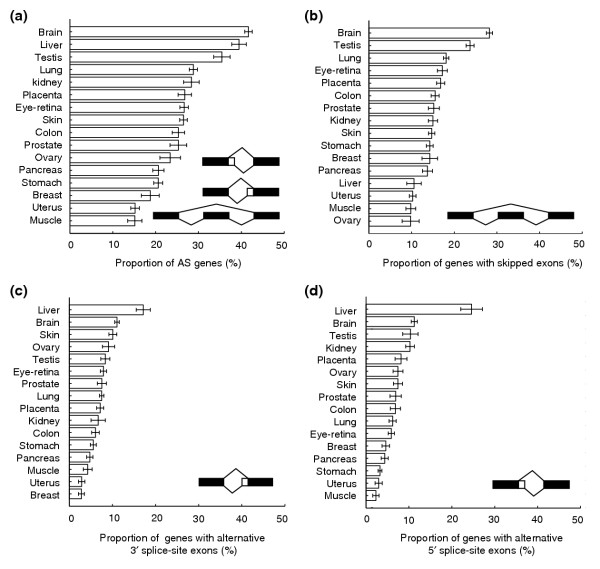
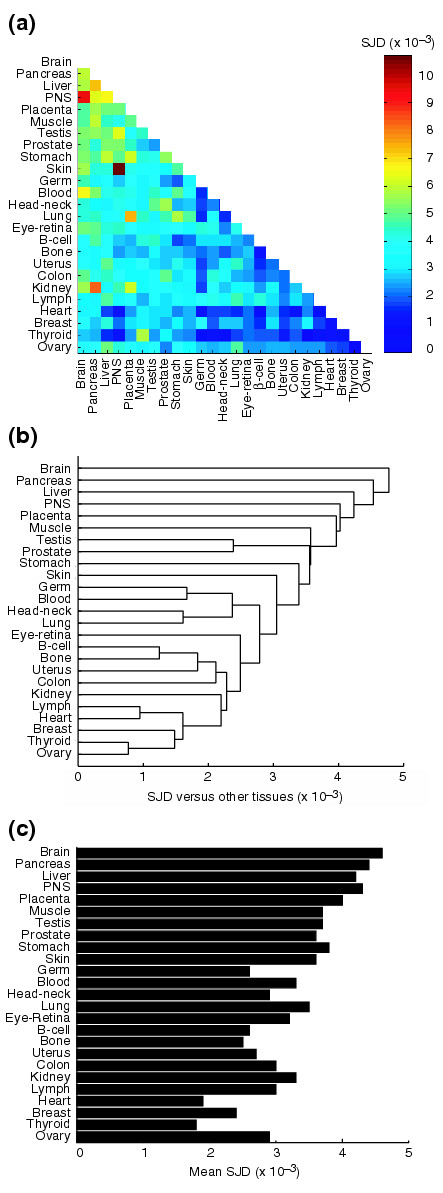
Background: Alternative pre-mRNA splicing (AS) is widely used by higher eukaryotes to generate different protein isoforms in specific cell or tissue types. To compare AS events across human tissues, we analyzed the splicing patterns of genomically aligned expressed sequence tags (ESTs) derived from libraries of cDNAs from different tissues. Results: Controlling for differences in EST coverage among tissues, we found that the brain and testis had the highest levels of exon skipping. The most pronounced differences between tissues were seen for the frequencies of alternative 3' splice site and alternative 5' splice site usage, which were about 50 to 100% higher in the liver than in any other human tissue studied. Quantifying differences in splice junction usage, the brain, pancreas, liver and the peripheral nervous system had the most distinctive patterns of AS. Analysis of available microarray expression data showed that the liver had the most divergent pattern of expression of serine-arginine protein and heterogeneous ribonucleoprotein genes compared to the other human tissues studied, possibly contributing to the unusually high frequency of alternative splice site usage seen in liver. Sequence motifs enriched in alternative exons in genes expressed in the brain, testis and liver suggest specific splicing factors that may be important in AS regulation in these tissues. Conclusions: This study distinguishes the human brain, testis and liver as having unusually high levels of AS, highlights differences in the types of AS occurring commonly in different tissues, and identifies candidate cis-regulatory elements and trans-acting factors likely to have important roles in tissue-specific AS in human cells.
Overview
The claims and statistics of this paper haven’t been checked yet.
Free: it reads the open-access text and checks the first 5 claims that cite a source we can check. Create a free account to check every claim.
Integrity signals
Registry
Cites
Statistics
Figures
Verification
Claims the paper makes
The claims and statistics of this paper haven’t been checked yet.
Free: it reads the open-access text and checks the first 5 claims that cite a source we can check. Create a free account to check every claim.
Claims other papers make about this one
Each is checked against this paper’s own text: does it say what the citing paper says it does?
The source backs part of the claim, not all of it — or backs it for a different population, condition or comparison.
In the citing paper
“Previous expressed sequence tagged mapping studies have led to the conclusion that the brain has the highest number of alternative splicing events when compared with other organs (Yeo et al., 2004)”
From An RNA-Sequencing Transcriptome and Splicing Database of Glia, Neurons, and Vascular Cells of the Cerebral Cortex (2014) · cites this paper as Yeo et al., 2004
Experimental — accuracy not yet measuredIn the citing paper
“Undocumented peptides are particularly enriched in the testis, which is known to differ markedly from other tissues in splicing pattern (Yeo et al., 2004).”
From Splice-Junction-Based Mapping of Alternative Isoforms in the Human Proteome (2019) · cites this paper as Yeo et al., 2004
In the citing paper
“Because brain contains a large number of alternatively spliced proteins [50]”
From Deep proteomic network analysis of Alzheimer’s disease brain reveals alterations in RNA binding proteins and RNA splicing associated with disease (2018) · cites this paper as [50]
Self-check
Percentages, sums and reported differences re-computed from the paper’s own numbers.
The self-check needs the paper’s full text.
Citations
Cites
A gene atlas of the mouse and human protein-encoding transcriptomes
Su, A. I., Wiltshire, T., Batalov, S., Lapp, H., Ching, K. A., Block, D., Zhang, J., Soden, R., Hayakawa, M., Kreiman, G., et al. (2004) · Proceedings of the National Academy of Sciences · doi:10.1073/pnas.0400782101 · Cited by 3,475 · cited 4×
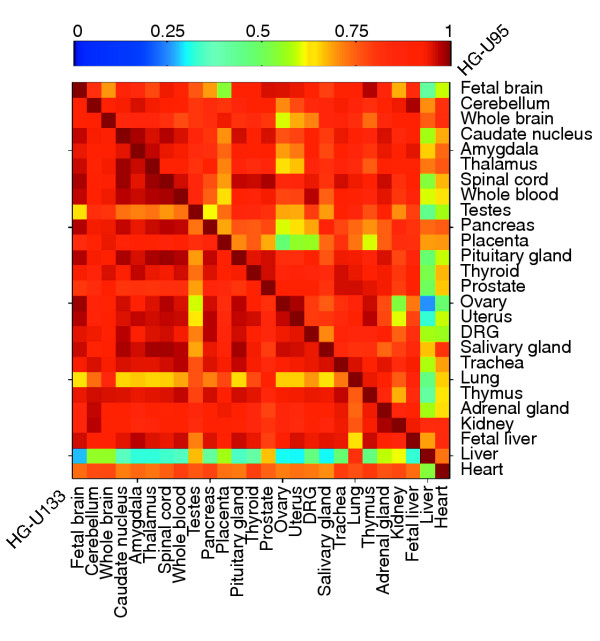
“Expression values for these genes were obtained from the 'gene expression atlas' using the HG-U95A DNA microarray [43] and from a similar set of expression data using the HGU133A DNA microarray [45].”
BackgroundMethodInfluentialSelf-citationGlantz, S. A. (1981) · Cited by 2,879
Mechanisms of Alternative Pre-Messenger RNA Splicing
Black, D. L. (2003) · Annual Review of Biochemistry · doi:10.1146/annurev.biochem.72.121801.161720 · Cited by 2,704 · cited 2×
“In addition to many differences between tissues in transcriptional and translational regulation of genes, alternative pre-mRNA splicing (AS) is also frequently used to regulate gene expression and to generate tissue-specific mRNA and protein isoforms [1-5].”
BackgroundGlantz, S. A. (1981) · Cited by 2,636
Listening to silence and understanding nonsense: exonic mutations that affect splicing
Cartegni, L., Chew, S. L., & Krainer, A. R. (2002) · Nature Reviews Genetics · doi:10.1038/nrg775 · Cited by 2,209 · cited 1×
“In addition to many differences between tissues in transcriptional and translational regulation of genes, alternative pre-mRNA splicing (AS) is also frequently used to regulate gene expression and to generate tissue-specific mRNA and protein isoforms [1-5].”
BackgroundLarge-scale analysis of the human and mouse transcriptomes
Su, A. I., Cooke, M. P., Ching, K. A., Hakak, Y., Walker, J. R., Wiltshire, T., Orth, A. P., Vega, R. G., Sapinoso, L. M., Moqrich, A., et al. (2002) · Proceedings of the National Academy of Sciences · doi:10.1073/pnas.012025199 · Cited by 1,466 · cited 5×
“In analyzing these microarray data, AD values smaller than 20 were standardized to 20, as in [43].”
BackgroundMethodInfluentialGenome-Wide Survey of Human Alternative Pre-mRNA Splicing with Exon Junction Microarrays
Johnson, J. M., Castle, J., Garrett-Engele, P., Kan, Z., Loerch, P. M., Armour, C. D., Santos, R., Schadt, E. E., Stoughton, R., & Shoemaker, D. D. (2003) · Science · doi:10.1126/science.1090100 · Cited by 1,418 · cited 2×
“In addition, DNA microarrays and polymerase colony approaches have been developed for higher-throughput analysis of alternative mRNA isoforms [23-26] and a cross-linking/immunoprecipitation strategy (CLIP) has been developed for systematic detection of the RNAs bound by a given splicing factor [27].”
MethodResultA genomic view of alternative splicing
Modrek, B., & Lee, C. (2002) · Nature Genetics · doi:10.1038/ng0102-13 · Cited by 1,302
A comparison of selected mRNA and protein abundances in human liver
Anderson, L., & Seilhamer, J. (1997) · ELECTROPHORESIS · doi:10.1002/elps.1150180333 · Cited by 1,262 · cited 1×
“The relation between the amount of mRNA expressed from a gene and the concentration of the corresponding protein has been examined previously in several studies in yeast as well as in human and mouse liver tissues [55-58].”
BackgroundPre-mRNA splicing and human disease
Faustino, N. A., & Cooper, T. A. (2003) · Genes & Development · doi:10.1101/gad.1048803 · Cited by 1,256 · cited 2×
“cated in several human genetic diseases [12].”
Background
Cited by
Items 201–300 of 685
Intragenic motifs regulate the transcriptional complexity of Pkhd1/PKHD1
Boddu, R., Yang, C., O’Connor, A. K., Hendrickson, R. C., Boone, B. E., Cui, X., García-González, M. Á., Igarashi, P., Onuchic², L. F., Germino, G. G., et al. (2014) · Journal of Molecular Medicine · doi:10.1007/s00109-014-1185-7 · Cited by 43
“The ACESCAN2 Web Server was used to analyze intronic splice enhancers [20].”
MethodLive or let die: posttranscriptional gene regulation in cell stress and cell death
Thomas, M. P., & Lieberman, J. (2013) · Immunological Reviews · doi:10.1111/imr.12052 · Cited by 43
“Transcriptome-wide sequencing and microarray studies have focused on the large variation in alternative splicing found across tissues, and the corresponding variations in expression of splicing regulators, such as the hnRNP and SR proteins (25, 32, 33).”
BackgroundChau, K. K., Zhang, P., Urresti, J., Amar, M., Pramod, A. B., Chen, J., Thomas, A. E., Corominas, R., Lin, G. N., & Iakoucheva, L. M. (2021) · Cell Reports · doi:10.1016/j.celrep.2021.109631 · Cited by 44
Antoniou, N., Prodromidou, K., Kouroupi, G., Boumpoureka, I., Samiotaki, M. K., Panayotou, G., Xilouri, M., Kloukina, I., Stefanis, L., Grailhe, R., et al. (2022) · npj Parkinson s Disease · doi:10.1038/s41531-022-00278-y · Cited by 43
“advantage of all these strategies as the brain has the highest levels of alternative splicing compared to any other human tissue [73].”
BackgroundAge and gender-dependent alternative splicing of P/Q-type calcium channel EF-hand
Chang, S. Y., Yong, T. F., Yu, C. Y., Liang, M. C., Pletniková, O., Troncoso, J. C., Burgunder, J., & Soong, T. W. (2007) · Neuroscience · doi:10.1016/j.neuroscience.2006.12.054 · Cited by 46
“Alternative splicing events have been documented to occur more frequently in transcripts from genes expressed in functionally complex tissues with diverse cell types such as the brain (Modrek et al., 2001,Johnson et al., 2003,Yeo et al., 2004).”
BackgroundSpecific genomic cues regulate Cajal body assembly
Sawyer, I. A., Hager, G. L., & Dundr, M. (2016) · RNA Biology · doi:10.1080/15476286.2016.1243648 · Cited by 43
“Specifically, the presence of CBs in brain tissue could be a cellular response to high splicing demands, as neuronal tissues have among the highest rates of alternative splicing in humans.(132) As previously shown, neuritogenesis itself is a splicing-intensive process and requires high-levels of U snRNPs and component…”
BackgroundLong-read sequencing for 29 immune cell subsets reveals disease-linked isoforms
Inamo, J., Suzuki, A., Ueda, M. T., Yamaguchi, K., Nishida, H., Suzuki, K., Kaneko, Y., Takeuchi, T., Hatano, H., Ishigaki, K., et al. (2024) · Nature Communications · doi:10.1038/s41467-024-48615-4 · Cited by 42
Nassisi, M., Mohand‐Saïd, S., Andrieu, C., Antonio, A., Condroyer, C., Méjécase, C., Varin, J., Wohlschlegel, J., Dhaenens, C., Sahel, J., et al. (2019) · International Journal of Molecular Sciences · doi:10.3390/ijms20205053 · Cited by 42
“(2) In silico prediction with algorithms capable to predict effects of variants on splicing: SpliceSiteFinder-like (SSF [47]), NNSplice ([48], http://www.fruitfly.org/seq_tools/splice. html), MaxEntScan ([49], http://hollywood.mit.edu/burgelab/maxent/Xmaxentscan_scoreseq.html, Gene Splicer ([50], http://www.cbcb.umd.e…”
InfluentialDynamic usage of alternative splicing exons during mouse retina development
Wan, J., Masuda, T., Hackler, L., Torres, K. M., Merbs, S. L., Zack, D. J., & Qian, J. (2011) · Nucleic Acids Research · doi:10.1093/nar/gkr545 · Cited by 38
“Retinal tissue has one of the highest levels of AS (11,12), and dysregulation of AS and mutations in general splicing factors have been associated with retinal diseases (13–16).”
BackgroundEckstein, M., Eleazer, R., Rea, M., & Fondufe‐Mittendorf, Y. N. (2016) · Reviews on Environmental Health · doi:10.1515/reveh-2016-0025 · Cited by 42
Genome-wide transcriptome analysis in murine neural retina using high-throughput RNA sequencing
Uzun, E. D. G., Ouyang, Q., Schmidt, M., Nagpal, S., & Morrow, E. M. (2011) · Genomics · doi:10.1016/j.ygeno.2011.09.003 · Cited by 41
“Our findings are highly consistent with prior estimates of alternatively splicing in human retina where alternative splicing has been estimated to be in 26% of retina genes in a study based on expressed sequence tags (ESTs) [29].”
ResultTau‐induced deficits in nonsense‐mediated mRNA decay contribute to neurodegeneration
Zuniga, G., Levy, S. A., Ramirez, P., Mange, J. D., Gonzalez, E. M., Gamez-Guijarro, M., & Frost, B. E. (2022) · Alzheimer s & Dementia · doi:10.1002/alz.12653 · Cited by 40
Estrogen receptor-α splice variants in the human brain
Ishunina, T. A., & Swaab, D. F. (2008) · Gynecological Endocrinology · doi:10.1080/09513590701705148 · Cited by 36
“Among different human tissues and apart from testis and liver, brain has the highest levels of exon skipping [22], which is the most common mechanism of alternative splicing.”
BackgroundCloning and embryonic expression patterns of the chicken CELF family
Brimacombe, K. R., & Ladd, A. N. (2007) · Developmental Dynamics · doi:10.1002/dvdy.21209 · Cited by 40
“…RNA processing plays an important part in the development of the CNS. Pre-mRNA alternative splicing occurs with particularly high frequency in the nervous system (Yeo et al., 2004), where many neurotransmitter receptor and ion channel genes produce multiple isoforms via alternative splicing.”
BackgroundGoo, Y., & Cooper, T. A. (2009) · Nucleic Acids Research · doi:10.1093/nar/gkp346 · Cited by 39
“RNA-binding protein SF3B2 (19) Transcription GTF2I (23) DDX42 (13) SPT6H (15) Matr3 (8) SET (9) TADBP (7) SNW1 (7) PRP31 (6) MEF2D (6) SRP68 (4) HDAC4 (5) SF3B4 (3) NELFE (4) PRP4 (3) NCoA3 (3) RNA/DNA helicase DDX1 (8) Signaling PPP1R13BL (10) DHX9 (5) ARNT (5) Exoribonuclease XRN2 (10) CAM2D (3) DNA repair ERCC5 (18…”
BackgroundGenetic variants in RBFOX3 are associated with sleep latency
Amin, N., Allebrandt, K. V., van der Spek, A., Müller‐Myhsok, B., Hek, K., Teder‐Laving, M., Hayward, C., Esko, T., van Mill, J. G., Mbarek, H., et al. (2016) · European Journal of Human Genetics · doi:10.1038/ejhg.2016.31 · Cited by 39
Hu, Q., Greene, C. S., & Heller, E. A. (2020) · Nucleic Acids Research · doi:10.1093/nar/gkaa248 · Cited by 39
Stojic, J., Stöhr, H., & Weber, B. H. F. (2007) · BMC Molecular Biology · doi:10.1186/1471-2199-8-42 · Cited by 39
Louadi, Z., Elkjaer, M. L., Klug, M., Lio, C. T., Fenn, A. M., Illés, Z., Bongiovanni, D., Baumbach, J., Kacprowski, T., List, M., et al. (2021) · Genome biology · doi:10.1186/s13059-021-02538-1 · Cited by 38
Analysis of the human testis proteome by mass spectrometry and bioinformatics
Guo, X., Zhang, P., Huo, R., Zhou, Z., & Sha, J. (2008) · PROTEOMICS - CLINICAL APPLICATIONS · doi:10.1002/prca.200780120 · Cited by 38
“Also it has the second highest number of cassette exons [23, 24].”
BackgroundTissue-specific regulation of gene expression via unproductive splicing
Mironov, A., Petrova, M. V., Margasyuk, S., Vlasenok, M., Mironov, A. A., Skvortsov, D. A., & Pervouchine, D. D. (2023) · Nucleic Acids Research · doi:10.1093/nar/gkad161 · Cited by 37
“This finding suggests a special role of NMD in orchestrating cerebellar transcriptional programs [70] amid generally higher abundance of AS events and their contribution to the development of all these tissues [71, 72, 73].”
BackgroundAberrant epigenetic landscape in intellectual disability
Sanchez-Mut, J. V., Huertas, D., & Esteller, M. (2012) · Progress in brain research · doi:10.1016/b978-0-444-54299-1.00004-2 · Cited by 39
ASPIC: a web resource for alternative splicing prediction and transcript isoforms characterization
Castrignanò, T., Rizzi, R., Talamo, I. G., Meo, P. D. D., Anselmo, A., Bonizzoni, P., & Pesole, G. (2006) · Nucleic Acids Research · doi:10.1093/nar/gkl324 · Cited by 37
“Recent descriptions of the functional implications of AS in tissue-specificity (3), different biological processes (4) and tumor development (5) has generated an explosion of interest and activity in this field particularly with respect to the development of suitable computational methods for AS prediction.”
MethodDisruption of nuclear speckle integrity dysregulates RNA splicing in C9ORF72-FTD/ALS
Wu, R., Ye, Y., Dong, D., Zhang, Z., Wang, S., Li, Y., Wright, N., Redding‐Ochoa, J., Chang, K., Xu, S., et al. (2024) · Neuron · doi:10.1016/j.neuron.2024.07.025 · Cited by 36
Alternative splicing dynamics and evolutionary divergence during embryogenesis in wheat species
Gao, P., Quilichini, T. D., Zhai, C., Qin, L. H., Nilsen, K. T., Li, Q., Sharpe, A., Kochian, L. V., Zou, J., Reddy, A. S. N., et al. (2021) · Plant Biotechnology Journal · doi:10.1111/pbi.13579 · Cited by 36
GarlicESTdb: an online database and mining tool for garlic EST sequences
Kim, D.-W., Jung, T.-S., Nam, S.-H., Kwon, H.-R., Kim, A., Chae, S., Choi, S.-H., Kim, D.-W., Kim, R. N., & Park, H.-S. (2009) · BMC Plant Biology · doi:10.1186/1471-2229-9-61 · Cited by 36
“Background EST sequencing is a useful tool for investigating a wide variety of genetic characteristics of a species, such as how many genes exist in the species, how gene expression patterns differ between tissues, where exonic and intronic regions are located and how many alternatively spliced transcripts can be crea…”
Investigation of Human Testis Protein Heterogeneity Using 2‐Dimensional Electrophoresis
Guo, X., Zhao, C. L., Wang, F., Zhu, Y., Cui, Y., Zhou, Z., Huo, R., & Sha, J. (2010) · Journal of Andrology · doi:10.2164/jandrol.109.007534 · Cited by 36
Kumar, D., Yadav, A. K., Jia, X., Mulvenna, J. P., & Dash, D. (2015) · Molecular & Cellular Proteomics · doi:10.1074/mcp.m114.047126 · Cited by 36
“The complexity of regulatory and interaction networks created among these molecules regulation and interaction between these molecules, especially proteins, is among the highest in the brain (1, 2).”
BackgroundPiwi Proteins and piRNAs Step onto the Systems Biology Stage
Clark, J. P., & Lau, N. C. (2014) · Advances in experimental medicine and biology · doi:10.1007/978-1-4939-1221-6_5 · Cited by 36
McCullough, R. M., Cantor, C. R., & 丁春明 (2005) · Nucleic Acids Research · doi:10.1093/nar/gni098 · Cited by 36
“The general trend of the data in Table 2, however, does correlate with previous EST and tissue-specific alternative splicing studies (13,16), in which brain was found to have the highest level of alternative splicing followed by the testis and heart.”
ResultZhang, C., Xiao, X., Zhang, Z., Hu, Z., & Li, M. (2021) · Molecular Psychiatry · doi:10.1038/s41380-021-01037-w · Cited by 35
SRSF10 is essential for progenitor spermatogonia expansion by regulating alternative splicing
Liu, W., Lu, X., Zhao, Z., Su, R., Li, Q.-N. L., Xue, Y., Gao, Z., Sun, S., Lei, W., Li, L., et al. (2022) · eLife · doi:10.7554/elife.78211 · Cited by 35
Hirschfeld, M., Zhang, B., Jaeger, M., Stamm, S., Erbes, T., Mayer, S., Tong, X., & Stickeler, E. (2013) · Molecular Carcinogenesis · doi:10.1002/mc.22045 · Cited by 35
“The development- and tissue-specific character of alternative splicing events [19–21] may account for the existence of the exon 6 skipping isoform as an evolutionary conserved physiological phenomenon [22,23].”
BackgroundEmerging Roles of Activity-Dependent Alternative Splicing in Homeostatic Plasticity
Thalhammer, A., Jaudon, F., & Cingolani, L. A. (2020) · Frontiers in Cellular Neuroscience · doi:10.3389/fncel.2020.00104 · Cited by 34
Storbeck, M., Hupperich, K., Gaspar, J. A., Meganathan, K., Carrera, L. M., Wirth, R., Sachinidis, A., & Wirth, B. (2014) · PLoS ONE · doi:10.1371/journal.pone.0089020 · Cited by 34
“In the brain there is a higher occurrence of alternative splicing events than in any other tissue [43,44,45] and 50 percent of known debilitating mutations in RNA-binding proteins cause neuronal-related diseases [46,47].”
Background547 transcriptomes from 44 brain areas reveal features of the aging brain in non-human primates
Li, M., Wu, S., Zhang, J.-J., Tian, H.-Y., Shao, Y., Wang, Z., Irwin, D. M., Li, J., Hu, X., & Wu, D. (2019) · Genome biology · doi:10.1186/s13059-019-1866-1 · Cited by 34
Novel neuronal proteolipid protein isoforms encoded by the human myelin proteolipid protein 1 gene
Sarret, C., Combes, P., Micheau, P., Gélot, A., Boespflug‐Tanguy, O., & Vaurs‐Barrière, C. (2009) · Neuroscience · doi:10.1016/j.neuroscience.2009.12.047 · Cited by 35
Transcriptome analysis of human gastric cancer
Oh, J., Yang, J. O., Hahn, Y., Kim, M., Byun, S.-S., Jeon, Y.-J., Kim, J., Song, K., Noh, S., Kim, S., et al. (2005) · Mammalian Genome · doi:10.1007/s00335-005-0075-2 · Cited by 34
“However, it is partly consistent with the previous report in which the number of alternative splicing variants in stomach tissue was ranked the lowest among human tissues (Yeo et al. 2004).”
ResultTISA: Tissue-specific Alternative Splicing in Human and Mouse Genes
Noh, S.-J., Lee, K., Paik, H., & Hur, C. (2006) · DNA Research · doi:10.1093/dnares/dsl011 · Cited by 34
Takeda, J.-I., Suzuki, Y., Sakate, R., Sato, Y., Seki, M., Irie, T., Takeuchi, N., Ueda, T., Nakao, M., Sugano, S., et al. (2008) · Nucleic Acids Research · doi:10.1093/nar/gkn677 · Cited by 35
“It is also interesting that most AS variants are produced in the brain and testis (40).”
Non-EST based prediction of exon skipping and intron retention events using Pfam information
Hiller, M., Huse, K., Platzer, M., & Backofen, R. (2005) · Nucleic Acids Research · doi:10.1093/nar/gki870 · Cited by 34
“Moreover, tissue distribution of ESTs is strongly biased with the brain having the highest number of ESTs (17).”
BackgroundKoterniak, B., Pilaka, P. P., Gracida, X., Schneider, L.-M., Pritišanac, I., Zhang, Y., & Calarco, J. A. (2020) · Genome Research · doi:10.1101/gr.267328.120 · Cited by 33
Fazeli, S., Motovali-Bashi, M., Peymani, M., Hashemi, M., Etemadifar, M., Nasr‐Esfahani, M. H., & Ghaedi, K. (2020) · PLoS ONE · doi:10.1371/journal.pone.0240855 · Cited by 33
Benson, B. C., Shaw, P. J., Azzouz, M., Highley, J. R., & Hautbergue, G. M. (2021) · Frontiers in Neuroscience · doi:10.3389/fnins.2021.783624 · Cited by 33
Strategies for Identifying RNA Splicing Regulatory Motifs and Predicting Alternative Splicing Events
Holste, D., & Ohler, U. (2008) · PLoS Computational Biology · doi:10.1371/journal.pcbi.0040021 · Cited by 33
“Probabilistic and sampling strategies have been discussed to circumvent or correct for this bias [21,22,24].”
BackgroundSelf-citationMa, W., Veltsos, P., Toups, M. A., Rodrigues, N., Sermier, R., Jeffries, D. L., & Perrin, N. (2018) · Genes · doi:10.3390/genes9060294 · Cited by 33
“Our finding that brain tissue had the highest tissue specificity is less documented and may have been caused by the fact that brains have among the highest alternative splice variants (in humans; [80,81]).”
BackgroundSplicing, cis genetic variation and disease
Jensen, C., Oldfield, B. J., & Rubio, J. P. (2009) · Biochemical Society Transactions · doi:10.1042/bst0371311 · Cited by 33
Human netrin-G1 isoforms show evidence of differential expression
Meerabux, J. M. A., Ohba, H., Fukasawa, M., Suto, Y., Aoki-Suzuki, M., Nakashiba, T., Nishimura, S., Itohara, S., & Yoshikawa, T. (2005) · Genomics · doi:10.1016/j.ygeno.2005.04.004 · Cited by 33
“The large number of NTNG1 isoforms detected in human brain reflects findings that between 40 and 60% of genes undergo alternative splicing, with the brain showing the highest levels of exon skipping [14,15].”
BackgroundFunctional genomics of human brain development and implications for autism spectrum disorders
Ziats, M. N., Grosvenor, L. P., & Rennert, O. M. (2015) · Translational Psychiatry · doi:10.1038/tp.2015.153 · Cited by 32
Nasti, R., Rossi, D., Amadio, M., Pascale, A., Ünver, M. Y., Hirsch, A. K. H., & Collina, S. (2017) · Journal of Medicinal Chemistry · doi:10.1021/acs.jmedchem.6b01871 · Cited by 32
Dery, K. J., Kojima, H., Kageyama, S., Kadono, K., Hirao, H., Cheng, B., Zhai, Y., Farmer, D. G., Kaldas, F. M., Yuan, X., et al. (2023) · Science Translational Medicine · doi:10.1126/scitranslmed.adf2059 · Cited by 32
“Microarray data suggest that the human liver has the most divergent hnRNP expression program, likely because of the high frequency of genes (~35 to 40%) that express alternative exons (4).”
Ogasawara, O., Otsuji, M., Watanabe, K., 飯塚, 高., Tamura, T., Hishiki, T., Kawamoto, S., & Okubo, K. (2005) · Nucleic Acids Research · doi:10.1093/nar/gkj137 · Cited by 32
“substantial portion of this splicing may be anatomically controlled (22), the resolution of expression should be enhanced to the transcript level from the gene level.”
BackgroundrRNA and tRNA Bridges to Neuronal Homeostasis in Health and Disease
Tuorto, F., & Parlato, R. (2019) · Journal of Molecular Biology · doi:10.1016/j.jmb.2019.03.004 · Cited by 32
Testicular Development and Spermatogenesis: Harvesting the Postgenomics Bounty
Rolland, A. D., Jégou, B., & Pineau, C. (2009) · Advances in experimental medicine and biology · doi:10.1007/978-0-387-09597-4_2 · Cited by 34
Sutton, M. Y., Lanier, Y. A., Willis, L. A., Castellanos, T., Dominguez, K., Fitzpatrick, L., & Miller, K. S. (2013) · American Journal of Public Health · doi:10.2105/ajph.2013.301345 · Cited by 31
Deficiency of Splicing Factor 1 Suppresses the Occurrence of Testicular Germ Cell Tumors
Zhu, R., Heaney, J. D., Nadeau, J. H., Ali, S., & Matin, A. (2010) · Cancer Research · doi:10.1158/0008-5472.can-10-0820 · Cited by 31
Sadeque, A., Serão, N. V. L., Southey, B. R., Delfino, K. R., & Rodriguez‐Zas, S. L. (2012) · BMC Medical Genomics · doi:10.1186/1755-8794-5-59 · Cited by 31
“The brain exhibits particularly high rates of AS [6] and the highest number of AEU events [7].”
BackgroundYang, F., Chen, I.-L., Xiong, Z., Yan, Y., Wang, H., & Yang, X. (2006) · Clinical Immunology · doi:10.1016/j.clim.2006.06.007 · Cited by 31
Extensive Alternative Splicing of KIR Transcripts
Bruijnesteijn, J., van der Wiel, M. K. H., de Groot, N., Otting, Ń., de Vos‐Rouweler, A. J. M., Lardy, N. M., de Groot, N. G., & Bontrop, R. E. (2018) · Frontiers in Immunology · doi:10.3389/fimmu.2018.02846 · Cited by 30
“However, tissue-specific alternative splicing has been reported, and suggests isoforms with a local specialized function (85).”
BackgroundExpression and function of circular RNAs in the mammalian brain
Xu, K., Zhang, Y., & Li, J. (2021) · Cellular and Molecular Life Sciences · doi:10.1007/s00018-021-03780-3 · Cited by 30
Deciphering RNA splicing logic with interpretable machine learning
Liao, S. E., Sudarshan, M., & Regev, O. (2023) · Proceedings of the National Academy of Sciences · doi:10.1073/pnas.2221165120 · Cited by 30
A family of splice variants of CstF-64 expressed in vertebrate nervous systems
Shankarling, G. S., Coates, P. W., Dass, B., & MacDonald, C. C. (2009) · BMC Molecular Biology · doi:10.1186/1471-2199-10-22 · Cited by 30
“Both of these processes are regulated in a tissue-specific manner, with the highest incidence occurring in the nervous system [5-7].”
BackgroundCoulson, R. L., Powell, W. T., Yasui, D. H., Dileep, G., Resnick, J. L., & LaSalle, J. M. (2018) · Human Molecular Genetics · doi:10.1093/hmg/ddy296 · Cited by 30
Edwards, D., Stajich, J., & Hansen, D. T. (2009) · Springer eBooks · doi:10.1007/978-0-387-92738-1 · Cited by 30
Alt Event Finder: a tool for extracting alternative splicing events from RNA-seq data
Zhou, A., Breese, M. R., Hao, Y., Edenberg, H. J., Li, L., Skaar, T. C., & Liu, Y. (2012) · BMC Genomics · doi:10.1186/1471-2164-13-s8-s10 · Cited by 29
“For instance, cassette exons are dominant in brain tissues, while alternative 5’ donor and 3’ acceptor events are more abundant in liver tissues [22].”
BackgroundRNA-Binding Proteins and the Complex Pathophysiology of ALS
Kim, W., Kim, D., & Lee, K. (2021) · International Journal of Molecular Sciences · doi:10.3390/ijms22052598 · Cited by 29
“Moreover, the brain shows unusually high levels of alternative splicing, including testis and liver [167].”
BackgroundIdentification of TIA1 mRNA targets during human neuronal development
Byres, L., Mufteev, M., Yuki, K. E., Wei, W., Piekna, A., Wilson, M. D., Rodrigues, D. C., & Ellis, J. (2021) · Molecular Biology Reports · doi:10.1007/s11033-021-06634-0 · Cited by 29
Cell-type-specific alternative splicing in the Arabidopsis germline
Misra, C. S., Sousa, A. G. G., Barros, P. M., Kermanov, A. V., & Becker, J. D. (2022) · PLANT PHYSIOLOGY · doi:10.1093/plphys/kiac574 · Cited by 29
“Genomewide analysis of AS in different tissues in humans is well documented (Xu et al., 2002; Yeo et al., 2004; Pan et al., 2008), whereas in plants analysis of AS is limited to stress responses (Mandadi and Scholthof, 2015; Keller et al., 2017; Calixto et al., 2018; Huang et al., 2020), while…”
BackgroundLi, H., Spencer, L., Nahhas, F., Miller, J. R., Fribley, A. M., Feldman, G. L., Conway, R. L., & Wolf, B. (2014) · Molecular Genetics and Metabolism · doi:10.1016/j.ymgme.2014.04.002 · Cited by 29
“310-15delT did not show evidence of a splicing alteration, including exon skipping, intron intention or activating cryptic splicing site [18]; however, qRT-PCR did demonstrate the decreased mRNA expression in the patient and her mother, both of whom carry this mutation.”
BackgroundThe application of proteomic approaches to the study of mammalian spermatogenesis and sperm function
MacLeod, G. D. A. H., & Varmuza, S. (2013) · FEBS Journal · doi:10.1111/febs.12461 · Cited by 29
Systematic evaluation of the effect of common SNPs on pre-mRNA splicing
ElSharawy, A., Hundrieser, B., Brosch, M., Wittig, M., Huse, K., Platzer, M., Becker, A., Simon, M., Rosenstiel, P., Schreiber, S., et al. (2009) · Human Mutation · doi:10.1002/humu.20906 · Cited by 28
A matter of space and time: Emerging roles of disease-associated proteins in neural development
Panagiotakos, G., & Pașca, S. P. (2021) · Neuron · doi:10.1016/j.neuron.2021.10.035 · Cited by 28
The Long Non-Coding RNA GOMAFU in Schizophrenia: Function, Disease Risk, and Beyond
Zakutansky, P. M., & Feng, Y. (2022) · Cells · doi:10.3390/cells11121949 · Cited by 28
“Strikingly, more than 40% of the transcripts expressed in the human brain are alternatively spliced [44], contributing to the complexity of gene regulation in the brain [30,45].”
BackgroundGenome-wide detection of testis- and testicular cancer-specific alternative splicing
He, C., Zuo, Z., Chen, H., Zhang, L., Zhou, F., Cheng, H., & Zhou, R. (2007) · Carcinogenesis · doi:10.1093/carcin/bgm194 · Cited by 28
CircUSP36 attenuates ischemic stroke injury through the miR-139-3p/SMAD3/Bcl2 signal axis
Yang, J., He, W., Gu, L., Long, J., Zhu, L., Zhang, R., Zhao, Z., Xu, B., Nan, A., & Su, L. (2022) · Clinical Science · doi:10.1042/cs20220157 · Cited by 28
Ethanol-related alterations in gene expression patterns in the developing murine hippocampus
Mandal, C., Park, K. S., Jung, K. H., & Chai, Y. G. (2015) · Acta Biochimica et Biophysica Sinica · doi:10.1093/abbs/gmv050 · Cited by 28
“An alternative splicing is abundant in the brain compared with other tissues [23], which can influence neurophysiology [24].”
BackgroundMullari, M., Fossat, N., Skotte, N. H., Asenjo-Martínez, A., Humphreys, D. T., Bukh, J., Kirkeby, A., Scheel, T. K. H., & Nielsen, M. L. (2023) · Nature Communications · doi:10.1038/s41467-023-39936-x · Cited by 27
“Alternative splicing occurs at a signi fi cantly higher rate in the brain compared to other tissues 8 – 10 and has determining roles in neuronal development, neuronal activity and for the functions of neuronal proteins 7,11 .”
BackgroundDAX‐1 and SOX6 molecular interplay results in an antagonistic effect in pre‐mRNA splicing
Ohe, K., Tamai, T. K., Parvinen, M., & Sassone‐Corsi, P. (2009) · Developmental Dynamics · doi:10.1002/dvdy.21957 · Cited by 27
Alternative Splicing of the Delta-Opioid Receptor Gene Suggests Existence of New Functional Isoforms
Piltonen, M., Parisien, M., Grégoire, S., Chabot‐Doré, A., Jafarnejad, S. M., Bérubé, P., Djambazian, H. H. V., SLADEK, R. M., Geneau, G., Willett, P., et al. (2018) · Molecular Neurobiology · doi:10.1007/s12035-018-1253-z · Cited by 26
Osada, N., Hirata, M., Tanuma, R., Kusuda, J., Hida, M., Suzuki, Y., Sugano, S., Gojobori, T., Shen, C.-K. J., Wu, C., et al. (2005) · Molecular Biology and Evolution · doi:10.1093/molbev/msi187 · Cited by 26
Vornholt, E., Luo, D., Qiu, W., McMichael, G. O., Liu, Y., Gillespie, N. A., Ma, C., & Vladimirov, V. I. (2019) · Neuroscience & Biobehavioral Reviews · doi:10.1016/j.neubiorev.2019.04.015 · Cited by 25
“Human brain also has a greater transcriptome complexity, which is reflected by the higher levels of alternative isoforms and magnitude of alternative splice events showing qualitatively different splicing patterns relative to other tissue types (Mortazavi et al., 2008; E. T. Wang et al., 2008; Yeo et al., 2004).”
BackgroundRobust and annotation-free analysis of alternative splicing across diverse cell types in mice
Benegas, G., Fischer, J., & Song, Y. S. (2022) · eLife · doi:10.7554/elife.73520 · Cited by 25
Ayers, K. L., Eggers, S., Rollo, B., Smith, K. R., Davidson, N., Siddall, N. A., Zhao, L., Bowles, J., Weiss, K., Zanni, G., et al. (2023) · Nature Communications · doi:10.1038/s41467-023-39040-0 · Cited by 25
“Indeed, the brain and testis largely exceed the other tissues with respect to the expression of splice-variants 62 – 65 and greater expression of speci fi c signatures of splice factors suggests that alternative splicing plays a particularly crucial role in these tissues 66 .”
Lee, M., Dworkin, A. M., Gildea, D. E., Trivedi, N. S., Program, N. C. S., Moorhead, G. B. G., & Crawford, N. P. S. (2013) · Oncogene · doi:10.1038/onc.2013.133 · Cited by 26
“Splicing patterns vary greatly across different species and tissues (34), and the level of conservation for orthologous genes ranges from 11 to 20% (35–37).”
BackgroundAlternative splicing level related to intron size and organism complexity
Yang, P., Wang, D., & Kang, L. (2021) · BMC Genomics · doi:10.1186/s12864-021-08172-2 · Cited by 25
Bioinformatics Detection of Alternative Splicing
Kim, N., & Lee, C. J. (2008) · Methods in molecular biology · doi:10.1007/978-1-60327-159-2_9 · Cited by 25
Wagner, S. D., & Berglund, J. A. (2014) · Methods in molecular biology · doi:10.1007/978-1-62703-980-2_4 · Cited by 25
Alternative Splicing and Hypoxia Puzzle in Alzheimer’s and Parkinson’s Diseases
Jakubauskienė, E., & Kanopka, A. (2021) · Genes · doi:10.3390/genes12081272 · Cited by 24
“The brain cells have an unusually high fraction of alternatively spliced genes, thus showing the most complex pattern of alternative splicing and producing a higher diversity of protein isoforms compared to other tissues [22,23].”
BackgroundThe Roles of hnRNP Family in the Brain and Brain-Related Disorders
Brandão‐Teles, C., Antunes, A. S. L. M., Vrechi, T. A. D. M., & Martins‐de‐Souza, D. (2023) · Molecular Neurobiology · doi:10.1007/s12035-023-03747-4 · Cited by 26
“In particular, the human brain exhibits high levels of tissue-specific alternative splice forms compared to other human tissues [30–32].”
Alternative splicing across the C. elegans nervous system
Weinreb, A., Varol, E., Barrett, A., McWhirter, R. M., Taylor, S. R., Courtney, I. G., Basavaraju, M., Poff, A., Tipps, J. A., Collings, B., et al. (2025) · Nature Communications · doi:10.1038/s41467-025-58293-5 · Cited by 26
Zaghlool, A., Ameur, A., Cavelier, L. B., & Feuk, L. (2014) · International review of neurobiology · doi:10.1016/b978-0-12-801105-8.00005-9 · Cited by 25
Molecular design of a splicing switch responsive to the RNA binding protein Tra2
Grellscheid, S., Dalgliesh, C., Rozanska, A. L., Grellscheid, D., Bourgeois, C. F., Stévenin, J., & Elliott, D. J. (2011) · Nucleic Acids Research · doi:10.1093/nar/gkr495 · Cited by 24
“107-109, del e+(1-34) deleted: GAGgttaaaaaaacatctttgcacttattctcaaata”
Antonacci, S., Forand, D., Wolf, M., Tyus, C., Barney, J., Kellogg, L., Simon, M. A., Kerr, G., Wells, K. L., Younes, S., et al. (2015) · G3 Genes Genomes Genetics · doi:10.1534/g3.115.017327 · Cited by 24
“Support for this comes from the well-documented prevalence of transcriptome diversity in the nervous system, which is thought to be important for contributing to cellular complexity (Yeo et al. 2004; Lipscombe 2005; Li et al. 2007; Norris and Calarco 2012).”
BackgroundY-Chromosome Structural Diversity in the Bonobo and Chimpanzee Lineages
Oetjens, M. T., Shen, F., Emery, S. B., Zou, Z., & Kidd, J. M. (2016) · Genome Biology and Evolution · doi:10.1093/gbe/evw150 · Cited by 24
Single-cell alternative splicing analysis reveals dominance of single transcript variant
Liu, W., & Zhang, X. (2020) · Genomics · doi:10.1016/j.ygeno.2020.01.014 · Cited by 24
MeDAS: a Metazoan Developmental Alternative Splicing database
Li, Z., Zhang, Y., Bush, S. J., Tang, C., Chen, L., Zhang, D., Urrutia, A. O., Lin, J.-W., & Chen, L. (2020) · Nucleic Acids Research · doi:10.1093/nar/gkaa886 · Cited by 24
“Many alternatively spliced isoforms have restricted transcriptional profiles, for instance being sex- (9–11), tissue- (12,13) or cell type-specific (14– 16).”
BackgroundCharacterization and prediction of mRNA polyadenylation sites in human genes
Chang, T., Wu, L.-C., Chen, Y., Huang, H., Liu, B.-J., Cheng, K.-F., & Horng, J. (2011) · Medical & Biological Engineering & Computing · doi:10.1007/s11517-011-0732-4 · Cited by 24
“In addition, machine learning via SVMs is known to achieve good performance when identifying biological signals, such as translation initiation sites [34] and splice sites [30, 32, 33].”
BackgroundData analysis of alternative splicing microarrays
Čuperlović‐Culf, M., Belacel, N., Culf, A. S., & Ouellette, R. J. (2006) · Drug Discovery Today · doi:10.1016/j.drudis.2006.09.011 · Cited by 24
Song, H., Zhu, L. J., Li, Y., Ma, C., Guan, K., Xia, X., & Li, F. (2015) · Gene · doi:10.1016/j.gene.2015.07.057 · Cited by 24
Future directions for high‐throughput splicing assays in precision medicine
Rhine, C. L., Neil, C. R., Glidden, D. T., Cygan, K. J., Fredericks, A. M., Wang, J., Walton, N., & Fairbrother, W. G. (2019) · Human Mutation · doi:10.1002/humu.23866 · Cited by 22
Metadata
- Authors
- Yeo, G., Holste, D., Kreiman, G., & Burge, C. B.
- Affiliations
- Massachusetts Institute of Technology (US)
- Corresponding author
- Burge, Christopher B
- Venue
- Genome Biology
- Published
- 2004-09-13
- Volume
- 5
- Issue
- 10
- Pages
- R74-R74
- ISSN
- 1465-6906 (ISSN-L)
- 1474-760X
- PMC
- PMC545594
- OpenAlex
- W2169685494
- Cited by
- 584
- References
- 70
- Citations by year
- 2026: 17 · 2025: 24 · 2024: 28 · 2023: 26 · 2022: 34 · 2021: 49 · 2020: 24 · 2019: 33 · 2018: 31 · 2017: 24 · 2016: 19 · 2015: 30 · 2014: 20 · 2013: 27 · 2012: 28
- FWCI
- 9.71
- Type
- journal article
- Language
- en
- Open access
- gold
- doi.org
- Licence
- cc-by
- creativecommons.org/licenses/by/2.0/ (tdm)
- creativecommons.org/licenses/by/2.0/ (vor)
- Locations
- Genome biology (publishedVersion, cc-by)
- PubMed Central (publishedVersion)
- PubMed (publishedVersion)
- Digital Access to Scholarship at Harvard (DASH) (Harvard University) (submittedVersion, cc-by)
- Funders
- National Science Foundation
- National Institutes of Health
- Topics
- Life Sciences › Biochemistry, Genetics and Molecular Biology › Molecular Biology › RNA Research and Splicing
- Life Sciences › Biochemistry, Genetics and Molecular Biology › Molecular Biology › RNA regulation and disease
- Life Sciences › Biochemistry, Genetics and Molecular Biology › Cancer Research › Cancer-related molecular mechanisms research
- Keywords
- alternative splicing, tissue-specific splicing, exon skipping, expressed sequence tags, liver, brain, testis, cis-regulatory elements, splicing factors, human tissue
- MeSH terms
- Brain, Exons, Humans, Liver, Male, Organ Specificity, Regulatory Sequences, Nucleic Acid, RNA, Messenger, Testis, Genetic Variation, Gene Library, Alternative Splicing, Protein Isoforms, Expressed Sequence Tags, RNA Splice Sites
About these checks
Registry, retraction, Cites and statistics results are computed, not judged, with one exception: a printed reference that no index lists is read once by a model before it counts as a citation error. Claims are extracted by a model and kept only when their quote appears verbatim in the text; each cited source is then checked, with a model’s help, for whether it says what the claim relies on. Those verdicts can be wrong — read the claim’s quote and the cited source before relying on one.
Statistics and arithmetic are recomputed, not judged.
Confidence bands are shown only for fields calibrated on our annotated test set. None is calibrated yet, so no band is shown.
What counts as a claim ›How we measure confidence ›How we check this ›
Are you an author, or do you see a problem with this page? Request a review
Data sources
Bibliographic data: Semantic Scholar, OpenAlex, Crossref.
Contains information from the Semantic Scholar Academic Graph Datasets, made available under the ODC Attribution License (ODC-BY 1.0).
Semantic Scholar’s data is described in: Kinney, R., et al. (2023). The Semantic Scholar Open Data Platform. arXiv:2301.10140.
