

Variation in alternative splicing across human tissues
Open accessThe DOI matches its Crossref record; 71 of the 71 references it cites were found in a registry or an index.
Abstract
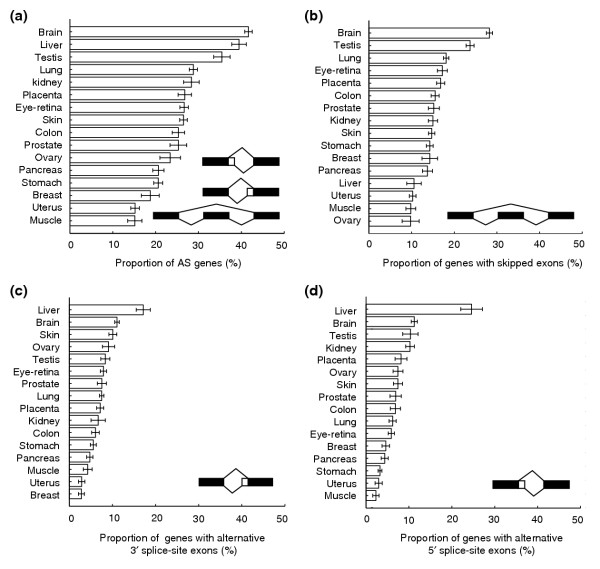
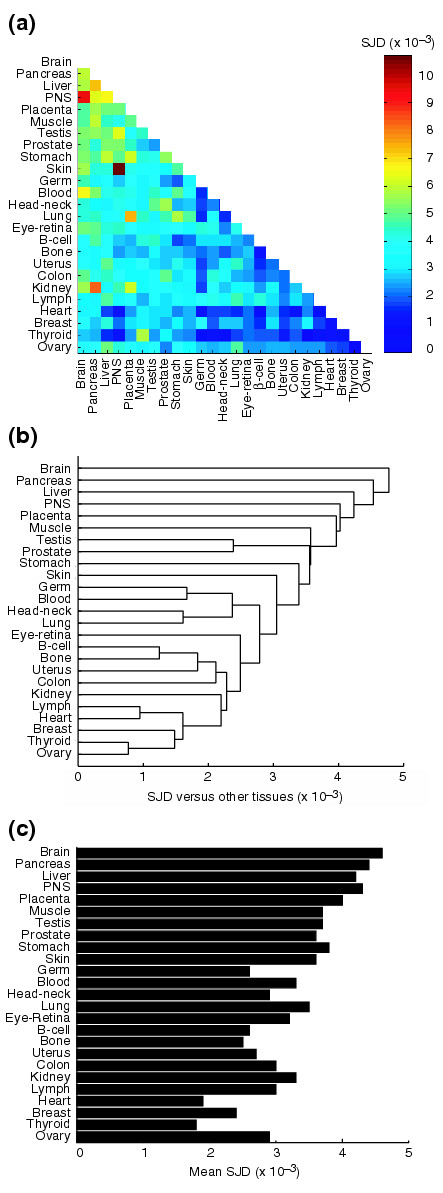
Background: Alternative pre-mRNA splicing (AS) is widely used by higher eukaryotes to generate different protein isoforms in specific cell or tissue types. To compare AS events across human tissues, we analyzed the splicing patterns of genomically aligned expressed sequence tags (ESTs) derived from libraries of cDNAs from different tissues. Results: Controlling for differences in EST coverage among tissues, we found that the brain and testis had the highest levels of exon skipping. The most pronounced differences between tissues were seen for the frequencies of alternative 3' splice site and alternative 5' splice site usage, which were about 50 to 100% higher in the liver than in any other human tissue studied. Quantifying differences in splice junction usage, the brain, pancreas, liver and the peripheral nervous system had the most distinctive patterns of AS. Analysis of available microarray expression data showed that the liver had the most divergent pattern of expression of serine-arginine protein and heterogeneous ribonucleoprotein genes compared to the other human tissues studied, possibly contributing to the unusually high frequency of alternative splice site usage seen in liver. Sequence motifs enriched in alternative exons in genes expressed in the brain, testis and liver suggest specific splicing factors that may be important in AS regulation in these tissues. Conclusions: This study distinguishes the human brain, testis and liver as having unusually high levels of AS, highlights differences in the types of AS occurring commonly in different tissues, and identifies candidate cis-regulatory elements and trans-acting factors likely to have important roles in tissue-specific AS in human cells.
Overview
The claims and statistics of this paper haven’t been checked yet.
Free: it reads the open-access text and checks the first 5 claims that cite a source we can check. Create a free account to check every claim.
Integrity signals
Registry
Cites
Statistics
Figures
Verification
Claims the paper makes
The claims and statistics of this paper haven’t been checked yet.
Free: it reads the open-access text and checks the first 5 claims that cite a source we can check. Create a free account to check every claim.
Claims other papers make about this one
Each is checked against this paper’s own text: does it say what the citing paper says it does?
The source backs part of the claim, not all of it — or backs it for a different population, condition or comparison.
In the citing paper
“Previous expressed sequence tagged mapping studies have led to the conclusion that the brain has the highest number of alternative splicing events when compared with other organs (Yeo et al., 2004)”
From An RNA-Sequencing Transcriptome and Splicing Database of Glia, Neurons, and Vascular Cells of the Cerebral Cortex (2014) · cites this paper as Yeo et al., 2004
Experimental — accuracy not yet measuredIn the citing paper
“Undocumented peptides are particularly enriched in the testis, which is known to differ markedly from other tissues in splicing pattern (Yeo et al., 2004).”
From Splice-Junction-Based Mapping of Alternative Isoforms in the Human Proteome (2019) · cites this paper as Yeo et al., 2004
In the citing paper
“Because brain contains a large number of alternatively spliced proteins [50]”
From Deep proteomic network analysis of Alzheimer’s disease brain reveals alterations in RNA binding proteins and RNA splicing associated with disease (2018) · cites this paper as [50]
Self-check
Percentages, sums and reported differences re-computed from the paper’s own numbers.
The self-check needs the paper’s full text.
Citations
Cites
A gene atlas of the mouse and human protein-encoding transcriptomes
Su, A. I., Wiltshire, T., Batalov, S., Lapp, H., Ching, K. A., Block, D., Zhang, J., Soden, R., Hayakawa, M., Kreiman, G., et al. (2004) · Proceedings of the National Academy of Sciences · doi:10.1073/pnas.0400782101 · Cited by 3,475 · cited 4×
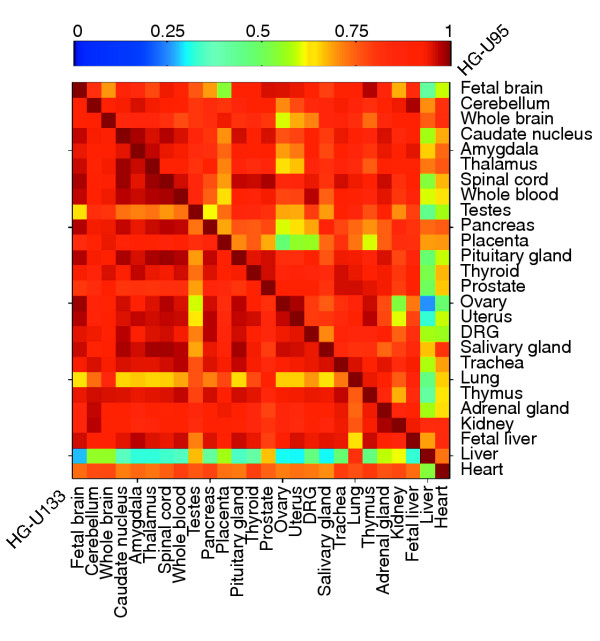
“Expression values for these genes were obtained from the 'gene expression atlas' using the HG-U95A DNA microarray [43] and from a similar set of expression data using the HGU133A DNA microarray [45].”
BackgroundMethodInfluentialSelf-citationGlantz, S. A. (1981) · Cited by 2,879
Mechanisms of Alternative Pre-Messenger RNA Splicing
Black, D. L. (2003) · Annual Review of Biochemistry · doi:10.1146/annurev.biochem.72.121801.161720 · Cited by 2,704 · cited 2×
“In addition to many differences between tissues in transcriptional and translational regulation of genes, alternative pre-mRNA splicing (AS) is also frequently used to regulate gene expression and to generate tissue-specific mRNA and protein isoforms [1-5].”
BackgroundGlantz, S. A. (1981) · Cited by 2,636
Listening to silence and understanding nonsense: exonic mutations that affect splicing
Cartegni, L., Chew, S. L., & Krainer, A. R. (2002) · Nature Reviews Genetics · doi:10.1038/nrg775 · Cited by 2,209 · cited 1×
“In addition to many differences between tissues in transcriptional and translational regulation of genes, alternative pre-mRNA splicing (AS) is also frequently used to regulate gene expression and to generate tissue-specific mRNA and protein isoforms [1-5].”
BackgroundLarge-scale analysis of the human and mouse transcriptomes
Su, A. I., Cooke, M. P., Ching, K. A., Hakak, Y., Walker, J. R., Wiltshire, T., Orth, A. P., Vega, R. G., Sapinoso, L. M., Moqrich, A., et al. (2002) · Proceedings of the National Academy of Sciences · doi:10.1073/pnas.012025199 · Cited by 1,466 · cited 5×
“In analyzing these microarray data, AD values smaller than 20 were standardized to 20, as in [43].”
BackgroundMethodInfluentialGenome-Wide Survey of Human Alternative Pre-mRNA Splicing with Exon Junction Microarrays
Johnson, J. M., Castle, J., Garrett-Engele, P., Kan, Z., Loerch, P. M., Armour, C. D., Santos, R., Schadt, E. E., Stoughton, R., & Shoemaker, D. D. (2003) · Science · doi:10.1126/science.1090100 · Cited by 1,418 · cited 2×
“In addition, DNA microarrays and polymerase colony approaches have been developed for higher-throughput analysis of alternative mRNA isoforms [23-26] and a cross-linking/immunoprecipitation strategy (CLIP) has been developed for systematic detection of the RNAs bound by a given splicing factor [27].”
MethodResultA genomic view of alternative splicing
Modrek, B., & Lee, C. (2002) · Nature Genetics · doi:10.1038/ng0102-13 · Cited by 1,302
A comparison of selected mRNA and protein abundances in human liver
Anderson, L., & Seilhamer, J. (1997) · ELECTROPHORESIS · doi:10.1002/elps.1150180333 · Cited by 1,262 · cited 1×
“The relation between the amount of mRNA expressed from a gene and the concentration of the corresponding protein has been examined previously in several studies in yeast as well as in human and mouse liver tissues [55-58].”
BackgroundPre-mRNA splicing and human disease
Faustino, N. A., & Cooper, T. A. (2003) · Genes & Development · doi:10.1101/gad.1048803 · Cited by 1,256 · cited 2×
“cated in several human genetic diseases [12].”
Background
Cited by
Items 601–685 of 685
Munyao, W., Rahman, M. M., Wang, Z., Beauvil, C., Yu, Y., & Ruggiu, M. (2025) · Journal of Biological Chemistry · doi:10.1016/j.jbc.2025.110426
“Both alternative splicing and A-to-I RNA editing, in fact, are more prevalent in transcripts derived from the brain than those from any other human tissue (1, 2).”
Identification of Rare Variants in Schizophrenia-relevant Pathways: A Computational Analysis
Slay, O. K. (2024) · Sheffield Hallam University · doi:10.7190/shu-thesis-00693
Mohandes, S., Hirohama, D., Ha, E., Dumoulin, B., Pan, S., Bergeson, A., Abedini, A., Nguyen, T., McAllister, F. E., & Suszták, K. (2025) · medRxiv · doi:10.1101/2025.10.02.25337157
“Early studies indicate that the kidney is among the tissues with the highest splicing complexity 10 , yet splicing events and the genetic architecture of renal splicing remains largely uncharted.”
Sebaï, M., Tang, R., Adnani, Y., Fiévet, A., Cabaret, O., de Rancher, M.-A. R., Auger, N., Elaribi, Y., Jilani, H., Limacher, J., et al. (2025) · Cancers · doi:10.3390/cancers17203320
“Recently, Aucouturier et al. validated a new approach using a targeted long-read RNA sequencing and listed on their supplementary documents the gross data of CDH1 full transcripts captured on LCLs [24].”
Zhao, X., Li, X., Yuan, J., Wang, X., Meng, Q., & Zhang, X. (2025) · Genomics · doi:10.1016/j.ygeno.2025.111138
The role of p19 C-H-Ras protein in metastasis and proliferative pathways
Cruz, G. D., & Marlen, R. (2013) · Dipòsit Digital de la Universitat de Barcelona (Universitat de Barcelona)
Mills, J. D. (2012) · UNSWorks (University of New South Wales, Sydney, Australia) · doi:10.26190/unsworks/15580
Fernandes Lourenco Dale, G. (2017) · UNSWorks (University of New South Wales, Sydney, Australia) · doi:10.26190/unsworks/3425
Additional file 14 of Alternative splicing level related to intron size and organism complexity
Yang, P., Wang, D., & Kang, L. (2021) · Figshare · doi:10.6084/m9.figshare.17079178
Additional file 1 of MTSplice predicts effects of genetic variants on tissue-specific splicing
Cheng, J., Çelik, M. H., Kundaje, A. B., & Gagneur, J. (2021) · Figshare · doi:10.6084/m9.figshare.14355211
Additional file 12 of Alternative splicing level related to intron size and organism complexity
Yang, P., Wang, D., & Kang, L. (2021) · Figshare · doi:10.6084/m9.figshare.17079172
The role of circular RNAs in the evolution of the brain
Curry‐Hyde, A. (2019) · UNSWorks (University of New South Wales, Sydney, Australia) · doi:10.26190/unsworks/3761
Characterising the landscape of circular RNAs in the human brain
Gokoolparsadh, A. (2019) · UNSWorks (University of New South Wales, Sydney, Australia) · doi:10.26190/unsworks/3799
Gutiérrez, J., van Wely, K. H. M., & Martínez‐A, C. (2022) · Figshare · doi:10.6084/m9.figshare.20024912
Gutiérrez, J., van Wely, K. H. M., & Martínez‐A, C. (2022) · Figshare · doi:10.6084/m9.figshare.20024915
Henrich, M., Ha, P., Wang, Y., Ting, K., Stodieck, L., Soo, C. B., Adams, J. S., & Chun, R. (2022) · Figshare · doi:10.6084/m9.figshare.19947329
Louadi, Z., Elkjaer, M. L., Klug, M., Lio, C. T., Fenn, A. M., Illés, Z., Bongiovanni, D., Baumbach, J., Kacprowski, T., List, M., et al. (2021) · Figshare · doi:10.6084/m9.figshare.17120378
Functional genomics studies of human brain development and implications for autism spectrum disorder
Ziats, M. N. (2014) · Apollo (University of Cambridge) · doi:10.17863/cam.16340
Statistical methods for the analysis of multi-omics and multi-study datasets
McCabe, S. (2020) · Carolina Digital Repository (University of North Carolina at Chapel Hill) · doi:10.17615/s1va-bv95
Shiau, C.-K., Huang, J.-H., Liu, Y.-T., & Tsai, H.-K. (2022) · Figshare · doi:10.6084/m9.figshare.19738567
Louadi, Z., Elkjaer, M. L., Klug, M., Lio, C. T., Fenn, A. M., Illés, Z., Bongiovanni, D., Baumbach, J., Kacprowski, T., List, M., et al. (2021) · Figshare · doi:10.6084/m9.figshare.17120420
Additional file 8 of Alternative splicing level related to intron size and organism complexity
Yang, P., Wang, D., & Kang, L. (2021) · Figshare · doi:10.6084/m9.figshare.17079208
Additional file 2 of MTSplice predicts effects of genetic variants on tissue-specific splicing
Cheng, J., Çelik, M. H., Kundaje, A. B., & Gagneur, J. (2021) · Figshare · doi:10.6084/m9.figshare.14355214
Gutiérrez, J., van Wely, K. H. M., & Martínez‐A, C. (2022) · Figshare · doi:10.6084/m9.figshare.20024936
Gutiérrez, J., van Wely, K. H. M., & Martínez‐A, C. (2022) · Figshare · doi:10.6084/m9.figshare.20024933
Additional file 16 of Alternative splicing level related to intron size and organism complexity
Yang, P., Wang, D., & Kang, L. (2021) · Figshare · doi:10.6084/m9.figshare.17079184
Additional file 13 of Alternative splicing level related to intron size and organism complexity
Yang, P., Wang, D., & Kang, L. (2021) · Figshare · doi:10.6084/m9.figshare.17079175
Characterisation of an alternative splice variant of LKB1
Denison, F. C. (2010) · doi:10.25560/5565
The role of alternative splicing and long non-coding RNAs in parkinson’s disease
Kavanagh, T. (2018) · UNSWorks (University of New South Wales, Sydney, Australia) · doi:10.26190/unsworks/3687
Jha, A., K. Aicher, J., R. Gazzara, M., Singh, D., & Barash, Y. (2020) · Figshare · doi:10.6084/m9.figshare.12519467
Additional file 10 of Alternative splicing level related to intron size and organism complexity
Yang, P., Wang, D., & Kang, L. (2021) · Figshare · doi:10.6084/m9.figshare.17079166
Additional file 11 of Alternative splicing level related to intron size and organism complexity
Yang, P., Wang, D., & Kang, L. (2021) · Figshare · doi:10.6084/m9.figshare.17079169
Jha, A., K. Aicher, J., R. Gazzara, M., Singh, D., & Barash, Y. (2020) · Figshare · doi:10.6084/m9.figshare.12519470
Additional file 3 of Alternative splicing level related to intron size and organism complexity
Yang, P., Wang, D., & Kang, L. (2021) · Figshare · doi:10.6084/m9.figshare.17079193
Analysis of FUS/TLS involvement in Amyotrophic Lateral Sclerosis
DINI MODIGLIANI, S. (2014) · IRIS Research product catalog (Sapienza University of Rome)
YT521 in endometrial cancer: alternative splicing and clinical implications
Zhang, B. (2010) · FreiDok plus (Universitätsbibliothek Freiburg)
Alteraciones epigenéticas en modelos murinos y humanos de enfermedad de Alzheimer
Mut, J. V. S., Navarro, X., & Cel·lular, D. F. I. D. U. A. D. B. D. D. B. (2014) · LA Referencia (Red Federada de Repositorios Institucionales de Publicaciones Científicas)
The role of N1-Src regulated splicing in neuronal differentiation
Kudasheva, S. (2021) · White Rose eTheses Online (University of Leeds, The University of Sheffield, University of York)
Muszyńska, A. (2023) · Digital Library of the Silesian University of Technology (Silesian University of Technology)
Transcriptome dynamics of neurodegeneration using single-cell and long-read approaches
Balderrama-Gutierrez, G. (2021) · eScholarship (California Digital Library)
Analysis of a new mouse model of mental illness: Derived (1)
Bonneau, M. G. F. (2019) · ERA
Keever-Keigher, M. R. (2021) · Illinois Digital Environment for Access to Learning and Scholarship (University of Illinois at Urbana-Champaign)
Systematic evaluation of the effect of common SNPs onpre-mRNA splicing
ElSharawy, A. (2008) · MACAU: Open Access Repository of Kiel University
DNA microarrays in structural and functional genomics
Żmieńko, A., Handschuh, L., Góralski, M., & Figlerowicz, M. (2008) · RCIN (Digital Repository of the Scientifics Institutes) (Institute of Archaeology and Ethnology of the Polish Academy of Sciences)
Fliedner, A. (2021) · OPUS Repository (Kooperativer Bibliotheksverbund Berlin-Brandenburg)
Avellan, C. I. A. (2008) · NORA - Norwegian Open Research Archives
Molecular mechanisms underlying the role of SynGAP in cognition and synaptopathies
Gou, G., & Molecular, U. A. D. B. D. D. B. I. D. B. (2019) · LA Referencia (Red Federada de Repositorios Institucionales de Publicaciones Científicas)
Assembling The Building Blocks For A Unified Splicing Code
Jha, A. (2020) · ScholarlyCommons (University of Pennsylvania)
Function of Germline-specific Ribonucleoprotein granules-from germline to cancer
Olotu, O. (2023) · UTUPub (University of Turku)
Misra, C. S. (2021) · Portuguese National Funding Agency for Science, Research and Technology (RCAAP Project by FCT)
Transcriptomics for investigating immunodeficiencies of mendelian and age-related origins
Lye, J. J. (2024) · ePrints Soton (University of Southampton)
Randazza, A., Howe, K. E., McCoy, J. R., Hatfield, A., Doucet-O’Hare, T. T., & Lackey, L. (2026) · bioRxiv (Cold Spring Harbor Laboratory) · doi:10.64898/2026.01.16.699960
Transcriptomic profiling uncovers mis-splicing and fusion transcripts in ALSPreprint
Xu, H., Petrozziello, T., Boudi, A., Shibata, S., Huntress, S. S., Granucci, E. J., Shahryari, A., Zhao, X., Kesavan, M., Torres, A. L. C., et al. (2026) · medRxiv · doi:10.64898/2026.02.05.26345503
Allele-specific splicing modulates protein isoforms and Alzheimer’s riskPreprint
King, A. J., Amoah, K., Zhang, L., Bahn, J. H., Barney, R. M., Quinones-Valdez, G., & Xiao, X. G. (2026) · bioRxiv (Cold Spring Harbor Laboratory) · doi:10.64898/2026.02.13.705796
“This process is tightly regulated and highly tissue-specific, with the brain exhibiting particularly complex splicing programs (Yeo et al. 2004).”
Computational analyses of alternative splicing microarray data
Fagnani, M. M. (2008) · TSpace (University of Toronto)
Investigating Mechanisms Dictating Tissue-Specific Alternative Splicing Patterns in C. elegans
Pilaka, P. P. (2025) · TSpace (University of Toronto)
VIRMA modulates function of photoreceptor cells through m6A modification and alternative splicing
Liu, W., Wu, X., Zou, R., Zhang, F., Fan, Y., Sun, K., Yang, L., Hu, J., Zhang, L., & Zhu, X. (2026) · JCI Insight · doi:10.1172/jci.insight.197880
Endothelial Adgrl2 Expression and Alternative Splicing Controls the Cerebrovasculature
King, A., Garcia, C., Blanton, C., Chen, A., Ahmad, A., Lukacsovich, D., Földy, C., Makita, T., & Anderson, G. R. (2026) · Journal of Neuroscience · doi:10.1523/jneurosci.0019-26.2026
“Among tissues, alternative splicing and protein isoform diversity are most complex in the nervous system with vertebrate evolution (Yeo et al., 2004; Barbosa-Morais et al., 2012; Merkin et al., 2012).”
武田, 淳. (2011) · Institutional Repositories DataBase (IRDB) · doi:10.15083/00004083
Deciphering splicing with sparse regression techniques in the era of high-throughput RNA sequencing.
Bernard, E. (2016) · theses.fr (ABES) · doi:10.70675/1074a190z4aa6z4e52zb386z0491fcaff5f3
“High-throughput studies have shown that 50% or more of alternative splicing isoforms are differently expressed among tissues, indicating that most alternative splicing is subject to tissue-specific regulation (Yeo et al., 2004; Wang et al., 2008a).”
BackgroundAlteration of alternative splicing in the pathogenesis of liver disease
Wang, H. (2017) · theses.fr (ABES) · doi:10.70675/bbd0da03z44bcz4adczaedazc17212ba6ebe
Tubeuf, H. (2019) · theses.fr (ABES) · doi:10.70675/e62a0ca5z7722z4c72z9d57z726ae2bc0e42
Modulation of hippo pathway by alternative splicing
Srivastava, D. (2019) · theses.fr (ABES) · doi:10.70675/39639c36z8ae3z4f14z9907zaaead2a13436
Role of glial cells during rabies virus infection
Feige, L. (2021) · theses.fr (ABES) · doi:10.70675/c423b214z3cc0z4976za6fazc5bc61c40274
Ballouhey, O. (2021) · theses.fr (ABES) · doi:10.70675/c92eabe1z7868z43c0z9df4zf6e02e91d61f
Mallick, D., Pal, N., Dutta, S., & Jana, S. S. (2026) · Journal of Biological Chemistry · doi:10.1016/j.jbc.2026.111443
Akkouh, I. A., Osete, J. R., Szabó, A., Steen, V. W., Torsvik, A., Molden, E., Parker, N., Koch, E. M., Ziller, M. J., Andreassen, O. A., et al. (2026) · bioRxiv (Cold Spring Harbor Laboratory) · doi:10.64898/2026.07.06.736738
Spatiotemporal isoform profiling identifies a central activator of microexon splicing in C. elegansPreprint
Koterniak, B., Liang, E., Zoberman, M., He, C., Choudhary, B. C., Sadek, N. H., Pilaka, P. P., Norris, A. D., & Calarco, J. A. (2026) · bioRxiv (Cold Spring Harbor Laboratory) · doi:10.64898/2026.09.14.751627
Nosi, V. (n.d.) · Institutional Research Information System University of Turin (University of Turin)
Tian, X., & Meyer, A. (2026) · Genome Biology and Evolution · doi:10.1093/gbe/evag237
“It is also characterized by a higher frequency of alternative splicing events in the brain compared to most other tissues (Yeo et al. 2004; Barbosa-Morais et al. 2012; Merkin et al. 2012).”
Scalable proteomics with multiDIA resolves proteoforms in neurodegenerative diseasePreprint
Kok, O., Friedrich, C., Altig, K., Oakley, D. H., Hyman, B. T., Collins, M. A., & Slavov, N. (2026) · bioRxiv (Cold Spring Harbor Laboratory) · doi:10.64898/2026.10.16.756994
“More generally, the brain exhibits particularly high levels of alternative mRNA splicing 25,26 , which generates additional proteoform diversity.”
FAIRsharing record for: Domain Interaction Graph Guided ExploreR
FAIRsharing Team, & Louadi, Z. (2018) · FAIRsharing.org · doi:10.25504/fairsharing.qp9j57
Novel TECTA Variants Reveal Distinct Molecular Mechanisms in Dominant and Recessive Hearing LossPreprint
Bengl, D., Prastyo, W. E., Doll, J., Chamanrou, N., Zamani, M., Galehdari, H., Dittrich, M. T., Grimm, C., Kolb, S., Schnapp, L., et al. (2026) · Research Square · doi:10.21203/rs.3.rs-11189368/v1
Lee, H. M. T., Lim, H. Y., He, H., Lau, C. Y., & Zheng, C. (2024) · doi:10.1371/journal.pgen.1011276.r001
Dickinson, R. L. (2013) · OpenGrey (Institut de l'Information Scientifique et Technique)
Lupindo, B. (2008) · Open University of Cape Town (University of Cape Town)
Metadata
- Authors
- Yeo, G., Holste, D., Kreiman, G., & Burge, C. B.
- Affiliations
- Massachusetts Institute of Technology (US)
- Corresponding author
- Burge, Christopher B
- Venue
- Genome Biology
- Published
- 2004-09-13
- Volume
- 5
- Issue
- 10
- Pages
- R74-R74
- ISSN
- 1465-6906 (ISSN-L)
- 1474-760X
- PMC
- PMC545594
- OpenAlex
- W2169685494
- Cited by
- 584
- References
- 70
- Citations by year
- 2026: 17 · 2025: 24 · 2024: 28 · 2023: 26 · 2022: 34 · 2021: 49 · 2020: 24 · 2019: 33 · 2018: 31 · 2017: 24 · 2016: 19 · 2015: 30 · 2014: 20 · 2013: 27 · 2012: 28
- FWCI
- 9.71
- Type
- journal article
- Language
- en
- Open access
- gold
- doi.org
- Licence
- cc-by
- creativecommons.org/licenses/by/2.0/ (tdm)
- creativecommons.org/licenses/by/2.0/ (vor)
- Locations
- Genome biology (publishedVersion, cc-by)
- PubMed Central (publishedVersion)
- PubMed (publishedVersion)
- Digital Access to Scholarship at Harvard (DASH) (Harvard University) (submittedVersion, cc-by)
- Funders
- National Science Foundation
- National Institutes of Health
- Topics
- Life Sciences › Biochemistry, Genetics and Molecular Biology › Molecular Biology › RNA Research and Splicing
- Life Sciences › Biochemistry, Genetics and Molecular Biology › Molecular Biology › RNA regulation and disease
- Life Sciences › Biochemistry, Genetics and Molecular Biology › Cancer Research › Cancer-related molecular mechanisms research
- Keywords
- alternative splicing, tissue-specific splicing, exon skipping, expressed sequence tags, liver, brain, testis, cis-regulatory elements, splicing factors, human tissue
- MeSH terms
- Brain, Exons, Humans, Liver, Male, Organ Specificity, Regulatory Sequences, Nucleic Acid, RNA, Messenger, Testis, Genetic Variation, Gene Library, Alternative Splicing, Protein Isoforms, Expressed Sequence Tags, RNA Splice Sites
About these checks
Registry, retraction, Cites and statistics results are computed, not judged, with one exception: a printed reference that no index lists is read once by a model before it counts as a citation error. Claims are extracted by a model and kept only when their quote appears verbatim in the text; each cited source is then checked, with a model’s help, for whether it says what the claim relies on. Those verdicts can be wrong — read the claim’s quote and the cited source before relying on one.
Statistics and arithmetic are recomputed, not judged.
Confidence bands are shown only for fields calibrated on our annotated test set. None is calibrated yet, so no band is shown.
What counts as a claim ›How we measure confidence ›How we check this ›
Are you an author, or do you see a problem with this page? Request a review
Data sources
Bibliographic data: Semantic Scholar, OpenAlex, Crossref.
Contains information from the Semantic Scholar Academic Graph Datasets, made available under the ODC Attribution License (ODC-BY 1.0).
Semantic Scholar’s data is described in: Kinney, R., et al. (2023). The Semantic Scholar Open Data Platform. arXiv:2301.10140.
