

Physical and mental health impacts of COVID-19 on healthcare workers: a scoping review
Open accessThe DOI matches its Crossref record; 38 of the 38 references it cites were found in a registry or an index.
Abstract
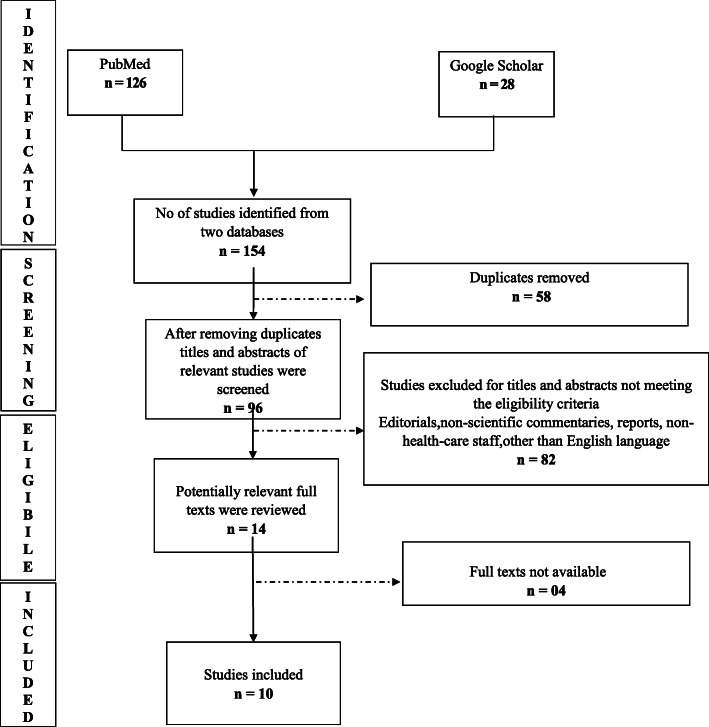
BACKGROUND: Coronavirus disease (COVID-19) pandemic has spread to 198 countries, with approximately 2.4 million confirmed cases and 150,000 deaths globally as of April 18. Frontline healthcare workers (HCWs) face a substantially higher risk of infection and death due to excessive COVID-19 exposure. This review aimed at summarizing the evidence of the physical and mental health impacts of COVID-19 pandemic on health-care workers (HCWs). METHODS: We used the Arksey O'Malley framework to conduct a scoping review. A systematic literature search was conducted using two databases: PubMed and Google Scholar. We found 154 studies, and out of which 10 met our criteria. We collected information on the date of publication, first author's country, the title of the article, study design, study population, intervention and outcome, and key findings, and divided all research articles into two domains: physical and mental health impact. RESULTS: We reviewed a total of 154 articles from PubMed (126) and Google Scholar (28), of which 58 were found to be duplicate articles and were excluded. Of the remaining 96 articles, 82 were excluded after screening for eligibility, and 4 articles did not have available full texts. Ten full-text articles were reviewed and included in this study. Our findings identified the following risk factors for COVID-19-related health impact: working in a high-risk department, diagnosed family member, inadequate hand hygiene, suboptimal hand hygiene before and after contact with patients, improper PPE use, close contact with patients (≥ 12 times/day), long daily contact hours (≥ 15 h), and unprotected exposure. The most common symptoms identified amongst HCWs were fever (85%), cough (70%), and weakness (70%). Prolonged PPE usage led to cutaneous manifestations and skin damage (97%), with the nasal bridge (83%) most commonly affected site. HCWs experienced high levels of depression, anxiety, insomnia, and distress. Female HCWs and nurses were disproportionately affected. CONCLUSION: The frontline healthcare workers are at risk of physical and mental consequences directly as the result of providing care to patients with COVID-19. Even though there are few intervention studies, early data suggest implementation strategies to reduce the chances of infections, shorter shift lengths, and mechanisms for mental health support could reduce the morbidity and mortality amongst HCWs.
Overview
The claims and statistics of this paper haven’t been checked yet.
Free: it reads the open-access text and checks the first 5 claims that cite a source we can check. Create a free account to check every claim.
Integrity signals
Registry
Cites
Statistics
Figures
Verification
Claims the paper makes
The claims and statistics of this paper haven’t been checked yet.
Free: it reads the open-access text and checks the first 5 claims that cite a source we can check. Create a free account to check every claim.
Claims other papers make about this one
Each is checked against this paper’s own text: does it say what the citing paper says it does?
The check wasn’t confident either way, so it gives no verdict — never disputed.
In the citing paper
“Thus, the COVID-19 pandemic acted as a catalyst for the development and adoption by health systems, especially of industrialized countries, of a broad range of telehealth technologies, developing and innovating in new virtual health facilities and telecare platforms to minimize these effects [3,4,5,6,7].”
From Telehealth and COVID-19 Pandemic: An Overview of the Telehealth Use, Advantages, Challenges, and Opportunities during COVID-19 Pandemic (2022) · cites this paper as [4]
Experimental — accuracy not yet measuredIn the citing paper
“Acute stress, including extreme anxiety and resignation symptoms, had already been observed, aggravated by nonoptimal disclosure of information about the pandemic (Marazziti, 2020;Shaukat, Ali & Razzak, 2020;Rossi et al., 2020;Zhang et al., 2020).”
From SECOND LINE VOLUNTEERING IN LOMBARDY COVID-19 EMERGENCY AS A PERSPECTIVE ON MEDICAL EDUCATION AND PSYCHOLOGICAL DISTRESS (2021) · doi:10.36131/cnfioritieditore20210506 · cites this paper as Shaukat, Ali & Razzak, 2020
Self-check
Percentages, sums and reported differences re-computed from the paper’s own numbers.
The self-check needs the paper’s full text.
Citations
Cites
Scoping studies: towards a methodological framework
Arksey, H., & O'Malley, L. (2005) · International Journal of Social Research Methodology · doi:10.1080/1364557032000119616 · Cited by 36,742
An interactive web-based dashboard to track COVID-19 in real time
Dong, E., Du, H., & Gardner, L. (2020) · The Lancet Infectious Diseases · doi:10.1016/s1473-3099(20)30120-1 · Cited by 10,048
Lai, J., Ma, S., Wang, Y., Cai, Z., Hu, J., Wei, N., Wu, J., Du, H., Chen, T., Li, R., et al. (2020) · JAMA Network Open · doi:10.1001/jamanetworkopen.2020.3976 · Cited by 8,015
First case of 2019 novel coronavirus in the United States
Holshue, M. L., DeBolt, C., Lindquist, S., Lofy, K. H., Wiesman, J., Bruce, H., Spitters, C., Ericson, K., Wilkerson, S., Tural, A., et al. (2020) · New England Journal of Medicine · doi:10.1056/nejmoa2001191 · Cited by 6,030
The epidemiology and pathogenesis of coronavirus disease (COVID-19) outbreak
Rothan, H. A., & Byrareddy, S. N. (2020) · Journal of Autoimmunity · doi:10.1016/j.jaut.2020.102433 · Cited by 5,840
Features, Evaluation and Treatment Coronavirus (COVID-19)
Cascella, M., Rajnik, M., Cuomo, A., Dulebohn, S. C., & Napoli, R. D. (2020) · StatPearls · Cited by 5,363
COVID-19 and Italy: what next?
Remuzzi, A., & Remuzzi, G. (2020) · The Lancet · doi:10.1016/s0140-6736(20)30627-9 · Cited by 3,119
Mental health care for medical staff in China during the COVID-19 outbreak
Chen, Q., Liang, M., Li, Y., Guo, J., Fei, D., Wang, L., He, L., Sheng, C., Cai, Y., Li, X., et al. (2020) · The Lancet Psychiatry · doi:10.1016/s2215-0366(20)30078-x · Cited by 2,233
The mental health of medical workers in Wuhan, China dealing with the 2019 novel coronavirus.
Kang, L., Li, Y., Hu, S., Chen, M., Yang, C., Yang, B. X., Wang, Y., Hu, J., Lai, J., Ma, X., et al. (2020) · The Lancet Psychiatry · doi:10.1016/s2215-0366(20)30047-x · Cited by 2,061
Maunder, R., Hunter, J., Vincent, L. H., Bennett, J. P., Peladeau, N., Leszcz, M., Sadavoy, J., Verhaeghe, L. M., Steinberg, R. J., & Mazzulli, T. (2003) · Europe PMC (PubMed Central) · Cited by 1,781
Cited by
Items 801–890 of 890
Impact of Strict Isolation Precautions on Families with a Language Other than English
Gregory, P. F., Desai, S., McDaniel, C. E., DeChalus, A., Bowen, E., Dinh, M., Gagen, J., Barry, D., Knight, A. B., Test, M. R., et al. (2025) · Health Equity · doi:10.1089/heq.2024.0117
“29,30 Proactive procurement of PPE, active transmission surveillance, and timely training of health care personnel can improve clinician and patient safety.”
How Classical Hematology Aims to Meet the Growing Healthcare Needs of an Aging American Population
Shapiro, A. D. (2025) · Physician leadership journal · doi:10.55834/plj.2922414682
Ramnarain, R., & Proches, C. G. (2025) · IGI Global eBooks · doi:10.4018/979-8-3693-6437-6.ch013
Reátegui-Rivera, C. M., Villarreal‐Zegarra, D., Soto-Becerra, P., Burgos-Flores, M. A., & Rosales‐Rimache, J. (2025) · Hispanic Health Care International · doi:10.1177/15404153251324638
“…exposure, rising work demands, shortage of personal protective equipment, mandatory physical isolation, stigma, personal losses, and the allocation of limited resources for patients (Mokhtari et al., 2020; Pfefferbaum & North, 2020; Rabow et al., 2021; Shaukat et al., 2020; Singh & Subedi, 2020).”
Hester, B. M., Johnson, P., & Padgett, J. H., Jr. (2025) · Open Journal of Medical Psychology · doi:10.4236/ojmp.2025.142006 · Cited by 1
“Studies report elevated levels of anxiety, depression, and post-traumatic stress disorder (PTSD) among medical staff [7] [8].”
Mogwitz, S., Wintermann, G., Albus, C., Baranowski, A., Beschoner, P., Erim, Y., Geiser, F., Jerg‐Bretzke, L., Morawa, E., Steudte‐Schmiedgen, S., et al. (2025) · BMC Psychiatry · doi:10.1186/s12888-025-06867-4
“Notably, anxiety or depression was significantly associated with increased adverse safety outcomes in healthcare settings [14], accompanied by limitations in the quality of care [15, 16].”
Chang, P.-Y., Li, C.-Y., Kuo, C.-W., Chang, Y.-K., & Lin, C.-F. (2025) · American Journal of Health Behavior · doi:10.5993/ajhb.49.2.6 · Cited by 1
Beaulieu-Jones, B. R., Berrigan, M. T., Marwaha, J. S., Kennedy, C. J., Robinson, K. A., Nathanson, L. A., Cook, C. H., Bohnen, J. D., & Brat, G. A. (2025) · Healthcare · doi:10.1016/j.hjdsi.2025.100764
Bölükkaya, M., & Tekingündüz, S. (2025) · Mersin Üniversitesi Tıp Fakültesi Lokman Hekim Tıp Tarihi ve Folklorik Tıp Dergisi · doi:10.31020/mutftd.1575402
Ncube, M., Itua, I., Hunt, M., & Knott, A. (2025) · JORMA International Journal of Health and Social Sciences · doi:10.64074/jorma004
“…reported risk of physical and mental health in this population group though the risk factors seemed different and more related to care provision (for example working in a high-risk department which increases the chances of infection and thus anxiety and stress) (Shaukat, Ali and Razzak, 2020).”
Impact of Workplace Factors on Nurse Well-Being: A Multivariate Approach
Bhimavarapu, U. (2025) · Advances in computational intelligence and robotics book series · doi:10.4018/979-8-3693-9301-7.ch008
The Psychological Impacts of the Coronavirus Crisis on Adults in Jordan
Dahadhah, M. R. N. (2024) · International Journal on Humanities and Social Sciences · doi:10.33193/ijohss.62.2024.761
Mwoltu, N., Njor, S. T., Sanni, O. F., Okposin, N., Ugege, O., Peter, N., Michael, A., Ugwuike, J., Amechi, P., Abang, R., et al. (2025) · MGM Journal of Medical Sciences · doi:10.4103/mgmj.mgmj_61_25
Raphela, T. D., & Happiness, M. (2025) · Frontiers in Psychology · doi:10.3389/fpsyg.2025.1553866
“Shaukat et al. (2020) state that healthcare workers (HCWs) have been psychologically impacted by working daily for long hours since the start of COVID-19, and their exposure to this virus has been very high.”
Balcha, F. (2025) · Research Square · doi:10.21203/rs.3.rs-6529296/v1
Mahyudin, M., Yari, Y., Ramba, H. L., Syamsuriah, & Silaban, M. (2025) · Jurnal Kesehatan Holistic · doi:10.33377/jkh.v9i2.254
Nyangu, I., & Ramathebane, M. M. (2025) · medRxiv · doi:10.1101/2025.08.01.25332516
“Again, Shaukat et al. (2020) connected the increased psychological impacts with high exposure risk due to a lack of PPE and long working hours.”
Tabarsy, B., Bahrami, S., & Kheyri, F. (2024) · Knowledge of Nursing Journal · doi:10.61882/knjournal.1.4.354
Vaz, A. V. M., & Teixeira, E. C. (2025) · Serviço Social e Saúde · doi:10.20396/sss.v23i00.8678308
Examining the career progression and aspirations of Certified CHWs in Baltimore, MarylandPreprint
Obasanjo, I., Okafor, U. B., & Werts, N. (2025) · Research Square · doi:10.21203/rs.3.rs-6941027/v1
Shouli, M. M., Shouli, K. M., Assi, E. A., Khamees, R. A., Darawsheh, H., & Issa, R. (2025) · Research Square · doi:10.21203/rs.3.rs-7447301/v1
Well-being of health workers during the COVID-19 pandemic in Quebec, Canada
Laberge, M., & Djedou, B. Y. (2025) · Social Sciences & Humanities Open · doi:10.1016/j.ssaho.2025.101952
Smith, L., Khor, K., McGrail, M. R., Lizarondo, L. M., Ford, M., Sangelaji, B., & Martin, P. (2025) · Journal of Health Organization and Management · doi:10.1108/jhom-04-2025-0181
Bryant, R. A., Haake, A., Murray, A. M., Genzler, L., & Son, C. R. V. (2025) · Nursing Research and Practice · doi:10.1155/nrp/6417570
“Many COVID-19 studies reported on the psychological distress experienced by HCWs, including fears of becoming infected, infecting family members, frustration, post-traumatic stress, disruption in lifestyle and routine activities, and loneliness [2–6].”
European Perspectives on Cancer and the Pandemic
Cloconi, C., Alexopoulou, C., Zamba, N., Economou, M., & Charalambous, A. (2025) · Springer eBooks · doi:10.1007/978-3-031-33855-7_6
Spanish version of the Posttraumatic Stress Disorder Checklist for DSM-5 (PCL-5) in health workers
Villarreal‐Zegarra, D., la Cruz-Torralva, K. D., Barrera-Begazo, J., Rosales‐Rimache, J., Soto-Becerra, P., Vilela-Estrada, A. L., Díaz-Vélez, C., Apolaya-Segura, M., Zavala, R. A. L., Reátegui-Rivera, C. M., et al. (2025) · International Journal of Mental Health · doi:10.1080/00207411.2025.2566398
Attar, I., Hadrya, F., Senhaji, M., Cigarroa, I., Bendriss, A., & Sfendla, A. (2025) · Enfermería Clínica (English Edition) · doi:10.1016/j.enfcle.2025.502309
Goson, P. C., Osuagwu, U. L., Ekpenyong, B. N., Miner, C. A., Ojeahere, M. I., Ishaya, T., Mashige, K. P., Ovenseri-Ogbomo, G. O., Envuladu, E. A., Abu, E. K., et al. (2025) · BMC Public Health · doi:10.1186/s12889-025-24941-0
“Other studies have also reported a higher risk of psychological effects in women and clinicians [38–40].”
Lessons From the COVID‐19 Pandemic: The Role of Interventions in Relieving Mental Stress
Tiagi, R. (2025) · Journal of Evaluation in Clinical Practice · doi:10.1111/jep.70317
Kapisiz, S. G., Özdemir, E. A., TEKİN, Y., & Gültekin, F. (2025) · Social Work in Health Care · doi:10.1080/00981389.2025.2594213
“Many faced increased workloads without adequate financial compensation, leading to burnout and job dissatisfaction (Shaukat et al., 2020).”
de Oliveira, E. P. (2025) · Revista Foco · doi:10.54751/revistafoco.v18n12-096
Hesselink, G., Straten, L., Gallée, L., Brants, A., Holkenborg, J., Barten, D. G., & Schoon, Y. (2021) · Figshare · doi:10.6084/m9.figshare.14702298
DiGiovanni, M. J., Weller, I., & Martin, A. (2021) · Figshare · doi:10.6084/m9.figshare.14821109
Mouedden, I. E., Hellemans, C., Anthierens, S., Michels, N. R. M., & DeSmet, A. (2022) · Figshare · doi:10.6084/m9.figshare.20521299
Zeraatkhah, H., Alavi, N. M., Ziabakhsh, H., & Mahdaviasl, Z. (2024) · Figshare · doi:10.6084/m9.figshare.25448997
Kiwanuka, S. N., Babirye, Z., Kabwama, S. N., Tusubira, A. K., Kizito, S., Ndejjo, R., Bosonkie, M., Egbende, L., Bondo, B. M., Mapatano, M. A., et al. (2024) · Figshare · doi:10.6084/m9.figshare.26701858
Hesselink, G., Straten, L., Gallée, L., Brants, A., Holkenborg, J., Barten, D. G., & Schoon, Y. (2021) · Figshare · doi:10.6084/m9.figshare.14702307
Dilokpattanamongkol, P., Yan, C., Jayanama, K., Ngamjanyaporn, P., D, S. S. M., & Rotjanapan, P. (2024) · Figshare · doi:10.6084/m9.figshare.25264429
Nazari, N., Sadeghi, M., Samusenkov, V., & Aligholipour, A. (2022) · Figshare · doi:10.6084/m9.figshare.18585738
Kabasinguzi, I., Ali, N., & Ochepo, P. (2024) · Figshare · doi:10.6084/m9.figshare.26578946
Hesselink, G., Straten, L., Gallée, L., Brants, A., Holkenborg, J., Barten, D. G., & Schoon, Y. (2021) · Figshare · doi:10.6084/m9.figshare.14702301
Dilokpattanamongkol, P., Yan, C., Jayanama, K., Ngamjanyaporn, P., D, S. S. M., & Rotjanapan, P. (2024) · Figshare · doi:10.6084/m9.figshare.26683627
Doan, L. P., Dam, V. A., Boyer, L., Auquier, P., Fond, G. B., Tran, B., Vu, T. M. T., Do, H. T., Latkin, C. A., Zhang, M. W. B., et al. (2023) · Figshare · doi:10.6084/m9.figshare.23240020
Dilokpattanamongkol, P., Yan, C., Jayanama, K., Ngamjanyaporn, P., D, S. S. M., & Rotjanapan, P. (2024) · Figshare · doi:10.6084/m9.figshare.26683630
DiGiovanni, M. J., Weller, I., & Martin, A. (2021) · Figshare · doi:10.6084/m9.figshare.14821106
Hesselink, G., Straten, L., Gallée, L., Brants, A., Holkenborg, J., Barten, D. G., & Schoon, Y. (2021) · Figshare · doi:10.6084/m9.figshare.14702295
Hesselink, G., Straten, L., Gallée, L., Brants, A., Holkenborg, J., Barten, D. G., & Schoon, Y. (2021) · Figshare · doi:10.6084/m9.figshare.14702304
Dilokpattanamongkol, P., Yan, C., Jayanama, K., Ngamjanyaporn, P., D, S. S. M., & Rotjanapan, P. (2024) · Figshare · doi:10.6084/m9.figshare.25264271
Etafa, W., Gadisa, G., Dugasa, S. J., & Takele, T. (2021) · Figshare · doi:10.6084/m9.figshare.14623216
Li, Y., Nazari, N., & Sadeghi, M. (2024) · Figshare · doi:10.6084/m9.figshare.26555171
Leigh, J. P., Kemp, L. G., de Grood, C., Brundin‐Mather, R., Stelfox, H. T., Ng-Kamstra, J., & Fiest, K. M. (2021) · Figshare · doi:10.6084/m9.figshare.14471592
Hörold, M., Gottschalk, M., Debbeler, C. M., Heytens, H., Ehrentreich, S., Braun-Dullaeus, R. C., & Apfelbacher, C. (2021) · Figshare · doi:10.6084/m9.figshare.17120348
Li, Y., Nazari, N., & Sadeghi, M. (2024) · Figshare · doi:10.6084/m9.figshare.26555168
Healthcare Challenges in Rural Bangladesh: Community Clinic Services and Satisfaction Gaps
Islam, M. R., & Fatema, N. (2025) · Springer eBooks · doi:10.1007/978-3-030-68127-2_844-1
Ekinci, Ö., & Brown, N. R. (2025) · Springer eBooks · doi:10.1007/978-3-032-03895-1_7
Will AI Finally Allow Dentists to Participate in Sleep Testing?
Massé, J.-F. (2026) · Journal of Dental Sleep Medicine · doi:10.15331/jdsm.7414
van Rensburg, C. J., & Thekiso, P. S. (2025) · IISES International Academic Conference · doi:10.20472/iac.2025.068.007
Khan, M. F. (2026) · Biomedical Letters · doi:10.47262/bl/12.1.20230220
Tabaie, A., Hurley, V. B., Kim, D. H., & Fong, A. (2026) · Quality Management in Health Care · doi:10.1097/qmh.0000000000000558
Rosle, N. S. M., Badrin, S., & Badrin, I. B. B. (2025) · Malaysian Journal of Medicine and Health Sciences · doi:10.47836/mjmhs.v21.i6.1406
“Battling with COVID-19 causes the HCWs to become vulnerable, physiological and psychological suffering (11).”
Bremi, A. A. P., Kouamé, A. A. B., Konan, L. G., Gouzou, W. F., Ouattara, Y. M., Aholia, C. V., Kilanko, G. E., Guiegui, C. P., Aka, I. N. A., & Kouassi, Y. M. (2026) · Archives des maladies professionnelles et de médecine du travail/Archives des maladies professionnelles et de l'environnement · doi:10.1016/j.admp.2025.102987
PSYCHOLOGICAL AND MENTAL HEALTH IMPACT OF COVID-19 PANDEMIC ON FRONTLINE HEALTH WORKERS IN NIGERIA
Jaiyeoba, A. F., & Adewumi, C. M. (2025) · Lagos Education Review · doi:10.52968/15067219
The Psychological Impacts of the Coronavirus Crisis on Adults in Jordan
Dahadhah, M. R. N. (2023) · era Journal for Humanities and Sociology · doi:10.33193/ejhas.9.2023.265
Effects of COVID-19 supplementary payments on healthcare workers performance in Türkiye
Eri̇ş, H., Ayhan, Z., Çelik, R., & Uysal, Ş. A. (2026) · Discover Public Health · doi:10.1186/s12982-026-01836-y
Sağlık Çalışanlarının Mesleki Algıları: COVID-19 Pandemisinin Etkileri
Güneşdoğmuş, H., & Akman, E. (2026) · Ege Üniversitesi Hemşirelik Fakültesi Dergisi · doi:10.53490/egehemsire.1773959
Watson, N. C., Kelly, K., Krech, L. A., Chapman, A. J., Pounders, S. J., Armstrong, M., Gibson, C. J., & Iskander, G. (2026) · Healthcare · doi:10.3390/healthcare14091154
Kwakye, I. N., Adom-Fynn, D., Roberts, C. O., Antwi, A. O., Opoku-Mensah, K., Vondee, S. E., & Kugbey, N. (2026) · BMC Nursing · doi:10.1186/s12912-026-04714-9
“Data were analysed using IBM SPSS Version 24.”
Experiences of Nurses Caring for Patients With COVID‐19: A Descriptive Phenomenological Study
Armah, J., Kyei‐Dompim, J., Boateng, E. A., Obour, K. A., Inok, E. O., Obiri, S. E. A., Annobil, F. A., Gyamfi, D., & Amponsah, A. K. (2026) · Nursing Open · doi:10.1002/nop2.70601
“This outcome was consistent with the study by Shaukat et al. (2020).”
Physical, chemical and psychological effect of COVID-19 pandemic upon health care providers
Abd, R. K., & Radhi, M. M. (2026) · BMC Public Health · doi:10.1186/s12889-025-23474-w
“These insights are crucial for the development of targeted interventions and support systems for healthcare providers to address their mental well-being [37].”
Sahadi, F., & Baybayan, S. (2026) · SOCIAL PSYCHOLOGY AND HUMAN EXPERIENCE · doi:10.62596/sz8y6118
Developing Wellness Pathway of Health Care Workers (HCW) During COVID-19 Pandemic
Blas, R., & Abed-Eddin, L. (2026) · European Journal of Business Management and Research · doi:10.24018/ejbmr.2025.10.6.52846
“Worldwide, healthcare workers around the globe are among the high-risk groups to acquire and even face death due to excessive exposure to the virus (Shaukat et al ., 2020).”
Fatimah, F. S., Hartono, Suwarto, & Anantanyu, S. (2026) · Multidisciplinary Science Journal · doi:10.31893/multiscience.2026758
“These manifestations show that work stress not only affects the body but also has implications for an individual's mental well-being (Shaukat et al., 2020; Syamlan et al., 2022).”
Psychological Resilience of Healthcare Workers After the Covid-19 Pandemic: An Exploratory Study
Cruz, I. P. D. L. (2026) · International Journal of Sustainability and Advanced Integrated Research · doi:10.65339/ijsair.v2.i2.618
“Research further shows that healthcare workers experienced elevated levels of anxiety, depression, stress, burnout, and emotional exhaustion during and after the pandemic (Shaukat et al., 2020; Carascal et al., 2022; Hilvano-Cabungcal & Bonito, 2024; Laviña et al., 2024).”
Alface, A. M. A., Salomé, G., Munguambe, K., Moon, T. D., Sevene, E., & Heitman, E. (2026) · Developing World Bioethics · doi:10.1111/dewb.70048
“During a healthcare emergency, patients may suffer increased harm if healthcare personnel are physically or mentally incapable of fulfilling their duties, leading to a reduction in the available workforce [1, 23-25].”
ПСИХОЛОГІЧНА АДАПТАЦІЯ ПАЦІЄНТІВ ДО СТАЦІОНАРНОГО ЛІКУВАННЯ: ЗНАЧЕННЯ МЕДСЕСТРИНСЬКОГО СУПРОВОДУ
Голубінська, А., & Чорна, В. В. (2026) · Перспективи та інновації науки · doi:10.52058/2786-4952-2026-5(63)-2576-2591
Understanding Pressure in Healthcare
Riemma, F. (2026) · Emerald Group Publishing Limited eBooks · doi:10.1108/978-1-80686-897-120261019
The Perfect Storm: Stress and Complexity in Healthcare
Riemma, F. (2026) · Emerald Group Publishing Limited eBooks · doi:10.1108/978-1-80686-897-120261002
Mapping the Terrain: Theories of Stress and Coping
Riemma, F. (2026) · Emerald Group Publishing Limited eBooks · doi:10.1108/978-1-80686-897-120261003
Lindgren, A. J., Callaway, L. K., Burke, K., Ryan, E., McKeown, L., & Kothari, A. (2026) · BMC Health Services Research · doi:10.1186/s12913-026-14588-x
“Within this context, COVID-19 has been shown to significantly impact the mental and physical well-being of healthcare workers globally, with studies reporting staffing challenges, burnout, and impaired patient care [1, 8, 9].”
Cermak, R., & Bhagwan, R. (2026) · Discover Social Science and Health · doi:10.1007/s44155-026-00467-7
“Shaukat et al. [21] also reported on the high prevalence of anxiety and depression amongst Chinese healthcare workers.”
Foxwell, A. M., Meghani, S. H., Deatrick, J. A., Courtright, K. R., Huang, L., Rhodes, J., Hirschman, K. B., & Ulrich, C. M. (2026) · Research Square · doi:10.21203/rs.3.rs-10272024/v1
Gong, C., & Yang, H. (2026) · Seminars in Oncology Nursing · doi:10.1016/j.soncn.2026.152355
Pontius, E., Lewis, R., Peixotto, S., & Connor-Crouch, P. (2026) · International Journal of Environmental Research and Public Health · doi:10.3390/ijerph23091189
Okafor, U. B., & Obasanjo, I. (2026) · Frontiers in Health Services · doi:10.3389/frhs.2026.1902919
“At the same time, as healthcare systems face workforce shortages driven by an ageing population and the lingering effects of the COVID-19 pandemic (25 – 28) the demand for a stable, well-supported CHW workforce has never been greater.”
Sanders, V. W. (2026) · SSRN Electronic Journal · doi:10.2139/ssrn.7566844
Metadata
- Authors
- Shaukat, N., Ali, D. M., & Razzak, J.
- Affiliations
- Aga Khan University (PK)
- Corresponding author
- Shaukat, Natasha
- Venue
- International Journal of Emergency Medicine
- Published
- 2020-07-20
- Volume
- 13
- Issue
- 1
- Pages
- 40-40
- ISSN
- 1865-1372 (ISSN-L)
- 1865-1380
- PMC
- PMC7370263
- OpenAlex
- W3043065230
- Semantic Scholar
- e25ae2ab02b02aa76bc898097339f711028bc710
- Cited by
- 879
- References
- 38
- Citations by year
- 2026: 27 · 2025: 49 · 2024: 94 · 2023: 155 · 2022: 257 · 2021: 275 · 2020: 22
- FWCI
- 14.04
- Type
- journal article
- Language
- en
- Open access
- gold
- doi.org
- Licence
- cc-by
- creativecommons.org/licenses/by/4.0 (tdm)
- creativecommons.org/licenses/by/4.0 (vor)
- Locations
- International Journal of Emergency Medicine (publishedVersion, cc-by)
- PubMed Central (publishedVersion, cc-by)
- PubMed (publishedVersion)
- eCommons - AKU (Aga Khan University) (submittedVersion, cc-by)
- DOAJ (DOAJ: Directory of Open Access Journals) (submittedVersion, cc-by-sa)
- Topics
- Social Sciences › Psychology › Clinical Psychology › COVID-19 and Mental Health
- Health Sciences › Health Professions › General Health Professions › Healthcare Systems and Challenges
- Health Sciences › Medicine › Clinical Neurology › Long-Term Effects of COVID-19
- Keywords
- COVID-19 pandemic, healthcare workers, occupational exposure, physical health, mental health, depression, anxiety, insomnia, personal protective equipment, hand hygiene, skin damage, nurses, risk factors, infection control
About these checks
Registry, retraction, Cites and statistics results are computed, not judged, with one exception: a printed reference that no index lists is read once by a model before it counts as a citation error. Claims are extracted by a model and kept only when their quote appears verbatim in the text; each cited source is then checked, with a model’s help, for whether it says what the claim relies on. Those verdicts can be wrong — read the claim’s quote and the cited source before relying on one.
Statistics and arithmetic are recomputed, not judged.
Confidence bands are shown only for fields calibrated on our annotated test set. None is calibrated yet, so no band is shown.
What counts as a claim ›How we measure confidence ›How we check this ›
Are you an author, or do you see a problem with this page? Request a review
Data sources
Bibliographic data: Semantic Scholar, OpenAlex, Crossref.
Contains information from the Semantic Scholar Academic Graph Datasets, made available under the ODC Attribution License (ODC-BY 1.0).
Semantic Scholar’s data is described in: Kinney, R., et al. (2023). The Semantic Scholar Open Data Platform. arXiv:2301.10140.
