

Methods to systematically review and meta-analyse observational studies: a systematic scoping review of recommendations
Open accessThe DOI matches its Crossref record; 104 of the 104 references it cites were found in a registry or an index; 48 of the 374 sources its claims cite were checked for support.
Abstract
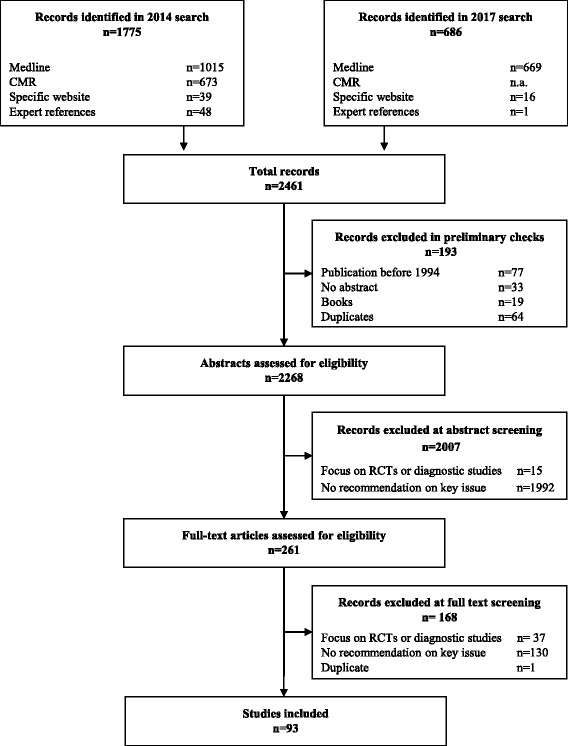
BACKGROUND: Systematic reviews and meta-analyses of observational studies are frequently performed, but no widely accepted guidance is available at present. We performed a systematic scoping review of published methodological recommendations on how to systematically review and meta-analyse observational studies. METHODS: We searched online databases and websites and contacted experts in the field to locate potentially eligible articles. We included articles that provided any type of recommendation on how to conduct systematic reviews and meta-analyses of observational studies. We extracted and summarised recommendations on pre-defined key items: protocol development, research question, search strategy, study eligibility, data extraction, dealing with different study designs, risk of bias assessment, publication bias, heterogeneity, statistical analysis. We summarised recommendations by key item, identifying areas of agreement and disagreement as well as areas where recommendations were missing or scarce. RESULTS: The searches identified 2461 articles of which 93 were eligible. Many recommendations for reviews and meta-analyses of observational studies were transferred from guidance developed for reviews and meta-analyses of RCTs. Although there was substantial agreement in some methodological areas there was also considerable disagreement on how evidence synthesis of observational studies should be conducted. Conflicting recommendations were seen on topics such as the inclusion of different study designs in systematic reviews and meta-analyses, the use of quality scales to assess the risk of bias, and the choice of model (e.g. fixed vs. random effects) for meta-analysis. CONCLUSION: There is a need for sound methodological guidance on how to conduct systematic reviews and meta-analyses of observational studies, which critically considers areas in which there are conflicting recommendations.
Overview
CoChat Summary
TL;DR
This systematic scoping review identified 93 articles giving methodological recommendations for systematic reviews and meta-analyses of observational studies. It found many recommendations were transferred from RCT guidance and that substantial disagreement remains on key methodological choices, with no comprehensive guidance available.
Key findings
- The searches identified 2461 articles; 93 were eligible. Only 1 (1%) addressed all 10 key items, 56 (60%) addressed two or more key items, and 37 (40%) addressed only one key item.
- Conflicting recommendations were found for “research question”, “study eligibility”, “considering different study designs”, “risk of bias assessment”, “publication bias” and “statistical analysis”. Examples include narrow versus broad research questions, whether to include all languages, whether to combine RCTs and non-randomised studies in one meta-analysis, use of quality scales versus component approaches, and fixed- versus random-effects models.
- Most included articles (62%) were published in statistical, epidemiological or systematic review methodological journals; 72% were written by authors affiliated with a systematic review organisation or a statistical/epidemiological university department. Many recommendations for observational studies were uncritically transferred from guidance for RCTs.
- Areas of agreement included the importance of a protocol, systematic risk-of-bias assessment, and examination of heterogeneity as central to meta-analysis of observational studies.
Methods
- Systematic scoping review following a protocol written before starting. Searches covered Medline, the Cochrane Methodology Register, websites of review centres, selected evidence-synthesis journals, expert contact, and references from included full texts; no language restrictions were applied. Initial search was January 2014, repeated February 2017 except for CMR.
- Included articles published from 1994 onward that provided recommendations on at least one of 10 a priori key methodological items. Excluded articles published before 1994, reviews of observational studies without methodological recommendations, and articles focused on RCTs, cost-effectiveness studies or diagnostic studies.
- Two reviewers independently screened and extracted data; disagreements were resolved by discussion or a senior methodologist. Recommendations were summarised descriptively and by qualitative thematic analysis. The authors did not appraise the methodological quality of included articles or recommendations.
Limitations
- Stated: including articles based on title and abstract may have missed relevant articles; books were excluded, including the Cochrane handbook; the authors did not assess the soundness of recommendations; and in-depth discussion of statistical methods was beyond scope.
- Stated: the authors did not appraise methodological quality of included articles and recommendations because widely accepted standards for systematic reviews and meta-analyses of observational studies are lacking.
- Evident from the text: the search relied on theoretical saturation rather than exhaustive retrieval, and the last search update was February 2017, so later guidance would not be captured.
Model-written summary. Check it against the paper before relying on it.
Integrity signals
Registry
Cites
Statistics
Figures
Verification
Claims the paper makes
18 Valid · 2 Not valid · 67 Not checked · 64 Own results and interpretations
At least one cited source doesn’t support this claim or points to a different paper, and none confirmed it — see the verdicts below.
In the paper
“Second, the use of a random-effects model for meta-analysis of observational studies by default was frequently recommended [8, 16, 29, 34, 70, 77, 100, 101].”
§ Methods to systematically review and meta-analyse observational studies: a systematic scoping review of recommendations > Results > Statistical analysis
What the sources say
- Not checked yetcites [8] Zwahlen M Renehan A Egger M Meta-analysis in medical research: potentials and limitations Urol Oncol 2008 26 320 329 10.1016/j.urolonc.2006.12.001 18452828 source
- Not checked yetcites [16] Lau J Ioannidis JP Schmid CH Quantitative synthesis in systematic reviews Ann Intern Med 1997 127 820 826 10.7326/0003-4819-127-9-199711010-00008 9382404 source
- Not checked yetcites [29] Egger M Smith GD Phillips AN Meta-analysis: principles and procedures BMJ 1997 315 1533 1537 10.1136/bmj.315.7121.1533 9432252 PMC2127925 source
- Not checked yetcites [34] Blair A Burg J Foran J Gibb H Greenland S Morris R Guidelines for application of meta-analysis in environmental epidemiology. ISLI risk science institute Regul Toxicol Pharmacol 1995 22 189 197 10.1006/rtph.1995.1084 8577954 source
- Disputedcites [70] Wong O Raabe GK Application of meta-analysis in reviewing occupational cohort studies Occup Environ Med 1996 53 793 800 10.1136/oem.53.12.793 8994397 PMC1128611 sourceExperimental — accuracy not yet measured
In the discussion of fixed- and random-effects models (p. 5), the paper says the choice is subject to ongoing debate, that commonly used methods are fixed-effects, and that random-effects models have been criticised. It does not recommend using random-effects models by default for observational studies; its account points in the opposite direction. (LLM, conf=0.85)
Checked by a reasoning model — may be wrong.
- Not checked yetcites [77] Colditz GA Burdick E Mosteller F Heterogeneity in meta-analysis of data from epidemiologic studies: a commentary Am J Epidemiol 1995 142 371 382 10.1093/oxfordjournals.aje.a117644 7625401 source
- Not checked yetcites [100] Pladevall-Vila M Delclos GL Varas C Guyer H Brugues-Tarradellas J Anglada-Arisa A Controversy of oral contraceptives and risk of rheumatoid arthritis: meta-analysis of conflicting studies and review of conflicting meta-analyses with special emphasis on analysis of heterogeneity Am J Epidemiol 1996 144 1 14 10.1093/oxfordjournals.aje.a008846 8659479 source
- Not checked yetcites [101] Dwyer T Couper D Walter SD Sources of heterogeneity in the meta-analysis of observational studies: the example of SIDS and sleeping position J Clin Epidemiol 2001 54 440 447 10.1016/S0895-4356(00)00313-9 11337206 source
plain- Asserted: passes — The authors put it forward as true.
- Checkable: passes — It can be checked against evidence.
- Load-bearing: unclear — It is unclear whether the paper’s conclusions depend on it.
- Based: passes — The paper gives a reason why it holds.
The sources with a verdict support this claim; the rest weren’t checked yet, have no full text we could read, or their verdicts aren’t rated yet.
In the paper
“Aspects that were frequently mentioned as important to address were the population, exposures or interventions, and outcomes [38–41, 43, 47, 48, 50, 54].”
§ Methods to systematically review and meta-analyse observational studies: a systematic scoping review of recommendations > Results > Research question
What the sources say
- Supportedcites [38] Simunovic N Sprague S Bhandari M Methodological issues in systematic reviews and meta-analyses of observational studies in orthopaedic research J Bone Jt Surg Am 2009 91 Suppl 3 87 94 10.2106/JBJS.H.01576 PMC12309503 19411505 source
The Introduction says that a systematic-review protocol should be centered on a focused research question and clearly describe the population, intervention or exposure, and outcomes of interest. This supports the aspects attributed to this source; the paper does not itself establish how frequently other sources mention them. (LLM, conf=0.92)
- Not checked yetcites [39] Armstrong R, Waters E, editors. Systematic Reviews of Health Promotion and Public Health Interventions. Guidelines for Systematic Reviews in Health Promotion and Public Health Task Force. Version 2. Melbourne University: Australia.; 2007.
- Supportedcites [40] Schünemann HJ Tugwell P Reeves BC Akl EA Santesso N Spencer FA Non-randomized studies as a source of complementary, sequential or replacement evidence for randomized controlled trials in systematic reviews on the effects of interventions Res Synth Methods. 2013 4 49 62 10.1002/jrsm.1078 26053539 source
Section 3.1 (p. 7) says review authors should define the elements of their PICO question when planning a review. Section 1.2 (p. 2) explicitly identifies population, intervention and outcomes among the elements to consider. The paper supports the cited point that these aspects are important to address, though it does not itself measure how frequently they are mentioned across sources. (LLM, conf=0.88)
- Not checked yetcites [41] Moola S Munn Z Sears K Sfetcu R Currie M Lisy K Conducting systematic reviews of association (etiology): the Joanna Briggs Institute’s approach Int J Evid Based Healthc. 2015 13 163 169 10.1097/XEB.0000000000000064 26262566 source
- Supportedcites [43] Ravani P Ronksley PE James MT Strippoli GF A nephrology guide to reading and using systematic reviews of observational studies Nephrol Dial Transplant 2015 30 1615 1621 10.1093/ndt/gfv257 26113546 source
Step 1 (p. 3) says that a systematic review’s question is specified using PICO and identifies population, intervention or exposure, and outcome as components. The source also includes a comparator, but the citing sentence does not claim its list is exhaustive. (LLM, conf=0.92)
- Not checked yetcites [47] Manchikanti L Datta S Smith HS Hirsch JA Evidence-based medicine, systematic reviews, and guidelines in interventional pain management: part 6. Systematic reviews and meta-analyses of observational studies Pain Physician 2009 12 819 850 19787009 source
- Not checked yetcites [48] Normand SL Meta-analysis: formulating, evaluating, combining, and reporting Stat Med 1999 18 321 359 10.1002/(SICI)1097-0258(19990215)18:3<321::AID-SIM28>3.0.CO;2-P 10070677 source
- Not checked yetcites [50] Raman G, Gaylor JM, Rao M, Chan J, Earley A, Chang LKW, et al. AHRQ methods for effective health care. In: Quality of reporting in systematic reviews of implantable medical devices. Rockville (MD): Agency for Healthcare Research and Quality (US); 2012. 23270007
- Not checked yetcites [54] Chaiyakunapruk N Saokaew S Sruamsiri R Dilokthornsakul P Systematic review and network meta-analysis in health technology assessment J Med Assoc Thail 2014 97 Suppl 5 S33 S42 24964697
plain- Asserted: passes — The authors put it forward as true.
- Checkable: passes — It can be checked against evidence.
- Load-bearing: unclear — It is unclear whether the paper’s conclusions depend on it.
- Based: passes — The paper gives a reason why it holds.
- Supported
The sources with a verdict support this claim; the rest weren’t checked yet, have no full text we could read, or their verdicts aren’t rated yet.
In the paper
“Only five articles referred to the combination of different non-randomised studies [38, 70, 75, 79, 80].”
§ Methods to systematically review and meta-analyse observational studies: a systematic scoping review of recommendations > Results > Considering different study designs
What the sources say
- Supportedcites [38] Simunovic N Sprague S Bhandari M Methodological issues in systematic reviews and meta-analyses of observational studies in orthopaedic research J Bone Jt Surg Am 2009 91 Suppl 3 87 94 10.2106/JBJS.H.01576 PMC12309503 19411505 source
The Introduction discusses whether different observational study designs should be combined and says that different study types should rarely be merged in a meta-analysis. This supports citing the paper as one article that refers to combining non-randomised studies; the count of five describes the citing document’s set of references, not a finding attributed to this paper. (LLM, conf=0.91)
- Supportedcites [70] Wong O Raabe GK Application of meta-analysis in reviewing occupational cohort studies Occup Environ Med 1996 53 793 800 10.1136/oem.53.12.793 8994397 PMC1128611 source
The Meta-review of occupational epidemiology (pp. 2–4) discusses when different occupational cohort studies can be combined in a meta-analysis. This establishes the cited paper as an example of an article addressing the combination of non-randomised studies; the count of five refers to the citing paper’s set of references, not a count this source needs to establish. (LLM, conf=0.91)
- Not checked yetcites [75] Valentine JC Thompson SG Issues relating to confounding and meta-analysis when including non-randomized studies in systematic reviews on the effects of interventions Res Synth Methods. 2013 4 26 35 10.1002/jrsm.1064 26053537 source
- Not checked yetcites [79] Martin DO Austin H An exact method for meta-analysis of case-control and follow-up studies Epidemiology 2000 11 255 260 10.1097/00001648-200005000-00005 10784240 source
- Not checked yetcites [80] Moreno V Martin ML Bosch FX de Sanjose S Torres F Munoz N Combined analysis of matched and unmatched case-control studies: comparison of risk estimates from different studies Am J Epidemiol 1996 143 293 300 10.1093/oxfordjournals.aje.a008741 8561164 source
plain- Asserted: passes — The authors put it forward as true.
- Checkable: passes — It can be checked against evidence.
- Load-bearing: unclear — It is unclear whether the paper’s conclusions depend on it.
- Based: passes — The paper gives a reason why it holds.
- Supported
The sources with a verdict support this claim; the rest weren’t checked yet, have no full text we could read, or their verdicts aren’t rated yet.
In the paper
“Most articles considered the combination of RCTs and non-randomised designs [29, 35, 38, 39, 49, 51, 56, 61, 75, 81].”
§ Methods to systematically review and meta-analyse observational studies: a systematic scoping review of recommendations > Results > Considering different study designs
What the sources say
- Not checked yetcites [29] Egger M Smith GD Phillips AN Meta-analysis: principles and procedures BMJ 1997 315 1533 1537 10.1136/bmj.315.7121.1533 9432252 PMC2127925 source
- Supportedcites [35] Loke YK Price D Herxheimer A Systematic reviews of adverse effects: framework for a structured approach BMC Med Res Methodol 2007 7 32 10.1186/1471-2288-7-32 17615054 PMC1933432 source
The Methods section (‘What types of studies?’) considers RCTs alongside cohort, case-control and other non-randomised designs for reviews of adverse effects. This paper supports its inclusion as one of the cited articles that considered both types of design; it does not itself establish the collective claim that most articles did so. (LLM, conf=0.88)
- Supportedcites [38] Simunovic N Sprague S Bhandari M Methodological issues in systematic reviews and meta-analyses of observational studies in orthopaedic research J Bone Jt Surg Am 2009 91 Suppl 3 87 94 10.2106/JBJS.H.01576 PMC12309503 19411505 source
The Introduction considers whether randomized controlled trials and observational studies should be included in the same review. As one of several citations supporting the citing authors’ summary of the articles, this paper is an example of an article that considers that combination. (LLM, conf=0.88)
- Not checked yetcites [39] Armstrong R, Waters E, editors. Systematic Reviews of Health Promotion and Public Health Interventions. Guidelines for Systematic Reviews in Health Promotion and Public Health Task Force. Version 2. Melbourne University: Australia.; 2007.
- Not checked yetcites [49] Price D Jefferson T Demicheli V Methodological issues arising from systematic reviews of the evidence of safety of vaccines Vaccine 2004 22 2080 2084 10.1016/j.vaccine.2004.01.009 15121328 source
- Not checked yetcites [51] Rosenthal R DiMatteo MR Meta-analysis: recent developments in quantitative methods for literature reviews Annu Rev Psychol 2001 52 59 82 10.1146/annurev.psych.52.1.59 11148299 source
- Not checked yetcites [56] Wille-Jorgensen P Renehan AG Systematic reviews and meta-analyses in coloproctology: interpretation and potential pitfalls Color Dis 2008 10 21 32 18005187 source
- Not checked yetcites [61] Thornton A Lee P Publication bias in meta-analysis: its causes and consequences J Clin Epidemiol 2000 53 207 216 10.1016/S0895-4356(99)00161-4 10729693 source
- Not checked yetcites [75] Valentine JC Thompson SG Issues relating to confounding and meta-analysis when including non-randomized studies in systematic reviews on the effects of interventions Res Synth Methods. 2013 4 26 35 10.1002/jrsm.1064 26053537 source
- Supportedcites [81] Souverein OW Dullemeijer C van’t Veer P van der Voet H Transformations of summary statistics as input in meta-analysis for linear dose-response models on a logarithmic scale: a methodology developed within EURRECA BMC Med Res Methodol 2012 12 57 10.1186/1471-2288-12-57 22533574 PMC3780718 source
The Background explicitly considers combining observational studies and RCTs in a single meta-analysis. The Discussion says the methodology makes their results comparable and identifies combining them as a possible application. This supports citing the paper as an article that considered the combination; the count of 'most articles' is the citing authors' synthesis, not a claim about this individual source. (LLM, conf=0.93)
plain- Asserted: passes — The authors put it forward as true.
- Checkable: passes — It can be checked against evidence.
- Load-bearing: unclear — It is unclear whether the paper’s conclusions depend on it.
- Based: passes — The paper gives a reason why it holds.
Every source the paper cites for this claim was checked and supports it.
In the paper
“However, our search was guided by the methodological principle of theoretical saturation [17, 18].”
§ Methods to systematically review and meta-analyse observational studies: a systematic scoping review of recommendations > Discussion
What the sources say
- Supportedcites [17] Lilford RJ Richardson A Stevens A Fitzpatrick R Edwards S Rock F Issues in methodological research: perspectives from researchers and commissioners Health Technol Assess 2001 5 1 57 10.3310/hta5080 11368832 source
In “Reflections on the findings,” the paper defines theoretical saturation as the point at which further searching yields no new insights and endorses systematicity rather than exhaustiveness. This supports its use as a principle guiding when to stop a literature search; the citing authors’ description of their own search is not a finding attributed to the source. (LLM, conf=0.92)
- Supportedcites [18] Rutjes A, Reitsma J, Coomarasamy A, Khan K, Bossuyt P. Evaluation of diagnostic tests when there is no gold standard. A review of methods. Health Technol Assess. 2007;11(50). 18021577 source
The “Literature search and inclusion of papers” section explicitly identifies theoretical saturation as a principle that guided the source paper’s search and selection. This supports citing it as a methodological precedent; the source does not independently establish how the citing authors conducted their own search. (LLM, conf=0.94)
plain- Asserted: passes — The authors put it forward as true.
- Checkable: passes — It can be checked against evidence.
- Load-bearing: passes — The paper’s conclusions depend on it.
- Based: passes — The paper gives a reason why it holds.
- Supported
43 more claims · 1 with their cited sources checked
Create a free account to see all 151 claims and to verify the 326 references still open.
- Probably not a substantial claim. 81
- It may state two separate claims as one. 45
Claims other papers make about this one
Each is checked against this paper’s own text: does it say what the citing paper says it does?
In the citing paper
“There is no standard answer to the question of whether study design or methodological quality should guide inclusion of studies [18].”
From COSMOS-E: Guidance on conducting systematic reviews and meta-analyses of observational studies of etiology (2019) · cites this paper as [18]
In the citing paper
“and some design issues are not settled yet [18].”
From COSMOS-E: Guidance on conducting systematic reviews and meta-analyses of observational studies of etiology (2019) · cites this paper as [18]
In the citing paper
“Authors provide different reasons for not pooling data [69], and different opinions exist on how to approach this question [18].”
From COSMOS-E: Guidance on conducting systematic reviews and meta-analyses of observational studies of etiology (2019) · cites this paper as [18]
In the citing paper
“The assumption that all these studies estimate the same underlying effect is rarely justified, and using a random-effects model for combining observational studies therefore seems reasonable [18].”
From COSMOS-E: Guidance on conducting systematic reviews and meta-analyses of observational studies of etiology (2019) · cites this paper as [18]
Self-check
Percentages, sums and reported differences re-computed from the paper’s own numbers.
Each contradiction between two passages listed here was confirmed by an independent check.
Rated minor: it would not touch a result — a value no result rests on, a p-value that stays on the same side of the significance level, or a conflict that is clerical, resolved elsewhere in the paper, or outside its own findings.
In the paper
§ Methods to systematically review and meta-analyse observational studies: a systematic scoping review of recommendations > Results > Overview of recommendations
“| Egger, 1997b [97] | Observational | ✗ | ✗ | ✗ | ✗ | ✗ | ✗ | ✗ | ✓ | ✗ | ✗ |”
§ Methods to systematically review and meta-analyse observational studies: a systematic scoping review of recommendations > References
“97. Egger M Smith GD Bias in location and selection of studies BMJ 1998 316 61 66 10.1136/bmj.316.7124.61 9451274 PMC2665334”
Rated minor: it would not touch a result — a value no result rests on, a p-value that stays on the same side of the significance level, or a conflict that is clerical, resolved elsewhere in the paper, or outside its own findings.
In the paper
§ Methods to systematically review and meta-analyse observational studies: a systematic scoping review of recommendations > Results > Study eligibility
“Five articles gave recommendations about how to assess eligibility: it should be blind [29, 30, 46], independent [29, 33, 46, 48], and performed by two reviewers [29, 30, 33, 48].”
§ Methods to systematically review and meta-analyse observational studies: a systematic scoping review of recommendations > Results > Overview of recommendations
“| | | Assessment of eligibility | 6 (27%) |”
Citations
Cites
Liberati, A., Altman, D. G., Tetzlaff, J., Mulrow, C., Gøtzsche, P. C., Ioannidis, J. P. A., Clarke, M., Devereaux, P. J., Kleijnen, J., & Moher, D. (2009) · PLoS Medicine · doi:10.1371/journal.pmed.1000100 · Cited by 28,164
Dermyshi, E., Wang, Y., Yan, C., Hong, W., Qiu, G., Gong, X., & Zhang, T. (2017) · Neonatology · doi:10.1159/000454668 · Cited by 24,451
Meta-analysis of Observational Studies in Epidemiology<SUBTITLE>A Proposal for Reporting</SUBTITLE>
Stroup, D. F. (2000) · JAMA · doi:10.1001/jama.283.15.2008 · Cited by 20,623
ROBINS-I: a tool for assessing risk of bias in non-randomised studies of interventions
Sterne, J. A., Hernán, M. A., Reeves, B. C., Savović, J., Berkman, N. D., Viswanathan, M., Henry, D., Altman, D. G., Ansari, M. T., Boutron, I., et al. (2016) · BMJ · doi:10.1136/bmj.i4919 · Cited by 20,329 · cited 3×
“A variation of this recommendation was to exclude studies that are at high risk of bias [42, 44, 54, 73, 82].”
BackgroundMethodLiberati, A., Altman, D. G., Tetzlaff, J., Mulrow, C., Gotzsche, P. C., Ioannidis, J. P. A., Clarke, M., Devereaux, P. J., Kleijnen, J., & Moher, D. (2009) · BMJ · doi:10.1136/bmj.b2700 · Cited by 17,648
GRADE guidelines: 3. Rating the quality of evidence
Balshem, H., Helfand, M., Schünemann, H. J., Oxman, A. D., Kunz, R., Brozek, J., Vist, G. E., Falck-Ytter, Y., Meerpohl, J., & Norris, S. (2011) · Journal of Clinical Epidemiology · doi:10.1016/j.jclinepi.2010.07.015 · Cited by 8,285 · cited 2×
“lack of applicability), and publication bias [84, 93].”
Guidance for conducting systematic scoping reviews
Peters, M. D. J., Godfrey, C. M., Khalil, H., McInerney, P., Parker, D., & Soares, C. B. (2015) · International Journal of Evidence-Based Healthcare · doi:10.1097/xeb.0000000000000050 · Cited by 7,472 · cited 1×
“However, we reported the source of each included article (see Additional file 3: Table S1) to facilitate the critical appraisal of recommendations by the reader [13].”
BackgroundMunn, Z., Moola, S., Lisy, K., Riitano, D., & Tufanaru, C. (2015) · International Journal of Evidence-Based Healthcare · doi:10.1097/xeb.0000000000000054 · Cited by 3,131 · cited 3×
“Similar to reviews of RCTs, it was suggested that criteria should be defined in terms of population, interventions, outcomes and study design of interest [47, 54], but a modified version for reviews of observational studies was also proposed: condition, context and population (“CoCoPop”) [72].”
MethodHow should meta‐regression analyses be undertaken and interpreted?
Thompson, S. G., & Higgins, J. P. T. (2002) · Statistics in Medicine · doi:10.1002/sim.1187 · Cited by 3,026 · cited 1×
“Thompson, 2002 [115] Observational ✗ ✗ ✗ ✗ ✗ ✗ ✗ ✗ ✗ ✓”
GRADE guidelines: 4. Rating the quality of evidence—study limitations (risk of bias)
Guyatt, G. H., Oxman, A. D., Vist, G., Kunz, R., Brozek, J., Alonso-Coello, P., Montori, V., Akl, E. A., Djulbegovic, B., & Falck-Ytter, Y. (2011) · Journal of Clinical Epidemiology · doi:10.1016/j.jclinepi.2010.07.017 · Cited by 2,798 · cited 2×
“lack of applicability), and publication bias [84, 93].”
Scoping reviews: Time for clarity in definition, methods, and reporting
Colquhoun, H. L., Levac, D., O'Brien, K. K., Straus, S., Tricco, A. C., Perrier, L., Kastner, M., & Moher, D. (2014) · Journal of Clinical Epidemiology · doi:10.1016/j.jclinepi.2014.03.013 · Cited by 2,783
Quantitative Synthesis in Systematic Reviews
Lau, J., Ioannidis, J. P. A., & Schmid, C. H. (1997) · Annals of Internal Medicine · doi:10.7326/0003-4819-127-9-199711010-00008 · Cited by 2,517 · cited 8×
“Second, the use of a random-effects model for meta-analysis of observational studies by default was frequently recommended [8, 16, 29, 34, 70, 77, 100, 101].”
BackgroundMethodResultInfluentialMeta-analysis: Principles and procedures
Egger, M., Smith, G. D., & Phillips, A. N. (1997) · BMJ · doi:10.1136/bmj.315.7121.1533 · Cited by 2,415
Self-citationGRADE guidelines: 7. Rating the quality of evidence—inconsistency
Guyatt, G. H., Oxman, A. D., Kunz, R., Woodcock, J., Brozek, J., Helfand, M., Alonso-Coello, P., Glasziou, P., Jaeschke, R., Akl, E. A., et al. (2011) · Journal of Clinical Epidemiology · doi:10.1016/j.jclinepi.2011.03.017 · Cited by 2,320
A scoping review on the conduct and reporting of scoping reviews
Tricco, A. C., Lillie, E., Zarin, W., O’Brien, K., Colquhoun, H., Kastner, M., Levac, D., Ng, C., Sharpe, J. P., Wilson, K., et al. (2016) · BMC Medical Research Methodology · doi:10.1186/s12874-016-0116-4 · Cited by 2,250
Thomas, B. H., Ciliska, D., Dobbins, M., & Micucci, S. (2004) · Worldviews on Evidence-Based Nursing · doi:10.1111/j.1524-475x.2004.04006.x · Cited by 2,118
GRADE guidelines: 2. Framing the question and deciding on important outcomes
Guyatt, G. H., Oxman, A. D., Kunz, R., Atkins, D., Brozek, J., Vist, G., Alderson, P., Glasziou, P., Falck-Ytter, Y., & Schünemann, H. J. (2011) · Journal of Clinical Epidemiology · doi:10.1016/j.jclinepi.2010.09.012 · Cited by 1,911 · cited 1×
“Guyatt, 2011b [45] Observational ✗ ✓ ✗ ✗ ✗ ✗ ✗ ✗ ✗ ✗”
GRADE guidelines: 5. Rating the quality of evidence—publication bias
Guyatt, G. H., Oxman, A. D., Montori, V., Vist, G., Kunz, R., Brozek, J., Alonso-Coello, P., Djulbegovic, B., Atkins, D., Falck-Ytter, Y., et al. (2011) · Journal of Clinical Epidemiology · doi:10.1016/j.jclinepi.2011.01.011 · Cited by 1,819 · cited 1×
“Guyatt, 2011a [95] Observational ✗ ✗ ✗ ✗ ✗ ✗ ✗ ✓ ✗ ✗”
Meta-Analysis: Recent Developments in Quantitative Methods for Literature Reviews
Rosenthal, R., & DiMatteo, M. R. (2001) · Annual Review of Psychology · doi:10.1146/annurev.psych.52.1.59 · Cited by 1,780 · cited 7×
“Rosenthal, 2001 [51] Observational and RCT ✗ ✓ ✓ ✗ ✗ ✓ ✗ ✗ ✓ ✗”
BackgroundInfluentialWhy we need observational studies to evaluate the effectiveness of health care
Black, N. (1996) · BMJ · doi:10.1136/bmj.312.7040.1215 · Cited by 1,598 · cited 1×
“Many research questions cannot be investigated in randomised controlled trials (RCTs) for ethical or methodological reasons [1], and around 80–90% of published clinical research is observational in design [2, 3].”
BackgroundSanderson, S., Tatt, I. D., & Higgins, J. P. (2007) · International Journal of Epidemiology · doi:10.1093/ije/dym018 · Cited by 1,531 · cited 2×
“The need for complete reporting of all relevant methodological aspects as a prerequisite to assessing the risk of bias of studies was highlighted in 10 articles, [16, 33, 35, 47, 50, 56, 86, 87, 90, 91] and was the focus of recommendations in a publication from the Meta-analysis Of Observational Studies in Epidemiolog…”
Backgroundmeta-analysis bias in location and selection of studies
Egger, M., & Smith, G. D. (1998) · BMJ · doi:10.1136/bmj.316.7124.61 · Cited by 1,374
Self-citationPublication bias in meta-analysis its causes and consequences
Thornton, A. (2000) · Journal of Clinical Epidemiology · doi:10.1016/s0895-4356(99)00161-4 · Cited by 1,291 · cited 8×
“One article recommended including “all studies regardless of language of publication” [30], whereas another suggested “including papers in all languages may actually introduce more bias into a meta-analysis” [61].”
BackgroundInfluentialTufanaru, C., Munn, Z., Stephenson, M., & Aromataris, E. (2015) · International Journal of Evidence-Based Healthcare · doi:10.1097/xeb.0000000000000065 · Cited by 1,057 · cited 5×
“proach takes clinical as well as statistical considerations into account when deciding on pooling and the choice of the model [31, 38, 41, 44, 47, 61, 116], because “statistical”
BackgroundMethodInfluentialMeta-analysis Spurious precision? Meta-analysis of observational studies
Egger, M., Schneider, M., & Smith, G. D. (1998) · BMJ · doi:10.1136/bmj.316.7125.140 · Cited by 997 · cited 1×
“of bias assessment is different, and decisions around combining results require more careful consideration to avoid precise but misleading results from metaanalysis [8, 9].”
BackgroundSelf-citationSystems to rate the strength of scientific evidence.
West, S. L., King, V., Carey, T. S., Lohr, K. N., Mckoy, N. A., Sutton, S. F., & Lux, L. J. (2002) · PubMed Central · Cited by 929
Conducting systematic reviews of association (etiology): The Joanna Briggs Institute's approach
Moola, S., Munn, Z., Sears, K., Sfetcu, R., Currie, M., Lisy, K., Tufanaru, C., Qureshi, R., Mattis, P., & Mu, P. (2015) · International Journal of Evidence-Based Healthcare · doi:10.1097/xeb.0000000000000064 · Cited by 849 · cited 4×
“proach takes clinical as well as statistical considerations into account when deciding on pooling and the choice of the model [31, 38, 41, 44, 47, 61, 116], because “statistical”
BackgroundMethodInfluentialPage, M. J., Shamseer, L., Altman, D. G., Tetzlaff, J., Sampson, M., Tricco, A. C., Catalá-López, F., Li, L., Reid, E. K., Sarkis-Onofre, R., et al. (2016) · PLOS Medicine · doi:10.1371/journal.pmed.1002028 · Cited by 768 · cited 2×
“In light of the increasing use of observational data in systematic reviews and meta-analyses [7], it is crucial for reviewers to have access to sound methodological advice on how to conduct systematic reviews and meta-analyses of observational data.”
BackgroundA comparison of statistical methods for meta‐analysis
Brockwell, S. E., & Gordon, I. R. (2001) · Statistics in Medicine · doi:10.1002/sim.650 · Cited by 573
Evaluation of diagnostic tests when there is no gold standard. A review of methods
Rutjes, A., Reitsma, J., Coomarasamy, A., Khan, K., & Bossuyt, P. (2007) · Health Technology Assessment · doi:10.3310/hta11500 · Cited by 524 · cited 3×
“methodological principle of theoretical saturation [17, 18].”
BackgroundInvited commentary: a critical look at some popular meta-analytic methods
Greenland, S. (1994) · American Journal of Epidemiology · doi:10.1093/oxfordjournals.aje.a117248 · Cited by 511 · cited 10×
“[85] “It adds to the previous evidence that contemporary quality scores have little or no value in improving the utility of a meta-analysis.”
BackgroundMethodInfluentialEvaluation of old and new tests of heterogeneity in epidemiologic meta-analysis
Takkouche, B., Cadarso-Suarez, C., & Spiegelman, D. (1999) · American Journal of Epidemiology · doi:10.1093/oxfordjournals.aje.a009981 · Cited by 380 · cited 2×
“Takkouche, 1999 [104] Observational ✗ ✗ ✗ ✗ ✗ ✗ ✗ ✗ ✓ ✓ Mueller et al.”
BackgroundWong, W. C., Cheung, C. S., & Hart, G. J. (2008) · Emerging Themes in Epidemiology · doi:10.1186/1742-7622-5-23 · Cited by 257 · cited 2×
“The need for complete reporting of all relevant methodological aspects as a prerequisite to assessing the risk of bias of studies was highlighted in 10 articles, [16, 33, 35, 47, 50, 56, 86, 87, 90, 91] and was the focus of recommendations in a publication from the Meta-analysis Of Observational Studies in Epidemiolog…”
BackgroundSystematic reviews of adverse effects: framework for a structured approach
Loke, Y. K., Price, D., Herxheimer, A., & the Cochrane Adverse Effects Methods Group (2007) · BMC Medical Research Methodology · doi:10.1186/1471-2288-7-32 · Cited by 253
Schünemann, H. J., Tugwell, P., Reeves, B. C., Akl, E. A., Santesso, N., Spencer, F. A., Shea, B., Wells, G., & Helfand, M. (2013) · Research Synthesis Methods · doi:10.1002/jrsm.1078 · Cited by 248 · cited 6×
“Although many authoritative articles providing sound advice exist, such as those included in this review by Greenland [85], Egger et al. [29, 97], and a series in Research Synthesis Methods [37, 40, 65, 71, 75], the inexperienced reviewer may find them difficult to identify among the many other papers with contradicto…”
BackgroundInfluentialHeterogeneity in Meta-analysis of Data from Epidemiologic Studies: A Commentary
Colditz, G. A., Burdick, E., & Mosteller, F. (1995) · American Journal of Epidemiology · doi:10.1093/oxfordjournals.aje.a117644 · Cited by 245 · cited 8×
“Second, the use of a random-effects model for meta-analysis of observational studies by default was frequently recommended [8, 16, 29, 34, 70, 77, 100, 101].”
BackgroundMethodResultInfluentialHartemink, N., Boshuizen, H. C., Nagelkerke, N. J. D., Jacobs, M. A. M., & van Houwelingen, H. C. (2006) · American Journal of Epidemiology · doi:10.1093/aje/kwj141 · Cited by 226
Adjustment of meta-analyses on the basis of quality scores should be abandoned
Herbison, P., Hay-Smith, J., & Gillespie, W. J. (2006) · Journal of Clinical Epidemiology · doi:10.1016/j.jclinepi.2006.03.008 · Cited by 207 · cited 1×
“Herbison, 2006 [92] Observational ✗ ✗ ✗ ✗ ✗ ✗ ✓ ✗ ✗ ✗”
Obstacles and opportunities in meta-analysis of genetic association studies
Salanti, G., Sanderson, S., & Higgins, J. P. T. (2005) · Genetics in Medicine · doi:10.1097/01.gim.0000151839.12032.1a · Cited by 196
Higgins, J. P., Ramsay, C., Reeves, B. C., Deeks, J. J., Shea, B., Valentine, J. C., Tugwell, P., & Wells, G. (2013) · Research Synthesis Methods · doi:10.1002/jrsm.1056 · Cited by 183 · cited 9×
“Although many authoritative articles providing sound advice exist, such as those included in this review by Greenland [85], Egger et al. [29, 97], and a series in Research Synthesis Methods [37, 40, 65, 71, 75], the inexperienced reviewer may find them difficult to identify among the many other papers with contradicto…”
BackgroundInfluentialSystematic Reviews of Genetic Association Studies
Sagoo, G. S., Little, J., & Higgins, J. P. T. (2009) · PLoS Medicine · doi:10.1371/journal.pmed.1000028 · Cited by 182 · cited 8×
“Thus, for example, multiple reports of the same study need to be merged to obtain a single “best” answer for that study” [33]”
BackgroundInfluentialMeta-analysis: Unresolved issues and future developments
Smith, G. D., & Egger, M. (1998) · BMJ · doi:10.1136/bmj.316.7126.221 · Cited by 175
Self-citationMeta-analysis. Beyond the grand mean?
Smith, G. D., Egger, M., & Phillips, A. N. (1997) · BMJ · doi:10.1136/bmj.315.7122.1610 · Cited by 174
Self-citationManchikanti, L. (2009) · Pain Physician · doi:10.36076/ppj.2009/12/819 · Cited by 168
Zingg, W., Castro-Sanchez, E., Secci, F. V., Edwards, R., Drumright, L. N., Sevdalis, N., & Holmes, A. H. (2016) · Public Health · doi:10.1016/j.puhe.2015.10.012 · Cited by 143 · cited 2×
“A variation of this recommendation was to exclude studies that are at high risk of bias [42, 44, 54, 73, 82].”
BackgroundWells, G. A., Shea, B., Higgins, J. P., Sterne, J., Tugwell, P., & Reeves, B. C. (2013) · Research Synthesis Methods · doi:10.1002/jrsm.1077 · Cited by 141 · cited 7×
“Although many authoritative articles providing sound advice exist, such as those included in this review by Greenland [85], Egger et al. [29, 97], and a series in Research Synthesis Methods [37, 40, 65, 71, 75], the inexperienced reviewer may find them difficult to identify among the many other papers with contradicto…”
BackgroundInfluentialMeta-analysis of rare and adverse event data
Sutton, A. J., Cooper, N. J., Lambert, P. C., Jones, D. R., Abrams, K. R., & Sweeting, M. J. (2002) · Expert Review of Pharmacoeconomics & Outcomes Research · doi:10.1586/14737167.2.4.367 · Cited by 141 · cited 2×
“Another article stressed that methods to appropriately combine data from multiple study designs need further development [78].”
BackgroundSearching one or two databases was insufficient for meta-analysis of observational studies
Lemeshow, A. R., Blum, R. E., Berlin, J. A., Stoto, M. A., & Colditz, G. A. (2005) · Journal of Clinical Epidemiology · doi:10.1016/j.jclinepi.2005.03.004 · Cited by 137 · cited 1×
“Lemeshow, 2005 [63] Observational ✗ ✗ ✓ ✗ ✗ ✗ ✗ ✗ ✗ ✗”
Prevost, T. C., Abrams, K. R., & Jones, D. R. (2000) · Statistics in Medicine · doi:10.1002/1097-0258(20001230)19:24<3359::aid-sim710>3.0.co;2-n · Cited by 137 · cited 2×
“Other topics included meta-regression, while few articles focused on more specific statistical issues, such as doseresponse analysis [81, 109, 111, 113], credibility ceilings [110], bias adjustment [112], hierarchical models [117], or regression bias [108].”
BackgroundIssues in methodological research: perspectives from researchers and commissioners
Lilford, R. J., Richardson, A., Stevens, A., Fitzpatrick, R., Edwards, S., Rock, F., & Hutton, J. L. (2001) · Health Technology Assessment · doi:10.3310/hta5080 · Cited by 132 · cited 2×
“methodological principle of theoretical saturation [17, 18].”
BackgroundValentine, J. C., & Thompson, S. G. (2013) · Research Synthesis Methods · doi:10.1002/jrsm.1064 · Cited by 130 · cited 10×
“” [75] “While there is absence of overall consensus on the reporting of nonrandomized studies, there is general agreement that combining data between nonrandomized and randomized studies is methodologically flawed, and that multilevel extrapolations should be avoided.”
BackgroundInfluentialVerde, P. E., & Ohmann, C. (2015) · Research Synthesis Methods · doi:10.1002/jrsm.1122 · Cited by 123 · cited 2×
“Verde, 2015 [83] Observational and RCT ✗ ✗ ✗ ✗ ✗ ✓ ✗ ✗ ✗ ✓”
ResultStansfield, C., Dickson, K., & Bangpan, M. (2016) · Systematic Reviews · doi:10.1186/s13643-016-0371-9 · Cited by 122
Chambers, D., Rodgers, M., & Woolacott, N. (2009) · Journal of Clinical Epidemiology · doi:10.1016/j.jclinepi.2008.12.010 · Cited by 121 · cited 1×
“Chambers, 2009 [32] Case series ✓ ✗ ✗ ✗ ✗ ✗ ✓ ✗ ✗ ✗”
Guidelines for Application of Metaanalysis in Environmental Epidemiology
Blair, A., Burg, J., Foran, J., Gibb, H., Greenland, S., Morris, R., Raabe, G., Savitz, D., Teta, J., Wartenberg, D., et al. (1995) · Regulatory Toxicology and Pharmacology · doi:10.1006/rtph.1995.1084 · Cited by 109
Systematic reviews and meta-analysis for the surgeon scientist
Mahid, S. S., Hornung, C. A., Minor, K. S., Turina, M., & Galandiuk, S. (2006) · British Journal of Surgery · doi:10.1002/bjs.5596 · Cited by 109 · cited 9×
“In this case a fixed-effect analysis is appropriate” [55].”
BackgroundMethodResultInfluentialSynthesis of observational studies should consider credibility ceilings
Salanti, G., & Ioannidis, J. P. A. (2009) · Journal of Clinical Epidemiology · doi:10.1016/j.jclinepi.2008.05.014 · Cited by 108 · cited 2×
“Other topics included meta-regression, while few articles focused on more specific statistical issues, such as doseresponse analysis [81, 109, 111, 113], credibility ceilings [110], bias adjustment [112], hierarchical models [117], or regression bias [108].”
BackgroundShuster, J. J., Jones, L. S., & Salmon, D. A. (2007) · Statistics in Medicine · doi:10.1002/sim.3060 · Cited by 105
A proposed method of bias adjustment for meta-analyses of published observational studies
Thompson, S., Ekelund, U., Jebb, S., Lindroos, A. K., Mander, A., Sharp, S., Turner, R., & Wilks, D. (2011) · International Journal of Epidemiology · doi:10.1093/ije/dyq248 · Cited by 101 · cited 2×
“Other topics included meta-regression, while few articles focused on more specific statistical issues, such as doseresponse analysis [81, 109, 111, 113], credibility ceilings [110], bias adjustment [112], hierarchical models [117], or regression bias [108].”
BackgroundSimunovic, N., Sprague, S., & Bhandari, M. (2009) · Journal of Bone and Joint Surgery · doi:10.2106/jbjs.h.01576 · Cited by 100 · cited 9×
“Regarding the width of eligibility criteria, some authors suggested that broad criteria could maintain generalisability [12, 38, 54], while others advocated that narrow criteria might reduce between study heterogeneity [46, 54].”
BackgroundInfluentialPoor reporting and inadequate searches were apparent in systematic reviews of adverse effects
Golder, S., Loke, Y. K., & McIntosh, H. M. (2008) · Journal of Clinical Epidemiology · doi:10.1016/j.jclinepi.2007.06.005 · Cited by 97 · cited 1×
“Golder, 2008 [60] Observational ✗ ✗ ✓ ✗ ✗ ✗ ✗ ✗ ✗ ✗”
CLINICAL RESEARCH AND STATISTICAL METHODS IN THE UROLOGY LITERATURE
SCALES, C. D., NORRIS, R. D., PETERSON, B. L., PREMINGER, G. M., & DAHM, P. (2005) · Journal of Urology · doi:10.1097/01.ju.0000173640.91654.b5 · Cited by 87 · cited 1×
“Many research questions cannot be investigated in randomised controlled trials (RCTs) for ethical or methodological reasons [1], and around 80–90% of published clinical research is observational in design [2, 3].”
BackgroundHorton, J., Vandermeer, B., Hartling, L., Tjosvold, L., Klassen, T. P., & Buscemi, N. (2010) · Journal of Clinical Epidemiology · doi:10.1016/j.jclinepi.2009.04.007 · Cited by 81 · cited 2×
“that data extraction should be performed using a standardised form [29] to avoid omissions [74].”
MethodFriedenreich, C. M., Brant, R. F., & Riboli, E. (1994) · Epidemiology · doi:10.1097/00001648-199401000-00011 · Cited by 81 · cited 3×
“Friedenreich, 1994 [31] Case-control ✓ ✗ ✗ ✗ ✗ ✗ ✗ ✗ ✗ ✓”
BackgroundMethodPladevall-Vila, M., Delclos, G. L., Varas, C., Guyer, H., BruguEs-Tarradellas, J., & Anglada-Arisa, A. (1996) · American Journal of Epidemiology · doi:10.1093/oxfordjournals.aje.a008846 · Cited by 74 · cited 2×
“Second, the use of a random-effects model for meta-analysis of observational studies by default was frequently recommended [8, 16, 29, 34, 70, 77, 100, 101].”
MethodHernández, A. F., González-Alzaga, B., López‐Flores, I., & Lacasaña, M. (2016) · Environment International · doi:10.1016/j.envint.2016.01.020 · Cited by 73 · cited 1×
“Hernandez, 2016 [107] Cohort, casecontrol and crosssectional ✗ ✗ ✗ ✗ ✗ ✗ ✗ ✗ ✓ ✓”
Meta-analysis in medical research: Potentials and limitations
Zwahlen, M., Renehan, A., & Egger, M. (2008) · Urologic Oncology: Seminars and Original Investigations · doi:10.1016/j.urolonc.2006.12.001 · Cited by 70 · cited 4×
“Second, the use of a random-effects model for meta-analysis of observational studies by default was frequently recommended [8, 16, 29, 34, 70, 77, 100, 101].”
BackgroundMethodResultInfluentialSelf-citationHaynes, R. B., Kastner, M., Wilczynski, N. L., & the Hedges Team (2005) · BMC Medical Informatics and Decision Making · doi:10.1186/1472-6947-5-8 · Cited by 65 · cited 1×
“Haynes, 2005 [57] Cohort ✗ ✗ ✓ ✗ ✗ ✗ ✗ ✗ ✗ ✗”
Distribution of Study Designs in Four Major US Journals of Obstetrics and Gynecology
Funai, E. F., Rosenbush, E. J., Lee, M.-J., & Del Priore, G. (2001) · Gynecologic and Obstetric Investigation · doi:10.1159/000052882 · Cited by 58 · cited 1×
“Many research questions cannot be investigated in randomised controlled trials (RCTs) for ethical or methodological reasons [1], and around 80–90% of published clinical research is observational in design [2, 3].”
BackgroundIdentifying observational studies of surgical interventions in MEDLINE and EMBASE
Fraser, C., Murray, A., & Burr, J. (2006) · BMC Medical Research Methodology · doi:10.1186/1471-2288-6-41 · Cited by 58
Basic concepts in meta-analysis: a primer for clinicians
KHOSHDEL, A., ATTIA, J., & CARNEY, S. L. (2006) · International Journal of Clinical Practice · doi:10.1111/j.1742-1241.2006.01078.x · Cited by 55 · cited 6×
“One article recommended including “all studies regardless of language of publication” [30], whereas another suggested “including papers in all languages may actually introduce more bias into a meta-analysis” [61].”
BackgroundInfluentialLimited search strategies were effective in finding relevant nonrandomized studies
Furlan, A. D., Irvin, E., & Bombardier, C. (2006) · Journal of Clinical Epidemiology · doi:10.1016/j.jclinepi.2006.03.004 · Cited by 54 · cited 3×
“Another recommendation was to create two different search terms: one for older dates with no limits on study design and the other for more recent dates, after study design search terms were introduced in databases, with study design restrictions applied [59].”
BackgroundNorris, S. L., Moher, D., Reeves, B. C., Shea, B., Loke, Y., Garner, S., Anderson, L., Tugwell, P., & Wells, G. (2013) · Research Synthesis Methods · doi:10.1002/jrsm.1062 · Cited by 50 · cited 4×
“Although many authoritative articles providing sound advice exist, such as those included in this review by Greenland [85], Egger et al. [29, 97], and a series in Research Synthesis Methods [37, 40, 65, 71, 75], the inexperienced reviewer may find them difficult to identify among the many other papers with contradicto…”
BackgroundInfluentialLoke, Y. K., Golder, S. P., & Vandenbroucke, J. P. (2011) · Therapeutic Advances in Drug Safety · doi:10.1177/2042098611401129 · Cited by 49 · cited 3×
“signs when conducting reviews of adverse effects [64].”
BackgroundDwyer, T., Couper, D., & Walter, S. D. (2001) · Journal of Clinical Epidemiology · doi:10.1016/s0895-4356(00)00313-9 · Cited by 48 · cited 5×
“Second, the use of a random-effects model for meta-analysis of observational studies by default was frequently recommended [8, 16, 29, 34, 70, 77, 100, 101].”
BackgroundMethodInfluentialAn Exact Method for Meta-Analysis of Case-Control and Follow-Up Studies
Martin, D. O., & Austin, H. (2000) · Epidemiology · doi:10.1097/00001648-200005000-00005 · Cited by 44 · cited 2×
“Only five articles referred to the combination of different non-randomised studies [38, 70, 75, 79, 80].”
BackgroundRobertson, C., Ramsay, C., Gurung, T., Mowatt, G., Pickard, R., Sharma, P., & The UK Robotic Laparoscopic Prostatectomy HTA Study Group (2014) · Research Synthesis Methods · doi:10.1002/jrsm.1102 · Cited by 38 · cited 1×
“Robertson, 2014 [94] Observational and RCT ✗ ✗ ✗ ✗ ✗ ✗ ✓ ✗ ✗ ✗”
Meta-analyses including data from observational studies
O’Connor, A. M., & Sargeant, J. M. (2014) · Preventive Veterinary Medicine · doi:10.1016/j.prevetmed.2013.10.017 · Cited by 38 · cited 7×
“A variation of this recommendation was to exclude studies that are at high risk of bias [42, 44, 54, 73, 82].”
BackgroundMethodResultInfluentialKuper, H., Nicholson, A., & Hemingway, H. (2006) · BMC Medical Research Methodology · doi:10.1186/1471-2288-6-4 · Cited by 36
Norris, S. L., Moher, D., Reeves, B. C., Shea, B., Loke, Y. K., Garner, S. E., Anderson, L., Tugwell, P., & Wells, G. A. (2013) · Research Synthesis Methods · doi:10.1002/jrsm.1074 · Cited by 36
Tweedie, R. L., & Mengersen, K. L. (1995) · Statistics in Medicine · doi:10.1002/sim.4780140514 · Cited by 35 · cited 2×
“Other topics included meta-regression, while few articles focused on more specific statistical issues, such as doseresponse analysis [81, 109, 111, 113], credibility ceilings [110], bias adjustment [112], hierarchical models [117], or regression bias [108].”
BackgroundApplication of meta-analysis in reviewing occupational cohort studies.
Wong, O., & Raabe, G. K. (1996) · Occupational and Environmental Medicine · doi:10.1136/oem.53.12.793 · Cited by 34 · cited 7×
“Second, the use of a random-effects model for meta-analysis of observational studies by default was frequently recommended [8, 16, 29, 34, 70, 77, 100, 101].”
BackgroundMethodInfluentialMcCarron, C. E., Pullenayegum, E. M., Thabane, L., Goeree, R., & Tarride, J.-E. (2010) · BMC Medical Research Methodology · doi:10.1186/1471-2288-10-64 · Cited by 33 · cited 1×
“McCarron, 2010 [114] Observational and RCT ✗ ✗ ✗ ✗ ✗ ✗ ✗ ✗ ✗ ✓”
A systematic method for search term selection in systematic reviews
Thompson, J., Davis, J., & MAZEROLLE, L. G. (2013) · Research Synthesis Methods · doi:10.1002/jrsm.1096 · Cited by 29 · cited 2×
“One additional article explored selecting search terms using semantic concept recognition software to supplement search term selection by experts [69].”
BackgroundIoannidis, J. P. A. (2011) · International Journal of Epidemiology · doi:10.1093/ije/dyq265 · Cited by 29 · cited 3×
“Ioannidis, 2011 [88] Observational ✗ ✗ ✗ ✗ ✗ ✗ ✓ ✗ ✗ ✗”
BackgroundInfluentialOn combining dose—response data from epidemiological studies by meta‐analysis
Smith, S. J., Caudill, S. L. P., Steinberg, K. K., & Thacker, S. B. (1995) · Statistics in Medicine · doi:10.1002/sim.4780140513 · Cited by 28 · cited 2×
“Smith, 1995 [111] Observational ✗ ✗ ✗ ✗ ✗ ✗ ✗ ✗ ✗ ✓”
BackgroundGeneralized synthesis of evidence and the threat of dissemination bias
Sutton, A. J., Abrams, K. R., & Jones, D. R. (2002) · Journal of Clinical Epidemiology · doi:10.1016/s0895-4356(02)00460-2 · Cited by 27 · cited 3×
“sults that establish a difference than those that do not” [48], and publication bias is difficult to eliminate, different articles advise to graphically examine its presence using funnel plots, or to assess it with statistical tests [16, 36, 48, 55, 85, 97, 99].”
BackgroundSouverein, O. W., Dullemeijer, C., van `t Veer, P., & van der Voet, H. (2012) · BMC Medical Research Methodology · doi:10.1186/1471-2288-12-57 · Cited by 26 · cited 3×
“Other topics included meta-regression, while few articles focused on more specific statistical issues, such as doseresponse analysis [81, 109, 111, 113], credibility ceilings [110], bias adjustment [112], hierarchical models [117], or regression bias [108].”
BackgroundWeeks, D. L. (2007) · Evaluation & the Health Professions · doi:10.1177/0163278707304043 · Cited by 23 · cited 4×
“Weeks, 2007 [108] Cohort and case-control ✗ ✗ ✗ ✗ ✗ ✗ ✗ ✗ ✗ ✓”
BackgroundInfluentialMethodological issues arising from systematic reviews of the evidence of safety of vaccines
Price, D., Jefferson, T., & Demicheli, V (2004) · Vaccine · doi:10.1016/j.vaccine.2004.01.009 · Cited by 23
Tak, L. M., Meijer, A., Manoharan, A., de Jonge, P., & Rosmalen, J. G. M. (2010) · Psychosomatic Medicine · doi:10.1097/psy.0b013e3181d714e1 · Cited by 23 · cited 2×
“This approach was, however, often criticised because of low power to detect heterogeneity in case of few (< 10) included studies [52, 77, 101, 104, 116, 118].”
BackgroundShamliyan, T., Kane, R. L., & Jansen, S. (2012) · Journal of Clinical Epidemiology · doi:10.1016/j.jclinepi.2011.10.017 · Cited by 22 · cited 2×
“[89] “Finally, I wholeheartedly condemn quality scores because they conflate objective study properties (such as study design) with subjective and often arbitrary quality weighting schemes.”
BackgroundMoreno, V., Martin, M. L., Bosch, F. X., de Sanjose, S., Torres, F., & Munoz, N. (1996) · American Journal of Epidemiology · doi:10.1093/oxfordjournals.aje.a008741 · Cited by 20 · cited 2×
“Only five articles referred to the combination of different non-randomised studies [38, 70, 75, 79, 80].”
BackgroundSystematic reviews and meta‐analyses in coloproctology: interpretation and potential pitfalls
Wille‐Jørgensen, P., & Renehan, A. G. (2008) · Colorectal Disease · doi:10.1111/j.1463-1318.2007.01421.x · Cited by 19 · cited 7×
“Five articles discouraged combining different study designs in meta-analyses but saw the added value of including different designs in a systematic review [35, 38, 56, 61, 75].”
BackgroundInfluentialSystematic review in diagnostic radiology
MacDonald-Jankowski, D. S., & Dozier, M. F. (2001) · Dentomaxillofacial Radiology · doi:10.1038/sj.dmfr.4600586 · Cited by 18 · cited 3×
“MacDonaldJankowski, 2001 [46] Observational and RCT ✗ ✓ ✓ ✓ ✗ ✗ ✗ ✓ ✗ ✗”
BackgroundMeta-analysis and the synthesis of evidence
Abrams, K. R., & Jones, D. R. H. (1995) · Mathematical Medicine and Biology A Journal of the IMA · doi:10.1093/imammb/12.3-4.297 · Cited by 17 · cited 1×
“Abrams, 1995 [102] Cohort and case-control ✗ ✗ ✗ ✗ ✗ ✗ ✗ ✗ ✓ ✗”
AUSTIN, H., PERKINS, L. L., & MARTIN, D. O. (1997) · Statistics in Medicine · doi:10.1002/(sici)1097-0258(19970515)16:9<1005::aid-sim520>3.0.co;2-n · Cited by 17 · cited 2×
“Austin, 1997 [76] Cohort and case-control ✗ ✗ ✗ ✗ ✗ ✓ ✗ ✗ ✗ ✗”
Background[Practice of systematic reviews. VII. Pooling of results from observational studies].
Zeegers, M. P., Heisterkamp, S. H., Kostense, P. J., van der Windt, D., & Scholten, R. J. P. M. (2000) · PubMed · Cited by 16
Systematic review and network meta-analysis in health technology assessment.
Chaiyakunapruk, N., Saokaew, S., Sruamsiri, R., & Dilokthornsakul, P. (2014) · PubMed · Cited by 15
Ashford, D., Davids, K., & Bennett, S. J. (2009) · Journal of Sports Sciences · doi:10.1080/02640410802482409 · Cited by 11 · cited 4×
“sults that establish a difference than those that do not” [48], and publication bias is difficult to eliminate, different articles advise to graphically examine its presence using funnel plots, or to assess it with statistical tests [16, 36, 48, 55, 85, 97, 99].”
BackgroundInfluentialMeta-analysis and structured literature review in radiology1
Doria, A. S. (2005) · Academic Radiology · doi:10.1016/j.acra.2005.01.007 · Cited by 9 · cited 1×
“…Observational ✓ ✗ ✓ ✓ ✓ ✓ ✓ ✓ ✓ ✓ Brockwell, 2001 [116] Not specified ✗ ✗ ✗ ✗ ✗ ✗ ✗ ✗ ✗ ✓ Chaiyakunapruk, 2014 [54] Cohort and case-control ✗ ✓ ✓ ✓ ✗ ✗ ✓ ✗ ✓ ✓ Chambers, 2009 [32] Case series ✓ ✗ ✗ ✗ ✗ ✗ ✓ ✗ ✗ ✗ Colditz, 1995 [77] Cohort and case-control ✗ ✗ ✗ ✗ ✗ ✓ ✓ ✗ ✓ ✓ Davey Smith, 1997…”
Practical Application of Nonrandomized Research to Patient Care: A Case Study of Nesiritide
Winegardner, M. L., Reaume, K. T., Dabaja, G. S., & Kalus, J. S. (2007) · Pharmacotherapy: The Journal of Human Pharmacology and Drug Therapy · doi:10.1592/phco.27.1.143 · Cited by 2 · cited 4×
“Authors recommended not to pool if heterogeneity is too high [35, 38, 47, 85, 103], and use statistical measures of heterogeneity to choose between random-effects (in case of heterogeneity) and fixed-effect models [55, 66].”
BackgroundMethodInfluentialA nephrology guide to reading and using systematic reviews of observational studies
Ravani, P., Ronksley, P. E., James, M. T., & Strippoli, G. F. (2015) · Nephrology Dialysis Transplantation · doi:10.1093/ndt/gfv257 · Cited by 1 · cited 3×
“Finding all available information may not be as important in reviews of observational studies as in reviews of RCTs [43].”
BackgroundMeta-analysis: formulating, evaluating, combining, and reporting
Normand, S.-L. T. (1999) · Statistics in Medicine · doi:10.1002/(sici)1097-0258(19990215)18:3<321::aid-sim28>3.0.co;2-p · cited 9×
“One article recommended using a panel of experts to decide on the inclusion status of a study [48].”
BackgroundInfluential
Research works printed but not linked: 3
- The Cochrane Library. http://www.cochranelibrary.com. Accessed 20 Jun 2017.
- Raman G, Gaylor JM, Rao M, Chan J, Earley A, Chang LKW, et al. AHRQ methods for effective health care. In: Quality of reporting in systematic reviews of implantable medical devices. Rockville (MD): Agency for Healthcare Research and Quality (US); 2012. 23270007
- Naumann. How to develop a search strategy. 2007. https://www.researchgate.net/file.PostFileLoader.html?id=5996c4eb48954ceeca4bf303&assetKey=AS%3A528656902483968%401503053035454. Accessed 13 Feb 2018.
Cited by
Brauer, M., Roth, G. A., Aravkin, A. Y., Zheng, P., Abate, K. H., Abate, Y. H., Abbafati, C., Abbasgholizadeh, R., Abbasi, M. A., Abbasian, M., et al. (2024) · The Lancet · doi:10.1016/s0140-6736(24)00933-4 · Cited by 2,884
“41 These 95% UIs are used to derive the BPRF, defined for harmful risks as the 5th quantile risk curve closest to null and for protective risks as the 95th quantile risk curve closest to null (RR=1; the function representing a relationship in which a change in risk exposure has no effect on health…”
MOOSE Reporting Guidelines for Meta-analyses of Observational Studies
Brooke, B. S., Schwartz, T. A., & Pawlik, T. M. (2021) · JAMA Surgery · doi:10.1001/jamasurg.2021.0522 · Cited by 742
Dekkers, O. M., Vandenbroucke, J. P., Cevallos, M., Renehan, A. G., Altman, D. G., & Egger, M. (2019) · PLOS Medicine · doi:10.1371/journal.pmed.1002742 · Cited by 525
Self-citationQuantitative Research: A Successful Investigation in Natural and Social Sciences
Mohajan, H. K. (2020) · Journal of Economic Development, Environment and People · doi:10.26458/jedep.v9i4.679 · Cited by 469
“…summarized recommendations on predefined key items, such as protocol development, research question, search strategy, study eligibility, data extraction, dealing with different study designs, risk of bias assessment, publication bias, heterogeneity, and statistical analysis [Mueller et al., 2018].”
BackgroundSociodemographic determinants of digital health literacy: A systematic review and meta-analysis
Estrela, M., Semedo, G., Roque, F., Ferreira, P. L., & Herdeiro, M. T. (2023) · International Journal of Medical Informatics · doi:10.1016/j.ijmedinf.2023.105124 · Cited by 414
Metadata
- Authors
- Mueller, M., D’Addario, M., Egger, M., Cevallos, M., Dekkers, O., Mugglin, C., & Scott, P.
- Affiliations
- University of Bern (CH)
- Leiden University Medical Center (NL)
- University of Otago (NZ)
- Corresponding author
- Scott, Pippa
- Venue
- BMC Medical Research Methodology
- Published
- 2018-05-21
- Volume
- 18
- Issue
- 1
- Pages
- 44-44
- ISSN
- 1471-2288 (ISSN-L)
- PMC
- PMC5963098
- OpenAlex
- W2806453502
- Semantic Scholar
- 639ae139189516144a153fcc4b5d862e76db4eae
- Cited by
- 400
- References
- 104
- Citations by year
- 2026: 28 · 2025: 28 · 2024: 55 · 2023: 54 · 2022: 89 · 2021: 71 · 2020: 58 · 2019: 11 · 2018: 4
- FWCI
- 7.08
- Type
- journal article
- Language
- en
- Open access
- gold
- doi.org
- Licence
- cc-by
- creativecommons.org/licenses/by/4.0/ (tdm)
- Locations
- BMC Medical Research Methodology (publishedVersion, cc-by)
- Europe PMC (PubMed Central) (publishedVersion, other-oa)
- PubMed Central (publishedVersion, cc-by)
- PubMed (publishedVersion)
- Leiden Repository (Leiden University) (submittedVersion, public-domain)
- Data Archiving and Networked Services (DANS) (submittedVersion, other-oa)
- BORIS (University Library Bern) (submittedVersion, cc-by)
- DOAJ (DOAJ: Directory of Open Access Journals) (submittedVersion, cc-by-sa)
- Leiden Repository (Leiden University) (submittedVersion)
- Open Access CRIS of the University of Bern
- Funders
- University of Otago
- University of Bern
- Topics
- Social Sciences › Decision Sciences › Statistics, Probability and Uncertainty › Meta-analysis and systematic reviews
- Physical Sciences › Mathematics › Statistics and Probability › Statistical Methods in Epidemiology
- Physical Sciences › Mathematics › Statistics and Probability › Advanced Causal Inference Techniques
- Keywords
- meta-analysis, observational studies, methodological recommendations, risk of bias assessment, publication bias, heterogeneity, study design heterogeneity, data extraction, search strategies, protocol design, evidence synthesis
- MeSH terms
- Systematic Reviews as Topic, Humans, Publications, Meta-Analysis as Topic, Guidelines as Topic, Observational Studies as Topic
About these checks
Registry, retraction, Cites and statistics results are computed, not judged, with one exception: a printed reference that no index lists is read once by a model before it counts as a citation error. Claims are extracted by a model and kept only when their quote appears verbatim in the text; each cited source is then checked, with a model’s help, for whether it says what the claim relies on. Those verdicts can be wrong — read the claim’s quote and the cited source before relying on one.
The claim verdicts this report counts are experimental: their accuracy is not yet measured.
A language model drew the claims from the paper on 2026-10-04, under version 3 of the claim definition (model deepseek-v4.1-flash, prompt extract-v3).
A second model labelled each claim on 2026-10-04 (model jev-1.13-20260917, definition revision gold-guideline-v0.2).
Cited sources are checked with a language model’s help (gpt-6-sol).
Statistics and arithmetic are recomputed, not judged.
Confidence bands are shown only for fields calibrated on our annotated test set. None is calibrated yet, so no band is shown.
What counts as a claim ›How we measure confidence ›How we check this ›
Are you an author, or do you see a problem with this page? Request a review
Data sources
Bibliographic data: Semantic Scholar, OpenAlex, Crossref.
Contains information from the Semantic Scholar Academic Graph Datasets, made available under the ODC Attribution License (ODC-BY 1.0).
Semantic Scholar’s data is described in: Kinney, R., et al. (2023). The Semantic Scholar Open Data Platform. arXiv:2301.10140.
