

Dynapenic obesity and the effect on long-term physical function and quality of life: data from the osteoarthritis initiative
Open accessThe DOI matches its Crossref record; 49 of the 49 references it cites were found in a registry or an index.
Abstract
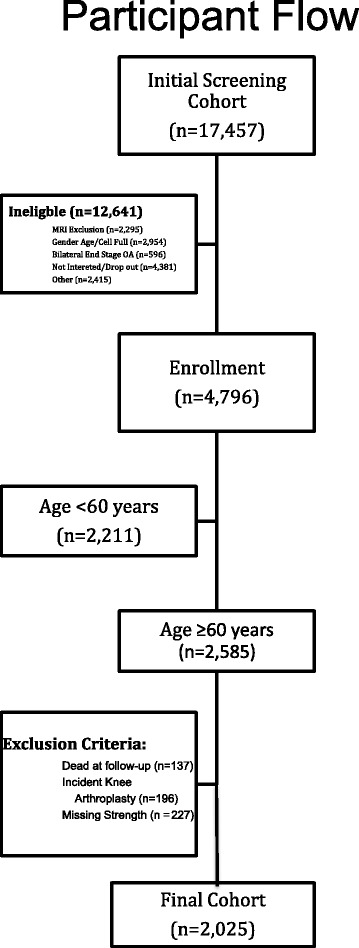
BACKGROUND: Obesity is associated with functional impairment, institutionalization, and increased mortality risk in elders. Dynapenia is defined as reduced muscle strength and is a known independent predictor of adverse events and disability. The synergy between dynapenia and obesity leads to worse outcomes than either independently. We identified the impact of dynapenic obesity in a cohort at risk for and with knee osteoarthritis on function. METHODS: We identified adults aged ≥ 60 years from the Osteoarthritis Initiative. Obesity was defined as a body mass index ≥ 30 kg/m(2). Dynapenia was classified using the lowest sex-specific tertile of knee extensor strength. Participants were grouped according to obesity and knee strength: dynapenic obesity; dynapenia without obesity; obesity without dynapenia; and no dynapenia nor obesity. Four-year data was available. Self-reported activities of daily living (ADL) were assessed at follow-up. Outcomes of gait speed, 400 m walk distance, Late-life Disability and Function Index (LLFDI), and Short-Form (SF)-12 were analyzed using mixed effects and logistic regression models. RESULTS: Of 2025 subjects (56.3 % female), mean age was 68.2 years and 182 (24.1 %) had dynapenic obesity. Dynapenic obesity was associated with reduced gait speed, LLFDI-limitations, and SF-12 physical score in both sexes and in the 400 m walk in men only (all p < 0.001). A time*group interaction was significant for dynapenic obese men in the 400 m walk distance only. Odds of ADL limitations in dynapenic obesity was OR 2.23 [1.42:3.50], in dynapenia 0.98 [0.66:1.46], and in obesity 1.98 [1.39:2.80] in males. In females, odds were 2.45 [1.63:3.68], 1.60 [1.15:2.22], and 1.47 [1.06:2.04] respectively. CONCLUSION: Dynapenic obesity may be a risk factor for functional decline suggesting the need to target subjects with low knee strength and obesity.
Overview
The claims and statistics of this paper haven’t been checked yet.
Free: it reads the open-access text and checks the first 5 claims that cite a source we can check. Create a free account to check every claim.
Integrity signals
Registry
Cites
Statistics
Figures
Verification
Claims the paper makes
The claims and statistics of this paper haven’t been checked yet.
Free: it reads the open-access text and checks the first 5 claims that cite a source we can check. Create a free account to check every claim.
Claims other papers make about this one
Each is checked against this paper’s own text: does it say what the citing paper says it does?
The source backs part of the claim, not all of it — or backs it for a different population, condition or comparison.
In the citing paper
“a combination of low knee extensor strength with high BMI was associated with reduced gait speed and reduced Late-Life Function and Disability Index and Short Form-12 scores207”
From Sarcopenic obesity in older adults: aetiology, epidemiology and treatment strategies (2018) · cites this paper as [207]
Experimental — accuracy not yet measured
Self-check
Percentages, sums and reported differences re-computed from the paper’s own numbers.
The self-check needs the paper’s full text.
Citations
Cites
Charlson, M. E., Pompei, P., Ales, K. L., & MacKenzie, C. R. (1987) · Journal of Chronic Diseases · doi:10.1016/0021-9681(87)90171-8 · Cited by 49,742 · cited 1×
“The Charlson co-morbidity index assessed subject co-morbidity [21].”
BackgroundFrailty in Older Adults: Evidence for a Phenotype
Fried, L. P., Tangen, C. M., Walston, J., Newman, A. B., Hirsch, C., Gottdiener, J., Seeman, T., Tracy, R., Kop, W. J., Burke, G., et al. (2001) · The Journals of Gerontology Series A: Biological Sciences and Medical Sciences · doi:10.1093/gerona/56.3.m146 · Cited by 24,907 · cited 1×
“For this study, subjects <60 years of age were excluded (n = 2221) due to a lower risk of functional impairment [18] and higher capacity for homeostasis [19].”
BackgroundSarcopenia: European consensus on definition and diagnosis
Cruz-Jentoft, A. J., Baeyens, J. P., Bauer, J. M., Boirie, Y., Cederholm, T., Landi, F., Martin, F. C., Michel, J.-P., Rolland, Y., Schneider, S. M., et al. (2010) · Age and Ageing · doi:10.1093/ageing/afq034 · Cited by 11,601
The metabolic phenotype in obesity: Fat mass, body fat distribution, and adipose tissue function
Goossens, G. H. (2017) · Obesity Facts · doi:10.1159/000471488 · Cited by 8,481
Prevalence of Childhood and Adult Obesity in the United States, 2011-2012
Ogden, C. L., Carroll, M. D., Kit, B. K., & Flegal, K. M. (2014) · JAMA · doi:10.1001/jama.2014.732 · Cited by 8,072
Gait speed and survival in older adults.
Studenski, S. (2011) · JAMA · doi:10.1001/jama.2010.1923 · Cited by 4,558 · cited 2×
“This is consistent with other studies demonstrating the drop in gait speed and physical fitness with time in the overall population [30].”
ResultStudenski, S. A., Peters, K. W., Alley, D. E., Cawthon, P. M., McLean, R. R., Harris, T. B., Ferrucci, L., Guralnik, J. M., Fragala, M. S., Kenny, A. M., et al. (2014) · The Journals of Gerontology: Series A · doi:10.1093/gerona/glu010 · Cited by 2,545 · cited 4×
“Challenges exist in adequately defining the relationship between sarcopenia and obesity which has impeded progress in characterizing the syndrome [5].”
BackgroundMethodInfluentialKatz, S. (1963) · JAMA · doi:10.1001/jama.1963.03060120024016 · Cited by 2,421 · cited 1×
“Subjects were classified as having impairment in function if they were unable to perform a basic ADL including, walking, bathing, dressing, eating, transferring out of bed, or toileting [28].”
MethodNewman, A. B., Kupelian, V., Visser, M., Simonsick, E. M., Goodpaster, B. H., Kritchevsky, S. B., Tylavsky, F. A., Rubin, S. M., Harris, T. B., & on Behalf of the Health, A. A. B. C. S. I. (2006) · The Journals of Gerontology Series A: Biological Sciences and Medical Sciences · doi:10.1093/gerona/61.1.72 · Cited by 1,692 · cited 1×
“In contrast, dynapenia alone may also lead to adverse, unintended outcomes [10–13].”
BackgroundAccuracy of body mass index in diagnosing obesity in the adult general population
Romero-Corral, A., Somers, V. K., Sierra-Johnson, J., Thomas, R. J., Collazo-Clavell, M. L., Korinek, J., Allison, T. G., Batsis, J. A., Sert-Kuniyoshi, F. H., & Lopez-Jimenez, F. (2008) · International Journal of Obesity · doi:10.1038/ijo.2008.11 · Cited by 1,589 · cited 1×
“Secondly, we fully acknowledge that we used BMI as a measure of obesity and that this anthropometric measure, while easy to use clinically, may suboptimally assess fat in older adults [48].”
MethodSelf-citationSarcopenic obesity: definition, cause and consequences
Stenholm, S., Harris, T. B., Rantanen, T., Visser, M., Kritchevsky, S. B., & Ferrucci, L. (2008) · Current Opinion in Clinical Nutrition and Metabolic Care · doi:10.1097/mco.0b013e328312c37d · Cited by 1,070 · cited 1×
“Recent evidence suggests that mechanistic similarities underlie sarcopenia and obesity in aging [6].”
BackgroundSarcopenia: alternative definitions and associations with lower extremity function
Newman, A. B., Kupelian, V., Visser, M., Simonsick, E., Goodpaster, B., Nevitt, M., Kritchevsky, S. B., Tylavsky, F. A., Rubin, S. M., Harris, T. B., et al. (2003) · Journal of the American Geriatrics Society · doi:10.1046/j.1532-5415.2003.51534.x · Cited by 981 · cited 1×
“Previous cross-sectional studies demonstrate a disparate interplay between sarcopenia, dynapenia, obesity and the impact on important geriatric measures in late-life [14, 16, 17, 32–37].”
BackgroundSarcopenic Obesity Predicts Instrumental Activities of Daily Living Disability in the Elderly
Baumgartner, R. N., Wayne, S. J., Waters, D. L., Janssen, I., Gallagher, D., & Morley, J. E. (2004) · Obesity Research · doi:10.1038/oby.2004.250 · Cited by 937 · cited 1×
“Previous cross-sectional studies demonstrate a disparate interplay between sarcopenia, dynapenia, obesity and the impact on important geriatric measures in late-life [14, 16, 17, 32–37].”
BackgroundDynapenia and aging: an update
Manini, T. M., & Clark, B. C. (2012) · The Journals of Gerontology: Series A · doi:10.1093/gerona/glr010 · Cited by 875 · cited 1×
“In contrast, dynapenia alone may also lead to adverse, unintended outcomes [10–13].”
BackgroundSkeletal Muscle Strength as a Predictor of All-Cause Mortality in Healthy Men
Metter, E. J., Talbot, L. A., Schrager, M., & Conwit, R. (2002) · The Journals of Gerontology Series A: Biological Sciences and Medical Sciences · doi:10.1093/gerona/57.10.b359 · Cited by 841 · cited 1×
“In contrast, dynapenia alone may also lead to adverse, unintended outcomes [10–13].”
BackgroundDecreased Muscle Strength and Quality in Older Adults With Type 2 Diabetes
Park, S. W., Goodpaster, B. H., Strotmeyer, E. S., de Rekeneire, N., Harris, T. B., Schwartz, A. V., Tylavsky, F. A., & Newman, A. B. (2006) · Diabetes · doi:10.2337/db05-1183 · Cited by 751
Hirvensalo, M., Rantanen, T., & Heikkinen, E. (2000) · Journal of the American Geriatrics Society · doi:10.1111/j.1532-5415.2000.tb04994.x · Cited by 664 · cited 1×
“For instance, if older adults with dynapenic obesity have a 2–3 fold higher risk of ADL limitations, this adversely impacts independence and can lead to death or institutionalization [38, 39].”
BackgroundFerrucci, L., Penninx, B. W. J. H., Volpato, S., Harris, T. B., Bandeen‐Roche, K., Balfour, J., Leveille, S. G., Fried, L. P., & Md, J. M. G. (2002) · Journal of the American Geriatrics Society · doi:10.1046/j.1532-5415.2002.50605.x · Cited by 618 · cited 1×
“A number of studies have demonstrated the relationship between knee extensor strength [16, 41–43] and grip strength [44, 45] on adverse outcomes in older adults.”
BackgroundLim, S., Kim, J. H., Yoon, J. W., Kang, S. M., Choi, S. H., Park, Y. J., Kim, K. W., Lim, J. Y., Park, K. S., & Jang, H. C. (2010) · Diabetes Care · doi:10.2337/dc10-0107 · Cited by 588 · cited 1×
“mass, obesity and their long-term outcomes [2, 8, 9].”
Rolland, Y., Lauwers-Cances, V., Cristini, C., van Kan, G. A., Janssen, I., Morley, J. E., & Vellas, B. (2009) · The American Journal of Clinical Nutrition · doi:10.3945/ajcn.2008.26950 · Cited by 465 · cited 1×
“Previous cross-sectional studies demonstrate a disparate interplay between sarcopenia, dynapenia, obesity and the impact on important geriatric measures in late-life [14, 16, 17, 32–37].”
BackgroundAdiposity, Muscle Mass, and Muscle Strength in Relation to Functional Decline in Older Persons
Schaap, L. A., Koster, A., & Visser, M. (2013) · Epidemiologic Reviews · doi:10.1093/epirev/mxs006 · Cited by 423 · cited 3×
“mass, obesity and their long-term outcomes [2, 8, 9].”
BackgroundClark, B. C., & Manini, T. M. (2012) · Nutrition · doi:10.1016/j.nut.2011.12.002 · Cited by 414
Disability in activities of daily living: patterns of change and a hierarchy of disability.
Dunlop, D. D., Hughes, S. L., & Manheim, L. M. (1997) · American Journal of Public Health · doi:10.2105/ajph.87.3.378 · Cited by 358 · cited 1×
“For this study, subjects <60 years of age were excluded (n = 2221) due to a lower risk of functional impairment [18] and higher capacity for homeostasis [19].”
BackgroundBatsis, J. A., Barre, L. K., Mackenzie, T. A., Pratt, S. I., Lopez‐Jimenez, F., & Bartels, S. J. (2013) · Journal of the American Geriatrics Society · doi:10.1111/jgs.12260 · Cited by 330
Self-citationBouchard, D. R., Dionne, I. J., & Brochu, M. (2009) · Obesity · doi:10.1038/oby.2009.109 · Cited by 314
Washburn, R. A., & Ficker, J. L. (1999) · PubMed · Cited by 294
Hand grip strength and incident ADL disability in elderly Mexican Americans over a seven-year period
Snih, S. A., Markides, K. S., Ottenbacher, K. J., & Raji, M. A. (2004) · Aging Clinical and Experimental Research · doi:10.1007/bf03327406 · Cited by 285 · cited 1×
“A number of studies have demonstrated the relationship between knee extensor strength [16, 41–43] and grip strength [44, 45] on adverse outcomes in older adults.”
BackgroundMeasuring handicap: the London Handicap Scale, a new outcome measure for chronic disease.
Harwood, R. H., Rogers, A., Dickinson, E., & Ebrahim, S. (1994) · Quality in Health Care · doi:10.1136/qshc.3.1.11 · Cited by 264 · cited 1×
“The instrument parallels the disablement framework described by Nagi on disability in community-dwelling older adults and correlates well with the physical functioning subscale of the Medical Outcomes Study 36-item Short Form (SF) Health Survey and the London Handicap Scale [27].”
MethodStenholm, S., Alley, D., Bandinelli, S., Griswold, M. E., Koskinen, S., Rantanen, T., Guralnik, J. M., & Ferrucci, L. (2009) · International Journal of Obesity · doi:10.1038/ijo.2009.62 · Cited by 248 · cited 2×
“Emerging evidence has proven that dynapenic obesity (measured by waist circumference) may also be related to a higher risk of functional decline [14, 16] and death [17].”
BackgroundValidation of the Late‐Life Function and Disability Instrument
Sayers, S. P., Jette, A. M., Haley, S. M., Heeren, T. C., Guralnik, J. M., & Fielding, R. A. (2004) · Journal of the American Geriatrics Society · doi:10.1111/j.1532-5415.2004.52422.x · Cited by 230 · cited 11×
“In both males and females, there were significant reductions in the dynapenic obesity group, as compared to those with neither dynapenia nor obesity, in gait speed, LLFDI-limitations subscale and SF-12 PCS scores.”
BackgroundInfluentialEffect of Therapeutic Exercise on Gait Speed in Community-Dwelling Elderly People: A Meta-analysis
Lopopolo, R. B., Greco, M., Sullivan, D., Craik, R. L., & Mangione, K. K. (2006) · Physical Therapy · doi:10.1093/ptj/86.4.520 · Cited by 218 · cited 1×
“Gait speed, a measure of functional performance that predicts impaired function and mortality [29], was assessed using the 20 m walk test at a usual walking pace.”
MethodRolland, Y. M., Cesari, M., Miller, M. E., Penninx, B. W., Atkinson, H. H., & Pahor, M. (2004) · Journal of the American Geriatrics Society · doi:10.1111/j.1532-5415.2004.52267.x · Cited by 194 · cited 1×
“The 400 m walk test is a measure of aerobic capacity related to V02 max that assesses physical fitness [31].”
BackgroundMorbidity and disability in older persons in the years prior to death.
Guralnik, J. M., LaCroix, A. Z., Branch, L. G., Kasl, S. V., & Wallace, R. B. (1991) · American Journal of Public Health · doi:10.2105/ajph.81.4.443 · Cited by 191 · cited 1×
“For instance, if older adults with dynapenic obesity have a 2–3 fold higher risk of ADL limitations, this adversely impacts independence and can lead to death or institutionalization [38, 39].”
BackgroundMetabolic Syndrome: From Global Epidemiology to Individualized Medicine
Batsis, J. A., Nieto-Martinez, R. E., & Lopez-Jimenez, F. (2007) · Clinical Pharmacology & Therapeutics · doi:10.1038/sj.clpt.6100355 · Cited by 170 · cited 1×
“A high WC was classified as ≥88 cm or ≥102 cm in females and males, respectively [24].”
BackgroundSelf-citationEffect of Sarcopenia on Cardiovascular Disease Risk Factors in Obese Postmenopausal Women
Aubertin‐Leheudre, M., Lord, C., Goulet, É. D. B., Khalil, A., & Dionne, I. J. (2006) · Obesity · doi:10.1038/oby.2006.267 · Cited by 151 · cited 1×
“Previous cross-sectional studies demonstrate a disparate interplay between sarcopenia, dynapenia, obesity and the impact on important geriatric measures in late-life [14, 16, 17, 32–37].”
BackgroundScott, D., Sanders, K. M., Aitken, D., Hayes, A., Ebeling, P. R., & Jones, G. (2014) · Obesity · doi:10.1002/oby.20734 · Cited by 141
Kim, T. N., Park, M. S., Ryu, J. Y., Choi, H. Y., Hong, H. C., Yoo, H. J., Kang, H. J., Song, W., Park, S. W., Baik, S. H., et al. (2014) · PLoS ONE · doi:10.1371/journal.pone.0115407 · Cited by 133 · cited 1×
“mass, obesity and their long-term outcomes [2, 8, 9].”
Martien, S., Delecluse, C., Boen, F., Seghers, J., Pelssers, J., Hoecke, A.-S. V., & Roie, E. V. (2014) · Archives of Gerontology and Geriatrics · doi:10.1016/j.archger.2014.11.010 · Cited by 127 · cited 1×
“Knee extensor strength is often available in research centers and training facilities, and has been proven in one study to be superior to that of grip strength in assessing strength in assisted living populations [46].”
BackgroundObesity Affects Nursing‐Care Facility Admission among Whites but Not Blacks
Zizza, C. A., Herring, A., Stevens, J., & Popkin, B. M. (2002) · Obesity Research · doi:10.1038/oby.2002.110 · Cited by 105 · cited 1×
“Both obesity and aging independently lead to adverse outcomes for older adults, including risk of long-term disability [2], institutionalization [3] and impaired quality of life [4].”
BackgroundSvege, I. C., Kolle, E., & Risberg, M. A. (2012) · BMC Musculoskeletal Disorders · doi:10.1186/1471-2474-13-26 · Cited by 103 · cited 1×
“Higher scores are associated with increased levels of activity and populationbased means are available [22, 23].”
BackgroundRosemann, T. J., Grol, R. P. T. M., Herman, K., Wensing, M., & Szécsényi, J. (2008) · International Journal of Behavioral Nutrition and Physical Activity · doi:10.1186/1479-5868-5-4 · Cited by 93 · cited 1×
“Both obesity and aging independently lead to adverse outcomes for older adults, including risk of long-term disability [2], institutionalization [3] and impaired quality of life [4].”
BackgroundRossi, A. P., Fantin, F., Caliari, C., Zoico, E., Mazzali, G., Zanardo, M., Bertassello, P., Zanandrea, V., Micciolo, R., & Zamboni, M. (2016) · Clinical Nutrition · doi:10.1016/j.clnu.2015.02.005 · Cited by 89 · cited 1×
“Emerging evidence has proven that dynapenic obesity (measured by waist circumference) may also be related to a higher risk of functional decline [14, 16] and death [17].”
BackgroundBaron, G., Tubach, F., Ravaud, P., Logeart, I., & Dougados, M. (2007) · Arthritis Care & Research · doi:10.1002/art.22685 · Cited by 86 · cited 6×
“Those excluded were older, had lower socioeconomic status, gait speed and SF-12 scores, and had gait speed and SF-12 scores, and had higher comorbid conditions and WOMAC scores.”
MethodInfluentialJanssen, I., & Mark, A. E. (2006) · International Journal of Obesity · doi:10.1038/sj.ijo.0803287 · Cited by 66 · cited 1×
“Previous cross-sectional studies demonstrate a disparate interplay between sarcopenia, dynapenia, obesity and the impact on important geriatric measures in late-life [14, 16, 17, 32–37].”
BackgroundStenholm, S., Härkänen, T., Sainio, P., Heliövaara, M., & Koskinen, S. V. P. (2012) · The Journals of Gerontology Series A · doi:10.1093/gerona/gls064 · Cited by 62 · cited 1×
“A number of studies have demonstrated the relationship between knee extensor strength [16, 41–43] and grip strength [44, 45] on adverse outcomes in older adults.”
BackgroundDynapenic Obesity and Lower Extremity Function in Elderly Adults
Yang, M., Jiang, J., Hao, Q., Luo, L., & Dong, B. (2015) · Journal of the American Medical Directors Association · doi:10.1016/j.jamda.2014.06.019 · Cited by 61 · cited 1×
“Previous studies have focused uniquely on cross-sectional relationships demonstrating the relationship of obesity and low muscle strength with impaired function [14, 15].”
BackgroundFlynn, C. A., & Saunders, V. (2015) · Research Bank (Australian Catholic University) · Cited by 59
Holstege, M. S., Lindeboom, R., & Lucas, C. (2011) · Archives of Physical Medicine and Rehabilitation · doi:10.1016/j.apmr.2010.10.015 · Cited by 58 · cited 1×
“A number of studies have demonstrated the relationship between knee extensor strength [16, 41–43] and grip strength [44, 45] on adverse outcomes in older adults.”
BackgroundBatsis, J. A., Zbehlik, A. J., Scherer, E. A., Barré, L. K., & Bartels, S. J. (2015) · Journal of the American Geriatrics Society · doi:10.1111/jgs.13542 · Cited by 38 · cited 1×
“The trajectories parallel other population groups, including one with a normal BMI with central adiposity, where the magnitudes of such declines occurred earlier in life [40].”
BackgroundSelf-citation
Research works printed but not linked: 1
- Ware J Kosinski M Keller S How to score the SF-12 physical. The mental health summary scales 1995 Boston, MA The Health Institute, New England Medical Center
Cited by
Sarcopenic obesity in older adults: aetiology, epidemiology and treatment strategies
Batsis, J. A., & Villareal, D. T. (2018) · Nature Reviews Endocrinology · doi:10.1038/s41574-018-0062-9 · Cited by 1,382
Self-citationDonini, L. M., Busetto, L., Bauer, J. M., Bischoff, S., Boirie, Y., Cederholm, T., Cruz-Jentoft, A. J., Dicker, D., Frühbeck, G., Giustina, A., et al. (2020) · Clinical Nutrition · doi:10.1016/j.clnu.2019.11.024 · Cited by 326
“Study design were predominantly cross-sectional (64 studies, one of which was nested in a retrospective cohort [57]) followed by prospective cohort studies (6 studies) [33,40,43,52,92,93] and randomized clinical trials (5 studies) [36,44,58,69,78].”
BackgroundMethodInfluentialExercise and nutrition strategies to counteract sarcopenic obesity
Trouwborst, I., Verreijen, A., Memelink, R., Massanet, P., Boirie, Y., Weijs, P., & Tieland, M. (2018) · Nutrients · doi:10.3390/nu10050605 · Cited by 210
“Additionally, it is often thought that sarcopenia and obesity work in a synergistic manner, as the consequences of sarcopenic obesity are often more severe than for sarcopenia or obesity alone [6,7].”
BackgroundSarcopenic Obesity: An Emerging Public Health Problem
Ji, T., Li, Y., & Ma, L. (2022) · Aging and disease · doi:10.14336/ad.2021.1006 · Cited by 124
“Muscle strength can be evaluated by measuring grip strength using a hand dynamometer, or by measuring knee extension strength [40].”
The impact of sarcopenic obesity on knee and hip osteoarthritis: a scoping review
Godziuk, K., Prado, C. M. M., Woodhouse, L. J., & Forhan, M. A. (2018) · BMC Musculoskeletal Disorders · doi:10.1186/s12891-018-2175-7 · Cited by 133
“2%) were secondary analyses of the North American Osteoarthritis Initiative (OAI) population cohort [59, 62], one (9%) was a secondary analysis of the French Knee and Hip OsteoArthritis Long-term Assessment (KHOALA) cohort [69], and the remaining four (36.”
BackgroundMethodInfluential
Metadata
- Authors
- Batsis, J. A., Zbehlik, A. J., Pidgeon, D., & Bartels, S. J.
- Affiliations
- Dartmouth College (US)
- Corresponding author
- Batsis, John A.
- Venue
- BMC Geriatrics
- Published
- 2015-10-08
- Volume
- 15
- Issue
- 1
- Pages
- 118-118
- ISSN
- 1471-2318 (ISSN-L)
- PMC
- PMC4599326
- OpenAlex
- W1927908814
- Cited by
- 74
- References
- 49
- Citations by year
- 2026: 2 · 2025: 5 · 2024: 3 · 2023: 28 · 2022: 8 · 2021: 2 · 2020: 6 · 2019: 6 · 2018: 9 · 2017: 5
- FWCI
- 3.44
- Type
- journal article
- Language
- en
- Open access
- gold
- doi.org
- Licence
- Locations
- BMC Geriatrics (publishedVersion, cc-by)
- Europe PMC (PubMed Central) (publishedVersion, cc-by)
- PubMed Central (publishedVersion, cc-by)
- PubMed (publishedVersion)
- Funders
- Foundation for the National Institutes of Health ((N01-AR-2-2258)
- U.S. Department of Health and Human Services (N01-AR-2-2258, N01-AR-2-2261, N01-AR-2-2262, N01-AR-2-2259, N01-AR-2-2260)
- Pfizer (N01-AR-2-2262)
- GlaxoSmithKline (N01-AR-2-2262)
- Novartis Pharmaceuticals Corporation (N01-AR-2-2261, N01-AR-2-2260)
- Dartmouth College
- National Institutes of Health (N01 AR‐2‐2260, N01-AR-2-2258,N01-AR-2-2259,N01-AR-2-2260,N01-AR-2-2261,N01-AR-2-2262, N01-AR-2-2258, N01‐AR‐2‐2259, N01-AR-2-2261, N01-AR-2-2262, U48DP005018)
- Centers for Disease Control and Prevention (U48DP005018)
- National Institute of Arthritis and Musculoskeletal and Skin Diseases (N01 ‐ AR ‐ 2 ‐ 2261, N01‐AR‐2‐2260, N01 ‐ AR ‐ 2 ‐ 2258, N01-AR-2- 2262, N01AR22259)
- National Center for Chronic Disease Prevention and Health Promotion (U48DP005018)
- Topics
- Health Sciences › Medicine › Physiology (medical) › Nutrition and Health in Aging
- Health Sciences › Medicine › Geriatrics and Gerontology › Frailty in Older Adults
- Health Sciences › Medicine › Public Health, Environmental and Occupational Health › Aging, Health, and Disability
- Keywords
- dynapenic obesity, dynapenia, knee osteoarthritis, quadriceps strength, physical function, activities of daily living, walking speed, disability, quality of life, older adults, functional decline
- MeSH terms
- Activities of Daily Living, Aged, Female, Gait, Humans, Longitudinal Studies, Male, Middle Aged, Motor Activity, Obesity, Osteoarthritis, Prospective Studies, Quality of Life, Risk Factors, Statistics as Topic, Time Factors, Cohort Studies, Body Mass Index, Muscle Strength
About these checks
Registry, retraction, Cites and statistics results are computed, not judged, with one exception: a printed reference that no index lists is read once by a model before it counts as a citation error. Claims are extracted by a model and kept only when their quote appears verbatim in the text; each cited source is then checked, with a model’s help, for whether it says what the claim relies on. Those verdicts can be wrong — read the claim’s quote and the cited source before relying on one.
Statistics and arithmetic are recomputed, not judged.
Confidence bands are shown only for fields calibrated on our annotated test set. None is calibrated yet, so no band is shown.
What counts as a claim ›How we measure confidence ›How we check this ›
Are you an author, or do you see a problem with this page? Request a review
Data sources
Bibliographic data: Semantic Scholar, OpenAlex, Crossref.
Contains information from the Semantic Scholar Academic Graph Datasets, made available under the ODC Attribution License (ODC-BY 1.0).
Semantic Scholar’s data is described in: Kinney, R., et al. (2023). The Semantic Scholar Open Data Platform. arXiv:2301.10140.
