

Study protocol of a multicenter randomized controlled trial of mindfulness training to reduce burnout and promote quality of life in police officers: the POLICE study
Open accessThe DOI matches its Crossref record; 78 of the 81 references it cites were found in a registry or an index; 24 of the 59 sources its claims cite were checked for support.
Abstract
Background: Police officers experience a high degree of chronic stress. Policing ranks among the highest professions in terms of disease and accident rates. Mental health is particularly impacted, evidenced by elevated rates of burnout, anxiety and depression, and poorer quality of life than the general public. Mindfulness training has been shown to reduce stress, anxiety, burnout and promote quality of life in a variety of settings, although its efficacy in this context has yet to be systematically evaluated. Therefore, this trial will investigate the efficacy of a mindfulness-based intervention versus a waitlist control in improving quality of life and reducing negative mental health symptoms in police officers. Methods: This multicenter randomized controlled trial has three assessment points: baseline, post-intervention, and six-month follow-up. Active police officers (n=160) will be randomized to Mindfulness-Based Health Promotion (MBHP) or waitlist control group at two Brazilian major cities: Porto Alegre and São Paulo. The primary outcomes are burnout symptoms and quality of life. Consistent with the MBHP conceptual model, assessed secondary outcomes include perceived stress, anxiety and depression symptoms, and the potential mechanisms of resilience, mindfulness, decentering, self-compassion, spirituality, and religiosity. Discussion: Findings from this study will inform and guide future research, practice, and policy regarding police offer health and quality of life in Brazil and globally. © 2018 The Author(s).
Overview
CoChat Summary
## TL;DR
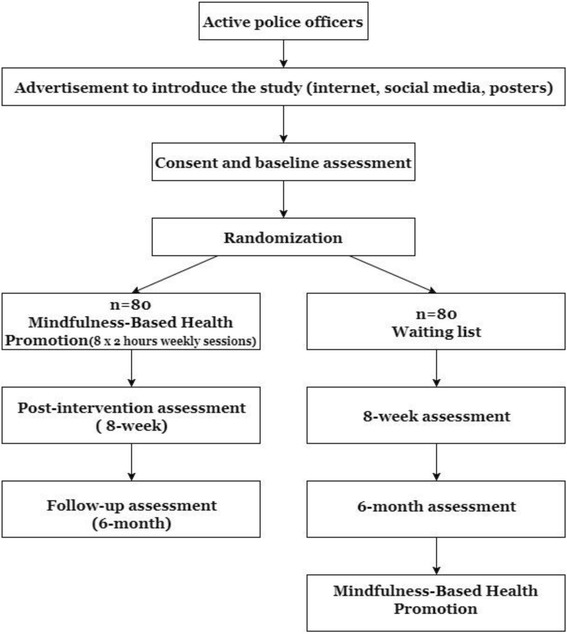
This is a study protocol for a multicenter randomized controlled trial testing whether an 8-week Mindfulness-Based Health Promotion program improves quality of life and reduces burnout in police officers, compared with a waitlist control. The trial plans to enroll 160 active officers in Porto Alegre and São Paulo, with assessments at baseline, post-intervention, and 6-month follow-up.
## Key findings
- The paper does not report trial results; it is a protocol. It states the study will test whether MBHP improves the primary outcomes of burnout symptoms and quality of life, and whether it reduces secondary outcomes including perceived stress, anxiety, and depression.
- The planned sample size is 160 participants total, with 80 per group and an expected minimum effective sample size of 128 after allowing for up to 20% loss to follow-up.
- The intervention is an 8-week, 2-hour mindfulness-based program; the authors say they will also assess feasibility and acceptability in this setting.
- The paper notes that approximately one third of police officers are estimated to meet criteria for burnout syndrome, based on prior cited literature.
## Methods
- Design: Multicenter, parallel, two-arm randomized controlled trial with 3 assessment points: baseline, post-intervention, and 6-month follow-up; participants randomized to MBHP or waitlist control.
- Sample/settings: 160 active police officers recruited from two Brazilian metropolitan areas: Porto Alegre and São Paulo; inclusion required being active, aged 21 to 65, available for 8 sessions, and willing to participate.
- Analysis: Planned intention-to-treat and per-protocol analyses, baseline group comparisons with chi-square and ANOVA, and a 2 × 3 repeated-measures ANOVA for intervention effects; mediation analyses will test mindfulness, self-compassion, resilience, decentering, and spirituality as mechanisms.
## Limitations
- The paper explicitly states that it uses a waitlist control rather than an active control intervention, and notes that such designs may overestimate intervention effects.
- Because the intervention is behavioral, the study is single-blind: outcomes assessors are blind, but participants are aware of group assignment.
- Evident from the text: this is a protocol, so the paper does not yet provide outcome data on effectiveness, feasibility, or acceptability.
Model-written summary. Check it against the paper before relying on it.
Integrity signals
Registry
Cites
Statistics
Figures
Verification
Claims the paper makes
17 Valid · 0 Not valid · 13 Not checked · 9 Own results and interpretations
The cited sources support only part of this claim — read each source’s verdict below.
In the paper
“Recent meta-analyses support this theory, indicating MBIs improve common health and risk factors, including stress [25, 26], depression and suicidal ideation [26, 27], anxiety and burnout [28, 29], and increases psychological resilience [30, 31].”
§ Study protocol of a multicenter randomized controlled trial of mindfulness training to reduce burnout and promote quality of life in police officers: the POLICE study > Background
What the sources say
- Partly supportedcites [30] Zenner C, Herrnleben-Kurz S, Walach H. Mindfulness-based interventions in schools—a systematic review and meta-analysis. Front Psychol. 2014;5(5):603. PMC4075476 25071620 sourceExperimental — accuracy not yet measured
The Results (Quantitative synthesis, Table 5; page not specified) report a positive controlled effect for factors of resilience (Hedges’s g = 0.36, 95% CI 0.09–0.62). The review concerns school-based interventions in children and youths and groups several measures under “factors of resilience”; it does not establish the unqualified claim for MBIs across populations. (LLM, conf=0.87)
- Not checked — no full text of the sourcecites [31] Kallapiran K Review: effectiveness of mindfulness in improving mental health symptoms of children and adolescents: a meta-analysis Child Adolesc Mental Health 2015 20 4 182 194 10.1111/camh.12113 32680348 source
hedgedstates a cause- Asserted: passes — The authors put it forward as true.
- Checkable: passes — It can be checked against evidence.
- Load-bearing: passes — The paper’s conclusions depend on it.
- Based: passes — The paper gives a reason why it holds.
- Partly supported
The cited sources support only part of this claim — read each source’s verdict below.
In the paper
“findings from a recent RCT indicate that relative to waitlist control, MBI participants experienced greater reductions in salivary cortisol (AUCi), self-reported aggression, burnout, alcohol use, sleep disturbance, and increases in psychological flexibility and non-reactivity at post-training [39].”
§ Study protocol of a multicenter randomized controlled trial of mindfulness training to reduce burnout and promote quality of life in police officers: the POLICE study > Background
What the sources say
- Partly supportedcites [39] Christopher MS, Hunsinger M, Goerling LRJ, Bowen S, Rogers BS, Gross CR, Dapolonia E, Pruessner JC. Mindfulness-based resilience training to reduce health risk, stress reactivity, and aggression among law enforcement officers: A feasibility and preliminary efficacy trial. Psychiatry Res. 2018;264:104-15. 10.1016/j.psychres.2018.03.059. PMC6226556 29627695 sourceExperimental — accuracy not yet measured
The Results (Cortisol Awakening Response) report lower AUCi for MBRT than waitlist participants on post-training sampling day three, and a reduction in overall AUCi among men. The claim omits those qualifications: the group-by-time interaction for overall AUCi was not significant in the full sample. (LLM, conf=0.90)
hedgedstates a cause- Asserted: passes — The authors put it forward as true.
- Checkable: passes — It can be checked against evidence.
- Load-bearing: passes — The paper’s conclusions depend on it.
- Based: passes — The paper gives a reason why it holds.
- Partly supported
The cited sources support only part of this claim — read each source’s verdict below.
In the paper
“findings from a recent RCT indicate that relative to waitlist control, MBI participants experienced greater reductions in salivary cortisol (AUCi), self-reported aggression, burnout, alcohol use, sleep disturbance, and increases in psychological flexibility and non-reactivity at post-training [39].”
§ Study protocol of a multicenter randomized controlled trial of mindfulness training to reduce burnout and promote quality of life in police officers: the POLICE study > Background
What the sources say
- Partly supportedcites [39] Christopher MS, Hunsinger M, Goerling LRJ, Bowen S, Rogers BS, Gross CR, Dapolonia E, Pruessner JC. Mindfulness-based resilience training to reduce health risk, stress reactivity, and aggression among law enforcement officers: A feasibility and preliminary efficacy trial. Psychiatry Res. 2018;264:104-15. 10.1016/j.psychres.2018.03.059. PMC6226556 29627695 sourceExperimental — accuracy not yet measured
The Results section (Psychological Health and Risk; page unavailable) reports a significant group-by-time interaction for alcohol use. However, its planned follow-up analysis found that the pre-to-post-training effect for MBRT relative to the control group was not statistically significant (p = .12), so the claim presents the comparative reduction more definitively than the paper does. (LLM, conf=0.88)
hedgedstates a cause- Asserted: passes — The authors put it forward as true.
- Checkable: passes — It can be checked against evidence.
- Load-bearing: unclear — It is unclear whether the paper’s conclusions depend on it.
- Based: passes — The paper gives a reason why it holds.
- Partly supported
Every source the paper cites for this claim was checked and supports it.
In the paper
“it has been noted that such designs may overestimate intervention effects [84].”
§ Study protocol of a multicenter randomized controlled trial of mindfulness training to reduce burnout and promote quality of life in police officers: the POLICE study > Discussion
What the sources say
- Supportedcites [84] Cunningham JA Kypri K McCambridge J Exploratory randomized controlled trial evaluating the impact of a waiting list control design BMC Med Res Methodol 2013 13 1 150 10.1186/1471-2288-13-150 24314204 PMC4029562 source
The paper’s Abstract Conclusions state that trials with waiting-list controls may overestimate treatment effects, while noting that the extent of bias likely varies between populations. The citing sentence preserves that qualified claim. (LLM, conf=0.95)
hedgedstates a possible cause- Asserted: passes — The authors put it forward as true.
- Checkable: passes — It can be checked against evidence.
- Load-bearing: unclear — It is unclear whether the paper’s conclusions depend on it.
- Based: passes — The paper gives a reason why it holds.
- Supported
Every source the paper cites for this claim was checked and supports it.
In the paper
“findings from a recent RCT indicate that relative to waitlist control, MBI participants experienced greater reductions in salivary cortisol (AUCi), self-reported aggression, burnout, alcohol use, sleep disturbance, and increases in psychological flexibility and non-reactivity at post-training [39].”
§ Study protocol of a multicenter randomized controlled trial of mindfulness training to reduce burnout and promote quality of life in police officers: the POLICE study > Background
What the sources say
- Supportedcites [39] Christopher MS, Hunsinger M, Goerling LRJ, Bowen S, Rogers BS, Gross CR, Dapolonia E, Pruessner JC. Mindfulness-based resilience training to reduce health risk, stress reactivity, and aggression among law enforcement officers: A feasibility and preliminary efficacy trial. Psychiatry Res. 2018;264:104-15. 10.1016/j.psychres.2018.03.059. PMC6226556 29627695 source
The Results (Psychological Health and Risk; page not provided) report a significant group-by-time interaction for burnout and significant improvement among MBRT participants at post-training (p = .006). The Discussion explicitly describes the burnout improvement as relative to the no-intervention control group; the Methods say that group was offered training after the final follow-up assessment. (LLM, conf=0.92)
hedgedstates a cause- Asserted: passes — The authors put it forward as true.
- Checkable: passes — It can be checked against evidence.
- Load-bearing: passes — The paper’s conclusions depend on it.
- Based: passes — The paper gives a reason why it holds.
- Supported
12 more claims · 4 with their cited sources checked
Create a free account to see all 39 claims and to verify the 3 references still open.
- It may state two separate claims as one. 16
- Probably not a substantial claim. 13
Claims other papers make about this one
Each is checked against this paper’s own text: does it say what the citing paper says it does?
The source backs part of the claim, not all of it — or backs it for a different population, condition or comparison.
In the citing paper
“Public safety personnel (PSP; eg, border services officers, correctional workers, firefighters, Indigenous emergency managers, operational intelligence personnel, paramedics, police officers, public safety communicators, and search and rescue personnel) have greater exposure to potentially psychologically traumatic events than the general population and a greater risk for several psychological dis”
From Web-Based Mindfulness Meditation as an Adjunct to Internet-Delivered Cognitive Behavioral Therapy for Public Safety Personnel: Mixed Methods Feasibility Evaluation Study (2024) · cites this paper as [3]
Experimental — accuracy not yet measuredThe source backs part of the claim, not all of it — or backs it for a different population, condition or comparison.
In the citing paper
“In terms of PSP, mindfulness-based interventions have been associated with reductions in stress, insomnia, burnout, anger, anxiety, and depression [20,21]; however, research has been limited to pilot or feasibility studies, police populations, and in-person class delivery style [3,22].”
From Web-Based Mindfulness Meditation as an Adjunct to Internet-Delivered Cognitive Behavioral Therapy for Public Safety Personnel: Mixed Methods Feasibility Evaluation Study (2024) · cites this paper as [3]
Experimental — accuracy not yet measuredThe cited source says what the claim attributes to it.
In the citing paper
“This heightened risk is, in part, attributable to the nature of their vocations [1-3].”
Citations
Cites
The Hospital Anxiety and Depression Scale
Zigmond, A. S., & Snaith, R. P. (1983) · Acta Psychiatrica Scandinavica · doi:10.1111/j.1600-0447.1983.tb09716.x · Cited by 47,139
SPSS and SAS procedures for estimating indirect effects in simple mediation models
Preacher, K. J., & Hayes, A. F. (2004) · Behavior Research Methods, Instruments, & Computers · doi:10.3758/bf03206553 · Cited by 17,383 · cited 1×
“To study potential working mechanisms of mindfulness intervention, mediation analysis will be conducted using the Preacher and Hayes (2004) procedure [81].”
MethodDepression and quality of life in older persons: A review
Sivertsen, H., Bjørkløf, G. H., Engedal, K., Selbæk, G., & Helvik, A.-S. (2015) · Dementia and Geriatric Cognitive Disorders · doi:10.1159/000437299 · Cited by 14,152
The benefits of being present: Mindfulness and its role in psychological well-being
Brown, K. W., & Ryan, R. M. (2003) · Journal of Personality and Social Psychology · doi:10.1037/0022-3514.84.4.822 · Cited by 13,448 · cited 1×
“The scale has strong psychometric properties and has been validated with college, community, and cancer patient samples [72].”
CONSORT 2010 Statement: updated guidelines for reporting parallel group randomised trials
the CONSORT Group, Schulz, K. F., Altman, D. G., & Moher, D. (2010) · BMC Medicine · doi:10.1186/1741-7015-8-18 · Cited by 13,371
Development of a new resilience scale: The Connor-Davidson Resilience Scale (CD-RISC)
Connor, K. M., & Davidson, J. R. T. (2003) · Depression and Anxiety · doi:10.1002/da.10113 · Cited by 11,793 · cited 1×
“Resilience may be viewed as a measure of stress coping ability and, as such, could be an important target of treatment in anxiety, depression, and stress reactions [71].”
BackgroundCONSORT 2010 Statement: updated guidelines for reporting parallel group randomised trials
Schulz, K. F., Altman, D. G., Moher, D., & for the CONSORT Group (2010) · BMJ · doi:10.1136/bmj.c332 · Cited by 9,329
(2008) · Medical Entomology and Zoology · Cited by 7,477
SPIRIT 2013 Statement: Defining Standard Protocol Items for Clinical Trials
Chan, A.-W., Tetzlaff, J. M., Altman, D. G., Laupacis, A., Gøtzsche, P. C., Krleža-Jerić, K., Hróbjartsson, A., Mann, H., Dickersin, K., Berlin, J. A., et al. (2013) · Annals of Internal Medicine · doi:10.7326/0003-4819-158-3-201302050-00583 · Cited by 7,363 · cited 3×
“This protocol was prepared in accordance with SPIRIT 2013 statement [40] and was approved by the centers ethical committees.”
MethodInfluentialThe Development and Validation of a Scale to Measure Self-Compassion
NEFF, K. D. (2003) · Self and Identity · doi:10.1080/15298860309027 · Cited by 6,436
SPIRIT 2013 Statement: defining standard protocol items for clinical trials.
Chan, A., Tetzlaff, J., Altman, D. G., Laupacis, A., Gøtzsche, P. C., A-Jerić, K. K., Hrobjartsson, A., Mann, H., Dickersin, K., Berlin, J. A., et al. (2015) · PubMed · Cited by 4,998
Skevington, S. M., Lotfy, M., & O'Connell, K. A. (2004) · Quality of Life Research · doi:10.1023/b:qure.0000018486.91360.00 · Cited by 4,686 · cited 1×
“Is one of the best known instruments that has been developed for cross-cultural comparisons of quality of life and is available in more than 40 languages [65].”
BackgroundThe effect of mindfulness based therapy on anxiety and depression: A meta analytic review
Hofmann, S. G., Sawyer, A. T., Witt, A. A., & Oh, D. (2010) · Journal of Consulting and Clinical Psychology · doi:10.1037/a0018555 · Cited by 3,846 · cited 1×
“Recent meta-analyses support this theory, indicating MBIs improve common health and risk factors, including stress [25, 26], depression and suicidal ideation [26, 27], anxiety and burnout [28, 29], and increases psychological resilience [30, 31].”
CONSORT 2010 statement: updated guidelines for reporting parallel group randomized trials
Schulz, K. F., Altman, D. G., Moher, D., & for the CONSORT Group* (2010) · Annals of Internal Medicine · doi:10.7326/0003-4819-152-11-201006010-00232 · Cited by 3,824
(2001) · Cited by 3,666
Mindfulness-based therapy: a comprehensive meta-analysis
Khoury, B., Lecomte, T., Fortin, G., Masse, M., Therien, P., Bouchard, V., Chapleau, M.-A., Paquin, K., & Hofmann, S. G. (2013) · Clinical Psychology Review · doi:10.1016/j.cpr.2013.05.005 · Cited by 2,003 · cited 1×
“Recent meta-analyses support this theory, indicating MBIs improve common health and risk factors, including stress [25, 26], depression and suicidal ideation [26, 27], anxiety and burnout [28, 29], and increases psychological resilience [30, 31].”
Fleck, M. P., Louzada, S., Xavier, M., Chachamovich, E., Vieira, G., Santos, L., & Pinzon, V. (2000) · Revista de Saúde Pública · doi:10.1590/s0034-89102000000200012 · Cited by 1,933
Mindfulness-based stress reduction for healthy individuals: A meta-analysis
Khoury, B., Sharma, M., Rush, S. E., & Fournier, C. (2015) · Journal of Psychosomatic Research · doi:10.1016/j.jpsychores.2015.03.009 · Cited by 1,617 · cited 1×
“Recent meta-analyses support this theory, indicating MBIs improve common health and risk factors, including stress [25, 26], depression and suicidal ideation [26, 27], anxiety and burnout [28, 29], and increases psychological resilience [30, 31].”
Mindfulness-based interventions in schools—a systematic review and meta-analysis
Zenner, C., Herrnleben-Kurz, S., & Walach, H. (2014) · Frontiers in Psychology · doi:10.3389/fpsyg.2014.00603 · Cited by 999 · cited 1×
“Recent meta-analyses support this theory, indicating MBIs improve common health and risk factors, including stress [25, 26], depression and suicidal ideation [26, 27], anxiety and burnout [28, 29], and increases psychological resilience [30, 31].”
A tutorial on sensitivity analyses in clinical trials: the what, why, when and how
Thabane, L., Mbuagbaw, L., Zhang, S., Samaan, Z., Marcucci, M., Ye, C., Thabane, M., Giangregorio, L., Dennis, B., Kosa, D., et al. (2013) · BMC Medical Research Methodology · doi:10.1186/1471-2288-13-92 · Cited by 893 · cited 1×
“Missing data will be handled according to the most appropriate method depending on the reasons for missingness, following the authors’ recommendations and sensitivity analyses principles [80].”
MethodFresco, D. M., Moore, M. T., van Dulmen, M. H. M., Segal, Z. V., Ma, S. H., Teasdale, J. D., & Williams, J. M. G. (2007) · Behavior Therapy · doi:10.1016/j.beth.2006.08.003 · Cited by 810 · cited 1×
“Items from the scale are rated on a Likert scale ranging between 1 (never or very rarely true) and 5 (very often or always true), with higher scores indicating greater decentering [73].”
BackgroundMeiklejohn, J., Phillips, C., Freedman, M. L., Griffin, M. L., Biegel, G., Roach, A., Frank, J., Burke, C., Pinger, L., Soloway, G., et al. (2012) · Mindfulness · doi:10.1007/s12671-012-0094-5 · Cited by 778 · cited 1×
“MBIs have been shown to be feasible and to lead to improved health outcomes among several high-stress populations, such as military personnel [32, 33], physicians [34, 35], firefighters [36], and innercity teachers [37].”
BackgroundValidation study of a Portuguese version of the Hospital Anxiety and Depression Scale
Pais-Ribeiro, J., Silva, I., Ferreira, T., Martins, A., Meneses, R., & Baltar, M. (2007) · Psychology, Health & Medicine · doi:10.1080/13548500500524088 · Cited by 774
Religion index for psychiatric research
(1997) · American Journal of Psychiatry · doi:10.1176/ajp.154.6.885b · Cited by 709
Physician Resilience: What It Means, Why It Matters, and How to Promote It
Epstein, R. M., & Krasner, M. S. (2013) · Academic Medicine · doi:10.1097/acm.0b013e318280cff0 · Cited by 509 · cited 1×
“MBIs have been shown to be feasible and to lead to improved health outcomes among several high-stress populations, such as military personnel [32, 33], physicians [34, 35], firefighters [36], and innercity teachers [37].”
BackgroundSegal, Z. V., Teasdale, J. D., Williams, J. M., & Gemar, M. C. (2002) · Clinical Psychology & Psychotherapy · doi:10.1002/cpp.320 · Cited by 432
Validation of the Maslach Burnout Inventory - General Survey: An Internet Study
Bakker, A. B., Demerouti, E., & Schaufeli, W. B. (2002) · Anxiety, Stress & Coping · doi:10.1080/1061580021000020716 · Cited by 416 · cited 1×
“The 3 dimensions are distributed in 16 items, whose answers are given on a 7-point Likert scale that varies from “never” to “every day” [68].”
BackgroundSleep disorders, health, and safety in police officers
Rajaratnam, S. M. W., Barger, L. K., Lockley, S. W., Shea, S. A., Wang, W., Landrigan, C. P., O’Brien, C. S., Qadri, S., Sullivan, J. P., Cade, B. E., et al. (2011) · JAMA · doi:10.1001/jama.2011.1851 · Cited by 405
(2003) · Cited by 402
Physical evidence of police officer stress
Anderson, G. S., Litzenberger, R., & Plecas, D. (2002) · Policing: An International Journal of Police Strategies & Management · doi:10.1108/13639510210429437 · Cited by 343 · cited 1×
“Police officers are routinely exposed to dangerous and unpredictable situations [1].”
BackgroundJob demands, job resources, and burnout among police officers
Martinussen, M., Richardsen, A. M., & Burke, R. J. (2007) · Journal of Criminal Justice · doi:10.1016/j.jcrimjus.2007.03.001 · Cited by 337 · cited 1×
“tributing to disruptive family relationships [21].”
Kallapiran, K., Koo, S., Kirubakaran, R., & Hancock, K. (2015) · Child and Adolescent Mental Health · doi:10.1111/camh.12113 · Cited by 326 · cited 1×
“Recent meta-analyses support this theory, indicating MBIs improve common health and risk factors, including stress [25, 26], depression and suicidal ideation [26, 27], anxiety and burnout [28, 29], and increases psychological resilience [30, 31].”
(2007) · PubMed · Cited by 324
Exploratory randomized controlled trial evaluating the impact of a waiting list control design
Cunningham, J. A., Kypri, K., & McCambridge, J. (2013) · BMC Medical Research Methodology · doi:10.1186/1471-2288-13-150 · Cited by 321 · cited 1×
“While there are ethical advantages to a waitlist design because it allows for the provision of care to research participants who are seeking help whilst permitting a non-intervention evaluation, specially in a non-clinical population as ours, it has been noted that such designs may overestimate intervention effects [8…”
BackgroundMcCreary, D. R., & Thompson, M. M. (2006) · International Journal of Stress Management · doi:10.1037/1072-5245.13.4.494 · Cited by 310 · cited 1×
“The PSQ was developed as an alternative to the general scales of stress at work in order to reflect the specifics stressors of police occupation [69].”
MethodInterventions to Reduce the Consequences of Stress in Physicians: A Review and Meta-Analysis
Regehr, C., Glancy, D., Pitts, A., & LeBlanc, V. R. (2014) · Journal of Nervous & Mental Disease · doi:10.1097/nmd.0000000000000130 · Cited by 310 · cited 1×
“Recent meta-analyses support this theory, indicating MBIs improve common health and risk factors, including stress [25, 26], depression and suicidal ideation [26, 27], anxiety and burnout [28, 29], and increases psychological resilience [30, 31].”
Systematic Review of Mindfulness Practice for Reducing Job Burnout
Luken, M., & Sammons, A. (2016) · American Journal of Occupational Therapy · doi:10.5014/ajot.2016.016956 · Cited by 250 · cited 1×
“Recent meta-analyses support this theory, indicating MBIs improve common health and risk factors, including stress [25, 26], depression and suicidal ideation [26, 27], anxiety and burnout [28, 29], and increases psychological resilience [30, 31].”
Resilience Training Program Reduces Physiological and Psychological Stress in Police Officers
Mccraty, R., & Atkinson, M. (2012) · Global Advances in Health and Medicine · doi:10.7453/gahmj.2012.1.5.013 · Cited by 234 · cited 1×
“In addition to higher rates of mental health concerns, police officers have an increased risk of sudden cardiac death, diabetes, obesity and metabolic syndrome [9, 10].”
BackgroundJohnson, D. C., Thom, N. J., Stanley, E. A., Haase, L., Simmons, A. N., Shih, P.-A. B., Thompson, W. K., Potterat, E. G., Minor, T. R., & Paulus, M. P. (2014) · American Journal of Psychiatry · doi:10.1176/appi.ajp.2014.13040502 · Cited by 227 · cited 1×
“MBIs have been shown to be feasible and to lead to improved health outcomes among several high-stress populations, such as military personnel [32, 33], physicians [34, 35], firefighters [36], and innercity teachers [37].”
BackgroundMindfulness-based Mind Fitness Training: A Case Study of a High-Stress Predeployment Military Cohort
Stanley, E. A., Schaldach, J. M., Kiyonaga, A., & Jha, A. P. (2011) · Cognitive and Behavioral Practice · doi:10.1016/j.cbpra.2010.08.002 · Cited by 226 · cited 1×
“MBIs have been shown to be feasible and to lead to improved health outcomes among several high-stress populations, such as military personnel [32, 33], physicians [34, 35], firefighters [36], and innercity teachers [37].”
BackgroundValidation of the Duke Religion Index: DUREL (Portuguese Version)
Lucchetti, G., Granero Lucchetti, A. L., Peres, M. F., Leão, F. C., Moreira-Almeida, A., & Koenig, H. G. (2012) · Journal of Religion and Health · doi:10.1007/s10943-010-9429-5 · Cited by 223
(2005) · Cited by 195
(2001) · Cited by 192
Luciano, J. V., Guallar, J. A., Aguado, J., López-del-Hoyo, Y., Olivan, B., Magallón, R., Alda, M., Serrano-Blanco, A., Gili, M., & Garcia-Campayo, J. (2014) · PAIN · doi:10.1016/j.pain.2013.12.029 · Cited by 183 · cited 1×
“[51] and positive psychology [52] are also heavily emphasized.”
BackgroundSelf-citationA prospective study of predictors of depression symptoms in police
Wang, Z., Inslicht, S. S., Metzler, T. J., Henn-Haase, C., McCaslin, S. E., Tong, H., Neylan, T. C., & Marmar, C. R. (2010) · Psychiatry Research · doi:10.1016/j.psychres.2008.11.010 · Cited by 182 · cited 2×
“Exposure to acute and chronic stress is reflected in elevated officer rates of burnout [2, 3], depression [4], suicide [5–7], and anxiety [8].”
BackgroundThe Hospital Anxiety and Depression Scale (HADS)
Zigmond, A. S., & Snaith, R. P. (1983) · Cited by 179
Christopher, M. S., Hunsinger, M., Goerling, L. R. J., Bowen, S., Rogers, B. S., Gross, C. R., Dapolonia, E., & Pruessner, J. C. (2018) · Psychiatry Research · doi:10.1016/j.psychres.2018.03.059 · Cited by 173 · cited 1×
“MBI studies among police officers are limited; however, a pre-post study suggests that mindfulness training can reduce stress and burnout symptoms [38], and findings from a recent RCT indicate that relative to waitlist control, MBI participants experienced greater reductions in salivary cortisol (AUCi), self-reported…”
ResultSelf-citationChristopher, M. S., Goerling, R. J., Rogers, B. S., Hunsinger, M., Baron, G., Bergman, A. L., & Zava, D. T. (2016) · Journal of Police and Criminal Psychology · doi:10.1007/s11896-015-9161-x · Cited by 170 · cited 1×
“MBI studies among police officers are limited; however, a pre-post study suggests that mindfulness training can reduce stress and burnout symptoms [38], and findings from a recent RCT indicate that relative to waitlist control, MBI participants experienced greater reductions in salivary cortisol (AUCi), self-reported…”
ResultSelf-citationStress management interventions for police officers and recruits: a meta-analysis
Patterson, G. T., Chung, I. W., & Swan, P. G. (2014) · Journal of Experimental Criminology · doi:10.1007/s11292-014-9214-7 · Cited by 151 · cited 1×
“Great emphasis is placed on physical health cultivation in police training, however evidence-based mental health and quality of life enhancing programs are scarce [82].”
BackgroundJob-Related Burnout Among Civilian and Sworn Police Personnel
McCarty, W. P., & Skogan, W. G. (2013) · Police Quarterly · doi:10.1177/1098611112457357 · Cited by 148 · cited 1×
“Exposure to acute and chronic stress is reflected in elevated officer rates of burnout [2, 3], depression [4], suicide [5–7], and anxiety [8].”
BackgroundMortality of a police cohort: 1950-1990
Violanti, J. M., Vena, J. E., & Petralia, S. (1998) · American Journal of Industrial Medicine · doi:10.1002/(sici)1097-0274(199804)33:4<366::aid-ajim6>3.0.co;2-s · Cited by 140
Hart, T., Fann, J. R., & Novack, T. A. (2008) · Neuropsychological Rehabilitation · doi:10.1080/09602010601082359 · Cited by 140 · cited 1×
“There is a growing discussion over the use of waitlist in psychological and behavioral research [83].”
BackgroundRelationship between meditative practice and self-reported mindfulness: the MINDSENS composite index
Soler, J., Cebolla, A., Feliu-Soler, A., Demarzo, M. M. P., Pascual, J. C., Baños, R., & García-Campayo, J. (2014) · PLoS ONE · doi:10.1371/journal.pone.0086622 · Cited by 138 · cited 1×
“At the post-intervention and the six-month follow-up evaluations we will address mindfulness practice parameters such as type, frequency and length of personal meditative practice through a questionnaire created by our research group [79].”
MethodSkevington, S. M., Gunson, K. S., & O’Connell, K. A. (2012) · Quality of Life Research · doi:10.1007/s11136-012-0237-0 · Cited by 132 · cited 4×
“Combines one item extracted from each of the eight SRPB facets in the WHOQOL-SRPB, with the 26 WHOQOL-BREF items, extracted from the WHOQOL-100, to construct the 34 item WHOQOL-SRPB-BREF [77].”
MethodInfluentialRole of Resilience in Mindfulness Training for First Responders
Kaplan, J. B., Bergman, A. L., Christopher, M., Bowen, S., & Hunsinger, M. (2017) · Mindfulness · doi:10.1007/s12671-017-0713-2 · Cited by 130 · cited 1×
“MBIs have been shown to be feasible and to lead to improved health outcomes among several high-stress populations, such as military personnel [32, 33], physicians [34, 35], firefighters [36], and innercity teachers [37].”
BackgroundSelf-citationPanzini, R. G., Maganha, C., Rocha, N. S. D., Bandeira, D. R., & Fleck, M. P. (2011) · Revista de Saúde Pública · doi:10.1590/s0034-89102011000100018 · Cited by 113
Self-citationValidity evidence of the brazilian version of the Mindful Attention Awareness Scale (MAAS)
Barros, V. V. D., Kozasa, E. H., Souza, I. C. W. D., & Ronzani, T. M. (2015) · Psicologia: Reflexão e Crítica · doi:10.1590/1678-7153.201528110 · Cited by 109
Schroeder, D. A., Stephens, E., Colgan, D., Hunsinger, M., Rubin, D., & Christopher, M. S. (2018) · American Journal of Lifestyle Medicine · doi:10.1177/1559827616629121 · Cited by 109 · cited 1×
“MBIs have been shown to be feasible and to lead to improved health outcomes among several high-stress populations, such as military personnel [32, 33], physicians [34, 35], firefighters [36], and innercity teachers [37].”
BackgroundSelf-citationMortality of a municipal worker cohort: III. Police officers
Vena, J. E., Violanti, J. M., Marshall, J., & Fiedler, R. C. (1986) · American Journal of Industrial Medicine · doi:10.1002/ajim.4700100406 · Cited by 104 · cited 1×
“It is no surprise to find that this occupation ranks highest on diseases and accidents rates among all professions [11, 12].”
BackgroundAdaptation of the Self-Compassion Scale for use in Brazil: Evidences of construct validity
Souza, L. K., & Hutz, C. S. (2016) · Temas em Psicologia · doi:10.9788/tp2016.1-11 · Cited by 101
Alexopoulos, E. C., Palatsidi, V., Tigani, X., & Darviri, C. (2014) · Safety and Health at Work · doi:10.1016/j.shaw.2014.07.004 · Cited by 98 · cited 1×
“Police quality of life is generally poor [13], including among Brazilian military police [14, 15] and recruits [16].”
BackgroundStress and Suicide in Police Officers: Paradigm of Occupational Stress
McCAFFERTY, F. L., McCAFFERTY, E., & McCAFFERTY, M. A. (1992) · Southern Medical Journal · doi:10.1097/00007611-199203000-00003 · Cited by 73
Prevalence and risk factors of burnout syndrome among Spanish police officers
De la Fuente Solana, E., Aguayo Extremera, R., Vargas Pecino, C., & Cañadas de la Fuente, G. (2013) · Psicothema · doi:10.7334/psicothema2013.81 · Cited by 70 · cited 2×
“Nature and environment of police work contributes to high burnout rates which are associated with escalating symptoms of diminished health [22].”
BackgroundMontero-Marín, J., Skapinakis, P., Araya, R., Gili, M., & García-Campayo, J. (2011) · Health and Quality of Life Outcomes · doi:10.1186/1477-7525-9-74 · Cited by 69
Self-citationSolano, J. P. C., Bracher, E. S. B., Faisal-Cury, A., Ashmawi, H. A., Carmona, M. J. C., Lotufo Neto, F., & Vieira, J. E. (2016) · Sao Paulo Medical Journal · doi:10.1590/1516-3180.2015.02290512 · Cited by 66
Police Work and Subclinical Atherosclerosis
Joseph, P. N., Violanti, J. M., Donahue, R., Andrew, M. E., Trevisan, M., Burchfiel, C. M., & Dorn, J. (2009) · Journal of Occupational & Environmental Medicine · doi:10.1097/jom.0b013e3181a02252 · Cited by 65 · cited 1×
“In addition to higher rates of mental health concerns, police officers have an increased risk of sudden cardiac death, diabetes, obesity and metabolic syndrome [9, 10].”
BackgroundStress and Quality of Life of Senior Brazilian Police Officers
Lipp, M. E. N. (2009) · The Spanish journal of psychology · doi:10.1017/s1138741600001967 · Cited by 62 · cited 1×
“Evidence consistently shows that officers exhibit low quality of life and its correlation with adverse mental health outcomes [4, 66, 67].”
BackgroundWaggoner, L. B., Grant, D. A., Van Dongen, H. P. A., Belenky, G., & Vila, B. (2012) · Sleep · doi:10.5665/sleep.2214 · Cited by 52
Gouveia, V. V., Barbosa, G. A., Andrade, E. D. O., & Carneiro, M. B. (2010) · Cadernos de Saúde Pública · doi:10.1590/s0102-311x2010000700023 · Cited by 51
MacMillan, F., Karamacoska, D., Masri, A. E., McBride, K. A., Steiner, G. Z., Cook, A. S., Kolt, G. S., Klupp, N. L., & George, E. S. (2017) · Occupational and Environmental Medicine · doi:10.1136/oemed-2017-104430 · Cited by 51 · cited 1×
“Evidence consistently shows that officers exhibit low quality of life and its correlation with adverse mental health outcomes [4, 66, 67].”
BackgroundHealth-related quality of life and related factors of military police officers
da Silva, F., Hernandez, S. S., Arancibia, B. A., Castro, T. L. D. S., Filho, P. J. B., & da Silva, R. (2014) · Health and Quality of Life Outcomes · doi:10.1186/1477-7525-12-60 · Cited by 45 · cited 1×
“Police quality of life is generally poor [13], including among Brazilian military police [14, 15] and recruits [16].”
BackgroundDemarzo, M. M. P., Andreoni, S., Sanches, N., Perez, S., Fortes, S., & Garcia-Campayo, J. (2014) · EXPLORE · doi:10.1016/j.explore.2013.12.005 · Cited by 41 · cited 12×
“It is relevant to address the feasibility and adherence of this intervention in Brazilian police officers, commonly exposed to dangerous environments and long shifts.”
BackgroundInfluentialSelf-citationStress in Policing: Sources, consequences and interventions
(2016) · doi:10.4324/9781315611075 · Cited by 29 · cited 1×
“Exposure to acute and chronic stress is reflected in elevated officer rates of burnout [2, 3], depression [4], suicide [5–7], and anxiety [8].”
BackgroundGregório, S., Pinto-Gouveia, J., Duarte, C., & Simões, L. (2015) · The Spanish Journal of Psychology · doi:10.1017/sjp.2015.18 · Cited by 22
0037 Associations of stress, anxiety, and resiliency in police work
Violanti, J., Mnatskanova, A., Michael, A., Tara, H., Desta, F., Penelope, B., & Cecil, B. (2014) · Occupational and Environmental Medicine · doi:10.1136/oemed-2014-102362.8 · Cited by 15
Braga Filho, R. T., & Júnior, A. D. (2014) · American Journal of Men's Health · doi:10.1177/1557988314526750 · Cited by 8 · cited 1×
“Police quality of life is generally poor [13], including among Brazilian military police [14, 15] and recruits [16].”
BackgroundBarbosa, W. G., Soares, E. M. K. V. K., Molina, G. E., Korre, M., Kales, S. N., Fontana, K. E., & Porto, L. G. G. (2017) · Medicine & Science in Sports & Exercise · doi:10.1249/01.mss.0000517132.28918.17 · Cited by 1
(2010) · PubMed
Research works printed but not linked: 6
- Clark DW White EK Violanti J Law enforcement suicide: current knowledge and future directions The Police Chief 2012 79 48 51
- Demarzo M Garcia-Campayo J Manual Prático de mindfulness: curiosidade e aceitação 2015 1 São Paulo Palas Athena
- Ciarrochi J Kashdan TB Mindfulness, acceptance, and positive psychology\rThe seven foundations of WellBeing 2013 California New Harbinger
- Tamayo MR Validação do Inventário de burnout de Maslach Universidade federal da Paraíba (org.). III Congresso Norte-Nordeste de Psicologia. Anais 2003 João Pessoa UFPB 392 393
- Cardoso, A.L.S. Validação de duas escalas de stresse ocupacional para a Polícia de Segurança Pública. Faculdade de Psicologia e de Ciências da Educação da Universidade de Coimbra, 2010. http://hdl.handle.net/10316/15597. Accessed 9 July 2017.
- Hillier G The 12-item general health questionnaire (GHQ-12) Soc Psychiatry Psychiatr Epidemiol 1979 20 4 839 843
Cited by
Queirós, C., Passos, F., Bártolo, A., Marques, A. J., da Silva, C. F., & Pereira, A. (2020) · Frontiers in Psychology · doi:10.3389/fpsyg.2020.00587 · Cited by 330
Trombka, M., Demarzo, M., Campos, D., Antonio, S. B., Cicuto, K., Walcher, A. L., García-Campayo, J., Schuman-Olivier, Z., & Rocha, N. S. (2021) · Frontiers in Psychiatry · doi:10.3389/fpsyt.2021.624876 · Cited by 69
“Primary and secondary outcomes were previously reported (73).”
BackgroundMethodResultInfluentialSelf-citationMental Disorders and Mental Health Promotion in Police Officers
Santre, S. (2024) · Health Psychology Research · doi:10.52965/001c.93904 · Cited by 82
Doody, C. B., Robertson, L., Cox, K. M., Bogue, J., Egan, J., & Sarma, K. M. (2021) · Cochrane Database of Systematic Reviews · doi:10.1002/14651858.cd013242.pub2 · Cited by 85
Vadvilavičius, T., Varnagirytė, E., Jarašiūnaitė–Fedosejeva, G., & Gustainienė, L. (2023) · Journal of Police and Criminal Psychology · doi:10.1007/s11896-022-09570-2 · Cited by 50
Metadata
- Authors
- Trombka, M., Demarzo, M., Bacas, D. C., Antonio, S. B., Cicuto, K., Salvo, V., Claudino, F. C. A., Ribeiro, L., Christopher, M., Garcia-Campayo, J., & Rocha, N. S.
- Affiliations
- Hospital de Clínicas de Porto Alegre (BR)
- Universidade Federal de São Paulo (BR)
- Pacific University (US)
- Corresponding author
- Demarzo, Marcelo
- Venue
- BMC Psychiatry
- Published
- 2018-05-25
- Volume
- 18
- Issue
- 1
- Pages
- 151-151
- ISSN
- 1471-244X (ISSN-L)
- PMC
- PMC5970505
- OpenAlex
- W2805322226
- Semantic Scholar
- 6cd8627ae1600ff02615d51b0c1c7e22b0f63215
- Cited by
- 51
- References
- 81
- Citations by year
- 2026: 2 · 2025: 9 · 2024: 8 · 2023: 6 · 2022: 7 · 2021: 8 · 2020: 6 · 2019: 4 · 2018: 1
- FWCI
- 5.09
- Type
- journal article
- Language
- en
- Open access
- gold
- doi.org
- Licence
- cc-by
- creativecommons.org/licenses/by/4.0/ (tdm)
- Locations
- BMC Psychiatry (publishedVersion, cc-by)
- Europe PMC (PubMed Central) (publishedVersion, other-oa)
- PubMed Central (publishedVersion, cc-by)
- PubMed (publishedVersion)
- Repositori UJI (Universitat Jaume I) (publishedVersion, cc-by-sa)
- LA Referencia (Red Federada de Repositorios Institucionales de Publicaciones Científicas) (submittedVersion, other-oa)
- Americanae (AECID Library) (submittedVersion, other-oa)
- LA Referencia (Red Federada de Repositorios Institucionales de Publicaciones Científicas) (submittedVersion, cc-by-sa)
- DOAJ (DOAJ: Directory of Open Access Journals) (submittedVersion, cc-by-sa)
- LA Referencia (Red Federada de Repositorios Institucionales de Publicaciones Científicas) (submittedVersion, cc-by-nc-sa)
- Zaguan (University of Zaragoza Repository) (submittedVersion, cc-by)
- Funders
- Hospital de Clínicas de Porto Alegre Research Incentive Fund (16-0491)
- Mente Aberta - Brazilian Center for Mindfulness and Health Promotion (17-1091)
- Topics
- Social Sciences › Psychology › Clinical Psychology › Mindfulness and Compassion Interventions
- Social Sciences › Psychology › Social Psychology › Stress and Burnout Research
- Health Sciences › Medicine › Public Health, Environmental and Occupational Health › Occupational Health and Burnout
- Keywords
- mindfulness training, police officers, burnout, quality of life, occupational stress, police mental health, anxiety, depression, resilience, self-compassion, spirituality, religiosity, decentering
- MeSH terms
- Burnout, Psychological, Adult, Anxiety, Brazil, Burnout, Professional, Depression, Empathy, Female, Humans, Male, Mental Health, Quality of Life, Multicenter Studies as Topic, Randomized Controlled Trials as Topic, Police, Mindfulness
About these checks
Registry, retraction, Cites and statistics results are computed, not judged, with one exception: a printed reference that no index lists is read once by a model before it counts as a citation error. Claims are extracted by a model and kept only when their quote appears verbatim in the text; each cited source is then checked, with a model’s help, for whether it says what the claim relies on. Those verdicts can be wrong — read the claim’s quote and the cited source before relying on one.
The claim verdicts this report counts are experimental: their accuracy is not yet measured.
A language model drew the claims from the paper on 2026-10-11, under version 3 of the claim definition (model deepseek-v4.1-flash, prompt extract-v3).
A second model labelled each claim on 2026-10-11 (model jev-1.13-20260917, definition revision gold-guideline-v0.2).
Cited sources are checked with a language model’s help (gpt-6-sol).
Statistics and arithmetic are recomputed, not judged.
Confidence bands are shown only for fields calibrated on our annotated test set. None is calibrated yet, so no band is shown.
What counts as a claim ›How we measure confidence ›How we check this ›
Are you an author, or do you see a problem with this page? Request a review
Data sources
Bibliographic data: Semantic Scholar, OpenAlex, Crossref.
Contains information from the Semantic Scholar Academic Graph Datasets, made available under the ODC Attribution License (ODC-BY 1.0).
Semantic Scholar’s data is described in: Kinney, R., et al. (2023). The Semantic Scholar Open Data Platform. arXiv:2301.10140.
