

Efficacy and acceptability of parent-only group cognitive behavioral intervention for treatment of anxiety disorder in children and adolescents: a meta-analysis of randomized controlled trials
Open accessPublished version of a preprint
The DOI matches its Crossref record; 46 of the 46 references it cites were found in a registry or an index; 8 of the 33 sources its claims cite were checked for support.
Abstract
Background: Anxiety disorder is the most prevalent mental disorder among children and adolescents, causing significant psychosocial problems and physical health conditions. Cognitive behavioral therapy (CBT) is an effective treatment for anxiety disorder in children and adolescents. And parent-only CBT is an alternative treatment for childhood anxiety disorder, which includes psychologists and parents rather than children in the treatment. As a new type of CBT, parent-only CBT has some advantages. However, it remains unclear whether parent-only CBT interventions are effective for treating children and adolescents with anxiety disorder. Methods: In this study, we evaluated the efficacy (the mean change scores of the anxiety rating scale from baseline to post-treatment, standardized mean difference SMD) and acceptability (the proportion of patients in the treatment group who withdrew from treatment early for any reason, risk ratios RRs) of parent-only cognitive behavioral therapy (CBT) for children and adolescents with anxiety disorder. We searched electronic databases, including PubMed, Cochrane Library, Embase, Web of Science, ProQuest, and PsycINFO from inception to June 2019. We included randomized controlled trials (RCTs) comparing parent-only CBT either with waitlist (WL), or CBT with parents in children and adolescents with anxiety disorder. Results: Finally, six RCTs with 407 participants were included in the meta-analyses. In terms of efficacy, pooled analyses indicated that parent-only CBT was significantly more effective than WL for reducing anxiety symptoms with SMD of − 0.72 (95% CI − 1.41 to − 0.03, p = 0.04), and more remission rate with RR of 4.33 (37.96% vs. 6.85, 95% CI 1.82 to 10.27, p = 0.0009) at post-treatment. And our analyses showed no evidence that parent-only CBT had significantly greater efficacy than CBT with parents with SMD of 0.21 (95% CI − 0.09 to 0.50, p = 0.17). Acceptability in the parent-only CBT group was not significantly different to the WL group with RR of 0.92 (95% CI 0.52 to 1.62, p = 0.77), and was significantly worse than in the CBT with parents group with RR of 1.93 (95% CI 1.05 to 3.57, p = 0.03). Conclusions: Current evidence indicates that parent-only CBT can be an alternative and acceptable intervention for treating children and adolescents with anxiety disorder. © 2021, The Author(s).
Overview
CoChat Summary
TL;DR
This meta-analysis of 6 randomized controlled trials (407 participants) found that parent-only CBT reduced child anxiety symptoms and improved remission compared with waitlist control, but was not superior to CBT with parents. Acceptability was similar to waitlist but worse than CBT with parents, so the authors conclude parent-only CBT is an alternative treatment.
Key findings
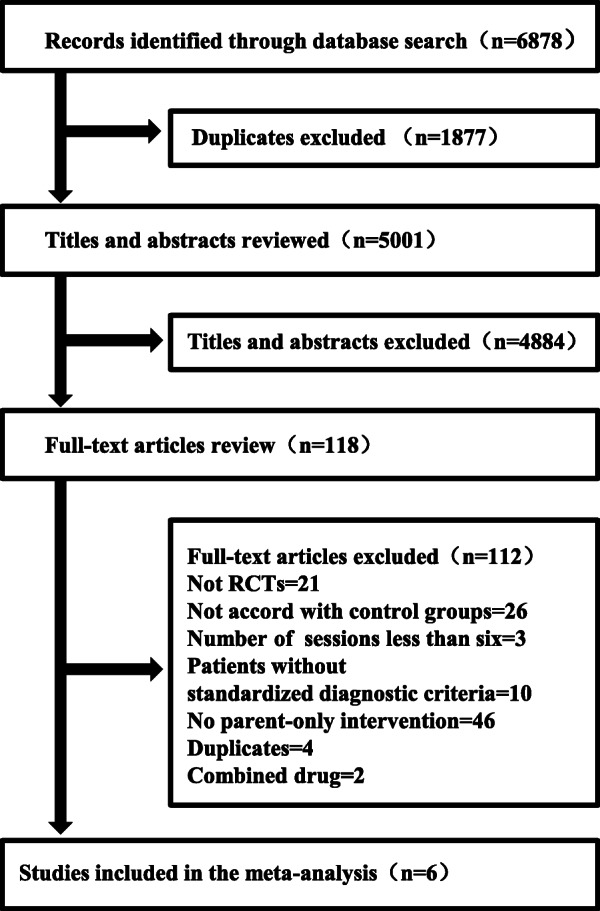
- Six RCTs with 407 participants were included; the parent-only CBT group had 199 patients, waitlist 114, and CBT with parents 94, with mean age 8.0 years.
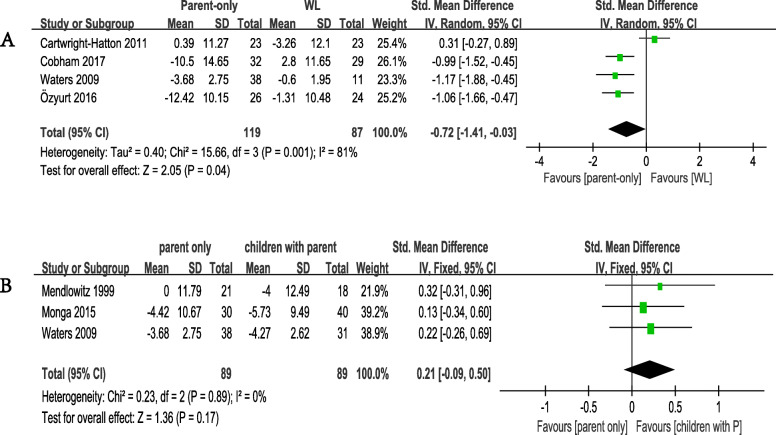
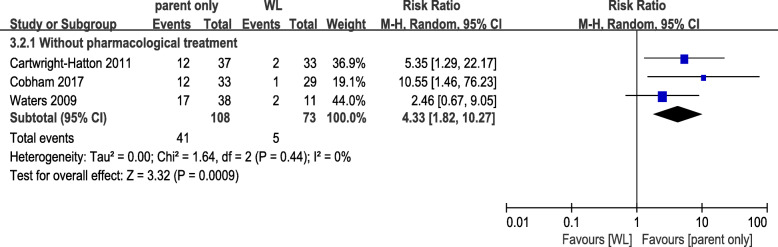
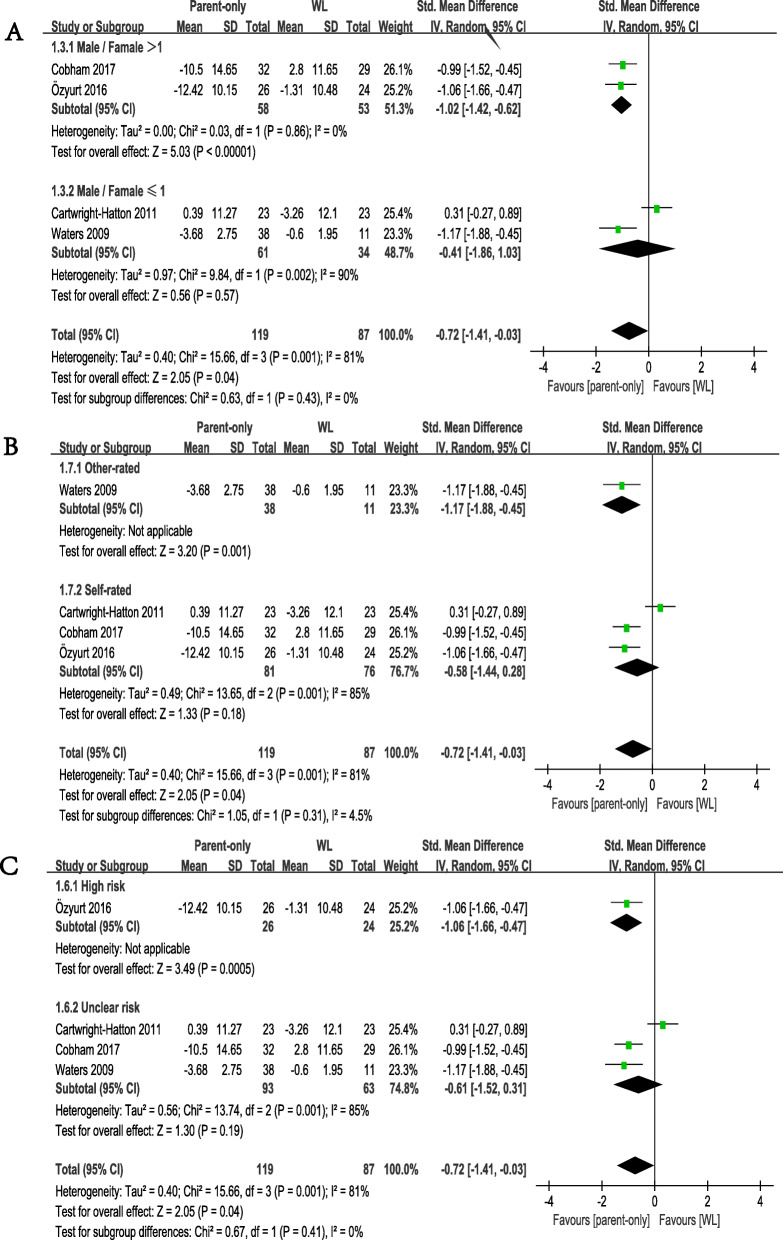
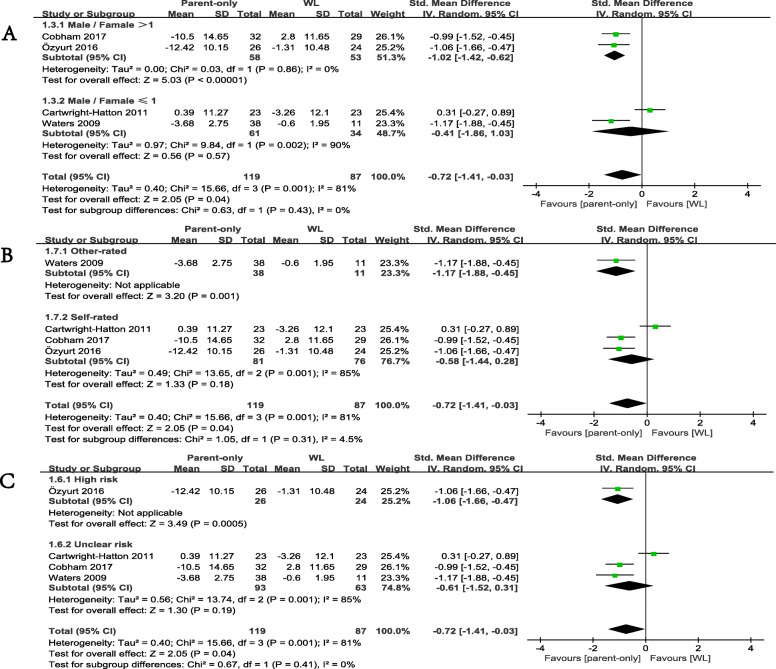
- Compared with waitlist, parent-only CBT significantly reduced anxiety symptoms at post-treatment: SMD = −0.72 (95% CI −1.41 to −0.03, p = 0.04; 4 studies, 206 patients) and improved remission: RR = 4.33 (37.96% vs. 6.85%, 95% CI 1.82 to 10.27, p = 0.0009; 3 studies, 181 patients).
- Compared with CBT with parents, parent-only CBT showed no significant efficacy difference: SMD = 0.21 (95% CI −0.09 to 0.50, p = 0.17; 3 studies, 178 patients).
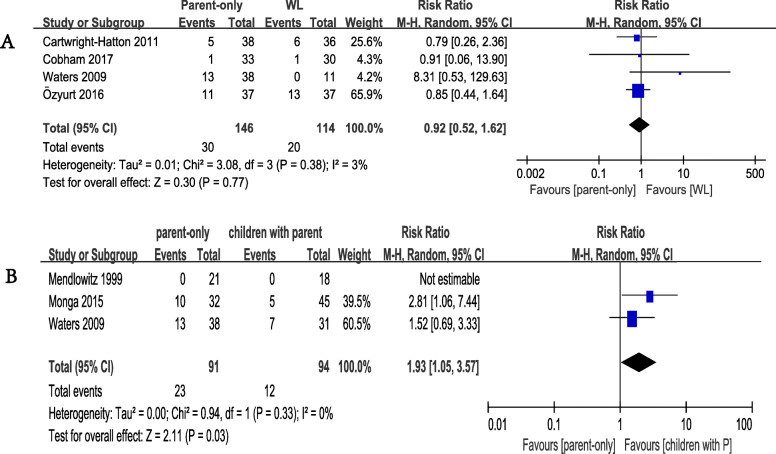
- Acceptability: discontinuation did not differ from waitlist (RR = 0.92, 95% CI 0.52 to 1.62, p = 0.77; 30/146 vs. 20/114), but was worse than CBT with parents (RR = 1.93, 95% CI 1.05 to 3.57, p = 0.03; 23/91 vs. 12/94).
Methods
- Systematic review and meta-analysis conducted under PRISMA guidelines, searching PubMed, Cochrane Library, Embase, Web of Science, ProQuest, and PsycINFO from inception to June 2019, plus reference lists.
- Included RCTs of children/adolescents under 18 with a current anxiety disorder diagnosis, comparing parent-only CBT with waitlist or CBT with parents; studies with >20% psychotropic drug use, treatment <6 weeks, <6 sessions, or repeated publication were excluded.
- Meta-analysis used Review Manager 5.3 with random-effects models; efficacy was pooled as standardized mean difference, acceptability as risk ratio, with heterogeneity assessed by Q and I², plus Egger’s test, sensitivity analysis, and subgroup analyses by sex ratio, risk of bias, and rating scale.
Limitations
- The paper states the sample size was not sufficient for reliable statistical power, especially in subgroup analyses, and that some included studies were of unsatisfactory quality.
- The included studies showed substantial heterogeneity, and the authors caution interpretation on that basis.
- The review did not consider other CBT formats involving parents (for example parent-delivered, internet-delivered, or telephone-delivered CBT), did not examine specific anxiety disorders, and did not assess follow-up outcomes due to lack of data; these are stated limitations.
Model-written summary. Check it against the paper before relying on it.
Integrity signals
Registry
Cites
Statistics
Figures
Verification
Claims the paper makes
7 Valid · 0 Not valid · 17 Not checked · 43 Own results and interpretations
Every source the paper cites for this claim was checked and supports it.
In the paper
“According to previous studies [30, 31], CBT involving parents was effective for treating child anxiety disorders.”
§ Efficacy and acceptability of parent-only group cognitive behavioral intervention for treatment of anxiety disorder in children and adolescents: a meta-analysis of randomized controlled trials > Discussion
What the sources say
- Supportedcites [30] Zhou X Zhang Y Furukawa TA Cuijpers P Pu J Weisz JR Yang L Hetrick SE Del Giovane C Cohen D Different types and acceptability of psychotherapies for acute anxiety disorders in children and adolescents: a network meta-analysis JAMA Psychiatry 2019 76 1 41 50 30383099 PMC6583467 source
The Results (Pairwise Meta-analysis; page not provided) report that CBT with parental involvement was significantly more effective than a wait-list condition both after treatment and at follow-up. This supports the claim that it was effective for child anxiety disorders; it does not imply that involving parents made CBT more effective than CBT without them. (LLM, conf=0.93)
- Supportedcites [31] Kreuze LJ Pijnenborg GHM de Jonge YB Nauta MH Cognitive-behavior therapy for children and adolescents with anxiety disorders: a meta-analysis of secondary outcomes J Anxiety Disord 2018 60 43 57 30447493 source
The Moderator analysis (§3.9; page unavailable) reports moderate reductions in child anxiety symptoms in all four CBT groups, including those with moderate or high parental involvement. It found no significant difference between parental-involvement groups, but the claim does not assert that involving parents improves outcomes relative to CBT without them. (LLM, conf=0.91)
plainstates a cause- Asserted: passes — The authors put it forward as true.
- Checkable: passes — It can be checked against evidence.
- Load-bearing: unclear — It is unclear whether the paper’s conclusions depend on it.
- Based: passes — The paper gives a reason why it holds.
- Supported
The sources with a verdict support this claim; the rest weren’t checked yet, have no full text we could read, or their verdicts aren’t rated yet.
In the paper
“As one type of CBT used with children and adolescents, CBT with parents has been demonstrated to be effective for treating children and adolescents with anxiety [5, 11, 12].”
§ Efficacy and acceptability of parent-only group cognitive behavioral intervention for treatment of anxiety disorder in children and adolescents: a meta-analysis of randomized controlled trials > Background
What the sources say
- Not checked — no full text of the sourcecites [5] In-Albon T Schneider S Psychotherapy of childhood anxiety disorders: a meta-analysis Psychother Psychosom 2007 76 1 15 24 17170560 source
- Supportedcites [11] Reynolds S Wilson C Austin J Hooper L Effects of psychotherapy for anxiety in children and adolescents: a meta-analytic review Clin Psychol Rev 2012 32 4 251 262 22459788 source
The Results section (‘What is the Impact of Treatment Delivery…’; page unavailable) reports medium, significant treatment effects at every level of parental involvement, including substantial involvement. The paper says most treatments were CBT. It does not claim that involving parents improves outcomes compared with CBT without parents, but the citing sentence does not make that comparison. (LLM, conf=0.89)
- Not checked — no full text of the sourcecites [12] Thulin U Svirsky L Serlachius E Andersson G Ost LG The effect of parent involvement in the treatment of anxiety disorders in children: a meta-analysis Cogn Behav Ther 2014 43 3 185 200 24950054 source
boostedstates a cause- Asserted: passes — The authors put it forward as true.
- Checkable: passes — It can be checked against evidence.
- Load-bearing: passes — The paper’s conclusions depend on it.
- Based: passes — The paper gives a reason why it holds.
A result the paper reports from its own data — it cites no other source for it, so there is none to check. The quote shows it is in the paper.
In the paper
“Finally, six RCTs with 407 participants were included in the meta-analyses.”
§ Efficacy and acceptability of parent-only group cognitive behavioral intervention for treatment of anxiety disorder in children and adolescents: a meta-analysis of randomized controlled trials > Abstract > Results
plainn = 407- Asserted: passes — The authors put it forward as true.
- Checkable: passes — It can be checked against evidence.
- Load-bearing: passes — The paper’s conclusions depend on it.
- Based: passes — The paper gives a reason why it holds.
A result the paper reports from its own data — it cites no other source for it, so there is none to check. The quote shows it is in the paper.
In the paper
“pooled analyses indicated that parent-only CBT was significantly more effective than WL for reducing anxiety symptoms with SMD of − 0.72 (95% CI − 1.41 to − 0.03, p = 0.04)”
§ Efficacy and acceptability of parent-only group cognitive behavioral intervention for treatment of anxiety disorder in children and adolescents: a meta-analysis of randomized controlled trials > Abstract > Results
hedgedstates a causen = 407 ·- Asserted: passes — The authors put it forward as true.
- Checkable: passes — It can be checked against evidence.
- Load-bearing: passes — The paper’s conclusions depend on it.
- Based: passes — The paper gives a reason why it holds.
In the paper
“When subgroups depended on self/other-rating scales, excluding one study [17] that measured anxiety in children using an other-rated scale (clinical severity rating, CSR, doctor-rated) resulted in different effects.”
§ Efficacy and acceptability of parent-only group cognitive behavioral intervention for treatment of anxiety disorder in children and adolescents: a meta-analysis of randomized controlled trials > Discussion
What the sources say
- Not checked — no full text of the sourcecites [17] Waters AM Ford LA Wharton TA Cobham VE Cognitive-behavioural therapy for young children with anxiety disorders: comparison of a child + parent condition versus a parent only condition Behav Res Ther 2009 47 8 654 662 19457471 source
plainstates a cause- Asserted: passes — The authors put it forward as true.
- Checkable: passes — It can be checked against evidence.
- Load-bearing: passes — The paper’s conclusions depend on it.
- Based: passes — The paper gives a reason why it holds.
31 more claims
Create a free account to see all 67 claims and every source verdict.
- It may state two separate claims as one. 15
- Probably not a substantial claim. 20
Claims other papers make about this one
Each is checked against this paper’s own text: does it say what the citing paper says it does?
The cited source says what the claim attributes to it.
In the citing paper
“While these initial findings are promising, they do not adequately speak to the acceptability or feasibility of ACT-PAC as experienced by parent participants, which is particularly important to evaluate in light of research showing that families are more likely to drop out of parent-only interventions compared to traditional CBT [42].”
From A Qualitative Study of Participant Feedback on an Acceptance and Commitment Therapy Group-Based Intervention for Parents of Youth with Anxiety Disorders. (2026) · cites this paper as [42]
Citations
Cites
Preferred Reporting Items for Systematic Reviews and Meta-Analyses: the PRISMA statement
Moher, D., Liberati, A., Tetzlaff, J., Altman, D. G., & for the PRISMA Group (2009) · BMJ · doi:10.1136/bmj.b2535 · Cited by 83,823
Preferred Reporting Items for Systematic Reviews and Meta-Analyses: The PRISMA Statement
Moher, D., Liberati, A., Tetzlaff, J., Altman, D. G., & The PRISMA Group (2009) · PLoS Medicine · doi:10.1371/journal.pmed.1000097 · Cited by 64,042
Preferred reporting items for systematic reviews and meta-analyses: the PRISMA Statement.
(2009) · PubMed Central · Cited by 44,859
Preferred reporting items for systematic reviews and meta-analyses: The PRISMA statement
Moher, D., Liberati, A., Tetzlaff, J., Altman, D. G., & the PRISMA Group* (2009) · Annals of Internal Medicine · doi:10.7326/0003-4819-151-4-200908180-00135 · Cited by 37,554
KAUFMAN, J., BIRMAHER, B., BRENT, D., RAO, U., FLYNN, C., MORECI, P., WILLIAMSON, D., & RYAN, N. (1997) · Journal of the American Academy of Child & Adolescent Psychiatry · doi:10.1097/00004583-199707000-00021 · Cited by 10,148
Cumpston, M., Li, T., Page, M. J., Chandler, J., Welch, V. A., Higgins, J. P., & Thomas, J. (2019) · Cochrane Database of Systematic Reviews · doi:10.1002/14651858.ed000142 · Cited by 7,218 · cited 3×
“The risk of bias among all studies was assessed according to the Cochrane Collaboration Risk of bias tool described in the Cochrane Handbook for Systematic Reviews of Intervention [23].”
MethodInfluentialA basic introduction to fixed-effect and random-effects models for meta-analysis
Borenstein, M., Hedges, L. V., Higgins, J. P. T., & Rothstein, H. R. (2010) · Research Synthesis Methods · doi:10.1002/jrsm.12 · Cited by 6,793
Polanczyk, G. V., Salum, G. A., Sugaya, L. S., Caye, A., & Rohde, L. A. (2015) · Journal of Child Psychology and Psychiatry · doi:10.1111/jcpp.12381 · Cited by 3,990
Journal of Consulting and Clinical Psychology
Nezu, A. M., & Greenberg, L. M. (2015) · The Encyclopedia of Clinical Psychology · doi:10.1002/9781118625392.wbecp389 · Cited by 2,469
Cognitive Behavioral Therapy, Sertraline, or a Combination in Childhood Anxiety
Walkup, J. T., Albano, A. M., Piacentini, J., Birmaher, B., Compton, S. N., Sherrill, J. T., Ginsburg, G. S., Rynn, M. A., McCracken, J., Waslick, B., et al. (2008) · New England Journal of Medicine · doi:10.1056/nejmoa0804633 · Cited by 1,442
Cognitive behavioural therapy for anxiety disorders in children and adolescents
James, A. C., James, G., Cowdrey, F. A., Soler, A., & Choke, A. (2015) · Cochrane Database of Systematic Reviews · doi:10.1002/14651858.cd004690.pub4 · Cited by 876
Family treatment of childhood anxiety: A controlled trial.
Barrett, P. M., Dadds, M. R., & Rapee, R. M. (1996) · Journal of Consulting and Clinical Psychology · doi:10.1037/0022-006x.64.2.333 · Cited by 791
British Journal of Clinical Psychology
(2010) · British Journal of Clinical Psychology · doi:10.1111/(issn)2044-8260 · Cited by 702
The Anxiety Disorders Interview Schedule for Children
SILVERMAN, W. K., & NELLES, W. B. (1988) · Journal of the American Academy of Child & Adolescent Psychiatry · doi:10.1097/00004583-198811000-00019 · Cited by 688
Effects of psychotherapy for anxiety in children and adolescents: A meta-analytic review
Reynolds, S., Wilson, C., Austin, J., & Hooper, L. (2012) · Clinical Psychology Review · doi:10.1016/j.cpr.2012.01.005 · Cited by 483
Cartwright‐Hatton, S., Roberts, C., Chitsabesan, P., Fothergill, C., & Harrington, R. (2004) · British Journal of Clinical Psychology · doi:10.1348/0144665042388928 · Cited by 449
JOURNAL OF CHILD PSYCHOLOGY AND PSYCHIATRY AND ALLIED DISCIPLINES
Keith, R. M. (1968) · Developmental Medicine & Child Neurology · doi:10.1111/j.1469-8749.1968.tb02984.x · Cited by 374
Psychotherapy of Childhood Anxiety Disorders: A Meta-Analysis
In-Albon, T., & Schneider, S. (2007) · Psychotherapy and Psychosomatics · doi:10.1159/000096361 · Cited by 373
MENDLOWITZ, S. L., MANASSIS, K., BRADLEY, S., SCAPILLATO, D., MIEZITIS, S., & SHAW, B. E. (1999) · Journal of the American Academy of Child & Adolescent Psychiatry · doi:10.1097/00004583-199910000-00010 · Cited by 365
Cognitive behavioural therapy for anxiety disorders in children and adolescents
James, A. C., James, G., Cowdrey, F. A., Soler, A., & Choke, A. (2013) · Cochrane Database of Systematic Reviews · doi:10.1002/14651858.cd004690.pub3 · Cited by 337
Family Cognitive Behavioral Therapy for Child Anxiety Disorders
WOOD, J. J., PIACENTINI, J. C., SOUTHAM-GEROW, M., CHU, B. C., & SIGMAN, M. (2006) · Journal of the American Academy of Child & Adolescent Psychiatry · doi:10.1097/01.chi.0000196425.88341.b0 · Cited by 316
Cognitive-Behavioral Therapy for Anxiety Disorders in Youth
Seligman, L. D., & Ollendick, T. H. (2011) · Child and Adolescent Psychiatric Clinics of North America · doi:10.1016/j.chc.2011.01.003 · Cited by 263
Spence, S. H., Holmes, J. M., March, S., & Lipp, O. V. (2006) · Journal of Consulting and Clinical Psychology · doi:10.1037/0022-006x.74.3.614 · Cited by 261
Rapee, R. M., Abbott, M. J., & Lyneham, H. J. (2006) · Journal of Consulting and Clinical Psychology · doi:10.1037/0022-006x.74.3.436 · Cited by 228
Mychailyszyn, M. P., Mendez, J. L., & Kendall, P. C. (2010) · School Psychology Review · doi:10.1080/02796015.2010.12087793 · Cited by 183
Evaluation of therapist-supported parent-implemented CBT for anxiety disorders in rural children
Lyneham, H. J., & Rapee, R. M. (2006) · Behaviour Research and Therapy · doi:10.1016/j.brat.2005.09.009 · Cited by 166
Cartwright-Hatton, S., McNally, D., Field, A. P., Rust, S., Laskey, B., Dixon, C., Gallagher, B., Harrington, R., Miller, C., Pemberton, K., et al. (2011) · Journal of the American Academy of Child & Adolescent Psychiatry · doi:10.1016/j.jaac.2010.12.015 · Cited by 146 · cited 4×
“We excluded the study of Cartwright-Hatton (2011), which made heterogeneity fromdwon to and pvalue from to.”
BackgroundMethodInfluentialVigerland, S., Ljótsson, B., Thulin, U., Öst, L.-G., Andersson, G., & Serlachius, E. (2016) · Behaviour Research and Therapy · doi:10.1016/j.brat.2015.11.006 · Cited by 136
The Effect of Parent Involvement in the Treatment of Anxiety Disorders in Children: A Meta-Analysis
Thulin, U., Svirsky, L., Serlachius, E., Andersson, G., & Öst, L.-G. (2014) · Cognitive Behaviour Therapy · doi:10.1080/16506073.2014.923928 · Cited by 124
Waters, A. M., Ford, L. A., Wharton, T. A., & Cobham, V. E. (2009) · Behaviour Research and Therapy · doi:10.1016/j.brat.2009.04.008 · Cited by 119 · cited 3×
“Waters reported that parents with high anxiety scores were more likely to drop out, both in the intervention group and the control group, but only a non-significant trend was observed on the DASS-42 Anxiety subscales from pre-treatment to post-treatment [17].”
BackgroundInfluentialAnnual Research Review: Conceptualising functional impairment in children and adolescents
Rapee, R. M., Bőgels, S. M., van der Sluis, C. M., Craske, M. G., & Ollendick, T. (2012) · Journal of Child Psychology and Psychiatry · doi:10.1111/j.1469-7610.2011.02479.x · Cited by 117
Panic Disorder, Phobias, and Generalized Anxiety Disorder
Craske, M. G., & Waters, A. M. (2005) · Annual Review of Clinical Psychology · doi:10.1146/annurev.clinpsy.1.102803.143857 · Cited by 106
Evidence Base Update on the Treatment of Early Childhood Anxiety and Related Problems
Comer, J. S., Hong, N., Poznanski, B., Silva, K., & Wilson, M. (2019) · Journal of Clinical Child & Adolescent Psychology · doi:10.1080/15374416.2018.1534208 · Cited by 98
The Role of Stigma in Parental Help-Seeking for Child Behavior Problems
Dempster, R., Wildman, B., & Keating, A. (2013) · Journal of Clinical Child & Adolescent Psychology · doi:10.1080/15374416.2012.700504 · Cited by 96
Behavioral Health Consultation and Primary Care: Lessons Learned
Robinson, P. J., & Strosahl, K. D. (2009) · Journal of Clinical Psychology in Medical Settings · doi:10.1007/s10880-009-9145-z · Cited by 80 · cited 2×
“Previous literature introduced Primary Care Behavioral Health (PCBH) model designed by the Veteran’s Administration and the Bureau of Primary Care [23].”
MethodZhou, X., Zhang, Y., Furukawa, T. A., Cuijpers, P., Pu, J., Weisz, J. R., Yang, L., Hetrick, S. E., Del Giovane, C., Cohen, D., et al. (2019) · JAMA Psychiatry · doi:10.1001/jamapsychiatry.2018.3070 · Cited by 80
Self-citationMonga, S., Rosenbloom, B. N., Tanha, A., Owens, M., & Young, A. (2014) · Journal of the American Academy of Child & Adolescent Psychiatry · doi:10.1016/j.jaac.2014.10.008 · Cited by 78 · cited 1×
“For example, the studies (Waters 2009 and Monga 2015) included young children adopted other-rated scale.”
MethodKreuze, L. J., Pijnenborg, G. H. M., de Jonge, Y. B., & Nauta, M. H. (2018) · Journal of Anxiety Disorders · doi:10.1016/j.janxdis.2018.10.005 · Cited by 69
Cobham, V. E., Filus, A., & Sanders, M. R. (2017) · Behaviour Research and Therapy · doi:10.1016/j.brat.2017.06.004 · Cited by 48
Anxiety Disorders in Children and Adolescents
James, A. C., Cowdrey, F. A., & James, C. (2012) · Wiley eBooks · doi:10.1002/9781118156391.ebcp001023 · Cited by 26
Zhang, H., Zhang, Y., Yang, L., Yuan, S., Zhou, X., Pu, J., Liu, L., Jiang, X., & Xie, P. (2017) · Journal of Nervous & Mental Disease · doi:10.1097/nmd.0000000000000749 · Cited by 18
Self-citationÖzyurt, G., Gencer, Ö., Öztürk, Y., & Özbek, A. (2016) · Journal of Child and Family Studies · doi:10.1007/s10826-015-0343-z · Cited by 16
(2018) · Europe PMC (PubMed Central) · Cited by 15
Zhou, X., Zhang, Y., Furukawa, T. A., Cuijpers, P. J., Pu, J., Weisz, J. R., Yang, L., Hetrick, S. E., Del Giovane, C., Cohen, D., et al. (2019) · doi:10.7892/boris.121383 · Cited by 13
Self-citationZhang, Y., Zhou, X., James, A. C., Qin, B., Whittington, C. J., Cuijpers, P., Del Giovane, C., Liu, Y., Cohen, D., Weisz, J. R., et al. (2015) · BMJ Open · doi:10.1136/bmjopen-2015-008572 · Cited by 10
Rabe‐Jabłońska, J. (1993) · PubMed · Cited by 7
Cited by
Canale, N., Marino, C., Lenzi, M., Vieno, A., Griffiths, M. D., Gaboardi, M., Giraldo, M., Cervone, C., & Santinello, M. (2021) · Journal of Happiness Studies · doi:10.1007/s10902-021-00421-1 · Cited by 93
The impact of parent-only interventions on child anxiety: A systematic review and meta-analysis
Jewell, C., Wittkowski, A., & Pratt, D. (2022) · Journal of Affective Disorders · doi:10.1016/j.jad.2022.04.082 · Cited by 87
Use of latent profile analysis and k-means clustering to identify student anxiety profiles
Liu, F., Yang, D., Liu, Y., Zhang, Q., Chen, S., Li, W., Ren, J., Tian, X., & Wang, X. (2022) · BMC Psychiatry · doi:10.1186/s12888-021-03648-7 · Cited by 73
Fiorilli, G., Grazioli, E., Buonsenso, A., Martino, G. D., Tsopani, D., Calcagno, G., & di Cagno, A. (2021) · PLoS ONE · doi:10.1371/journal.pone.0248345 · Cited by 53
Interventions for Young Children’s Mental Health: A Review of Reviews
Hudson, J. L., Minihan, S., Chen, W., Carl, T., Fu, M., Tully, L. A., Kangas, M., Rosewell, L., McDermott, E. A., Wang, Y., et al. (2023) · Clinical Child and Family Psychology Review · doi:10.1007/s10567-023-00443-6 · Cited by 62
“The other six meta-analyses found that CBT significantly reduced anxiety symptoms in children (Ale et al., 2015; Fisak et al., 2011; Howes Vallis et al., 2020; McGuire et al., 2015; Viswanathan et al., 2022; Yin et al., 2021).”
Background
Metadata
- Authors
- Yin, B., Teng, T., Tong, L., Li, X., Fan, L., Zhou, X., & Xie, P.
- Affiliations
- The Affiliated Yongchuan Hospital of Chongqing Medical University (CN)
- China Medical University (CN)
- Corresponding author
- Zhou, Xinyu
- Xie, Peng
- Venue
- BMC Psychiatry
- Published
- 2021-01-11
- Volume
- 21
- Issue
- 1
- Pages
- 101-101
- ISSN
- 1471-244X (ISSN-L)
- PMC
- PMC7802251
- OpenAlex
- W3119107823
- Cited by
- 35
- References
- 44
- Citations by year
- 2026: 6 · 2025: 6 · 2024: 9 · 2023: 2 · 2022: 7 · 2021: 5
- FWCI
- 0.76
- Type
- journal article
- Language
- en
- Update notices
- correction (2021-02-16)
- Open access
- gold
- doi.org
- Licence
- cc-by
- creativecommons.org/licenses/by/4.0/ (tdm)
- creativecommons.org/licenses/by/4.0/ (vor)
- Locations
- BMC Psychiatry (publishedVersion, cc-by)
- Research Square (acceptedVersion, cc-by)
- Europe PMC (PubMed Central) (publishedVersion, other-oa)
- PubMed Central (publishedVersion, cc-by)
- PubMed (publishedVersion)
- DOAJ (DOAJ: Directory of Open Access Journals) (submittedVersion, cc-by-sa)
- Funders
- Science and Technology Research Project of Chongqing Education Commission (KJQN201800415KJQN201800415)
- High-end R&D Talent Support Project of Chongqing Science and Technology Bureau (cstc2018kjcxljrc0038)
- Topics
- Social Sciences › Psychology › Clinical Psychology › Child and Adolescent Psychosocial and Emotional Development
- Social Sciences › Psychology › Experimental and Cognitive Psychology › Anxiety, Depression, Psychometrics, Treatment, Cognitive Processes
- Social Sciences › Psychology › Clinical Psychology › Psychological Treatments and Assessments
- Keywords
- childhood anxiety disorders, adolescent anxiety disorders, treatment acceptability, treatment efficacy, parent involvement in treatment, remission rate, treatment discontinuation, child and adolescent mental health services, cost-effectiveness
- MeSH terms
- Adolescent, Anxiety Disorders, Child, Cognition, Humans, Parents, Cognitive Behavioral Therapy, Randomized Controlled Trials as Topic
About these checks
Registry, retraction, Cites and statistics results are computed, not judged, with one exception: a printed reference that no index lists is read once by a model before it counts as a citation error. Claims are extracted by a model and kept only when their quote appears verbatim in the text; each cited source is then checked, with a model’s help, for whether it says what the claim relies on. Those verdicts can be wrong — read the claim’s quote and the cited source before relying on one.
The claim verdicts this report counts are experimental: their accuracy is not yet measured.
A language model drew the claims from the paper on 2026-10-11, under version 3 of the claim definition (model deepseek-v4.1-flash, prompt extract-v3).
A second model labelled each claim on 2026-10-11 (model jev-1.13-20260917, definition revision gold-guideline-v0.2).
Cited sources are checked with a language model’s help (gpt-6-sol).
Statistics and arithmetic are recomputed, not judged.
Confidence bands are shown only for fields calibrated on our annotated test set. None is calibrated yet, so no band is shown.
What counts as a claim ›How we measure confidence ›How we check this ›
Are you an author, or do you see a problem with this page? Request a review
Data sources
Bibliographic data: Semantic Scholar, OpenAlex, Crossref.
Contains information from the Semantic Scholar Academic Graph Datasets, made available under the ODC Attribution License (ODC-BY 1.0).
Semantic Scholar’s data is described in: Kinney, R., et al. (2023). The Semantic Scholar Open Data Platform. arXiv:2301.10140.
