

Effectiveness of an age-modified mindfulness-based cognitive therapy (MBCT) in improving mental health in older people with depressive symptoms: a non-randomised controlled trial.
Open accessThe DOI matches its Crossref record; 59 of the 59 references it cites were found in a registry or an index; 15 of the 37 sources its claims cite were checked for support.
Abstract
Background: Emerging evidence has shown that mindfulness-based cognitive therapy (MBCT) is effective in improving depressive symptoms in the older population. However, the accessibility to MBCT is limited by the shortage of psychotherapists or mindfulness teachers. One potential solution is to involve social workers, who have the knowledge and skills to promote individual and community well-being in various settings, in delivering modified MBCT to enhance its accessibility and sustainability. This study examined the effectiveness of an eight-week age-modified MBCT led by different mental health professionals (mindfulness teacher only vs. mindfulness teacher and social worker) in improving mental health outcomes as compared with a control group. Methods: Older adults (N = 112) were recruited through five community-based centres for older adults and mental wellness in Hong Kong. Participants were allocated to one of three groups: (1) mindfulness teacher-led modified MBCT, (2) social worker/teacher co-led modified MBCT (50% led by social workers and 50% led by mindfulness teacher), or (3) control (care as usual). The age-modified MBCT consisted of eight weekly sessions, with age-related modifications including more sitting meditation, shortened duration of each session, and the removal of the retreat. Outcome variables (i.e., depressive symptoms, anxiety symptoms, perceived stress, and mindfulness) were assessed at baseline (T0), after the intervention (T1), and four weeks after the intervention (T2), through self-reported questionnaires. Linear mixed models were performed while controlling for demographic variables to examine changes in outcome variables between the groups. Results: Participants from the age-modified MBCT intervention groups (teacher-led and social worker/teacher co-led) showed significantly greater reductions in depressive symptoms and stress, as well as greater increase in mindful non-reactivity, compared to the control group post-intervention. No significant interaction effect of time and group was found for anxiety and both overall mindfulness and its other facets. The improvements in mental health and mindfulness outcomes post-intervention were not significantly different between the teacher-led and social worker/teacher co-led MCBT groups. Discussion: Age-modified MBCT is beneficial in managing depressive and stress symptoms and in improving mindful non-reactivity among older adults at risk for depression. The findings support the feasibility and effectiveness of partial task-shifting in the delivery of MBCT to trained social workers. Future studies may explore the possibility for social workers in leading MBCTs independently to further improve its scalability and service accessibility for older adults in the community. Trial registration: ClinicalTrials.gov NCT05995587. Retrospectively registered on 16 August 2023.
Overview
CoChat Summary
## TL;DR
This non-randomised controlled trial found that an eight-week age-modified MBCT improved depressive symptoms, perceived stress, and mindful non-reactivity in older adults with depressive symptoms compared with care as usual. Outcomes did not significantly differ between teacher-led MBCT and social worker/teacher co-led MBCT, suggesting partial task-shifting to trained social workers may be feasible.
## Key findings
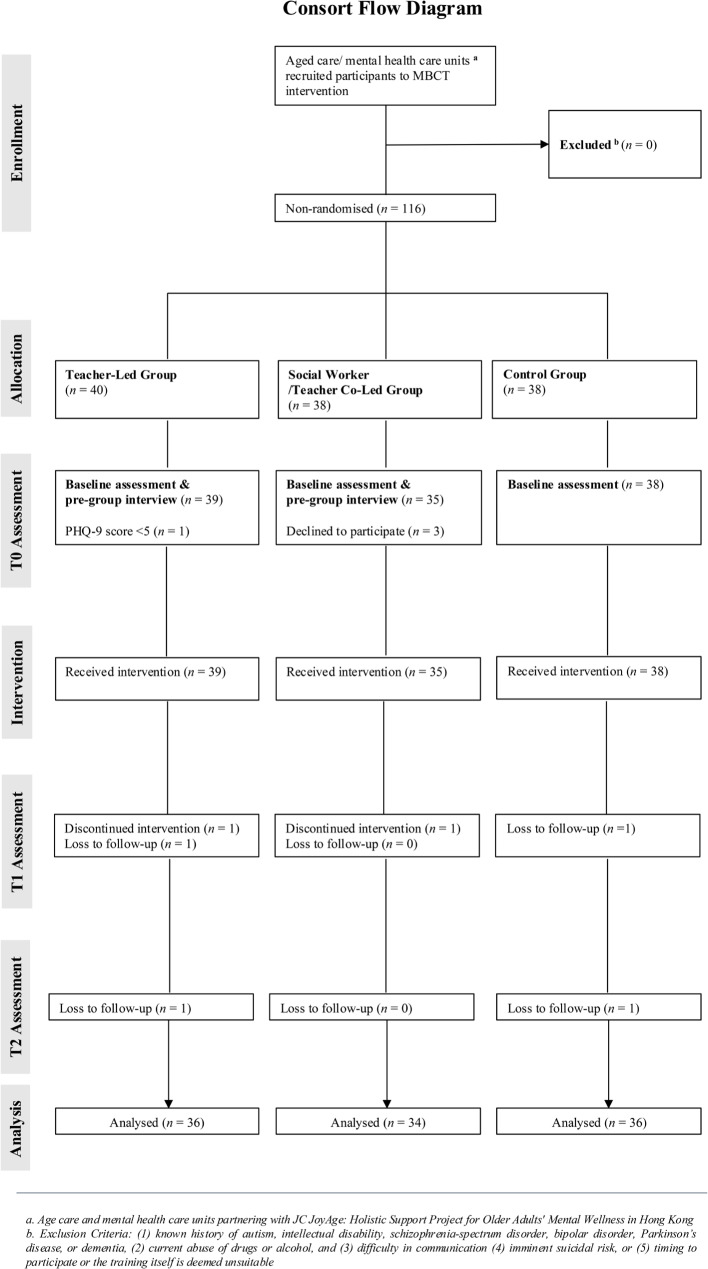
- The study included 112 older adults aged 60–93 years across three groups: 38 control, 39 teacher-led MBCT, and 35 social worker/teacher co-led MBCT.
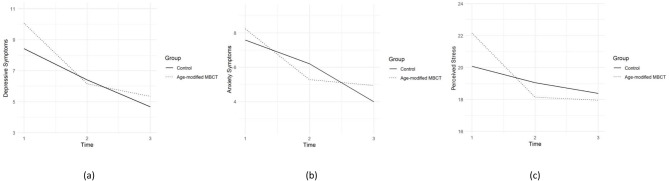
- Compared with control, the age-modified MBCT groups showed significantly greater reductions in depressive symptoms and stress, and greater increases in mindful non-reactivity post-intervention.
- For depression, the mixed models showed significant effects of time at T1: t(211) = -3.09, p = .002 and T2: t(212) = -5.69, p < .001, plus a time × group interaction at T1: t(211) = -2.35, p = .02.
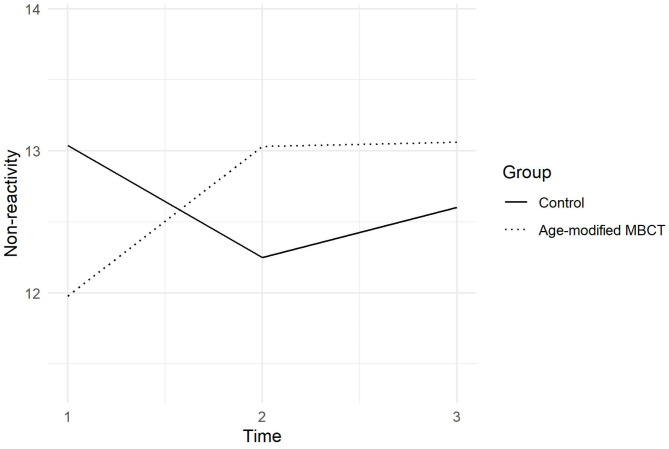
- For stress, there was a significant time × group interaction at T1: t(211) = -2.13, p = .03; for non-reactivity, the interaction was significant at T1: t(211) = 2.84, p = .005 and T2: t(211) = 2.33, p = .02.
- There was no significant effect on anxiety in the abstract; in the models, anxiety showed a significant main effect of time at T2: t(211) = -4.72, p < .001, but no significant group effect or interaction.
## Methods
- Design: Three-arm non-randomised controlled trial embedded in the JC JoyAge program; participants were allocated by social workers to teacher-led MBCT, social worker/teacher co-led MBCT, or care as usual.
- Sample/data: 112 community-dwelling older adults recruited from five community-based centres in Hong Kong; eligibility included age 60+ and PHQ-9 ≥ 5 at baseline.
- Analysis: Self-reported outcomes were collected at baseline (T0), post-intervention (T1, 8 weeks), and 4 weeks later (T2); the main analysis used linear mixed models controlling for demographic variables, with baseline group differences tested by ANOVAs.
## Limitations
- The paper states that no randomisation was applied for feasibility reasons, including concern about contamination and workflow constraints.
- The authors state that the MBCT modifications may have compromised effects on other mindfulness facets and possibly anxiety, and that the modifications were top-down rather than based on older adults’ needs.
- The paper also states that social workers had less experience with mindfulness and were not qualified to lead MBCT on their own, which limited testing their independent role.
- Evident from the text: outcomes were measured by self-report questionnaires only, which may limit measurement robustness (evident from the measures described).
Model-written summary. Check it against the paper before relying on it.
Integrity signals
Registry
Cites
Statistics
Figures
Verification
Claims the paper makes
8 Valid · 5 Not valid · 12 Not checked · 56 Own results and interpretations
At least one cited source doesn’t support this claim or points to a different paper, and none confirmed it — see the verdicts below.
In the paper
“Based on previous literature on the effectiveness of MBIs [54, 55], assuming a small-to-medium effect size (Cohen’s d = 0.40/f = 0.20), 80% power, and 5% significance level, a minimum of 84 participants is needed to elicit changes for three arms over three timepoints.”
§ Effectiveness of an age-modified mindfulness-based cognitive therapy (MBCT) in improving mental health in older people with depressive symptoms: a non-randomised controlled trial > Method > Power analysis
What the sources say
- Disputedcites [54] Shih VW, Chan W-C, Tai O-K, et al. Mindfulness-based cognitive therapy for late-life depression: a randomised controlled trial. East Asian Archives Psychiatry. 2021;31:27–35. 34987115 sourceExperimental — accuracy not yet measured
The Methods section (page not provided) describes a two-arm, two-timepoint design and calculates a required sample of 54 participants, not 84, at 80% power and 5% significance. It does not use the claimed Cohen’s d = 0.40/f = 0.20 assumption. (LLM, conf=0.89)
Checked by a reasoning model — may be wrong.
- Not checked — no full text of the sourcecites [55] Zhang J-x, Liu X-h, Xie X-h, et al. Mindfulness-based stress reduction for chronic insomnia in adults older than 75 years: a randomized, controlled, single-blind clinical trial. Explore. 2015;11:180–5. 25843539 source
plainn = 84- Asserted: passes — The authors put it forward as true.
- Checkable: passes — It can be checked against evidence.
- Load-bearing: unclear — It is unclear whether the paper’s conclusions depend on it.
- Based: passes — The paper gives a reason why it holds.
- Disputed
The cited sources that could be checked couldn’t confirm or dispute this claim.
In the paper
“As in many other countries, the proportion of registered social workers working in the mental health sector in Hong Kong is considerably greater than other mental health professionals (e.g., psychiatrists and clinical psychologists [46]).”
§ Effectiveness of an age-modified mindfulness-based cognitive therapy (MBCT) in improving mental health in older people with depressive symptoms: a non-randomised controlled trial > Background
What the sources say
- Could not verifycites [46] Tickell A, Ball S, Bernard P, et al. The effectiveness of mindfulness-based cognitive therapy (MBCT) in real-world healthcare services. Mindfulness. 2020;11:279–90. 32064009 PMC6995449 sourceExperimental — accuracy not yet measured
The Method sections on Participants and Procedure describe service users and five NHS services in England, not Hong Kong’s mental-health workforce. Searches for Hong Kong social workers and for workforce comparisons with psychiatrists and psychologists found no passage addressing the claimed proportions. Page numbers were unavailable in our copy. (LLM, conf=0.76)
plain- Asserted: passes — The authors put it forward as true.
- Checkable: passes — It can be checked against evidence.
- Load-bearing: passes — The paper’s conclusions depend on it.
- Based: passes — The paper gives a reason why it holds.
- Could not verify
The sources with a verdict support this claim; the rest weren’t checked yet, have no full text we could read, or their verdicts aren’t rated yet.
In the paper
“Furthermore, several studies have suggested that CBT may be less effective when applied to older adults as compared with younger populations, potentially because of age-related cognitive decline [20, 21], comorbidities such as generalised anxiety disorder [22–24], or general low perceived need or reluctance to seek for mental health treatment due to poor expectancies or stigma [25, 26].”
§ Effectiveness of an age-modified mindfulness-based cognitive therapy (MBCT) in improving mental health in older people with depressive symptoms: a non-randomised controlled trial > Background
What the sources say
- Supportedcites [20] Hall JDCKS, Berrios RPD, Bains MKDC, Scott SDC. Efficacy of cognitive behavioral therapy for generalized anxiety disorder in older adults: systematic review, Meta-analysis, and Meta-Regression. Am J Geriatric Psychiatry. 2016;24:1063–73. 27687212 source
The Discussion says the treatment-effect magnitudes add to evidence suggesting that CBT for GAD may be less effective in older adults than in younger adults. The Introduction reports the same qualified comparison. The paper makes this point specifically about CBT for GAD, rather than CBT for every condition. (LLM, conf=0.90)
- Not checked — no full text of the sourcecites [21] Executive skills in older adults with GAD: Relations with clinical variables and CBT outcome. M J. J Anxiety Disord. 2013;27:131–9. 23376600 source
hedgedstates a possible cause- Asserted: passes — The authors put it forward as true.
- Checkable: passes — It can be checked against evidence.
- Load-bearing: passes — The paper’s conclusions depend on it.
- Based: passes — The paper gives a reason why it holds.
- Supported
The cited sources support only part of this claim — read each source’s verdict below.
In the paper
“Depressive symptoms were assessed using the validated Chinese version of the Patient Health Questionnaire (PHQ-9) [48, 49].”
§ Effectiveness of an age-modified mindfulness-based cognitive therapy (MBCT) in improving mental health in older people with depressive symptoms: a non-randomised controlled trial > Method > Measures
What the sources say
- Partly supportedcites [48] Kroenke K, Spitzer RL, Williams JB. The PHQ-9: validity of a brief depression severity measure. J Gen Intern Med. 2001;16:606–13. 11556941 PMC1495268 sourceExperimental — accuracy not yet measured
The Methods identify the PHQ-9 as a nine-item depression measure, and the Conclusion calls it a reliable and valid measure of depression severity. The paper does not establish that a Chinese version was used or validated; searches for Chinese translation and language-specific validation found no supporting passage. (LLM, conf=0.88)
- Not checked — no full text of the sourcecites [49] Wang W, Bian Q, Zhao Y, et al. Reliability and validity of the Chinese version of the Patient Health Questionnaire (PHQ-9) in the general population. Gen Hosp Psychiatry. 2014;36:539–44. 25023953 source
plain- Asserted: passes — The authors put it forward as true.
- Checkable: passes — It can be checked against evidence.
- Load-bearing: passes — The paper’s conclusions depend on it.
- Based: passes — The paper gives a reason why it holds.
- Partly supported
Every source the paper cites for this claim was checked and supports it.
In the paper
“However, the current age-modified MBCT did not show significant effects on anxiety symptoms, which has been observed in another study on mindfulness-based intervention for older adults [59].”
§ Effectiveness of an age-modified mindfulness-based cognitive therapy (MBCT) in improving mental health in older people with depressive symptoms: a non-randomised controlled trial > Discussion
What the sources say
- Supportedcites [59] Aisenberg-Shafran D, Shturm L. The effects of mindfulness meditation versus CBT for anxiety on emotional distress and attitudes toward seeking mental health treatment: a semi-randomized trial. Sci Rep. 2022;12:19711. 36385638 PMC9668224 source
The Discussion states that the mindfulness intervention for elderly participants did not diminish anxiety. This directly supports the cited claim about no significant effect on anxiety symptoms in older adults. (LLM, conf=0.94)
plain- Asserted: passes — The authors put it forward as true.
- Checkable: passes — It can be checked against evidence.
- Load-bearing: unclear — It is unclear whether the paper’s conclusions depend on it.
- Based: passes — The paper gives a reason why it holds.
- Supported
24 more claims
Create a free account to see all 81 claims and to verify the 3 references still open.
- Probably not a substantial claim. 32
- It may state two separate claims as one. 33
Statistics that don’t add up
Each reported p-value recomputed from its test statistic and degrees of freedom, each partial η² from its F, and each ratio, mean difference or B printed with a p checked against its own confidence interval.
Rated minor: it would not touch a result — a value no result rests on, a p-value that stays on the same side of the significance level, or a conflict that is clerical, resolved elsewhere in the paper, or outside its own findings.
In the paper
“F(2,109) = 1.970, p = .19”
§ Effectiveness of an age-modified mindfulness-based cognitive therapy (MBCT) in improving mental health in older people with depressive symptoms: a non-randomised controlled trial > Results
Reported p = .19 · recomputed p = .144
Rated minor: it would not touch a result — a value no result rests on, a p-value that stays on the same side of the significance level, or a conflict that is clerical, resolved elsewhere in the paper, or outside its own findings.
In the paper
“t(136) = 2.00, p = .04”
§ Effectiveness of an age-modified mindfulness-based cognitive therapy (MBCT) in improving mental health in older people with depressive symptoms: a non-randomised controlled trial > Results > Linear mixed models
Reported p = .04 · recomputed p = .047
Statistics recomputed
Every reported test result, recomputed from its test statistic and degrees of freedom. A result shows as not adding up only once an independent check has confirmed it.
- Doesn’t add upF(2, 109) = 1.97reported p = .19 · recomputed p = .144
“F(2,109) = 1.970, p = .19”
- Doesn’t add upt(136) = 2reported p = .04 · recomputed p = .047
“t(136) = 2.00, p = .04”
- ConsistentF(2, 109) = 1.69reported p = .19 · recomputed p = .189
“F(2, 109) = 1.69, p = .19”
- ConsistentF(2, 108) = 0.35reported p = .71 · recomputed p = .705
“F(2, 108) = 0.35, p = .71”
- ConsistentF(2, 107) = 1.92reported p = .15 · recomputed p = .152
“F(2,107) = 1.92, p = .15”
26 more recomputed tests
Create a free account to see every test the Stats check recomputed.
Self-check
Percentages, sums and reported differences re-computed from the paper’s own numbers.
Self-check results appear here once an independent check has confirmed them.
Citations
Cites
Fitting Linear Mixed-Effects Models Using lme4
Bates, D., Mächler, M., Bolker, B., & Walker, S. (2015) · Journal of Statistical Software · doi:10.18637/jss.v067.i01 · Cited by 86,835
The PHQ-9: Validity of a brief depression severity measure
Kroenke, K., Spitzer, R. L., & Williams, J. B. W. (2001) · Journal of General Internal Medicine · doi:10.1046/j.1525-1497.2001.016009606.x · Cited by 44,910
A Brief Measure for Assessing Generalized Anxiety Disorder: The GAD-7
Spitzer, R. L., Kroenke, K., Williams, J. B. W., & Löwe, B. (2006) · Archives of Internal Medicine · doi:10.1001/archinte.166.10.1092 · Cited by 31,765
James, S. L., Abate, D., Abate, K. H., Abay, S. M., Abbafati, C., Abbasi, N., Abbastabar, H., Abd-Allah, F., Abdela, J., Abdelalim, A., et al. (2018) · The Lancet · doi:10.1016/s0140-6736(18)32279-7 · Cited by 13,867
(2001) · Cited by 3,666
Depression in Late Life: Review and Commentary
Blazer, D. G. (2003) · The Journals of Gerontology Series A: Biological Sciences and Medical Sciences · doi:10.1093/gerona/58.3.m249 · Cited by 2,344
Wang, W., Bian, Q., Zhao, Y., Li, X., Wang, W., Du, J., Zhang, G., Zhou, Q., & Zhao, M. (2014) · General Hospital Psychiatry · doi:10.1016/j.genhosppsych.2014.05.021 · Cited by 1,480 · cited 1×
“Depressive symptoms were assessed using the validated Chinese version of the Patient Health Questionnaire (PHQ-9) [48, 49].”
Mindfulness-Based Cognitive Therapy for Depression: A New Approach to Preventing Relapse
HODO, D. W. (2002) · American Journal of Psychiatry · doi:10.1176/appi.ajp.159.7.1257 · Cited by 1,401
Robustness of linear mixed-effects models to violations of distributional assumptions
Schielzeth, H., Dingemanse, N. J., Nakagawa, S., Westneat, D. F., Allegue, H., Teplitsky, C., Réale, D., Dochtermann, N. A., Garamszegi, L. Z., & Araya‐Ajoy, Y. G. (2020) · Methods in Ecology and Evolution · doi:10.1111/2041-210x.13434 · Cited by 1,393 · cited 1×
“Although LMMs are relatively robust to assumption violation [56], we checked assumptions of linearity, normality of residuals, homoscedasticity, and no autocorrelation by plots and ensured they were met before applying the analyses.”
Meta-analysis of the Impact of 9 Medication Classes on Falls in Elderly Persons
Woolcott, J. C. (2009) · Archives of Internal Medicine · doi:10.1001/archinternmed.2009.357 · Cited by 1,326
Management of Depression in Older Adults: A Review
Kok, R. M., & Reynolds, C. F. (2017) · JAMA · doi:10.1001/jama.2017.5706 · Cited by 890
Challenges and opportunities in global mental health: a research-to-practice perspective
Wainberg, M. L., Scorza, P., Shultz, J. M., Helpman, L., Mootz, J. J., Johnson, K. A., Neria, Y., Bradford, J.-M. E., Oquendo, M. A., & Arbuckle, M. R. (2017) · Current Psychiatry Reports · doi:10.1007/s11920-017-0780-z · Cited by 875 · cited 1×
“With rapid population ageing across societies and the ongoing challenge of insufficient manpower and resources [58], our findings suggest that enhancing training for social workers in delivering adapted versions of MBCT may be a possible means of partial task-shifting and may help increase access…”
Chiesa, A., & Serretti, A. (2011) · Psychiatry Research · doi:10.1016/j.psychres.2010.08.011 · Cited by 650 · cited 1×
“These modifications include simplifying walking meditation, allowing sitting on a chair for exercises such as body scanning [34], removing the whole day retreat [28] and reducing the length of each session [34, 36].”
Mental health treatment seeking among older adults with depression: The impact of stigma and race
Conner, K. O., Copeland, V. C., Grote, N. K., Koeske, G., Rosen, D., Reynolds, C. F., & Brown, C. (2010) · The American Journal of Geriatric Psychiatry · doi:10.1097/jgp.0b013e3181cc0366 · Cited by 568 · cited 1×
“…older adults as compared with younger populations, potentially because of age-related cognitive decline [20, 21], comorbidities such as generalised anxiety disorder [22–24], or general low perceived need or reluctance to seek for mental health treatment due to poor expectancies or stigma [25, 26].”
Validation of the Generalized Anxiety Disorder-7 (GAD-7) among Chinese people with epilepsy
Tong, X., An, D., McGonigal, A., Park, S.-P., & Zhou, D. (2016) · Epilepsy Research · doi:10.1016/j.eplepsyres.2015.11.019 · Cited by 525 · cited 1×
“Anxiety symptoms were assessed by adopting the validated Chinese version of the Generalized Anxiety Disorder 7-item scale (GAD-7) [50, 51].”
The wear-and-tear of daily stressors on mental health
Charles, S. T., Piazza, J. R., Mogle, J., Sliwinski, M. J., & Almeida, D. M. (2013) · Psychological Science · doi:10.1177/0956797612462222 · Cited by 459
Prevalence of depression in older adults: A systematic review and meta-analysis
Hu, T., Zhao, X., Wu, M., Li, Z., Luo, L., Yang, C., & Yang, F. (2022) · Psychiatry Research · doi:10.1016/j.psychres.2022.114511 · Cited by 409 · cited 1×
“Depression is one of the most common geriatric psychiatric disorders in later life, with a global prevalence rate of 28.4%, [6] and is often comorbid with anxiety symptoms [7].”
InfluentialMultisystemic Treatment: A Meta-Analysis of Outcome Studies.
Curtis, N. M., Ronan, K. R., & Borduin, C. M. (2004) · Journal of Family Psychology · doi:10.1037/0893-3200.18.3.411 · Cited by 407 · cited 1×
“Some studies have suggested that adapting treatments to fit service needs in the community may reduce its effectiveness [46, 64].”
Cognitive-behavioral treatment of late-life generalized anxiety disorder
Stanley, M. A., Beck, J. G., Novy, D. M., Averill, P. M., Swann, A. C., Diefenbach, G. J., & Hopko, D. R. (2003) · Journal of Consulting and Clinical Psychology · doi:10.1037/0022-006x.71.2.309 · Cited by 247 · cited 1×
“…older adults as compared with younger populations, potentially because of age-related cognitive decline [20, 21], comorbidities such as generalised anxiety disorder [22–24], or general low perceived need or reluctance to seek for mental health treatment due to poor expectancies or stigma [25, 26].”
Tang, T., Jiang, J., & Tang, X. (2021) · Journal of Affective Disorders · doi:10.1016/j.jad.2021.06.050 · Cited by 244
Levinson, D. B., Smallwood, J., & Davidson, R. J. (2012) · Psychological Science · doi:10.1177/0956797611431465 · Cited by 232
Depression and Risk of Heart Failure Among the Elderly: A Prospective Community-Based Study
Williams, S. A., Kasl, S. V., Heiat, A., Abramson, J. L., Krumholz, H. M., & Vaccarino, V. (2002) · Psychosomatic Medicine · doi:10.1097/00006842-200201000-00002 · Cited by 216
Hou, J., Wong, S. Y.-S., Lo, H. H.-M., Mak, W. W.-S., & Ma, H. S.-W. (2014) · Assessment · doi:10.1177/1073191113485121 · Cited by 215 · cited 1×
“Mindfulness was assessed using the Chinese validated Five Facet Mindfulness Questionnaire Short Form (FFMQ-SF) [53].”
Self-citationGeiger, P. J., Boggero, I. A., Brake, C. A., Caldera, C. A., Combs, H. L., Peters, J. R., & Baer, R. A. (2016) · Mindfulness · doi:10.1007/s12671-015-0444-1 · Cited by 205 · cited 4×
“Few studies have measured mind-fulness as a change mechanism, and among them, results are inconclusive [32].”
InfluentialGould, R. L., Coulson, M. C., & Howard, R. J. (2012) · Journal of the American Geriatrics Society · doi:10.1111/j.1532-5415.2012.04166.x · Cited by 201
Stress on health-related quality of life in older adults: the protective nature of mindfulness
de Frias, C. M., & Whyne, E. (2015) · Aging & Mental Health · doi:10.1080/13607863.2014.924090 · Cited by 165
Reynolds, C. F., Cuijpers, P., Patel, V., Cohen, A., Dias, A., Chowdhary, N., Okereke, O. I., Amanda Dew, M., Anderson, S. J., Mazumdar, S., et al. (2012) · Annual Review of Public Health · doi:10.1146/annurev-publhealth-031811-124544 · Cited by 163
Disability and cognitive impairment in the elderly
Barberger-Gateau, P., & Fabrigoule, C. (1997) · Disability and Rehabilitation · doi:10.3109/09638289709166525 · Cited by 158
Hall, J., Kellett, S., Berrios, R., Bains, M. K., & Scott, S. (2016) · The American Journal of Geriatric Psychiatry · doi:10.1016/j.jagp.2016.06.006 · Cited by 157
The Economic, Public Health, and Caregiver Burden of Late-life Depression
Zivin, K., Wharton, T., & Rostant, O. (2013) · Psychiatric Clinics of North America · doi:10.1016/j.psc.2013.08.008 · Cited by 122
Ng, S.-M. (2013) · BMC Psychology · doi:10.1186/2050-7283-1-9 · Cited by 121
Identifying mechanisms of change in psychotherapy: Mediators of treatment outcome
Johansson, P., & Høglend, P. (2007) · Clinical Psychology & Psychotherapy · doi:10.1002/cpp.514 · Cited by 120 · cited 4×
“The findings also corroborate with previous research that showed a lack of effect or modest effect of MBCT in improving psychological outcomes when an active control group (e.g., psychoeducation, social support, or nutrition education) was employed [34, 35].”
InfluentialZhang, J.-X., Liu, X.-H., Xie, X.-H., Zhao, D., Shan, M.-S., Zhang, X.-L., Kong, X.-M., & Cui, H. (2015) · EXPLORE · doi:10.1016/j.explore.2015.02.005 · Cited by 119
Karlin, B. E., Duffy, M., & Gleaves, D. H. (2008) · Psychological Services · doi:10.1037/1541-1559.5.3.275 · Cited by 118
Mindfulness-Based Cognitive Therapy With Older Adults: An Exploratory Study
Foulk, M. A., Ingersoll-Dayton, B., Kavanagh, J., Robinson, E., & Kales, H. C. (2014) · Journal of Gerontological Social Work · doi:10.1080/01634372.2013.869787 · Cited by 115 · cited 2×
“To ensure the current MBCT could be most optimally understood by the older adults sample, age-related modifications were made to the standardised MBCT programme as suggested by the literature to increase feasibility and acceptability [31].”
Naef, R., Ward, R., Mahrer-Imhof, R., & Grande, G. (2013) · International Journal of Nursing Studies · doi:10.1016/j.ijnurstu.2012.11.026 · Cited by 110
O’Connor, M., Piet, J., & Hougaard, E. (2013) · Mindfulness · doi:10.1007/s12671-013-0194-x · Cited by 106 · cited 2×
“…mindful eating, mindful walking, as well as bringing awareness and attention to different parts of the body, mindfulness practices aim to shift people’s awareness to the present moment in a nonjudgmental manner, and in turn develop the ability to disengage from maladaptive thinking patterns [33].”
Tham, A., Jonsson, U., Andersson, G., Söderlund, A., Allard, P., & Bertilsson, G. (2016) · Journal of Affective Disorders · doi:10.1016/j.jad.2016.06.013 · Cited by 104
The Effectiveness of Mindfulness-Based Cognitive Therapy (MBCT) in Real-World Healthcare Services
Tickell, A., Ball, S., Bernard, P., Kuyken, W., Marx, R., Pack, S., Strauss, C., Sweeney, T., & Crane, C. (2020) · Mindfulness · doi:10.1007/s12671-018-1087-9 · Cited by 99 · cited 2×
“Some studies have suggested that adapting treatments to fit service needs in the community may reduce its effectiveness [46, 64].”
Do improvements in emotional distress correlate with becoming more mindful? A study of older adults.
Splevins, K., Smith, A., & Simpson, J. (2009) · Aging & Mental Health · doi:10.1080/13607860802459807 · Cited by 98 · cited 1×
“…after the intervention [32], others found that specific facets, such as acting with awareness, non-judging, and non-reactivity, if not overall mindfulness, improved after the intervention [37, 42] and are associated with improved emotional well-being and reduced depressive symptoms [42].”
The Importance of Cultivating Mindfulness for Cognitive and Emotional Well-Being in Late Life
Fiocco, A. J., & Mallya, S. (2015) · Journal of Evidence-Based Complementary & Alternative Medicine · doi:10.1177/2156587214553940 · Cited by 76
Zou, Y., Li, P., Hofmann, S. G., & Liu, X. (2020) · Frontiers in Psychology · doi:10.3389/fpsyg.2020.01053 · Cited by 63 · cited 1×
“Previous studies have found that non-reactivity plays a more specific role in reducing stress and improving cognitive flexibility after mindfulness-based interventions [28, 60, 61].”
Executive skills in older adults with GAD: Relations with clinical variables and CBT outcome
Mohlman, J. (2013) · Journal of Anxiety Disorders · doi:10.1016/j.janxdis.2012.12.001 · Cited by 49
Kangaslampi, S., & Peltonen, K. (2022) · Current Psychology · doi:10.1007/s12144-019-00478-5 · Cited by 45 · cited 4×
“Our findings are generally in line with the literature suggesting that mindfulness-based interventions can improve depressive symptoms and perceived stress in older adults [35].”
InfluentialPsychiatric comorbidity and depression in older adults
Gum, A. M., & Cheavens, J. S. (2008) · Current Psychiatry Reports · doi:10.1007/s11920-008-0006-5 · Cited by 40
Haenen, S., Nyklíček, I., van Son, J., Pop, V., & Pouwer, F. (2016) · Journal of Psychosomatic Research · doi:10.1016/j.jpsychores.2016.04.006 · Cited by 38 · cited 1×
“Inter-estingly, a randomised wait-list control trial among out-patients with diabetes has shown that the non-reactivity facet of mindfulness mediated the effects of MBCT on depressed mood, whereas the observing facet mediated the effects on anxiety symptoms [62].”
Han, A. (2022) · Clinical Gerontologist · doi:10.1080/07317115.2021.1995561 · Cited by 38
Predictors of CBT outcome in older adults with GAD
Hundt, N. E., Amspoker, A. B., Kraus-Schuman, C., Cully, J. A., Rhoades, H., Kunik, M. E., & Stanley, M. A. (2014) · Journal of Anxiety Disorders · doi:10.1016/j.janxdis.2014.09.012 · Cited by 33
Nagaoka, M., Hashimoto, Z., Takeuchi, H., & Sado, M. (2021) · PLoS ONE · doi:10.1371/journal.pone.0255128 · Cited by 30
Mindfulness for Healthcare Providers: The Role of Non-Reactivity in Reducing Stress
Benzo, R. P., Anderson, P. M., Bronars, C., & Clark, M. (2018) · EXPLORE · doi:10.1016/j.explore.2018.03.008 · Cited by 29 · cited 1×
“Previous studies have found that non-reactivity plays a more specific role in reducing stress and improving cognitive flexibility after mindfulness-based interventions [28, 60, 61].”
Lee, E. K., Wong, B., Chan, P. H. S., Zhang, D. D., Sun, W., Chan, D. C., Gao, T., Ho, F., Kwok, T. C. Y., & Wong, S. Y. (2022) · International Journal of Geriatric Psychiatry · doi:10.1002/gps.5616 · Cited by 29
Self-citationEffects of Mindfulness-based Interventions on Dementia Patients: A Meta-analysis
Wang, F. L., Tang, Q. Y., Zhang, L. L., Yang, J., Li, Y., Peng, H., & Wang, S. H. (2020) · Western Journal of Nursing Research · doi:10.1177/0193945920916750 · Cited by 26 · cited 1×
“These studies were mainly conducted with clinical samples, such as those with cognitive or intellectual impairment and living in nursing homes rather than non-clinical, community-dwelling older adults [37–41].”
Should antidepressant medication be used in the elderly?
Taylor, W. D. (2015) · Expert Review of Neurotherapeutics · doi:10.1586/14737175.2015.1070671 · Cited by 25
Ye, J., Pan, Y., Wu, C., Hu, Z., Wu, S., Wang, W., Guo, J., & Xiao, A. (2024) · ALPHA PSYCHIATRY · doi:10.5152/alphapsychiatry.2024.231379 · Cited by 25 · cited 2×
“For example, in Guang-dong province of China, mental health nurses who obtained national occupational qualifications as psycho-therapists and completed MBCT training can provide MBCT to their patients, expanding access to MBCT in mental health facilities [43].”
Mindfulness-Based Cognitive Therapy for Late-Life Depression: a Randomised Controlled Trial
Shih, V. W., Chan, W.-C., Tai, O.-K., Wong, H.-L., Cheng, C. P., & Wong, C. S. (2021) · East Asian Archives of Psychiatry · doi:10.12809/eaap2075 · Cited by 23 · cited 1×
“Based on previous literature on the effectiveness of MBIs [54, 55], assuming a small-to-medium effect size (Cohen’s d = 0.40/ f = 0.20), 80% power, and 5% significance level, a minimum of 84 participants is needed to elicit changes for three arms over three timepoints.”
InfluentialBadrasawi, M., & Zidan, S. J. (2021) · Eastern Mediterranean Health Journal · doi:10.26719/2021.27.3.260 · Cited by 17
Leow, Y., Rashid, N. L. A., Klainin‐Yobas, P., Zhang, Z., & Wu, X. V. (2023) · Journal of Advanced Nursing · doi:10.1111/jan.15720 · Cited by 17
Aisenberg-Shafran, D., & Shturm, L. (2022) · Scientific Reports · doi:10.1038/s41598-022-24256-9 · Cited by 16 · cited 2×
“In the current study, the FFMQ score across groups was around 63, which is comparable to the scores in a previous study that also found a null effect among older adults (a score of around 65) [59].”
Aisenberg-Shafran, D., & Harmatz, M. (2023) · Frontiers in Psychology · doi:10.3389/fpsyg.2022.994336 · Cited by 9 · cited 4×
“Aisenberg-Shafran and Har-mataz also suggested training nursing home workers to deliver mindfulness-based interventions to older residents [37].”
Influential
Research works printed but not linked: 3
- Excellence NIfHaC. Depression in adults: Treatment and management. https://www.nice.org.uk/guidance/ng222/chapter/Recommendations (2022). 35977056
- Segal ZV, Williams JMG, Teasdale JD. Mindfulness-based cognitive therapy for depression. Guilford Press; 2013.
- J K-Z. Full catastrophe living: using the wisdom of your body and mind to face stress, pain, and illness. Revised and updated edition ed. New York: Bantam Books trade paperback, 2013.
Cited by
Recent Advances in Multimodal Non-Pharmacological Interventions for Late-Life Depression
Xu, T., Mao, Y., Wang, Y., Gong, Y., & Yu, E. (2025) · Neuropsychiatric Disease and Treatment · doi:10.2147/ndt.s558969 · Cited by 4
“25 Further studies have shown that older populations receiving web-based mindfulness intervention do not only exhibit cognitive and emotional improvements but also demonstrate adaptive modulation of neural oscillatory rhythms in specific brain regions.”
Self-citationAdvances in the assessment and study of suicide in late-life depression
Xu, T., Mao, Y., Wang, Y., Zhang, W., Cao, H., & Yu, E. (2025) · Frontiers in Psychiatry · doi:10.3389/fpsyt.2025.1610730 · Cited by 5
Self-citationShang, S., Ho, W.-J., Chen, K., Hsieh, M., & Chang, Y.-L. (2026) · Heart & Lung · doi:10.1016/j.hrtlng.2026.102729 · Cited by 1
Wang, Y.-L., Wang, Y., Leung, D. K. Y., Wong, S. M. Y., Ng, Z. L. Y., Chan, R. C. L., Chan, O. L. H., Chan, W. C., Wong, G. H. Y., & Lum, T. Y. S. (2025) · Contemporary Clinical Trials · doi:10.1016/j.cct.2025.107991 · Cited by 1
Self-citationGarg, R., Awasthi, S., Gupta, N., et al. (2026) · Research Square · doi:10.21203/rs.3.rs-8046204/v1
Metadata
- Authors
- Wang, Y.-H., Wang, Y.-L., Leung, D. K. Y., Ng, Z. L. Y., Chan, O. L. H., Wong, S. M. Y., Chan, R. C. L., Liu, T., Wong, G. H. Y., & Lum, T. Y. S.
- Affiliations
- National Taiwan University (TW)
- University of Hong Kong (HK)
- Hong Kong Polytechnic University (HK)
- University of Reading (GB)
- Corresponding author
- Leung, Dara Kiu Yi
- ORCID
- Venue
- BMC Complementary Medicine and Therapies
- Published
- 2025-02-26
- Volume
- 25
- Issue
- 1
- Pages
- 81-81
- ISSN
- 2662-7671 (ISSN-L)
- PMC
- PMC11863447
- OpenAlex
- W4407979468
- Cited by
- 5
- References
- 59
- Citations by year
- 2026: 2 · 2025: 3
- FWCI
- 5.88
- Type
- journal article
- Language
- en
- Open access
- gold
- doi.org
- Licence
- cc-by-nc-nd
- creativecommons.org/licenses/by-nc-nd/4.0 (tdm)
- creativecommons.org/licenses/by-nc-nd/4.0 (vor)
- Locations
- BMC Complementary Medicine and Therapies (publishedVersion, cc-by-nc-nd)
- PubMed Central (publishedVersion, cc-by-nc-nd)
- PubMed (publishedVersion)
- PolyU Institutional Research Archive (Hong Kong Polytechnic University) (submittedVersion, cc-by-nc-nd)
- DOAJ (DOAJ: Directory of Open Access Journals) (submittedVersion, cc-by-sa)
- The HKU Scholars Hub (University of Hong Kong) (submittedVersion)
- Funders
- The Hong Kong Jockey Club Charities Trust.
- Topics
- Social Sciences › Psychology › Clinical Psychology › Mindfulness and Compassion Interventions
- Social Sciences › Psychology › Clinical Psychology › Psychotherapy Techniques and Applications
- Social Sciences › Psychology › Experimental and Cognitive Psychology › Anxiety, Depression, Psychometrics, Treatment, Cognitive Processes
- Keywords
- mindfulness-based cognitive therapy, older adults, depressive symptoms, social workers, perceived stress, anxiety, mental health, community mental health services, feasibility and effectiveness
- MeSH terms
- Aged, Aged, 80 and over, Depression, Female, Hong Kong, Humans, Male, Mental Health, Middle Aged, Cognitive Behavioral Therapy, Mindfulness
About these checks
Registry, retraction, Cites and statistics results are computed, not judged, with one exception: a printed reference that no index lists is read once by a model before it counts as a citation error. Claims are extracted by a model and kept only when their quote appears verbatim in the text; each cited source is then checked, with a model’s help, for whether it says what the claim relies on. Those verdicts can be wrong — read the claim’s quote and the cited source before relying on one.
The claim verdicts this report counts are experimental: their accuracy is not yet measured.
A language model drew the claims from the paper on 2026-10-11, under version 3 of the claim definition (model deepseek-v4.1-flash, prompt extract-v3).
A second model labelled each claim on 2026-10-11 (model jev-1.13-20260917, definition revision gold-guideline-v0.2).
Cited sources are checked with a language model’s help (gpt-6-sol).
Statistics and arithmetic are recomputed, not judged.
Confidence bands are shown only for fields calibrated on our annotated test set. None is calibrated yet, so no band is shown.
What counts as a claim ›How we measure confidence ›How we check this ›
Are you an author, or do you see a problem with this page? Request a review
Data sources
Bibliographic data: Semantic Scholar, OpenAlex, Crossref.
Contains information from the Semantic Scholar Academic Graph Datasets, made available under the ODC Attribution License (ODC-BY 1.0).
Semantic Scholar’s data is described in: Kinney, R., et al. (2023). The Semantic Scholar Open Data Platform. arXiv:2301.10140.
