

A systematic review of the use of the Consolidated Framework for Implementation Research
Open accessThe DOI matches its Crossref record; 44 of the 45 references it cites were found in a registry or an index.
Abstract
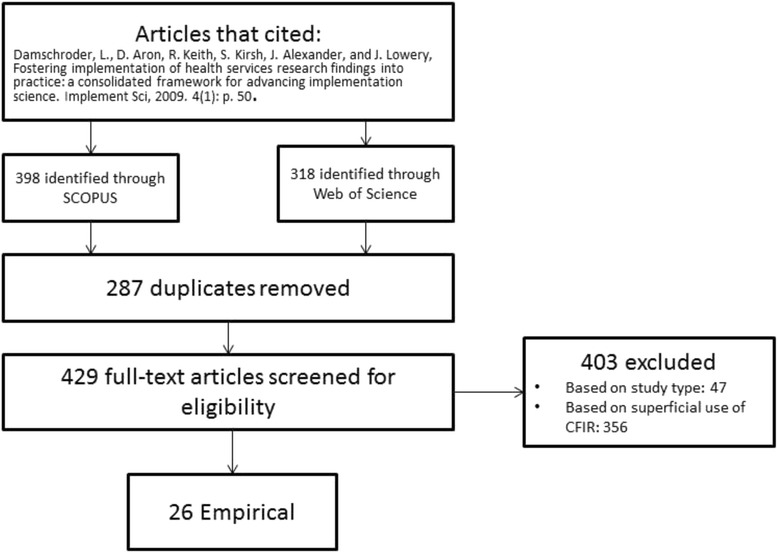
BACKGROUND: In 2009, Damschroder et al. developed the Consolidated Framework for Implementation Research (CFIR), which provides a comprehensive listing of constructs thought to influence implementation. This systematic review assesses the extent to which the CFIR's use in implementation research fulfills goals set forth by Damschroder et al. in terms of breadth of use, depth of application, and contribution to implementation research. METHODS: We searched Scopus and Web of Science for publications that cited the original CFIR publication by Damschroder et al. (Implement Sci 4:50, 2009) and downloaded each unique result for review. After applying exclusion criteria, the final articles were empirical studies published in peer-review journals that used the CFIR in a meaningful way (i.e., used the CFIR to guide data collection, measurement, coding, analysis, and/or reporting). A framework analysis approach was used to guide abstraction and synthesis of the included articles. RESULTS: Twenty-six of 429 unique articles (6 %) met inclusion criteria. We found great breadth in CFIR application; the CFIR was applied across a wide variety of study objectives, settings, and units of analysis. There was also variation in the method of included studies (mixed methods (n = 13); qualitative (n = 10); quantitative (n = 3)). Depth of CFIR application revealed some areas for improvement. Few studies (n = 3) reported justification for selection of CFIR constructs used; the majority of studies (n = 14) used the CFIR to guide data analysis only; and few studies investigated any outcomes (n = 11). Finally, reflections on the contribution of the CFIR to implementation research were scarce. CONCLUSIONS: Our results indicate that the CFIR has been used across a wide range of studies, though more in-depth use of the CFIR may help advance implementation science. To harness its potential, researchers should consider how to most meaningfully use the CFIR. Specific recommendations for applying the CFIR include explicitly justifying selection of CFIR constructs; integrating the CFIR throughout the research process (in study design, data collection, and analysis); and appropriately using the CFIR given the phase of implementation of the research (e.g., if the research is post-implementation, using the CFIR to link determinants of implementation to outcomes).
Overview
The claims and statistics of this paper haven’t been checked yet.
Free: it reads the open-access text and checks the first 5 claims that cite a source we can check. Create a free account to check every claim.
Integrity signals
Registry
Cites
Statistics
Figures
Verification
Claims the paper makes
The claims and statistics of this paper haven’t been checked yet.
Free: it reads the open-access text and checks the first 5 claims that cite a source we can check. Create a free account to check every claim.
Claims other papers make about this one
Each is checked against this paper’s own text: does it say what the citing paper says it does?
The cited source says what the claim attributes to it.
In the citing paper
“Kirk et al.’s 2015 review of 26 articles with meaningful use of the CFIR found that most users employed mixed (n = 13) or qualitative (n = 10) methods and used the CFIR in the post-implementation phase (n = 15) [13].”
From The updated consolidated framework for implementation research based on user feedback (2022) · cites this paper as [13]
The cited source says what the claim attributes to it.
In the citing paper
“Determinant frameworks can thus be used to inform choice of implementation strategies that may best address contextual determinants [14], generate hypotheses to prospectively guide predictions of implementation outcomes, or retrospectively explain implementation outcomes by assessing differences in determinants across implementation settings [11, 13, 15].”
From The updated consolidated framework for implementation research based on user feedback (2022) · cites this paper as [13]
The cited source says what the claim attributes to it.
In the citing paper
“The majority of CFIR users employ qualitative methods to assess constructs [13].”
From The updated consolidated framework for implementation research based on user feedback (2022) · cites this paper as [13]
The cited source says what the claim attributes to it.
In the citing paper
“In their systematic review of CFIR application, Kirk et al highlight gaps in depth of use of the framework, variation in selection of CFIR constructs, and a lack of justification of constructs used, limiting comparison of findings across time and contexts.14”
The cited source says what the claim attributes to it.
In the citing paper
“One indicator of this is a finding by Kirk et al: Among 26 research studies that meaningfully used CFIR, only two of the 26 included patients among their unit of analysis.14”
4 more claims about this paper
Create a free account to see every claim other papers make about this one.
Self-check
Percentages, sums and reported differences re-computed from the paper’s own numbers.
The self-check needs the paper’s full text.
Citations
Cites
Damschroder, L. J., Aron, D. C., Keith, R. E., Kirsh, S. R., Alexander, J. A., & Lowery, J. C. (2009) · Implementation Science · doi:10.1186/1748-5908-4-50 · Cited by 14,496 · cited 10×
“At the macro level, the CFIR provides a standardized structure for building on findings across studies [3].”
BackgroundMethodInfluentialSelf-citationGale, N. K., Heath, G., Cameron, E., Rashid, S., & Redwood, S. (2013) · BMC Medical Research Methodology · doi:10.1186/1471-2288-13-117 · Cited by 10,865 · cited 1×
“Objective 3: determine the contribution of the CFIR to implementation research General co posed by D • Cohere • Whethe • Whethe Microsoft Excel where content was arrayed in a matrix format consisting of rows (articles), columns (codes), and cells (summarized data) [8].”
BackgroundQualitative research practice: a guide for social science students and researchers
(2003) · Choice Reviews Online · doi:10.5860/choice.41-1319 · Cited by 10,543
Proctor, E., Silmere, H., Raghavan, R., Hovmand, P., Aarons, G., Bunger, A., Griffey, R., & Hensley, M. (2011) · Administration and Policy in Mental Health and Mental Health Services Research · doi:10.1007/s10488-010-0319-7 · Cited by 8,721 · cited 2×
“[25]), (2) provide clearer linkage of CFIR constructs with outcomes, and (3) provide clearer specification of which CFIR constructs were used to investigate outcomes.”
BackgroundComparison of PubMed, Scopus, Web of Science, and Google Scholar: strengths and weaknesses
Falagas, M. E., Pitsouni, E. I., Malietzis, G. A., & Pappas, G. (2008) · The FASEB Journal · doi:10.1096/fj.07-9492lsf · Cited by 5,039 · cited 1×
“, Google Scholar) [6].”
The Challenge of Innovation Implementation
Klein, K. J., & Sorra, J. S. (1996) · The Academy of Management Review · doi:10.2307/259164 · Cited by 2,113 · cited 1×
“Investigation of outcomes is critical for the field of implementation science overall because optimal implementation outcomes are a necessary condition for innovation effectiveness [25, 26].”
BackgroundFrench, S. D., Green, S. E., O’Connor, D. A., McKenzie, J. E., Francis, J. J., Michie, S., Buchbinder, R., Schattner, P., Spike, N., & Grimshaw, J. M. (2012) · Implementation Science · doi:10.1186/1748-5908-7-38 · Cited by 1,338 · cited 1×
“Better integration of the CFIR (or other theoretical framework) into empirical studies would help to address gaps in use of theory and advance implementation science [4, 31, 32].”
Kitson, A. L., Rycroft-Malone, J., Harvey, G., McCormack, B., Seers, K., & Titchen, A. (2008) · Implementation Science · doi:10.1186/1748-5908-3-1 · Cited by 1,314 · cited 1×
“earlier by developers of the PARIHS framework [27].”
MethodMeho, L. I., & Yang, K. (2007) · Journal of the American Society for Information Science and Technology · doi:10.1002/asi.20677 · Cited by 974
Damschroder, L. J., & Lowery, J. C. (2013) · Implementation Science · doi:10.1186/1748-5908-8-51 · Cited by 734
Self-citation
Cited by
Items 901–1,000 of 1,001
Liang, J., Tan, X., Li, Y., Yang, X., Miao, J., Xu, Y., & Li, W. (2025) · Journal of Multidisciplinary Healthcare · doi:10.2147/jmdh.s565297 · Cited by 2
“19 To address these concerns, the CFIR development team released a revised version in 2022.”
Langfelder-Schwind, E., Basile, M. J., Moyal‐Smith, R., Polo, J., McGinniss, M. A., Petersen, J., Talavera, J., Schwind, H., Parad, R. B., & Raraigh, K. S. (2025) · Pediatric Pulmonology · doi:10.1002/ppul.71416 · Cited by 2
“Moreover, we mapped the codebook to domains of the Consolidated Framework for Implementation Science (CFIR) [19].”
Amabili, G., Sgolastra, A., Margaritini, A., Barbarossa, F., Maranesi, E., Cucchieri, G., Pascucci, L., Ferrara, L., & Bevilacqua, R. (2025) · JMIR Research Protocols · doi:10.2196/81395 · Cited by 2
Oladipo, O. E., & Adewuya, A. O. (2026) · International Journal of Mental Health · doi:10.1080/00207411.2025.2612254 · Cited by 2
Pre-implementation Evaluation of VR as a Mine Safety Training Tool
Bellanca, J. L., & Hoebbel, C. (2026) · Mining Metallurgy & Exploration · doi:10.1007/s42461-025-01408-9 · Cited by 2
“CFIR was first introduced in 2009 [ 36] and has been used in a wide range of studies [37] and continues to be updated and used today [34, 38 ].”
Snyder, J. S., Canda, E., O’Brien, L. A., Reardon, E. E., Ogutu, E. A., Hoffman, S., Bagtas, P. R. C., Santos, F., & Freeman, M. C. (2026) · Implementation Science Communications · doi:10.1186/s43058-026-00872-8 · Cited by 2
Tabak, R. G., Schwarz, C. D., Haire-Joshu, D. L., Wang, J., Gilbert, A. S., & Steger-May, K. (2026) · Frontiers in Health Services · doi:10.3389/frhs.2026.1637060 · Cited by 2
“…applied in community-based health promotion (18, 24, 38–40) to understand context (37) (e.g., leadership engagement, available resources, mission alignment), as well as antecedent outcomes (potential predictors of adoption or implementation), including the implementation climate (32–37).”
Hart, J. L., Carter, D., Hinton, C., Grilli, J., Brown, L. A., Brier, N., Lu, Y., Whitman, C., Harhay, M. O., Sims, M. W., et al. (2026) · Trials · doi:10.1186/s13063-025-09210-0 · Cited by 2
“1) [22, 31].”
Mi, Z., Tao, Z., Feng, J., Song, L., Li, Y., & Pang, D. (2026) · International Journal of Nursing Sciences · doi:10.1016/j.ijnss.2026.04.016 · Cited by 2
“The Consolidated Framework for Implementation Research (CFIR) comprises five domains (intervention characteristics, inner setting, outer setting, characteristics of individuals, and process) and is widely used in implementation research [17,18].”
Domlyn, A. M., Dodge, J., Pfeiffer, P. N., Robinson, C., Evans, L., Damschroder, L. J., Stewart, M. A., Garlick, B., Sussman, J. B., & Nevedal, A. (2026) · Implementation Science Communications · doi:10.1186/s43058-026-00956-5 · Cited by 3
“The Consolidated Framework for Implementation Research (CFIR) is one of the most used implementation frameworks for assessing implementation context, with over 12,000 citations within 15 years of its publication [1, 2].”
Self-citationHasan, M. Z., Okello, G., GROOTE, W. D., Omaren, A., Adair, T., & Bachani, A. M. (2026) · SSM - Health Systems · doi:10.1016/j.ssmhs.2026.100254 · Cited by 2
Mastaglio, E., Egleston, B. L., Lee, K. T., Fetzer, D., Brown, S., Domchek, S. M., Fleisher, L. G., Yi-Wen, K., Wagner, L. I., Roberts, S., et al. (2026) · BMC Cancer · doi:10.1186/s12885-026-16620-z · Cited by 2
Progovac, A. M., Tepper, M. C., Leff, H. S., Cortés, D. E., Colts, A., Ault-Brutus, A., Hou, S. S.-Y., Lu, F. Q., Banbury, S., Sunder, D., et al. (2021) · Implementation Research and Practice · doi:10.1177/26334895211043791 · Cited by 2
Bringing Evidence into Practice in Hand Surgery
Waljee, J. F., & Chung, K. C. (2020) · Hand Clinics · doi:10.1016/j.hcl.2020.01.014 · Cited by 2
Perspectives on healthcare quality and safety
Russ, S. J., & Sevdalis, N. (2020) · Oxford University Press eBooks · doi:10.1093/oso/9780198837206.003.0012 · Cited by 2
Juckett, L., Wengerd, L. R., Banhos, M., & Darragh, A. R. (2022) · Neurorehabilitation and neural repair · doi:10.1177/15459683221138747 · Cited by 2
Prætorius, T., Lundberg, A. S. B., Søndergaard, E., Knudsen, S. T., & Sandbæk, A. (2022) · Trials · doi:10.1186/s13063-022-06961-y · Cited by 2
“The project also studies factors that facilitate or limit the implementation of cross-sectoral and virtual specialist conferences [28], which are important to understand for subsequent upscaling [18].”
BackgroundVoelskow, V., Meßner, C., Kurth, T., Busam, A., Glatz, T., & Ebert, N. (2023) · Digital Health · doi:10.1177/20552076231180677 · Cited by 2
“exploratory noncontrolled study and did not prospectively apply a theory-driven implementation approach.(39) Our findings mainly provide a broad description of employees’ as well as callers’ user experiences and acceptance of the use of a voicebot in local health authorities in Germany investigating whether relief of…”
BackgroundWands, B., Hu, J., George-Gay, B., Alley, A. H., & Damico, N. K. (2023) · Journal of Nursing Education · doi:10.3928/01484834-20230815-10 · Cited by 2
Tata, V., Saadi, R. A., Cho, S. K., Varisco, T. J., Wanat, M. A., & Thornton, J. D. (2023) · BMC Health Services Research · doi:10.1186/s12913-023-10136-z · Cited by 2
“It consists of 39 constructs nested across five major domains, all of which interact to influence implementation and implementation effectiveness [21, 29].”
BackgroundBenz, C., Dantas, J. A. R., Welsh, M., Norman, R., Hendrie, D. V., & Robinson, S. (2023) · Digital Health · doi:10.1177/20552076231211283 · Cited by 2
“The questions in the interview schedule were aligned to the salient constructs of the Consolidated Framework of Implementation Research (CFIR), 35 selected and agreed to by a Steering Committee of staff and customers from the industry partner.”
MethodInfluentialWaller, D., Kang, M. S., Gibson, S., Brooks, F. M., Medlow, S., Steinbeck, K. S., & Perry, L. (2024) · Australian and New Zealand Journal of Public Health · doi:10.1016/j.anzjph.2023.100112 · Cited by 2
Foundations for change management in integrating the arts into healthcare: An empirical study
MacRitchie, J., Short, A. E., Dion, S., & Chow, J. S. (2022) · Approaches An Interdisciplinary Journal of Music Therapy · doi:10.56883/aijmt.2024.62 · Cited by 2
Drivers of success: improving implementation research tools for better health outcomes
Fernandes, Q., Augusto, O. J., & Sherr, K. (2024) · BMC Pediatrics · doi:10.1186/s12887-023-04471-7 · Cited by 2
“Furthermore, these tools aid in communicating outcomes to a broader audience [7].”
BackgroundDickson, K. S., Holt, T., & Arredondo, E. M. (2024) · Health Promotion Practice · doi:10.1177/15248399241237958 · Cited by 2
“Consistent with prior work utilizing CFIR and the HEIF equity domains, our results highlight the importance of examining the characteristics and needs of innovation recipients within the inner context, including culturally relevant factors (Kirk et al., 2015; Woodward et al., 2021).”
Sorensen, J., Kadowaki, L., Kervin, L. M., Hamilton, C. B., Berndt, A., Dhadda, S., Irfan, A., Leong, E., & Mithani, A. (2024) · BMJ Open Quality · doi:10.1136/bmjoq-2023-002589 · Cited by 2
Brandvik, C. L., Meshkovska, B., Schultz, G. I. G., & Garnweidner-Holme, L. M. (2024) · BMC Nutrition · doi:10.1186/s40795-024-00908-z · Cited by 2
“Furthermore, the possibility of applying the framework post-implementation to inform adaptations of interventions and implementation [30] was considered valuable for this study.”
BackgroundScheffler, A., Klocker, L., Puls, A., Hummers, E., & Demmer, I. (2024) · Bundesgesundheitsblatt - Gesundheitsforschung - Gesundheitsschutz · doi:10.1007/s00103-024-03935-0 · Cited by 2
“Darunterhatsichdas Consolidated Framework for Implementation Research (CFIR) nach Damschroder et al. [19] als nützliches Determinanten-Framework für die Analyse implemen-tierungsrelevanter Faktoren erwiesen [18, 20].”
BackgroundDuran, A. T., Cumella, R., Mendieta, M., Keener-DeNoia, A., Veneros, D. L., Farris, S. G., Moise, N., & Kronish, I. M. (2024) · JMIR Formative Research · doi:10.2196/55137 · Cited by 2
“…was then categorized into relevant theoretical domains and constructs of the Consolidated Framework for Implementation Research (CFIR) 2.0 (ie, 39 constructs within 5 domains [eg, inner setting, outer setting, individual characteristics, innovation, and implementation process]) [57-60].”
InfluentialMootz, J. J., de Vos, L., Stockton, M. A., Sweetland, A. C., Kann, B., Seijo, C., Bezuidenhout, C., Suleman, A., Feliciano, P., Santos, P., et al. (2024) · BMC Health Services Research · doi:10.1186/s12913-024-11594-9 · Cited by 4
“In order to identify unanticipated multi-level barriers and facilitators to initial implementation and future scale-up, we used the Consolidated Framework for Implementation Research (CFIR) [14].”
BackgroundMethodInfluentialMa, Y., Lessard, D., Vicente, S., Engler, K., Rodriguez-Cruz, A., Laymouna, M. A., Hijal, T., Balso, L. D., Thériault, G., Paisible, N., et al. (2024) · Journal of Participatory Medicine · doi:10.2196/48194 · Cited by 2
“They used the Consolidated Framework for Implementation Research (CFIR) [47], a commonly used implementation science framework, to identify influences on implementation.”
Sharma, N., Wrede, C., Bastoni, S., Braakman‐Jansen, A., & van Gemert‐Pijnen, J. E. W. C. (2024) · JMIR Formative Research · doi:10.2196/54734 · Cited by 2
“We believe that using an implementation framework such as the CFIR, which has frequently been used to retrospectively evaluate implementation or to prospectively design implementation strategies [32,33], provided a valuable tool for interpreting the results.”
Eichler, M., Hentschel, L., Hornemann, B., Schuler, M. K., Richter, S., Meier, F. E., Weitz, J., Schaser, K.-D., Krause, M., Mütherig, A., et al. (2024) · Zeitschrift für Evidenz Fortbildung und Qualität im Gesundheitswesen · doi:10.1016/j.zefq.2024.09.005 · Cited by 2
Fjæra, K. E., Lekhal, S., Lekhal, R., & Helseth, S. (2024) · Global Implementation Research and Applications · doi:10.1007/s43477-024-00139-1 · Cited by 2
Cochran, G., Brown, J. L., Yu, Z., Gordon, A. J., Frede, S. M., Hardy, C. J., Castora‐Binkley, M., Homsted, F. A. E., Marsch, L. A., Holtyn, A. F., et al. (2024) · Addiction Science & Clinical Practice · doi:10.1186/s13722-024-00514-1 · Cited by 2
Mixed Methods in Geriatrics and Gerontology Research
Gallo, J. J., & Joo, J. H. (2024) · Springer eBooks · doi:10.1007/978-3-031-76469-1_10 · Cited by 2
Grodensky, C. A., Comfort, M. L., Trudeau, J. V., Tibaduiza, E., & DeMichele, M. T. (2024) · Criminal Justice and Behavior · doi:10.1177/00938548241307236 · Cited by 2
“…implementation of innovations in real-world settings related to health care delivery, quality improvement, and health promotion and disease management, including health care in legal and correctional settings (Hanna et al., 2020; kirk et al., 2015; Louie et al., 2021; Van Deinse et al., 2023).”
Developing and piloting a peer quality improvement coaching protocol for front-line healthcare staff
Popivanov, P., McCarthy, S. E., & Finn, M. (2025) · BMJ Open Quality · doi:10.1136/bmjoq-2024-002967 · Cited by 2
“96 97 Our study has several limitations.”
Fosbrooke, V., Riguzzi, M., & Raab, A. M. (2025) · JMIR Rehabilitation and Assistive Technologies · doi:10.2196/65759 · Cited by 2
“…for Implementation Research (CFIR) serves as a widely used guide in implementation research, comprising 39 constructs synthesizing existing theories applicable across all implementation phases, allowing researchers to select the most relevant constructs for their specific study setting [43-45].”
Stansbury, R. C., Stout, N. L., Rudisill, T. M., Feinberg, J., Dino, G., Sharma, S., & Strollo, P. J. (2025) · Annals of the American Thoracic Society · doi:10.1513/annalsats.202410-1074oc · Cited by 2
Daoud, A. K., Larson, E., Rhone, T. J., Conklin, C. R., Olden, H. A., Vitek, K., Cabral, H., Declercq, E. R., Amutah‐Onukagha, N., Diop, H., et al. (2025) · Implementation Science Communications · doi:10.1186/s43058-025-00703-2 · Cited by 2
Cullen, K. J., Mir, H. R., Natarajan, M. K., Corovic, M., Mosleh, K., Crawshaw, J., Mercuri, M., Masoom, H., & Schwalm, J. (2025) · JMIR mhealth and uhealth · doi:10.2196/60173 · Cited by 2
“CFIR is a widely used framework in implementation science, with great breadth in its application across study design, objectives, settings, and outcome measures [20].”
Clark, N., Johnson, M., Kottam, L., Brealey, S., Adamson, J., Rangan, A., The UK FROST Stakeholder Group, Aldous, S., Armstrong, A., Armitage, A., et al. (2025) · Health Research Policy and Systems · doi:10.1186/s12961-025-01335-7 · Cited by 2
“A systematic review of studies utilising CFIR concluded that more implementation studies need to include use of the CFIR in pre-implemen-tation work [17].”
Abbasi, I. N., Almas, A., Sheikh, A., Hewitt, C. E., Khwaja, H., Afaq, S., Bukhari, S., Soofi, S. B., Virani, S. S., Hanif, S., et al. (2025) · BMJ Open · doi:10.1136/bmjopen-2025-100365 · Cited by 2
Gillespie, R., Maksi, S. J., Bush, J. L., Cockerham, C., Luecking, C. T., Deierlein, A. L., Wasser, H., & Gustafson, A. (2025) · Frontiers in Health Services · doi:10.3389/frhs.2025.1625558 · Cited by 2
Zimmermann, M., Schaefer, A. J., Tong, X. J., Palmer, S. J., Millen, L., Arowosegbe, A., Julce, C., Simas, T. A. M., Sheldrick, R. C., Mackie, T. I., et al. (2025) · Journal of Reproductive and Infant Psychology · doi:10.1080/02646838.2025.2587670 · Cited by 2
Witzel, T. C., Weatherburn, P., Burns, F. M., Chu, I. Y., Samba, P., & Rodger, A. (2024) · LSHTM Research Online (London School of Hygiene and Tropical Medicine) · doi:10.5522/04/26013646 · Cited by 2
IMPACT: kooperative Behandlungsmodelle der Depression
Hüll, M., & Hölzel, L. P. (2017) · Springer eBooks · doi:10.1007/978-3-662-53697-1_26 · Cited by 3
Livingood, W. C., Bilello, L. A., & Lukens-Bull, K. (2019) · SAGE Open Medicine · doi:10.1177/2050312119845703 · Cited by 2
Bejarano, C. M., Snow, K., Lane, H., Calvert, H. G., Hoppe, K., Alfonsin, N., Turner, L. R., & Carlson, J. (2019) · Preventive Medicine Reports · doi:10.1016/j.pmedr.2019.100909 · Cited by 2
Alaiad, A., Alrawashdah, S., Alnsour, Y., & Alsharo, M. (2020) · Journal of the Association for Information Systems · Cited by 2
O’Donnell, R., Ayton, D., Pizzirani, B., Savaglio, M., Fast, D., Vicary, D., & Skouteris, H. (2020) · Australian Journal of Primary Health · doi:10.1071/py20046 · Cited by 2
Tuzzio, L., Meyers, C. M., Dember, L. M., Grudzen, C. R., Melnick, E. R., Staman, K. L., Huang, S. S., Richards, J. A., DeBar, L., Vazquez, M. A., et al. (2021) · Healthcare · doi:10.1016/j.hjdsi.2020.100432 · Cited by 2
Teupen, S., Holle, D., & Roes, M. (2021) · Implementation Science Communications · doi:10.1186/s43058-021-00191-0 · Cited by 2
“We applied the CFIR as an analytical framework by using its constructs as categories for deductive coding, as has been done before [30, 40].”
BackgroundMethodRay, A. E., Mun, E., Lewis, M. A., Litt, D., Stapleton, J. L., Tan, L., Buller, D. B., Zhou, Z., Bush, H., & Himelhoch, S. S. (2023) · JMIR Research Protocols · doi:10.2196/43986 · Cited by 2
“…by the CFIR interview guide tool [72] and will target constructs within the intervention characteristics domain of CFIR (eg, adaptability, complexity, design quality, and relative advantage), exploring barriers and facilitators to implementation at both the student level and systems level [69,73].”
Mixed-Methods Evaluation in Dissemination and Implementation Science
Palinkas, L. A., Cooper, B. R., Leon, J. D., & Salinas, E. (2023) · Oxford University Press eBooks · doi:10.1093/oso/9780197660690.003.0018 · Cited by 2
Kenya, S., Young, B., Richards, L., Casanova, F. O., Rodriguez, A. E., Blackmon, J., Carrasquillo, O., Pan, Y., & Jones-Weiss, D. (2024) · The Open AIDS Journal · doi:10.2174/0118746136309444240425061403 · Cited by 2
Aljendi, S., Mrklas, K., & Kamal, N. R. (2024) · Healthcare · doi:10.3390/healthcare12181801 · Cited by 3
“This systematic approach mirrors CFIR’s structured method of categorizing and analyzing multiple implementation constructs across various domains [20].”
InfluentialSasnal, M., Jensen, R. M., Mai, U. T., Gold, C. A., Nassar, A. K., Korndorffer, J. R., Morris, A. M., & Miller-Kuhlmann, R. K. (2024) · Medical Education Online · doi:10.1080/10872981.2024.2407656 · Cited by 2
Algunmeeyn, A. (2019) · Nottingham ePrints (University of Nottingham) · Cited by 2
Olmstead Mandated Statewide Implementation of Assertive Community Treatment
Nelson-Cooke, E. (2020) · UKnowledge (University of Kentucky) · doi:10.13023/etd.2020.125 · Cited by 2
“The framework has been used to guide data collection, coding, analysis, and reporting in implementation research (Kirk et al., 2016).”
MethodThe implementation of EHealth in dementia care: lessons learned
Christie, H. L. (2020) · Research Publications (Maastricht University) · doi:10.26481/dis.20200918hc · Cited by 2
Testa, V. (2021) · uO Research (University of Ottawa) · doi:10.20381/ruor-26140 · Cited by 2
Beuf, T. L. F. D. (2022) · Research Publications (Maastricht University) · doi:10.26481/dis.20220404td · Cited by 2
Hahn, E. E., Munoz‐Plaza, C. E., Altman, D. E., Hsu, C., Cannizzaro, N. T., Ngo‐Metzger, Q., Wride, P., Gould, M. K., Mittman, B. S., Hodeib, M., et al. (2021) · Research Square · doi:10.21203/rs.3.rs-318847/v1 · Cited by 2
Scaling Mhealth in Africa: Lessons From The Implementation of The MomConnect ProgramPreprint
Ezezika, O. C., Varatharajan, C., & Racine, S. (2020) · Research Square · doi:10.21203/rs.3.rs-103769/v1 · Cited by 2
“However, the use of the CFIR allowed the findings to be placed in the context of the wider implementation research literature (43,44).”
MethodZainal, H., Xin, X. H., Thumboo, J., & Fong, K. Y. (2023) · Research Square · doi:10.21203/rs.3.rs-3098448/v1 · Cited by 2
May, C. R., Hillis, A., Gravenhorst, K. C., Bradley, C., Geng, E., Gallacher, K., Chew-Graham, C. A., Lippiett, K. A., May, C., Smyth, R., et al. (2023) · Research Square · doi:10.21203/rs.3.rs-3059427/v1 · Cited by 2
Elvey, R., Mathieson, A., & Wilson, P. M. (2024) · Research Square · doi:10.21203/rs.3.rs-4347771/v1 · Cited by 2
Zitti, T. (2021) · theses.fr (ABES) · doi:10.70675/9f8f1293zfb1az481az86aez0132eead49ea · Cited by 2
Jensen, L. W. H. (2024) · VBN Forskningsportal (Aalborg Universitet) · doi:10.54337/aau745674755 · Cited by 2
Guo, Y. P. (. (2023) · cIRcle (University of British Columbia) · doi:10.14288/1.0423804 · Cited by 2
Ansbro, É. (2024) · LSHTM Research Online (London School of Hygiene and Tropical Medicine) · doi:10.17037/pubs.04672642 · Cited by 2
Delivering a Screening Programme for Atrial Fibrillation: a mixed methods investigation
Modi, R. N. (2023) · Apollo (University of Cambridge) · doi:10.17863/cam.97053 · Cited by 2
Karamat, A. (2023) · Enlighten: Theses (The University of Glasgow) · doi:10.5525/gla.thesis.83535 · Cited by 2
Eenoo, L. V., Cuyper, K. D., Declercq, A., & Van Audenhove, C. (2017) · Lirias · Cited by 2
Gibson, E. (2025) · BCU Open Access Repository (Birmingham City University) · Cited by 2
Rantanen, R. (2023) · Tampere University Institutional Repository (Tampere University) · Cited by 2
Implementation Science: Slowing Down to Install a Practice
Bertram, R. M., & Kerns, S. E. U. (2019) · Springer eBooks · doi:10.1007/978-3-030-11325-4_8 · Cited by 1
Evaluation of IPS Grow: Final report
Picken, N., Hofman, J., Gilder, L., Gloinson, E. R., & Ling, T. (2021) · RAND Corporation eBooks · doi:10.7249/rra948-1 · Cited by 1
Leiva, L., Barría, D., & Zavala‐Villalón, G. (2024) · Psykhe (Santiago) · doi:10.7764/psykhe.2021.36777 · Cited by 2
He, H., Wang, N., Lu, J., Li, J., Li, J., Lu, H. S., & Zhu, X. (2024) · Women and Children Nursing · doi:10.1016/j.wcn.2024.01.001 · Cited by 1
Staras, S. A. S., Tauscher, J. S., Vinson, M., Thompson, L. A., Gerend, M. A., & Shenkman, E. A. (2024) · JMIR Formative Research · doi:10.2196/56559 · Cited by 1
Guajardo, M. G. U., Schneider, C. H., Mukumbang, F. C., Liu, H., Woolfenden, S. R., Jones, T., Gillespie, J., Hiscock, H., Haigh, F., Goldfeld, S. R., et al. (2024) · Journal of Integrated Care · doi:10.1108/jica-05-2024-0022 · Cited by 1
Arkell, P., Ketklao, S., Songjaeng, A., Mairiang, D., Rodríguez-Manzano, J., Georgiou, P., Holmes, A. H., Ahmad, R., Malasit, P., Avirutnan, P., et al. (2024) · BMJ Open · doi:10.1136/bmjopen-2024-085946 · Cited by 1
Kauffeldt, K. D., McFadyen, I. K., Latimer‐Cheung, A. E., Faulkner, G., & Tomasone, J. R. (2024) · Frontiers in Public Health · doi:10.3389/fpubh.2024.1470050 · Cited by 1
Exploring implementation of interventions to facilitate integration in fragmented healthcare systems
Bragdon, C. L., Siden, R., Winget, M., Harris, S. R., Carey, R., Ko, J., Vyas, A., & Brown‐Johnson, C. G. (2025) · Learning Health Systems · doi:10.1002/lrh2.10483 · Cited by 1
Segmenting spatter particles on additively manufactured surfaces using deep learning
Ng, H. P., Chan, Q., Tan, Z. J., Ssebaggala, R., & Lifton, J. J. (2025) · Surface Topography Metrology and Properties · doi:10.1088/2051-672x/ada6e1 · Cited by 1
Lorente-Català, R., Jaén, I., Buscà-Huertas, X., Ferrer, B. F., & García‐Palacios, A. (2025) · BMC Public Health · doi:10.1186/s12889-025-21519-8 · Cited by 1
“Establishing the determinant factors in the implementation process of the STEPPS program in CS will enhance the understanding of the dynamics of this complex context, enabling the development of specific adjustments and implementation strategies [30].”
Brasileiro, J., Widman, L. M., Norwalk, K. E., Desmarais, S. L., Wechsberg, W. M., Seebaluck, K. D., & Go, V. F.-L. (2025) · The Journal of Sex Research · doi:10.1080/00224499.2025.2457445 · Cited by 1
“CFIR was selected for this study as it is a widely used framework in the field of implementation science, that can be adapted to many health fields and interventions (Damschroder et al., 2022; Kirk et al., 2016).”
Grussing, E. D., Dershwitz, S. D., Asupoto, O., Martin, M. S., Beniers, P.-J., Batchelder, A., & Wurcel, A. G. (2025) · BMC Nursing · doi:10.1186/s12912-025-02845-z · Cited by 1
“We developed de novo guides to assess barriers and facilitators based on constructs from the Consolidated Framework for Implementation Research and the Theoretical Domains Framework [20, 21].”
Plaza, A., Mulliss, B., Adsett, J. A., Kittrick, A. M., Hill, A., McRae, P., & Mudge, A. (2025) · Burns · doi:10.1016/j.burns.2025.107479 · Cited by 1
Stanić, J., Martin, D., Gaignard, M., Bodmer, A., Zaman, K., Sarivalasis, A., Bondolfi, G., & Eicher, M. (2025) · European Journal of Cancer Care · doi:10.1155/ecc/2920092 · Cited by 1
“Te CFIR is mainly used in the postimplementation stage to inform the adaptation or maintenance of an intervention [24].”
Patient-level simulation models in cancer care: a systematic review
Busschaert, S.-L., Deynse, H. V., Ridder, M. D., & Putman, K. D. (2025) · Frontiers in Public Health · doi:10.3389/fpubh.2025.1335300 · Cited by 1
Tran, A., Ramchandani, R., Brehaut, J., Hudek, N., Haines, J., Watpool, I., Porteous, R., Kusevic, D., Bucciero, K., Kyeremanteng, K., et al. (2025) · JMIR Research Protocols · doi:10.2196/65360 · Cited by 1
“This framework describes the range of the barriers and drivers to the effective implementation of complex interventions at multiple levels and among many stakeholders; it has been used in health care settings to evaluate the implementation of innovations [17,19,20].”
Hassanieh, I., Yoo, S. G. K., Li, J., McKay, V., & Huffman, M. D. (2025) · Journal of the American Heart Association · doi:10.1161/jaha.124.038438 · Cited by 1
Innovation readiness index for healthcare organizations and significance of its factors
Gabrielyan, A. R., Aleksandrova, O. Y., & Mikhailov, I. А. (2025) · Medical Technologies Assessment and Choice · doi:10.17116/medtech20254702131 · Cited by 1
Chavez, M. G., Parsons, H., Gutner, C. A., Asnaani, A., & Baucom, K. J. W. (2025) · Translational Behavioral Medicine · doi:10.1093/tbm/ibaf024 · Cited by 1
“This study utilized the Consolidated Framework for Implementation Research [10], which was developed to aid researchers in comprehensively analyzing contextual factors that may affect the implementation of innovations (e.g., lifestyle intervention) [11].”
Morroni, D., Charalambous, E., & Karekla, M. (2025) · Journal of Contextual Behavioral Science · doi:10.1016/j.jcbs.2025.100919 · Cited by 1
Masket, D., Thomson, C. C., Amaral, A. C. K.-B., Hough, C. L., Johnson, N. J., Kaufman, D. A., Siner, J. M., Stevens, J. P., Agarwal, L., Banankhah, P., et al. (2025) · Annals of the American Thoracic Society · doi:10.1513/annalsats.202501-089oc · Cited by 1
Metadata
- Authors
- Kirk, M. A., Kelley, C., Yankey, N., Birken, S. A., Abadie, B., & Damschroder, L.
- Affiliations
- University of North Carolina at Chapel Hill (US)
- VA Ann Arbor Healthcare System (US)
- Eastern Michigan University (US)
- Corresponding author
- Kirk, M. Alexis
- Venue
- Implementation Science
- Published
- 2015-12
- Volume
- 11
- Issue
- 1
- Pages
- 72-72
- ISSN
- 1748-5908 (ISSN-L)
- PMC
- PMC4869309
- OpenAlex
- W2398003476
- Cited by
- 1,496
- References
- 45
- Citations by year
- 2026: 160 · 2025: 173 · 2024: 236 · 2023: 209 · 2022: 213 · 2021: 182 · 2020: 151 · 2019: 87 · 2018: 40 · 2017: 38 · 2016: 4 · 2015: 2
- FWCI
- 5.03
- Type
- journal article
- Language
- en
- Open access
- gold
- doi.org
- Licence
- cc-by
- Locations
- Implementation Science (publishedVersion, cc-by)
- PubMed Central (publishedVersion, cc-by)
- PubMed (publishedVersion)
- Carolina Digital Repository (University of North Carolina at Chapel Hill) (submittedVersion)
- Funders
- RTI International (NA)
- Topics
- Health Sciences › Health Professions › General Health Professions › Health Policy Implementation Science
- Health Sciences › Health Professions › General Health Professions › Health Sciences Research and Education
- Health Sciences › Medicine › Public Health, Environmental and Occupational Health › Clinical practice guidelines implementation
- Keywords
- Consolidated Framework for Implementation Research, implementation research, implementation factors, implementation outcomes
- MeSH terms
- Goals, Health Plan Implementation, Health Services Research, Humans
About these checks
Registry, retraction, Cites and statistics results are computed, not judged, with one exception: a printed reference that no index lists is read once by a model before it counts as a citation error. Claims are extracted by a model and kept only when their quote appears verbatim in the text; each cited source is then checked, with a model’s help, for whether it says what the claim relies on. Those verdicts can be wrong — read the claim’s quote and the cited source before relying on one.
Statistics and arithmetic are recomputed, not judged.
Confidence bands are shown only for fields calibrated on our annotated test set. None is calibrated yet, so no band is shown.
What counts as a claim ›How we measure confidence ›How we check this ›
Are you an author, or do you see a problem with this page? Request a review
Data sources
Bibliographic data: Semantic Scholar, OpenAlex, Crossref.
Contains information from the Semantic Scholar Academic Graph Datasets, made available under the ODC Attribution License (ODC-BY 1.0).
Semantic Scholar’s data is described in: Kinney, R., et al. (2023). The Semantic Scholar Open Data Platform. arXiv:2301.10140.
