

A systematic review of the use of the Consolidated Framework for Implementation Research
Open accessThe DOI matches its Crossref record; 44 of the 45 references it cites were found in a registry or an index.
Abstract
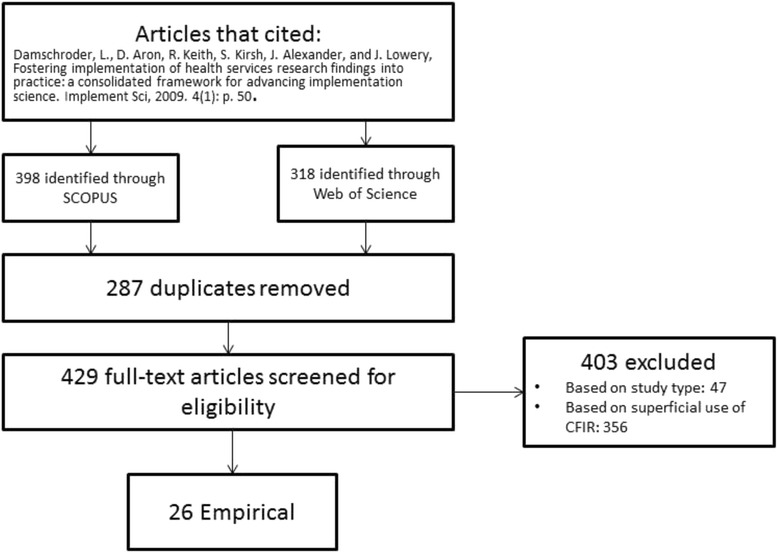
BACKGROUND: In 2009, Damschroder et al. developed the Consolidated Framework for Implementation Research (CFIR), which provides a comprehensive listing of constructs thought to influence implementation. This systematic review assesses the extent to which the CFIR's use in implementation research fulfills goals set forth by Damschroder et al. in terms of breadth of use, depth of application, and contribution to implementation research. METHODS: We searched Scopus and Web of Science for publications that cited the original CFIR publication by Damschroder et al. (Implement Sci 4:50, 2009) and downloaded each unique result for review. After applying exclusion criteria, the final articles were empirical studies published in peer-review journals that used the CFIR in a meaningful way (i.e., used the CFIR to guide data collection, measurement, coding, analysis, and/or reporting). A framework analysis approach was used to guide abstraction and synthesis of the included articles. RESULTS: Twenty-six of 429 unique articles (6 %) met inclusion criteria. We found great breadth in CFIR application; the CFIR was applied across a wide variety of study objectives, settings, and units of analysis. There was also variation in the method of included studies (mixed methods (n = 13); qualitative (n = 10); quantitative (n = 3)). Depth of CFIR application revealed some areas for improvement. Few studies (n = 3) reported justification for selection of CFIR constructs used; the majority of studies (n = 14) used the CFIR to guide data analysis only; and few studies investigated any outcomes (n = 11). Finally, reflections on the contribution of the CFIR to implementation research were scarce. CONCLUSIONS: Our results indicate that the CFIR has been used across a wide range of studies, though more in-depth use of the CFIR may help advance implementation science. To harness its potential, researchers should consider how to most meaningfully use the CFIR. Specific recommendations for applying the CFIR include explicitly justifying selection of CFIR constructs; integrating the CFIR throughout the research process (in study design, data collection, and analysis); and appropriately using the CFIR given the phase of implementation of the research (e.g., if the research is post-implementation, using the CFIR to link determinants of implementation to outcomes).
Overview
The claims and statistics of this paper haven’t been checked yet.
Free: it reads the open-access text and checks the first 5 claims that cite a source we can check. Create a free account to check every claim.
Integrity signals
Registry
Cites
Statistics
Figures
Verification
Claims the paper makes
The claims and statistics of this paper haven’t been checked yet.
Free: it reads the open-access text and checks the first 5 claims that cite a source we can check. Create a free account to check every claim.
Claims other papers make about this one
Each is checked against this paper’s own text: does it say what the citing paper says it does?
The cited source says what the claim attributes to it.
In the citing paper
“Kirk et al.’s 2015 review of 26 articles with meaningful use of the CFIR found that most users employed mixed (n = 13) or qualitative (n = 10) methods and used the CFIR in the post-implementation phase (n = 15) [13].”
From The updated consolidated framework for implementation research based on user feedback (2022) · cites this paper as [13]
The cited source says what the claim attributes to it.
In the citing paper
“Determinant frameworks can thus be used to inform choice of implementation strategies that may best address contextual determinants [14], generate hypotheses to prospectively guide predictions of implementation outcomes, or retrospectively explain implementation outcomes by assessing differences in determinants across implementation settings [11, 13, 15].”
From The updated consolidated framework for implementation research based on user feedback (2022) · cites this paper as [13]
The cited source says what the claim attributes to it.
In the citing paper
“The majority of CFIR users employ qualitative methods to assess constructs [13].”
From The updated consolidated framework for implementation research based on user feedback (2022) · cites this paper as [13]
The cited source says what the claim attributes to it.
In the citing paper
“In their systematic review of CFIR application, Kirk et al highlight gaps in depth of use of the framework, variation in selection of CFIR constructs, and a lack of justification of constructs used, limiting comparison of findings across time and contexts.14”
The cited source says what the claim attributes to it.
In the citing paper
“One indicator of this is a finding by Kirk et al: Among 26 research studies that meaningfully used CFIR, only two of the 26 included patients among their unit of analysis.14”
4 more claims about this paper
Create a free account to see every claim other papers make about this one.
Self-check
Percentages, sums and reported differences re-computed from the paper’s own numbers.
The self-check needs the paper’s full text.
Citations
Cites
Damschroder, L. J., Aron, D. C., Keith, R. E., Kirsh, S. R., Alexander, J. A., & Lowery, J. C. (2009) · Implementation Science · doi:10.1186/1748-5908-4-50 · Cited by 14,496 · cited 10×
“At the macro level, the CFIR provides a standardized structure for building on findings across studies [3].”
BackgroundMethodInfluentialSelf-citationGale, N. K., Heath, G., Cameron, E., Rashid, S., & Redwood, S. (2013) · BMC Medical Research Methodology · doi:10.1186/1471-2288-13-117 · Cited by 10,865 · cited 1×
“Objective 3: determine the contribution of the CFIR to implementation research General co posed by D • Cohere • Whethe • Whethe Microsoft Excel where content was arrayed in a matrix format consisting of rows (articles), columns (codes), and cells (summarized data) [8].”
BackgroundQualitative research practice: a guide for social science students and researchers
(2003) · Choice Reviews Online · doi:10.5860/choice.41-1319 · Cited by 10,543
Proctor, E., Silmere, H., Raghavan, R., Hovmand, P., Aarons, G., Bunger, A., Griffey, R., & Hensley, M. (2011) · Administration and Policy in Mental Health and Mental Health Services Research · doi:10.1007/s10488-010-0319-7 · Cited by 8,721 · cited 2×
“[25]), (2) provide clearer linkage of CFIR constructs with outcomes, and (3) provide clearer specification of which CFIR constructs were used to investigate outcomes.”
BackgroundComparison of PubMed, Scopus, Web of Science, and Google Scholar: strengths and weaknesses
Falagas, M. E., Pitsouni, E. I., Malietzis, G. A., & Pappas, G. (2008) · The FASEB Journal · doi:10.1096/fj.07-9492lsf · Cited by 5,039 · cited 1×
“, Google Scholar) [6].”
The Challenge of Innovation Implementation
Klein, K. J., & Sorra, J. S. (1996) · The Academy of Management Review · doi:10.2307/259164 · Cited by 2,113 · cited 1×
“Investigation of outcomes is critical for the field of implementation science overall because optimal implementation outcomes are a necessary condition for innovation effectiveness [25, 26].”
BackgroundFrench, S. D., Green, S. E., O’Connor, D. A., McKenzie, J. E., Francis, J. J., Michie, S., Buchbinder, R., Schattner, P., Spike, N., & Grimshaw, J. M. (2012) · Implementation Science · doi:10.1186/1748-5908-7-38 · Cited by 1,338 · cited 1×
“Better integration of the CFIR (or other theoretical framework) into empirical studies would help to address gaps in use of theory and advance implementation science [4, 31, 32].”
Kitson, A. L., Rycroft-Malone, J., Harvey, G., McCormack, B., Seers, K., & Titchen, A. (2008) · Implementation Science · doi:10.1186/1748-5908-3-1 · Cited by 1,314 · cited 1×
“earlier by developers of the PARIHS framework [27].”
MethodMeho, L. I., & Yang, K. (2007) · Journal of the American Society for Information Science and Technology · doi:10.1002/asi.20677 · Cited by 974
Damschroder, L. J., & Lowery, J. C. (2013) · Implementation Science · doi:10.1186/1748-5908-8-51 · Cited by 734
Self-citation
Cited by
Items 301–400 of 1,001
Zettergren, L., Larsson, E. C., Hellsten, L., Kosidou, K., & Nielsen, A. M. (2024) · BMC Health Services Research · doi:10.1186/s12913-024-10932-1 · Cited by 22
“Findings may however still inform adjustments and strategies of the digital services that can be used to further implement and support its sustained use [32, 43].”
Telestroke Adoption Among Community Hospitals in North Carolina: A Cross-Sectional Study
Shea, C. M., Tabriz, A. A., Turner, K. L., North, S., & Reiter, K. L. (2018) · Journal of Stroke and Cerebrovascular Diseases · doi:10.1016/j.jstrokecerebrovasdis.2018.04.032 · Cited by 21
“CFIR builds upon classic theories(24) to identify constructs associated with innovation adoption and implementation and has been applied to a range of innovations and care settings, including stroke care.(25) CFIR includes five domains, two of which in particular (outer setting and inner setting) are consistent with t…”
ResultSimione, M., Frost, H. M., Cournoyer, R. N., Mini, F. N., Cassidy, J., Craddock, C., Moreland, J., Wallace, J., Metlay, J. P., Kistin, C. J., et al. (2020) · Implementation Science Communications · doi:10.1186/s43058-020-00047-z · Cited by 21
“CFIR has been used for assessment of needs and identification of barriers and facilitators prior to implementation of programs and interventions [11].”
MethodLevinson, A. J., Ayers, S., Butler, L., Παπαϊωάννου, Α., Marr, S., & Sztramko, R. (2020) · JMIR Aging · doi:10.2196/21264 · Cited by 21
Smith, M. C. (2017) · Environment and Planning C Politics and Space · doi:10.1177/2399654417725076 · Cited by 21
Calhoun, C. L., Luo, L., Baumann, A. A., Bauer, A., Shen, E., McKay, V., Hooley, C., James, A. S., & King, A. A. (2021) · Journal of Pediatric Hematology/Oncology · doi:10.1097/mph.0000000000002322 · Cited by 22
Desafios na avaliação da atenção básica a partir de um programa de melhoria da qualidade
Ferreira, L. R., Neves, V. R., & Rosa, A. D. S. (2022) · Escola Anna Nery · doi:10.1590/2177-9465-ean-2021-0287pt · Cited by 20
Kirkland, E. B., Johnson, E. E., Bays, C., Marsden, J. E., Verdin, R., Ford, D. W., King, K. L., & Sterba, K. R. (2023) · Telemedicine Reports · doi:10.1089/tmr.2022.0038 · Cited by 21
“Adapted from the Consolidated Framework for Implementation Research.(12,13) Kirkland et al.”
BackgroundMethodMatthew, M., Bainbridge, D. B., Bishop, V. R., Sinding, C., Winemaker, S., Kilbertus, F., Kortes-Miller, K., & Seow, H. Y. (2023) · BMC Palliative Care · doi:10.1186/s12904-023-01265-7 · Cited by 20
Steensma, R., van den Bogerd, N., Dijkstra, K., Janssen-Heijnen, M. L. G., Krabbendam, L., de Vries, R., & Maas, J. (2024) · Urban forestry & urban greening · doi:10.1016/j.ufug.2024.128587 · Cited by 20
Cai, S., Wang, H., Zhang, Y., Zhao, T., Yuan, X., Deng, H., Chen, Y., Liu, Y.-F., Dang, J., Shi, D., et al. (2025) · World Journal of Pediatrics · doi:10.1007/s12519-024-00874-3 · Cited by 22
Hitch, D., Leech, K., Neale, S., & Malcolm, A. (2020) · PLoS ONE · doi:10.1371/journal.pone.0235055 · Cited by 20
VanDevanter, N., Vu, M., Nguyen, A. M., Nguyen, T., Minh, H. V., Nguyen, N. T., & Shelley, D. (2020) · Implementation Science · doi:10.1186/s13012-020-01035-6 · Cited by 20
Bastos-Carvalho, A., Ware, S. L., Belcher, T., Mehmeti, F., Higgins, E., Sprang, R., Williams, C., Studts, J. L., & Studts, C. R. (2021) · Implementation Science Communications · doi:10.1186/s43058-021-00157-2 · Cited by 21
“The Consolidated Framework for Implementation Research (CFIR) [30] guided our conceptualization of multi-level factors influencing implementation of TDRS.”
MethodShinall, M. C., Bonnet, K. R., Schlundt, D. G., & Verma, M. (2021) · Liver Transplantation · doi:10.1002/lt.26364 · Cited by 23
Koike, D., Ito, M., Horiguchi, A., Yatsuya, H., & Ota, A. (2022) · BMC Health Services Research · doi:10.1186/s12913-022-07822-9 · Cited by 20
Heerman, W. J., Schludnt, D., Harris, D., Teeters, L., Apple, R., & Barkin, S. L. (2018) · BMC Public Health · doi:10.1186/s12889-018-5403-z · Cited by 20
“Conceptual models, like the Consolidated Framework for Implementation Research (CFIR) provide a strong theoretical foundation [26].”
MethodFetters, M. D. (2022) · Journal of Mixed Methods Research · doi:10.1177/15586898221131238 · Cited by 20
“Additional dimensions or facets of integration are relevant at the philosophical, paradigmatic, theoretical (Kirk et al., 2015), analytical, or methodological dimension as was noted above relative to naming when combining mixed methods with other methodologies.”
BackgroundResultInfluentialHagaman, A. K., Rhodes, E., Aloe, C. F., Hennein, R., Peng, M. L., Deyling, M., Georgescu, M., Nyhan, K., Schwartz, A. E., Zhou, K., et al. (2025) · Implementation Research and Practice · doi:10.1177/26334895251367470 · Cited by 20
“This fi nding is consistent with previous analyses of IS studies that highlighted the suboptimal use of frameworks wherein frameworks are not operationalized or integrated throughout the research process from study design to data collection and analysis (Kirk et al., 2016; Moullin et al., 2019).”
Implementation science promotes clinical practice of guidelines: a scoping review
Zhang, J., Xue, X., Liang, S., Bao, Y., & Chen, Z. (2025) · BMC Health Services Research · doi:10.1186/s12913-025-13317-0 · Cited by 19
“Although multiple frameworks have been developed and advocated—corroborating the findings of Tinkle et al. [140] and Kirk et al. [141]—the lack of standardized selection criteria and application protocols contributes to their underutilization and suboptimal application [133, 134, 142, 143].”
Michas, M., Deuchar, L., Leigh, R., Bhutani, M., Rowe, B. H., Stickland, M. K., Ospina, M. B., for the COPD PRIHS-2 Group, Damant, R. W., Mayers, I., et al. (2020) · Implementation Science Communications · doi:10.1186/s43058-020-00017-5 · Cited by 20
“While the emergence of evidence in dissemination and implementation science provides tools and strategies for the design of practice improvements [12], challenges in bringing these same improvements to frontline clinicians and patients and subsequently sustaining the adoption of these improvements in clinical settings…”
BackgroundBasger, B., Moles, R. J., & Chen, T. F. (2023) · BMC Geriatrics · doi:10.1186/s12877-023-03921-2 · Cited by 19
“A post-implementation (post hoc) study of these factors was conducted, such studies being commonly used to analyse and explain the implementation process [39, 49].”
MethodO’Donovan, B., Kirke, C., Pate, M., McHugh, S., Bennett, K., & Cahir, C. (2023) · Implementation Science Communications · doi:10.1186/s43058-023-00466-8 · Cited by 19
“This study found it beneficial to combine the TDF and CFIR to address the limitations of the two frameworks identified by previous research such as broad or poorly defined domains, variation in which domains/constructs are used, gaps between determinants and outcomes [3, 5, 14].”
Backgrounddel Pozo, B., Nevill, R. E. A., Cepeda, J., Adams, I. T., Whiteside, A., & Thompson, E. (2024) · Police Practice and Research · doi:10.1080/15614263.2025.2512806 · Cited by 19
“The CFIR was selected for its intentionally broad array of implementation determinants, 67 in all (Economidis et al., 2023), making it suitable for research in several fields (Kirk et al., 2016).”
Delawarde, C., Gagné, M., Brunson, L., & Drapeau, S. (2018) · Children and Youth Services Review · doi:10.1016/j.childyouth.2018.03.009 · Cited by 19
Two Medicaid health plans’ models and motivations for improving colorectal cancer screening rates
Coury, J., Schneider, J. L., Green, B. B., Baldwin, L., Petrik, A. F., Rivelli, J. S., Schwartz, M., & Coronado, G. D. (2018) · Translational Behavioral Medicine · doi:10.1093/tbm/iby094 · Cited by 19
“An open-ended, semi-structured interview guide was developed based on review of prior meeting minutes, research staff expertise, and concepts drawn from the Consolidated Framework for Implementation Research (CFIR) [35].”
MethodInfluentialDeimplementation of Routine Chest X‐rays in Adult Intensive Care Units
Trumbo, S. P., Iams, W. T., Limper, H. M., Goggins, K. M., Gibson, J., Oliver, L. A., Leverenz, D. L., Samuels, L. R., Brady, D. W., & Kripalani, S. B. (2019) · Journal of Hospital Medicine · doi:10.12788/jhm.3129 · Cited by 19
Seidel, K., Quasdorf, T., Haberstroh, J., & Thyrian, J. R. (2022) · International Journal of Environmental Research and Public Health · doi:10.3390/ijerph19095478 · Cited by 20
Yue, J., Liu, J., Zhao, Y., Williams, S., Zhang, B., Zhang, L., Zhang, Q., Liu, X., Wall, S. N., & Zhao, G. (2022) · BMC Health Services Research · doi:10.1186/s12913-022-07493-6 · Cited by 19
Hernández, C., Herranz, C., Baltaxe, E., Seijas, N., González, R., Asenjo, M. A., Coloma, E., Fernandez, J., Vela, E., Carot-Sans, G., et al. (2024) · Cost Effectiveness and Resource Allocation · doi:10.1186/s12962-024-00536-1 · Cited by 19
“The process of deployment of the service was analyzed using the Consolidated Framework for Implementation Research (CFIR) [38, 39].”
MethodSenier, L., McBride, C. M., Ramsey, A. T., Bonham, V. L., & Chambers, D. (2019) · International Journal of Environmental Research and Public Health · doi:10.3390/ijerph16203899 · Cited by 20
Beuf, T. L. F. D., de Ruiter, C., & de Vogel, V. (2020) · International Journal of Forensic Mental Health · doi:10.1080/14999013.2020.1756994 · Cited by 19
“Therefore, this comprehensive framework might provide an adequate starting point for future risk assessment implementation studies, for example, when developing interview questions that explicitly prompt for certain domains and constructs, such as the outer setting or implementation climate (Kirk et al., 2015).”
BackgroundO’Shea, R., Rankin, N. M., Kentwell, M., Gleeson, M., Salmon, L., Tucker, K., Lewis, S. J., & Taylor, N. J. (2020) · Genetics in Medicine · doi:10.1038/s41436-020-0838-x · Cited by 19
“It has been widely used across various disciplines and health organizations to evaluate pre- and postimplementation efforts and implementation processes in real-world settings.(16) As various approaches are being trialed to integrate genetic testing into oncology, it is important to consider the implementation factors…”
BackgroundTaher, S., Muramatsu, N., Odoms-Young, A., Peacock, N., Michael, C. F., & Courtney, K. S. (2022) · BMC Public Health · doi:10.1186/s12889-021-12407-y · Cited by 18
Kählke, F., Hasking, P., Küchler, A.-M., & Baumeister, H. (2024) · Frontiers in Digital Health · doi:10.3389/fdgth.2024.1284661 · Cited by 18
Gallant, N. L., Hadjistavropoulos, T., Stopyn, R. J. N., & Feere, E. K. (2022) · The Gerontologist · doi:10.1093/geront/gnac098 · Cited by 18
“with the implementation of interventions across health care settings (Damschroder et al., 2009; Kirk et al., 2016).”
BackgroundFacilitating Health Behavior Change: A Self-Determination Theory Perspective
Ntoumanis, N., & Moller, A. C. (2023) · Oxford University Press eBooks · doi:10.1093/oxfordhb/9780197600047.013.39 · Cited by 19
Milko, L. V., & Berg, J. S. (2023) · International Journal of Neonatal Screening · doi:10.3390/ijns9030036 · Cited by 18
Cochran, G., Smid, M. C., Krans, E. E., Yu, Z., Carlston, K., White, A., Abdulla, W., Baylis, J. D., Charron, E. M., Okifugi, A., et al. (2023) · Addiction · doi:10.1111/add.16364 · Cited by 18
Haneveld, L. K., Kip, H., Bouman, Y. H. A., Weerdmeester, J., Scholten, H., & Kelders, S. M. (2023) · Frontiers in Psychology · doi:10.3389/fpsyg.2023.1201485 · Cited by 18
Poduval, S., Arnold, L., Carta, E., Nimmons, D., STRATTON, I. M., Shaw, M., Bradbury, K. J., & Stevenson, F. A. (2025) · BMC Public Health · doi:10.1186/s12889-025-21418-y · Cited by 18
Extended Reality (XR) in Pediatric Acute and Chronic Pain: Systematic Review and Evidence Gap Map
Hess, C. W., Rosenbloom, B. N., Mesaroli, G., Lopez, C., Ngo, N. H., Cohen, E., Ouellette, C., Gold, J. I., Logan, D. E., Simons, L. E., et al. (2025) · JMIR Pediatrics and Parenting · doi:10.2196/63854 · Cited by 19
“The use of implementation science frameworks (eg, Consolidated Framework for Implementation Research) [122] to evaluate contextual and personnel differences as they relate to technology integration in settings outside of a hospital can support these efforts.”
Waelli, M., Gomez, M.-L., Sicotte, C., Zicari, A. P., Bonnefond, J.-Y., Lorino, P., & Minvielle, É. (2016) · BMC Health Services Research · doi:10.1186/s12913-016-1794-7 · Cited by 18
“According to the emerging field of the implementation sciences [16], this study aims to explore the pathway through which measurement tools come to be operationalized in practice.”
BackgroundCommunity pharmacists’ perspectives on implementation of Medicines Use Review in Slovenia
Makovec, U. N., Kos, M., & Pisk, N. (2018) · International Journal of Clinical Pharmacy · doi:10.1007/s11096-018-0644-6 · Cited by 18
eSalud en servicios de salud públicos en México: estudio de caso
Castañeda, C. D. D. L., & Góngora-Ortega, J. (2020) · región y sociedad · doi:10.22198/rys2020/32/1256 · Cited by 18
Martorella, G., & McDougall, G. J. (2020) · Pain Management Nursing · doi:10.1016/j.pmn.2020.09.004 · Cited by 19
Koh, W. Q., Felding, S. A., Toomey, E. C., & Casey, D. (2021) · Systematic Reviews · doi:10.1186/s13643-021-01598-5 · Cited by 18
Zanti, S., & Thomas, M. L. (2021) · Global Implementation Research and Applications · doi:10.1007/s43477-021-00028-x · Cited by 18
van Scherpenseel, M. C., Velde, S. J. T., Veenhof, C., Emmelot‐Vonk, M. H., & Barten, D. (2023) · Frontiers in Health Services · doi:10.3389/frhs.2023.1138517 · Cited by 19
“Frontiers in Health Services 14 importance of always taking into account local contexts (13, 63).”
BackgroundMethodStrid, E. N., Wallin, L., & Nilsagård, Y. E. (2023) · BMC Family Practice · doi:10.1186/s12875-023-02079-5 · Cited by 18
mHealth to improve implementation of TB contact investigation: a case study from Uganda
Gupta, A. J., Turimumahoro, P., Ochom, E., Ggita, J. M., Babirye, D., Ayakaka, I., Mark, D., Okello, D. A., Cattamanchi, A., Dowdy, D. W., et al. (2023) · Implementation Science Communications · doi:10.1186/s43058-023-00448-w · Cited by 18
Maye, M. P., Sanchez, V. E., Stone-MacDonald, A. K., & Carter, A. S. (2020) · Journal of Autism and Developmental Disorders · doi:10.1007/s10803-020-04456-w · Cited by 18
Study design and implementation of the PRecision Medicine In MEntal health Care (PRIME Care) Trial
Oslin, D. W., Chapman, S. R., DuVall, S. L., Gelernter, J. E., Ingram, E. P., Kranzler, H. R., Lehmann, L. S., Lynch, J. A., Lynch, K. G., Pyne, J. M., et al. (2020) · Contemporary Clinical Trials · doi:10.1016/j.cct.2020.106247 · Cited by 18
Beames, J. R., Lingam, R., Boydell, K., Calear, A. L., Torok, M. H., Maston, K., Zbukvic, I., Huckvale, K., Batterham, P. J., Christensen, H. M., et al. (2021) · BMJ Open · doi:10.1136/bmjopen-2020-042133 · Cited by 18
Consolidated Framework for Implementation Research (CFIR)
Drake, C. D., Lewinski, A. A., & Zullig, L. L. (2022) · Wiley eBooks · doi:10.1002/9781119678816.iehc0944 · Cited by 18
Wong, C. H. L., Tse, J. V. H., Nilsén, P., Ho, L. T. F., Wu, I. X. Y., & Chung, V. C. (2021) · BMC Complementary Medicine and Therapies · doi:10.1186/s12906-021-03372-5 · Cited by 17
Carver, H., McCulloch, P. G., & Parkes, T. (2021) · BMC Public Health · doi:10.1186/s12889-021-11828-z · Cited by 17
“The CFIR has been used in a wide range of studies within the field of healthcare and most aim to understand practitioners’ experiences of barriers and facilitators to implementation [34].”
BackgroundInfluentialFalzon, D., Carver, H., Masterton, W., Wallace, B. B., Sumnall, H. R., Measham, F. C., Craik, V., Gittins, R., Aston, E., Watson, K., et al. (2024) · Substance Abuse Treatment Prevention and Policy · doi:10.1186/s13011-023-00590-7 · Cited by 17
“CFIR is most commonly used during or post-implementation [42].”
BackgroundMethodAntimicrobial stewardship interventions involving community pharmacy teams: a scoping review
Zerbinato, F., Cunningham, S., & Tonna, A. P. (2025) · JAC-Antimicrobial Resistance · doi:10.1093/jacamr/dlaf156 · Cited by 18
Soukup, T., Hull, L., Smith, E. L., Healey, A., Bakolis, I., Amiel, S. A., Sevdalis, N., & PWD Group (2019) · BMJ Open · doi:10.1136/bmjopen-2019-030370 · Cited by 17
Pauly, B., Brown, M. E., Chow, C. M., Wettlaufer, A., East Side Illicit Drinkers Group for Education (EIDGE), Graham, B. M., Urbanoski, K. A., Callaghan, R. C., Rose, C., Jordan, M., et al. (2021) · Harm Reduction Journal · doi:10.1186/s12954-021-00512-5 · Cited by 17
“The CFIR can help to investigate implementation issues before an intervention is operationalized and can be used to inform program design, identify potential barriers, refine the implementation strategy, and adapt the intervention prior to implementation [48].”
BackgroundLumba‐Brown, A., Prager, E. M., Harmon, N., McCrea, M., Bell, M. J., Ghajar, J., Pyne, S. W., & Cifu, D. X. (2021) · Journal of Neurotrauma · doi:10.1089/neu.2021.0067 · Cited by 17
Deftereos, I., Hitch, D., Butzkueven, S., Carter, V. M., Fetterplace, K., Fox, K., Ottaway, A., Pierce, K., Steer, B., Varghese, J. A., et al. (2022) · BMC Health Services Research · doi:10.1186/s12913-022-07466-9 · Cited by 17
“The CFIR provides a rigorous structure for the principles of process evaluation, as previously described by Proctor [9] and Moore [7], and enables comprehensive evaluation of implementation by exploring the relationship between domains, constructs and outcomes [8, 10].”
BackgroundMethodImplementation evaluation of an Irish secondary-level whole school programme: a qualitative inquiry
McHale, F., Ng, K., Scanlon, D., Cooper, J., Grady, C. L., Norton, C., O'Shea, D. B., & Woods, C. B. (2022) · Health Promotion International · doi:10.1093/heapro/daac131 · Cited by 17
Obonyo, G., Nyongesa, V., Duffy, M. H., Kathono, J., Nyamai, D. N., Mwaniga, S., Yator, O., Levy, M., Lai, J., & Kumar, M. (2023) · PLOS Global Public Health · doi:10.1371/journal.pgph.0000722 · Cited by 17
“Determinants from the ADEPT model were integrated into the CFIR framework in addition to an examination of the political context as revealed through interviews as described within the KPP (Fig 2).”
MethodMaruszczyk, K., McMullan, C., Aiyegbusi, O. L., Keeley, T., Wilson, R., Collis, P., Bottomley, C. J., & Calvert, M. (2023) · Heliyon · doi:10.1016/j.heliyon.2023.e20157 · Cited by 17
Implementation Research as Applied Science: Bridging the Research to Practice Gap
Livingood, W. C., Bilello, L. A., Lukens-Bull, K., Smotherman, C. R., & Choe, U. (2019) · Health Promotion Practice · doi:10.1177/1524839919858082 · Cited by 17
“Within that context, one purpose of implementation research is to reveal the underlying principles of change within health care practice organizations, consistent with developing and testing theory associated with many forms of research (Damschroder et al., 2009; Kirk et al., 2016; Nilsen, 2015; Sales, Smith, Curran,…”
Okamoto, S. K., Helm, S., Chin, S. K., Hata, J., Hata, E., & Okamura, K. H. (2019) · Journal of Community Psychology · doi:10.1002/jcop.22222 · Cited by 17
“The model has mainly been used to guide data analysis in implementation research (Kirk et al., 2016), although some research has integrated the model throughout different phases of the research process, such as data collection and reporting of actionable findings (Keith, Crosson, O’Malley, Cromp, & Taylor, 2017).”
MethodStoner, C. R., Chandra, M., Bertrand, E., Du, B., Durgante, H. B., Klaptocz, J., Krishna, M., Lakshminarayanan, M., Mkenda, S., Mograbi, D. C., et al. (2020) · Frontiers in Public Health · doi:10.3389/fpubh.2020.00342 · Cited by 17
Qu, H., Shewchuk, R. M., Hu, X., Baumann, A. A., Martin, M. Y., Pisu, M., Oster, R. A., & Rogers, L. Q. (2020) · Implementation Science Communications · doi:10.1186/s43058-020-00061-1 · Cited by 17
“mixed-method studies have adopted CFIR to develop interview guides [32], form codebooks [33], analyze and interpret data [34], and report implementation-related findings [29].”
BackgroundMethodKoester, M. N., Bejarano, C. M., Davis, A. M., Brownson, R. C., Kerner, J. F., Sallis, J. F., Steel, C., & Carlson, J. (2021) · Implementation Science Communications · doi:10.1186/s43058-021-00198-7 · Cited by 17
“Given that the CFIR was developed for and has been most often used in clinical settings [19, 29], a unique contribution of the present study was the adaptation of the CFIR for a community-based intervention.”
MethodPatel, E., Solomon, K. T., Saleem, H. T., Saloner, B. K., Pugh, T., Hulsey, E. G., & Leontsini, E. (2021) · Journal of Substance Abuse Treatment · doi:10.1016/j.jsat.2021.108658 · Cited by 17
Inguane, C., Soi, C., Gimbel, S., Manaca, N., Ramiro, I., Floriano, F., Castro, G. D., Augusto, O. J., Tembe, S., Pfeiffer, J. T., et al. (2022) · Global Health Science and Practice · doi:10.9745/ghsp-d-21-00714 · Cited by 17
“Yet, to date, the CFIR has mostly been used in the post-implementation phase, to guide data analysis; and some studies have provided the rationale and methods for selecting and using constructs, whereas others have not.(14,15) Using the CFIR in this fashion limits its analytical contribution to implementation science…”
MethodBarriers and Facilitators to Implementing Exercise is Medicine Canada on Campus Groups
McEachern, B. M., Jackson, J., Yungblut, S., & Tomasone, J. R. (2019) · Health Promotion Practice · doi:10.1177/1524839919830923 · Cited by 16
Nilsen, P. (2026) · Implementation Science Communications · doi:10.1186/s43058-026-00901-6 · Cited by 18
Zhou, S., Dong, X., Liu, F., Zhang, Y., Yue, D., Zhou, Q., Jin, Y., & Zheng, Z. (2021) · Implementation Science · doi:10.1186/s13012-021-01107-1 · Cited by 16
“Second, a novel model will be used to measure the implementation strategy of the optimized QI initiatives, using a stepped wedge cluster randomized control design, under a modified RE-AIM (reach, effectiveness, adoption, implementation, maintenance) framework [21].”
MethodStout, N. L., Harrington, S., Perry, A. M., Alappattu, M. J., Pfab, V., Stewart, B., & Manes, M. R. (2023) · Journal of Cancer Survivorship · doi:10.1007/s11764-023-01374-5 · Cited by 16
“(Appen-dix 1) [19].”
Churruca, K., Westbrook, J. I., Bagot, K. L., McMullan, R. D., Urwin, R., Cunningham, N. J., Mitchell, R. J., Hibbert, P. D., Sunderland, N., Loh, E., et al. (2023) · BMC Health Services Research · doi:10.1186/s12913-023-09614-1 · Cited by 16
“Application of this framework supports an understanding of factors affecting implementation in a particular context, as well as enabling comparison and the ability to generalise these findings to other settings [23].”
MethodResultMoore, S. A., Cooper, J. M., Malloy, J. M., & Lyon, A. R. (2023) · Administration and Policy in Mental Health and Mental Health Services Research · doi:10.1007/s10488-023-01320-8 · Cited by 18
“Thus, the CFIR provides a structure for synthesizing determinants across studies and settings using a common terminology (Damschroder et al., 2009; Kirk et al., 2020).”
MethodAbel, B., Bongartz, M., Rapp, K., Roigk, P., Peiter, J., Metz, B., Finger, B., Büchele, G., Wensing, M., Roth, C., et al. (2024) · BMC Geriatrics · doi:10.1186/s12877-023-04634-2 · Cited by 16
Fathi, L. I., Yang, D., Walker, J. L., Robinson, M., Littlewood, R., & Truby, H. (2024) · Health Promotion Journal of Australia · doi:10.1002/hpja.847 · Cited by 16
Houghtaling, B., Short, E., Long, C. R., Steeves, E. A., Isack, M., Flournoy, L., Cawrse, N., August, E., Summerfelt, W. T., & Calloway, E. E. (2025) · Translational Behavioral Medicine · doi:10.1093/tbm/ibaf013 · Cited by 16
“The CFIR/CFIR 2.0 is a widely used framework in implementation science [22] meant to be applicable to a variety of settings [17, 21].”
InfluentialUnderstanding the dissemination of appointment-based synchronization models using the CFIR framework
Patterson, J. A., & Holdford, D. A. (2017) · Research in Social and Administrative Pharmacy · doi:10.1016/j.sapharm.2017.05.022 · Cited by 16
Development of a guideline for the treatment of generalized anxiety disorder with the ADAPTE method
Hurtado, M. M., Nogueras, E. V., Cantero, N., Gálvez, L., García‐Herrera, J. M., & Morales‐Asencio, J. M. (2020) · International Journal for Quality in Health Care · doi:10.1093/intqhc/mzaa053 · Cited by 16
Burn, A., Vainre, M., Humphrey, A., & Howarth, E. (2020) · Implementation Science Communications · doi:10.1186/s43058-020-00078-6 · Cited by 16
“Additionally, we drew on the CFIR [23] to identify the barriers and facilitators to implementation [28], [29].”
MethodBerthoud, L., Turcotte, M., Dzemaili, S., Ducraux, D., Shaha, M., & Bucher, C. O. (2021) · Nursing and Health Sciences · doi:10.1111/nhs.12796 · Cited by 16
Teeling, S. P., Davies, C., Barnard, M., O’Connor, L., Coffey, A., Lambert, V., McNamara, M. S., Tuohy, D., Frawley, T., Redmond, C., et al. (2021) · International Journal of Environmental Research and Public Health · doi:10.3390/ijerph182211932 · Cited by 16
Gallant, N. L., Hadjistavropoulos, T., Winters, E. M., Feere, E. K., & Wickson‐Griffiths, A. (2022) · BMC Geriatrics · doi:10.1186/s12877-022-03020-8 · Cited by 17
Shattuck, D. G., Richard, B. O., Jaramillo, E. T., Byrd, E., & Willging, C. E. (2022) · Frontiers in Health Services · doi:10.3389/frhs.2022.920790 · Cited by 16
Yount, K. M., Anderson, K. M., Trang, Q. T., & Bergenfeld, I. (2023) · BMC Public Health · doi:10.1186/s12889-023-15973-5 · Cited by 16
“Since its creation, CFIR has been used in a range of health contexts [39], including internationally and in LMICs [38].”
BackgroundGalvin, E., Desselle, S. P., Gavin, B. E., Quigley, E., Flear, M. L., Kilbride, K., McNicholas, F., Cullinan, S., & Hayden, J. C. (2023) · BMC Health Services Research · doi:10.1186/s12913-023-09529-x · Cited by 16
“The CFIR has been commonly employed in post-hoc analyses of what facilitated or hindered implementation of an innovation [27] and has been previously applied in the context of telemedicine implementation [28].”
MethodBrämberg, E. B., Jensen, I. B., & Kwak, L. (2018) · Disability and Rehabilitation · doi:10.1080/09638288.2018.1496151 · Cited by 16
Implementation of Health Promotion Competencies in Ireland and Italy—A Case Study
Battel-Kirk, B., & Barry, M. M. (2019) · International Journal of Environmental Research and Public Health · doi:10.3390/ijerph16244992 · Cited by 16
Baldwin, L., Schneider, J. L., Schwartz, M., Rivelli, J. S., Green, B. B., Petrik, A. F., & Coronado, G. D. (2020) · BMC Health Services Research · doi:10.1186/s12913-019-4868-5 · Cited by 16
“The team was interviewed as a group by JS, using a structured guide that explored the Consolidated Framework for Implementation Research (CFIR) domains that the study team felt were most relevant to evaluation of the implementation of BeneFIT’s mailed FIT intervention: intervention characteristics, inner setting, oute…”
MethodSmit, A. K., Reyes-Marcelino, G., Keogh, L. A., Dunlop, K. L. A., Newson, A. J., & Cust, A. E. (2020) · BMC Public Health · doi:10.1186/s12889-020-09143-0 · Cited by 16
“The Consolidated Framework for Implementation Research (CFIR) enables the identification of determinants of implementation that are relevant to specific innovations or changes to healthcare systems and pathways [11, 12].”
MethodSnow, A. L., Loup, J. R., Morgan, R. O., Richards, K. C., Parmelee, P. A., Baier, R. R., McCreedy, E. M., Frank, B., Brady, C., Fry, L., et al. (2021) · BMC Geriatrics · doi:10.1186/s12877-021-02189-8 · Cited by 16
“This study’s central innovation, the LOCK sleep intervention, holds promise for being an effective, real-world mechanism to improve sleep for nursing home residents and significantly move forward goals of the Table 3 CFIR implementation constructs and data sources CFIR Domains & Constructs Assessments Intervention Cha…”
MethodInfluentialSimpson, M. L., Ruru, S., OETZEL, J. G., Meha, P., Nock, S., Holmes, K., Adams, H., Akapita, N., Clark, M., Ngaia, K., et al. (2022) · Implementation Science Communications · doi:10.1186/s43058-022-00374-3 · Cited by 17
“Two frameworks of interest to our study are the Consolidated Framework for Implementation Research (CFIR) [13, 16] and the He Pikinga Waiora (Enhancing Wellbeing) Implementation Framework HPW [17].”
BackgroundMethodInfluentialPiat, M., Wainwright, M., Cherkas, D., LeBlanc, S., Sofouli, E., Rivest, M.-P., Albert, H., Casey, R., O’Rourke, J. J., & Labonté, L. (2021) · Implementation Science Communications · doi:10.1186/s43058-021-00206-w · Cited by 16
“[36]’s review of the use of CFIR in research reported that in the majority of cases CFIR is used at the post-implementation phase for data analysis only.”
Harding, T., OETZEL, J. G., Simpson, M. L., & Nock, S. (2021) · Health Education & Behavior · doi:10.1177/10901981211033228 · Cited by 15
“It has been widely used in various implementation contexts (Kirk et al., 2016), including in Indigenous communities (Sebastian et al., 2020).”
BackgroundGayles, J. G., Chilenski, S. M., Barragán, N., Cooper, B. R., Welsh, J. A., & Galinsky, M. (2024) · Evaluation & the Health Professions · doi:10.1177/01632787241248769 · Cited by 15
“The aforementioned studies, as with much of CFIR research (Kirk et al., 2016), show how factors related to intervention characteristics in fl uence implementation outcomes; these factors also likely relate to the degree of TA that is delivered to support organizations implementing EBIs.”
Background
Metadata
- Authors
- Kirk, M. A., Kelley, C., Yankey, N., Birken, S. A., Abadie, B., & Damschroder, L.
- Affiliations
- University of North Carolina at Chapel Hill (US)
- VA Ann Arbor Healthcare System (US)
- Eastern Michigan University (US)
- Corresponding author
- Kirk, M. Alexis
- Venue
- Implementation Science
- Published
- 2015-12
- Volume
- 11
- Issue
- 1
- Pages
- 72-72
- ISSN
- 1748-5908 (ISSN-L)
- PMC
- PMC4869309
- OpenAlex
- W2398003476
- Semantic Scholar
- c8757b9931f0128e029ff09f1d76564f0b0c686b
- Cited by
- 1,496
- References
- 45
- Citations by year
- 2026: 160 · 2025: 173 · 2024: 236 · 2023: 209 · 2022: 213 · 2021: 182 · 2020: 151 · 2019: 87 · 2018: 40 · 2017: 38 · 2016: 4 · 2015: 2
- FWCI
- 5.03
- Type
- journal article
- Language
- en
- Open access
- gold
- doi.org
- Licence
- cc-by
- Locations
- Implementation Science (publishedVersion, cc-by)
- PubMed Central (publishedVersion, cc-by)
- PubMed (publishedVersion)
- Carolina Digital Repository (University of North Carolina at Chapel Hill) (submittedVersion)
- Funders
- RTI International (NA)
- Topics
- Health Sciences › Health Professions › General Health Professions › Health Policy Implementation Science
- Health Sciences › Health Professions › General Health Professions › Health Sciences Research and Education
- Health Sciences › Medicine › Public Health, Environmental and Occupational Health › Clinical practice guidelines implementation
- Keywords
- Consolidated Framework for Implementation Research, implementation research, implementation factors, implementation outcomes
- MeSH terms
- Goals, Health Plan Implementation, Health Services Research, Humans
About these checks
Registry, retraction, Cites and statistics results are computed, not judged, with one exception: a printed reference that no index lists is read once by a model before it counts as a citation error. Claims are extracted by a model and kept only when their quote appears verbatim in the text; each cited source is then checked, with a model’s help, for whether it says what the claim relies on. Those verdicts can be wrong — read the claim’s quote and the cited source before relying on one.
Statistics and arithmetic are recomputed, not judged.
Confidence bands are shown only for fields calibrated on our annotated test set. None is calibrated yet, so no band is shown.
What counts as a claim ›How we measure confidence ›How we check this ›
Are you an author, or do you see a problem with this page? Request a review
Data sources
Bibliographic data: Semantic Scholar, OpenAlex, Crossref.
Contains information from the Semantic Scholar Academic Graph Datasets, made available under the ODC Attribution License (ODC-BY 1.0).
Semantic Scholar’s data is described in: Kinney, R., et al. (2023). The Semantic Scholar Open Data Platform. arXiv:2301.10140.
