

A systematic review of the use of the Consolidated Framework for Implementation Research
Open accessThe DOI matches its Crossref record; 44 of the 45 references it cites were found in a registry or an index.
Abstract
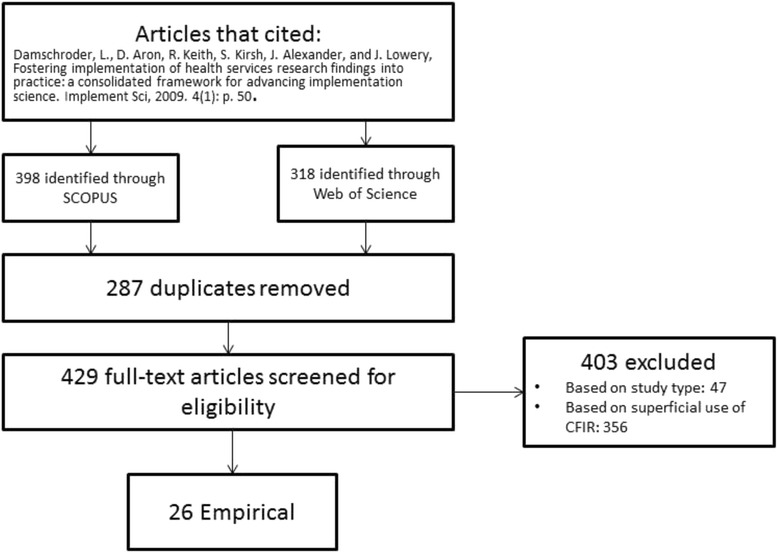
BACKGROUND: In 2009, Damschroder et al. developed the Consolidated Framework for Implementation Research (CFIR), which provides a comprehensive listing of constructs thought to influence implementation. This systematic review assesses the extent to which the CFIR's use in implementation research fulfills goals set forth by Damschroder et al. in terms of breadth of use, depth of application, and contribution to implementation research. METHODS: We searched Scopus and Web of Science for publications that cited the original CFIR publication by Damschroder et al. (Implement Sci 4:50, 2009) and downloaded each unique result for review. After applying exclusion criteria, the final articles were empirical studies published in peer-review journals that used the CFIR in a meaningful way (i.e., used the CFIR to guide data collection, measurement, coding, analysis, and/or reporting). A framework analysis approach was used to guide abstraction and synthesis of the included articles. RESULTS: Twenty-six of 429 unique articles (6 %) met inclusion criteria. We found great breadth in CFIR application; the CFIR was applied across a wide variety of study objectives, settings, and units of analysis. There was also variation in the method of included studies (mixed methods (n = 13); qualitative (n = 10); quantitative (n = 3)). Depth of CFIR application revealed some areas for improvement. Few studies (n = 3) reported justification for selection of CFIR constructs used; the majority of studies (n = 14) used the CFIR to guide data analysis only; and few studies investigated any outcomes (n = 11). Finally, reflections on the contribution of the CFIR to implementation research were scarce. CONCLUSIONS: Our results indicate that the CFIR has been used across a wide range of studies, though more in-depth use of the CFIR may help advance implementation science. To harness its potential, researchers should consider how to most meaningfully use the CFIR. Specific recommendations for applying the CFIR include explicitly justifying selection of CFIR constructs; integrating the CFIR throughout the research process (in study design, data collection, and analysis); and appropriately using the CFIR given the phase of implementation of the research (e.g., if the research is post-implementation, using the CFIR to link determinants of implementation to outcomes).
Overview
The claims and statistics of this paper haven’t been checked yet.
Free: it reads the open-access text and checks the first 5 claims that cite a source we can check. Create a free account to check every claim.
Integrity signals
Registry
Cites
Statistics
Figures
Verification
Claims the paper makes
The claims and statistics of this paper haven’t been checked yet.
Free: it reads the open-access text and checks the first 5 claims that cite a source we can check. Create a free account to check every claim.
Claims other papers make about this one
Each is checked against this paper’s own text: does it say what the citing paper says it does?
The cited source says what the claim attributes to it.
In the citing paper
“Kirk et al.’s 2015 review of 26 articles with meaningful use of the CFIR found that most users employed mixed (n = 13) or qualitative (n = 10) methods and used the CFIR in the post-implementation phase (n = 15) [13].”
From The updated consolidated framework for implementation research based on user feedback (2022) · cites this paper as [13]
The cited source says what the claim attributes to it.
In the citing paper
“Determinant frameworks can thus be used to inform choice of implementation strategies that may best address contextual determinants [14], generate hypotheses to prospectively guide predictions of implementation outcomes, or retrospectively explain implementation outcomes by assessing differences in determinants across implementation settings [11, 13, 15].”
From The updated consolidated framework for implementation research based on user feedback (2022) · cites this paper as [13]
The cited source says what the claim attributes to it.
In the citing paper
“The majority of CFIR users employ qualitative methods to assess constructs [13].”
From The updated consolidated framework for implementation research based on user feedback (2022) · cites this paper as [13]
The cited source says what the claim attributes to it.
In the citing paper
“In their systematic review of CFIR application, Kirk et al highlight gaps in depth of use of the framework, variation in selection of CFIR constructs, and a lack of justification of constructs used, limiting comparison of findings across time and contexts.14”
The cited source says what the claim attributes to it.
In the citing paper
“One indicator of this is a finding by Kirk et al: Among 26 research studies that meaningfully used CFIR, only two of the 26 included patients among their unit of analysis.14”
4 more claims about this paper
Create a free account to see every claim other papers make about this one.
Self-check
Percentages, sums and reported differences re-computed from the paper’s own numbers.
The self-check needs the paper’s full text.
Citations
Cites
Damschroder, L. J., Aron, D. C., Keith, R. E., Kirsh, S. R., Alexander, J. A., & Lowery, J. C. (2009) · Implementation Science · doi:10.1186/1748-5908-4-50 · Cited by 14,496 · cited 10×
“At the macro level, the CFIR provides a standardized structure for building on findings across studies [3].”
BackgroundMethodInfluentialSelf-citationGale, N. K., Heath, G., Cameron, E., Rashid, S., & Redwood, S. (2013) · BMC Medical Research Methodology · doi:10.1186/1471-2288-13-117 · Cited by 10,865 · cited 1×
“Objective 3: determine the contribution of the CFIR to implementation research General co posed by D • Cohere • Whethe • Whethe Microsoft Excel where content was arrayed in a matrix format consisting of rows (articles), columns (codes), and cells (summarized data) [8].”
BackgroundQualitative research practice: a guide for social science students and researchers
(2003) · Choice Reviews Online · doi:10.5860/choice.41-1319 · Cited by 10,543
Proctor, E., Silmere, H., Raghavan, R., Hovmand, P., Aarons, G., Bunger, A., Griffey, R., & Hensley, M. (2011) · Administration and Policy in Mental Health and Mental Health Services Research · doi:10.1007/s10488-010-0319-7 · Cited by 8,721 · cited 2×
“[25]), (2) provide clearer linkage of CFIR constructs with outcomes, and (3) provide clearer specification of which CFIR constructs were used to investigate outcomes.”
BackgroundComparison of PubMed, Scopus, Web of Science, and Google Scholar: strengths and weaknesses
Falagas, M. E., Pitsouni, E. I., Malietzis, G. A., & Pappas, G. (2008) · The FASEB Journal · doi:10.1096/fj.07-9492lsf · Cited by 5,039 · cited 1×
“, Google Scholar) [6].”
The Challenge of Innovation Implementation
Klein, K. J., & Sorra, J. S. (1996) · The Academy of Management Review · doi:10.2307/259164 · Cited by 2,113 · cited 1×
“Investigation of outcomes is critical for the field of implementation science overall because optimal implementation outcomes are a necessary condition for innovation effectiveness [25, 26].”
BackgroundFrench, S. D., Green, S. E., O’Connor, D. A., McKenzie, J. E., Francis, J. J., Michie, S., Buchbinder, R., Schattner, P., Spike, N., & Grimshaw, J. M. (2012) · Implementation Science · doi:10.1186/1748-5908-7-38 · Cited by 1,338 · cited 1×
“Better integration of the CFIR (or other theoretical framework) into empirical studies would help to address gaps in use of theory and advance implementation science [4, 31, 32].”
Kitson, A. L., Rycroft-Malone, J., Harvey, G., McCormack, B., Seers, K., & Titchen, A. (2008) · Implementation Science · doi:10.1186/1748-5908-3-1 · Cited by 1,314 · cited 1×
“earlier by developers of the PARIHS framework [27].”
MethodMeho, L. I., & Yang, K. (2007) · Journal of the American Society for Information Science and Technology · doi:10.1002/asi.20677 · Cited by 974
Damschroder, L. J., & Lowery, J. C. (2013) · Implementation Science · doi:10.1186/1748-5908-8-51 · Cited by 734
Self-citation
Cited by
Items 601–700 of 1,001
Shakibaei, E., Sohal, A. S., Moghadam, V. K., Rajabkhah, K., Prajogo, D. I., Melder, A., Nguyen, Q., Bingham, G., & Tong, E. (2025) · Health Policy and Technology · doi:10.1016/j.hlpt.2025.101014 · Cited by 8
Health Care Home implementation in Otago and Southland: a qualitative evaluation
Gurung, G., Barson, S., Haughey, M., & Stokes, T. (2022) · Journal of Primary Health Care · doi:10.1071/hc22032 · Cited by 8
Transformational Performance Improvement: Why Is Progress so Slow?
Hung, D. Y., Lee, J., & Rundall, T. G. (2022) · Emerald Group Publishing Limited eBooks · doi:10.1108/s1474-823120220000021002 · Cited by 8
Prausnitz, S. R., Altschuler, A., Herrinton, L. J., Avins, A. L., & Corley, D. A. (2023) · Learning Health Systems · doi:10.1002/lrh2.10359 · Cited by 8
Anderson, D. M., Bear, A. B., Zacher, T., Endres, K., Saxton, R. E., Richards, F. R. W., Robe, L. B., Harvey, D. E., Best, L. G., Cloud, R. R., et al. (2023) · International Journal of Environmental Research and Public Health · doi:10.3390/ijerph20032681 · Cited by 8
Contextual and Policy Influences on the Implementation of Prenatal Care Coordination
Greene, M. Z., Gillespie, K. H., & Dyer, R. L. (2023) · Policy Politics & Nursing Practice · doi:10.1177/15271544231159655 · Cited by 8
Flood, L. D., Angelle, P. S., & Koerber, N. (2023) · Management in Education · doi:10.1177/08920206231160648 · Cited by 8
“Without the use of a framework, researchers often identify aspects of their research that are only applicable to the speci fi c contexts where their individual study was conducted (Kirk et al., 2016).”
Colton, Z. A., Liles, S. M., Griffith, M. M., Stanek, C. J., Walden, J., King, A. A., Barnard-Kirk, T., Creary, S. E., & Nahata, L. (2024) · Journal of Pediatric Psychology · doi:10.1093/jpepsy/jsae031 · Cited by 8
Holbert, M. D., Duff, J. S., Wood, F. M., Holland, A. J. A., Teague, W. J., Frear, C. C., Crellin, D., Phillips, N. T., Storey, K., Martin, L. J., et al. (2024) · Journal of Pediatric Nursing · doi:10.1016/j.pedn.2024.05.018 · Cited by 8
Meyle, J., Lambert, F., Winning, L., Bertl, K., Bruckmann, C., Duplan, M. B., Harrison, P., Laleman, I., Mattheos, N., Molina, A., et al. (2024) · Journal Of Clinical Periodontology · doi:10.1111/jcpe.14071 · Cited by 8
Koon, A. D., Conrad, A., Naimoli, J. F., Saxena, S., Connor, C., & Rodríguez, D. (2019) · Global Public Health · doi:10.1080/17441692.2019.1622758 · Cited by 8
“Both frameworks have reliably produced evidence on the successful implementation of health interventions (Kirk et al., 2015).”
BackgroundWalkosz, B. J., Buller, D. B., Buller, M. K., Wallis, A. D., & Liu, X. (2019) · American Journal of Industrial Medicine · doi:10.1002/ajim.23033 · Cited by 8
Moore, S. K., Saunders, E. C., McLeman, B. M., Metcalf, S. A., Walsh, O., Bell, K. R., Meier, A., & Marsch, L. A. (2021) · International Journal of Drug Policy · doi:10.1016/j.drugpo.2021.103259 · Cited by 8
Kauffeldt, K. D., Sabiston, C. M., Mina, D. S., & Tomasone, J. R. (2021) · Supportive Care in Cancer · doi:10.1007/s00520-021-06591-1 · Cited by 8
“The use of an implementation framework to explore the stratified factors influencing CBEP implementation ensured that all relevant determinants to implementation were considered [36].”
MethodEzezika, O. C., Varatharajan, C., Racine, S., & Ameyaw, E. K. (2021) · African Journal of Science Technology Innovation and Development · doi:10.1080/20421338.2021.1985946 · Cited by 9
“However, the use of the CFIR allowed the findings to be placed in the context of the wider implementation research literature (Kirk et al. 2015; Means et al. 2020).”
MethodNelson, P. A., Bradley, F., Ullah, A., William, W., Brunton, L., Calovski, V., Money, A., Dowding, D., Cullum, N. A., & Wilson, P. M. (2023) · Implementation Science Communications · doi:10.1186/s43058-022-00387-y · Cited by 8
“Damschroder LJ, Lowery JC. Evaluation of a large-scale weight management program using the consolidated framework for implementation research (CFIR).”
MethodInfluentialImplementing Models of Geriatric Care—Behind the Scenes
Chodosh, J., & Weiner, M. (2017) · Journal of the American Geriatrics Society · doi:10.1111/jgs.15183 · Cited by 8
Harris, M., Fry, M., & Fitzpatrick, L. (2019) · Australasian Emergency Care · doi:10.1016/j.auec.2019.02.001 · Cited by 8
Hunter, S. C., Young, J. A., Lawless, M., Kitson, A. A., & Feo, R. (2020) · Implementation Science Communications · doi:10.1186/s43058-020-00071-z · Cited by 8
“These approaches, frameworks and theories can assist in teasing out why some implementation efforts are more successful than others, and thereby increase the likelihood of future implementation success [2].”
BackgroundWintemute, K., Noor, M., Bhatt, A., Bloch, G. C., Arackal, S., Kalia, S., Aliarzadeh, B., Tona, S. L., Lo, J., Pinto, A. D., et al. (2021) · BMC Family Practice · doi:10.1186/s12875-021-01514-9 · Cited by 8
“We scaled up using strategies known to be effective (presence of champion, building consensus on the importance of the issue, clinician education, leadership endorsement, availability of resources, adapting and tailoring strategies to local context) (30).”
BackgroundMethodSivakumar, B., Mak, J., Bafagih, S., & Arcand, J. (2025) · Nutrition in Clinical Practice · doi:10.1002/ncp.70020 · Cited by 7
McLellan, R. K., Berenji, M., Egbuji, A., Fagan, K., Nabeel, I., Perkison, W. B., Rabinowitz, P. M., Santiago, R., Sirinara, P., Stoneman, E. K., et al. (2025) · Journal of Occupational and Environmental Medicine · doi:10.1097/jom.0000000000003523 · Cited by 7
Fuster, M., Dimond, E., Handley, M. A., Rose, D. D., Stoecker, C., Knapp, M., Elbel, B. D., Conaboy, C., & Huang, T. T. ‐. (2023) · Frontiers in Public Health · doi:10.3389/fpubh.2023.1150790 · Cited by 8
“The framework has been primarily applied in healthcare settings (26), with few community-based applications, even less in restaurants (27, 28).”
BackgroundReddy, A. R., Doshi, A. K., Mak, A. K., Shea, J. A., Fardad, J. T., Moon, J., Hu, P., & García‐Marcinkiewicz, A. G. (2023) · Frontiers in Pediatrics · doi:10.3389/fped.2023.1308673 · Cited by 7
Facilitators and barriers for implementation of health programmes with Māori communities
OETZEL, J. G., Ngawati, R. M., Penetito-Hemara, D., Puke, T. T., Henry, A., Povaru-Bourne, S., & Sika‐Paotonu, D. (2024) · Implementation Science Communications · doi:10.1186/s43058-024-00567-y · Cited by 7
Scantlebury, A., Sivey, P. M., Anteneh, Z. F., Ayres, B. E., Bloor, K. E., Castelli, A., Castro-Ávila, A. C., Davies, F., Davies, S., Glerum–Brooks, K., et al. (2024) · BMJ Open · doi:10.1136/bmjopen-2024-086338 · Cited by 7
“Theoretical framework MEASURE will be informed by the Consolidated Framework for Implementation Research (CFIR), 13 14 which has increasingly and successfully been applied to evaluate care model redesigns 15 and to underpin mixed method 15 and economic evaluations.”
MethodBahraini, S., Maisonneuve, A. R., Wu, D., Huang, M., Xu, M., Yang, L., Li, F. Y., Samson, A., Li, F., & Robaey, P. (2024) · BMC Health Services Research · doi:10.1186/s12913-024-10910-7 · Cited by 7
“In general, CIFR does not make extensive use of patient perspectives or experience [32].”
BackgroundJohnson, G. G. R. J., Singh, H., Helewa, R. M., Sibley, K. M., Reynolds, K., El‐Kefraoui, C., & Doupe, M. B. (2024) · Scientific Reports · doi:10.1038/s41598-024-63753-x · Cited by 7
Drake, C., Wang, V., Stechuchak, K. M., Sperber, N. R., Bruening, R., Coffman, C. J., Choate, A., Houtven, C. H. V., Allen, K. D., Colon-Emeric, C. S., et al. (2024) · PM&R · doi:10.1002/pmrj.13190 · Cited by 7
The Influencing Factors of Implementation in Emergency Medical Service Systems – A Scoping Review
Chiu, Y., Liu, C., Chiu, Y.-L., Wang, L.-W., Chen, H., & Yang, C. (2024) · Prehospital Emergency Care · doi:10.1080/10903127.2024.2386444 · Cited by 7
Sun, X., Liu, W., Li, L., Song, J., Gao, Y., Zhang, W., & Wu, X. (2024) · Innovation in Aging · doi:10.1093/geroni/igae109 · Cited by 7
Garrido, M. A., Álvarez, E., Ponce, D. P., Salech, F., Tobar, D., & Tobar, E. A. (2020) · International Journal of Geriatric Psychiatry · doi:10.1002/gps.5425 · Cited by 7
“A literature review regarding progress in IS was performed, addressing both the general and specific aspects of such disciplines applied previously in delirium prevention.(17,18,22,23,25) Furthermore, we examined studies that explored barriers regarding the implementation of good practices for delirium prevention and…”
BackgroundDevelopment and validation of the Readiness to Train Assessment Tool (RTAT)
Zlateva, I., Schiessl, A., Khalid, N., Bamrick, K., & Flinter, M. (2021) · BMC Health Services Research · doi:10.1186/s12913-021-06406-3 · Cited by 7
“Second, we chose the CFIR’s constructs because they can be easily customized to diverse settings and scenarios [36] and thus, have been used in dozens of studies [49, 50].”
MethodBlock, H., Annesley, A., Lockwood, K., Xu, L., Cameron, I. D., Laver, K., Crotty, M., Sherrington, C., Kifley, A., Howard, K., et al. (2022) · BMC Geriatrics · doi:10.1186/s12877-022-03178-1 · Cited by 7
“The CFIR consists of 40 constructs organised into 5 domains: Intervention Characteristics, Outer Setting, Inner Setting, Characteristics of Individuals, and Process [21].”
BackgroundMethodJesus, T. S., Kamalakannan, S., Bhattacharjya, S., Bettger, J. P., Jacobs, K., & Hoenig, H. (2023) · Work · doi:10.3233/wor-210745 · Cited by 7
“For this study, we have selected the Consolidated Framework for Implementation Research (CFIR) based on its widespread in the field of Implementation Science [48, 49] and its use for similar studies [31].”
Freund, J., Ebert, D. D., Thielecke, J., Braun, L., Baumeister, H., Berking, M., & Titzler, I. (2023) · Frontiers in Digital Health · doi:10.3389/fdgth.2022.1083143 · Cited by 7
“Although CFIR is one of the most frequently used frameworks to examine implementation in diverse health settings (68), literature in the area of digital interventions to prevent depression is scarce.”
BackgroundGoldhaber-Fiebert, S. N., Frackman, A., Agarwala, A. V., Doney, A., & Pian-Smith, M. C. M. (2023) · Journal of Clinical Anesthesia · doi:10.1016/j.jclinane.2023.111111 · Cited by 7
Determinants of Blood Culture Use in Critically Ill Children: A Multicenter Qualitative Study
Woods-Hill, C. Z., Nelson, M. N., Eriksen, W., Rendle, K. A. S., Beidas, R. S., Bonafide, C. P., Brajcich, M. R., Milstone, A. M., & Shea, J. A. (2023) · Pediatric Quality and Safety · doi:10.1097/pq9.0000000000000647 · Cited by 7
Voland, A., Lohmann, A., Ansmann, L., & Wiskemann, J. (2023) · European Journal of Cancer Care · doi:10.1155/2023/6270049 · Cited by 7
“Te CFIR is a validated and widely applied framework that assesses existing and potential barriers and facilitators of program implementation [13–15].”
Hyde, A. M., Johnson, E., Luig, T., Schroeder, D., Carbonneau, M., Campbell-Scherer, D. L., & Tandon, P. (2023) · BMC Health Services Research · doi:10.1186/s12913-023-09632-z · Cited by 7
Agarwal, D., Bailie, C. R., Rana, S., Balan, L., Grills, N., & Mathias, K. R. (2023) · Cambridge Prisms Global Mental Health · doi:10.1017/gmh.2023.79 · Cited by 7
“The CFIR has been widely applied, in high-income settings (Damschroder et al., 2009; Kirk et al., 2016), yet may be less appropriate to LMICs where patterns or presentations of implementation determinants differ (Means et al., 2020).”
BackgroundMeredith, L. S., Wong, E. C., Marx, B. P., Han, B., Korn, A. R., Tobin, J. N., Cassells, A. N., Williamson, S. L., Franco, M. E., Overa, C. C., et al. (2024) · Contemporary Clinical Trials · doi:10.1016/j.cct.2024.107435 · Cited by 7
Gago, C. M., León, E. D., Mandal, S., Calle, F. D. L., Garcia, M., Colella, D., Dapkins, I. P., & Schoenthaler, A. (2024) · Implementation Science Communications · doi:10.1186/s43058-024-00587-8 · Cited by 7
“Specifically, we chose to ground our evaluation metrics and analysis in the CFIR [32, 33], as it is one of the most widely published Implementation Science determinant frameworks [34].”
MethodAdvances in Violent Extremist Risk Analysis
Gill, P., Marchment, Z., Zolghadriha, S., Salman, N. L., Rottweiler, B., Clemmow, C., & van der Vegt, I. (2020) · Emerald Group Publishing Limited eBooks · doi:10.1108/s1521-613620200000025004 · Cited by 8
Implementing SAFE™ care: Evaluation of a geriatric model of care for real-world practice
Peig, N. N. A., Ansryan, L. Z., Mamais, F., Appleby, R., Cruz, K. D., Caffarini, E., Yoo, J. J., Holden, K., Brasel, J., Gorman, E., et al. (2020) · Geriatric Nursing · doi:10.1016/j.gerinurse.2020.09.009 · Cited by 7
Kenney, A., Cox, N., Bryan, M. A., & Cochran, G. (2021) · American Journal of Health-System Pharmacy · doi:10.1093/ajhp/zxaa389 · Cited by 7
“The CFIR has an extensive literature base for formulating and implementing evidencebased interventions into real-world practice.(23) The CFIR has been applied across a number of programmatic areas, including healthcare delivery, healthcare processes redesign, quality improvement, health promotion, and disease manageme…”
MethodLaird, P. J., & Schultz, A. (2021) · The Lancet Regional Health - Western Pacific · doi:10.1016/j.lanwpc.2021.100253 · Cited by 7
Fiechtner, L. G., Velez, D. S., Ayala, S. G., Castro, I., Lindros, J., Perkins, M. E., Baker, A. E., Salmon, J., Biggs, V., Cannon-Smith, G., et al. (2021) · Childhood Obesity · doi:10.1089/chi.2021.0178 · Cited by 7
“24 A recent literature search revealed the use of RE-AIM to evaluate the implementation of multiple PWMIs.”
Busse, T. S., Kernebeck, S., Dreier, L. A., Meyer, D., Zenz, D., Haas, P. J., Zernikow, B., & Ehlers, J. P. (2022) · International Journal of Environmental Research and Public Health · doi:10.3390/ijerph19010453 · Cited by 7
“A systematic review showed that this is the most common form of CFIR use [14].”
BackgroundFokuo, J. K., McCuistian, C. L., Masson, C. L., Gruber, V. A., Straus, E. R., Wong, J., & Guydish, J. R. (2022) · Substance Use & Misuse · doi:10.1080/10826084.2022.2079139 · Cited by 7
“The CFIR model has been used with interventions spanning several different topics, including mental health and physical health conditions, though, few studies have employed the CFIR model to explore factors at pre-implementation stage (Kirk et al., 2016).”
MethodKnighton, A. J., Bass, E. J., McLaurin, E. J., Anderson, M., Baird, J. D., Cray, S., Destino, L., Khan, A., Liss, I., Markle, P., et al. (2022) · Implementation Science Communications · doi:10.1186/s43058-022-00322-1 · Cited by 7
“CFIR constructs identified as relevant for analyzing organization determinants through the scoping review and multidisciplinary expert panel formed the theoretical basis for the interview guide questions.”
MethodInfluentialHodgins, M., Zurynski, Y. A., Burley, J., Pelly, R. M., Hibbert, P. D., Woolfenden, S. R., Le, J., Germano, S., Khano, S., Morris, T. M., et al. (2022) · BMJ Open · doi:10.1136/bmjopen-2022-063450 · Cited by 7
Nagy, G. A., LeMaire, K. L., Miller, M. L., Howard, M., Wyatt, K. P., & Zerubavel, N. (2019) · Cognitive and Behavioral Practice · doi:10.1016/j.cbpra.2019.02.004 · Cited by 7
Balentine, C. J., Morris, M. S., Knight, S. J., Turan, J. M., Flood, K. L., Gutierrez-Meza, D., Macdonald, C. L., Bhatia, S., & Brown, C. J. (2020) · Annals of Surgery · doi:10.1097/sla.0000000000004433 · Cited by 7
“The CFIR organizes program evaluation and data analysis into 5 domains: intervention characteristics, outer setting, inner setting, characteristics of individuals, and implementation process.(10,11) Details on CFIR domains, subdomains, and definitions are shown in Figure 2.”
MethodNurses' perspectives on pain management practices during newborn blood sampling in China
Hu, J., Gifford, W., Zhou, Y., Zhang, Q., & Harrison, D. M. (2021) · Journal of Neonatal Nursing · doi:10.1016/j.jnn.2021.06.015 · Cited by 7
Implementación de medidas para mejorar la eficiencia y la integridad en la publicación científica
Bermúdez‐Tamayo, C., Negrín, M. Á., & Lumbreras, B. (2019) · Gaceta Sanitaria · doi:10.1016/j.gaceta.2018.12.001 · Cited by 7
Weaver, S. J., Verhoeven, D. C., Castro, K. M., Adjei, B. A., & Geiger, A. M. (2022) · JNCI Cancer Spectrum · doi:10.1093/jncics/pkac008 · Cited by 6
Wagner, L., Corona, L. L., Khan, N., Hooper, M. A., Dixon, A., Lavanderos, A. M., Zheng, Z., Sarkar, N., Sarkar, N., & Warren, Z. E. (2023) · JMIR Human Factors · doi:10.2196/45957 · Cited by 6
“To date, the Consolidated Framework for Implementation Research (CFIR) [27] has been used broadly in health-related implementation research [28] and increasingly in the domain of mobile health apps [23,24].”
MethodDonessouné, F. M. G., Sossa, O. G., & Kouanda, S. (2024) · Frontiers in Health Services · doi:10.3389/frhs.2023.1294176 · Cited by 6
“The systematic review conducted by Kirk (2016) revealed that the CFIR can be applied at all stages of the implementation process, with particular utility in the post-implementation phase.”
BackgroundAdamu, A. A., Jalo, R. I., Ndwandwe, D. E., & Wiysonge, C. S. (2024) · Human Vaccines & Immunotherapeutics · doi:10.1080/21645515.2024.2381922 · Cited by 6
“24,26 CFIR is a “broad-based” framework as it helps researchers and policymakers to identify determinants across multiple levels of the implementation context.”
BackgroundYusuf, J., D’Souza, N. J., Caldwell, H. A. T., Sim, S. M., Embrett, M. G., & Kirk, S. (2024) · International Journal for Equity in Health · doi:10.1186/s12939-024-02256-7 · Cited by 6
“The CFIR has been applied to a range of contexts within health systems, ranging from individual programs to improve service delivery, to interventions to change health care provider practice [14].”
BackgroundMethodHuddlestone, L., Shoesmith, E., Pervin, J., Stevens, R., Gilbody, S. M., & Ratschen, E. (2024) · Nicotine & Tobacco Research · doi:10.1093/ntr/ntae237 · Cited by 6
Feroz, A. S., Riaz, A., Yasmin, H., Saleem, S., Bhutta, Z. A., & Seto, E. (2024) · Digital Health · doi:10.1177/20552076241292682 · Cited by 6
“36 Our study used the Consolidated Framework for Implementation Research (CFIR), an established implementation framework, to enable a richer understanding of the barriers and facilitators associated with the potential implementation of the Raabta program in public and private sector hospitals in…”
Gartner, J., Lemaire, C., & Côté, A. (2025) · International Journal of Health Policy and Management · doi:10.34172/ijhpm.8517 · Cited by 7
“40 These are the challenges we seek to address in this article, describing the development and implementation methodology of our Learning Care Pathways (LCP) framework.”
Knapp, A., O’Brien, J., Cruz, M., Walker, M. E., Kawchuk, J., Brons, C., & Valiani, S. (2025) · Palliative Medicine Reports · doi:10.1089/pmr.2024.0091 · Cited by 6
Understanding implementation science in medical radiation sciences
Manning, F., Hancock, A., Meertens, R. M., & Ede, J. (2025) · Radiography · doi:10.1016/j.radi.2025.103288 · Cited by 6
Shaetonhodi, N. G., de Vos, L., Brock, P., Davey, D. J., de Voux, A., & Medina‐Marino, A. (2026) · BMC Global and Public Health · doi:10.1186/s44263-026-00261-2 · Cited by 6
Esmail, R., Hanson, H. M., Holroyd-Leduc, J. M., Niven, D. J., & Clement, F. M. (2021) · BMJ Open · doi:10.1136/bmjopen-2020-042251 · Cited by 7
Micallef, J., Arutiunian, A., Hiley, J., Benson, A., & Dubrowski, A. (2021) · Cureus · doi:10.7759/cureus.18824 · Cited by 6
A Qualitative Study of Factors Influencing Implementation of Tobacco Control in Pediatric Practices
Nabi-Burza, E., Winickoff, J. P., Drehmer, J. E., Zeegers, M. P., Walters, B. H., & Ward, K. D. (2022) · The Journal of Smoking Cessation · doi:10.1155/2022/4156982 · Cited by 6
“Clinicians and staff were interviewed using questions from an interview guide, which consisted of tailored questions from the CFIR interview guide [26, 27] and questions specific to the CEASE intervention.”
MethodDavis, S., Bayes, S. J., & Geraghty, S. (2023) · European Journal of Midwifery · doi:10.18332/ejm/157459 · Cited by 7
Hickey, G., McGilloway, S., Leckey, Y., Bywater, T. J., & Donnelly, M. (2023) · Evaluation · doi:10.1177/13563890231165814 · Cited by 6
“Subsequently, we drew on the Consolidated Framework for Implementation Research (CFIR; Damschroder et al., 2009) to guide data analysis.”
MethodInfluentialReyneke, R. A., Richens, I. F., Buchanan, H., Davies, E. B., Sorrell, C., Ashmore, A., & Brennan, M. L. (2023) · Preventive Veterinary Medicine · doi:10.1016/j.prevetmed.2023.105928 · Cited by 6
Budak, K. B., Uribe, F. L., Meiland, F. J. M., Felding, S. A., Teupen, S., Bergmann, J. M., Müller-Widmer, R., & Roes, M. (2023) · JMIR Aging · doi:10.2196/45231 · Cited by 6
Collective Health in Brazil and Implementation Science: Challenges and Potentialities
Silva, A. A., Lopes, G. P. D., Claro, H. G., Menezes, P. R., Tanaka, O. Y., & Campos, R. T. O. (2023) · Global Implementation Research and Applications · doi:10.1007/s43477-023-00095-2 · Cited by 8
“It enables testing hypotheses, evaluating barriers and implementation facilitators, and the context in which the implementation occurred (Kirk et al., 2015; Ross et al., 2016).”
InfluentialHuang, J., Wang, B., Sun, K., Zhang, H., Bai, F., Lian, H., Lei, C., Cheng, Y., Nie, K., & Zang, Y. (2023) · Journal of Advanced Nursing · doi:10.1111/jan.15927 · Cited by 6
Madrigal, L., Haardörfer, R., Kegler, M. C., Piper, S., Blais, L. M., Weber, M. B., & Escoffery, C. (2023) · Implementation Science Communications · doi:10.1186/s43058-023-00522-3 · Cited by 6
“CFIR constructs have been useful in understanding implementation in a wide range of interventions, settings, and research designs [8– 10].”
BackgroundMethodLauritsen, E. S., Cash, P. J., & Kreye, M. E. (2023) · IEEE Transactions on Engineering Management · doi:10.1109/tem.2023.3336235 · Cited by 6
“Second, based on the literature regarding the consolidated framework for implementation research, they evaluated issues that made sense for the organization’s management [78].”
BackgroundInequities in the Impacts of Hurricanes and Other Extreme Weather Events for Cancer Survivors
Gudenkauf, L. M., Hathaway, C. A., Carroll, J., Small, B. J., Li, X., Hoogland, A. I., Castro, E., Armaiz-Peña, G. N., Oswald, L. B., Jim, H., et al. (2024) · Cancer Epidemiology Biomarkers & Prevention · doi:10.1158/1055-9965.epi-23-1029 · Cited by 6
Jensen, L. W. H., Rahbek, O., Lauritsen, R. E. K., Kold, S., & Dinesen, B. (2024) · JMIR Human Factors · doi:10.2196/53391 · Cited by 6
“The CFIR is widely used in health services research and specifically adapted to understand facilitators and barriers to implementation, even at an early preimplementation stage [17,18].”
BackgroundMethodHarris, J. I., Dunlap, S. W., Xanthos, D., Pyne, J. M., Hermes, E. D. A., Griffin, B. J., Kondrath, S. R., Kim, S. Y., Golden, K. B., Cooney, N. J., et al. (2024) · Behavioral Sciences · doi:10.3390/bs14040281 · Cited by 6
“The CFIR promotes the development of effective implementation strategies based on the mitigation of identified barriers and the promotion of identified facilitators [29].”
BackgroundMethodLöfstrand, K., Brämberg, E. B., Flink, I. K., Wurm, M., & Bergbom, S. (2024) · Cognitive Behaviour Therapy · doi:10.1080/16506073.2024.2417426 · Cited by 6
“The CFIR has been applied in a wide variety of studies (Kirk et al., 2016), however, the use in pain research is rare and the heterogeneity in how implementation frameworks are applied makes the comparison of studies difficult (de la Vega et al., 2024).”
Bulushi, S. A., McIntosh, T., Talkhan, H., Grant, A. M., Stewart, D. C., Famy, M. A., & Cunningham, S. (2024) · International Journal of Clinical Pharmacy · doi:10.1007/s11096-024-01844-5 · Cited by 6
“Kirk et al., in a systematic review of the use of CFIR for implementation research reported the infrequent prospective use in strategy development [61].”
Soltaninejad, M., Naavaal, S., Reardon, C. M., & Scherrer, C. (2025) · Global Implementation Research and Applications · doi:10.1007/s43477-025-00160-y · Cited by 6
“The CFIR is a comprehensive typology that has been associated with effective implementation across myriad applica - tions (Kirk et al., 2015), including oral health (Weintraub et al., 2019) and pediatric primary care (Soukup et al., 2021).”
Hale, L. A., Stokes, T., Scarth, B., Mani, R., Sullivan, T. A., Doolan‐Noble, F., Jayakaran, P., Gray, A. R., Mann, J. I., & Higgs, C. (2019) · BMJ Open · doi:10.1136/bmjopen-2018-025578 · Cited by 6
Swindle, T., Martinez, A., Børsheim, E., & Andres, A. (2020) · BMJ Open · doi:10.1136/bmjopen-2020-038582 · Cited by 6
Introduction to the Special Section on Innovative Knowledge Translation in Sex Research
Rosen, N. O., & Brotto, L. A. (2021) · Archives of Sexual Behavior · doi:10.1007/s10508-020-01894-6 · Cited by 6
Implementation stages in practice: A review of behavioral health innovation within hospitals
Domlyn, A. M. (2021) · Health Services Management Research · doi:10.1177/09514848211010271 · Cited by 6
Okamoto, R., Kageyama, M., Koide, K., Tanaka, M., Yamamoto, Y., Fujioka, M., Osuna, A., Saeki, K., Hirokane, K., Nagano, F., et al. (2022) · Implementation Science Communications · doi:10.1186/s43058-022-00270-w · Cited by 6
“CFIR was originally developed by integrating numerous existing models [11] and has been used across a wide range of studies for more than a decade [15].”
MethodTrevethan, M., Bennett, S. H., Doig, E., Patterson, F., & Pigott, A. E. (2022) · Health & Social Care in the Community · doi:10.1111/hsc.13979 · Cited by 6
Boutillier, C. L., Ahmed, H., Patel, V., McPhail, M. J. W., Carter, B., Ward, C., & Lawrence, V. C. (2022) · PLoS ONE · doi:10.1371/journal.pone.0275668 · Cited by 6
“Implementation studies typically classify interventions as events in systems and identify factors that impact uptake across multiple levels of healthcare, including patient, provider, organisation, and policy levels [8,9].”
Ludden, T., O’Hare, K., Shade, L. E., Reeves, K. W., Patterson, C. G., & Tapp, H. (2022) · BMC Medical Informatics and Decision Making · doi:10.1186/s12911-022-02030-1 · Cited by 6
“Domains from the CFIR [90–94], such as inner setting (structural characteristics, culture, networks and communications, and tension for change) and outer setting (patient needs and resources, external policies, and incentives), will be incorporated into the implementation evaluation surveys (see…”
BackgroundMCH Leadership Training Program: An Innovative Application of an Implementation Science Framework
Vamos, C. A., Salinas‐Miranda, A., Daley, E. M., Kirby, R. S., Liller, K. D., Marshall, J. T., Sappenfield, W. M., Wilson, R. E., & Petersen, D. J. (2023) · Maternal and Child Health Journal · doi:10.1007/s10995-023-03607-6 · Cited by 6
“Implementation science carries great promise in generating valuable evidence for more effective and sustainable MCH workforce development programs, ultimately improving the adoption, implementation, and sustainability of MCH leadership development efforts across settings and programs (Fleming et al., 2019; Kirk et al.…”
BackgroundVincenzo, J. L., Brach, J. S., Bean, J. F., & Curran, G. M. (2023) · Archives of Rehabilitation Research and Clinical Translation · doi:10.1016/j.arrct.2023.100268 · Cited by 6
“We will use the CFIR, which facilitates the implementation of health services research findings into practice.(28,29) CFIR is used as a guide to identify and select strategies to mitigate barriers and capitalize on facilitators.”
MethodPelt, A. E. V., Beidas, R. S., Baumann, A. A., & Castillo-Neyra, R. (2023) · Global Implementation Research and Applications · doi:10.1007/s43477-023-00097-0 · Cited by 6
Kabukye, J. K., Namagembe, R., Nakku, J. E. M., Kiberu, V. M., Sjölinder, M., Nilsson, S., & Wamala-Larsson, C. (2024) · JMIR Human Factors · doi:10.2196/53976 · Cited by 6
“The CFIR is one of the most widely used theoretical frameworks to identify implementation barriers and facilitators (ie, a determinant framework) [27-31].”
BackgroundSolving the Puzzle of Global Health Inequity: Completing the Picture Piece by Piece by Piece
Carey, T. A. (2021) · Global Implementation Research and Applications · doi:10.1007/s43477-021-00022-3 · Cited by 6
“In fact, it has been suggested that using the CFIR to assist with research question development could improve the research that is conducted and the subsequent application of the findings (Kirk et al., 2016).”
BackgroundStraw, C., Antelo, V. S., Paolino, M., Murillo, R., Espina, C., & Arrossi, S. (2022) · ecancermedicalscience · doi:10.3332/ecancer.2022.1375 · Cited by 6
“Self-efficacy and efficacy of colleagues Capacity of an individual to execute a course of action aimed at achieving the implementation objectives Appropriateness Feasibility ‘Self-making’ based on the adaptation of Damschroder [9], Proctor [6], Kirk [11] and Meyerson [12].”
MethodMartin, E. K., Fisher, O. J., Merlo, G., Zardo, P., Barrimore, S. E., Rowland, J. T. J., & Davies, J. M. (2022) · Implementation Science Communications · doi:10.1186/s43058-022-00293-3 · Cited by 6
“Doing this enabled us to identify which aspects of the program influenced its implementation and thus contributed to changes in EBP capacity across the health service [24].”
BackgroundMethodMutumba-Nakalembe, M. J. (2023) · UWSpace (University of Waterloo) · Cited by 6
Metadata
- Authors
- Kirk, M. A., Kelley, C., Yankey, N., Birken, S. A., Abadie, B., & Damschroder, L.
- Affiliations
- University of North Carolina at Chapel Hill (US)
- VA Ann Arbor Healthcare System (US)
- Eastern Michigan University (US)
- Corresponding author
- Kirk, M. Alexis
- Venue
- Implementation Science
- Published
- 2015-12
- Volume
- 11
- Issue
- 1
- Pages
- 72-72
- ISSN
- 1748-5908 (ISSN-L)
- PMC
- PMC4869309
- OpenAlex
- W2398003476
- Semantic Scholar
- c8757b9931f0128e029ff09f1d76564f0b0c686b
- Cited by
- 1,496
- References
- 45
- Citations by year
- 2026: 160 · 2025: 173 · 2024: 236 · 2023: 209 · 2022: 213 · 2021: 182 · 2020: 151 · 2019: 87 · 2018: 40 · 2017: 38 · 2016: 4 · 2015: 2
- FWCI
- 5.03
- Type
- journal article
- Language
- en
- Open access
- gold
- doi.org
- Licence
- cc-by
- Locations
- Implementation Science (publishedVersion, cc-by)
- PubMed Central (publishedVersion, cc-by)
- PubMed (publishedVersion)
- Carolina Digital Repository (University of North Carolina at Chapel Hill) (submittedVersion)
- Funders
- RTI International (NA)
- Topics
- Health Sciences › Health Professions › General Health Professions › Health Policy Implementation Science
- Health Sciences › Health Professions › General Health Professions › Health Sciences Research and Education
- Health Sciences › Medicine › Public Health, Environmental and Occupational Health › Clinical practice guidelines implementation
- Keywords
- Consolidated Framework for Implementation Research, implementation research, implementation factors, implementation outcomes
- MeSH terms
- Goals, Health Plan Implementation, Health Services Research, Humans
About these checks
Registry, retraction, Cites and statistics results are computed, not judged, with one exception: a printed reference that no index lists is read once by a model before it counts as a citation error. Claims are extracted by a model and kept only when their quote appears verbatim in the text; each cited source is then checked, with a model’s help, for whether it says what the claim relies on. Those verdicts can be wrong — read the claim’s quote and the cited source before relying on one.
Statistics and arithmetic are recomputed, not judged.
Confidence bands are shown only for fields calibrated on our annotated test set. None is calibrated yet, so no band is shown.
What counts as a claim ›How we measure confidence ›How we check this ›
Are you an author, or do you see a problem with this page? Request a review
Data sources
Bibliographic data: Semantic Scholar, OpenAlex, Crossref.
Contains information from the Semantic Scholar Academic Graph Datasets, made available under the ODC Attribution License (ODC-BY 1.0).
Semantic Scholar’s data is described in: Kinney, R., et al. (2023). The Semantic Scholar Open Data Platform. arXiv:2301.10140.
