

A systematic review of the use of the Consolidated Framework for Implementation Research
Open accessThe DOI matches its Crossref record; 44 of the 45 references it cites were found in a registry or an index.
Abstract
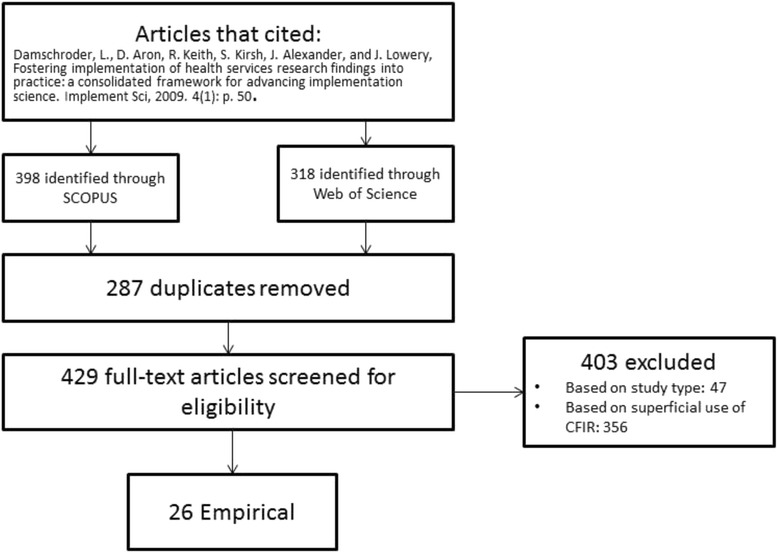
BACKGROUND: In 2009, Damschroder et al. developed the Consolidated Framework for Implementation Research (CFIR), which provides a comprehensive listing of constructs thought to influence implementation. This systematic review assesses the extent to which the CFIR's use in implementation research fulfills goals set forth by Damschroder et al. in terms of breadth of use, depth of application, and contribution to implementation research. METHODS: We searched Scopus and Web of Science for publications that cited the original CFIR publication by Damschroder et al. (Implement Sci 4:50, 2009) and downloaded each unique result for review. After applying exclusion criteria, the final articles were empirical studies published in peer-review journals that used the CFIR in a meaningful way (i.e., used the CFIR to guide data collection, measurement, coding, analysis, and/or reporting). A framework analysis approach was used to guide abstraction and synthesis of the included articles. RESULTS: Twenty-six of 429 unique articles (6 %) met inclusion criteria. We found great breadth in CFIR application; the CFIR was applied across a wide variety of study objectives, settings, and units of analysis. There was also variation in the method of included studies (mixed methods (n = 13); qualitative (n = 10); quantitative (n = 3)). Depth of CFIR application revealed some areas for improvement. Few studies (n = 3) reported justification for selection of CFIR constructs used; the majority of studies (n = 14) used the CFIR to guide data analysis only; and few studies investigated any outcomes (n = 11). Finally, reflections on the contribution of the CFIR to implementation research were scarce. CONCLUSIONS: Our results indicate that the CFIR has been used across a wide range of studies, though more in-depth use of the CFIR may help advance implementation science. To harness its potential, researchers should consider how to most meaningfully use the CFIR. Specific recommendations for applying the CFIR include explicitly justifying selection of CFIR constructs; integrating the CFIR throughout the research process (in study design, data collection, and analysis); and appropriately using the CFIR given the phase of implementation of the research (e.g., if the research is post-implementation, using the CFIR to link determinants of implementation to outcomes).
Overview
The claims and statistics of this paper haven’t been checked yet.
Free: it reads the open-access text and checks the first 5 claims that cite a source we can check. Create a free account to check every claim.
Integrity signals
Registry
Cites
Statistics
Figures
Verification
Claims the paper makes
The claims and statistics of this paper haven’t been checked yet.
Free: it reads the open-access text and checks the first 5 claims that cite a source we can check. Create a free account to check every claim.
Claims other papers make about this one
Each is checked against this paper’s own text: does it say what the citing paper says it does?
The cited source says what the claim attributes to it.
In the citing paper
“Kirk et al.’s 2015 review of 26 articles with meaningful use of the CFIR found that most users employed mixed (n = 13) or qualitative (n = 10) methods and used the CFIR in the post-implementation phase (n = 15) [13].”
From The updated consolidated framework for implementation research based on user feedback (2022) · cites this paper as [13]
The cited source says what the claim attributes to it.
In the citing paper
“Determinant frameworks can thus be used to inform choice of implementation strategies that may best address contextual determinants [14], generate hypotheses to prospectively guide predictions of implementation outcomes, or retrospectively explain implementation outcomes by assessing differences in determinants across implementation settings [11, 13, 15].”
From The updated consolidated framework for implementation research based on user feedback (2022) · cites this paper as [13]
The cited source says what the claim attributes to it.
In the citing paper
“The majority of CFIR users employ qualitative methods to assess constructs [13].”
From The updated consolidated framework for implementation research based on user feedback (2022) · cites this paper as [13]
The cited source says what the claim attributes to it.
In the citing paper
“In their systematic review of CFIR application, Kirk et al highlight gaps in depth of use of the framework, variation in selection of CFIR constructs, and a lack of justification of constructs used, limiting comparison of findings across time and contexts.14”
The cited source says what the claim attributes to it.
In the citing paper
“One indicator of this is a finding by Kirk et al: Among 26 research studies that meaningfully used CFIR, only two of the 26 included patients among their unit of analysis.14”
4 more claims about this paper
Create a free account to see every claim other papers make about this one.
Self-check
Percentages, sums and reported differences re-computed from the paper’s own numbers.
The self-check needs the paper’s full text.
Citations
Cites
Damschroder, L. J., Aron, D. C., Keith, R. E., Kirsh, S. R., Alexander, J. A., & Lowery, J. C. (2009) · Implementation Science · doi:10.1186/1748-5908-4-50 · Cited by 14,496 · cited 10×
“At the macro level, the CFIR provides a standardized structure for building on findings across studies [3].”
BackgroundMethodInfluentialSelf-citationGale, N. K., Heath, G., Cameron, E., Rashid, S., & Redwood, S. (2013) · BMC Medical Research Methodology · doi:10.1186/1471-2288-13-117 · Cited by 10,865 · cited 1×
“Objective 3: determine the contribution of the CFIR to implementation research General co posed by D • Cohere • Whethe • Whethe Microsoft Excel where content was arrayed in a matrix format consisting of rows (articles), columns (codes), and cells (summarized data) [8].”
BackgroundQualitative research practice: a guide for social science students and researchers
(2003) · Choice Reviews Online · doi:10.5860/choice.41-1319 · Cited by 10,543
Proctor, E., Silmere, H., Raghavan, R., Hovmand, P., Aarons, G., Bunger, A., Griffey, R., & Hensley, M. (2011) · Administration and Policy in Mental Health and Mental Health Services Research · doi:10.1007/s10488-010-0319-7 · Cited by 8,721 · cited 2×
“[25]), (2) provide clearer linkage of CFIR constructs with outcomes, and (3) provide clearer specification of which CFIR constructs were used to investigate outcomes.”
BackgroundComparison of PubMed, Scopus, Web of Science, and Google Scholar: strengths and weaknesses
Falagas, M. E., Pitsouni, E. I., Malietzis, G. A., & Pappas, G. (2008) · The FASEB Journal · doi:10.1096/fj.07-9492lsf · Cited by 5,039 · cited 1×
“, Google Scholar) [6].”
The Challenge of Innovation Implementation
Klein, K. J., & Sorra, J. S. (1996) · The Academy of Management Review · doi:10.2307/259164 · Cited by 2,113 · cited 1×
“Investigation of outcomes is critical for the field of implementation science overall because optimal implementation outcomes are a necessary condition for innovation effectiveness [25, 26].”
BackgroundFrench, S. D., Green, S. E., O’Connor, D. A., McKenzie, J. E., Francis, J. J., Michie, S., Buchbinder, R., Schattner, P., Spike, N., & Grimshaw, J. M. (2012) · Implementation Science · doi:10.1186/1748-5908-7-38 · Cited by 1,338 · cited 1×
“Better integration of the CFIR (or other theoretical framework) into empirical studies would help to address gaps in use of theory and advance implementation science [4, 31, 32].”
Kitson, A. L., Rycroft-Malone, J., Harvey, G., McCormack, B., Seers, K., & Titchen, A. (2008) · Implementation Science · doi:10.1186/1748-5908-3-1 · Cited by 1,314 · cited 1×
“earlier by developers of the PARIHS framework [27].”
MethodMeho, L. I., & Yang, K. (2007) · Journal of the American Society for Information Science and Technology · doi:10.1002/asi.20677 · Cited by 974
Damschroder, L. J., & Lowery, J. C. (2013) · Implementation Science · doi:10.1186/1748-5908-8-51 · Cited by 734
Self-citation
Cited by
Items 201–300 of 1,001
Geraldo, R. M., de Oliveira, J. C., Alexandre, L. S. C., Aguiar, M. R. D. A., Vieira, A. F. S., & Germani, A. C. C. G. (2022) · Ciência & Saúde Coletiva · doi:10.1590/1413-812320222710.08822022 · Cited by 33
Zhu, E. M., Buljac‐Samardžić, M., Ahaus, K., Sevdalis, N., & Huijsman, R. (2023) · Implementation Science · doi:10.1186/s13012-023-01314-y · Cited by 34
van der Westhuizen, C., Myers, B., Malan, M., Naledi, T., Roelofse, M., Stein, D. J., Lahri, S., & Sorsdahl, K. (2019) · PLOS ONE · doi:10.1371/journal.pone.0224951 · Cited by 32
“This approach has not been widely applied [38], as most studies using the CFIR identify barriers and facilitators to implementation, without linking the findings to implementation outcomes, such as adoption or appropriateness [38, 39].”
MethodEthnography and user-centered design to inform context-driven implementation
Haines, E. R., Kirk, M. A., Lux, L., Smitherman, A. B., Powell, B. J., Dopp, A. R., Stover, A. M., & Birken, S. A. (2021) · Translational Behavioral Medicine · doi:10.1093/tbm/ibab077 · Cited by 34
Self-citationCochran, G., Brown, J. L., Yu, Z., Frede, S. M., Bryan, M. A., Ferguson, A. M., Bayyari, N., Taylor, B., Snyder, M. E., Charron, E. M., et al. (2021) · Drug and Alcohol Dependence · doi:10.1016/j.drugalcdep.2021.109067 · Cited by 32
Madrigal, L., Manders, O. C., Kegler, M. C., Haardörfer, R., Piper, S., Blais, L. M., Weber, M. B., & Escoffery, C. (2022) · Implementation Science Communications · doi:10.1186/s43058-022-00350-x · Cited by 34
Adoption and Value of the Medicare Annual Wellness Visit: A Mixed-Methods Study
Hamer, M. K., DeCamp, M. W., Bradley, C. J., Nease, D. E., & Perraillon, M. C. (2023) · Medical Care Research and Review · doi:10.1177/10775587231166037 · Cited by 32
“(Kirk et al., 2015)”
Initial insights into the impact and implementation of Creating Active Schools in Bradford, UK
Morris, J. L., Chalkley, A. E., Helme, Z. E., Timms, O., Young, E., McLoughlin, G. M., Bartholomew, J. B., & Daly-Smith, A. (2023) · International Journal of Behavioral Nutrition and Physical Activity · doi:10.1186/s12966-023-01485-3 · Cited by 32
“Moreover, while CFIR is widely adopted in healthcare research (27–30), there has only been a limited use within whole-school physical activity and wellness programmes (31,32).”
BackgroundLowenthal, E. D., Chapman, J., Ohrenschall, R., Calabrese, K., Baltrusaitis, K., Heckman, B. E., Yin, D. E., Agwu, A. L., Harrington, C. M., Solingen-Ristea, R. M. V., et al. (2024) · The Lancet HIV · doi:10.1016/s2352-3018(23)00301-6 · Cited by 32
Krings, J. G., Sekhar, T. C., Chen, V., Blake, K., Sumino, K., James, A. S., Clover, A. K., Lenze, E. J., Brownson, R. C., & Castro, M. (2023) · The Journal of Allergy and Clinical Immunology In Practice · doi:10.1016/j.jaip.2023.05.023 · Cited by 31
“38,39 To ensure codebook integrity, 4 transcripts were reviewed together by J.G.K., T.C.S., and V.C. using this codebook, which was then deductively adapted on the basis of emergent themes before being considered final (see Table E4 in this article’s Online Repository at www.jaci-inpractice.org for…”
McKillop, A., Shaw, J., Sheridan, N., Gray, C. S., Carswell, P., Wodchis, W. P., Connolly, M. J., Denis, J., Baker, G. R., & Kenealy, T. W. (2017) · International Journal of Integrated Care · doi:10.5334/ijic.2516 · Cited by 32
“Reviews of the PARHIS framework [30] and CFIR [1, 32] indeed suggest that the strength of these models is their attention to the interplay of contextual factors, which may suggest an interpretivist approach.”
MethodInfluentialTeeters, L., Heerman, W. J., Schlundt, D. G., Harris, D., & Barkin, S. L. (2018) · Health Research Policy and Systems · doi:10.1186/s12961-017-0262-0 · Cited by 31
“The CFIR has also been used to drive data collection and analysis post implementation, with the aim of understanding practitioners’ experiences of the implementation of interventions [5].”
MethodNorman, Å., Nyberg, G., & Berlin, A. (2019) · PLoS ONE · doi:10.1371/journal.pone.0224512 · Cited by 31
“However, CFIR has been used widely within studies focusing on implementation of health interventions [40] in which an ecological underpinning is often essential to understanding the intervention context and target group.”
MethodWilcox, S., Jake‐Schoffman, D. E., Saunders, R. P., Kinnard, D., Kaczynski, A. T., Hutto, B., & James, K. L. (2020) · Translational Behavioral Medicine · doi:10.1093/tbm/ibaa025 · Cited by 31
“[17] and was designed a priori to apply the CFIR throughout the research process to better understand implementation in the faith-based setting.”
BackgroundMethodInfluentialAment, S. M. C., van den Broek, L. M., Everdingen, M. H. J. V. D. B.-V., Boyne, J. J., Maessen, J. M. C., Bekkers, S. C. A. M., Bellersen, L., Rocca, H. B., Engels, Y., & Janssen, D. J. A. (2022) · BMC Palliative Care · doi:10.1186/s12904-021-00896-y · Cited by 32
McLoughlin, G. M., Sweeney, R., Liechty, L., Lee, J. A., Rosenkranz, R. R., & Welk, G. J. (2022) · Frontiers in Health Services · doi:10.3389/frhs.2022.881639 · Cited by 31
“The Consolidated Framework for Implementation Research (CFIR) (27, 28), referred to as a determinants framework in the D&I literature, offers specific advantages for a more comprehensive analyses of factors influencing implementation of SWITCH.”
MethodKerins, C., McHugh, S., McSharry, J., Reardon, C. M., Hayes, C., Perry, I. J., Geaney, F., Seery, S., & Kelly, C. (2020) · International Journal of Behavioral Nutrition and Physical Activity · doi:10.1186/s12966-020-00948-1 · Cited by 30
“The CFIR provides a common language and clear consensual definitions which allows for comparison across diverse studies [49, 50].”
BackgroundDuran, A. T., Keener-DeNoia, A., Stavrolakes, K., Fraser, A., Blanco, L., Fleisch, E., Pieszchata, N., Cannone, D. E., McKay, C. K., Whittman, E., et al. (2023) · JMIR Formative Research · doi:10.2196/47264 · Cited by 31
Nnaji, C. A., Wiysonge, C. S., Okeibunor, J., Malinga, T., Adamu, A. A., Tumusiime, P., & Karamagi, H. C. (2021) · BMC Health Services Research · doi:10.1186/s12913-021-06449-6 · Cited by 31
“institutional leadership, financial incentives, clarity of goals as well as strong collaboration among stakeholders, are consistent with those reported in previous reviews [76, 78].”
ResultMelder, A., Robinson, T., McLoughlin, I. P., Iedema, R. A. M., & Teede, H. J. (2022) · BMC Health Services Research · doi:10.1186/s12913-022-07505-5 · Cited by 30
Taylor, C., Maben, J., Jagosh, J., Carrieri, D., Briscoe, S., Klepacz, N. A., & Mattick, K. L. (2024) · BMJ Quality & Safety · doi:10.1136/bmjqs-2023-016468 · Cited by 30
“Previous research with doctors 28 and evidence-based implementation science frameworks (eg, refs 135 136 ) suggest endorsement, expertise, engagement and evaluation are important factors for successful implementation.”
Bergström, H., Sundblom, E., Elinder, L. S., Norman, Å., & Nyberg, G. (2020) · The Journal of Primary Prevention · doi:10.1007/s10935-020-00584-2 · Cited by 31
“This is recommended by the developers of CFIR in order to promote the ability to compare research over time and across contexts (Kirk et al., 2016).”
BackgroundReanalysis of genomic data, how do we do it now and what if we automate it? A qualitative study
Fehlberg, Z., Stark, Z., & Best, S. (2024) · European Journal of Human Genetics · doi:10.1038/s41431-023-01532-4 · Cited by 29
“Whilst prospective use is less common [15] integrating context assessment and identi fi cation of barriers and facilitators using the CFIR throughout the implementation process can guide tailored implementation strategies.”
Pratt, R. J., Saman, D. M., Allen, C. I., Crabtree, B. F., Ohnsorg, K. A., Sperl‐Hillen, J. M., Harry, M. L., Henzler-Buckingham, H., O’Connor, P. J., & DESAI, J. R. (2022) · BMC Medical Informatics and Decision Making · doi:10.1186/s12911-021-01745-x · Cited by 30
Jahn, R., Ziegler, S., Nöst, S., Gewalt, S. C., Straßner, C., & Bozorgmehr, K. (2018) · Globalization and Health · doi:10.1186/s12992-018-0394-1 · Cited by 29
Calvert, H. G., Lane, H., Bejarano, C. M., Snow, K., Hoppe, K., Alfonsin, N., Turner, L. R., & Carlson, J. (2018) · Translational Behavioral Medicine · doi:10.1093/tbm/iby134 · Cited by 29
“, individual and organizational) of implementation contextual factors [28,29], evidence of explaining variation in implementation in previous work [30], relevance to setting/organizational-based interventions such as school PA, and familiarity among the investigators.”
BackgroundShidhaye, R. R., Murhar, V., Muke, S. S., Shrivastava, R., Khan, A., Singh, A., & Breuer, E. (2019) · BJPsych Open · doi:10.1192/bjo.2019.53 · Cited by 29
Christie, H. L., Boots, L. M. M., Peetoom, K. K. B., Tange, H. J., Verhey, F. R. J., & de Vugt, M. E. (2020) · JMIR Aging · doi:10.2196/18624 · Cited by 29
Dopp, A. R., Hunter, S. B., Godley, M. D., Pham, C., Han, B., Smart, R., Cantor, J., Kilmer, B., Hindmarch, G., González, I. E., et al. (2022) · Implementation Science Communications · doi:10.1186/s43058-022-00298-y · Cited by 28
“We will develop focus group facilitation guides based on a recent adaptation [96] of the Consolidated Framework for Implementation Research (CFIR [97, 98]) for policy implementation.”
MethodJayasinghe, K., Biroš, E., Harris, T., Wood, A., O’Shea, R., Hill, L., Fowles, L., Wardrop, L., Shalhoub, C., Hahn, D., et al. (2024) · Kidney International Reports · doi:10.1016/j.ekir.2024.04.068 · Cited by 28
Warner, G., Kervin, E. K., Pesut, B., Urquhart, R., Duggleby, W., & Hill, T. G. (2021) · BMC Health Services Research · doi:10.1186/s12913-020-06031-6 · Cited by 29
“’s [34] CFIR was chosen because it reflects an amalgamation of domains and constructs identified in prior studies, and is more appropriate than most frameworks or theories for assessing community and health system-level factors that affect implementation [35, 36].”
BackgroundMethodDepla, A. L., Crombag, N. M. T. H., Franx, A., & Bekker, M. N. (2021) · BMC Health Services Research · doi:10.1186/s12913-021-06121-z · Cited by 28
“The framework is widely used in implementation research and applies to each phase of implementation [23].”
MethodPedregosa-Fauste, S., Fabrellas, N., Risco, E., Pereira, M. R. P., Stefaniak, M., Şenuzun, F., Martin, S., & Zabalegui, A. (2021) · BMC Nursing · doi:10.1186/s12912-021-00576-5 · Cited by 28
“It is considered that use of the CFIR may help to advance implementation science [13, 14].”
BackgroundKang, E., & Foster, E. R. (2022) · Frontiers in Public Health · doi:10.3389/fpubh.2022.834473 · Cited by 29
“Complex interventions like MyGoals require tailored and effective strategies to enhance their implementation (17, 18).”
BackgroundPol-Castañeda, S., Rodríguez-Calero, M. Á., Gomila, C. J. V., Blanco‐Mavillard, I., Lallemand, C. Z., Ferrer-Cruz, F., & de Pedro‐Gómez, J. E. (2022) · BMC Nursing · doi:10.1186/s12912-022-01110-x · Cited by 28
Tjilos, M., Tamlyn, A. L., Ragan, E. J., Assoumou, S. A., Barnett, K. G., Martin, P., Perkins, R. B., Linas, B. P., & Drainoni, M. (2023) · BMC Public Health · doi:10.1186/s12889-023-15198-6 · Cited by 29
“While CFIR is traditionally used in implementation research [26], we used CFIR as a decision-making framework to inform implementation of future interventions to increase vaccination.”
MethodKnighton, A. J., Kean, J. T., Wolfe, D., Allen, L., Jacobs, J. R., Carpenter, L., Winberg, C., Berry, J. G., Peltan, I. D., Grissom, C. K., et al. (2020) · Implementation Science Communications · doi:10.1186/s43058-020-00057-x · Cited by 28
Gold, R. B., Bunce, A., Cowburn, S., Davis, J. V., Nelson, J. C., Nelson, C. A., Hicks, E. M., Cohen, D. J., Horberg, M. A., Melgar, G., et al. (2019) · Implementation Science · doi:10.1186/s13012-019-0948-5 · Cited by 27
“When applicable, results are presented along with the Consolidated Framework for Implementation Research (CFIR) categories with which they align, to enable their comparison to those of similar studies [44, 45].”
MethodDevi, R., Martin, G. P., Banerjee, J., Gladman, J. R. F., Dening, T., Barat, A., & Gordon, A. L. (2022) · BMJ Quality & Safety · doi:10.1136/bmjqs-2021-014345 · Cited by 27
“…study, the seven sustainability themes identified are consistent not only with constructs identified in the CFS but also with theories of implementation: for example, the Consol-idated Framework for Implementation Research, 22 Quality Implementation Framework 23 and Normalisation Process Theory.”
Ahuja, L., Price, A., Bramwell, C., Briscoe, S., Shaw, L., Nunns, M., O’Rourke, G., Baron, S., & Anderson, R. (2022) · The British Journal of Social Work · doi:10.1093/bjsw/bcac076 · Cited by 27
Alderson, H., Smart, D., Kerridge, G., Currie, G., Johnson, R., Kaner, E., Lynch, A., Munro, E. R., Swan, J. A., & McGovern, R. (2023) · Child & Family Social Work · doi:10.1111/cfs.12998 · Cited by 27
Ahumada‐Canale, A., Jeet, V., Bilgrami, A., Seil, E., Gu, Y., & Cutler, H. (2023) · Social Science & Medicine · doi:10.1016/j.socscimed.2023.115790 · Cited by 26
Bundy, Ł., Haardörfer, R., Kegler, M. C., Owolabi, S., Berg, C. J., Escoffery, C., Thompson, T., Mullen, P. D., Williams, R. S., Hovell, M., et al. (2018) · Nicotine & Tobacco Research · doi:10.1093/ntr/nty256 · Cited by 27
Shade, L. E., Ludden, T., Dolor, R. J., Halladay, J. R., Reeves, K. W., Rees, J. R., Hendrickson, L., Bray, P., & Tapp, H. (2019) · Journal of Asthma · doi:10.1080/02770903.2019.1702200 · Cited by 27
“One such metatheoretical framework used to measure implementation effectiveness is the Consolidated Framework for Implementation Research (CFIR) (12).”
MethodKempen, T. G. H., Kälvemark, A., Sawires, M., Stewart, D. C., & Gillespie, U. (2020) · European Journal of Clinical Pharmacology · doi:10.1007/s00228-020-02846-8 · Cited by 27
“The CFIR is a meta-theoretical framework that has been used in healthcare research to guide evaluation of implementation processes and help to explain outcomes in effectiveness studies [32].”
MethodMatlock, D. D., Fukunaga, M. I., Tan, A. S. L., Knoepke, C. E., McNeal, D. M., Mazor, K. M., & Glasgow, R. E. (2020) · MDM Policy & Practice · doi:10.1177/2381468320963070 · Cited by 27
“Many other models exist and have been applied to SDM and DAs including normalization process theory,(52) and the Consolidated Framework for Implementation Research (CFIR).(53) This article presents one example of the promise of the more general issue of integrating implementation science and health communication disci…”
MethodTumuhimbise, W., Theuring, S., Atukunda, E. C., Godfrey, M. R., Babirye, D., Kaggwa, F., Rogers, M., Gerald, K., Nuwematsiko, R., Wanyana, I., et al. (2025) · Discover Education · doi:10.1007/s44217-025-00793-z · Cited by 27
“The lack of theoretical frameworks for conducting and performing implementation research hinders the generalizability of the study findings [25].”
Wakefield, B. J., Drwal, K. R., Paez, M., Grover, S., Franciscus, C. L., Reisinger, H. S., Kaboli, P. J., & Accaoui, R. N. E. (2019) · BMC Cardiovascular Disorders · doi:10.1186/s12872-019-1224-y · Cited by 27
Brimblecombe, J. K., Miles, B., Chappell, E., Silva, K. D., Ferguson, M., Mah, C. L., Miles, E., Gunther, A., Wycherley, T. P., Peeters, A., et al. (2023) · International Journal of Behavioral Nutrition and Physical Activity · doi:10.1186/s12966-022-01377-y · Cited by 26
Wilson, H. K., Wieler, C., Bell, D. L., Bhattarai, A. P., Castillo‐Hernández, I. M., Williams, E. R., Evans, E. M., & Berg, A. C. (2023) · Prevention Science · doi:10.1007/s11121-023-01518-0 · Cited by 28
“To encourage comparability across translational studies of evidence-based programs and to meet the call for greater use of the Consolidated Framework for Implementation Research (CFIR) in implementation science, the Reach, Effectiveness, Adoption, Implementation, and Maintenance (RE-AIM) framework and the CFIR were se…”
MethodFahim, S. M., Alexander, C. S. W., Qian, J., Ngorsuraches, S., Hohmann, N. S., Lloyd, K. B., Reagan, A., Hart, L. D., McCormick, N. P., & Westrick, S. C. (2023) · Journal of the American Pharmacists Association · doi:10.1016/j.japh.2023.04.022 · Cited by 26
IMPLEMENTATION OF AN EVIDENCED‐BASED PARENTING PROGRAM IN A COMMUNITY MENTAL HEALTH SETTING
Ordway, M. R., McMahon, T. J., Kuhn, L. D. L. H., & Suchman, N. E. (2017) · Infant Mental Health Journal · doi:10.1002/imhj.21691 · Cited by 26
“The domains interact in an organizational framework to synthesize and build information about the “who, what, where, and with whom” influence implementation and implementation effectiveness (see Table 2) (Kirk et al., 2015).”
BackgroundStrehlenert, H., Hansson, J., Nyström, M. E., & Hasson, H. (2019) · BMC Health Services Research · doi:10.1186/s12913-019-4591-2 · Cited by 26
“fairly well-defined interventions in clinical settings [11].”
MethodDamush, T. M., Miech, E. J., Rattray, N. A., Homoya, B. J., Penney, L., Cheatham, A. J., Baird, S. A., Myers, J. L., Austin, C., Myers, L. J., et al. (2020) · Journal of General Internal Medicine · doi:10.1007/s11606-020-06100-w · Cited by 26
Chinman, M., Gellad, W. F., McCarthy, S., Gordon, A. J., Rogal, S. S., Mor, M. K., & Hausmann, L. R. M. (2019) · Implementation Science · doi:10.1186/s13012-019-0852-z · Cited by 27
“CFIR interview protocol The CFIR is a predominant framework in implementation science [32], containing a comprehensive listing of factors that have been shown to influence implementation of new programs and initiatives.”
MethodFernando, M., Abell, B., Tyack, Z. F., Donovan, T., McPhail, S., & Naicker, S. (2023) · Journal of Medical Internet Research · doi:10.2196/45163 · Cited by 27
“…when a theory, model, or framework has been applied to a study, theoretical constructs have been found to be chosen inappropriately [42], not adhered to when applied [43-45], and often applied retrospectively after implementation when many approaches are designed to be applied prospectively [46].”
BackgroundBest Practices in Organizing Digital Transformation: Qualitative Case Study in Dutch Hospital Care
Schiffelers, T., Kapteijns, K., Hochstenbach, L. M. J., Kietselaer, B., Talboom-Kamp, E. P. W. A., & Spreeuwenberg, M. D. (2025) · Journal of Medical Internet Research · doi:10.2196/63576 · Cited by 26
“Moreover, research has shown that cocreating with health care professionals can enhance the user-friendliness and acceptability of new digital health technologies [33].”
Rauner, Y., & Stummer, H. (2025) · Digital Business · doi:10.1016/j.digbus.2025.100135 · Cited by 28
Myall, M., May, C. R., Richardson, A. M., Bogle, S., Campling, N. C., Dace, S., & Lund, S. (2020) · Journal of Health Organization and Management · doi:10.1108/jhom-06-2020-0240 · Cited by 25
“It is characterised by complex connections, interdependencies and interactions, not only between human actors but also between actors and context that impact on change (Dopson et al., 2008; Pfadenhauer et al., 2017; Kirk et al., 2016; May et al., 2016).”
BackgroundSeljelid, B., Varsi, C., Nes, L. S., Øystese, K. A., & Børøsund, E. (2021) · Journal of Medical Internet Research · doi:10.2196/22399 · Cited by 25
Eapen, V., Woolfenden, S. R., Schmied, V. A., Jalaludin, B. B., Lawson, K. D., Liaw, S., Lingam, R., Page, A., Cibralic, S., Winata, T., et al. (2021) · BMC Health Services Research · doi:10.1186/s12913-021-07243-0 · Cited by 25
Eisman, A. B., Kiperman, S., Rupp, L. A., Kilbourne, A. M., & Palinkas, L. A. (2021) · Translational Behavioral Medicine · doi:10.1093/tbm/ibab162 · Cited by 26
Zhou, S., Ma, J., Dong, X., Li, N., Duan, Y., Wang, Z., Gao, L., Han, L., Tu, S., Liang, Z., et al. (2022) · Implementation Science · doi:10.1186/s13012-022-01207-6 · Cited by 25
“The CFIR is a determinant meta-theoretical framework that includes all constructs that interact across the implementation process and can be used to open the “black box” of implementation [31, 32].”
BackgroundFactors that influence the clinical supervision implementation for nurses: A scoping review
Ryu, H., Buus, N., Naccarella, L., Parkinson-Zarb, L., & Hamilton, B. E. (2024) · Journal of Advanced Nursing · doi:10.1111/jan.16390 · Cited by 25
“Since its inception, CFIR has been one of the most commonly used frameworks in implementation of healthcare delivery, quality improvement, and health promotion, spanning a wide variety of health-related topics (Kirk et al., 2016 ).”
Lauffenburger, J. C., Isaac, T., Trippa, L., Keller, P. A., Robertson, T., Glynn, R. J., Sequist, T. D., Kim, D. H., Fontanet, C. P., Castonguay, E. W. B., et al. (2021) · Implementation Science · doi:10.1186/s13012-020-01078-9 · Cited by 25
“We will also measure implementation outcomes informed by the RE-AIM and CFIR implementation frameworks to provide insight into its implementation and scalability to other healthcare settings [25, 47].”
MethodPithara, C., Farr, M., Sullivan, S. A., Edwards, H. B., Hall, W., Gadd, C., Walker, J., Hebden, N., & Horwood, J. (2020) · Journal of Medical Internet Research · doi:10.2196/14868 · Cited by 24
“The CFIR was then used as a framework to order codes [30,34], in line with the CFIR Qualitative Codebook Guidelines [35] to deepen our analysis, rather than impose deductive codes on the data.”
BackgroundMethodInfluentialMeasuring implementation: development of the implementation process assessment tool (IPAT)
Hartveit, M., Hovlid, E., Nordin, M. H. A., Øvretveit, J., Bond, G. R., Biringer, E., Assmus, J., Mariniusson, G. H., & Ruud, T. (2019) · BMC Health Services Research · doi:10.1186/s12913-019-4496-0 · Cited by 24
“Comprehensive frameworks, such as the CFIR [4], have been used to guide the exploration of implementation processes, but have still not been measured [12, 21] or only partly measured [22].”
BackgroundMethodWendt, J., Scheller, D. A., Flechtner‐Mors, M., Meshkovska, B., Łuszczyńska, A., Lien, N., Forberger, S., Banik, A., Łobczowska, K., & Steinacker, J. M. (2023) · Frontiers in Public Health · doi:10.3389/fpubh.2023.935292 · Cited by 25
“Although numerous frameworks exist for evaluating determinants for policies promoting physical activity (36), we chose the CFIR as it is one of the most widely used frameworks (37, 38), provides a detailed description of constructs (22), and has also been found to be applicable and appropriate for the school setting (…”
BackgroundMethodMulvale, G. M., McRae, S. A., & Milicic, S. (2017) · Implementation Science · doi:10.1186/s13012-017-0627-3 · Cited by 25
“Similarly, the CFIR framework points to characteristics of policy interventions that influence their implementation and that can be part of the policy dialogue discussions use of evidence, stakeholder representation and meeting environment, policy dialogues can encourage short-term individual capacities that include n…”
MethodInfluentialCiencias de la Implementación y Salud Mental: un Diálogo Urgente
Agudelo‐Hernández, F., & Andrade, R. M. R. (2021) · Revista Colombiana de Psiquiatría · doi:10.1016/j.rcp.2021.08.001 · Cited by 25
Framework for Research on Implementation of Process Redesigns
Ashok, M., Hung, D., Rojas-Smith, L., Halpern, M. T., & Harrison, M. (2018) · Quality Management in Health Care · doi:10.1097/qmh.0000000000000158 · Cited by 23
“The PR framework builds on the Consolidated Framework for Implementation Research (CFIR),(5) a popular framework that has been applied in many settings and interventions.(6) The CFIR brings together a set of key constructs, organized by domain, from a range of established implementation theories.”
MethodBartels, S. L., Johnsson, S. I., Boersma, K., Flink, I., McCracken, L. M., Petersson, S., Christie, H. L., Feldman, I., Simons, L. E., Onghena, P., et al. (2022) · BMJ Open · doi:10.1136/bmjopen-2021-059152 · Cited by 23
“44 45 Particularly, business modelling in the context of eHealth technologies can help to create a set of success factors that will influence uptake, sustainability and effectiveness.”
Fisher, O. J., Donahoo, C., Bosley, E., du Cloux, R., Garner, S., Powell, S., Pickard, J., Grevis-James, N. T., & Wyder, M. (2024) · Implementation Research and Practice · doi:10.1177/26334895231220259 · Cited by 23
“…(Westerlund, Nilsen and Sundberg, 2019) by using the Consolidated Framework for Implementation Research (CFIR), an evidence-based implementation science framework (Damschroder et al., 2009; Kirk et al., 2016), to identify implementation determinants of police mental health co-responder programs.”
MethodKrisnadewi, K. I., Kristina, S. A., Andayani, T. M., & Endarti, D. (2025) · Journal of Applied Pharmaceutical Science · doi:10.7324/japs.2024.194416 · Cited by 23
“The selection of CFIR domains is tailored to research objectives, as a systematic review has shown [13].”
White‐Traut, R. C., Brandon, D., Kavanaugh, K. L., Gralton, K. S., Pan, W., Myers, E. R., Andrews, B., Msall, M. E., & Norr, K. F. (2021) · BMC Pediatrics · doi:10.1186/s12887-021-02596-1 · Cited by 23
Valentini, J., Fröhlich, D., Stolz, R., Mahler, C., Martus, P., Klafke, N., Horneber, M., Frasch, J., Kramer, K., Bertz, H., et al. (2022) · BMJ Open · doi:10.1136/bmjopen-2021-055076 · Cited by 23
Trivedi, M. K., Hoque, S., Shillan, H. N., Seay, H., Spano, M. A., Gaffin, J. M., Phipatanakul, W., Rosal, M. C., Garg, A., Gerald, L. B., et al. (2022) · Implementation Science Communications · doi:10.1186/s43058-022-00283-5 · Cited by 23
Hatzikiriakidis, K., Ayton, D., O’Connor, A., Callaway, L., Carmody, S., Skouteris, H., & Green, R. (2023) · Disability and health journal · doi:10.1016/j.dhjo.2023.101442 · Cited by 23
Redesigning the Hospital Environment to Improve Restfulness
Catley, C. D., Paynter, K., Jackson, K., Huggins, A., Ji, J., Sanka, S. A., Simkins, M., Maddox, T. M., & Lyons, P. G. (2024) · JAMA Network Open · doi:10.1001/jamanetworkopen.2024.47790 · Cited by 24
Low, L. L., Rahim, I. A., Johari, M. Z., Abdullah, Z., Aziz, S. H. A., Suhaimi, N. A., Jaafar, N., Hanafiah, A. N. M., Kong, Y., Mahmud, S. H., et al. (2019) · BMC Health Services Research · doi:10.1186/s12913-019-4312-x · Cited by 24
Margolis, K. L., Crain, A. L., Bergdall, A. R., Beran, M., ANDERSON, J. P., Solberg, L. I., O’Connor, P. J., Sperl‐Hillen, J. M., Pawloski, P. A., Ziegenfuss, J. Y., et al. (2020) · Contemporary Clinical Trials · doi:10.1016/j.cct.2020.105939 · Cited by 22
Joudrey, P. J., Oldfield, B. J., Yonkers, K. A., O’Connor, P. G., Berland, G. K., & Edelman, E. J. (2020) · Drug and Alcohol Dependence · doi:10.1016/j.drugalcdep.2020.108090 · Cited by 24
“The CFIR contains five major constructs and has been used to support a consistent and systematic approach to evidence-based practice adoption across a variety of clinical settings (Kirk et al., 2015).”
Young, J. Q., Sugarman, R., Schwartz, J., & O’Sullivan, P. (2020) · Academic Medicine · doi:10.1097/acm.0000000000003543 · Cited by 23
Waid, J., & Choy-Brown, M. (2021) · Children and Youth Services Review · doi:10.1016/j.childyouth.2021.106098 · Cited by 24
DeSisto, C. L., Kroelinger, C. D., Estrich, C. G., Velonis, A., Uesugi, K., Goodman, D. A., Pliska, E. S., Akbarali, S., & Rankin, K. (2019) · Public Health Reports · doi:10.1177/0033354918824329 · Cited by 23
Hunter, S. B., Felician, M., Dopp, A. R., Godley, S. H., Pham, C., Bouskill, K., Slaughter, M. E., & Garner, B. R. (2020) · Journal of Substance Abuse Treatment · doi:10.1016/j.jsat.2020.107999 · Cited by 22
“The CFIR remains one of the most widely used and cited frameworks in implementation science to date (Kirk et al., 2016).”
MethodWeidler, E. M., Britto, M. T., & Sitzman, T. J. (2020) · The Cleft Palate-Craniofacial Journal · doi:10.1177/1055665620940187 · Cited by 22
“The facilitators and barriers to standardized outcome measurement identified in this study can be targeted by selecting specific evidence-based interventions to address each item (Grol and Wensing, 2005b; Powell et al., 2015; Kirk et al., 2016).”
BackgroundStakeholder perspectives on scaling up medical device reprocessing: A qualitative study
Hennein, R., Goddard, E., & Sherman, J. D. (2022) · PLoS ONE · doi:10.1371/journal.pone.0279808 · Cited by 22
“The Consolidated Framework for Implementation Research (CFIR) is widely used for characterizing constructs that influence the implementation of quality improvement initiatives [10, 11], such as MDR.”
MethodGil, N., Cox, A., Whitaker, K. L., & Kerrison, R. (2023) · Journal of Intellectual Disability Research · doi:10.1111/jir.13110 · Cited by 22
Yi, T. W., O’Hara, D. V., Smyth, B. J., Jardine, M., Levin, A., & Morton, R. L. (2023) · Canadian Journal of Kidney Health and Disease · doi:10.1177/20543581231217857 · Cited by 23
Regauer, V., Seckler, E., Campbell, C., Phillips, A., Rotter, T., Bauer, P., & Müller, M. (2021) · Implementation Science Communications · doi:10.1186/s43058-021-00222-w · Cited by 23
Hahn, E. E., Munoz‐Plaza, C. E., Altman, D. E., Hsu, C., Cannizzaro, N. T., Ngo‐Metzger, Q., Wride, P., Gould, M. K., Mittman, B. S., Hodeib, M., et al. (2021) · Implementation Science Communications · doi:10.1186/s43058-021-00211-z · Cited by 23
Implementation of a diabetes prevention program within two community sites: a qualitative assessment
Dineen, T. E., Bean, C. N., & Jung, M. E. (2022) · Implementation Science Communications · doi:10.1186/s43058-022-00258-6 · Cited by 22
“In 2015, a systematic review identified 429 unique articles referencing the framework; however, the authors, including the author of the CFIR framework, stated only 6% of studies used CFIR in a meaningful manner [17].”
BackgroundMethodInfluentialQuality and Performance Measurement in Primary Diabetes Care: A Qualitative Study in Urban China
Rasooly, A., Pan, Y., Tang, Z., He, J., Ellen, M., Manor, O., Hu, S., & Davidovitch, N. (2022) · International Journal of Health Policy and Management · doi:10.34172/ijhpm.2022.6372 · Cited by 22
Ciencias de la implementación: de la evidencia a la práctica
Suárez‐Obando, F., Gómez–Restrepo, C., & Castro, S. (2017) · Acta Médica Colombiana · doi:10.36104/amc.2018.1054 · Cited by 23
Westerlund, A., Ivarsson, A., & Sundberg, L. R. (2020) · Scandinavian Journal of Caring Sciences · doi:10.1111/scs.12859 · Cited by 22
Cole, C. B., Pacca, J., Mehl, A., Tomasulo, A., van der Veken, L., Viola, A., & Ridde, V. (2018) · Reproductive Health · doi:10.1186/s12978-018-0574-8 · Cited by 21
“The lead author and an additional analyst who did not participate directly in data collection were responsible for applying CFIR domains for deductive coding, for inductively identifying emerging themes, and for developing a codebook and corresponding code-tree with descriptions of all codes and sub-codes [30, 31].”
BackgroundMethodFrech, S., Doherty, R. M., Duque, M., Ramírez, Ó., Pomata, A., Samudio, A., Antwi, O.-A., Htun, Y. Y., Mra, R., Htoon, P. T., et al. (2021) · JCO Global Oncology · doi:10.1200/go.20.00606 · Cited by 21
“For example, the Consolidated Framework for Implementation Research has been widely used,(3) but a critical review determined that many initiatives used the framework mainly as a tool to guide data analysis rather than informing the design and development of health initiatives.(4) A specific framework for strategic im…”
MethodSmith, A. W., DiMartino, L., Garcia, S. F., Mitchell, S. A., Ruddy, K. J., Smith, J. D., Wong, S. L., Cahue, S., Cella, D. F., Jensen, R. E., et al. (2023) · JNCI Cancer Spectrum · doi:10.1093/jncics/pkad073 · Cited by 21
La implementación de las políticas públicas en salud: revisión narrativa de modelos para su análisis
Núñez, L. P. C., & Martínez, G. M. (2023) · Salud Uninorte · doi:10.14482/sun.39.03.258.963 · Cited by 21
“El Marco Consolidado para la Investigación de Implementación (CFIR por sus siglas en inglés “Consolidated Framework for Implementation Research”) fue publicado en un artículo de 2009; de acuerdo con Damschroder et al., es un marco referencial meta-teórico pragmático que puede ser usado para complementar teorías de pro…”
Metadata
- Authors
- Kirk, M. A., Kelley, C., Yankey, N., Birken, S. A., Abadie, B., & Damschroder, L.
- Affiliations
- University of North Carolina at Chapel Hill (US)
- VA Ann Arbor Healthcare System (US)
- Eastern Michigan University (US)
- Corresponding author
- Kirk, M. Alexis
- Venue
- Implementation Science
- Published
- 2015-12
- Volume
- 11
- Issue
- 1
- Pages
- 72-72
- ISSN
- 1748-5908 (ISSN-L)
- PMC
- PMC4869309
- OpenAlex
- W2398003476
- Semantic Scholar
- c8757b9931f0128e029ff09f1d76564f0b0c686b
- Cited by
- 1,496
- References
- 45
- Citations by year
- 2026: 160 · 2025: 173 · 2024: 236 · 2023: 209 · 2022: 213 · 2021: 182 · 2020: 151 · 2019: 87 · 2018: 40 · 2017: 38 · 2016: 4 · 2015: 2
- FWCI
- 5.03
- Type
- journal article
- Language
- en
- Open access
- gold
- doi.org
- Licence
- cc-by
- Locations
- Implementation Science (publishedVersion, cc-by)
- PubMed Central (publishedVersion, cc-by)
- PubMed (publishedVersion)
- Carolina Digital Repository (University of North Carolina at Chapel Hill) (submittedVersion)
- Funders
- RTI International (NA)
- Topics
- Health Sciences › Health Professions › General Health Professions › Health Policy Implementation Science
- Health Sciences › Health Professions › General Health Professions › Health Sciences Research and Education
- Health Sciences › Medicine › Public Health, Environmental and Occupational Health › Clinical practice guidelines implementation
- Keywords
- Consolidated Framework for Implementation Research, implementation research, implementation factors, implementation outcomes
- MeSH terms
- Goals, Health Plan Implementation, Health Services Research, Humans
About these checks
Registry, retraction, Cites and statistics results are computed, not judged, with one exception: a printed reference that no index lists is read once by a model before it counts as a citation error. Claims are extracted by a model and kept only when their quote appears verbatim in the text; each cited source is then checked, with a model’s help, for whether it says what the claim relies on. Those verdicts can be wrong — read the claim’s quote and the cited source before relying on one.
Statistics and arithmetic are recomputed, not judged.
Confidence bands are shown only for fields calibrated on our annotated test set. None is calibrated yet, so no band is shown.
What counts as a claim ›How we measure confidence ›How we check this ›
Are you an author, or do you see a problem with this page? Request a review
Data sources
Bibliographic data: Semantic Scholar, OpenAlex, Crossref.
Contains information from the Semantic Scholar Academic Graph Datasets, made available under the ODC Attribution License (ODC-BY 1.0).
Semantic Scholar’s data is described in: Kinney, R., et al. (2023). The Semantic Scholar Open Data Platform. arXiv:2301.10140.
