

A systematic review of the use of the Consolidated Framework for Implementation Research
Open accessThe DOI matches its Crossref record; 44 of the 45 references it cites were found in a registry or an index.
Abstract
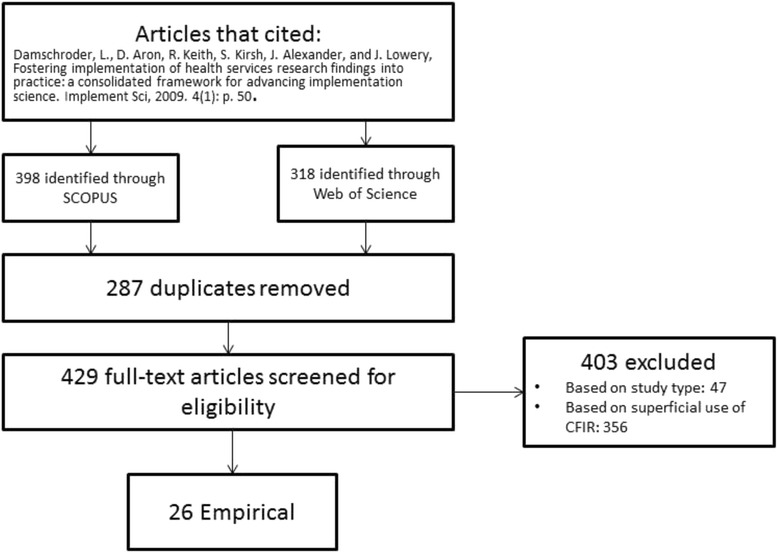
BACKGROUND: In 2009, Damschroder et al. developed the Consolidated Framework for Implementation Research (CFIR), which provides a comprehensive listing of constructs thought to influence implementation. This systematic review assesses the extent to which the CFIR's use in implementation research fulfills goals set forth by Damschroder et al. in terms of breadth of use, depth of application, and contribution to implementation research. METHODS: We searched Scopus and Web of Science for publications that cited the original CFIR publication by Damschroder et al. (Implement Sci 4:50, 2009) and downloaded each unique result for review. After applying exclusion criteria, the final articles were empirical studies published in peer-review journals that used the CFIR in a meaningful way (i.e., used the CFIR to guide data collection, measurement, coding, analysis, and/or reporting). A framework analysis approach was used to guide abstraction and synthesis of the included articles. RESULTS: Twenty-six of 429 unique articles (6 %) met inclusion criteria. We found great breadth in CFIR application; the CFIR was applied across a wide variety of study objectives, settings, and units of analysis. There was also variation in the method of included studies (mixed methods (n = 13); qualitative (n = 10); quantitative (n = 3)). Depth of CFIR application revealed some areas for improvement. Few studies (n = 3) reported justification for selection of CFIR constructs used; the majority of studies (n = 14) used the CFIR to guide data analysis only; and few studies investigated any outcomes (n = 11). Finally, reflections on the contribution of the CFIR to implementation research were scarce. CONCLUSIONS: Our results indicate that the CFIR has been used across a wide range of studies, though more in-depth use of the CFIR may help advance implementation science. To harness its potential, researchers should consider how to most meaningfully use the CFIR. Specific recommendations for applying the CFIR include explicitly justifying selection of CFIR constructs; integrating the CFIR throughout the research process (in study design, data collection, and analysis); and appropriately using the CFIR given the phase of implementation of the research (e.g., if the research is post-implementation, using the CFIR to link determinants of implementation to outcomes).
Overview
The claims and statistics of this paper haven’t been checked yet.
Free: it reads the open-access text and checks the first 5 claims that cite a source we can check. Create a free account to check every claim.
Integrity signals
Registry
Cites
Statistics
Figures
Verification
Claims the paper makes
The claims and statistics of this paper haven’t been checked yet.
Free: it reads the open-access text and checks the first 5 claims that cite a source we can check. Create a free account to check every claim.
Claims other papers make about this one
Each is checked against this paper’s own text: does it say what the citing paper says it does?
The cited source says what the claim attributes to it.
In the citing paper
“Kirk et al.’s 2015 review of 26 articles with meaningful use of the CFIR found that most users employed mixed (n = 13) or qualitative (n = 10) methods and used the CFIR in the post-implementation phase (n = 15) [13].”
From The updated consolidated framework for implementation research based on user feedback (2022) · cites this paper as [13]
The cited source says what the claim attributes to it.
In the citing paper
“Determinant frameworks can thus be used to inform choice of implementation strategies that may best address contextual determinants [14], generate hypotheses to prospectively guide predictions of implementation outcomes, or retrospectively explain implementation outcomes by assessing differences in determinants across implementation settings [11, 13, 15].”
From The updated consolidated framework for implementation research based on user feedback (2022) · cites this paper as [13]
The cited source says what the claim attributes to it.
In the citing paper
“The majority of CFIR users employ qualitative methods to assess constructs [13].”
From The updated consolidated framework for implementation research based on user feedback (2022) · cites this paper as [13]
The cited source says what the claim attributes to it.
In the citing paper
“In their systematic review of CFIR application, Kirk et al highlight gaps in depth of use of the framework, variation in selection of CFIR constructs, and a lack of justification of constructs used, limiting comparison of findings across time and contexts.14”
The cited source says what the claim attributes to it.
In the citing paper
“One indicator of this is a finding by Kirk et al: Among 26 research studies that meaningfully used CFIR, only two of the 26 included patients among their unit of analysis.14”
4 more claims about this paper
Create a free account to see every claim other papers make about this one.
Self-check
Percentages, sums and reported differences re-computed from the paper’s own numbers.
The self-check needs the paper’s full text.
Citations
Cites
Damschroder, L. J., Aron, D. C., Keith, R. E., Kirsh, S. R., Alexander, J. A., & Lowery, J. C. (2009) · Implementation Science · doi:10.1186/1748-5908-4-50 · Cited by 14,496 · cited 10×
“At the macro level, the CFIR provides a standardized structure for building on findings across studies [3].”
BackgroundMethodInfluentialSelf-citationGale, N. K., Heath, G., Cameron, E., Rashid, S., & Redwood, S. (2013) · BMC Medical Research Methodology · doi:10.1186/1471-2288-13-117 · Cited by 10,865 · cited 1×
“Objective 3: determine the contribution of the CFIR to implementation research General co posed by D • Cohere • Whethe • Whethe Microsoft Excel where content was arrayed in a matrix format consisting of rows (articles), columns (codes), and cells (summarized data) [8].”
BackgroundQualitative research practice: a guide for social science students and researchers
(2003) · Choice Reviews Online · doi:10.5860/choice.41-1319 · Cited by 10,543
Proctor, E., Silmere, H., Raghavan, R., Hovmand, P., Aarons, G., Bunger, A., Griffey, R., & Hensley, M. (2011) · Administration and Policy in Mental Health and Mental Health Services Research · doi:10.1007/s10488-010-0319-7 · Cited by 8,721 · cited 2×
“[25]), (2) provide clearer linkage of CFIR constructs with outcomes, and (3) provide clearer specification of which CFIR constructs were used to investigate outcomes.”
BackgroundComparison of PubMed, Scopus, Web of Science, and Google Scholar: strengths and weaknesses
Falagas, M. E., Pitsouni, E. I., Malietzis, G. A., & Pappas, G. (2008) · The FASEB Journal · doi:10.1096/fj.07-9492lsf · Cited by 5,039 · cited 1×
“, Google Scholar) [6].”
The Challenge of Innovation Implementation
Klein, K. J., & Sorra, J. S. (1996) · The Academy of Management Review · doi:10.2307/259164 · Cited by 2,113 · cited 1×
“Investigation of outcomes is critical for the field of implementation science overall because optimal implementation outcomes are a necessary condition for innovation effectiveness [25, 26].”
BackgroundFrench, S. D., Green, S. E., O’Connor, D. A., McKenzie, J. E., Francis, J. J., Michie, S., Buchbinder, R., Schattner, P., Spike, N., & Grimshaw, J. M. (2012) · Implementation Science · doi:10.1186/1748-5908-7-38 · Cited by 1,338 · cited 1×
“Better integration of the CFIR (or other theoretical framework) into empirical studies would help to address gaps in use of theory and advance implementation science [4, 31, 32].”
Kitson, A. L., Rycroft-Malone, J., Harvey, G., McCormack, B., Seers, K., & Titchen, A. (2008) · Implementation Science · doi:10.1186/1748-5908-3-1 · Cited by 1,314 · cited 1×
“earlier by developers of the PARIHS framework [27].”
MethodMeho, L. I., & Yang, K. (2007) · Journal of the American Society for Information Science and Technology · doi:10.1002/asi.20677 · Cited by 974
Damschroder, L. J., & Lowery, J. C. (2013) · Implementation Science · doi:10.1186/1748-5908-8-51 · Cited by 734
Self-citation
Cited by
Items 401–500 of 1,001
Nyantakyi, E., Baenziger, J., Caci, L., Blum, K., Wolfensberger, A., Dramowski, A., Albers, B., Castro, M., Schultes, M.-T., & Clack, L. (2025) · Antimicrobial Resistance and Infection Control · doi:10.1186/s13756-025-01516-7 · Cited by 15
Dadgostar, P., Qin, Q., Cui, S., Ashcraft, L. E., & Nooraie, R. Y. (2025) · Journal of Medical Internet Research · doi:10.2196/57370 · Cited by 15
“This is a frequent limitation in dissemination research [1,81,82].”
Sala, D. C. P., Tanaka, O. Y., Luz, R. A., Balsanelli, A. P., Venâncio, S. I., Louvison, M. C. P., & Baumann, A. A. (2025) · BMC Public Health · doi:10.1186/s12889-025-22889-9 · Cited by 16
“The wide variety of determinants for implementing evidence-based practices identified in this study is relatively common in the literature [113].”
Callaghan‐Koru, J. A., Islam, M., Khan, M. A., Sowe, A., Islam, J., Mannan, I. I., George, J., & The Bangladesh Chlorhexidine Scale Up Study Group (2020) · Health Policy and Planning · doi:10.1093/heapol/czz156 · Cited by 15
Costa, L., Bobay, K. L., Hughes, R. G., Bahr, S. J., Siclovan, D. M., Nuccio, S. A., & Weiss, M. (2020) · Nursing Outlook · doi:10.1016/j.outlook.2020.07.005 · Cited by 15
“Innovations included health care delivery and process re-design, health promotion and disease management (Hill et al. 2018; Kirk et al., 2015).”
BackgroundMethodInfluentialPaciocco, S., Kothari, A. R., Licskai, C. J., Ferrone, M., & Sibbald, S. L. (2021) · BMC Health Services Research · doi:10.1186/s12913-021-06636-5 · Cited by 15
Jorgenson, A., Luz, R. A., Juskevicius, L. F., Padoveze, M. C., & Price, L. (2022) · Nurse Researcher · doi:10.7748/nr.2022.e1827 · Cited by 15
Operational challenges that may affect implementation of evidence-based mobile market interventions
Kasprzak, C., Lally, A., Schoonover, J. J., Gallicchio, D., Haynes‐Maslow, L., Vermont, L. N., Ammerman, A. S., Raja, S., Tumiel‐Berhalter, L., Tirabassi, J., et al. (2022) · BMC Public Health · doi:10.1186/s12889-022-13207-8 · Cited by 15
Perinatal Women’s Views of Pharmacist-Delivered Perinatal Depression Screening: A Qualitative Study
Pham, L., Moles, R. J., O’Reilly, C. L., Carter, S., Raynes‐Greenow, C. H., Chen, T. F., Raduescu, C., Randall, S., Bloomfield, J. G., Strowel, C., et al. (2022) · International Journal of Environmental Research and Public Health · doi:10.3390/ijerph192316295 · Cited by 15
Doorenbos, A. Z., Schlaeger, J. M., deMartelly, V. A., Burke, L., Boyd, A. D., Knisely, M. R., Leigh, J. W., Li, H., Mandernach, M. W., Molokie, R. E., et al. (2023) · Contemporary Clinical Trials Communications · doi:10.1016/j.conctc.2023.101076 · Cited by 15
“questions that reflect the five domains and select constructs of the Consolidated Framework for Implementation Research (CFIR) to capture experiences related to the use and implementation of the 2 CIH therapies [60,61].”
Barwick, M. A., Brown, J., Petricca, K., Stevens, B., Powell, B. J., Jaouich, A., Shakespeare, J., & Seto, E. (2023) · Implementation Science Communications · doi:10.1186/s43058-023-00402-w · Cited by 16
“CFIR has been extensively studied in various contexts [85–88], including the study of eHealth technology implementation [89].”
BackgroundHamilton, A. B., Finley, E. P., Bean‐Mayberry, B., Lang, A. J., Haskell, S. G., Moin, T., Farmer, M. M., & the EMPOWER QUERI Team (2023) · Implementation Science Communications · doi:10.1186/s43058-022-00389-w · Cited by 15
Lin, F. F., Chen, Y., Rattray, M., Murray, L., Jacobs, K., Brailsford, J., Free, P., Garrett, P., Tabah, A., & Ramanan, M. (2024) · Intensive and Critical Care Nursing · doi:10.1016/j.iccn.2024.103688 · Cited by 15
Sullivan, J. L., Montano, A.-R. L., Hughes, J. M., Davila, H. W., O’Malley, K. A., Engle, R. L., Hawley, C. E., Shin, M. H., Smith, J. G., & Pimentel, C. B. (2022) · The Gerontologist · doi:10.1093/geront/gnac096 · Cited by 15
The Translational Science Spectrum
McCartney, P. R. (2021) · Journal of Obstetric, Gynecologic & Neonatal Nursing · doi:10.1016/j.jogn.2021.09.007 · Cited by 15
Adametz, L., Richter, F., Mühleck, J., Wick, K., Strauss, B. M., & Berger, U. (2017) · PPmP - Psychotherapie · Psychosomatik · Medizinische Psychologie · doi:10.1055/s-0043-117878 · Cited by 15
“[24] Kirk MA, Kelley C, Yankey N et al.”
BackgroundTinc, P. J., Sorensen, J. A., & Lindvall, K. (2020) · SAGE Open · doi:10.1177/2158244020932515 · Cited by 14
“Although the CFIR’s use has been well-documented within clinical medicine, fewer studies have explored its utility in public health; even fewer have explored implementation efforts within occupational safety and health using the CFIR (CFIR Research Team, 2019; Kirk et al., 2016).”
MethodStakeholder perspectives around post-TB wellbeing and care in Kenya and Malawi
Karanja, S., Malenga, T., Mphande, J., Squire, S. B., Muhwa, J. C., Tomeny, E., Roșu, L., Mulupi, S., Wingfield, T., Zulu, E. M., et al. (2022) · PLOS Global Public Health · doi:10.1371/journal.pgph.0000510 · Cited by 14
Haun, J. N., Melillo, C., Schneider, T., McDaniel, J. T., McMahon-Grenz, J., Benzinger, R. C., Nakase‐Richardson, R., Pugh, M. J., Skop, K. M., Friedman, Y., et al. (2024) · Journal of Head Trauma Rehabilitation · doi:10.1097/htr.0000000000000988 · Cited by 14
Durojaiye, C., Prausnitz, S. R., Schneider, J. L., Lieu, T. A., Schmittdiel, J. A., Rouillard, S., Chen, Y., Lee, K., & Corley, D. A. (2024) · BMC Health Services Research · doi:10.1186/s12913-024-11803-5 · Cited by 14
“CFIR’s framework can evaluate implementation before, during, or after project completion [18, 19, 24].”
Aldridge, G., Reupert, A., Wu, L., Seguin, J. P., Olivier, P. L., Pringle, G., & Yap, M. B. H. (2024) · International Journal of Environmental Research and Public Health · doi:10.3390/ijerph21121599 · Cited by 14
Bierbaum, M., Ying-hua, Y., Molloy, C. J., Bowditch, L., Salmon, P. M., Middleton, S., Braithwaite, J., & Hibbert, P. D. (2025) · Frontiers in Health Services · doi:10.3389/frhs.2025.1645575 · Cited by 16
Kowalkowski, M. A., Eaton, T. A., McWilliams, A. D., Tapp, H., Rios, A., Murphy, S., Burns, R., Gutnik, B., O’Hare, K., McCurdy, L., et al. (2021) · BMC Health Services Research · doi:10.1186/s12913-021-06521-1 · Cited by 14
“CFIR Consolidated Framework for Implementation Research and epidemiology.”
MethodInfluentialPerformance Evaluation of Lateral Flow Assays for Coronavirus Disease-19 Serology
Ochola, L. B., Ogongo, P., Mbugua, S. M., Gitaka, J., & Suliman, S. (2021) · Clinics in Laboratory Medicine · doi:10.1016/j.cll.2021.10.005 · Cited by 14
“Decentralized administration of serologic tests raises important concerns about the accuracy of these platforms, subsequent interpretation of test results by both providers and end-users,(123) and their suitability for different implementation scenarios.(124) These considerations are summarized in Table 2.”
BackgroundReid, H., Proeschold‐Bell, R. J., Makarushka, C., Vega, K. D. M., Huchko, M. J., Jerónimo, J., & Vasudevan, L. (2022) · JMIR Formative Research · doi:10.2196/32577 · Cited by 14
Wess, T., Steiner, W., Dür, M., & Janssen, J. (2022) · BMC Health Services Research · doi:10.1186/s12913-022-08355-x · Cited by 14
“the use of the CFIR has been common since its development in 2009 and it is recommended to integrate the framework throughout the whole research and implementation process [19].”
MethodHashad, N., Stewart, D. C., Perumal, D., Abdulrazzaq, N. M., & Tonna, A. P. (2022) · Journal of Hospital Infection · doi:10.1016/j.jhin.2022.08.005 · Cited by 14
“…maintenance of pre-pandemic ASP activities, including adapting the reporting infrastructure (e.g. adopting digital systems with evolution of paper forms to online pre-authorization forms to facilitate antimicrobial authorization) (Table S2, Quotes 21 and 22, see online supplementary material).”
InfluentialHodgins, M., Ostojic, K., Hu, N., Lawson, K. D., Samir, N., Webster, A., Rogers, H. J., Henry, A., Murphy, E., Lingam, R., et al. (2022) · BMJ Open · doi:10.1136/bmjopen-2022-061002 · Cited by 14
DNP-PhD Collaboration in NINR-Funded Physical Activity Trials: A Series of Case Studies
Halloway, S., Buchholz, S. W., Odiaga, J. A., Bavis, M. P., Lemke, S., Cygan, H., Kalensky, M., Pelt, P. P., Braun, L. T., Tafini, S., et al. (2023) · Western Journal of Nursing Research · doi:10.1177/01939459231168699 · Cited by 14
Cuba, L., Schlichtig, K., Dürr, P., Inwald, E. C., Fromm, M. F., & Dörje, F. (2023) · Healthcare · doi:10.3390/healthcare11111640 · Cited by 14
“, using the validated German CFIR version [32] and a systematic review [33]) for developing our semi-structured interview questions and the selected CFIR (sub-)constructs [31] is displayed in Figure 4.”
BackgroundMethodKip, H., Buitelaar-Huijsse, G. K. G., Kouijzer, M. M. T. E., & Kelders, S. M. (2023) · Global Implementation Research and Applications · doi:10.1007/s43477-023-00101-7 · Cited by 14
“They can support researchers in taking all relevant implementation domains into account and prevent a focus on one implementation level, such as therapists or the intervention, and can support implement-ers in adopting a systematic, theory-based approach towards implementation (Kirk et al., 2015).”
Butscher, F., Ellinger, J., Singer, M., & Mall, C. (2024) · Implementation Science Communications · doi:10.1186/s43058-024-00548-1 · Cited by 15
“Because a wide variety of implementation frameworks exists [92, 93], this review also facilitates standardization and an increase in comparability of results in implementation research in general [94] and for school-based obesity-targeting interventions specifically, using CFIR.”
MethodOtani, V. H. O., Novaes, R. A. C. B., Pedron, J., Nabhan, P. C., Rodrigues, T. M., Chiba, R., Guedes, J. V. C., Marques, L. M., & Vissoci, J. R. N. (2024) · Frontiers in Psychiatry · doi:10.3389/fpsyt.2024.1297332 · Cited by 14
“In this context, the method presented in this paper aims to create a protocol in six steps for developing an intervention via TTRPGs, guided by the Consolidated Framework for Implementation Research (CFIR).”
MethodInfluentialGäbler, G., Coenen, M., Fohringer, K., Trauner, M., & Stamm, T. (2019) · BMC Health Services Research · doi:10.1186/s12913-019-4600-5 · Cited by 14
Atkins, D. L., Wagner, A. D., Zhang, J., Njuguna, I. N., Neary, J., Omondi, V. O., Otieno, V. A., Ondenge, K., Wamalwa, D. C., John-Stewart, G. C., et al. (2020) · JAIDS Journal of Acquired Immune Deficiency Syndromes · doi:10.1097/qai.0000000000002323 · Cited by 14
Research into ageing and frailty
Gordon, A. L., Witham, M. D., Henderson, E. J., Harwood, R., & Masud, T. (2021) · Future Healthcare Journal · doi:10.7861/fhj.2021-0088 · Cited by 14
Goff, D. L., Barais, M., Perraud, G., Derriennic, J., Aujoulat, P., Guillou-Landréat, M., & Reste, J. Y. L. (2021) · BMC Public Health · doi:10.1186/s12889-021-11443-y · Cited by 16
Lin, J. L., Huber, B., Amir, O., Gehrmann, S., Ramirez, K. S., Ochoa, K. M., Asch, S. M., Gajos, K. Z., Grosz, B. J., & Sanders, L. (2022) · Journal of Medical Internet Research · doi:10.2196/30902 · Cited by 14
“We selected a 3-phase approach, as the application of implementation science throughout intervention development is associated with increased success of implementation [18].”
Sloboda, Z., Johnson, K., Fishbein, D. H., Brown, C. H., Coatsworth, J. D., Fixsen, D. L., Kandel, D. B., Paschall, M. J., Silva, F. S., Sumnall, H. R., et al. (2023) · Prevention Science · doi:10.1007/s11121-023-01532-2 · Cited by 14
Amador, S., Rapaport, P., Lang, I., Sommerlad, A., Mukadam, N., Stringer, A., Hart, N., Nurock, S., & Livingston, G. (2021) · PLOS ONE · doi:10.1371/journal.pone.0250410 · Cited by 13
Vaitheswaran, S., Currie, G., Dhandapani, V. R., Mohan, G., Rangaswamy, T., & Preet Singh, S. (2021) · SSM - Mental Health · doi:10.1016/j.ssmmh.2021.100018 · Cited by 13
Stakeholders’ Views on Reducing Psychological Distress in Chronic Obstructive Pulmonary Disease
Hart, J. L., Hong, D., Summer, A., & Schnoll, R. A. (2021) · Journal of Pain and Symptom Management · doi:10.1016/j.jpainsymman.2021.06.021 · Cited by 13
Kerkhoff, A. D., Muiruri, C., Geng, E., & Hickey, M. D. (2022) · Current Opinion in HIV and AIDS · doi:10.1097/coh.0000000000000776 · Cited by 14
“44 www.co-hivandaids.com Copyright © 2022 Wolters Kluwer H 46.”
BackgroundInfluentialMakovec, U. N., Tomsic, T., Kos, M., Ignjatovic, T. S., & Susič, A. P. (2023) · BMC Family Practice · doi:10.1186/s12875-022-01963-w · Cited by 13
“Although, the main characteristics and objectives of the CMR are often similar [2, 6, 7], factors like the differences in healthcare system, perception of the pharmacist role in patient care, professional development background, reimbursement of the service might influence the implementation and sustainability of the…”
BackgroundAdamu, A. A., Jalo, R. I., Ndwandwe, D. E., & Wiysonge, C. S. (2024) · Vaccines · doi:10.3390/vaccines12020111 · Cited by 13
“The consolidated framework for implementation research (CFIR) is a well-validated determinants framework that has been widely used to evaluate health interventions [22,23].”
MethodBosch, N. M., Kalkdijk-Dijkstra, A. J., Broens, P. M. A., van Westreenen, H. L., Pierie, J.-P. E. N., Klarenbeek, B. R., Heijden, J. V. D., & on behalf of the FORCE trial group (2024) · PLoS ONE · doi:10.1371/journal.pone.0301518 · Cited by 13
“This study represents a qualitative follow-up study of the FORCE trial, utilizing the Consoli-dated Framework for Implementation Research (CFIR) [13] for data collection and analysis.”
MethodPepping, R. M. C., Vos, R. C., Numans, M. E., Kroon, I., Rappard, K., Labots, G., van Nieuwkoop, C., & van Aken, M. O. (2024) · BMC Geriatrics · doi:10.1186/s12877-024-05260-2 · Cited by 13
“The five domains of the CFIR are (1) Intervention characteristics, (2) Outer setting, (3) Inner setting, (4) Characteristics of individuals and (5) Process of implementation [17, 18].”
BackgroundMethodApplication status of the CFIR-ERIC matching tool in healthcare context: a scoping review
Meng, M., Wang, Z., Yang, D., Jiang, H., Lu, J., Chen, S., Zhang, X., Huang, J., 冯婷, Li, X., et al. (2026) · Implementation Science · doi:10.1186/s13012-026-01490-7 · Cited by 13
“Thirdly, as one of the most highly cited frameworks and widely validated frameworks in implementation science [15], CFIR has been widely applied across diverse objectives, analytical units, study designs, and intervention scenarios, demonstrating broad applicability and high credibility [14].”
Hahn, E. E., Munoz‐Plaza, C. E., Schottinger, J. E., Brasfield, F. M., Gould, M. K., & Parry, C. (2018) · Supportive Care in Cancer · doi:10.1007/s00520-018-4425-5 · Cited by 13
McBeath, B., Mosley, J. E., Hopkins, K., Guerrero, E. G., Austin, M. J., & Tropman, J. E. (2019) · Social Work Research · doi:10.1093/swr/svz003 · Cited by 13
Hatch, B., Tillotson, C. J., Huguet, N., Marino, M., Baron, A. N., Nelson, J. C., Sumic, A., Cohen, D. J., & DeVoe, J. E. (2020) · BMC Health Services Research · doi:10.1186/s12913-020-05317-z · Cited by 13
Lee, R. E., Parker, N. H., Hallett, A. M., Kao, D., Modelska, M. J., Rifai, H. S., Soltero, E. G., & O’Connor, D. P. (2020) · Translational Behavioral Medicine · doi:10.1093/tbm/ibaa058 · Cited by 13
Midboe, A. M., Gray, C. P., Cheng, H. L., Okwara, L., & Gale, R. C. (2020) · BMJ Open · doi:10.1136/bmjopen-2020-036937 · Cited by 13
Ridde, V., Carillon, S., du Loû, A. D., & Sombié, I. (2022) · Revue d Épidémiologie et de Santé Publique · doi:10.1016/j.respe.2022.06.001 · Cited by 13
Sothornwit, J., Lumbiganon, P., Saranrittichai, K., Sangkomkamhang, U. S., Singhdaeng, T., & Jampathong, N. (2022) · International Journal of Women s Health · doi:10.2147/ijwh.s370012 · Cited by 13
“The team used a deductive approach to analysis guided by CFIR as a coding framework.(16,17) Following this, the coding results were reviewed, and discrepancies were resolved by discussion among the two coders.”
MethodMcAiney, C. A., Markle‐Reid, M., Ganann, R., Whitmore, C., Valaitis, R. K., Urajnik, D. J., Fisher, K., Ploeg, J., Petrie, P., McMillan, F., et al. (2022) · PLoS ONE · doi:10.1371/journal.pone.0271500 · Cited by 13
“CFIR is a commonly used framework for examining health service implementation using evidencebased factors associated with successful implementation of interventions across a wide range of settings [42].”
BackgroundKonrad, L. M., Ribeiro, C. G., Maciel, E. C., Tomicki, C., Brito, F. A., Almeida, F. A., & Benedetti, T. R. B. (2022) · Frontiers in Public Health · doi:10.3389/fpubh.2022.726021 · Cited by 13
“Thus, the CFIR will be able to contribute to the assessment of adaptation, sustainability and impact outcomes, aiding the investigation factors that influence implementation and how they affect the development of the intervention (41).”
BackgroundOryokot, B., Kazibwe, A., Kagimu, D., Oluka, A. I., Kato, D., Miya, Y., Etukoit, M. B., & Namusoke-Magongo, E. (2023) · Implementation Science Communications · doi:10.1186/s43058-023-00449-9 · Cited by 13
Minteer, S. A., Cheville, A. L., Tesch, N. K., Griffin, J. M., Austin, J. D., Mitchell, S. A., Leppin, A. L., & Ridgeway, J. L. (2023) · Supportive Care in Cancer · doi:10.1007/s00520-023-08114-6 · Cited by 13
“…facilitators and barriers to implementation that may arise at any stage of the implementation process; however, fewer studies have used it during the pre-implementation phase, despite this being an important application that can help shape and adapt interventions prior to implementation [25].”
BackgroundDenninger, N.-E., Brefka, S., Skudlik, S., Leinert, C., Mross, T., Meyer, G., Sulmann, D., Dallmeier, D., Denkinger, M. D., & Müller, M. (2023) · International Journal of Nursing Studies · doi:10.1016/j.ijnurstu.2023.104645 · Cited by 13
Lopez, C. J., Jones, J. M., Campbell, K. L., Bender, J. L., Strudwick, G., Langelier, D. M., Reiman, T., Greenland, J., & Neil‐Sztramko, S. (2024) · BMC Health Services Research · doi:10.1186/s12913-023-10445-3 · Cited by 14
“The CFIR is a widely used determinant framework in implementation science [32] that includes 39 constructs within five domains (characteristics of the intervention, inner setting, outer setting, characteristics of individuals, and the process of implementation) known to influence implementation…”
MethodSmith, M. Y., Gaglio, B., & Anatchkova, M. (2024) · Health Research Policy and Systems · doi:10.1186/s12961-024-01102-0 · Cited by 13
“…review, the fact that none of the studies had conducted IS research prior to market launch of the medicinal product represented a lost opportunity to identify potential barriers in advance [59], and to develop or adapt their implementation strategies before implementation began [21, 42, 45, 47].”
BackgroundHu, Y., Yan, R., Yin, X., Gong, E., Xin, X., Gao, A., Shi, X., Wang, J., Xue, H., Feng, L., et al. (2024) · JAMA Network Open · doi:10.1001/jamanetworkopen.2024.3098 · Cited by 13
Mbalilaki, J. A., Lilleheie, I., Rimehaug, S. A., Tveitan, S. N., Linnestad, A.-M., Krøll, P., Lundberg, S., Molle, M., & Moore, J. L. (2024) · Journal of Clinical Medicine · doi:10.3390/jcm13133708 · Cited by 13
“To identify the CFIR domains and constructs to explore during the focus group interviews, we used a pragmatic context assessment tool (pCAT) [35,36].”
MethodMensah, K., Mosquera, I., Tisler, A., Uusküla, A., Machado, J. F., Lunet, N., Nicula, F., Tăut, D., Băban, A., Basu, P. S., et al. (2024) · Health Research Policy and Systems · doi:10.1186/s12961-024-01190-y · Cited by 13
Research and Scholarly Methods: Using Theory, Models, and Frameworks to Guide Study Design
Axon, D. R., & Cernasev, A. (2026) · JACCP JOURNAL OF THE AMERICAN COLLEGE OF CLINICAL PHARMACY · doi:10.1002/jac5.70226 · Cited by 13
“In pharmacy practice research, the CFIR is frequently employed in mixed-methods and qualitative studies to guide data collection, analysis, and interpretation [26].”
Tinc, P. J., Jenkins, P., Sorensen, J. A., Weinehall, L., Gadomski, A., & Lindvall, K. (2019) · Scandinavian Journal of Work Environment & Health · doi:10.5271/sjweh.3844 · Cited by 13
“In addition, the CFIR as a framework has been assessed for validity through a systematic review of its use (11).”
Pizzirani, B., Cox), R. G. (., O’Donnell, R., & Skouteris, H. (2020) · Australian Social Work · doi:10.1080/0312407x.2020.1716260 · Cited by 13
“In addition, the Consolidated Framework for Implementation Research (CFIR; Kirk et al., 2015) has also informed the MCHRI framework; stakeholder engagement is embedded throughout the translation cycle given that consumer, community, and stakeholder needs, and the barriers to their health and social care improvement in…”
MethodInfluentialMcLoughlin, G. M., Vazou, S., Liechty, L., Torbert, A., Lanningham‐Foster, L., Rosenkranz, R. R., & Welk, G. J. (2020) · Child & Youth Care Forum · doi:10.1007/s10566-020-09556-3 · Cited by 13
“…to guide dissemination and implementation of evidencebased interventions document the need to understand and assess motivation of individuals and organizations involved in the intervention activities (Damschroder et al., 2009; Kirk et al., 2016; Lonsdale et al., 2016; Wandersman et al., 2008).”
BackgroundFranzosa, E. C., Traylor, M., Judon, K. M., Guerrero, V. M., Schwartzkopf, A. L., Boockvar, K. S., & Dixon, B. E. (2021) · Journal of the American Medical Informatics Association · doi:10.1093/jamia/ocab074 · Cited by 14
Jacobs, M., Kerkmeijer, L. G. W., Ruysscher, D. D., Brunenberg, E. J. L., Boersma, L. J., & Verheij, M. (2021) · Radiotherapy and Oncology · doi:10.1016/j.radonc.2021.12.007 · Cited by 13
Wilcox, S., Day, K. R., Saunders, R. P., Jake‐Schoffman, D. E., Kaczynski, A. T., Stucker, J., Dunn, C. G., & Bernhart, J. A. (2022) · International Journal of Behavioral Nutrition and Physical Activity · doi:10.1186/s12966-022-01253-9 · Cited by 13
Singh, K., Huffman, M. D., Johnson, L. C. M., Tandon, N., Prabhakaran, D., & Mendenhall, E. (2022) · Global Heart · doi:10.5334/gh.1161 · Cited by 12
Lubeya, M. K., Chibwesha, C. J., Mwanahamuntu, M., Mukosha, M., Vwalika, B., & Kawonga, M. (2023) · Vaccines · doi:10.3390/vaccines12010032 · Cited by 12
“CFIR is one of the most widely used frameworks for exploring implementation determinants, especially in health-related research [23].”
BackgroundSaunders, J. M., Hipple, N. K., Allison, K., & Peterson, J. R. (2020) · Justice Quarterly · doi:10.1080/07418825.2020.1831578 · Cited by 12
“Research (CFIR) (Kirk et al., 2015), and the Proctor Conceptual Model (Proctor et al.”
BackgroundMethodInfluentialNalugwa, T., Handley, M. A., Shete, P. B., Ojok, C., Nantale, M., Reza, T. F., Katamba, A., Cattamanchi, A., & Ackerman, S. (2022) · Implementation Science Communications · doi:10.1186/s43058-022-00260-y · Cited by 12
“A recent systematic review [10] showed that CFIR-based assessments during the pre-implementation phase could help anticipate potential barriers before large-scale implementation in low resource settings.”
BackgroundWideman, T. H., Bostick, G. P., Miller, J., Thomas, A., Bussières, A., Walton, D. M., Tousignant‐Laflamme, Y., Carlesso, L. C., Hunter, J. P., Perreault, K., et al. (2022) · Canadian Journal of Pain · doi:10.1080/24740527.2022.2056006 · Cited by 12
“A multilevel implementation framework, such as the Consolidated Framework for Implementation Research, 44 would be well suited for this task.”
MethodHashad, N., Stewart, D. C., Perumal, D., Abdulrazzaq, N. M., & Tonna, A. P. (2023) · Journal of Hospital Infection · doi:10.1016/j.jhin.2023.05.003 · Cited by 13
Cardona, M. I., Monsees, J., Schmachtenberg, T., Grünewald, A., & Thyrian, J. R. (2023) · PLoS ONE · doi:10.1371/journal.pone.0289737 · Cited by 12
“…implementation); (3) Outer setting (environmental characteristics likely to affect implementation); (4) Characteristics of individuals (persons engaged in the initiative likely to affect implementation); and (5) Implementation process (planning, executing, evaluating the intervention) [22, 23].”
Carter, H. M., Beard, D. J., Harvey, A., Leighton, P. A., Moffatt, F., Smith, B. E., Webster, K. E., & Logan, P. (2023) · Implementation Science Communications · doi:10.1186/s43058-023-00499-z · Cited by 13
“Similar to the strategy outlined by May et al. [10] and Kirk et al. [29], the main method of searching was focused on citations.”
MethodEaton, T. A., Kowalkowski, M. A., Burns, R., Tapp, H., O’Hare, K., & Taylor, S. P. (2024) · BMC Health Services Research · doi:10.1186/s12913-024-11344-x · Cited by 12
“We guided our study with the Consolidated Framework for Implementation Research (CFIR), due to its breadth, widespread use [22, 23], and expert-recom-mended mapping from CFIR-identified barriers to defined implementation strategies [24].”
BackgroundMethodKingsley, R. A. (2020) · Pain Management Nursing · doi:10.1016/j.pmn.2020.03.005 · Cited by 12
Rodriguez, V. J., Chahine, A., de la Rosa, A., Lee, T. K., Cristofari, N. V., Jones, D. L., Zulu, R., Chitalu, N. W., & Weiss, S. M. (2019) · Translational Behavioral Medicine · doi:10.1093/tbm/ibz048 · Cited by 12
Bogren, M. U., Banu, A., Parvin, S., Chowdhury, M., & Erlandsson, K. (2020) · Global Health Action · doi:10.1080/16549716.2020.1761642 · Cited by 12
“The application of CFIR at this stage could then be used to link the determinants of implementation to outcomes, such as implementation and innovation of effectiveness [42].”
MethodXu, D. R., Pan, J., Dai, X., Hu, M., Cai, Y., He, H., Zhang, Y., Liao, J., Chen, Y., Gong, W., et al. (2021) · BMJ Open · doi:10.1136/bmjopen-2020-040792 · Cited by 12
Findlay, M., Bauer, J. D., Shaw, T. J., White, K., Lai, M., & Rankin, N. M. (2021) · Supportive Care in Cancer · doi:10.1007/s00520-021-06162-4 · Cited by 12
“The selection of the most appropriate strategies may help achieve successful implementation [18].”
BackgroundSocias, I. M., Leiva, A., Pombo, H., Bejarano‐Romero, F., Verdú, E. S., Rodríguez-Rincón, R. M., Fiol, F., Mengual, M., Ajenjo-Navarro, A., do Pazo-Oubiña, F., et al. (2021) · International Journal of Environmental Research and Public Health · doi:10.3390/ijerph18157964 · Cited by 13
Bossert, J., Mahler, C., Boltenhagen, U., Kaltenbach, A., Froehlich, D., Szécsényi, J., Wensing, M., Joos, S., & Klafke, N. (2022) · PLoS ONE · doi:10.1371/journal.pone.0268091 · Cited by 12
Evaluation of the feasibility of the FAST-M maternal sepsis intervention in Pakistan: a protocol
Ahmed, S. I., Sikandar, R., Barolia, R., Khowaja, B. M. H., Memon, K. A., Cheshire, J., Dunlop, C. L., Coomarasamy, A., Sheikh, L., & Lissauer, D. M. (2022) · Pilot and Feasibility Studies · doi:10.1186/s40814-022-01090-4 · Cited by 12
“This framework has been used in a wide range of studies because this flexible framework can be tailored to different settings across multiple contexts [22].”
BackgroundKlafke, N., Mahler, C., von Hagens, C., Wensing, M., Schneeweiß, A., Müller, A., Szécsényi, J., & Joos, S. (2017) · Oncology nursing forum · doi:10.1188/17.onf.e223-e231 · Cited by 12
“The CFIR was applied to guide the overall study design of the process evaluation (Damschroder et al., 2009; Kirk et al., 2016); however, to comprehensively unravel the healthcare structure providing the basis for the long-term delivery of complementary supportive therapy, some emphasis also needs to be placed on inter…”
InfluentialVerbunt, E., Akter, S., Manda‐Taylor, L., Sarker, B. K., Ataíde, R., Davidson, E., Pasricha, S., & Prang, K.-H. (2023) · Reproductive Female and Child Health · doi:10.1002/rfc2.25 · Cited by 11
Zhou, J., Yuan, Q., Huang, Q., Wang, Q., Huang, H., Chen, W., Wang, G., Liu, S., Zhang, T., Zhao, X., et al. (2024) · Infectious Diseases of Poverty · doi:10.1186/s40249-024-01222-3 · Cited by 11
Hunter, S. C., Morgillo, S., Kim, B., Bergström, A., Ehrenberg, A., Eldh, A. C., Wallin, L., & Kitson, A. A. (2025) · Implementation Science Communications · doi:10.1186/s43058-025-00704-1 · Cited by 11
“Also, consistent with the systematic review on CFIR [16], this review assessed the quality and depth of application of the PARIHS/i-PARIHS framework and other theoretical implementation science approaches by: (1) the inclusion criteria of our systematic review (i.e., applied PARIHS/i-PARIHS and at…”
The Early Implementation of FFT-CW®, MST-Psychiatric®, and SafeCare® in Australia
Albers, B., Hateley-Browne, J., Steele, T., Rose, V. K., Shlonsky, A., & Mildon, R. L. (2020) · Research on Social Work Practice · doi:10.1177/1049731520908326 · Cited by 11
“…in-depth use of the CFIR, which is aimed at advancing the framework itself as well as the discipline of implementation science, occurs less often (Kirk et al., 2016), highlighting the need to more systematically reflect on the utility and limitations of implementation frameworks and on ways to…”
BackgroundBeckman, M., Lindqvist, H., Öhman, L., Forsberg, L., Lundgren, T., & Ghaderi, A. (2021) · Patient Education and Counseling · doi:10.1016/j.pec.2021.01.014 · Cited by 11
Kumar, M., Verdeli, H., Saxena, S., Petersen, I., Huang, K., Othieno, C. J., Grote, N. K., Law, R., Unützer, J., & McKay, M. M. (2022) · Clinical Medicine Insights Psychiatry · doi:10.1177/11795573221075573 · Cited by 11
Mkuu, R. S., Staras, S. A. S., Szurek, S. M., D’Ingeo, D., Gerend, M. A., Goede, D. L., & Shenkman, E. A. (2022) · BMC Cancer · doi:10.1186/s12885-022-09350-5 · Cited by 11
Wu, E., Lee, Y. G., Vinogradov, V., Kali, S., Yelkeyev, A., Goddard‐Eckrich, D., Dasgupta, A., & Hess, L. (2022) · Research on Social Work Practice · doi:10.1177/10497315221120605 · Cited by 11
“…implementation science frameworks, such as the Consolidated Framework for Implementation Research (CFIR) (Damschroder et al., 2009, 2022; Kirk et al., 2015); Integrated-Promoting Action on Research Implementation in Health Services (i-PARIHS) (Harvey & Kitson, 2015); and the more recent…”
MethodGodoy, S. M., Kainz, K., Brevard, K. C., & Keyes, O. (2022) · Children and Youth Services Review · doi:10.1016/j.childyouth.2022.106681 · Cited by 12
Cusack, M. C., Montgomery, A. E., Harris, T. E., Roncarati, J. S., Brecht, T., Antonellis, C., Byrne, T. H., Tsai, J., & True, G. (2022) · Health & Social Care in the Community · doi:10.1111/hsc.14077 · Cited by 11
Metadata
- Authors
- Kirk, M. A., Kelley, C., Yankey, N., Birken, S. A., Abadie, B., & Damschroder, L.
- Affiliations
- University of North Carolina at Chapel Hill (US)
- VA Ann Arbor Healthcare System (US)
- Eastern Michigan University (US)
- Corresponding author
- Kirk, M. Alexis
- Venue
- Implementation Science
- Published
- 2015-12
- Volume
- 11
- Issue
- 1
- Pages
- 72-72
- ISSN
- 1748-5908 (ISSN-L)
- PMC
- PMC4869309
- OpenAlex
- W2398003476
- Cited by
- 1,496
- References
- 45
- Citations by year
- 2026: 160 · 2025: 173 · 2024: 236 · 2023: 209 · 2022: 213 · 2021: 182 · 2020: 151 · 2019: 87 · 2018: 40 · 2017: 38 · 2016: 4 · 2015: 2
- FWCI
- 5.03
- Type
- journal article
- Language
- en
- Open access
- gold
- doi.org
- Licence
- cc-by
- Locations
- Implementation Science (publishedVersion, cc-by)
- PubMed Central (publishedVersion, cc-by)
- PubMed (publishedVersion)
- Carolina Digital Repository (University of North Carolina at Chapel Hill) (submittedVersion)
- Funders
- RTI International (NA)
- Topics
- Health Sciences › Health Professions › General Health Professions › Health Policy Implementation Science
- Health Sciences › Health Professions › General Health Professions › Health Sciences Research and Education
- Health Sciences › Medicine › Public Health, Environmental and Occupational Health › Clinical practice guidelines implementation
- Keywords
- Consolidated Framework for Implementation Research, implementation research, implementation factors, implementation outcomes
- MeSH terms
- Goals, Health Plan Implementation, Health Services Research, Humans
About these checks
Registry, retraction, Cites and statistics results are computed, not judged, with one exception: a printed reference that no index lists is read once by a model before it counts as a citation error. Claims are extracted by a model and kept only when their quote appears verbatim in the text; each cited source is then checked, with a model’s help, for whether it says what the claim relies on. Those verdicts can be wrong — read the claim’s quote and the cited source before relying on one.
Statistics and arithmetic are recomputed, not judged.
Confidence bands are shown only for fields calibrated on our annotated test set. None is calibrated yet, so no band is shown.
What counts as a claim ›How we measure confidence ›How we check this ›
Are you an author, or do you see a problem with this page? Request a review
Data sources
Bibliographic data: Semantic Scholar, OpenAlex, Crossref.
Contains information from the Semantic Scholar Academic Graph Datasets, made available under the ODC Attribution License (ODC-BY 1.0).
Semantic Scholar’s data is described in: Kinney, R., et al. (2023). The Semantic Scholar Open Data Platform. arXiv:2301.10140.
