

A systematic review of the use of the Consolidated Framework for Implementation Research
Open accessThe DOI matches its Crossref record; 44 of the 45 references it cites were found in a registry or an index.
Abstract
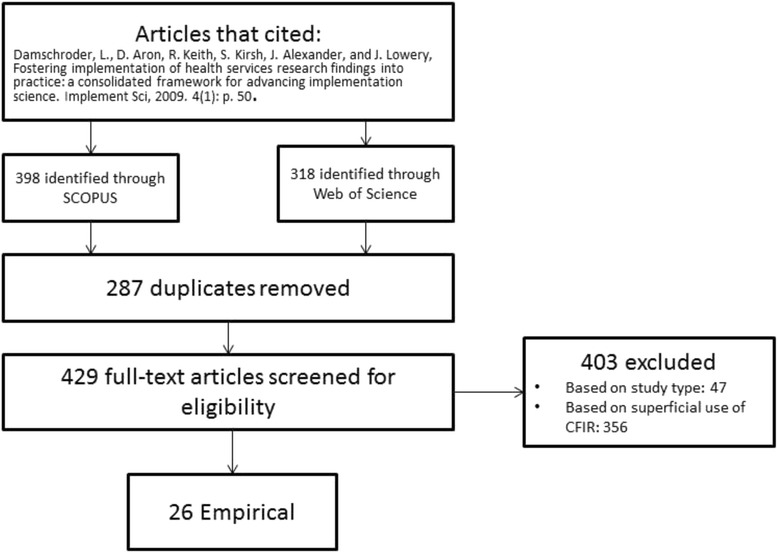
BACKGROUND: In 2009, Damschroder et al. developed the Consolidated Framework for Implementation Research (CFIR), which provides a comprehensive listing of constructs thought to influence implementation. This systematic review assesses the extent to which the CFIR's use in implementation research fulfills goals set forth by Damschroder et al. in terms of breadth of use, depth of application, and contribution to implementation research. METHODS: We searched Scopus and Web of Science for publications that cited the original CFIR publication by Damschroder et al. (Implement Sci 4:50, 2009) and downloaded each unique result for review. After applying exclusion criteria, the final articles were empirical studies published in peer-review journals that used the CFIR in a meaningful way (i.e., used the CFIR to guide data collection, measurement, coding, analysis, and/or reporting). A framework analysis approach was used to guide abstraction and synthesis of the included articles. RESULTS: Twenty-six of 429 unique articles (6 %) met inclusion criteria. We found great breadth in CFIR application; the CFIR was applied across a wide variety of study objectives, settings, and units of analysis. There was also variation in the method of included studies (mixed methods (n = 13); qualitative (n = 10); quantitative (n = 3)). Depth of CFIR application revealed some areas for improvement. Few studies (n = 3) reported justification for selection of CFIR constructs used; the majority of studies (n = 14) used the CFIR to guide data analysis only; and few studies investigated any outcomes (n = 11). Finally, reflections on the contribution of the CFIR to implementation research were scarce. CONCLUSIONS: Our results indicate that the CFIR has been used across a wide range of studies, though more in-depth use of the CFIR may help advance implementation science. To harness its potential, researchers should consider how to most meaningfully use the CFIR. Specific recommendations for applying the CFIR include explicitly justifying selection of CFIR constructs; integrating the CFIR throughout the research process (in study design, data collection, and analysis); and appropriately using the CFIR given the phase of implementation of the research (e.g., if the research is post-implementation, using the CFIR to link determinants of implementation to outcomes).
Overview
The claims and statistics of this paper haven’t been checked yet.
Free: it reads the open-access text and checks the first 5 claims that cite a source we can check. Create a free account to check every claim.
Integrity signals
Registry
Cites
Statistics
Figures
Verification
Claims the paper makes
The claims and statistics of this paper haven’t been checked yet.
Free: it reads the open-access text and checks the first 5 claims that cite a source we can check. Create a free account to check every claim.
Claims other papers make about this one
Each is checked against this paper’s own text: does it say what the citing paper says it does?
The cited source says what the claim attributes to it.
In the citing paper
“Kirk et al.’s 2015 review of 26 articles with meaningful use of the CFIR found that most users employed mixed (n = 13) or qualitative (n = 10) methods and used the CFIR in the post-implementation phase (n = 15) [13].”
From The updated consolidated framework for implementation research based on user feedback (2022) · cites this paper as [13]
The cited source says what the claim attributes to it.
In the citing paper
“Determinant frameworks can thus be used to inform choice of implementation strategies that may best address contextual determinants [14], generate hypotheses to prospectively guide predictions of implementation outcomes, or retrospectively explain implementation outcomes by assessing differences in determinants across implementation settings [11, 13, 15].”
From The updated consolidated framework for implementation research based on user feedback (2022) · cites this paper as [13]
The cited source says what the claim attributes to it.
In the citing paper
“The majority of CFIR users employ qualitative methods to assess constructs [13].”
From The updated consolidated framework for implementation research based on user feedback (2022) · cites this paper as [13]
The cited source says what the claim attributes to it.
In the citing paper
“In their systematic review of CFIR application, Kirk et al highlight gaps in depth of use of the framework, variation in selection of CFIR constructs, and a lack of justification of constructs used, limiting comparison of findings across time and contexts.14”
The cited source says what the claim attributes to it.
In the citing paper
“One indicator of this is a finding by Kirk et al: Among 26 research studies that meaningfully used CFIR, only two of the 26 included patients among their unit of analysis.14”
4 more claims about this paper
Create a free account to see every claim other papers make about this one.
Self-check
Percentages, sums and reported differences re-computed from the paper’s own numbers.
The self-check needs the paper’s full text.
Citations
Cites
Damschroder, L. J., Aron, D. C., Keith, R. E., Kirsh, S. R., Alexander, J. A., & Lowery, J. C. (2009) · Implementation Science · doi:10.1186/1748-5908-4-50 · Cited by 14,496 · cited 10×
“At the macro level, the CFIR provides a standardized structure for building on findings across studies [3].”
BackgroundMethodInfluentialSelf-citationGale, N. K., Heath, G., Cameron, E., Rashid, S., & Redwood, S. (2013) · BMC Medical Research Methodology · doi:10.1186/1471-2288-13-117 · Cited by 10,865 · cited 1×
“Objective 3: determine the contribution of the CFIR to implementation research General co posed by D • Cohere • Whethe • Whethe Microsoft Excel where content was arrayed in a matrix format consisting of rows (articles), columns (codes), and cells (summarized data) [8].”
BackgroundQualitative research practice: a guide for social science students and researchers
(2003) · Choice Reviews Online · doi:10.5860/choice.41-1319 · Cited by 10,543
Proctor, E., Silmere, H., Raghavan, R., Hovmand, P., Aarons, G., Bunger, A., Griffey, R., & Hensley, M. (2011) · Administration and Policy in Mental Health and Mental Health Services Research · doi:10.1007/s10488-010-0319-7 · Cited by 8,721 · cited 2×
“[25]), (2) provide clearer linkage of CFIR constructs with outcomes, and (3) provide clearer specification of which CFIR constructs were used to investigate outcomes.”
BackgroundComparison of PubMed, Scopus, Web of Science, and Google Scholar: strengths and weaknesses
Falagas, M. E., Pitsouni, E. I., Malietzis, G. A., & Pappas, G. (2008) · The FASEB Journal · doi:10.1096/fj.07-9492lsf · Cited by 5,039 · cited 1×
“, Google Scholar) [6].”
The Challenge of Innovation Implementation
Klein, K. J., & Sorra, J. S. (1996) · The Academy of Management Review · doi:10.2307/259164 · Cited by 2,113 · cited 1×
“Investigation of outcomes is critical for the field of implementation science overall because optimal implementation outcomes are a necessary condition for innovation effectiveness [25, 26].”
BackgroundFrench, S. D., Green, S. E., O’Connor, D. A., McKenzie, J. E., Francis, J. J., Michie, S., Buchbinder, R., Schattner, P., Spike, N., & Grimshaw, J. M. (2012) · Implementation Science · doi:10.1186/1748-5908-7-38 · Cited by 1,338 · cited 1×
“Better integration of the CFIR (or other theoretical framework) into empirical studies would help to address gaps in use of theory and advance implementation science [4, 31, 32].”
Kitson, A. L., Rycroft-Malone, J., Harvey, G., McCormack, B., Seers, K., & Titchen, A. (2008) · Implementation Science · doi:10.1186/1748-5908-3-1 · Cited by 1,314 · cited 1×
“earlier by developers of the PARIHS framework [27].”
MethodMeho, L. I., & Yang, K. (2007) · Journal of the American Society for Information Science and Technology · doi:10.1002/asi.20677 · Cited by 974
Damschroder, L. J., & Lowery, J. C. (2013) · Implementation Science · doi:10.1186/1748-5908-8-51 · Cited by 734
Self-citation
Cited by
Items 801–900 of 1,001
Blanchette, V., Fakhfakh, M., Andoulsi, Y., Brousseau‐Foley, M., Pallin, J. A., Buckley, C. M., Drudi, L. M., de Mestral, C., Kuhnke, J. L., & McIntosh, C. D. (2025) · HRB Open Research · doi:10.12688/hrbopenres.14119.1 · Cited by 3
“It can also help to support scaling 31 .”
Cha, B. S., Eikey, E. V., Mukamel, D. B., Palomares, K., Schueller, S. M., Sorkin, D. H., Stadnick, N. A., Stoeckl, S. E., Zheng, K., & Schneider, M. L. (2025) · Administration and Policy in Mental Health and Mental Health Services Research · doi:10.1007/s10488-025-01441-2 · Cited by 3
“The CFIR can be applied at any phase of implementation (pre-implementation, during implementation, or post-implementation), which allows for flexible adaptation and application for a wide range of interventions on varying timelines (Kirk et al., 2016).”
PrEP Navigator Perceptions of the Implementation of Injectable PrEP on HIV Prevention in Tennessee
Chandler, C. J., Schlundt, D. G., Dagostino, C., Bonnet, K. R., Sellers, A. J., Pichon, L. C., & Alexander, L. R. (2025) · International Journal of Environmental Research and Public Health · doi:10.3390/ijerph22050662 · Cited by 3
“We used an iterative inductive/deductive approach to the qualitative data analysis [33–35], resulting in the development of a conceptual framework (Figure 1) based on the Consolidated Framework for Implementation Research (CFIR) [36,37].”
InfluentialPocuca, N., Dakin, B. C., Puljević, C., Francis, C., Stjepanović, D., Barnett, A., & Hides, L. M. (2025) · Drug and Alcohol Review · doi:10.1111/dar.14073 · Cited by 3
“Implementation science frameworks champion the importance of pre-implementation studies as pivotal to increasing understanding of potential barriers and facilitators to inform intervention and implementation de-sign and ultimately, increase the likelihood of successful intervention uptake [32, 35].”
Calnan, S., Matvienko‐Sikar, K., Fitzgerald, N., Gilheany, S., & Kabir, Z. (2025) · International Journal of Drug Policy · doi:10.1016/j.drugpo.2025.104870 · Cited by 3
Edelman, E. R., Verbeek, J. G. E., Hunen, P., de Groot, M., van Eldik, N., & Spreeuwenberg, M. D. (2025) · BMC Digital Health · doi:10.1186/s44247-025-00173-5 · Cited by 3
“The tension between this well-founded theoretical framework and its pragmatic use has been a subject of ongoing research over the years of its use [23–26].”
Lorente-Català, R., Díaz‐García, A., Jaén, I., Gili, M., Mayoral, F., García‐Campayo, J., del Hoyo, Y. L., Castro, A., Hurtado, M. M., Planting, C. H. M., et al. (2025) · Journal of Clinical Medicine · doi:10.3390/jcm14176347 · Cited by 3
“(5) The diverse and inconsistent utilization of theoretical frameworks and terminology associated with implementation outcomes posed a challenge when categorizing studies according to Proctor’s taxonomy and the CFIR framework.”
InfluentialSchreurs, B. G. M., Zee, M., Cornelissen, F., & de Jong, P. F. (2025) · Educational Management Administration & Leadership · doi:10.1177/17411432251375332 · Cited by 3
Reñosa, M. D. C., Kulkarni, P., Steiner, L., Lamigo, C. E., Sornillo, B. J., Hechanova-Cruz, R. A., Dungca-Lorilla, A. M., Hapsari, A. F., Yunihastuti, E., Hasibuan, A. S., et al. (2025) · Implementation Science Communications · doi:10.1186/s43058-025-00776-z · Cited by 3
“Our findings added further value to the utility of CFIR in providing a structured and meaningful approach to identifying implementation determinants in research [38–40], and specifically in the delivery and management of TPT in HIV care [18, 41, 42].”
The academic ecosystems: A systematic literature review
Lenart-Gansiniec, R. A., & Sułkowski, Ł. (2025) · Economics & Sociology · doi:10.14254/2071-789x.2025/18-3/14 · Cited by 3
Mushonga, R. H., Bere, T. C., Jopling, R., Glozah, F. N., Anyorikeya, M., Kamvura, T. T., Dodd, S., Maramba, A., Gudyanga, D., Weobong, B., et al. (2025) · PLoS ONE · doi:10.1371/journal.pone.0335963 · Cited by 3
“The ‘Inner Setting’ captures the institutional, structural, political, and contextual factors such as leadership, communication, and available resources that can influence intervention delivery [22].”
Zharima, C., Griffiths, F. E., & Goudge, J. (2026) · JMIR Medical Informatics · doi:10.2196/73831 · Cited by 3
“Due to the framework’s flexibility, researchers can tailor it to specific interventions and contexts [32], and it has been widely adopted in research, applied across different research designs, and cited in over 300 published articles [29].”
Aufenberg, B., Offermann, J., Pauge, S., Ziefle, M., & Greiner, W. (2025) · BMC Geriatrics · doi:10.1186/s12877-025-06786-9 · Cited by 3
“To further contextualize these findings, the Consoli-dated Framework for Implementation Research (CFIR) [e.g., 77, 78] provides a useful lens for understanding the relative importance and interaction of the identified factors.”
A CFIR-guided qualitative study of digital health engagement among Black adults with type 2 diabetes
Zein, A. E., Hays, D., Glidden, G., Johnson, S., John, T., Nawshin, T., Hearld, L. R., & Mehta, T. S. (2025) · npj Digital Medicine · doi:10.1038/s41746-025-02107-x · Cited by 3
Estifanos, A. S., Gebremariam, A., Shifeta, M., Medhanyie, A. A., Hailemariam, D., Nigussie, B., Beyene, S. A., Tadele, H., Endalamaw, L. A., Aredo, A. D., et al. (2026) · Children · doi:10.3390/children13020187 · Cited by 3
“To guide the development of formative assessments and continuous program learning data collection tools, we adapted the CFIR [19,20].”
Smith, J., Philbrick, S. M., Akiba, C. F., Wenger, L. D., Hairgrove, S., Kral, A. H., Lambdin, B. H., & Patel, S. V. (2026) · Harm Reduction Journal · doi:10.1186/s12954-026-01413-1 · Cited by 3
“Although CFIR is most often applied only after implementation, limiting researchers' understanding of barriers and facilitators to a post-implementation phase, we applied it to a range of SSPs that had and had yet to implement DCS [54].”
da Silva, A. T. C., Uchimura, L. Y. T., Yokota, K. H. A., Nonato, A. C., Azuma, L. L. B., Matias, A. B., Klautau, G. B., Lowenthal, R., Germani, A. C. C. G., & de Soárez, P. C. (2026) · Implementation Science Communications · doi:10.1186/s43058-026-00866-6 · Cited by 3
Bhandari, A. K. C., Lwin, K. S., Nguyen, P. T., Htay, Z. W., Shrestha, D., Saito, J., Yaguchi‐Saito, A., Ota, E., & Shimazu, T. (2026) · Frontiers in Public Health · doi:10.3389/fpubh.2026.1750114 · Cited by 3
Kumar, V., Vyas, N., Godinho, M. A., Raj, S. E. A., & Govindan, S. (2026) · Discover Public Health · doi:10.1186/s12982-026-02352-9 · Cited by 3
“Moreover, researchers such as Dam-schroder et al. and Kirk et al. have recommended adaptation to specific contexts [12, 13] .”
Translating Fall Prevention Research into Practice
Sibley, K. M., Korall, A. M. B., & Touchette, A. J. (2021) · Cambridge University Press eBooks · doi:10.1017/9781108594455.030 · Cited by 3
Estevao, C., Lopez, M. B., Davis, R. E., Jarrett, L., Soukup, T., Bakolis, I., Healey, A., Harrington, J., Woods, A., Crane, N., et al. (2022) · BMJ Open · doi:10.1136/bmjopen-2021-057805 · Cited by 3
Johnson, L. C. M., Nikhare, K., Jaganathan, S., Ali, M. K., Narayan, K. M. V., Prabhakaran, D., Tandon, N., & Singh, K. (2022) · Global Implementation Research and Applications · doi:10.1007/s43477-022-00060-5 · Cited by 3
“The framework organizes 39 constructs into five domains (Kirk et al., 2016).”
BackgroundConnell, N. B., Zupanc, S. N., Lorenz, K., Bhatnagar, S., Fereydooni, S., Gamboa, R., Ganesh, A., Satija, A., Singh, N. K., Spruijt, O., et al. (2023) · Health Care Management Review · doi:10.1097/hmr.0000000000000368 · Cited by 3
Kasprzak, C., Canizares, A., Lally, A., Tirabassi, J., Vermont, L. N., Lev, S., Ammerman, A. S., & Leone, L. A. (2024) · Frontiers in Health Services · doi:10.3389/frhs.2024.1288160 · Cited by 3
Lindquist, K. M., Mendon, S. J., Timmins, G. T., Dopp, A. R., & Hunter, S. B. (2024) · JAACAP Open · doi:10.1016/j.jaacop.2024.02.002 · Cited by 3
“15 Of the numerous conceptual frameworks available to help understand implementation and sustainment, 16 the Consolidated Framework for Implementation Research (CFIR) is one of the most widely used 17 and is well suited to studying SUD treatments.”
Spanish translation of the Expert Recommendations for Implementing Change (ERIC) compilation
Pelt, A. E. V., Paniagua-Ávila, A., Sanchez, A., Sila, S., Lowenthal, E. D., Powell, B. J., & Beidas, R. S. (2024) · Implementation Science Communications · doi:10.1186/s43058-024-00616-6 · Cited by 3
Ryan, M. I., Ward, E. C., Burns, C. L., Carrington, C., Cuff, K. E., Mackinnon, M., & Snoswell, C. L. (2024) · Exploratory Research in Clinical and Social Pharmacy · doi:10.1016/j.rcsop.2024.100501 · Cited by 3
Tasseron-Dries, P. E. M., Smaling, H. J. A., van der Steen, J. T., & Achterberg, W. P. (2024) · Frontiers in Dementia · doi:10.3389/frdem.2024.1444815 · Cited by 3
Ng, Q. X., Yaow, C. Y. L., Tan, H. K., Ong, M. E. H., Kosonen, H., & Karlström, J. (2025) · BMJ Global Health · doi:10.1136/bmjgh-2024-017681 · Cited by 3
Fisher, K., Carusone, S. C., Ganann, R., Markle‐Reid, M., Northwood, M., & Sherifali, D. (2025) · Trials · doi:10.1186/s13063-025-08839-1 · Cited by 3
“Our search revealed that CFIR users mainly employ qualitative methods to assess the constructs [52].”
Kemp, C. G. (2025) · Current Opinion in HIV and AIDS · doi:10.1097/coh.0000000000000978 · Cited by 3
Smith, N., Charles, A., Abrahamson, V., Mikelyte, R., Trapp, O., Zhang, W., Hashem, F., Potts, J., Walton, G., & Towers, A. (2026) · Health Research Policy and Systems · doi:10.1186/s12961-026-01447-8 · Cited by 3
“It has been used in numerous research studies across a wide range of implementation contexts, especially clinical and applied health settings [45–48], as well as in education [49, 50], although, not previously to assess challenges and facilitators to research capacity building in social care…”
Assessing Preliminary Implementation Outcomes of a Lifestyle Medicine Intervention
Pangalangan, J. M. L., Farewell, C. V., Frates, E. P., Tollefson, M., Brooks‐Russell, A., & Puma, J. E. (2026) · Health Promotion Practice · doi:10.1177/15248399261419077 · Cited by 5
Ruvalcaba, E., Callaghan‐Koru, J. A., Rand, C. S., & Eakin, M. N. (2019) · Evaluation and Program Planning · doi:10.1016/j.evalprogplan.2019.101684 · Cited by 3
McDonald, S., & Kent, J. (2020) · Early Years Journal of International Research and Development · doi:10.1080/09575146.2020.1817869 · Cited by 3
“2009) was best suited to our purpose; it is useful in evaluating implementations in a variety of settings (Kirk et al. 2016) and permits researchers to explore a range of factors in depth.”
BackgroundLaforce, T. M., Ravitsky, V., & Laberge, A. (2022) · Canadian Journal of Bioethics · doi:10.7202/1089788ar · Cited by 3
Screening for cardiovascular risk in the general population: The SPICES implementation survey
Goff, D. L., Perraud, G., Aujoulat, P., Derriennic, J., Guillou-Landréat, M., Barais, M., & Reste, J. Y. L. (2023) · Frontiers in Medicine · doi:10.3389/fmed.2022.1058090 · Cited by 3
“Facilitators, barriers, and neutral factors were classified in the CFIR template, as presented in Table 3.”
MethodInfluentialAn implementation science approach to the systematic study of access to gynecologic cancer care
Shalowitz, D. I., Schroeder, M. C., & Birken, S. A. (2023) · Gynecologic Oncology · doi:10.1016/j.ygyno.2023.03.012 · Cited by 3
Self-citationMyers, Q. W. O., Lambert‐Kerzner, A., Colborn, K. L., Dyas, A. R., Henderson, W. G., & Meguid, R. A. (2023) · Surgery · doi:10.1016/j.surg.2023.06.023 · Cited by 3
Sims‐Gould, J., Franke, T., Staempfli, S., Hung, L., & Havaei, F. (2023) · Journal of Long-Term Care · doi:10.31389/jltc.145 · Cited by 3
Workplace Programs Aimed at Limiting Occupational Sitting
Healy, G. N., Stephens, S., & Goode, A. D. (2023) · Springer series on epidemiology and public health · doi:10.1007/978-3-031-41881-5_18 · Cited by 3
Dorr, D. A., Montgomery, E., Ghumman, A., Michaels, L. C., Rolbiecki, A. J., Canfield, S. M., Shaffer, V. A., Johnson, B., Lockwood, M., Ghosh, P., et al. (2024) · BMJ Open · doi:10.1136/bmjopen-2024-085898 · Cited by 3
Ferguson, A., Erwin, E., Sleeth, J., Symonds, N., Chard, S., Yuma, S., Oneko, O., Macheku, G. S., Andrews, L., West, N., et al. (2024) · International Journal of Environmental Research and Public Health · doi:10.3390/ijerph21070878 · Cited by 3
“…Efficacy, Adoption, Implementation, and Maintenance (RE-AIM) Framework [22,23] and the Consolidated Framework for Implementation Research (CFIR) [24,25] are implementation science frameworks that were developed to guide systematic assessment of multilevel implementation contexts and assist in…”
BackgroundAlotabi, A. J. D., Alotaibi, M. B. M., Khawaji, G. A. A., Alhulayyil, A. A., Alanezi, S. A., Aldossary, G. I., Mahboob, F. M. H., Albahli, M. A., Alwrafi, A., Asiri, H. A., et al. (2024) · Journal of Ecohumanism · doi:10.62754/joe.v3i8.6132 · Cited by 3
Hansen, K. A., Blakeney, E. A., & Price, C. J. (2025) · Global Advances in Integrative Medicine and Health · doi:10.1177/27536130251319244 · Cited by 3
Understanding the implementation process of the Adult Day Services Plus program
Cotton, Q. D., Bailey, D., Albers, E., Ingvalson, S., Bloomquist, E., Marx, K., Anderson, K. A., Dabelko‐Schoeny, H., Parker, L. J., Gitlin, L. N., et al. (2025) · BMC Geriatrics · doi:10.1186/s12877-025-05757-4 · Cited by 3
Sperling, J. B., Quenstedt, S., Glauber, K. M., Muhigaba, P. B., Ghanem, E., Saxena, T., Rodriguez, V., Sanchez, C., & McClernon, F. J. (2025) · Journal of Clinical and Translational Science · doi:10.1017/cts.2025.10056 · Cited by 3
“…levels (individuals, community, and society) that help to inform current conditions; the Consolidated Framework for Implementation Research (CFIR) [14], which examines contexts affecting successful implementation of interventions (individual, internal, external); and frameworks and models of…”
Wang, X., Zhou, T., Xu, L., Sheng, Z., Wen, L., Liu, X., Yang, X., Ma, X., Hong, X., Liang, G., et al. (2025) · Asian Journal of Psychiatry · doi:10.1016/j.ajp.2025.104645 · Cited by 3
Sommer, A., Rehbock, C., Krafft, T., & Ziemann, A. (2019) · Implementation Science · doi:10.1186/s13012-019-0911-5 · Cited by 3
“Home Away from Home”: Affirmative Care Practices Among Leading LGBTQ+ Organizations Serving Youth
Bochicchio, L. A. (2020) · Columbia Academic Commons (Columbia University) · doi:10.7916/d8-4v23-2h82 · Cited by 3
Ortíz-Basso, T., & Paladini, A. (2020) · Oftalmología clínica y experimental. · doi:10.70313/2718.7446.v13.n3.29 · Cited by 3
Implementation of a novel rehabilitation model of care across Alberta, Canada: a focused ethnography
Manhas, K. P., Olson, K. L., Churchill, K., Vohra, S., & Wasylak, T. (2021) · BMJ Open Quality · doi:10.1136/bmjoq-2020-001261 · Cited by 3
Torres-Cortés, B., Leiva, L., Antivilo-Bruna, A., & Zavala‐Villalón, G. (2021) · Frontiers in Education · doi:10.3389/feduc.2021.599712 · Cited by 3
“Although some studies include all the dimensions and sub-dimensions of the CFIR, others—like this study—include only some of them (Kirk et al., 2015).”
ResultEzezika, O. C., Mengistu, M., & Lear, T. (2021) · Journal of Global Health Reports · doi:10.29392/001c.29042 · Cited by 3
Implementing team-based newborn well care: Perspectives of nurses and physicians
Gregory, E. F., White, E., Wu, K. K., McPeak, K. E., & Fiks, A. G. (2022) · Journal of Pediatric Nursing · doi:10.1016/j.pedn.2022.03.013 · Cited by 3
Yaguchi‐Saito, A., Kaji, Y., Matsuoka, A., Okuyama, A., Fujimori, M., Saito, J., Odawara, M., Otsuki, A., Uchitomi, Y., Zenda, S., et al. (2022) · BMJ Open · doi:10.1136/bmjopen-2021-055473 · Cited by 3
Implementation science challenges: hearing care professionals identify barriers to clinical research
Meyer, C., Scarinci, N., Lind, C., Tulloch, K., Atkins, J., & Hickson, L. M. H. (2022) · International Journal of Audiology · doi:10.1080/14992027.2022.2142162 · Cited by 3
“Detailed descriptions of how these frameworks have been applied in health research is beyond the scope of this study (see Kirk et al. 2016; Mosavianpour et al. 2016; Presseau et al. 2022).”
BackgroundVamos, C. A., Griner, S. B., Daley, E. M., Cayama, M. R., Beckstead, J. W., Boggess, K., Quiñonez, R. B., & Damschroder, L. J. (2022) · Implementation Science Communications · doi:10.1186/s43058-022-00363-6 · Cited by 3
“It is recommended that researchers assess the importance of each construct and provide justification for those identified, yet few researchers describe this process [16, 17].”
BackgroundMethodSelf-citationStevens, G., Johnson, L. C., Saunders, C. H., Schmidt, P. N., Sierpe, A., Thomeer, R. P., Little, N. R., Cantrell, M., Yen, R. W., Pogue, J. A., et al. (2023) · BMC Public Health · doi:10.1186/s12889-023-15266-x · Cited by 3
“Consolidated Framework for Implementation Research (CFIR) [36, 76, 77] (see Fig.”
MethodInfluentialWhite, M. J., Xie, R., Lane, H., Rodriguez, J., Gilchrist, L., Howard, J., Perrin, E. M., Skinner, A. C., & Silberberg, M. (2023) · Translational Behavioral Medicine · doi:10.1093/tbm/ibac108 · Cited by 3
Evans, S. K., Dopp, A. R., Meredith, L. S., Ober, A. J., Osilla, K. C., Komaromy, M. S., & Watkins, K. E. (2023) · The Journal of Behavioral Health Services & Research · doi:10.1007/s11414-023-09851-6 · Cited by 3
“18,19 This study contributes to the developing research area that links pre-implementation research to implementation plans.”
Flores, A., Wiener, R. S., Hon, S. M., Wakeman, C., Howard, J., Virani, N., Mattus, B., Foreman, A. G., Singh, J., Rosén, L., et al. (2024) · Nicotine & Tobacco Research · doi:10.1093/ntr/ntae023 · Cited by 3
Acquah, D. K., Lisek, K., & Jacobzone, S. (2019) · OECD Journal on Budgeting · doi:10.1787/74fa8447-en · Cited by 3
Hurley, E., McHugh, S., Browne, J. P., Vaughan, L., & Normand, C. E. M. (2019) · BMC Health Services Research · doi:10.1186/s12913-019-4629-5 · Cited by 3
Rodríguez, L. A., Barquera, S., Aguilar-Salinas, C. A., Sepúlveda-Amor, J., Sánchez‐Romero, L. M., Denova‐Gutiérrez, E., Balderas-Arteaga, N., Loaeza, L. M., Handley, M. A., Basu, S., et al. (2020) · Contemporary Clinical Trials · doi:10.1016/j.cct.2020.106067 · Cited by 3
O’Donnell, R., Savaglio, M., Halfpenny, N., Morris, H., Dunbar, A., Sharman, C., Williams, R., MILLER, R. M., & Skouteris, H. (2022) · Child Abuse & Neglect · doi:10.1016/j.chiabu.2022.105855 · Cited by 3
Pulse oximetry in low-income settings: a case study of Kenyan hospitals
Enoch, A. J. (2018) · Oxford University Research Archive (ORA) (University of Oxford) · doi:10.5287/ora-bebavmk01 · Cited by 3
Luz, R. A. (2019) · Digital Library of Theses and Dissertations (Universidade de São Paulo) · doi:10.11606/t.7.2019.tde-22022021-161513 · Cited by 3
McLoughlin, G. M., Allen, P. M., Walsh‐Bailey, C., & Brownson, R. C. (2021) · Research Square · doi:10.21203/rs.3.rs-206237/v2 · Cited by 3
Initial insights into the impact and implementation of Creative Active Schools in Bradford, UKPreprint
Morris, J. L., Chalkley, A. E., Helme, Z. E., Timms, O., Young, E., McLoughlin, G. M., Bartholomew, J. B., & Daly-Smith, A. (2023) · Research Square · doi:10.21203/rs.3.rs-2458671/v1 · Cited by 3
Initial insights into the impact and implementation of Creating Active Schools in Bradford, UKPreprint
Morris, J. L., Chalkley, A. E., Helme, Z. E., Timms, O., Young, E., McLoughlin, G. M., Bartholomew, J. B., & Daly-Smith, A. (2023) · Research Square · doi:10.21203/rs.3.rs-2458671/v2 · Cited by 3
Feroz, A. S. (2024) · TSpace (University of Toronto) · Cited by 3
Fanaki, C., Fortin, J. A., Sirois, M., Kröger, E., Elliott, J. B., Stolee, P., Gregg, S., Sims‐Gould, J., & Giguere, A. M. C. (2023) · Canadian Geriatrics Journal · doi:10.5770/cgj.26.646 · Cited by 2
“It is a strength that during this process we assessed the compatibility of the care pathway with patients’ perspectives on their care and needs, because it has already been noted as a limitation of studies using the CFIR that patients’ perspectives and experiences are not taken into account.(47,48) A limitation of thi…”
MethodHolcomb, L. A., Koob, C., Mayo, R. M., Charron, E. M., Dickes, L., Sherrill, W. W., & Hudson, J. A. (2023) · BMC Health Services Research · doi:10.1186/s12913-023-09734-8 · Cited by 2
“Using CFIR constructs improves finding generalizability and project replication [8].”
MethodRoos, R., Pepping, R. M. C., van Aken, M. O., Labots, G., Lahdidioui, A., Berg, J., Kolfschoten, N. E., Pasha, S. M., ten Holder, J. T., Mollink, S. M., et al. (2023) · BMJ Open · doi:10.1136/bmjopen-2023-073126 · Cited by 2
Kimpel, C. C., Myer, E. A., Cupples, A., Jones, J. R., Seidler, K. J., Rick, C. K., Brown, R. T., Rawlins, C. R., Hadler, R. A., Tsivitse, E., et al. (2023) · Journal for Healthcare Quality · doi:10.1097/jhq.0000000000000419 · Cited by 2
Implementing care-related services in care units - an interview study
Reichert, D., Gummesson, K., Wallin, L., & Dahlström, T. (2024) · BMC Health Services Research · doi:10.1186/s12913-024-11465-3 · Cited by 2
“There is a need for in-depth studies focusing on new staff models [22, 23].”
BackgroundKennedy, L. E., Norman‐Burgdolf, H., Jarvandi, S., & Washburn, L. T. (2024) · Health Promotion Practice · doi:10.1177/15248399241285506 · Cited by 2
“CFIR has been used as a framework for the development, implementation, and evaluation of interventions focused on organizations, communities, and systems (Kirk et al., 2016).”
Weiler‐Wichtl, L., Fohn-Erhold, V., Rosenmayr, V., Hansl, R., Hopfgartner, M., Pal-Handl, K., Wasinger-Brandweiner, V., Herzog, K., Neumann, K., Schellenberg, T., et al. (2024) · Supportive Care in Cancer · doi:10.1007/s00520-024-08981-7 · Cited by 2
“Among the most prominent frameworks to promote systematic implementation, is the Consolidated Framework for Implementation Research (CFIR) [11] which has been updated recently [12, 13].”
Keeler-Villa, N. R., Beaulieu, D. A., Harris-Lane, L. M., Bérubé, S., Burke, K., Churchill, A., Cornish, P. A., Goguen, B., Jaouich, A., Michaud, M., et al. (2024) · Administration and Policy in Mental Health and Mental Health Services Research · doi:10.1007/s10488-024-01423-w · Cited by 2
“The CFIR is one of the most highly cited frameworks in implementation science with the majority of 26 articles identified in a review published in 2015 employing mixed ( n = 13) or qualitative ( n = 10) methods used in the post-implementation phase (Kirk et al., 2016).”
Kiene, S. M., Miller, A. P., Tuhebwe, D., Ceballos, D. A., Sanchez, C. N., Moody, J. S., Famania-Martinez, L., Moore, R. V., Oren, E., & McDaniels-Davidson, C. R. (2024) · Implementation Science Communications · doi:10.1186/s43058-024-00669-7 · Cited by 2
Babirye, D., & Anderson, R. (2025) · ACM Journal on Computing and Sustainable Societies · doi:10.1145/3707638 · Cited by 2
“The study design was informed by selected sub-domains from the Consolidated Framework for Implementation Research (CFIR) [16, 34] adapted with the recommended questions for guiding the implementation of training programs [57].”
Puma, J. E., LaRocca, D., Risendal, B., Scarbro, S. L., McManus, B. M., Varda, D., & Leiferman, J. A. (2025) · Trials · doi:10.1186/s13063-025-08881-z · Cited by 2
“” [54] Interviews are being conducted with ECE directors, teachers, and parents and organizational representatives from the ACEs services system of care throughout the course of the study to explore CFIR constructs related to the implementation outcomes of interest.”
Lai-Kwon, J. E., Rutherford, C., Jefford, M., Zhang, I., Devereux, C., Herath, D., Burbury, K., & Best, S. (2025) · Quality of Life Research · doi:10.1007/s11136-025-03995-y · Cited by 2
“…that specify the barriers and facilitators that influence implementation outcomes (e.g. the Consolidated Framework for Implementation Research [20, 21]) and evaluation frameworks that evaluate the degree of implementation success (e.g. Reach Effectiveness Adoption Implementation and Maintenance…”
Cullen, J., Jayamaha, N. P., Childerhouse, P., & McBain, L. (2025) · Journal of Primary Health Care · doi:10.1071/hc25021 · Cited by 2
Steensma, R., van den Bogerd, N., Dijkstra, K., Meijboom, W., Janssen-Heijnen, M. L. G., Krabbendam, L., & Maas, J. (2025) · HERD Health Environments Research & Design Journal · doi:10.1177/19375867251331105 · Cited by 2
“The CFIR is a widely utilized framework in implementation research and frequently applied to support implementation processes in healthcare settings (Kirk et al., 2016).”
Caring for loved ones as community: Supporting caregivers of Native Hawaiians living with dementia
Jackson, A., Dillard, A. Y., Kekauoha, B. P., Austin, M. M., Balaz, P., Lee, E., Dutro, N., Mayeda, P., Dutro, A. K., O’Sullivan, K. S., et al. (2025) · SSM - Mental Health · doi:10.1016/j.ssmmh.2025.100483 · Cited by 2
Kumar, S. J., Bishop, V., Bainbridge, D. B., Kilbertus, F., Kortes-Miller, K., Winemaker, S., & Seow, H. Y. (2025) · Journal of Palliative Care · doi:10.1177/08258597251351432 · Cited by 2
Fox, A. R., Lin, F. F., Williams, S., Joseph, R., Tomkins, E. M., Yin, H., Stuart, L., Yates, P. M., & Chan, R. J. (2025) · Journal of Advanced Nursing · doi:10.1111/jan.70075 · Cited by 2
“…of health service innovations requires a systems-thinking approach that engages key stakeholders across practitioner, financial, organisational and system levels to support both the innovation and its implementation (Fox, Gardner, and Osborne 2018; Keith et al. 2017; Kirk et al. 2016).”
Dong, X., Guan, H., Liu, W., Zhao, J., Wang, H., Shi, Y., & Ma, X. (2025) · BMJ Open · doi:10.1136/bmjopen-2024-097809 · Cited by 2
Schmitz, K. H., Berger, N. A., Owusu, C., Thomson, C. A., Chinchilli, V. M., Basen‐Engquist, K., Evans, W. J., Pink, J. J., Schleicher, E. A., Cao, C., et al. (2025) · Contemporary Clinical Trials · doi:10.1016/j.cct.2025.108074 · Cited by 2
Xu, X., Chen, Y., Zhou, J., Li, S., Dong, X., & Shen, Z. (2025) · Healthcare · doi:10.3390/healthcare13182353 · Cited by 2
“CFIR is the most widely used determinant analysis tool of the implementation process due to its multidimensional structural characteristics [20].”
Implementation of the clinical practice guideline on intrapartum care for low-risk births in Belgium
Kuipers, Y., Bleijenbergh, R., & Mestdagh, E. (2025) · Midwifery · doi:10.1016/j.midw.2025.104606 · Cited by 2
Chavez‐Yenter, D., Fetzer, D., Egleston, B. L., Domchek, S. M., Fleisher, L. G., Wagner, L. I., Wen, K., Karpink, K., Gutstein, L., Posen, S., et al. (2025) · BMC Cancer · doi:10.1186/s12885-025-14968-2 · Cited by 2
Bakuwa, T. C., Saloojee, G. M., & Slemming, W. (2026) · PLoS ONE · doi:10.1371/journal.pone.0356240 · Cited by 2
Momand, P., Götrick, B., & Hansson, K. (2025) · BMC Oral Health · doi:10.1186/s12903-025-07064-1 · Cited by 2
“…should integrate frameworks from Implementation Research (e.g. Theoretical Domains Framework [59, 60] and/or Consolidated Framework for Implementation Research [61]) to systematically identify barriers and facilitators influencing the adoption of evidence-based antibiotic prophylaxis guidelines.”
HIV Prevention for People Releasing from Incarceration: A Qualitative Pre-implementation Study
Callen, E., Graham, S. M., Forsyth, W., Gerbino, N. R., Senter, Z., Hauber, B., Weiner, B. J., Bagdon-Cox, C., & Jack, H. E. (2025) · Journal of General Internal Medicine · doi:10.1007/s11606-025-09895-8 · Cited by 2
Bjerk, M., Førland, O., Bergersen, L., Langøien, L. J., & Larun, L. (2025) · Frontiers in Health Services · doi:10.3389/frhs.2025.1686425 · Cited by 2
Hiscock, H., Moore, C. L., Khano, S., Sanci, L. A., Dalziel, K., Freed, G. L., Boyle, D. I., Morris, T. M., Liaw, S., Le, J., et al. (2025) · The Medical Journal of Australia · doi:10.5694/mja2.70115 · Cited by 2
“…total continuous score in the upper quartile of the culture subdomain distribution of the Consolidated Framework for Implementation Research) [29]; general practice learning climate (total continuous score in the upper quartile of the climate subdomain) [29]; general practice billing type…”
Raka, L., Krasniqi, S., PharmD, A. J., Ymerhalili, A., Sreenivasan, N., Zaman, A. W., Skov, R. L., Córdoba, G., & Hoxha, I. S. (2025) · Implementation Science Communications · doi:10.1186/s43058-025-00836-4 · Cited by 2
“The tools developed for data collection and the information collected will be analysed using the CFIR framework [41–43].”
Metadata
- Authors
- Kirk, M. A., Kelley, C., Yankey, N., Birken, S. A., Abadie, B., & Damschroder, L.
- Affiliations
- University of North Carolina at Chapel Hill (US)
- VA Ann Arbor Healthcare System (US)
- Eastern Michigan University (US)
- Corresponding author
- Kirk, M. Alexis
- Venue
- Implementation Science
- Published
- 2015-12
- Volume
- 11
- Issue
- 1
- Pages
- 72-72
- ISSN
- 1748-5908 (ISSN-L)
- PMC
- PMC4869309
- OpenAlex
- W2398003476
- Semantic Scholar
- c8757b9931f0128e029ff09f1d76564f0b0c686b
- Cited by
- 1,496
- References
- 45
- Citations by year
- 2026: 160 · 2025: 173 · 2024: 236 · 2023: 209 · 2022: 213 · 2021: 182 · 2020: 151 · 2019: 87 · 2018: 40 · 2017: 38 · 2016: 4 · 2015: 2
- FWCI
- 5.03
- Type
- journal article
- Language
- en
- Open access
- gold
- doi.org
- Licence
- cc-by
- Locations
- Implementation Science (publishedVersion, cc-by)
- PubMed Central (publishedVersion, cc-by)
- PubMed (publishedVersion)
- Carolina Digital Repository (University of North Carolina at Chapel Hill) (submittedVersion)
- Funders
- RTI International (NA)
- Topics
- Health Sciences › Health Professions › General Health Professions › Health Policy Implementation Science
- Health Sciences › Health Professions › General Health Professions › Health Sciences Research and Education
- Health Sciences › Medicine › Public Health, Environmental and Occupational Health › Clinical practice guidelines implementation
- Keywords
- Consolidated Framework for Implementation Research, implementation research, implementation factors, implementation outcomes
- MeSH terms
- Goals, Health Plan Implementation, Health Services Research, Humans
About these checks
Registry, retraction, Cites and statistics results are computed, not judged, with one exception: a printed reference that no index lists is read once by a model before it counts as a citation error. Claims are extracted by a model and kept only when their quote appears verbatim in the text; each cited source is then checked, with a model’s help, for whether it says what the claim relies on. Those verdicts can be wrong — read the claim’s quote and the cited source before relying on one.
Statistics and arithmetic are recomputed, not judged.
Confidence bands are shown only for fields calibrated on our annotated test set. None is calibrated yet, so no band is shown.
What counts as a claim ›How we measure confidence ›How we check this ›
Are you an author, or do you see a problem with this page? Request a review
Data sources
Bibliographic data: Semantic Scholar, OpenAlex, Crossref.
Contains information from the Semantic Scholar Academic Graph Datasets, made available under the ODC Attribution License (ODC-BY 1.0).
Semantic Scholar’s data is described in: Kinney, R., et al. (2023). The Semantic Scholar Open Data Platform. arXiv:2301.10140.
