

A systematic review of the use of the Consolidated Framework for Implementation Research
Open accessThe DOI matches its Crossref record; 44 of the 45 references it cites were found in a registry or an index.
Abstract
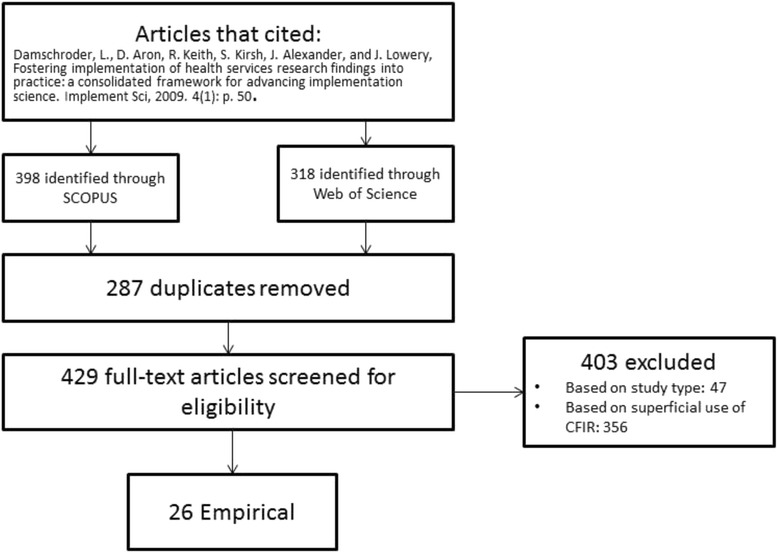
BACKGROUND: In 2009, Damschroder et al. developed the Consolidated Framework for Implementation Research (CFIR), which provides a comprehensive listing of constructs thought to influence implementation. This systematic review assesses the extent to which the CFIR's use in implementation research fulfills goals set forth by Damschroder et al. in terms of breadth of use, depth of application, and contribution to implementation research. METHODS: We searched Scopus and Web of Science for publications that cited the original CFIR publication by Damschroder et al. (Implement Sci 4:50, 2009) and downloaded each unique result for review. After applying exclusion criteria, the final articles were empirical studies published in peer-review journals that used the CFIR in a meaningful way (i.e., used the CFIR to guide data collection, measurement, coding, analysis, and/or reporting). A framework analysis approach was used to guide abstraction and synthesis of the included articles. RESULTS: Twenty-six of 429 unique articles (6 %) met inclusion criteria. We found great breadth in CFIR application; the CFIR was applied across a wide variety of study objectives, settings, and units of analysis. There was also variation in the method of included studies (mixed methods (n = 13); qualitative (n = 10); quantitative (n = 3)). Depth of CFIR application revealed some areas for improvement. Few studies (n = 3) reported justification for selection of CFIR constructs used; the majority of studies (n = 14) used the CFIR to guide data analysis only; and few studies investigated any outcomes (n = 11). Finally, reflections on the contribution of the CFIR to implementation research were scarce. CONCLUSIONS: Our results indicate that the CFIR has been used across a wide range of studies, though more in-depth use of the CFIR may help advance implementation science. To harness its potential, researchers should consider how to most meaningfully use the CFIR. Specific recommendations for applying the CFIR include explicitly justifying selection of CFIR constructs; integrating the CFIR throughout the research process (in study design, data collection, and analysis); and appropriately using the CFIR given the phase of implementation of the research (e.g., if the research is post-implementation, using the CFIR to link determinants of implementation to outcomes).
Overview
The claims and statistics of this paper haven’t been checked yet.
Free: it reads the open-access text and checks the first 5 claims that cite a source we can check. Create a free account to check every claim.
Integrity signals
Registry
Cites
Statistics
Figures
Verification
Claims the paper makes
The claims and statistics of this paper haven’t been checked yet.
Free: it reads the open-access text and checks the first 5 claims that cite a source we can check. Create a free account to check every claim.
Claims other papers make about this one
Each is checked against this paper’s own text: does it say what the citing paper says it does?
The cited source says what the claim attributes to it.
In the citing paper
“Kirk et al.’s 2015 review of 26 articles with meaningful use of the CFIR found that most users employed mixed (n = 13) or qualitative (n = 10) methods and used the CFIR in the post-implementation phase (n = 15) [13].”
From The updated consolidated framework for implementation research based on user feedback (2022) · cites this paper as [13]
The cited source says what the claim attributes to it.
In the citing paper
“Determinant frameworks can thus be used to inform choice of implementation strategies that may best address contextual determinants [14], generate hypotheses to prospectively guide predictions of implementation outcomes, or retrospectively explain implementation outcomes by assessing differences in determinants across implementation settings [11, 13, 15].”
From The updated consolidated framework for implementation research based on user feedback (2022) · cites this paper as [13]
The cited source says what the claim attributes to it.
In the citing paper
“The majority of CFIR users employ qualitative methods to assess constructs [13].”
From The updated consolidated framework for implementation research based on user feedback (2022) · cites this paper as [13]
The cited source says what the claim attributes to it.
In the citing paper
“In their systematic review of CFIR application, Kirk et al highlight gaps in depth of use of the framework, variation in selection of CFIR constructs, and a lack of justification of constructs used, limiting comparison of findings across time and contexts.14”
The cited source says what the claim attributes to it.
In the citing paper
“One indicator of this is a finding by Kirk et al: Among 26 research studies that meaningfully used CFIR, only two of the 26 included patients among their unit of analysis.14”
4 more claims about this paper
Create a free account to see every claim other papers make about this one.
Self-check
Percentages, sums and reported differences re-computed from the paper’s own numbers.
The self-check needs the paper’s full text.
Citations
Cites
Damschroder, L. J., Aron, D. C., Keith, R. E., Kirsh, S. R., Alexander, J. A., & Lowery, J. C. (2009) · Implementation Science · doi:10.1186/1748-5908-4-50 · Cited by 14,496 · cited 10×
“At the macro level, the CFIR provides a standardized structure for building on findings across studies [3].”
BackgroundMethodInfluentialSelf-citationGale, N. K., Heath, G., Cameron, E., Rashid, S., & Redwood, S. (2013) · BMC Medical Research Methodology · doi:10.1186/1471-2288-13-117 · Cited by 10,865 · cited 1×
“Objective 3: determine the contribution of the CFIR to implementation research General co posed by D • Cohere • Whethe • Whethe Microsoft Excel where content was arrayed in a matrix format consisting of rows (articles), columns (codes), and cells (summarized data) [8].”
BackgroundQualitative research practice: a guide for social science students and researchers
(2003) · Choice Reviews Online · doi:10.5860/choice.41-1319 · Cited by 10,543
Proctor, E., Silmere, H., Raghavan, R., Hovmand, P., Aarons, G., Bunger, A., Griffey, R., & Hensley, M. (2011) · Administration and Policy in Mental Health and Mental Health Services Research · doi:10.1007/s10488-010-0319-7 · Cited by 8,721 · cited 2×
“[25]), (2) provide clearer linkage of CFIR constructs with outcomes, and (3) provide clearer specification of which CFIR constructs were used to investigate outcomes.”
BackgroundComparison of PubMed, Scopus, Web of Science, and Google Scholar: strengths and weaknesses
Falagas, M. E., Pitsouni, E. I., Malietzis, G. A., & Pappas, G. (2008) · The FASEB Journal · doi:10.1096/fj.07-9492lsf · Cited by 5,039 · cited 1×
“, Google Scholar) [6].”
The Challenge of Innovation Implementation
Klein, K. J., & Sorra, J. S. (1996) · The Academy of Management Review · doi:10.2307/259164 · Cited by 2,113 · cited 1×
“Investigation of outcomes is critical for the field of implementation science overall because optimal implementation outcomes are a necessary condition for innovation effectiveness [25, 26].”
BackgroundFrench, S. D., Green, S. E., O’Connor, D. A., McKenzie, J. E., Francis, J. J., Michie, S., Buchbinder, R., Schattner, P., Spike, N., & Grimshaw, J. M. (2012) · Implementation Science · doi:10.1186/1748-5908-7-38 · Cited by 1,338 · cited 1×
“Better integration of the CFIR (or other theoretical framework) into empirical studies would help to address gaps in use of theory and advance implementation science [4, 31, 32].”
Kitson, A. L., Rycroft-Malone, J., Harvey, G., McCormack, B., Seers, K., & Titchen, A. (2008) · Implementation Science · doi:10.1186/1748-5908-3-1 · Cited by 1,314 · cited 1×
“earlier by developers of the PARIHS framework [27].”
MethodMeho, L. I., & Yang, K. (2007) · Journal of the American Society for Information Science and Technology · doi:10.1002/asi.20677 · Cited by 974
Damschroder, L. J., & Lowery, J. C. (2013) · Implementation Science · doi:10.1186/1748-5908-8-51 · Cited by 734
Self-citation
Cited by
Items 701–800 of 1,001
Lee, S.-Y., Hayes, L. W., Ozaydin, B., Howard, S., Garretson, A. M., Bradley, H. M., Land, A. M., DeLaney, E. W., Pritchett, A. O., Furr, A. L., et al. (2024) · JMIR Research Protocols · doi:10.2196/56049 · Cited by 5
“The CFIR systemically evaluates factors that can impact the success of implementation in complex settings like health care and is applicable to the early stages prior to implementation [50,51].”
BackgroundKwok, G., Senger, A., Sharma, A., Mandato, I., & Devine, K. A. (2024) · Implementation Science Communications · doi:10.1186/s43058-024-00612-w · Cited by 5
“…applied as determinant frameworks to a variety of studies exploring barriers and facilitators of intervention adoption including identifying determinants of successful implementation of evidence-based practices in public health agencies [35] and engaging pregnant women in smoking cessation [36].”
BackgroundComella, N., & Elwy, A. R. (2024) · Journal of Integrative and Complementary Medicine · doi:10.1089/jicm.2024.0370 · Cited by 5
Zulauf-McCurdy, C. A., Johansson, M., Hashimoto, J. R., & Meza, R. D. (2024) · Prevention Science · doi:10.1007/s11121-024-01742-2 · Cited by 5
“…been broadly applied to the prevention of communicable (e.g., HIV; Kegeles et al., 2015) and non-communicable diseases (e.g., diabetes; Price et al., 2019) with recommendations to integrate the CFIR into additional empirical studies to help address the research-to-practice gap (Kirk et al., 2015).”
Markle‐Reid, M., Fisher, K., Walker, K. M., Cameron, J. I., Dayler, D., Fleck, R., Gafni, A., Ganann, R., Hajas, K., Koetsier, B., et al. (2025) · Journal of Multimorbidity and Comorbidity · doi:10.1177/26335565251323748 · Cited by 6
“It considers factors at the individual, organizational, and external levels, providing a holistic view of implementation processes that are grounded in empirical evidence, 62 and 3) CFIR provides a practical guide for implementation planning and evaluation.”
Craig, S. G., Anderson, T. J., Stark, P., Wilson, C. B., Carter, G., McEvoy, C. T., Creighton, L., Henderson, E., Porter, S., Alhalaiqa, F., et al. (2025) · Nursing Reports · doi:10.3390/nursrep15060188 · Cited by 5
“This approach will ensure that the evaluation captures key contextual and process-related determinants of successful implementation, enabling identification of barriers and facilitators unique to the nursing home environment [45,46].”
da Fonseca, F. L., Caxico‐Vieira, L. J. S., Silva, R. D. O. S., Araújo-Neto, F. D. C., Tavares, T. M. A., Ribeiro, M. D. A. L., & de Lyra, D. P. (2025) · Public Health · doi:10.1016/j.puhe.2025.105825 · Cited by 5
Grogan, C., Harriman, S., Martin, E. K., Waite, R., & Fisher, O. J. (2025) · Frontiers in Health Services · doi:10.3389/frhs.2025.1550729 · Cited by 5
Branch‐Elliman, W., Chambers, D., Albin, O. R., Batshon, L. J., Castejón-Ramírez, S., Cheng, V. C., Emetuche, N., Datta, R., Kamboj, M., Krein, S. L., et al. (2025) · Infection Control and Hospital Epidemiology · doi:10.1017/ice.2025.75 · Cited by 5
Watts, S., del Pozo, B., White, M. D., & Malm, A. E. (2025) · Journal of Experimental Criminology · doi:10.1007/s11292-025-09711-7 · Cited by 5
“Among them, the Consolidated Framework for Implementation Research (CFIR, 2023) has proven to be highly adaptable to a variety of settings (Kirk et al., 2016), as it consists of an inventory of dozens of variables both within and outside of an organization that have been shown to act as barriers…”
Augeard, N., Longtin, C., Bussières, A., Bostick, G. P., Thomas, A., Miller, J., Tousignant‐Laflamme, Y., Walton, D. M., Hudon, A., Cooper, L., et al. (2025) · Canadian Journal of Pain · doi:10.1080/24740527.2025.2574969 · Cited by 5
Demelash, S., Alava, M. A., Fekadu, L., Misganaw, H. W., Gebeyehu, T. A., Zeynu, N., Dema, S. T., Afele, M. A., & Argaw, Z. M. (2026) · PLOS Global Public Health · doi:10.1371/journal.pgph.0005459 · Cited by 5
Implementation science in hybrid randomized controlled trials: a state-of-the-art systematic review
Liu, M., Comber, E. R., Martin, A. J., Roberts, N. A., Trott, M., Costa, N., Foster, N. E., & Hickman, I. J. (2026) · International Journal of Evidence-Based Healthcare · doi:10.1097/xeb.0000000000000568 · Cited by 5
Sepúlveda, C., Ibáñez, C. F., Libuy, N., Viviana Guajardo, T., Araneda, A. M., Taibo, L. C., Donoso, P., & Mundt, A. P. (2023) · Health Promotion Practice · doi:10.1177/15248399231201551 · Cited by 5
Theophanous, R. G., Gordee, A., Peethumnongsin, E., Huang, W., Gurysh, K., Coco, M., Cantillo-Campos, S., Ruderman, B. T., Kuchibhatla, M. N., & Broder, J. S. (2023) · Journal of Emergency Medicine · doi:10.1016/j.jemermed.2023.10.032 · Cited by 5
Bello‐Manga, H., Haliru, L., Ahmed, K., Ige, S., Musa, H., Muhammad-Idris, Z. K., Monday, B., Sani, A. M., Bonnet, K. R., Schlundt, D. G., et al. (2024) · Implementation Science Communications · doi:10.1186/s43058-023-00534-z · Cited by 5
Kulkarni, A. J., Thiagarajan, A. B., Skolarus, T. A., Krein, S. L., & Ellimoottil, C. S. (2024) · Surgery · doi:10.1016/j.surg.2024.03.033 · Cited by 5
Lane, H., Calvert, H. G., Lowe, M. M., Hager, E. R., & Turner, L. R. (2025) · Journal of the Academy of Nutrition and Dietetics · doi:10.1016/j.jand.2025.03.002 · Cited by 5
Meyerson, B. E., Davis, A., Crosby, R. A., Linde-Krieger, L. B., Brady, B. R., Carter, G. A., Mahoney, A. N., Frank, D., Rothers, J., Coffee, Z. H., et al. (2025) · JMIR Research Protocols · doi:10.2196/69829 · Cited by 5
“Implementation science suggests that in addition to the outer setting factor of federal policy, there are inner setting factors that likely influence the adoption of MMT treatment innovation [27].”
Marotta, P. L., Humphries, D. L., Escudero, D. J., Katz, D. A., Rosen, J. G., Hill, S. V., Glick, J. L., Li, D. H., Elopre, L. E., Ghadimi, F., et al. (2025) · JAIDS Journal of Acquired Immune Deficiency Syndromes · doi:10.1097/qai.0000000000003625 · Cited by 5
Haddad, R., Fallu, J., Huỳnh, C., Gervais, M.-J., & Dagenais, C. (2025) · Scientific Reports · doi:10.1038/s41598-025-96001-x · Cited by 5
Reeves, K. W., O’Hare, K., Shade, L. E., Ludden, T., McWilliams, A. D., Manning, M., Hogg, M. M., Reynolds, S. L., Shea, C. M., Burton, E. C., et al. (2020) · Implementation Science Communications · doi:10.1186/s43058-020-00010-y · Cited by 5
Knowledge translation theories in fall prevention and balance control: A scoping review
Aloraini, S. M., Alothaim, N. K., Alsalamah, N. M., & Aldaihan, M. M. (2022) · PM&R · doi:10.1002/pmrj.12888 · Cited by 5
“60 Further, the CFIR was found useful for implementation and KT studies.”
BackgroundMethodVelez, D. S., Gundewar, A. U., Persaud, A., Simione, M., Castro, I., Perkins, M. E., Lindros, J., Salmon, J., Smith, J. D., Taveras, E. M., et al. (2023) · Frontiers in Public Health · doi:10.3389/fpubh.2023.1045618 · Cited by 5
Elucidating determinants of medication disposal programs at retail pharmacies in North Carolina
Egan, K. L., McCallum, L., Matthews, J. C., & Eldridge, L. A. (2023) · Journal of the American Pharmacists Association · doi:10.1016/j.japh.2023.10.032 · Cited by 5
Shi, Z., Comeau, J., Bloom, G. A., Gainforth, H. L., Thomas, A., & Sweet, S. N. (2023) · Frontiers in Rehabilitation Sciences · doi:10.3389/fresc.2023.1296505 · Cited by 5
Saxena, M., Roll, A., Walson, J. L., Pearman, E., Legge, H., Nindi, P., Chirambo, C. M., Titus, A., Johnson, J., Elijan, A. B., et al. (2024) · PLoS neglected tropical diseases · doi:10.1371/journal.pntd.0011819 · Cited by 5
“The CFIR is a commonly used framework in implementation research to understand the effectiveness of implementation strategies and to guide the investigation of the multi-level factors that influence implementation across clusters [20].”
MethodZhang, X., Warner, M. E., Tennyson, S. L., Brunner, W. M., Wethington, E., & Sipple, J. W. (2024) · PLoS ONE · doi:10.1371/journal.pone.0303660 · Cited by 5
Factors facilitating and hindering the implementation of digital sleep coaching for bus drivers
Järnefelt, H., Anttilainen, J., Karhula, K., Hublin, C., Pehkonen, I., & Sallinen, M. (2024) · Applied Ergonomics · doi:10.1016/j.apergo.2024.104356 · Cited by 5
Dubbeldeman, E. M., van der Kleij, R., Sprenger, M., Aslam, A. S., Jong, J. C. K., & Crone, M. R. (2024) · Children and Youth Services Review · doi:10.1016/j.childyouth.2024.108110 · Cited by 5
Gurung, R., Zaka, N., Budhathoki, S. S., Sunny, A. K., Thapa, J., Zhou, H., & Ashish, K. C. (2019) · Systematic Reviews · doi:10.1186/s13643-019-1110-9 · Cited by 5
Fernandes, B. D., Foppa, A. A., Ayres, L. R., & Chemello, C. (2022) · Research in Social and Administrative Pharmacy · doi:10.1016/j.sapharm.2022.01.010 · Cited by 5
Dossett, L. A., Miller, J. B., Jagsi, R., Sales, A. E., Fetters, M. D., Boothman, R. C., & Dimick, J. B. (2019) · JMIR Research Protocols · doi:10.2196/13396 · Cited by 5
“We will then conduct a robust preimplementation analysis to identify barriers and facilitators to implementation using the Consolidated Framework for Implementation Research (CFIR) [13,14] supplemented by the Theoretical Domains Framework (TDF) [15] (aim 2).”
Allsopp, L., Sterling, D. A., Spence, E. E., & Aryal, S. (2020) · Journal of School Health · doi:10.1111/josh.12909 · Cited by 5
Zucco, L., Levy, N., Li, Y., Golen, T. H., Shainker, S. A., Hess, P. E., & Ramachandran, S. K. (2021) · BMC Health Services Research · doi:10.1186/s12913-021-06787-5 · Cited by 5
Lazo-Porras, M., Brandt, L. R., Cornejo-Vucovich, E. C., Denman, C. A., Diez‐Canseco, F., Malavera, A., Mukherjee, A., Ouyang, M., Praveen, D., Schierhout, G., et al. (2022) · Salud Pública de México · doi:10.21149/12853 · Cited by 5
Bermúdez‐Tamayo, C., Muñoz, J. B., Briones‐Vozmediano, E., Carrasco‐Portiño, M., Zunzunegui, M. V., Negrín, M. Á., González, L., García, L. P., & Díaz, C. Á.-D. (2017) · Gaceta Sanitaria · doi:10.1016/j.gaceta.2017.03.002 · Cited by 5
Alaradi, L. (2017) · Enlighten: Theses (The University of Glasgow) · Cited by 5
Holmes, J. A. (2018) · Nottingham ePrints (University of Nottingham) · Cited by 5
Kanno, N. D. P. (2023) · Digital Library of Theses and Dissertations (Universidade de São Paulo) · doi:10.11606/d.5.2023.tde-31052023-165648 · Cited by 5
Improving the implementation of transitional care innovations
Fakha, A. (2023) · Research Publications (Maastricht University) · doi:10.26481/dis.20230710af · Cited by 5
Psihogios, A. M., & Stiles‐Shields, C. (2024) · Journal of Pediatric Psychology · doi:10.1093/jpepsy/jsae094 · Cited by 6
Barriers and Facilitators to the Implementation of a Peer Support Intervention in Universities
Maillé, S., Beaulieu, F., Lachance, L., & Grégoire, S. (2025) · Journal of College Student Mental Health · doi:10.1080/28367138.2024.2325437 · Cited by 4
Parks, A., Sakowski, J. A., Wear, A. G., Russell, I. T., & Nunnery, D. L. (2023) · Journal of Primary Care & Community Health · doi:10.1177/21501319231213783 · Cited by 4
Sowan, A. K., & Chinman, M. (2024) · JMIR Research Protocols · doi:10.2196/54213 · Cited by 4
“In terms of empirical support and application to wide settings or population criteria, the CFIR is the most cited determinant model in implementation science [24], KTA is a widely used process model in implementation science [25], and GTO is a widely used program evaluation model [26].”
Scale-up of Global Child and Youth Mental Health Services: A Scoping Review
Walker, S. C., Wissow, L. S., Gubner, N. R., Ngo, S., Szatmári, P., & Servili, C. (2024) · Administration and Policy in Mental Health and Mental Health Services Research · doi:10.1007/s10488-024-01400-3 · Cited by 4
Zbukvic, I., Fisher, E., Stainton, A., Bryce, S., Kartal, D., Kunin, M., Nicholas, J., Hamilton, C., Smith, D., Murphy, M., et al. (2025) · Early Intervention in Psychiatry · doi:10.1111/eip.70004 · Cited by 4
“The CFIR was selected as it allows for the assessment organisational-level context re-lated to potential barriers and facilitators to successful implementation and has been broadly used in mental health settings (Kirk et al. 2016).”
Five ways to bridge the ‘know–do’ continuum in global health
Sarker, M., Ahuja, S., Alonge, O., Irazola, V. E., Mahendradhata, Y., & Montagu, D. (2025) · Nature Human Behaviour · doi:10.1038/s41562-025-02106-8 · Cited by 4
Vincenzo, J. L., Wingood, M., Scott, A. J., Moore, R. A., Caulley, J. M., & Curran, G. M. (2025) · Journal of Geriatric Physical Therapy · doi:10.1519/jpt.0000000000000447 · Cited by 4
Anttilainen, J., Haukka, E., Järnefelt, H., & Pehkonen, I. (2025) · Ergonomics · doi:10.1080/00140139.2025.2509610 · Cited by 4
“…4) individuals domain, focusing on characteristics of those participating in or affecting implementation; and 5) process domain, outlining activities for implementing the tool, including planning, reflecting, and evaluating (Damschroder, Reardon, Opra Widerquist, et al. 2022; Kirk et al. 2016).”
Sperling, J. B., Ghanem, E., Quenstedt, S., & Saxena, T. (2025) · Frontiers in Public Health · doi:10.3389/fpubh.2025.1612590 · Cited by 4
Schiffelers, T., Hochstenbach, L. M. J., Talboom-Kamp, E. P. W. A., Wijk, S. S., Kietselaer, B., & Spreeuwenberg, M. D. (2025) · Digital Health · doi:10.1177/20552076251374210 · Cited by 4
Zhang, Q., Cao, G., Duan, X., Zhu, R., & Han, S. (2025) · Journal of Clinical Nursing · doi:10.1111/jocn.70130 · Cited by 4
Abuhaloob, L., Conway, D. I., Blokland, A., & Ross, A. J. (2025) · Community Dental Health · doi:10.1177/0265539x251381498 · Cited by 4
“Workshop discussions were transcribed, and analysed using thematic analysis based on the Consolidated Framework for Implementation Research (Kirk et al., 2015) facilitated by QSR NVivo 14.0 (LUMIVERO Denver, USA) data analysis software.”
InfluentialMansfield, M. E., Volpi, C. R., John, C., Adebiyi, R., Mitchell, A. B., Aigoro, J. A., Bawa, Y. J., Kolawole, K. E., Ononaku, U., Jibrin, P., et al. (2025) · BMC Cancer · doi:10.1186/s12885-025-15120-w · Cited by 4
Miller, J., Donnelly, C. A., McClintock, C., Varette, K., Camargo, Y., Marsh, J. D., Taljaard, M., Mamun, M. S. A., Bacchus, G., Barber, D., et al. (2026) · JMIR Research Protocols · doi:10.2196/89004 · Cited by 4
Rajit, D., Johnson, A., Reeder, S., Cadilhac, D. A.-M., Enticott, J., & Teede, H. J. (2026) · BMC Health Services Research · doi:10.1186/s12913-025-13923-y · Cited by 4
“…driven Implementation science frameworks such as the Consolidated Framework for Implementation Research (CFIR) [3] are often used as static determinant frameworks with limitations in operationalising delivery of improvement or cat-alysing iterative learning in complex systems over time [4, 5].”
Courtwright, S. E., Jones, J., Barton, A. J., Peterson, K. A., Eigen, K., Feuerstein, J. L., Pawa, A., Pawa, A., Northridge, J., & Pall, H. (2023) · Journal of Pediatric Health Care · doi:10.1016/j.pedhc.2023.01.004 · Cited by 4
Lo, B., Shin, H. D., Kemp, J., Munnery, M., Chen, S., Ma, C., Jankowicz, D., Mehta, R., Harris, A., Sakal, M., et al. (2023) · The Canadian Journal of Psychiatry · doi:10.1177/07067437231197060 · Cited by 4
“…be limited if there is insuf fi cient support to enable the bene fi ts. Implementation frameworks such as the Consolidated Framework for Implementation Research 60 can be useful to support the identi fi cation of key facilitators and challenges in supporting the adoption and use of these innovations.”
Baim‐Lance, A. M., Addison, D., Archer, N., Gordon, P. C., Duke, S. I., Shubert, V., Nash, D., & Robertson, M. M. (2023) · JAIDS Journal of Acquired Immune Deficiency Syndromes · doi:10.1097/qai.0000000000003285 · Cited by 4
Huffhines, L. P., Ramirez, I., Silver, R. B., Low, C. M., Parade, S. H., & Elwy, A. R. (2024) · Prevention Science · doi:10.1007/s11121-024-01744-0 · Cited by 4
Nawaz, S., Bee, P., & Faija, C. (2024) · Journal of Affective Disorders · doi:10.1016/j.jad.2024.12.054 · Cited by 4
Falb, K., Blackwell, A., Balanchander, M., Bourey, C., Yuan, C. T., & Decker, M. R. (2025) · Trauma Violence & Abuse · doi:10.1177/15248380251340640 · Cited by 4
“…implementation science theories, models, and frameworks have been developed, including the Consolidated Framework on Implementation Research (CFIR) (Kirk et al., 2015), Exploration, Preparation, Implementation, and Sustainment Framework (EPIS) (Moullin et al., 2019), Dynamic Sustainability…”
InfluentialVolpi, C. R., Chama, J., Mansfield, M. E., Adebiyi, R., Mitchell, A. B., Aigoro, J. A., Bawa, Y. J., Kolawole, K. E., Ononaku, U., Jibrin, P., et al. (2025) · PLOS Global Public Health · doi:10.1371/journal.pgph.0004616 · Cited by 4
“CFIR offers a practical guide to evaluate challenges utilizing 39 domains that include research constructs such as: intervention source, adaptability, and patient needs and resources [22].”
Kvæl, L. A. H. (2025) · Implementation Science Communications · doi:10.1186/s43058-025-00807-9 · Cited by 4
“Its flexibility allows adaptation to various research designs and stages of implementation [26, 27].”
Kasim, A. M. (2023) · Media Informasi · doi:10.37160/mijournal.v20i2.608 · Cited by 4
Health professionals' perceptions of complex feeding decision‐making in school‐aged children
Jackson, B. N., Wong, C., & Miles, A. (2021) · Journal of Paediatrics and Child Health · doi:10.1111/jpc.15834 · Cited by 4
Expanded Pharmacy Practice Implementation: Lessons from Remote Practice
Taylor, S. M., Cairns, A., & Glass, B. D. (2022) · Pharmacy · doi:10.3390/pharmacy10010015 · Cited by 4
“UP can be applied to the four stages of implementation: planning, engaging, executing and reflecting and evaluating [12].”
BackgroundMethodInfluentialCFIR framework in pharmacy and health services research
Shoemaker-Hunt, S. J., Childs, E., Swan, H., & Curran, G. M. (2022) · Elsevier eBooks · doi:10.1016/b978-0-323-91888-6.00045-4 · Cited by 4
Building a high school violence prevention app to educate and protect students
Potter, S. J., Moschella, E. A., & Lynch, M. A. (2022) · Journal of Research on Technology in Education · doi:10.1080/15391523.2022.2110336 · Cited by 4
“…social self-identification (Potter, 2012 ; Potter et al., 2011 , 2015 ), (2) the social-ecological model (Banyard et al., 2007 ; Berkowitz, 2010 ; Bronfenbrenner, 2009 ; Maton, 2000 ; Stokols, 1992 , 1996 ), and (3) the Consolidated Framework for Implementation Research (CFIR; Kirk et al., 2016 ).”
BackgroundMethodInfluentialBaran, M. B., & Sawrikar, V. (2022) · Administration and Policy in Mental Health and Mental Health Services Research · doi:10.1007/s10488-022-01222-1 · Cited by 4
“The CFIR has been extensively applied to evaluate factors that influence the implementation process, highlighting its utility in conducting in-depth exploration of key variables that may either facilitate or hinder adoption of evidence-based guidelines within healthcare (Kirk et al., 2016).”
BackgroundFrost, L., Valaitis, R. K., Jack, S. M., Butt, M. L., & Akhtar‐Danesh, N. (2023) · Canadian Journal of Nursing Research · doi:10.1177/08445621221143019 · Cited by 4
“Public health and population health In Ontario, local PHUs are responsible for the delivery of public health services (Lyons, 2016).”
BackgroundDe-implementation of Low-Value Practices for Autism Spectrum Disorder
Friedman, N. R., Watkins, L., Barnard-Brak, L. M., Barber, A. B., & White, S. W. (2023) · Clinical Child and Family Psychology Review · doi:10.1007/s10567-023-00447-2 · Cited by 4
“The CFIR comprises five major domains: (1) innovation characteristics, (2) outer setting, (3) inner setting, (4) individual characteristics, and (5) the process of implementation, and is widely recognized to provide a comprehensive overview of relevant constructs applicable to implementation research and clinical prac…”
BackgroundInguane, C., Gimbel, S., Soi, C., Tavede, E., Murgorgo, F., Isidoro, X., Sidat, Y., Nassiaca, R., Coutinho, J., Cruz, M., et al. (2023) · Implementation Science Communications · doi:10.1186/s43058-023-00422-6 · Cited by 4
“We applied the CFIR in annual qualitative data collection throughout implementation, whereas most studies have used it after implementation [21, 22].”
BackgroundMethodInnovative Models of Care for Hospitals of the Future
Clay‐Williams, R., Hibbert, P. D., Loy, G., & Braithwaite, J. (2024) · International Journal of Health Policy and Management · doi:10.34172/ijhpm.2024.7861 · Cited by 4
“Utilising an evidence-based approach to implementation, guided by an Implementation Science framework, 18,19 such as the Consolidated Framework for Implementation Research, 20 can be vital for success.”
MethodStevens, E. R., Xu, L., Kwon, J., Tasneem, S., Henning, N., Feldthouse, D. M., Kim, E. J., Hess, R., Dauber-Decker, K. L., Smith, P. D., et al. (2024) · JMIR Formative Research · doi:10.2196/54996 · Cited by 4
“The CFIR (Consolidated Framework for Implementation Research) [27] has been widely used to guide the systematic assessment of multilevel implementation contexts to identify contextual determinants of implementation success [28].”
MethodIto, N., Sato, A., Takeuchi, K., Shigeno, T., Sasaki, H., Aoyama, M., & Miyashita, M. (2024) · Journal of Patient-Reported Outcomes · doi:10.1186/s41687-024-00730-y · Cited by 4
“The study was conducted in six steps with reference to the Consoli-dated Framework for Implementation Research (CFIR) [14, 15, 18, 19].”
MethodAlinaitwe, B., Kisakye, F. S., Kato, C. D., Nkunzimaana, F., Ayebare, E. O., Winter, J. J., & Ngabirano, T. D. (2024) · Patient Preference and Adherence · doi:10.2147/ppa.s486921 · Cited by 4
Nurjono, M., Ho, E., Lee, J. Y., Petcu, R., & Sim, C. P. C. (2025) · Digital Health · doi:10.1177/20552076241312562 · Cited by 4
Wilson, P. M., Elvey, R., Mathieson, A., Bower, P., Gibson, M., Vell, T., & Dixon, S. (2025) · BMJ Open · doi:10.1136/bmjopen-2023-083441 · Cited by 4
Chalmer, R., Ayers, E. I., Weiss, E. F., Fowler, N. R., Telzak, A., Summanwar, D., Zwerling, J. L., Wang, C., Xu, H., Holden, R. J., et al. (2025) · JMIR Research Protocols · doi:10.2196/60471 · Cited by 4
“We will then analyze all findings using the CFIR as a lens to examine the relationships between these outcomes and implementation context and process factors [54,59].”
InfluentialChen, J. C., DeJong, C., Agarwal, M., Hairston, A. M., Durstenfeld, M. S., Powell, B. J., McKay, V., Huffman, M. D., Hsue, P. Y., & Agarwal, A. (2025) · JACC Advances · doi:10.1016/j.jacadv.2025.102195 · Cited by 4
Tarp, K., Nielsen, S. L., Holmberg, T. T., Dalsgaard, C., Borkner, S., Skaarnes, H., Jensen, E. S., Piera-Jiménez, J., Vis, C., & Mathiasen, K. (2023) · Frontiers in Psychiatry · doi:10.3389/fpsyt.2023.1104301 · Cited by 4
“Integrating CFIR into both the data collection and analysis phases and in the selection of relevant constructs for deployment can be especially helpful in advancing implementation science (28).”
MethodHargreaves, J., Leslie, S., Cottrell, M. A., Snoswell, A., O’Leary, S. P., & Window, P. (2023) · Australian Journal of Clinical Education · doi:10.53300/001c.75204 · Cited by 4
“Such evaluation undertaken through the lens of a knowledge translation framework would guide analysis informative to quality improvement interventions for clinical placement providers (Keith et al., 2017; Kirk et al., 2016).”
MethodKathuria, H., Herbst, N. P., Seth, B., Clark, K. P., Helm, E. D., Zhang, M. H., O’Donnell, C., Fitzgerald, C. A., Itchapurapu, I. S., Waite, M., et al. (2021) · Implementation Research and Practice · doi:10.1177/26334895211041295 · Cited by 4
Rindal, D. B., Kottke, T. E., Jurkovich, M. W., Asche, S. E., Enstad, C. J., Truitt, A. R., Ziegenfuss, J. Y., Romito, L. M., Thyvalikakath, T. P., O’Donnell, J. A., et al. (2022) · Journal of Evidence Based Dental Practice · doi:10.1016/j.jebdp.2022.101747 · Cited by 4
Kariyawasam, D., Soukup, T., Parsons, J., Sevdalis, N., Lopez, M. B., Forde, R., Ismail, K., Jones, M., Ford‐Adams, M., Yemane, N., et al. (2022) · BMJ Open · doi:10.1136/bmjopen-2022-062971 · Cited by 4
Legenza, L. M., Coetzee, R., Rose, W. E., Esack, T., Crombie, K., Mina, M., Safdar, N., & Barnett, S. G. (2022) · Research in Social and Administrative Pharmacy · doi:10.1016/j.sapharm.2022.07.046 · Cited by 4
Zang, Y., Lu, H., Zhao, L., Zhang, H., Hu, Y., & Fu, L. (2022) · Midwifery · doi:10.1016/j.midw.2022.103458 · Cited by 4
The IMPActS Framework: the necessary requirements for making science-based organizational impact
Fitzgerald, M. C. (2019) · OhioLink ETD Center (Ohio Library and Information Network) · Cited by 4
Danseco, E. R., Barber, A. M., Brown, K., & Carter, C. (2017) · Canadian Journal of Community Mental Health · doi:10.7870/cjcmh-2017-014 · Cited by 4
Plotkin, M., George, J., Bundala, F. A., Tibaijuka, G., Njonge, L., Lemwayi, R., Drake, M., Bishanga, D. R., Rawlins, B. J., Ramaswamy, R., et al. (2020) · International Journal of Environmental Research and Public Health · doi:10.3390/ijerph17061931 · Cited by 4
“Additionally, teams have used the consolidated framework on implementation research (CFIR) [37] to support health service improvements, including a study on improving hospital service quality in Kenya [38].”
Mullins, L. E., & Scott, V. (2022) · Journal of Intellectual Disabilities · doi:10.1177/17446295221114619 · Cited by 4
“The CFIR has been used in over twenty-six studies and applied inter-nationally across a range of study objectives and settings (Kirk et al., 2016).”
MethodSensors and Wearables in Oncology: A study of the Barriers and Facilitators to Adoption
Hanna, S. (2020) · doi:10.4079/ths2020.01 · Cited by 4
“According to Kirk et al. (2016) “CFIR is comprised of 39 constructs across five domains that interact and influence implementation effectiveness.””
BackgroundGashu, K. D., Gelaye, K. A., & Tilahun, B. C. (2021) · Research Square · doi:10.21203/rs.3.rs-229284/v1 · Cited by 4
Loch, S. F., Muhar, A., Bouskill, K., Stein, B. D., Shi, Q., Bonnet, K. R., Schlundt, D., Sieger, M. L., Parker, E. M. L., Orgel, C., et al. (2023) · PubMed · Cited by 3
Facilitators and barriers to monitoring and evaluation at syringe service programs
Healy, E., Means, A. R., Knudtson, K., Frank, N. D., Juarez, A. M., Prohaska, S. M., McKnight, C. A., Jarlais, D. C. D., Asher, A. K., & Glick, S. N. (2024) · Harm Reduction Journal · doi:10.1186/s12954-024-01073-z · Cited by 3
“The CFIR is a meta-theoretical framework that provides a menu of multi-level constructs that may influence implementation of an intervention or program [8–10].”
BackgroundEmergency department buprenorphine program: staff concerns and recommended implementation strategies
Ajumobi, O. O., Friedman, S. A., Granner, M. L., Lucero, J. E., Westhoff, J., Koch, B., & Wagner, K. D. (2024) · Implementation Science Communications · doi:10.1186/s43058-024-00649-x · Cited by 3
“We used the robust, multi-level, determinant Consolidated Framework for Implementation Research (CFIR 1.0) [24] to assess barriers and facilitators of implementing an intervention.”
MethodInfluentialYan, C., Hu, J., Kang, J., Xing, X., Tu, S., & Zhou, F. (2024) · Systematic Reviews · doi:10.1186/s13643-024-02713-y · Cited by 3
Gityamwi, N., Toma, M., Bertoncin, C., Dicerto, S., Lapite, O., & Armes, J. (2025) · Public Health in Practice · doi:10.1016/j.puhip.2025.100603 · Cited by 3
“CFIR was selected to ensure we captured and considered all the relevant factors and generated findings that are comprehensive, actionable and can directly inform improvements and implementation [27].”
Metadata
- Authors
- Kirk, M. A., Kelley, C., Yankey, N., Birken, S. A., Abadie, B., & Damschroder, L.
- Affiliations
- University of North Carolina at Chapel Hill (US)
- VA Ann Arbor Healthcare System (US)
- Eastern Michigan University (US)
- Corresponding author
- Kirk, M. Alexis
- Venue
- Implementation Science
- Published
- 2015-12
- Volume
- 11
- Issue
- 1
- Pages
- 72-72
- ISSN
- 1748-5908 (ISSN-L)
- PMC
- PMC4869309
- OpenAlex
- W2398003476
- Cited by
- 1,496
- References
- 45
- Citations by year
- 2026: 160 · 2025: 173 · 2024: 236 · 2023: 209 · 2022: 213 · 2021: 182 · 2020: 151 · 2019: 87 · 2018: 40 · 2017: 38 · 2016: 4 · 2015: 2
- FWCI
- 5.03
- Type
- journal article
- Language
- en
- Open access
- gold
- doi.org
- Licence
- cc-by
- Locations
- Implementation Science (publishedVersion, cc-by)
- PubMed Central (publishedVersion, cc-by)
- PubMed (publishedVersion)
- Carolina Digital Repository (University of North Carolina at Chapel Hill) (submittedVersion)
- Funders
- RTI International (NA)
- Topics
- Health Sciences › Health Professions › General Health Professions › Health Policy Implementation Science
- Health Sciences › Health Professions › General Health Professions › Health Sciences Research and Education
- Health Sciences › Medicine › Public Health, Environmental and Occupational Health › Clinical practice guidelines implementation
- Keywords
- Consolidated Framework for Implementation Research, implementation research, implementation factors, implementation outcomes
- MeSH terms
- Goals, Health Plan Implementation, Health Services Research, Humans
About these checks
Registry, retraction, Cites and statistics results are computed, not judged, with one exception: a printed reference that no index lists is read once by a model before it counts as a citation error. Claims are extracted by a model and kept only when their quote appears verbatim in the text; each cited source is then checked, with a model’s help, for whether it says what the claim relies on. Those verdicts can be wrong — read the claim’s quote and the cited source before relying on one.
Statistics and arithmetic are recomputed, not judged.
Confidence bands are shown only for fields calibrated on our annotated test set. None is calibrated yet, so no band is shown.
What counts as a claim ›How we measure confidence ›How we check this ›
Are you an author, or do you see a problem with this page? Request a review
Data sources
Bibliographic data: Semantic Scholar, OpenAlex, Crossref.
Contains information from the Semantic Scholar Academic Graph Datasets, made available under the ODC Attribution License (ODC-BY 1.0).
Semantic Scholar’s data is described in: Kinney, R., et al. (2023). The Semantic Scholar Open Data Platform. arXiv:2301.10140.
