

A systematic review of the use of the Consolidated Framework for Implementation Research
Open accessThe DOI matches its Crossref record; 44 of the 45 references it cites were found in a registry or an index.
Abstract
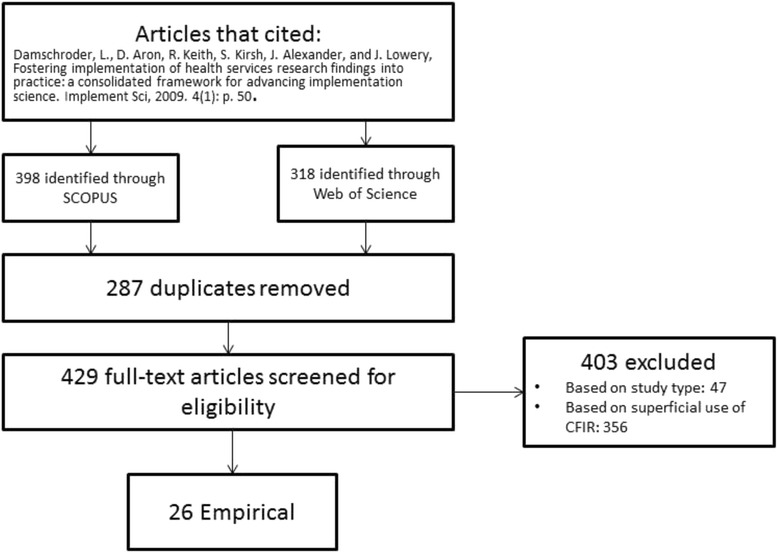
BACKGROUND: In 2009, Damschroder et al. developed the Consolidated Framework for Implementation Research (CFIR), which provides a comprehensive listing of constructs thought to influence implementation. This systematic review assesses the extent to which the CFIR's use in implementation research fulfills goals set forth by Damschroder et al. in terms of breadth of use, depth of application, and contribution to implementation research. METHODS: We searched Scopus and Web of Science for publications that cited the original CFIR publication by Damschroder et al. (Implement Sci 4:50, 2009) and downloaded each unique result for review. After applying exclusion criteria, the final articles were empirical studies published in peer-review journals that used the CFIR in a meaningful way (i.e., used the CFIR to guide data collection, measurement, coding, analysis, and/or reporting). A framework analysis approach was used to guide abstraction and synthesis of the included articles. RESULTS: Twenty-six of 429 unique articles (6 %) met inclusion criteria. We found great breadth in CFIR application; the CFIR was applied across a wide variety of study objectives, settings, and units of analysis. There was also variation in the method of included studies (mixed methods (n = 13); qualitative (n = 10); quantitative (n = 3)). Depth of CFIR application revealed some areas for improvement. Few studies (n = 3) reported justification for selection of CFIR constructs used; the majority of studies (n = 14) used the CFIR to guide data analysis only; and few studies investigated any outcomes (n = 11). Finally, reflections on the contribution of the CFIR to implementation research were scarce. CONCLUSIONS: Our results indicate that the CFIR has been used across a wide range of studies, though more in-depth use of the CFIR may help advance implementation science. To harness its potential, researchers should consider how to most meaningfully use the CFIR. Specific recommendations for applying the CFIR include explicitly justifying selection of CFIR constructs; integrating the CFIR throughout the research process (in study design, data collection, and analysis); and appropriately using the CFIR given the phase of implementation of the research (e.g., if the research is post-implementation, using the CFIR to link determinants of implementation to outcomes).
Overview
The claims and statistics of this paper haven’t been checked yet.
Free: it reads the open-access text and checks the first 5 claims that cite a source we can check. Create a free account to check every claim.
Integrity signals
Registry
Cites
Statistics
Figures
Verification
Claims the paper makes
The claims and statistics of this paper haven’t been checked yet.
Free: it reads the open-access text and checks the first 5 claims that cite a source we can check. Create a free account to check every claim.
Claims other papers make about this one
Each is checked against this paper’s own text: does it say what the citing paper says it does?
The cited source says what the claim attributes to it.
In the citing paper
“Kirk et al.’s 2015 review of 26 articles with meaningful use of the CFIR found that most users employed mixed (n = 13) or qualitative (n = 10) methods and used the CFIR in the post-implementation phase (n = 15) [13].”
From The updated consolidated framework for implementation research based on user feedback (2022) · cites this paper as [13]
The cited source says what the claim attributes to it.
In the citing paper
“Determinant frameworks can thus be used to inform choice of implementation strategies that may best address contextual determinants [14], generate hypotheses to prospectively guide predictions of implementation outcomes, or retrospectively explain implementation outcomes by assessing differences in determinants across implementation settings [11, 13, 15].”
From The updated consolidated framework for implementation research based on user feedback (2022) · cites this paper as [13]
The cited source says what the claim attributes to it.
In the citing paper
“The majority of CFIR users employ qualitative methods to assess constructs [13].”
From The updated consolidated framework for implementation research based on user feedback (2022) · cites this paper as [13]
The cited source says what the claim attributes to it.
In the citing paper
“In their systematic review of CFIR application, Kirk et al highlight gaps in depth of use of the framework, variation in selection of CFIR constructs, and a lack of justification of constructs used, limiting comparison of findings across time and contexts.14”
The cited source says what the claim attributes to it.
In the citing paper
“One indicator of this is a finding by Kirk et al: Among 26 research studies that meaningfully used CFIR, only two of the 26 included patients among their unit of analysis.14”
4 more claims about this paper
Create a free account to see every claim other papers make about this one.
Self-check
Percentages, sums and reported differences re-computed from the paper’s own numbers.
The self-check needs the paper’s full text.
Citations
Cites
Damschroder, L. J., Aron, D. C., Keith, R. E., Kirsh, S. R., Alexander, J. A., & Lowery, J. C. (2009) · Implementation Science · doi:10.1186/1748-5908-4-50 · Cited by 14,496 · cited 10×
“At the macro level, the CFIR provides a standardized structure for building on findings across studies [3].”
BackgroundMethodInfluentialSelf-citationGale, N. K., Heath, G., Cameron, E., Rashid, S., & Redwood, S. (2013) · BMC Medical Research Methodology · doi:10.1186/1471-2288-13-117 · Cited by 10,865 · cited 1×
“Objective 3: determine the contribution of the CFIR to implementation research General co posed by D • Cohere • Whethe • Whethe Microsoft Excel where content was arrayed in a matrix format consisting of rows (articles), columns (codes), and cells (summarized data) [8].”
BackgroundQualitative research practice: a guide for social science students and researchers
(2003) · Choice Reviews Online · doi:10.5860/choice.41-1319 · Cited by 10,543
Proctor, E., Silmere, H., Raghavan, R., Hovmand, P., Aarons, G., Bunger, A., Griffey, R., & Hensley, M. (2011) · Administration and Policy in Mental Health and Mental Health Services Research · doi:10.1007/s10488-010-0319-7 · Cited by 8,721 · cited 2×
“[25]), (2) provide clearer linkage of CFIR constructs with outcomes, and (3) provide clearer specification of which CFIR constructs were used to investigate outcomes.”
BackgroundComparison of PubMed, Scopus, Web of Science, and Google Scholar: strengths and weaknesses
Falagas, M. E., Pitsouni, E. I., Malietzis, G. A., & Pappas, G. (2008) · The FASEB Journal · doi:10.1096/fj.07-9492lsf · Cited by 5,039 · cited 1×
“, Google Scholar) [6].”
The Challenge of Innovation Implementation
Klein, K. J., & Sorra, J. S. (1996) · The Academy of Management Review · doi:10.2307/259164 · Cited by 2,113 · cited 1×
“Investigation of outcomes is critical for the field of implementation science overall because optimal implementation outcomes are a necessary condition for innovation effectiveness [25, 26].”
BackgroundFrench, S. D., Green, S. E., O’Connor, D. A., McKenzie, J. E., Francis, J. J., Michie, S., Buchbinder, R., Schattner, P., Spike, N., & Grimshaw, J. M. (2012) · Implementation Science · doi:10.1186/1748-5908-7-38 · Cited by 1,338 · cited 1×
“Better integration of the CFIR (or other theoretical framework) into empirical studies would help to address gaps in use of theory and advance implementation science [4, 31, 32].”
Kitson, A. L., Rycroft-Malone, J., Harvey, G., McCormack, B., Seers, K., & Titchen, A. (2008) · Implementation Science · doi:10.1186/1748-5908-3-1 · Cited by 1,314 · cited 1×
“earlier by developers of the PARIHS framework [27].”
MethodMeho, L. I., & Yang, K. (2007) · Journal of the American Society for Information Science and Technology · doi:10.1002/asi.20677 · Cited by 974
Damschroder, L. J., & Lowery, J. C. (2013) · Implementation Science · doi:10.1186/1748-5908-8-51 · Cited by 734
Self-citation
Cited by
Items 501–600 of 1,001
Lakind, D., Becker, K. D., Chu, W., Boyd, M. R., & Chorpita, B. F. (2023) · School Mental Health · doi:10.1007/s12310-023-09599-6 · Cited by 11
“Additionally, we drew on constructs identified in the Consolidated Framework for Implementation Research, or CFIR—a widely used framework that outlines key constructs at multiple levels associated with implementation outcomes (Damschroder et al., 2009; Kirk et al., 2015).”
MethodChapuma, C. I. J., Sakala, D., Nyirenda-Nyang’wa, M., Hosseinipour, M. C., Mbeye, N. M., Matoga, M., Kumwenda, M., Chikweza, A., Mipando, A. L. N., & Mwapasa, V. (2024) · Journal of the International AIDS Society · doi:10.1002/jia2.26284 · Cited by 11
Jehl, N. M., Hess, C. W., Choate, E., Nguyen, H. T., Yang, Y., & Simons, L. E. (2024) · Journal of Pediatric Psychology · doi:10.1093/jpepsy/jsae056 · Cited by 11
Nnodu, O. E., Munung, N. S., Chirande, L., Chunda-Liyoka, C. M., Kiguli, S., Sarfo, F. S., Touré, B. A., Balandya, E., Guindo, A., Kuona, P., et al. (2024) · BMJ Open · doi:10.1136/bmjopen-2024-089056 · Cited by 11
“24 25 Within these domains are 37 specific constructs that may act as barriers and/ or enablers to implementation.”
Stokes, T., Atmore, C., Penno, E., Richard, L., Wyeth, E., Richards, R., Doolan‐Noble, F., Gray, A. R., Sullivan, T. A., & Gauld, R. D. C. (2019) · BMJ Open · doi:10.1136/bmjopen-2019-030076 · Cited by 12
Enhanced recovery program implementation: an evidence-based review of the art and the science
Aloia, T. A., Keller, D. S., Kowalski, R. B., Lin, H., Luciano, M. M., Myers, J. A., Sinha, P., Spaniolas, K., & Young‐Fadok, T. M. (2019) · Surgical Endoscopy · doi:10.1007/s00464-019-07065-6 · Cited by 11
Walsh, D. J., Spiby, H., McCourt, C., Coleby, D., Grigg, C. P., Bishop, S., Scanlon, M., Culley, L. A., Wilkinson, J., Pacanowski, L., et al. (2020) · Health Services and Delivery Research · doi:10.3310/hsdr08120 · Cited by 12
Chikalipo, M., Kapanda, L., Mndolo, N., Mbiza, C. R., Khisi, P., Golombe, E., Bonongwe, P., Chirwa, E. M., & Maluwa, A. O. (2020) · International Journal of Women s Health · doi:10.2147/ijwh.s223029 · Cited by 11
Scale up mHealth HIV interventions: site and public health perspectives and lessons learned from P3
Paul, M. E., Castillo, M., Emmanuel, P. J., Bauermeister, J. A., Mena, L. A., Sullivan, P. S., & Hightow‐Weidman, L. (2021) · mHealth · doi:10.21037/mhealth-20-65 · Cited by 11
“There are multiple models or theoretical frameworks to inform efforts at scale-up which, along with reliable, valid measures, are needed to improve replicability and generalizability of results (10-17).”
BackgroundVoss, H., Francke, A. L., & de Veer, A. J. E. (2020) · Disability and health journal · doi:10.1016/j.dhjo.2020.101049 · Cited by 11
Busse, T. S., Jux, C., Kernebeck, S., Dreier, L. A., Meyer, D., Zenz, D., Zernikow, B., & Ehlers, J. P. (2021) · Children · doi:10.3390/children8100839 · Cited by 11
“Here, frameworks, such as the Consolidated Framework for Implementation Research (CFIR) [43], can be helpful and should be included in further research [44].”
MethodThornewill, J., Antimisiaris, D. E., Ezekekwu, E. U., & Esterhay, R. J. (2021) · Journal of the American Pharmacists Association · doi:10.1016/j.japh.2021.10.018 · Cited by 11
Pratt, R. J., Xiong, S., Kmiecik, A., Strobel-Ayres, C., Joseph, A. M., Everson‐Rose, S. A., Luo, X., Cooney, N. L., Thomas, J., Specker, S., et al. (2022) · BMC Public Health · doi:10.1186/s12889-022-13563-5 · Cited by 11
“The Consolidated Framework for Implementation Research (CFIR)(14–16) has been widely used in health services research(15) and focuses on ve key areas of implementation.”
MethodFavas, C., Ansbro, É., Eweka, E., Agarwal, G., Porras, M. L., Tsiligianni, I., Vedanthan, R., Webster, R. J., Perel, P., & Murphy, A. (2022) · Public health reviews · doi:10.3389/phrs.2022.1604583 · Cited by 11
“By providing a standardized de fi nition of constructs and guidance for qualitative coding, the CFIR facilitated intuitive data extraction and analysis, while ensuring consistency and systemization in the process [32].”
InfluentialDy, S. M., Hamayel, N. A. A., Hannum, S. M., Sharma, R., Isenberg, S. R., Kuchinad, K. E., Zhu, J., Smith, K. C., Lorenz, K., Kamal, A. H., et al. (2017) · Journal of Pain and Symptom Management · doi:10.1016/j.jpainsymman.2017.06.008 · Cited by 11
Weintraub, J. A., Birken, S. A., Burgette, J. M., Lewis, T. A., & White, B. A. (2019) · Journal of Public Health Dentistry · doi:10.1111/jphd.12324 · Cited by 11
Self-citationMontena, A. L., Possemato, K., Kuhn, E. R., Carlson, E. B., McGovern, M. P., Smith, J. S., & Blonigen, D. M. (2021) · Journal of Technology in Behavioral Science · doi:10.1007/s41347-021-00198-3 · Cited by 11
“One strength of this study is that we relied on an established framework for identifying implementation barriers and facilitators (CFIR) throughout our research process, which has been recommended to advance implementation research (Kirk et al., 2016).”
MethodMarcial, L. H., Johnston, D., Shapiro, M. R., Jacobs, S., Blumenfeld, B. H., & Smith, L. R. (2019) · JAMIA Open · doi:10.1093/jamiaopen/ooz002 · Cited by 11
Merlo, G., Page, K., Zardo, P., & Graves, N. (2019) · Applied Health Economics and Health Policy · doi:10.1007/s40258-019-00477-4 · Cited by 10
The Consolidated Framework for Implementation Research: Application to Education
Walters, W., Barber, W., & Jutras, M. (2025) · Education Sciences · doi:10.3390/educsci15050613 · Cited by 10
Brøderud, L., Førde, R., Romøren, M., Wahl, A. K., & Pedersen, R. (2025) · Journal of Evaluation in Clinical Practice · doi:10.1111/jep.70131 · Cited by 10
“…that is, the municipal and national levels, which are referred to as the ‘ inner setting ’ and ‘ outer setting ’ , respectively, in one of the most widely used implementation frameworks for studying barriers and facilitators [28], the Consolidated Framework for Implementation Research (CFIR) [24].”
Moss, C., Malpass, J., Fox, L., Urbano, T. G., Aggarwal, A., & Hemelrijck, M. V. (2025) · Journal of Cancer Policy · doi:10.1016/j.jcpo.2025.100618 · Cited by 10
Karim, L., McIntosh, T., Jebara, T., & Cunningham, S. (2025) · International Journal of Pharmacy Practice · doi:10.1093/ijpp/riaf063 · Cited by 11
Valasaki, M., Taylor, L. C., Woof, V. G., Howell, S. J., Tischkowitz, M. D., Antoniou, A. C., Archer, S., French, D., & Usher‐Smith, J. A. (2026) · British Journal of Cancer · doi:10.1038/s41416-025-03329-2 · Cited by 10
“The CFIR was chosen as it is considered one of the most ef fi cient approaches to gain evidence on barriers and facilitators of potential interventions in different contexts, particularly in healthcare, and considers factors at system, individual and local levels [24].”
Expectations vs Reality of an Intraoperative Artificial Intelligence Intervention
Thornton, M. A., Cher, B. A. Y., Macdonald, C. L., Baker, J., Marten, E. L., Mai, D., Sankaranarayanan, G., & Balentine, C. J. (2026) · JAMA Surgery · doi:10.1001/jamasurg.2025.6029 · Cited by 12
O’Riordan, F., Shiely, F., Byrne, S., & Fleming, A. (2020) · International Journal of Clinical Pharmacy · doi:10.1007/s11096-020-01159-1 · Cited by 10
Gupte, H., D’Costa, M., Ramanadhan, S., & Viswanath, K. (2020) · Workplace Health & Safety · doi:10.1177/2165079920952761 · Cited by 10
“It offers a list of constructs that help in understanding the intervention across multiple settings, that is, what works, where and why (Kirk et al., 2016).”
BackgroundAusserhofer, D., Bragadóttir, H., Dhaini, S., Harvey, C. L., Lehocki, F., & Schubert, M. (2021) · Springer eBooks · doi:10.1007/978-3-030-71073-6_7 · Cited by 10
Gordon, E. J., Uriarte, J. J., Anderson, N., Smith, J. D., Caicedo, J. C., & Shumate, M. (2022) · Journal of Clinical and Translational Science · doi:10.1017/cts.2022.378 · Cited by 10
“CFIR includes 39 constructs in 5 domains: intervention characteristics, organizational inner setting, characteristics of individuals, outer setting, and process [30,31].”
BackgroundVanDevanter, N., Zhong, L., Dannefer, R., Manyindo, N., Walker, S., Otero, V., Smith, K., Keita, R., Thorpe, L. E., Drackett, E., et al. (2022) · Frontiers in Public Health · doi:10.3389/fpubh.2022.689942 · Cited by 10
“Similar to other implementation studies, this study found that CFIR provided a valuable tool for assessing domains and constructs important to successful intervention implementation (8).”
ResultGurung, G., Jaye, C., Gauld, R. D. C., & Stokes, T. (2022) · BMJ Open · doi:10.1136/bmjopen-2022-065635 · Cited by 10
Roll, A., Saxena, M., Orlan, E., Titus, A., Juvekar, S. K., Gwayi-Chore, M.-C., Avokpaho, E., Chabi, F., Togbevi, C. I., Elijan, A. B., et al. (2022) · Global Health Research and Policy · doi:10.1186/s41256-022-00281-z · Cited by 10
Smith, S., Trevithick, R., Smith, J. A., Pung, L., Taylor, K., Ha, N. T., Chai, K. E. K., Gewerc, C. G., & Moorin, R. E. (2023) · BMC Health Services Research · doi:10.1186/s12913-023-09662-7 · Cited by 10
“Yet, CFIR enables future comparisons with other cancer staging process evaluations and other interventions through its standardised constructs [61].”
BackgroundRommerskirch‐Manietta, M., Manietta, C., Purwins, D., Braunwarth, J. I., Quasdorf, T., & Roes, M. (2023) · Implementation Science Communications · doi:10.1186/s43058-023-00486-4 · Cited by 10
Implementing medication adherence interventions in four Dutch living labs; context matters
Hogervorst, S., Vervloet, M., Janssen, R., Koster, E. S., Adriaanse, M. C., Bekker, C. L., van den Bemt, B. J. F., Bouvy, M. L., Heerdink, E. R., Hugtenburg, J. G., et al. (2023) · BMC Health Services Research · doi:10.1186/s12913-023-10018-4 · Cited by 10
Preparing community pharmacy teams for health information exchange (HIE)
Hettinger, K. N., Adeoye‐Olatunde, O. A., Russ, A. L., Riley-Jensen, E. G., Kepley, K. L., & Snyder, M. E. (2023) · Journal of the American Pharmacists Association · doi:10.1016/j.japh.2023.12.003 · Cited by 11
Contextual Determinants of Time to Surgery for Patients With Hip Fracture
Welch, J. M., Gomez, G. I., Chatterjee, M., Shapiro, L. M., Morris, A. M., Gardner, M. J., Harris, A. H. S., Baker, L. C., Koltsov, J. C. B., Castillo, T. N., et al. (2023) · JAMA Network Open · doi:10.1001/jamanetworkopen.2023.47834 · Cited by 12
Strid, E. N., Wallin, L., & Nilsagård, Y. E. (2024) · Scandinavian Journal of Primary Health Care · doi:10.1080/02813432.2023.2301556 · Cited by 10
“…to integrate and sustain change in clinical practice [37]. a selection of cFiR constructs is often used in data collection and data analysis [28]. the interview questions in this study focused on constructs related to engagement and the need for support within the inner setting and…”
Tabak, R. G., Nilsén, P., Woodward, E. N., & Chambers, D. (2023) · Oxford University Press eBooks · doi:10.1093/oso/9780197660690.003.0004 · Cited by 10
Health screenings in college health centers: Variations in practice
Sutherland, M. A., Hutchinson, M. K., Si, B., Ding, Y., Liebermann, E., Connolly, S. L., Cadely, H. S., Hayes, J. F., & Mueller, S. D. (2024) · Journal of American College Health · doi:10.1080/07448481.2024.2361307 · Cited by 10
Johnson, A., Self, K. J., Silvey, R., Webb, G. A., Kalra, N., Fallon, S., Cunningham, S., & Kanamori, M. (2024) · PLoS ONE · doi:10.1371/journal.pone.0305269 · Cited by 10
Review of the facilitators and barriers to adoption of biofortified foods and food products
Huey, S. L., Islam, S., Mehta, N. H., Konieczynski, E. M., Friesen, V. M., Krisher, J. T., Mbuya, M. N. N., Monterrosa, E. C., Nyangaresi, A. M., & Mehta, S. (2024) · Nutrition Research Reviews · doi:10.1017/s0954422424000258 · Cited by 11
Alshihab, S., Ibrahim, M. I. M., Zaidan, M., & Hadi, M. A. (2024) · International Journal of Clinical Pharmacy · doi:10.1007/s11096-024-01830-x · Cited by 10
“While the majority of studies utilizing the CFIR framework focus on the post-implementation phase to understand determinants of implementation success [46], this study is distinct in its application of CFIR during the pre-implementation phase.”
Zhang, Q., Han, S., Dong, W., Cao, G., Wang, Z., Li, M., & Zhu, R. (2024) · Nurse Education Today · doi:10.1016/j.nedt.2024.106501 · Cited by 10
Barker, B., Norton, A., Wood, S., Macevicius, C., Hogan, K., Cadieux, K., Meilleur, L. R., Nosyk, B., Urbanoski, K. A., Pauly, B., et al. (2024) · International Journal of Drug Policy · doi:10.1016/j.drugpo.2024.104679 · Cited by 11
Cook, C., Finch, T. L., Sharma, S., Girling, M., Rapley, T., & Vernazza, C. R. (2019) · European Journal Of Dental Education · doi:10.1111/eje.12481 · Cited by 10
Jackson, L. A., Dechman, M., Mathias, H., Gahagan, J., & Morrison, K. (2021) · Health & Social Care in the Community · doi:10.1111/hsc.13409 · Cited by 11
Colón‐López, V., Soto-Abreu, R., Medina-Laabes, D. T., Diaz-miranda, O. L., Ortiz, A. P., Suarez, E. L., & Hull, P. C. (2021) · Human Vaccines & Immunotherapeutics · doi:10.1080/21645515.2021.1955609 · Cited by 10
“26–28 This framework has been used previously to describe similar interventions related to HPV vaccination in adolescents.”
MethodAdeoye‐Olatunde, O. A., Curran, G. M., Jaynes, H. A., Hillman, L. A., Sangasubana, N., Chewning, B. A., Kreling, D. H., Schommer, J. C., Murawski, M. M., Perkins, S. M., et al. (2022) · Implementation Science Communications · doi:10.1186/s43058-022-00277-3 · Cited by 10
Wilson, P. M., Dixon, S., Vell, T., Bower, P., Rootkin, L., Williams, C., Strong, A., Lawrence, D., Elvey, R., Williams, O., et al. (2023) · International Journal of Clinical Trials · doi:10.18203/2349-3259.ijct20231106 · Cited by 10
Orchowski, L. M., Paszek, C., Lopez, R. J. M., Oesterle, D. W., Pearlman, D. N., Rizzo, C. J., Elwy, A. R., Berkowitz, A. D., Malone, S., & Fortson, B. L. (2023) · Journal of Community Psychology · doi:10.1002/jcop.23050 · Cited by 11
Labbé, D., Heider, A., Eisenberg, Y., Gould, R. L., & Jones, R. (2023) · Evaluation and Program Planning · doi:10.1016/j.evalprogplan.2023.102367 · Cited by 10
Skouteris, H., Melder, A., Bailey, C., Morris, H., Garad, R. M., Teede, H. J., & Robinson, T. (2018) · Seminars in Reproductive Medicine · doi:10.1055/s-0038-1667311 · Cited by 10
Mäkelä, P., Godfrey, M., Cradduck-Bamford, A., Ellis, G., & Shepperd, S. (2018) · Trials · doi:10.1186/s13063-018-2929-4 · Cited by 10
“Abbreviations CFIR: Consolidated Framework for Implementation Research; CGA: Comprehensive Geriatric Assessment; HAH: Hospital at home; MDT: Multidisciplinary team; MRC: Medical Research Council; NHS: National Health Service; RCT: Randomised controlled trial Acknowledgements The overall supervision of the trial and pr…”
Method‘Why do we need a policy?’ Administrators’ perceptions on breast-feeding-friendly childcare
Marhefka, S. L., Sharma, V., Schafer, E. J., Turner, D. E., Falope, O. O., Louis‐Jacques, A. F., Wachira, M. M., Livingston, T. A., & Roig-Romero, R. M. (2018) · Public Health Nutrition · doi:10.1017/s1368980018002914 · Cited by 10
“The CFIR has been used across a variety of settings((28)), to aid in planning to implement new innovations as well as understanding”
MethodKlaman, S. L., Turner, K. L., Lorvick, J., & Jones, H. E. (2020) · Journal of Addiction Medicine · doi:10.1097/adm.0000000000000657 · Cited by 10
“The CFIR includes 5 domains: intervention characteristics, outer setting, inner setting, characteristics of individuals, and process (Damschroder et al., 2009; Kirk et al., 2016).”
BackgroundImplementation of national antenatal hypertension guidelines: a multicentre multiple methods study
Whybrow, R., Webster, L., Girling, J., Brown, H., Wilson, H. M., Sandall, J., & Chappell, L. C. (2020) · BMJ Open · doi:10.1136/bmjopen-2019-035762 · Cited by 10
Implementation challenges to patient safety in Guatemala: a mixed methods evaluation
Hall, B. J., Puente, M., Aguilar, A., Sico, I. P., Barrios, M. O., Méndez, S., Baumgartner, J. N., Boyd, D. L., Calgua, E., Lou‐Meda, R., et al. (2021) · BMJ Quality & Safety · doi:10.1136/bmjqs-2020-012552 · Cited by 10
Soukup, T., Davis, R. E., Lopez, M. B., Healey, A., Estevao, C., Fancourt, D. E., Dazzan, P., Pariante, C. M., Dye, H., Osborn, T., et al. (2022) · BMJ Open · doi:10.1136/bmjopen-2021-055691 · Cited by 10
Carver, H., Parkes, T., Masterton, W., Booth, H., Ball, L., Murdoch, H., Falzon, D., & Pauly, B. (2022) · International Journal of Environmental Research and Public Health · doi:10.3390/ijerph192215207 · Cited by 10
“While the CFIR has most commonly been used during or post-implementation [29], we used the”
BackgroundMethodMalham, S. A., Smithman, M.-A., Touati, N., Brousselle, A., Loignon, C., Dubois, C.-A., Nour, K., Boivin, A., & Breton, M. (2019) · Journal of Health Organization and Management · doi:10.1108/jhom-10-2018-0303 · Cited by 9
“It is organized in five major domains that incorporate 39 constructs considered important to the effectiveness of implementation (Kirk et al., 2016).”
BackgroundXames, M. D., Topcu, T. G., Parker, S. H., Zagarese, V., & Epling, J. W. (2025) · Frontiers in Digital Health · doi:10.3389/fdgth.2025.1611225 · Cited by 9
Severinsen, F., Varsi, C., Andersen, L. F., Henriksen, C., & Paulsen, M. M. (2025) · BMC Health Services Research · doi:10.1186/s12913-025-13542-7 · Cited by 9
“It has been suggested that using CFIR to prospectively assess barriers and facilitators may increase the likelihood of successful implementation of a given program [50], making CFIR an appropriate framework for the present study.”
Kegler, M. C., Rana, S., Vandenberg, A. E., Hastings, S. N., Hwang, U., Eucker, S. A., & Vaughan, C. P. (2022) · Frontiers in Health Services · doi:10.3389/frhs.2022.1053489 · Cited by 9
“The Consolidated Framework for Implementation Research (CFIR) (32) is a widely used framework in implementation science designed to synthesize constructs from a range of theories and models (32, 33).”
Theoretical Models of Health Behavior
McDowell, I. (2023) · Springer eBooks · doi:10.1007/978-3-031-28986-6_6 · Cited by 11
Grootjans, S. J. M., Stijnen, M., Jong, I. H.-D., Kroese, M., Ruwaard, D., & Jansen, M. W. J. (2023) · Scandinavian Journal of Public Health · doi:10.1177/14034948231199804 · Cited by 9
“Using a theoretical framework to guide data collection, analysis and interpretation is crucial to identify determinants of implementation that are relevant also outside the specific context in which the research was conducted [12].”
BackgroundMethodNayahangan, L. J., Thinggaard, E., Khan, F., Gustafsson, A., Mørcke, A. M., Dubrowski, A., Hirshfield, L. E., & Konge, L. (2023) · Medical Education · doi:10.1111/medu.15248 · Cited by 9
“28,54 While the CFIR was a valuable tool, our findings also highlighted some limitations of the framework, particularly in defining the domains.”
MethodPrendeville, P., Bourke, M., & Kinsella, W. (2023) · SAGE Open · doi:10.1177/21582440231192187 · Cited by 10
“A systematic review by Kirk et al. (2016) found that it was applied in various settings using a wide variety of innovative approaches across a range of topics and constructs.”
BackgroundInfluentialKim, S.-H., Rochette, A., Ahmed, S., Archambault, P. S., Auger, C., Battaglini, A., Freeman, A. R., Kehayia, E., Kinsella, E. A., Larney, E., et al. (2023) · Advances in Health Sciences Education · doi:10.1007/s10459-023-10298-9 · Cited by 9
“We drew on the Consolidated Framework for Implementation Research (CFIR), a determinant framework widely used in knowledge translation (Kirk et al., 2015).”
Haun, J. N., Nakase‐Richardson, R., Cotner, B. A., Agtarap, S., Martin, A. M., Tweed, A., Hanks, R. A., Wittine, L. M., Bergquist, T. F., & Hoffman, J. M. (2024) · Journal of Head Trauma Rehabilitation · doi:10.1097/htr.0000000000000920 · Cited by 9
“…frameworks, such as RE-AIM (Reach, Effectiveness, Adoption, Implementation, Maintenance) 34,35 and the Consolidated Framework for Implementation Research (CFIR), 36 and evidence-based implementation strategies to support the effective adoption and sus-tainment of evidence-based practices.”
MethodMinian, N., Gayapersad, A., Coroiu, A., Dragonetti, R., Zawertailo, L. A., Zaheer, J., O’Neill, B. G., Lange, S., Thomson, N., Crawford, A. S., et al. (2024) · Frontiers in Psychiatry · doi:10.3389/fpsyt.2024.1286078 · Cited by 10
Henderson, T. O., Allen, M. A., Mim, R., Egleston, B. L., Fleisher, L. G., Elkin, E. B., Oeffinger, K. C., Krull, K. R., Ofidis, D., McLeod, B. I., et al. (2024) · BMC Health Services Research · doi:10.1186/s12913-024-10586-z · Cited by 9
Gertz, A. M., Smith, M. L., Thomas, D., Ti, A. J., Vamos, C. A., & Bohn, J. (2024) · BMC Medical Education · doi:10.1186/s12909-024-05305-5 · Cited by 9
“…guide for programs designing sustainable anti-racism curricula in the future, the Consoli-dated Framework for Implementation Research (CFIR) [19–21] was used to organize themes and sub-themes derived from key informant interviews, and guide creation of the SPOC (Support – Pipeline – Outcomes –…”
MethodTucker, R., Vickers, R., Adams, E. J., Burgon, C., Lock, J., Goldberg, S. E., Gladman, J. R. F., Masud, T., Orton, E., Timmons, S., et al. (2024) · Archives of Public Health · doi:10.1186/s13690-024-01283-8 · Cited by 9
Partnering with Schools to Adapt a Team Science Intervention: Processes and Challenges
Kuriyan, A. B., Albright, J., Rushworth, S., Duresso, B., Testa, S. M., Eiraldi, R. B., Marshaleck, E. W., & Wolk, C. B. (2024) · School Mental Health · doi:10.1007/s12310-024-09665-7 · Cited by 9
“In using the CFIR as a framework to guide study design, we were able to prospectively identify implementation challenges, adapt the intervention, and tailor implementation procedures prior to large scale roll-out as recommended (Kirk et al., 2016).”
MethodIntegrating Economic Evaluation and Implementation Science to Advance the Global HIV Response
Salomon, J. A. (2019) · JAIDS Journal of Acquired Immune Deficiency Syndromes · doi:10.1097/qai.0000000000002219 · Cited by 9
Evaluating a Whole Health Approach to Enhance Veteran Care: Exploring the Staff Experience
Haun, J. N., Melillo, C., Cotner, B. A., McMahon-Grenz, J., & Paykel, J. M. (2021) · Journal of Veterans Studies · doi:10.21061/jvs.v7i1.201 · Cited by 9
Wexler, C., Kamau, Y., Muchoki, E., Babu, S., Maosa, N., Maloba, M., Brown, M., Goggin, K., Mabachi, N. M., Gautney, B. J., et al. (2021) · Implementation Science Communications · doi:10.1186/s43058-021-00188-9 · Cited by 9
“Our reporting on selected salient constructs demonstrates CFIR’s flexibility and versatility, yet limits cross-study comparisons, which is a noted limitation of CFIR [31].”
BackgroundBrämberg, E. B., Arapovic-Johansson, B., Bültmann, U., Svedberg, P., & Bergström, G. (2021) · BMC Public Health · doi:10.1186/s12889-021-11786-6 · Cited by 9
“context will be based on the CFIR guide to enable a systematic identification of barriers to and facilitators of the intervention [59, 60].”
Methoddel Pozo, B. (2021) · Contemporary Drug Problems · doi:10.1177/00914509211052107 · Cited by 9
“The Consolidated Framework for Implementation Research (Damschroder et al., 2009) has been shown effective at providing the means to evaluate and improve interventions in a wide range of settings (Kirk et al., 2016), and has the flexibility to produce insights at a rapid pace (Keith et al., 2017).”
BackgroundNilsen, H. M., & Feiring, E. (2022) · Scandinavian Journal of Public Health · doi:10.1177/14034948221080402 · Cited by 9
“Theoretical perspectives can be used to guide data collection, analysis and interpretation, and make us able to build on findings across studies and contexts [16].”
BackgroundAvokpaho, E., Lawrence, S. O., Roll, A., Titus, A., Jacob, Y., Kaliappan, S. P., Gwayi-Chore, M.-C., Chabi, F., Togbevi, C. I., Elijan, A. B., et al. (2022) · BMJ Open · doi:10.1136/bmjopen-2022-061682 · Cited by 9
Pilot implementation of the PharmNet naloxone program in an independent pharmacy
Eldridge, L. A., Meyerson, B. E., & Agley, J. D. (2022) · Journal of the American Pharmacists Association · doi:10.1016/j.japh.2022.09.004 · Cited by 9
Sperber, N. R., Miech, E. J., Clary, A., Perry, K. R., Edwards-Orr, M., Rudolph, J. L., Houtven, C. H. V., & Thomas, K. S. (2022) · Healthcare · doi:10.1016/j.hjdsi.2022.100653 · Cited by 9
Love, P., Laws, R., Taki, S., West, M. L., Hesketh, K. D., & Campbell, K. J. (2022) · Frontiers in Health Services · doi:10.3389/frhs.2022.1031628 · Cited by 10
“While the CFIR can be applied using a quantitative approach (52, 53), this study applied a qualitative approach as commonly used by others (54, 55).”
MethodMoss, J. L., Stoltzfus, K. C., Popalis, M. L., Calo, W. A., & Kraschnewski, J. L. (2023) · BMC Health Services Research · doi:10.1186/s12913-022-08976-2 · Cited by 9
“The Consolidated Framework for Implementation Research (CFIR) [16, 17] outlines implementation domains and constructs that influence the success of interventions, particularly when implementing these interventions in new contexts.”
Evaluation of interdisciplinary care pathway implementation in older elective surgery patients
Hu, F. Y., Rowe, K., O’Mara, L., Bulger, A. L., Bleday, R., Groff, M. W., Cooper, Z. R., & Bernacki, R. (2023) · Journal of the American Geriatrics Society · doi:10.1111/jgs.18244 · Cited by 9
Ming, D. Y., Wong, W., Jones, K. A., Antonelli, R. C., Gujral, N., Gonzales, S. E., Rogers, U. A., Ratliff, W., Shah, N., & King, H. A. (2023) · JMIR Research Protocols · doi:10.2196/46847 · Cited by 9
Meshkovska, B., Forberger, S., Wendt, J., Scheller, D. A., Castellari, E., Tiboldo, G., Łuszczyńska, A., & Lien, N. (2023) · Global Implementation Research and Applications · doi:10.1007/s43477-023-00100-8 · Cited by 9
“The CFIR remains one of the most comprehensive and widely used determinant frameworks in implementation science offering a cross-disciplinary comparison of findings (Birken et al., 2017; Kirk et al., 2016).”
Economidis, G., Eades, A., Shakeshaft, A. P., & Farnbach, S. (2023) · PLoS ONE · doi:10.1371/journal.pone.0295204 · Cited by 10
“The CFIR is a conceptual, systematic and meta-theoretical approach that is used to assess the uptake of a program against key factors that have been shown to influence the implementation of complex programs [8–10].”
InfluentialDürsch, H., Boltenhagen, U., Mahler, C., Joos, S., Szécsényi, J., & Klafke, N. (2024) · Qualitative Health Research · doi:10.1177/10497323241231530 · Cited by 9
“…these research objectives, three distinct yet interconnected studies were designed and conducted in consideration of the Consolidated Framework for Implementation Research (CFIR) (Damschroder et al., 2009), a recognized framework for the evaluation of complex interventions (Kirk et al., 2016).”
BackgroundSibley, K. M., Touchette, A. J., Singer, J. C., Dubberley, K. M. A., & Oates, A. (2019) · BMC Geriatrics · doi:10.1186/s12877-019-1224-x · Cited by 9
Augustsson, P., Holst, A., Svenningsson, I., Petersson, E., Björkelund, C., & Brämberg, E. B. (2020) · BMJ Open · doi:10.1136/bmjopen-2019-035629 · Cited by 9
Choi, K., Lindert, L., Schlomann, L., Samel, C., Hellmich, M., & Pfaff, H. (2021) · International Journal of Environmental Research and Public Health · doi:10.3390/ijerph182211844 · Cited by 9
OETZEL, J. G., Sika‐Paotonu, D., Penetito-Hemara, D., & Henry, A. (2022) · Implementation Science Communications · doi:10.1186/s43058-022-00373-4 · Cited by 8
Chamberlain, S. A., Warner, G., Andrew, M. K., Hande, M. J., Hubley, E., Weeks, L. E., & Keefe, J. M. (2022) · The Gerontologist · doi:10.1093/geront/gnac175 · Cited by 8
“There are numerous implementation science theories, models, and frameworks (Nilsen, 2015), and the CFIR was chosen because it assesses health system-level factors that affect the successful implementation of an intervention (Kirk et al., 2016; McIsaac et al., 2018).”
Engaging community members in cancer research: an assessment of an NCI-designated cancer center
Leader, A. E., Melillo, R. J., Greene, Q., Blanding-Godbolt, J., Shimada, A., Eischen, C. M., & Aplin, A. E. (2023) · Cancer Causes & Control · doi:10.1007/s10552-022-01666-8 · Cited by 8
Lin, X., Yuen, J. Y. E., Chan, W. Q. J., Gosavi, T. D., Keong, N. C. H., Lee, L. C. H., Kumar, S., Tan, C. S., Soon, K. C. P., Chew, Y. P. A., et al. (2023) · Pilot and Feasibility Studies · doi:10.1186/s40814-023-01234-0 · Cited by 8
“CFIR enables a systematic and comprehensive assessment of potential barriers and facilitators to implementation of an intervention, and it is well-used in health service research [16, 17].”
BackgroundEvans, S. K., Ober, A. J., Korn, A. R., Peltz, A., Friedmann, P. D., Page, K. A., Murray-Krezan, C. M., Huerta, S., Ryzewicz, S., Tarhuni, L., et al. (2024) · Addiction Science & Clinical Practice · doi:10.1186/s13722-024-00461-x · Cited by 8
“To examine potential determinants of implementation in the pre-implementation phase of the START, we conducted semi-structured interviews with hospital admin-istrators and clinicians at each START site between April and August 2021 prior to the launch of the pragmatic trial [34].”
MethodDamme, A. V., Talrich, F., Crone, M. R., Rijnders, M. E. B., Patil, C. L., Rising, S. S., Abanga, J., Billings, D. L., Hindori‐Mohangoo, A. D., Hindori, M. P., et al. (2024) · Midwifery · doi:10.1016/j.midw.2024.104166 · Cited by 8
Metadata
- Authors
- Kirk, M. A., Kelley, C., Yankey, N., Birken, S. A., Abadie, B., & Damschroder, L.
- Affiliations
- University of North Carolina at Chapel Hill (US)
- VA Ann Arbor Healthcare System (US)
- Eastern Michigan University (US)
- Corresponding author
- Kirk, M. Alexis
- Venue
- Implementation Science
- Published
- 2015-12
- Volume
- 11
- Issue
- 1
- Pages
- 72-72
- ISSN
- 1748-5908 (ISSN-L)
- PMC
- PMC4869309
- OpenAlex
- W2398003476
- Cited by
- 1,496
- References
- 45
- Citations by year
- 2026: 160 · 2025: 173 · 2024: 236 · 2023: 209 · 2022: 213 · 2021: 182 · 2020: 151 · 2019: 87 · 2018: 40 · 2017: 38 · 2016: 4 · 2015: 2
- FWCI
- 5.03
- Type
- journal article
- Language
- en
- Open access
- gold
- doi.org
- Licence
- cc-by
- Locations
- Implementation Science (publishedVersion, cc-by)
- PubMed Central (publishedVersion, cc-by)
- PubMed (publishedVersion)
- Carolina Digital Repository (University of North Carolina at Chapel Hill) (submittedVersion)
- Funders
- RTI International (NA)
- Topics
- Health Sciences › Health Professions › General Health Professions › Health Policy Implementation Science
- Health Sciences › Health Professions › General Health Professions › Health Sciences Research and Education
- Health Sciences › Medicine › Public Health, Environmental and Occupational Health › Clinical practice guidelines implementation
- Keywords
- Consolidated Framework for Implementation Research, implementation research, implementation factors, implementation outcomes
- MeSH terms
- Goals, Health Plan Implementation, Health Services Research, Humans
About these checks
Registry, retraction, Cites and statistics results are computed, not judged, with one exception: a printed reference that no index lists is read once by a model before it counts as a citation error. Claims are extracted by a model and kept only when their quote appears verbatim in the text; each cited source is then checked, with a model’s help, for whether it says what the claim relies on. Those verdicts can be wrong — read the claim’s quote and the cited source before relying on one.
Statistics and arithmetic are recomputed, not judged.
Confidence bands are shown only for fields calibrated on our annotated test set. None is calibrated yet, so no band is shown.
What counts as a claim ›How we measure confidence ›How we check this ›
Are you an author, or do you see a problem with this page? Request a review
Data sources
Bibliographic data: Semantic Scholar, OpenAlex, Crossref.
Contains information from the Semantic Scholar Academic Graph Datasets, made available under the ODC Attribution License (ODC-BY 1.0).
Semantic Scholar’s data is described in: Kinney, R., et al. (2023). The Semantic Scholar Open Data Platform. arXiv:2301.10140.
