

A systematic review of empirical studies examining mechanisms of implementation in health
Open accessThe DOI matches its Crossref record; 143 of the 145 references it cites were found in a registry or an index.
Abstract
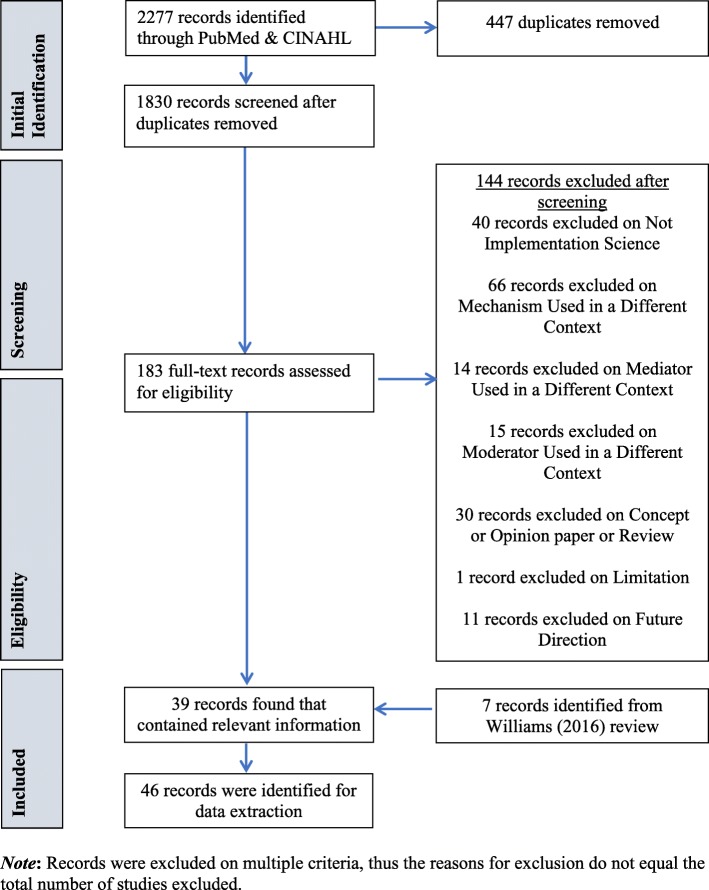
Background: Understanding the mechanisms of implementation strategies (i.e., the processes by which strategies produce desired effects) is important for research to understand why a strategy did or did not achieve its intended effect, and it is important for practice to ensure strategies are designed and selected to directly target determinants or barriers. This study is a systematic review to characterize how mechanisms are conceptualized and measured, how they are studied and evaluated, and how much evidence exists for specific mechanisms. Methods: We systematically searched PubMed and CINAHL Plus for implementation studies published between January 1990 and August 2018 that included the terms “mechanism,” “mediator,” or “moderator.” Two authors independently reviewed title and abstracts and then full texts for fit with our inclusion criteria of empirical studies of implementation in health care contexts. Authors extracted data regarding general study information, methods, results, and study design and mechanisms-specific information. Authors used the Mixed Methods Appraisal Tool to assess study quality. Results: Search strategies produced 2277 articles, of which 183 were included for full text review. From these we included for data extraction 39 articles plus an additional seven articles were hand-entered from only other review of implementation mechanisms (total = 46 included articles). Most included studies employed quantitative methods (73.9%), while 10.9% were qualitative and 15.2% were mixed methods. Nine unique versions of models testing mechanisms emerged. Fifty-three percent of the studies met half or fewer of the quality indicators. The majority of studies (84.8%) only met three or fewer of the seven criteria stipulated for establishing mechanisms. Conclusions: Researchers have undertaken a multitude of approaches to pursue mechanistic implementation research, but our review revealed substantive conceptual, methodological, and measurement issues that must be addressed in order to advance this critical research agenda. To move the field forward, there is need for greater precision to achieve conceptual clarity, attempts to generate testable hypotheses about how and why variables are related, and use of concrete behavioral indicators of proximal outcomes in the case of quantitative research and more directed inquiry in the case of qualitative research.
Overview
The claims and statistics of this paper haven’t been checked yet.
Free: it reads the open-access text and checks the first 5 claims that cite a source we can check. Create a free account to check every claim.
Integrity signals
Registry
Cites
Statistics
Figures
Verification
Claims the paper makes
The claims and statistics of this paper haven’t been checked yet.
Free: it reads the open-access text and checks the first 5 claims that cite a source we can check. Create a free account to check every claim.
Claims other papers make about this one
Each is checked against this paper’s own text: does it say what the citing paper says it does?
The source backs part of the claim, not all of it — or backs it for a different population, condition or comparison.
In the citing paper
“Emerging topics include prospectively building mechanism-focused hypotheses into research designs, developing approaches for identifying and prioritizing mechanisms, and advancing mechanisms measurement [19, 27].”
From Ten years of implementation outcomes research: a scoping review (2023) · cites this paper as [27]
Experimental — accuracy not yet measuredThe source backs part of the claim, not all of it — or backs it for a different population, condition or comparison.
In the citing paper
“Current literature also reflects an increasing number of studies testing the effectiveness of implementation strategies and the mechanisms that explain how these strategies may influence implementation outcomes [25–31].”
From Ten years of implementation outcomes research: a scoping review (2023) · cites this paper as [27]
Experimental — accuracy not yet measured
Self-check
Percentages, sums and reported differences re-computed from the paper’s own numbers.
The self-check needs the paper’s full text.
Citations
Cites
The theory of planned behavior
Ajzen, I. (1991) · Organizational Behavior and Human Decision Processes · doi:10.1016/0749-5978(91)90020-t · Cited by 134,657
Baron, R. M., & Kenny, D. A. (1986) · Journal of Personality and Social Psychology · doi:10.1037/0022-3514.51.6.1173 · Cited by 91,532
Perceived usefulness, perceived ease of use, and user acceptance of information technology
Davis, F. D. (1989) · MIS Quarterly · doi:10.2307/249008 · Cited by 68,483
Self-efficacy: The exercise of control
Bandura, A., Freeman, W. H., & Lightsey, R. (1999) · Journal of Cognitive Psychotherapy · doi:10.1891/0889-8391.13.2.158 · Cited by 46,835
Rogers, E. M., Singhal, A., & Quinlan, M. M. (2019) · An Integrated Approach to Communication Theory and Research · doi:10.4324/9780203710753-35 · Cited by 37,322
(1990) · Choice Reviews Online · doi:10.5860/choice.27-3338 · Cited by 35,305
Preacher, K. J., & Hayes, A. F. (2008) · Behavior Research Methods · doi:10.3758/brm.40.3.879 · Cited by 34,117 · cited 1×
“, computing significance for the product of coefficients) [95, 126], and Sobel’s (N = 4, 8.”
BackgroundSPSS and SAS procedures for estimating indirect effects in simple mediation models
Preacher, K. J., & Hayes, A. F. (2004) · Behavior Research Methods, Instruments, & Computers · doi:10.3758/bf03206553 · Cited by 17,383
Damschroder, L. J., Aron, D. C., Keith, R. E., Kirsh, S. R., Alexander, J. A., & Lowery, J. C. (2009) · Implementation Science · doi:10.1186/1748-5908-4-50 · Cited by 14,496 · cited 1×
“2017 [16] N Consolidated framework for implementation research [68] Interviews None”
Methodmice: Multivariate Imputation by Chained Equations in R
Buuren, S. V., & Groothuis-Oudshoorn, K. (2011) · Journal of Statistical Software · doi:10.18637/jss.v045.i03 · Cited by 13,870 · cited 1×
“2018 [27] Y Theoretical domains framework [84] Self-report, secondary analysis [85, 86]”
BackgroundValente, T. W. (2003) · Genetics in Medicine · doi:10.1097/01.gim.0000061743.67794.c4 · Cited by 13,723
Asymptotic Confidence Intervals for Indirect Effects in Structural Equation Models
Sobel, M. E. (1982) · Sociological Methodology · doi:10.2307/270723 · Cited by 12,810
Mediation in experimental and nonexperimental studies: New procedures and recommendations.
Shrout, P. E., & Bolger, N. (2002) · Psychological Methods · doi:10.1037/1082-989x.7.4.422 · Cited by 11,335
Research in Organizational Behavior.
Grimes, A. J., Cummings, L. L., & Staw, B. M. (1986) · Administrative Science Quarterly · doi:10.2307/2392975 · Cited by 10,899
Crossing the Quality Chasm: A New Health System for the 21st Century
Baker, A. (2001) · BMJ · doi:10.1136/bmj.323.7322.1192 · Cited by 10,736
Applied Longitudinal Data Analysis: Modeling Change and Event Occurrence
Singer, J. D., & Willett, J. B. (2003) · doi:10.1093/acprof:oso/9780195152968.001.0001 · Cited by 10,647
Perceived organizational support.
Eisenberger, R., Huntington, R., Hutchison, S., & Sowa, D. (1986) · Journal of Applied Psychology · doi:10.1037/0021-9010.71.3.500 · Cited by 10,023 · cited 1×
“2009 [34] Y Institutional theory [93], Theory of planned behavior [65], Theory of perceived organizational support [94] Self-report [78]”
BackgroundBeyond Baron and Kenny: Statistical Mediation Analysis in the New Millennium
Hayes, A. F. (2009) · Communication Monographs · doi:10.1080/03637750903310360 · Cited by 9,757 · cited 5×
“David and Schiff 2017 [41] Y Diffusion of innovation theory [87, 109] Self-report [110]”
BackgroundInfluentialA comparison of methods to test mediation and other intervening variable effects
MacKinnon, D. P., Lockwood, C. M., Hoffman, J. M., West, S. G., & Sheets, V. (2002) · Psychological Methods · doi:10.1037/1082-989x.7.1.83 · Cited by 9,406 · cited 1×
“Williams [14] suggests the product of coefficients approach [134, 135] is more appropriate for mediation analysis because it is a highly general approach to both single and multi-level mediation models that minimizes type I error rates, maximizes statistical power, and enhances accuracy of confidence intervals [14].”
BackgroundStages and processes of self-change of smoking: Toward an integrative model of change.
Prochaska, J. O., & DiClemente, C. C. (1983) · Journal of Consulting and Clinical Psychology · doi:10.1037/0022-006x.51.3.390 · Cited by 9,098
Proctor, E., Silmere, H., Raghavan, R., Hovmand, P., Aarons, G., Bunger, A., Griffey, R., & Hensley, M. (2011) · Administration and Policy in Mental Health and Mental Health Services Research · doi:10.1007/s10488-010-0319-7 · Cited by 8,721 · cited 1×
“We conceptualize distal outcomes as the eight implementation outcomes articulated by Proctor and colleagues [129].”
MethodSelf-citationInstitutions and organizations
(1995) · Choice Reviews Online · doi:10.5860/choice.33-1848 · Cited by 8,003
Building a practically useful theory of goal setting and task motivation: A 35-year odyssey.
Locke, E. A., & Latham, G. P. (2002) · American Psychologist · doi:10.1037/0003-066x.57.9.705 · Cited by 7,766 · cited 1×
“2011 [39] N Goal setting theory [105]; Goal commitment theory [106] Self-report [80, 107] Lewis et al.”
BackgroundKupper, L. L., Hosmer, D. W., & Lemeshow, S. (1990) · Journal of the American Statistical Association · doi:10.2307/2290035 · Cited by 7,599
The environment and disease: association or causation?
Hill, A. B. (2015) · Journal of the Royal Society of Medicine · doi:10.1177/0141076814562718 · Cited by 7,285
The Environment and Disease: Association or Causation?
Hill, A. B. (1965) · Proceedings of the Royal Society of Medicine · doi:10.1177/003591576505800503 · Cited by 6,974
Process evaluation of complex interventions: Medical Research Council guidance
Moore, G. F., Audrey, S., Barker, M., Bond, L., Bonell, C., Hardeman, W., Moore, L., O'Cathain, A., Tinati, T., Wight, D., et al. (2015) · BMJ · doi:10.1136/bmj.h1258 · Cited by 6,204 · cited 1×
“This kind of directed qualitative research is called for in the United Kingdom’s MRC Guidance for Process Evaluation [136].”
BackgroundThe diffusion of innovations: Some examples of finnish civil servant's professional tours in Europe
Hietala, M. (1983) · Scandinavian Journal of History · doi:10.1080/03468758308579015 · Cited by 6,162
MacKinnon, D. P., Fairchild, A. J., & Fritz, M. S. (2007) · Annual Review of Psychology · doi:10.1146/annurev.psych.58.110405.085542 · Cited by 5,688
Implementation intentions: Strong effects of simple plans.
Gollwitzer, P. M. (1999) · American Psychologist · doi:10.1037/0003-066x.54.7.493 · Cited by 5,478 · cited 1×
“2009 [38] N Theory of planned behavior [65]; Social cognitive theory [99]; Operant learning theory [100]; Action planning [101]; Common sense self-regulation model [102]; Precaution adoption process model [103]; Stage theory [103, 104] Self-report; objective measure [78, 79]”
BackgroundPowell, B. J., Waltz, T. J., Chinman, M. J., Damschroder, L. J., Smith, J. L., Matthieu, M. M., Proctor, E. K., & Kirchner, J. E. (2015) · Implementation Science · doi:10.1186/s13012-015-0209-1 · Cited by 4,963 · cited 1×
“, a discrete strategy is insufficient) [2, 3], but we have a poor understanding of how and why these strategies work.”
BackgroundCane, J., O’Connor, D., & Michie, S. (2012) · Implementation Science · doi:10.1186/1748-5908-7-37 · Cited by 4,888 · cited 1×
“2018 [27] Y Theoretical domains framework [84] Self-report, secondary analysis [85, 86]”
BackgroundLost in knowledge translation: Time for a map?
Graham, I. D., Logan, J., Harrison, M. B., Straus, S. E., Tetroe, J., Caswell, W., & Robinson, N. (2006) · Journal of Continuing Education in the Health Professions · doi:10.1002/chp.47 · Cited by 4,705 · cited 1×
“2014 [47] N Knowledge to action conceptual framework [117] Self-report [78, 79, 95]”
BackgroundPerceived Organizational Support
(2017) · The SAGE Encyclopedia of Industrial and Organizational Psychology, 2nd edition · doi:10.4135/9781483386874.n398 · Cited by 4,398
Kennedy, P. (1979) · Cited by 4,340
A general approach to causal mediation analysis.
Imai, K., Keele, L., & Tingley, D. (2010) · Psychological Methods · doi:10.1037/a0020761 · Cited by 4,143 · cited 1×
“2018 [27] Y Theoretical domains framework [84] Self-report, secondary analysis [85, 86]”
BackgroundTesting moderator and mediator effects in counseling psychology research.
Frazier, P. A., Tix, A. P., & Barron, K. E. (2004) · Journal of Counseling Psychology · doi:10.1037/0022-0167.51.1.115 · Cited by 4,037 · cited 1×
“Some researchers conflate moderators, mediators, and mechanisms [6], using the terms interchangeably [7].”
BackgroundPersonal Computing: Toward a Conceptual Model of Utilization1
Thompson, R. L., Higgins, C. A., & Howell, J. M. (1991) · MIS Quarterly · doi:10.2307/249443 · Cited by 3,814
(2005) · Cited by 3,748
Handbook of personality theory and research
Wilson, G. (1991) · Personality and Individual Differences · doi:10.1016/0191-8869(91)90043-b · Cited by 3,538
Making psychological theory useful for implementing evidence based practice: a consensus approach
Michie, S. (2005) · Quality and Safety in Health Care · doi:10.1136/qshc.2004.011155 · Cited by 3,440
Advancing a Conceptual Model of Evidence-Based Practice Implementation in Public Service Sectors
Aarons, G. A., Hurlburt, M., & Horwitz, S. M. (2011) · Administration and Policy in Mental Health and Mental Health Services Research · doi:10.1007/s10488-010-0327-7 · Cited by 3,240 · cited 1×
“2014 [42] Y EPIS framework [111] Self-report [80, 112]”
Self-citationGill, J. (2005) · Encyclopedia of Social Measurement · doi:10.1016/b0-12-369398-5/00166-3 · Cited by 3,114
Health promotion from the perspective of Social Cognitive Theory
Bandura, A. (1998) · Psychology & Health · doi:10.1080/08870449808407422 · Cited by 3,087
Exercise of Human Agency Through Collective Efficacy
Bandura, A. (2000) · Current Directions in Psychological Science · doi:10.1111/1467-8721.00064 · Cited by 2,948
Institutions and Organizations
Baum, J. A. C., & Scott, W. R. (1998) · Contemporary Sociology · doi:10.2307/2654789 · Cited by 2,754
Mediators and Moderators of Treatment Effects in Randomized Clinical Trials
Kraemer, H. C., Wilson, G. T., Fairburn, C. G., & Agras, W. S. (2002) · Archives of General Psychiatry · doi:10.1001/archpsyc.59.10.877 · Cited by 2,562 · cited 1×
“Compared to mediators, mechanisms are conceptualized as more precise in their description of the operations underlying causal processes [5].”
BackgroundMediators and Mechanisms of Change in Psychotherapy Research
Kazdin, A. E. (2007) · Annual Review of Clinical Psychology · doi:10.1146/annurev.clinpsy.3.022806.091432 · Cited by 2,504 · cited 8×
“Originally, BradfordHill [8], and more recently Kazdin offers [4] at least seven criteria for establishing mechanisms of psychosocial treatments that are equally relevant to implementation strategies: strong association, specificity, consistency, experimental manipulation, timeline, gradient, plausibility, or coherenc…”
BackgroundMethodInfluentialWelcome to Implementation Science
Eccles, M. P., & Mittman, B. S. (2006) · Implementation Science · doi:10.1186/1748-5908-1-1 · Cited by 2,254 · cited 1×
“Background Implementation research is the scientific evaluation of strategies or methods used to support the integration of evidence-based practices or programs (EBPs) into healthcare settings to enhance the quality and effectiveness of services [1].”
BackgroundSelf-citationAllison, P. (1984) · Sage eBooks · doi:10.4135/9781412984195 · Cited by 2,150
The Challenge of Innovation Implementation
Klein, K. J., & Sorra, J. S. (1996) · The Academy of Management Review · doi:10.2307/259164 · Cited by 2,113 · cited 2×
“2018 [44] Y Theory on middle manager s[69] Self-report [113]”
BackgroundEnabling the implementation of evidence based practice: a conceptual framework.
Kitson, A., Harvey, G., & McCormack, B. (1998) · Quality in Health Care · doi:10.1136/qshc.7.3.149 · Cited by 1,985
Stansfield, R. G. (1983) · Journal of the Operational Research Society · doi:10.1057/jors.1983.42 · Cited by 1,917
Institutions and Organizations.
Dacin, M. T., & Scott, W. R. (1997) · Administrative Science Quarterly · doi:10.2307/2393661 · Cited by 1,584
(2018) · The SAGE Encyclopedia of Educational Research, Measurement, and Evaluation · doi:10.4135/9781506326139.n404 · Cited by 1,528
The precaution adoption process.
Weinstein, N. D. (1988) · Health Psychology · doi:10.1037//0278-6133.7.4.355 · Cited by 1,459
(2000) · Cited by 1,369
New Developments and Techniques in Structural Equation Modeling
(2001) · Psychology Press eBooks · doi:10.4324/9781410601858 · Cited by 1,338
Multilevel Modeling of Individual and Group Level Mediated Effects
Krull, J. L., & MacKinnon, D. P. (2001) · Multivariate Behavioral Research · doi:10.1207/s15327906mbr3602_06 · Cited by 1,330
Is More Ever Too Much? The Number of Indicators per Factor in Confirmatory Factor Analysis
Marsh, H. W., Hau, K.-T., Balla, J. R., & Grayson, D. (1998) · Multivariate Behavioral Research · doi:10.1207/s15327906mbr3302_1 · Cited by 1,307 · cited 4×
“Attitudes towards program 2. curriculum delivered to schoolwide material usage Bonetti et al. 2009 [38] Behavioral intention Action planning Placing fissure sealants Chou et al. 2011 [39] Receipt of individual performance feedback, clinician input into guideline implementation and quality improvement, clinician expect…”
InfluentialChen, H.-T. (1990) · Medical Entomology and Zoology · Cited by 1,227
Karlson, K. B., Holm, A., & Breen, R. (2012) · Sociological Methodology · doi:10.1177/0081175012444861 · Cited by 1,204
Testing Multilevel Mediation Using Hierarchical Linear Models: Problems and Solutions
Zhang, Z., Zyphur, M. J., & Preacher, K. J. (2009) · Organizational Research Methods · doi:10.1177/1094428108327450 · Cited by 1,093
A compilation of strategies for implementing clinical innovations in health and mental health
Powell, B. J., McMillen, J. C., Proctor, E. K., Carpenter, C. R., Griffey, R. T., Bunger, A. C., Glass, J. E., & York, J. L. (2012) · Medical Care Research and Review · doi:10.1177/1077558711430690 · Cited by 1,069
Social network thresholds in the diffusion of innovations
Valente, T. W. (1996) · Social Networks · doi:10.1016/0378-8733(95)00256-1 · Cited by 1,041
A Hierarchical Taxonomy of Leadership Behavior: Integrating a Half Century of Behavior Research
Yukl, G., Gordon, A., & Taber, T. (2002) · Journal of Leadership & Organizational Studies · doi:10.1177/107179190200900102 · Cited by 951 · cited 1×
“2015 [55] N Hierarchical taxonomy of leader behavior [121] Interviews; self-report [95, 122]”
BackgroundRealist synthesis - an introduction
Pawson, R., Greenhalgh, T., Harvey, G., & Walshe, K. (2004) · UCL Discovery (University College London) · Cited by 913
On tests and indices for evaluating structural models
Bentler, P. M. (2007) · Personality and Individual Differences · doi:10.1016/j.paid.2006.09.024 · Cited by 852
Ployhart, R. E. (2014) · Wiley StatsRef: Statistics Reference Online · doi:10.1002/9781118445112.stat06437 · Cited by 801
Item Parceling Issues in Structural Equation Modeling
(2001) · New Developments and Techniques in Structural Equation Modeling · doi:10.4324/9781410601858-15 · Cited by 730
Ingredients for change: revisiting a conceptual framework
Rycroft-Malone, J. (2002) · Quality and Safety in Health Care · doi:10.1136/qhc.11.2.174 · Cited by 701 · cited 2×
“2010 [56] Y Fixsen model [123]; Promoting action on research in health services (PARiHS) [120] Self-report; logs None”
BackgroundLockyer, J. (1997) · Journal of Continuing Education in the Health Professions · doi:10.1002/chp.4750170109 · Cited by 619
Understanding and Using Mediators and Moderators
Wu, A. D., & Zumbo, B. D. (2008) · Social Indicators Research · doi:10.1007/s11205-007-9143-1 · Cited by 598
Statistical power and optimal design for multisite randomized trials.
Raudenbush, S. W., & Liu, X. (2000) · Psychological Methods · doi:10.1037/1082-989x.5.2.199 · Cited by 593 · cited 1×
“2009 [28] N Diffusion of innovation theory [87] Coder ratings [88]”
BackgroundLewis, C. C., Klasnja, P., Powell, B. J., Lyon, A. R., Tuzzio, L., Jones, S., Walsh-Bailey, C., & Weiner, B. (2018) · Frontiers in Public Health · doi:10.3389/fpubh.2018.00136 · Cited by 588
Self-citationCognitive-Experiential Self-Theory
Epstein, S. (1998) · The Plenum Series in Social/Clinical Psychology · doi:10.1007/978-1-4419-8580-4_9 · Cited by 580
Illness Representations and Coping With Health Threats
Leventhal, H., Nerenz, D. R., & Steele, D. J. (2020) · Handbook of Psychology and Health (Volume IV) · doi:10.1201/9781003044307-9 · Cited by 558
Diffusion of a School-Based Substance Abuse Prevention Program: Predictors of Program Implementation
Rohrbach, L. A., Graham, J. W., & Hansen, W. B. (1993) · Preventive Medicine · doi:10.1006/pmed.1993.1020 · Cited by 431
The Accuracy of Multilevel Structural Equation Modeling With Pseudobalanced Groups and Small Samples
Hox, J. J., & Maas, C. J. M. (2001) · Structural Equation Modeling: A Multidisciplinary Journal · doi:10.1207/s15328007sem0802_1 · Cited by 411
Social Science Methodology: A Criterial Framework
Gerring, J. (2001) · Cambridge University Press eBooks · doi:10.1017/cbo9780511815492 · Cited by 384
Pawson, R., & Manzano-Santaella, A. (2012) · Evaluation · doi:10.1177/1356389012440912 · Cited by 349
Social science methodology: a criterial framework
(2002) · Choice Reviews Online · doi:10.5860/choice.39-6491 · Cited by 336
Systematic review of knowledge translation strategies in the allied health professions
Scott, S. D., Albrecht, L., O’Leary, K., Ball, G. D., Hartling, L., Hofmeyer, A., Jones, C. A., Klassen, T. P., Burns, K. K., Newton, A. S., et al. (2012) · Implementation Science · doi:10.1186/1748-5908-7-70 · Cited by 331
History and Development of Evidence‐based Medicine
Claridge, J. A., & Fabian, T. C. (2005) · World Journal of Surgery · doi:10.1007/s00268-005-7910-1 · Cited by 289
Aarons, G. A., Sommerfeld, D. H., & Walrath-Greene, C. M. (2009) · Implementation Science · doi:10.1186/1748-5908-4-83 · Cited by 276
Self-citationTailoring quality improvement interventions to identified barriers: a multiple case analysis
Bosch, M., Van Der Weijden, T., Wensing, M., & Grol, R. (2007) · Journal of Evaluation in Clinical Practice · doi:10.1111/j.1365-2753.2006.00660.x · Cited by 272
Beets, M. W., Flay, B. R., Vuchinich, S., Acock, A. C., Li, K.-K., & Allred, C. (2008) · Prevention Science · doi:10.1007/s11121-008-0100-2 · Cited by 263
Evidence-Based Psychotherapy: Advantages and Challenges
Cook, S. C., Schwartz, A. C., & Kaslow, N. J. (2017) · Neurotherapeutics · doi:10.1007/s13311-017-0549-4 · Cited by 252 · cited 1×
“This starting date was selected given that the concept of evidence-based practice/evidence-based treatment/evidence-based medicine first gained prominence in the 1990’s with the field of implementation science following in response to a growing consciousness of the research to practice gap [10, 11].”
BackgroundRandomized trial of MST and ARC in a two-level evidence-based treatment implementation strategy.
Glisson, C., Schoenwald, S. K., Hemmelgarn, A., Green, P., Dukes, D., Armstrong, K. S., & Chapman, J. E. (2010) · Journal of Consulting and Clinical Psychology · doi:10.1037/a0019160 · Cited by 243 · cited 9×
“Therapists’ intention to achieve targeted threshold Glisson et al. 2010 [25] Availability responsiveness and continuity (ARC) Intervention + Multisystemic Therapy quality assurance, pay for performance Fidelity to multisystemic therapy Rate of change in child behavior out of home placements Holth…”
BackgroundMethodInfluentialAn Integrated Model of Organizational Adoption and Diffusion of Innovations
Frambach, R. T. (1993) · European Journal of Marketing · doi:10.1108/03090569310039705 · Cited by 220
Nelson, T. D., & Steele, R. G. (2007) · Administration and Policy in Mental Health and Mental Health Services Research · doi:10.1007/s10488-006-0111-x · Cited by 216 · cited 9×
“Nelson and Steele 2007 [48] EBP training, openness of clinical setting to EBPs Positive attitudes towards treatment research, negative attitudes towards treatment research EBP use”
BackgroundInfluentialBirken, S. A., Lee, S.-Y. D., Weiner, B. J., Chin, M. H., Chiu, M., & Schaefer, C. T. (2014) · Health Care Management Review · doi:10.1097/hmr.0000000000000018 · Cited by 205
Self-citationTeacher key opinion leaders and mental health consultation in low-income urban schools.
Atkins, M. S., Frazier, S. L., Leathers, S. J., Graczyk, P. A., Talbott, E., Jakobsons, L., Adil, J. A., Marinez-Lora, A., Demirtas, H., Gibbons, R. B., et al. (2008) · Journal of Consulting and Clinical Psychology · doi:10.1037/a0013036 · Cited by 174 · cited 10×
“We suggest the term “mechanism” be used to reflect a process or event through which an implementation strategy operates to affect desired Table 8 Kazdin criteria Association Specificity Consistency Manipulation Timeline Gradient Plausibility Total Qualitative Bardosh et al. 2017 [16] 0 0 1 0 0 0 1 2 Brewster et al. 20…”
BackgroundMethodInfluentialWilliams, N. J. (2016) · Administration and Policy in Mental Health and Mental Health Services Research · doi:10.1007/s10488-015-0693-2 · Cited by 164
Motivation theory reconsidered.
Landy, F. J., & Becker, W. S. (1987) · Research in Organizational Behavior · Cited by 159
VCE Physical Activity Leadership Team, Chambers, D., Simpson, L., Neta, G., Schwarz, U. V. T., Percy-Laurry, A., Aarons, G. A., Neta, G., Brownson, R., Vogel, A., et al. (2017) · Implementation Science · doi:10.1186/s13012-017-0575-y · Cited by 156
Self-citationEveritt, B. S. (2005) · Encyclopedia of Statistics in Behavioral Science · doi:10.1002/0470013192.bsa354 · Cited by 155
Baer, J. S., Wells, E. A., Rosengren, D. B., Hartzler, B., Beadnell, B., & Dunn, C. (2009) · Journal of Substance Abuse Treatment · doi:10.1016/j.jsat.2009.01.003 · Cited by 149
In Search of Synergy: Strategies for Combining Interventions at Multiple Levels
Weiner, B. J., Lewis, M. A., Clauser, S. B., & Stitzenberg, K. B. (2012) · JNCI Monographs · doi:10.1093/jncimonographs/lgs001 · Cited by 149 · cited 1×
“, intrapersonal, interpersonal, organizational, community, macro policy [130]).”
Self-citationDissemination of the Coping Power program: Importance of intensity of counselor training.
Lochman, J. E., Boxmeyer, C., Powell, N., Qu, L., Wells, K., & Windle, M. (2009) · Journal of Consulting and Clinical Psychology · doi:10.1037/a0014514 · Cited by 147
Powell, B. J., Stanick, C. F., Halko, H. M., Dorsey, C. N., Weiner, B. J., Barwick, M. A., Damschroder, L. J., Wensing, M., Wolfenden, L., & Lewis, C. C. (2017) · Implementation Science · doi:10.1186/s13012-017-0649-x · Cited by 144 · cited 1×
“However, conceptual, theoretical, and empirical work is needed to (a) articulate the theorized mechanisms for the 70+ strategies and proximal outcomes [128], (b) identify measures of implementation mechanisms and evaluate their psychometric evidence base [131] and pragmatic qualities [132], and (c) attempt to identify…”
BackgroundSelf-citationBonetti, D. L., Eccles, M., Johnston, M., Steen, N., Grimshaw, J., Baker, R. M., Walker, A. E., & Pitts, N. B. (2004) · Social Science & Medicine · doi:10.1016/j.socscimed.2004.08.072 · Cited by 140
Beenstock, J., Sniehotta, F. F., White, M., Bell, R., Milne, E. M., & Araujo-Soares, V. (2012) · Implementation Science · doi:10.1186/1748-5908-7-36 · Cited by 138 · cited 12×
“Principal support intervention 1a. Teacher self-efficacy, 1b. enthusiasm, 1c. preparedness 2a. Principal encouragement, 2b. Principal beliefs about program Quantity of program implementation Seys et al. 2018 [31] Care pathway implementation Adherence to evidence-based recommendations, level of competence, team climate…”
BackgroundInfluentialAdvancing implementation science through measure development and evaluation: a study protocol
Lewis, C. C., Weiner, B. J., Stanick, C., & Fischer, S. M. (2015) · Implementation Science · doi:10.1186/s13012-015-0287-0 · Cited by 115 · cited 1×
“However, conceptual, theoretical, and empirical work is needed to (a) articulate the theorized mechanisms for the 70+ strategies and proximal outcomes [128], (b) identify measures of implementation mechanisms and evaluate their psychometric evidence base [131] and pragmatic qualities [132], and (c) attempt to identify…”
BackgroundSelf-citationDissemination and Implementation of Evidence-Based Practices in Child and Adolescent Mental Health
Beidas, R. S., Kendall, P. C., & McClelland, H. (2017) · Clinical Psychology Forum · doi:10.53841/bpscpf.2017.1.300.46 · Cited by 108
Self-citationSimmonds, M. J., Derghazarian, T., & Vlaeyen, J. W. S. (2012) · The Clinical Journal of Pain · doi:10.1097/ajp.0b013e31825bfe65 · Cited by 98
Kauth, M. R., Sullivan, G., Blevins, D., Cully, J. A., Landes, R. D., Said, Q., & Teasdale, T. A. (2010) · Implementation Science · doi:10.1186/1748-5908-5-75 · Cited by 98 · cited 7×
“2010 [56] Veterans Affairs Clinics (k = 21); mental health providers (n = 23) Cognitive Behavioral Therapy Y mixed method, quasiexperimental, longitudinal (2 assessment points, 6 months), randomized”
BackgroundMethodInfluentialIntegrating new practices: a qualitative study of how hospital innovations become routine
Brewster, A. L., Curry, L. A., Cherlin, E. J., Talbert-Slagle, K., Horwitz, L. I., & Bradley, E. H. (2015) · Implementation Science · doi:10.1186/s13012-015-0357-3 · Cited by 91
Huis, A. M. P., Holleman, G., van Achterberg, T., Grol, R. P. T. M., Schoonhoven, L., & Hulscher, M. (2013) · Implementation Science · doi:10.1186/1748-5908-8-41 · Cited by 86
Williams, N. J., Glisson, C., Hemmelgarn, A., & Green, P. (2017) · Administration and Policy in Mental Health and Mental Health Services Research · doi:10.1007/s10488-016-0742-5 · Cited by 86
Potthoff, S., Presseau, J., Sniehotta, F. F., Johnston, M., Elovainio, M., & Avery, L. (2017) · Implementation Science · doi:10.1186/s13012-017-0551-6 · Cited by 82
Operant Conditioning: An Experimental Analysis of Behaviour
Blackman, D. E. (1974) · Medical Entomology and Zoology · Cited by 70
Bardosh, K. L., Murray, M., Khaemba, A. M., Smillie, K., & Lester, R. (2017) · Globalization and Health · doi:10.1186/s12992-017-0311-z · Cited by 61
Guerrero, E. G., Frimpong, J. A., Kong, Y., Fenwick, K. M., & Aarons, G. A. (2018) · Health Care Management Review · doi:10.1097/hmr.0000000000000213 · Cited by 61
Self-citationThree-Level Models for Indirect Effects in School- and Class-Randomized Experiments in Education
Pituch, K. A., Murphy, D. L., & Tate, R. L. (2009) · The Journal of Experimental Education · doi:10.1080/00220970903224685 · Cited by 58
Graduating Baccalaureate Students’ Evidence-Based Practice Knowledge, Readiness, and Implementation
Llasus, L., Angosta, A. D., & Clark, M. C. (2014) · Journal of Nursing Education · doi:10.3928/01484834-20140806-05 · Cited by 57
Cheong, Y. F., Fotiu, R. P., & Raudenbush, S. W. (2001) · Journal of Educational and Behavioral Statistics · doi:10.3102/10769986026004411 · Cited by 54
Stahmer, A. C., Suhrheinrich, J., Schetter, P. L., & Hassrick, E. M. (2018) · Implementation Science · doi:10.1186/s13012-017-0698-1 · Cited by 52
Frykman, M., Hasson, H., Athlin, Å. M., & Schwarz, U. V. T. (2014) · BMC Health Services Research · doi:10.1186/1472-6963-14-218 · Cited by 50
Wiener-Ogilvie, S., Huby, G., Pinnock, H., Gillies, J., & Sheikh, A. (2008) · BMC Family Practice · doi:10.1186/1471-2296-9-32 · Cited by 48 · cited 7×
“…[71] Focus groups None Frykman et al. 2014 [19] N Direction, competence, opportunity and motivation (DCOM) [72, 73] Interviews; observations None Wiener-Ogilvie et al. 2008 [20] N None reported Interviews; focus groups None Quantitative- randomized Atkins et al. 2008 [21] Y Diffusion of…”
BackgroundInfluentialTeam Effectiveness and Organizational Context in the Implementation of a Clinical Innovation
Lukas, C. V., Mohr, D. C., & Meterko, M. (2009) · Quality Management in Health Care · doi:10.1097/01.qmh.0000344591.56133.90 · Cited by 47
Presseau, J., Grimshaw, J., Tetroe, J., Eccles, M., Francis, J., Godin, G., Graham, I. D., Hux, J. E., Johnston, M., Légaré, F., et al. (2015) · Implementation Science · doi:10.1186/s13012-016-0485-4 · Cited by 45
Wanless, S. B., Rimm‐Kaufman, S. E., Abry, T., Larsen, R., & Patton, C. L. (2014) · Prevention Science · doi:10.1007/s11121-014-0519-6 · Cited by 41
CIHR Team in Children’s Pain, Yamada, J., Squires, J. E., Estabrooks, C. A., Victor, C. J., & Stevens, B. (2017) · BMC Health Services Research · doi:10.1186/s12913-017-2029-2 · Cited by 40
The Acute Aphasia IMplementation Study (AAIMS): a pilot cluster randomized controlled trial
Shrubsole, K., Worrall, L. E., Power, E., & O’Connor, D. A. (2018) · International Journal of Language & Communication Disorders · doi:10.1111/1460-6984.12419 · Cited by 39
Implementation of evidence-based practices: Applying a goal commitment framework
Chou, A. F., Vaughn, T. E., McCoy, K. D., & Doebbeling, B. N. (2011) · Health Care Management Review · doi:10.1097/hmr.0b013e3181dc8233 · Cited by 36
Stockdale, S. E., Rose, D. E., Darling, J. E., Meredith, L. S., Helfrich, C. D., Dresselhaus, T. R., Roos, P., & Rubenstein, L. V. (2018) · Medical Care · doi:10.1097/mlr.0000000000000914 · Cited by 36
Becker, S. J., Squires, D. D., Strong, D. R., Barnett, N. P., Monti, P. M., & Petry, N. M. (2015) · Substance Abuse · doi:10.1080/08897077.2015.1129524 · Cited by 35
Rapkin, B. D., Weiss, E. S., Lounsbury, D. W., Michel, T. A., Gordon, A., Erb‐Downward, J., Sabino‐Laughlin, E., Carpenter, A., Schwartz, C. E., Bulone, L., et al. (2017) · American Journal of Community Psychology · doi:10.1002/ajcp.12161 · Cited by 35
Bonetti, D. L., Johnston, M., Clarkson, J., & Turner, S. (2008) · Psychology and Health · doi:10.1080/08870440802108918 · Cited by 34
The evolution of knowledge exchanges enabling successful practice change in two intensive care units
Rangachari, P., Madaio, M. P., Rethemeyer, R. K., Wagner, P. J., Hall, L., Roy, S., & Rissing, P. (2013) · Health Care Management Review · doi:10.1097/hmr.0000000000000001 · Cited by 34
The Process of Adoption of Evidence-based Tobacco Use Prevention Programs in California Schools
Little, M. A., Pokhrel, P., Sussman, S. Y., & Rohrbach, L. A. (2014) · Prevention Science · doi:10.1007/s11121-013-0457-8 · Cited by 34
Edmunds, J. M., Read, K. L., Ringle, V. A., Brodman, D. M., Kendall, P. C., & Beidas, R. S. (2014) · Implementation Science · doi:10.1186/s13012-014-0089-9 · Cited by 31
Self-citationCarrera, P. M., & Lambooij, M. (2015) · Medicine · doi:10.1097/md.0000000000001813 · Cited by 29
Lee, H., Hall, A. E., Nathan, N., Reilly, K., Seward, K., Williams, C. M., Yoong, S. L., Finch, M., Wiggers, J., & Wolfenden, L. (2018) · Implementation Science · doi:10.1186/s13012-018-0734-9 · Cited by 27
How do clinicians use implementation tools to apply breast cancer screening guidelines to practice?
Armson, H., Roder, S., Elmslie, T., Khan, S., & Straus, S. E. (2018) · Implementation Science · doi:10.1186/s13012-018-0765-2 · Cited by 27
Seys, D., Bruyneel, L., Sermeus, W., Lodewijckx, C., Decramer, M., Deneckere, S., Panella, M., & Vanhaecht, K. (2018) · COPD Journal of Chronic Obstructive Pulmonary Disease · doi:10.1080/15412555.2018.1434137 · Cited by 23
Gnich, W., Sherriff, A., Bonetti, D. L., Conway, D. I., & MacPherson, L. M. D. (2018) · Implementation Science · doi:10.1186/s13012-018-0775-0 · Cited by 23
The impact of pay-for-performance on therapists' intentions to deliver high-quality treatment
Garner, B. R., Godley, S. H., & Bair, C. M. L. (2011) · Journal of Substance Abuse Treatment · doi:10.1016/j.jsat.2011.01.012 · Cited by 22
Holth, P., Torsheim, T., Sheidow, A. J., Ogden, T., & Henggeler, S. W. (2011) · Journal of Child & Adolescent Substance Abuse · doi:10.1080/1067828x.2011.581974 · Cited by 21
The Assimilation of Evidence-Based Healthcare Innovations: A Management-Based Perspective
Panzano, P. C., Sweeney, H. A., Seffrin, B., Massatti, R. R., & Knudsen, K. J. (2012) · The Journal of Behavioral Health Services & Research · doi:10.1007/s11414-012-9294-y · Cited by 20
David, P., & Schiff, M. (2017) · Journal of Evidence-Informed Social Work · doi:10.1080/23761407.2017.1298072 · Cited by 19
SwitchPoints: Culture Change on the Fast Track to Business Success
Johnson, J., Dakens, L., Edwards, P. J., & Morse, N. (2008) · Cited by 8
Research works printed but not linked: 7
- Thomas J Brunton J Graziosi S EPPI-Reviewer 4: software for research synthesis 2010 EPPI-Centre Software. London Social Science Research Unit, UCL Institute of Education
- Rogers E Diffusion of Innovations 1983 3 New York Free Press
- Braksick LW Unlock behavior, unleash profits: developing leadership behavior that drives profitability in your organization 2007 New York, NY McGraw-Hill
- Raudenbush SW Bryk AS Cheong YF Congdon RT HLM7: hierarchical linear and nonlinear modeling 2004 Chicago Scientific Software International
- Raudenbush SW Bryk A Congdon RT HLM 6 2005 Scientific Software International Lincolnwood, IL
- Joreskog KGS D. LISRELR 8: User’s reference guide 1996 Lincolnwood, IL Scientific Software International
- Muthén LK, Muthén BO. Mplus user's guide Los Angeles, CA: Muthén & Muthén 2012 [Seventh Edition:[Available from: https://www.statmodel.com/download/usersguide/Mplus%20user%20guide%20Ver_7_r3_web.pdf.
Cited by
Ten years of implementation outcomes research: a scoping review
Proctor, E. K., Bunger, A. C., Lengnick-Hall, R., Gerke, D. R., Martin, J. K., Phillips, R. J., & Swanson, J. C. (2023) · Implementation Science · doi:10.1186/s13012-023-01286-z · Cited by 424
Designing and undertaking randomised implementation trials: guide for researchers
Wolfenden, L., Foy, R., Presseau, J., Grimshaw, J. M., Ivers, N. M., Powell, B. J., Taljaard, M., Wiggers, J., Sutherland, R., Nathan, N., et al. (2021) · BMJ · doi:10.1136/bmj.m3721 · Cited by 270
Woodward, E. N., Singh, R. S., Ndebele-Ngwenya, P., Melgar Castillo, A., Dickson, K. S., & Kirchner, J. E. (2021) · Implementation Science Communications · doi:10.1186/s43058-021-00146-5 · Cited by 270
Beidas, R. S., Dorsey, S., Lewis, C. C., Lyon, A. R., Powell, B. J., Purtle, J., Saldana, L., Shelton, R. C., Stirman, S. W., & Lane-Fall, M. B. (2022) · Implementation Science · doi:10.1186/s13012-022-01226-3 · Cited by 230
Self-citationLewis, C. C., Klasnja, P., Lyon, A. R., Powell, B. J., Lengnick-Hall, R., Buchanan, G., Meza, R. D., Chan, M. C., Boynton, M. H., & Weiner, B. J. (2022) · Implementation Science Communications · doi:10.1186/s43058-022-00358-3 · Cited by 132
Self-citation
Metadata
- Authors
- Lewis, C. C., Boyd, M. R., Walsh-Bailey, C., Lyon, A. R., Beidas, R., Mittman, B., Aarons, G. A., Weiner, B. J., & Chambers, D. A.
- Affiliations
- Kaiser Permanente Washington Health Research Institute (US)
- University of California, Los Angeles (US)
- University of Washington (US)
- University of Pennsylvania (US)
- Kaiser Permanente (US)
- University of California San Diego (US)
- National Institutes of Health (US)
- Corresponding author
- Lewis, Cara C.
- ORCID
- Venue
- Implementation Science
- Published
- 2020-04-16
- Volume
- 15
- Issue
- 1
- Pages
- 21-21
- ISSN
- 1748-5908 (ISSN-L)
- PMC
- PMC7164241
- OpenAlex
- W3016365690
- Semantic Scholar
- e2e3a97fa50b5426ef913b07e5f829a00c8a1ea5
- Cited by
- 363
- References
- 145
- Citations by year
- 2026: 35 · 2025: 42 · 2024: 69 · 2023: 66 · 2022: 68 · 2021: 72 · 2020: 10
- FWCI
- 10.34
- Type
- journal article
- Language
- en
- Open access
- gold
- doi.org
- Licence
- cc-by
- creativecommons.org/licenses/by/4.0/ (tdm)
- creativecommons.org/licenses/by/4.0/ (vor)
- Locations
- Implementation Science (publishedVersion, cc-by)
- PubMed Central (publishedVersion, cc-by)
- PubMed (publishedVersion)
- DOAJ (DOAJ: Directory of Open Access Journals) (submittedVersion, cc-by-sa)
- Funders
- Agency for Healthcare Research and Quality (R13HS025632)
- National Cancer Institute (P50CA244431)
- Topics
- Health Sciences › Health Professions › General Health Professions › Health Policy Implementation Science
- Health Sciences › Health Professions › General Health Professions › Health Sciences Research and Education
- Health Sciences › Medicine › Public Health, Environmental and Occupational Health › Clinical practice guidelines implementation
- Keywords
- implementation mechanisms, implementation strategies, healthcare implementation, mediators and moderators, study quality, conceptual clarity, behavioral effects
- MeSH terms
- Implementation Science, Delivery of Health Care, Humans, Research Design, Information Dissemination, Evidence-Based Practice, Translational Research, Biomedical
About these checks
Registry, retraction, Cites and statistics results are computed, not judged, with one exception: a printed reference that no index lists is read once by a model before it counts as a citation error. Claims are extracted by a model and kept only when their quote appears verbatim in the text; each cited source is then checked, with a model’s help, for whether it says what the claim relies on. Those verdicts can be wrong — read the claim’s quote and the cited source before relying on one.
Statistics and arithmetic are recomputed, not judged.
Confidence bands are shown only for fields calibrated on our annotated test set. None is calibrated yet, so no band is shown.
What counts as a claim ›How we measure confidence ›How we check this ›
Are you an author, or do you see a problem with this page? Request a review
Data sources
Bibliographic data: Semantic Scholar, OpenAlex, Crossref.
Contains information from the Semantic Scholar Academic Graph Datasets, made available under the ODC Attribution License (ODC-BY 1.0).
Semantic Scholar’s data is described in: Kinney, R., et al. (2023). The Semantic Scholar Open Data Platform. arXiv:2301.10140.
