

CHESS: a new human gene catalog curated from thousands of large-scale RNA sequencing experiments reveals extensive transcriptional noise
Open accessThe DOI matches its Crossref record; 57 of the 57 references it cites were found in a registry or an index.
Abstract
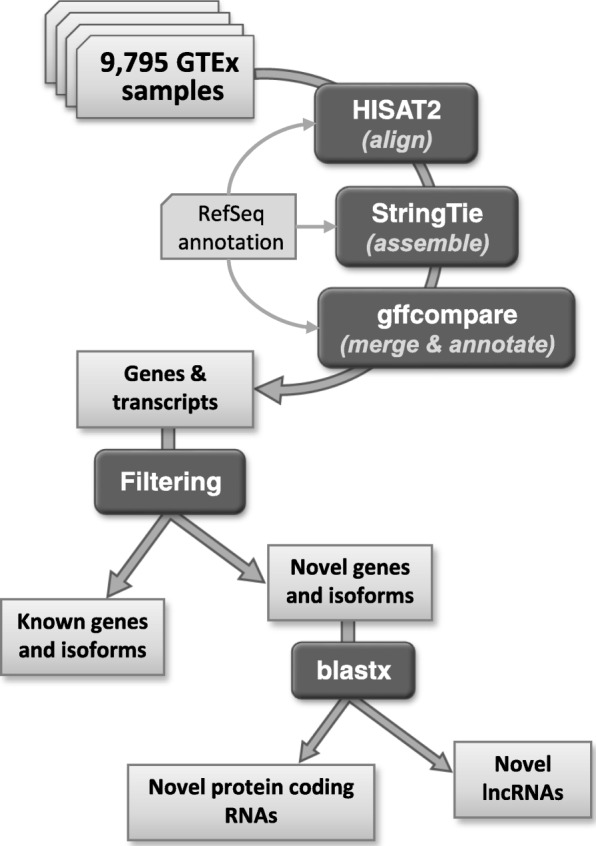
We assembled the sequences from deep RNA sequencing experiments by the Genotype-Tissue Expression (GTEx) project, to create a new catalog of human genes and transcripts, called CHESS. The new database contains 42,611 genes, of which 20,352 are potentially protein-coding and 22,259 are noncoding, and a total of 323,258 transcripts. These include 224 novel protein-coding genes and 116,156 novel transcripts. We detected over 30 million additional transcripts at more than 650,000 genomic loci, nearly all of which are likely nonfunctional, revealing a heretofore unappreciated amount of transcriptional noise in human cells. The CHESS database is available at http://ccb.jhu.edu/chess .
Overview
The claims and statistics of this paper haven’t been checked yet.
Free: it reads the open-access text and checks the first 5 claims that cite a source we can check. Create a free account to check every claim.
Integrity signals
Registry
Cites
Statistics
Figures
Verification
Claims the paper makes
The claims and statistics of this paper haven’t been checked yet.
Free: it reads the open-access text and checks the first 5 claims that cite a source we can check. Create a free account to check every claim.
Claims other papers make about this one
Each is checked against this paper’s own text: does it say what the citing paper says it does?
In the citing paper
“In the present day, practically all human genes have been identified (14)”
From Protection of the human gene research literature from contract cheating organizations known as research paper mills (2022) · cites this paper as [14]
In the citing paper
“Despite the availability of ∼40 000 human genes for research (14)”
From Protection of the human gene research literature from contract cheating organizations known as research paper mills (2022) · cites this paper as [14]
In the citing paper
“The number of protein-coding genes originally estimated by the HGP dropped from >100,00072 to a relatively stable ~19,700 at HGP draft release, a number that is close to the current neXtProt’s 2020 release of 19,773 protein-coding genes (Supplementary Fig. 1)60.”
From A high-stringency blueprint of the human proteome (2020) · cites this paper as [72]
Self-check
Percentages, sums and reported differences re-computed from the paper’s own numbers.
The self-check needs the paper’s full text.
Citations
Cites
Moderated estimation of fold change and dispersion for RNA-seq data with DESeq2
Love, M. I., Huber, W., & Anders, S. (2014) · Genome Biology · doi:10.1186/s13059-014-0550-8 · Cited by 95,106
Gapped BLAST and PSI-BLAST: a new generation of protein database search programs
Altschul, S. (1997) · Nucleic Acids Research · doi:10.1093/nar/25.17.3389 · Cited by 73,302
Initial sequencing and analysis of the human genome
International Human Genome Sequencing Consortium, Whitehead Institute for Biomedical Research, C. F. G. R., Lander, E. S., Linton, L. M., Birren, B., Nusbaum, C., Zody, M. C., Baldwin, J., Devon, K., Dewar, K., et al. (2001) · Nature · doi:10.1038/35057062 · Cited by 24,216
HISAT: a fast spliced aligner with low memory requirements
Kim, D., Langmead, B., & Salzberg, S. L. (2015) · Nature Methods · doi:10.1038/nmeth.3317 · Cited by 24,112
Self-citationTrapnell, C., Williams, B. A., Pertea, G., Mortazavi, A., Kwan, G., van Baren, M. J., Salzberg, S. L., Wold, B. J., & Pachter, L. (2010) · Nature Biotechnology · doi:10.1038/nbt.1621 · Cited by 15,556
Self-citationFast, scalable generation of high‐quality protein multiple sequence alignments using Clustal Omega
Sievers, F., Wilm, A., Dineen, D., Gibson, T. J., Karplus, K., Li, W., Lopez, R., McWilliam, H., Remmert, M., Söding, J., et al. (2011) · Molecular Systems Biology · doi:10.1038/msb.2011.75 · Cited by 15,355
StringTie enables improved reconstruction of a transcriptome from RNA-seq reads
Pertea, M., Pertea, G. M., Antonescu, C. M., Chang, T.-C., Mendell, J. T., & Salzberg, S. L. (2015) · Nature Biotechnology · doi:10.1038/nbt.3122 · Cited by 14,298
Self-citationThe sequence of the human genome
Venter, J. C., Adams, M. D., Myers, E. W., Li, P. W., Mural, R. J., Sutton, G. G., Smith, H. O., Yandell, M., Evans, C. A., Holt, R. A., et al. (2001) · Science · doi:10.1126/science.1058040 · Cited by 13,909
Self-citationSalmon provides fast and bias-aware quantification of transcript expression
Patro, R., Duggal, G., Love, M. I., Irizarry, R. A., & Kingsford, C. (2017) · Nature Methods · doi:10.1038/nmeth.4197 · Cited by 12,700
Trapnell, C., Roberts, A., Goff, L., Pertea, G., Kim, D., Kelley, D. R., Pimentel, H., Salzberg, S. L., Rinn, J. L., & Pachter, L. (2012) · Nature Protocols · doi:10.1038/nprot.2012.016 · Cited by 12,116
Self-citationAccelerated Profile HMM Searches
Eddy, S. R. (2011) · PLoS Computational Biology · doi:10.1371/journal.pcbi.1002195 · Cited by 6,975
Transcript-level expression analysis of RNA-seq experiments with HISAT, StringTie and Ballgown
Pertea, M., Kim, D., Pertea, G. M., Leek, J. T., & Salzberg, S. L. (2016) · Nature Protocols · doi:10.1038/nprot.2016.095 · Cited by 6,845
Self-citationO'Leary, N. A., Wright, M. W., Brister, J. R., Ciufo, S., Haddad, D., McVeigh, R., Rajput, B., Robbertse, B., Smith-White, B., Ako-Adjei, D., et al. (2016) · Nucleic Acids Research · doi:10.1093/nar/gkv1189 · Cited by 6,357
The Pfam protein families database: towards a more sustainable future
Finn, R. D., Coggill, P., Eberhardt, R. Y., Eddy, S. R., Mistry, J., Mitchell, A. L., Potter, S. C., Punta, M., Qureshi, M., Sangrador-Vegas, A., et al. (2016) · Nucleic Acids Research · doi:10.1093/nar/gkv1344 · Cited by 5,975
Gouy, M., Guindon, S., & Gascuel, O. (2010) · Molecular Biology and Evolution · doi:10.1093/molbev/msp259 · Cited by 5,782
The Genotype-Tissue Expression (GTEx) pilot analysis: Multitissue gene regulation in humans
The GTEx Consortium, Ardlie, K. G., Deluca, D. S., Segrè, A. V., Sullivan, T. J., Young, T. R., Gelfand, E. T., Trowbridge, C. A., Maller, J. B., Tukiainen, T., et al. (2015) · Science · doi:10.1126/science.1262110 · Cited by 5,062
Finishing the euchromatic sequence of the human genome
International Human Genome Sequencing Consortium (2004) · Nature · doi:10.1038/nature03001 · Cited by 4,971
GENCODE: The reference human genome annotation for The ENCODE Project
Harrow, J., Frankish, A., Gonzalez, J. M., Tapanari, E., Diekhans, M., Kokocinski, F., Aken, B. L., Barrell, D., Zadissa, A., Searle, S., et al. (2012) · Genome Research · doi:10.1101/gr.135350.111 · Cited by 4,585
UniProt: the universal protein knowledgebase
The UniProt Consortium (2017) · Nucleic Acids Research · doi:10.1093/nar/gkw1099 · Cited by 4,436
Chromatin signature reveals over a thousand highly conserved large non-coding RNAs in mammals
Guttman, M., Amit, I., Garber, M., French, C., Lin, M. F., Feldser, D., Huarte, M., Zuk, O., Carey, B. W., Cassady, J. P., et al. (2009) · Nature · doi:10.1038/nature07672 · Cited by 4,098
Differential analyses for RNA-seq: transcript-level estimates improve gene-level inferences
Soneson, C., Love, M. I., & Robinson, M. D. (2015) · F1000Research · doi:10.12688/f1000research.7563.1 · Cited by 3,929 · cited 1×
“We used the tximport package [48] to import the Salmon output and generate separate gene-level count matrices for each tissue that contained both male and female samples.”
MethodCabili, M. N., Trapnell, C., Goff, L., Koziol, M., Tazon-Vega, B., Regev, A., & Rinn, J. L. (2011) · Genes & Development · doi:10.1101/gad.17446611 · Cited by 3,502
CDD/SPARCLE: functional classification of proteins via subfamily domain architectures
Marchler-Bauer, A., Bo, Y., Han, L., He, J., Lanczycki, C. J., Lu, S., Chitsaz, F., Derbyshire, M. K., Geer, R. C., Gonzales, N. R., et al. (2017) · Nucleic Acids Research · doi:10.1093/nar/gkw1129 · Cited by 2,713
A draft map of the human proteome
Kim, M.-S., Pinto, S. M., Getnet, D., Nirujogi, R. S., Manda, S. S., Chaerkady, R., Madugundu, A. K., Kelkar, D. S., Isserlin, R., Jain, S., et al. (2014) · Nature · doi:10.1038/nature13302 · Cited by 2,198
Self-citation20 years of the SMART protein domain annotation resource
Letunic, I., & Bork, P. (2018) · Nucleic Acids Research · doi:10.1093/nar/gkx922 · Cited by 2,020
Long noncoding RNAs: past, present, and future
Kung, J. T. Y., Colognori, D., & Lee, J. T. (2013) · Genetics · doi:10.1534/genetics.112.146704 · Cited by 1,874
Mass-spectrometry-based draft of the human proteome
Wilhelm, M., Schlegl, J., Hahne, H., Gholami, A. M., Lieberenz, M., Savitski, M. M., Ziegler, E., Butzmann, L., Gessulat, S., Marx, H., et al. (2014) · Nature · doi:10.1038/nature13319 · Cited by 1,820
Stochastic mRNA Synthesis in Mammalian Cells
Raj, A., Peskin, C. S., Tranchina, D., Vargas, D. Y., & Tyagi, S. (2006) · PLoS Biology · doi:10.1371/journal.pbio.0040309 · Cited by 1,737
The Sequence of the Human Genome
Venter, J. C., Smith, H. O., & Adams, M. D. (2015) · Clinical Chemistry · doi:10.1373/clinchem.2014.237016 · Cited by 1,648 · cited 2×
“were dramatically lower, with one paper reporting 31,000 genes [6] and the other 26,588 plus ~ 12,000 genes with “weak supporting evidence” [7].”
BackgroundMethodSpliced segments at the 5′ terminus of adenovirus 2 late mRNA
Berget, S. M., Moore, C., & Sharp, P. A. (1977) · Proceedings of the National Academy of Sciences · doi:10.1073/pnas.74.8.3171 · Cited by 1,413
The human transcriptome across tissues and individuals
Melé, M., Ferreira, P. G., Reverter, F., DeLuca, D. S., Monlong, J., Sammeth, M., Young, T. R., Goldmann, J. M., Pervouchine, D. D., Sullivan, T. J., et al. (2015) · Science · doi:10.1126/science.aaa0355 · Cited by 1,304
An amazing sequence arrangement at the 5′ ends of adenovirus 2 messenger RNA
Chow, L. T., Gelinas, R. E., Broker, T. R., & Roberts, R. J. (1977) · Cell · doi:10.1016/0092-8674(77)90180-5 · Cited by 1,234
Specific expression of long noncoding RNAs in the mouse brain
Mercer, T. R., Dinger, M. E., Sunkin, S. M., Mehler, M. F., & Mattick, J. S. (2008) · Proceedings of the National Academy of Sciences · doi:10.1073/pnas.0706729105 · Cited by 1,103
A Gene Map of the Human Genome
Schuler, G. D., Boguski, M. S., Stewart, E. A., Stein, L. D., Gyapay, G., Rice, K., White, R. E., Rodriguez-Tomé, P., Aggarwal, A., Bajorek, E., et al. (1996) · Science · doi:10.1126/science.274.5287.540 · Cited by 1,027
An atlas of human long non-coding RNAs with accurate 5′ ends
Hon, C.-C., Ramilowski, J. A., Harshbarger, J., Bertin, N., Rackham, O. J. L., Gough, J., Denisenko, E., Schmeier, S., Poulsen, T. M., Severin, J., et al. (2017) · Nature · doi:10.1038/nature21374 · Cited by 1,007
Non-coding RNA: what is functional and what is junk?
Palazzo, A. F., & Lee, E. S. (2015) · Frontiers in Genetics · doi:10.3389/fgene.2015.00002 · Cited by 901
A Novel Approach to High-Quality Postmortem Tissue Procurement: The GTEx Project
Carithers, L. J., Ardlie, K., Barcus, M., Branton, P. A., Britton, A., Buia, S. A., Compton, C. C., DeLuca, D. S., Peter-Demchok, J., Gelfand, E. T., et al. (2015) · Biopreservation and Biobanking · doi:10.1089/bio.2015.0032 · Cited by 833
Distinguishing protein-coding and noncoding genes in the human genome
Clamp, M., Fry, B., Kamal, M., Xie, X., Cuff, J., Lin, M. F., Kellis, M., Lindblad-Toh, K., & Lander, E. S. (2007) · Proceedings of the National Academy of Sciences · doi:10.1073/pnas.0709013104 · Cited by 624
Multiple evidence strands suggest that there may be as few as 19 000 human protein-coding genes
Ezkurdia, I., Juan, D., Rodriguez, J. M., Frankish, A., Diekhans, M., Harrow, J., Vazquez, J., Valencia, A., & Tress, M. L. (2014) · Human Molecular Genetics · doi:10.1093/hmg/ddu309 · Cited by 549
Clinical application of exome sequencing in undiagnosed genetic conditions
Need, A. C., Shashi, V., Hitomi, Y., Schoch, K., Shianna, K. V., McDonald, M. T., Meisler, M. H., & Goldstein, D. B. (2012) · Journal of Medical Genetics · doi:10.1136/jmedgenet-2012-100819 · Cited by 438
Whole-exome sequencing in undiagnosed genetic diseases: interpreting 119 trios
Zhu, X., Petrovski, S., Xie, P., Ruzzo, E. K., Lu, Y.-F., McSweeney, K. M., Ben-Zeev, B., Nissenkorn, A., Anikster, Y., Oz-Levi, D., et al. (2015) · Genetics in Medicine · doi:10.1038/gim.2014.191 · Cited by 342
Noisy Splicing Drives mRNA Isoform Diversity in Human Cells
Pickrell, J. K., Pai, A. A., Gilad, Y., & Pritchard, J. K. (2010) · PLoS Genetics · doi:10.1371/journal.pgen.1001236 · Cited by 311
3,400 new expressed sequence tags identify diversity of transcripts in human brain
Adams, M. D., Kerlavage, A. R., Fields, C., & Venter, J. C. (1993) · Nature Genetics · doi:10.1038/ng0793-256 · Cited by 290
How many genes in the human genome?
Fields, C., Adams, M. D., White, O., & Venter, J. C. (1994) · Nature Genetics · doi:10.1038/ng0794-345 · Cited by 290
Gene Index analysis of the human genome estimates approximately 120,000 genes
Liang, F., Holt, I., Pertea, G., Karamycheva, S., Salzberg, S. L., & Quackenbush, J. (2000) · Nature Genetics · doi:10.1038/76126 · Cited by 280
Self-citationBetween a chicken and a grape: estimating the number of human genes
Pertea, M., & Salzberg, S. L. (2010) · Genome Biology · doi:10.1186/gb-2010-11-5-206 · Cited by 244
Self-citationSVA retrotransposons: Evolution and genetic instability
Hancks, D. C., & Kazazian, H. H. (2010) · Seminars in Cancer Biology · doi:10.1016/j.semcancer.2010.04.001 · Cited by 194
Current status and new features of the Consensus Coding Sequence database
Farrell, C. M., O’Leary, N. A., Harte, R. A., Loveland, J. E., Wilming, L. G., Wallin, C., Diekhans, M., Barrell, D., Searle, S. M. J., Aken, B., et al. (2014) · Nucleic Acids Research · doi:10.1093/nar/gkt1059 · Cited by 145
Survey of the Heritability and Sparse Architecture of Gene Expression Traits across Human Tissues
Wheeler, H. E., Shah, K. P., Brenner, J., Garcia, T., Aquino-Michaels, K., GTEx Consortium, Cox, N. J., Nicolae, D. L., & Im, H. K. (2016) · PLOS Genetics · doi:10.1371/journal.pgen.1006423 · Cited by 145
Samandi, S., Roy, A. V., Delcourt, V., Lucier, J.-F., Gagnon, J., Beaudoin, M. C., Vanderperre, B., Breton, M.-A., Motard, J., Jacques, J.-F., et al. (2017) · eLife · doi:10.7554/elife.27860 · Cited by 124
The fitness cost of mis-splicing is the main determinant of alternative splicing patterns
Saudemont, B., Popa, A., Parmley, J. L., Rocher, V., Blugeon, C., Necsulea, A., Meyer, E., & Duret, L. (2017) · Genome Biology · doi:10.1186/s13059-017-1344-6 · Cited by 106
Na, C. H., Barbhuiya, M. A., Kim, M., Verbruggen, S., Eacker, S. M., Pletniková, O., Troncoso, J. C., Halushka, M. K., Menschaert, G., Overall, C. M., et al. (2017) · Genome Research · doi:10.1101/gr.226050.117 · Cited by 102
Self-citationA Preliminary Estimate of the Number of Human Genes
VOGEL, F. (1964) · Nature · doi:10.1038/201847a0 · Cited by 67
Effects of Alu insertions on gene function
Szmulewicz, M. N., Novick, G. E., & Herrera, R. J. (1998) · Electrophoresis · doi:10.1002/elps.1150190806 · Cited by 57
Predicting the total number of human genes
Antequera, F., & Bird, A. P. (1994) · Nature Genetics · doi:10.1038/ng1094-114a · Cited by 42
Chen, Y., Iseli, C., Venditti, C. A., Old, L. J., Simpson, A. J. G., & Jongeneel, C. V. (2006) · Genes, Chromosomes and Cancer · doi:10.1002/gcc.20298 · Cited by 40
Next-Generation Transcriptome Assembly: Strategies and Performance Analaysis
Voshall, A., & Moriyama, E. N. (2018) · InTech eBooks · doi:10.5772/intechopen.73497 · Cited by 36
Research works printed but not linked: 1
- Pertea M Shumate A Pertea G Varabyou A Breitwieser FP Salzberg SL CHESS: a new human gene catalog curated from thousands of large-scale RNA sequencing experiments reveals extensive transcriptional noise 2018 PMC6260756 30486838
Cited by
Transcriptome assembly from long-read RNA-seq alignments with StringTie2
Kovaka, S., Zimin, A. V., Pertea, G. M., Razaghi, R., Salzberg, S. L., & Pertea, M. (2019) · Genome Biology · doi:10.1186/s13059-019-1910-1 · Cited by 1,967
Self-citationFrankish, A., Diekhans, M., Jungreis, I., Lagarde, J., Loveland, J. E., Mudge, J. M., Sisu, C., Wright, J. C., Armstrong, J., Barnes, I., et al. (2021) · Nucleic Acids Research · doi:10.1093/nar/gkaa1087 · Cited by 1,334
“For example, we examined the novel protein-coding genes reported in the CHESS gene annotation set (18), adding five protein-coding genes, 16 pseudogenes and 37 lncRNAs.”
BackgroundGFF Utilities: GffRead and GffCompare
Pertea, G., & Pertea, M. (2020) · F1000Research · doi:10.12688/f1000research.23297.2 · Cited by 1,152
“…nature, both GffRead and GffCompare have already been used in many bioinformatics projects as integral parts of pipelines for genome annotation 5–7 , novel gene discoveries and characterizations 8–18 , gene structure reconstruction accuracy 19–21 , and gene annotation comparisons 22–25 among…”
MethodSelf-citationImproved transcriptome assembly using a hybrid of long and short reads with StringTie
Shumate, A., Wong, B., Pertea, G., & Pertea, M. (2022) · PLOS Computational Biology · doi:10.1371/journal.pcbi.1009730 · Cited by 478
“All three species have well-characterized reference annotation available, even though their level of completeness is not fully established [10].”
BackgroundSelf-citationA complete reference genome improves analysis of human genetic variation
Aganezov, S., Yan, S. M., Soto, D. C., Kirsche, M., Zarate, S., Avdeyev, P., Taylor, D. J., Shafin, K., Shumate, A., Xiao, C., et al. (2022) · Science · doi:10.1126/science.abl3533 · Cited by 441
Self-citation
Metadata
- Authors
- Pertea, M., Shumate, A., Pertea, G., Varabyou, A., Breitwieser, F. P., Chang, Y.-C., Madugundu, A. K., Pandey, A., & Salzberg, S. L.
- Affiliations
- Johns Hopkins University (US)
- Mayo Clinic (US)
- Corresponding author
- Salzberg, Steven L.
- ORCID
- Venue
- Genome Biology
- Published
- 2018-11-28
- Volume
- 19
- Issue
- 1
- Pages
- 208-208
- ISSN
- 1465-6906 (ISSN-L)
- 1474-760X
- PMC
- PMC6260756
- OpenAlex
- W2903241977
- Cited by
- 335
- References
- 57
- Citations by year
- 2026: 22 · 2025: 24 · 2024: 22 · 2023: 34 · 2022: 55 · 2021: 58 · 2020: 82 · 2019: 35 · 2018: 3
- FWCI
- 15.92
- Type
- journal article
- Language
- en
- Open access
- gold
- doi.org
- Licence
- cc-by
- creativecommons.org/licenses/by/4.0/ (tdm)
- creativecommons.org/licenses/by/4.0/ (vor)
- Locations
- Genome biology (publishedVersion, cc-by)
- Europe PMC (PubMed Central) (publishedVersion, cc-by)
- PubMed Central (publishedVersion, cc-by)
- PubMed (publishedVersion)
- DOAJ (DOAJ: Directory of Open Access Journals) (submittedVersion, cc-by-sa)
- Funders
- National Human Genome Research Institute (R01-HG006677)
- National Institute of General Medical Sciences (R01-GM083873)
- National Science Foundation (DBI-1458178)
- Topics
- Life Sciences › Biochemistry, Genetics and Molecular Biology › Molecular Biology › Genomics and Phylogenetic Studies
- Life Sciences › Biochemistry, Genetics and Molecular Biology › Molecular Biology › RNA Research and Splicing
- Life Sciences › Biochemistry, Genetics and Molecular Biology › Molecular Biology › Single-cell and spatial transcriptomics
- Keywords
- transcriptome, GTEx, novel protein-coding genes, novel transcripts, non-coding transcripts, transcriptional noise, genome annotation, transcriptome assembly
- MeSH terms
- Amino Acid Sequence, Animals, Female, Humans, Introns, Male, Transcription, Genetic, Sequence Analysis, RNA, Databases, Genetic
About these checks
Registry, retraction, Cites and statistics results are computed, not judged, with one exception: a printed reference that no index lists is read once by a model before it counts as a citation error. Claims are extracted by a model and kept only when their quote appears verbatim in the text; each cited source is then checked, with a model’s help, for whether it says what the claim relies on. Those verdicts can be wrong — read the claim’s quote and the cited source before relying on one.
Statistics and arithmetic are recomputed, not judged.
Confidence bands are shown only for fields calibrated on our annotated test set. None is calibrated yet, so no band is shown.
What counts as a claim ›How we measure confidence ›How we check this ›
Are you an author, or do you see a problem with this page? Request a review
Data sources
Bibliographic data: Semantic Scholar, OpenAlex, Crossref.
Contains information from the Semantic Scholar Academic Graph Datasets, made available under the ODC Attribution License (ODC-BY 1.0).
Semantic Scholar’s data is described in: Kinney, R., et al. (2023). The Semantic Scholar Open Data Platform. arXiv:2301.10140.
