

The DOI matches its Crossref record; 49 of the 51 references it cites were found in a registry or an index; none of the 61 sources its claims cite is checked for support yet.
Early sex differences are not autism-specific: A Baby Siblings Research Consortium (BSRC) study
Open accessAbstract
BACKGROUND: The increased male prevalence of autism spectrum disorder (ASD) may be mirrored by the early emergence of sex differences in ASD symptoms and cognitive functioning. The female protective effect hypothesis posits that ASD recurrence and symptoms will be higher among relatives of female probands. This study examined sex differences and sex of proband differences in ASD outcome and in the development of ASD symptoms and cognitive functioning among the high-risk younger siblings of ASD probands and low-risk children. METHODS: Prior to 18 months of age, 1824 infants (1241 high-risk siblings, 583 low-risk) from 15 sites were recruited. Hierarchical generalized linear model (HGLM) analyses of younger sibling and proband sex differences in ASD recurrence among high-risk siblings were followed by HGLM analyses of sex differences and group differences (high-risk ASD, high-risk non-ASD, and low-risk) on the Mullen Scales of Early Learning (MSEL) subscales (Expressive and Receptive Language, Fine Motor, and Visual Reception) at 18, 24, and 36 months and Autism Diagnostic Observation Schedule (ADOS) domain scores (social affect (SA) and restricted and repetitive behaviors (RRB)) at 24 and 36 months. RESULTS: Of 1241 high-risk siblings, 252 had ASD outcomes. Male recurrence was 26.7 % and female recurrence 10.3 %, with a 3.18 odds ratio. The HR-ASD group had lower MSEL subscale scores and higher RRB and SA scores than the HR non-ASD group, which had lower MSEL subscale scores and higher RRB scores than the LR group. Regardless of group, males obtained lower MSEL subscale scores, and higher ADOS RRB scores, than females. There were, however, no significant interactions between sex and group on either the MSEL or ADOS. Proband sex did not affect ASD outcome, MSEL subscale, or ADOS domain scores. CONCLUSIONS: A 3.2:1 male:female odds ratio emerged among a large sample of prospectively followed high-risk siblings. Sex differences in cognitive performance and repetitive behaviors were apparent not only in high-risk children with ASD, but also in high-risk children without ASD and in low-risk children. Sex differences in young children with ASD do not appear to be ASD-specific but instead reflect typically occurring sex differences seen in children without ASD. Results did not support a female protective effect hypothesis.
Overview
AI snapshot
Written from the paper’s full text.
TL;DR
In a prospective BSRC sample of 1,824 infants, high-risk younger siblings of ASD probands showed a 3.18 male:female odds ratio for ASD recurrence, but sex differences in cognition and repetitive behavior appeared across ASD, high-risk non-ASD, and low-risk groups. Proband sex did not predict recurrence or symptom/cognitive profiles, providing no support for a female protective effect.
Key findings
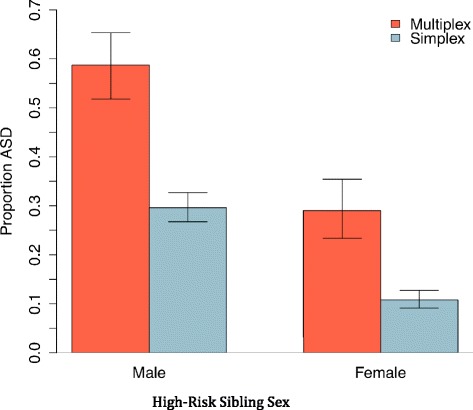
- Among 1,241 high-risk siblings, 252 had ASD outcomes; recurrence was 26.7% in males vs 10.3% in females, odds ratio 3.18 (95% CI 2.31–4.39), with overall recurrence 19.5% (95% CI 15.2–24.6).
- Multiplex status independently increased recurrence odds (OR 3.38, 95% CI 2.02–5.66), but proband sex was not significantly associated with recurrence (p = .44) or with MSEL/ADOS profiles.
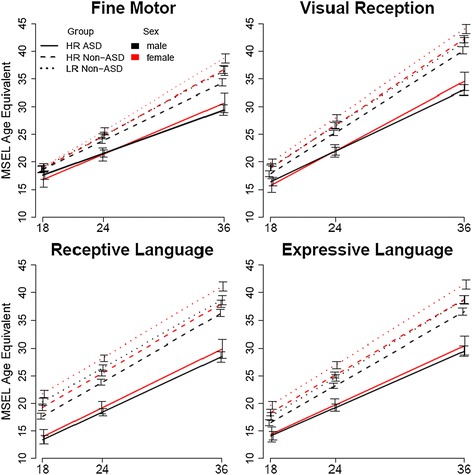
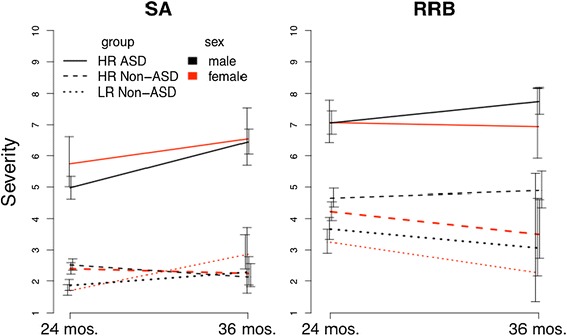
- Males had lower MSEL subscale scores and higher ADOS restricted/repetitive behavior (RRB) scores than females (RRB sex difference d = .29), but there were no significant sex-by-group interactions for MSEL (p = .17) or ADOS (p = .27), and no sex difference in social affect.
- The HR-ASD group had lower MSEL scores and higher RRB and social affect scores than HR non-ASD, which in turn had lower MSEL scores and higher RRB scores than low-risk children.
Methods
- Pooled data from 15 BSRC sites: 1,824 infants (1,241 high-risk siblings of ASD probands, 583 low-risk), enrolled before 18 months, with outcome categorization based on clinical best estimate and ADOS criteria.
- Longitudinal measures included MSEL subscales (expressive/receptive language, fine motor, visual reception) at 18, 24, and 36 months and ADOS social affect and RRB domain severity scores at 24 and 36 months.
- Hierarchical generalized linear models tested ASD recurrence by sibling sex, proband sex, demographics, and multiplex status; profile analyses tested sex, group, and sex-by-group effects on MSEL and ADOS trajectories in R with lme4 and Satterthwaite approximation.
Limitations
- The paper states the behavioral assays were relatively coarse-grained; neuroimaging, electrophysiology, and subtler behavioral measures may reveal ASD-specific sex differences not documented here.
- The paper states larger samples are needed to test whether female probands in multiplex families confer greater risk, and notes small multiplex (n = 77) and female-proband-in-multiplex (n = 7) samples warrant caution.
- The paper notes missing data were more common in low-risk and high-risk non-ASD groups, which may bias profile estimates slightly toward poorer functioning in those groups and make group comparisons slightly more conservative.
Model-written summary. Check it against the paper before relying on it.
Integrity signals
Registry
Cites
Statistics
Figures
Verification
Claims the paper makes
67 Own result · 32 Not checked yet · 14 Own interpretation · 10 Own method · 2 No basis given
A result the paper reports from its own data — it cites no other source for it, so there is none to check. The quote shows it is in the paper.
In the paper
“However, the sex by group interaction was not significant (p = .17), and there were no significant higher-order interactions involving sex and group (all p > .62).”
§ Early sex differences are not autism-specific: A Baby Siblings Research Consortium (BSRC) study > Results > Profile analyses
plain- Asserted: passes — The authors put it forward as true.
- Checkable: passes — It can be checked against evidence.
- Load-bearing: passes — The paper’s conclusions depend on it.
- Based: passes — The paper gives a reason why it holds.
A result the paper reports from its own data — it cites no other source for it, so there is none to check. The quote shows it is in the paper.
In the paper
“When age was re-centered at each age to test sex differences within subscales, males were significantly lower than females at each age (all p < .001) on all but one subscale (fine motor at 18 months).”
§ Early sex differences are not autism-specific: A Baby Siblings Research Consortium (BSRC) study > Results > Profile analyses
plaincorrelational- Asserted: passes — The authors put it forward as true.
- Checkable: passes — It can be checked against evidence.
- Load-bearing: passes — The paper’s conclusions depend on it.
- Based: passes — The paper gives a reason why it holds.
A result the paper reports from its own data — it cites no other source for it, so there is none to check. The quote shows it is in the paper.
In the paper
“The overall percentage of recurrence was 26.7 % for males and 10.3 % for females.”
- Also stated in: § Results · plain
“Male recurrence was 26.7 % and female recurrence 10.3 %, with a 3.18 odds ratio.”
§ Early sex differences are not autism-specific: A Baby Siblings Research Consortium (BSRC) study > Results > Sex differences and recurrence rates of ASD
plaincorrelational- Asserted: passes — The authors put it forward as true.
- Checkable: passes — It can be checked against evidence.
- Load-bearing: passes — The paper’s conclusions depend on it.
- Based: passes — The paper gives a reason why it holds.
- Also stated in: § Results · plain
A result the paper reports from its own data — it cites no other source for it, so there is none to check. The quote shows it is in the paper.
In the paper
“However, the sex by group interaction was not significant (p = .17), and there were no significant higher-order interactions involving sex and group (all p > .62).”
§ Early sex differences are not autism-specific: A Baby Siblings Research Consortium (BSRC) study > Results > Profile analyses
plain- Asserted: passes — The authors put it forward as true.
- Checkable: passes — It can be checked against evidence.
- Load-bearing: passes — The paper’s conclusions depend on it.
- Based: passes — The paper gives a reason why it holds.
A result the paper reports from its own data — it cites no other source for it, so there is none to check. The quote shows it is in the paper.
In the paper
“In brief, all main and interaction effects of group, age, and MSEL subscale were significant (p < .001).”
§ Early sex differences are not autism-specific: A Baby Siblings Research Consortium (BSRC) study > Results > Profile analyses
plaincorrelational- Asserted: passes — The authors put it forward as true.
- Checkable: passes — It can be checked against evidence.
- Load-bearing: unclear — It is unclear whether the paper’s conclusions depend on it.
- Based: passes — The paper gives a reason why it holds.
A result the paper reports from its own data — it cites no other source for it, so there is none to check. The quote shows it is in the paper.
In the paper
“The odds ratio of male to female recurrence was 3.18 (95 % CI = 2.31 to 4.39).”
- Also stated in: § Conclusions · plain
“A 3.2:1 male:female odds ratio emerged among a large sample of prospectively followed high-risk siblings.”
§ Early sex differences are not autism-specific: A Baby Siblings Research Consortium (BSRC) study > Results > Sex differences and recurrence rates of ASD
plaincorrelational- Asserted: passes — The authors put it forward as true.
- Checkable: passes — It can be checked against evidence.
- Load-bearing: passes — The paper’s conclusions depend on it.
- Based: passes — The paper gives a reason why it holds.
- Also stated in: § Conclusions · plain
A result the paper reports from its own data — it cites no other source for it, so there is none to check. The quote shows it is in the paper.
In the paper
“There was a main effect of sex (p < .001).”
§ Early sex differences are not autism-specific: A Baby Siblings Research Consortium (BSRC) study > Results > Profile analyses
plaincorrelational- Asserted: passes — The authors put it forward as true.
- Checkable: passes — It can be checked against evidence.
- Load-bearing: passes — The paper’s conclusions depend on it.
- Based: passes — The paper gives a reason why it holds.
A result the paper reports from its own data — it cites no other source for it, so there is none to check. The quote shows it is in the paper.
In the paper
“The odds ratio of recurrence in multiplex to simplex families was 3.38 (95 % CI = 2.02 to 5.66).”
§ Early sex differences are not autism-specific: A Baby Siblings Research Consortium (BSRC) study > Results > Sex differences and recurrence rates of ASD
plaincorrelationaln = 991- Asserted: passes — The authors put it forward as true.
- Checkable: passes — It can be checked against evidence.
- Load-bearing: unclear — It is unclear whether the paper’s conclusions depend on it.
- Based: passes — The paper gives a reason why it holds.
A result the paper reports from its own data — it cites no other source for it, so there is none to check. The quote shows it is in the paper.
In the paper
“Neither proband sex (X2 = 0.59, df = 1, p = .44), non-Caucasian status (X2 = 0.36, df = 1, p = .55), or paternal education (X2 = 2.09, df = 1, p = .15) was significantly associated with ASD recurrence.”
§ Early sex differences are not autism-specific: A Baby Siblings Research Consortium (BSRC) study > Results > Sex differences and recurrence rates of ASD
plain- Asserted: passes — The authors put it forward as true.
- Checkable: passes — It can be checked against evidence.
- Load-bearing: passes — The paper’s conclusions depend on it.
- Based: passes — The paper gives a reason why it holds.
A result the paper reports from its own data — it cites no other source for it, so there is none to check. The quote shows it is in the paper.
In the paper
“Adding multiplex status to the model including sex and site revealed a significant main effect for multiplex status (X2 = 20.68, df = 1, p < .01), but no interaction between sex and multiplex status (X2 = 0.04, df = 1, p = .85).”
§ Early sex differences are not autism-specific: A Baby Siblings Research Consortium (BSRC) study > Results > Sex differences and recurrence rates of ASD
plainn = 991- Asserted: passes — The authors put it forward as true.
- Checkable: passes — It can be checked against evidence.
- Load-bearing: passes — The paper’s conclusions depend on it.
- Based: passes — The paper gives a reason why it holds.
- It may state two separate claims as one. 51
- Probably not a substantial claim. 28
- The quote only partly states this claim. 1
A result the paper reports from its own data — it cites no other source for it, so there is none to check. The quote shows it is in the paper.
In the paper
“Examination of simple effects revealed that both males and females showed similar trajectories among different subscales, with visual reception scores rising significantly more rapidly than other subscales, fine motor rising significantly more slowly than other subscales, and both language subscales rising at intermediate rates.”
§ Early sex differences are not autism-specific: A Baby Siblings Research Consortium (BSRC) study > Results > Profile analyses
plaincorrelational- Asserted: passes — The authors put it forward as true.
- Checkable: passes — It can be checked against evidence.
- Load-bearing: unclear — It is unclear whether the paper’s conclusions depend on it.
- Based: passes — The paper gives a reason why it holds.
It may state two separate claims as one.
A result the paper reports from its own data — it cites no other source for it, so there is none to check. The quote shows it is in the paper.
In the paper
“The two non-ASD groups did not differ in their visual reception and receptive language trajectories, but the HR non-ASD group had significantly slower growth in fine motor and expressive language when compared to the LR non-ASD group.”
§ Early sex differences are not autism-specific: A Baby Siblings Research Consortium (BSRC) study > Results > Profile analyses
plain- Asserted: passes — The authors put it forward as true.
- Checkable: passes — It can be checked against evidence.
- Load-bearing: passes — The paper’s conclusions depend on it.
- Based: passes — The paper gives a reason why it holds.
It may state two separate claims as one.
A result the paper reports from its own data — it cites no other source for it, so there is none to check. The quote shows it is in the paper.
In the paper
“likewise, 2.4 % of HR-ASD, 17.2 % of HR-No-ASD, and 14.2 % of LR ASD were missing.”
§ Early sex differences are not autism-specific: A Baby Siblings Research Consortium (BSRC) study > Results > Profile analyses
plain- Asserted: passes — The authors put it forward as true.
- Checkable: passes — It can be checked against evidence.
- Load-bearing: fails — The paper’s conclusions may not depend on it.
- Based: passes — The paper gives a reason why it holds.
Probably not a substantial claim. The paper’s conclusions may not depend on it. It may state two separate claims as one.
A result the paper reports from its own data — it cites no other source for it, so there is none to check. The quote shows it is in the paper.
In the paper
“The female advantage for significant comparisons at each age ranged from 1.06 to 3.3 months on age-equivalent scores; effect sizes ranged from medium to large (d range .33 to .54).”
§ Early sex differences are not autism-specific: A Baby Siblings Research Consortium (BSRC) study > Results > Profile analyses
plaincorrelational- Asserted: passes — The authors put it forward as true.
- Checkable: passes — It can be checked against evidence.
- Load-bearing: passes — The paper’s conclusions depend on it.
- Based: passes — The paper gives a reason why it holds.
It may state two separate claims as one.
A result the paper reports from its own data — it cites no other source for it, so there is none to check. The quote shows it is in the paper.
In the paper
“At 36 months, 14.1 % of male and 14.3 % of female ADOS were missing;”
§ Early sex differences are not autism-specific: A Baby Siblings Research Consortium (BSRC) study > Results > Profile analyses
plain- Asserted: passes — The authors put it forward as true.
- Checkable: passes — It can be checked against evidence.
- Load-bearing: fails — The paper’s conclusions may not depend on it.
- Based: passes — The paper gives a reason why it holds.
Probably not a substantial claim. The paper’s conclusions may not depend on it.
A result the paper reports from its own data — it cites no other source for it, so there is none to check. The quote shows it is in the paper.
In the paper
“On the ADOS, for example, 13.9 % of data were missing at 24 months and 14.2 % were missing at 36 months.”
§ Early sex differences are not autism-specific: A Baby Siblings Research Consortium (BSRC) study > Results > Profile analyses
plain- Asserted: passes — The authors put it forward as true.
- Checkable: passes — It can be checked against evidence.
- Load-bearing: fails — The paper’s conclusions may not depend on it.
- Based: passes — The paper gives a reason why it holds.
Probably not a substantial claim. The paper’s conclusions may not depend on it. It may state two separate claims as one.
A result the paper reports from its own data — it cites no other source for it, so there is none to check. The quote shows it is in the paper.
In the paper
“Proband sex was not associated with ASD symptom severity or cognitive functioning, a pattern which does not implicate a female protective effect.”
§ Early sex differences are not autism-specific: A Baby Siblings Research Consortium (BSRC) study > Discussion
plain- Asserted: passes — The authors put it forward as true.
- Checkable: passes — It can be checked against evidence.
- Load-bearing: passes — The paper’s conclusions depend on it.
- Based: passes — The paper gives a reason why it holds.
It may state two separate claims as one.
A result the paper reports from its own data — it cites no other source for it, so there is none to check. The quote shows it is in the paper.
In the paper
“Similarly, for multiplex status, there was no main effect (X2 = 0.66, df = 1, p = .42), and no interaction with infant sibling sex (X2 = 0.18, df = 1, p = .67) or with group (X2 = 0.97, df = 1, p = .33).”
§ Early sex differences are not autism-specific: A Baby Siblings Research Consortium (BSRC) study > Results > Profile analyses
plain- Asserted: passes — The authors put it forward as true.
- Checkable: passes — It can be checked against evidence.
- Load-bearing: unclear — It is unclear whether the paper’s conclusions depend on it.
- Based: passes — The paper gives a reason why it holds.
It may state two separate claims as one.
A result the paper reports from its own data — it cites no other source for it, so there is none to check. The quote shows it is in the paper.
In the paper
“However, multiplex status did not interact with group (X2 = 0.02, df = 1, p = .88) or with infant sibling sex (X2 = 1.35, df = 1, p = .25).”
§ Early sex differences are not autism-specific: A Baby Siblings Research Consortium (BSRC) study > Results > Profile analyses
plain- Asserted: passes — The authors put it forward as true.
- Checkable: passes — It can be checked against evidence.
- Load-bearing: unclear — It is unclear whether the paper’s conclusions depend on it.
- Based: passes — The paper gives a reason why it holds.
It may state two separate claims as one.
A result the paper reports from its own data — it cites no other source for it, so there is none to check. The quote shows it is in the paper.
In the paper
“For the MSEL subscales, proband sex did not have a significant main effect (X2 = 1.42, df = 1, p = .23), nor did it interact with group (X2 = 0.69, df = 1, p = .41) or with infant sibling sex (X2 = 0.13, df = 1, p = .72).”
§ Early sex differences are not autism-specific: A Baby Siblings Research Consortium (BSRC) study > Results > Profile analyses
plain- Asserted: passes — The authors put it forward as true.
- Checkable: passes — It can be checked against evidence.
- Load-bearing: passes — The paper’s conclusions depend on it.
- Based: passes — The paper gives a reason why it holds.
It may state two separate claims as one.
A result the paper reports from its own data — it cites no other source for it, so there is none to check. The quote shows it is in the paper.
In the paper
“At 24 months, the HR non-ASD group was significantly higher than the LR non-ASD group in both the RRB and SA domains but, at 36 months, was only higher in the RRB domain.”
- Also stated in: § Sex differences and the early ASD phenotype · plain
“At 36 months, the high-risk group without ASD outcomes exhibited higher levels of restricted and repetitive behaviors, but not social affect difficulties, than the low-risk group.”
§ Early sex differences are not autism-specific: A Baby Siblings Research Consortium (BSRC) study > Results > Profile analyses
plaincorrelational- Asserted: passes — The authors put it forward as true.
- Checkable: passes — It can be checked against evidence.
- Load-bearing: passes — The paper’s conclusions depend on it.
- Based: passes — The paper gives a reason why it holds.
It may state two separate claims as one.
- Also stated in: § Sex differences and the early ASD phenotype · plain
A result the paper reports from its own data — it cites no other source for it, so there is none to check. The quote shows it is in the paper.
In the paper
“For slope comparisons between subscales within each outcome group, all three groups showed similar patterns of trajectories across the subscales, with the greatest increases in visual reception, the slowest increases in fine motor, and both language subscales showing intermediate growth over time.”
§ Early sex differences are not autism-specific: A Baby Siblings Research Consortium (BSRC) study > Results > Profile analyses
plain- Asserted: passes — The authors put it forward as true.
- Checkable: passes — It can be checked against evidence.
- Load-bearing: passes — The paper’s conclusions depend on it.
- Based: passes — The paper gives a reason why it holds.
It may state two separate claims as one.
A result the paper reports from its own data — it cites no other source for it, so there is none to check. The quote shows it is in the paper.
In the paper
“Across risk and outcome groups, girls performed better than boys in all dimensions of cognitive functioning assessed and exhibited a lower level of repetitive behavioral severity than boys.”
- Also stated in: § Conclusions · plain
“Regardless of group membership, males exhibited lower levels of cognitive functioning than females and higher levels of restricted and repetitive behaviors.”
§ Early sex differences are not autism-specific: A Baby Siblings Research Consortium (BSRC) study > Discussion
plaincorrelational- Asserted: passes — The authors put it forward as true.
- Checkable: passes — It can be checked against evidence.
- Load-bearing: passes — The paper’s conclusions depend on it.
- Based: passes — The paper gives a reason why it holds.
It may state two separate claims as one.
- Also stated in: § Conclusions · plain
A result the paper reports from its own data — it cites no other source for it, so there is none to check. The quote shows it is in the paper.
In the paper
“SA severity scores increased significantly for both the ASD and LR non-ASD groups between 24 and 36 months, but not for the HR non-ASD group.”
- Also stated in: § Sex differences and the early ASD phenotype · plain
“While social affect severity scores increased for the HR ASD group, these children exhibited stable and elevated levels of restricted and repetitive behaviors between 2 and 3 years.”
§ Early sex differences are not autism-specific: A Baby Siblings Research Consortium (BSRC) study > Results > Profile analyses
plain- Asserted: passes — The authors put it forward as true.
- Checkable: passes — It can be checked against evidence.
- Load-bearing: passes — The paper’s conclusions depend on it.
- Based: passes — The paper gives a reason why it holds.
It may state two separate claims as one.
- Also stated in: § Sex differences and the early ASD phenotype · plain
A result the paper reports from its own data — it cites no other source for it, so there is none to check. The quote shows it is in the paper.
In the paper
“With respect to group differences, as expected, children with ASD performed more poorly on cognitive subscales and exhibited higher levels of ASD-symptom severity than other children.”
- Also stated in: § Conclusions · plain
“Children with ASD had lower levels of cognitive functioning and higher symptom severity levels than high-risk children without ASD who, in turn, exhibited lower cognitive functioning and higher ASD symptom severity than low-risk comparison children.”
§ Early sex differences are not autism-specific: A Baby Siblings Research Consortium (BSRC) study > Discussion
plaincorrelational- Asserted: passes — The authors put it forward as true.
- Checkable: passes — It can be checked against evidence.
- Load-bearing: unclear — It is unclear whether the paper’s conclusions depend on it.
- Based: passes — The paper gives a reason why it holds.
It may state two separate claims as one.
- Also stated in: § Conclusions · plain
A result the paper reports from its own data — it cites no other source for it, so there is none to check. The quote shows it is in the paper.
In the paper
“The analysis data set contained 1824 infant participants, of whom 1241 were high-risk (HR) and 583 were low-risk (LR).”
- Also stated in: § Methods · plain
“Prior to 18 months of age, 1824 infants (1241 high-risk siblings, 583 low-risk) from 15 sites were recruited.”
§ Early sex differences are not autism-specific: A Baby Siblings Research Consortium (BSRC) study > Methods > Participants
plainn = 1,824- Asserted: passes — The authors put it forward as true.
- Checkable: passes — It can be checked against evidence.
- Load-bearing: fails — The paper’s conclusions may not depend on it.
- Based: passes — The paper gives a reason why it holds.
Probably not a substantial claim. The paper’s conclusions may not depend on it. It may state two separate claims as one.
- Also stated in: § Methods · plain
A result the paper reports from its own data — it cites no other source for it, so there is none to check. The quote shows it is in the paper.
In the paper
“The odds ratio of ASD recurrence was 3:18 for male versus female high-risk siblings and was not impacted by proband sex.”
- Also stated in: § Sex differences in recurrence · plain
“The 3.18:1 increased odds of ASD in males in the current sample (95 % CI = 2.31 to 4.39) is similar to estimates from community-based ascertainment of children (2.5:1–2.6:1) [5–7], as well as to a previous report on approximately half of the current high-risk sample [10].”
- Also stated in: § Conclusions · plain
“This large prospectively ascertained sample of infants at high risk for ASD due to familial factors revealed a three-to-one male:female odds ratio in ASD recurrence.”
§ Early sex differences are not autism-specific: A Baby Siblings Research Consortium (BSRC) study > Discussion
plaincorrelational- Asserted: passes — The authors put it forward as true.
- Checkable: passes — It can be checked against evidence.
- Load-bearing: passes — The paper’s conclusions depend on it.
- Based: passes — The paper gives a reason why it holds.
It may state two separate claims as one. The quote only partly states this claim.
- Also stated in: § Sex differences in recurrence · plain
A result the paper reports from its own data — it cites no other source for it, so there is none to check. The quote shows it is in the paper.
In the paper
“In brief, the sex by group interaction was not significant (p = .27), and there were no significant higher-order interactions involving sex and group (all p > .12).”
§ Early sex differences are not autism-specific: A Baby Siblings Research Consortium (BSRC) study > Results > Profile analyses
plain- Asserted: passes — The authors put it forward as true.
- Checkable: passes — It can be checked against evidence.
- Load-bearing: passes — The paper’s conclusions depend on it.
- Based: passes — The paper gives a reason why it holds.
It may state two separate claims as one.
A result the paper reports from its own data — it cites no other source for it, so there is none to check. The quote shows it is in the paper.
In the paper
“Proband sex did not affect ASD outcome, MSEL subscale, or ADOS domain scores.”
§ Early sex differences are not autism-specific: A Baby Siblings Research Consortium (BSRC) study > Abstract > Results
plain- Asserted: passes — The authors put it forward as true.
- Checkable: passes — It can be checked against evidence.
- Load-bearing: passes — The paper’s conclusions depend on it.
- Based: passes — The paper gives a reason why it holds.
It may state two separate claims as one.
A result the paper reports from its own data — it cites no other source for it, so there is none to check. The quote shows it is in the paper.
In the paper
“For the ADOS profile analyses, there was no significant main effect of proband sex (X2 = 0.09, df = 1, p = .76), and no interaction with infant sibling sex (X2 = 0.95, df =1, p = .33) or group (X2 = 0.19, df = 1, p = .66).”
§ Early sex differences are not autism-specific: A Baby Siblings Research Consortium (BSRC) study > Results > Profile analyses
plain- Asserted: passes — The authors put it forward as true.
- Checkable: passes — It can be checked against evidence.
- Load-bearing: passes — The paper’s conclusions depend on it.
- Based: passes — The paper gives a reason why it holds.
It may state two separate claims as one.
A result the paper reports from its own data — it cites no other source for it, so there is none to check. The quote shows it is in the paper.
In the paper
“The HR ASD group was significantly higher than each of the non-ASD comparison groups at both ages in both RRB and SA by between 2.25 and 4.31 points (all p < .001).”
§ Early sex differences are not autism-specific: A Baby Siblings Research Consortium (BSRC) study > Results > Profile analyses
plain- Asserted: passes — The authors put it forward as true.
- Checkable: passes — It can be checked against evidence.
- Load-bearing: passes — The paper’s conclusions depend on it.
- Based: passes — The paper gives a reason why it holds.
It may state two separate claims as one.
A result the paper reports from its own data — it cites no other source for it, so there is none to check. The quote shows it is in the paper.
In the paper
“Regardless of group, males obtained lower MSEL subscale scores, and higher ADOS RRB scores, than females.”
§ Early sex differences are not autism-specific: A Baby Siblings Research Consortium (BSRC) study > Abstract > Results
plaincorrelational- Asserted: passes — The authors put it forward as true.
- Checkable: passes — It can be checked against evidence.
- Load-bearing: passes — The paper’s conclusions depend on it.
- Based: passes — The paper gives a reason why it holds.
It may state two separate claims as one.
A result the paper reports from its own data — it cites no other source for it, so there is none to check. The quote shows it is in the paper.
In the paper
“The HR-ASD group had lower MSEL subscale scores and higher RRB and SA scores than the HR non-ASD group, which had lower MSEL subscale scores and higher RRB scores than the LR group.”
§ Early sex differences are not autism-specific: A Baby Siblings Research Consortium (BSRC) study > Abstract > Results
plaincorrelational- Asserted: passes — The authors put it forward as true.
- Checkable: passes — It can be checked against evidence.
- Load-bearing: passes — The paper’s conclusions depend on it.
- Based: passes — The paper gives a reason why it holds.
It may state two separate claims as one.
A result the paper reports from its own data — it cites no other source for it, so there is none to check. The quote shows it is in the paper.
In the paper
“Comparing group differences within subscales at each age, the HR ASD group scored significantly below the HR non-ASD group on all subscales at all ages (all p < .001), and the HR non-ASD group scored below the LR non-ASD group on all but one subscale (fine motor at 18 months) at all ages (all p < .001).”
§ Early sex differences are not autism-specific: A Baby Siblings Research Consortium (BSRC) study > Results > Profile analyses
plain- Asserted: passes — The authors put it forward as true.
- Checkable: passes — It can be checked against evidence.
- Load-bearing: passes — The paper’s conclusions depend on it.
- Based: passes — The paper gives a reason why it holds.
It may state two separate claims as one.
A result the paper reports from its own data — it cites no other source for it, so there is none to check. The quote shows it is in the paper.
In the paper
“Boys across all groups exhibited slower growth trajectories and lower levels of cognitive performance than girls in fine motor, visual reception, receptive and expressive language functioning.”
§ Early sex differences are not autism-specific: A Baby Siblings Research Consortium (BSRC) study > Discussion > Sex differences and the early ASD phenotype
plaincorrelational- Asserted: passes — The authors put it forward as true.
- Checkable: passes — It can be checked against evidence.
- Load-bearing: passes — The paper’s conclusions depend on it.
- Based: passes — The paper gives a reason why it holds.
It may state two separate claims as one.
A result the paper reports from its own data — it cites no other source for it, so there is none to check. The quote shows it is in the paper.
In the paper
“Nevertheless, an advantage in early cognitive functioning and lower levels of restricted and repetitive behaviors were both evident in females.”
§ Early sex differences are not autism-specific: A Baby Siblings Research Consortium (BSRC) study > Discussion > Limitations
plaincorrelational- Asserted: passes — The authors put it forward as true.
- Checkable: passes — It can be checked against evidence.
- Load-bearing: unclear — It is unclear whether the paper’s conclusions depend on it.
- Based: passes — The paper gives a reason why it holds.
It may state two separate claims as one.
A result the paper reports from its own data — it cites no other source for it, so there is none to check. The quote shows it is in the paper.
In the paper
“The risks associated with a high-risk sibling being male and being from a multiplex status family were independent but cumulative.”
§ Early sex differences are not autism-specific: A Baby Siblings Research Consortium (BSRC) study > Discussion > Sex differences in recurrence
plaincorrelationaln = 77- Asserted: passes — The authors put it forward as true.
- Checkable: passes — It can be checked against evidence.
- Load-bearing: passes — The paper’s conclusions depend on it.
- Based: passes — The paper gives a reason why it holds.
It may state two separate claims as one.
A result the paper reports from its own data — it cites no other source for it, so there is none to check. The quote shows it is in the paper.
In the paper
“Challenging accounts of greater female affectedness, there was no evidence that girls exhibited lower levels of cognitive functioning or higher levels of symptom severity than boys.”
§ Early sex differences are not autism-specific: A Baby Siblings Research Consortium (BSRC) study > Discussion > Sex differences and the early ASD phenotype
plain- Asserted: passes — The authors put it forward as true.
- Checkable: passes — It can be checked against evidence.
- Load-bearing: passes — The paper’s conclusions depend on it.
- Based: passes — The paper gives a reason why it holds.
It may state two separate claims as one.
None of the sources cited for this claim have been checked yet.
In the paper
“The 3.18:1 increased odds of ASD in males in the current sample (95 % CI = 2.31 to 4.39) is similar to estimates from community-based ascertainment of children (2.5:1–2.6:1) [5–7], as well as to a previous report on approximately half of the current high-risk sample [10].”
§ Early sex differences are not autism-specific: A Baby Siblings Research Consortium (BSRC) study > Discussion > Sex differences in recurrence
What the sources say
- Not checked yetcites [5] Honda H et al. Cumulative incidence of childhood autism: a total population study of better accuracy and precision. Dev Med Child Neurol. 2005;47(1):10–8. source
- Not checked yetcites [6] Kim YS, Leventhal BL, Koh YJ, Fombonne E, Laska E, Lim EC, et al. Prevalence of autism spectrum disorders in a total population sample. Am J Psychiatry. 2011;168(9):904–12. source
- Not checked yetcites [7] Idring S, Rai D, Dal H, Dalman C, Sturm H, Zander E, et al. Autism spectrum disorders in the Stockholm youth cohort: design, prevalence and validity. PLoS One. 2012;7(7), e41280. source
- Not checked yetcites [10] Ozonoff S, Young GS, Carter A, Messinger D, Yirmiya N, Zwaigenbaum L, et al. Recurrence risk for autism spectrum disorders: a Baby Siblings Research Consortium study. Pediatrics. 2011;128(3):15. source
plaincorrelational- Asserted: passes — The authors put it forward as true.
- Checkable: passes — It can be checked against evidence.
- Load-bearing: unclear — It is unclear whether the paper’s conclusions depend on it.
- Based: passes — The paper gives a reason why it holds.
It may state two separate claims as one.
A result the paper reports from its own data — it cites no other source for it, so there is none to check. The quote shows it is in the paper.
In the paper
“Children with ASD exhibited elevated levels of both repetitive behaviors and disturbances of social affect with respect to HR siblings without ASD and low-risk children.”
§ Early sex differences are not autism-specific: A Baby Siblings Research Consortium (BSRC) study > Discussion > Sex differences and the early ASD phenotype
plaincorrelational- Asserted: passes — The authors put it forward as true.
- Checkable: passes — It can be checked against evidence.
- Load-bearing: unclear — It is unclear whether the paper’s conclusions depend on it.
- Based: passes — The paper gives a reason why it holds.
It may state two separate claims as one.
The paper states this without a source or data behind it here, so there is nothing to check it against. The quote shows it is in the paper.
In the paper
“Elevations in restricted and repetitive behavior were characteristic of all children with ASD and of boys relative to girls regardless of ASD or risk status.”
§ Early sex differences are not autism-specific: A Baby Siblings Research Consortium (BSRC) study > Discussion > Sex differences and the early ASD phenotype
plaincorrelational- Asserted: passes — The authors put it forward as true.
- Checkable: passes — It can be checked against evidence.
- Load-bearing: passes — The paper’s conclusions depend on it.
- Based: passes — The paper gives a reason why it holds.
It may state two separate claims as one.
A result the paper reports from its own data — it cites no other source for it, so there is none to check. The quote shows it is in the paper.
In the paper
“The male rate of ASD recurrence in the high-risk siblings was approximately 1 in 4 (26.7 %) while the female rate was 1 in 10 (10.3 %).”
§ Early sex differences are not autism-specific: A Baby Siblings Research Consortium (BSRC) study > Discussion > Sex differences in recurrence
plaincorrelational- Asserted: passes — The authors put it forward as true.
- Checkable: passes — It can be checked against evidence.
- Load-bearing: passes — The paper’s conclusions depend on it.
- Based: passes — The paper gives a reason why it holds.
It may state two separate claims as one.
A result the paper reports from its own data — it cites no other source for it, so there is none to check. The quote shows it is in the paper.
In the paper
“Likewise, children with ASD outcomes, regardless of sex, exhibited slower growth trajectories and lower levels of performance than both high-risk and low-risk children without ASD.”
§ Early sex differences are not autism-specific: A Baby Siblings Research Consortium (BSRC) study > Discussion > Sex differences and the early ASD phenotype
plaincorrelational- Asserted: passes — The authors put it forward as true.
- Checkable: passes — It can be checked against evidence.
- Load-bearing: passes — The paper’s conclusions depend on it.
- Based: passes — The paper gives a reason why it holds.
It may state two separate claims as one.
What the paper did — it cites no source for this, so there is none to check. The quote shows it is in the paper.
In the paper
“Given the small sample of female probands in multiplex families (n = 7), these analyses should be interpreted with caution,”
§ Early sex differences are not autism-specific: A Baby Siblings Research Consortium (BSRC) study > Results > Sex differences and recurrence rates of ASD
plainn = 7- Asserted: passes — The authors put it forward as true.
- Checkable: passes — It can be checked against evidence.
- Load-bearing: fails — The paper’s conclusions may not depend on it.
- Based: passes — The paper gives a reason why it holds.
Probably not a substantial claim. The paper’s conclusions may not depend on it.
A conclusion the paper draws from its own results — it cites no other source for it, so there is none to check. The quote shows it is in the paper.
In the paper
“As such, estimates of profile scores may be biased slightly toward poorer functioning in the LR non-ASD and HR non-ASD groups, thereby making group comparisons slightly more conservative.”
§ Early sex differences are not autism-specific: A Baby Siblings Research Consortium (BSRC) study > Results > Profile analyses
hedgedconditional- Asserted: passes — The authors put it forward as true.
- Checkable: passes — It can be checked against evidence.
- Load-bearing: unclear — It is unclear whether the paper’s conclusions depend on it.
- Based: passes — The paper gives a reason why it holds.
It may state two separate claims as one.
What the paper did — it cites no source for this, so there is none to check. The quote shows it is in the paper.
In the paper
“Levels of missing data tended to be comparable for males and females and to be more common among LR and HR non-ASD than among the ASD group.”
§ Early sex differences are not autism-specific: A Baby Siblings Research Consortium (BSRC) study > Results > Profile analyses
hedgedcorrelational- Asserted: passes — The authors put it forward as true.
- Checkable: passes — It can be checked against evidence.
- Load-bearing: unclear — It is unclear whether the paper’s conclusions depend on it.
- Based: passes — The paper gives a reason why it holds.
It may state two separate claims as one.
A conclusion the paper draws from its own results — it cites no other source for it, so there is none to check. The quote shows it is in the paper.
In the paper
“These patterns suggest that high-risk status and the emergence of ASD indicators within the HR group are associated with less missing data.”
§ Early sex differences are not autism-specific: A Baby Siblings Research Consortium (BSRC) study > Results > Profile analyses
hedgedcorrelational- Asserted: passes — The authors put it forward as true.
- Checkable: passes — It can be checked against evidence.
- Load-bearing: unclear — It is unclear whether the paper’s conclusions depend on it.
- Based: passes — The paper gives a reason why it holds.
It may state two separate claims as one.
A conclusion the paper draws from its own results — it cites no other source for it, so there is none to check. The quote shows it is in the paper.
In the paper
“Thus male sex and multiplex status were each independently associated with an approximate 3:1 increase in the odds of ASD recurrence.”
§ Early sex differences are not autism-specific: A Baby Siblings Research Consortium (BSRC) study > Results > Sex differences and recurrence rates of ASD
plaincorrelationaln = 991- Asserted: passes — The authors put it forward as true.
- Checkable: passes — It can be checked against evidence.
- Load-bearing: passes — The paper’s conclusions depend on it.
- Based: passes — The paper gives a reason why it holds.
It may state two separate claims as one.
What the paper did — it cites no source for this, so there is none to check. The quote shows it is in the paper.
In the paper
“For both the ADOS and MSEL, missing data were present at all ages for both sexes in all three groups.”
§ Early sex differences are not autism-specific: A Baby Siblings Research Consortium (BSRC) study > Results > Profile analyses
plain- Asserted: passes — The authors put it forward as true.
- Checkable: passes — It can be checked against evidence.
- Load-bearing: fails — The paper’s conclusions may not depend on it.
- Based: passes — The paper gives a reason why it holds.
Probably not a substantial claim. The paper’s conclusions may not depend on it.
None of the sources cited for this claim have been checked yet.
In the paper
“Age-equivalent scores are calibrated in months and are more sensitive to the low performance common in ASD samples than standard scores [17, 30].”
§ Early sex differences are not autism-specific: A Baby Siblings Research Consortium (BSRC) study > Methods > Measures
What the sources say
- Not checked yetcites [17] Hartley SL, Sikora DM. Sex differences in autism spectrum disorder: an examination of developmental functioning, autistic symptoms, and coexisting behavior problems in toddlers. J Autism Dev Disord. 2009;39(12):1715–22. source
- Not checked yetcites [30] Carter AS et al. Sex differences in toddlers with autism spectrum disorders. J Autism Dev Disord. 2007;37(1):86–97. source
plaincorrelational- Asserted: passes — The authors put it forward as true.
- Checkable: passes — It can be checked against evidence.
- Load-bearing: passes — The paper’s conclusions depend on it.
- Based: passes — The paper gives a reason why it holds.
It may state two separate claims as one.
None of the sources cited for this claim have been checked yet.
In the paper
“Differences in the prevalence of ASD among males and females are among the most well-documented features of the disorder, but these sex differences vary by sample and ascertainment procedure [3, 8, 33].”
§ Early sex differences are not autism-specific: A Baby Siblings Research Consortium (BSRC) study > Discussion > Sex differences in recurrence
What the sources say
- Not checked yetcites [3] Fombonne E. Epidemiology of pervasive developmental disorders. Pediatr Res. 2009;65(6):591–8. source
- Not checked yetcites [8] Sandin S, Lichtenstein P, Kuja-Halkola R, Larsson H, Hultman CM, Reichenberg A. The familial risk of autism. JAMA. 2014;311(17):1770–7. source
- Not checked yetcites [33] Grønborg TK, Schendel DE, Parner ET. Recurrence of autism spectrum disorders in full- and half-siblings and trends over time: a population-based cohort study. JAMA Pediatr. 2013;167(10):947–53. source
boostedcorrelational- Asserted: passes — The authors put it forward as true.
- Checkable: passes — It can be checked against evidence.
- Load-bearing: fails — The paper’s conclusions may not depend on it.
- Based: passes — The paper gives a reason why it holds.
Probably not a substantial claim. The paper’s conclusions may not depend on it. It may state two separate claims as one.
In the paper
“and may have a higher threshold for the impact of the multifactorial array of genetic and environmental factors thought to be responsible for ASD [21].”
§ Early sex differences are not autism-specific: A Baby Siblings Research Consortium (BSRC) study > Background
What the sources say
- Not checked yetcites [21] Werling DM, Geschwind DH. Sex differences in autism spectrum disorders. Curr Opin Neurol. 2013;26(2):146–53. source
hedgedconditional- Asserted: passes — The authors put it forward as true.
- Checkable: passes — It can be checked against evidence.
- Load-bearing: passes — The paper’s conclusions depend on it.
- Based: passes — The paper gives a reason why it holds.
Probably not a substantial claim.
In the paper
“Clinically identified girls with ASD carry a higher load of deleterious genetic variants than boys [20]”
§ Early sex differences are not autism-specific: A Baby Siblings Research Consortium (BSRC) study > Background
What the sources say
- Not checked yetcites [20] Jacquemont S et al. A higher mutational burden in females supports a “female protective model” in neurodevelopmental disorders. Am J Hum Genet. 2014;94(3):415–25. source
plaincorrelational- Asserted: passes — The authors put it forward as true.
- Checkable: passes — It can be checked against evidence.
- Load-bearing: passes — The paper’s conclusions depend on it.
- Based: passes — The paper gives a reason why it holds.
Probably not a substantial claim.
None of the sources cited for this claim have been checked yet.
In the paper
“Females with ASD have historically presented with lower IQ than boys [3, 12, 13].”
§ Early sex differences are not autism-specific: A Baby Siblings Research Consortium (BSRC) study > Background
What the sources say
- Not checked yetcites [3] Fombonne E. Epidemiology of pervasive developmental disorders. Pediatr Res. 2009;65(6):591–8. source
- Not checked yetcites [12] Volkmar FR, Szatmari P, Sparrow SS. Sex differences in pervasive developmental disorders. J Autism Dev Disord. 1993;23(4):579–91. source
- Not checked yetcites [13] Lord C, Schopler E, Revicki D. Sex differences in autism. J Autism Dev Disord. 1982;12(4):317–30. source
plaincorrelational- Asserted: passes — The authors put it forward as true.
- Checkable: passes — It can be checked against evidence.
- Load-bearing: fails — The paper’s conclusions may not depend on it.
- Based: passes — The paper gives a reason why it holds.
Probably not a substantial claim. The paper’s conclusions may not depend on it.
In the paper
“These 10-point severity scores allow for examining change in symptom severity over time as they are calibrated across different ages and test versions [28].”
§ Early sex differences are not autism-specific: A Baby Siblings Research Consortium (BSRC) study > Methods > Measures
What the sources say
- Not checked yetcites [28] Hus V, Gotham K, Lord C. Standardizing ADOS domain scores: separating severity of social affect and restricted and repetitive behaviors. J Autism Dev Disord. 2014;44(10):2400–12. source
plain- Asserted: passes — The authors put it forward as true.
- Checkable: passes — It can be checked against evidence.
- Load-bearing: passes — The paper’s conclusions depend on it.
- Based: passes — The paper gives a reason why it holds.
It may state two separate claims as one.
In the paper
“However, a recent investigation did not reveal sex differences in cognitive performance or ASD symptom severity either among 3-year-olds with ASD or among typically developing children [15].”
§ Early sex differences are not autism-specific: A Baby Siblings Research Consortium (BSRC) study > Background
What the sources say
- Not checked yetcites [15] Reinhardt VP, Wetherby AM, Schatschneider C, Lord C. Examination of sex differences in a large sample of young children with autism spectrum disorder and typical development. J Autism Dev Disord. 2015;45(3):697–706. source
plain- Asserted: passes — The authors put it forward as true.
- Checkable: passes — It can be checked against evidence.
- Load-bearing: passes — The paper’s conclusions depend on it.
- Based: passes — The paper gives a reason why it holds.
Probably not a substantial claim.
None of the sources cited for this claim have been checked yet.
In the paper
“ASD is more common in males than females [2], with an approximate 4:1 risk ratio estimate emerging both from literature review [3] and a school-based prevalence study of 8-year-olds [4].”
§ Early sex differences are not autism-specific: A Baby Siblings Research Consortium (BSRC) study > Background
What the sources say
- Not checked yetcites [2] Elsabbagh M, Divan G, Koh YJ, Kim YS, Kauchali S, Marcín C, et al. Global prevalence of autism and other pervasive developmental disorders. Autism Res. 2012;5(3):160–79. source
- Not checked yetcites [3] Fombonne E. Epidemiology of pervasive developmental disorders. Pediatr Res. 2009;65(6):591–8. source
- Not checked yetcites [4] Autism and Developmental Disabilities Monitoring Network Surveillance Year 2008 Principal Investigators; Centers for Disease Control and Prevention. Prevalence of autism spectrum disorder among children aged 8 years — autism and developmental disabilities monitoring network, 11 sites, united states, 2010. MMWR Surveill Summ. 2014;63(SS02):1–21.
hedgedcorrelational- Asserted: passes — The authors put it forward as true.
- Checkable: passes — It can be checked against evidence.
- Load-bearing: fails — The paper’s conclusions may not depend on it.
- Based: passes — The paper gives a reason why it holds.
Probably not a substantial claim. The paper’s conclusions may not depend on it. It may state two separate claims as one.
A conclusion the paper draws from its own results — it cites no other source for it, so there is none to check. The quote shows it is in the paper.
In the paper
“As sex differences were neither attenuated nor exaggerated among children with ASD, the results highlight the role of normative sex differences in the development of the autism phenotype.”
§ Early sex differences are not autism-specific: A Baby Siblings Research Consortium (BSRC) study > Discussion
plain- Asserted: passes — The authors put it forward as true.
- Checkable: passes — It can be checked against evidence.
- Load-bearing: passes — The paper’s conclusions depend on it.
- Based: passes — The paper gives a reason why it holds.
It may state two separate claims as one.
What the paper did — it cites no source for this, so there is none to check. The quote shows it is in the paper.
In the paper
“All sites used similar recruitment and sampling methodologies as well as standardized longitudinal diagnostic assessment procedures.”
§ Early sex differences are not autism-specific: A Baby Siblings Research Consortium (BSRC) study > Methods > Participants
plain- Asserted: passes — The authors put it forward as true.
- Checkable: passes — It can be checked against evidence.
- Load-bearing: passes — The paper’s conclusions depend on it.
- Based: passes — The paper gives a reason why it holds.
Probably not a substantial claim. It may state two separate claims as one.
In the paper
“and a non-significant male:female difference in a Swedish population cohort [8].”
§ Early sex differences are not autism-specific: A Baby Siblings Research Consortium (BSRC) study > Background
What the sources say
- Not checked yetcites [8] Sandin S, Lichtenstein P, Kuja-Halkola R, Larsson H, Hultman CM, Reichenberg A. The familial risk of autism. JAMA. 2014;311(17):1770–7. source
plain- Asserted: passes — The authors put it forward as true.
- Checkable: passes — It can be checked against evidence.
- Load-bearing: fails — The paper’s conclusions may not depend on it.
- Based: passes — The paper gives a reason why it holds.
Probably not a substantial claim. The paper’s conclusions may not depend on it.
In the paper
“Likewise, females diagnosed with ASD in the Simons Simplex Collection exhibited higher levels of social affect and communication symptoms on the Autism Diagnostic Observation Schedule (ADOS) than males with ASD, as well as lower verbal and nonverbal IQ [14].”
§ Early sex differences are not autism-specific: A Baby Siblings Research Consortium (BSRC) study > Background
What the sources say
- Not checked yetcites [14] Frazier TW, Georgiades S, Bishop SL, Hardan AY. Behavioral and cognitive characteristics of females and males with autism in the Simons Simplex Collection. J Am Acad Child Adolesc Psychiatry. 2014;53(3):329–340. source
plaincorrelational- Asserted: passes — The authors put it forward as true.
- Checkable: passes — It can be checked against evidence.
- Load-bearing: fails — The paper’s conclusions may not depend on it.
- Based: passes — The paper gives a reason why it holds.
Probably not a substantial claim. The paper’s conclusions may not depend on it. It may state two separate claims as one.
A conclusion the paper draws from its own results — it cites no other source for it, so there is none to check. The quote shows it is in the paper.
In the paper
“Sex differences in cognitive performance and repetitive behaviors were apparent not only in high-risk children with ASD, but also in high-risk children without ASD and in low-risk children.”
§ Early sex differences are not autism-specific: A Baby Siblings Research Consortium (BSRC) study > Abstract > Conclusions
plaincorrelational- Asserted: passes — The authors put it forward as true.
- Checkable: passes — It can be checked against evidence.
- Load-bearing: passes — The paper’s conclusions depend on it.
- Based: passes — The paper gives a reason why it holds.
It may state two separate claims as one.
In the paper
“A prospective investigation, for example, yielded some evidence of a female advantage (higher fine motor scores on the MSEL and lower ADOS severity scores) for high-risk siblings with an ASD outcome, high-risk siblings without an ASD outcome, and low-risk children [11].”
§ Early sex differences are not autism-specific: A Baby Siblings Research Consortium (BSRC) study > Background
What the sources say
- Not checked yetcites [11] Zwaigenbaum L, Bryson SE, Szatmari P, Brian J, Smith IM, Roberts W, et al. Sex differences in children with autism spectrum disorder identified within a high-risk infant cohort. J Autism Dev Disord. 2012;28:28.
hedgedcorrelational- Asserted: passes — The authors put it forward as true.
- Checkable: passes — It can be checked against evidence.
- Load-bearing: passes — The paper’s conclusions depend on it.
- Based: passes — The paper gives a reason why it holds.
Probably not a substantial claim. It may state two separate claims as one.
In the paper
“A previous report from the Baby Siblings Research Consortium (BSRC) utilizing slightly more than half (664) of the current sample of 1241 high-risk infants yielded an 18.7 % risk of ASD recurrence, which was elevated among males and among siblings from multiplex families [10].”
§ Early sex differences are not autism-specific: A Baby Siblings Research Consortium (BSRC) study > Background
What the sources say
- Not checked yetcites [10] Ozonoff S, Young GS, Carter A, Messinger D, Yirmiya N, Zwaigenbaum L, et al. Recurrence risk for autism spectrum disorders: a Baby Siblings Research Consortium study. Pediatrics. 2011;128(3):15. source
plaincorrelationaln = 664- Asserted: passes — The authors put it forward as true.
- Checkable: passes — It can be checked against evidence.
- Load-bearing: fails — The paper’s conclusions may not depend on it.
- Based: passes — The paper gives a reason why it holds.
Probably not a substantial claim. The paper’s conclusions may not depend on it. It may state two separate claims as one.
In the paper
“In a subsequent BSRC report on non-diagnosed high-risk siblings [26], males in both high-risk (n = 507) and low-risk groups (n = 324) exhibited higher ASD symptom severity scores—and lower levels of verbal and nonverbal functioning—than females.”
§ Early sex differences are not autism-specific: A Baby Siblings Research Consortium (BSRC) study > Background
What the sources say
- Not checked yetcites [26] Messinger D, Young GS, Ozonoff S, Dobkins K, Carter A, Zwaigenbaum L, et al. Beyond autism: a baby siblings research consortium study of high-risk children at three years of age. J Am Acad Child Adolesc Psychiatry. 2013;52(3):300–8. e1. source
plaincorrelationaln = 507- Asserted: passes — The authors put it forward as true.
- Checkable: passes — It can be checked against evidence.
- Load-bearing: passes — The paper’s conclusions depend on it.
- Based: passes — The paper gives a reason why it holds.
It may state two separate claims as one.
A conclusion the paper draws from its own results — it cites no other source for it, so there is none to check. The quote shows it is in the paper.
In the paper
“Sex differences in young children with ASD do not appear to be ASD-specific but instead reflect typically occurring sex differences seen in children without ASD.”
§ Early sex differences are not autism-specific: A Baby Siblings Research Consortium (BSRC) study > Abstract > Conclusions
hedged- Asserted: passes — The authors put it forward as true.
- Checkable: passes — It can be checked against evidence.
- Load-bearing: passes — The paper’s conclusions depend on it.
- Based: passes — The paper gives a reason why it holds.
It may state two separate claims as one.
What the paper did — it cites no source for this, so there is none to check. The quote shows it is in the paper.
In the paper
“To control for site differences in recurrence rates, site was included as a random effect.”
§ Early sex differences are not autism-specific: A Baby Siblings Research Consortium (BSRC) study > Methods > Analysis plan
plain- Asserted: passes — The authors put it forward as true.
- Checkable: passes — It can be checked against evidence.
- Load-bearing: passes — The paper’s conclusions depend on it.
- Based: passes — The paper gives a reason why it holds.
Probably not a substantial claim.
None of the sources cited for this claim have been checked yet.
In the paper
“Two reports indicate that the siblings of female probands present with higher levels of parent-reported ASD symptoms than the siblings of male probands [16, 22].”
§ Early sex differences are not autism-specific: A Baby Siblings Research Consortium (BSRC) study > Background
What the sources say
- Not checked yetcites [16] Szatmari P, Liu XQ, Goldberg J, Zwaigenbaum L, Paterson AD, Woodbury-Smith M, et al. Sex differences in repetitive stereotyped behaviors in autism: implications for genetic liability. Am J Med Genet B Neuropsychiatr Genet. 2012;159b(1):5–12. source
- Not checked yetcites [22] Robinson EB, Lichtenstein P, Anckarsäter H, Happé F, Ronald A. Examining and interpreting the female protective effect against autistic behavior. Proc Natl Acad Sci U S A. 2013;110(13):5258–62. source
hedgedcorrelational- Asserted: passes — The authors put it forward as true.
- Checkable: passes — It can be checked against evidence.
- Load-bearing: passes — The paper’s conclusions depend on it.
- Based: passes — The paper gives a reason why it holds.
Probably not a substantial claim.
What the paper did — it cites no source for this, so there is none to check. The quote shows it is in the paper.
In the paper
“The instruments used to assess sex differences among multiple sites of Baby Sibling Research Consortium were relatively coarse-grained behavioral assays.”
§ Early sex differences are not autism-specific: A Baby Siblings Research Consortium (BSRC) study > Discussion > Limitations
plain- Asserted: passes — The authors put it forward as true.
- Checkable: passes — It can be checked against evidence.
- Load-bearing: fails — The paper’s conclusions may not depend on it.
- Based: passes — The paper gives a reason why it holds.
Probably not a substantial claim. The paper’s conclusions may not depend on it.
What the paper did — it cites no source for this, so there is none to check. The quote shows it is in the paper.
In the paper
“Assessment of ASD outcome occurred at a fixed time point, 3 years of age, using both clinical best estimate diagnosis and ADOS criteria.”
§ Early sex differences are not autism-specific: A Baby Siblings Research Consortium (BSRC) study > Discussion > Sex differences in recurrence
plain- Asserted: passes — The authors put it forward as true.
- Checkable: passes — It can be checked against evidence.
- Load-bearing: passes — The paper’s conclusions depend on it.
- Based: passes — The paper gives a reason why it holds.
Probably not a substantial claim. It may state two separate claims as one.
In the paper
“Although a recent report on twins reported higher recurrence for siblings of female probands, probands (and affected siblings) were identified by thresholding (e.g., greater than 90th percentile) parent-reported autistic traits rather than by diagnosis [22].”
§ Early sex differences are not autism-specific: A Baby Siblings Research Consortium (BSRC) study > Discussion > Proband sex
What the sources say
- Not checked yetcites [22] Robinson EB, Lichtenstein P, Anckarsäter H, Happé F, Ronald A. Examining and interpreting the female protective effect against autistic behavior. Proc Natl Acad Sci U S A. 2013;110(13):5258–62. source
plaincorrelational- Asserted: passes — The authors put it forward as true.
- Checkable: passes — It can be checked against evidence.
- Load-bearing: passes — The paper’s conclusions depend on it.
- Based: passes — The paper gives a reason why it holds.
It may state two separate claims as one.
What the paper did — it cites no source for this, so there is none to check. The quote shows it is in the paper.
In the paper
“Although consonant with earlier reports from the sample [10], the number of multiplex cases (n = 77) was limited, suggesting that multiplex results should be interpreted with caution.”
§ Early sex differences are not autism-specific: A Baby Siblings Research Consortium (BSRC) study > Discussion > Sex differences in recurrence
hedgedn = 77- Asserted: passes — The authors put it forward as true.
- Checkable: passes — It can be checked against evidence.
- Load-bearing: fails — The paper’s conclusions may not depend on it.
- Based: passes — The paper gives a reason why it holds.
Probably not a substantial claim. The paper’s conclusions may not depend on it.
In the paper
“Specification of this particular area of challenges for non-diagnosed high-risk siblings was not possible in reports of smaller subsets of this sample [26].”
§ Early sex differences are not autism-specific: A Baby Siblings Research Consortium (BSRC) study > Discussion > Sex differences and the early ASD phenotype
What the sources say
- Not checked yetcites [26] Messinger D, Young GS, Ozonoff S, Dobkins K, Carter A, Zwaigenbaum L, et al. Beyond autism: a baby siblings research consortium study of high-risk children at three years of age. J Am Acad Child Adolesc Psychiatry. 2013;52(3):300–8. e1. source
plain- Asserted: passes — The authors put it forward as true.
- Checkable: passes — It can be checked against evidence.
- Load-bearing: fails — The paper’s conclusions may not depend on it.
- Based: passes — The paper gives a reason why it holds.
Probably not a substantial claim. The paper’s conclusions may not depend on it.
A conclusion the paper draws from its own results — it cites no other source for it, so there is none to check. The quote shows it is in the paper.
In the paper
“Although the ADOS can function as an index of severity, it may have limited sensitivity to detect such subtle effects.”
§ Early sex differences are not autism-specific: A Baby Siblings Research Consortium (BSRC) study > Discussion > Sex differences and the early ASD phenotype
hedged- Asserted: passes — The authors put it forward as true.
- Checkable: passes — It can be checked against evidence.
- Load-bearing: passes — The paper’s conclusions depend on it.
- Based: passes — The paper gives a reason why it holds.
Probably not a substantial claim.
What the paper did — it cites no source for this, so there is none to check. The quote shows it is in the paper.
In the paper
“Methodological strengths of the current study included prospective tracking of a large sample of 1241 high-risk siblings, 527 of whom were female, recruited by 18 months of age.”
§ Early sex differences are not autism-specific: A Baby Siblings Research Consortium (BSRC) study > Discussion > Sex differences in recurrence
plain- Asserted: passes — The authors put it forward as true.
- Checkable: passes — It can be checked against evidence.
- Load-bearing: passes — The paper’s conclusions depend on it.
- Based: passes — The paper gives a reason why it holds.
Probably not a substantial claim.
In the paper
“Although a meta-analysis of clinical samples suggested that elevated levels of repetitive and stereotyped behaviors in males emerged only after age 6 [40], the current dataset affords a more fine-grained developmental perspective.”
§ Early sex differences are not autism-specific: A Baby Siblings Research Consortium (BSRC) study > Discussion > Sex differences and the early ASD phenotype
What the sources say
- Not checked yetcites [40] Van Wijngaarden-Cremers PJ, van Eeten E, Groen WB, Van Deurzen PA, Oosterling IJ, Van der Gaag RJ. Gender and age differences in the core triad of impairments in autism spectrum disorders: a systematic review and meta-analysis. J Autism Dev Disord. 2014;44(3):627–35. source
hedged- Asserted: passes — The authors put it forward as true.
- Checkable: passes — It can be checked against evidence.
- Load-bearing: passes — The paper’s conclusions depend on it.
- Based: passes — The paper gives a reason why it holds.
Probably not a substantial claim. It may state two separate claims as one.
A conclusion the paper draws from its own results — it cites no other source for it, so there is none to check. The quote shows it is in the paper.
In the paper
“This pattern of results points to the potential clinical importance of prospective developmental designs in understanding sex differences in the emergence of autism.”
§ Early sex differences are not autism-specific: A Baby Siblings Research Consortium (BSRC) study > Discussion > Sex differences and the early ASD phenotype
hedgedcorrelational- Asserted: passes — The authors put it forward as true.
- Checkable: fails — It may be too vague to check against evidence.
- Load-bearing: passes — The paper’s conclusions depend on it.
- Based: passes — The paper gives a reason why it holds.
Probably not a substantial claim. It may be too vague to check against evidence.
In the paper
“Recent findings highlight within family diversity in the de novo and rare inherited genetic mutations linked to sibling ASD [44].”
§ Early sex differences are not autism-specific: A Baby Siblings Research Consortium (BSRC) study > Discussion > Limitations
What the sources say
- Not checked yetcites [44] Yuen RKC, Thiruvahindrapuram B, Merico D, Walker S, Tammimies K, Hoang N, et al. Whole-genome sequencing of quartet families with autism spectrum disorder. Nat Med. 2015;21(2):185–91. source
plaincorrelational- Asserted: passes — The authors put it forward as true.
- Checkable: passes — It can be checked against evidence.
- Load-bearing: fails — The paper’s conclusions may not depend on it.
- Based: passes — The paper gives a reason why it holds.
Probably not a substantial claim. The paper’s conclusions may not depend on it.
The paper relies on this without support.
Relatively little is known about the development of sex differences in the ASD phenotype as it emerges in early childhood.
“In contrast to sex differences in ASD occurrence, relatively little is known about the development of sex differences in the ASD phenotype as it emerges in early childhood.”
Claims other papers make about this one
Each is checked against this paper’s own text: does it say what the citing paper says it does?
In the citing paper
“our results are consistent with recent large-scale research showing that sex differences in the cognitive and motor profiles of infant siblings of children with ASD are not unique to ASD risk, but rather reflect broader sex differences in the general population [44].”
From Linguistic camouflage in girls with autism spectrum disorder (2017) · cites this paper as [44]
Self-check
Percentages, sums and reported differences re-computed from the paper’s own numbers.
Each contradiction between two passages listed here was confirmed by an independent check.
Rated minor: it would not touch a result — a value no result rests on, a p-value that stays on the same side of the significance level, or a conflict that is clerical, resolved elsewhere in the paper, or outside its own findings.
In the paper
§ Early sex differences are not autism-specific: A Baby Siblings Research Consortium (BSRC) study > Discussion
“The odds ratio of ASD recurrence was 3:18 for male versus female high-risk siblings and was not impacted by proband sex.”
§ Early sex differences are not autism-specific: A Baby Siblings Research Consortium (BSRC) study > Results > Sex differences and recurrence rates of ASD
“The odds ratio of male to female recurrence was 3.18 (95 % CI = 2.31 to 4.39).”
Citations
Cites
R: A Language and Environment for Statistical Computing
R Core Team (2000) · doi:10.32614/r.manuals · Cited by 355,893
Baio, J., Wiggins, L., Christensen, D. L., Maenner, M. J., Daniels, J., Warren, Z., Kurzius-Spencer, M., Zahorodny, W., Robinson, C., Rosenberg, et al. (2018) · MMWR. Surveillance Summaries · doi:10.15585/mmwr.ss6706a1 · Cited by 6,078
Linear Mixed-Effects Models using 'Eigen' and S4
Bates, D. M., Maechler, M., Bolker, B. M., & Walker, S. C. (2015) · Cited by 5,924
Global Prevalence of Autism and Other Pervasive Developmental Disorders
Elsabbagh, M., Divan, G., Koh, Y., Kim, Y. S., Kauchali, S., Marcín, C., Montiel‐Nava, C., Patel, V., Paula, C. S., Wang, C., et al. (2012) · Autism Research · doi:10.1002/aur.239 · Cited by 2,636
Mullen Scales of Early Learning
Bradley‐Johnson, S. (1997) · Psychology in the Schools · doi:10.1002/(sici)1520-6807(199710)34:4 · Cited by 2,329
The extreme male brain theory of autism
Baron-Cohen, S. (2002) · Trends in Cognitive Sciences · doi:10.1016/s1364-6613(02)01904-6 · Cited by 2,007
Epidemiology of Pervasive Developmental Disorders
Fombonne, E. (2009) · Pediatric Research · doi:10.1203/pdr.0b013e31819e7203 · Cited by 1,971
Genetic Heritability and Shared Environmental Factors Among Twin Pairs With Autism
Hallmayer, J. (2011) · Archives of General Psychiatry · doi:10.1001/archgenpsychiatry.2011.76 · Cited by 1,970
Prevalence of Autism Spectrum Disorders in a Total Population Sample
Kim, Y. S., Leventhal, B. L., Koh, Y.-J., Fombonne, E., Laska, E., Lim, E.-C., Cheon, K.-A., Kim, S.-J., Kim, Y.-K., Lee, H., et al. (2011) · American Journal of Psychiatry · doi:10.1176/appi.ajp.2011.10101532 · Cited by 1,524
Recurrence Risk for Autism Spectrum Disorders: A Baby Siblings Research Consortium Study
Ozonoff, S., Young, G. S., Carter, A., Messinger, D., Yirmiya, N., Zwaigenbaum, L., Bryson, S., Carver, L. J., Constantino, J. N., Dobkins, K., et al. (2011) · Pediatrics · doi:10.1542/peds.2010-2825 · Cited by 1,429
Self-citation
Cited by
Sorted by citations
Lord, C., Elsabbagh, M., Baird, G., & Veenstra-Vanderweele, J. (2018) · The Lancet · doi:10.1016/s0140-6736(18)31129-2 · Cited by 2,819
Salari, N., Rasoulpoor, S., Rasoulpoor, S., Shohaimi, S., Jafarpour, S., Abdoli, N., Khaledi-Paveh, B., & Mohammadi, M. (2022) · Italian Journal of Pediatrics · doi:10.1186/s13052-022-01310-w · Cited by 571
Autism genetics: opportunities and challenges for clinical translation
Vorstman, J. A. S., Parr, J. R., Moreno‐De‐Luca, D., Anney, R., Nürnberger, J. I., & Hallmayer, J. F. (2017) · Nature Reviews Genetics · doi:10.1038/nrg.2017.4 · Cited by 517
Sex differences in autism spectrum disorder: a review
Ferri, S. L., Abel, T., & Brodkin, E. S. (2018) · Current Psychiatry Reports · doi:10.1007/s11920-018-0874-2 · Cited by 392
What about the girls? Sex-based differences in autistic traits and adaptive skills
Ratto, A. B., Kenworthy, L., Yerys, B. E., Bascom, J., Wieckowski, A. T., White, S. W., Wallace, G. L., Pugliese, C., Schultz, R. T., Ollendick, T. H., et al. (2018) · Journal of Autism and Developmental Disorders · doi:10.1007/s10803-017-3413-9 · Cited by 342
Mandy, W., & Lai, M. (2016) · Journal of Child Psychology and Psychiatry · doi:10.1111/jcpp.12501 · Cited by 283
Szatmári, P., Chawarska, K., Dawson, G., Georgiades, S., Landa, R. J., Lord, C., Messinger, D. S., Thurm, A. E., & Halladay, A. K. (2016) · Journal of the American Academy of Child & Adolescent Psychiatry · doi:10.1016/j.jaac.2015.12.014 · Cited by 250
Self-citationSex and gender impacts on the behavioural presentation and recognition of autism
Lai, M.-C., & Szatmari, P. (2020) · Current Opinion in Psychiatry · doi:10.1097/yco.0000000000000575 · Cited by 237
The role of sex-differential biology in risk for autism spectrum disorder
Werling, D. M. (2016) · Biology of Sex Differences · doi:10.1186/s13293-016-0112-8 · Cited by 208
Linguistic camouflage in girls with autism spectrum disorder
Parish-Morris, J., Liberman, M. Y., Cieri, C., Herrington, J. D., Yerys, B. E., Bateman, L., Donaher, J., Ferguson, E., Pandey, J., & Schultz, R. T. (2017) · Molecular Autism · doi:10.1186/s13229-017-0164-6 · Cited by 181
Toward a conceptual framework for early brain and behavior development in autism
Piven, J., Elison, J. T., & Zylka, M. J. (2017) · Molecular Psychiatry · doi:10.1038/mp.2017.131 · Cited by 173
Jones, E. J. H., Dawson, G., Kelly, J. F., Estes, A. M., & Webb, S. J. (2017) · Autism Research · doi:10.1002/aur.1754 · Cited by 161
Self-citationCharman, T., Young, G. S., Brian, J., Carter, A., Carver, L. J., Chawarska, K., Curtin, S., Dobkins, K., Elsabbagh, M., Georgiades, S., et al. (2017) · Autism Research · doi:10.1002/aur.1669 · Cited by 147
Self-citationAdani, S., & Cepanec, M. (2019) · Croatian Medical Journal · doi:10.3325/cmj.2019.60.141 · Cited by 175
Prevalence and Characteristics of Autism Spectrum Disorder Among Spanish School-Age Children
Morales-Hidalgo, P., Roigé-Castellví, J., Hernández-Martínez, C., Voltas, N., & Canals, J. (2018) · Journal of Autism and Developmental Disorders · doi:10.1007/s10803-018-3581-2 · Cited by 98
Iverson, J. M., Shic, F., Wall, C. A., Chawarska, K., Curtin, S. L., Estes, A. M., Gardner, J. M., Hutman, T., Landa, R. J., Levin, A. R., et al. (2019) · Journal of Abnormal Psychology · doi:10.1037/abn0000390 · Cited by 137
Self-citationAltered gaze following during live interaction in infants at risk for autism: an eye tracking study
The EASE Team, Thorup, E., Nyström, P., Gredebäck, G., Bölte, S., & Falck‐Ytter, T. (2016) · Molecular Autism · doi:10.1186/s13229-016-0069-9 · Cited by 132
The journey to autism: Insights from neuroimaging studies of infants and toddlers
Wolff, J. J., Jacob, S., & Elison, J. T. (2017) · Development and Psychopathology · doi:10.1017/s0954579417000980 · Cited by 131
Corbett, B. A., Schwartzman, J. M., Libsack, E. J., Muscatello, R. A., Lerner, M. D., Simmons, G. L., & White, S. W. (2020) · Autism Research · doi:10.1002/aur.2440 · Cited by 161
Linguistic markers of autism in girls: evidence of a “blended phenotype” during storytelling
Boorse, J., Cola, M., Plate, S. N., Yankowitz, L. D., Pandey, J., Schultz, R. T., & Parish‐Morris, J. (2019) · Molecular Autism · doi:10.1186/s13229-019-0268-2 · Cited by 111
Enhanced Social Attention in Female Infant Siblings at Risk for Autism
Chawarska, K., Macari, S. L., Powell, K. K., DiNicola, L. M., & Shic, F. (2015) · Journal of the American Academy of Child & Adolescent Psychiatry · doi:10.1016/j.jaac.2015.11.016 · Cited by 109
Self-citationAutism spectrum disorder: pathogenesis, biomarker, and intervention therapy
Zhuang, H., Liang, Z., Ma, G., Qureshi, A., Ran, X., Feng, C., Liu, X., Yan, X., & Shen, L. (2024) · MedComm · doi:10.1002/mco2.497 · Cited by 111
Infants Time Their Smiles to Make Their Moms Smile
Ruvolo, P., Messinger, D. S., & Movellan, J. R. (2015) · PLoS ONE · doi:10.1371/journal.pone.0136492 · Cited by 90
Self-citationAssociation of Sex With Recurrence of Autism Spectrum Disorder Among Siblings
Palmer, N., Beam, A., Agniel, D., Eran, A., Manrai, A., Spettell, C., Steinberg, G., Mandl, K., Fox, K., Nelson, S. F., et al. (2017) · JAMA Pediatrics · doi:10.1001/jamapediatrics.2017.2832 · Cited by 89
the EASE Team, Thorup, E., Nyström, P., Gredebäck, G., Bölte, S., & Falck‐Ytter, T. (2018) · Research on Child and Adolescent Psychopathology · doi:10.1007/s10802-017-0388-0 · Cited by 98
Trajectories of Autism Symptom Severity Change During Early Childhood
Waizbard‐Bartov, E., Ferrer, E. E., Young, G. S., Heath, B. E., Rogers, S. J., Nordahl, C. W., Solomon, M., & Amaral, D. G. (2020) · Journal of Autism and Developmental Disorders · doi:10.1007/s10803-020-04526-z · Cited by 86
Self-citationGarrido, D., Petrova, D., Watson, L. R., García‐Retamero, R., & Carballo, G. (2017) · Autism Research · doi:10.1002/aur.1829 · Cited by 85
Hiremath, C., Kommu, J. V. S., Yamini, B. K., Girimaji, A. S., Kumar, K. R., Sravanti, S. L., Padmanabha, H., Raju, K. N. V., Kishore, M. T., Jacob, P., et al. (2021) · Translational Psychiatry · doi:10.1038/s41398-020-01178-6 · Cited by 90
Familial Recurrence of Autism: Updates From the Baby Siblings Research Consortium
Ozonoff, S. J., Young, G. S., Bradshaw, J. L., Charman, T., Chawarska, K., Iverson, J. M., Klaiman, C., Landa, R. J., McDonald, N. M., Messinger, D. S., et al. (2024) · PEDIATRICS · doi:10.1542/peds.2023-065297 · Cited by 79
Self-citationBieleninik, Ł., Posserud, M.-B. R., Geretsegger, M., Thompson, G. A., Elefant, C., & Gold, C. (2017) · PLoS ONE · doi:10.1371/journal.pone.0183160 · Cited by 91
Micai, M., Fulceri, F., Caruso, A., Guzzetta, A., Gila, L., & Scattoni, M. L. (2020) · Neuroscience & Biobehavioral Reviews · doi:10.1016/j.neubiorev.2020.06.027 · Cited by 94
Sex differences in the association between infant markers and later autistic traits
Bedford, R., Jones, E. J. H., Johnson, M. H., Pickles, A. R., Charman, T., & Gliga, T. (2016) · Molecular Autism · doi:10.1186/s13229-016-0081-0 · Cited by 79
Self-citationPearson, N., Charman, T., Happé, F., Bolton, P. F., & McEwen, F. S. (2018) · Autism Research · doi:10.1002/aur.2035 · Cited by 75
Self-citationClinical Genetic Aspects of Autism Spectrum Disorders
Schaefer, G. B. (2016) · International Journal of Molecular Sciences · doi:10.3390/ijms17020180 · Cited by 74
McQuaid, G. A., Pelphrey, K. A., Bookheimer, S. Y., Dapretto, M., Webb, S. J., Bernier, R., McPartland, J. C., Horn, J. D. V., & Wallace, G. L. (2021) · Autism · doi:10.1177/1362361321995620 · Cited by 83
Self-citationLanguage delay aggregates in toddler siblings of children with autism spectrum disorder
for the IBIS Network, Marrus, N. M., Hall, L., Paterson, S., Elison, J. T., Wolff, J. J., Swanson, M. R., Parish‐Morris, J., Eggebrecht, A. T., Pruett, J. R., et al. (2018) · Journal of Neurodevelopmental Disorders · doi:10.1186/s11689-018-9247-8 · Cited by 73
Self-citationDevelopmental Trajectories of Infants With Multiplex Family Risk for Autism
McDonald, N. M., Şentürk, D., Scheffler, A., Brian, J. A., Carver, L. J., Charman, T., Chawarska, K., Curtin, S. L., Hertz‐Picciotto, I., Jones, E. J. H., et al. (2019) · JAMA Neurology · doi:10.1001/jamaneurol.2019.3341 · Cited by 66
Self-citationChoi, B., Nelson, C. A., Rowe, M. L., & Tager-Flusberg, H. B. (2020) · Autism Research · doi:10.1002/aur.2270 · Cited by 69
Self-citationDougherty, J. D., Marrus, N. M., Maloney, S. E., Yip, B. H. K., Sandin, S., Turner, T. N., Selmanovic, D., Kroll, K. L., Gutmann, D. H., Constantino, J. N., et al. (2022) · Neuron · doi:10.1016/j.neuron.2022.06.020 · Cited by 73
Visual search performance in infants associates with later ASD diagnosis
Cheung, C. H. M., Bedford, R., Johnson, M. H., Charman, T., & Gliga, T. (2016) · Developmental Cognitive Neuroscience · doi:10.1016/j.dcn.2016.09.003 · Cited by 63
Self-citationVernetti, A., Senju, A., Charman, T., Johnson, M. H., & Gliga, T. (2017) · Developmental Cognitive Neuroscience · doi:10.1016/j.dcn.2017.08.004 · Cited by 57
Self-citationDistinct ERP profiles for auditory processing in infants at-risk for autism and language impairment
Riva, V., Cantiani, C., Mornati, G., Gallo, M., Villa, L. M., Mani, E., Saviozzi, I., Marino, C., & Molteni, M. (2018) · Scientific Reports · doi:10.1038/s41598-017-19009-y · Cited by 65
Burrows, C. A., Grzadzinski, R., Donovan, K., Stallworthy, I. C., Rutsohn, J., John, T. S., Marrus, N. M., Parish‐Morris, J., MacIntyre, L., Hampton, J., et al. (2022) · Biological Psychiatry · doi:10.1016/j.biopsych.2022.05.027 · Cited by 62
Self-citationThe Developmental Origins of Gaze‐Following in Human Infants
Bianco, T. D., Falck‐Ytter, T., Thorup, E., & Gredebäck, G. (2018) · Infancy · doi:10.1111/infa.12276 · Cited by 56
Friend matters: sex differences in social language during autism diagnostic interviews
Cola, M., Yankowitz, L. D., Tena, K. G., Russell, A. R. B., Bateman, L., Knox, A., Plate, S. N., Cubit, L. S., Zampella, C., Pandey, J., et al. (2022) · Molecular Autism · doi:10.1186/s13229-021-00483-1 · Cited by 68
The longitudinal heterogeneity of autistic traits: A systematic review
Pender, R., Fearon, P., Heron, J., & Mandy, W. (2020) · Research in Autism Spectrum Disorders · doi:10.1016/j.rasd.2020.101671 · Cited by 55
Mid‐childhood outcomes of infant siblings at familial high‐risk of autism spectrum disorder
Shephard, E., Milosavljevic, B., Pasco, G., Jones, E. J. H., Gliga, T., Happe, F. G. E., Johnson, M. H., Charman, T., & The BASIS Team (2016) · Autism Research · doi:10.1002/aur.1733 · Cited by 60
Self-citationEurosibs: Towards robust measurement of infant neurocognitive predictors of autism across Europe
Jones, E. J. H., Mason, L., Ali, J. B., van den Boomen, C., Braukmann, R., Cauvet, É., Demurie, E., Hessels, R. S., Ward, E. K., Hunnius, S., et al. (2019) · Infant Behavior and Development · doi:10.1016/j.infbeh.2019.03.007 · Cited by 53
Self-citationIverson, J. M. (2018) · Journal of Speech Language and Hearing Research · doi:10.1044/2018_jslhr-l-rsaut-18-0035 · Cited by 67
Self-citationWilkinson, C. L., Levin, A. R., Gabard-Durnam, L. J., Tager-Flusberg, H. B., & Nelson, C. A. (2019) · Autism Research · doi:10.1002/aur.2131 · Cited by 50
Self-citationRea, H. M., Øien, R. A., Shic, F., Webb, S. J., & Ratto, A. B. (2023) · Journal of Autism and Developmental Disorders · doi:10.1007/s10803-022-05566-3 · Cited by 50
Self-citationLyall, K., Song, L., Botteron, K. N., Croen, L., Dager, S. R., Fallin, M. D., Hazlett, H. C., Kauffman, E. M., Landa, R. J., Ladd‐Acosta, C., et al. (2020) · Autism Research · doi:10.1002/aur.2303 · Cited by 55
Self-citationAnnual Research Review: Early intervention viewed through the lens of developmental neuroscience
Nelson, C. A., Sullivan, E., & Engelstad, A. (2023) · Journal of Child Psychology and Psychiatry · doi:10.1111/jcpp.13858 · Cited by 70
Self-citationMaternal experience raising girls with autism spectrum disorder: a qualitative study
Navot, N., Jorgenson, A. G., & Webb, S. J. (2017) · Child: Care, Health and Development · doi:10.1111/cch.12470 · Cited by 48
Self-citationDevelopmental neurogenetics and multimodal neuroimaging of sex differences in autism
Chen, C., & Horn, J. D. V. (2016) · Brain Imaging and Behavior · doi:10.1007/s11682-015-9504-3 · Cited by 55
Shephard, E., Milosavljevic, B., Mason, L., Elsabbagh, M., Tye, C., Gliga, T., Jones, E. J. H., Charman, T., Johnson, M. H., Baron‐Cohen, S., et al. (2020) · Cortex · doi:10.1016/j.cortex.2020.02.008 · Cited by 49
Self-citationExposure to early childhood maltreatment and its effect over time on social cognition
Crawford, K. M., Choi, K., Davis, K. A., Zhu, Y., Soare, T. W., Smith, A. D. A. C., Germine, L. T., & Dunn, E. C. (2020) · Development and Psychopathology · doi:10.1017/s095457942000139x · Cited by 56
Harrop, C., Green, J., & Hudry, K. (2016) · Autism · doi:10.1177/1362361315622410 · Cited by 52
Inherited risk for autism through maternal and paternal lineage
Bai, D., Marrus, N., Yip, B. H. K., Reichenberg, A., Constantino, J. N., & Sandin, S. (2020) · Biological Psychiatry · doi:10.1016/j.biopsych.2020.03.013 · Cited by 45
Martin, G. E., Bush, L. C., Klusek, J., Patel, S. P., & Losh, M. C. (2018) · Journal of Speech Language and Hearing Research · doi:10.1044/2018_jslhr-l-18-0008 · Cited by 44
Huberty, S., Leno, V. C., van Noordt, S. J. R., Bedford, R., Pickles, A. R., Desjardins, J. A., Webb, S. J., The BASIS Team, & Elsabbagh, M. (2021) · Autism Research · doi:10.1002/aur.2518 · Cited by 43
Self-citationLai, M., Amestoy, A., Bishop, S. L., Brown, H. M., Onaiwu, M. G., Halladay, A. K., Harrop, C., Hotez, E., Huerta, M., Kelly, A. M., et al. (2023) · The Lancet Child & Adolescent Health · doi:10.1016/s2352-4642(23)00221-3 · Cited by 47
Self-citationHarrop, C., Libsack, E. J., Bernier, R., Dapretto, M., Jack, A., McPartland, J. C., Horn, J. D. V., Webb, S. J., & Pelphrey, K. A. (2020) · Autism Research · doi:10.1002/aur.2446 · Cited by 57
Self-citationRomeo, R. R., Choi, B., Gabard-Durnam, L. J., Wilkinson, C. L., Levin, A. R., Rowe, M. L., Tager-Flusberg, H. B., & Nelson, C. A. (2021) · Journal of Autism and Developmental Disorders · doi:10.1007/s10803-021-05024-6 · Cited by 47
Self-citationSex Differences in the Developmental Trajectories of Autism Spectrum Disorder
McFayden, T. C., Putnam, O. C., Grzadzinski, R., & Harrop, C. (2023) · Current Developmental Disorders Reports · doi:10.1007/s40474-023-00270-y · Cited by 45
Vivanti, G., & Messinger, D. S. (2021) · Journal of Autism and Developmental Disorders · doi:10.1007/s10803-021-04887-z · Cited by 50
Self-citationD’Abate, L., Walker, S., Yuen, R. K. C., Tammimies, K., Buchanan, J. A., Davies, R., Thiruvahindrapuram, B., Wei, J., Brian, J. A., Bryson, S. E., et al. (2019) · Nature Communications · doi:10.1038/s41467-019-13380-2 · Cited by 39
Self-citationMartin, G. E., Barstein, J., Hornickel, J., Matherly, S., Durante, G., & Losh, M. C. (2017) · Journal of Communication Disorders · doi:10.1016/j.jcomdis.2017.01.003 · Cited by 40
EEG Features in Autism Spectrum Disorder: A Retrospective Analysis in a Cohort of Preschool Children
Santarone, M. E., Zambrano, S., Zanotta, N., Mani, E., Minghetti, S., Pozzi, M., Villa, L. M., Molteni, M., & Zucca, C. (2023) · Brain Sciences · doi:10.3390/brainsci13020345 · Cited by 35
Sex Differences in Social Attention in Infants at Risk for Autism
Kleberg, J. L., Nyström, P., Bölte, S., & Falck‐Ytter, T. (2018) · Journal of Autism and Developmental Disorders · doi:10.1007/s10803-018-3799-z · Cited by 45
McFayden, T. C., Antezana, L., Albright, J., Muskett, A., & Scarpa, A. (2019) · Review Journal of Autism and Developmental Disorders · doi:10.1007/s40489-019-00183-w · Cited by 44
Molecular causes of sex‐specific deficits in rodent models of neurodevelopmental disorders
Mossa, A., & Manzini, M. C. (2019) · Journal of Neuroscience Research · doi:10.1002/jnr.24577 · Cited by 37
The EASE Team, Nyström, P., Bölte, S., & Falck‐Ytter, T. (2017) · Journal of Autism and Developmental Disorders · doi:10.1007/s10803-017-3253-7 · Cited by 38
No Sex Differences in Cognitive Ability in Young Children with Autism Spectrum Disorder
Duvall, S. W., Huang-Storms, L. Y., Hill, A. P., Myers, J., & Fombonne, E. J. (2019) · Journal of Autism and Developmental Disorders · doi:10.1007/s10803-019-03933-1 · Cited by 37
Early trajectories of motor skills in infant siblings of children with autism spectrum disorder
Patterson, J. W., Armstrong, V. L., Duku, E., Richard, A., Franchini, M., Brian, J. A., Zwaigenbaum, L., Bryson, S. E., Sacrey, L.-A. R., Roncadin, C., et al. (2021) · Autism Research · doi:10.1002/aur.2641 · Cited by 34
Self-citationBelteki, Z., Lumbreras, R., Fico, K., Haman, E., & Junge, C. (2022) · International Journal of Environmental Research and Public Health · doi:10.3390/ijerph19031469 · Cited by 33
Sex differences in Sensory Features between boys and girls with Autism Spectrum Disorder
Bitsika, V., Sharpley, C. F., & Mills, R. (2018) · Research in Autism · doi:10.1016/j.rasd.2018.04.002 · Cited by 33
Family Emotional Climate and Children with Autism Spectrum Disorder
Hickey, E., Nix, R. L., & Hartley, S. L. (2019) · Journal of Autism and Developmental Disorders · doi:10.1007/s10803-019-04037-6 · Cited by 38
Parent-Endorsed Sex Differences in Toddlers with and Without ASD: Utilizing the M-CHAT
Øien, R. A., Hart, L., Schjølberg, S., Wall, C. A., Kim, E. S., Nordahl-Hansen, A., Eisemann, M. R., Chawarska, K., Volkmar, F. R., & Shic, F. (2017) · Journal of Autism and Developmental Disorders · doi:10.1007/s10803-016-2945-8 · Cited by 31
Self-citationImpact of autism genetic risk on brain connectivity: a mechanism for the female protective effect
Lawrence, K. E., Hernandez, L. M., Fuster, E., Padgaonkar, N. T., Patterson, G., Jung, J., Okada, N. J., Lowe, J. K., Hoekstra, J. N., Jack, A., et al. (2021) · Brain · doi:10.1093/brain/awab204 · Cited by 35
Self-citationVocalization Rate and Consonant Production in Toddlers at High and Low Risk for Autism
Chenausky, K. V., Nelson, C. A., & Tager-Flusberg, H. B. (2017) · Journal of Speech Language and Hearing Research · doi:10.1044/2016_jslhr-s-15-0400 · Cited by 38
Self-citationPotential Sex Differences Relative to Autism Spectrum Disorder and Metals
Dickerson, A. S., Rotem, R. S., Christian, M. A., Nguyen, V. T., & Specht, A. J. (2017) · Current Environmental Health Reports · doi:10.1007/s40572-017-0164-x · Cited by 31
Schmidt, R. J., Schroeder, D. I., Crary-Dooley, F. K., Barkoski, J. M., Tancredi, D. J., Walker, C. K., Ozonoff, S. J., Hertz‐Picciotto, I., & LaSalle, J. M. (2016) · Current Zoology · doi:10.1093/eep/dvw024 · Cited by 31
Self-citationLin, P., Zhang, Q., Sun, J., Li, Q., Li, D., Zhu, M., Fu, X., Zhao, L., Wang, M., Lou, X., et al. (2024) · Frontiers in Psychiatry · doi:10.3389/fpsyt.2023.1318637 · Cited by 32
Lyall, K., Hosseini, M., Ladd‐Acosta, C., Ning, X., Catellier, D., Constantino, J. N., Croen, L., Kaat, A. J., Botteron, K. N., Bush, N. R., et al. (2020) · Journal of Autism and Developmental Disorders · doi:10.1007/s10803-020-04667-1 · Cited by 26
Self-citationPecukonis, M., Perdue, K. L., Wong, J., Tager-Flusberg, H. B., & Nelson, C. A. (2020) · Developmental Cognitive Neuroscience · doi:10.1016/j.dcn.2020.100897 · Cited by 28
Self-citationthe Eurosibs Team, Hendry, A. J., Jones, E. J. H., Bedford, R., Konke, L. A., Ali, J. B., Bölte, S., Brocki, K. C., Demurie, E., Johnson, M. H., et al. (2020) · Journal of Autism and Developmental Disorders · doi:10.1007/s10803-020-04465-9 · Cited by 25
Self-citationInfant vocalizing and phenotypic outcomes in autism: Evidence from the first 2 years
Plate, S. N., Yankowitz, L. D., Resorla, L., Swanson, M. R., Meera, S. S., Estes, A. M., Marrus, N. M., Cola, M., Petrulla, V., Faggen, A., et al. (2021) · Child Development · doi:10.1111/cdev.13697 · Cited by 28
Self-citationTran, X. A., McDonald, N. M., Dickinson, A. H., Scheffler, A., Frohlich, J., Marin, A., Liu, C. K., Nosco, E., Şentürk, D., Dapretto, M., et al. (2020) · European Journal of Neuroscience · doi:10.1111/ejn.15005 · Cited by 22
Gupta, N., Srinivasan, S., & Gupta, M. (2025) · CNS Spectrums · doi:10.1017/s1092852925000021 · Cited by 22
Bieleninik, Ł., & Gold, C. (2021) · Brain Sciences · doi:10.3390/brainsci11030340 · Cited by 20
Higazi, A., Kamel, H., Abdelnaem, E. A., Abdullah, N. M., Mahrous, D. M., & Osman, A. (2021) · Scientific Reports · doi:10.1038/s41598-021-86162-w · Cited by 21
Zhang, F., Moerman, F., Niu, H., Warreyn, P., & Roeyers, H. (2022) · Autism Research · doi:10.1002/aur.2827 · Cited by 21
Ruta, L., Arduino, G. M., Gagliano, A., Apicella, F., Leonardi, E., Famà, F. I., Chericoni, N., Costanzo, V., Turco, N., Tartarisco, G., et al. (2019) · Research in Autism · doi:10.1016/j.rasd.2019.04.004 · Cited by 23
Language growth in very young siblings at risk for autism spectrum disorder
Bruyneel, E., Demurie, E., Warreyn, P., Beyers, W., Boterberg, S., Bontinck, C., Dewaele, N., & Roeyers, H. (2019) · International Journal of Language & Communication Disorders · doi:10.1111/1460-6984.12497 · Cited by 20
The social brain in female autism: a structural imaging study of twins
Cauvet, É., Westeinde, A. V., Toro, R., Kuja‐Halkola, R., Neufeld, J., Mevel, K., & Bölte, S. (2020) · Social Cognitive and Affective Neuroscience · doi:10.1093/scan/nsaa064 · Cited by 20
Lung, S. L. M., Picard, È., Soulières, I., & Bertone, A. (2024) · Research in Autism · doi:10.1016/j.rasd.2024.102458 · Cited by 27
Attachment security differs by later autism spectrum disorder: A prospective study
Martin, K. B., Haltigan, J. D., Ekas, N. V., Prince, E. B., & Messinger, D. S. (2020) · Developmental Science · doi:10.1111/desc.12953 · Cited by 22
Self-citationStroth, S., Tauscher, J., Wolff, N., Küpper, C. S., Poustka, L., Roepke, S., Roessner, V., Heider, D., & Kamp‐Becker, I. (2022) · Molecular Autism · doi:10.1186/s13229-022-00491-9 · Cited by 18
Mid‐childhood autism sibling recurrence in infants with a family history of autism
Bazelmans, T., Arthur, R., Pasco, G., Shephard, E., Milosavljevic, B., Ali, J. B., Pickles, A. R., Johnson, M. H., Jones, E. J. H., Charman, T., et al. (2024) · Autism Research · doi:10.1002/aur.3182 · Cited by 18
Self-citation
Metadata
- Authors
- Messinger, D. S., Young, G. S., Webb, S. J., Ozonoff, S., Bryson, S. E., Carter, A., Carver, L., Charman, T., Chawarska, K., Curtin, S., Dobkins, K., Hertz-Picciotto, I., Hutman, T., Iverson, J. M., Landa, R., Nelson, C. A., Stone, W. L., Tager-Flusberg, H., & Zwaigenbaum, L.
- Affiliations
- University of Miami (US)
- University of California, Davis (US)
- University of Washington (US)
- Dalhousie University (CA)
- University of Massachusetts Boston (US)
- University of California San Diego (US)
- King's College London (GB)
- Yale University (US)
- University of Calgary (CA)
- University of California, Los Angeles (US)
- University of Pittsburgh (US)
- Kennedy Krieger Institute (US)
- Boston Children's Hospital (US)
- Boston University (US)
- University of Alberta (CA)
- Corresponding author
- Messinger, Daniel S.
- ORCID
- Venue
- Molecular Autism
- Published
- 2015-06-04
- Volume
- 6
- Issue
- 1
- Pages
- 32-32
- ISSN
- 2040-2392 (ISSN-L)
- PMC
- PMC4455973
- OpenAlex
- W1534086060
- Semantic Scholar
- ec86d6059fd0ffeab2635f02c06df13fbc6b1efe
- Cited by
- 207
- References
- 51
- Citations by year
- 2026: 2 · 2025: 14 · 2024: 19 · 2023: 17 · 2022: 23 · 2021: 19 · 2020: 32 · 2019: 24 · 2018: 17 · 2017: 19 · 2016: 18 · 2015: 2
- FWCI
- 11.22
- Type
- journal article
- Language
- en
- Open access
- gold
- doi.org
- Locations
- Molecular Autism (publishedVersion, cc-by)
- PubMed Central (publishedVersion, cc-by)
- PubMed (publishedVersion)
- Research Portal (King's College London) (publishedVersion, cc-by)
- D-Scholarship@Pitt (University of Pittsburgh) (acceptedVersion)
- eScholarship (California Digital Library) (submittedVersion, cc-by)
- Digital Access to Scholarship at Harvard (DASH) (Harvard University) (submittedVersion, cc-by)
- eScholarship (California Digital Library) (submittedVersion)
- OpenBU (Boston University) (submittedVersion, cc-by)
- Funders
- Autism Speaks
- Simons Foundation
- Yale University
- Vanderbilt University
- University of Miami
- Alberta Health Services
- University of Washington
- Johns Hopkins University
- University of Pittsburgh
- University of Alberta
- Curtin University of Technology
- IWK Health Centre
- National Institutes of Health
- University of California, San Diego
- Canadian Institutes of Health Research
- Medical Research Council (MR/K021389/1)
- National Institute of Mental Health (R01MH068398, R01MH087554, K01MH096961, R01MH059630, U54MH068172)
- National Institute on Deafness and Other Communication Disorders (R01DC010290)
- National Institute of General Medical Sciences (R01GM105004)
- Eunice Kennedy Shriver National Institute of Child Health and Human Development (R01HD064820, P50HD055782, R01HD057284, U54HD083091, P50HD055784, R01HD054979, P01HD003008)
- Topics
- Life Sciences › Neuroscience › Cognitive Neuroscience › Autism Spectrum Disorder Research
- Life Sciences › Biochemistry, Genetics and Molecular Biology › Genetics › Genetics and Neurodevelopmental Disorders
- Health Sciences › Medicine › Psychiatry and Mental health › Child Nutrition and Feeding Issues
- Keywords
- autism spectrum disorder, sex differences, high-risk siblings, younger siblings, cognitive development, restricted and repetitive behaviors, social affect, language development, infant development
About these checks
Registry, retraction, Cites and statistics results are computed, not judged, with one exception: a printed reference that no index lists is read once by a model before it counts as a citation error. Claims are extracted by a model and kept only when their quote appears verbatim in the text; each cited source is then checked, with a model’s help, for whether it says what the claim relies on. Those verdicts can be wrong — read the claim’s quote and the cited source before relying on one.
A language model drew the claims from the paper on 2026-10-06, under version 3 of the claim definition (model deepseek-v4.1-flash, prompt extract-v3).
A second model labelled each claim on 2026-10-06 (model jev-1.13-20260917, definition revision gold-guideline-v0.2).
Statistics and arithmetic are recomputed, not judged.
Confidence bands are shown only for fields calibrated on our annotated test set. None is calibrated yet, so no band is shown.
What counts as a claim ›How we measure confidence ›How we check this ›
Are you an author, or do you see a problem with this page? Request a review
