

Parent-reported and clinician-observed autism spectrum disorder (ASD) symptoms in children with attention deficit/hyperactivity disorder (ADHD): implications for practice under DSM-5
Open accessThe DOI matches its Crossref record; 66 of the 66 references it cites were found in a registry or an index.
Abstract
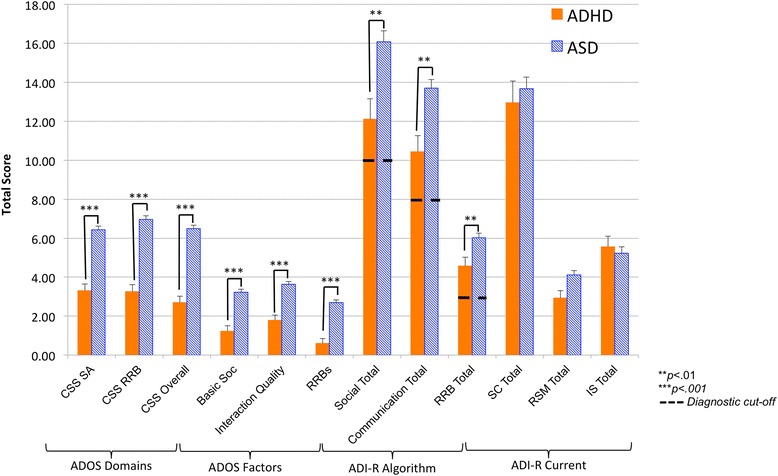
BACKGROUND: Children with attention deficit/hyperactivity disorder (ADHD) often present with social difficulties, though the extent to which these clearly overlap with symptoms of autism spectrum disorder (ASD) is not well understood. METHODS: We explored parent-reported and directly-observed ASD symptoms on the Autism Diagnostic Interview-Revised (ADI-R) and the Autism Diagnostic Observation Schedule (ADOS) in children referred to ASD-specialty clinics who received diagnoses of either ADHD (n = 48) or ASD (n = 164). RESULTS: Of the ADHD sample, 21 % met ASD cut-offs on the ADOS and 30 % met ASD cut-offs on all domains of the ADI-R. Four social communication ADOS items (Quality of Social Overtures, Unusual Eye Contact, Facial Expressions Directed to Examiner, and Amount of Reciprocal Social Communication) adequately differentiated the groups while none of the items on the ADI-R met the criteria for adequate discrimination. CONCLUSIONS: Results of this work highlight the challenges that clinicians and researchers face when distinguishing ASD from other disorders in verbally fluent, school-age children.
Overview
The claims and statistics of this paper haven’t been checked yet.
Free: it reads the open-access text and checks the first 5 claims that cite a source we can check. Create a free account to check every claim.
Integrity signals
Registry
Cites
Statistics
Figures
Verification
Claims the paper makes
The claims and statistics of this paper haven’t been checked yet.
Free: it reads the open-access text and checks the first 5 claims that cite a source we can check. Create a free account to check every claim.
Claims other papers make about this one
Each is checked against this paper’s own text: does it say what the citing paper says it does?
The source backs part of the claim, not all of it — or backs it for a different population, condition or comparison.
In the citing paper
“the social difficulties in ASD seem to reflect deficits in social knowledge10 that result in social disengagement, isolation, and indifference to social cues11,12”
From Executive function deficits in attention-deficit/hyperactivity disorder and autism spectrum disorder (2024) · cites this paper as [11]
Experimental — accuracy not yet measuredThe source backs part of the claim, not all of it — or backs it for a different population, condition or comparison.
In the citing paper
“select items from the Behavior Assessment System for Children-3 (BASC-3) and the Autism Diagnostic Observation System (ADOS-2) might accurately differentiate ASD from ADHD, although both measures fail to adequately differentiate ADHD from ASD.11,95”
From Executive function deficits in attention-deficit/hyperactivity disorder and autism spectrum disorder (2024) · cites this paper as [11]
Experimental — accuracy not yet measuredThe source backs part of the claim, not all of it — or backs it for a different population, condition or comparison.
In the citing paper
“none of the items on the gold-standard Autism Diagnostic Inventory – Revised (ADI-R) adequately differentiate ASD from ADHD.11,94”
From Executive function deficits in attention-deficit/hyperactivity disorder and autism spectrum disorder (2024) · cites this paper as [11]
Experimental — accuracy not yet measured
Self-check
Percentages, sums and reported differences re-computed from the paper’s own numbers.
The self-check needs the paper’s full text.
Citations
Cites
Diagnostic and Statistical Manual of Mental Disorders
American Psychiatric Association (2013) · doi:10.1176/appi.books.9780890425596 · Cited by 116,369
Diagnostic and Statistical Manual of Mental Disorders
Williams, J. B. W., & First, M. (2013) · Encyclopedia of Social Work · doi:10.1093/acrefore/9780199975839.013.104 · Cited by 109,519
Lord, C., Rutter, M., & Le Couteur, A. (1994) · Journal of Autism and Developmental Disorders · doi:10.1007/bf02172145 · Cited by 9,065 · cited 2×
“The ADOS [28] and the ADI-R [29] were administered in order to obtain information about ASD symptoms.”
BackgroundMethodSelf-citationInsel, T., Cuthbert, B., Garvey, M., Heinssen, R., Pine, D. S., Quinn, K., Sanislow, C., & Wang, P. (2010) · American Journal of Psychiatry · doi:10.1176/appi.ajp.2010.09091379 · Cited by 7,067 · cited 1×
“Although current research motivations emphasize exploration of symptoms on a continuum (Research Domain Criteria (RDoC)) [31], current clinical needs require practitioners to provide dichotomous determinations of whether someone does or does not have a disorder.”
Baio, J., Wiggins, L., Christensen, D. L., Maenner, M. J., Daniels, J., Warren, Z., Kurzius-Spencer, M., Zahorodny, W., Robinson, C., Rosenberg, et al. (2018) · MMWR. Surveillance Summaries · doi:10.15585/mmwr.ss6706a1 · Cited by 6,078
Wechsler Abbreviated Scale of Intelligence
Dumont, R., Willis, J. O., Veizel, K., & Zibulsky, J. (2014) · Encyclopedia of Special Education · doi:10.1002/9781118660584.ese2519 · Cited by 5,521
Wechsler Abbreviated Scale of Intelligence
Wechsler, D. (2012) · PsycTESTS Dataset · doi:10.1037/t15170-000 · Cited by 4,596
Peabody Picture Vocabulary Test
Campbell, J. M., & Dommestrup, A. K. (2010) · The Corsini Encyclopedia of Psychology · doi:10.1002/9780470479216.corpsy0649 · Cited by 3,787
Maenner, M. J., Shaw, K. A., Baio, J., EdS1, Washington, A., Patrick, M., DiRienzo, M., Christensen, D. L., Wiggins, L. D., Pettygrove, S., et al. (2020) · MMWR. Surveillance Summaries · doi:10.15585/mmwr.ss6904a1 · Cited by 3,780
Simonoff, E., Pickles, A., Charman, T., Chandler, S., Loucas, T., & Baird, G. (2008) · Journal of the American Academy of Child & Adolescent Psychiatry · doi:10.1097/chi.0b013e318179964f · Cited by 3,399
Vineland Adaptive Behavior Scales
Sparrow, S. S. (2011) · Encyclopedia of Clinical Neuropsychology · doi:10.1007/978-0-387-79948-3_1602 · Cited by 1,966
Standardizing ADOS Scores for a Measure of Severity in Autism Spectrum Disorders
Gotham, K., Pickles, A., & Lord, C. (2009) · Journal of Autism and Developmental Disorders · doi:10.1007/s10803-008-0674-3 · Cited by 1,605 · cited 13×
“However, it should be noted that CPEA criteria do not technically require the presence of RRBs, which would be required to make a DSM-5 clinical diagnosis.”
MethodInfluentialSelf-citationWechsler Intelligence Scale for Children, Fourth Edition
Wechsler, D. (2012) · PsycTESTS Dataset · doi:10.1037/t15174-000 · Cited by 1,577
Naarden Braun, K. V., Lopez, M., White, T., et al. (2023) · Carolina Digital Repository (University of North Carolina at Chapel Hill) · doi:10.17615/y3kk-5x30 · Cited by 1,381
The Autism Diagnostic Observation Schedule: Revised Algorithms for Improved Diagnostic Validity
Gotham, K., Risi, S., Pickles, A., & Lord, C. (2007) · Journal of Autism and Developmental Disorders · doi:10.1007/s10803-006-0280-1 · Cited by 1,161 · cited 4×
“As Table 2 shows, 21 % of the ADHD sample and 85 % of the ASD sample met ADOS ASD algorithm cut-offs (cut-off for ASD ≥7 for module 3 and ≥8 for module 4) [39, 40].”
BackgroundMethodResultInfluentialSelf-citationWechsler Intelligence Scale for Children–Fourth Edition
Dumont, R., Willis, J. O., Veizel, K., & Zibulsky, J. (2014) · Encyclopedia of Special Education · doi:10.1002/9781118660584.ese2522 · Cited by 634
Shared heritability of attention-deficit/hyperactivity disorder and autism spectrum disorder
Rommelse, N. N. J., Franke, B., Geurts, H. M., Hartman, C. A., & Buitelaar, J. K. (2010) · European Child & Adolescent Psychiatry · doi:10.1007/s00787-010-0092-x · Cited by 564 · cited 2×
“Furthermore, obtaining detailed information about specific social difficulties in children with ADHD has implications for treatment planning, as well as for interpreting emerging evidence of both genetic [19, 32] and neurobiological [33–35] overlap between these disorders.”
BackgroundHus, V., & Lord, C. (2014) · Journal of Autism and Developmental Disorders · doi:10.1007/s10803-014-2080-3 · Cited by 547 · cited 14×
“However, it should be noted that CPEA criteria do not technically require the presence of RRBs, which would be required to make a DSM-5 clinical diagnosis.”
MethodResultInfluentialSelf-citationHigh Rates of Psychiatric Co-Morbidity in PDD-NOS
de Bruin, E. I., Ferdinand, R. F., Meester, S., de Nijs, P. F. A., & Verheij, F. (2007) · Journal of Autism and Developmental Disorders · doi:10.1007/s10803-006-0215-x · Cited by 508
Luyster, R., Gotham, K., Guthrie, W., Coffing, M., Petrak, R., Pierce, K., Bishop, S., Esler, A., Hus, V., Oti, R., et al. (2009) · Journal of Autism and Developmental Disorders · doi:10.1007/s10803-009-0746-z · Cited by 468 · cited 1×
“Fourth, using methodology previously employed for the purpose of identifying items for diagnostic algorithms and other discrimination purposes [39, 54, 55], we identified specific social communication items that discriminated best between the groups.”
MethodSelf-citationLeitner, Y. (2014) · Frontiers in Human Neuroscience · doi:10.3389/fnhum.2014.00268 · Cited by 439
The Clinical Evaluation of Language Fundamentals, Fourth Edition (CELF-4): A Review
Paslawski, T. (2005) · Canadian Journal of School Psychology · doi:10.1177/0829573506295465 · Cited by 410
Anderson, D. K., Liang, J. W., & Lord, C. (2014) · Journal of Child Psychology and Psychiatry · doi:10.1111/jcpp.12178 · Cited by 401 · cited 8×
“Children with a BEC of ASD were chosen as a comparison group, based on the same criteria outlined above.”
MethodInfluentialSelf-citationGadow, K. D., Devincent, C. J., Pomeroy, J., & Azizian, A. (2005) · Autism · doi:10.1177/1362361305056079 · Cited by 388
Lainhart, J. E., Bigler, E. D., Bocian, M., Coon, H., Dinh, E., Dawson, G., Deutsch, C. K., Dunn, M., Estes, A., Tager‐Flusberg, H., et al. (2006) · American Journal of Medical Genetics Part A · doi:10.1002/ajmg.a.31465 · Cited by 381 · cited 9×
“However, it should be noted that CPEA criteria do not technically require the presence of RRBs, which would be required to make a DSM-5 clinical diagnosis.”
BackgroundMethodInfluentialAutistic traits in a population-based ADHD twin sample
Reiersen, A. M., Constantino, J. N., Volk, H. E., & Todd, R. D. (2007) · Journal of Child Psychology and Psychiatry · doi:10.1111/j.1469-7610.2006.01720.x · Cited by 352
Di Martino, A., Zuo, X.-N., Kelly, C., Grzadzinski, R., Mennes, M., Schvarcz, A., Rodman, J., Lord, C., Castellanos, F. X., & Milham, M. P. (2013) · Biological Psychiatry · doi:10.1016/j.biopsych.2013.02.011 · Cited by 345 · cited 1×
“Furthermore, detailed phenotyping of ASD-like traits in these children could provide insight into studies exploring the neurobiological [33, 34] and genetic [32] underpinnings of these disorders, both when they occur alone and together.”
BackgroundSelf-citationHuerta, M., Bishop, S. L., Duncan, A., Hus, V., & Lord, C. (2012) · American Journal of Psychiatry · doi:10.1176/appi.ajp.2012.12020276 · Cited by 341 · cited 5×
“To aid in diagnostic symptom understanding, researchers have mapped individual items from the ADOS and ADI-R to ASD symptom domains [30].”
BackgroundMethodInfluentialSelf-citationEfficacy of three screening instruments in the identification of autistic-spectrum disorders
Charman, T., Baird, G., Simonoff, E., Loucas, T., Chandler, S., Meldrum, D., & Pickles, A. (2007) · British Journal of Psychiatry · doi:10.1192/bjp.bp.107.040196 · Cited by 263
Examining autistic traits in children with ADHD: does the autism spectrum extend to ADHD?
Grzadzinski, R., Di Martino, A., Brady, E., Mairena, M. A., O’Neale, M., Petkova, E., Lord, C., & Castellanos, F. X. (2011) · Journal of Autism and Developmental Disorders · doi:10.1007/s10803-010-1135-3 · Cited by 260 · cited 1×
“Similarly, symptoms of ASD have been found to be associated with oppositional behaviors and depression in children with ADHD [8, 9, 11].”
BackgroundSelf-citationA Review of Peer Relationships and Friendships in Youth With ADHD
Gardner, D. M., & Gerdes, A. C. (2015) · Journal of Attention Disorders · doi:10.1177/1087054713501552 · Cited by 255
Autism and ADHD: how far have we come in the comorbidity debate
Gargaro, B. A., Rinehart, N. J., Bradshaw, J. L., Tonge, B. J., & Sheppard, D. M. (2011) · Neuroscience & Biobehavioral Reviews · doi:10.1016/j.neubiorev.2010.11.002 · Cited by 244 · cited 1×
“Furthermore, detailed phenotyping of ASD-like traits in these children could provide insight into studies exploring the neurobiological [33, 34] and genetic [32] underpinnings of these disorders, both when they occur alone and together.”
BackgroundMulligan, A., Anney, R. J. L., O’Regan, M., Chen, W., Butler, L., Fitzgerald, M., Buitelaar, J., Steinhausen, H.-C., Rothenberger, A., Minderaa, R., et al. (2009) · Journal of Autism and Developmental Disorders · doi:10.1007/s10803-008-0621-3 · Cited by 233 · cited 3×
“Although elevated scores on ASD measures in this sample of children with ADHD may suggest that actual ASD symptoms are common in ADHD [9, 10, 18], results of the clinician observation (ADOS) and the BEC non-ASD diagnoses suggest that there are important differences in the social communication behavior characteristic o…”
BackgroundAutistic symptoms in children with attention deficit-hyperactivity disorder
Clark, T., Feehan, C., Tinline, C., & Vostanis, P. (1999) · European Child & Adolescent Psychiatry · doi:10.1007/s007870050083 · Cited by 227
Use of Artificial Intelligence to Shorten the Behavioral Diagnosis of Autism
Wall, D. P., Dally, R., Luyster, R., Jung, J.-Y., & DeLuca, T. F. (2012) · PLoS ONE · doi:10.1371/journal.pone.0043855 · Cited by 226 · cited 3×
“Recently, Wall and colleagues [58] identified seven items from the ADI-R (past items) that distinguished ASD from typical development with >90 % accuracy: Comprehension of Simple Language, Reciprocal Conversation, Imaginative Play, Imaginative Play with Peers, Direct Gaze, Group Play with Peers, and Age when Abnormali…”
BackgroundMethodDevelopmental trajectories as autism phenotypes
Lord, C., Bishop, S., & Anderson, D. (2015) · American Journal of Medical Genetics Part C: Seminars in Medical Genetics · doi:10.1002/ajmg.c.31440 · Cited by 197 · cited 3×
“In addition, in order to understand current behavior described on the ADI-R, domains of social communication (SC), repetitive sensory motor (RSM), and insistence on sameness (IS) were calculated using domains defined by Lord, Bishop, and Anderson [38].”
BackgroundMethodInfluentialSelf-citationGREENE, R. W., BIEDERMAN, J., FARAONE, S. V., OUELLETTE, C. A., PENN, C., & GRIFFIN, S. M. (1996) · Journal of the American Academy of Child & Adolescent Psychiatry · doi:10.1097/00004583-199605000-00011 · Cited by 175
Hus, V., Pickles, A., Cook, E. H., Risi, S., & Lord, C. (2007) · Biological Psychiatry · doi:10.1016/j.biopsych.2006.08.044 · Cited by 172
Self-citationEmpathy and Social Perspective Taking in Children with Attention-Deficit/Hyperactivity Disorder
Marton, I., Wiener, J., Rogers, M., Moore, C., & Tannock, R. (2009) · Journal of Abnormal Child Psychology · doi:10.1007/s10802-008-9262-4 · Cited by 170
Commonly studied comorbid psychopathologies among persons with autism spectrum disorder
Matson, J. L., & Cervantes, P. E. (2014) · Research in Developmental Disabilities · doi:10.1016/j.ridd.2014.02.012 · Cited by 157 · cited 1×
“Over the last several years, there has been increasing interest in ASD-ADHD symptom overlap [13].”
BackgroundBishop, S., Gahagan, S., & Lord, C. (2007) · Journal of Child Psychology and Psychiatry · doi:10.1111/j.1469-7610.2007.01782.x · Cited by 143 · cited 1×
“Fourth, using methodology previously employed for the purpose of identifying items for diagnostic algorithms and other discrimination purposes [39, 54, 55], we identified specific social communication items that discriminated best between the groups.”
MethodSelf-citationLuteijn, E. F., Serra, M., Jackson, S., Steenhuis, M. P., Althaus, M., Volkmar, F., & Minderaa, R. (2000) · European Child & Adolescent Psychiatry · doi:10.1007/s007870070040 · Cited by 138
Symptoms of autism and ADHD: A Swedish twin study examining their overlap.
Ronald, A., Larsson, H., Anckarsäter, H., & Lichtenstein, P. (2014) · Journal of Abnormal Psychology · doi:10.1037/a0036088 · Cited by 133 · cited 1×
“It also underscores the importance of understanding the boundaries and overlaps between these disorders [14].”
BackgroundUse of the Autism Diagnostic Observation Schedule (ADOS) in a clinical setting
Molloy, C. A., Murray, D. S., Akers, R., Mitchell, T., & Manning-Courtney, P. (2011) · Autism · doi:10.1177/1362361310379241 · Cited by 119
Exploratory and confirmatory factor analysis of the Autism Diagnostic Interview—revised
Frazier, T. W., Youngstrom, E. A., Kubu, C. S., Sinclair, L., & Rezai, A. (2008) · Journal of Autism and Developmental Disorders · doi:10.1007/s10803-007-0415-z · Cited by 116 · cited 1×
“One study described ASD symptoms in children with ADHD as loading on two factors, social communication and restricted, repetitive behaviors [19], the same way that these constructs have been shown to organize in ASD samples [20, 21].”
BackgroundBroadbooks, D. Y., & Schmelzer, R. V. (2008) · Wiley eBooks · doi:10.1002/9780470373699.speced0664 · Cited by 116
Autistic traits in children with ADHD index clinical and cognitive problems
Cooper, M., Martin, J., Langley, K., Hamshere, M., & Thapar, A. (2014) · European Child & Adolescent Psychiatry · doi:10.1007/s00787-013-0398-6 · Cited by 109 · cited 1×
“Similarly, symptoms of ASD have been found to be associated with oppositional behaviors and depression in children with ADHD [8, 9, 11].”
BackgroundImpact of ADHD symptoms on autism spectrum disorder symptom severity
Sprenger, L., Bühler, E., Poustka, L., Bach, C., Heinzel-Gutenbrunner, M., Kamp-Becker, I., & Bachmann, C. (2013) · Research in Developmental Disabilities · doi:10.1016/j.ridd.2013.07.028 · Cited by 105
Ronk, M. J., Hund, A. M., & Landau, S. E. (2011) · Research on Child and Adolescent Psychopathology · doi:10.1007/s10802-011-9497-3 · Cited by 98
Hartley, S. L., & Sikora, D. M. (2009) · Autism · doi:10.1177/1362361309335717 · Cited by 94
PDD symptoms in ADHD, an independent familial trait?
Nijmeijer, J. S., Hoekstra, P. J., Minderaa, R. B., Buitelaar, J. K., Altink, M. E., Buschgens, C. J. M., Fliers, E. A., Rommelse, N. N. J., Sergeant, J. A., & Hartman, C. A. (2009) · Journal of Abnormal Child Psychology · doi:10.1007/s10802-008-9282-0 · Cited by 93 · cited 2×
“Although elevated scores on ASD measures in this sample of children with ADHD may suggest that actual ASD symptoms are common in ADHD [9, 10, 18], results of the clinician observation (ADOS) and the BEC non-ASD diagnoses suggest that there are important differences in the social communication behavior characteristic o…”
BackgroundHus, V., & Lord, C. (2013) · Journal of Autism and Developmental Disorders · doi:10.1007/s10803-012-1576-y · Cited by 86
Self-citationGirls With Social and/or Attention Deficits: A Descriptive Study of 100 Clinic Attenders
Kopp, S., Kelly, K. B., & Gillberg, C. (2010) · Journal of Attention Disorders · doi:10.1177/1087054709332458 · Cited by 80 · cited 1×
“Discussion Results of this work highlight the diagnostic conundrum that clinicians often face when assessing verbally fluent, school-aged children for ASD [18, 36, 37, 56, 57].”
BackgroundWechsler Preschool and Primary Scale of Intelligence
National Cancer Institute (2020) · Definitions · doi:10.32388/1c0ktj · Cited by 79
Mikami, A. Y., Jia, M., & Na, J. J. (2014) · Child and Adolescent Psychiatric Clinics of North America · doi:10.1016/j.chc.2014.05.007 · Cited by 76
Mandell, D. S., & Lecavalier, L. (2014) · Autism · doi:10.1177/1362361314538131 · Cited by 70
Hagberg, B. S., Miniscalco, C., & Gillberg, C. (2009) · Research in Developmental Disabilities · doi:10.1016/j.ridd.2009.07.012 · Cited by 69 · cited 1×
“Discussion Results of this work highlight the diagnostic conundrum that clinicians often face when assessing verbally fluent, school-aged children for ASD [18, 36, 37, 56, 57].”
BackgroundThorell, L. B., & Rydell, A. (2008) · Child: Care, Health and Development · doi:10.1111/j.1365-2214.2008.00869.x · Cited by 66
Attention Deficit Hyperactivity Disorder Symptoms in Adults with Autism Spectrum Disorders
Johnston, K., Dittner, A., Bramham, J., Murphy, C., Knight, A., & Russell, A. (2013) · Autism Research · doi:10.1002/aur.1283 · Cited by 51
Factor Structure of Autistic Traits in Children with ADHD
Martin, J., Hamshere, M. L., O’Donovan, M. C., Rutter, M., & Thapar, A. (2014) · Journal of Autism and Developmental Disorders · doi:10.1007/s10803-013-1865-0 · Cited by 49 · cited 2×
“Furthermore, obtaining detailed information about specific social difficulties in children with ADHD has implications for treatment planning, as well as for interpreting emerging evidence of both genetic [19, 32] and neurobiological [33–35] overlap between these disorders.”
BackgroundThe Relationship Between Grey-Matter and ASD and ADHD Traits in Typical Adults
Geurts, H. M., Ridderinkhof, K. R., & Scholte, H. S. (2012) · Journal of Autism and Developmental Disorders · doi:10.1007/s10803-012-1708-4 · Cited by 46
Schwenck, C., & Freitag, C. M. (2014) · ADHD Attention Deficit and Hyperactivity Disorders · doi:10.1007/s12402-014-0147-9 · Cited by 34
The Structure of Autism Symptoms as Measured by the Autism Diagnostic Observation Schedule
Norris, M., Lecavalier, L., & Edwards, M. C. (2012) · Journal of Autism and Developmental Disorders · doi:10.1007/s10803-011-1348-0 · Cited by 32 · cited 1×
“One study described ASD symptoms in children with ADHD as loading on two factors, social communication and restricted, repetitive behaviors [19], the same way that these constructs have been shown to organize in ASD samples [20, 21].”
BackgroundSikora, D. M., Hartley, S. L., McCoy, R., Gerrard-Morris, A. E., & Dill, K. C. (2007) · Research in Autism · doi:10.1016/j.rasd.2007.05.003 · Cited by 23 · cited 2×
“Discussion Results of this work highlight the diagnostic conundrum that clinicians often face when assessing verbally fluent, school-aged children for ASD [18, 36, 37, 56, 57].”
BackgroundBrief Report: Can Metrics of Reporting Bias Enhance Early Autism Screening Measures?
Taylor, C. M., Vehorn, A. C., Noble, H. E., Weitlauf, A. S., & Warren, Z. E. (2014) · Journal of Autism and Developmental Disorders · doi:10.1007/s10803-014-2099-5 · Cited by 19 · cited 1×
“These results also suggest that care must be taken with regard to proposals of quick diagnoses based on abbreviated information [58], questionnaires [59], or diagnoses made through chart reviews [60].”
Background
Research works printed but not linked: 5
- 28. Lord C Rutter M DiLavore PC Risi S Gotham K Bishop SL Autism diagnostic observation schedule, second edition (ADOS-2) modules 1-4 2012 Los Angeles, California Western Psychological Services
- 42. Bishop S, Havdahl KA, Huerta M, Lord C. Sub-domains of social-communication impairments in verbally fluent children with developmental disorders. under review.
- 43. Elliot CD Differential abilities scale 1990 San Antonio, TX Psychological Corporation
- 47. Wechsler D The Wechsler adult intelligence scale—revised manual 1981 New York Psychological Corporation
- 51. Raven JC Progressive matrices: a perceptual test of intelligence 1938 London, UK HK Lewis
Cited by
Antshel, K. M., & Russo, N. (2019) · Current Psychiatry Reports · doi:10.1007/s11920-019-1020-5 · Cited by 450
Co-occurring psychiatric conditions in autism spectrum disorder
Rosen, T. E., Mazefsky, C. A., Vasa, R. A., & Lerner, M. D. (2018) · International Review of Psychiatry · doi:10.1080/09540261.2018.1450229 · Cited by 325
“To address the dearth of studies utilizing direct clinical observation, Grzadzinski et al. (2016) used structured diagnostic assessments of ASD symptoms in ADHD only and ASD only samples, and found that clinical observation via the ADOS (Lord et al., 2012) yielded more specificity than parentreport…”
BackgroundState of the field: Differentiating intellectual disability from autism spectrum disorder
Thurm, A., Farmer, C., Salzman, E., Lord, C., & Bishop, S. (2019) · Frontiers in Psychiatry · doi:10.3389/fpsyt.2019.00526 · Cited by 267
“, peek-a-boo), are most specific to ASD (74, 75).”
BackgroundSelf-citationSolmi, M., Song, M., Yon, D. K., Lee, S. W., Fombonne, E., Kim, M. S., Park, S., Lee, M. H., Hwang, J., Keller, R., et al. (2022) · Molecular Psychiatry · doi:10.1038/s41380-022-01630-7 · Cited by 226
Khundrakpam, B. S., Lewis, J. D., Kostopoulos, P., Carbonell, F., & Evans, A. C. (2017) · Cerebral Cortex · doi:10.1093/cercor/bhx038 · Cited by 216
“These inconsistencies are, to some extent, due to the fact that ASD is a very heterogeneous disorder characterized by a wide range of symptoms with varying severity and is often accompanied by one of a number of comorbid conditions (Johnston et al. 2013; Kim et al. 2015; Grzadzinski et al. 2016; Kantzer et al. 2016).”
Metadata
- Authors
- Grzadzinski, R., Dick, C., Lord, C., & Bishop, S.
- Affiliations
- NewYork–Presbyterian Hospital (US)
- University of California, San Francisco (US)
- Corresponding author
- Grzadzinski, Rebecca
- Venue
- Molecular Autism
- Published
- 2016-01-19
- Volume
- 7
- Issue
- 1
- Pages
- 7-7
- ISSN
- 2040-2392 (ISSN-L)
- PMC
- PMC4717584
- OpenAlex
- W2263330556
- Cited by
- 192
- References
- 66
- Citations by year
- 2026: 17 · 2025: 22 · 2024: 17 · 2023: 15 · 2022: 23 · 2021: 35 · 2020: 20 · 2019: 17 · 2018: 12 · 2017: 11 · 2016: 3
- FWCI
- 9.12
- Type
- journal article
- Language
- en
- Open access
- gold
- doi.org
- Licence
- cc-by
- creativecommons.org/licenses/by/4.0/ (tdm)
- creativecommons.org/licenses/by/4.0/ (vor)
- Locations
- Molecular Autism (publishedVersion, cc-by)
- PubMed Central (publishedVersion, cc-by)
- PubMed (publishedVersion)
- eScholarship (California Digital Library) (submittedVersion, cc-by)
- Funders
- National Institute of Mental Health (1RC1MH089721, 1R01MH089390)
- Health Resources and Services Administration (R40MC274730100)
- Weill Cornell Medical College (n/a)
- Teachers College, Columbia University (n/a)
- Topics
- Life Sciences › Neuroscience › Cognitive Neuroscience › Autism Spectrum Disorder Research
- Health Sciences › Medicine › Psychiatry and Mental health › Attention Deficit Hyperactivity Disorder
- Health Sciences › Medicine › Psychiatry and Mental health › Child Nutrition and Feeding Issues
- Keywords
- autism spectrum disorder, attention deficit hyperactivity disorder, comorbidities, parent-reported symptoms, DSM-5, social communication, diagnostic overlap, autism screening, ADI-R, Autism Diagnostic Observation Schedule
- MeSH terms
- Autism Spectrum Disorder, Adolescent, Attention Deficit Disorder with Hyperactivity, Child, Child, Preschool, Diagnosis, Differential, Facial Expression, Female, Fixation, Ocular, Humans, Interview, Psychological, Male, Parents, Psychiatry, Psychological Tests, Psychology, Severity of Illness Index, Social Behavior, Observer Variation, Age of Onset, Diagnostic and Statistical Manual of Mental Disorders, Symptom Assessment
About these checks
Registry, retraction, Cites and statistics results are computed, not judged, with one exception: a printed reference that no index lists is read once by a model before it counts as a citation error. Claims are extracted by a model and kept only when their quote appears verbatim in the text; each cited source is then checked, with a model’s help, for whether it says what the claim relies on. Those verdicts can be wrong — read the claim’s quote and the cited source before relying on one.
Statistics and arithmetic are recomputed, not judged.
Confidence bands are shown only for fields calibrated on our annotated test set. None is calibrated yet, so no band is shown.
What counts as a claim ›How we measure confidence ›How we check this ›
Are you an author, or do you see a problem with this page? Request a review
Data sources
Bibliographic data: Semantic Scholar, OpenAlex, Crossref.
Contains information from the Semantic Scholar Academic Graph Datasets, made available under the ODC Attribution License (ODC-BY 1.0).
Semantic Scholar’s data is described in: Kinney, R., et al. (2023). The Semantic Scholar Open Data Platform. arXiv:2301.10140.
