

The impact of social activities, social networks, social support and social relationships on the cognitive functioning of healthy older adults: a systematic review
Open accessThe DOI matches its Crossref record; 102 of the 103 references it cites were found in a registry or an index.
Abstract
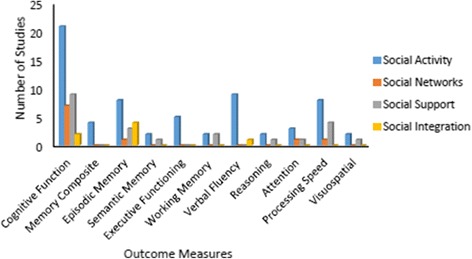
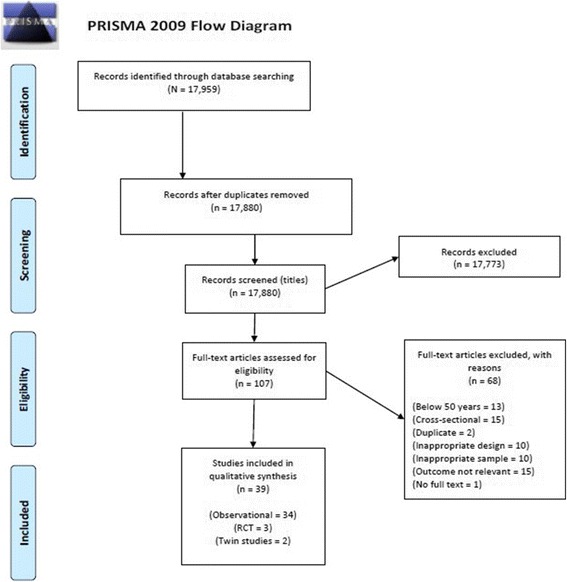
BACKGROUND: Social relationships, which are contingent on access to social networks, promote engagement in social activities and provide access to social support. These social factors have been shown to positively impact health outcomes. In the current systematic review, we offer a comprehensive overview of the impact of social activities, social networks and social support on the cognitive functioning of healthy older adults (50+) and examine the differential effects of aspects of social relationships on various cognitive domains. METHODS: We followed PRISMA (Preferred Reporting Items for Systematic Reviews and Meta-Analysis) guidelines, and collated data from randomised controlled trials (RCTs), genetic and observational studies. Independent variables of interest included subjective measures of social activities, social networks, and social support, and composite measures of social relationships (CMSR). The primary outcome of interest was cognitive function divided into domains of episodic memory, semantic memory, overall memory ability, working memory, verbal fluency, reasoning, attention, processing speed, visuospatial abilities, overall executive functioning and global cognition. RESULTS: Thirty-nine studies were included in the review; three RCTs, 34 observational studies, and two genetic studies. Evidence suggests a relationship between (1) social activity and global cognition and overall executive functioning, working memory, visuospatial abilities and processing speed but not episodic memory, verbal fluency, reasoning or attention; (2) social networks and global cognition but not episodic memory, attention or processing speed; (3) social support and global cognition and episodic memory but not attention or processing speed; and (4) CMSR and episodic memory and verbal fluency but not global cognition. CONCLUSIONS: The results support prior conclusions that there is an association between social relationships and cognitive function but the exact nature of this association remains unclear. Implications of the findings are discussed and suggestions for future research provided. SYSTEMATIC REVIEW REGISTRATION: PROSPERO 2012: CRD42012003248 .
Overview
The claims and statistics of this paper haven’t been checked yet.
Free: it reads the open-access text and checks the first 5 claims that cite a source we can check. Create a free account to check every claim.
Integrity signals
Registry
Cites
Statistics
Figures
Verification
Claims the paper makes
The claims and statistics of this paper haven’t been checked yet.
Free: it reads the open-access text and checks the first 5 claims that cite a source we can check. Create a free account to check every claim.
Claims other papers make about this one
Each is checked against this paper’s own text: does it say what the citing paper says it does?
The cited source doesn’t support the claim as written.
In the citing paper
“Frequent social activity was associated with improved memory, executive function, visuospatial ability, and processing speed, whereas frequent social support was associated only with improved memory.8”
From Associations between social connections and cognition: a global collaborative individual participant data meta-analysis (2022) · cites this paper as [8]
Checked by a reasoning model — may be wrong.
Experimental — accuracy not yet measuredThe source backs part of the claim, not all of it — or backs it for a different population, condition or comparison.
In the citing paper
“Despite clear cultural variation in the meaning and perception of social isolation, findings of protective effect of more social contact are largely consistent in different settings and for either sex across the studies and meta-analyses.”
From Dementia prevention, intervention, and care: 2020 report of the Lancet Commission (2020) · cites this paper as [118]
Experimental — accuracy not yet measuredThe source backs part of the claim, not all of it — or backs it for a different population, condition or comparison.
In the citing paper
“a systematic review of low quality RCTs of 576 adults aged 60 or more years with normal cognition found facilitated meeting and discussion groups were associated with improved global cognition and increased brain volume at follow-up.”
From Dementia prevention, intervention, and care: 2020 report of the Lancet Commission (2020) · cites this paper as [118]
Experimental — accuracy not yet measuredThe source backs part of the claim, not all of it — or backs it for a different population, condition or comparison.
In the citing paper
“Another meta-analysis of 39 studies reported that social activity and social support were associated with decline in global cognition and specific cognitive domains.8”
From Associations between social connections and cognition: a global collaborative individual participant data meta-analysis (2022) · cites this paper as [8]
Experimental — accuracy not yet measuredThe source backs part of the claim, not all of it — or backs it for a different population, condition or comparison.
In the citing paper
“Consequently, measurement of this kind often does not permit testing of alternative hypotheses about social or biological mechanisms.”
From Why the cognitive ‘fountain of youth’ may be upstream: pathways to dementia risk and resilience through social connectedness (2022) · cites this paper as [11]
Experimental — accuracy not yet measured
11 more claims about this paper
Create a free account to see every claim other papers make about this one.
Self-check
Percentages, sums and reported differences re-computed from the paper’s own numbers.
The self-check needs the paper’s full text.
Citations
Cites
Stress, social support, and the buffering hypothesis
Cohen, S., & Wills, T. A. (1985) · Psychological Bulletin · doi:10.1037/0033-2909.98.2.310 · Cited by 18,093 · cited 1×
“Social support in particular may impact cognitive outcomes via its buffering effect on stress [44].”
BackgroundSocial Relationships and Mortality Risk: A Meta-analytic Review
Holt-Lunstad, J., Smith, T. B., & Layton, J. B. (2010) · PLoS Medicine · doi:10.1371/journal.pmed.1000316 · Cited by 7,272 · cited 1×
“One difficulty when trying to determine the effect of social relationships on cognitive function is the use of discrepant and unclear definitions of different social factors [14].”
BackgroundEffects of stress throughout the lifespan on the brain, behaviour and cognition
Lupien, S. J., McEwen, B. S., Gunnar, M. R., & Heim, C. (2009) · Nature Reviews Neuroscience · doi:10.1038/nrn2639 · Cited by 6,256
From social integration to health: durkheim in the new millennium
Berkman, L. F., Glass, T., Brissette, I., & Seeman, T. E. (2000) · Social Science & Medicine · doi:10.1016/s0277-9536(00)00065-4 · Cited by 4,821 · cited 6×
“In an attempt to address the issue of discrepant definitions in the literature, Berkman and colleagues suggested a framework to clarify terms describing social factors and behaviours [15].”
BackgroundInfluentialWhat is cognitive reserve? Theory and research application of the reserve concept
STERN, Y. (2002) · Journal of the International Neuropsychological Society · doi:10.1017/s1355617702813248 · Cited by 3,951 · cited 1×
“Social activities may include a type of cognitive stimulation, thus contributing to cognitive outcomes via the building of cognitive reserve [41]; cognitive reserve optimises cognitive performance through the recruitment of alternate brain networks and cognitive strategies to compensate for cognitive difficulties rela…”
BackgroundSocial and emotional patterns in adulthood: Support for socioemotional selectivity theory
Carstensen, L. L. (1992) · Psychology and Aging · doi:10.1037/0882-7974.7.3.331 · Cited by 2,174
Perceived social isolation and cognition
Cacioppo, J. T., & Hawkley, L. C. (2009) · Trends in Cognitive Sciences · doi:10.1016/j.tics.2009.06.005 · Cited by 2,144 · cited 1×
“In addition, social factors tend to be considered alongside or as part of other lifestyle factors such as leisure or intellectual activity [41]; outcomes such as mortality, physical health, or dementia are included in lieu of cognitive function [10, 18]; only specific aspects of social relationships are considered, su…”
BackgroundAn active and socially integrated lifestyle in late life might protect against dementia
Fratiglioni, L., Paillard-Borg, S., & Winblad, B. (2004) · The Lancet Neurology · doi:10.1016/s1474-4422(04)00767-7 · Cited by 2,135 · cited 1×
“In addition, social factors tend to be considered alongside or as part of other lifestyle factors such as leisure or intellectual activity [41]; outcomes such as mortality, physical health, or dementia are included in lieu of cognitive function [10, 18]; only specific aspects of social relationships are considered, su…”
BackgroundThe handbook of aging and cognition
Craik, F. I. M., & Salthouse, T. A. (1992) · doi:10.4324/9781410601988 · Cited by 2,003
A Meta-Analysis of Interventions to Reduce Loneliness
Masi, C. M., Chen, H.-Y., Hawkley, L. C., & Cacioppo, J. T. (2011) · Personality and Social Psychology Review · doi:10.1177/1088868310377394 · Cited by 1,995
Cited by
Items 901–1,000 of 1,000
Wang, J. (2025) · Current Psychology · doi:10.1007/s12144-025-08904-7 · Cited by 1
“This insight is crucial for designing targeted interventions, emphasizing the importance of con - sidering social activity type, frequency, and quality (Kelly et al., 2017 ; Litwin & Stoeckel, 2016).”
InfluentialWang, J., & Xiao, D. (2025) · Research Square · doi:10.21203/rs.3.rs-8064443/v1
Scambray, K. A., Walters, M. E., Tsotsoros, C. E., Gutiérrez, Á., Sol, K., & Choi, H. (2025) · The Journals of Gerontology Series B · doi:10.1093/geronb/gbaf266 · Cited by 1
Liougas, M. P., Sommerlad, A., O’Rourke, H. M., McGilton, K. S., & Bethell, J. (2024) · Figshare · doi:10.6084/m9.figshare.25231342
Schliep, K. C., Barbeau, W. A., Lynch, K. E., Sorweid, M. K., Varner, M. W., Foster, N. L., & Qeadan, F. (2022) · Figshare · doi:10.6084/m9.figshare.19586923
Nie, Y., Richards, M., Kubínová, R., Titarenko, A., Malyutina, S. K., Kozela, M., Pajak, A., Bobák, M., & Ruiz, M. A. (2021) · Figshare · doi:10.6084/m9.figshare.16829638
Sun, J., Kong, X., Li, H., Chen, J., Yao, Q., Li, H., Zhou, F., & Hu, H. (2022) · Figshare · doi:10.6084/m9.figshare.20220248
Mogic, L., Rutter, E. C., Tyas, S. L., Maxwell, C. J., O’Connell, M. E., & Oremus, M. (2024) · Figshare · doi:10.6084/m9.figshare.26590724
Nie, Y., Richards, M., Kubínová, R., Titarenko, A., Malyutina, S. K., Kozela, M., Pajak, A., Bobák, M., & Ruiz, M. A. (2021) · Figshare · doi:10.6084/m9.figshare.16829623
Zhou, Y., Abuduxukuer, K., Wang, C., Wei, J., Shi, W., Li, Y., Huang, G., Zhou, Y., Zhang, Y., & Luo, J. (2024) · Figshare · doi:10.6084/m9.figshare.26182241
Nie, Y., Richards, M., Kubínová, R., Titarenko, A., Malyutina, S. K., Kozela, M., Pajak, A., Bobák, M., & Ruiz, M. A. (2021) · Figshare · doi:10.6084/m9.figshare.16829626
Schliep, K. C., Barbeau, W. A., Lynch, K. E., Sorweid, M. K., Varner, M. W., Foster, N. L., & Qeadan, F. (2022) · Figshare · doi:10.6084/m9.figshare.19586917
Lim, M. L., Zammit, C., Lewis, E., Ee, N., Maiden, G., Goldwater, M. B., Kimonis, E. R., Kenning, G., Rockwood, K. J., Fitzgerald, A., et al. (2024) · Figshare · doi:10.6084/m9.figshare.25264274
Haghighi, P., & Oremus, M. (2023) · Figshare · doi:10.6084/m9.figshare.22814957
Schliep, K. C., Barbeau, W. A., Lynch, K. E., Sorweid, M. K., Varner, M. W., Foster, N. L., & Qeadan, F. (2022) · Figshare · doi:10.6084/m9.figshare.19586914
Duan, Y., Jiang, S., Yin, Z., Wang, S., Gao, J., Yang, M., Chen, C., Fu, H., & Wang, C. (2024) · Figshare · doi:10.6084/m9.figshare.26605966
Liougas, M. P., Sommerlad, A., O’Rourke, H. M., McGilton, K. S., & Bethell, J. (2024) · Figshare · doi:10.6084/m9.figshare.25231151
Nie, Y., Richards, M., Kubínová, R., Titarenko, A., Malyutina, S. K., Kozela, M., Pajak, A., Bobák, M., & Ruiz, M. A. (2021) · Figshare · doi:10.6084/m9.figshare.16829620
Nie, Y., Richards, M., Kubínová, R., Titarenko, A., Malyutina, S. K., Kozela, M., Pajak, A., Bobák, M., & Ruiz, M. A. (2021) · Figshare · doi:10.6084/m9.figshare.16829629
Hsu, H.-C., & Bai, C.-H. (2022) · Figshare · doi:10.6084/m9.figshare.19408249
Schliep, K. C., Barbeau, W. A., Lynch, K. E., Sorweid, M. K., Varner, M. W., Foster, N. L., & Qeadan, F. (2022) · Figshare · doi:10.6084/m9.figshare.19586929
Schliep, K. C., Barbeau, W. A., Lynch, K. E., Sorweid, M. K., Varner, M. W., Foster, N. L., & Qeadan, F. (2022) · Figshare · doi:10.6084/m9.figshare.19586920
Liougas, M. P., Sommerlad, A., O’Rourke, H. M., McGilton, K. S., & Bethell, J. (2024) · Figshare · doi:10.6084/m9.figshare.26681053
Mogic, L., Rutter, E. C., Tyas, S. L., Maxwell, C. J., O’Connell, M. E., & Oremus, M. (2024) · Figshare · doi:10.6084/m9.figshare.26590721
Schliep, K. C., Barbeau, W. A., Lynch, K. E., Sorweid, M. K., Varner, M. W., Foster, N. L., & Qeadan, F. (2022) · Figshare · doi:10.6084/m9.figshare.19586935
Nie, Y., Richards, M., Kubínová, R., Titarenko, A., Malyutina, S. K., Kozela, M., Pajak, A., Bobák, M., & Ruiz, M. A. (2021) · Figshare · doi:10.6084/m9.figshare.16829617
Vaingankar, J. A., Abdin, E., Chong, S. A., Shafie, S., Sambasivam, R., Zhang, Y. J., Chang, S., Chua, B. Y., Shahwan, S., Jeyagurunathan, A., et al. (2020) · Figshare · doi:10.6084/m9.figshare.13161729
Lee, H. J., Jieun, J., Choi, D.-W., Chae, W., Park, E.-C., & Jang, S.-I. (2020) · Figshare · doi:10.6084/m9.figshare.12900439
Sugimoto, H., Kawagoe, T., & Otake, M. (2020) · Figshare · doi:10.6084/m9.figshare.13269840
Jong, M. C., Dahlqvist, H. Z., Lown, E. A., Schats, W., Beckman, L., & Jong, M. (2023) · Figshare · doi:10.6084/m9.figshare.23908837
Ma, T., Liao, J., Ye, Y., & Li, J. (2024) · Figshare · doi:10.6084/m9.figshare.24965952
Liougas, M. P., Sommerlad, A., O’Rourke, H. M., McGilton, K. S., & Bethell, J. (2024) · Figshare · doi:10.6084/m9.figshare.26681050
Franklin, H., Russell, L. L., Peakman, G., Greaves, C. V., Bocchetta, M., Nicholas, J. M., Poos, J. M., Convery, R. S., Cash, D. M., Swieten, J. C. V., et al. (2021) · Figshare · doi:10.6084/m9.figshare.14966272
Mogic, L., Rutter, E. C., Tyas, S. L., Maxwell, C. J., O’Connell, M. E., & Oremus, M. (2024) · Figshare · doi:10.6084/m9.figshare.26590727
Nie, Y., Richards, M., Kubínová, R., Titarenko, A., Malyutina, S. K., Kozela, M., Pajak, A., Bobák, M., & Ruiz, M. A. (2021) · Figshare · doi:10.6084/m9.figshare.16829644
Nie, Y., Richards, M., Kubínová, R., Titarenko, A., Malyutina, S. K., Kozela, M., Pajak, A., Bobák, M., & Ruiz, M. A. (2021) · Figshare · doi:10.6084/m9.figshare.16829635
Nie, Y., Richards, M., Kubínová, R., Titarenko, A., Malyutina, S. K., Kozela, M., Pajak, A., Bobák, M., & Ruiz, M. A. (2021) · Figshare · doi:10.6084/m9.figshare.16829632
Nie, Y., Richards, M., Kubínová, R., Titarenko, A., Malyutina, S. K., Kozela, M., Pajak, A., Bobák, M., & Ruiz, M. A. (2021) · Figshare · doi:10.6084/m9.figshare.16829641
Lim, M. L., Zammit, C., Lewis, E., Ee, N., Maiden, G., Goldwater, M. B., Kimonis, E. R., Kenning, G., Rockwood, K. J., Fitzgerald, A., et al. (2024) · Figshare · doi:10.6084/m9.figshare.25264423
運転中止後の高齢者の心身機能に対する生活活動の重要性 : 混合方法研究による解釈
赤井田, 将., 144357, & Akaida, S. (2024) · Kagoshima University Repository
Naseer, S., & Azad, H. (2025) · Proceedings of meetings on acoustics · doi:10.1121/2.0002107
Esiaka, D. K. (2025) · The Conversation · doi:10.64628/aai.95cqrak33 · Cited by 1
Roslan, A. I., & Baharuddin, D. (2025) · Asian People Journal (APJ) · doi:10.37231/apj.2025.8.si1.815
“Teachers or more seasoned classmates, then integrate the knowledge to function on their own (Kelly et al., 2017).”
Guardiano, M., Robbins, W. A., Sokolow, S., Song, Y., Siegrist, J., & Li, J. (2026) · Memory · doi:10.1080/09658211.2026.2617345
“…socioeconomic, lifestyle-related, health, and psychosocial work factors, which were selected for their relevance in cognitive health (Gupta, 2021; Harada et al., 2013; Hedges et al., 2019; Jennings et al., 2022; Kelly et al., 2017; Levine et al., 2021; Livingston et al., 2020; Marden et al., 2017).”
Beyond the Block: Social Network Extralocality and Cognitive Function Among U.S. Older Adults
Goldman, A. W., & Campbell, A. (2026) · Journal of Aging and Health · doi:10.1177/08982643261416985
Rajczyk, J. I., Burke, J. F., Xu, W., & Wing, J. J. (2026) · Journal of Social Service Research · doi:10.1080/01488376.2025.2610961 · Cited by 1
“For example, social engagement may minimize harmful responses to stressful events that trigger inflammation in the brain or enhance cognitive reserve through the facilitation of more resilient brain networks (Finlay et al., 2022; Kelly et al., 2017).”
Social network composition influences chronic post-stroke aphasia recovery
Hammond, L. E., Johnson, L., Basilakos, A., Matchin, W., Hogan, A. L., Newman‐Norlund, R., Fridriksson, J., & den Ouden, D. (2026) · Aphasiology · doi:10.1080/02687038.2026.2618714 · Cited by 2
Bužgová, R., Zeleníková, R., Kozáková, R., & Bobčíková, K. (2026) · Journal of Health Psychology · doi:10.1177/13591053251409606
“Combining cognitive exercises with structured social interaction may not only enhance engagement and motivation, but also improve emotional and psychological outcomes (Ben Izhak et al., 2024; Kelly et al., 2017; Lampit et al., 2014; Rieker et al., 2022).”
InfluentialLi, H. Q., Liu, J., Wang, H., & Tan, L. (2026) · Frontiers in Medicine · doi:10.3389/fmed.2026.1696233
Quality of Life in Retirement: Health, Social, and Economic Dimensions
Epik, M. T. (2025) · DergiPark (Istanbul University)
Sun, H., & Xi, Y. (2026) · Journal of Aging and Health · doi:10.1177/08982643261423253
Hu, X., Yu, M., Li, G., Zhang, H., Chen, H., & Li, B. (2026) · BMC Public Health · doi:10.1186/s12889-026-26446-w · Cited by 1
Peng, M., Wang, P., & Huang, S. (2026) · Journal of Aging & Social Policy · doi:10.1080/08959420.2026.2630887
Kim, J. Y., & Chang, H. (2026) · Korean Journal of Adult Nursing · doi:10.7475/kjan.2025.1013
“Social networks represent the opportunity component within this framework, providing the environmental and social conditions that enable behavior change [3,7,16,17].”
Can Raising grandchildren prevent or slow cognitive decline in Chinese elderly?
Yang, J., Zhang, X., Zhang, Y., Yan, J., He, W., Yan, J., Gong, Y., Duan, Z., Ji, B., Pei, Z., et al. (2026) · BMC Public Health · doi:10.1186/s12889-026-26656-2
Wu, X., Guo, J., Ma, A., Sun, X., & Guo, J. (2026) · Research Square · doi:10.21203/rs.3.rs-8794173/v1
Utku, İ. K., Kurnaz, B., KÜÇÜK, H., Şahin, M. H., Kumcu, B. A., Özceylan, G., Aktaş, E. O., Gider, H., Baydere, D., Çatıkkaş, N. M., et al. (2026) · Journal of Medicine and Palliative Care · doi:10.47582/jompac.1861483
Saliwa, S. S., Gaviola, N. J. S., Gaviola, S. J. S., Talucdo, S. S. A., Suletario, V. P., Rara, A. P. P., Galido, J. A. B., Binayao, T. J. A., & Taja-on, E. P. (2026) · Formosa Journal of Applied Sciences · doi:10.55927/fjas.v5i2.6
Modifiable lifestyle factors associated with cognitive functioning among college students
Foster, E. M., Garcia, S. L., & Lategan-Potgieter, R. (2026) · Applied Neuropsychology Adult · doi:10.1080/23279095.2026.2633185 · Cited by 1
Wu, Q., Pei, H., Zhang, L., Chen, Y., Wang, L., He, J., & Song, C. (2026) · Heart Lung and Circulation · doi:10.1016/j.hlc.2025.09.016
Bentué‐Martínez, C., Antón, M. Z., & Rodrígues, M. (2026) · Boletín de la Asociación de Geógrafos Españoles · doi:10.21138/bage.3755
Kluckert, C., & Hüll, M. (2026) · Neurologie up2date · doi:10.1055/a-2770-4235
Moreno, M. A. H. (2026) · Gredos (University of Salamanca) · doi:10.14201/gredos.170615
Maeda, A., Suzuki, M., Suzumura, S., Kamiya, E., Yamaguchi, D., Okaniwa, K., & Takechi, H. (2026) · Journal of Family Medicine and Primary Care · doi:10.4103/jfmpc.jfmpc_1621_25
Vogelsang, E. M., Moorman, S., Mijares, A., Zanotelli, Z., Ashtiani, R. T., & Khani, S. (2026) · Research on Aging · doi:10.1177/01640275261437322
Li, T. Y., Yu, A. P., Hui, S. S., Chan, D. K. C., Cheng, C. P., Fong, D., Irwin, M. R., & Siu, P. M. (2026) · Mental health and physical activity · doi:10.1016/j.mhpa.2026.100768 · Cited by 1
Ziv, G., Levin, O., & Masiulis, N. (2026) · Kinesiology Review · doi:10.1123/kr.2025-0076
Lingling (2023) · Institutional Repositories DataBase (IRDB) · doi:10.20776/900122560
Moorman, S. M., & Goldman, A. W. (2026) · Journal of the American Geriatrics Society · doi:10.1111/jgs.70410
Sui, Y., Liu, X., & Sun, X. (2026) · Medicine · doi:10.1097/md.0000000000048151
“[10] Based on the social relationship framework proposed by Kelly, [11] social participation is also referred to as participation in social activities, which means engaging in life situations at the social level, different from social support and social networks.”
Murayama, H., Amagasa, S., Machida, M., Inoue, S., Fujiwara, T., & Shobugawa, Y. (2026) · Journal of Epidemiology · doi:10.2188/jea.je20250534
Rehel, S. (2019) · theses.fr (ABES) · doi:10.70675/b600c245z51b5z41bbz9b4cze94f8bfd6a4a · Cited by 2
A Study on the Intersection and Impacts Among Lifestyle, Cognitive Health, and Retirement
Zhao, L., Yan, Y., & Leng, S. (2026) · Sustainability · doi:10.3390/su18073606
Wei, X., Tan, F., Shao, W., Zhang, J., Zhao, Y., Zhang, Y., Michel, J.-P., Gong, E., Barreto, P. D. S., & Shao, R. (2026) · Aging Clinical and Experimental Research · doi:10.1007/s40520-026-03348-w
Leisure Inactivity and Cognitive Function: The Role of Grandchild Care
Cunha, C., Voss, G., Martínez-Pecino, R., & Matos, A. D. (2026) · Journal of Cognitive Enhancement · doi:10.1007/s41465-026-00343-x
“Cognitive function is a critical health concern among ageing populations, as and social interaction, which these activities are known to provide (Cohn-Schwartz, 2020; Guiney & Machado, 2018; Kelly et al., 2017; Litwin et al., 2017; Song et al., 2022).”
Social connectedness and cognitive outcomes in rural middle‐ to older‐age adults
Park, J. A., Besser, L. M., Tourelle, M., Williams, C., Cook, D. J., Mitsova, D., Magzamen, S., & Wiese, L. K. (2026) · Alzheimer s & Dementia · doi:10.1002/alz.71401
“21 Positive social relationships, often facilitated through social engagement and support, can promote cognitive reserve by stimulating mental processes, reducing stress, and encouraging health-promoting behaviors.”
InfluentialXu, J., Li, N., Jian, Y., Yang, X., & Li, X. (2026) · Healthcare · doi:10.3390/healthcare14081071 · Cited by 1
“…which may be attributed to the fact that we studied older adult individuals in socially supported urban communities where all participants were married and had access to stable family support, potentially amplifying the negative effects of excessive internet use on executive function [27].”
Orbitofrontal PV interneurons modulate social interaction via default mode network dynamics
Khatamsaz, E., Ionescu, T. M., Keppler, K., Stoller, F., Kätzel, D., Marston, H. M., & Hengerer, B. (2026) · Communications Biology · doi:10.1038/s42003-026-10060-y · Cited by 1
Pelle, E., Rivellini, G., Zaccarin, S., & Santelli, F. (2026) · Research Square · doi:10.21203/rs.3.rs-9309725/v1
Santana, L. K., Peng, S., & Meng, H. (2026) · Journal of Aging and Health · doi:10.1177/08982643261447919
Pereira, M. G., Guimarães, R., & Lima, S. (2026) · Springer eBooks · doi:10.1007/978-981-95-2121-0_23
Uemura, K., Kamitani, T., Nagai, K., Ueda, T., Fukuda, E., Kuzuya, M., & Yamada, M. (2026) · Journal of the American Geriatrics Society · doi:10.1111/jgs.70499
Tang, F., Yin, Q., Da, W., & Jiang, Y. (2026) · The Journals of Gerontology Series B · doi:10.1093/geronb/gbag085
Weiguo, J., Xu, N., Wang, Y., & XianJun, Z. (2026) · Psycho-Oncologie · doi:10.18282/po4230
Braun, A. L., Angerer, S., & Latzke, M. (2026) · Aging & Mental Health · doi:10.1080/13607863.2026.2672101
“Recent studies showed that social interactions either stimulate and train neuropathways or work as cognitive buffer against stress, because of the received emotional support from social relationships (Kelly et al., 2017; Samtani et al., 2022).”
Mechanisms and Interventions for Enhancing Cognitive Reserve in Aging Populations
Silva-Pereyra, J., Fernández, T., & Rodríguez, V. (2026) · Frontiers research topics · doi:10.3389/978-2-8325-7954-1
Stability and change in social network size over four decades: an age-period-cohort analysis
Sosnowski, D. W., Khizar, M., Ding, Y., Costa, P. T., Tsai, G., Maher, B. S., Spira, A. P., & Eaton, W. W. (2026) · Social Psychiatry and Psychiatric Epidemiology · doi:10.1007/s00127-026-03114-3
Yokoyama, Y., Uchida, K., Sugimoto, T., Fujita, K., Matsumoto, N., Kuroda, Y., Arai, H., SAKURAI, T., & Inadomi, H. (2026) · Archives of Gerontology and Geriatrics · doi:10.1016/j.archger.2026.106322
Arnhold, T., Weber, D., & Bordone, V. (2026) · Research on Aging · doi:10.1177/01640275261456210 · Cited by 1
Yamasaki, T., Hamaguchi, K., IKEDA, T., Hiraoka, S., & Kumagai, S. (2026) · Discover Aging · doi:10.1007/s44518-026-00003-4
Mid-to-late-life social network size and resilience to neurodegeneration: The Framingham Heart Study
Ho, K., & Hwang, P. H. (2026) · BMC Neurology · doi:10.1186/s12883-026-05080-4
“Systematic reviews and meta-analyses found positive associations between social network size and cognitive function [8, 9].”
Health-related lifestyle among postgraduate students: A comparative study
Chandra, K., & Lal, D. C. (2025) · International Journal of Physical Education Sports and Health · doi:10.22271/kheljournal.2025.v12.i2f.4604
LI, X., Wang, J., & Singh, P. S. J. (2026) · Research Square · doi:10.21203/rs.3.rs-9811713/v1 · Cited by 1
Wang, Q., Ma, S., Zhao, J., Qi, X., Ma, D., Liu, S., Zhang, L., Wang, C. F., He, Y., & Zhao, D. (2026) · Frontiers in Aging Neuroscience · doi:10.3389/fnagi.2026.1855864 · Cited by 1
“Furthermore, social activities, social networks, and social support generally contribute to maintaining cognitive health in older adults (Kelly et al., 2017).”
Wu, C.-J., Lu, S.-F., Wang, K.-Y., Hsu, J.-Z., & Hsu, Y. (2026) · Research in Gerontological Nursing · doi:10.3928/19404921-20260615-03
Yu, X., Thomas, P. A., Chen, A., & Ang, S. (2026) · The Journals of Gerontology Series B · doi:10.1093/geronb/gbag114
Dual-Platform Digital Intervention for Cognitive Training and Social Participation in Older Adults
Zhao, S., & Yang, L. (2026) · Journal of Visualized Experiments · doi:10.3791/70919
Relationship between playing golf and cognitive function in old age
Shimada, H., Doi, T., Makizako, H., & Toba, K. (2026) · Acta Psychologica · doi:10.1016/j.actpsy.2026.107354
Metadata
- Authors
- Kelly, M. E., Duff, H., Kelly, S., McHugh Power, J. E., Brennan, S., Lawlor, B. A., & Loughrey, D. G.
- Affiliations
- National College of Ireland (IE)
- Trinity College Dublin (IE)
- Corresponding author
- Kelly, Michelle E.
- Venue
- Systematic Reviews
- Published
- 2017-12
- Volume
- 6
- Issue
- 1
- Pages
- 259-259
- ISSN
- 2046-4053 (ISSN-L)
- PMC
- PMC5735742
- OpenAlex
- W2777525821
- Cited by
- 1,027
- References
- 103
- Citations by year
- 2026: 128 · 2025: 172 · 2024: 195 · 2023: 135 · 2022: 144 · 2021: 140 · 2020: 71 · 2019: 28 · 2018: 13
- FWCI
- 4.65
- Type
- journal article
- Language
- en
- Open access
- gold
- doi.org
- Licence
- cc-by
- Locations
- Systematic Reviews (publishedVersion, cc-by)
- Europe PMC (PubMed Central) (publishedVersion, cc-by)
- PubMed Central (publishedVersion, cc-by)
- PubMed (publishedVersion)
- DOAJ (DOAJ: Directory of Open Access Journals) (submittedVersion, cc-by-sa)
- Topics
- Health Sciences › Medicine › Psychiatry and Mental health › Dementia and Cognitive Impairment Research
- Social Sciences › Psychology › Developmental and Educational Psychology › Aging and Gerontology Research
- Health Sciences › Medicine › Public Health, Environmental and Occupational Health › Aging, Health, and Disability
- Keywords
- social activity, social networks, social support, interpersonal relationships, cognitive function, older adults, episodic memory, executive function, working memory, processing speed, visuospatial ability, verbal fluency, global cognition
- MeSH terms
- Cognition, Humans, Interpersonal Relations, Memory, Social Support, Executive Function, Social Participation
About these checks
Registry, retraction, Cites and statistics results are computed, not judged, with one exception: a printed reference that no index lists is read once by a model before it counts as a citation error. Claims are extracted by a model and kept only when their quote appears verbatim in the text; each cited source is then checked, with a model’s help, for whether it says what the claim relies on. Those verdicts can be wrong — read the claim’s quote and the cited source before relying on one.
Statistics and arithmetic are recomputed, not judged.
Confidence bands are shown only for fields calibrated on our annotated test set. None is calibrated yet, so no band is shown.
What counts as a claim ›How we measure confidence ›How we check this ›
Are you an author, or do you see a problem with this page? Request a review
Data sources
Bibliographic data: Semantic Scholar, OpenAlex, Crossref.
Contains information from the Semantic Scholar Academic Graph Datasets, made available under the ODC Attribution License (ODC-BY 1.0).
Semantic Scholar’s data is described in: Kinney, R., et al. (2023). The Semantic Scholar Open Data Platform. arXiv:2301.10140.
