

The impact of social activities, social networks, social support and social relationships on the cognitive functioning of healthy older adults: a systematic review
Open accessThe DOI matches its Crossref record; 102 of the 103 references it cites were found in a registry or an index.
Abstract
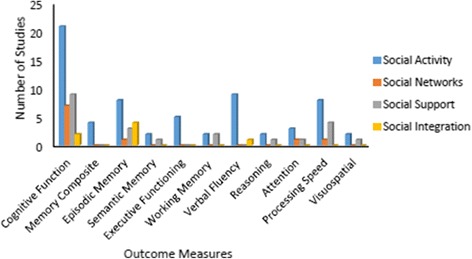
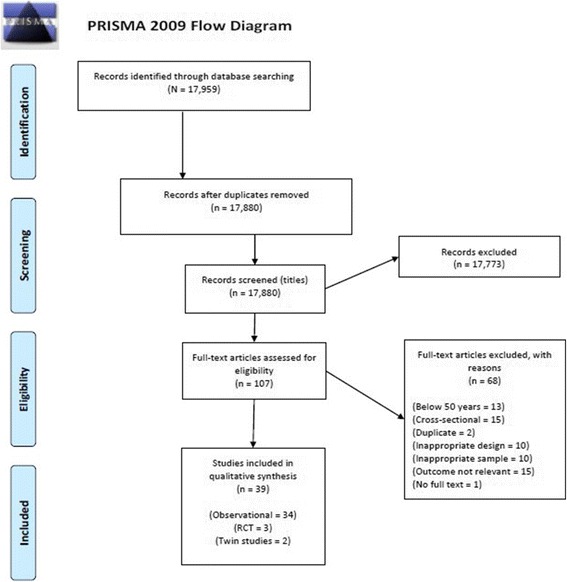
BACKGROUND: Social relationships, which are contingent on access to social networks, promote engagement in social activities and provide access to social support. These social factors have been shown to positively impact health outcomes. In the current systematic review, we offer a comprehensive overview of the impact of social activities, social networks and social support on the cognitive functioning of healthy older adults (50+) and examine the differential effects of aspects of social relationships on various cognitive domains. METHODS: We followed PRISMA (Preferred Reporting Items for Systematic Reviews and Meta-Analysis) guidelines, and collated data from randomised controlled trials (RCTs), genetic and observational studies. Independent variables of interest included subjective measures of social activities, social networks, and social support, and composite measures of social relationships (CMSR). The primary outcome of interest was cognitive function divided into domains of episodic memory, semantic memory, overall memory ability, working memory, verbal fluency, reasoning, attention, processing speed, visuospatial abilities, overall executive functioning and global cognition. RESULTS: Thirty-nine studies were included in the review; three RCTs, 34 observational studies, and two genetic studies. Evidence suggests a relationship between (1) social activity and global cognition and overall executive functioning, working memory, visuospatial abilities and processing speed but not episodic memory, verbal fluency, reasoning or attention; (2) social networks and global cognition but not episodic memory, attention or processing speed; (3) social support and global cognition and episodic memory but not attention or processing speed; and (4) CMSR and episodic memory and verbal fluency but not global cognition. CONCLUSIONS: The results support prior conclusions that there is an association between social relationships and cognitive function but the exact nature of this association remains unclear. Implications of the findings are discussed and suggestions for future research provided. SYSTEMATIC REVIEW REGISTRATION: PROSPERO 2012: CRD42012003248 .
Overview
The claims and statistics of this paper haven’t been checked yet.
Free: it reads the open-access text and checks the first 5 claims that cite a source we can check. Create a free account to check every claim.
Integrity signals
Registry
Cites
Statistics
Figures
Verification
Claims the paper makes
The claims and statistics of this paper haven’t been checked yet.
Free: it reads the open-access text and checks the first 5 claims that cite a source we can check. Create a free account to check every claim.
Claims other papers make about this one
Each is checked against this paper’s own text: does it say what the citing paper says it does?
The cited source doesn’t support the claim as written.
In the citing paper
“Frequent social activity was associated with improved memory, executive function, visuospatial ability, and processing speed, whereas frequent social support was associated only with improved memory.8”
From Associations between social connections and cognition: a global collaborative individual participant data meta-analysis (2022) · cites this paper as [8]
Checked by a reasoning model — may be wrong.
Experimental — accuracy not yet measuredThe source backs part of the claim, not all of it — or backs it for a different population, condition or comparison.
In the citing paper
“Despite clear cultural variation in the meaning and perception of social isolation, findings of protective effect of more social contact are largely consistent in different settings and for either sex across the studies and meta-analyses.”
From Dementia prevention, intervention, and care: 2020 report of the Lancet Commission (2020) · cites this paper as [118]
Experimental — accuracy not yet measuredThe source backs part of the claim, not all of it — or backs it for a different population, condition or comparison.
In the citing paper
“a systematic review of low quality RCTs of 576 adults aged 60 or more years with normal cognition found facilitated meeting and discussion groups were associated with improved global cognition and increased brain volume at follow-up.”
From Dementia prevention, intervention, and care: 2020 report of the Lancet Commission (2020) · cites this paper as [118]
Experimental — accuracy not yet measuredThe source backs part of the claim, not all of it — or backs it for a different population, condition or comparison.
In the citing paper
“Another meta-analysis of 39 studies reported that social activity and social support were associated with decline in global cognition and specific cognitive domains.8”
From Associations between social connections and cognition: a global collaborative individual participant data meta-analysis (2022) · cites this paper as [8]
Experimental — accuracy not yet measuredThe source backs part of the claim, not all of it — or backs it for a different population, condition or comparison.
In the citing paper
“Consequently, measurement of this kind often does not permit testing of alternative hypotheses about social or biological mechanisms.”
From Why the cognitive ‘fountain of youth’ may be upstream: pathways to dementia risk and resilience through social connectedness (2022) · cites this paper as [11]
Experimental — accuracy not yet measured
11 more claims about this paper
Create a free account to see every claim other papers make about this one.
Self-check
Percentages, sums and reported differences re-computed from the paper’s own numbers.
The self-check needs the paper’s full text.
Citations
Cites
Stress, social support, and the buffering hypothesis
Cohen, S., & Wills, T. A. (1985) · Psychological Bulletin · doi:10.1037/0033-2909.98.2.310 · Cited by 18,093 · cited 1×
“Social support in particular may impact cognitive outcomes via its buffering effect on stress [44].”
BackgroundSocial Relationships and Mortality Risk: A Meta-analytic Review
Holt-Lunstad, J., Smith, T. B., & Layton, J. B. (2010) · PLoS Medicine · doi:10.1371/journal.pmed.1000316 · Cited by 7,272 · cited 1×
“One difficulty when trying to determine the effect of social relationships on cognitive function is the use of discrepant and unclear definitions of different social factors [14].”
BackgroundEffects of stress throughout the lifespan on the brain, behaviour and cognition
Lupien, S. J., McEwen, B. S., Gunnar, M. R., & Heim, C. (2009) · Nature Reviews Neuroscience · doi:10.1038/nrn2639 · Cited by 6,256
From social integration to health: durkheim in the new millennium
Berkman, L. F., Glass, T., Brissette, I., & Seeman, T. E. (2000) · Social Science & Medicine · doi:10.1016/s0277-9536(00)00065-4 · Cited by 4,821 · cited 6×
“In an attempt to address the issue of discrepant definitions in the literature, Berkman and colleagues suggested a framework to clarify terms describing social factors and behaviours [15].”
BackgroundInfluentialWhat is cognitive reserve? Theory and research application of the reserve concept
STERN, Y. (2002) · Journal of the International Neuropsychological Society · doi:10.1017/s1355617702813248 · Cited by 3,951 · cited 1×
“Social activities may include a type of cognitive stimulation, thus contributing to cognitive outcomes via the building of cognitive reserve [41]; cognitive reserve optimises cognitive performance through the recruitment of alternate brain networks and cognitive strategies to compensate for cognitive difficulties rela…”
BackgroundSocial and emotional patterns in adulthood: Support for socioemotional selectivity theory
Carstensen, L. L. (1992) · Psychology and Aging · doi:10.1037/0882-7974.7.3.331 · Cited by 2,174
Perceived social isolation and cognition
Cacioppo, J. T., & Hawkley, L. C. (2009) · Trends in Cognitive Sciences · doi:10.1016/j.tics.2009.06.005 · Cited by 2,144 · cited 1×
“In addition, social factors tend to be considered alongside or as part of other lifestyle factors such as leisure or intellectual activity [41]; outcomes such as mortality, physical health, or dementia are included in lieu of cognitive function [10, 18]; only specific aspects of social relationships are considered, su…”
BackgroundAn active and socially integrated lifestyle in late life might protect against dementia
Fratiglioni, L., Paillard-Borg, S., & Winblad, B. (2004) · The Lancet Neurology · doi:10.1016/s1474-4422(04)00767-7 · Cited by 2,135 · cited 1×
“In addition, social factors tend to be considered alongside or as part of other lifestyle factors such as leisure or intellectual activity [41]; outcomes such as mortality, physical health, or dementia are included in lieu of cognitive function [10, 18]; only specific aspects of social relationships are considered, su…”
BackgroundThe handbook of aging and cognition
Craik, F. I. M., & Salthouse, T. A. (1992) · doi:10.4324/9781410601988 · Cited by 2,003
A Meta-Analysis of Interventions to Reduce Loneliness
Masi, C. M., Chen, H.-Y., Hawkley, L. C., & Cacioppo, J. T. (2011) · Personality and Social Psychology Review · doi:10.1177/1088868310377394 · Cited by 1,995
Cited by
Items 801–900 of 1,000
Randolph, J. J., Wishart, H. A., & Rabin, L. A. (2022) · Springer eBooks · doi:10.1007/978-3-031-11389-5_9
Behavioral Perspectives on B Corps
Tudor, M. C., Bernardic, U., Sooter, N. M., & Ugazio, G. (2022) · Springer eBooks · doi:10.1007/978-3-031-14216-1_12 · Cited by 2
Can our life resources support successful aging?
Szepietowska, E. M. (2022) · Kwartalnik Naukowy Fides et Ratio · doi:10.34766/fetr.v4i52.1141
“, fosters intellectual and physical activity, improves self-esteem, reduces feelings of loneliness or depression, and strengthens social competences in later stages of life ( James, Wilson, Barnes, Bennett, 2011; Kelly et al., 2017; Lee, Kim, 2016).”
BackgroundTortosa, A. J. P., Méndez, A. A., Giménez, B. G., & Fuentes, G. V. (2022) · Gladius et Scientia Revista de Seguridad del CESEG · doi:10.15304/ges.3.8504
Estrategias para mantener las funciones cognitivas en adultos mayores
Sánchez-Nieto, J. M. (2022) · Casos y Revisiones de Salud · doi:10.22201/fesz.26831422e.2022.4.2s.6
Putra, I. G. N. E., Daly, M., & Robinson, E. (2023) · PsyArXiv (OSF Preprints) · doi:10.31234/osf.io/rh2ym
Ghorbani, S., Farhangnia, S., Zanganeh, F., Noohpisheh, S., & Shakki, M. (2021) · Journal of Research Development in Nursing and Midwifery · doi:10.52547/jgbfnm.18.2.1
Pelegrini, L. N. D. C. (2022) · Digital Library of Theses and Dissertations (Universidade de São Paulo) · doi:10.11606/t.22.2022.tde-08032023-163147
Kluckert, C., & Hüll, M. (2023) · PSYCH up2date · doi:10.1055/a-1857-4819
“Für die Effekte von speziellen Ausformungen der sozialen Interventionen im Hinblick auf Demenzpräventi-on gibt es nur wenig Evidenz, es wurden jedoch teilweise positive Effekte bei älteren Menschen ( ≥ 60 Jahre) be - schrieben [35].”
Socially Designed: A Prescription for Brain Health
Fridman, D. (2023) · Open Access Victoria University of Wellington | Te Herenga Waka (Figshare) · doi:10.26686/wgtn.23596278
Bolarinwa, M. A., & Odetunde, M. T. (2023) · European Journal of Business Management and Research · doi:10.24018/ejbmr.2023.8.4.2036
“Similarly, studies revealed that while underweight is connected to decreasing cognition, more depression and less independent physical functioning, overweight benefits women than men (Kelly et al., 2017).”
BackgroundKim, B., Efird, J. T., & Hu, J. (2023) · Diabetology · doi:10.3390/diabetology4030028
Social Relationships and Cognitive Function in Older Adults
Kim, H. (2023) · Cambridge University Press eBooks · doi:10.1017/9781108974325.014 · Cited by 1
Preventing Dementia with Social Connection
Chey, J., Cho, I., Kim, H., Kim, H., Kwak, S., Sul, S., Lee, S., & Youm, Y. (2023) · Cambridge University Press eBooks · doi:10.1017/9781108974325.017 · Cited by 1
An Individual’s Cognitive Aging with Others: Key Findings, Issues, and Implications
Chey, J. (2023) · Cambridge University Press eBooks · doi:10.1017/9781108974325.013
Healthy Aging, Mental Health, and Sexuality
(2023) · Frontiers research topics · doi:10.3389/978-2-8325-3425-0
Pushing Shopping Cart: An Intentional Exercise for Older Adults
Singh, C., & Jayadas, A. (2023) · Activities Adaptation & Aging · doi:10.1080/01924788.2023.2288987
“Lack of social interaction and physical exercise could contribute to cognitive decline (Kelly et al., 2017).”
The relationships between personality characteristics and social function in older adults
Ghahari, S., Afshar, P. F., & Zahednezhad, H. (2023) · Interpersona An International Journal on Personal Relationships · doi:10.5964/ijpr.9705
“Social activities or social participation includes interacting with others and participat ing in social events and tasks (Kelly et al., 2017).”
BackgroundChipalo, E., Odii, I. O., Kapupa, L., Agwu, U. K., & Makwalu, T. (2023) · Texila international journal of public health · doi:10.21522/tijph.2013.11.04.art021
Kumar, M. V., Thirunaaukarasu, D., Geetha, M., & Catherine Rexy, D. (2024) · International Journal of Community Medicine and Public Health · doi:10.18203/2394-6040.ijcmph20240316 · Cited by 1
Kotelevets, A. (2023) · Modern Science · doi:10.62204/2336-498x-2023-3-10
Leveraging critical technologies in emergent AI in business processes
(2023) · Scientific Papers of Silesian University of Technology Organization and Management Series · doi:10.29119/1641-3466.2023.183.34
The future of the digital age: impacts on mental health and overall well-being
(2023) · Scientific Papers of Silesian University of Technology Organization and Management Series · doi:10.29119/1641-3466.2023.183.33
City idea. On the strategy of building the image of the city
(2023) · Scientific Papers of Silesian University of Technology Organization and Management Series · doi:10.29119/1641-3466.2023.183.35
Ma, W., Wang, W., & Zou, Y. (2024) · Research Square · doi:10.21203/rs.3.rs-3961970/v1
Social participation of the older sexual minority population: CLSA data
Yang, W., Craig, S. L., Muntaner, C., Anderson, J. A. E., & Ross, L. E. (2024) · Leisure Studies · doi:10.1080/02614367.2024.2316165
“Social support has been defined as ‘person’s perception of the availability of help or support’ (Kelly et al., 2017, p. 2) and social participation has been defined as ‘person’s involvement in activities that provide interaction with others in society or the community’ (Levasseur et al., 2010, p.…”
SAÚDE MENTAL E MEDICINA DO ESTILO DE VIDA
da Fonseca, J. V. M., & Cruz, B. F. (2024) · Seven Editora eBooks · doi:10.56238/medestvida-009
A IMPORTÂNCIA DAS RELAÇÕES SOCIAIS PARA A SAÚDE
Oliveira, C. R. S., & Torres, J. L. (2024) · Seven Editora eBooks · doi:10.56238/medestvida-008
INTRODUÇÃO SOBRE MEDICINA DO ESTILO DE VIDA
Iunes, L. C., & Moschetta, A. L. (2024) · Seven Editora eBooks · doi:10.56238/medestvida-001
da Fonseca, L. M., & de Azevedo, L. A. C. (2024) · Seven Editora eBooks · doi:10.56238/medestvida-005
Barbosa, J. D. O., & Alvarez-Leite, J. I. (2024) · Seven Editora eBooks · doi:10.56238/medestvida-003
CONTROLE DO USO DE SUBSTÂNCIAS
Wolff, D. B., & Sella, L. F. (2024) · Seven Editora eBooks · doi:10.56238/medestvida-007
Ferreira, A. L. H. A., Neves, M. G., & PENNA, L. H. G. (2024) · Seven Editora eBooks · doi:10.56238/medestvida-004
Miller, B. L., Robertson, I. H., Kavanagh, N., & Valcour, V. (2024) · Frontiers research topics · doi:10.3389/978-2-8325-4619-2
Madjarov, N., Nikolova, R., Kundurzhiev, T., Hristova, L., Lyubomirova, К., & Tonev, I. (2024) · Acta Medica Bulgarica · doi:10.2478/amb-2024-0007
Fatores associados ao desempenho cognitivo acima da média em idosos longevos
Pereira, C. A., Gomes, L., Freitas, E. R., Chariglione, I. P. F. S., Moraes, C. F., Alves, V. P., & da Silva, H. S. (2024) · Estudos de Psicologia (Campinas) · doi:10.1590/1982-0275202441e210207pt
“Os dados do presente estudo, embora tenham apresentado tamanhos de efeito modestos, estão em consonância com os estudos de Litwin e Stoeckel (2016, Kelly et al. (2017), Holstege et al. (2018).”
BackgroundTrnka, R., Schneiderová, M., Vojtěchová, I., Daďová, K., & Georgi, H. S. (2024) · SAGE Open · doi:10.1177/21582440241248359
“Importantly, Kelly et al. (2017) expect that different aspects of social life may affect cognitive domains in different ways.”
Brain functions of saffron and crocin: Case report and literature review
Kito, S., & Shoyama, Y. (2023) · Open Journal of Clinical and Medical Case Reports · doi:10.52768/2379-1039/2119
Eliasen, E. H., Weihe, P., Debes, F., Tróndarson, M., & Petersen, M. S. (2024) · Journal of Aging and Health · doi:10.1177/08982643241255405
“In terms of access to health services and welfare system the Faroe Islands are comparable to other Nordic countries making the result comparable.”
The impact of interpersonal relationships on mental health of Polish medical students
Limanówka, P., Kuca, J., Laska, J., Łacwik, J., Szczuraszyk, A., & Kasperczyk, J. (2024) · Annales Academiae Medicae Silesiensis · doi:10.18794/aams/178518 · Cited by 1
“Numerous studies have reported that subjects with more advanced social contacts have better preserved cognitive skills and memory [16].”
BackgroundInfluence of Health Social Network Sites on Chronic Disease Management: A Systematic Review
Mahloko, L., & Adebesin, F. (2024) · IST-Africa Conference (IST-Africa) · doi:10.23919/ist-africa63983.2024.10569915
“Hence, the exchange of social support is an important foundation for forming and maintaining social interactions [38].”
BackgroundConcepts of Ethics to Engage the Older Person with the Community
McDonnell‐Naughton, M. (2024) · Proceedings of the ... International Conference on Business Excellence · doi:10.2478/picbe-2024-0091
“Kelly et al. (2017) highlights that access to social networks, have been shown to positively impact health outcomes.”
Contemporary View of a Human Lifetime in a Super-Aging Society : the “Cognitive Reserve” Perspective
Tsukiura, T. (2024) · Higher Brain Function Research · doi:10.2496/hbfr.44.132
دار, ه., جاد, س. أ. ع. ا., & مجدي, أ. (2024) · المجلة العلمیة لکلیة السیاحة و الفنادق جامعة الأسکندریة · doi:10.21608/thalexu.2024.302413.1133
Shin, W.-G., Ahn, J., Choe, K. W., Lee, H., Han, J.-H., Lee, E., Lux, B. K., Woo, C., Choi, I., & Sul, S. (2024) · PsyArXiv (OSF Preprints) · doi:10.31234/osf.io/6y2fa
Askari, R., NasrAbadi, M., Haghighi, A. H., Mahin, M. J., Somayeh, R., & Pusceddu, M. M. (2024) · AIMS neuroscience · doi:10.3934/neuroscience.2024017
“Some studies have demonstrated that working memory is improved by chronic exercise in older adults [30,46,47].”
BackgroundQin, A., & Xu, L. (2024) · Journal of the American Medical Directors Association · doi:10.1016/j.jamda.2024.105226
Stringer, C., Bryning, L., Spencer, L. H., Anthony, B. F., Ezeofor, V. ‘., Lawrence, C. L., & Edwards, R. T. (2024) · Oxford University Press eBooks · doi:10.1093/9780191919336.003.0006
Ping, Y., Odden, M. C., Chen, X., Prina, M. A., Xu, H., Xiang, H., & Wu, C. (2024) · Innovation in Aging · doi:10.1093/geroni/igae078
“Studies demonstrated that older persons with better socioeconomic status had more social support and larger social network (32,33), which may reduce the risk of cognitive impairment (34).”
BackgroundStaite, E., & Francine, F. (2024) · Counselling and Psychotherapy Research · doi:10.1002/capr.12812
Li, Y., Zhai, Q., & Peng, W. (2024) · JMIR Public Health and Surveillance · doi:10.2196/63067
Yoo‐Jeong, M., Weinstein, A. M., Ware, D. P., Brennan‐Ing, M., SHOPTAW, S. J., Teplin, L. A., Haberlen, S., Friedman, M. R., & Plankey, M. W. (2024) · AIDS and Behavior · doi:10.1007/s10461-024-04501-0
Effects of biopsychosocial approach on cognition among Parkinson's population
Elango, J., Abathsagayam, K., Vishnuram, S., Suganthirababu, P., & Senthil Kumar, N. (2024) · Physiotherapy Research International · doi:10.1002/pri.2140 · Cited by 1
Pudur, R. (2024) · University of North Texas Digital Library (University of North Texas) · doi:10.12794/metadc2356149 · Cited by 1
Ghosh, M. (2024) · Palgrave studies in digital inequalities · doi:10.1007/978-3-031-71194-7_4
Wang, Y., Muraki, S., Choi, J., & Fan, Y.-W. (2024) · Communications in computer and information science · doi:10.1007/978-981-97-9910-7_21
Nagesh, & Kanojiya, R. (2024) · ShodhKosh Journal of Visual and Performing Arts · doi:10.29121/shodhkosh.v5.i2.2024.2927
“Recreational activities provide a holistic combining physical exercise, cognitive engagement, and social interaction(Alanazi, 2024; Carter & Van Andel, 2019; Hertzog et al ., 2008; Kelly et al., 2017; King et al., 2002; Stöcker et al., 2024).”
Comorbidity of depression and dementia: epidemiological, biological and therapeutic aspects
Петрова, Н. Н. (2024) · S S Korsakov Journal of Neurology and Psychiatry · doi:10.17116/jnevro2024124111113
Conexión Social: Un Análisis Bibliométrico
Villarrubia, M. D., Morán, V. E., Giovannini, V., & Vieyra, V. (2024) · PSIQUEMAG/ Revista Científica Digital de Psicología · doi:10.18050/psiquemag.v13i2.3104
Keil, J. S., Wister, A., & Pauly, T. (2024) · International Journal of Behavioral Development · doi:10.1177/01650254241305547 · Cited by 1
“Among older adults, social participation is linked to improved executive functioning, processing speed, visuospatial performance, and working memory (Kelly et al., 2017; Piolatto et al., 2022).”
InfluentialRole of Emotions in the Interaction Between Humans and Artificial Agents
Mehra, R. K., & Fernando, A. N. (2024) · Advances in computational intelligence and robotics book series · doi:10.4018/979-8-3693-7011-7.ch017
The Impact of Social Interaction on Prospective Memory: A Review
陈, 嘉. (2024) · Advances in Social Sciences · doi:10.12677/ass.2024.13121134
Westrick, A. C., Yu, X., O’Shea, B. Q., & Kobayashi, L. C. (2025) · Journal of Epidemiology & Community Health · doi:10.1136/jech-2024-222962
“7 8 This is particularly important among older adults who often have additional life and health burdens and fewer social ties due to death and illness than younger adults.”
Faizefu, A. R. (2025) · International Journal of Psychology and Cognitive Education · doi:10.58425/ijpce.v4i1.307 · Cited by 1
THE IMPACT OF NEUROPEPTIDE THERAPY ON THE QUALITY OF LIFE IN PATIENTS DURING THE ACUTE STROKE PERIOD
Arkhincheeva, N. T., & Митрофанович, Б. И. (2024) · Современные проблемы науки и образования · doi:10.17513/spno.33848
Social support to eradicate open defecation: raise awareness and promote healthy behavior
Ikhtiar, M., Mahmud, N. U., Asrina, A., Arysta, A., & Khairunnisa, P. (2025) · Healthcare in Low-resource Settings · doi:10.4081/hls.2025.13381 · Cited by 3
Lee, D.-E., Zheng, Y., Min, K., Joyce, B. T., Wang, J., Gao, T., Hou, L., Ha, S., Jeong, D.-E., Kang, M. J., et al. (2025) · Archives of Gerontology and Geriatrics · doi:10.1016/j.archger.2025.105808
Association of Social Relationships and Genetic Risk With Frailty
Song, W.-Q., Zhong, W.-F., Yan, H.-Y., Li, Z., Gao, J., Wang, X.-M., Chen, P., You, F., Li, C., Chen, H., et al. (2025) · American Journal of Geriatric Psychiatry · doi:10.1016/j.jagp.2025.02.015
Ai, M. (2024) · Digital Repository Service (Northeastern University) · doi:10.17760/d20670404
Zhang, Y., Jiawen, P., Jia, M., Kaixuan, X., Youpeng, G., Li, T., Dongyan, L., & Lixiu, Z. (2025) · Geriatric Nursing · doi:10.1016/j.gerinurse.2025.03.014 · Cited by 1
Cognitive Development and Aging
Kankam, H. (2025) · Springer eBooks · doi:10.1007/978-3-031-89752-8_12
Xu, L., Peng, Z., Lian, J., & Shao, Y. (2025) · International Journal of Sport and Exercise Psychology · doi:10.1080/1612197x.2025.2498422
“This finding aligns with social motivation theory, which posits that social rewards, by fulfilling individuals’ needs for belonging and identity, promote deeper task engagement and emotional stability (Kelly et al., 2017; Metts & Craske, 2023).”
Ibsen, T. L., Zotcheva, E., Bergh, S., Gerritsen, D. L., Livingston, G., Lurås, H., Mamelund, S., Rokstad, A. M. M., Strand, B. H., Thingstad, P., et al. (2025) · International Journal of Geriatric Psychiatry · doi:10.1002/gps.70097 · Cited by 1
“Furthermore, prior research links social isolation with cognitive decline, as engagement in social activities appears to play a protective role against cognitivedeteriorationinolderadults[9,10].”
InfluentialChen, X., & Liu, S. (2025) · Universal Access in the Information Society · doi:10.1007/s10209-025-01228-0
Kim, E., Cutrona, C. E., & Russell, D. W. (2025) · The Journal of Positive Psychology · doi:10.1080/17439760.2025.2500565
“Their higher participation in goal-directed activities is associated with higher levels of physical activity, healthy behaviors, and better cognitive function (Kelly et al., 2017; Santini et al., 2020; Umberson et al., 2010).”
Venegas‐Sanabria, L. C., Mateus, R. P., Borda, M. G., Satorres, E., Bueno, C., & Meléndez, J. C. (2026) · Aging & Mental Health · doi:10.1080/13607863.2026.2624569
“Several systematic reviews (Kelly et al., 2017) have reported that better social health is associated with better cognitive well-being and a lower risk of dementia.”
Skill-learning variety and frequency on long-term cognitive performance in older adults
Ferguson, L., Mehrkesh, A., Kürüm, E., Rebok, G. W., & Wu, R. (2025) · Educational Gerontology · doi:10.1080/03601277.2025.2515562
“…our findings, which do not fully support our hypotheses, suggest that learning novel skills in a supportive learning environment at any frequency (even for just a couple of hours per week) could be beneficial for older adults (e.g., Han & Nam, 2021; Kelly et al., 2017; Pillemer & Holtzer, 2016).”
Davis, J., Bingham, K. S., Easson-Bruno, S., & Horgan, S. A. (2025) · Journal of Integrated Care · doi:10.1108/jica-12-2024-0075
To Engage or Not to Engage? Social Activities and Survival Beliefs in Older Adults
Wang‐Lu, H. (2025) · Kyklos · doi:10.1111/kykl.12475
“…depressive symptoms, 5-year survival rates, specific health shocks (e.g., heart attack, cardiovascular disease, and COVID-19), cognitive functioning, life satisfaction, and happiness, among others (see Morita et al. 2010; Kelly et al. 2017; Miao et al. 2019; Rodgers et al. 2019; Cheng et al. 2024).”
Depression and cognitive impairment in Malaysian elderly: insights from a nationwide study
Nikmat, A. W., Raduan, N. J. N., Hashim, N. A., Tarmizi, N. A. A., Affandi, N. A., Hairoman, N. F., Ismail, M. Z. H., & Kamarulbahri, T. M. S. T. (2025) · International Journal of Public Health Science (IJPHS) · doi:10.11591/ijphs.v14i3.25220
What is health promotion and how can it be used for older people?
Marshall, J. (2025) · Nursing Older People · doi:10.7748/nop.37.4.18.s10
Staying Connected for Cognitive Stimulation
Astell, A. J., & Clayton, D. (2025) · Synthesis lectures on technology and health · doi:10.1007/978-3-031-87031-6_7
Interprofessional Care and Informal Support Networks of Independent Community-Dwelling Older Adults
Awotunde, A. F., Bolt, J., & Wilbur, K. (2025) · Canadian Journal on Aging / La Revue canadienne du vieillissement · doi:10.1017/s0714980825100226
“…be associated with higher cognitive performance (Wennberg et al., 2023), while having friends and strong social relationships (Haslam et al., 2023; Kelly et al., 2017) significantly benefits older adults by enhancing quality of life, preserving cognitive function, and reducing the risk of…”
Chen, R., Lee, H., Wang, J., Yang, Y., Okuzono, S. S., Nishimi, K. M., Kobayashi, L. C., Glymour, M. M., & Kubzansky, L. D. (2025) · American Journal of Epidemiology · doi:10.1093/aje/kwaf189
Waqas, Z., Aamir, A., Mehtab, M., Izhar, R., & Hassan, S. M. U. (2025) · Foundation University Journal of Psychology · doi:10.33897/fujp.v9i1.778
“According to Kelly et al. (2017), a relationship exists between social support and the global cognition of older adults, specifically memory.”
Taylor, M. K., Schiloski, K. A., & Lachman, M. E. (2025) · Journal of Behavioral Medicine · doi:10.1007/s10865-025-00603-9
“Social support refers to an individual’s perception of the extent to which they can count on others from their social networks when needed (Kelly et al., 2017).”
Wang, L., Sun, S., Zhu, C., Tang, Y., Zhu, L., Gu, Y., & Xu, H. (2025) · Journal of Advanced Nursing · doi:10.1111/jan.70243
Cohen, H. R., & Holtzer, R. (2025) · Archives of Clinical Neuropsychology · doi:10.1093/arclin/acaf088
Zhu, X. (2025) · Research on Aging · doi:10.1177/01640275251388383
“In contrast, higher self-esteem is related to stronger social networks and greater social engagement (Baumeister et al., 2003), which helps maintain brain activity and cognitive functioning (Kelly et al., 2017).”
Chander, R. J., Grainger, S. A., Crawford, J. D., Jiang, J., Kochan, N. A., Numbers, K. T., Brodaty, H., Henry, J. D., Wen, W. X., & Sachdev, P. S. (2025) · bioRxiv (Cold Spring Harbor Laboratory) · doi:10.1101/2025.10.16.682959
Santana, L. K., Meng, H., Liu, Y., Le, M. Q., Peterson, L. J., Grippo, A. J., Branco, M. D. F. C., Li, M., & Dobbs, D. (2025) · Sage Open Aging · doi:10.1177/30495334251385858
“While the mechanisms underlying this effect remain to be fully understood, they may involve cognitive reserve, stress-buffering pathways, and enhanced social and emotional support (Kelly et al., 2017; Stern & Barulli, 2019).”
Developing a psychological test battery to measure cognition in daily life
Aschenbrenner, A. J., Xi, M., Cohn, J., Simon, D. A., & Jackson, J. J. (2026) · Behavior Research Methods · doi:10.3758/s13428-026-03128-4
“Each of these factors have well-established effects on cognitive performance (Calvo & Gutiérrez-García, 2016; Kelly et al., 2017; Padmala et al., 2011; Sandi, 2013; Shields et al., 2016), which will help us establish the sensitivity of our HFCA outcomes (i.e., we should replicate the known findings…”
Akasaki, Y., Shimokihara, S., Hidaka, Y., Maruta, M., Han, G., Kamasaki, T., Kumura, Y., Kukizaki, W., Nakahara, R., Makizako, H., et al. (2025) · Aging & Mental Health · doi:10.1080/13607863.2025.2570823 · Cited by 1
“For example, autonomy has been linked to enhanced executive functioning, competence to increased cognitive engagement and self-efficacy, and relatedness to the maintenance of social cognition and reduced risk of cognitive decline (Kelly et al., 2017; Ng et al., 2012).”
Labonté, K., Nielsen, D. E., Dubé, L., & Paquet, C. (2025) · Aging & Mental Health · doi:10.1080/13607863.2025.2581096
“While aging is accompanied by normal cognitive alterations, such as decreased perceptual speed as well as poorer episodic memory and reasoning skills (Salthouse, 2019), social relationships can help mitigate these effects (Kelly et al., 2017).”
Aydemir, M., & Altuntaş, O. (2025) · Occupational Therapy in Mental Health · doi:10.1080/0164212x.2025.2580461
Naibu, R. S., & Maligany, W. (2025) · Journal of Management and Science · doi:10.26524/jms.15.28
ÇAKI, B., Kuşlu, S., Eminoğlu, A., & Çakır, B. (2025) · Aging & Mental Health · doi:10.1080/13607863.2025.2585497
“…in older adults increases the risk of suicide and negatively impacts well-being (Bernier et al., 2020; Yu et al., 2018), whereas high social efficacy and positive social outcome expectations reduce depression, improve quality of life, and enhance cognition (Adams et al., 2016; Kelly et al., 2017).”
Madden, V. J., Court, L., Gidana, A., Knight, L., Wadley, A. L., Mqadi, L., Rabie, S., Edwards, R. R., Joska, J. A., & Parker, R. (2025) · medRxiv · doi:10.1101/2025.11.07.25339650 · Cited by 1
Balan, D. S., & Mallanhanse, A. K. (2025) · Journal of Cultural Analysis and Social Change · doi:10.64753/jcasc.v10i3.2393
Metadata
- Authors
- Kelly, M. E., Duff, H., Kelly, S., McHugh Power, J. E., Brennan, S., Lawlor, B. A., & Loughrey, D. G.
- Affiliations
- National College of Ireland (IE)
- Trinity College Dublin (IE)
- Corresponding author
- Kelly, Michelle E.
- Venue
- Systematic Reviews
- Published
- 2017-12
- Volume
- 6
- Issue
- 1
- Pages
- 259-259
- ISSN
- 2046-4053 (ISSN-L)
- PMC
- PMC5735742
- OpenAlex
- W2777525821
- Cited by
- 1,027
- References
- 103
- Citations by year
- 2026: 128 · 2025: 172 · 2024: 195 · 2023: 135 · 2022: 144 · 2021: 140 · 2020: 71 · 2019: 28 · 2018: 13
- FWCI
- 4.65
- Type
- journal article
- Language
- en
- Open access
- gold
- doi.org
- Licence
- cc-by
- Locations
- Systematic Reviews (publishedVersion, cc-by)
- Europe PMC (PubMed Central) (publishedVersion, cc-by)
- PubMed Central (publishedVersion, cc-by)
- PubMed (publishedVersion)
- DOAJ (DOAJ: Directory of Open Access Journals) (submittedVersion, cc-by-sa)
- Topics
- Health Sciences › Medicine › Psychiatry and Mental health › Dementia and Cognitive Impairment Research
- Social Sciences › Psychology › Developmental and Educational Psychology › Aging and Gerontology Research
- Health Sciences › Medicine › Public Health, Environmental and Occupational Health › Aging, Health, and Disability
- Keywords
- social activity, social networks, social support, interpersonal relationships, cognitive function, older adults, episodic memory, executive function, working memory, processing speed, visuospatial ability, verbal fluency, global cognition
- MeSH terms
- Cognition, Humans, Interpersonal Relations, Memory, Social Support, Executive Function, Social Participation
About these checks
Registry, retraction, Cites and statistics results are computed, not judged, with one exception: a printed reference that no index lists is read once by a model before it counts as a citation error. Claims are extracted by a model and kept only when their quote appears verbatim in the text; each cited source is then checked, with a model’s help, for whether it says what the claim relies on. Those verdicts can be wrong — read the claim’s quote and the cited source before relying on one.
Statistics and arithmetic are recomputed, not judged.
Confidence bands are shown only for fields calibrated on our annotated test set. None is calibrated yet, so no band is shown.
What counts as a claim ›How we measure confidence ›How we check this ›
Are you an author, or do you see a problem with this page? Request a review
Data sources
Bibliographic data: Semantic Scholar, OpenAlex, Crossref.
Contains information from the Semantic Scholar Academic Graph Datasets, made available under the ODC Attribution License (ODC-BY 1.0).
Semantic Scholar’s data is described in: Kinney, R., et al. (2023). The Semantic Scholar Open Data Platform. arXiv:2301.10140.
