

Single-paper meta-analyses of the effects of spaced retrieval practice in nine introductory STEM courses: is the glass half full or half empty?
Open accessThe DOI matches its Crossref record; 72 of the 72 references it cites were found in a registry or an index.
Abstract
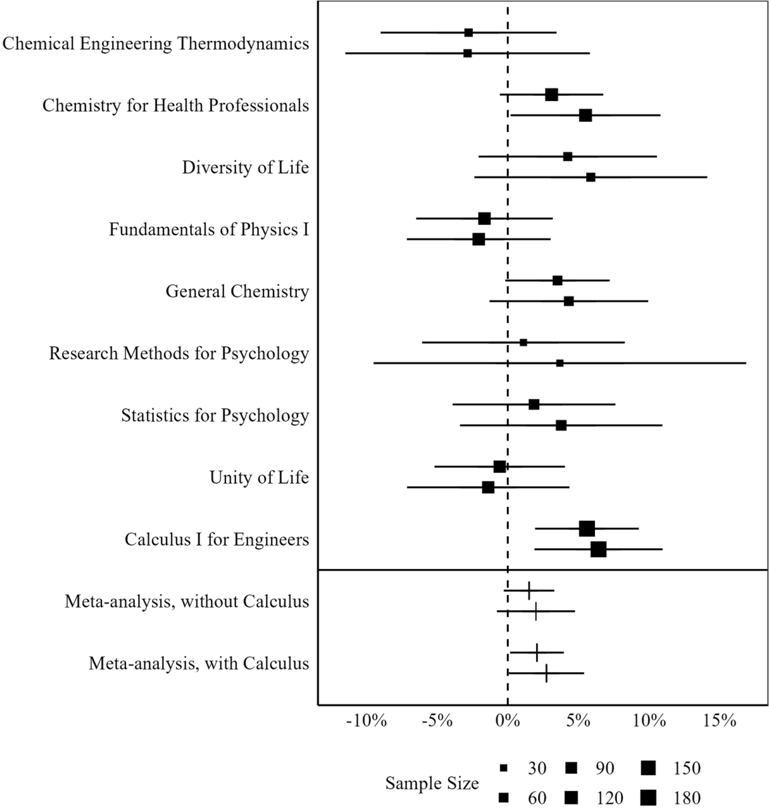
Background: Undergraduate STEM instructors want to help students learn and retain knowledge for their future courses and careers. One promising evidence-based technique that is thought to increase long-term memory is spaced retrieval practice, or repeated testing over time. The beneficial effect of spacing has repeatedly been demonstrated in the laboratory as well as in undergraduate mathematics courses, but its generalizability across diverse STEM courses is unknown. We investigated the effect of spaced retrieval practice in nine introductory STEM courses. Retrieval practice opportunities were embedded in bi-weekly quizzes, either massed on a single quiz or spaced over multiple quizzes. Student performance on practice opportunities and a criterial test at the end of each course were examined as a function of massed or spaced practice. We also conducted a single-paper meta-analysis on criterial test scores to assess the generalizability of the effectiveness of spaced retrieval practice across introductory STEM courses. Results: Significant positive effects of spacing on the criterial test were found in only two courses (Calculus I for Engineers and Chemistry for Health Professionals), although small positive effect sizes were observed in two other courses (General Chemistry and Diversity of Life). Meta-analyses revealed a significant spacing effect when all courses were included, but not when calculus was excluded. The generalizability of the spacing effect across STEM courses therefore remains unclear. Conclusions: Although we could not clearly determine the generalizability of the benefits of spacing in STEM courses, our findings indicate that spaced retrieval practice could be a low-cost method of improving student performance in at least some STEM courses. More work is needed to determine when, how, and for whom spaced retrieval practice is most beneficial. The effect of spacing in classroom settings may depend on some design features such as the nature of retrieval practice activities (multiple-choice versus short answer) and/or feedback settings, as well as student actions (e.g., whether they look at feedback or study outside of practice opportunities). The evidence is promising, and further pragmatic research is encouraged.
Overview
The claims and statistics of this paper haven’t been checked yet.
Free: it reads the open-access text and checks the first 5 claims that cite a source we can check. Create a free account to check every claim.
Integrity signals
Registry
Cites
Statistics
Figures
Verification
Claims the paper makes
The claims and statistics of this paper haven’t been checked yet.
Free: it reads the open-access text and checks the first 5 claims that cite a source we can check. Create a free account to check every claim.
Self-check
Percentages, sums and reported differences re-computed from the paper’s own numbers.
The self-check needs the paper’s full text.
Citations
Cites
Dunlosky, J., Rawson, K. A., Marsh, E. J., Nathan, M. J., & Willingham, D. T. (2013) · Psychological Science in the Public Interest · doi:10.1177/1529100612453266 · Cited by 3,138
The power of testing memory: Basic research and implications for educational practice
Roediger, H. L., & Karpicke, J. D. (2006) · Perspectives on Psychological Science · doi:10.1111/j.1745-6916.2006.00012.x · Cited by 2,037
Distributed practice in verbal recall tasks: A review and quantitative synthesis.
Cepeda, N. J., Pashler, H., Vul, E., Wixted, J. T., & Rohrer, D. (2006) · Psychological Bulletin · doi:10.1037/0033-2909.132.3.354 · Cited by 1,888 · cited 2×
“…conditions are compared in laboratory studies with verbal materials, the spaced condition typically leads to superior information retention (Cepeda et al., 2006; Cull, 2000; Karpicke & Roediger, 2007; Landauer & Eldridge, 1967), representing what is called a spacing effect (Dempster, 1989).”
The critical role of retrieval practice in long-term retention
Roediger, H. L., & Butler, A. C. (2011) · Trends in Cognitive Sciences · doi:10.1016/j.tics.2010.09.003 · Cited by 1,796 · cited 1×
“Feed-back has been shown to help students identify and correct their mistakes as well as gain confidence in correct responses (Butler et al., 2008; Pashler et al., 2005), which may be required in a classroom setting but not in laboratory studies (e.g., Roediger & Butler, 2011).”
The Critical Importance of Retrieval for Learning
Karpicke, J. D., & Roediger, H. L. (2008) · Science · doi:10.1126/science.1152408 · Cited by 1,791 · cited 1×
“…information from memory bolsters the long-term retention of that information more than restudying the information (i.e., the testing effect; e.g., Karpicke & Roediger, 2008; Roediger & Karpicke, 2006; for a meta-analysis, see Adesope et al., 2017; for a recent review, see McDermott, 2021).”
Memory and Metamemory Considerations in the Training of Human Beings
Bjork, R. A. (1994) · Metacognition · doi:10.7551/mitpress/4561.003.0011 · Cited by 1,084 · cited 2×
“Indeed, spacing is often characterized as inducing desirable difficulty (Bjork, 1994), meaning that spacing reduces performance during the early stages of learning but, in the process, promotes cognitive mechanisms that benefit long-term retention (Bjork & Bjork, 2011; Bjork, 1999).”
The effect of testing versus restudy on retention: A meta-analytic review of the testing effect.
Rowland, C. A. (2014) · Psychological Bulletin · doi:10.1037/a0037559 · Cited by 1,066 · cited 1×
“Effects of retrieval practice on memory have been extensively studied (Rowland, 2014).”
Wicherts, J. M., Veldkamp, C. L. S., Augusteijn, H. E. M., Bakker, M., van Aert, R. C. M., & van Assen, M. A. L. M. (2016) · Frontiers in Psychology · doi:10.3389/fpsyg.2016.01832 · Cited by 754 · cited 1×
“The authors followed the a priori analysis plan with the intention of ethical research, specifically not running multiple analyses on the same dataset including and excluding different courses (to avoid p -hacking; Wicherts et al., 2016).”
Karpicke, J. D., Butler, A. C., & Roediger III, H. L. (2009) · Memory · doi:10.1080/09658210802647009 · Cited by 745 · cited 1×
“College students often fail to harness the power of retrieval practice, choosing instead to restudy (Karpicke et al., 2009).”
(2011) · Cited by 725
Learning Versus Performance: An Integrative Review
Soderstrom, N. C., & Bjork, R. A. (2015) · Perspectives on Psychological Science · doi:10.1177/1745691615569000 · Cited by 651 · cited 1×
“We argued that this produced a more cohesive mental model and thereby benefitted learning (Soderstrom & Bjork, 2015).”
Testing the testing effect in the classroom
McDaniel, M. A., Anderson, J. L., Derbish, M. H., & Morrisette, N. (2007) · European Journal of Cognitive Psychology · doi:10.1080/09541440701326154 · Cited by 563 · cited 1×
“…assignments or activities that require students to practice retrieval more than students would on their own, students retain more course content and earn higher grades (e.g., Leeming, 2002; Lyle & Crawford, 2011; McDaniel et al., 2007; for a review, see Agarwal et al., 2021; Yang et al., 2021).”
Rethinking the Use of Tests: A Meta-Analysis of Practice Testing
Adesope, O. O., Trevisan, D. A., & Sundararajan, N. (2017) · Review of Educational Research · doi:10.3102/0034654316689306 · Cited by 544 · cited 1×
“…information from memory bolsters the long-term retention of that information more than restudying the information (i.e., the testing effect; e.g., Karpicke & Roediger, 2008; Roediger & Karpicke, 2006; for a meta-analysis, see Adesope et al., 2017; for a recent review, see McDermott, 2021).”
Carpenter, S. K., Cepeda, N. J., Rohrer, D., Kang, S. H. K., & Pashler, H. (2012) · Educational Psychology Review · doi:10.1007/s10648-012-9205-z · Cited by 469 · cited 2×
“Although cognitive psychologists have recommended using spaced retrieval practice to enhance memory in educational settings (Carpenter et al., 2012; Dunlosky et al., 2013; Kang, 2016; Roediger & Pyc, 2012; Weinstein et al., 2018), it is important to ask how much we know about its impact in actual…”
Single-Paper Meta-Analysis: Benefits for Study Summary, Theory Testing, and Replicability
McShane, B. B., & Böckenholt, U. (2017) · Journal of Consumer Research · doi:10.1093/jcr/ucw085 · Cited by 457 · cited 1×
“A single-paper meta-analysis instead combines results from multiple studies within a single paper (McShane & Böckenholt, 2017).”
When Does Feedback Facilitate Learning of Words?
Pashler, H., Cepeda, N. J., Wixted, J. T., & Rohrer, D. (2005) · Journal of Experimental Psychology: Learning, Memory, and Cognition · doi:10.1037/0278-7393.31.1.3 · Cited by 445 · cited 1×
“Feed-back has been shown to help students identify and correct their mistakes as well as gain confidence in correct responses (Butler et al., 2008; Pashler et al., 2005), which may be required in a classroom setting but not in laboratory studies (e.g., Roediger & Butler, 2011).”
Karpicke, J. D., & Roediger, H. L. (2007) · Journal of Experimental Psychology: Learning, Memory, and Cognition · doi:10.1037/0278-7393.33.4.704 · Cited by 421 · cited 2×
“…conditions are compared in laboratory studies with verbal materials, the spaced condition typically leads to superior information retention (Cepeda et al., 2006; Cull, 2000; Karpicke & Roediger, 2007; Landauer & Eldridge, 1967), representing what is called a spacing effect (Dempster, 1989).”
Spaced Repetition Promotes Efficient and Effective Learning: Policy Implications for Instruction
Kang, S. H. K. (2016) · Policy Insights from the Behavioral and Brain Sciences · doi:10.1177/2372732215624708 · Cited by 408 · cited 2×
“The many enthusiastic calls to embrace spacing in educational contexts (Carpenter et al., 2012; Dunlosky et al., 2013; Kang, 2016; Pashler et al., 2007; Roediger & Pyc, 2012; Weinstein et al., 2018) may be running ahead of the available evidence.”
The "testing" phenomenon: Not gone but nearly forgotten.
Glover, J. A. (1989) · Journal of Educational Psychology · doi:10.1037/0022-0663.81.3.392 · Cited by 392 · cited 1×
“Other factors may also become important, such as question type (e.g., recall versus target recognition, Car-penter & DeLosh, 2006; Glover, 1989).”
Carpenter, S. K., & Delosh, E. L. (2006) · Memory & Cognition · doi:10.3758/bf03193405 · Cited by 386
Chan, J. C. K., McDermott, K. B., & Roediger, H. L. (2006) · Journal of Experimental Psychology: General · doi:10.1037/0096-3445.135.4.553 · Cited by 364 · cited 1×
“Practicing retrieval of information can increase retention of related, non-practiced information (Chan et al., 2006; Cranney et al., 2009; Rowland & DeLosh, 2014).”
The shuffling of mathematics problems improves learning
Rohrer, D., & Taylor, K. (2007) · Instructional Science · doi:10.1007/s11251-007-9015-8 · Cited by 357 · cited 3×
“Of these, some have found a negative effect of spacing on the retrieval practice exercises (Ebersbach & Barzagar Nazari, 2020b; Lyle et al., 2020), but others have not (Barzagar Nazari & Ebersbach, 2019; Ebersbach & Barzagar Nazari, 2020a; Rohrer & Taylor, 2007).”
Optimising learning using flashcards: Spacing is more effective than cramming
Kornell, N. (2009) · Applied Cognitive Psychology · doi:10.1002/acp.1537 · Cited by 350 · cited 1×
“As for students themselves, they seem not to be cognizant of the value of spacing (Hartwig et al., 2022; Kornell, 2009; Logan et al., 2012), making it unlikely that they will spontaneously incorporate spaced retrieval into their own self-initiated study practices.”
Testing (quizzing) boosts classroom learning: a systematic and meta-analytic review
Yang, C., Luo, L., Vadillo, M. A., Yu, R., & Shanks, D. R. (2021) · Psychological Bulletin · doi:10.1037/bul0000309 · Cited by 333 · cited 1×
“…assignments or activities that require students to practice retrieval more than students would on their own, students retain more course content and earn higher grades (e.g., Leeming, 2002; Lyle & Crawford, 2011; McDaniel et al., 2007; for a review, see Agarwal et al., 2021; Yang et al., 2021).”
Assessing Our Own Competence: Heuristics and Illusions
Bjork, R. A. (1999) · Attention and Performance XVII · doi:10.7551/mitpress/1480.003.0023 · Cited by 327
Correcting a metacognitive error: Feedback increases retention of low-confidence correct responses.
Butler, A. C., Karpicke, J. D., & Roediger, H. L. (2008) · Journal of Experimental Psychology: Learning, Memory, and Cognition · doi:10.1037/0278-7393.34.4.918 · Cited by 326 · cited 1×
“Feed-back has been shown to help students identify and correct their mistakes as well as gain confidence in correct responses (Butler et al., 2008; Pashler et al., 2005), which may be required in a classroom setting but not in laboratory studies (e.g., Roediger & Butler, 2011).”
Roediger, H. L., & Pyc, M. A. (2012) · Journal of Applied Research in Memory and Cognition · doi:10.1016/j.jarmac.2012.09.002 · Cited by 308 · cited 3×
“The many enthusiastic calls to embrace spacing in educational contexts (Carpenter et al., 2012; Dunlosky et al., 2013; Kang, 2016; Pashler et al., 2007; Roediger & Pyc, 2012; Weinstein et al., 2018) may be running ahead of the available evidence.”
Organizing Instruction and Study to Improve Student Learning
Pashler, H., Bain, P. M., Bottge, B. A., Graesser, A., Koedinger, K., McDaniel, M., & Metcalfe, J. (2007) · PsycEXTRA Dataset · doi:10.1037/e607972011-001 · Cited by 306
The effects of overlearning and distributed practise on the retention of mathematics knowledge
Rohrer, D., & Taylor, K. (2006) · Applied Cognitive Psychology · doi:10.1002/acp.1266 · Cited by 250 · cited 3×
“To the second question, about laboratory studies, it is true that these have shown a spacing effect in multiple STEM subjects (e.g., Dobson et al., 2017; Grote, 1995; Reynolds & Glaser, 1964; Rohrer & Taylor, 2006, 2007).”
Spacing effects and their implications for theory and practice
Dempster, F. N. (1989) · Educational Psychology Review · doi:10.1007/bf01320097 · Cited by 243 · cited 1×
“…conditions are compared in laboratory studies with verbal materials, the spaced condition typically leads to superior information retention (Cepeda et al., 2006; Cull, 2000; Karpicke & Roediger, 2007; Landauer & Eldridge, 1967), representing what is called a spacing effect (Dempster, 1989).”
Teaching the science of learning
Weinstein, Y., Madan, C. R., & Sumeracki, M. A. (2018) · Cognitive Research: Principles and Implications · doi:10.1186/s41235-017-0087-y · Cited by 231 · cited 2×
“The many enthusiastic calls to embrace spacing in educational contexts (Carpenter et al., 2012; Dunlosky et al., 2013; Kang, 2016; Pashler et al., 2007; Roediger & Pyc, 2012; Weinstein et al., 2018) may be running ahead of the available evidence.”
The Exam-A-Day Procedure Improves Performance in Psychology Classes
Leeming, F. C. (2002) · Teaching of Psychology · doi:10.1207/s15328023top2903_06 · Cited by 222 · cited 1×
“…assignments or activities that require students to practice retrieval more than students would on their own, students retain more course content and earn higher grades (e.g., Leeming, 2002; Lyle & Crawford, 2011; McDaniel et al., 2007; for a review, see Agarwal et al., 2021; Yang et al., 2021).”
Agarwal, P. K., Nunes, L. D., & Blunt, J. R. (2021) · Educational Psychology Review · doi:10.1007/s10648-021-09595-9 · Cited by 211 · cited 1×
“…assignments or activities that require students to practice retrieval more than students would on their own, students retain more course content and earn higher grades (e.g., Leeming, 2002; Lyle & Crawford, 2011; McDaniel et al., 2007; for a review, see Agarwal et al., 2021; Yang et al., 2021).”
Conway, M. A., Cohen, G., & Stanhope, N. (1991) · Journal of Experimental Psychology: General · doi:10.1037/0096-3445.120.4.395 · Cited by 199 · cited 1×
“Information is retained long enough to support adequate performance on near-term tests but is forgotten soon after (Bacon & Stewart, 2006; Conway et al., 1991; Kamuche & Ledman, 2005; Rawson et al., 2013).”
Retrieving Essential Material at the End of Lectures Improves Performance on Statistics Exams
Lyle, K. B., & Crawford, N. A. (2011) · Teaching of Psychology · doi:10.1177/0098628311401587 · Cited by 180 · cited 1×
“…assignments or activities that require students to practice retrieval more than students would on their own, students retain more course content and earn higher grades (e.g., Leeming, 2002; Lyle & Crawford, 2011; McDaniel et al., 2007; for a review, see Agarwal et al., 2021; Yang et al., 2021).”
Self-citationHow Fast Do Students Forget What They Learn in Consumer Behavior? A Longitudinal Study
Bacon, D. R., & Stewart, K. A. (2006) · Journal of Marketing Education · doi:10.1177/0273475306291463 · Cited by 157 · cited 1×
“Information is retained long enough to support adequate performance on near-term tests but is forgotten soon after (Bacon & Stewart, 2006; Conway et al., 1991; Kamuche & Ledman, 2005; Rawson et al., 2013).”
The Power of Successive Relearning: Improving Performance on Course Exams and Long-Term Retention
Rawson, K. A., Dunlosky, J., & Sciartelli, S. M. (2013) · Educational Psychology Review · doi:10.1007/s10648-013-9240-4 · Cited by 148 · cited 3×
“Information is retained long enough to support adequate performance on near-term tests but is forgotten soon after (Bacon & Stewart, 2006; Conway et al., 1991; Kamuche & Ledman, 2005; Rawson et al., 2013).”
Storm, B. C., Bjork, R. A., & Storm, J. C. (2010) · Memory & Cognition · doi:10.3758/mc.38.2.244 · Cited by 143 · cited 1×
“Of those, only 3 were labeled as classroom studies and one of those appears to have been mislabeled (Storm et al., 2010).”
Hopkins, R. F., Lyle, K. B., Hieb, J. L., & Ralston, P. A. S. (2016) · Educational Psychology Review · doi:10.1007/s10648-015-9349-8 · Cited by 136 · cited 5×
“If one rejects the notion that the spacing effect generalizes across STEM courses, one is left to explain why robust effects were observed in mathematics classrooms (Emeny et al., 2021; Hopkins et al., 2016; Lyle et al., 2020, 2022) and not necessarily elsewhere.”
InfluentialSelf-citationImproving self-regulated learning with a retrieval practice intervention.
Ariel, R., & Karpicke, J. D. (2018) · Journal of Experimental Psychology: Applied · doi:10.1037/xap0000133 · Cited by 124 · cited 1×
“In addition, spaced retrieval practice may indirectly benefit learning by improving students’ metacognition or self-regulated learning processes (e.g., Ariel & Karpicke, 2018).”
Lichtenstein, G., McCormick, A. C., Sheppard, S. D., & Puma, J. (2010) · Journal of Engineering Education · doi:10.1002/j.2168-9830.2010.tb01065.x · Cited by 116 · cited 1×
“…in pre-medicine majors might be more inclined to study for small assignments (like the practice quizzes in our research) than engineering students, who might have higher workloads (see Lichtenstein et al., 2010) and whose career aspirations are not as strongly influenced by undergraduate GPA.”
Practicing Retrieval Facilitates Learning
McDermott, K. B. (2021) · Annual review of psychology · doi:10.1146/annurev-psych-010419-051019 · Cited by 113 · cited 1×
“…information from memory bolsters the long-term retention of that information more than restudying the information (i.e., the testing effect; e.g., Karpicke & Roediger, 2008; Roediger & Karpicke, 2006; for a meta-analysis, see Adesope et al., 2017; for a recent review, see McDermott, 2021).”
Effects of repetition and spaced review upon retention of a complex learning task.
Reynolds, J. H., & Glaser, R. A. (1964) · Journal of Educational Psychology · doi:10.1037/h0040734 · Cited by 111 · cited 1×
“To the second question, about laboratory studies, it is true that these have shown a spacing effect in multiple STEM subjects (e.g., Dobson et al., 2017; Grote, 1995; Reynolds & Glaser, 1964; Rohrer & Taylor, 2006, 2007).”
Spacing and lag effects in free recall of pure lists
Kahana, M. J., & Howard, M. W. (2005) · Psychonomic Bulletin & Review · doi:10.3758/bf03196362 · Cited by 104
Logan, J. M., Castel, A. D., Haber, S., & Viehman, E. J. (2012) · Metacognition and Learning · doi:10.1007/s11409-012-9090-3 · Cited by 103 · cited 1×
“As for students themselves, they seem not to be cognizant of the value of spacing (Hartwig et al., 2022; Kornell, 2009; Logan et al., 2012), making it unlikely that they will spontaneously incorporate spaced retrieval into their own self-initiated study practices.”
Lyle, K. B., Bego, C. R., Hopkins, R. F., Hieb, J. L., & Ralston, P. A. S. (2020) · Educational Psychology Review · doi:10.1007/s10648-019-09489-x · Cited by 103 · cited 7×
“If one rejects the notion that the spacing effect generalizes across STEM courses, one is left to explain why robust effects were observed in mathematics classrooms (Emeny et al., 2021; Hopkins et al., 2016; Lyle et al., 2020, 2022) and not necessarily elsewhere.”
InfluentialSelf-citationA Meta-Analytic Review of the Benefit of Spacing out Retrieval Practice Episodes on Retention
Latimier, A., Peyre, H., & Ramus, F. (2021) · Educational Psychology Review · doi:10.1007/s10648-020-09572-8 · Cited by 96 · cited 3×
“For example, in a meta-analysis of research that was published in September 2017, Latimier et al. (2021) identified 29 articles that examined the effect of spaced versus massed retrieval practice on retention.”
Experimental research into teaching innovations: responding to methodological and ethical challenges
Taber, K. S. (2019) · Studies in Science Education · doi:10.1080/03057267.2019.1658058 · Cited by 94 · cited 1×
“From a research perspective, it is therefore difficult to detect the impact of a real-world classroom intervention (see Taber, 2019).”
Distributed retrieval practice promotes superior recall of anatomy information
Dobson, J. L., Perez, J., & Linderholm, T. (2017) · Anatomical Sciences Education · doi:10.1002/ase.1668 · Cited by 85 · cited 1×
“To the second question, about laboratory studies, it is true that these have shown a spacing effect in multiple STEM subjects (e.g., Dobson et al., 2017; Grote, 1995; Reynolds & Glaser, 1964; Rohrer & Taylor, 2006, 2007).”
Cranney, J., Ahn, M., McKinnon, R., Morris, S., & Watts, K. (2009) · European Journal of Cognitive Psychology · doi:10.1080/09541440802413505 · Cited by 80 · cited 1×
“Practicing retrieval of information can increase retention of related, non-practiced information (Chan et al., 2006; Cranney et al., 2009; Rowland & DeLosh, 2014).”
The Scarcity of Interleaved Practice in Mathematics Textbooks
Rohrer, D., Dedrick, R. F., & Hartwig, M. K. (2020) · Educational Psychology Review · doi:10.1007/s10648-020-09516-2 · Cited by 79 · cited 1×
“For example, an analysis of mathematics textbooks showed that practice problems are overwhelmingly massed (Rohrer et al., 2020).”
The effect of distributed practice on students’ conceptual understanding of statistics
Budé, L., Imbos, T., van de Wiel, M. W., & Berger, M. P. (2011) · Higher Education · doi:10.1007/s10734-010-9366-y · Cited by 79 · cited 1×
“…(Lyle et al., 2020) and obtained in undergraduate calculus (Lyle et al., 2022) and statistics courses (Ebersbach & Barzagar Nazari, 2020a; see also Budé et al., 2011, for related research less tightly focused on retrieval practice), as well as in math courses for German third and seventh graders…”
The Value of Time Limits on Internet Quizzes
Brothen, T., & Wambach, C. A. (2004) · Teaching of Psychology · doi:10.1207/s15328023top3101_12 · Cited by 66 · cited 1×
“Quizzes were not proctored, but several Blackboard ® assignment settings were used to encourage retrieval of information as opposed to collaborative work or restudy (see Brothen & Wambach, 2004).”
STEM: Science, Technology, Engineering, and Mathematics
McComas, W. F. (2013) · SensePublishers eBooks · doi:10.1007/978-94-6209-497-0_92 · Cited by 61 · cited 1×
“As alluded to in the introduction, the constituent STEM disciplines are grouped together not because they have shared cognitive underpinnings, but because they have collectively been prioritized by society (see McComas, 2014).”
Rowland, C. A., & DeLosh, E. L. (2014) · Psychonomic Bulletin & Review · doi:10.3758/s13423-014-0625-2 · Cited by 61 · cited 1×
“Practicing retrieval of information can increase retention of related, non-practiced information (Chan et al., 2006; Cranney et al., 2009; Rowland & DeLosh, 2014).”
Fyfe, E. R., de Leeuw, J. R., Carvalho, P. F., Goldstone, R. L., Sherman, J., Admiraal, D., Alford, L. K., Bonner, A., Brassil, C. E., Brooks, C. A., et al. (2021) · Advances in Methods and Practices in Psychological Science · doi:10.1177/25152459211027575 · Cited by 59 · cited 3×
“Fyfe et al. (2021) proposed the ManyClasses paradigm as a framework to assess the generalizability of an educational practice.”
InfluentialInterleaving Retrieval Practice Promotes Science Learning
Sana, F., & Yan, V. X. (2022) · Psychological Science · doi:10.1177/09567976211057507 · Cited by 59 · cited 1×
“One concern is that something within our spacing manipulation, like inter-leaving the massed practice items within a quiz, may have masked the effect of spacing (Sana & Yan, 2022).”
Barzagar Nazari, K., & Ebersbach, M. (2019) · Applied Cognitive Psychology · doi:10.1002/acp.3485 · Cited by 54 · cited 1×
“Of these, some have found a negative effect of spacing on the retrieval practice exercises (Ebersbach & Barzagar Nazari, 2020b; Lyle et al., 2020), but others have not (Barzagar Nazari & Ebersbach, 2019; Ebersbach & Barzagar Nazari, 2020a; Rohrer & Taylor, 2007).”
Distributed Versus Massed Practice in High School Physics
Grote, M. G. (1995) · School Science and Mathematics · doi:10.1111/j.1949-8594.1995.tb15736.x · Cited by 47 · cited 2×
“To the second question, about laboratory studies, it is true that these have shown a spacing effect in multiple STEM subjects (e.g., Dobson et al., 2017; Grote, 1995; Reynolds & Glaser, 1964; Rohrer & Taylor, 2006, 2007).”
Effect of tests without feedback and presentation-test interval in paired-associate learning.
Landauer, T. K., & Eldridge, L. (1967) · Journal of Experimental Psychology · doi:10.1037/h0025047 · Cited by 43 · cited 2×
“…conditions are compared in laboratory studies with verbal materials, the spaced condition typically leads to superior information retention (Cepeda et al., 2006; Cull, 2000; Karpicke & Roediger, 2007; Landauer & Eldridge, 1967), representing what is called a spacing effect (Dempster, 1989).”
Spaced mathematics practice improves test scores and reduces overconfidence
Emeny, W. G., Hartwig, M. K., & Rohrer, D. (2021) · Applied Cognitive Psychology · doi:10.1002/acp.3814 · Cited by 43 · cited 2×
“If one rejects the notion that the spacing effect generalizes across STEM courses, one is left to explain why robust effects were observed in mathematics classrooms (Emeny et al., 2021; Hopkins et al., 2016; Lyle et al., 2020, 2022) and not necessarily elsewhere.”
Gurung, R. A. R., & Burns, K. (2019) · Applied Cognitive Psychology · doi:10.1002/acp.3507 · Cited by 42 · cited 1×
“Less encouraging, spacing out retrieval practice had no clear-cut benefit for the retention of course content in introductory psychology courses (Burns & Gurung, 2023; Gurung & Burns, 2019).”
Scheduling math practice: Students’ underappreciation of spacing and interleaving.
Hartwig, M. K., Rohrer, D., & Dedrick, R. F. (2022) · Journal of Experimental Psychology Applied · doi:10.1037/xap0000391 · Cited by 37 · cited 1×
“As for students themselves, they seem not to be cognizant of the value of spacing (Hartwig et al., 2022; Kornell, 2009; Logan et al., 2012), making it unlikely that they will spontaneously incorporate spaced retrieval into their own self-initiated study practices.”
Greving, S., & Richter, T. (2022) · Journal of Cognitive Psychology · doi:10.1080/20445911.2022.2085281 · Cited by 33
Spaced Retrieval Practice Imposes Desirable Difficulty in Calculus Learning
Lyle, K. B., Bego, C. R., Ralston, P. A. S., & Immekus, J. C. (2022) · Educational Psychology Review · doi:10.1007/s10648-022-09677-2 · Cited by 31 · cited 15×
“If one rejects the notion that the spacing effect generalizes across STEM courses, one is left to explain why robust effects were observed in mathematics classrooms (Emeny et al., 2021; Hopkins et al., 2016; Lyle et al., 2020, 2022) and not necessarily elsewhere.”
InfluentialSelf-citationRelationship of Time and Learning Retention
Kamuche, F. U., & Ledman, R. E. (2011) · Journal of College Teaching & Learning (TLC) · doi:10.19030/tlc.v2i8.1851 · Cited by 26 · cited 1×
“Information is retained long enough to support adequate performance on near-term tests but is forgotten soon after (Bacon & Stewart, 2006; Conway et al., 1991; Kamuche & Ledman, 2005; Rawson et al., 2013).”
Ebersbach, M., & Barzagar Nazari, K. (2020) · Frontiers in Psychology · doi:10.3389/fpsyg.2020.00811 · Cited by 22 · cited 2×
“Of these, some have found a negative effect of spacing on the retrieval practice exercises (Ebersbach & Barzagar Nazari, 2020b; Lyle et al., 2020), but others have not (Barzagar Nazari & Ebersbach, 2019; Ebersbach & Barzagar Nazari, 2020a; Rohrer & Taylor, 2007).”
Burns, K. C., & Gurung, R. A. R. (2020) · Scholarship of Teaching and Learning in Psychology · doi:10.1037/stl0000206 · Cited by 14 · cited 1×
“Less encouraging, spacing out retrieval practice had no clear-cut benefit for the retention of course content in introductory psychology courses (Burns & Gurung, 2023; Gurung & Burns, 2019).”
Using SQL to query the difficulty imposed by spaced retrieval in engineering mathematics
Boyd, J. R., Bego, C. R., Garcia, O. A., Ralston, P. A. S., Immekus, J. C., & Lyle, K. B. (2021) · IEEE Frontiers in Education Conference (FIE) · doi:10.1109/fie49875.2021.9637171 · Cited by 13 · cited 1×
“2 for screening steps and analyses) using MySQL Workbench and R Studio (Boyd et al., 2021).”
Self-citationImplementing distributed practice in statistics courses: Benefits for retention and transfer.
Ebersbach, M., & Barzagar Nazari, K. (2020) · Journal of Applied Research in Memory and Cognition · doi:10.1037/h0101860 · Cited by 11 · cited 2×
“Of these, some have found a negative effect of spacing on the retrieval practice exercises (Ebersbach & Barzagar Nazari, 2020b; Lyle et al., 2020), but others have not (Barzagar Nazari & Ebersbach, 2019; Ebersbach & Barzagar Nazari, 2020a; Rohrer & Taylor, 2007).”
Bego, C. R., Ralston, P. A. S., Lyle, K. B., & Immekus, J. C. (2020) · IEEE Frontiers in Education Conference (FIE) · doi:10.1109/fie44824.2020.9273913 · Cited by 7 · cited 1×
“Therefore, in this study, four items were created that differed in verbiage but required students to retrieve the same information (see Bego et al., 2020).”
Self-citation(2000) · doi:10.1002/(sici)1099-0720(200005/06)14:3<215::aid-acp640>3.0.co;2-1 · cited 2×
“…conditions are compared in laboratory studies with verbal materials, the spaced condition typically leads to superior information retention (Cepeda et al., 2006; Cull, 2000; Karpicke & Roediger, 2007; Landauer & Eldridge, 1967), representing what is called a spacing effect (Dempster, 1989).”
Cited by
Opportunities and Challenges in Harnessing Digital Technology for Effective Teaching and Learning
Chen, Z., & Singh, C. (2025) · Trends in Higher Education · doi:10.3390/higheredu4010006 · Cited by 16
“Many students did not keep up with the course videos and other course materials and crammed a few days before each exam, something that has been shown to be detrimental to long-term retention in some studies [85].”
ChatGPT-Assisted Retrieval Practice and Exam Scores: Does It Work?
Yusof, I. J. (2025) · Journal of Information Technology Education Research · doi:10.28945/5474 · Cited by 21
“Bego et al. (2024) investigated spaced retrieval practice in STEM courses through bi - weekly quizzes, finding substantial benefits for engineering and health science students.”
Retrieval Practice—A Tool to Narrow the Achievement Gap in Learning Higher Mathematics
Muzsnay, A., Szabó, C., Zámbó, C., Szabó, G., & Szeibert, J. (2025) · International Journal of Science and Mathematics Education · doi:10.1007/s10763-025-10607-1 · Cited by 11
“This support is multifaceted: Firstly, retrieval practice enhances long-term memory: actively recalling information reinforces neural pathways and improves future recall, making it easier for students to build and retain foundational knowledge over time (Bego et al., 2024).”
Millán, M. D. C. S., & Arango, J. P. B. (2025) · Discover Education · doi:10.1007/s44217-025-00735-9 · Cited by 9
“…use of different information and communication technologies, it is possible to show a significant increase in calculus and chemistry courses focused on health personnel; identifying the spaced retrieval practice as a low-cost method that allows enhancing student performance in STEM courses [47].”
Mobile microlearning with repeated short video access: Effects on vocational skill retention
Sudira, P., Inderanata, R. N., Widodo, S., Wagiran, W., & Aryani, S. T. (2026) · Jurnal Pendidikan Vokasi · doi:10.21831/jpv.v15i3.95712 · Cited by 4
Metadata
- Authors
- Bego, C. R., Lyle, K. B., Ralston, P. A. S., Immekus, J. C., Chastain, R. J., Haynes, L. D., Hoyt, L. K., Pigg, R. M., Rabin, S. D., Scobee, M. W., & Starr, T. L.
- Affiliations
- University of Louisville (US)
- Corresponding author
- Bego, Campbell R.
- ORCID
- Venue
- International Journal of STEM Education
- Published
- 2024-02-07
- Volume
- 11
- Issue
- 1
- ISSN
- 2196-7822 (ISSN-L)
- OpenAlex
- W4391602638
- Cited by
- 12
- References
- 72
- Citations by year
- 2026: 3 · 2025: 8
- FWCI
- 2.67
- Type
- journal article
- Language
- en
- Open access
- gold
- doi.org
- Licence
- cc-by
- creativecommons.org/licenses/by/4.0 (tdm)
- creativecommons.org/licenses/by/4.0 (vor)
- Locations
- International Journal of STEM Education (publishedVersion, cc-by)
- DOAJ (DOAJ: Directory of Open Access Journals) (submittedVersion, cc-by-sa)
- Funders
- Division of Undergraduate Education (1912253)
- Topics
- Life Sciences › Neuroscience › Cognitive Neuroscience › Memory Processes and Influences
- Social Sciences › Education › Innovative Teaching Methods
- Social Sciences › Psychology › Experimental and Cognitive Psychology › Visual and Cognitive Learning Processes
- Keywords
- spaced retrieval practice, massed practice, introductory STEM courses, long-term memory, undergraduate mathematics, calculus teaching, chemistry education, active learning
About these checks
Registry, retraction, Cites and statistics results are computed, not judged, with one exception: a printed reference that no index lists is read once by a model before it counts as a citation error. Claims are extracted by a model and kept only when their quote appears verbatim in the text; each cited source is then checked, with a model’s help, for whether it says what the claim relies on. Those verdicts can be wrong — read the claim’s quote and the cited source before relying on one.
Statistics and arithmetic are recomputed, not judged.
Confidence bands are shown only for fields calibrated on our annotated test set. None is calibrated yet, so no band is shown.
What counts as a claim ›How we measure confidence ›How we check this ›
Are you an author, or do you see a problem with this page? Request a review
Data sources
Bibliographic data: Semantic Scholar, OpenAlex, Crossref.
Contains information from the Semantic Scholar Academic Graph Datasets, made available under the ODC Attribution License (ODC-BY 1.0).
Semantic Scholar’s data is described in: Kinney, R., et al. (2023). The Semantic Scholar Open Data Platform. arXiv:2301.10140.
