

SANRA—a scale for the quality assessment of narrative review articles
Open accessThe DOI matches its Crossref record; 12 of the 13 references it cites were found in a registry or an index; 4 of the 12 sources its claims cite were checked for support.
Abstract
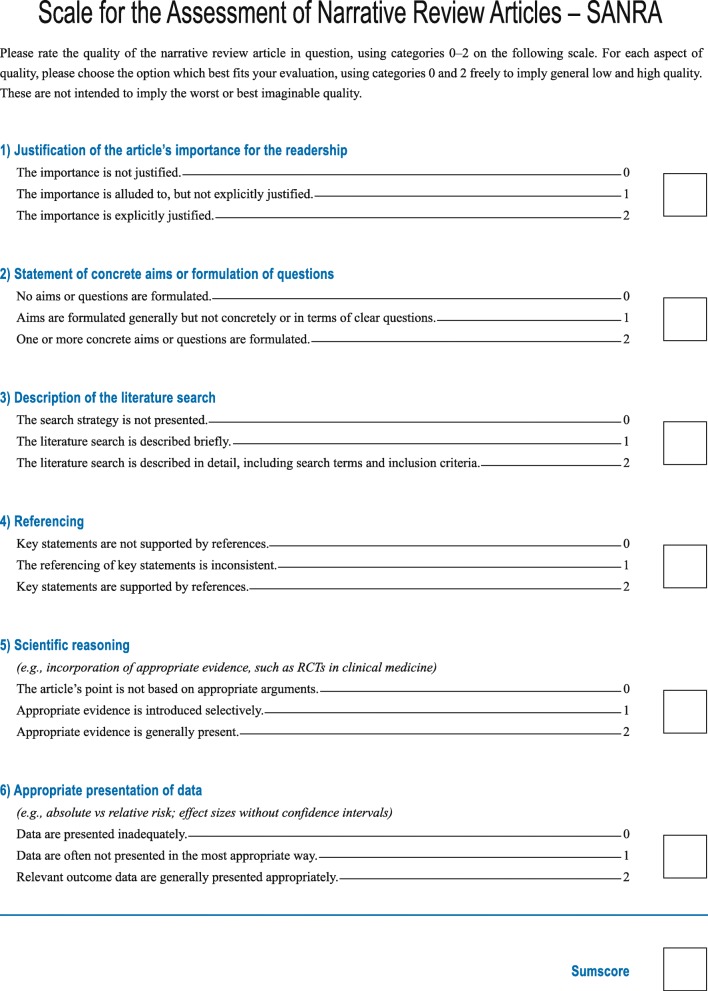
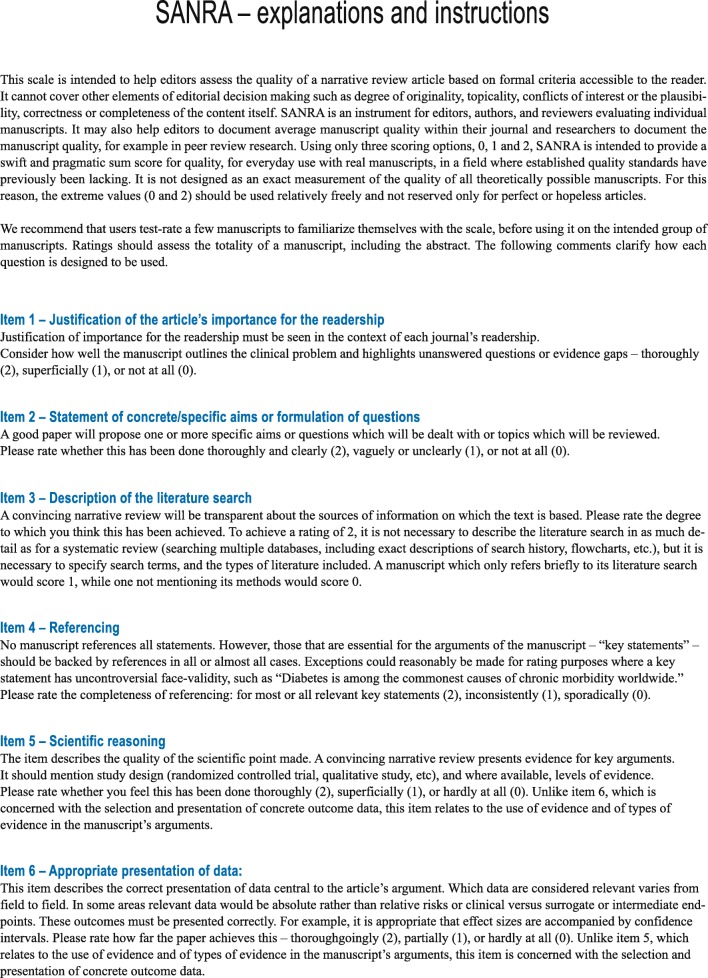
BACKGROUND: Narrative reviews are the commonest type of articles in the medical literature. However, unlike systematic reviews and randomized controlled trials (RCT) articles, for which formal instruments exist to evaluate quality, there is currently no instrument available to assess the quality of narrative reviews. In response to this gap, we developed SANRA, the Scale for the Assessment of Narrative Review Articles. METHODS: A team of three experienced journal editors modified or deleted items in an earlier SANRA version based on face validity, item-total correlations, and reliability scores from previous tests. We deleted an item which addressed a manuscript's writing and accessibility due to poor inter-rater reliability. The six items which form the revised scale are rated from 0 (low standard) to 2 (high standard) and cover the following topics: explanation of (1) the importance and (2) the aims of the review, (3) literature search and (4) referencing and presentation of (5) evidence level and (6) relevant endpoint data. For all items, we developed anchor definitions and examples to guide users in filling out the form. The revised scale was tested by the same editors (blinded to each other's ratings) in a group of 30 consecutive non-systematic review manuscripts submitted to a general medical journal. RESULTS: Raters confirmed that completing the scale is feasible in everyday editorial work. The mean sum score across all 30 manuscripts was 6.0 out of 12 possible points (SD 2.6, range 1-12). Corrected item-total correlations ranged from 0.33 (item 3) to 0.58 (item 6), and Cronbach's alpha was 0.68 (internal consistency). The intra-class correlation coefficient (average measure) was 0.77 [95% CI 0.57, 0.88] (inter-rater reliability). Raters often disagreed on items 1 and 4. CONCLUSIONS: SANRA's feasibility, inter-rater reliability, homogeneity of items, and internal consistency are sufficient for a scale of six items. Further field testing, particularly of validity, is desirable. We recommend rater training based on the "explanations and instructions" document provided with SANRA. In editorial decision-making, SANRA may complement journal-specific evaluation of manuscripts-pertaining to, e.g., audience, originality or difficulty-and may contribute to improving the standard of non-systematic reviews.
Overview
CoChat Summary
TL;DR
SANRA is a six-item, 0–2 scale (maximum 12) for assessing the quality of narrative review articles, developed and field-tested by three journal editors. In 30 consecutive non-systematic review manuscripts, it showed feasible use, sufficient internal consistency and inter-rater reliability, and a modest association with editorial acceptance.
Key findings
- Across 30 manuscripts (90 ratings), the mean SANRA sum score was 6.0 out of 12 (SD 2.6, range 1–12, median 6).
- Internal consistency was Cronbach’s alpha 0.68; corrected item-total correlations ranged from 0.33 (item 3) to 0.58 (item 6).
- Inter-rater reliability was an intra-class correlation coefficient (average measure) of 0.77 [95% CI 0.57, 0.88]; raters often disagreed on items 1 and 4.
- Average SANRA scores were modestly associated with editorial acceptance (mean 6.6, SD 1.9, n = 17) versus rejection (mean 5.1, SD 2.1, n = 13), point biserial correlation 0.37 (t = 2.09, df 28; two-sided p = 0.046).
Methods
- SANRA was developed between 2010 and 2017 by three experienced editors at Deutsches Ärzteblatt; the revised six-item version deleted an item on writing and accessibility due to poor inter-rater reliability.
- The revised scale was tested on 30 consecutive non-systematic review manuscripts submitted to Deutsches Ärzteblatt in 2015; three editor-raters scored them independently and blinded to each other’s ratings.
- Analyses included descriptive statistics, Cronbach’s alpha, corrected item-total correlations, average-measure intra-class correlation using a two-way random effects model (consistency definition), and a post hoc point biserial correlation between SANRA sum scores and acceptance/rejection.
Limitations
- The paper states the main limitation is sample size: 30 manuscripts was a compromise between representativeness, power, and feasibility, and took about 6 months to sample.
- The authors state that the scale’s authors were also the test-raters, so inter-rater reliability may be lower in groups less familiar with SANRA; the study also did not assess test-retest reliability, and results are study-specific.
- The paper acknowledges restricted content validity because SANRA is limited to six items and is a critical appraisal tool rather than a reporting guideline; criterion validity evidence is post hoc and weak, and no established cut-offs exist for comparing manuscripts across settings.
Model-written summary. Check it against the paper before relying on it.
Integrity signals
Registry
Cites
Statistics
Figures
Verification
Claims the paper makes
3 Valid · 0 Not valid · 5 Not checked · 27 Own results and interpretations
The cited sources support only part of this claim — read each source’s verdict below.
In the paper
“Bastian et al. found that they constitute the largest share of all text types in medicine and they concluded that they “remain the staple of medical literature” [1].”
- Also stated in: § Background · plain
“Narrative reviews are the commonest type of articles in the medical literature.”
§ SANRA—a scale for the quality assessment of narrative review articles > Background
What the sources say
- Partly supportedcites [1] Bastian H Glasziou P Chalmers I Seventy-five trials and eleven systematic reviews a day: how will we ever keep up? PLoS Med 2010 7 9 e1000326 10.1371/journal.pmed.1000326 20877712 PMC2943439 sourceExperimental — accuracy not yet measured
In “How Close Are We to Archie Cochrane’s Goal?” and the Summary Points (pages unavailable), the paper calls non-systematic narrative reviews the staple of medical literature synthesis. It does not say they constitute the largest share of all medical text types; that extends a claim about literature synthesis to medical literature as a whole. (LLM, conf=0.88)
plain- Asserted: passes — The authors put it forward as true.
- Checkable: passes — It can be checked against evidence.
- Load-bearing: unclear — It is unclear whether the paper’s conclusions depend on it.
- Based: passes — The paper gives a reason why it holds.
- Also stated in: § Background · plain
The sources with a verdict support this claim; the rest weren’t checked yet, have no full text we could read, or their verdicts aren’t rated yet.
In the paper
“non-systematic reviews or narrative reviews have been widely criticized as unreliable [1, 4].”
§ SANRA—a scale for the quality assessment of narrative review articles > Background
What the sources say
- Supportedcites [1] Bastian H Glasziou P Chalmers I Seventy-five trials and eleven systematic reviews a day: how will we ever keep up? PLoS Med 2010 7 9 e1000326 10.1371/journal.pmed.1000326 20877712 PMC2943439 source
In “How Close Are We to Archie Cochrane’s Goal?”, the paper describes reviews not conducted systematically as having great potential for error and calls them less reliable forms of information. Box 1 also says that articles and textbooks had highlighted the risk of bias and chance in reviews. Together, these passages support the broad characterization that narrative reviews have been criticized as unreliable; page numbers are not provided in our copy. (LLM, conf=0.89)
- Not checked — no full text of the sourcecites [4] Mulrow CD The medical review article: state of the science Ann Intern Med 1987 106 485 488 10.7326/0003-4819-106-3-485 3813259 source
plain- Asserted: passes — The authors put it forward as true.
- Checkable: passes — It can be checked against evidence.
- Load-bearing: passes — The paper’s conclusions depend on it.
- Based: passes — The paper gives a reason why it holds.
- Supported
A result the paper reports from its own data — it cites no other source for it, so there is none to check. The quote shows it is in the paper.
In the paper
“Cronbach’s alpha was 0.68 (internal consistency).”
- Also stated in: § Results · plain
“The scale’s internal consistency, measured as Cronbach’s alpha, was 0.68.”
§ SANRA—a scale for the quality assessment of narrative review articles > Abstract > Results
plainn = 90- Asserted: passes — The authors put it forward as true.
- Checkable: passes — It can be checked against evidence.
- Load-bearing: passes — The paper’s conclusions depend on it.
- Based: passes — The paper gives a reason why it holds.
- Also stated in: § Results · plain
A result the paper reports from its own data — it cites no other source for it, so there is none to check. The quote shows it is in the paper.
In the paper
“Raters often disagreed on items 1 and 4.”
- Also stated in: § Results · plain
“Disagreements most often occurred with regard to items 1 and 4.”
§ SANRA—a scale for the quality assessment of narrative review articles > Abstract > Results
plain- Asserted: passes — The authors put it forward as true.
- Checkable: passes — It can be checked against evidence.
- Load-bearing: unclear — It is unclear whether the paper’s conclusions depend on it.
- Based: passes — The paper gives a reason why it holds.
- Also stated in: § Results · plain
A result the paper reports from its own data — it cites no other source for it, so there is none to check. The quote shows it is in the paper.
In the paper
“The intra-class correlation coefficient (average measure) was 0.77 [95% CI 0.57, 0.88] (inter-rater reliability).”
- Also stated in: § Results · plain
“The intra-class correlation coefficient (average measure) amounted to 0.77 [95% CI 0.57, 0.88; F 4.3; df 29, 58].”
§ SANRA—a scale for the quality assessment of narrative review articles > Abstract > Results
plain- Asserted: passes — The authors put it forward as true.
- Checkable: passes — It can be checked against evidence.
- Load-bearing: passes — The paper’s conclusions depend on it.
- Based: passes — The paper gives a reason why it holds.
- Also stated in: § Results · plain
14 more claims
Create a free account to see all 35 claims and to verify the 3 references still open.
- Probably not a substantial claim. 11
- It may state two separate claims as one. 11
Claims other papers make about this one
Each is checked against this paper’s own text: does it say what the citing paper says it does?
The source backs part of the claim, not all of it — or backs it for a different population, condition or comparison.
In the citing paper
“The review was conducted and reported in accordance with the principles of the Scale for the Assessment of Narrative Review Articles (SANRA), which provides a validated framework for ensuring methodological transparency, scientific rigor, and balanced interpretation in narrative reviews [ 19 ].”
From Paracetamol: A History of Assumptions, Errors, and Evidence Reversals in Pain Management (2026) · cites this paper as [19]
Experimental — accuracy not yet measuredThe source backs part of the claim, not all of it — or backs it for a different population, condition or comparison.
In the citing paper
“As a narrative review, the present work does not include an aggregated quantitative assessment and is more exposed to selection subjectivity than a registered systematic review [124,125].”
From Berberine-Drug Interactions: Mechanisms, Clinical Relevance and Risk Stratification-A Narrative Review (2026) · cites this paper as [124]
Experimental — accuracy not yet measuredThe cited source says what the claim attributes to it.
In the citing paper
“This work is designed as a structured narrative review, with transparent reporting of the documentation strategy, guided by the quality criteria of the Scale for the Assessment of Narrative Review Articles (SANRA) [124].”
From Berberine-Drug Interactions: Mechanisms, Clinical Relevance and Risk Stratification-A Narrative Review (2026) · cites this paper as [124]
The cited source says what the claim attributes to it.
In the citing paper
“we used the following:-Cochrane Risk of Bias 2 (RoB 2) [29] and PEDRO scale tools for RCTs.-AMSTAR 2 [30] checklist for systematic review.-SANRA (Scale for the Assessment of Narrative Review Articles) [31] for narrative reviews.-JBI Checklist for Text and Opinion [32] for expert opinion papers.”
From Pelvic Floor Muscle Training Following Surgery for Pelvic Organ Prolapse: Recommendation from Scientific Literature (2026) · cites this paper as [31]
The cited source says what the claim attributes to it.
In the citing paper
“Data analysis employed a narrative and thematic synthesis methodology,adhering to the SANRA guidelines for narrative reviews (32).”
From Ethical issues in multi-agent AI systems for healthcare: a narrative review (2026) · cites this paper as [32]
12 more claims about this paper
Create a free account to see every claim other papers make about this one.
Citations
Cites
Shea, B. J., Reeves, B. C., Wells, G., Thuku, M., Hamel, C., Moran, J., Moher, D., Tugwell, P., Welch, V., Kristjansson, E., et al. (2017) · BMJ · doi:10.1136/bmj.j4008 · Cited by 10,636 · cited 2×
“Critical appraisal tools have been developed for systematic reviews (e.g., AMSTAR 2 [A MeaSurement Tool to Assess Systematic Reviews] [7]) and papers on RCTs (e.g., the CASP [Critical Appraisal Skills Program] checklist for randomized trials [8]) and other types of medical studies.”
BackgroundStreiner, D. L., & Norman, G. R. (2008) · doi:10.1093/acprof:oso/9780199231881.001.0001 · Cited by 2,631
Critical appraisal skills programme
Singh, J. (2013) · Journal of Pharmacology and Pharmacotherapeutics · doi:10.4103/0976-500x.107697 · Cited by 2,556
Guidelines for Reporting Reliability and Agreement Studies (GRRAS) were proposed
Kottner, J., Audigé, L., Brorson, S., Donner, A., Gajewski, B. J., Hróbjartsson, A., Roberts, C., Shoukri, M., & Streiner, D. L. (2011) · Journal of Clinical Epidemiology · doi:10.1016/j.jclinepi.2010.03.002 · Cited by 2,174
The Mass Production of Redundant, Misleading, and Conflicted Systematic Reviews and Meta‐analyses
IOANNIDIS, J. P. A. (2016) · The Milbank Quarterly · doi:10.1111/1468-0009.12210 · Cited by 1,483 · cited 1×
“While systematic reviews are not per se superior articles and while certain systematic reviews have been criticized lately [3], non-systematic reviews or narrative reviews have”
BackgroundSeventy-five trials and eleven systematic reviews a day: how will we ever keep up?
Bastian, H., Glasziou, P., & Chalmers, I. (2010) · PLoS Medicine · doi:10.1371/journal.pmed.1000326 · Cited by 1,188 · cited 2×
“found that they constitute the largest share of all text types in medicine and they concluded that they “remain the staple of medical literature” [1].”
BackgroundThe Medical Review Article: State of the Science
MULROW, C. D. (1987) · Annals of Internal Medicine · doi:10.7326/0003-4819-106-3-485 · Cited by 856 · cited 1×
“been widely criticized as unreliable [1, 4].”
Writing a narrative biomedical review: considerations for authors, peer reviewers, and editors
Gasparyan, A. Y., Ayvazyan, L., Blackmore, H., & Kitas, G. D. (2011) · Rheumatology International · doi:10.1007/s00296-011-1999-3 · Cited by 694 · cited 1×
“[13], for example, have provided guidance for writing narrative reviews, and Byrne [14] as well as Pautasso [15] has written, from different angles, thoughtful editorials on improving narrative reviews and presented lists of key features of writing a good review—lists that naturally overlap with SANRA items (e.”
BackgroundTen Simple Rules for Writing a Literature Review
Pautasso, M. (2013) · PLoS Computational Biology · doi:10.1371/journal.pcbi.1003149 · Cited by 272 · cited 3×
“[13], for example, have provided guidance for writing narrative reviews, and Byrne [14] as well as Pautasso [15] has written, from different angles, thoughtful editorials on improving narrative reviews and presented lists of key features of writing a good review—lists that naturally overlap with SANRA items (e.”
BackgroundImproving the peer review of narrative literature reviews
Byrne, J. A. (2016) · Research Integrity and Peer Review · doi:10.1186/s41073-016-0019-2 · Cited by 159 · cited 3×
“[13], for example, have provided guidance for writing narrative reviews, and Byrne [14] as well as Pautasso [15] has written, from different angles, thoughtful editorials on improving narrative reviews and presented lists of key features of writing a good review—lists that naturally overlap with SANRA items (e.”
Background
Research works printed but not linked: 3
- Higgins JPT, Green S. (eds.). Cochrane Handbook for Systematic Reviews and Interventions. Version 5.1.0. The Cochrane Collaboration 2011, section 1.2.2., www.handbook.cochrane.org, retrieved on Oct 31, 2018.
- Baethge C Mertens S Goldbeck-Wood S Development of a quality score for the assessment of non-systematic review articles (SANRA) Poster, Seventh International Congress on Peer Review and Biomedical Publication 2013 USA Chicago, Illinois
- Baethge C Goldbeck-Wood S Mertens S A scale for the assessment of non-systematic review articles (SANRA) Poster, Eighth International Congress on Peer and Biomedical Publication 2017 USA Chicago, Illinois
Cited by
Items 1,001–1,100 of 4,334
Beyond the p Value Dichotomy: Alternatives for Statistical Inference—A Critical Review
Ferreira, M. H. L., Câmara, L. C., & Carvas, N. (2026) · Journal of Evaluation in Clinical Practice · doi:10.1111/jep.70373 · Cited by 9
“A total of 25 articles were assessed with SANRA [14].”
InfluentialClaudia, M., Mellucci, C., & Caterina, G. (2026) · The Clinical Teacher · doi:10.1111/tct.70366 · Cited by 5
Constance, M. N. M., Maroyi, R., Ganywamulume, B., Alain, B. M., Ngeleza, O., & Mukwege, D. M. (2026) · International Journal of Women s Health · doi:10.2147/ijwh.s593155 · Cited by 5
Pelaz, A. C., Hanna, E. Y., Guntinas‐Lichius, O., Kowalski, L. P., Rodrigo, J. P., Takes, R. P., Hamoir, M., de Bree, R., Civantos, F., Robbins, K. T., et al. (2026) · Diagnostics · doi:10.3390/diagnostics16060855 · Cited by 5
Wani, F. A. (2026) · Medicina · doi:10.3390/medicina62030545 · Cited by 8
ACL injury in female soccer players: Risk, resilience, and prevention in the modern game
D’Ambrosi, R., Baumert, P., & Fink, C. (2026) · Science Progress · doi:10.1177/00368504261428994 · Cited by 5
Ng, J. Y. (2026) · Frontiers in Artificial Intelligence · doi:10.3389/frai.2026.1745928 · Cited by 8
Mechanisms of Visuomotor Interception
Márquez, I., & Treviño, M. (2026) · Brain Sciences · doi:10.3390/brainsci16050435 · Cited by 5
“Study selection was guided by thematic relevance and the authors’ domain expertise; accordingly, this is a narrative rather than a systematic review, and the coverage is not intended to be exhaustive (for reporting standards in narrative reviews, see [7]).”
Stefano, M., Querci, L., & Chieregato, A. (2026) · Nutrients · doi:10.3390/nu18091359 · Cited by 5
“This approach aligns with narrative review principles that emphasize a balanced synthesis of evidence, clear clinical translation, and forward-looking recommendations [61]—the major studies considered are summarized in Table 1.”
Christodoulou, R. C., Lorentzen, L. Y., Eller, D., & Vassiliou, E. K. (2026) · Nutrients · doi:10.3390/nu18091392 · Cited by 7
“The search strategy adhered to recommended reporting standards for narrative reviews, prioritizing transparency in how the literature was identified and studies selected, while noting the non-systematic nature of narrative reviews [19,20].”
Ispas, V., Maggio, V., Hassan, H. S., Sayilgan, A. I., Hassan, F. M., Ispas, S., & Rizzo, M. (2026) · Nutrients · doi:10.3390/nu18101552 · Cited by 5
“…of the review were guided by the Scale for the Assessment of Narrative Review Articles (SANRA), which emphasizes the importance of a clear rationale, explicit aims, transparent literature-search description, appropriate referencing, scientific reasoning, and clear presentation of evidence [14].”
Vasiliu, O. (2026) · Frontiers in Public Health · doi:10.3389/fpubh.2026.1816917 · Cited by 6
Durai, S. (2021) · Indian Journal of Continuing Nursing Education · doi:10.4103/ijcn.ijcn_51_21 · Cited by 6
Systematic Review of Pediatric Brain Tumors in Neurofibromatosis Type 1: Status of Gene Therapy
Thomas, S., Bikeyeva, V., Abdullah, A., Radivojevic, A., Jad, A. A. A., Ravanavena, A., Ravindra, C., Igweonu-Nwakile, E. O., Ali, S., Paul, S., et al. (2022) · Cureus · doi:10.7759/cureus.27963 · Cited by 5
“trials [9], Scale for the Assessment of Narrative Review Articles 2 (SANRA 2) for narrative reviews [10], and Assessment of Multiple Systematic Reviews (AMSTAR) for systematic reviews and meta-analyses [11].”
BackgroundGut Microsex/Genderome, Immunity and the Stress Response in the Sexes: An Updated Review
Stefanaki, C., Bacopoulou, F., & Chrousos, G. P. (2022) · Sexes · doi:10.3390/sexes3040039 · Cited by 6
School Health Policies in the World: A Scoping Review
Asadi, Z., Teymourlouy, A. A., & Hashjin, A. A. (2023) · Health Scope · doi:10.5812/jhealthscope-133708 · Cited by 7
Lupia, T., Crisà, E., Gaviraghi, A., Rizzello, B., Vincenzo, A. D., Carnevale‐Schianca, F., Caravelli, D., Fizzotti, M., Tolomeo, F., Vitolo, U., et al. (2023) · Tropical Medicine and Infectious Disease · doi:10.3390/tropicalmed8070358 · Cited by 5
Preventing controlled substance diversion in perioperative settings: a narrative review
Wong, M. J., Wang, Y., Blake, L., & Ke, J. X. C. (2023) · Canadian Journal of Anesthesia/Journal canadien d anesthésie · doi:10.1007/s12630-023-02574-4 · Cited by 6
Yan, L., Karamchandani, K., Gaiser, R. R., & Carr, Z. J. (2024) · Anesthesia & Analgesia · doi:10.1213/ane.0000000000006666 · Cited by 8
“9 We performed a literature search on PubMed with the search protocol: (“cognitive bias” OR “cognitive biases” OR “cognitive error” OR “cognitive errors” OR “cognitive process” OR “cognitive processes” OR “heuristic” OR “heuristics”) AND (“medicine” OR “medical” OR “perioperative” OR “surgery” OR…”
Focus on Thyroid Cancer in Elderly Patients
Lauretta, R., Bianchini, M., Mormando, M., Puliani, G., & Appetecchia, M. (2023) · Endocrines · doi:10.3390/endocrines4040055 · Cited by 5
Eeles, E. M., Tran, D. D., Boyd, J., Tronstad, O., Teodorczuk, A., Flaws, D., Fraser, J. F., & Dissanayaka, N. N. (2023) · Australian Critical Care · doi:10.1016/j.aucc.2023.11.006 · Cited by 5
Lateral Approach to the Cervical Spine to Manage Degenerative Cervical Myelopathy and Radiculopathy
Chibbaro, S., Cornelius, J. F., Mallereau, C.-H., Bruneau, M., Zaed, I., Visocchi, M., Maduri, R., Todeschi, J., Bruno, C., George, B., et al. (2023) · Acta neurochirurgica. Supplementum · doi:10.1007/978-3-031-36084-8_51 · Cited by 5
Nguyen, K. T., Beauchamp, D. W., & O’Hara, R. B. (2024) · Military Medicine · doi:10.1093/milmed/usad506 · Cited by 5
Augmented reality in brachytherapy: A narrative review
Ferioli, M., Medici, F., Forlani, L., Cilla, S., Fionda, B., Cammelli, S., Tagliaferri, L., MORGANTI, A. G., & Buwenge, M. (2024) · Journal of Contemporary Brachytherapy · doi:10.5114/jcb.2024.137779 · Cited by 5
“This narrative review of the literature was conducted by a multi-disciplinary team, including radiation oncologists, medical physicists, and radiotherapy technicians, and was written based on scale for the assessment of narrative review articles (SANRA) [13].”
Tezepelumab: patient selection and place in therapy in severe asthma
Menzella, F., Munari, S., Corsi, L., Tonin, S., Cestaro, W., Ballarin, A., Floriani, A., Dartora, C., & Senna, G. (2024) · Journal of International Medical Research · doi:10.1177/03000605241246740 · Cited by 5
“14”
Ekawati, F. M., Widyasari, A., Lisa, H. R. A., Putri, C. G., & Tuteja, A. (2024) · Sexual & Reproductive Healthcare · doi:10.1016/j.srhc.2024.101005 · Cited by 6
Agritourism as the Epitome of India's Sustainability Culture : A Narrative Review
Dsouza, K. J., Shetty, A., & Rajasekharan Pillai, K. (2024) · Indian Journal of Marketing · doi:10.17010/ijom/2024/v54/i7/174015 · Cited by 5
Huang, Z., Iqbal, Z., Zhao, Z., Chen, X., Mahmmod, A., Liu, J., Li, W., & Deng, Z. (2024) · International Journal of Molecular Medicine · doi:10.3892/ijmm.2024.5405 · Cited by 5
Mingels, S., Granitzer, M., Luedtke, K., & Dankaerts, W. (2024) · Current Pain and Headache Reports · doi:10.1007/s11916-024-01306-7 · Cited by 6
“Limitations of a narrative review concern the missing quality check, and the lacking conclusions on effectiveness [31].”
InfluentialImplications of xylazine exposure in pregnancy: a narrative review
Hull, I., Jawa, R., Shang, M., Davis, C. S., King, C., McMurtrie, G., & Krans, E. E. (2024) · Journal of Addictive Diseases · doi:10.1080/10550887.2024.2391156 · Cited by 6
Uniportal Video-Assisted Thoracoscopic Surgery for Minor Procedures
Agrafiotis, A. C., Moraitis, S. D., & Sotiropoulos, G. C. (2024) · Journal of Personalized Medicine · doi:10.3390/jpm14080880 · Cited by 5
“The current recommendations for the quality assessment of narrative review articles were followed in conducting this review [4].”
BackgroundSchwarzer, S., Lázaro‐Martínez, J. L., Killeen, A. L., Alves, P. J. P., Gledhill, A., Nygren, E., Lavery, L. A., & Malone, M. (2024) · International Wound Journal · doi:10.1111/iwj.70053 · Cited by 5
Liu, H.-Y., Luo, Y.-G., Zhang, J., Hu, Y., He, H., Li, J., Mao, H.-P., & Fu, S. (2024) · Medicine · doi:10.1097/md.0000000000040235 · Cited by 5
“[33] 3”
Positioning tezepelumab for patients with severe asthma: from evidence to unmet needs
Lombardi, C., Cottini, M., Bosi, A., & Menzella, F. (2024) · Journal of International Medical Research · doi:10.1177/03000605241297532 · Cited by 5
Ansari, N., Pitts, L. N., & Wilson, C. M. (2024) · Nurse Education in Practice · doi:10.1016/j.nepr.2024.104241 · Cited by 6
Rozevink, S. G., Murgia, A., Bongers, R. M., & van der Sluis, C. K. (2025) · Technology and Disability · doi:10.1177/10554181241311687 · Cited by 7
Rao, K. N., Piazza, C., Snyderman, C. H., Poorten, V. V., Sreeram, M. P., Strojan, P., Hanna, E. Y., Guntinas‐Lichius, O., López, F., Mikkelsen, L. H., et al. (2025) · Advances in Therapy · doi:10.1007/s12325-025-03113-x · Cited by 5
“To evaluate the quality of the comprehensive review, the Scale for the Assessment of Narra‑ tive Review Articles, a concise critical appraisal tool designed for non‑systematic reviews was employed [4].”
A New Intrauterine Adhesions Classification System: The “Loddo Score”
Loddo, A., Kaza, L., & Saponara, S. (2025) · Gynecology and Minimally Invasive Therapy · doi:10.4103/gmit.gmit_85_24 · Cited by 5
“[24] The relevant publications were identified after a systematic query of PubMed, Google Scholar, Scopus, and Web of Science complemented by cross-checking the reference lists.”
Clinical Outcome Assessment Tools for Evaluating the Management of Gliomas
Chakravarti, S., Gupta, S. R., Myneni, S., Elshareif, M., Rogers, J. L., Caraway, C. A., Ahmed, A. K., Schreck, K. C., Kamson, D. O., Holdhoff, M., et al. (2025) · Cancers · doi:10.3390/cancers17101659 · Cited by 5
“One author (S.C.) used the scale for the quality assessment of narrative review articles (SANRA) to evaluate the quality of all cited studies [9].”
Ferrara, F., Martellone, L., Vaccaro, M., Coluccia, A., Scognamiglio, M., Langella, R., Zovi, A., & Polito, G. (2025) · European Journal of Clinical Pharmacology · doi:10.1007/s00228-025-03866-y · Cited by 5
The Impact of Socioeconomic Disadvantages on Academic Achievement During COVID-19 School Disruptions
Deep, P. D., Ghosh, N., Chen, Y., & Gaither, C. (2025) · Journal of Education and Learning · doi:10.5539/jel.v14n5p57 · Cited by 8
“To ensure methodological rigor, the process adhered to the SANRA guidelines (Baethge et al., 2019).”
Goonathilake, M. R., Waqar, S., George, S., Jean-Baptiste, W., Ali, A. Y., Inyang, B., Koshy, F. S., George, K., Poudel, P., Chalasani, R., et al. (2022) · Cureus · doi:10.7759/cureus.27132 · Cited by 5
“Scale for the quality Assessment of Narrative Review Articles (SANRA 2) [13] Narrative review 12 9 Chinn et al.”
MethodUsing Alternative Sources of Energy for Decarbonization: A Piece of Cake, but How to Cook This Cake?
Boguslavsky, D. V., Sharov, K. S., & Sharova, N. P. (2022) · International Journal of Environmental Research and Public Health · doi:10.3390/ijerph192316286 · Cited by 5
Patikorn, C., Kategeaw, W., Perdrizet, J. E., Li, X., & Chaiyakunapruk, N. (2023) · Human Vaccines & Immunotherapeutics · doi:10.1080/21645515.2023.2177459 · Cited by 5
McLachlan, C. S., & Truong, H. (2023) · Journal of Cardiovascular Development and Disease · doi:10.3390/jcdd10040141 · Cited by 5
Abaza, A., Jamil, A., Gutlapalli, S. D., Ali, M., Oble, M. J. P., Sonia, S. N., George, S., Shahi, S. R., Ali, Z., & Khan, S. (2023) · Cureus · doi:10.7759/cureus.44353 · Cited by 9
“Finally, 16 highly informative review articles were selected after meeting the criteria of the Scale for the Assessment of Narrative Review Articles (SANRA) checklist [8].”
BackgroundRadiation Therapy for Gestational Trophoblastic Neoplasia: Forward-Looking Lessons Learnt
Barcellini, A., Fodor, A., Charalampopoulou, A., Cassani, C., Locati, L. D., Cioffi, R., Bergamini, A., Pignata, S., Orlandi, E. M., & Mangili, G. (2023) · Cancers · doi:10.3390/cancers15194817 · Cited by 5
“The design of the current manuscript followed the recommendations on the quality assessment of narrative review articles provided by Baethge et al. [20].”
MethodTuono, R. D. M., Louokdom, J. S., Chetcha, B. C., Nya, P. C. B., Pieme, C. A., & Tagny, C. T. (2023) · Health Science Reports · doi:10.1002/hsr2.1609 · Cited by 8
Serritella, E., Colombo, V. L., Özcan, M., Galluccio, G., & Paolo, C. D. (2024) · Current Oral Health Reports · doi:10.1007/s40496-023-00359-8 · Cited by 5
“The methodology for this review adhered to the Scale for the Quality Assessment of Narrative Review Articles (SANRA) guidelines [8].”
The importance of social relationships in depression in autistic adolescents: a narrative-review
Mamimoué, É., & Gauld, C. (2024) · Frontiers in Psychology · doi:10.3389/fpsyg.2024.1335882 · Cited by 5
Yook, J. H., Rizwan, M., Shahid, N. U. A., Naguit, N., Jakkoju, R., Laeeq, S., Reghefaoui, T., Zahoor, H., & Mohammed, L. (2021) · Cureus · doi:10.7759/cureus.19045 · Cited by 8
“tools were of low risk of bias, except three animal studies that were of moderate risk of bias according to SYRCLE's risk of bias tool [10-12].”
de Almeida, M. M. G., & do Amaral, C. G. (2021) · Interface - Comunicação Saúde Educação · doi:10.1590/interface.210059 · Cited by 10
Abrouq, N. (2022) · Journal of World Englishes and Educational Practices · doi:10.32996/jweep.2022.4.2.6 · Cited by 5
Scott, K., Ankrum, S., Lindsey, E., Lopez, O., Beitner, J., Reck, C., & Kargela, M. (2022) · Cardiopulmonary Physical Therapy Journal · doi:10.1097/cpt.0000000000000217 · Cited by 5
Integrative Approaches in Non-Small Cell Lung Cancer Management: The Role of Radiotherapy
Visa, M. A., Abazeed, M. E., & Patino, D. M. A. (2024) · Journal of Clinical Medicine · doi:10.3390/jcm13154296 · Cited by 5
“This review was structured in a manner consistent with the Scale for the Assessment of Narrative Review Articles (SANRA) [16].”
MethodDsouza, M. P., Shetty, A., D’Souza, S. E., Buthello, E., & Gudi, N. (2025) · Sage Open · doi:10.1177/21582440251318806 · Cited by 4
“Our study was also assessed for quality using the Scale for the Quality Assessment of Narrative Review Articles (SANRA) (Baethge et al., 2019).”
Saha, I., Banerjee, O., Sarkar, S., & Mukherjee, S. (2025) · Science Progress · doi:10.1177/00368504251322069 · Cited by 5
“This narrative review follows the guidelines of the Scale for the Assessment of Narrative Review Articles as described by Baethge et al. (2019).”
Cognitive outcomes following ischaemic stroke: a narrative review
Myooran, J., Rahman, F., Cordato, D. J., & Chróinín, D. N. (2025) · Aging and Health Research · doi:10.1016/j.ahr.2025.100232 · Cited by 5
Colantuono, S., Menzella, F., Mari, P., Macagno, F., Lombardi, F., Baglivo, I., & Caruso, C. (2025) · Journal of International Medical Research · doi:10.1177/03000605251340894 · Cited by 6
Bottussi, A., Ursoleo, J. D., Perinati, L., Pruna, A., Agosta, V. T., Russo, C., Huang, J., & Monaco, F. (2025) · Journal of Cardiothoracic and Vascular Anesthesia · doi:10.1053/j.jvca.2025.06.035 · Cited by 4
Integrating mHealth Innovations into Decentralized Oncology Trials
ÇİÇİN, F. N., & Çiçin, İ. (2025) · Journal of Medical Systems · doi:10.1007/s10916-025-02233-9 · Cited by 5
“A narrative review was conducted according to SANRA, the Scale for the Assessment of Narrative Review Articles, guidelines (9).”
Endovascular Arch Repair: Endograft Design Options and Worldwide Results
Lescan, M., Kondov, S., Dimov, A., Berger, T., Discher, P., Gottardi, R., Kletzer, J., Kreibich, M., Schusterová, I., & Czerny, M. (2025) · European Journal of Cardio-Thoracic Surgery · doi:10.1093/ejcts/ezaf273 · Cited by 4
Osman, H. G. A., Elbadri, M. E., Alhadi, I. A. H., Ibrahim, A., Ayyub, A., Mohamed, A. H., Sahnon, A. S. A., Alkhazendar, J. H. J., Alkhazendar, A. H., & Awan, M. (2025) · Cureus · doi:10.7759/cureus.89592 · Cited by 4
Peri-Operative Nursing of Patients with Malignant Hyperthermia: A Narrative Literature Review
Ruta, F., Monica, A. D., Mas, F. D., Bolgeo, T., Notarnicola, I., Procacci, C., Ferrara, P., Masini, A., Mancin, S., Cangelosi, G., et al. (2025) · Surgeries · doi:10.3390/surgeries6030078 · Cited by 5
“This study employs a narrative review methodology, conducted according to the Scale for the Assessment of Narrative Review Articles (SANRA) to ensure methodological rigor and qualitative support (Supplementary File S1: SANRA Check List) [31].”
PCSK9 in peripheral arterial disease: Mechanisms and therapeutic perspectives
Gao, Y., Zhang, J., Jiang, N., Wang, L., Cao, T., Xie, Y., He, H., & Li, L. (2025) · Science Progress · doi:10.1177/00368504251370679 · Cited by 5
“13 Genetic determinants of PCSK9 in PAD pathogenesis PCSK9 gene polymorphisms exhibited signi fi cant associations with the risk of developing PAD.”
Educational Artificial Intelligence, Child Rights, and Human Care in Early Childhood
Peinado, R. G. (2025) · The European Educational Researcher · doi:10.31757/euer.833 · Cited by 4
Meng, J., Suárez, L., Yip, C. C. E., & Marsh, N. V. (2025) · Behavioral Sciences · doi:10.3390/bs15101313 · Cited by 4
“The methodology for this review followed the SANRA (a scale for the quality assessment of narrative review articles) guidelines (Baethge et al., 2019), with its six criteria addressed as follows: (1) Importance—”
Complement and local ocular inflammatory response: Chronic immune factors in myopia
Zhang, M., Mo, Y., Gao, J., Qu, W., Chen, A., Wu, S., & Zhang, Y. (2025) · Science Progress · doi:10.1177/00368504251383046 · Cited by 4
“8 Overview of the complement system and pathway mechanism The complement system, a crucial part of the innate immune system, comprises a set of plasma proteins circulating in body fl uids and their membrane-bound receptors.”
Bustnes, K. A., Schäfer, S., Held, L., Wessels, H., & Friehs, M. A. (2025) · Stress and Health · doi:10.1002/smi.70108 · Cited by 4
“For the assessment of the included narrative reviews, we used a scale for narrative review articles (SANRA) as most criteria of the JBI are not applicable for narrative reviews (Baethge et al. 2019).”
Arroyo-Bello, E., González-Toledo, B., Abad-Valle, J., Rodríguez-Gómez, P., & Ramon, M. (2025) · Cureus · doi:10.7759/cureus.94259 · Cited by 8
Thoracic blunt trauma causing fatal cardiac rupture and aortic dissection: A narrative review
Wang, L., Su, S., Liang, L., & Yu, H. (2025) · Journal of International Medical Research · doi:10.1177/03000605251386164 · Cited by 4
“5 This review synthesized global evidence on BCR and TAD, highlighting similarities, differences, clinical implications, and knowledge gaps across studies.”
Impact of sickle cell anaemia on reproductive health: a narrative review
Kotam, G. P., Morrison, D. B., Nyarkoh, J. K., Mawunyo, A. O., Kotam, J., Osei, G. N., & Adu, P. (2025) · Reproductive Health · doi:10.1186/s12978-025-02169-w · Cited by 7
“However, this same comparison in low and middle income countries (LMICs) shows a relatively higher odds of maternal mortality in pregnant women with SCD compared with those without SCD (OR = 22.8, p 0.001) [35].”
InfluentialTeaching Environmentalism in Philippine Schools: An Empirical Integrative Review
Cruz, M. E. P. (2025) · Bedan Research Journal · doi:10.58870/berj.v10i1.82 · Cited by 5
Emphysematous gastritis: The silent storm within the stomach wall
Aggarwal, C. S., Dahiya, S., Kochhar, S., Aggarwal, K., Edgecombe, L., Jeje, T., & Jain, R. (2025) · Journal of International Medical Research · doi:10.1177/03000605251389384 · Cited by 4
Raza, S. S., Zakir, Z., Hashmat, A., Awan, S. K., & Varrassi, G. (2025) · Cureus · doi:10.7759/cureus.96739 · Cited by 8
“We structured our work around the Scale for the Assessment of Narrative Review Articles criteria to keep the process clear, rigorous, and relevant [12].”
Kostov, S. G., Kornovski, Y. D., Ivanova, V., Metodiev, D., Yordanov, A. D., Slavchev, S. H., Ivanova, Y., Seidel, A., Juhasz‐Böss, I., Hasan, I., et al. (2025) · Cancers · doi:10.3390/cancers17233819 · Cited by 4
Guraya, S. S., Ennab, F., & Guraya, S. Y. (2025) · Frontiers in Medicine · doi:10.3389/fmed.2025.1715752 · Cited by 5
Deep, P. D., Ghosh, N., & Natoli, A. P. (2026) · International Journal on Social and Education Sciences · doi:10.46328/ijonses.5915 · Cited by 7
“Unlike systematic reviews, which prioritize methodological uniformity and narrowly focused research questions, narrative reviews allow for greater conceptual depth and flexibility in drawing connections across diverse bodies of knowledge (Baethge et al., 2019; Green et al., 2006).”
Impact of Spinal Cord Injury on Mental Health: A Narrative Review
Gklantzouni, K., Evangelopoulos, D.-S., Evangelopoulos, M., & Pnevmaticos, S. (2025) · Cureus · doi:10.7759/cureus.100422 · Cited by 4
“Socioeconomic gradients were also apparent: financial strain was correlated with poorer mental health outcomes, including higher depressive symptom burden [16,17,21,36].”
InfluentialGenetic, Epigenetic, and Non-Genetic Factors in Testicular Dysgenesis Syndrome: A Narrative Review
Ciarloni, A., Muti, N. D., Sacco, S., Ambo, N., Giacomi, V. D., Perrone, M., Rossi, S., Balercia, M., Salvio, G., & Balercia, G. (2025) · Genes · doi:10.3390/genes17010040 · Cited by 5
“…consistency in our narrative review, we strictly adhered to the SANRA assessment scale (Scale for the Assessment of Non-Systematic Review Articles) [45], a 7-item tool that evaluates (1) justification of the article’s importance for the readership, (2) statement of concrete aims or formulation of…”
Large Language Models in Radiologist–Patient Communication: A Narrative Review for Clinical Practice
Naidu, J. S., Muthyala, H., Naidu, S. S., Muralidharan, S., & Baskaradoss, V. K. (2026) · Cureus · doi:10.7759/cureus.101890 · Cited by 6
“…a narrative review, conducted and reported in accordance with the principles of the Scale for the Assessment of Narrative Review Articles (SANRA) [21], which emphasises clarity of rationale, explicit aims, justified literature search, appropriate referencing, scientific reasoning, and meaningful…”
Artificial intelligence in breast surgery: Current applications, challenges, and future perspectives
Khajeh, M., Farshidmehr, P., Rahimpour, E., Amiri, P., & Shahram, M. A. (2026) · Journal of International Medical Research · doi:10.1177/03000605251412124 · Cited by 6
“13 A structured literature search was conducted to identify relevant studies on AI applications in breast surgery, encompassing lesion diagnosis, preoperative planning, intraoperative guidance, and postoperative follow-up.”
Mixed‐methods research in medical education: Lessons from a meta‐study of methodological practice
Cleland, J., MacLeod, A., Schalkwyk, S. C. V., & Ellaway, R. (2026) · Medical Education · doi:10.1111/medu.70177 · Cited by 4
D’Onofrio, A. M., Ferrajoli, G. F., Balzoni, L. M., Massetti, M., Zanzarri, A., Marano, G., Mazza, M., Koukopoulos, A. E., Kotzalidis, G. D., Moccia, L., et al. (2026) · Geriatrics · doi:10.3390/geriatrics11010013 · Cited by 8
“In particular, the SANRA (Scale for the Assessment of Narrative Review Articles) [5] criteria were used as a self-assessment guide during manuscript development and revision, with attention to justification of the article’s importance, clarity of aims, description of the literature search,…”
Rechcińska, A., Bralewska, B., Mordaka, M., & Rechciński, T. (2026) · Journal of Clinical Medicine · doi:10.3390/jcm15031193 · Cited by 4
“…systematic identification and selection of studies with a predominantly narrative synthesis; therefore, we chose to structure reporting according to PRISMA-type items rather than formally applying SANRA, which is primarily a quality-assessment tool for non-systematic narrative reviews [32].”
Mansour, R. A., Yaseen, A., & Rahman, Z. A. (2026) · International Journal of Molecular Sciences · doi:10.3390/ijms27041775 · Cited by 4
“This review was conducted and reported in accordance with the Scale for the Assessment of Narrative Review Articles (SANRA) guidelines [55].”
Rossi‐Fedele, G., Doğramacı, E. J., & Heithersay, G. S. (2026) · International Endodontic Journal · doi:10.1111/iej.70119 · Cited by 4
Denosumab Plus Immune Checkpoint Inhibitors in Bone Metastases From Solid Tumors
Wang, N., Song, F., Li, X., & Chen, H. (2026) · Cancer Control · doi:10.1177/10732748261427063 · Cited by 4
“13”
Tittarelli, F., Battistelli, N., & Aprea, G. (2026) · Journal of Food Protection · doi:10.1016/j.jfp.2026.100744 · Cited by 4
Jaiswar, D., Jeeyar, V., Choudhury, S., & Dixit, M. (2026) · Cancer Control · doi:10.1177/10732748261433619 · Cited by 4
Zhang, K., Trambaiolli, L. R., Zhao, Z., Taschereau‐Dumouchel, V., & Feusner, J. D. (2026) · Journal of Psychiatric Research · doi:10.1016/j.jpsychires.2026.03.013 · Cited by 4
“This narrative review was conducted in accordance with the SANRA (Scale for the Assessment of Narrative Review Articles) guidelines (Baethge et al., 2019).”
Louokdom, J. S., Tuono, R. D. M., Njopwouo, M. S., & Tayou, C. T. (2026) · The Scientific World JOURNAL · doi:10.1155/tswj/8864775 · Cited by 4
Li, J., Cheng, H., & Liu, X. (2026) · Frontiers in Pharmacology · doi:10.3389/fphar.2026.1804877 · Cited by 4
“Given the high heterogeneity in experimental models and study designs among included studies, this review did not perform a quantitative meta-analysis but was reported using the Systematically Assessing Narrative Review Articles (SANRA) framework (Baethge et al., 2019).”
Anterior Segment Optical Coherence Tomography with Angiography for the Cornea and Ocular Surface
Wong, Q. Y., Sim, R. Z. H., & Ang, M. (2026) · Journal of Clinical Medicine · doi:10.3390/jcm15062402 · Cited by 4
Abdulla, M., Shah, S. M., Abosoudah, W., Bader, S., Shamsi, S., Aldiab, R., Alsafadi, B., Yaqinuddin, S. A., Hussain, S. S. M., Chishtee, L. M., et al. (2026) · Frontiers in Public Health · doi:10.3389/fpubh.2026.1788012 · Cited by 6
Plant extracts and essential oils as green corrosion inhibitors for steel in acidic media: A review
Himeur, T., Ferkous, H., Rouibah, K., Abdennouri, A., & Bousba, D. (2026) · Journal of Molecular Structure · doi:10.1016/j.molstruc.2026.146143 · Cited by 7
Martínez-Aguilar, M., Abdullah, Z., Blokzijl, H., & Moshage, H. J. (2026) · Biomedicine & Pharmacotherapy · doi:10.1016/j.biopha.2026.119350 · Cited by 4
“Phenotyping obstructive sleep apnea: a pathway to precision medicine”
BaHammam, A. S. (2026) · Sleep And Breathing · doi:10.1007/s11325-026-03672-5 · Cited by 5
“…systematic review with meta-analytic synthesis was not appropriate; the narrative approach was chosen to allow integration, interpretation, and critical appraisal of evidence spanning clinical phenotyping, pathophysiological endotyping, computational methods, and therapeutic applications [12].”
Hassan, M., Abu-El-Ruz, R., & Zughaier, S. M. (2026) · Digital Health · doi:10.1177/20552076261443074 · Cited by 6
“28”
Zhang, T., Wang, Z., Zhang, B., & Tang, X. (2026) · Pharmacological Research · doi:10.1016/j.phrs.2026.108315 · Cited by 6
Metadata
- Authors
- Baethge, C., Goldbeck-Wood, S., & Mertens, S.
- Affiliations
- University of Cologne (DE)
- BMJ Group (United Kingdom) (GB)
- Corresponding author
- Baethge, Christopher
- ORCID
- Baethge, Christopher
- Venue
- Research Integrity and Peer Review
- Published
- 2019-03-26
- Volume
- 4
- Issue
- 1
- Pages
- 5-5
- ISSN
- 2058-8615 (ISSN-L)
- PMC
- PMC6434870
- OpenAlex
- W2922577842
- Semantic Scholar
- ea7f35b3069b53791c3b746c5c4b3c72a83a526b
- Cited by
- 3,469
- References
- 13
- Citations by year
- 2026: 1823 · 2025: 551 · 2024: 379 · 2023: 309 · 2022: 218 · 2021: 152 · 2020: 32 · 2019: 4
- FWCI
- 20.57
- Type
- journal article
- Language
- en
- Open access
- gold
- doi.org
- Licence
- cc-by
- creativecommons.org/licenses/by/4.0/ (tdm)
- Locations
- Research Integrity and Peer Review (publishedVersion, cc-by)
- Europe PMC (PubMed Central) (publishedVersion, other-oa)
- PubMed Central (publishedVersion, cc-by)
- PubMed (publishedVersion)
- Kölner Universitäts PublikationsServer (Universität zu Köln) (publishedVersion)
- DOAJ (DOAJ: Directory of Open Access Journals) (submittedVersion, cc-by-sa)
- Topics
- Social Sciences › Decision Sciences › Statistics, Probability and Uncertainty › Meta-analysis and systematic reviews
- Social Sciences › Library and Information Sciences › Academic Writing and Publishing
- Social Sciences › Library and Information Sciences › scientometrics and bibliometrics research
- Keywords
- quality assessment scale, manuscript review, inter-rater reliability, level of evidence, scale development
About these checks
Registry, retraction, Cites and statistics results are computed, not judged, with one exception: a printed reference that no index lists is read once by a model before it counts as a citation error. Claims are extracted by a model and kept only when their quote appears verbatim in the text; each cited source is then checked, with a model’s help, for whether it says what the claim relies on. Those verdicts can be wrong — read the claim’s quote and the cited source before relying on one.
The claim verdicts this report counts are experimental: their accuracy is not yet measured.
A language model drew the claims from the paper on 2026-11-10, under version 3 of the claim definition (model deepseek-v4.1-flash, prompt extract-v3).
A second model labelled each claim on 2026-11-10 (model jev-1.13-20260917, definition revision gold-guideline-v0.2).
Cited sources are checked with a language model’s help (gpt-6-sol).
Statistics and arithmetic are recomputed, not judged.
Confidence bands are shown only for fields calibrated on our annotated test set. None is calibrated yet, so no band is shown.
What counts as a claim ›How we measure confidence ›How we check this ›
Are you an author, or do you see a problem with this page? Request a review
Data sources
Bibliographic data: Semantic Scholar, OpenAlex, Crossref.
Contains information from the Semantic Scholar Academic Graph Datasets, made available under the ODC Attribution License (ODC-BY 1.0).
Semantic Scholar’s data is described in: Kinney, R., et al. (2023). The Semantic Scholar Open Data Platform. arXiv:2301.10140.
