

The Polarization of the U.S. Labor Market
The DOI matches its Crossref record; 7 of the 7 references it cites were found in a registry or an index; none of the 16 sources its claims cite is checked for support yet.
Abstract
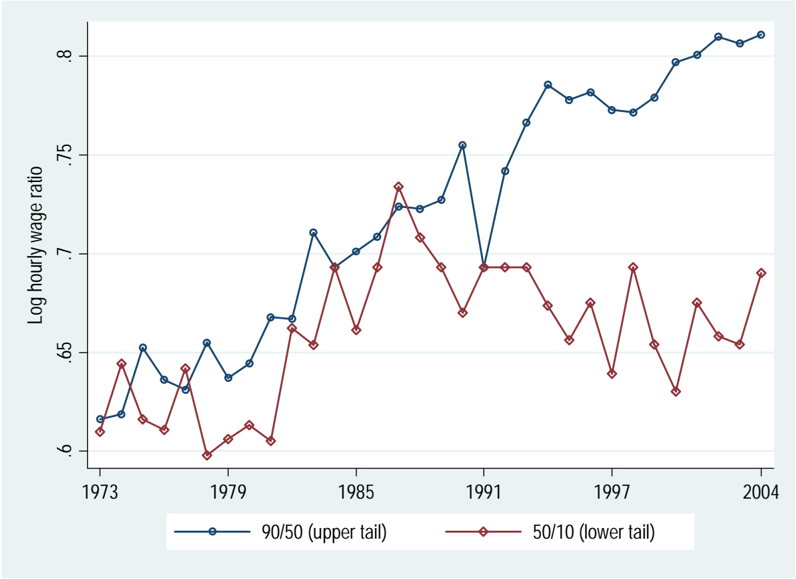
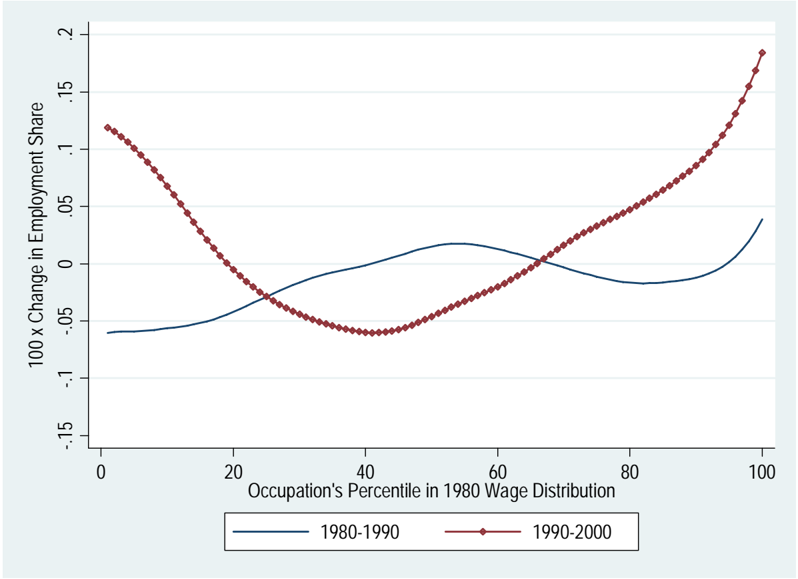
This paper analyzes a marked change in the evolution of the U.S. wage structure over the past fifteen years: divergent trends in upper-tail (90/50) and lower-tail (50/10) wage inequality. We document that wage inequality in the top half of distribution has displayed an unchecked and rather smooth secular rise for the last 25 years (since 1980). Wage inequality in the bottom half of the distribution also grew rapidly from 1979 to 1987, but it has ceased growing (and for some measures actually narrowed) since the late 1980s. Furthermore we find that occupational employment growth shifted from monotonically increasing in wages (education) in the 1980s to a pattern of more rapid growth in jobs at the top and bottom relative to the middles of the wage (education) distribution in the 1990s. We characterize these patterns as the "polarization" of the U.S. labor market, with employment polarizing into high-wage and low-wage jobs at the expense of middle-wage work. We show how a model of computerization in which computers most strongly complement the non-routine (abstract) cognitive tasks of high-wage jobs, directly substitute for the routine tasks found in many traditional middle-wage jobs, and may have little direct impact on non-routine manual tasks in relatively low-wage jobs can help explain the observed polarization of the U.S. labor market.
Overview
CoChat Summary
TL;DR
This paper documents that U.S. wage inequality diverged after the late 1980s: upper-tail inequality kept rising while lower-tail inequality stopped growing, and employment growth shifted from monotonic skill upgrading in the 1980s to polarization into high- and low-wage jobs in the 1990s. The authors argue that a model of computerization—complementing abstract tasks, substituting for routine tasks, and having little direct effect on non-routine manual tasks—can help explain these patterns.
Key findings
- From 1979 to 1987, upper-half (90/50) and lower-half (50/10) wage inequality rose similarly, expanding the 90-10 log wage differential by 21 log points; after 1987, upper-half inequality continued rising while the 50-10 differential contracted by 4 log points from 1987 to 2004, leaving only 4 log points of 90-10 growth since 1987.
- Occupational employment growth changed from monotonically increasing in wages/education in the 1980s to polarized growth in the 1990s: employment grew more rapidly below the 25th and above the 65th percentiles of the occupational wage distribution and declined in the middle (25th to 65th percentiles).
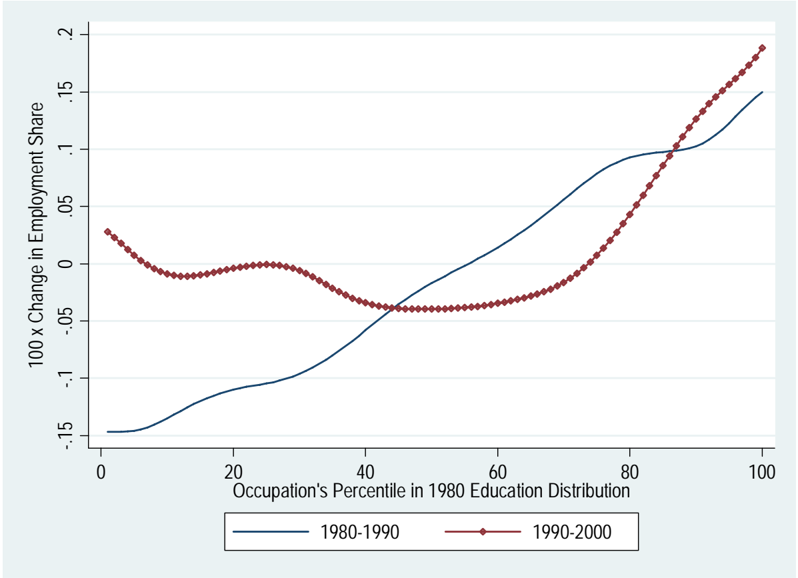
- Using 1980 occupational education percentiles, employment growth was near-monotonic in the 1980s but polarized in the 1990s, with more rapid growth at the bottom than the middle and the most rapid, diverging gains at the top.
- The authors find that quantity and price changes covary positively throughout the earnings distribution in both the 1980s and 1990s, suggesting labor demand shifts are central to explaining wage structure changes.
Methods
- The paper combines descriptive analysis of U.S. wage and employment data with a conceptual task-based model of computerization.
- Wage inequality trends are measured using Current Population Survey May samples for 1973–78 and Merged Outgoing Rotation Group samples for 1979–2004, focusing on 90/50 and 50/10 log hourly wage differentials.
- Employment polarization is analyzed using 1980, 1990, and 2000 Census Integrated Public Use Microsamples, ranking occupations by 1980 median hourly wage or average years of schooling and fitting locally weighted smoothing regressions of decadal employment-share growth on initial skill percentile.
Limitations
- Stated: the model assumes only two worker types, with college workers supplying abstract skill and high school workers substituting between routine and manual tasks; a more complete model would allow endogenous education responses, routine skills for college workers, abstract skills for high school workers, and heterogeneity in abstract skills among college workers.
- Stated: the “social norms” explanation for upper-tail skewness is intriguing but needs refinement to be directly testable, and the minimum wage explanation fits lower-tail inequality trends only to 1987.
- Evident: the paper is largely descriptive and theoretical rather than a causal test of computerization; the model’s predictions are used to interpret observed polarization, but the text does not report direct causal estimates linking computerization to the wage and employment changes.
Model-written summary. Check it against the paper before relying on it.
Integrity signals
Registry
Cites
Statistics
Figures
Verification
Claims the paper makes
0 Valid · 3 Not valid · 14 Not checked · 49 Own results and interpretations
A result the paper states — it cites no source for it, so there is none to check. The quote shows it is in the paper.
In the paper
“The net effect has been a slower growth of only 4 log points in the 90-10 log wage differential since 1987.”
plain- Asserted: passes — The authors put it forward as true.
- Checkable: passes — It can be checked against evidence.
- Load-bearing: passes — The paper’s conclusions depend on it.
- Based: passes — The paper gives a reason why it holds.
A result the paper reports from its own data — it cites no other source for it, so there is none to check. The quote shows it is in the paper.
In the paper
“Using this skill measure, we find near-monotonic (almost linear) increases in employment growth moving up the education distribution in the 1980s.”
plainstates an association- Asserted: passes — The authors put it forward as true.
- Checkable: passes — It can be checked against evidence.
- Load-bearing: unclear — It is unclear whether the paper’s conclusions depend on it.
- Based: passes — The paper gives a reason why it holds.
A result the paper reports from its own data — it cites no other source for it, so there is none to check. The quote shows it is in the paper.
In the paper
“We document that wage inequality in the top half of distribution has displayed an unchecked and rather smooth secular rise for the last 25 years (since 1980).”
- Also stated in: § ABSTRACT · plain
“wage inequality in the top half of the distribution has exhibited an unchecked secular rise for the last 25 years (since 1980)”
plain- Asserted: passes — The authors put it forward as true.
- Checkable: passes — It can be checked against evidence.
- Load-bearing: passes — The paper’s conclusions depend on it.
- Based: passes — The paper gives a reason why it holds.
- Also stated in: § ABSTRACT · plain
A result the paper reports from its own data — it cites no other source for it, so there is none to check. The quote shows it is in the paper.
In the paper
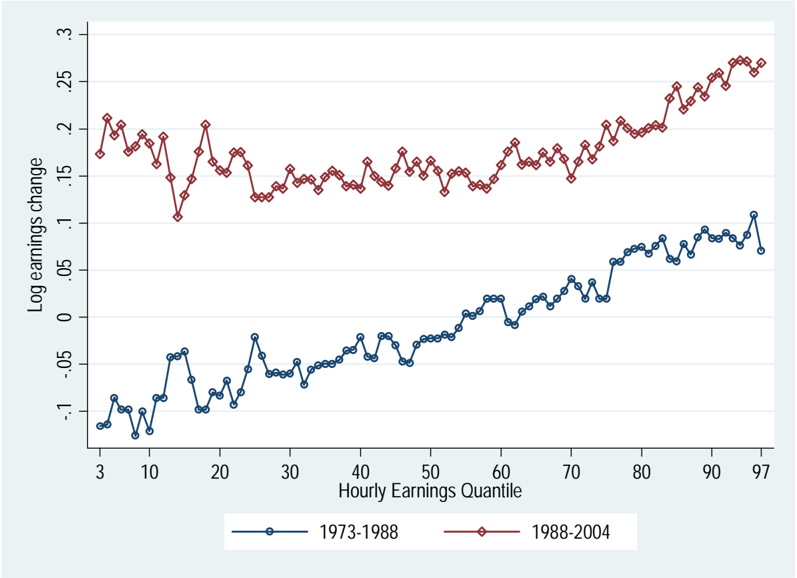
“The figure shows an almost linear spreading out of the entire wage distribution (from the 3 rd to 97 th percentile) in the first half of the sample (driven by changes in the 1980s).”
plainstates a cause- Asserted: passes — The authors put it forward as true.
- Checkable: passes — It can be checked against evidence.
- Load-bearing: passes — The paper’s conclusions depend on it.
- Based: passes — The paper gives a reason why it holds.
A result the paper reports from its own data — it cites no other source for it, so there is none to check. The quote shows it is in the paper.
In the paper
“The plot shows similar substantial increases in upper-half (90-50) and lower-half (50-10) wage inequality from 1979 to 1987, expanding the 90-10 log wage differential by 21 log points.”
plain- Asserted: passes — The authors put it forward as true.
- Checkable: passes — It can be checked against evidence.
- Load-bearing: passes — The paper’s conclusions depend on it.
- Based: passes — The paper gives a reason why it holds.
37 more claims
Create a free account to see all 66 claims and every source verdict.
- It may state two separate claims as one. 20
- Probably not a substantial claim. 5
- The quote only partly states this claim. 1
Claims other papers make about this one
Each is checked against this paper’s own text: does it say what the citing paper says it does?
The source backs part of the claim, not all of it — or backs it for a different population, condition or comparison.
In the citing paper
“Since the 1980s, the U.S. labor market has experienced declines in middle-skill, middle-income jobs in manufacturing and construction as a result of improvements in assembly line automation and the displacement of routine production jobs offshore, among other explanations (Acemoglu and Autor 2011; Autor, Katz, and Kearney 2006; Kalleberg 2009).”
From Beyond the Great Recession: Labor Market Polarization and Ongoing Fertility Decline in the United States (2019) · cites this paper as Autor, Katz, and Kearney 2006
Experimental — accuracy not yet measuredThe cited source says what the claim attributes to it.
In the citing paper
“Prior research on computer-based automation posited that routine work was most susceptible to replacement by computers (Autor et al., 2006; Acemoglu and Autor, 2011).”
From Large language models at work in China’s labor market (2025) · cites this paper as Autor et al., 2006
Citations
Cites
The Skill Content of Recent Technological Change: An Empirical Exploration
Autor, D. H., Levy, F., & Murnane, R. J. (2003) · The Quarterly Journal of Economics · doi:10.1162/003355303322552801 · Cited by 6,205
Self-citationIncome Inequality in the United States, 1913-1998
Piketty, T., & Saez, E. (2003) · The Quarterly Journal of Economics · doi:10.1162/00335530360535135 · Cited by 3,769
Lousy and Lovely Jobs: The Rising Polarization of Work in Britain
Goos, M., & Manning, A. (2007) · Review of Economics and Statistics · doi:10.1162/rest.89.1.118 · Cited by 2,285
Why Has CEO Pay Increased So Much?*
Gabaix, X., & Landier, A. (2008) · Quarterly Journal of Economics · doi:10.1162/qjec.2008.123.1.49 · Cited by 1,764
Skill‐Biased Technological Change and Rising Wage Inequality: Some Problems and Puzzles
Card, D., & DiNardo, J. E. (2002) · Journal of Labor Economics · doi:10.1086/342055 · Cited by 1,714
Technical Change, Job Tasks, and Rising Educational Demands: Looking outside the Wage Structure
Spitz‐Oener, A. (2006) · Journal of Labor Economics · doi:10.1086/499972 · Cited by 1,241
Changes in Unemployment and Wage Inequality: An Alternative Theory and Some Evidence
Acemoglu, D. (1999) · American Economic Review · doi:10.1257/aer.89.5.1259 · Cited by 634
Research works printed but not linked: 3
- Antràs Garicano, Quarterly Journal of Economics (forthcoming).
- Katz Lawrence F, 1999, North-Holland, 1463
- Lemieux Thomas, American Economic Review (forthcoming).
Cited by
Items 201–300 of 1,479
Artificial Intelligence, Robots and Unemployment: Evidence from OECD Countries
Bordot, F. (2022) · Journal of Innovation Economics & Management · doi:10.3917/jie.037.0117 · Cited by 122
Immigration and Production Technology
Lewis, E. (2013) · Annual Review of Economics · doi:10.1146/annurev-economics-080612-134132 · Cited by 106
Telework in the spread of COVID-19
Okubo, T. (2022) · Information Economics and Policy · doi:10.1016/j.infoecopol.2022.100987 · Cited by 98
Lehn, C. V. (2019) · Journal of Monetary Economics · doi:10.1016/j.jmoneco.2019.01.004 · Cited by 79
Technology, employment and skills: A look into job duration
Silva, H. C., & Lima, F. (2017) · Research Policy · doi:10.1016/j.respol.2017.07.007 · Cited by 87
A Distribution in Motion: The Case of ArgentinaPreprint
Cruces, G., & Gasparini, L. (2008) · RePEc: Research Papers in Economics · Cited by 108
Kok, S., & ter Weel, B. (2014) · Journal of Regional Science · doi:10.1111/jors.12125 · Cited by 71
Lewandowski, P., Park, A. F., Hardy, W., Du, Y., & Wu, S. (2022) · The World Bank Economic Review · doi:10.1093/wber/lhac005 · Cited by 93
The Employment Consequences of Robots: Firm-Level EvidencePreprint
Dixon, J., Hong, B., & Wu, L. (2020) · Social Science Research Network · doi:10.2139/ssrn.3422581 · Cited by 317
Between communism and capitalism: long-term inequality in Poland, 1892–2015
Bukowski, P., & Novokmet, F. (2021) · Journal of Economic Growth · doi:10.1007/s10887-021-09190-1 · Cited by 109
Si, R., Wang, Y., Cao, M., et al. (2024) · International Review of Economics & Finance · doi:10.1016/j.iref.2024.103406 · Cited by 65
Recent Trends in the Earnings of New Immigrants to the United States
Borjas, G. J., & Friedberg, R. M. (2009) · National Bureau of Economic Research · doi:10.3386/w15406 · Cited by 64
Codagnone, C., Fabienne, A., & Biagi, F. (2016) · SSRN Electronic Journal · doi:10.2139/ssrn.2784774 · Cited by 75
Wang, S., Huang, X., Xia, M., & Shi, X. (2024) · Journal of the Knowledge Economy · doi:10.1007/s13132-023-01707-w · Cited by 80
Globalization and imperfect labor market sorting
Davidson, C., Heyman, F., Matusz, S. J., Sjöholm, F., & Zhu, S. C. (2014) · Journal of International Economics · doi:10.1016/j.jinteco.2014.08.001 · Cited by 80
Changes in wage inequality in Canada: An interprovincial perspective
Fortin, N. M., & Lemieux, T. (2015) · Canadian Journal of Economics/Revue canadienne d économique · doi:10.1111/caje.12140 · Cited by 95
Economic Stimulus at the Expense of Routine-Task Jobs
Tüzel, Ş., & Zhang, M. B. (2017) · The Journal of Finance · doi:10.1111/jofi.13080 · Cited by 71
Vocational education: A clean slate for disengaged students?
Kelly, S., & Price, H. E. (2009) · Social Science Research · doi:10.1016/j.ssresearch.2009.05.002 · Cited by 79
Selected Issues in the Rise of Income Inequality
Gordon, R. J., & Dew-Becker, I. (2007) · Brookings Papers on Economic Activity · doi:10.1353/eca.2008.0011 · Cited by 69
Inference on counterfactual distributions
Melly, B., Fernández‐Val, I., & Chernozhukov, V. (2013) · doi:10.1920/wp.cem.2013.1713 · Cited by 66
The Changing (Dis-)Utility of Work
Kaplan, G., & Schulhofer-Wohl, S. (2018) · Journal of Economic Perspectives · doi:10.1257/jep.32.3.239 · Cited by 60
Exporting, skills and wage inequality
Klein, M. W., Moser, C., & Urban, D. M. (2013) · Labour Economics · doi:10.1016/j.labeco.2013.03.005 · Cited by 87
The anatomy of job polarisation in the UK
Salvatori, A. (2018) · Journal for Labour Market Research · doi:10.1186/s12651-018-0242-z · Cited by 88
The Costs of Occupational Mobility: An Aggregate Analysis
Cortés, G. M., & Gallipoli, G. (2015) · Journal of the European Economic Association · doi:10.1093/jeea/jvx006 · Cited by 106
Tertiary Education Systems and Labour Markets
Machin, S. J., & McNally, S. (2007) · University of Surrey Open Research repository · Cited by 132
Bischoff, K., & Owens, A. M. D. (2019) · Demography · doi:10.1007/s13524-019-00817-y · Cited by 68
Qin, B., Yu, Y., Ge, L., Yiting, L., Zheng, Y., & Liu, Z. (2024) · Cities · doi:10.1016/j.cities.2024.105462 · Cited by 77
Ohtake, F. (2008) · Asian Economic Policy Review · doi:10.1111/j.1748-3131.2008.00093.x · Cited by 58
Could artificial intelligence create an unemployment crisis?
Ford, M. (2013) · Communications of the ACM · doi:10.1145/2483852.2483865 · Cited by 63
MacCrory, F., Westerman, G. F., AlHammadi, Y., & Brynjolfsson, E. (2014) · International Conference on Information Systems · Cited by 56
To be (routine) or not to be (routine), that is the question: a cross-country task-based answer†
Marcolin, L., Miroudot, S., & Squicciarini, M. (2018) · Industrial and Corporate Change · doi:10.1093/icc/dty020 · Cited by 70
The price of polarization: Estimating task prices under routine‐biased technical change
Böhm, M. J. (2020) · Quantitative Economics · doi:10.3982/qe1031 · Cited by 69
Barth, E., & Moene, K. O. (2009) · National Bureau of Economic Research · doi:10.3386/w15076 · Cited by 68
Human Capital and Income Inequality: Some Facts and Some PuzzlesPreprint
Castelló‐Climent, A., & Doménech, R. (2012) · RePEc: Research Papers in Economics · Cited by 98
International Trade and Job Polarization: Evidence at the Worker-Level
Keller, W., & Utar, H. (2016) · National Bureau of Economic Research · doi:10.3386/w22315 · Cited by 82
The macroeconomics of automation: Data, theory, and policy analysis
Jaimovich, N., Saporta‐Eksten, I., Siu, H., & Yedid‐Levi, Y. (2021) · Journal of Monetary Economics · doi:10.1016/j.jmoneco.2021.06.004 · Cited by 77
A Note to Schooling in Development Accounting
Caselli, F., & Ciccone, A. (2012) · Journal of Development Economics · doi:10.1016/j.jdeveco.2013.02.006 · Cited by 55
What drives the gender wage gap? A look at the role of firm and job-title heterogeneity
Cardoso, A. R., Guimarães, P., & Portugal, P. (2016) · Oxford Economic Papers · doi:10.1093/oep/gpv069 · Cited by 91
FIRMS' EXPECTATIONS ABOUT THE IMPACT OF AI AND ROBOTICS: EVIDENCE FROM A SURVEY
Morikawa, M. (2017) · Economic Inquiry · doi:10.1111/ecin.12412 · Cited by 54
Rozelle, S., Xia, Y., Friesen, D., Vanderjack, B., & Cohen, N. (2020) · Comparative Economic Studies · doi:10.1057/s41294-020-00137-w · Cited by 93
Wang, X., Chen, M., & Chen, N. (2024) · Heliyon · doi:10.1016/j.heliyon.2024.e26686 · Cited by 99
Inequality and polarisation in health systems’ responsiveness: A cross-country analysis
Jones, A. M., Rice, N., Robone, S., & Dias, P. R. (2011) · Journal of Health Economics · doi:10.1016/j.jhealeco.2011.05.003 · Cited by 62
Rohrbach-Schmidt, D., & Tiemann, M. (2016) · Journal for Labour Market Research · doi:10.1007/s12651-016-0198-9 · Cited by 63
The empirics of technology, employment and occupations: Lessons learned and challenges ahead
Montobbio, F., Staccioli, J., Virgillito, M. E., & Vivarelli, M. (2023) · Journal of Economic Surveys · doi:10.1111/joes.12601 · Cited by 82
The Labor Market and Young Black Men: Updating Moynihan's Perspective
Holzer, H. J. (2009) · The ANNALS of the American Academy of Political and Social Science · doi:10.1177/0002716208324627 · Cited by 52
Mobilizing the Wealthy: Doing “Privilege Work” and Challenging the Roots of Inequality
Scully, M. A., Rothenberg, S. L., Beaton, E. E., & Tang, Z. (2017) · Business & Society · doi:10.1177/0007650317698941 · Cited by 61
Occupational mobility and automation: a data-driven network model
del Rio-Chanona, R. M., Mealy, P., Beguerisse-Díaz, M., Lafond, F., & Farmer, J. D. (2021) · Journal of The Royal Society Interface · doi:10.1098/rsif.2020.0898 · Cited by 116
The endangered middle class? A comparative analysis of the role played by income redistribution
Dallinger, U. (2013) · Journal of European Social Policy · doi:10.1177/0958928712456573 · Cited by 73
Relative Income and Indebtedness: Evidence from Panel Data
Carr, M., & Jayadev, A. (2014) · Review of Income and Wealth · doi:10.1111/roiw.12134 · Cited by 66
Job polarization, job tasks and the role of firms
Heyman, F. (2016) · Economics Letters · doi:10.1016/j.econlet.2016.06.032 · Cited by 70
Automation, Job Polarisation, and Structural Change
Fierro, L. E., Caiani, A., & Russo, A. (2022) · Journal of Economic Behavior & Organization · doi:10.1016/j.jebo.2022.05.025 · Cited by 65
A Comprehensive Taxonomy of Tasks for Assessing the Impact of New Technologies on Work
Fernández‐Macías, E., & Bisello, M. (2021) · Social Indicators Research · doi:10.1007/s11205-021-02768-7 · Cited by 102
Skill Biased Financial Development: Education, Wages and Occupations in the U.S. Financial Sector
Philippon, T., & Reshef, A. (2007) · National Bureau of Economic Research · doi:10.3386/w13437 · Cited by 58
Changes in the Wage Structure in EU CountriesPreprint
Christopoulou, R., Jimeno, J. F., & Lamo, A. (2010) · SSRN Electronic Journal · doi:10.2139/ssrn.1628603 · Cited by 61
The Vanishing Middle: Job Polarization and Workers' Response to the Decline in Middle-Skill Jobs
Tüzemen, D., & Willis, J. L. (2013) · RePEc: Research Papers in Economics · Cited by 81
Putting Tasks to the Test: Human Capital, Job Tasks and Wages
Autor, D., & Handel, M. (2009) · National Bureau of Economic Research · doi:10.3386/w15116 · Cited by 73
Self-citationValadkhani, A., & Smyth, R. (2015) · Economic Modelling · doi:10.1016/j.econmod.2015.07.001 · Cited by 51
Gesthuizen, M., & Wolbers, M. H. J. (2010) · Research in Social Stratification and Mobility · doi:10.1016/j.rssm.2010.06.001 · Cited by 59
Gerten, E., Beckmann, M., & Bellmann, L. (2019) · Jahrbücher für Nationalökonomie und Statistik · doi:10.1515/jbnst-2017-0154 · Cited by 68
Vidal, M. (2012) · New Political Economy · doi:10.1080/13563467.2012.630459 · Cited by 56
Low-Wage Job Growth, Polarization, and the Limits and Opportunities of the Service Economy
Dwyer, R. E., & Wright, E. O. (2019) · RSF The Russell Sage Foundation Journal of the Social Sciences · doi:10.7758/rsf.2019.5.4.02 · Cited by 63
Martin-Caughey, A. (2021) · American Sociological Review · doi:10.1177/00031224211042053 · Cited by 61
Overeducation: Concept, theories, and empirical evidence
Capsada‐Munsech, Q. (2017) · Sociology Compass · doi:10.1111/soc4.12518 · Cited by 99
Industrial employment and income inequality: Evidence from panel data
Mehic, A. (2018) · Structural Change and Economic Dynamics · doi:10.1016/j.strueco.2018.02.006 · Cited by 64
Welfare Chauvinism, Economic Insecurity and the Asylum Seeker “Crisis”
Heizmann, B., Jedinger, A., & Perry, A. (2018) · Societies · doi:10.3390/soc8030083 · Cited by 59
Matthes, B. K., Christoph, B., Janik, F., & Ruland, M. (2014) · Journal for Labour Market Research · doi:10.1007/s12651-014-0155-4 · Cited by 63
Austerity, inequality and politics
Schaltegger, C. A., & Weder, M. (2014) · European Journal of Political Economy · doi:10.1016/j.ejpoleco.2014.03.005 · Cited by 54
Information technology and employment: The impact of job tasks and worker skills
Peng, G., Wang, Y., & Han, G. H. (2018) · Journal of Industrial Relations · doi:10.1177/0022185617741924 · Cited by 58
PRODUCE OR SPECULATE? ASSET BUBBLES, OCCUPATIONAL CHOICE, AND EFFICIENCY*
Cahuc, P., & Challe, É. (2012) · International Economic Review · doi:10.1111/j.1468-2354.2012.00713.x · Cited by 55
Yang, L. (2018) · International Journal of Educational Development · doi:10.1016/j.ijedudev.2018.02.009 · Cited by 49
Beyond R&D: the role of embodied technological change in affecting employment
Pellegrino, G., Piva, M., & Vivarelli, M. (2019) · Journal of Evolutionary Economics · doi:10.1007/s00191-019-00635-w · Cited by 52
Mainert, J., Niepel, C., Murphy, K. R., & Greiff, S. (2018) · Journal of Business and Psychology · doi:10.1007/s10869-018-9561-x · Cited by 60
Does digitalization promote net job creation? Empirical evidence from WAEMU countries
Avom, D., Dadegnon, A. K., & Igue, C. B. (2021) · Telecommunications Policy · doi:10.1016/j.telpol.2021.102215 · Cited by 53
Digital technologies, employment, and skills
Reljic, J., Evangelista, R., & Pianta, M. (2021) · Industrial and Corporate Change · doi:10.1093/icc/dtab059 · Cited by 73
Employment structure in China from 1990 to 2015
Ge, P., Sun, W., & Zhao, Z. (2021) · Journal of Economic Behavior & Organization · doi:10.1016/j.jebo.2021.02.022 · Cited by 52
Understanding the decline in the U.S. labor share: Evidence from occupational tasks
Lehn, C. V. (2018) · European Economic Review · doi:10.1016/j.euroecorev.2018.07.005 · Cited by 45
This Job is 'Getting Old:' Measuring Changes in Job Opportunities Using Occupational Age Structure
Autor, D., & Dorn, D. (2009) · National Bureau of Economic Research · doi:10.3386/w14652 · Cited by 51
Self-citationKanaparthi, V. K. (2023) · FinTech · doi:10.3390/fintech2030026 · Cited by 60
Du, J., He, J., Yang, J. H., & Chen, X. (2024) · Technological Forecasting and Social Change · doi:10.1016/j.techfore.2024.123655 · Cited by 47
Labor Market Institutions and the Dispersion of Wage Earnings
Salverda, W., & Checchi, D. (2014) · Handbook of income distribution · doi:10.1016/b978-0-444-59429-7.00019-4 · Cited by 74
Trade and Tasks: An Exploration Over Three Decades in Germany
Becker, S. O., & Muendler, M.-A. (2014) · Economic Policy · doi:10.1093/epolic/eiv014 · Cited by 70
The Routine Content Of Occupations: New Cross-Country Measures Based On PIAAC
Marcolin, L., Miroudot, S., & Squicciarini, M. (2016) · OECD trade policy working papers · doi:10.1787/5jm0mq86fljg-en · Cited by 53
(2018) · Emerald Group Publishing Limited eBooks · doi:10.1108/978-1-78743-809-520181009 · Cited by 42
Zhou, J., Lan, H., Zhao, C., & Wang, W. (2022) · Technology Analysis and Strategic Management · doi:10.1080/09537325.2022.2157255 · Cited by 44
The Financial Premium in the US Labor Market: A Distributional Analysis
Lin, K.-H. (2015) · Social Forces · doi:10.1093/sf/sou132 · Cited by 55
Routine-Biased technical change: Individual-Level evidence from a plant closure
Goos, M., Rademakers, E., & Röttger, R. (2020) · Research Policy · doi:10.1016/j.respol.2020.104002 · Cited by 53
Artificial intelligence and the wellbeing of workers
Giuntella, O., Konig, J., & Stella, L. (2025) · Scientific Reports · doi:10.1038/s41598-025-98241-3 · Cited by 116
Future skill shortages in the U.S. economy?
Neumark, D., Johnson, H. P., & Mejia, M. C. (2012) · Economics of Education Review · doi:10.1016/j.econedurev.2012.09.004 · Cited by 48
ROUTINIZATION‐BIASED TECHNICAL CHANGE AND GLOBALIZATION: UNDERSTANDING LABOR MARKET POLARIZATION
Jung, J., & Mercenier, J. (2014) · Economic Inquiry · doi:10.1111/ecin.12108 · Cited by 55
Maier, T., Mönnig, A., & Zika, G. (2015) · Economic Systems Research · doi:10.1080/09535314.2014.997678 · Cited by 57
A SURVEY OF TRADE AND WAGE INEQUALITY: ANOMALIES, RESOLUTIONS AND NEW TRENDS
Kurokawa, Y. (2012) · Journal of Economic Surveys · doi:10.1111/joes.12007 · Cited by 53
Routinization, within-occupation task changes and long-run employment dynamics
Consoli, D., Marin, G., Rentocchini, F., & Vona, F. (2022) · Research Policy · doi:10.1016/j.respol.2022.104658 · Cited by 46
Changes in the Incidence and Duration of Periods without Insurance
Cutler, D., & Gelber, A. (2009) · New England Journal of Medicine · doi:10.1056/nejmsa0804668 · Cited by 42
Workforce Development as an Antipoverty Strategy: What Do We Know? What Should We Do?Preprint
Holzer, H. J. (2008) · SSRN Electronic Journal · doi:10.2139/ssrn.1293548 · Cited by 47
Degrees of Poverty: The Relationship between Family Income Background and the Returns to Education
Bartik, T. J., & Hershbein, B. J. (2018) · Upjohn Research (W.E. Upjohn Institute for Employment Research) · doi:10.17848/wp18-284 · Cited by 55
New Skills for the Digital Economy
OECD (2016) · OECD digital economy papers · doi:10.1787/5jlwnkm2fc9x-en · Cited by 68
(2024) · OECD Digital Economy Outlook · doi:10.1787/f0b5c251-en · Cited by 41
Technological change and wage premiums: Historical evidence from linked employer–employee data
Hynninen, S., Ojala, J., & Pehkonen, J. (2013) · Labour Economics · doi:10.1016/j.labeco.2013.05.006 · Cited by 54
The Impact of Investments in New Digital Technologies on Wages – Worker-Level Evidence from Germany
Genz, S., Janser, M., & Lehmer, F. (2019) · Jahrbücher für Nationalökonomie und Statistik · doi:10.1515/jbnst-2017-0161 · Cited by 53
Computerization, obsolescence and the length of working life
Hudomiet, P., & Willis, R. J. (2021) · Labour Economics · doi:10.1016/j.labeco.2021.102005 · Cited by 52
Metadata
- Authors
- Autor, D. H., Katz, L. F., & Kearney, M. S.
- Affiliations
- National Bureau of Economic Research (US)
- Brookings Institution (US)
- Venue
- American Economic Review
- Publisher
- American Economic Association
- Published
- 2006-04-01
- Volume
- 96
- Issue
- 2
- Pages
- 189-194
- ISSN
- 0002-8282 (ISSN-L)
- OpenAlex
- W3124544360
- Cited by
- 1,594
- References
- 4
- Citations by year
- 2026: 75 · 2025: 108 · 2024: 122 · 2023: 90 · 2022: 89 · 2021: 100 · 2020: 107 · 2019: 96 · 2018: 93 · 2017: 74 · 2016: 76 · 2015: 91 · 2014: 78 · 2013: 81 · 2012: 59
- FWCI
- 110.81
- Type
- journal article
- Language
- en
- Open access
- closed
- Locations
- American Economic Review (publishedVersion)
- RePEc: Research Papers in Economics (submittedVersion)
- Topics
- Social Sciences › Economics, Econometrics and Finance › Economics and Econometrics › Labor market dynamics and wage inequality
- Social Sciences › Economics, Econometrics and Finance › General Economics, Econometrics and Finance › Economic Theory and Policy
- Social Sciences › Sociology and Political Science › Income, Poverty, and Inequality
- Keywords
- labor market polarization, wage inequality, wage distribution, computerization, high-wage jobs, low-wage employment, United States labor market
About these checks
Registry, retraction, Cites and statistics results are computed, not judged, with one exception: a printed reference that no index lists is read once by a model before it counts as a citation error. Claims are extracted by a model and kept only when their quote appears verbatim in the text; each cited source is then checked, with a model’s help, for whether it says what the claim relies on. Those verdicts can be wrong — read the claim’s quote and the cited source before relying on one.
A language model drew the claims from the paper on 2026-10-12, under version 3 of the claim definition (model deepseek-v4.1-flash, prompt extract-v3).
A second model labelled each claim on 2026-10-12 (model jev-1.13-20260917, definition revision gold-guideline-v0.2).
Statistics and arithmetic are recomputed, not judged.
Confidence bands are shown only for fields calibrated on our annotated test set. None is calibrated yet, so no band is shown.
What counts as a claim ›How we measure confidence ›How we check this ›
Are you an author, or do you see a problem with this page? Request a review
Data sources
Bibliographic data: Semantic Scholar, OpenAlex, Crossref.
Contains information from the Semantic Scholar Academic Graph Datasets, made available under the ODC Attribution License (ODC-BY 1.0).
Semantic Scholar’s data is described in: Kinney, R., et al. (2023). The Semantic Scholar Open Data Platform. arXiv:2301.10140.
