

The Polarization of the U.S. Labor Market
The DOI matches its Crossref record; 7 of the 7 references it cites were found in a registry or an index; none of the 16 sources its claims cite is checked for support yet.
Abstract
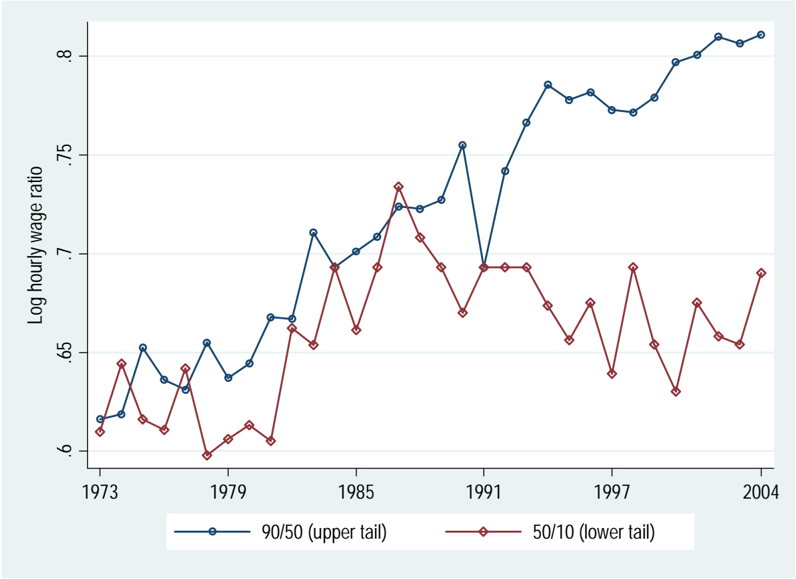
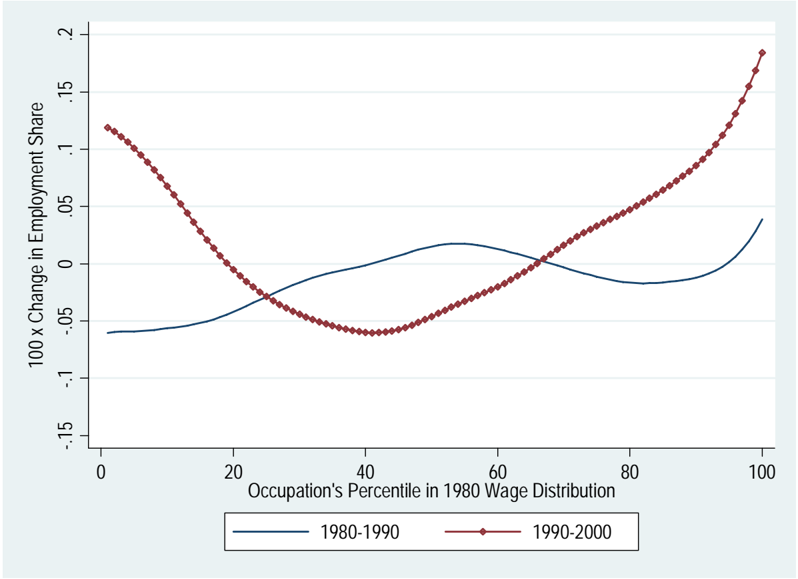
This paper analyzes a marked change in the evolution of the U.S. wage structure over the past fifteen years: divergent trends in upper-tail (90/50) and lower-tail (50/10) wage inequality. We document that wage inequality in the top half of distribution has displayed an unchecked and rather smooth secular rise for the last 25 years (since 1980). Wage inequality in the bottom half of the distribution also grew rapidly from 1979 to 1987, but it has ceased growing (and for some measures actually narrowed) since the late 1980s. Furthermore we find that occupational employment growth shifted from monotonically increasing in wages (education) in the 1980s to a pattern of more rapid growth in jobs at the top and bottom relative to the middles of the wage (education) distribution in the 1990s. We characterize these patterns as the "polarization" of the U.S. labor market, with employment polarizing into high-wage and low-wage jobs at the expense of middle-wage work. We show how a model of computerization in which computers most strongly complement the non-routine (abstract) cognitive tasks of high-wage jobs, directly substitute for the routine tasks found in many traditional middle-wage jobs, and may have little direct impact on non-routine manual tasks in relatively low-wage jobs can help explain the observed polarization of the U.S. labor market.
Overview
CoChat Summary
TL;DR
This paper documents that U.S. wage inequality diverged after the late 1980s: upper-tail inequality kept rising while lower-tail inequality stopped growing, and employment growth shifted from monotonic skill upgrading in the 1980s to polarization into high- and low-wage jobs in the 1990s. The authors argue that a model of computerization—complementing abstract tasks, substituting for routine tasks, and having little direct effect on non-routine manual tasks—can help explain these patterns.
Key findings
- From 1979 to 1987, upper-half (90/50) and lower-half (50/10) wage inequality rose similarly, expanding the 90-10 log wage differential by 21 log points; after 1987, upper-half inequality continued rising while the 50-10 differential contracted by 4 log points from 1987 to 2004, leaving only 4 log points of 90-10 growth since 1987.
- Occupational employment growth changed from monotonically increasing in wages/education in the 1980s to polarized growth in the 1990s: employment grew more rapidly below the 25th and above the 65th percentiles of the occupational wage distribution and declined in the middle (25th to 65th percentiles).
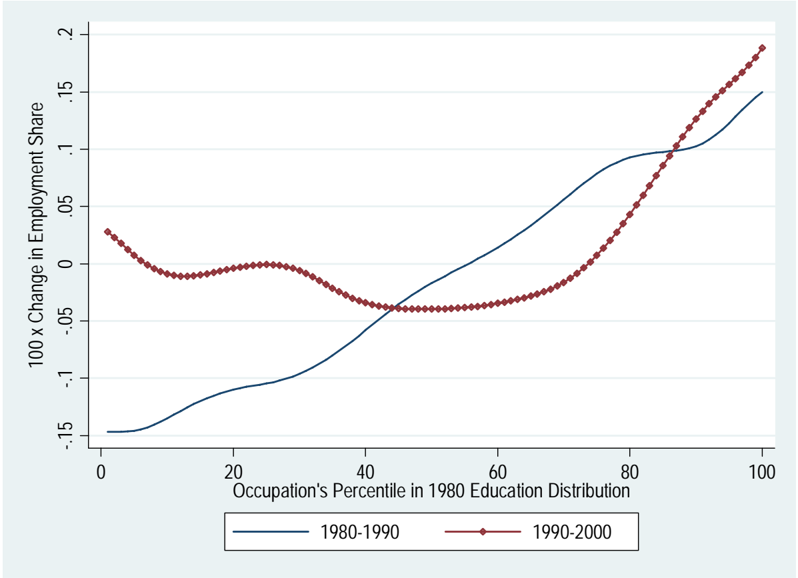
- Using 1980 occupational education percentiles, employment growth was near-monotonic in the 1980s but polarized in the 1990s, with more rapid growth at the bottom than the middle and the most rapid, diverging gains at the top.
- The authors find that quantity and price changes covary positively throughout the earnings distribution in both the 1980s and 1990s, suggesting labor demand shifts are central to explaining wage structure changes.
Methods
- The paper combines descriptive analysis of U.S. wage and employment data with a conceptual task-based model of computerization.
- Wage inequality trends are measured using Current Population Survey May samples for 1973–78 and Merged Outgoing Rotation Group samples for 1979–2004, focusing on 90/50 and 50/10 log hourly wage differentials.
- Employment polarization is analyzed using 1980, 1990, and 2000 Census Integrated Public Use Microsamples, ranking occupations by 1980 median hourly wage or average years of schooling and fitting locally weighted smoothing regressions of decadal employment-share growth on initial skill percentile.
Limitations
- Stated: the model assumes only two worker types, with college workers supplying abstract skill and high school workers substituting between routine and manual tasks; a more complete model would allow endogenous education responses, routine skills for college workers, abstract skills for high school workers, and heterogeneity in abstract skills among college workers.
- Stated: the “social norms” explanation for upper-tail skewness is intriguing but needs refinement to be directly testable, and the minimum wage explanation fits lower-tail inequality trends only to 1987.
- Evident: the paper is largely descriptive and theoretical rather than a causal test of computerization; the model’s predictions are used to interpret observed polarization, but the text does not report direct causal estimates linking computerization to the wage and employment changes.
Model-written summary. Check it against the paper before relying on it.
Integrity signals
Registry
Cites
Statistics
Figures
Verification
Claims the paper makes
0 Valid · 3 Not valid · 14 Not checked · 49 Own results and interpretations
A result the paper states — it cites no source for it, so there is none to check. The quote shows it is in the paper.
In the paper
“The net effect has been a slower growth of only 4 log points in the 90-10 log wage differential since 1987.”
plain- Asserted: passes — The authors put it forward as true.
- Checkable: passes — It can be checked against evidence.
- Load-bearing: passes — The paper’s conclusions depend on it.
- Based: passes — The paper gives a reason why it holds.
A result the paper reports from its own data — it cites no other source for it, so there is none to check. The quote shows it is in the paper.
In the paper
“Using this skill measure, we find near-monotonic (almost linear) increases in employment growth moving up the education distribution in the 1980s.”
plainstates an association- Asserted: passes — The authors put it forward as true.
- Checkable: passes — It can be checked against evidence.
- Load-bearing: unclear — It is unclear whether the paper’s conclusions depend on it.
- Based: passes — The paper gives a reason why it holds.
A result the paper reports from its own data — it cites no other source for it, so there is none to check. The quote shows it is in the paper.
In the paper
“We document that wage inequality in the top half of distribution has displayed an unchecked and rather smooth secular rise for the last 25 years (since 1980).”
- Also stated in: § ABSTRACT · plain
“wage inequality in the top half of the distribution has exhibited an unchecked secular rise for the last 25 years (since 1980)”
plain- Asserted: passes — The authors put it forward as true.
- Checkable: passes — It can be checked against evidence.
- Load-bearing: passes — The paper’s conclusions depend on it.
- Based: passes — The paper gives a reason why it holds.
- Also stated in: § ABSTRACT · plain
A result the paper reports from its own data — it cites no other source for it, so there is none to check. The quote shows it is in the paper.
In the paper
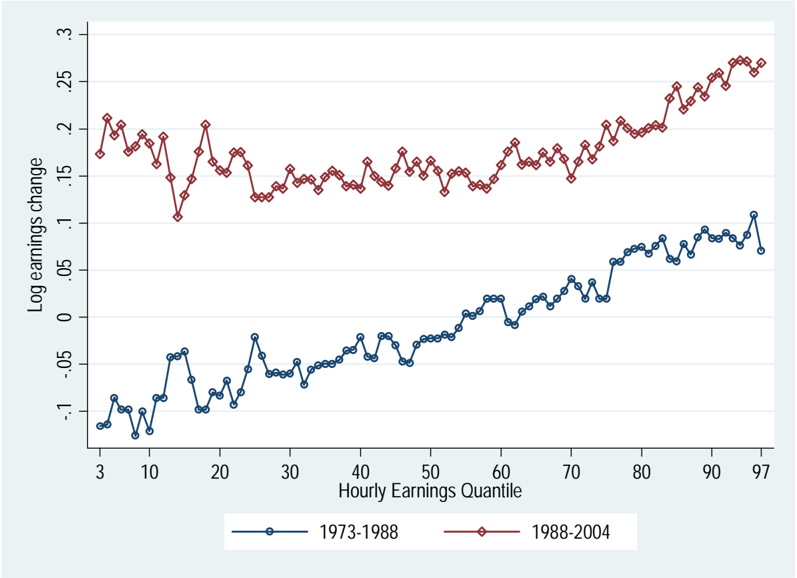
“The figure shows an almost linear spreading out of the entire wage distribution (from the 3 rd to 97 th percentile) in the first half of the sample (driven by changes in the 1980s).”
plainstates a cause- Asserted: passes — The authors put it forward as true.
- Checkable: passes — It can be checked against evidence.
- Load-bearing: passes — The paper’s conclusions depend on it.
- Based: passes — The paper gives a reason why it holds.
A result the paper reports from its own data — it cites no other source for it, so there is none to check. The quote shows it is in the paper.
In the paper
“The plot shows similar substantial increases in upper-half (90-50) and lower-half (50-10) wage inequality from 1979 to 1987, expanding the 90-10 log wage differential by 21 log points.”
plain- Asserted: passes — The authors put it forward as true.
- Checkable: passes — It can be checked against evidence.
- Load-bearing: passes — The paper’s conclusions depend on it.
- Based: passes — The paper gives a reason why it holds.
37 more claims
Create a free account to see all 66 claims and every source verdict.
- It may state two separate claims as one. 20
- Probably not a substantial claim. 5
- The quote only partly states this claim. 1
Claims other papers make about this one
Each is checked against this paper’s own text: does it say what the citing paper says it does?
The source backs part of the claim, not all of it — or backs it for a different population, condition or comparison.
In the citing paper
“Since the 1980s, the U.S. labor market has experienced declines in middle-skill, middle-income jobs in manufacturing and construction as a result of improvements in assembly line automation and the displacement of routine production jobs offshore, among other explanations (Acemoglu and Autor 2011; Autor, Katz, and Kearney 2006; Kalleberg 2009).”
From Beyond the Great Recession: Labor Market Polarization and Ongoing Fertility Decline in the United States (2019) · cites this paper as Autor, Katz, and Kearney 2006
Experimental — accuracy not yet measuredThe cited source says what the claim attributes to it.
In the citing paper
“Prior research on computer-based automation posited that routine work was most susceptible to replacement by computers (Autor et al., 2006; Acemoglu and Autor, 2011).”
From Large language models at work in China’s labor market (2025) · cites this paper as Autor et al., 2006
Citations
Cites
The Skill Content of Recent Technological Change: An Empirical Exploration
Autor, D. H., Levy, F., & Murnane, R. J. (2003) · The Quarterly Journal of Economics · doi:10.1162/003355303322552801 · Cited by 6,205
Self-citationIncome Inequality in the United States, 1913-1998
Piketty, T., & Saez, E. (2003) · The Quarterly Journal of Economics · doi:10.1162/00335530360535135 · Cited by 3,769
Lousy and Lovely Jobs: The Rising Polarization of Work in Britain
Goos, M., & Manning, A. (2007) · Review of Economics and Statistics · doi:10.1162/rest.89.1.118 · Cited by 2,285
Why Has CEO Pay Increased So Much?*
Gabaix, X., & Landier, A. (2008) · Quarterly Journal of Economics · doi:10.1162/qjec.2008.123.1.49 · Cited by 1,764
Skill‐Biased Technological Change and Rising Wage Inequality: Some Problems and Puzzles
Card, D., & DiNardo, J. E. (2002) · Journal of Labor Economics · doi:10.1086/342055 · Cited by 1,714
Technical Change, Job Tasks, and Rising Educational Demands: Looking outside the Wage Structure
Spitz‐Oener, A. (2006) · Journal of Labor Economics · doi:10.1086/499972 · Cited by 1,241
Changes in Unemployment and Wage Inequality: An Alternative Theory and Some Evidence
Acemoglu, D. (1999) · American Economic Review · doi:10.1257/aer.89.5.1259 · Cited by 634
Research works printed but not linked: 3
- Antràs Garicano, Quarterly Journal of Economics (forthcoming).
- Katz Lawrence F, 1999, North-Holland, 1463
- Lemieux Thomas, American Economic Review (forthcoming).
Cited by
Items 801–900 of 1,479
Efectos del cambio tecnológico en los mercados de trabajo regionales en México
Pérez, R. E. R., & Lugo, D. C. (2012) · ESTUDIOS FRONTERIZOS · doi:10.21670/ref.2012.26.a06 · Cited by 22
Modern management and the demand for technical skill
Lee, Y. S. (2018) · Labour Economics · doi:10.1016/j.labeco.2018.11.001 · Cited by 10
Mismatch in the Labor Market: Measuring the Supply of and Demand for Skilled Labor in New EnglandPreprint
Modestino, A. (2011) · SSRN Electronic Journal · doi:10.2139/ssrn.1947436 · Cited by 6
Growth with equity in Singapore: Challenges and prospectsPreprint
Toh, H. W. T. R. (2014) · RePEc: Research Papers in Economics · Cited by 6
Figueiredo, H., Teixeira, P., & Rubery, J. (2011) · RePEc: Research Papers in Economics · Cited by 9
The endangered middle class? A comparative analysis of the role public redistribution playsPreprint
Dallinger, U. (2011) · RePEc: Research Papers in Economics · Cited by 9
The Dynamics of CapitalismPreprint
Scherer, F. M. (2009) · SSRN Electronic Journal · doi:10.2139/ssrn.1523309 · Cited by 6
Firm-Level Technology Adoption in the State of Ceara in Brazil
Comín, D., Cirera, X., Lee, K. M., et al. (2021) · World Bank, Washington, DC eBooks · doi:10.1596/1813-9450-9568 · Cited by 6
The changing nature of work and earnings inequality in China
Xing, C. (2021) · WIDER Working Paper Series · doi:10.35188/unu-wider/2021/045-0 · Cited by 8
Relational Expertise: What Machines Can't KnowPreprint
Pakarinen, P., & Huising, R. (2024) · SSRN Electronic Journal · doi:10.2139/ssrn.4785397 · Cited by 6
The impact of increasing labour market rigidity on employment growth in OECD countries
Wiese, R., Jalles, J. T., & de Haan, J. (2025) · Economic Analysis and Policy · doi:10.1016/j.eap.2025.03.010 · Cited by 12
Chetty, R., Dobbie, W., Goldman, B., Porter, S. R., & Yang, C. S. (2026) · The Quarterly Journal of Economics · doi:10.1093/qje/qjaf057 · Cited by 29
Digital infrastructure construction and urban inflow of high-skilled talents: evidence from China
Zou, X., Meng, S., & Liu, C. (2026) · Humanities and Social Sciences Communications · doi:10.1057/s41599-026-06590-9 · Cited by 12
Polarisation et bas salaires : comment sortir certains emplois de l’impasse ?
Devetter, F., & Valentin, J. (2021) · Revue de l'OFCE/La Revue de l'OFCE · doi:10.3917/reof.169.0005 · Cited by 8
Digital Economy and Entrepreneurship: Heterogeneity of Labor Force Skills
Wen, H., Li, N., & Zhou, F. (2025) · Asian Economics Letters · doi:10.46557/001c.39726 · Cited by 5
Income polarisation, expenditure and the Australian urban middle class
Wiesel, I., de Bruyn, J., Meekes, J., & Chandrashekeran, S. (2023) · Urban Studies · doi:10.1177/00420980231164922 · Cited by 7
How can industrial intelligence change the employment structure of the floating population?
Siyao, L., Ya, W., & Yingfeng, L. (2024) · PLoS ONE · doi:10.1371/journal.pone.0297266 · Cited by 6
Wang, L., Zhao, J. C., Sun, J., & Dong, Z. (2019) · Chinese Management Studies · doi:10.1108/cms-07-2018-0615 · Cited by 7
The Digital Transformation and Labor Demand
Calvino, F., & Spiezia, V. (2020) · Springer eBooks · doi:10.1007/978-3-319-57365-6_19-3 · Cited by 7
Barros, D., & Teixeira, A. A. C. (2021) · Review of Regional Research · doi:10.1007/s10037-020-00149-0 · Cited by 7
Lee, J. (2022) · Social Science Research · doi:10.1016/j.ssresearch.2022.102840 · Cited by 7
Machine endowment cost model: task assignment between humans and machines
Gong, Q. (2023) · Humanities and Social Sciences Communications · doi:10.1057/s41599-023-01622-0 · Cited by 7
Yang, L., & Liu, Y. (2024) · Environment Development and Sustainability · doi:10.1007/s10668-023-04414-3 · Cited by 5
Learning the Right Skill: Vocational Curricula and Returns to Skills
Cnossen, F., Piracha, M., & Tchuente, G. (2024) · Journal of Labor Economics · doi:10.1086/730123 · Cited by 13
Sustainable youth employment quality management: The impact of robotization in China
Liang, F., & Liu, Y. (2024) · PLoS ONE · doi:10.1371/journal.pone.0298081 · Cited by 6
Hinks, T. (2024) · AI & Society · doi:10.1007/s00146-024-01962-8 · Cited by 7
Gannaway, G., Palsson, C., Price, J., & Sims, D. (2014) · Journal of Sports Economics · doi:10.1177/1527002514542740 · Cited by 5
États-Unis : l'emploi contre les salaires depuis les années 1980
Sauviat, C. (2012) · La Revue de l Ires · doi:10.3917/rdli.073.0151 · Cited by 4
Occupations at risk: job tasks, job security, and wages
Nedelkoska, L. (2013) · Industrial and Corporate Change · doi:10.1093/icc/dtt002 · Cited by 10
Why Are There Still So Many Jobs? The History and Future of Workplace
Autor, D. (2015) · Cited by 6
Self-citationDillon, E. W. (2017) · Labour Economics · doi:10.1016/j.labeco.2017.09.006 · Cited by 6
Forced migration in childhood and subsequent fertility: The Karelian displaced population in Finland
Saarela, J. M., & Skirbekk, V. (2018) · Population Space and Place · doi:10.1002/psp.2223 · Cited by 4
Kim, E., Hong, A., & Hwang, J. (2018) · Telematics and Informatics · doi:10.1016/j.tele.2018.12.002 · Cited by 7
Smolarek, B. B., & Scrivener, L. (2019) · Journal of Education Policy · doi:10.1080/02680939.2019.1686539 · Cited by 7
Technical Progress and Structural Change in Jean Fourastié’s Theory of Development
Alcouffe, A., & Bris, D. L. (2019) · History of Political Economy · doi:10.1215/00182702-8009547 · Cited by 7
Changes in Occupations, Jobs, and Skill Polarization
Sakamoto, A., Kim, C., & Tamborini, C. R. (2020) · Cambridge University Press eBooks · doi:10.1017/9781108278034.006 · Cited by 5
Graizbord, B., & Santiago, L. E. (2020) · EURE (Santiago) · doi:10.7764/eure.47.141.02 · Cited by 6
Mismatch unemployment in Austria: the role of regional labour markets for skills
Böheim, R., & Christl, M. (2022) · Regional Studies Regional Science · doi:10.1080/21681376.2022.2061867 · Cited by 18
Cooperate or compete? The impact of vertical wage dispersion on employees’ behavior in tournaments
Guo, L., Huo, K., & Libby, T. (2022) · Management Accounting Research · doi:10.1016/j.mar.2022.100817 · Cited by 4
Anderson, G. J. (2017) · Social Indicators Research · doi:10.1007/s11205-017-1767-1 · Cited by 6
Using tools to distinguish general and occupation-specific skills
Cunningham, C., & Mohr, R. D. (2019) · Journal for Labour Market Research · doi:10.1186/s12651-019-0256-1 · Cited by 8
D’Orlando, F. (2022) · Basic Income Studies · doi:10.1515/bis-2020-0001 · Cited by 5
Offshoring and the Skill‐premium: Evidence from Individual Workers’ Data
Tempesti, T. (2015) · World Economy · doi:10.1111/twec.12298 · Cited by 8
Evidence on new technologies and wage inequality in France
Moreno-Galbis, E., & Wolff, F. (2009) · Applied Economics · doi:10.1080/00036840802600004 · Cited by 5
Technology diffusion and its effects on social inequalities
Magalhães, M., & Hellström, C. (2013) · Journal of Macroeconomics · doi:10.1016/j.jmacro.2013.05.008 · Cited by 9
Tasks, Talents and TaxesPreprint
Ales, L., Kurnaz, M., & Sleet, C. M. (2014) · SSRN Electronic Journal · doi:10.2139/ssrn.2422522 · Cited by 5
Wage inequality in trade-in-tasks modelsPreprint
Rojas‐Romagosa, H. (2011) · RePEc: Research Papers in Economics · Cited by 12
Broecke, S., Quintini, G., & Vandeweyer, M. (2015) · SSRN Electronic Journal · doi:10.2139/ssrn.2655613 · Cited by 5
Public Child Care Provision and Firms' Access to Female TalentPreprint
Chhaochharia, V., Gräfe, C., Niessen‐Ruenzi, A., Schneider, C. L., & Ghosh, S. (2017) · SSRN Electronic Journal · doi:10.2139/ssrn.2943427 · Cited by 7
Estimating the Heterogeneous Impact of the Free Movement of Persons on Relative Wage MobilityPreprint
Naguib, C. (2019) · SSRN Electronic Journal · doi:10.2139/ssrn.3344222 · Cited by 7
Degrees of Poverty: The Relationship between Family Income Background and the Returns to EducationPreprint
Bartik, T. J., & Hershbein, B. J. (2018) · SSRN Electronic Journal · doi:10.2139/ssrn.3141213 · Cited by 5
The Rise of Niche ConsumptionPreprint
Neiman, B., & Vavra, J. (2019) · SSRN Electronic Journal · doi:10.2139/ssrn.3432536 · Cited by 9
Expertise at Work: New Technologies, New Skills, and Worker ImpactsPreprint
Lipowski, C., Salomons, A., & Zierahn, U. (2024) · SSRN Electronic Journal · doi:10.2139/ssrn.4871742 · Cited by 14
Zheng, Y., Peng, Y., Wei, W., Liu, Y., & Chiong, R. (2025) · Humanities and Social Sciences Communications · doi:10.1057/s41599-025-05426-2 · Cited by 7
Generative AI and Job Vulnerability: A Global Review
Pokhrel, S., Poudel, S., Banjade, S. R., Ganesan, S., & Goonawardane, C. (2025) · Recent Research Reviews Journal · doi:10.36548/rrrj.2025.2.006 · Cited by 6
Digital Gains: FinTech Development and Labour Share
Cao, Y., Lu, M., Shan, Y., Zhang, Z., & Zu, Y. (2025) · Accounting and Finance · doi:10.1111/acfi.70039 · Cited by 10
Connecting Gender, Race, Class, and Immigration Status to Disease Management at the Workplace.
Rosemberg, M., & Tsai, A. (2014) · Journal of health disparities research and practice · Cited by 23
Globalization, Job Tasks and the Demand for Different Occupations
Heyman, F., & Sjöholm, F. (2019) · Travail et emploi · doi:10.4000/travailemploi.8962 · Cited by 4
Robot Imports and Employment Location Choice: Evidence From the Survey of Labor Dynamics in China
Liu, K., Hu, K., Wang, Y., & Sun, Y. (2023) · Journal of Global Information Management · doi:10.4018/jgim.321181 · Cited by 4
How Do Households Fare Economically When Mothers Become Their Primary Financial Support?
McErlean, K., & Glass, J. (2023) · Journal of Family and Economic Issues · doi:10.1007/s10834-023-09922-y · Cited by 11
Hollowing out of middle‐pay jobs in Ohio: An exploratory analysis
Pham, T., Khalaf, C., Jolley, G. J., & Belleville, D. E. (2023) · American Journal of Economics and Sociology · doi:10.1111/ajes.12552 · Cited by 4
Camussi, S. A. M., & Gigio, L. A. (2022) · Italian Economic Journal · doi:10.1007/s40797-023-00247-1 · Cited by 5
Berger, J. L., Diekmann, A., & Wehrli, S. (2024) · Rationality and Society · doi:10.1177/10434631231225544 · Cited by 5
The gender gap in earnings growth at the early stage of work careers in Korea
Kim, C., & Shin, H. (2024) · Research in Social Stratification and Mobility · doi:10.1016/j.rssm.2024.100979 · Cited by 8
Turning non-members into members: Do public subsidies to union membership matter?
Barth, E., Bryson, A., & Dale‐Olsen, H. (2024) · Journal of Economic Behavior & Organization · doi:10.1016/j.jebo.2024.106855 · Cited by 14
The relationship between Artificial Intelligence (AI) exposure and returns to education
Madoń, K. (2024) · Central European Economic Journal · doi:10.2478/ceej-2024-0029 · Cited by 6
Avis, J. (2025) · Springer eBooks · doi:10.1007/978-3-031-80618-6_6 · Cited by 4
Robots, jobs, and optimal fertility timing
Costanzo, C. (2025) · Journal of Population Economics · doi:10.1007/s00148-025-01105-3 · Cited by 6
Internet access and rural energy poverty alleviation in China: The moderating role of human capital
Xu, H., Wang, X., & Zhang, D. (2025) · Energy · doi:10.1016/j.energy.2025.137880 · Cited by 4
La educación en la era de las competencias
Hirtt, N. (2010) · Dialnet (Universidad de la Rioja) · Cited by 4
Dey, D., Fan, M., & Peng, G. (2011) · ACM Transactions on Management Information Systems · doi:10.1145/1929916.1929922 · Cited by 6
Strobel, T. (2014) · Journal of Productivity Analysis · doi:10.1007/s11123-014-0405-z · Cited by 4
Dynamiek in overscholing en verdringing op de arbeidsmarkt
Wolbers, M. H. J. (2011) · Tijdschrift voor Arbeidsvraagstukken · doi:10.5117/2011.027.004.398 · Cited by 8
Changing Fertility Regimes and the Transition to Adulthood: Evidence from a Recent Cohort.
Cherlin, A. J., & Talbert, E. (2014) · Cited by 4
Immigrants’ Wage Performance in a Routine Biased Technological Change Era: France 1994–2012
Moreno-Galbis, E., Tanguy, J., Tritah, A., & Laffineur, C. (2019) · Industrial Relations A Journal of Economy and Society · doi:10.1111/irel.12245 · Cited by 5
Job Polarization, Structural Transformation and Biased Technological Change
Bárány, Z., & Siegel, C. (2019) · Travail et emploi · doi:10.4000/travailemploi.8996 · Cited by 8
The Impact of Technical Change on Employment Structure in the Visegrad Group Countries
Martinák, D. (2020) · Politická ekonomie · doi:10.18267/j.polek.1265 · Cited by 6
Employment incentives and the disaggregated impact on the economy. The Italian case
Zotti, J., Pretaroli, R., Severini, F., Socci, C., & Infantino, G. (2020) · Economia Politica · doi:10.1007/s40888-020-00192-7 · Cited by 4
Spatial aggregation and resampling expansion of big surveys: An analysis of wage inequality
Larraz, B., Pavía, J. M., & Gómez, M. H. (2020) · Regional Science Policy & Practice · doi:10.1111/rsp3.12333 · Cited by 4
Mobility, Stagnation, or Attrition? Diverse Earning Trajectories in a Cohort of Foreign‐born Men
Ye, L. Z., & Engelman, M. (2020) · Population and Development Review · doi:10.1111/padr.12368 · Cited by 4
Fortsatt polarisering i det norske arbeidsmarkedet?
Barth, E., & Østbakken, K. M. (2021) · Søkelys på arbeidslivet · doi:10.18261/issn.1504-7989-2021-01-02 · Cited by 5
The Skill-Specific Impact of Past and Projected Occupational Decline
Hensvik, L., & Skans, O. N. (2020) · Labour Economics · doi:10.1016/j.labeco.2023.102326 · Cited by 14
Retirement in Western Germany – How Workplace Tasks Influence Its Timing
Mertens, A., & Gordo, L. R. (2021) · Work Employment and Society · doi:10.1177/09500170211011330 · Cited by 9
Bello, S. L., Puerta, M. L. S., & Winkler, H. (2019) · World Bank, Washington, DC eBooks · doi:10.1596/31354 · Cited by 5
Does Premature Deindustrialisation Stall Growth? Evidence from Sub-Saharan Africa
Ravindran, R., & Manalaya, S. B. (2022) · Progress in Development Studies · doi:10.1177/14649934221122320 · Cited by 7
Goldmann, S., & Knörzer, M. (2022) · Managerial and Decision Economics · doi:10.1002/mde.3793 · Cited by 8
Obrimah, O. A. (2023) · SN Business & Economics · doi:10.1007/s43546-023-00523-3 · Cited by 5
Using payroll taxes as a redistribution tool
Bozio, A., Breda, T., & Guillot, M. (2023) · Journal of Public Economics · doi:10.1016/j.jpubeco.2023.104986 · Cited by 16
Assessing the Effect of Task Automation in Labor Markets: Case of IT Services Industry
Upreti, A., & Sridhar, V. (2024) · IEEE Transactions on Technology and Society · doi:10.1109/tts.2024.3365423 · Cited by 7
Waddoups, C. J. (2017) · Education Economics · doi:10.1080/09645292.2017.1367758 · Cited by 4
The shifting Scully curve: international evidence from 1871 to 2016
Matteo, L. D., & Summerfield, F. (2020) · Applied Economics · doi:10.1080/00036846.2020.1733479 · Cited by 6
Graizbord, B., & Santiago, L. E. (2020) · Urban Science · doi:10.3390/urbansci4040058 · Cited by 6
In Technology We Trust? Human Skills & Intermediaries in Digital Retail Banking
Das, S., & Chaudhuri, B. (2020) · IFIP advances in information and communication technology · doi:10.1007/978-3-030-64697-4_21 · Cited by 4
Under the hood of the routine share decline
Jaimovich, N., Zhang, M. B., & Vincent, N. (2023) · Economics Letters · doi:10.1016/j.econlet.2023.111437 · Cited by 4
Nys, A., Meeusen, L., & Corluy, V. (2015) · Social Indicators Research · doi:10.1007/s11205-015-1050-2 · Cited by 4
Understanding the Labor Market Impact of Immigration
Wagner, M. C. (2009) · Cited by 8
Labour Market Institutions and Technological Employment
Chéron, A., Langot, F., & Moreno-Galbis, E. (2010) · Economica · doi:10.1111/j.1468-0335.2009.00806.x · Cited by 4
Tøffere krav? – Ferdigheter og deltakelse i arbeidslivet
Bratsberg, B., Hægeland, T., & Raaum, O. (2011) · Søkelys på arbeidslivet · doi:10.18261/issn1504-7989-2011-04-02 · Cited by 4
The Assignment of Workers to Tasks, Wage Distribution, and Technical Change: A Critical Review
Dupuy, A. (2008) · Journal of Income Distribution · doi:10.25071/1874-6322.18128 · Cited by 7
Characteristics Of The Unemployed In Canada: Leavers, Losers And Layoffs
Chhinzer, N. N., & Ababneh, K. I. (2010) · International Business & Economics Research Journal (IBER) · doi:10.19030/iber.v9i12.343 · Cited by 4
Metadata
- Authors
- Autor, D. H., Katz, L. F., & Kearney, M. S.
- Affiliations
- National Bureau of Economic Research (US)
- Brookings Institution (US)
- Venue
- American Economic Review
- Publisher
- American Economic Association
- Published
- 2006-04-01
- Volume
- 96
- Issue
- 2
- Pages
- 189-194
- ISSN
- 0002-8282 (ISSN-L)
- OpenAlex
- W3124544360
- Cited by
- 1,594
- References
- 4
- Citations by year
- 2026: 75 · 2025: 108 · 2024: 122 · 2023: 90 · 2022: 89 · 2021: 100 · 2020: 107 · 2019: 96 · 2018: 93 · 2017: 74 · 2016: 76 · 2015: 91 · 2014: 78 · 2013: 81 · 2012: 59
- FWCI
- 110.81
- Type
- journal article
- Language
- en
- Open access
- closed
- Locations
- American Economic Review (publishedVersion)
- RePEc: Research Papers in Economics (submittedVersion)
- Topics
- Social Sciences › Economics, Econometrics and Finance › Economics and Econometrics › Labor market dynamics and wage inequality
- Social Sciences › Economics, Econometrics and Finance › General Economics, Econometrics and Finance › Economic Theory and Policy
- Social Sciences › Sociology and Political Science › Income, Poverty, and Inequality
- Keywords
- labor market polarization, wage inequality, wage distribution, computerization, high-wage jobs, low-wage employment, United States labor market
About these checks
Registry, retraction, Cites and statistics results are computed, not judged, with one exception: a printed reference that no index lists is read once by a model before it counts as a citation error. Claims are extracted by a model and kept only when their quote appears verbatim in the text; each cited source is then checked, with a model’s help, for whether it says what the claim relies on. Those verdicts can be wrong — read the claim’s quote and the cited source before relying on one.
A language model drew the claims from the paper on 2026-10-12, under version 3 of the claim definition (model deepseek-v4.1-flash, prompt extract-v3).
A second model labelled each claim on 2026-10-12 (model jev-1.13-20260917, definition revision gold-guideline-v0.2).
Statistics and arithmetic are recomputed, not judged.
Confidence bands are shown only for fields calibrated on our annotated test set. None is calibrated yet, so no band is shown.
What counts as a claim ›How we measure confidence ›How we check this ›
Are you an author, or do you see a problem with this page? Request a review
Data sources
Bibliographic data: Semantic Scholar, OpenAlex, Crossref.
Contains information from the Semantic Scholar Academic Graph Datasets, made available under the ODC Attribution License (ODC-BY 1.0).
Semantic Scholar’s data is described in: Kinney, R., et al. (2023). The Semantic Scholar Open Data Platform. arXiv:2301.10140.
