

The Polarization of the U.S. Labor Market
The DOI matches its Crossref record; 7 of the 7 references it cites were found in a registry or an index; none of the 16 sources its claims cite is checked for support yet.
Abstract
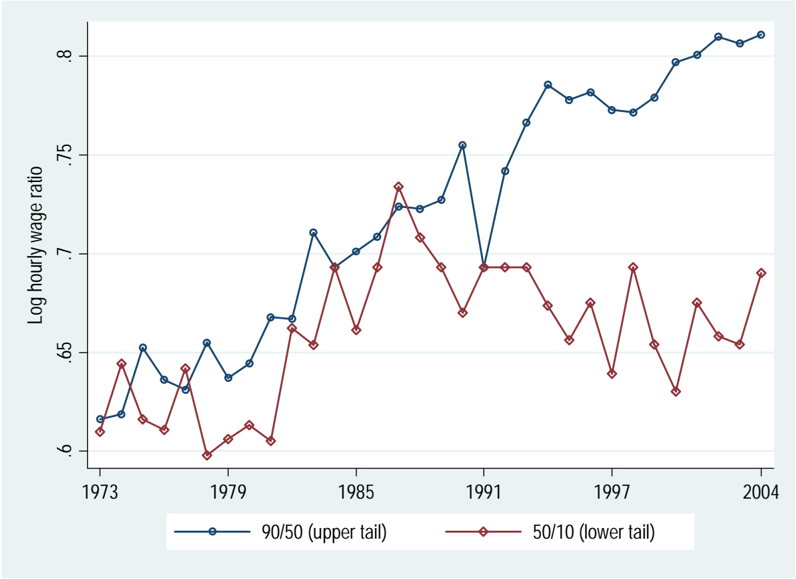
This paper analyzes a marked change in the evolution of the U.S. wage structure over the past fifteen years: divergent trends in upper-tail (90/50) and lower-tail (50/10) wage inequality. We document that wage inequality in the top half of distribution has displayed an unchecked and rather smooth secular rise for the last 25 years (since 1980). Wage inequality in the bottom half of the distribution also grew rapidly from 1979 to 1987, but it has ceased growing (and for some measures actually narrowed) since the late 1980s. Furthermore we find that occupational employment growth shifted from monotonically increasing in wages (education) in the 1980s to a pattern of more rapid growth in jobs at the top and bottom relative to the middles of the wage (education) distribution in the 1990s. We characterize these patterns as the "polarization" of the U.S. labor market, with employment polarizing into high-wage and low-wage jobs at the expense of middle-wage work. We show how a model of computerization in which computers most strongly complement the non-routine (abstract) cognitive tasks of high-wage jobs, directly substitute for the routine tasks found in many traditional middle-wage jobs, and may have little direct impact on non-routine manual tasks in relatively low-wage jobs can help explain the observed polarization of the U.S. labor market.
Overview
CoChat Summary
TL;DR
This paper documents that U.S. wage inequality diverged after the late 1980s: upper-tail inequality kept rising while lower-tail inequality stopped growing, and employment growth shifted from monotonic skill upgrading in the 1980s to polarization into high- and low-wage jobs in the 1990s. The authors argue that a model of computerization—complementing abstract tasks, substituting for routine tasks, and having little direct effect on non-routine manual tasks—can help explain these patterns.
Key findings
- From 1979 to 1987, upper-half (90/50) and lower-half (50/10) wage inequality rose similarly, expanding the 90-10 log wage differential by 21 log points; after 1987, upper-half inequality continued rising while the 50-10 differential contracted by 4 log points from 1987 to 2004, leaving only 4 log points of 90-10 growth since 1987.
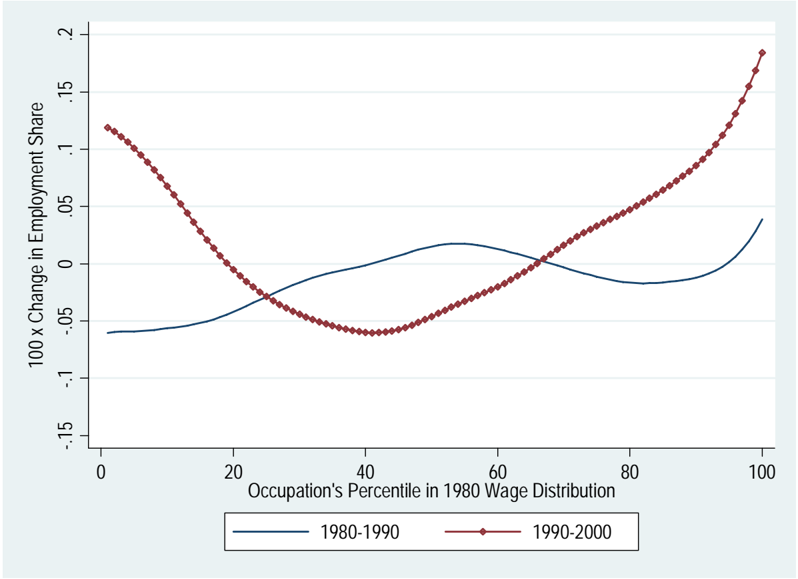
- Occupational employment growth changed from monotonically increasing in wages/education in the 1980s to polarized growth in the 1990s: employment grew more rapidly below the 25th and above the 65th percentiles of the occupational wage distribution and declined in the middle (25th to 65th percentiles).
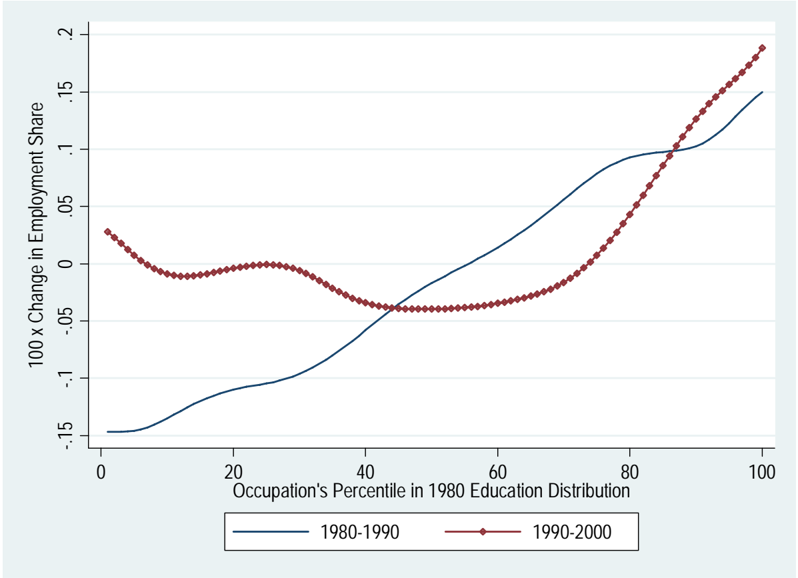
- Using 1980 occupational education percentiles, employment growth was near-monotonic in the 1980s but polarized in the 1990s, with more rapid growth at the bottom than the middle and the most rapid, diverging gains at the top.
- The authors find that quantity and price changes covary positively throughout the earnings distribution in both the 1980s and 1990s, suggesting labor demand shifts are central to explaining wage structure changes.
Methods
- The paper combines descriptive analysis of U.S. wage and employment data with a conceptual task-based model of computerization.
- Wage inequality trends are measured using Current Population Survey May samples for 1973–78 and Merged Outgoing Rotation Group samples for 1979–2004, focusing on 90/50 and 50/10 log hourly wage differentials.
- Employment polarization is analyzed using 1980, 1990, and 2000 Census Integrated Public Use Microsamples, ranking occupations by 1980 median hourly wage or average years of schooling and fitting locally weighted smoothing regressions of decadal employment-share growth on initial skill percentile.
Limitations
- Stated: the model assumes only two worker types, with college workers supplying abstract skill and high school workers substituting between routine and manual tasks; a more complete model would allow endogenous education responses, routine skills for college workers, abstract skills for high school workers, and heterogeneity in abstract skills among college workers.
- Stated: the “social norms” explanation for upper-tail skewness is intriguing but needs refinement to be directly testable, and the minimum wage explanation fits lower-tail inequality trends only to 1987.
- Evident: the paper is largely descriptive and theoretical rather than a causal test of computerization; the model’s predictions are used to interpret observed polarization, but the text does not report direct causal estimates linking computerization to the wage and employment changes.
Model-written summary. Check it against the paper before relying on it.
Integrity signals
Registry
Cites
Statistics
Figures
Verification
Claims the paper makes
0 Valid · 3 Not valid · 14 Not checked · 49 Own results and interpretations
A result the paper states — it cites no source for it, so there is none to check. The quote shows it is in the paper.
In the paper
“The net effect has been a slower growth of only 4 log points in the 90-10 log wage differential since 1987.”
plain- Asserted: passes — The authors put it forward as true.
- Checkable: passes — It can be checked against evidence.
- Load-bearing: passes — The paper’s conclusions depend on it.
- Based: passes — The paper gives a reason why it holds.
A result the paper reports from its own data — it cites no other source for it, so there is none to check. The quote shows it is in the paper.
In the paper
“Using this skill measure, we find near-monotonic (almost linear) increases in employment growth moving up the education distribution in the 1980s.”
plainstates an association- Asserted: passes — The authors put it forward as true.
- Checkable: passes — It can be checked against evidence.
- Load-bearing: unclear — It is unclear whether the paper’s conclusions depend on it.
- Based: passes — The paper gives a reason why it holds.
A result the paper reports from its own data — it cites no other source for it, so there is none to check. The quote shows it is in the paper.
In the paper
“We document that wage inequality in the top half of distribution has displayed an unchecked and rather smooth secular rise for the last 25 years (since 1980).”
- Also stated in: § ABSTRACT · plain
“wage inequality in the top half of the distribution has exhibited an unchecked secular rise for the last 25 years (since 1980)”
plain- Asserted: passes — The authors put it forward as true.
- Checkable: passes — It can be checked against evidence.
- Load-bearing: passes — The paper’s conclusions depend on it.
- Based: passes — The paper gives a reason why it holds.
- Also stated in: § ABSTRACT · plain
A result the paper reports from its own data — it cites no other source for it, so there is none to check. The quote shows it is in the paper.
In the paper
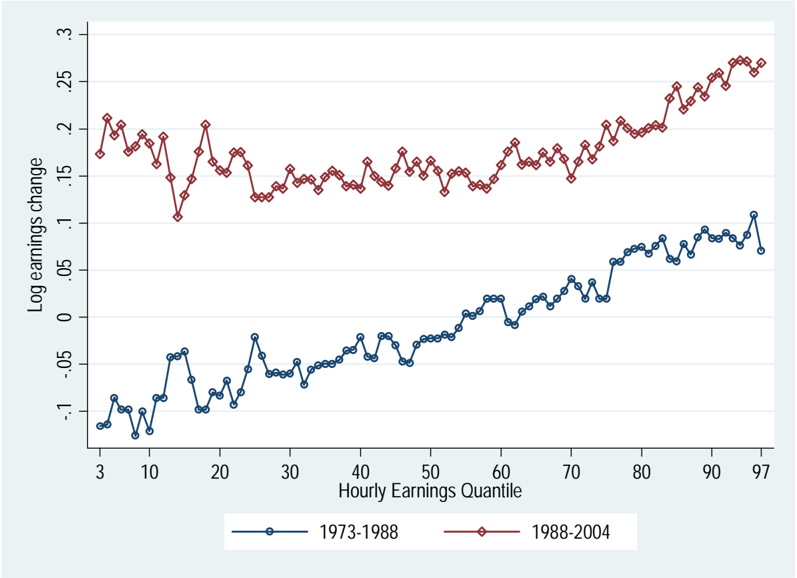
“The figure shows an almost linear spreading out of the entire wage distribution (from the 3 rd to 97 th percentile) in the first half of the sample (driven by changes in the 1980s).”
plainstates a cause- Asserted: passes — The authors put it forward as true.
- Checkable: passes — It can be checked against evidence.
- Load-bearing: passes — The paper’s conclusions depend on it.
- Based: passes — The paper gives a reason why it holds.
A result the paper reports from its own data — it cites no other source for it, so there is none to check. The quote shows it is in the paper.
In the paper
“The plot shows similar substantial increases in upper-half (90-50) and lower-half (50-10) wage inequality from 1979 to 1987, expanding the 90-10 log wage differential by 21 log points.”
plain- Asserted: passes — The authors put it forward as true.
- Checkable: passes — It can be checked against evidence.
- Load-bearing: passes — The paper’s conclusions depend on it.
- Based: passes — The paper gives a reason why it holds.
37 more claims
Create a free account to see all 66 claims and every source verdict.
- It may state two separate claims as one. 20
- Probably not a substantial claim. 5
- The quote only partly states this claim. 1
Claims other papers make about this one
Each is checked against this paper’s own text: does it say what the citing paper says it does?
The source backs part of the claim, not all of it — or backs it for a different population, condition or comparison.
In the citing paper
“Since the 1980s, the U.S. labor market has experienced declines in middle-skill, middle-income jobs in manufacturing and construction as a result of improvements in assembly line automation and the displacement of routine production jobs offshore, among other explanations (Acemoglu and Autor 2011; Autor, Katz, and Kearney 2006; Kalleberg 2009).”
From Beyond the Great Recession: Labor Market Polarization and Ongoing Fertility Decline in the United States (2019) · cites this paper as Autor, Katz, and Kearney 2006
Experimental — accuracy not yet measuredThe cited source says what the claim attributes to it.
In the citing paper
“Prior research on computer-based automation posited that routine work was most susceptible to replacement by computers (Autor et al., 2006; Acemoglu and Autor, 2011).”
From Large language models at work in China’s labor market (2025) · cites this paper as Autor et al., 2006
Citations
Cites
The Skill Content of Recent Technological Change: An Empirical Exploration
Autor, D. H., Levy, F., & Murnane, R. J. (2003) · The Quarterly Journal of Economics · doi:10.1162/003355303322552801 · Cited by 6,205
Self-citationIncome Inequality in the United States, 1913-1998
Piketty, T., & Saez, E. (2003) · The Quarterly Journal of Economics · doi:10.1162/00335530360535135 · Cited by 3,769
Lousy and Lovely Jobs: The Rising Polarization of Work in Britain
Goos, M., & Manning, A. (2007) · Review of Economics and Statistics · doi:10.1162/rest.89.1.118 · Cited by 2,285
Why Has CEO Pay Increased So Much?*
Gabaix, X., & Landier, A. (2008) · Quarterly Journal of Economics · doi:10.1162/qjec.2008.123.1.49 · Cited by 1,764
Skill‐Biased Technological Change and Rising Wage Inequality: Some Problems and Puzzles
Card, D., & DiNardo, J. E. (2002) · Journal of Labor Economics · doi:10.1086/342055 · Cited by 1,714
Technical Change, Job Tasks, and Rising Educational Demands: Looking outside the Wage Structure
Spitz‐Oener, A. (2006) · Journal of Labor Economics · doi:10.1086/499972 · Cited by 1,241
Changes in Unemployment and Wage Inequality: An Alternative Theory and Some Evidence
Acemoglu, D. (1999) · American Economic Review · doi:10.1257/aer.89.5.1259 · Cited by 634
Research works printed but not linked: 3
- Antràs Garicano, Quarterly Journal of Economics (forthcoming).
- Katz Lawrence F, 1999, North-Holland, 1463
- Lemieux Thomas, American Economic Review (forthcoming).
Cited by
Items 901–1,000 of 1,479
The War of Talents in Software Business: Polarisation of the Software Labour Force?
Hyrynsalmi, S. M., Rantanen, M. M., & Hyrynsalmi, S. (2018) · Communications in computer and information science · doi:10.1007/978-3-319-97931-1_4 · Cited by 6
Labor force heterogeneity and wage polarization: Italy and Spain
Addabbo, T., García‐Fernández, R. M., Rodríguez, C. M. L., & Maccagnan, A. (2018) · Journal of Economic Studies · doi:10.1108/jes-03-2017-0071 · Cited by 7
Deciphering the causes for the post-1990 slow output recoveries
Wen, Z. (2018) · Economics Letters · doi:10.1016/j.econlet.2018.12.003 · Cited by 5
Doan, T. T., Nghiem, N., & Doan, N. (2022) · International Migration · doi:10.1111/imig.13011 · Cited by 4
"Technological Change and Earnings Polarization: Implications for Skill Demand and Economic Growth"Preprint
Autor, D. (2007) · RePEc: Research Papers in Economics · Cited by 8
Self-citationHowell, D. R., & Diallo, M. (2007) · RePEc: Research Papers in Economics · Cited by 4
Measuring Skill Intensity of Occupations with Imperfect Substitutability Across Skill TypesPreprint
Pertold-Gebická, B. (2010) · SSRN Electronic Journal · doi:10.2139/ssrn.1692337 · Cited by 6
Law-Abiding Immigrants: The Incarceration Gap between Immigrants and the Us-Born, 1850–2020Preprint
Abramitzky, R., Boustan, L. P., Jácome, E., Pérez, S. T., & Torres, J. D. (2023) · SSRN Electronic Journal · doi:10.2139/ssrn.4512476 · Cited by 6
Panichella, N., Cantalini, S., Avola, M., & Piccitto, G. (2024) · doi:10.31235/osf.io/5rhvq · Cited by 4
Delaporte, I., & Peña, W. (2022) · World Development · doi:10.1016/j.worlddev.2025.106923 · Cited by 6
Zhou, X., Kogler, D. F., Wang, J., Chen, J., & Ao, R. (2025) · Humanities and Social Sciences Communications · doi:10.1057/s41599-025-05771-2 · Cited by 4
Schulz, F., Valizade, D., Stuart, M., Soffia, M., & Skordis, J. (2025) · British Journal of Industrial Relations · doi:10.1111/bjir.70019 · Cited by 7
Engines of the Skill Premium in the Portuguese Economy
Nogueira, M. C., & Afonso, Ó. (2019) · CESifo Economic Studies · doi:10.1093/cesifo/ifz007 · Cited by 4
Hollowing Out: The Channels of Income Polarization in the United States
Alichi, A., Mariscal, R., & Muhaj, D. (2017) · IMF Working Paper · doi:10.5089/9781484328293.001 · Cited by 7
Perron, S. (2023) · Research in Social Stratification and Mobility · doi:10.1016/j.rssm.2023.100848 · Cited by 3
Samaan, D. (2023) · Springer eBooks · doi:10.1007/978-3-031-45304-5_34 · Cited by 3
Boso, À., Álvarez, B., Rodríguez, I. R., & Sánchez-Galvis, L. K. (2024) · International Journal of Sociology · doi:10.1080/00207659.2024.2386647 · Cited by 3
Are there sufficient jobs for older workers in a local market?
Yeo, H. (2025) · Educational Gerontology · doi:10.1080/03601277.2025.2450135 · Cited by 3
Pustovalova, A., & Vahter, P. (2025) · Economics of Innovation and New Technology · doi:10.1080/10438599.2025.2468458 · Cited by 6
Household Debt Overhang and Human Capital Investment
Manso, G., Rivera, A., Wang, H., & Xia, H. (2022) · Journal of Financial Economics · doi:10.1016/j.jfineco.2025.104141 · Cited by 6
Cohort and Period Perspectives on Gender, Education, and Earnings in Canada
Ornstein, M. (2011) · Canadian Public Policy · doi:10.1353/cpp.2011.0003 · Cited by 6
Computer Usage and Labour Regulation in India's Retail Sector
Amin, M. (2010) · The Journal of Development Studies · doi:10.1080/00220388.2010.492868 · Cited by 3
Kehrig, M. (2018) · Journal of Monetary Economics · doi:10.1016/j.jmoneco.2018.05.004 · Cited by 4
Measuring wage inequality under right censoring
Nicolau, J., Raposo, P. S., & Rodrigues, P. (2022) · Economic Inquiry · doi:10.1111/ecin.13119 · Cited by 3
Redistribution and wage inequality
Pi, J., & Zhang, P. (2020) · International Review of Economics & Finance · doi:10.1016/j.iref.2020.12.017 · Cited by 4
Unbalanced growth in the labourscape: explaining regional employment divergence
Sobyra, R., Sigler, T., & Charles‐Edwards, E. (2021) · Regional Studies · doi:10.1080/00343404.2021.1972958 · Cited by 4
González, X., Loveira, R., & Pazó, C. (2022) · Labour · doi:10.1111/labr.12227 · Cited by 8
Grande, R., & Peña, A. V. (2023) · International Journal of Innovation and Technology Management · doi:10.1142/s0219877023500359 · Cited by 5
Cohort-Specific Experiences of Industrial Decline and Intergenerational Income Mobility
Seltzer, N. (2024) · Social Forces · doi:10.1093/sf/soad145 · Cited by 6
The effect of external innovation on firm employment
Arenas, G., Barge‐Gil, A., Heijs, J., & Marzucchi, A. (2024) · Economics of Innovation and New Technology · doi:10.1080/10438599.2024.2303051 · Cited by 4
Immigration and the Top 1 Percent
Advani, A., Koenig, F., Pessina, L., & Summers, A. (2025) · The Review of Economics and Statistics · doi:10.1162/rest_a_01408 · Cited by 11
Cultures of Inequality: Labor, Social Finance, and the Swinging Pendulum of Trust in Capitalism
Magnani, E. (2024) · Social Currents · doi:10.1177/23294965241235136 · Cited by 3
Quality Trumps Quantity: Exploring Relationships between Job Quality, Job Quantity, and Sleep
Guo, Y., & Wang, S. (2024) · Socius Sociological Research for a Dynamic World · doi:10.1177/23780231241234471 · Cited by 4
Engaged robots, disengaged workers: Automation and political alienation
González‐Rostani, V. (2024) · Economics and Politics · doi:10.1111/ecpo.12307 · Cited by 7
Effects of innovation and markups on employment and labour share in OECD industries
Uğur, M. (2024) · Structural Change and Economic Dynamics · doi:10.1016/j.strueco.2024.07.011 · Cited by 5
Inequality through digitalization: investigation of mediating and moderating mechanisms
Zang, L., Zhu, Y., & Cheng, D. (2024) · Information Technology for Development · doi:10.1080/02681102.2024.2423390 · Cited by 5
Input Tariff Cuts and the Spatial Distribution of Skilled Labor: Evidence From China
Liu, W., Xiao, W., & Qin, Z. (2024) · Growth and Change · doi:10.1111/grow.70013 · Cited by 3
González‐Rostani, V. (2024) · The Journal of Politics · doi:10.1086/734533 · Cited by 8
Government Investment Stimulus and Household Balance Sheet Externalities
Bhardwaj, A., & Mukherjee, S. (2025) · Journal of Financial and Quantitative Analysis · doi:10.1017/s0022109024000449 · Cited by 5
Foreign scientists and engineers and economic growth in Canadian labor markets
Peri, G., & Shih, K. Y. (2015) · Edward Elgar Publishing eBooks · doi:10.4337/9781783476817.00022 · Cited by 3
Measuring and Understanding Trade in Service Tasks
Chiquiar, D., Tobal, M., & Yslas, R. (2018) · International Labour Review · doi:10.1111/ilr.12090 · Cited by 3
Güven, A., & Sakamoto, A. (2016) · Research in Social Stratification and Mobility · doi:10.1016/j.rssm.2016.08.005 · Cited by 2
Rendall, M. S., & Shattuck, R. M. (2018) · Journal of Poverty · doi:10.1080/10875549.2018.1550132 · Cited by 5
Pérez, S. T. (2019) · Papers Revista de Sociologia · doi:10.5565/rev/papers.2567 · Cited by 3
Globalization and jobless recoveries
Waddle, A. (2019) · Journal of Macroeconomics · doi:10.1016/j.jmacro.2019.103138 · Cited by 3
Induced technology hypothesis. Acemoglu and Marx on deskilling (skill replacing) innovations
Ertürk, K. A. (2019) · Review of Social Economy · doi:10.1080/00346764.2019.1650291 · Cited by 17
Polarization(s) in Labour Markets: Synthesis and Perspectives
Manning, A. (2019) · Travail et emploi · doi:10.4000/travailemploi.8921 · Cited by 8
Economic transformation, skills, and the future of work
Beylis, G., Jaef, R. F., Morris, M. L., Sebastian, A. R., & Sinha, R. (2020) · World Bank, Washington, DC eBooks · doi:10.1596/978-1-4648-1448-8_ch3 · Cited by 3
Market structure effects on wages in the Brazilian industrial firms
Silva-Jr, G. G. (2011) · Estudos Econômicos (São Paulo) · doi:10.1590/s0101-41612011000300001 · Cited by 3
Beschäftigungs- und Lohnwirkungen von betrieblichen Reorganisationsprozessen
Bellmann, L. (2011) · Journal for Labour Market Research · doi:10.1007/s12651-011-0053-y · Cited by 6
Are there Racial Gaps in High School Leadership Opportunities? Do Academics Matter More?
Weinberger, C. J. (2014) · The Review of Black Political Economy · doi:10.1007/s12114-014-9198-6 · Cited by 4
Contemporary Phase of Globalization: Does It Have a Serious Downside?
Das, D. K. (2008) · Global Economic Review · doi:10.1080/12265080802481058 · Cited by 3
Shifts and twists in the relative productivity of skilled labor
Dupuy, A., & Marey, P. S. (2007) · Journal of Macroeconomics · doi:10.1016/j.jmacro.2007.08.003 · Cited by 16
Path from human capital to economic growth: A free highway or a complicated labyrinth?
Lyubimov, I. L. (2017) · Voprosy Ekonomiki · doi:10.32609/0042-8736-2017-8-5-23 · Cited by 47
Castellano, R., Musella, G., & Punzo, G. (2019) · Review of Social Economy · doi:10.1080/00346764.2019.1655163 · Cited by 5
Albæk, K., Asplund, R., Barth, E., et al. (2020) · Søkelys på arbeidslivet · doi:10.18261/issn.1504-7989-2020-01-02-08 · Cited by 3
Hyrynsalmi, S. M., Rantanen, M. M., & Hyrynsalmi, S. (2021) · Finnish Journal of eHealth and eWelfare · doi:10.23996/fjhw.82689 · Cited by 6
Wage Differentials And Educational Attainment In Germany. How Do Job Profiles Affect Earnings?
Popova, M. (2021) · SocioEconomic Challenges · doi:10.21272/sec.5(2).15-25.2021 · Cited by 3
Resilience Capability and Successful Adoption of Digital Technologies: Two Case Studies
Sgobbi, F., & Codara, L. (2022) · Contributions to management science · doi:10.1007/978-3-030-85954-1_18 · Cited by 7
Scherer, F. M. (2012) · Oxford University Press eBooks · doi:10.1093/oxfordhb/9780195391176.013.0006 · Cited by 3
Measuring and understanding trade in service tasks
Chiquiar, D., Tobal, M., & Yslas, R. (2019) · International Labour Review · doi:10.1111/ilr.12133 · Cited by 4
The Great Financial Crisis, Commodity Prices and Environmental LimitsPreprint
López, R., & Lopez, R. E. (2009) · RePEc: Research Papers in Economics · doi:10.22004/ag.econ.51987 · Cited by 3
Decreasing Wage Inequality in Italy: The Role of Supply and Demand for EducationPreprint
Naticchioni, P., & Ricci, A. (2010) · SSRN Electronic Journal · doi:10.2139/ssrn.1548633 · Cited by 6
Racial Differences in Fringe Benefits and CompensationPreprint
Mok, W. K. C., & Siddique, Z. (2009) · SSRN Electronic Journal · doi:10.2139/ssrn.1489258 · Cited by 3
'Can't Get Enough': Prejudice, Contact Jobs and the Racial Wage Gap in the UsPreprint
Laouénan, M. (2014) · SSRN Electronic Journal · doi:10.2139/ssrn.2406328 · Cited by 3
Bressan, G. S., & de Oliveira, A. M. H. C. (2011) · RePEc: Research Papers in Economics · Cited by 16
The earnings losses of injured men: Accounting for injuries outside the Workers' Compensation systemPreprint
Woock, C. (2007) · RePEc: Research Papers in Economics · Cited by 3
A Case Study on Trade Liberalization: Argentina in the 1990sPreprint
Beker, V. A. (2012) · SSRN Electronic Journal · doi:10.2139/ssrn.1987329 · Cited by 4
The Wage Effects of Job Polarization: Evidence from the Allocation of TalentsPreprint
Böhm, M. J. (2014) · RePEc: Research Papers in Economics · Cited by 14
Accetturo, A., Gigio, L. A., Beretta, E., Camussi, S. A. M., Cannari, L., Coin, D., Conti, L., Cullino, R., Fabbrini, A., Fabrizi, C., et al. (2016) · SSRN Electronic Journal · doi:10.2139/ssrn.2728280 · Cited by 4
Do Computers Reduce the Value of Worker Persistence?Preprint
Brynjolfsson, E., Liu, M., & Westerman, G. F. (2018) · SSRN Electronic Journal · doi:10.2139/ssrn.3286084 · Cited by 3
Young, Educated, UnemployedPreprint
Coskun, S. (2026) · SSRN Electronic Journal · doi:10.2139/ssrn.6181687 · Cited by 4
Higher and Higher? Performance Pay and Wage Inequality in GermanyPreprint
Sommerfeld, K. (2012) · SSRN Electronic Journal · doi:10.2139/ssrn.2146535 · Cited by 3
Labor Market Polarization and International Macroeconomic DynamicsPreprint
Mandelman, F. (2015) · SSRN Electronic Journal · doi:10.2139/ssrn.2579901 · Cited by 4
The Financial Premium in the US Labor Market: A Distributional AnalysisPreprint
Lin, K.-H. (2014) · SSRN Electronic Journal · doi:10.2139/ssrn.2487257 · Cited by 3
The Role of Establishments and the Concentration of Occupations in Wage InequalityPreprint
Handwerker, E. W., & Spletzer, J. R. (2015) · SSRN Electronic Journal · doi:10.2139/ssrn.2664570 · Cited by 3
Globalization and the Provision of Incentives Inside the Firm: The Effect of Foreign CompetitionPreprint
Guadalupe, M., & Cuñat, V. (2008) · SSRN Electronic Journal · doi:10.2139/ssrn.1295926 · Cited by 3
Employment Structures in China from 1990 to 2015: Demographic and Technological ChangePreprint
Ge, P., Sun, W., & Zhao, Z. (2021) · SSRN Electronic Journal · doi:10.2139/ssrn.3794087 · Cited by 3
The Polarisation of Remote WorkPreprint
Braesemann, F., Stephany, F., Teutloff, O., kässi, O., Graham, M., & Lehdonvirta, V. (2021) · Research Square · doi:10.21203/rs.3.rs-855246/v1 · Cited by 3
Exposure of occupations to technologies of the fourth industrial revolutionPreprint
Meindl, B., Frank, M. R., & Mendonça, J. (2021) · RePEc: Research Papers in Economics · doi:10.48550/arxiv.2110.13317 · Cited by 17
Can the Labor Demand Curve Explain Job Polarization?Preprint
Peichl, A., & Popp, M. (2022) · SSRN Electronic Journal · doi:10.2139/ssrn.4137956 · Cited by 4
Law-Abiding Immigrants: The Incarceration Gap Between Immigrants and the US-born, 1870–2020Preprint
Abramitzky, R., Boustan, L. P., Jácome, E., Pérez, S. T., & Torres, J. D. (2023) · SSRN Electronic Journal · doi:10.2139/ssrn.4505070 · Cited by 7
Remote Work and Skill ExpectationsPreprint
Zhang, L., Wang, S., & Liao, Z. (2023) · SSRN Electronic Journal · doi:10.2139/ssrn.4523986 · Cited by 2
Vidal, M. (2024) · Critical Sociology · doi:10.1177/08969205231219209 · Cited by 4
The Long Reach of Education: Early Retirement
Venti, S., & Wise, D. (2014) · doi:10.3386/w20740 · Cited by 3
Hidden patterns of inequality: The heterogeneity in parenting within educational groups
Breinholt, A. (2024) · Poetics · doi:10.1016/j.poetic.2024.101941 · Cited by 4
How is Labour Demand Changing Across European Regions in the Post-COVID-19 Era
Lovaglio, P. G., & Riussi, M. (2025) · International Regional Science Review · doi:10.1177/01600176251327985 · Cited by 3
Heikkuri, S. (2025) · Scandinavian Economic History Review · doi:10.1080/03585522.2025.2492564 · Cited by 3
Efficiency of human capital in Poland in terms of sectors and industries
Nawrocki, T. L., & Zieliński, M. (2024) · International Journal of Management and Economics · doi:10.2478/ijme-2025-0002 · Cited by 2
Declining Wage Inequality in Developing Countries: The Case of Brazil
FIRPO, S. P., & Portella, A. L. (2025) · Journal of Economic Literature · doi:10.1257/jel.20241697 · Cited by 5
The nexus between labor share and income inequality: theory and evidence from the U.S
Chang, J., Kuo, C.-H., Lei, K.-Y., & Liu, C.-Y. (2025) · Oxford Economic Papers · doi:10.1093/oep/gpaf028 · Cited by 5
Structural transformation and skills mismatch
Abdulla, K. (2025) · Oxford Development Studies · doi:10.1080/13600818.2025.2544262 · Cited by 2
Do Industrial Robots Mitigate Supply Chain Risks? Evidence from Firm-Level Text Analysis
Wang, J.-Y., & Chen, Z. (2025) · Sustainability · doi:10.3390/su172411340 · Cited by 2
Xing, Z., He, C., & Pan, Y. (2025) · Technological Forecasting and Social Change · doi:10.1016/j.techfore.2025.124518 · Cited by 4
de Madrid, U. C., & Pérez, S. T. (2017) · Revista de Economía Laboral · doi:10.21114/rel.2017.02.06 · Cited by 4
Beendet die Digitalisierung das deutsche Jobwunder?
Spermann, A. (2020) · FOM-Edition · doi:10.1007/978-3-658-30129-3_11 · Cited by 4
Young Men’s Entry and Persistence in Female-Dominated Occupations
Swiatek, S., & Dill, J. S. (2021) · Sociological Focus · doi:10.1080/00380237.2021.1894282 · Cited by 3
THE ECONOMY IS NOT FLAT: THE TECHNOLOGY GRADIENT IN THE MASS MARKET ECONOMY
Mayer‐Foulkes, D., & Hafner, K. A. (2023) · Global economy journal · doi:10.1142/s2194565923500112 · Cited by 2
ÖZALP, L. F. A., & Özalp, H. (2023) · Panoeconomicus · doi:10.2298/pan190828014a · Cited by 2
The link between routine tasks and job polarization: A task measurement problem?
Walo, S. (2023) · Labour · doi:10.1111/labr.12251 · Cited by 3
Metadata
- Authors
- Autor, D. H., Katz, L. F., & Kearney, M. S.
- Affiliations
- National Bureau of Economic Research (US)
- Brookings Institution (US)
- Venue
- American Economic Review
- Publisher
- American Economic Association
- Published
- 2006-04-01
- Volume
- 96
- Issue
- 2
- Pages
- 189-194
- ISSN
- 0002-8282 (ISSN-L)
- OpenAlex
- W3124544360
- Cited by
- 1,594
- References
- 4
- Citations by year
- 2026: 75 · 2025: 108 · 2024: 122 · 2023: 90 · 2022: 89 · 2021: 100 · 2020: 107 · 2019: 96 · 2018: 93 · 2017: 74 · 2016: 76 · 2015: 91 · 2014: 78 · 2013: 81 · 2012: 59
- FWCI
- 110.81
- Type
- journal article
- Language
- en
- Open access
- closed
- Locations
- American Economic Review (publishedVersion)
- RePEc: Research Papers in Economics (submittedVersion)
- Topics
- Social Sciences › Economics, Econometrics and Finance › Economics and Econometrics › Labor market dynamics and wage inequality
- Social Sciences › Economics, Econometrics and Finance › General Economics, Econometrics and Finance › Economic Theory and Policy
- Social Sciences › Sociology and Political Science › Income, Poverty, and Inequality
- Keywords
- labor market polarization, wage inequality, wage distribution, computerization, high-wage jobs, low-wage employment, United States labor market
About these checks
Registry, retraction, Cites and statistics results are computed, not judged, with one exception: a printed reference that no index lists is read once by a model before it counts as a citation error. Claims are extracted by a model and kept only when their quote appears verbatim in the text; each cited source is then checked, with a model’s help, for whether it says what the claim relies on. Those verdicts can be wrong — read the claim’s quote and the cited source before relying on one.
A language model drew the claims from the paper on 2026-10-12, under version 3 of the claim definition (model deepseek-v4.1-flash, prompt extract-v3).
A second model labelled each claim on 2026-10-12 (model jev-1.13-20260917, definition revision gold-guideline-v0.2).
Statistics and arithmetic are recomputed, not judged.
Confidence bands are shown only for fields calibrated on our annotated test set. None is calibrated yet, so no band is shown.
What counts as a claim ›How we measure confidence ›How we check this ›
Are you an author, or do you see a problem with this page? Request a review
Data sources
Bibliographic data: Semantic Scholar, OpenAlex, Crossref.
Contains information from the Semantic Scholar Academic Graph Datasets, made available under the ODC Attribution License (ODC-BY 1.0).
Semantic Scholar’s data is described in: Kinney, R., et al. (2023). The Semantic Scholar Open Data Platform. arXiv:2301.10140.
