

The Polarization of the U.S. Labor Market
The DOI matches its Crossref record; 7 of the 7 references it cites were found in a registry or an index; 1 of the 16 sources its claims cite were checked for support.
Abstract
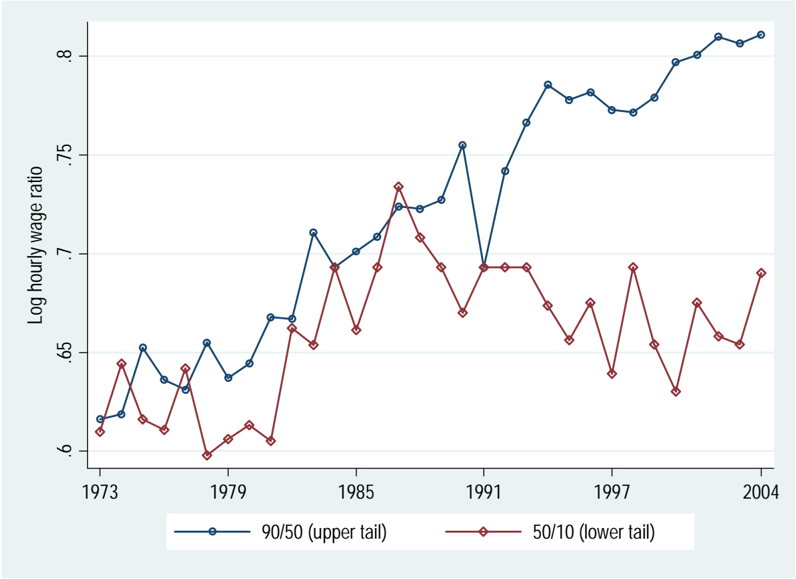
This paper analyzes a marked change in the evolution of the U.S. wage structure over the past fifteen years: divergent trends in upper-tail (90/50) and lower-tail (50/10) wage inequality. We document that wage inequality in the top half of distribution has displayed an unchecked and rather smooth secular rise for the last 25 years (since 1980). Wage inequality in the bottom half of the distribution also grew rapidly from 1979 to 1987, but it has ceased growing (and for some measures actually narrowed) since the late 1980s. Furthermore we find that occupational employment growth shifted from monotonically increasing in wages (education) in the 1980s to a pattern of more rapid growth in jobs at the top and bottom relative to the middles of the wage (education) distribution in the 1990s. We characterize these patterns as the "polarization" of the U.S. labor market, with employment polarizing into high-wage and low-wage jobs at the expense of middle-wage work. We show how a model of computerization in which computers most strongly complement the non-routine (abstract) cognitive tasks of high-wage jobs, directly substitute for the routine tasks found in many traditional middle-wage jobs, and may have little direct impact on non-routine manual tasks in relatively low-wage jobs can help explain the observed polarization of the U.S. labor market.
Overview
CoChat Summary
TL;DR
This paper documents that U.S. wage inequality diverged after the late 1980s: upper-tail inequality kept rising while lower-tail inequality stopped growing, and employment growth shifted from monotonic skill upgrading in the 1980s to polarization into high- and low-wage jobs in the 1990s. The authors argue that a model of computerization—complementing abstract tasks, substituting for routine tasks, and having little direct effect on non-routine manual tasks—can help explain these patterns.
Key findings
- From 1979 to 1987, upper-half (90/50) and lower-half (50/10) wage inequality rose similarly, expanding the 90-10 log wage differential by 21 log points; after 1987, upper-half inequality continued rising while the 50-10 differential contracted by 4 log points from 1987 to 2004, leaving only 4 log points of 90-10 growth since 1987.
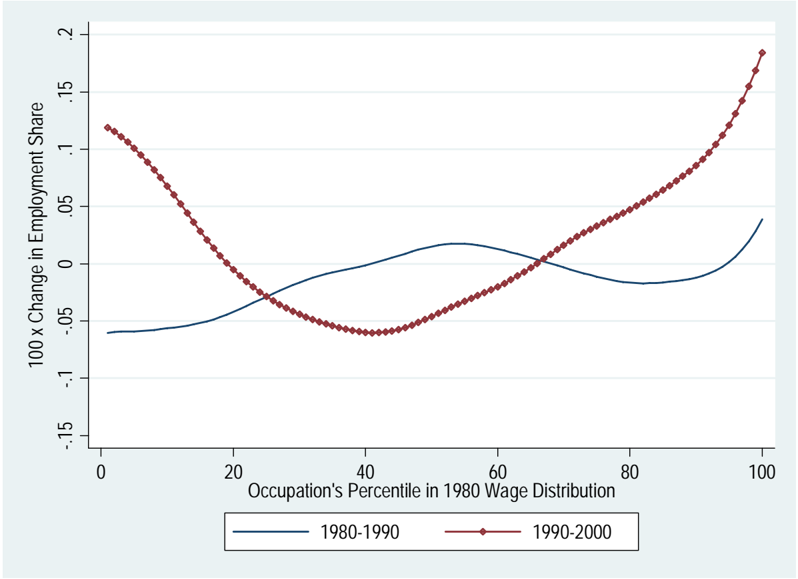
- Occupational employment growth changed from monotonically increasing in wages/education in the 1980s to polarized growth in the 1990s: employment grew more rapidly below the 25th and above the 65th percentiles of the occupational wage distribution and declined in the middle (25th to 65th percentiles).
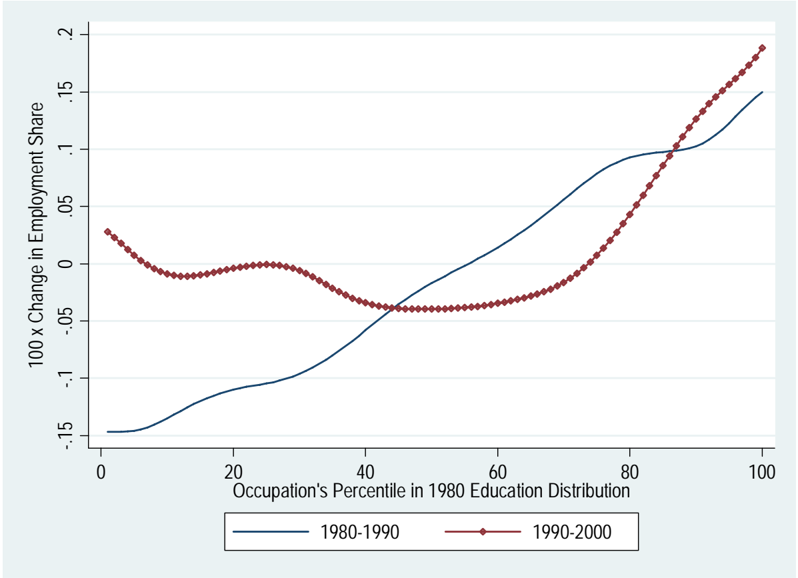
- Using 1980 occupational education percentiles, employment growth was near-monotonic in the 1980s but polarized in the 1990s, with more rapid growth at the bottom than the middle and the most rapid, diverging gains at the top.
- The authors find that quantity and price changes covary positively throughout the earnings distribution in both the 1980s and 1990s, suggesting labor demand shifts are central to explaining wage structure changes.
Methods
- The paper combines descriptive analysis of U.S. wage and employment data with a conceptual task-based model of computerization.
- Wage inequality trends are measured using Current Population Survey May samples for 1973–78 and Merged Outgoing Rotation Group samples for 1979–2004, focusing on 90/50 and 50/10 log hourly wage differentials.
- Employment polarization is analyzed using 1980, 1990, and 2000 Census Integrated Public Use Microsamples, ranking occupations by 1980 median hourly wage or average years of schooling and fitting locally weighted smoothing regressions of decadal employment-share growth on initial skill percentile.
Limitations
- Stated: the model assumes only two worker types, with college workers supplying abstract skill and high school workers substituting between routine and manual tasks; a more complete model would allow endogenous education responses, routine skills for college workers, abstract skills for high school workers, and heterogeneity in abstract skills among college workers.
- Stated: the “social norms” explanation for upper-tail skewness is intriguing but needs refinement to be directly testable, and the minimum wage explanation fits lower-tail inequality trends only to 1987.
- Evident: the paper is largely descriptive and theoretical rather than a causal test of computerization; the model’s predictions are used to interpret observed polarization, but the text does not report direct causal estimates linking computerization to the wage and employment changes.
Model-written summary. Check it against the paper before relying on it.
Integrity signals
Registry
Cites
Statistics
Figures
Verification
Claims the paper makes
1 Valid · 3 Not valid · 13 Not checked · 49 Own results and interpretations
Every source the paper cites for this claim was checked and supports it.
In the paper
“Acemoglu (1999) also finds U.S. job polarization from the mid-1980s to early 1990s using more aggregated industry-occupation cells, and Goos and Manning (2003) document job growth polarization by detailed occupations from 1979 to 1999 for Britain-another country with a large increase in wage inequality.”
What the sources say
- Supportedcites Acemoglu (1999) matched to “Changes in Unemployment and Wage Inequality: An Alternative Theory and Some Evidence” (1999) source
In 'C. Changes in the Distribution of Jobs' Acemoglu (1999) states he provides 'some evidence that "middling" jobs have been replaced by jobs from more extreme parts of the quality distribution,' using industry-occupation cells as job categories — 19 major industries crossed with 12 1-digit occupations, giving 174 aggregated cells covering over 72 percent of CPS employment, ranked by residual wages. The data are the CPS Annual Earnings File 1983 to 1993 (mid-1980s to early 1990s reference periods), and 'Table 2 shows that 35 percent of employment was in the top and bottom 25 percent job categories. By 1993, this number had risen to just under 38 percent' — i.e., rising weight at the tails, the substance of job polarization. The robustness checks on p. 1274 repeat the exercise at other aggregation levels (72 occupation categories, 2-digit occupation and industry), confirming that the aggregated industry-occupation cell construction is this paper's own. (LLM, conf=0.88)
plainstates an association- Asserted: passes — The authors put it forward as true.
- Checkable: passes — It can be checked against evidence.
- Load-bearing: unclear — It is unclear whether the paper’s conclusions depend on it.
- Based: passes — The paper gives a reason why it holds.
- Supported
A result the paper states — it cites no source for it, so there is none to check. The quote shows it is in the paper.
In the paper
“The net effect has been a slower growth of only 4 log points in the 90-10 log wage differential since 1987.”
plain- Asserted: passes — The authors put it forward as true.
- Checkable: passes — It can be checked against evidence.
- Load-bearing: passes — The paper’s conclusions depend on it.
- Based: passes — The paper gives a reason why it holds.
A result the paper reports from its own data — it cites no other source for it, so there is none to check. The quote shows it is in the paper.
In the paper
“Using this skill measure, we find near-monotonic (almost linear) increases in employment growth moving up the education distribution in the 1980s.”
plainstates an association- Asserted: passes — The authors put it forward as true.
- Checkable: passes — It can be checked against evidence.
- Load-bearing: unclear — It is unclear whether the paper’s conclusions depend on it.
- Based: passes — The paper gives a reason why it holds.
A result the paper reports from its own data — it cites no other source for it, so there is none to check. The quote shows it is in the paper.
In the paper
“We document that wage inequality in the top half of distribution has displayed an unchecked and rather smooth secular rise for the last 25 years (since 1980).”
- Also stated in: § ABSTRACT · plain
“wage inequality in the top half of the distribution has exhibited an unchecked secular rise for the last 25 years (since 1980)”
plain- Asserted: passes — The authors put it forward as true.
- Checkable: passes — It can be checked against evidence.
- Load-bearing: passes — The paper’s conclusions depend on it.
- Based: passes — The paper gives a reason why it holds.
- Also stated in: § ABSTRACT · plain
A result the paper reports from its own data — it cites no other source for it, so there is none to check. The quote shows it is in the paper.
In the paper
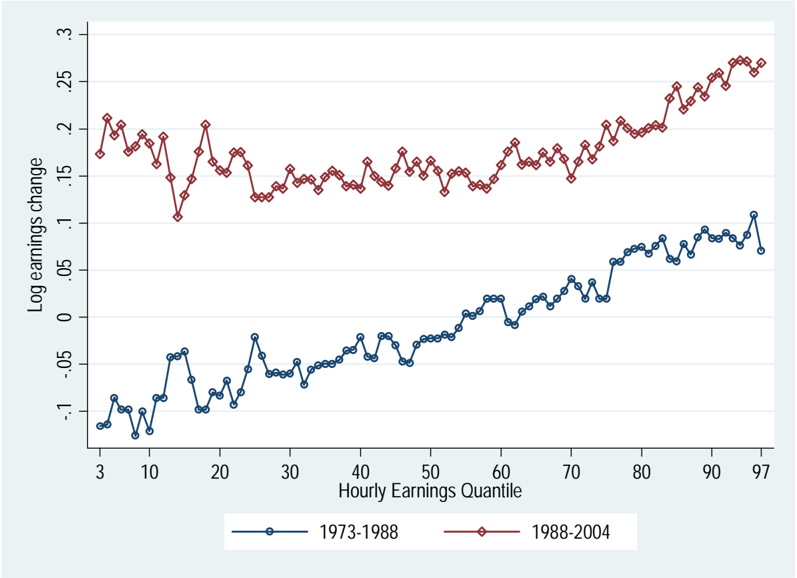
“The figure shows an almost linear spreading out of the entire wage distribution (from the 3 rd to 97 th percentile) in the first half of the sample (driven by changes in the 1980s).”
plainstates a cause- Asserted: passes — The authors put it forward as true.
- Checkable: passes — It can be checked against evidence.
- Load-bearing: passes — The paper’s conclusions depend on it.
- Based: passes — The paper gives a reason why it holds.
37 more claims
Create a free account to see all 66 claims and every source verdict.
- It may state two separate claims as one. 20
- Probably not a substantial claim. 5
- The quote only partly states this claim. 1
Claims other papers make about this one
Each is checked against this paper’s own text: does it say what the citing paper says it does?
The source backs part of the claim, not all of it — or backs it for a different population, condition or comparison.
In the citing paper
“Since the 1980s, the U.S. labor market has experienced declines in middle-skill, middle-income jobs in manufacturing and construction as a result of improvements in assembly line automation and the displacement of routine production jobs offshore, among other explanations (Acemoglu and Autor 2011; Autor, Katz, and Kearney 2006; Kalleberg 2009).”
From Beyond the Great Recession: Labor Market Polarization and Ongoing Fertility Decline in the United States (2019) · cites this paper as Autor, Katz, and Kearney 2006
Experimental — accuracy not yet measuredThe cited source says what the claim attributes to it.
In the citing paper
“Prior research on computer-based automation posited that routine work was most susceptible to replacement by computers (Autor et al., 2006; Acemoglu and Autor, 2011).”
From Large language models at work in China’s labor market (2025) · cites this paper as Autor et al., 2006
Citations
Cites
The Skill Content of Recent Technological Change: An Empirical Exploration
Autor, D. H., Levy, F., & Murnane, R. J. (2003) · The Quarterly Journal of Economics · doi:10.1162/003355303322552801 · Cited by 6,205
Self-citationIncome Inequality in the United States, 1913-1998
Piketty, T., & Saez, E. (2003) · The Quarterly Journal of Economics · doi:10.1162/00335530360535135 · Cited by 3,769
Lousy and Lovely Jobs: The Rising Polarization of Work in Britain
Goos, M., & Manning, A. (2007) · Review of Economics and Statistics · doi:10.1162/rest.89.1.118 · Cited by 2,285
Why Has CEO Pay Increased So Much?*
Gabaix, X., & Landier, A. (2008) · Quarterly Journal of Economics · doi:10.1162/qjec.2008.123.1.49 · Cited by 1,764
Skill‐Biased Technological Change and Rising Wage Inequality: Some Problems and Puzzles
Card, D., & DiNardo, J. E. (2002) · Journal of Labor Economics · doi:10.1086/342055 · Cited by 1,714
Technical Change, Job Tasks, and Rising Educational Demands: Looking outside the Wage Structure
Spitz‐Oener, A. (2006) · Journal of Labor Economics · doi:10.1086/499972 · Cited by 1,241
Changes in Unemployment and Wage Inequality: An Alternative Theory and Some Evidence
Acemoglu, D. (1999) · American Economic Review · doi:10.1257/aer.89.5.1259 · Cited by 634
Research works printed but not linked: 3
- Antràs Garicano, Quarterly Journal of Economics (forthcoming).
- Katz Lawrence F, 1999, North-Holland, 1463
- Lemieux Thomas, American Economic Review (forthcoming).
Cited by
Items 1,401–1,479 of 1,479
Long Run Employment and Income Growth: A By Sector AnalysisPreprint
Hooks, C. (2013) · SSRN Electronic Journal · doi:10.2139/ssrn.2553585
Superstar CitiesPreprint
Mayer, C. J., Gyourko, J. E., & Sinai, T. M. (2006) · SSRN Electronic Journal · doi:10.2139/ssrn.921741
Employability, Automation and the Future of Work in the US and UK: An Occupational Analysis
Brown, P., & Tholen, G. (2025) · Emerald Group Publishing Limited eBooks · doi:10.1108/s0277-283320250000037004 · Cited by 2
Drivers behind the diverging gender patterns of wage inequality
Oliver, X., & Sard, M. (2025) · Journal for Labour Market Research · doi:10.1186/s12651-025-00415-z
Bhattacharyya, R., & Banerjee, K. (2025) · Emerald Group Publishing Limited eBooks · doi:10.1108/978-1-83708-022-920261021
The Long‐Term Rise and Geographic Concentration of Labor Market Detachment
Abel, J. R., & Deitz, R. (2025) · Growth and Change · doi:10.1111/grow.70091
The Effect of Public Expenditures on Unemployment: Does Technology Matter?
BEŞİRLİ, Ö. B., & Seçilmiş, E. (2025) · Mehmet Akif Ersoy Üniversitesi İktisadi ve İdari Bilimler Fakültesi Dergisi · doi:10.30798/makuiibf.1700034
Oferta y demanda de empleo en el sector tecnológico ecuatoriano
Rubio, C. G. N., Lissette, P. C. F., & Almache, J. L. T. (2025) · Arandu-UTIC. · doi:10.69639/arandu.v12i4.1787
Cambios en la composición del empleo y desigualdad salarial en Colombia
Ariza, J. F., & Agudelo, S. A. (2025) · Revista Facultad de Ciencias Económicas · doi:10.18359/rfce.7697
Job polarization: Evidence for Türkiye
GÜLSER, E., & Yılmaz, E. (2026) · Revista Internacional del Trabajo · doi:10.16995/ilr.23807
Lv, Q., Tang, Y., Ge, L., & Ni, D. (2026) · Economic Modelling · doi:10.1016/j.econmod.2026.107492 · Cited by 2
Labor market polarization and the great urban divergence
Davis, D. R., Mengus, É., & Michalski, T. (2026) · Journal of International Economics · doi:10.1016/j.jinteco.2026.104224 · Cited by 1
Will Technological Developments Disrupt Income Distribution in the Near Future?
Doğan, F. C., & Akdağ, N. (2026) · Sosyoekonomi · doi:10.17233/sosyoekonomi.2026.01.16
Xu, X. (2026) · Research in Social Stratification and Mobility · doi:10.1016/j.rssm.2026.101135
Co-evolution of skill structure and labor market processes in US regions, 2003–2023
Park, J., & Kim, D. (2026) · Cities · doi:10.1016/j.cities.2026.106830
AI, Automation, and ExpertisePreprint
Teeselink, B. K., & Carey, D. (2026) · SSRN Electronic Journal · doi:10.2139/ssrn.6134506 · Cited by 6
Tobler, L., & Leesch, J. (2026) · Social Science Research · doi:10.1016/j.ssresearch.2026.103311 · Cited by 1
Polarisation des emplois: l’exemple de la Türkiye
Yılmaz, E., & GÜLSER, E. (2026) · Revue internationale du Travail · doi:10.16995/ilrf.23807
Work Precarity and Workplace Surveillance Experiences
Behrend, T. S., Shoss, M. K., Tracy, M. M., Stolle, D. P., Blachly, B. D., Chan, M., & Schwartz, B. (2026) · Journal of Business and Psychology · doi:10.1007/s10869-026-10105-3
Anti-corruption campaign in China and corporate finance
Tong, S., & Qian, H. (2026) · Journal of Financial Crime · doi:10.1108/jfc-03-2025-0066 · Cited by 2
Mortality, morbidity, and occupational decline
Hernnäs, S. (2026) · Scandinavian Journal of Economics · doi:10.1111/sjoe.70014
Free to Choose in the American CityPreprint
Kahn, M. E. (2026) · SSRN Electronic Journal · doi:10.2139/ssrn.6215220
Reassessing Welfare State Generosity: A Focus on New Social Risks
López, J., & Buendía, L. (2026) · Social Indicators Research · doi:10.1007/s11205-026-03808-w
The Role of Skills and Tasks in Gender Gaps in Latin America
Bonavida, C., & Gasparini, L. (2026) · Review of Development Economics · doi:10.1111/rode.70150
Feng, P., Ding, D., & Lu, Y. (2026) · Applied Economics · doi:10.1080/00036846.2026.2649919
Partial Specialization and Heterogeneous Task Assignments
Liu, C. (2026) · American Economic Journal Macroeconomics · doi:10.1257/mac.20230209 · Cited by 1
Competences, product innovation, growth and employment : An agent-based approach
Huynh, T.-T. (2019) · theses.fr (ABES) · doi:10.70675/ab7cdb7dzcf12z449dz8a0eze82a4f10c14f · Cited by 2
Zago, R. (2018) · theses.fr (ABES) · doi:10.70675/807a0892z502az4e41z83e1z36b93b67bcde
Essays on labor economics : sorting, inequality and technological change
Tan, J. (2018) · theses.fr (ABES) · doi:10.70675/3bb39869z16d1z46eazaf65z220813916c53
The political economy of degrowth
Parrique, T. (2019) · theses.fr (ABES) · doi:10.70675/990ea551ze617z4de3z89fazcd0812c1d9c6 · Cited by 132
Economics of labour income taxation : inequality and redistribution
Guillot, M. (2018) · theses.fr (ABES) · doi:10.70675/53c4ab25z8ac0z49d2z854fzbf041fcd16ad
L'abus de l'état de dépendance en droit des contrats
Tamod, N. L. (2019) · theses.fr (ABES) · doi:10.70675/9dd9e9c9zc5b9z40eazabeaz9a7d38c48a58 · Cited by 1
Three essays on the impact of exogenous and persistent changes on the provision of incentives
Tena, V. (2021) · theses.fr (ABES) · doi:10.70675/a6a17e2bzf86dz412fzb60az704532e3ac1a
Three Essays on Macroeconomics of Informality
Ospina, M. G. (2021) · theses.fr (ABES) · doi:10.70675/997cb427zd37bz4e8azacb3z1770c1c974cc
Three essays on labour market polarization
Moiteaux, E. (2021) · theses.fr (ABES) · doi:10.70675/4c6d150bza359z43b5z8237z9289f60d1d6e · Cited by 1
Essays on job polarization, market power and gender wage inequality
Patel, A. (2021) · theses.fr (ABES) · doi:10.70675/d7acb538zb2aez47cfzba9dz169085c970ec
Anatomy of the Suburban Metropolis : Labor Earnings, Large Scale Commuting, and Social Discontent
Delemotte, T. (2022) · theses.fr (ABES) · doi:10.70675/f1575380z9444z48f6zb3c6z6b14b26b5712
Technological Change, Skill Shortages and Migration Policy
Signorelli, S. (2021) · theses.fr (ABES) · doi:10.70675/0c0a2f64z9e20z4567za1a4z40cbd47687fe
The Labor Market: An Empirical Overview
Muolo, A., & Salvati, L. (2026) · Contributions to economics · doi:10.1007/978-3-032-17592-2_3
Unraveling the Intrinsic Complexity of Regional Labor Markets
Muolo, A., & Salvati, L. (2026) · Contributions to economics · doi:10.1007/978-3-032-17592-2_1
Robotics and artificial intelligence : what impacts on employment and inequalities ?
Bordot, F. (2022) · theses.fr (ABES) · doi:10.70675/d55f2ec4zca90z4e9fz83f9z18ed5da92644 · Cited by 1
Regional Labor Markets and the Uneven Growth of Economic Districts: Fundamentals
Muolo, A., & Salvati, L. (2026) · Contributions to economics · doi:10.1007/978-3-032-17592-2_5
The Labor Market: A Theoretical Overview
Muolo, A., & Salvati, L. (2026) · Contributions to economics · doi:10.1007/978-3-032-17592-2_2
Urban-Rural Labor Markets: Facts and Findings
Muolo, A., & Salvati, L. (2026) · Contributions to economics · doi:10.1007/978-3-032-17592-2_7
Overeducation and labour market trajectories
Fouquet, F. (2023) · theses.fr (ABES) · doi:10.70675/538290f6zcf0dz421fz9e77z21d9d9e06bd9 · Cited by 2
The Rising Global Middle ClassPreprint
Gradín, C. (2026) · Research Square · doi:10.21203/rs.3.rs-9289839/v1
What Goes Up May Come Down: Trends in the Upward and Downward Occupational Mobility of U.S. Workers
Ruder, A. I., & Sanchez, A. (2026) · Economic Development Quarterly · doi:10.1177/08912424261444980
การศึกษาตลาดแรงงานสองขั้วและผลกระทบของเจเนอเรชันต่อตลาดแรงงานไทย
เพชรสว่าง, ข., & คุ้มประดิษฐ์, ว. (2026) · Journal of Applied Economics and Management Strategy · doi:10.56825/jaems.2026.1316537
Educational attainment and anxiety over AI-induced job loss: survey-based evidence from China
Hu, A., Xiao, Y. H., Du, S., & Bao, Y. (2026) · British Journal of Sociology of Education · doi:10.1080/01425692.2026.2657326 · Cited by 2
The specifics of non‐routine task changes: A granular approach
Scotese, C. (2026) · Contemporary Economic Policy · doi:10.1111/coep.70041
AI adoption in China: spatial and occupational disparities
Fan, J., Qi, H., & Leng, Y. (2026) · Applied Economics Letters · doi:10.1080/13504851.2026.2674181
Mitigating the impact of robotisation on the European labour markets: The role of trade unions
Niemczyk, I., & Parteka, A. (2026) · Journal of Industrial Relations · doi:10.1177/00221856261450255
Khakbaz, A., & Malmir, B. (2026) · Technological Forecasting and Social Change · doi:10.1016/j.techfore.2026.124743
Lovaglio, P. G. (2026) · Quality & Quantity · doi:10.1007/s11135-026-02886-9 · Cited by 1
Tasks and the gender wage gap in urban China, 2002 –2023
Ma, X., Han, J., & Li, S. (2026) · China Economic Review · doi:10.1016/j.chieco.2026.102740
(2026) · De Gruyter eBooks · doi:10.1515/9783111438399-034
The Wisdom Premium: Senior-Biased Technological Change in the Age of AIPreprint
Padauy, L. P. (2026) · SSRN Electronic Journal · doi:10.2139/ssrn.6862318
Skill-Replacing Technology and Bottom-Half Inequality
Danieli, O. (2026) · The Review of Economic Studies · doi:10.1093/restud/rdag068 · Cited by 6
Da, X. (2026) · Journal of Economic Surveys · doi:10.1111/joes.70134
Bensusán, G., & Dussauge‐Laguna, M. I. (2026) · Perfiles Latinoamericanos · doi:10.18504/pl3468-014-2026
Having it All? Broadband Technology and the Growing Divide Between High and Low-Skilled WomenPreprint
Bøckmann, E., & Strøm, M. (2026) · SSRN Electronic Journal · doi:10.2139/ssrn.7048507
Demand for Skills and Wage Inequality
Grasso, G., & Tatsiramos, K. (2026) · Labour · doi:10.1111/labr.70023
Artificial intelligence and within-firm wage gaps: Evidence from China’s manufacturing sector
Yin, Y., Chen, M., & Fang, S. (2026) · International Labour Review · doi:10.16995/ilr.23835
Substitution and Enhancement: Transforming the Labor Market
C I C C Research CICC Global Institute (2026) · Springer eBooks · doi:10.1007/978-981-92-3270-3_2
A rising tide: revisiting the occupational impact of AI in the generative era
Casas, P., Fernández‐Macías, E., Martínez‐Plumed, F., Gómez, E., González-Vázquez, I., & Salotti, S. (2026) · Structural Change and Economic Dynamics · doi:10.1016/j.strueco.2026.07.016 · Cited by 3
Song, C., & Lim, U. (2026) · The Annals of Regional Science · doi:10.1007/s00168-026-01539-x
Workplace injustice and inequality beliefs
Crowley, M., Roscigno, V. J., & Yavorsky, J. E. (2026) · Social Problems · doi:10.1093/socpro/spag037
Innovation Heterogeneity and Employment Structure in Sub-Saharan African Firms
Asiamah, S., Radičić, D., Hosseini, S. M. P., & Hou, J. (2026) · Economies · doi:10.3390/economies14080349
Yin, Y., Chen, M., Fang, S., & Zhuangrui, Z. H. U. (2026) · Revue internationale du Travail · doi:10.16995/ilrf.23835
Yin, Y., Chen, M., Fang, S., & Zhuangrui, Z. H. U. (2026) · Revista Internacional del Trabajo · doi:10.16995/ilrs.23835
Occupational Green Potential: A Continuous Task-Based Measure of Green WorkPreprint
Chen, S. E., Cheng, Y., & Katz, A. (2026) · SSRN Electronic Journal · doi:10.2139/ssrn.7396036
Occupational Structure Change in a Chinese Metropolitan Region: Case Study of the Pearl River Delta
Zhang, Z., & Cao, G. (2026) · Applied Spatial Analysis and Policy · doi:10.1007/s12061-026-09980-3
AI subsidies as a tool for redistribution
Parmentier, L. (2026) · Economic Modelling · doi:10.1016/j.econmod.2026.107817
Industrial Robots and the Saving Rate of Migrant Households: Evidence from ChinaPreprint
Gao, Y., Wang, D., Wei, J., & Zhu, J. (2026) · Research Square · doi:10.21203/rs.3.rs-10717662/v1
Recessions and the Labor Market Returns to Cognitive and Social Skills
Frisvold, D., & Kim, S. H. (2026) · Industrial and Labor Relations Review · doi:10.1177/00197939261483570 · Cited by 1
Bobzien, L., Kalleitner, F., & Schlögl, L. (2026) · Journal of European Social Policy · doi:10.1177/09589287261491123
Diminishing returns: the impact of artificial intelligence on cognitive and decision-making skills
Agrawal, V. (2026) · Journal of Science and Technology Policy Management · doi:10.1108/jstpm-02-2025-0057
Sladká, D., & Matysiak, A. (2026) · Journal of Family Research · doi:10.20377/jfr-1363
Eisfeldt, A. L., Schubert, G., Zhang, M. B., & Taska, B. (2026) · The Journal of Finance · doi:10.1111/jofi.70089 · Cited by 19
Metadata
- Authors
- Autor, D. H., Katz, L. F., & Kearney, M. S.
- Affiliations
- National Bureau of Economic Research (US)
- Brookings Institution (US)
- Venue
- American Economic Review
- Publisher
- American Economic Association
- Published
- 2006-04-01
- Volume
- 96
- Issue
- 2
- Pages
- 189-194
- ISSN
- 0002-8282 (ISSN-L)
- OpenAlex
- W3124544360
- Cited by
- 1,594
- References
- 4
- Citations by year
- 2026: 75 · 2025: 108 · 2024: 122 · 2023: 90 · 2022: 89 · 2021: 100 · 2020: 107 · 2019: 96 · 2018: 93 · 2017: 74 · 2016: 76 · 2015: 91 · 2014: 78 · 2013: 81 · 2012: 59
- FWCI
- 110.81
- Type
- journal article
- Language
- en
- Open access
- closed
- Locations
- American Economic Review (publishedVersion)
- RePEc: Research Papers in Economics (submittedVersion)
- Topics
- Social Sciences › Economics, Econometrics and Finance › Economics and Econometrics › Labor market dynamics and wage inequality
- Social Sciences › Economics, Econometrics and Finance › General Economics, Econometrics and Finance › Economic Theory and Policy
- Social Sciences › Sociology and Political Science › Income, Poverty, and Inequality
- Keywords
- labor market polarization, wage inequality, wage distribution, computerization, high-wage jobs, low-wage employment, United States labor market
About these checks
Registry, retraction, Cites and statistics results are computed, not judged, with one exception: a printed reference that no index lists is read once by a model before it counts as a citation error. Claims are extracted by a model and kept only when their quote appears verbatim in the text; each cited source is then checked, with a model’s help, for whether it says what the claim relies on. Those verdicts can be wrong — read the claim’s quote and the cited source before relying on one.
A language model drew the claims from the paper on 2026-10-12, under version 3 of the claim definition (model deepseek-v4.1-flash, prompt extract-v3).
A second model labelled each claim on 2026-10-12 (model jev-1.13-20260917, definition revision gold-guideline-v0.2).
Cited sources are checked with a language model’s help (qwen3.8-omni-flash).
Statistics and arithmetic are recomputed, not judged.
Confidence bands are shown only for fields calibrated on our annotated test set. None is calibrated yet, so no band is shown.
What counts as a claim ›How we measure confidence ›How we check this ›
Are you an author, or do you see a problem with this page? Request a review
Data sources
Bibliographic data: Semantic Scholar, OpenAlex, Crossref.
Contains information from the Semantic Scholar Academic Graph Datasets, made available under the ODC Attribution License (ODC-BY 1.0).
Semantic Scholar’s data is described in: Kinney, R., et al. (2023). The Semantic Scholar Open Data Platform. arXiv:2301.10140.
