

The Polarization of the U.S. Labor Market
The DOI matches its Crossref record; 7 of the 7 references it cites were found in a registry or an index; none of the 16 sources its claims cite is checked for support yet.
Abstract
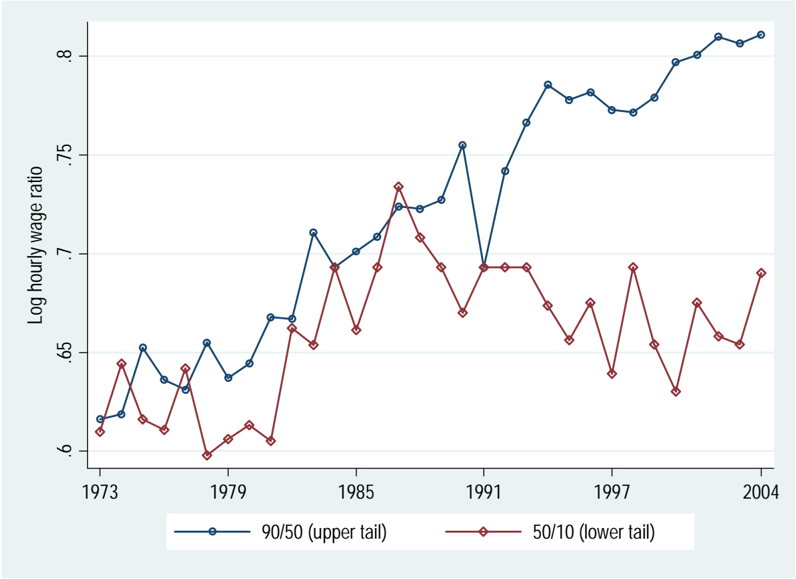
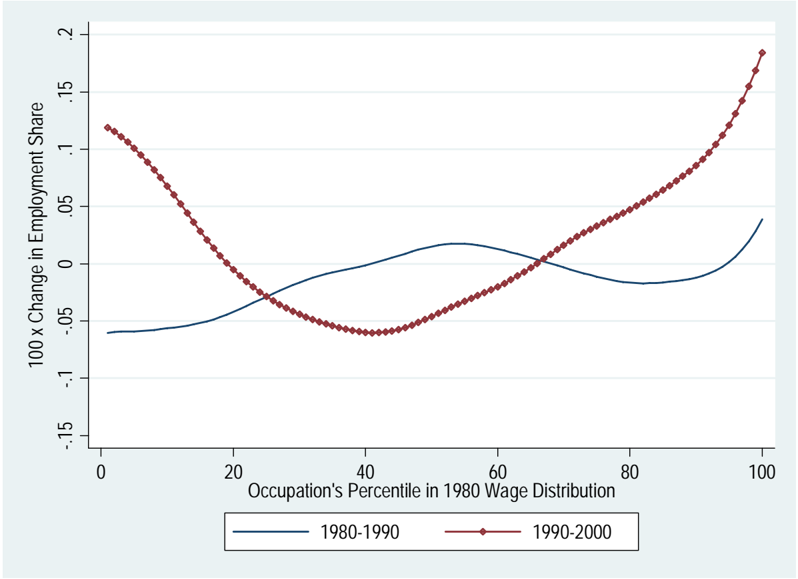
This paper analyzes a marked change in the evolution of the U.S. wage structure over the past fifteen years: divergent trends in upper-tail (90/50) and lower-tail (50/10) wage inequality. We document that wage inequality in the top half of distribution has displayed an unchecked and rather smooth secular rise for the last 25 years (since 1980). Wage inequality in the bottom half of the distribution also grew rapidly from 1979 to 1987, but it has ceased growing (and for some measures actually narrowed) since the late 1980s. Furthermore we find that occupational employment growth shifted from monotonically increasing in wages (education) in the 1980s to a pattern of more rapid growth in jobs at the top and bottom relative to the middles of the wage (education) distribution in the 1990s. We characterize these patterns as the "polarization" of the U.S. labor market, with employment polarizing into high-wage and low-wage jobs at the expense of middle-wage work. We show how a model of computerization in which computers most strongly complement the non-routine (abstract) cognitive tasks of high-wage jobs, directly substitute for the routine tasks found in many traditional middle-wage jobs, and may have little direct impact on non-routine manual tasks in relatively low-wage jobs can help explain the observed polarization of the U.S. labor market.
Overview
CoChat Summary
TL;DR
This paper documents that U.S. wage inequality diverged after the late 1980s: upper-tail inequality kept rising while lower-tail inequality stopped growing, and employment growth shifted from monotonic skill upgrading in the 1980s to polarization into high- and low-wage jobs in the 1990s. The authors argue that a model of computerization—complementing abstract tasks, substituting for routine tasks, and having little direct effect on non-routine manual tasks—can help explain these patterns.
Key findings
- From 1979 to 1987, upper-half (90/50) and lower-half (50/10) wage inequality rose similarly, expanding the 90-10 log wage differential by 21 log points; after 1987, upper-half inequality continued rising while the 50-10 differential contracted by 4 log points from 1987 to 2004, leaving only 4 log points of 90-10 growth since 1987.
- Occupational employment growth changed from monotonically increasing in wages/education in the 1980s to polarized growth in the 1990s: employment grew more rapidly below the 25th and above the 65th percentiles of the occupational wage distribution and declined in the middle (25th to 65th percentiles).
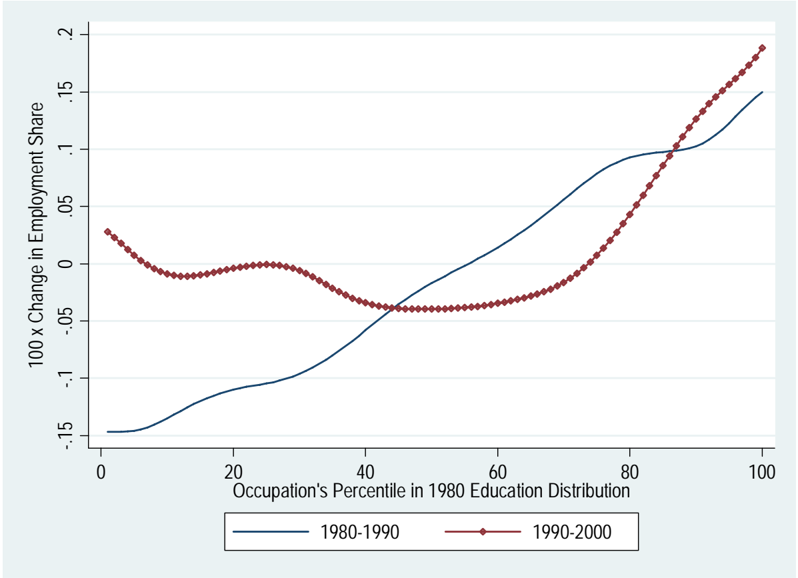
- Using 1980 occupational education percentiles, employment growth was near-monotonic in the 1980s but polarized in the 1990s, with more rapid growth at the bottom than the middle and the most rapid, diverging gains at the top.
- The authors find that quantity and price changes covary positively throughout the earnings distribution in both the 1980s and 1990s, suggesting labor demand shifts are central to explaining wage structure changes.
Methods
- The paper combines descriptive analysis of U.S. wage and employment data with a conceptual task-based model of computerization.
- Wage inequality trends are measured using Current Population Survey May samples for 1973–78 and Merged Outgoing Rotation Group samples for 1979–2004, focusing on 90/50 and 50/10 log hourly wage differentials.
- Employment polarization is analyzed using 1980, 1990, and 2000 Census Integrated Public Use Microsamples, ranking occupations by 1980 median hourly wage or average years of schooling and fitting locally weighted smoothing regressions of decadal employment-share growth on initial skill percentile.
Limitations
- Stated: the model assumes only two worker types, with college workers supplying abstract skill and high school workers substituting between routine and manual tasks; a more complete model would allow endogenous education responses, routine skills for college workers, abstract skills for high school workers, and heterogeneity in abstract skills among college workers.
- Stated: the “social norms” explanation for upper-tail skewness is intriguing but needs refinement to be directly testable, and the minimum wage explanation fits lower-tail inequality trends only to 1987.
- Evident: the paper is largely descriptive and theoretical rather than a causal test of computerization; the model’s predictions are used to interpret observed polarization, but the text does not report direct causal estimates linking computerization to the wage and employment changes.
Model-written summary. Check it against the paper before relying on it.
Integrity signals
Registry
Cites
Statistics
Figures
Verification
Claims the paper makes
0 Valid · 3 Not valid · 14 Not checked · 49 Own results and interpretations
A result the paper states — it cites no source for it, so there is none to check. The quote shows it is in the paper.
In the paper
“The net effect has been a slower growth of only 4 log points in the 90-10 log wage differential since 1987.”
plain- Asserted: passes — The authors put it forward as true.
- Checkable: passes — It can be checked against evidence.
- Load-bearing: passes — The paper’s conclusions depend on it.
- Based: passes — The paper gives a reason why it holds.
A result the paper reports from its own data — it cites no other source for it, so there is none to check. The quote shows it is in the paper.
In the paper
“Using this skill measure, we find near-monotonic (almost linear) increases in employment growth moving up the education distribution in the 1980s.”
plainstates an association- Asserted: passes — The authors put it forward as true.
- Checkable: passes — It can be checked against evidence.
- Load-bearing: unclear — It is unclear whether the paper’s conclusions depend on it.
- Based: passes — The paper gives a reason why it holds.
A result the paper reports from its own data — it cites no other source for it, so there is none to check. The quote shows it is in the paper.
In the paper
“We document that wage inequality in the top half of distribution has displayed an unchecked and rather smooth secular rise for the last 25 years (since 1980).”
- Also stated in: § ABSTRACT · plain
“wage inequality in the top half of the distribution has exhibited an unchecked secular rise for the last 25 years (since 1980)”
plain- Asserted: passes — The authors put it forward as true.
- Checkable: passes — It can be checked against evidence.
- Load-bearing: passes — The paper’s conclusions depend on it.
- Based: passes — The paper gives a reason why it holds.
- Also stated in: § ABSTRACT · plain
A result the paper reports from its own data — it cites no other source for it, so there is none to check. The quote shows it is in the paper.
In the paper
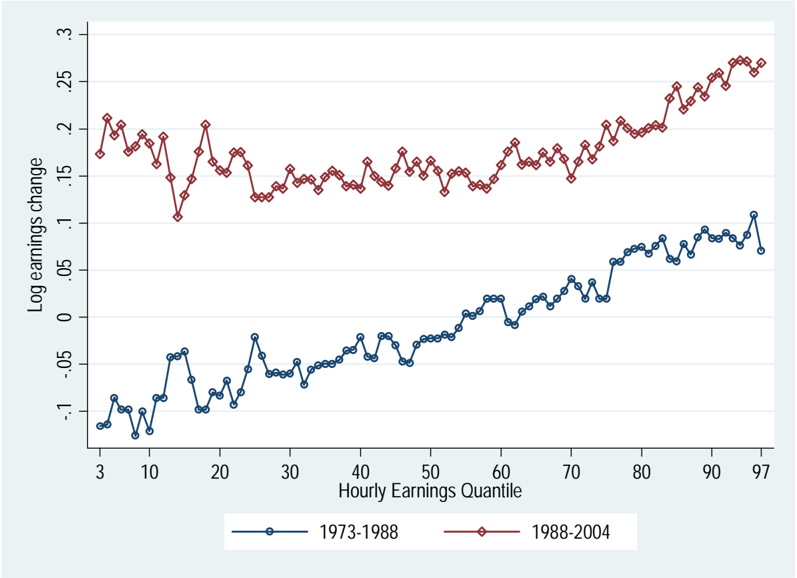
“The figure shows an almost linear spreading out of the entire wage distribution (from the 3 rd to 97 th percentile) in the first half of the sample (driven by changes in the 1980s).”
plainstates a cause- Asserted: passes — The authors put it forward as true.
- Checkable: passes — It can be checked against evidence.
- Load-bearing: passes — The paper’s conclusions depend on it.
- Based: passes — The paper gives a reason why it holds.
A result the paper reports from its own data — it cites no other source for it, so there is none to check. The quote shows it is in the paper.
In the paper
“The plot shows similar substantial increases in upper-half (90-50) and lower-half (50-10) wage inequality from 1979 to 1987, expanding the 90-10 log wage differential by 21 log points.”
plain- Asserted: passes — The authors put it forward as true.
- Checkable: passes — It can be checked against evidence.
- Load-bearing: passes — The paper’s conclusions depend on it.
- Based: passes — The paper gives a reason why it holds.
37 more claims
Create a free account to see all 66 claims and every source verdict.
- It may state two separate claims as one. 20
- Probably not a substantial claim. 5
- The quote only partly states this claim. 1
Claims other papers make about this one
Each is checked against this paper’s own text: does it say what the citing paper says it does?
The source backs part of the claim, not all of it — or backs it for a different population, condition or comparison.
In the citing paper
“Since the 1980s, the U.S. labor market has experienced declines in middle-skill, middle-income jobs in manufacturing and construction as a result of improvements in assembly line automation and the displacement of routine production jobs offshore, among other explanations (Acemoglu and Autor 2011; Autor, Katz, and Kearney 2006; Kalleberg 2009).”
From Beyond the Great Recession: Labor Market Polarization and Ongoing Fertility Decline in the United States (2019) · cites this paper as Autor, Katz, and Kearney 2006
Experimental — accuracy not yet measuredThe cited source says what the claim attributes to it.
In the citing paper
“Prior research on computer-based automation posited that routine work was most susceptible to replacement by computers (Autor et al., 2006; Acemoglu and Autor, 2011).”
From Large language models at work in China’s labor market (2025) · cites this paper as Autor et al., 2006
Citations
Cites
The Skill Content of Recent Technological Change: An Empirical Exploration
Autor, D. H., Levy, F., & Murnane, R. J. (2003) · The Quarterly Journal of Economics · doi:10.1162/003355303322552801 · Cited by 6,205
Self-citationIncome Inequality in the United States, 1913-1998
Piketty, T., & Saez, E. (2003) · The Quarterly Journal of Economics · doi:10.1162/00335530360535135 · Cited by 3,769
Lousy and Lovely Jobs: The Rising Polarization of Work in Britain
Goos, M., & Manning, A. (2007) · Review of Economics and Statistics · doi:10.1162/rest.89.1.118 · Cited by 2,285
Why Has CEO Pay Increased So Much?*
Gabaix, X., & Landier, A. (2008) · Quarterly Journal of Economics · doi:10.1162/qjec.2008.123.1.49 · Cited by 1,764
Skill‐Biased Technological Change and Rising Wage Inequality: Some Problems and Puzzles
Card, D., & DiNardo, J. E. (2002) · Journal of Labor Economics · doi:10.1086/342055 · Cited by 1,714
Technical Change, Job Tasks, and Rising Educational Demands: Looking outside the Wage Structure
Spitz‐Oener, A. (2006) · Journal of Labor Economics · doi:10.1086/499972 · Cited by 1,241
Changes in Unemployment and Wage Inequality: An Alternative Theory and Some Evidence
Acemoglu, D. (1999) · American Economic Review · doi:10.1257/aer.89.5.1259 · Cited by 634
Research works printed but not linked: 3
- Antràs Garicano, Quarterly Journal of Economics (forthcoming).
- Katz Lawrence F, 1999, North-Holland, 1463
- Lemieux Thomas, American Economic Review (forthcoming).
Cited by
Items 101–200 of 1,479
Racial Inequality Trends and the Intergenerational Persistence of Income and Family Structure
Bloome, D. (2014) · American Sociological Review · doi:10.1177/0003122414554947 · Cited by 151
Xie, M., Ding, L., Xia, Y., Guo, J., Pan, J., & Wang, H. (2021) · Economic Modelling · doi:10.1016/j.econmod.2021.01.009 · Cited by 175
Uneven growth: automation’s impact on income and wealth inequality
Moll, B., Rachel, L., & Restrepo, P. (2022) · Econometrica · doi:10.3982/ecta19417 · Cited by 148
Berrone, P., Gelabert, L., Massa-Saluzzo, F., & Rousseau, H. E. (2016) · Academy of Management Journal · doi:10.5465/amj.2015.0746 · Cited by 146
Inequality and Specialization: The Growth of Low-Skill Service Jobs in the United StatesPreprint
Autor, D., & Dorn, D. (2009) · SSRN Electronic Journal · doi:10.2139/ssrn.1434624 · Cited by 209
Self-citationPersonnel Economics: The Economist's View of Human Resources
Lazear, E. P., & Shaw, K. L. (2007) · National Bureau of Economic Research · doi:10.3386/w13653 · Cited by 158
Digitalization, routineness and employment: An exploration on Italian task-based data
Cirillo, V., Evangelista, R., Guarascio, D., & Sostero, M. (2020) · Research Policy · doi:10.1016/j.respol.2020.104079 · Cited by 190
Personnel Economics: Hiring and Incentives
Oyer, P., & Schaefer, S. (2011) · Handbook of labour economics · doi:10.1016/s0169-7218(11)02418-x · Cited by 249
Conceptualizing Innovation in Higher Education
Tierney, W. G., & Lanford, M. (2016) · Higher education · doi:10.1007/978-3-319-26829-3_1 · Cited by 243
Roksa, J., & Levey, T. G. (2010) · Social Forces · doi:10.1353/sof.2010.0085 · Cited by 181
Aaronson, S. R., Fallick, B. C., Figura, A., Pingle, J. F., & Wascher, W. L. (2006) · Brookings Papers on Economic Activity · doi:10.1353/eca.2006.0012 · Cited by 173
Heterogeneous Labor Market Impacts of the COVID-19 Pandemic
Cortés, G. M., & Forsythe, E. C. (2022) · Industrial and Labor Relations Review · doi:10.1177/00197939221076856 · Cited by 204
Neubert, J. C., Mainert, J., Kretzschmar, A., & Greiff, S. (2015) · Industrial and Organizational Psychology · doi:10.1017/iop.2015.14 · Cited by 133
The composite link between technological change and employment: A survey of the literature
Mondolo, J. (2021) · Journal of Economic Surveys · doi:10.1111/joes.12469 · Cited by 160
Changes in Returns to Education in Latin America: The Role of Demand and Supply of Skills
Manacorda, M., Sánchez-Páramo, C., & Schady, N. (2010) · Industrial and Labor Relations Review · doi:10.1177/001979391006300207 · Cited by 167
The Declining Labor Market Prospects of Less-Educated Men
Binder, A., & Bound, J. (2019) · The Journal of Economic Perspectives · doi:10.1257/jep.33.2.163 · Cited by 169
Employee Involvement, Technology and Evolution in Job Skills: A Task-Based Analysis
Green, F. (2012) · Industrial and Labor Relations Review · doi:10.1177/001979391206500103 · Cited by 176
Revisiting the German Wage StructurePreprint
Dustmann, C., Ludsteck, J., & Schönberg, U. (2007) · SSRN Electronic Journal · doi:10.2139/ssrn.980724 · Cited by 184
Shang, Y., Zhou, S., Zhuang, D., Żywiołek, J., & Dınçer, H. (2024) · Gondwana Research · doi:10.1016/j.gr.2024.02.012 · Cited by 157
Resurgent Metropolis: Economy, Society and Urbanization in an Interconnected World
Scott, A. J. (2008) · International Journal of Urban and Regional Research · doi:10.1111/j.1468-2427.2008.00795.x · Cited by 137
Wall Street and Main Street: What Contributes to the Rise in the Highest Incomes?Preprint
Rauh, J., & Kaplan, S. N. (2006) · SSRN Electronic Journal · doi:10.2139/ssrn.931280 · Cited by 122
Inflation and Income Inequality in Developed EconomiesPreprint
Monnin, P. (2014) · SSRN Electronic Journal · doi:10.2139/ssrn.2444710 · Cited by 142
STEM Workers, H-1B Visas, and Productivity in US Cities
Peri, G., Shih, K., & Sparber, C. (2016) · World Scientific Studies in International Economics · doi:10.1142/9789814719902_0009 · Cited by 124
Olsthoorn, M. (2013) · Social Indicators Research · doi:10.1007/s11205-013-0480-y · Cited by 142
Hope, D., & Martelli, A. (2019) · World Politics · doi:10.1017/s0043887118000333 · Cited by 139
Lazonick, W. H. (2017) · International Journal of Political Economy · doi:10.1080/08911916.2017.1407736 · Cited by 129
Selection into Trade and Wage Inequality
Sampson, T. (2014) · American Economic Journal: Microeconomics · doi:10.1257/mic.6.3.157 · Cited by 116
Enhancing problem-solving skills with smart personal assistant technology
Winkler, R., Söllner, M., & Leimeister, J. M. (2021) · Computers & Education · doi:10.1016/j.compedu.2021.104148 · Cited by 115
Controversies about the Rise of American Inequality: A Survey
Gordon, R. J., & Dew-Becker, I. (2008) · National Bureau of Economic Research · doi:10.3386/w13982 · Cited by 152
Labor-Technology Substitution: Implications for Asset Pricing
Zhang, M. B. (2016) · The Journal of Finance · doi:10.1111/jofi.12766 · Cited by 125
Lifetime Earnings Inequality in Germany
Bönke, T., Corneo, G. G., & Lüthen, H. (2014) · Journal of Labor Economics · doi:10.1086/677559 · Cited by 163
Polarization and Rising Wage Inequality: Comparing the U.S. and Germany
Antonczyk, D., DeLeire, T., & Fitzenberger, B. (2018) · Econometrics · doi:10.3390/econometrics6020020 · Cited by 132
Declining Job Quality in the United States: Explanations and Evidence
Howell, D. R., & Kalleberg, A. L. (2019) · RSF The Russell Sage Foundation Journal of the Social Sciences · doi:10.7758/rsf.2019.5.4.01 · Cited by 164
Dougherty, S. M. (2016) · Education Finance and Policy · doi:10.1162/edfp_a_00224 · Cited by 169
Web 2.0 and competence‐oriented design of learning—Potentials and implications for higher education
Schneckenberg, D., Ehlers, U. D., & Adelsberger, H. H. (2011) · British Journal of Educational Technology · doi:10.1111/j.1467-8535.2010.01092.x · Cited by 138
Personnel Economics: Hiring and Incentives
Oyer, P., & Schaefer, S. (2010) · National Bureau of Economic Research · doi:10.3386/w15977 · Cited by 104
Air pollution, water pollution, and robots: Is technology the panacea
Song, J., Chen, Y., & Luan, F. (2022) · Journal of Environmental Management · doi:10.1016/j.jenvman.2022.117170 · Cited by 124
Sorting Multidimensional Types: Theory and Application
Lindenlaub, I. (2017) · The Review of Economic Studies · doi:10.1093/restud/rdw063 · Cited by 190
Reinventing the Welfare StatePreprint
Mooij, R. A. D. (2006) · RePEc: Research Papers in Economics · Cited by 107
Relational Expertise: What Machines Can't Know
Pakarinen, P., & Huising, R. (2025) · Journal of Management Studies · doi:10.1111/joms.12915 · Cited by 105
The Nature of Countercyclical Income Risk
Guvenen, F., Ozkan, S., & Song, J. G. (2013) · Finance and Economics Discussion Series · doi:10.17016/feds.2013.25 · Cited by 111
Informational cities: Analysis and construction of cities in the knowledge society
Stock, W. G. (2011) · Journal of the American Society for Information Science and Technology · doi:10.1002/asi.21506 · Cited by 115
Dahlin, E. (2019) · Socius: Sociological Research for a Dynamic World · doi:10.1177/2378023119846249 · Cited by 81
Knowledge-Based Hierarchies: Using Organizations to Understand the Economy
Garicano, L., & Rossi-Hansberg, E. (2015) · Annual Review of Economics · doi:10.1146/annurev-economics-080614-115748 · Cited by 97
Dougherty, S. M., & Lombardi, A. R. (2016) · Review of Research in Education · doi:10.3102/0091732x16678602 · Cited by 152
Skills-displacing technological change and its impact on jobs: challenging technological alarmism?
McGuinness, S., Pouliakas, K., & Redmond, P. (2023) · Economics of Innovation and New Technology · doi:10.1080/10438599.2021.1919517 · Cited by 98
Inference on Counterfactual DistributionsPreprint
Chernozhukov, V., Fernández‐Val, I., & Melly, B. (2008) · SSRN Electronic Journal · doi:10.2139/ssrn.1235529 · Cited by 108
Is College Education Less Necessary with AI? Evidence from Firm-Level Labor Structure Changes
Mei, X., Cao, X., Feng, X., Gu, B., & Zhang, Y. (2022) · Journal of Management Information Systems · doi:10.1080/07421222.2022.2096542 · Cited by 120
Automation, unemployment, and the role of labor market training
Schmidpeter, B., & Winter‐Ebmer, R. (2021) · European Economic Review · doi:10.1016/j.euroecorev.2021.103808 · Cited by 135
Alexander, L. S., & Eberly, J. C. (2018) · IMF Economic Review · doi:10.1057/s41308-017-0044-2 · Cited by 114
Immigrants, English Ability and the Digital Divide
Ono, H., & Zavodny, M. (2008) · Social Forces · doi:10.1353/sof.0.0052 · Cited by 96
Skills at Work: How Skills and their Use Matter in the Labour Market
Quintini, G. (2014) · OECD social employment and migration working papers · doi:10.1787/5jz44fdfjm7j-en · Cited by 141
Technology, offshoring and the rise of non-routine jobs
Reijnders, L. S. M., & de Vries, G. J. (2018) · Journal of Development Economics · doi:10.1016/j.jdeveco.2018.08.009 · Cited by 117
Falck, O., Heimisch, A., & Wiederhold, S. (2016) · Research Policy · doi:10.1016/j.respol.2020.104064 · Cited by 185
Enns, P. K., Kelly, N. J., Morgan, J., Volscho, T., & Witko, C. (2014) · The Journal of Politics · doi:10.1017/s0022381613001321 · Cited by 93
The impact of technological progress on labour markets: policy challenges
Goos, M. (2018) · Oxford Review of Economic Policy · doi:10.1093/oxrep/gry002 · Cited by 137
The dynamics of disappearing routine jobs: A flows approach
Cortés, G. M., Jaimovich, N., Nekarda, C. J., & Siu, H. (2020) · Labour Economics · doi:10.1016/j.labeco.2020.101823 · Cited by 114
How Population Structure Shapes Neighborhood Segregation
Bruch, E. E. (2014) · American Journal of Sociology · doi:10.1086/675411 · Cited by 109
Technical Change, Wage Inequality, and Taxes
Ales, L., Kurnaz, M., & Sleet, C. M. (2015) · American Economic Review · doi:10.1257/aer.20140466 · Cited by 105
Job polarization, technological change and routinization: Evidence for Portugal
Fonseca, T., Lima, F., & Pereira, S. C. (2018) · Labour Economics · doi:10.1016/j.labeco.2018.02.003 · Cited by 129
Reaching for the Stars: Who Pays for Talent in Innovative Industries?
Andersson, F. W., Freedman, M. L., Haltiwanger, J., Lane, J. I., & Shaw, K. L. (2009) · The Economic Journal · doi:10.1111/j.1468-0297.2009.02277.x · Cited by 102
Explaining Job Polarization: The Roles of Technology, Offshoring and InstitutionsPreprint
Goos, M., Manning, A., & Salomons, A. (2012) · SSRN Electronic Journal · doi:10.2139/ssrn.1983952 · Cited by 96
Berger, T., & Frey, C. B. (2015) · Regional Science and Urban Economics · doi:10.1016/j.regsciurbeco.2015.11.003 · Cited by 138
The Rise of Finance and Firm Employment Dynamics
Lin, K.-H. (2016) · Organization Science · doi:10.1287/orsc.2016.1073 · Cited by 105
The Flynn effect and population aging
Skirbekk, V., Stonawski, M., Bonsang, E., & Staudinger, U. M. (2013) · Intelligence · doi:10.1016/j.intell.2013.02.001 · Cited by 89
For whom the bell tolls: The firm-level effects of automation on wage and gender inequality
Domini, G., Grazzi, M., Moschella, D., & Treibich, T. (2022) · Research Policy · doi:10.1016/j.respol.2022.104533 · Cited by 127
Innovation and skill dynamics: a life-cycle approach
Vona, F., & Consoli, D. (2014) · Industrial and Corporate Change · doi:10.1093/icc/dtu028 · Cited by 129
Residential Segregation, Spatial Mismatch and Economic Growth across US Metropolitan Areas
Li, H., Campbell, H. S., & Fernandez, S. (2013) · Urban Studies · doi:10.1177/0042098013477697 · Cited by 105
Offshoring and the skill structure of labour demand
Foster‐McGregor, N., Stehrer, R., & de Vries, G. J. (2013) · Review of World Economics · doi:10.1007/s10290-013-0163-4 · Cited by 112
Skill-biased technological change and labor market polarization in China
Wang, J., Hu, Y. Q., & Zhang, Z. (2021) · Economic Modelling · doi:10.1016/j.econmod.2021.105507 · Cited by 106
Digital transformation and labor upgrading
Li, W., Yang, X., & Yin, X. (2024) · Pacific-Basin Finance Journal · doi:10.1016/j.pacfin.2024.102280 · Cited by 109
Private Equity, Layoffs, and Job Polarization
Olsson, M., & Tå̊g, J. (2016) · Journal of Labor Economics · doi:10.1086/690712 · Cited by 104
Children and Socioeconomic Status
Duncan, G. J., Magnuson, K., & Votruba‐Drzal, E. (2015) · Wiley eBooks · doi:10.1002/9781118963418.childpsy414 · Cited by 111
Tapia, J. R. B. (1986) · LA Referencia (Red Federada de Repositorios Institucionales de Publicaciones Científicas) · Cited by 82
Estimating the Variance of Wages in the Presence of Selection and Unobserved Heterogeneity
Chen, S. H. (2008) · Review of Economics and Statistics · doi:10.1162/rest.90.2.275 · Cited by 81
Codagnone, C., Fabienne, A., & Federico, B. (2016) · SSRN Electronic Journal · doi:10.2791/431485 · Cited by 81
Reworking Postfordism: Labor Process Versus Employment Relations
Vidal, M. (2011) · Sociology Compass · doi:10.1111/j.1751-9020.2011.00366.x · Cited by 78
Gray, R. (2013) · Explorations in Economic History · doi:10.1016/j.eeh.2013.04.002 · Cited by 100
Kupets, O. (2015) · Journal of Comparative Economics · doi:10.1016/j.jce.2015.10.005 · Cited by 107
Immigration, Search and Redistribution: A Quantitative Assessment of Native Welfare
Battisti, M., Felbermayr, G. J., Peri, G., & Poutvaara, P. (2017) · Journal of the European Economic Association · doi:10.1093/jeea/jvx035 · Cited by 125
Berlin, G. (2007) · The Future of Children · doi:10.1353/foc.2007.0013 · Cited by 88
Just the Facts, Ma'am: Postsecondary Education and Labor Market Outcomes in the U.S.Preprint
Holzer, H. J., & Dunlop, E. (2013) · SSRN Electronic Journal · doi:10.2139/ssrn.2250297 · Cited by 85
New Frontiers: The Origins and Content of New Work, 1940–2018Preprint
Autor, D., Chin, C., Salomons, A., & Seegmiller, B. (2022) · SSRN Electronic Journal · doi:10.2139/ssrn.4196333 · Cited by 72
Self-citationCapital Accumulation, Trade Liberalization, and Rising Wage Inequality: The Case of Argentina
Acosta, P. A., & Gasparini, L. (2007) · Economic Development and Cultural Change · doi:10.1086/516764 · Cited by 97
The March of the Techies: Job Polarization Within and Between Firms
Harrigan, J., Reshef, A., & Toubal, F. (2020) · Research Policy · doi:10.1016/j.respol.2020.104008 · Cited by 95
High-Touch and Here-to-Stay: Future Skills Demands in US Low Wage Service Occupations
Gatta, M., Boushey, H., & Appelbaum, E. (2009) · Sociology · doi:10.1177/0038038509340735 · Cited by 75
Family, Education, and Sources of Wealth among the Richest Americans, 1982–2012
Kaplan, S. N., & Rauh, J. (2013) · American Economic Review · doi:10.1257/aer.103.3.158 · Cited by 85
Capital imports composition, complementarities, and the skill premium in developing countries
Raveh, O., & Reshef, A. (2015) · Journal of Development Economics · doi:10.1016/j.jdeveco.2015.07.011 · Cited by 72
Occupations and British Wage Inequality, 1970s-2000s
Williams, M. (2012) · European Sociological Review · doi:10.1093/esr/jcs063 · Cited by 102
The global polarisation of remote work
Braesemann, F., Stephany, F., Teutloff, O., Kässi, O., Graham, M., & Lehdonvirta, V. (2022) · PLOS ONE · doi:10.1371/journal.pone.0274630 · Cited by 76
Economic Change and the Structure of Opportunity for Less-Skilled Workers
Blank, R. M. (2008) · Cited by 78
Access to Mathematics: “A Possessive Investment in Whiteness”1
Battey, D. (2013) · Curriculum Inquiry · doi:10.1111/curi.12015 · Cited by 112
Structural transformation and the rise of information technology
Gallipoli, G., & Makridis, C. A. (2018) · Journal of Monetary Economics · doi:10.1016/j.jmoneco.2018.05.005 · Cited by 58
Trade, Education, and the Shrinking Middle Class
Blanchard, E. J., & Willmann, G. (2013) · Journal of International Economics · doi:10.1016/j.jinteco.2015.10.007 · Cited by 122
ASSESSING THE JOB POLARIZATION EXPLANATION OF GROWING WAGE INEQUALITY
Mishel, L., Schmitt, J., & Shierholz, H. (2013) · Cited by 92
Using Payroll Tax Variation to Unpack the Black Box of Firm-Level Production
Benzarti, Y., & Harju, J. (2021) · Journal of the European Economic Association · doi:10.1093/jeea/jvab010 · Cited by 95
Financialization and US Income Inequality, 1970-2008Preprint
Lin, K.-H., & Tomaskovic‐Devey, D. (2011) · SSRN Electronic Journal · doi:10.2139/ssrn.1954129 · Cited by 71
Offshoring and the Polarization of the U.S. Labor Market
Oldenski, L. (2014) · Industrial and Labor Relations Review · doi:10.1177/00197939140670s311 · Cited by 100
ICT demand behaviour: an international comparison
Cette, G., & Lopez, J. (2011) · Economics of Innovation and New Technology · doi:10.1080/10438599.2011.595921 · Cited by 84
Machin, S. J., & Reenen, J. M. V. (2007) · London School of Economics and Political Science Research Online (London School of Economics and Political Science) · Cited by 82
Metadata
- Authors
- Autor, D. H., Katz, L. F., & Kearney, M. S.
- Affiliations
- National Bureau of Economic Research (US)
- Brookings Institution (US)
- Venue
- American Economic Review
- Publisher
- American Economic Association
- Published
- 2006-04-01
- Volume
- 96
- Issue
- 2
- Pages
- 189-194
- ISSN
- 0002-8282 (ISSN-L)
- OpenAlex
- W3124544360
- Cited by
- 1,594
- References
- 4
- Citations by year
- 2026: 75 · 2025: 108 · 2024: 122 · 2023: 90 · 2022: 89 · 2021: 100 · 2020: 107 · 2019: 96 · 2018: 93 · 2017: 74 · 2016: 76 · 2015: 91 · 2014: 78 · 2013: 81 · 2012: 59
- FWCI
- 110.81
- Type
- journal article
- Language
- en
- Open access
- closed
- Locations
- American Economic Review (publishedVersion)
- RePEc: Research Papers in Economics (submittedVersion)
- Topics
- Social Sciences › Economics, Econometrics and Finance › Economics and Econometrics › Labor market dynamics and wage inequality
- Social Sciences › Economics, Econometrics and Finance › General Economics, Econometrics and Finance › Economic Theory and Policy
- Social Sciences › Sociology and Political Science › Income, Poverty, and Inequality
- Keywords
- labor market polarization, wage inequality, wage distribution, computerization, high-wage jobs, low-wage employment, United States labor market
About these checks
Registry, retraction, Cites and statistics results are computed, not judged, with one exception: a printed reference that no index lists is read once by a model before it counts as a citation error. Claims are extracted by a model and kept only when their quote appears verbatim in the text; each cited source is then checked, with a model’s help, for whether it says what the claim relies on. Those verdicts can be wrong — read the claim’s quote and the cited source before relying on one.
A language model drew the claims from the paper on 2026-10-12, under version 3 of the claim definition (model deepseek-v4.1-flash, prompt extract-v3).
A second model labelled each claim on 2026-10-12 (model jev-1.13-20260917, definition revision gold-guideline-v0.2).
Statistics and arithmetic are recomputed, not judged.
Confidence bands are shown only for fields calibrated on our annotated test set. None is calibrated yet, so no band is shown.
What counts as a claim ›How we measure confidence ›How we check this ›
Are you an author, or do you see a problem with this page? Request a review
Data sources
Bibliographic data: Semantic Scholar, OpenAlex, Crossref.
Contains information from the Semantic Scholar Academic Graph Datasets, made available under the ODC Attribution License (ODC-BY 1.0).
Semantic Scholar’s data is described in: Kinney, R., et al. (2023). The Semantic Scholar Open Data Platform. arXiv:2301.10140.
