

The Polarization of the U.S. Labor Market
The DOI matches its Crossref record; 7 of the 7 references it cites were found in a registry or an index; none of the 16 sources its claims cite is checked for support yet.
Abstract
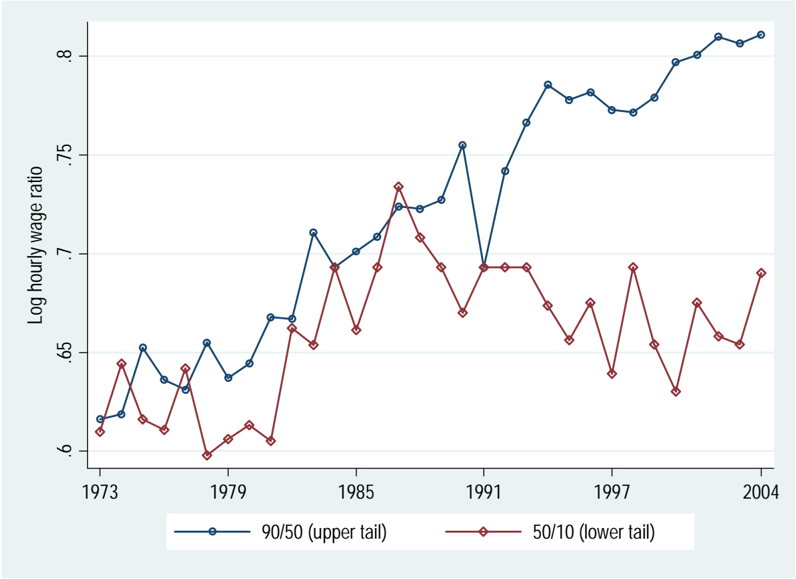
This paper analyzes a marked change in the evolution of the U.S. wage structure over the past fifteen years: divergent trends in upper-tail (90/50) and lower-tail (50/10) wage inequality. We document that wage inequality in the top half of distribution has displayed an unchecked and rather smooth secular rise for the last 25 years (since 1980). Wage inequality in the bottom half of the distribution also grew rapidly from 1979 to 1987, but it has ceased growing (and for some measures actually narrowed) since the late 1980s. Furthermore we find that occupational employment growth shifted from monotonically increasing in wages (education) in the 1980s to a pattern of more rapid growth in jobs at the top and bottom relative to the middles of the wage (education) distribution in the 1990s. We characterize these patterns as the "polarization" of the U.S. labor market, with employment polarizing into high-wage and low-wage jobs at the expense of middle-wage work. We show how a model of computerization in which computers most strongly complement the non-routine (abstract) cognitive tasks of high-wage jobs, directly substitute for the routine tasks found in many traditional middle-wage jobs, and may have little direct impact on non-routine manual tasks in relatively low-wage jobs can help explain the observed polarization of the U.S. labor market.
Overview
CoChat Summary
TL;DR
This paper documents that U.S. wage inequality diverged after the late 1980s: upper-tail inequality kept rising while lower-tail inequality stopped growing, and employment growth shifted from monotonic skill upgrading in the 1980s to polarization into high- and low-wage jobs in the 1990s. The authors argue that a model of computerization—complementing abstract tasks, substituting for routine tasks, and having little direct effect on non-routine manual tasks—can help explain these patterns.
Key findings
- From 1979 to 1987, upper-half (90/50) and lower-half (50/10) wage inequality rose similarly, expanding the 90-10 log wage differential by 21 log points; after 1987, upper-half inequality continued rising while the 50-10 differential contracted by 4 log points from 1987 to 2004, leaving only 4 log points of 90-10 growth since 1987.
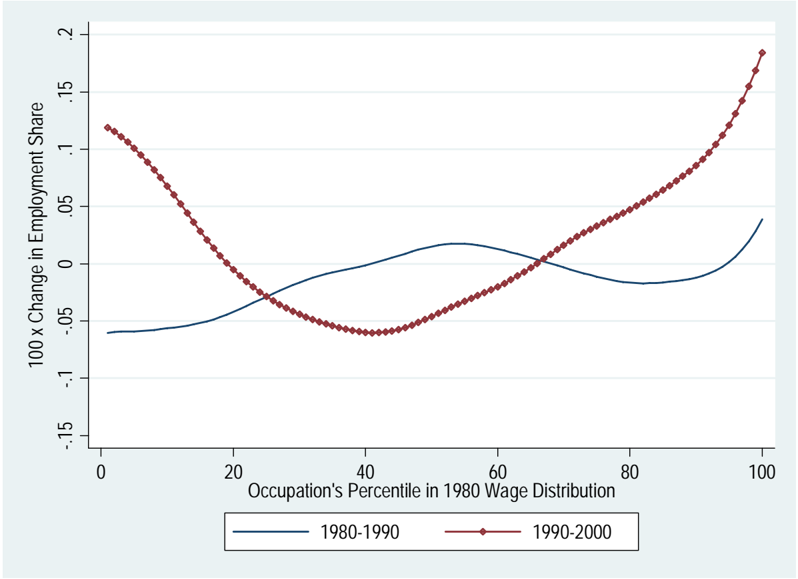
- Occupational employment growth changed from monotonically increasing in wages/education in the 1980s to polarized growth in the 1990s: employment grew more rapidly below the 25th and above the 65th percentiles of the occupational wage distribution and declined in the middle (25th to 65th percentiles).
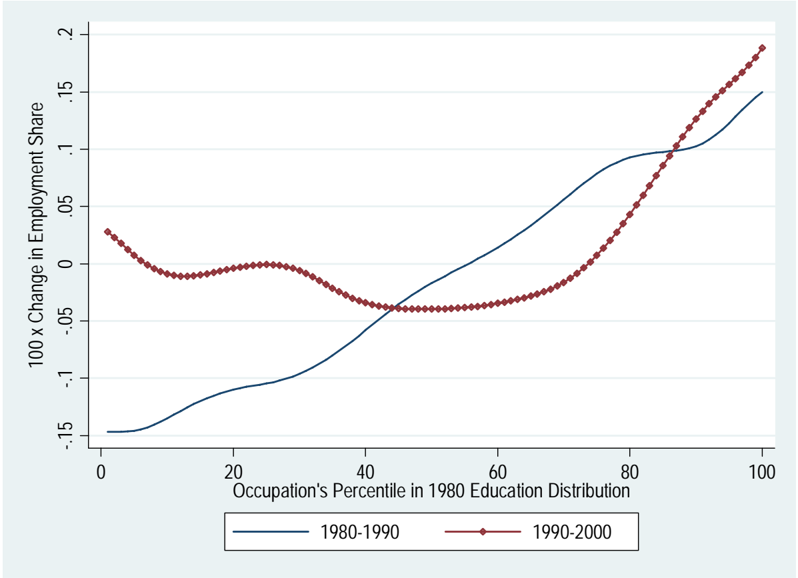
- Using 1980 occupational education percentiles, employment growth was near-monotonic in the 1980s but polarized in the 1990s, with more rapid growth at the bottom than the middle and the most rapid, diverging gains at the top.
- The authors find that quantity and price changes covary positively throughout the earnings distribution in both the 1980s and 1990s, suggesting labor demand shifts are central to explaining wage structure changes.
Methods
- The paper combines descriptive analysis of U.S. wage and employment data with a conceptual task-based model of computerization.
- Wage inequality trends are measured using Current Population Survey May samples for 1973–78 and Merged Outgoing Rotation Group samples for 1979–2004, focusing on 90/50 and 50/10 log hourly wage differentials.
- Employment polarization is analyzed using 1980, 1990, and 2000 Census Integrated Public Use Microsamples, ranking occupations by 1980 median hourly wage or average years of schooling and fitting locally weighted smoothing regressions of decadal employment-share growth on initial skill percentile.
Limitations
- Stated: the model assumes only two worker types, with college workers supplying abstract skill and high school workers substituting between routine and manual tasks; a more complete model would allow endogenous education responses, routine skills for college workers, abstract skills for high school workers, and heterogeneity in abstract skills among college workers.
- Stated: the “social norms” explanation for upper-tail skewness is intriguing but needs refinement to be directly testable, and the minimum wage explanation fits lower-tail inequality trends only to 1987.
- Evident: the paper is largely descriptive and theoretical rather than a causal test of computerization; the model’s predictions are used to interpret observed polarization, but the text does not report direct causal estimates linking computerization to the wage and employment changes.
Model-written summary. Check it against the paper before relying on it.
Integrity signals
Registry
Cites
Statistics
Figures
Verification
Claims the paper makes
0 Valid · 3 Not valid · 14 Not checked · 49 Own results and interpretations
A result the paper states — it cites no source for it, so there is none to check. The quote shows it is in the paper.
In the paper
“The net effect has been a slower growth of only 4 log points in the 90-10 log wage differential since 1987.”
plain- Asserted: passes — The authors put it forward as true.
- Checkable: passes — It can be checked against evidence.
- Load-bearing: passes — The paper’s conclusions depend on it.
- Based: passes — The paper gives a reason why it holds.
A result the paper reports from its own data — it cites no other source for it, so there is none to check. The quote shows it is in the paper.
In the paper
“Using this skill measure, we find near-monotonic (almost linear) increases in employment growth moving up the education distribution in the 1980s.”
plainstates an association- Asserted: passes — The authors put it forward as true.
- Checkable: passes — It can be checked against evidence.
- Load-bearing: unclear — It is unclear whether the paper’s conclusions depend on it.
- Based: passes — The paper gives a reason why it holds.
A result the paper reports from its own data — it cites no other source for it, so there is none to check. The quote shows it is in the paper.
In the paper
“We document that wage inequality in the top half of distribution has displayed an unchecked and rather smooth secular rise for the last 25 years (since 1980).”
- Also stated in: § ABSTRACT · plain
“wage inequality in the top half of the distribution has exhibited an unchecked secular rise for the last 25 years (since 1980)”
plain- Asserted: passes — The authors put it forward as true.
- Checkable: passes — It can be checked against evidence.
- Load-bearing: passes — The paper’s conclusions depend on it.
- Based: passes — The paper gives a reason why it holds.
- Also stated in: § ABSTRACT · plain
A result the paper reports from its own data — it cites no other source for it, so there is none to check. The quote shows it is in the paper.
In the paper
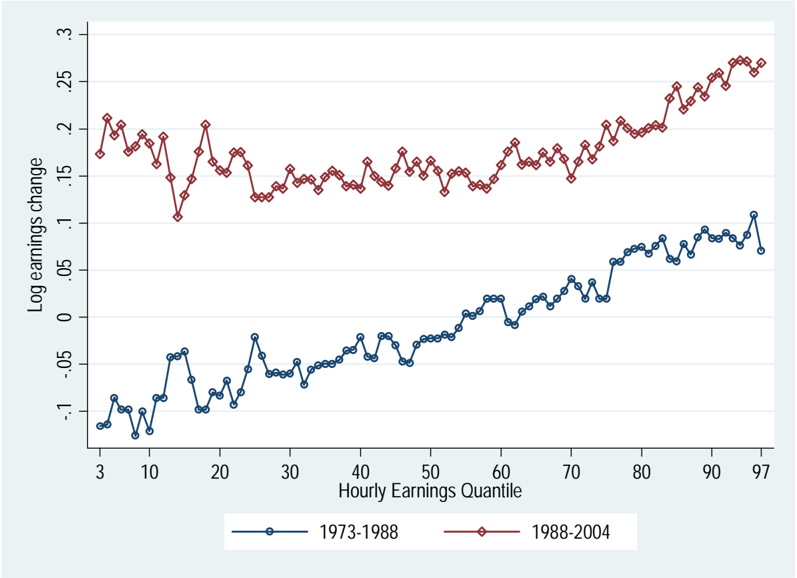
“The figure shows an almost linear spreading out of the entire wage distribution (from the 3 rd to 97 th percentile) in the first half of the sample (driven by changes in the 1980s).”
plainstates a cause- Asserted: passes — The authors put it forward as true.
- Checkable: passes — It can be checked against evidence.
- Load-bearing: passes — The paper’s conclusions depend on it.
- Based: passes — The paper gives a reason why it holds.
A result the paper reports from its own data — it cites no other source for it, so there is none to check. The quote shows it is in the paper.
In the paper
“The plot shows similar substantial increases in upper-half (90-50) and lower-half (50-10) wage inequality from 1979 to 1987, expanding the 90-10 log wage differential by 21 log points.”
plain- Asserted: passes — The authors put it forward as true.
- Checkable: passes — It can be checked against evidence.
- Load-bearing: passes — The paper’s conclusions depend on it.
- Based: passes — The paper gives a reason why it holds.
37 more claims
Create a free account to see all 66 claims and every source verdict.
- It may state two separate claims as one. 20
- Probably not a substantial claim. 5
- The quote only partly states this claim. 1
Claims other papers make about this one
Each is checked against this paper’s own text: does it say what the citing paper says it does?
The source backs part of the claim, not all of it — or backs it for a different population, condition or comparison.
In the citing paper
“Since the 1980s, the U.S. labor market has experienced declines in middle-skill, middle-income jobs in manufacturing and construction as a result of improvements in assembly line automation and the displacement of routine production jobs offshore, among other explanations (Acemoglu and Autor 2011; Autor, Katz, and Kearney 2006; Kalleberg 2009).”
From Beyond the Great Recession: Labor Market Polarization and Ongoing Fertility Decline in the United States (2019) · cites this paper as Autor, Katz, and Kearney 2006
Experimental — accuracy not yet measuredThe cited source says what the claim attributes to it.
In the citing paper
“Prior research on computer-based automation posited that routine work was most susceptible to replacement by computers (Autor et al., 2006; Acemoglu and Autor, 2011).”
From Large language models at work in China’s labor market (2025) · cites this paper as Autor et al., 2006
Citations
Cites
The Skill Content of Recent Technological Change: An Empirical Exploration
Autor, D. H., Levy, F., & Murnane, R. J. (2003) · The Quarterly Journal of Economics · doi:10.1162/003355303322552801 · Cited by 6,205
Self-citationIncome Inequality in the United States, 1913-1998
Piketty, T., & Saez, E. (2003) · The Quarterly Journal of Economics · doi:10.1162/00335530360535135 · Cited by 3,769
Lousy and Lovely Jobs: The Rising Polarization of Work in Britain
Goos, M., & Manning, A. (2007) · Review of Economics and Statistics · doi:10.1162/rest.89.1.118 · Cited by 2,285
Why Has CEO Pay Increased So Much?*
Gabaix, X., & Landier, A. (2008) · Quarterly Journal of Economics · doi:10.1162/qjec.2008.123.1.49 · Cited by 1,764
Skill‐Biased Technological Change and Rising Wage Inequality: Some Problems and Puzzles
Card, D., & DiNardo, J. E. (2002) · Journal of Labor Economics · doi:10.1086/342055 · Cited by 1,714
Technical Change, Job Tasks, and Rising Educational Demands: Looking outside the Wage Structure
Spitz‐Oener, A. (2006) · Journal of Labor Economics · doi:10.1086/499972 · Cited by 1,241
Changes in Unemployment and Wage Inequality: An Alternative Theory and Some Evidence
Acemoglu, D. (1999) · American Economic Review · doi:10.1257/aer.89.5.1259 · Cited by 634
Research works printed but not linked: 3
- Antràs Garicano, Quarterly Journal of Economics (forthcoming).
- Katz Lawrence F, 1999, North-Holland, 1463
- Lemieux Thomas, American Economic Review (forthcoming).
Cited by
Why Are There Still So Many Jobs? The History and Future of Workplace Automation
Autor, D. H. (2015) · Journal of Economic Perspectives · doi:10.1257/jep.29.3.3 · Cited by 3,917
“…evidence confirms the presence of employment polarization at the level of industries, localities, and national labor markets (Autor, Katz, and Kearney 2006, 2008; Goos and Manning 2007; Autor and Dorn 2013; Michaels, Natraj, and Van Reenen 2014; Goos, Manning, and Salomons 2014; Graetz and…”
BackgroundSelf-citationThe growth of low-skill service jobs and the polarization of the US labor market
Autor, D. H., & Dorn, D. (2013) · American Economic Review · doi:10.1257/aer.103.5.1553 · Cited by 3,824
Self-citationSkills, Tasks and Technologies: Implications for Employment and Earnings
Acemoglu, D., & Autor, D. (2011) · Handbook of Labor Economics · doi:10.1016/s0169-7218(11)02410-5 · Cited by 3,799
Self-citationTrends in U.S. Wage Inequality: Revising the Revisionists
Autor, D. H., Katz, L. F., & Kearney, M. S. (2008) · Review of Economics and Statistics · doi:10.1162/rest.90.2.300 · Cited by 2,385
“These trends toward wage structure “polarization” can, we believe, be partially reconciled by a reinterpretation of the skill-biased technical change hypothesis along the lines developed by Autor, Levy, and Murnane (2003), Autor, Katz, and Kearney (2006), and Goos and Manning (2007).”
Self-citationTop Incomes in the Long Run of History
Atkinson, A. B., Piketty, T., & Saez, E. (2011) · Journal of Economic Literature · doi:10.1257/jel.49.1.3 · Cited by 2,362
Unconditional Quantile Regressions
(2009) · Econometrica · doi:10.3982/ecta6822 · Cited by 2,226
Skills, Tasks and Technologies: Implications for Employment and Earnings
Acemoglu, D., & Autor, D. (2010) · doi:10.3386/w16082 · Cited by 2,180
Self-citationExplaining Job Polarization: Routine-Biased Technological Change and Offshoring
Goos, M., Manning, A., & Salomons, A. (2014) · American Economic Review · doi:10.1257/aer.104.8.2509 · Cited by 2,111
Does Working from Home Work? Evidence from a Chinese Experiment *
Bloom, N., Liang, J., Roberts, J., & Ying, Z. J. (2015) · The Quarterly Journal of Economics · doi:10.1093/qje/qju032 · Cited by 1,991
Why Has CEO Pay Increased So Much?*
Gabaix, X., & Landier, A. (2008) · Quarterly Journal of Economics · doi:10.1162/qjec.2008.123.1.49 · Cited by 1,764
The Growing Importance of Social Skills in the Labor Market*
Deming, D. J. (2017) · The Quarterly Journal of Economics · doi:10.1093/qje/qjx022 · Cited by 1,727
“Beginning in the 1990s, the labor market “hollowed out” as computers substituted for labor in middle-skill routine tasks and complemented high-skilled labor, a phenomenon referred to as job polarization (Autor et al. 2003, 2006; Michaels et al. 2014; Goos et al. 2014).”
BackgroundGoos, M., Manning, A., & Salomons, A. (2009) · American Economic Review · doi:10.1257/aer.99.2.58 · Cited by 1,375
Loebbecke, C., & Picot, A. (2015) · The Journal of Strategic Information Systems · doi:10.1016/j.jsis.2015.08.002 · Cited by 1,317
“Centralized production implies that the market falls into a few hands, leading to oligopolistic or even monopolistic structures where a few players dominate, and with traditional market boundaries blurring or falling altogether (Autor et al., 2006, 1998; Shirky, 2008).”
BackgroundDo better schools lead to more growth? Cognitive skills, economic outcomes, and causation
Hanushek, E. A., & Woessmann, L. (2012) · Journal of Economic Growth · doi:10.1007/s10887-012-9081-x · Cited by 1,264
“The U.S. analysis of Autor et al. (2006, 2008) suggests that high-skilled workers and low-skilled workers are complements, a result that helps explain income variations across the educational spectrum. the home countries.”
Income Inequality and Income Segregation
Reardon, S. F., & Bischoff, K. (2011) · American Journal of Sociology · doi:10.1086/657114 · Cited by 1,047
“4 The trend in the 50/10 ratio we report here differs slightly than that reported by Autor et al. (2006, 2008), who find that the 50/10 ratio grew in the 1970s and early 1980s before flattening in the late l980s and 1990s.”
ResultHas ICT Polarized Skill Demand? Evidence from Eleven Countries over Twenty-Five Years
Michaels, G., Natraj, A., & Van Reenen, J. (2014) · The Review of Economics and Statistics · doi:10.1162/rest_a_00366 · Cited by 900
“Autor, Katz, and Kearney (2006, 2008) use U.S. data to show that although upper-tail inequality (between the 90th and 50th percentiles of the wage distribution) has continued to rise in an almost secular way over the past thirty years, lower-tail inequality (between the 50th and 10th percentiles of…”
MethodThe Skill Complementarity of Broadband Internet *
Akerman, A., Gaarder, I., & Mogstad, M. (2015) · The Quarterly Journal of Economics · doi:10.1093/qje/qjv028 · Cited by 808
OECD Employment Outlook 2019: The Future of Work
OECD (2019) · OECD Employment Outlook · doi:10.1787/9ee00155-en · Cited by 821
Revisiting the German Wage Structure*
Dustmann, C., Ludsteck, J., & Schönberg, U. (2009) · Quarterly Journal of Economics · doi:10.1162/qjec.2009.124.2.843 · Cited by 812
Bartel, A., Ichniowski, C., & Shaw, K. (2007) · The Quarterly Journal of Economics · doi:10.1162/qjec.2007.122.4.1721 · Cited by 711
“Analyzing data on the U.S. labor market, Autor, Katz, and Kearney (2005, 2006) show that during the past 15 years of rapidly falling computer prices, wages and employment have increased dramatically at the polar ends of the wage distribution: wages rose in occupations that employ the most highly…”
MethodCauses and Consequences of Income Inequality
Tsounta, E., Suphaphiphat, N., Ricka, F., Dabla-Norris, E., & Kochhar, K. (2015) · Staff Discussion Notes · doi:10.5089/9781513555188.006 · Cited by 710
Decomposing Wage Distributions Using Recentered Influence Function Regressions
Firpo, S. P., Fortin, N. M., & Lemieux, T. (2018) · Econometrics · doi:10.3390/econometrics6020028 · Cited by 647
Untangling Trade and Technology: Evidence from Local Labour Markets
Autor, D. H., Dorn, D., & Hanson, G. H. (2015) · The Economic Journal · doi:10.1111/ecoj.12245 · Cited by 628
Self-citationPutting Tasks to the Test: Human Capital, Job Tasks, and Wages
Autor, D. H., & Handel, M. J. (2013) · Journal of Labor Economics · doi:10.1086/669332 · Cited by 630
“Subsequent work by Autor, Katz, and Kearney ð2006, 2008Þ, SpitzOener ð2006Þ, Bartel, Ichniowski, and Shaw ð2007Þ, Felstead et al. ð2007Þ, Goos and Manning ð2007Þ, Smith ð2008Þ, Dustmann, Ludsteck, and Schönberg ð2009Þ, Antonczyk, DeLeire, and Fitzenberger ð2010Þ, Black and Spitz-Oener ð2010Þ,…”
Self-citationOccupational Feminization and Pay: Assessing Causal Dynamics Using 1950-2000 U.S. Census Data
Levanon, A., England, P., & Allison, P. (2009) · Social Forces · doi:10.1353/sof.0.0264 · Cited by 598
Torche, F. (2011) · American Journal of Sociology · doi:10.1086/661904 · Cited by 587
Performance Pay and Wage Inequality*
Lemieux, T., MacLeod, W. B., & Parent, D. (2009) · Quarterly Journal of Economics · doi:10.1162/qjec.2009.124.1.1 · Cited by 549
Financialization and U.S. Income Inequality, 1970–2008
Lin, K.-H., & Tomaskovic-Devey, D. (2013) · American Journal of Sociology · doi:10.1086/669499 · Cited by 573
Wall Street and Main Street: What Contributes to the Rise in the Highest Incomes?
Kaplan, S. N., & Rauh, J. (2010) · Review of Financial Studies · doi:10.1093/rfs/hhp006 · Cited by 476
The Structure of Inequality and the Politics of Redistribution
LUPU, N., & PONTUSSON, J. (2011) · American Political Science Review · doi:10.1017/s0003055411000128 · Cited by 484
Furman, J., & Seamans, R. (2019) · Innovation Policy and the Economy · doi:10.1086/699936 · Cited by 483
Personnel Economics: The Economist's View of Human Resources
Lazear, E. P., & Shaw, K. L. (2007) · Journal of Economic Perspectives · doi:10.1257/jep.21.4.91 · Cited by 470
Krugman, P. R. (2008) · Brookings Papers on Economic Activity · doi:10.1353/eca.0.0006 · Cited by 466
The Internet and Local Wages: A Puzzle
Forman, C., Goldfarb, A., & Greenstein, S. (2012) · American Economic Review · doi:10.1257/aer.102.1.556 · Cited by 452
The Labor Market in the Great Recession
Elsby, M. W. L., Hobijn, B., & Şahin, A. (2010) · Brookings Papers on Economic Activity · doi:10.1353/eca.2010.0001 · Cited by 447
The Nature of Countercyclical Income Risk
Guvenen, F., Ozkan, S., & Song, J. (2014) · Journal of Political Economy · doi:10.1086/675535 · Cited by 427
“The pronounced U shape in the 1990s can be viewed as a stronger version of what Autor, Katz, and Kearney ð2006Þ called “wage polarization” during this period.”
BackgroundImmigration, Skill Mix, and Capital Skill Complementarity
Lewis, E. (2011) · The Quarterly Journal of Economics · doi:10.1093/qje/qjr011 · Cited by 422
The Robot Revolution: Managerial and Employment Consequences for Firms
Dixon, J., Hong, B., & Wu, L. (2021) · Management Science · doi:10.1287/mnsc.2020.3812 · Cited by 463
“…1990s led to a reduction in the demand for routine tasks typically done by low-skilled workers and a corresponding increase in demand for nonroutine and cognitively challenging tasks, including managing employees (Autor et al. 2006, Autor et al. 2003, Card and DiNardo 2002, Murnane et al. 1999).”
Artificial Intelligence as Augmenting Automation: Implications for Employment
Tschang, F. T., & Almirall, E. (2021) · Academy of Management Perspectives · doi:10.5465/amp.2019.0062 · Cited by 409
Economics of Artificial Intelligence: Implications for the Future of Work
Ernst, E., Merola, R., & Samaan, D. (2019) · IZA Journal of Labor Policy · doi:10.2478/izajolp-2019-0004 · Cited by 405
The Great Reversal in the Demand for Skill and Cognitive Tasks
Beaudry, P., Green, D. A., & Sand, B. M. (2016) · Journal of Labor Economics · doi:10.1086/682347 · Cited by 396
The ‘Task Approach’ to Labor Markets – An Overview
Autor, D. H. (2013) · Journal for Labour Market Research · doi:10.1007/s12651-013-0128-z · Cited by 382
Self-citationThe changing nature of wage inequality
Lemieux, T. (2007) · Journal of Population Economics · doi:10.1007/s00148-007-0169-0 · Cited by 361
What Does Human Capital Do? A Review of Goldin and Katz's The Race between Education and Technology
Acemoglu, D., & Autor, D. (2012) · Journal of Economic Literature · doi:10.1257/jel.50.2.426 · Cited by 363
Self-citationExplaining Women's Success: Technological Change and the Skill Content of Women's Work
Black, S. E., & Spitz-Oener, A. (2010) · Review of Economics and Statistics · doi:10.1162/rest.2009.11761 · Cited by 354
STEM Workers, H-1B Visas, and Productivity in US Cities
Peri, G., Shih, K., & Sparber, C. (2015) · Journal of Labor Economics · doi:10.1086/679061 · Cited by 362
“Polarization, instead, implies higher relative labor demand growth at the high and low ends of the educational spectrum at the expense of intermediate-level jobs (e.g. Autor (2010), Autor et al. (2006)).”
Job Polarization and Jobless Recoveries
Jaimovich, N., & Siu, H. E. (2020) · The Review of Economics and Statistics · doi:10.1162/rest_a_00875 · Cited by 343
“Acemoglu (1999), Autor, Katz, and Kearney (2006), Goos and Manning (2007), and Goos, Manning, and Salomons (2009), among others, document that employment is becoming concentrated at the tails of the occupational skill distribution.”
BackgroundWork of the past, work of the future
Autor, D. H. (2019) · AEA Papers and Proceedings · doi:10.1257/pandp.20191110 · Cited by 435
Polanyi's Paradox and the Shape of Employment Growth
Autor, D. (2014) · doi:10.3386/w20485 · Cited by 323
“… employment polarization: computerization is strongly associated with employment polarization at the level of industries, localities, and national labor markets (Autor, Katz, and Kearney, 2006 and 2008; Goos and Manning, 2007; Autor and Dorn, 2013a; Michaels,…”
Self-citationCultural economy and the creative field of the city
Scott, A. J. (2010) · Geografiska Annaler: Series B, Human Geography · doi:10.1111/j.1468-0467.2010.00337.x · Cited by 311
“…they are associated with high levels of computerization and incessant innovation in both process and product configurations, especially when compared with the economy of mechanization and repetition that dominated up to about the 1980s (cf. Corsani 2003; levy and Murnane 2004; autor et al. 2006).”
BackgroundProbing Precarious Work: Theory, Research, and Politics
(2017) · Precarious Work · doi:10.1108/s0277-283320170000031017 · Cited by 296
“An ominous trend for many workers is the increasing use of automation and technological innovations to substitute capital for labor in numerous jobs, especially manual and non-manual routine jobs, as Autor, Katz, and Kearney (2006) and Ford (2015), among others, have argued.”
BackgroundOccupations and the Structure of Wage Inequality in the United States, 1980s to 2000s
Mouw, T., & Kalleberg, A. L. (2010) · American Sociological Review · doi:10.1177/0003122410363564 · Cited by 278
Inference on counterfactual distributions
Melly, B., Fernandez-Val, I., & Chernozhukov, V. (2009) · doi:10.1920/wp.cem.2009.0909 · Cited by 279
“Under the conditions M, C, Q, and RP, the estimators F^ (S) = /v -^Aj((^|x)cfF\-^, (x) of the marginal distributions of the effects F^ (6) jointly converge in law to the following Gaussian processes: VTi{Fi^[8) - Fi^{6)) ^ ^^ZA,(<5,,T;)r/Fv,(x) ^: Zi^[8), j,k G {0,1},”
Causes and Consequences of Income Inequality : A Global Perspective
Dabla‐Norris, E., Kochhar, K., Suphaphiphat, N., Ricka, F., & Tsounta, E. (2015) · IMF staff discussion note · Cited by 1,106
OECD Digital Economy Outlook 2015
OECD (2015) · OECD Digital Economy Outlook · doi:10.1787/9789264232440-en · Cited by 272
This Job is “Getting Old”: Measuring Changes in Job Opportunities using Occupational Age Structure
Autor, D., & Dorn, D. (2009) · American Economic Review · doi:10.1257/aer.99.2.45 · Cited by 265
Self-citationOccupational Tasks and Changes in the Wage Structure
Firpo, S., Fortin, N. M., & Lemieux, T. (2011) · SSRN Electronic Journal · doi:10.2139/ssrn.1778886 · Cited by 265
Where Have the Middle-Wage Workers Gone? A Study of Polarization Using Panel Data
Cortes, G. M. (2016) · Journal of Labor Economics · doi:10.1086/682289 · Cited by 256
Long-Run Changes in the Wage Structure: Narrowing, Widening, Polarizing
Goldin, C. D., & Katz, L. F. (2007) · Brookings Papers on Economic Activity · doi:10.1353/eca.2008.0000 · Cited by 253
Self-citationA Schumpeterian Model of Top Income Inequality
Jones, C. I., & Kim, J. (2018) · Journal of Political Economy · doi:10.1086/699190 · Cited by 252
Flexible Employment and Inequality in Europe
Barbieri, P. (2009) · European Sociological Review · doi:10.1093/esr/jcp020 · Cited by 252
The Care Economy? Gender, Economic Restructuring, and Job Polarization in the U.S. Labor Market
Dwyer, R. E. (2013) · American Sociological Review · doi:10.1177/0003122413487197 · Cited by 240
Beaudry, P., Doms, M., & Lewis, E. (2010) · Journal of Political Economy · doi:10.1086/658371 · Cited by 229
“Section V examines al-5 Our results may appear to conflict with more aggregate approaches, such as Katz and Murphy (1992), Krusell et al. (2000), and Autor, Katz, and Kearney (2006), which suggest that there is a stable relationship between the supply of skill and its return over long periods of…”
ResultGlobalization and the Provision of Incentives inside the Firm: The Effect of Foreign Competition
Cuñat, V., & Guadalupe, M. (2009) · Journal of Labor Economics · doi:10.1086/599817 · Cited by 221
“[5] Autor, David H.”
Spillovers from High-Skill Consumption to Low-Skill Labor Markets
Mazzolari, F., & Ragusa, G. (2013) · Review of Economics and Statistics · doi:10.1162/rest_a_00234 · Cited by 228
The Rise of the Machines: Automation, Horizontal Innovation, and Income Inequality
Hémous, D., & Olsen, M. (2022) · American Economic Journal: Macroeconomics · doi:10.1257/mac.20160164 · Cited by 222
It's the Market: The Broad-Based Rise in the Return to Top Talent
Kaplan, S. N., & Rauh, J. (2013) · Journal of Economic Perspectives · doi:10.1257/jep.27.3.35 · Cited by 221
“…would include explanations of greater inequality based in skill-biased technological change (Katz and Murphy 1992; Garicano and Rossi-Hansberg 2006; Autor, Katz, and Kearney 2006; Garicano and Hubbard 2007), greater scale (Tervio 2008; Gabaix and Landier 2008), superstars (Rosen 1981), and trade…”
BackgroundJob Polarization and Jobless Recoveries
Jaimovich, N., & Siu, H. (2012) · doi:10.3386/w18334 · Cited by 228
Does Foreign Direct Investment Affect Wage Inequality? An Empirical Investigation
Figini, P., & Go¨rg, H. (2011) · The World Economy · doi:10.1111/j.1467-9701.2011.01397.x · Cited by 224
Long-Run Trends in the Distribution of Income and Wealth
(2015) · Handbook of Income Distribution · doi:10.1016/b978-0-444-59428-0.00008-4 · Cited by 215
Immigration, Offshoring, and American Jobs
Ottaviano, G. I. P., Peri, G., & Wright, G. C. (2013) · American Economic Review · doi:10.1257/aer.103.5.1925 · Cited by 210
Bidwell, M. J., Briscoe, F. S., Fernandez‐Mateo, I., & Sterling, A. D. (2013) · Academy of Management Annals · doi:10.1080/19416520.2013.761403 · Cited by 293
People Skills and the Labor-Market Outcomes of Underrepresented Groups
Borghans, L., Ter Weel, B., & Weinberg, B. A. (2014) · ILR Review · doi:10.1177/001979391406700202 · Cited by 209
Leamer, E. E. (2007) · Journal of Economic Literature · doi:10.1257/jel.45.1.83 · Cited by 208
Employment Stability in the U.S. Labor Market: Rhetoric versus Reality
Hollister, M. (2011) · Annual Review of Sociology · doi:10.1146/annurev-soc-081309-150042 · Cited by 207
Racing with or Against the Machine? Evidence from Europe
Gregory, T., Salomons, A., & Zierahn, U. (2016) · SSRN Electronic Journal · doi:10.2139/ssrn.2815469 · Cited by 208
“5Several other studies have related relative employment changes to RRTC by modeling and/or estimating relative task-demand (Antonczyk et al. 2010; Autor et al. 2006, 2008; Black and Spitz-Oener 2010; Dustmann et al. 2009; Goos and Manning 2007; Michaels et al. 2010; Spitz-Oener 2006; Senftleben and…”
The Rise of the Machines: Automation, Horizontal Innovation and Income Inequality
Hemous, D., & Olsen, M. (2013) · SSRN Electronic Journal · doi:10.2139/ssrn.2328774 · Cited by 199
“More recently, Autor, Katz, and Kearney (2006, 2008) and Autor and Dorn (2013), amongst others, show that whereas income inequality has continued to increase above the median, there has been a reversal below the median.”
Higher Education and Children in Immigrant Families
Baum, S., & Flores, S. M. (2011) · The Future of Children · doi:10.1353/foc.2011.0000 · Cited by 204
Katz, L., & Margo, R. (2013) · doi:10.3386/w18752 · Cited by 202
Self-citationThe SAGE Handbook of the Sociology of Work and Employment
Edgell, S., Gottfried, H., & Granter, E. (2015) · SAGE Publications Ltd eBooks · doi:10.4135/9781473915206 · Cited by 200
“The increasing use of computers has permitted managers to routinize and automate middle-level occupations (Levy and Murnane, 2004; Autor et al., 2006), which reduces inequality between these and low-end jobs, which are less amenable to computerization.”
InfluentialCapitalism and Urbanization in a New Key? The Cognitive-Cultural Dimension
Scott, A. J. (2007) · Social Forces · doi:10.1353/sof.2007.0078 · Cited by 198
“The gap between the average incomes of these two strata of the workforce identified in the previous paragraphs has been growing apace in the United States over the last decade or so (Autor et al. 2006; Morris and Western 1999; Yun 2006).”
BackgroundSeltzer, N. (2019) · Demography · doi:10.1007/s13524-019-00790-6 · Cited by 196
“2014), researchers have identified technological advances in assembly line automation and the offshoring of routine production jobs as major causes (Autor et al. 2006; Kalleberg 2009).”
INEQUALITY AND TRUST: NEW EVIDENCE FROM PANEL DATA
Barone, G., & Mocetti, S. (2016) · Economic Inquiry · doi:10.1111/ecin.12309 · Cited by 208
“One of the most prominent explanations for inequality trends in recent decades concerns SBTC (see Levi and Murnane, 1992; Acemoglu, 2002; Autor et al., 2006).”
Inequality and Institutions in 20th Century America
Levy, F. S., & Temin, P. (2007) · SSRN Electronic Journal · doi:10.2139/ssrn.984330 · Cited by 207
The Evolution of Work in the United States
Atalay, E., Phongthiengtham, P., Sotelo, S., & Tannenbaum, D. (2020) · American Economic Journal: Applied Economics · doi:10.1257/app.20190070 · Cited by 166
Zhong, S., Xiong, Y., & Xiang, G. (2021) · Journal of Environmental Management · doi:10.1016/j.jenvman.2020.111877 · Cited by 176
Boustan, L., Ferreira, F., Winkler, H., & Zolt, E. M. (2013) · The Review of Economics and Statistics · doi:10.1162/rest_a_00332 · Cited by 174
“Recent work by Autor, Katz, and Kearney (2006) emphasizes that technological change is complementary with both low- and high-skilled labor, leading to polarization in the labor market.”
BackgroundGender gaps and the structure of local labor markets
Petrongolo, B., & Ronchi, M. (2020) · Labour Economics · doi:10.1016/j.labeco.2020.101819 · Cited by 172
New Frontiers: The Origins and Content of New Work, 1940–2018
Autor, D., Chin, C., Salomons, A., & Seegmiller, B. (2024) · The Quarterly Journal of Economics · doi:10.1093/qje/qjae008 · Cited by 174
Self-citationJob Polarization and Structural Change
Bárány, Z. L., & Siegel, C. (2018) · American Economic Journal: Macroeconomics · doi:10.1257/mac.20150258 · Cited by 172
“In what follows we document each of these facts in detail.”
BackgroundOn the Intergenerational Transmission of Economic Status
Lee, S. Y. (., & Seshadri, A. (2019) · Journal of Political Economy · doi:10.1086/700765 · Cited by 171
“Top-coded earnings are multiplied by 1.5, which is a common ad hoc correction procedure (Autor, Katz, and Kearney 2006).”
MethodInfluentialThe Rise of Intra-Occupational Wage Inequality in the United States, 1983 to 2002
Kim, C., & Sakamoto, A. (2008) · American Sociological Review · doi:10.1177/000312240807300107 · Cited by 168
“Economists have paid more attention to increasing wage inequality (Autor and Katz 1999; Autor et al. 2006; Bound and Johnson 1992; Card and DiNardo 2002; Lemieux 2006; Levy 1998; Levy and Murname 1992).”
BackgroundPolitical machinery: did robots swing the 2016 US presidential election?
Frey, C. B., Berger, T., & Chen, C. (2018) · Oxford Review of Economic Policy · doi:10.1093/oxrep/gry007 · Cited by 161
The Impact of College Education on Fertility: Evidence for Heterogeneous Effects
Brand, J. E., & Davis, D. (2011) · Demography · doi:10.1007/s13524-011-0034-3 · Cited by 163
The Trend is the Cycle: Job Polarization and Jobless RecoveriesPreprint
Jaimovich, N., & Siu, H. (2012) · SSRN Electronic Journal · Cited by 280
Determinants of Disparities in Early COVID-19 Job Losses
Montenovo, L., Jiang, X., Lozano-Rojas, F., Schmutte, I., Simon, K., Weinberg, B. A., & Wing, C. (2022) · Demography · doi:10.1215/00703370-9961471 · Cited by 158
Labor-market exposure as a determinant of attitudes toward immigration
Ortega, F., & Polavieja, J. G. (2012) · Labour Economics · doi:10.1016/j.labeco.2012.02.004 · Cited by 182
“12 The literature on the task-content of occupations was pioneered by Autor et al. (2002, 2006).”
Increasing Income Inequality, External Habits, and Self-Reported Happiness
Dynan, K. E., & Ravina, E. (2007) · American Economic Review · doi:10.1257/aer.97.2.226 · Cited by 179
Beautiful city: Leisure amenities and urban growth
Carlino, G. A., & Sáiz, A. (2019) · Journal of Regional Science · doi:10.1111/jors.12438 · Cited by 208
Avis, J. (2018) · Journal of Vocational Education and Training · doi:10.1080/13636820.2018.1498907 · Cited by 225
“A similar argument in relation to job polarisation in the US has been developed by Autor, Katz, and Kearney (2006).”
Background
Metadata
- Authors
- Autor, D. H., Katz, L. F., & Kearney, M. S.
- Affiliations
- National Bureau of Economic Research (US)
- Brookings Institution (US)
- Venue
- American Economic Review
- Publisher
- American Economic Association
- Published
- 2006-04-01
- Volume
- 96
- Issue
- 2
- Pages
- 189-194
- ISSN
- 0002-8282 (ISSN-L)
- OpenAlex
- W3124544360
- Cited by
- 1,594
- References
- 4
- Citations by year
- 2026: 75 · 2025: 108 · 2024: 122 · 2023: 90 · 2022: 89 · 2021: 100 · 2020: 107 · 2019: 96 · 2018: 93 · 2017: 74 · 2016: 76 · 2015: 91 · 2014: 78 · 2013: 81 · 2012: 59
- FWCI
- 110.81
- Type
- journal article
- Language
- en
- Open access
- closed
- Locations
- American Economic Review (publishedVersion)
- RePEc: Research Papers in Economics (submittedVersion)
- Topics
- Social Sciences › Economics, Econometrics and Finance › Economics and Econometrics › Labor market dynamics and wage inequality
- Social Sciences › Economics, Econometrics and Finance › General Economics, Econometrics and Finance › Economic Theory and Policy
- Social Sciences › Sociology and Political Science › Income, Poverty, and Inequality
- Keywords
- labor market polarization, wage inequality, wage distribution, computerization, high-wage jobs, low-wage employment, United States labor market
About these checks
Registry, retraction, Cites and statistics results are computed, not judged, with one exception: a printed reference that no index lists is read once by a model before it counts as a citation error. Claims are extracted by a model and kept only when their quote appears verbatim in the text; each cited source is then checked, with a model’s help, for whether it says what the claim relies on. Those verdicts can be wrong — read the claim’s quote and the cited source before relying on one.
A language model drew the claims from the paper on 2026-10-12, under version 3 of the claim definition (model deepseek-v4.1-flash, prompt extract-v3).
A second model labelled each claim on 2026-10-12 (model jev-1.13-20260917, definition revision gold-guideline-v0.2).
Statistics and arithmetic are recomputed, not judged.
Confidence bands are shown only for fields calibrated on our annotated test set. None is calibrated yet, so no band is shown.
What counts as a claim ›How we measure confidence ›How we check this ›
Are you an author, or do you see a problem with this page? Request a review
Data sources
Bibliographic data: Semantic Scholar, OpenAlex, Crossref.
Contains information from the Semantic Scholar Academic Graph Datasets, made available under the ODC Attribution License (ODC-BY 1.0).
Semantic Scholar’s data is described in: Kinney, R., et al. (2023). The Semantic Scholar Open Data Platform. arXiv:2301.10140.
