

The Polarization of the U.S. Labor Market
The DOI matches its Crossref record; 7 of the 7 references it cites were found in a registry or an index; none of the 16 sources its claims cite is checked for support yet.
Abstract
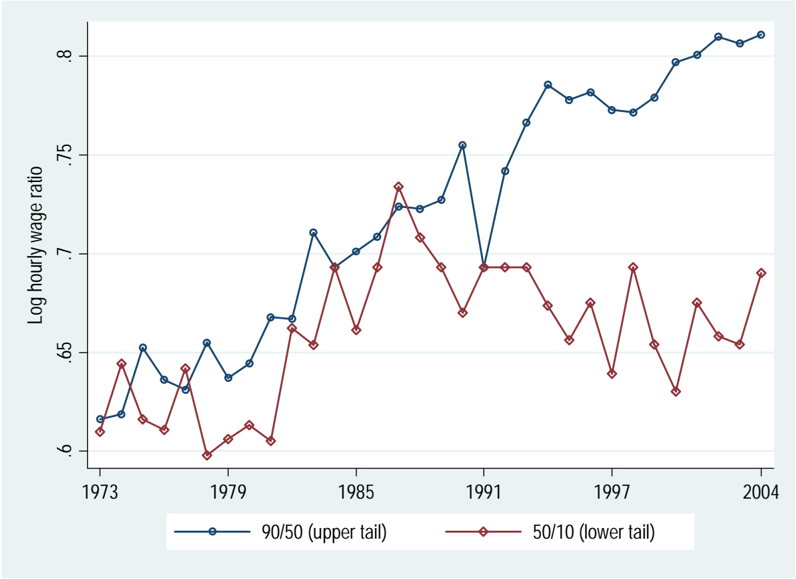
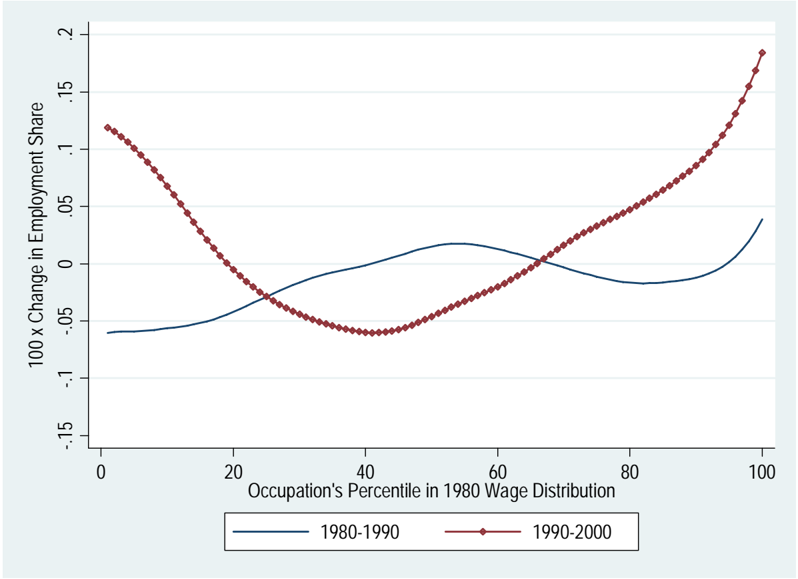
This paper analyzes a marked change in the evolution of the U.S. wage structure over the past fifteen years: divergent trends in upper-tail (90/50) and lower-tail (50/10) wage inequality. We document that wage inequality in the top half of distribution has displayed an unchecked and rather smooth secular rise for the last 25 years (since 1980). Wage inequality in the bottom half of the distribution also grew rapidly from 1979 to 1987, but it has ceased growing (and for some measures actually narrowed) since the late 1980s. Furthermore we find that occupational employment growth shifted from monotonically increasing in wages (education) in the 1980s to a pattern of more rapid growth in jobs at the top and bottom relative to the middles of the wage (education) distribution in the 1990s. We characterize these patterns as the "polarization" of the U.S. labor market, with employment polarizing into high-wage and low-wage jobs at the expense of middle-wage work. We show how a model of computerization in which computers most strongly complement the non-routine (abstract) cognitive tasks of high-wage jobs, directly substitute for the routine tasks found in many traditional middle-wage jobs, and may have little direct impact on non-routine manual tasks in relatively low-wage jobs can help explain the observed polarization of the U.S. labor market.
Overview
CoChat Summary
TL;DR
This paper documents that U.S. wage inequality diverged after the late 1980s: upper-tail inequality kept rising while lower-tail inequality stopped growing, and employment growth shifted from monotonic skill upgrading in the 1980s to polarization into high- and low-wage jobs in the 1990s. The authors argue that a model of computerization—complementing abstract tasks, substituting for routine tasks, and having little direct effect on non-routine manual tasks—can help explain these patterns.
Key findings
- From 1979 to 1987, upper-half (90/50) and lower-half (50/10) wage inequality rose similarly, expanding the 90-10 log wage differential by 21 log points; after 1987, upper-half inequality continued rising while the 50-10 differential contracted by 4 log points from 1987 to 2004, leaving only 4 log points of 90-10 growth since 1987.
- Occupational employment growth changed from monotonically increasing in wages/education in the 1980s to polarized growth in the 1990s: employment grew more rapidly below the 25th and above the 65th percentiles of the occupational wage distribution and declined in the middle (25th to 65th percentiles).
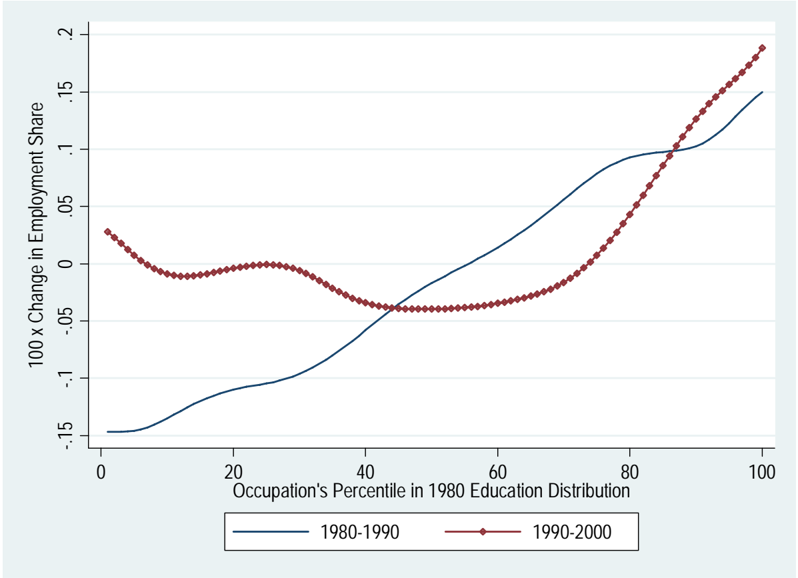
- Using 1980 occupational education percentiles, employment growth was near-monotonic in the 1980s but polarized in the 1990s, with more rapid growth at the bottom than the middle and the most rapid, diverging gains at the top.
- The authors find that quantity and price changes covary positively throughout the earnings distribution in both the 1980s and 1990s, suggesting labor demand shifts are central to explaining wage structure changes.
Methods
- The paper combines descriptive analysis of U.S. wage and employment data with a conceptual task-based model of computerization.
- Wage inequality trends are measured using Current Population Survey May samples for 1973–78 and Merged Outgoing Rotation Group samples for 1979–2004, focusing on 90/50 and 50/10 log hourly wage differentials.
- Employment polarization is analyzed using 1980, 1990, and 2000 Census Integrated Public Use Microsamples, ranking occupations by 1980 median hourly wage or average years of schooling and fitting locally weighted smoothing regressions of decadal employment-share growth on initial skill percentile.
Limitations
- Stated: the model assumes only two worker types, with college workers supplying abstract skill and high school workers substituting between routine and manual tasks; a more complete model would allow endogenous education responses, routine skills for college workers, abstract skills for high school workers, and heterogeneity in abstract skills among college workers.
- Stated: the “social norms” explanation for upper-tail skewness is intriguing but needs refinement to be directly testable, and the minimum wage explanation fits lower-tail inequality trends only to 1987.
- Evident: the paper is largely descriptive and theoretical rather than a causal test of computerization; the model’s predictions are used to interpret observed polarization, but the text does not report direct causal estimates linking computerization to the wage and employment changes.
Model-written summary. Check it against the paper before relying on it.
Integrity signals
Registry
Cites
Statistics
Figures
Verification
Claims the paper makes
0 Valid · 3 Not valid · 14 Not checked · 49 Own results and interpretations
A result the paper states — it cites no source for it, so there is none to check. The quote shows it is in the paper.
In the paper
“The net effect has been a slower growth of only 4 log points in the 90-10 log wage differential since 1987.”
plain- Asserted: passes — The authors put it forward as true.
- Checkable: passes — It can be checked against evidence.
- Load-bearing: passes — The paper’s conclusions depend on it.
- Based: passes — The paper gives a reason why it holds.
A result the paper reports from its own data — it cites no other source for it, so there is none to check. The quote shows it is in the paper.
In the paper
“Using this skill measure, we find near-monotonic (almost linear) increases in employment growth moving up the education distribution in the 1980s.”
plainstates an association- Asserted: passes — The authors put it forward as true.
- Checkable: passes — It can be checked against evidence.
- Load-bearing: unclear — It is unclear whether the paper’s conclusions depend on it.
- Based: passes — The paper gives a reason why it holds.
A result the paper reports from its own data — it cites no other source for it, so there is none to check. The quote shows it is in the paper.
In the paper
“We document that wage inequality in the top half of distribution has displayed an unchecked and rather smooth secular rise for the last 25 years (since 1980).”
- Also stated in: § ABSTRACT · plain
“wage inequality in the top half of the distribution has exhibited an unchecked secular rise for the last 25 years (since 1980)”
plain- Asserted: passes — The authors put it forward as true.
- Checkable: passes — It can be checked against evidence.
- Load-bearing: passes — The paper’s conclusions depend on it.
- Based: passes — The paper gives a reason why it holds.
- Also stated in: § ABSTRACT · plain
A result the paper reports from its own data — it cites no other source for it, so there is none to check. The quote shows it is in the paper.
In the paper
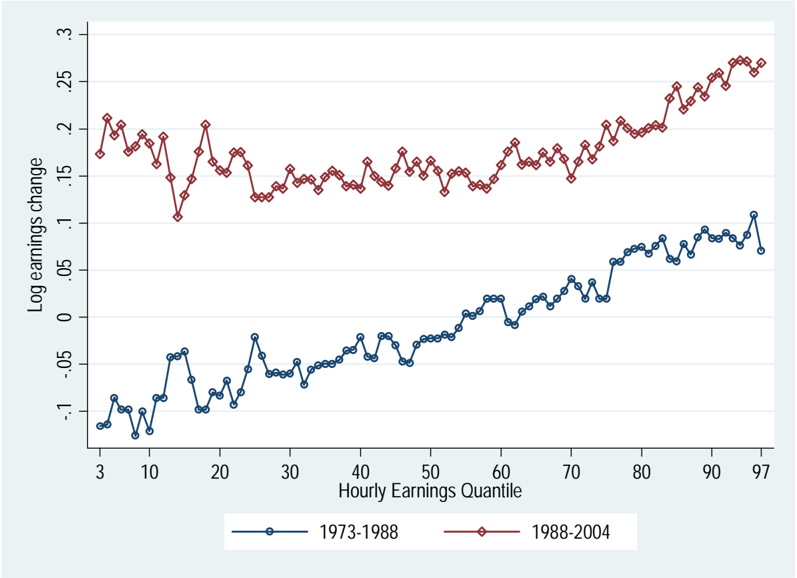
“The figure shows an almost linear spreading out of the entire wage distribution (from the 3 rd to 97 th percentile) in the first half of the sample (driven by changes in the 1980s).”
plainstates a cause- Asserted: passes — The authors put it forward as true.
- Checkable: passes — It can be checked against evidence.
- Load-bearing: passes — The paper’s conclusions depend on it.
- Based: passes — The paper gives a reason why it holds.
A result the paper reports from its own data — it cites no other source for it, so there is none to check. The quote shows it is in the paper.
In the paper
“The plot shows similar substantial increases in upper-half (90-50) and lower-half (50-10) wage inequality from 1979 to 1987, expanding the 90-10 log wage differential by 21 log points.”
plain- Asserted: passes — The authors put it forward as true.
- Checkable: passes — It can be checked against evidence.
- Load-bearing: passes — The paper’s conclusions depend on it.
- Based: passes — The paper gives a reason why it holds.
37 more claims
Create a free account to see all 66 claims and every source verdict.
- It may state two separate claims as one. 20
- Probably not a substantial claim. 5
- The quote only partly states this claim. 1
Claims other papers make about this one
Each is checked against this paper’s own text: does it say what the citing paper says it does?
The source backs part of the claim, not all of it — or backs it for a different population, condition or comparison.
In the citing paper
“Since the 1980s, the U.S. labor market has experienced declines in middle-skill, middle-income jobs in manufacturing and construction as a result of improvements in assembly line automation and the displacement of routine production jobs offshore, among other explanations (Acemoglu and Autor 2011; Autor, Katz, and Kearney 2006; Kalleberg 2009).”
From Beyond the Great Recession: Labor Market Polarization and Ongoing Fertility Decline in the United States (2019) · cites this paper as Autor, Katz, and Kearney 2006
Experimental — accuracy not yet measuredThe cited source says what the claim attributes to it.
In the citing paper
“Prior research on computer-based automation posited that routine work was most susceptible to replacement by computers (Autor et al., 2006; Acemoglu and Autor, 2011).”
From Large language models at work in China’s labor market (2025) · cites this paper as Autor et al., 2006
Citations
Cites
The Skill Content of Recent Technological Change: An Empirical Exploration
Autor, D. H., Levy, F., & Murnane, R. J. (2003) · The Quarterly Journal of Economics · doi:10.1162/003355303322552801 · Cited by 6,205
Self-citationIncome Inequality in the United States, 1913-1998
Piketty, T., & Saez, E. (2003) · The Quarterly Journal of Economics · doi:10.1162/00335530360535135 · Cited by 3,769
Lousy and Lovely Jobs: The Rising Polarization of Work in Britain
Goos, M., & Manning, A. (2007) · Review of Economics and Statistics · doi:10.1162/rest.89.1.118 · Cited by 2,285
Why Has CEO Pay Increased So Much?*
Gabaix, X., & Landier, A. (2008) · Quarterly Journal of Economics · doi:10.1162/qjec.2008.123.1.49 · Cited by 1,764
Skill‐Biased Technological Change and Rising Wage Inequality: Some Problems and Puzzles
Card, D., & DiNardo, J. E. (2002) · Journal of Labor Economics · doi:10.1086/342055 · Cited by 1,714
Technical Change, Job Tasks, and Rising Educational Demands: Looking outside the Wage Structure
Spitz‐Oener, A. (2006) · Journal of Labor Economics · doi:10.1086/499972 · Cited by 1,241
Changes in Unemployment and Wage Inequality: An Alternative Theory and Some Evidence
Acemoglu, D. (1999) · American Economic Review · doi:10.1257/aer.89.5.1259 · Cited by 634
Research works printed but not linked: 3
- Antràs Garicano, Quarterly Journal of Economics (forthcoming).
- Katz Lawrence F, 1999, North-Holland, 1463
- Lemieux Thomas, American Economic Review (forthcoming).
Cited by
Items 701–800 of 1,479
Una Mappa Della Disuguaglianza Del Reddito in Italia (The Geography of Income Inequality in Italy)Preprint
Acciari, P., & Mocetti, S. (2013) · SSRN Electronic Journal · doi:10.2139/ssrn.2413484 · Cited by 21
Fostering Sustainable Innovation Through Creative Destruction Theory
Jackson, E. A. (2021) · Encyclopedia of the UN sustainable development goals · doi:10.1007/978-3-319-95873-6_119 · Cited by 12
Technological Change and Occupations over the Long RunPreprint
Kogan, L., Papanikolaou, D., Schmidt, L., & Seegmiller, B. (2019) · SSRN Electronic Journal · doi:10.2139/ssrn.3585676 · Cited by 11
Lu, Y., Li, X., & Elbers, B. (2022) · Work Employment and Society · doi:10.1177/09500170221133714 · Cited by 10
The Skill-Specific Automatability of Aging Workers and Its Impact on Retirement Decisions
Lee, Z. (2023) · Work Aging and Retirement · doi:10.1093/workar/waad008 · Cited by 19
Neuhuber, T., & Schneider, A. E. (2024) · Journal of Regional Science · doi:10.1111/jors.12722 · Cited by 16
Tan, W., Shen, G., & Zhou, G. (2025) · World Development · doi:10.1016/j.worlddev.2025.106932 · Cited by 10
Carstensen, M. B., Durazzi, N., Emmenegger, P., & Gingrich, J. R. (2025) · Regulation & Governance · doi:10.1111/rego.70098 · Cited by 11
Veranderingen in werk en vaardigheden
Fouarge, D. J. A. G. (2017) · Research Publications (Maastricht University) · doi:10.26481/spe.20170629df · Cited by 15
Contribution du patrimoine à la formation des inégalités
Carbonnier, C. (2018) · Revue d économie financière · doi:10.3917/ecofi.128.0181 · Cited by 10
Offshoring and job polarisation between firms
Egger, H., Kreickemeier, U., Moser, C., & Wrona, J. (2024) · Journal of International Economics · doi:10.1016/j.jinteco.2024.103892 · Cited by 17
Wage inequality, entrepreneurship and creative people in regional labour markets
Ribeiro, A. S., Baptista, R., & Lima, F. (2021) · Regional Studies · doi:10.1080/00343404.2021.1988553 · Cited by 10
Delisle, M., & Lajoie, D. (2021) · Canadian Public Administration · doi:10.1111/capa.12440 · Cited by 10
Dynamics of wage inequality over the prolonged economic transformation: The case of Vietnam
Doan, T. T., Ha, V. T. C., Tran, T. Q., & Yang, J. S. (2023) · Economic Analysis and Policy · doi:10.1016/j.eap.2023.04.029 · Cited by 15
Has job polarization squeezed the middle class? Evidence from the allocation of talents
Boehm, M. J. (2013) · London School of Economics and Political Science Research Online (London School of Economics and Political Science) · Cited by 9
Labor supply in the new century
Bradbury, K., Foote, C. L., & Triest, R. K. (2007) · Conference Series ; [Proceedings] · Cited by 14
Colen, C. G., Ramey, D. M., & Browning, C. R. (2016) · Journal of Quantitative Criminology · doi:10.1007/s10940-016-9284-y · Cited by 10
Targeted search, endogenous market segmentation, and wage inequality
Yang, H. (2019) · Economic Theory · doi:10.1007/s00199-018-01172-6 · Cited by 8
Employment polarization and over-education in Germany, Spain, Sweden and UK
Sarkar, S. (2017) · Empirica · doi:10.1007/s10663-017-9372-8 · Cited by 13
TRADE‐INDUCED SKILL POLARIZATION
Gu, G. W., Malik, S., Pozzoli, D., & Rocha, V. C. (2019) · Economic Inquiry · doi:10.1111/ecin.12834 · Cited by 10
The rise in women’s labour force participation in Mexico: Supply vs demand factors
Bhalotra, S. R., & Fernández, M. (2021) · WIDER Working Paper Series · doi:10.35188/unu-wider/2021/950-1 · Cited by 11
Transportation cost reducing technological change and wages inequalities
Cheng, C., & Wang, X. (2021) · Structural Change and Economic Dynamics · doi:10.1016/j.strueco.2021.10.008 · Cited by 8
Koerner, K., Moritz, M., & Schäffler, J. (2021) · World Economy · doi:10.1111/twec.13223 · Cited by 9
Are we nearly there yet? New technology adoption and labor demand in Peru
Novella, R., Rosas-Shady, D., & Alvarado, A. (2023) · Science and Public Policy · doi:10.1093/scipol/scad007 · Cited by 14
Peer effects in an automated world
Corgnet, B., Hérnan-Gonzalez, R., & Mateo, R. (2023) · Labour Economics · doi:10.1016/j.labeco.2023.102455 · Cited by 10
Occupational reallocation within and across firms: Implications for labor market polarization
Mukoyama, T., Takayama, N., & Tanaka, S. (2024) · Journal of Monetary Economics · doi:10.1016/j.jmoneco.2024.103701 · Cited by 9
THE DRIVERS OF LABOR INCOME INEQUALITY — A LITERATURE REVIEW
Kierzenkowski, R., & Koske, I. (2013) · Journal of International Commerce Economics and Policy · doi:10.1142/s179399331350004x · Cited by 12
A tale of two Ginis in the US, 1921–2012
Schneider, M., & Tavani, D. (2015) · International Review of Applied Economics · doi:10.1080/02692171.2016.1173654 · Cited by 12
Nonlinear evidence on the existence of jobless recoveries
Bradley, M. D., & Jansen, D. W. (2017) · Studies in Nonlinear Dynamics and Econometrics · doi:10.1515/snde-2016-0081 · Cited by 5
The risk factors of abusive relationships for nontraditional students
Min, H. (2018) · Journal of American College Health · doi:10.1080/07448481.2018.1468333 · Cited by 7
The Regulatory Roots of Inequality in America
Vogel, S. K. (2021) · Journal of Law and Political Economy · doi:10.5070/lp61251588 · Cited by 10
The Algorithmic Disruption of Workplace Solidarity: Phenomenology and the Future of Work Question
Meacham, D., & Tava, F. (2021) · Philosophy Today · doi:10.5840/philtoday2021519408 · Cited by 13
Chen, S. H., & Khan, S. A. (2005) · Cited by 8
Measurement Error in Occupational Coding:An Analysis on Share DataPreprint
Belloni, M., Brugiavini, A., Meschi, E., et al. (2014) · SSRN Electronic Journal · doi:10.2139/ssrn.2539080 · Cited by 8
The Social Contract with Endogenous SentimentsPreprint
Cervellati, M., Esteban, J. M., & Kranich, L. (2006) · SSRN Electronic Journal · doi:10.2139/ssrn.934353 · Cited by 9
Job Tasks, Time Allocation, and Wages
Stinebrickner, R., Stinebrickner, T. R., & Sullivan, P. (2017) · National Bureau of Economic Research · doi:10.3386/w24079 · Cited by 8
Comparing Outcomes: The Relative Job-Market Performance of Former International StudentsPreprint
Skuterud, M., & Chen, Z. J. (2018) · SSRN Electronic Journal · doi:10.2139/ssrn.3246096 · Cited by 8
The Distribution of the Gender Wage GapPreprint
Bhalotra, S. R., & Sierra, M. F. (2018) · SSRN Electronic Journal · doi:10.2139/ssrn.3202481 · Cited by 12
Creative Destruction and the Autonomous Life
Kogelmann, B. (2024) · Journal of Business Ethics · doi:10.1007/s10551-024-05721-z · Cited by 11
Intelligent manufacturing and green innovation: Quasi-natural evidence from China
Cao, X., & Liu, S. (2024) · Heliyon · doi:10.1016/j.heliyon.2024.e34942 · Cited by 9
The impact of financial technology on employment: Protection or disruption?
Huang, Y., & Gao, Y. (2024) · International Review of Economics & Finance · doi:10.1016/j.iref.2024.103586 · Cited by 11
Does increasing robot density exacerbate wealth inequality?
Jia, N., Yan, X., & Yu, S. (2024) · Journal of Asian Economics · doi:10.1016/j.asieco.2024.101830 · Cited by 9
The effects of digitalization on production
Schwark, F., & Tryphonides, A. (2024) · European Economic Review · doi:10.1016/j.euroecorev.2024.104896 · Cited by 9
Digital technologies and performance incentives: evidence from businesses in the Swiss economy
Lehmann, J., & Beckmann, M. (2025) · Zeitschrift für schweizerische Statistik und Volkswirtschaft/Schweizerische Zeitschrift für Volkswirtschaft und Statistik/Swiss journal of economics and statistics · doi:10.1186/s41937-024-00132-3 · Cited by 29
Wang, X. (2020) · Labour Economics · doi:10.1016/j.labeco.2020.101862 · Cited by 14
Maurizio, R., & Monsalvo, A. P. (2021) · Working Paper Series · doi:10.35188/unu-wider/2021/949-5 · Cited by 9
Skill Premiums and the Supply of Young Workers in Germany
Glitz, A., & Wissmann, D. (2021) · Labour Economics · doi:10.1016/j.labeco.2021.102034 · Cited by 16
What do unions do… for temps? Collective bargaining and the wage penalty
Litwin, A. S., & Shay, O. (2021) · Industrial Relations A Journal of Economy and Society · doi:10.1111/irel.12294 · Cited by 9
Can public subsidy on education reduce wage inequality in the presence of automation?
Zhang, P. (2022) · Economic Research-Ekonomska Istraživanja · doi:10.1080/1331677x.2022.2053783 · Cited by 6
The Redistributive Effect of Selected Federal Transfer and Tax Provisions
Hungerford, T. L. (2010) · Public Finance Review · doi:10.1177/1091142110373610 · Cited by 7
Li, A., Wallace, M., & Hyde, A. (2019) · Social Science Research · doi:10.1016/j.ssresearch.2019.102342 · Cited by 12
What Do Unions Do to Work Design? Computer Use, Union Presence, and Tayloristic Jobs in Britain
Eisele, S., & Schneider, M. (2020) · Industrial Relations A Journal of Economy and Society · doi:10.1111/irel.12266 · Cited by 13
Bishop, M., Burgess, R., & Zipfel, C. (2022) · Springer eBooks · doi:10.1007/978-3-030-86065-3_2 · Cited by 8
THE DYNAMICS OF TASK-BIASED TECHNOLOGICAL CHANGE : THE CASE OF OCCUPATIONS
Kampelmann, S., & Rycx, F. (2013) · Brussels economic review · Cited by 7
La montée en puissance des machines : comment l’ordinateur a changé le travail
Dorn, D. (2016) · Revue française des affaires sociales · doi:10.3917/rfas.161.0035 · Cited by 22
Structural reforms and income distribution
Causa, O., de Serres, A., & Ruiz, N. (2015) · OECD economic policy papers · doi:10.1787/5js3777lbxzn-en · Cited by 11
The Economic Forces Behind Deindustrialization: An Empirical InvestigationPreprint
van Neuss, L. (2016) · SSRN Electronic Journal · doi:10.2139/ssrn.2817332 · Cited by 7
The Equal Employment Opportunity OmissionPreprint
Lazonick, W. H., Moss, P., & Weitz, J. (2017) · SSRN Electronic Journal · doi:10.2139/ssrn.2993928 · Cited by 7
Business Taxation and Wages – Evidence from Individual Panel DataPreprint
Bauer, T., Kasten, T., & Siemers, L. H. R. (2012) · SSRN Electronic Journal · doi:10.2139/ssrn.2122520 · Cited by 10
AI and the EconomyPreprint
Furman, J., & Seamans, R. (2018) · SSRN Electronic Journal · doi:10.2139/ssrn.3186591 · Cited by 21
Name, N. (2009) · SSRN Electronic Journal · doi:10.2139/ssrn.1370412 · Cited by 7
OECD (2016) · OECD digital economy papers · doi:10.1787/5jlwt496h37l-en · Cited by 14
Gravina, A. F., & Foster‐McGregor, N. (2024) · Empirical Economics · doi:10.1007/s00181-024-02587-y · Cited by 12
Kerr, A. (2024) · Review of Income and Wealth · doi:10.1111/roiw.12695 · Cited by 10
Technological change and entrepreneurial activities: Evidence from China
Cui, L., & Xu, Y. (2024) · Structural Change and Economic Dynamics · doi:10.1016/j.strueco.2024.11.006 · Cited by 6
A study of job polarization in Sweden from an urban-rural perspective
Nordin, M., Hammarlund, C., & Bergh, A. (2025) · Journal for Labour Market Research · doi:10.1186/s12651-025-00397-y · Cited by 11
Azpitarte, F. (2023) · Population Space and Place · doi:10.1002/psp.2644 · Cited by 8
The fourth industrial revolution and the future of work: Reasons to worry and policies to consider
Goldsmith, A. H., & Casey, J. F. (2024) · Southern Economic Journal · doi:10.1002/soej.12714 · Cited by 9
Labor-Market Regimes in U.S. Economic History
Rosenbloom, J. L., & Sundstrom, W. A. (2011) · Stanford University Press eBooks · doi:10.2307/j.ctvqsdnxq.18 · Cited by 6
LA EVOLUCIÓN DE LA ESTRUCTURA SALARIAL, 2002-2010 *
Casado-Díaz, J. M., & Simón, H. J. (2015) · Revista de economía aplicada/Revista de economía aplicada · Cited by 20
The recent process of job polarization in Japan: evidence from 1980 to 2010
Furukawa, Y., & Toyoda, H. (2017) · Applied Economics Letters · doi:10.1080/13504851.2017.1332741 · Cited by 8
Can Workers in Low-End Occupations Climb the Job Ladder?
Gabe, T., Abel, J. R., & Florida, R. L. (2019) · Economic Development Quarterly · doi:10.1177/0891242419838324 · Cited by 7
Routinization and Employment: Evidence for Latin America
Brambilla, I., César, A., Falcone, G., Gasparini, L., & Lombardo, C. (2023) · Revista Desarrollo y Sociedad · doi:10.13043/dys.95.4 · Cited by 10
Chen, X. (2021) · Journal of Research in Technical Careers · doi:10.9741/2578-2118.1092 · Cited by 6
Labor Market, Distributive Gains and Cumulative Causation: Insights from the Brazilian Economy
Dweck, E., Baltar, C. T., Marcato, M. B., & Krepsky, C. U. (2022) · Review of Political Economy · doi:10.1080/09538259.2022.2041284 · Cited by 8
Internet use and inverted U-shaped employment polarization in tourism occupations
Guo, W. L., Wang, J., & Kang, Y. (2023) · Tourism Economics · doi:10.1177/13548166231161879 · Cited by 7
Liu, J., Ma, X., Zhao, B., Cui, Q., Zhang, S., & Zhang, J. (2023) · Sustainability · doi:10.3390/su151411298 · Cited by 11
Non‐routine tasks and ICT tools in telework
Okubo, T. (2024) · Labour · doi:10.1111/labr.12262 · Cited by 7
Immigration and the Wages of Native Workers: Spatial versus Occupational Approaches
Kim, C., & Sakamoto, A. (2013) · Sociological Focus · doi:10.1080/00380237.2013.766834 · Cited by 8
The world’s interconnected demographic/fiscal transition
Fehr, H., Jokisch, S., & Kotlikoff, L. J. (2013) · The Journal of the Economics of Ageing · doi:10.1016/j.jeoa.2013.07.002 · Cited by 9
The Assignment of Workers to Tasks with Endogenous Supply of Skills
Dupuy, A. (2014) · Economica · doi:10.1111/ecca.12071 · Cited by 7
Underqualification as an Opportunity for Low-Educated Workers
Hamersma, M., Edzes, A. J. E., & van Dijk, J. (2015) · Environment and Planning C Government and Policy · doi:10.1068/c12274r · Cited by 11
Between- and within-group wage inequalities, and the advent of new technology
Miyake, A., Muro, K., Nakamura, T., & Yasuoka, M. (2008) · The Journal of Economic Inequality · doi:10.1007/s10888-008-9091-2 · Cited by 6
Human resources as facilitators of the adoption of information and communication technologies
Castel, A. G., & Alesón, M. L. R. (2008) · International Journal of Information Technology and Management · doi:10.1504/ijitm.2008.018657 · Cited by 11
Separating Risk from Heterogeneity in Education: A Semiparametric Approach
Mazza, J., & van Ophem, H. (2016) · Journal of the Royal Statistical Society Series A (Statistics in Society) · doi:10.1111/rssa.12253 · Cited by 6
Income Divide and Race/Ethnicity in Tennessee Metropolises
Sharma, M. (2017) · UWM Digital Commons (University of Wisconsin–Milwaukee) · Cited by 6
Company Closures and the Erosion of the Political Centre: Evidence from Germany
Braakmann, N. (2017) · British Journal of Industrial Relations · doi:10.1111/bjir.12292 · Cited by 6
Chapter 2 Technology-driven Task Replacement and the Future of Employment
Jacobs, J. A., & Karen, R. (2019) · Research in the sociology of work · doi:10.1108/s0277-283320190000033004 · Cited by 6
Cortés, O. S., & Carabaña, J. (2019) · Journal of Contemporary European Studies · doi:10.1080/14782804.2019.1625756 · Cited by 10
What Has Changed and What Has Not?
Murphy, K. R., & Tierney, W. (2020) · Cambridge University Press eBooks · doi:10.1017/9781108278034.003 · Cited by 6
Sun, S. (2020) · The Annals of the American Academy of Political and Social Science · doi:10.1177/0002716219897249 · Cited by 5
Complex-Task Biased Technological Change and the Labor Market
Caines, C. C., Hoffmann, F., & Kambourov, G. (2017) · International Finance Discussion Paper · doi:10.17016/ifdp.2017.1192 · Cited by 7
Zurdo, R. J. P., Dopacio, C. I., & Paredes, V. R. (2022) · REVESCO Revista de Estudios Cooperativos · doi:10.5209/reve.83719 · Cited by 10
The Race between Education and Technology: A Review Article
Guryan, J. (2009) · Journal of Human Capital · doi:10.1086/645089 · Cited by 11
Mothers’ Nonstandard Employment, Family Structure, and Children’s Health Insurance Coverage
Lim, S. (2018) · Journal of Family and Economic Issues · doi:10.1007/s10834-018-9596-1 · Cited by 6
Shao, L. F., & Krause, M. (2020) · PLoS ONE · doi:10.1371/journal.pone.0242803 · Cited by 6
Re-shaping global-ness by spending overseas: Analysis of emerging Chinese consumption abroad
Wang, L., Yang, W., Zhang, X., et al. (2020) · Cities · doi:10.1016/j.cities.2020.103034 · Cited by 6
Exporting inequality: US investors and the Americanization of executive pay in the United Kingdom
Linsi, L., Hopkin, J., & Jaupart, P. (2021) · Review of International Political Economy · doi:10.1080/09692290.2021.2004440 · Cited by 7
What Might Improve the Employment and Advancement Prospects of the Poor?
Holzer, H. J. (2009) · Upjohn Research (W.E. Upjohn Institute for Employment Research) · doi:10.17848/9781441631992.ch9 · Cited by 9
The political economy of revenue pressure and tax collection efficiency
Das, S. P. (2011) · Indian Growth and Development Review · doi:10.1108/17538251111124990 · Cited by 6
Metadata
- Authors
- Autor, D. H., Katz, L. F., & Kearney, M. S.
- Affiliations
- National Bureau of Economic Research (US)
- Brookings Institution (US)
- Venue
- American Economic Review
- Publisher
- American Economic Association
- Published
- 2006-04-01
- Volume
- 96
- Issue
- 2
- Pages
- 189-194
- ISSN
- 0002-8282 (ISSN-L)
- OpenAlex
- W3124544360
- Cited by
- 1,594
- References
- 4
- Citations by year
- 2026: 75 · 2025: 108 · 2024: 122 · 2023: 90 · 2022: 89 · 2021: 100 · 2020: 107 · 2019: 96 · 2018: 93 · 2017: 74 · 2016: 76 · 2015: 91 · 2014: 78 · 2013: 81 · 2012: 59
- FWCI
- 110.81
- Type
- journal article
- Language
- en
- Open access
- closed
- Locations
- American Economic Review (publishedVersion)
- RePEc: Research Papers in Economics (submittedVersion)
- Topics
- Social Sciences › Economics, Econometrics and Finance › Economics and Econometrics › Labor market dynamics and wage inequality
- Social Sciences › Economics, Econometrics and Finance › General Economics, Econometrics and Finance › Economic Theory and Policy
- Social Sciences › Sociology and Political Science › Income, Poverty, and Inequality
- Keywords
- labor market polarization, wage inequality, wage distribution, computerization, high-wage jobs, low-wage employment, United States labor market
About these checks
Registry, retraction, Cites and statistics results are computed, not judged, with one exception: a printed reference that no index lists is read once by a model before it counts as a citation error. Claims are extracted by a model and kept only when their quote appears verbatim in the text; each cited source is then checked, with a model’s help, for whether it says what the claim relies on. Those verdicts can be wrong — read the claim’s quote and the cited source before relying on one.
A language model drew the claims from the paper on 2026-10-12, under version 3 of the claim definition (model deepseek-v4.1-flash, prompt extract-v3).
A second model labelled each claim on 2026-10-12 (model jev-1.13-20260917, definition revision gold-guideline-v0.2).
Statistics and arithmetic are recomputed, not judged.
Confidence bands are shown only for fields calibrated on our annotated test set. None is calibrated yet, so no band is shown.
What counts as a claim ›How we measure confidence ›How we check this ›
Are you an author, or do you see a problem with this page? Request a review
Data sources
Bibliographic data: Semantic Scholar, OpenAlex, Crossref.
Contains information from the Semantic Scholar Academic Graph Datasets, made available under the ODC Attribution License (ODC-BY 1.0).
Semantic Scholar’s data is described in: Kinney, R., et al. (2023). The Semantic Scholar Open Data Platform. arXiv:2301.10140.
