

The Polarization of the U.S. Labor Market
The DOI matches its Crossref record; 7 of the 7 references it cites were found in a registry or an index; none of the 16 sources its claims cite is checked for support yet.
Abstract
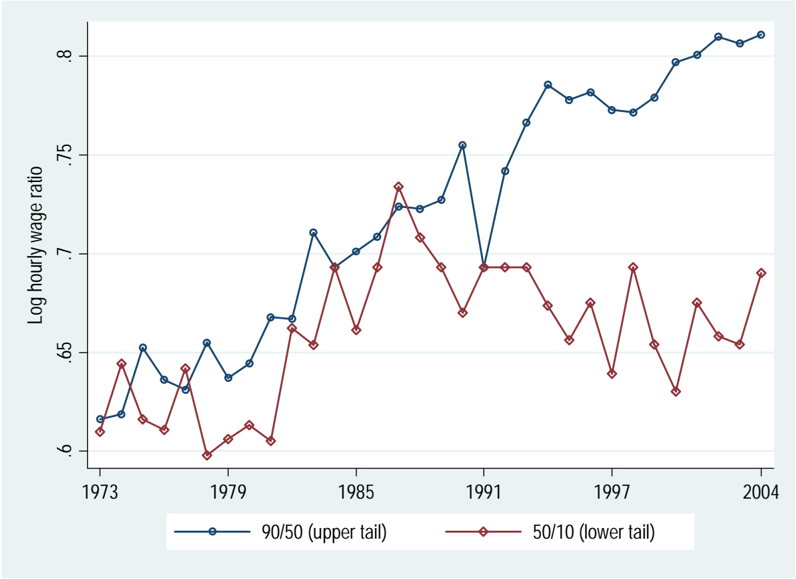
This paper analyzes a marked change in the evolution of the U.S. wage structure over the past fifteen years: divergent trends in upper-tail (90/50) and lower-tail (50/10) wage inequality. We document that wage inequality in the top half of distribution has displayed an unchecked and rather smooth secular rise for the last 25 years (since 1980). Wage inequality in the bottom half of the distribution also grew rapidly from 1979 to 1987, but it has ceased growing (and for some measures actually narrowed) since the late 1980s. Furthermore we find that occupational employment growth shifted from monotonically increasing in wages (education) in the 1980s to a pattern of more rapid growth in jobs at the top and bottom relative to the middles of the wage (education) distribution in the 1990s. We characterize these patterns as the "polarization" of the U.S. labor market, with employment polarizing into high-wage and low-wage jobs at the expense of middle-wage work. We show how a model of computerization in which computers most strongly complement the non-routine (abstract) cognitive tasks of high-wage jobs, directly substitute for the routine tasks found in many traditional middle-wage jobs, and may have little direct impact on non-routine manual tasks in relatively low-wage jobs can help explain the observed polarization of the U.S. labor market.
Overview
CoChat Summary
TL;DR
This paper documents that U.S. wage inequality diverged after the late 1980s: upper-tail inequality kept rising while lower-tail inequality stopped growing, and employment growth shifted from monotonic skill upgrading in the 1980s to polarization into high- and low-wage jobs in the 1990s. The authors argue that a model of computerization—complementing abstract tasks, substituting for routine tasks, and having little direct effect on non-routine manual tasks—can help explain these patterns.
Key findings
- From 1979 to 1987, upper-half (90/50) and lower-half (50/10) wage inequality rose similarly, expanding the 90-10 log wage differential by 21 log points; after 1987, upper-half inequality continued rising while the 50-10 differential contracted by 4 log points from 1987 to 2004, leaving only 4 log points of 90-10 growth since 1987.
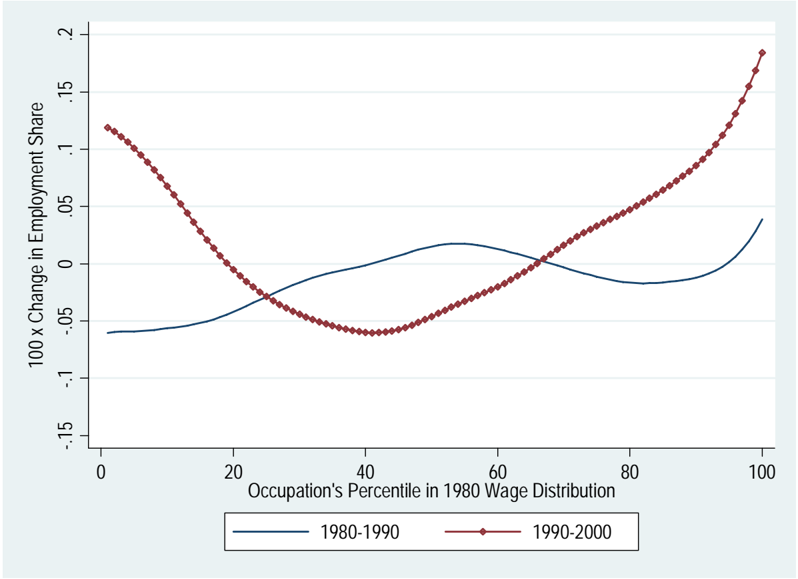
- Occupational employment growth changed from monotonically increasing in wages/education in the 1980s to polarized growth in the 1990s: employment grew more rapidly below the 25th and above the 65th percentiles of the occupational wage distribution and declined in the middle (25th to 65th percentiles).
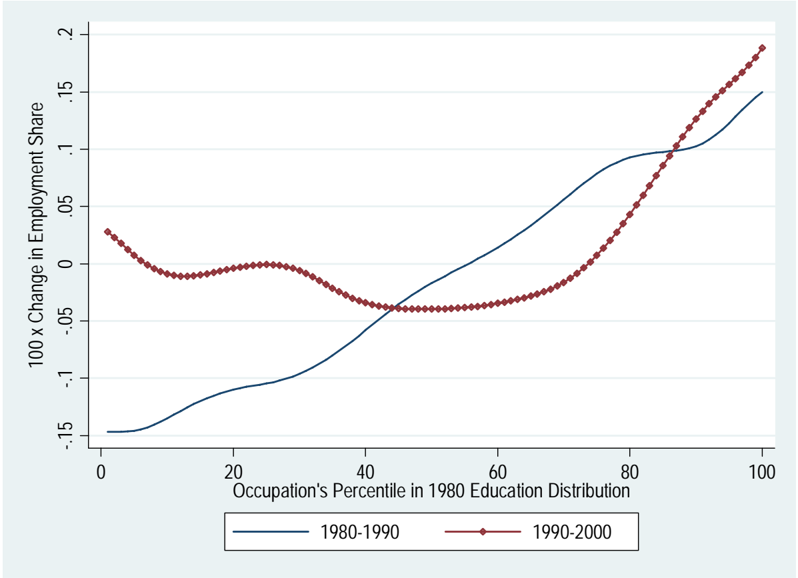
- Using 1980 occupational education percentiles, employment growth was near-monotonic in the 1980s but polarized in the 1990s, with more rapid growth at the bottom than the middle and the most rapid, diverging gains at the top.
- The authors find that quantity and price changes covary positively throughout the earnings distribution in both the 1980s and 1990s, suggesting labor demand shifts are central to explaining wage structure changes.
Methods
- The paper combines descriptive analysis of U.S. wage and employment data with a conceptual task-based model of computerization.
- Wage inequality trends are measured using Current Population Survey May samples for 1973–78 and Merged Outgoing Rotation Group samples for 1979–2004, focusing on 90/50 and 50/10 log hourly wage differentials.
- Employment polarization is analyzed using 1980, 1990, and 2000 Census Integrated Public Use Microsamples, ranking occupations by 1980 median hourly wage or average years of schooling and fitting locally weighted smoothing regressions of decadal employment-share growth on initial skill percentile.
Limitations
- Stated: the model assumes only two worker types, with college workers supplying abstract skill and high school workers substituting between routine and manual tasks; a more complete model would allow endogenous education responses, routine skills for college workers, abstract skills for high school workers, and heterogeneity in abstract skills among college workers.
- Stated: the “social norms” explanation for upper-tail skewness is intriguing but needs refinement to be directly testable, and the minimum wage explanation fits lower-tail inequality trends only to 1987.
- Evident: the paper is largely descriptive and theoretical rather than a causal test of computerization; the model’s predictions are used to interpret observed polarization, but the text does not report direct causal estimates linking computerization to the wage and employment changes.
Model-written summary. Check it against the paper before relying on it.
Integrity signals
Registry
Cites
Statistics
Figures
Verification
Claims the paper makes
0 Valid · 3 Not valid · 14 Not checked · 49 Own results and interpretations
A result the paper states — it cites no source for it, so there is none to check. The quote shows it is in the paper.
In the paper
“The net effect has been a slower growth of only 4 log points in the 90-10 log wage differential since 1987.”
plain- Asserted: passes — The authors put it forward as true.
- Checkable: passes — It can be checked against evidence.
- Load-bearing: passes — The paper’s conclusions depend on it.
- Based: passes — The paper gives a reason why it holds.
A result the paper reports from its own data — it cites no other source for it, so there is none to check. The quote shows it is in the paper.
In the paper
“Using this skill measure, we find near-monotonic (almost linear) increases in employment growth moving up the education distribution in the 1980s.”
plainstates an association- Asserted: passes — The authors put it forward as true.
- Checkable: passes — It can be checked against evidence.
- Load-bearing: unclear — It is unclear whether the paper’s conclusions depend on it.
- Based: passes — The paper gives a reason why it holds.
A result the paper reports from its own data — it cites no other source for it, so there is none to check. The quote shows it is in the paper.
In the paper
“We document that wage inequality in the top half of distribution has displayed an unchecked and rather smooth secular rise for the last 25 years (since 1980).”
- Also stated in: § ABSTRACT · plain
“wage inequality in the top half of the distribution has exhibited an unchecked secular rise for the last 25 years (since 1980)”
plain- Asserted: passes — The authors put it forward as true.
- Checkable: passes — It can be checked against evidence.
- Load-bearing: passes — The paper’s conclusions depend on it.
- Based: passes — The paper gives a reason why it holds.
- Also stated in: § ABSTRACT · plain
A result the paper reports from its own data — it cites no other source for it, so there is none to check. The quote shows it is in the paper.
In the paper
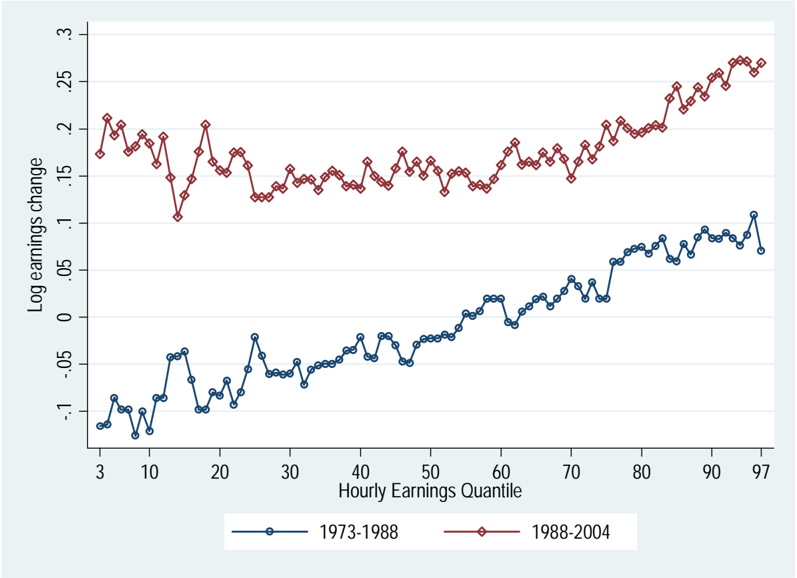
“The figure shows an almost linear spreading out of the entire wage distribution (from the 3 rd to 97 th percentile) in the first half of the sample (driven by changes in the 1980s).”
plainstates a cause- Asserted: passes — The authors put it forward as true.
- Checkable: passes — It can be checked against evidence.
- Load-bearing: passes — The paper’s conclusions depend on it.
- Based: passes — The paper gives a reason why it holds.
A result the paper reports from its own data — it cites no other source for it, so there is none to check. The quote shows it is in the paper.
In the paper
“The plot shows similar substantial increases in upper-half (90-50) and lower-half (50-10) wage inequality from 1979 to 1987, expanding the 90-10 log wage differential by 21 log points.”
plain- Asserted: passes — The authors put it forward as true.
- Checkable: passes — It can be checked against evidence.
- Load-bearing: passes — The paper’s conclusions depend on it.
- Based: passes — The paper gives a reason why it holds.
37 more claims
Create a free account to see all 66 claims and every source verdict.
- It may state two separate claims as one. 20
- Probably not a substantial claim. 5
- The quote only partly states this claim. 1
Claims other papers make about this one
Each is checked against this paper’s own text: does it say what the citing paper says it does?
The source backs part of the claim, not all of it — or backs it for a different population, condition or comparison.
In the citing paper
“Since the 1980s, the U.S. labor market has experienced declines in middle-skill, middle-income jobs in manufacturing and construction as a result of improvements in assembly line automation and the displacement of routine production jobs offshore, among other explanations (Acemoglu and Autor 2011; Autor, Katz, and Kearney 2006; Kalleberg 2009).”
From Beyond the Great Recession: Labor Market Polarization and Ongoing Fertility Decline in the United States (2019) · cites this paper as Autor, Katz, and Kearney 2006
Experimental — accuracy not yet measuredThe cited source says what the claim attributes to it.
In the citing paper
“Prior research on computer-based automation posited that routine work was most susceptible to replacement by computers (Autor et al., 2006; Acemoglu and Autor, 2011).”
From Large language models at work in China’s labor market (2025) · cites this paper as Autor et al., 2006
Citations
Cites
The Skill Content of Recent Technological Change: An Empirical Exploration
Autor, D. H., Levy, F., & Murnane, R. J. (2003) · The Quarterly Journal of Economics · doi:10.1162/003355303322552801 · Cited by 6,205
Self-citationIncome Inequality in the United States, 1913-1998
Piketty, T., & Saez, E. (2003) · The Quarterly Journal of Economics · doi:10.1162/00335530360535135 · Cited by 3,769
Lousy and Lovely Jobs: The Rising Polarization of Work in Britain
Goos, M., & Manning, A. (2007) · Review of Economics and Statistics · doi:10.1162/rest.89.1.118 · Cited by 2,285
Why Has CEO Pay Increased So Much?*
Gabaix, X., & Landier, A. (2008) · Quarterly Journal of Economics · doi:10.1162/qjec.2008.123.1.49 · Cited by 1,764
Skill‐Biased Technological Change and Rising Wage Inequality: Some Problems and Puzzles
Card, D., & DiNardo, J. E. (2002) · Journal of Labor Economics · doi:10.1086/342055 · Cited by 1,714
Technical Change, Job Tasks, and Rising Educational Demands: Looking outside the Wage Structure
Spitz‐Oener, A. (2006) · Journal of Labor Economics · doi:10.1086/499972 · Cited by 1,241
Changes in Unemployment and Wage Inequality: An Alternative Theory and Some Evidence
Acemoglu, D. (1999) · American Economic Review · doi:10.1257/aer.89.5.1259 · Cited by 634
Research works printed but not linked: 3
- Antràs Garicano, Quarterly Journal of Economics (forthcoming).
- Katz Lawrence F, 1999, North-Holland, 1463
- Lemieux Thomas, American Economic Review (forthcoming).
Cited by
Items 501–600 of 1,479
Reinhold, M., & Thomsen, S. L. (2017) · Journal for Labour Market Research · doi:10.1007/s12651-017-0227-3 · Cited by 35
What Does Human Capital Do? A Review of Goldin and Katz’s The Race between Education and TechnologyPreprint
Acemoğlu, D., & Autor, D. (2012) · SSRN Electronic Journal · doi:10.2139/ssrn.1987249 · Cited by 37
Self-citationThe Costs of Occupational Mobility: An Aggregate AnalysisPreprint
Cortés, G. M., & Gallipoli, G. (2015) · SSRN Electronic Journal · doi:10.2139/ssrn.2717671 · Cited by 19
ABSTRACT The Growth of Low Skill Service Jobs and the Polarization of the U.S. Labor MarketPreprint
Dorn, D., & de Alisal, C. (2012) · SSRN Electronic Journal · Cited by 21
The Employment Impact of Emerging Digital TechnologiesPreprint
Prytkova, E., Petit, F., Li, D., Chaturvedi, S., & Ciarli, T. (2024) · SSRN Electronic Journal · doi:10.2139/ssrn.4739904 · Cited by 42
The social impact of generative LLM-based AI
Xie, Y., & Avila, S. (2025) · Chinese Journal of Sociology · doi:10.1177/2057150x251315997 · Cited by 34
Autor, D., & Thompson, N. (2025) · Journal of the European Economic Association · doi:10.1093/jeea/jvaf023 · Cited by 30
Self-citationLordan, G., & Stringer, E.-J. (2022) · Economics & Human Biology · doi:10.1016/j.ehb.2022.101144 · Cited by 32
Labor market tightness and individual wage growth: evidence from Germany
Brunow, S., Lösch, S., & Okhrin, O. (2022) · Journal for Labour Market Research · doi:10.1186/s12651-022-00322-7 · Cited by 24
Skills requirements across task-content groups in Poland: What online job offers tell us
Arendt, Ł., Gałecka‐Burdziak, E., Núñez, F., Pater, R., & Usabiaga, C. (2022) · Technological Forecasting and Social Change · doi:10.1016/j.techfore.2022.122245 · Cited by 26
Trade Unions and the Process of Technological Change
Kostøl, F. B., & Svarstad, E. (2023) · Labour Economics · doi:10.1016/j.labeco.2023.102386 · Cited by 15
Firm-level labor demand for and macroeconomic increases in non-regular workers in Japan
Teruyama, H., Goto, Y., & Lechevalier, S. (2018) · Japan and the World Economy · doi:10.1016/j.japwor.2018.08.006 · Cited by 18
Manuel, P. C. (2010) · Revista Desarrollo y Sociedad · doi:10.13043/dys.66.3 · Cited by 30
Easy, collaborative and engaging – the use of cloud computing in the design of management classrooms
Schneckenberg, D. (2014) · Educational Research · doi:10.1080/00131881.2014.965569 · Cited by 27
Declining inter-industry wage dispersion in the US
Kim, C., & Sakamoto, A. (2008) · Social Science Research · doi:10.1016/j.ssresearch.2008.06.001 · Cited by 24
Within and between firm trends in job polarization: the roles of globalization and technology
Kerr, S. P., Maczulskij, T., & Maliranta, M. (2019) · Journal of Economic Geography · doi:10.1093/jeg/lbz028 · Cited by 35
Employment Polarisation in Spain Over the Course of the 1997-2012 CyclePreprint
Anghel, B., de la Rica, S., & Lacuesta, A. (2013) · SSRN Electronic Journal · doi:10.2139/ssrn.2370322 · Cited by 26
Reaching for the Stars: Who Pays for Talent in Innovative Industries?Preprint
Andersson, F. W., Haltiwanger, J., Freedman, M. L., Lane, J. I., & Shaw, K. L. (2006) · SSRN Electronic Journal · doi:10.2139/ssrn.918000 · Cited by 18
Large language models at work in China’s labor market
Chen, Q., Ge, J., Xie, H., Xu, X., & Yang, Y. (2025) · China Economic Review · doi:10.1016/j.chieco.2025.102413 · Cited by 47
“Upon comparing the model scores with the results of hu-Figure (Autor, Katz, and Kearney 2006; Acemoglu and Autor 2011).”
Eisfeldt, A. L., Schubert, G., Zhang, M. B., & Taska, B. (2023) · doi:10.2139/ssrn.4436627 · Cited by 17
The informalization of the Egyptian economy (1998–2012): a driver of growing wage inequality
El-Haddad, A., & Gadallah, M. (2020) · Applied Economics · doi:10.1080/00036846.2020.1796917 · Cited by 20
The labor market effects of an educational expansion
Jaume, D. (2021) · Journal of Development Economics · doi:10.1016/j.jdeveco.2020.102619 · Cited by 21
Labor market segmentation and the gender wage gap: Evidence from China
Li, M., Tang, Y., & Jin, K. (2024) · PLoS ONE · doi:10.1371/journal.pone.0299355 · Cited by 24
Automated machines and the labor wage gap
Jiang, H., Wang, X., & Liu, C. (2024) · Technological Forecasting and Social Change · doi:10.1016/j.techfore.2024.123505 · Cited by 25
Do Large Modern Retailers Pay Premium Wages?
Cardiff-Hicks, B., Lafontaine, F., & Shaw, K. L. (2015) · Industrial and Labor Relations Review · doi:10.1177/0019793915570877 · Cited by 20
Institutions and Wages in Post–World War II America
Levy, F. S., & Temin, P. (2009) · Cambridge University Press eBooks · doi:10.1017/cbo9780511809798.002 · Cited by 19
The changing face of youth employment in Europe
Lewis, P. A. J., & Heyes, J. (2017) · Economic and Industrial Democracy · doi:10.1177/0143831x17720017 · Cited by 25
Abraham, K. G., & Spletzer, J. R. (2010) · University of Chicago Press eBooks · doi:10.7208/chicago/9780226001463.003.0004 · Cited by 17
Where have All the Educated Workers Gone? Services and Wage Inequality in Three Asian Economies
Mehta, A. S., Felipe, J., Quising, P., & Camingue, S. F. (2013) · Metroeconomica · doi:10.1111/meca.12014 · Cited by 22
The impact of TFP growth on the unemployment rate: Does on-the-job training matter?
Moreno-Galbis, E. (2012) · European Economic Review · doi:10.1016/j.euroecorev.2012.09.004 · Cited by 23
Educational Expansion and its Heterogeneous Returns for Wage WorkersPreprint
Gebel, M., & Pfeiffer, F. (2007) · SSRN Electronic Journal · doi:10.2139/ssrn.965356 · Cited by 17
The Dynamics of Labor Market PolarizationPreprint
Smith, C. L. (2013) · SSRN Electronic Journal · doi:10.2139/ssrn.2348172 · Cited by 17
The Declining Labor Market Prospects of Less-Educated Men
Binder, A., & Bound, J. (2019) · National Bureau of Economic Research · doi:10.3386/w25577 · Cited by 21
Cao, Q., Ni, P., & Guo, J. (2025) · China Economic Review · doi:10.1016/j.chieco.2025.102369 · Cited by 23
Thinking globally about inequality and stratification: Wages across the world, 1982–2009
Korzeniewicz, R. P., & Albrecht, S. G. (2012) · International Journal of Comparative Sociology · doi:10.1177/0020715212474286 · Cited by 16
Øye, D. D. (2019) · Søkelys på arbeidslivet · doi:10.18261/issn.1504-7989-2019-01-02-02 · Cited by 21
Surplus Division between Labor and Capital: A Review and Research Agenda
Sevcenko, V., Wu, L., Kacperczyk, A. J., & Ethiraj, S. K. (2021) · Academy of Management Annals · doi:10.5465/annals.2019.0130 · Cited by 24
Moving to density: Half a century of housing costs and wage premia from Queens to King Salmon
Hoxie, P. G., Shoag, D., & Veuger, S. A. (2023) · Journal of Public Economics · doi:10.1016/j.jpubeco.2023.104906 · Cited by 15
Pause artificial intelligence research? Understanding AI policy challenges
Goldfarb, A. (2024) · Canadian Journal of Economics/Revue canadienne d économique · doi:10.1111/caje.12705 · Cited by 25
Educational Attainment and the Cyclical Sensitivity of Employment
Jefferson, P. N. (2008) · Journal of Business and Economic Statistics · doi:10.1198/073500108000000060 · Cited by 21
Carvajal, M. J., & Armayor, G. M. (2013) · Research in Social and Administrative Pharmacy · doi:10.1016/j.sapharm.2013.01.004 · Cited by 16
Sakellariou, C. N. (2011) · Applied Economics · doi:10.1080/00036846.2011.581221 · Cited by 20
The Dutch labour market during the Great Recession
van den Berge, W., Erken, H., de Graaf-Zijl, M., & van Loon, E. (2014) · Cited by 19
Within Occupation Wage Dispersion and the Task Content of Jobs
van der Velde, L. (2020) · Oxford Bulletin of Economics and Statistics · doi:10.1111/obes.12368 · Cited by 17
Understanding Contributions of the Creative Class to Sustainable Economic Growth in China
Zhao, K., Zhang, Y., Zhao, J., et al. (2020) · Sustainability · doi:10.3390/su12041304 · Cited by 16
Does Inequality Increase Productivity? Evidence From U.S. Manufacturing Industries, 1979 to 1996
Kim, C., & Sakamoto, A. (2008) · Work and Occupations · doi:10.1177/0730888407311975 · Cited by 22
Accounting for Big‐City Growth in Low‐Paid Occupations: Immigration and/or Service‐Class Consumption
Gordon, I. R., & Kaplanis, I. (2013) · Economic Geography · doi:10.1111/ecge.12026 · Cited by 18
The effects of technology and offshoring on changes in employment and task-content of occupationsPreprint
Akçomak, İ. S., Kok, S., & Rojas‐Romagosa, H. (2013) · RePEc: Research Papers in Economics · Cited by 31
The Price of Polarization: Estimating Task Prices Under Routine-Biased Technical ChangePreprint
Böhm, M. J. (2015) · SSRN Electronic Journal · doi:10.2139/ssrn.2586736 · Cited by 22
What You Do at Work Matters: New Lenses on LabourPreprint
Mealy, P., del Rio-Chanona, R. M., & Farmer, J. D. (2018) · SSRN Electronic Journal · doi:10.2139/ssrn.3143064 · Cited by 27
Can Low-wage Workers Find Better Jobs?Preprint
Abel, J. R., Florida, R. L., & Gabe, T. (2018) · SSRN Electronic Journal · doi:10.2139/ssrn.3164963 · Cited by 24
Firm-Level Adoption of Technologies in Senegal
Comín, D., Cirera, X., Lee, K. M., & Cruz, M. (2021) · World Bank, Washington, DC eBooks · doi:10.1596/1813-9450-9657 · Cited by 16
Task Routineness and Trade Policy Preferences
Blonigen, B. A., & McGrew, J. (2014) · Economics and Politics · doi:10.1111/ecpo.12046 · Cited by 15
The Theory and Practice of Pay Setting
Bryson, A., & Forth, J. (2008) · SAGE Publications Ltd eBooks · doi:10.4135/9781849200431.n26 · Cited by 18
Wilhite, E. R., Ashenhurst, J. R., Marino, E. N., & Fromme, K. (2017) · Journal of American College Health · doi:10.1080/07448481.2017.1341892 · Cited by 19
Understanding productivity dynamics: A task taxonomy approach
Fonseca, T., Lima, F., & Pereira, S. C. (2017) · Research Policy · doi:10.1016/j.respol.2017.11.004 · Cited by 21
Millennials and Gender in an Era of Growing Inequality
Baralt, L. B., Carian, E. K., Johnson, A. L., Lim, S., & Yoon, S. (2020) · Sociological Perspectives · doi:10.1177/0731121420915870 · Cited by 16
Job Polarization in Europe: Evidence from Central and Eastern European Countries
Nchor, D., & Rozmáhel, P. (2020) · Danube · doi:10.2478/danb-2020-0004 · Cited by 20
Employment polarization in regional labor markets: Evidence from the Netherlands
Terzidis, N., & Ortega‐Argilés, R. (2021) · Journal of Regional Science · doi:10.1111/jors.12521 · Cited by 22
Occupations and the wage structure: The role of occupational tasks in Britain
Williams, M., & Bol, T. (2017) · Research in Social Stratification and Mobility · doi:10.1016/j.rssm.2017.11.003 · Cited by 32
Smithian insights on automation and the future of work
Boyd, J., & Hüettinger, M. (2019) · Futures · doi:10.1016/j.futures.2019.06.002 · Cited by 19
New Color Lines: Racial/Ethnic Inequality in Earnings among College-Educated Men
Kim, C. (2015) · Sociological Quarterly · doi:10.1111/tsq.12078 · Cited by 23
Pica, G., & Mora, J. V. R. (2011) · Journal of International Economics · doi:10.1016/j.jinteco.2011.04.002 · Cited by 19
Job Polarization in the U.S.: A Reassessment of the Evidence from the 1980s and 1990sPreprint
Lefter, A. M., & Sand, B. (2011) · RePEc: Research Papers in Economics · Cited by 23
Globalization and Imperfect Labor Market SortingPreprint
Davidson, C., Heyman, F., Matusz, S. J., Sjöholm, F., & Zhu, S. C. (2011) · SSRN Electronic Journal · doi:10.2139/ssrn.1740368 · Cited by 22
Effect of automation of routine and non-routine tasks on labour demand and wages
Upreti, A., & Sridhar, V. (2024) · IIMB Management Review · doi:10.1016/j.iimb.2024.09.001 · Cited by 18
Skill demand polarization in Egypt
Helmy, O. (2015) · Middle East Development Journal · doi:10.1080/17938120.2015.1019291 · Cited by 12
The Rise in Women’s Labor-Force Participation in Mexico—Supply vs. Demand Factors
Bhalotra, S. R., & Sierra, M. F. (2023) · The World Bank Economic Review · doi:10.1093/wber/lhad025 · Cited by 29
Innovation, market power and the labour share: Evidence from OECD industries
Uğur, M. (2024) · Technological Forecasting and Social Change · doi:10.1016/j.techfore.2024.123388 · Cited by 16
Work organization and job polarization
Holm, J. R., Lorenz, E., & Nielsen, P. (2020) · Research Policy · doi:10.1016/j.respol.2020.104015 · Cited by 22
Assessing business process complexity based on textual data: Evidence from ITIL IT ticket processing
Rizun, N., Revina, A., & Meister, V. G. (2021) · Business Process Management Journal · doi:10.1108/bpmj-04-2021-0217 · Cited by 27
Polarization, employment and the minimum wage: Evidence from European local labor markets
Maarek, P., & Moiteaux, E. (2021) · Labour Economics · doi:10.1016/j.labeco.2021.102076 · Cited by 24
The Impact of Low-Skilled Immigration on the Youth Labor Market
Smith, C. L. (2009) · Finance and Economics Discussion Series · doi:10.17016/feds.2010.03 · Cited by 20
Frontier workers and the seedbeds of inequality and prosperity
Connor, D. S., Kemeny, T., & Storper, M. (2023) · Journal of Economic Geography · doi:10.1093/jeg/lbad018 · Cited by 48
Job Polarisation, Labour Market Fluidity and the Flattening of the Phillips Curve
Siena, D., & Zago, R. (2024) · The Economic Journal · doi:10.1093/ej/ueae006 · Cited by 25
ECONOMIC RESTRUCTURING, THE EDUCATIONAL INCOME GAP, AND OVERALL INCOME INEQUALITY
Albrecht, D. E., & Albrecht, S. G. (2009) · Sociological Spectrum · doi:10.1080/02732170902904822 · Cited by 18
An exploratory study of the pricing of legal services
Maheshri, V., & Winston, C. M. (2013) · International Review of Law and Economics · doi:10.1016/j.irle.2013.05.003 · Cited by 15
The evolution of job stability and wages after the implementation of the Hartz reforms
Giannelli, G. C., Jaenichen, U., & Rothe, T. (2016) · Journal for Labour Market Research · doi:10.1007/s12651-016-0209-x · Cited by 20
The ‘Forgotten’ middle class: An analysis of the effects of globalisation
Pleninger, R., de Haan, J., & Sturm, J. (2021) · World Economy · doi:10.1111/twec.13180 · Cited by 20
Innovation and Income Inequality in the USA: Ceremonial versus Institutional Changes
Josifidis, K., & Supić, N. (2020) · Journal of Economic Issues · doi:10.1080/00213624.2020.1756658 · Cited by 15
Moving between jobs: An analysis of occupation distances and skill needs
Bechichi, N., Grundke, R., Jamet, S., & Squicciarini, M. (2018) · OECD science, technology and industry policy papers · doi:10.1787/d35017ee-en · Cited by 25
Kogan, L., Papanikolaou, D., Schmidt, L., & Seegmiller, B. (2021) · SSRN Electronic Journal · doi:10.2139/ssrn.3983906 · Cited by 38
Do Recessions Accelerate Routine-Biased Technological Change? Evidence from Vacancy Postings
Hershbein, B. J., & Kahn, L. (2016) · Upjohn Research (W.E. Upjohn Institute for Employment Research) · doi:10.17848/wp16-254 · Cited by 41
On the peripheral-urban wage gap in Germany
Brixy, U., Brunow, S., & Ochsen, C. (2022) · Applied Geography · doi:10.1016/j.apgeog.2022.102647 · Cited by 18
Chletsos, M., & Roupakias, S. (2020) · Review of Development Economics · doi:10.1111/rode.12695 · Cited by 14
Who Climbs the Academic Ladder? Race and Gender Stratification in a World of Whiteness
Moore, K. K., Cid-Martinez, I., Toney, J., Smith, J. A., Kalb, A. C., Shin, J. H., & Spalter-Roth, R. M. (2018) · The Review of Black Political Economy · doi:10.1177/0034644618813667 · Cited by 25
Occupations and the recent trends in wage inequality in Europe
Fernández‐Macías, E., & Muñoz, J. M. A. (2019) · European Journal of Industrial Relations · doi:10.1177/0959680119866041 · Cited by 18
Guilmi, C. D., & Fujiwara, Y. (2022) · Journal of Economic Behavior & Organization · doi:10.1016/j.jebo.2022.02.003 · Cited by 13
Sun, Z., Liu, J., & Tansuchat, R. (2023) · Sustainability · doi:10.3390/su151511682 · Cited by 20
Austerity in America: gender and community consequences of restructuring the public sector
GLASMEIER, A. K., & Lee-Chuvala, C. R. (2011) · Cambridge Journal of Regions Economy and Society · doi:10.1093/cjres/rsr029 · Cited by 21
Income Inequality and the Veteran Experience
MacLean, A., & Kleykamp, M. A. (2015) · The Annals of the American Academy of Political and Social Science · doi:10.1177/0002716215596964 · Cited by 16
Inequality and Changes in Task Prices: Within and between Occupation Effects
Fortin, N. M., & Lemieux, T. (2016) · Research in labor economics · doi:10.1108/s0147-912120160000043014 · Cited by 20
Wallace, M., & Kwak, J. (2017) · Emerald Group Publishing Limited eBooks · doi:10.1108/s0277-283320170000031004 · Cited by 13
Task content routinisation, technological change and labour turnover: Evidence from China
Du, Y., & Wei, X. (2020) · The Economic and Labour Relations Review · doi:10.1177/1035304620921569 · Cited by 16
Stimulating Economic Growth through Knowledge-Based Investment
Hulten, C. R. (2013) · OECD science, technology and industry working papers · doi:10.1787/5k46dbzqhj9v-en · Cited by 23
Aggregate Real Wages: Macro Fluctuations and Micro DriversPreprint
Daly, M. C., Hobijn, B., & Wiles, T. S. (2011) · RePEc: Research Papers in Economics · Cited by 14
Morikawa, M. (2016) · RePEc: Research Papers in Economics · Cited by 30
Defining Skilled Technical WorkPreprint
Rothwell, J. (2015) · SSRN Electronic Journal · doi:10.2139/ssrn.2709141 · Cited by 19
Countries for Old Men: An Analysis of the Age Pay GapPreprint
Bianchi, N., & Paradisi, M. (2021) · SSRN Electronic Journal · doi:10.2139/ssrn.3880501 · Cited by 18
Generative AI and the future of equality norms
Danaher, J. (2024) · Cognition · doi:10.1016/j.cognition.2024.105906 · Cited by 23
Metadata
- Authors
- Autor, D. H., Katz, L. F., & Kearney, M. S.
- Affiliations
- National Bureau of Economic Research (US)
- Brookings Institution (US)
- Venue
- American Economic Review
- Publisher
- American Economic Association
- Published
- 2006-04-01
- Volume
- 96
- Issue
- 2
- Pages
- 189-194
- ISSN
- 0002-8282 (ISSN-L)
- OpenAlex
- W3124544360
- Cited by
- 1,594
- References
- 4
- Citations by year
- 2026: 75 · 2025: 108 · 2024: 122 · 2023: 90 · 2022: 89 · 2021: 100 · 2020: 107 · 2019: 96 · 2018: 93 · 2017: 74 · 2016: 76 · 2015: 91 · 2014: 78 · 2013: 81 · 2012: 59
- FWCI
- 110.81
- Type
- journal article
- Language
- en
- Open access
- closed
- Locations
- American Economic Review (publishedVersion)
- RePEc: Research Papers in Economics (submittedVersion)
- Topics
- Social Sciences › Economics, Econometrics and Finance › Economics and Econometrics › Labor market dynamics and wage inequality
- Social Sciences › Economics, Econometrics and Finance › General Economics, Econometrics and Finance › Economic Theory and Policy
- Social Sciences › Sociology and Political Science › Income, Poverty, and Inequality
- Keywords
- labor market polarization, wage inequality, wage distribution, computerization, high-wage jobs, low-wage employment, United States labor market
About these checks
Registry, retraction, Cites and statistics results are computed, not judged, with one exception: a printed reference that no index lists is read once by a model before it counts as a citation error. Claims are extracted by a model and kept only when their quote appears verbatim in the text; each cited source is then checked, with a model’s help, for whether it says what the claim relies on. Those verdicts can be wrong — read the claim’s quote and the cited source before relying on one.
A language model drew the claims from the paper on 2026-10-12, under version 3 of the claim definition (model deepseek-v4.1-flash, prompt extract-v3).
A second model labelled each claim on 2026-10-12 (model jev-1.13-20260917, definition revision gold-guideline-v0.2).
Statistics and arithmetic are recomputed, not judged.
Confidence bands are shown only for fields calibrated on our annotated test set. None is calibrated yet, so no band is shown.
What counts as a claim ›How we measure confidence ›How we check this ›
Are you an author, or do you see a problem with this page? Request a review
Data sources
Bibliographic data: Semantic Scholar, OpenAlex, Crossref.
Contains information from the Semantic Scholar Academic Graph Datasets, made available under the ODC Attribution License (ODC-BY 1.0).
Semantic Scholar’s data is described in: Kinney, R., et al. (2023). The Semantic Scholar Open Data Platform. arXiv:2301.10140.
