

The Polarization of the U.S. Labor Market
The DOI matches its Crossref record; 7 of the 7 references it cites were found in a registry or an index; none of the 16 sources its claims cite is checked for support yet.
Abstract
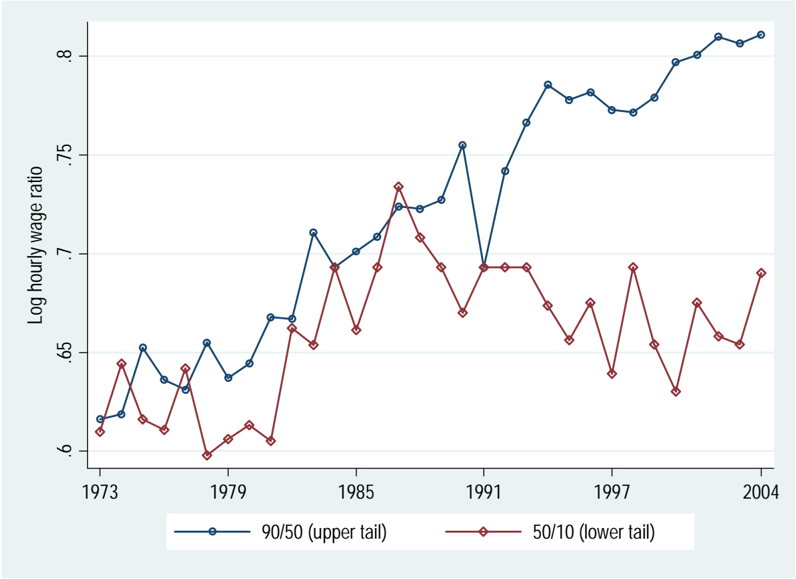
This paper analyzes a marked change in the evolution of the U.S. wage structure over the past fifteen years: divergent trends in upper-tail (90/50) and lower-tail (50/10) wage inequality. We document that wage inequality in the top half of distribution has displayed an unchecked and rather smooth secular rise for the last 25 years (since 1980). Wage inequality in the bottom half of the distribution also grew rapidly from 1979 to 1987, but it has ceased growing (and for some measures actually narrowed) since the late 1980s. Furthermore we find that occupational employment growth shifted from monotonically increasing in wages (education) in the 1980s to a pattern of more rapid growth in jobs at the top and bottom relative to the middles of the wage (education) distribution in the 1990s. We characterize these patterns as the "polarization" of the U.S. labor market, with employment polarizing into high-wage and low-wage jobs at the expense of middle-wage work. We show how a model of computerization in which computers most strongly complement the non-routine (abstract) cognitive tasks of high-wage jobs, directly substitute for the routine tasks found in many traditional middle-wage jobs, and may have little direct impact on non-routine manual tasks in relatively low-wage jobs can help explain the observed polarization of the U.S. labor market.
Overview
CoChat Summary
TL;DR
This paper documents that U.S. wage inequality diverged after the late 1980s: upper-tail inequality kept rising while lower-tail inequality stopped growing, and employment growth shifted from monotonic skill upgrading in the 1980s to polarization into high- and low-wage jobs in the 1990s. The authors argue that a model of computerization—complementing abstract tasks, substituting for routine tasks, and having little direct effect on non-routine manual tasks—can help explain these patterns.
Key findings
- From 1979 to 1987, upper-half (90/50) and lower-half (50/10) wage inequality rose similarly, expanding the 90-10 log wage differential by 21 log points; after 1987, upper-half inequality continued rising while the 50-10 differential contracted by 4 log points from 1987 to 2004, leaving only 4 log points of 90-10 growth since 1987.
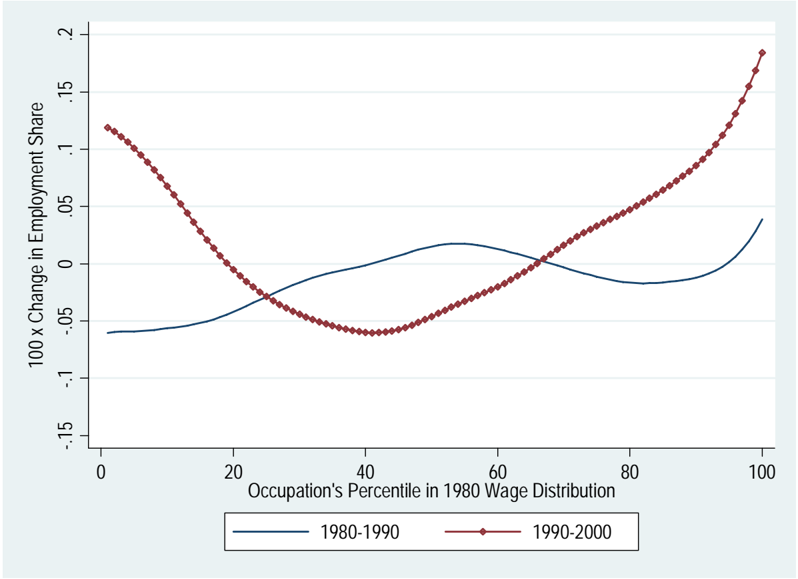
- Occupational employment growth changed from monotonically increasing in wages/education in the 1980s to polarized growth in the 1990s: employment grew more rapidly below the 25th and above the 65th percentiles of the occupational wage distribution and declined in the middle (25th to 65th percentiles).
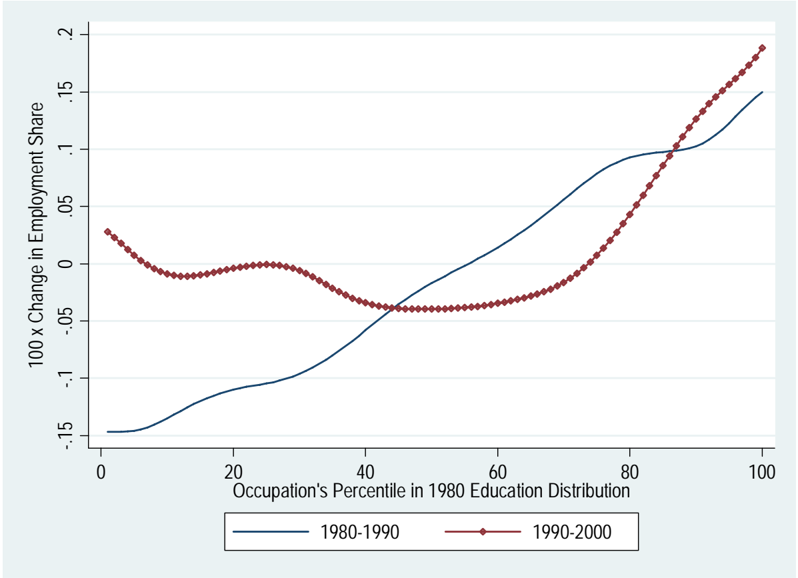
- Using 1980 occupational education percentiles, employment growth was near-monotonic in the 1980s but polarized in the 1990s, with more rapid growth at the bottom than the middle and the most rapid, diverging gains at the top.
- The authors find that quantity and price changes covary positively throughout the earnings distribution in both the 1980s and 1990s, suggesting labor demand shifts are central to explaining wage structure changes.
Methods
- The paper combines descriptive analysis of U.S. wage and employment data with a conceptual task-based model of computerization.
- Wage inequality trends are measured using Current Population Survey May samples for 1973–78 and Merged Outgoing Rotation Group samples for 1979–2004, focusing on 90/50 and 50/10 log hourly wage differentials.
- Employment polarization is analyzed using 1980, 1990, and 2000 Census Integrated Public Use Microsamples, ranking occupations by 1980 median hourly wage or average years of schooling and fitting locally weighted smoothing regressions of decadal employment-share growth on initial skill percentile.
Limitations
- Stated: the model assumes only two worker types, with college workers supplying abstract skill and high school workers substituting between routine and manual tasks; a more complete model would allow endogenous education responses, routine skills for college workers, abstract skills for high school workers, and heterogeneity in abstract skills among college workers.
- Stated: the “social norms” explanation for upper-tail skewness is intriguing but needs refinement to be directly testable, and the minimum wage explanation fits lower-tail inequality trends only to 1987.
- Evident: the paper is largely descriptive and theoretical rather than a causal test of computerization; the model’s predictions are used to interpret observed polarization, but the text does not report direct causal estimates linking computerization to the wage and employment changes.
Model-written summary. Check it against the paper before relying on it.
Integrity signals
Registry
Cites
Statistics
Figures
Verification
Claims the paper makes
0 Valid · 3 Not valid · 14 Not checked · 49 Own results and interpretations
A result the paper states — it cites no source for it, so there is none to check. The quote shows it is in the paper.
In the paper
“The net effect has been a slower growth of only 4 log points in the 90-10 log wage differential since 1987.”
plain- Asserted: passes — The authors put it forward as true.
- Checkable: passes — It can be checked against evidence.
- Load-bearing: passes — The paper’s conclusions depend on it.
- Based: passes — The paper gives a reason why it holds.
A result the paper reports from its own data — it cites no other source for it, so there is none to check. The quote shows it is in the paper.
In the paper
“Using this skill measure, we find near-monotonic (almost linear) increases in employment growth moving up the education distribution in the 1980s.”
plainstates an association- Asserted: passes — The authors put it forward as true.
- Checkable: passes — It can be checked against evidence.
- Load-bearing: unclear — It is unclear whether the paper’s conclusions depend on it.
- Based: passes — The paper gives a reason why it holds.
A result the paper reports from its own data — it cites no other source for it, so there is none to check. The quote shows it is in the paper.
In the paper
“We document that wage inequality in the top half of distribution has displayed an unchecked and rather smooth secular rise for the last 25 years (since 1980).”
- Also stated in: § ABSTRACT · plain
“wage inequality in the top half of the distribution has exhibited an unchecked secular rise for the last 25 years (since 1980)”
plain- Asserted: passes — The authors put it forward as true.
- Checkable: passes — It can be checked against evidence.
- Load-bearing: passes — The paper’s conclusions depend on it.
- Based: passes — The paper gives a reason why it holds.
- Also stated in: § ABSTRACT · plain
A result the paper reports from its own data — it cites no other source for it, so there is none to check. The quote shows it is in the paper.
In the paper
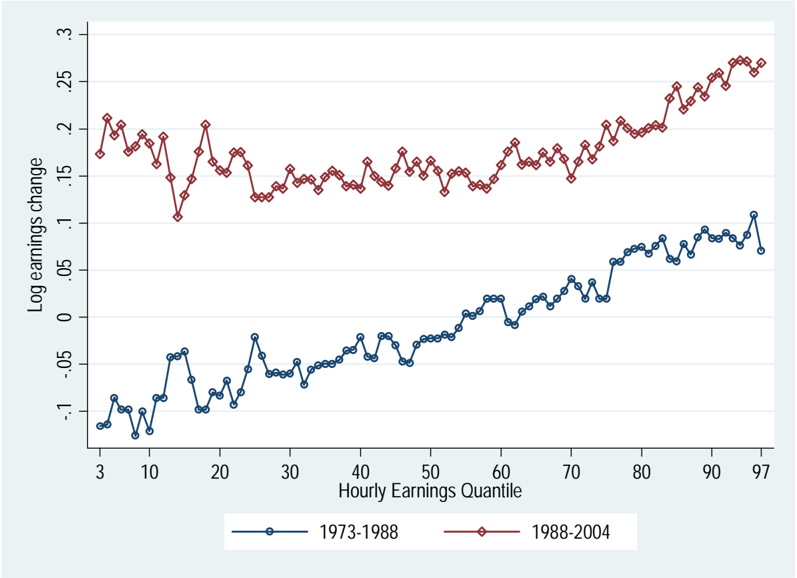
“The figure shows an almost linear spreading out of the entire wage distribution (from the 3 rd to 97 th percentile) in the first half of the sample (driven by changes in the 1980s).”
plainstates a cause- Asserted: passes — The authors put it forward as true.
- Checkable: passes — It can be checked against evidence.
- Load-bearing: passes — The paper’s conclusions depend on it.
- Based: passes — The paper gives a reason why it holds.
A result the paper reports from its own data — it cites no other source for it, so there is none to check. The quote shows it is in the paper.
In the paper
“The plot shows similar substantial increases in upper-half (90-50) and lower-half (50-10) wage inequality from 1979 to 1987, expanding the 90-10 log wage differential by 21 log points.”
plain- Asserted: passes — The authors put it forward as true.
- Checkable: passes — It can be checked against evidence.
- Load-bearing: passes — The paper’s conclusions depend on it.
- Based: passes — The paper gives a reason why it holds.
37 more claims
Create a free account to see all 66 claims and every source verdict.
- It may state two separate claims as one. 20
- Probably not a substantial claim. 5
- The quote only partly states this claim. 1
Claims other papers make about this one
Each is checked against this paper’s own text: does it say what the citing paper says it does?
The source backs part of the claim, not all of it — or backs it for a different population, condition or comparison.
In the citing paper
“Since the 1980s, the U.S. labor market has experienced declines in middle-skill, middle-income jobs in manufacturing and construction as a result of improvements in assembly line automation and the displacement of routine production jobs offshore, among other explanations (Acemoglu and Autor 2011; Autor, Katz, and Kearney 2006; Kalleberg 2009).”
From Beyond the Great Recession: Labor Market Polarization and Ongoing Fertility Decline in the United States (2019) · cites this paper as Autor, Katz, and Kearney 2006
Experimental — accuracy not yet measuredThe cited source says what the claim attributes to it.
In the citing paper
“Prior research on computer-based automation posited that routine work was most susceptible to replacement by computers (Autor et al., 2006; Acemoglu and Autor, 2011).”
From Large language models at work in China’s labor market (2025) · cites this paper as Autor et al., 2006
Citations
Cites
The Skill Content of Recent Technological Change: An Empirical Exploration
Autor, D. H., Levy, F., & Murnane, R. J. (2003) · The Quarterly Journal of Economics · doi:10.1162/003355303322552801 · Cited by 6,205
Self-citationIncome Inequality in the United States, 1913-1998
Piketty, T., & Saez, E. (2003) · The Quarterly Journal of Economics · doi:10.1162/00335530360535135 · Cited by 3,769
Lousy and Lovely Jobs: The Rising Polarization of Work in Britain
Goos, M., & Manning, A. (2007) · Review of Economics and Statistics · doi:10.1162/rest.89.1.118 · Cited by 2,285
Why Has CEO Pay Increased So Much?*
Gabaix, X., & Landier, A. (2008) · Quarterly Journal of Economics · doi:10.1162/qjec.2008.123.1.49 · Cited by 1,764
Skill‐Biased Technological Change and Rising Wage Inequality: Some Problems and Puzzles
Card, D., & DiNardo, J. E. (2002) · Journal of Labor Economics · doi:10.1086/342055 · Cited by 1,714
Technical Change, Job Tasks, and Rising Educational Demands: Looking outside the Wage Structure
Spitz‐Oener, A. (2006) · Journal of Labor Economics · doi:10.1086/499972 · Cited by 1,241
Changes in Unemployment and Wage Inequality: An Alternative Theory and Some Evidence
Acemoglu, D. (1999) · American Economic Review · doi:10.1257/aer.89.5.1259 · Cited by 634
Research works printed but not linked: 3
- Antràs Garicano, Quarterly Journal of Economics (forthcoming).
- Katz Lawrence F, 1999, North-Holland, 1463
- Lemieux Thomas, American Economic Review (forthcoming).
Cited by
Items 601–700 of 1,479
Empowering Workers in an Age of Automation: Social Justice, Technology, and the Future of Work
Parr, T. (2025) · doi:10.1093/9780192589002.001.0001 · Cited by 16
How automation and skill gaps fail to explain wage suppression or wage inequality
Mishel, L. (2022) · Industrial and Corporate Change · doi:10.1093/icc/dtac004 · Cited by 21
Zhang, C., & Weng, X. (2024) · Journal of Asian Economics · doi:10.1016/j.asieco.2024.101759 · Cited by 15
Wu, Q. (2024) · Managerial and Decision Economics · doi:10.1002/mde.4400 · Cited by 13
Growth without gain? The faltering living standards of people on low-to-middle incomes
PLUNKETT, J. W. (2011) · Cited by 18
Worldwide Knowledge? Global Firms, Local Labour and the Region
Antonietti, R. (2015) · Regional Studies · doi:10.1080/00343404.2015.1099198 · Cited by 12
The Future of Welfare State Politics
Rehm, P. (2019) · Political Science Research and Methods · doi:10.1017/psrm.2018.33 · Cited by 12
Automation and Structural Transformation in Developing Countries
Schlögl, L., & Sumner, A. (2020) · Springer eBooks · doi:10.1007/978-3-030-30131-6_5 · Cited by 16
The fall of the labor income share: The role of technological change and hiring frictions
Carbonero, F., Offermanns, C. J., & Weber, E. (2022) · Review of Economic Dynamics · doi:10.1016/j.red.2022.09.001 · Cited by 13
Does ICT affect the demand for vocationally educated workers?
Pusterla, F., & Renold, U. (2022) · Zeitschrift für schweizerische Statistik und Volkswirtschaft/Schweizerische Zeitschrift für Volkswirtschaft und Statistik/Swiss journal of economics and statistics · doi:10.1186/s41937-022-00101-8 · Cited by 18
Outsourcing, Occupationally Homogeneous Employers, and Wage Inequality in the United States
Handwerker, E. W. (2023) · Journal of Labor Economics · doi:10.1086/726634 · Cited by 19
Migration in the Tenth District: Long-Term Trends and Current Developments
Keeton, W. R., & Newton, G. B. (2006) · RePEc: Research Papers in Economics · Cited by 12
Muñoz, J. M. A., & Serrano, C. G. (2014) · International Journal of Manpower · doi:10.1108/ijm-01-2012-0019 · Cited by 12
Empleo, salarios y desigualdad en Argentina: análisis de los determinantes distributivos
Groisman, F. (2014) · Problemas del Desarrollo Revista Latinoamericana de Economía · doi:10.1016/s0301-7036(14)70863-6 · Cited by 26
The State of Work (and Workers) in America
Kalleberg, A. L. (2008) · Work and Occupations · doi:10.1177/0730888408320463 · Cited by 12
Full Industry Equilibrium: A Theory of the Industrial Long Run
Opocher, A., & Steedman, I. (2015) · Thammasat University Digital Collections · Cited by 12
Women's economic opportunities and the intra-household production of child human capital
Bruins, M. (2017) · Labour Economics · doi:10.1016/j.labeco.2016.12.007 · Cited by 15
Foreign direct investment and wage dispersion: Evidence from French employer-employee data
Laffineur, C., & Gazaniol, A. (2019) · International Economics · doi:10.1016/j.inteco.2018.12.001 · Cited by 16
The associations between patterns of precarious employment and workers’ health
Cho, Y. (2020) · The Social Science Journal · doi:10.1016/j.soscij.2019.09.006 · Cited by 16
Globalization, the jobs ladder and economic mobility
Davidson, C., Heyman, F., Matusz, S. J., Sjöholm, F., & Zhu, S. C. (2020) · European Economic Review · doi:10.1016/j.euroecorev.2020.103444 · Cited by 19
What drives employment–unemployment transitions? Evidence from Italian task-based data
Cassandro, N., Centra, M., Guarascio, D., & Esposito, P. (2021) · Economia Politica · doi:10.1007/s40888-021-00237-5 · Cited by 17
Do Computers Reduce the Value of Worker Persistence?
Brynjolfsson, E., Liu, M., & Westerman, G. F. (2022) · Journal of Management Information Systems · doi:10.1080/07421222.2021.2023406 · Cited by 20
Fiskalische und individuelle Bildungsrenditen – aktuelle Befunde für Deutschland
Pfeiffer, F., & Stichnoth, H. (2015) · Perspektiven der Wirtschaftspolitik · doi:10.1515/pwp-2015-0023 · Cited by 29
Factors driving sectoral and occupational employment changes during the Spanish boom (1995–2005)
Madariaga, R. (2018) · Economic Systems Research · doi:10.1080/09535314.2018.1474182 · Cited by 14
Strobel, T. (2010) · RePEc: Research Papers in Economics · Cited by 12
Automation and Labor Market Outcomes: The Pivotal Role of High-Quality Education
Kattan, R. B., Macdonald, K., & Patrinos, H. A. (2018) · World Bank, Washington, DC eBooks · doi:10.1596/1813-9450-8474 · Cited by 18
The changing labour market for graduates from medium-level vocational education and training
Vandeweyer, M., & Verhagen, A. (2020) · OECD social employment and migration working papers · doi:10.1787/503bcecb-en · Cited by 23
Machin, S. J., & Reenen, J. M. V. (2008) · Palgrave Macmillan UK eBooks · doi:10.1057/978-1-349-95121-5_2001-1 · Cited by 14
Fostering Sustainable Innovation Through Creative Destruction Theory
Jackson, E. A. (2020) · Encyclopedia of the UN sustainable development goals · doi:10.1007/978-3-319-71059-4_119-1 · Cited by 18
Digital skill adoption and employment dynamics: Evidence from matched vacancy-employer–employee data
Jensen, M. F., & Schneider, C. (2026) · Research Policy · doi:10.1016/j.respol.2026.105476 · Cited by 14
Structural Labour Market Change and Gender Inequality in Earnings
Matysiak, A., Hardy, W., & van der Velde, L. (2024) · Work Employment and Society · doi:10.1177/09500170241258953 · Cited by 14
Caselli, M., Fracasso, A., Scicchitano, S., Traverso, S., & Tundis, E. (2021) · Research Policy · doi:10.1016/j.respol.2024.105135 · Cited by 46
The Impact of Demographics on 21st Century Education
Eng, N. (2013) · Society · doi:10.1007/s12115-013-9655-z · Cited by 11
Labour market performance and school careers of low educated graduates
Edzes, A. J. E., Hamersma, M., Venhorst, V. A., & van Dijk, J. (2015) · Letters in Spatial and Resource Sciences · doi:10.1007/s12076-015-0141-7 · Cited by 14
Design Capitalism: Design, Economics and Innovation in the Auto-Industrial Age
Murphy, P. (2015) · She ji · doi:10.1016/j.sheji.2015.11.003 · Cited by 13
INTERGENERATIONAL MOBILITY IN EDUCATION AND OCCUPATION
Alonso‐Carrera, J., Caballé, J., & Raurich, X. (2018) · Macroeconomic Dynamics · doi:10.1017/s1365100518000226 · Cited by 14
Skills Mismatch? Military Service, Combat Occupations, and Civilian Earnings
MacLean, A. (2016) · Sociological Perspectives · doi:10.1177/0731121416632011 · Cited by 16
Hinz, T., & Abraham, M. (2018) · Springer eBooks · doi:10.1007/978-3-658-02256-3_2 · Cited by 22
Neighbourhood ties and employment: a test of different hypotheses across neighbourhoods
Custers, G. (2018) · Housing Studies · doi:10.1080/02673037.2018.1527020 · Cited by 11
Income inequality and the imprint of globalization on U.S. metropolitan areas
Boschken, H. L. (2021) · Cities · doi:10.1016/j.cities.2021.103503 · Cited by 14
The adjustment of national education systems to a knowledge‐based economy: a new approach
Nelson, M. (2010) · Comparative Education · doi:10.1080/03050068.2010.519480 · Cited by 20
Incentive Contracts and the Allocation of Talent
Wu, Y. (2017) · The Economic Journal · doi:10.1111/ecoj.12397 · Cited by 12
Rethinking Entrepreneurial Human Capital
Giulio, B., Minola, T., Origo, F., & Tomelleri, S. (2018) · Studies on entrepreneurship, structural change and industrial dynamics · doi:10.1007/978-3-319-90548-8 · Cited by 14
The 'Task Approach' to Labor Markets: An OverviewPreprint
Autor, D. (2013) · SSRN Electronic Journal · doi:10.2139/ssrn.2323067 · Cited by 11
Self-citationUsing Payroll Tax Variation to Unpack the Black Box of Firm-Level ProductionPreprint
Benzarti, Y., & Harju, J. (2021) · SSRN Electronic Journal · doi:10.2139/ssrn.3810736 · Cited by 11
Offshoring and Relative Labor Demand from a Task PerspectivePreprint
Hogrefe, J. (2013) · SSRN Electronic Journal · doi:10.2139/ssrn.2333590 · Cited by 23
Computerization, Obsolescence, and the Length of Working Life
Hudomiet, P., & Willis, R. J. (2021) · National Bureau of Economic Research · doi:10.3386/w28701 · Cited by 11
Artificial Intelligence and the Labor MarketPreprint
Hampole, M., Papanikolaou, D., Schmidt, L., & Seegmiller, B. (2025) · SSRN Electronic Journal · doi:10.2139/ssrn.5121025 · Cited by 43
“Bad jobs” for marriage: Precarious work and the transition to first marriage
Lim, S. (2017) · Precarious Work · doi:10.1108/s0277-283320170000031015 · Cited by 10
The Dependency Structure of Bad Jobs: How Market Constraint Undermines Job Quality
Benton, R. A., & Kim, K. (2020) · Industrial and Labor Relations Review · doi:10.1177/0019793920936250 · Cited by 31
External financing, technological changes, and employees
Kim, E. H., Li, Y., Lü, Y., & Shi, X. (2023) · European Finance Review · doi:10.1093/rof/rfad040 · Cited by 13
Does capital market liberalization increase corporate labor income share? Evidence from China
Si, D.-K., Meng, M., Wang, J., & Zhou, F. (2024) · Economic Modelling · doi:10.1016/j.econmod.2024.106919 · Cited by 14
Lewis, P. A. J. (2010) · Journal of Social Policy · doi:10.1017/s0047279410000917 · Cited by 11
The Evolution of the Occupational Structure in Italy in the Last Decade
Basso, G. (2019) · Social Indicators Research · doi:10.1007/s11205-020-02460-2 · Cited by 30
RCT evidence on differential impact of US job training programmes by pre-training employment status
Baird, M., Engberg, J., & Gutierrez, I. A. (2022) · Labour Economics · doi:10.1016/j.labeco.2022.102140 · Cited by 15
WAGES AND WORKPLACE COMPUTER USE IN CHILE
Benavente, J. M., BRAVO, D., & Montero, R. (2011) · The Developing Economies · doi:10.1111/j.1746-1049.2011.00144.x · Cited by 12
Long term trends in fair and unfair inequality in the United States
Hussey, A. J., & Jetter, M. (2016) · Applied Economics · doi:10.1080/00036846.2016.1213362 · Cited by 13
Structural demand shifts and potential labor supply responses in the new century
Autor, D. (2007) · RePEc: Research Papers in Economics · Cited by 15
Self-citationInvesting in Skills for Inclusive Trade
World Trade Organization (2017) · doi:10.30875/e8db886e-en · Cited by 13
Bosio, G., & Cristini, A. (2018) · Studies on entrepreneurship, structural change and industrial dynamics · doi:10.1007/978-3-319-90548-8_2 · Cited by 11
Chen, Z. J., & Skuterud, M. (2017) · Canadian Public Policy · doi:10.3138/cpp.2017-042 · Cited by 20
Offshoring, computerization, labor market polarization and top income inequality
Cavenaile, L. (2021) · Journal of Macroeconomics · doi:10.1016/j.jmacro.2021.103317 · Cited by 15
Discrimination and Monopsony Power
Stelzner, M. J., & Bahn, K. (2021) · The Review of Black Political Economy · doi:10.1177/00346446211025646 · Cited by 16
Roberts, A. J., & Kwon, R. (2022) · Research in Social Stratification and Mobility · doi:10.1016/j.rssm.2022.100675 · Cited by 39
Fulfilment of basic needs from a subjective point of view in rural Guatemala
Guardiola, J., & García‐Muñoz, T. (2010) · International Journal of Social Welfare · doi:10.1111/j.1468-2397.2010.00758.x · Cited by 13
Okazawa, R. (2012) · The Journal of Economic Inequality · doi:10.1007/s10888-012-9223-6 · Cited by 12
Retirement intentions in the presence of technological change: theory and evidence from France
Messe, P., Moreno-Galbis, E., & Wolff, F. (2014) · IZA Journal of Labor Economics · doi:10.1186/2193-8997-3-8 · Cited by 17
SKILL REQUIREMENTS, SEARCH FRICTIONS, AND WAGE INEQUALITY*
Uren, L., & Virág, G. (2011) · International Economic Review · doi:10.1111/j.1468-2354.2011.00632.x · Cited by 15
Romero, L. M., & Salinas-Jiménez, M. D. M. (2018) · Personnel Review · doi:10.1108/pr-03-2017-0088 · Cited by 11
Competition and labor productivity in India's retail stores
Amin, M. (2015) · Journal of Asian Economics · doi:10.1016/j.asieco.2015.10.003 · Cited by 11
Educational Credentials and Intra-Occupational Inequality: Evidence from Law Firm Dissolutions.Preprint
Rider, C. I. (2011) · SSRN Electronic Journal · doi:10.2139/ssrn.1881028 · Cited by 11
Automation and the Displacement of Labor by Capital: Asset Pricing Theory and Empirical EvidencePreprint
Knesl, J. (2018) · SSRN Electronic Journal · doi:10.2139/ssrn.3293405 · Cited by 10
Addressing labour market challenges in Belgium
McGowan, M. A., Hijzen, A., Law, D., Salvatori, A., Sicari, P., & Thewissen, S. (2020) · OECD Economics Department working papers · doi:10.1787/8a542d68-en · Cited by 24
The effect of COVID ‐19 on employment: A bibliometric review of a she‐cession
Enciso‐Alfaro, S., Marhroub, S., Martínez‐Córdoba, P., & Sánchez, I. (2024) · Corporate Social Responsibility and Environmental Management · doi:10.1002/csr.2756 · Cited by 13
Strategic alliance, agency problems, and labor investment efficiency
Chen, W., Chen, Z., Qin, L., Shan, Y., & Xu, W. (2024) · Economic Modelling · doi:10.1016/j.econmod.2024.106809 · Cited by 12
Mann, K., & Pozzoli, D. (2024) · Journal of Economic Behavior & Organization · doi:10.1016/j.jebo.2024.106708 · Cited by 12
York, H. W., Song, X., & Xie, Y. (2024) · American Journal of Sociology · doi:10.1086/733122 · Cited by 15
Law-Abiding Immigrants: The Incarceration Gap between Immigrants and the US-Born, 1870–2020
Abramitzky, R., Boustan, L. P., Jácome, E., Pérez, S. T., & Torres, J. D. (2024) · American Economic Review Insights · doi:10.1257/aeri.20230459 · Cited by 25
Russ, M., Bansal, G., & Parrillo, A. J. (2015) · Journal of the Knowledge Economy · doi:10.1007/s13132-015-0278-z · Cited by 10
Highly Skilled International Migration, STEM Workers, and Innovation
Bongers, A., Roldán, C. D., & Torres, J. L. (2022) · Economics · doi:10.1515/econ-2022-0022 · Cited by 16
Decomposing the Education Wage Gap: Everything but the Kitchen Sink
Hotchkiss, J. L., & Shiferaw, M. (2011) · doi:10.20955/r.93.243-272 · Cited by 14
Starr, E. (2022) · Gender Work and Organization · doi:10.1111/gwao.12812 · Cited by 10
Accelerated demand for interpersonal skills in the Australian post-pandemic labour market
Evans, D., Mason, C., Chen, H., & Reeson, A. F. (2024) · Nature Human Behaviour · doi:10.1038/s41562-023-01788-2 · Cited by 19
Cultural constraints on rising income inequality: A U.S.–Japan comparison
Sakamoto, A., Woo, H., Takei, I., & Murase, Y. (2011) · The Journal of Economic Inequality · doi:10.1007/s10888-011-9204-1 · Cited by 10
A critical review of the technology-inequality debate
Bogliacino, F. (2014) · Suma de Negocios · doi:10.1016/s2215-910x(14)70034-5 · Cited by 14
The Wage Response to Shocks: The Role of Inter-Occupational Labour Adjustment
Tschopp, J. (2015) · Labour Economics · doi:10.1016/j.labeco.2015.08.003 · Cited by 13
Möller, S., Misra, J., Wemlinger, E., & Strader, E. (2016) · Socius Sociological Research for a Dynamic World · doi:10.1177/2378023116669150 · Cited by 10
Job polarization and the natural rate of unemployment in the United States
Tüzemen, D. (2018) · Economics Letters · doi:10.1016/j.econlet.2018.12.011 · Cited by 9
Capsada‐Munsech, Q., & Valiente, Ó. (2020) · European Education · doi:10.1080/10564934.2020.1723421 · Cited by 17
Technologies and “Routinization”
Biagi, F., & Sebastian, R. (2020) · Springer eBooks · doi:10.1007/978-3-319-57365-6_8-2 · Cited by 22
Occupational mobility in Europe during the crisis: Did the social elevator break?
Pohlig, M. (2020) · Research in Social Stratification and Mobility · doi:10.1016/j.rssm.2020.100549 · Cited by 18
Skills and the evolution of wage inequality
Capatina, E. (2014) · Labour Economics · doi:10.1016/j.labeco.2014.03.003 · Cited by 12
Spletzer, J. R., & Handwerker, E. W. (2014) · Monthly labor review · doi:10.21916/mlr.2014.18 · Cited by 12
Social Skill Dimensions and Career Dynamics
Wyant, A. D., Manzoni, A., & McDonald, S. (2018) · Socius Sociological Research for a Dynamic World · doi:10.1177/2378023118768007 · Cited by 17
Gender Earnings Disparity and Discrimination in Urban China: Unconditional Quantile Regression
Tang, Y., & Long, W. (2013) · African Journal of Science Technology Innovation and Development · doi:10.1080/20421338.2013.796743 · Cited by 13
Prekäre Mitte? Sozialstaat und Mittelschicht im internationalen Vergleich1
Dallinger, U. (2011) · Zeitschrift für Sozialreform · doi:10.1515/zsr-2011-0105 · Cited by 14
Millennials, Baby Boomers, and Rebounding Multifamily Home ConstructionPreprint
Rappaport, J. M. (2015) · SSRN Electronic Journal · doi:10.2139/ssrn.2637622 · Cited by 9
Jung, J., & Mercenier, J. (2010) · HAL · Cited by 14
Innovation, Human Capital and Earning Distribution: towards a dynamic life-cycle approach
Vona, F., & Consoli, D. (2008) · Munich Personal RePEc Archive (Ludwig Maximilian University of Munich) · Cited by 10
Are Middle-Paid Jobs in OECD Countries Disappearing? An OverviewPreprint
Kolev, A. (2010) · RePEc: Research Papers in Economics · Cited by 10
Metadata
- Authors
- Autor, D. H., Katz, L. F., & Kearney, M. S.
- Affiliations
- National Bureau of Economic Research (US)
- Brookings Institution (US)
- Venue
- American Economic Review
- Publisher
- American Economic Association
- Published
- 2006-04-01
- Volume
- 96
- Issue
- 2
- Pages
- 189-194
- ISSN
- 0002-8282 (ISSN-L)
- OpenAlex
- W3124544360
- Cited by
- 1,594
- References
- 4
- Citations by year
- 2026: 75 · 2025: 108 · 2024: 122 · 2023: 90 · 2022: 89 · 2021: 100 · 2020: 107 · 2019: 96 · 2018: 93 · 2017: 74 · 2016: 76 · 2015: 91 · 2014: 78 · 2013: 81 · 2012: 59
- FWCI
- 110.81
- Type
- journal article
- Language
- en
- Open access
- closed
- Locations
- American Economic Review (publishedVersion)
- RePEc: Research Papers in Economics (submittedVersion)
- Topics
- Social Sciences › Economics, Econometrics and Finance › Economics and Econometrics › Labor market dynamics and wage inequality
- Social Sciences › Economics, Econometrics and Finance › General Economics, Econometrics and Finance › Economic Theory and Policy
- Social Sciences › Sociology and Political Science › Income, Poverty, and Inequality
- Keywords
- labor market polarization, wage inequality, wage distribution, computerization, high-wage jobs, low-wage employment, United States labor market
About these checks
Registry, retraction, Cites and statistics results are computed, not judged, with one exception: a printed reference that no index lists is read once by a model before it counts as a citation error. Claims are extracted by a model and kept only when their quote appears verbatim in the text; each cited source is then checked, with a model’s help, for whether it says what the claim relies on. Those verdicts can be wrong — read the claim’s quote and the cited source before relying on one.
A language model drew the claims from the paper on 2026-10-12, under version 3 of the claim definition (model deepseek-v4.1-flash, prompt extract-v3).
A second model labelled each claim on 2026-10-12 (model jev-1.13-20260917, definition revision gold-guideline-v0.2).
Statistics and arithmetic are recomputed, not judged.
Confidence bands are shown only for fields calibrated on our annotated test set. None is calibrated yet, so no band is shown.
What counts as a claim ›How we measure confidence ›How we check this ›
Are you an author, or do you see a problem with this page? Request a review
Data sources
Bibliographic data: Semantic Scholar, OpenAlex, Crossref.
Contains information from the Semantic Scholar Academic Graph Datasets, made available under the ODC Attribution License (ODC-BY 1.0).
Semantic Scholar’s data is described in: Kinney, R., et al. (2023). The Semantic Scholar Open Data Platform. arXiv:2301.10140.
