

The Polarization of the U.S. Labor Market
The DOI matches its Crossref record; 7 of the 7 references it cites were found in a registry or an index; none of the 16 sources its claims cite is checked for support yet.
Abstract
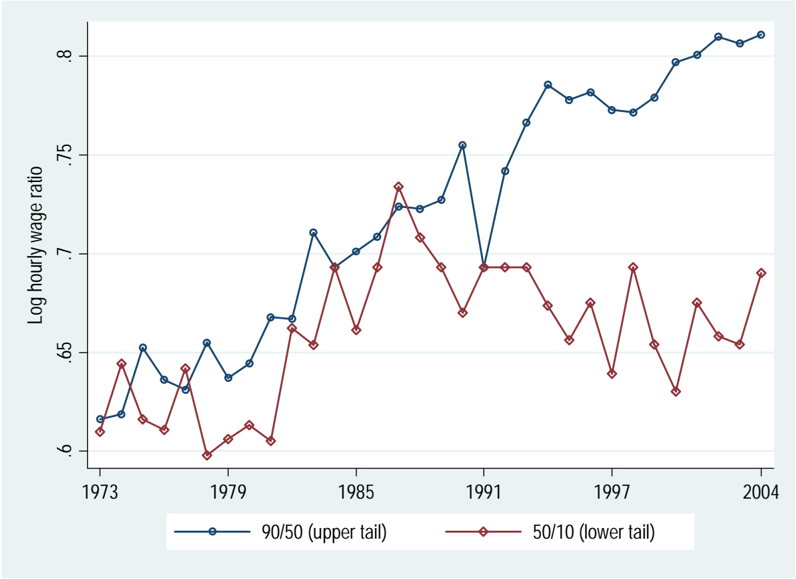
This paper analyzes a marked change in the evolution of the U.S. wage structure over the past fifteen years: divergent trends in upper-tail (90/50) and lower-tail (50/10) wage inequality. We document that wage inequality in the top half of distribution has displayed an unchecked and rather smooth secular rise for the last 25 years (since 1980). Wage inequality in the bottom half of the distribution also grew rapidly from 1979 to 1987, but it has ceased growing (and for some measures actually narrowed) since the late 1980s. Furthermore we find that occupational employment growth shifted from monotonically increasing in wages (education) in the 1980s to a pattern of more rapid growth in jobs at the top and bottom relative to the middles of the wage (education) distribution in the 1990s. We characterize these patterns as the "polarization" of the U.S. labor market, with employment polarizing into high-wage and low-wage jobs at the expense of middle-wage work. We show how a model of computerization in which computers most strongly complement the non-routine (abstract) cognitive tasks of high-wage jobs, directly substitute for the routine tasks found in many traditional middle-wage jobs, and may have little direct impact on non-routine manual tasks in relatively low-wage jobs can help explain the observed polarization of the U.S. labor market.
Overview
CoChat Summary
TL;DR
This paper documents that U.S. wage inequality diverged after the late 1980s: upper-tail inequality kept rising while lower-tail inequality stopped growing, and employment growth shifted from monotonic skill upgrading in the 1980s to polarization into high- and low-wage jobs in the 1990s. The authors argue that a model of computerization—complementing abstract tasks, substituting for routine tasks, and having little direct effect on non-routine manual tasks—can help explain these patterns.
Key findings
- From 1979 to 1987, upper-half (90/50) and lower-half (50/10) wage inequality rose similarly, expanding the 90-10 log wage differential by 21 log points; after 1987, upper-half inequality continued rising while the 50-10 differential contracted by 4 log points from 1987 to 2004, leaving only 4 log points of 90-10 growth since 1987.
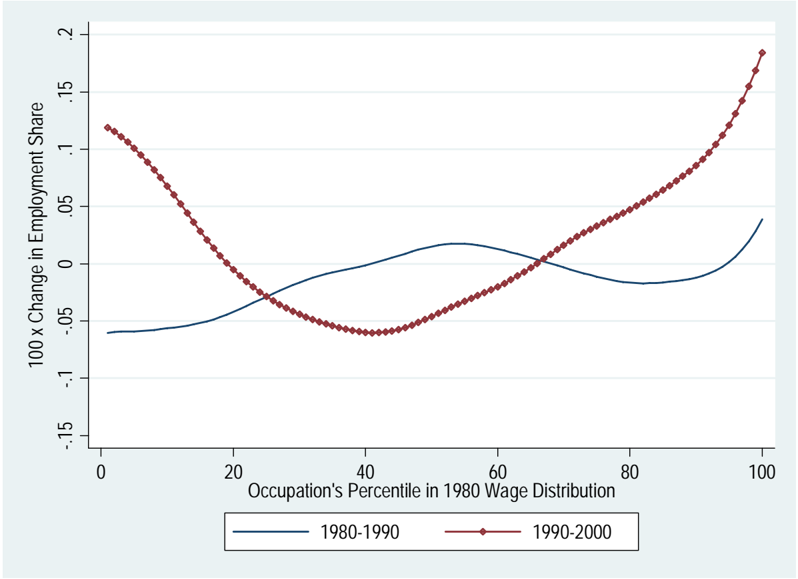
- Occupational employment growth changed from monotonically increasing in wages/education in the 1980s to polarized growth in the 1990s: employment grew more rapidly below the 25th and above the 65th percentiles of the occupational wage distribution and declined in the middle (25th to 65th percentiles).
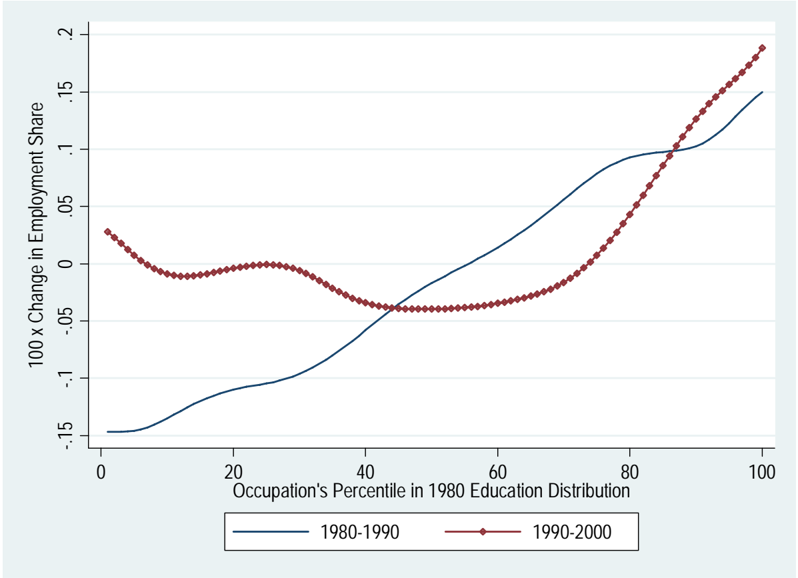
- Using 1980 occupational education percentiles, employment growth was near-monotonic in the 1980s but polarized in the 1990s, with more rapid growth at the bottom than the middle and the most rapid, diverging gains at the top.
- The authors find that quantity and price changes covary positively throughout the earnings distribution in both the 1980s and 1990s, suggesting labor demand shifts are central to explaining wage structure changes.
Methods
- The paper combines descriptive analysis of U.S. wage and employment data with a conceptual task-based model of computerization.
- Wage inequality trends are measured using Current Population Survey May samples for 1973–78 and Merged Outgoing Rotation Group samples for 1979–2004, focusing on 90/50 and 50/10 log hourly wage differentials.
- Employment polarization is analyzed using 1980, 1990, and 2000 Census Integrated Public Use Microsamples, ranking occupations by 1980 median hourly wage or average years of schooling and fitting locally weighted smoothing regressions of decadal employment-share growth on initial skill percentile.
Limitations
- Stated: the model assumes only two worker types, with college workers supplying abstract skill and high school workers substituting between routine and manual tasks; a more complete model would allow endogenous education responses, routine skills for college workers, abstract skills for high school workers, and heterogeneity in abstract skills among college workers.
- Stated: the “social norms” explanation for upper-tail skewness is intriguing but needs refinement to be directly testable, and the minimum wage explanation fits lower-tail inequality trends only to 1987.
- Evident: the paper is largely descriptive and theoretical rather than a causal test of computerization; the model’s predictions are used to interpret observed polarization, but the text does not report direct causal estimates linking computerization to the wage and employment changes.
Model-written summary. Check it against the paper before relying on it.
Integrity signals
Registry
Cites
Statistics
Figures
Verification
Claims the paper makes
0 Valid · 3 Not valid · 14 Not checked · 49 Own results and interpretations
A result the paper states — it cites no source for it, so there is none to check. The quote shows it is in the paper.
In the paper
“The net effect has been a slower growth of only 4 log points in the 90-10 log wage differential since 1987.”
plain- Asserted: passes — The authors put it forward as true.
- Checkable: passes — It can be checked against evidence.
- Load-bearing: passes — The paper’s conclusions depend on it.
- Based: passes — The paper gives a reason why it holds.
A result the paper reports from its own data — it cites no other source for it, so there is none to check. The quote shows it is in the paper.
In the paper
“Using this skill measure, we find near-monotonic (almost linear) increases in employment growth moving up the education distribution in the 1980s.”
plainstates an association- Asserted: passes — The authors put it forward as true.
- Checkable: passes — It can be checked against evidence.
- Load-bearing: unclear — It is unclear whether the paper’s conclusions depend on it.
- Based: passes — The paper gives a reason why it holds.
A result the paper reports from its own data — it cites no other source for it, so there is none to check. The quote shows it is in the paper.
In the paper
“We document that wage inequality in the top half of distribution has displayed an unchecked and rather smooth secular rise for the last 25 years (since 1980).”
- Also stated in: § ABSTRACT · plain
“wage inequality in the top half of the distribution has exhibited an unchecked secular rise for the last 25 years (since 1980)”
plain- Asserted: passes — The authors put it forward as true.
- Checkable: passes — It can be checked against evidence.
- Load-bearing: passes — The paper’s conclusions depend on it.
- Based: passes — The paper gives a reason why it holds.
- Also stated in: § ABSTRACT · plain
A result the paper reports from its own data — it cites no other source for it, so there is none to check. The quote shows it is in the paper.
In the paper
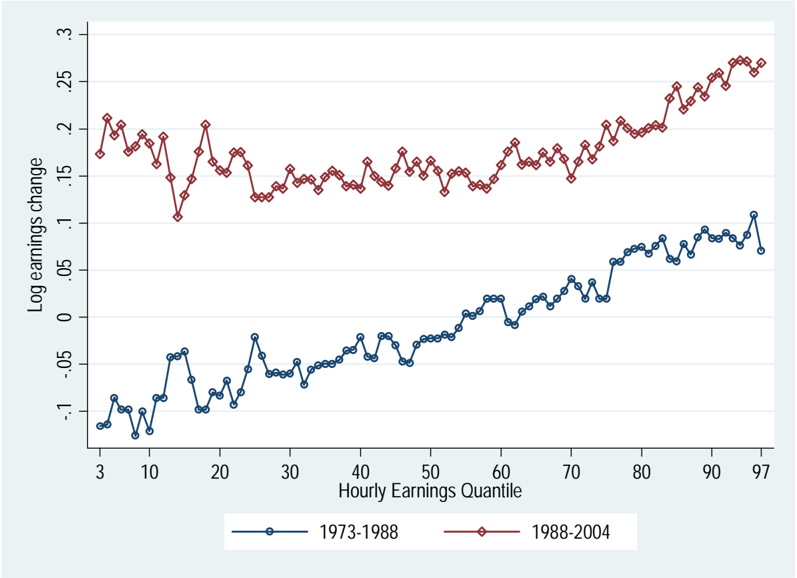
“The figure shows an almost linear spreading out of the entire wage distribution (from the 3 rd to 97 th percentile) in the first half of the sample (driven by changes in the 1980s).”
plainstates a cause- Asserted: passes — The authors put it forward as true.
- Checkable: passes — It can be checked against evidence.
- Load-bearing: passes — The paper’s conclusions depend on it.
- Based: passes — The paper gives a reason why it holds.
A result the paper reports from its own data — it cites no other source for it, so there is none to check. The quote shows it is in the paper.
In the paper
“The plot shows similar substantial increases in upper-half (90-50) and lower-half (50-10) wage inequality from 1979 to 1987, expanding the 90-10 log wage differential by 21 log points.”
plain- Asserted: passes — The authors put it forward as true.
- Checkable: passes — It can be checked against evidence.
- Load-bearing: passes — The paper’s conclusions depend on it.
- Based: passes — The paper gives a reason why it holds.
37 more claims
Create a free account to see all 66 claims and every source verdict.
- It may state two separate claims as one. 20
- Probably not a substantial claim. 5
- The quote only partly states this claim. 1
Claims other papers make about this one
Each is checked against this paper’s own text: does it say what the citing paper says it does?
The source backs part of the claim, not all of it — or backs it for a different population, condition or comparison.
In the citing paper
“Since the 1980s, the U.S. labor market has experienced declines in middle-skill, middle-income jobs in manufacturing and construction as a result of improvements in assembly line automation and the displacement of routine production jobs offshore, among other explanations (Acemoglu and Autor 2011; Autor, Katz, and Kearney 2006; Kalleberg 2009).”
From Beyond the Great Recession: Labor Market Polarization and Ongoing Fertility Decline in the United States (2019) · cites this paper as Autor, Katz, and Kearney 2006
Experimental — accuracy not yet measuredThe cited source says what the claim attributes to it.
In the citing paper
“Prior research on computer-based automation posited that routine work was most susceptible to replacement by computers (Autor et al., 2006; Acemoglu and Autor, 2011).”
From Large language models at work in China’s labor market (2025) · cites this paper as Autor et al., 2006
Citations
Cites
The Skill Content of Recent Technological Change: An Empirical Exploration
Autor, D. H., Levy, F., & Murnane, R. J. (2003) · The Quarterly Journal of Economics · doi:10.1162/003355303322552801 · Cited by 6,205
Self-citationIncome Inequality in the United States, 1913-1998
Piketty, T., & Saez, E. (2003) · The Quarterly Journal of Economics · doi:10.1162/00335530360535135 · Cited by 3,769
Lousy and Lovely Jobs: The Rising Polarization of Work in Britain
Goos, M., & Manning, A. (2007) · Review of Economics and Statistics · doi:10.1162/rest.89.1.118 · Cited by 2,285
Why Has CEO Pay Increased So Much?*
Gabaix, X., & Landier, A. (2008) · Quarterly Journal of Economics · doi:10.1162/qjec.2008.123.1.49 · Cited by 1,764
Skill‐Biased Technological Change and Rising Wage Inequality: Some Problems and Puzzles
Card, D., & DiNardo, J. E. (2002) · Journal of Labor Economics · doi:10.1086/342055 · Cited by 1,714
Technical Change, Job Tasks, and Rising Educational Demands: Looking outside the Wage Structure
Spitz‐Oener, A. (2006) · Journal of Labor Economics · doi:10.1086/499972 · Cited by 1,241
Changes in Unemployment and Wage Inequality: An Alternative Theory and Some Evidence
Acemoglu, D. (1999) · American Economic Review · doi:10.1257/aer.89.5.1259 · Cited by 634
Research works printed but not linked: 3
- Antràs Garicano, Quarterly Journal of Economics (forthcoming).
- Katz Lawrence F, 1999, North-Holland, 1463
- Lemieux Thomas, American Economic Review (forthcoming).
Cited by
Items 401–500 of 1,479
Uneven Growth: Automation’s Impact on Income and Wealth InequalityPreprint
Moll, B., Rachel, Ł., & Restrepo, P. (2021) · SSRN Electronic Journal · doi:10.2139/ssrn.3801089 · Cited by 26
No automation please, we’re British: technology and the prospects for work
Spencer, D., & Slater, G. (2020) · Cambridge Journal of Regions, Economy and Society · doi:10.1093/cjres/rsaa003 · Cited by 26
Haslberger, M. (2021) · Research in Social Stratification and Mobility · doi:10.1016/j.rssm.2021.100623 · Cited by 40
Gruijters, R. J., Winkle, Z. V., & Fasang, A. E. (2023) · American Journal of Sociology · doi:10.1086/726445 · Cited by 43
Irene, B. (2019) · Palgrave studies of entrepreneurship in Africa · doi:10.1007/978-3-030-04924-9_7 · Cited by 26
Is this time different? A note on automation and labour in the fourth industrial revolution
Marengo, L. (2019) · Journal of Industrial and Business Economics · doi:10.1007/s40812-019-00123-z · Cited by 30
Income Polarization in the United States
Alichi, A., Kantenga, K., & Sole, J. A. (2016) · IMF Working Paper · doi:10.5089/9781475522501.001 · Cited by 48
Innovation and job quality. A firm-level exploration
Grande, R., de Bustillo, R. M., Fernández‐Macías, E., & Antón, J. (2020) · Structural Change and Economic Dynamics · doi:10.1016/j.strueco.2020.04.002 · Cited by 30
Routinization of work processes, de-routinization of job structures
Fernández‐Macías, E., Bisello, M., Peruffo, E., & Rinaldi, R. (2022) · Socio-Economic Review · doi:10.1093/ser/mwac044 · Cited by 43
Trends in occupational mobility in France: 1982–2009
Lalé, É. (2012) · Labour Economics · doi:10.1016/j.labeco.2012.03.005 · Cited by 41
Measuring inequality persistence in OECD 1963–2008 using fractional integration and cointegration
Gil‐Alana, L. A., Škare, M., & Družeta, R. P. (2019) · The Quarterly Review of Economics and Finance · doi:10.1016/j.qref.2018.12.006 · Cited by 30
How noise affects effort in tournaments
Drugov, M., & Ryvkin, D. (2020) · Journal of Economic Theory · doi:10.1016/j.jet.2020.105065 · Cited by 38
Improving Job Quality: Policies Aimed at the Demand Side of the Low-Wage Labor Market
Osterman, P. (2008) · Upjohn Research (W.E. Upjohn Institute for Employment Research) · doi:10.17848/9781435641037.ch6 · Cited by 36
Why to employ both migrants and natives? A study on task-specific substitutability
Haas, A., Lucht, M., & Schanne, N. (2013) · Journal for Labour Market Research · doi:10.1007/s12651-013-0145-y · Cited by 35
R&D innovation, industrial evolution and the labor skill structure in China manufacturing
Hang, L., Lu, W. P., Ge, X., Ye, B., Zhao, Z., & Cheng, F. (2024) · Technological Forecasting and Social Change · doi:10.1016/j.techfore.2024.123434 · Cited by 38
Ehlert, M. (2020) · KZfSS Kölner Zeitschrift für Soziologie und Sozialpsychologie · doi:10.1007/s11577-020-00676-1 · Cited by 41
Nalani, A., Yoshikawa, H., & Carter, P. L. (2021) · Socius Sociological Research for a Dynamic World · doi:10.1177/23780231211020236 · Cited by 28
Hütter, C., & Weber, E. (2021) · Economic Modelling · doi:10.1016/j.econmod.2021.105584 · Cited by 29
Silva, H. C., & Lima, F. (2022) · Small Business Economics · doi:10.1007/s11187-022-00602-z · Cited by 31
Has U.S. employment really polarized? A critical reappraisal
Hunt, J., & Nunn, R. (2022) · Labour Economics · doi:10.1016/j.labeco.2022.102117 · Cited by 34
A mulher na recuperação recente do mercado de trabalho brasileiro
Leone, E. T., & Baltar, P. E. D. A. (2008) · Revista Brasileira de Estudos de População · doi:10.1590/s0102-30982008000200003 · Cited by 25
Low-wage mobility during the early career
Campbell, C. (2011) · Research in Social Stratification and Mobility · doi:10.1016/j.rssm.2011.05.002 · Cited by 25
In Search of a Better Life: The Occupational Attainment of Rural and Urban Migrants in China
Ou, D., & Kondo, A. (2013) · Chinese Sociological Review · doi:10.2753/csa2162-0555460102 · Cited by 28
Dupuy, A. (2011) · Economica · doi:10.1111/j.1468-0335.2011.00901.x · Cited by 25
Reichelt, M. (2015) · European Sociological Review · doi:10.1093/esr/jcv055 · Cited by 42
Biased technological change and employment reallocation
Bárány, Z., & Siegel, C. (2020) · Labour Economics · doi:10.1016/j.labeco.2020.101930 · Cited by 31
Giesecke, J. A., & Verwiebe, R. (2009) · Berliner Journal für Soziologie · doi:10.1007/s11609-009-0108-x · Cited by 39
Assignment reversals: Trade, skill allocation and wage inequality
Sampson, T. G. (2016) · Journal of Economic Theory · doi:10.1016/j.jet.2016.02.001 · Cited by 28
Rise of the Machines: The Effects of Labor-Saving Innovations on Jobs and WagesPreprint
Graetz, G. (2015) · SSRN Electronic Journal · doi:10.2139/ssrn.2564969 · Cited by 34
Returns to ICT SkillsPreprint
Falck, O., Heimisch, A., & Wiederhold, S. (2016) · SSRN Electronic Journal · doi:10.2139/ssrn.2744714 · Cited by 25
GVCs, Jobs And Routine Content Of Occupations
Marcolin, L., Miroudot, S., & Squicciarini, M. (2016) · OECD trade policy working papers · doi:10.1787/5jm0mq7kr6s8-en · Cited by 30
The Rise of the Machines: Automation, Horizontal Innovation and Income Inequality
Hémous, D., & Olsen, M. (2015) · Zurich Open Repository and Archive (University of Zurich) · doi:10.5167/uzh-122916 · Cited by 71
Precarious Childhoods: Childhood Family Income Volatility and Mental Health in Early Adulthood
Cheng, S., Kosidou, K., Burström, B., Björkenstam, C., Pebley, A. R., & Björkenstam, E. (2020) · Social Forces · doi:10.1093/sf/soaa020 · Cited by 28
Ageing of routine jobs in Europe
Lewandowski, P., Keister, R., Hardy, W., & Górka, S. (2017) · Economic Systems · doi:10.1016/j.ecosys.2020.100816 · Cited by 58
Arvanitis, S., & Loukis, E. (2015) · Industrial and Corporate Change · doi:10.1093/icc/dtv008 · Cited by 36
Zhang, X., Lin, F., Wang, Y., & Wang, M. (2022) · Labor History · doi:10.1080/0023656x.2022.2133101 · Cited by 29
Legewie, J., & DiPrete, T. A. (2009) · Journal of Contextual Economics – Schmollers Jahrbuch · doi:10.3790/schm.129.2.169 · Cited by 26
Nichols, A., & Rehm, P. (2014) · Review of Income and Wealth · doi:10.1111/roiw.12111 · Cited by 34
Interindustry wage differentials, technology adoption, and job polarization
Shim, M. K., & Yang, H.-S. (2017) · Journal of Economic Behavior & Organization · doi:10.1016/j.jebo.2017.11.014 · Cited by 34
Production and work in the American metropolis: a macroscopic approach
Scott, A. J. (2007) · The Annals of Regional Science · doi:10.1007/s00168-007-0194-7 · Cited by 27
Technological Innovation: Winners and LosersPreprint
Kogan, L., Papanikolaou, D., & Stoffman, N. (2012) · SSRN Electronic Journal · doi:10.2139/ssrn.2193042 · Cited by 24
More Power to the People: Electricity Adoption, Technological Change, and Labor Conflict
Molinder, J., Karlsson, T., & Enflo, K. (2021) · The Journal of Economic History · doi:10.1017/s0022050721000127 · Cited by 30
Who Benefited from Industrialization? The Local Effects of Hydropower Technology Adoption in Norway
Leknes, S., & Modalsli, J. H. (2019) · The Journal of Economic History · doi:10.1017/s0022050719000743 · Cited by 25
The economic underpinnings of the drug epidemic
Seltzer, N. (2020) · SSM - Population Health · doi:10.1016/j.ssmph.2020.100679 · Cited by 28
Facing Human Capital Challenges of the 21st Century
Gonzalez, G. C., Karoly, L. A., Constant, L., et al. (2008) · Cited by 23
Multinationals, skills, and wage elasticities
Hakkala, K. N., Heyman, F., & Sjöholm, F. (2010) · Review of World Economics · doi:10.1007/s10290-009-0047-9 · Cited by 29
The Declining Relative Status of Black Women Workers, 1980-2002
Dozier, R. (2010) · Social Forces · doi:10.1353/sof.2010.0022 · Cited by 33
Structure of the labour market and wage inequality: evidence from European countries
Castellano, R., Musella, G., & Punzo, G. (2016) · Quality & Quantity · doi:10.1007/s11135-016-0381-7 · Cited by 34
Job polarization: an historical perspective
Buyst, E., Goos, M., & Salomons, A. (2018) · Oxford Review of Economic Policy · doi:10.1093/oxrep/gry003 · Cited by 40
The Internal Economics of a University: Evidence from Personnel Data
Haeck, C., & Verboven, F. (2012) · Journal of Labor Economics · doi:10.1086/664946 · Cited by 30
Globalization and the Welfare State: A Review of Hans-Werner Sinn'sCan Germany Be Saved?
Snower, D. J., Brown, A. J. G., & Merkl, C. (2009) · Journal of Economic Literature · doi:10.1257/jel.47.1.136 · Cited by 43
Chapter 13 Saving between Cohorts: The Role of Planning
Lusardi, A., & Beeler, J. (2007) · Oxford University Press eBooks · doi:10.1093/acprof:oso/9780199230778.003.0013 · Cited by 22
Hungerford, T. L. (2013) · SSRN Electronic Journal · doi:10.2139/ssrn.2207372 · Cited by 21
Job Polarization and Rising Inequality in the Nation and the New York-Northern New Jersey Region
Abel, J. R., & Deitz, R. (2012) · SSRN Electronic Journal · doi:10.2139/ssrn.2163765 · Cited by 22
The Great Separation: Top Earner Segregation at Work in Advanced Capitalist Economies
Godechot, O., Tomaskovic‐Devey, D., Boza, I., Henriksen, L. F., Hermansen, A. S., Hou, F., Jung, J., Kodama, N., Křížková, A., Lippényi, Z., et al. (2024) · American Journal of Sociology · doi:10.1086/731603 · Cited by 45
The gender dimension of technical change and the role of task inputs
Lindley, J. K. (2012) · Labour Economics · doi:10.1016/j.labeco.2012.05.005 · Cited by 32
What Should Children Learn? Americans’ Changing Socialization Values, 1986–2018
Nomaguchi, K. M., & Milkie, M. A. (2019) · Socius Sociological Research for a Dynamic World · doi:10.1177/2378023119879016 · Cited by 26
A Functional Contextualist Approach to Mastery Learning in Vocational Education and Training
Parker, D. A., & Roumell, E. A. L. (2020) · Frontiers in Psychology · doi:10.3389/fpsyg.2020.01479 · Cited by 33
Labor market polarization and international macroeconomic dynamics
Mandelman, F. (2016) · Journal of Monetary Economics · doi:10.1016/j.jmoneco.2016.01.004 · Cited by 25
Sakamoto, A., & Kim, C. (2014) · Sociological Quarterly · doi:10.1111/tsq.12055 · Cited by 23
From Wages to Welfare: Decomposing Gains and Losses from Rising Inequality
Heathcote, J., Storesletten, K., & Violante, G. L. (2013) · Cambridge University Press eBooks · doi:10.1017/cbo9781139060028.007 · Cited by 21
Bösch, N., & ter Weel, B. (2013) · De Economist · doi:10.1007/s10645-013-9202-8 · Cited by 32
Economic Development and the Demographics of Criminals in Victorian England
Vickers, C., & Ziebarth, N. L. (2016) · The Journal of Law and Economics · doi:10.1086/684303 · Cited by 24
Skills and Wage Inequality in Greece: Evidence from Matched Employer-Employee Data, 1995-2002Preprint
Kosma, T. S., & Christopoulou, R. (2022) · SSRN Electronic Journal · doi:10.2139/ssrn.4166886 · Cited by 22
Taxes and Technological Determinants of Wage Inequalities: France 1976-2010Preprint
Bozio, A., Breda, T., & Guillot, M. (2016) · RePEc: Research Papers in Economics · Cited by 32
Inequality and Trust: New Evidence from Panel DataPreprint
Barone, G., & Mocetti, S. (2015) · SSRN Electronic Journal · doi:10.2139/ssrn.2550741 · Cited by 22
Anatomy of the Italian occupational structure: concentrated power and distributed knowledge
Cetrulo, A., Guarascio, D., & Virgillito, M. E. (2020) · Industrial and Corporate Change · doi:10.1093/icc/dtaa050 · Cited by 66
Decomposing Vietnamese gender equality in terms of wage distribution
Vu, T. M., & Yamada, H. (2018) · Pacific Economic Review · doi:10.1111/1468-0106.12269 · Cited by 28
Computerization and the Decline of American Unions: Is Computerization Class-Biased?
Kristal, T. (2019) · Work and Occupations · doi:10.1177/0730888419859927 · Cited by 25
Dill, J., & Hodges, M. J. (2019) · Social Science Research · doi:10.1016/j.ssresearch.2019.102350 · Cited by 25
Returns to Skills and the Distribution of Wages: Spain 1995–2010
Carrasco, R., Jimeno, J. F., & Masagué, A. C. O. (2014) · Oxford Bulletin of Economics and Statistics · doi:10.1111/obes.12077 · Cited by 29
Greenfield FDI and skill upgrading: A polarized issue
Davies, R. B., & Desbordes, R. (2015) · Canadian Journal of Economics/Revue canadienne d économique · doi:10.1111/caje.12126 · Cited by 29
Linking the Sectoral Employment Structure and Household Poverty in the United Kingdom
Sissons, P., Green, A. E., & Lee, N. (2017) · Work Employment and Society · doi:10.1177/0950017017722939 · Cited by 29
Capital–Skill Complementarity: Does Capital Composition Matter?
Correa, J. A., Lorca, M., & Parro, F. (2018) · Scandinavian Journal of Economics · doi:10.1111/sjoe.12267 · Cited by 26
Rizun, N., Revina, A., & Meister, V. G. (2021) · Computers in Industry · doi:10.1016/j.compind.2021.103463 · Cited by 31
Automation in the future of public sector employment: the case of Brazilian Federal Government
Adamczyk, W. B., Monastério, L. M., & Fochezatto, A. (2021) · Technology in Society · doi:10.1016/j.techsoc.2021.101722 · Cited by 31
Kim, C., & Sakamoto, A. (2010) · Work and Occupations · doi:10.1177/0730888410364938 · Cited by 24
SOCIAL STATUS, ADOLESCENT BEHAVIOR, AND EDUCATIONAL ATTAINMENT
Albrecht, C. M., & Albrecht, D. E. (2010) · Sociological Spectrum · doi:10.1080/02732173.2011.525698 · Cited by 31
Deskilling among Manufacturing Production WorkersPreprint
Kunst, D. (2019) · SSRN Electronic Journal · doi:10.2139/ssrn.3429711 · Cited by 29
Searching for STARs: Work Experience as a Job Market Signal for Workers without Bachelor's Degrees
Blair, P. Q., Castagnino, T., Groshen, E. L., Debroy, P., Auguste, B., Ahmed, S., Diaz, F. G., & Bonavida, C. (2020) · National Bureau of Economic Research · doi:10.3386/w26844 · Cited by 32
Technology and Labor Displacement: Evidence from Linking Patents with Worker-Level DataPreprint
Kogan, L., Papanikolaou, D., Schmidt, L., & Seegmiller, B. (2023) · SSRN Electronic Journal · doi:10.2139/ssrn.4631010 · Cited by 43
Matysiak, A., & Vignoli, D. (2024) · European Journal of Population / Revue européenne de Démographie · doi:10.1007/s10680-024-09701-x · Cited by 33
Income distribution and total factor productivity: a cross-country panel cointegration analysis
Espoir, D. K., & Ngepah, N. N. (2021) · International Economics and Economic Policy · doi:10.1007/s10368-021-00494-6 · Cited by 26
A Forum on Emerging Technologies
Litwin, A. S., Hammerling, J. H., Carré, F. J., Tilly, C., Benner, C., Mason, S., Viscelli, S., Gutelius, B., & Theodore, N. (2022) · Industrial and Labor Relations Review · doi:10.1177/00197939221095527 · Cited by 29
The Role of Establishments and the Concentration of Occupations in Wage Inequality
Handwerker, E. W., & Spletzer, J. R. (2016) · Research in labor economics · doi:10.1108/s0147-912120160000043013 · Cited by 27
Polarization or upgrading? Evolution of Employment in Transitional Russia
Gimpelson, V. E., & Kapeliushnikov, R. (2015) · Voprosy Ekonomiki · doi:10.32609/0042-8736-2015-7-87-119 · Cited by 31
Labor Market Effects of Trade and FDI – Recent Advances and Research Gaps
Pflüger, M., Blien, U., Möller, J., & Moritz, M. (2013) · Jahrbücher für Nationalökonomie und Statistik · doi:10.1515/jbnst-2013-0107 · Cited by 40
New Evidence on the Formation of Trade Policy Preferences
Blonigen, B. A. (2008) · National Bureau of Economic Research · doi:10.3386/w14627 · Cited by 20
OECD (2016) · OECD trade policy working papers · doi:10.1787/5jlvc7sb5s8w-en · Cited by 43
Productivity and Internationalization: A Micro-Data Approach
van Bergeijk, P. A. G., Fortanier, F., Garretsen, H., de Groot, H. L. F., & Moons, S. (2011) · De Economist · doi:10.1007/s10645-011-9175-4 · Cited by 18
Allen, J. P., Belfi, B., & Borghans, L. (2020) · Frontiers in Psychology · doi:10.3389/fpsyg.2020.01710 · Cited by 31
Vanishing social classes? Facts and figures of the Italian labour market
Cetrulo, A., Sbardella, A., & Virgillito, M. E. (2022) · Journal of Evolutionary Economics · doi:10.1007/s00191-022-00793-4 · Cited by 18
The AI trilemma: Saving the planet without ruining our jobs
Ernst, E. (2022) · Frontiers in Artificial Intelligence · doi:10.3389/frai.2022.886561 · Cited by 29
Internal capital markets and employee wage: Evidence from China
Tan, W., Li, X. R., Zhao, J., Lin, C., & Wang, H. (2023) · International Review of Financial Analysis · doi:10.1016/j.irfa.2023.102680 · Cited by 19
Elekes, Z., Baranowska-Rataj, A., & Eriksson, R. H. (2023) · Cambridge Journal of Regions Economy and Society · doi:10.1093/cjres/rsad016 · Cited by 24
Rising Top, Falling Bottom: Industries and Rising Wage Inequality
Haltiwanger, J., Hyatt, H. R., & Spletzer, J. R. (2024) · American Economic Review · doi:10.1257/aer.20221574 · Cited by 30
Technological change and employment in Brazil, Colombia and Mexico: Which workers are most affected?
Ariza, J. F., & Bara, J. L. R. (2020) · International Labour Review · doi:10.1111/ilr.12104 · Cited by 25
Sector Bias and Sector Dualism: The Knowledge Society and Inequality
Rohrbach-Schmidt, D. (2009) · International Journal of Comparative Sociology · doi:10.1177/0020715209339885 · Cited by 28
Removing Barriers to Work for Older Americans
Abraham, K. G., & Houseman, S. N. (2008) · Upjohn Research (W.E. Upjohn Institute for Employment Research) · doi:10.17848/9781435641037.ch5 · Cited by 25
Measuring and Detecting Errors in Occupational Coding: an Analysis of SHARE Data
Belloni, M., Brugiavini, A., Meschi, E., & Tijdens, K. G. (2016) · Journal of Official Statistics · doi:10.1515/jos-2016-0049 · Cited by 34
Metadata
- Authors
- Autor, D. H., Katz, L. F., & Kearney, M. S.
- Affiliations
- National Bureau of Economic Research (US)
- Brookings Institution (US)
- Venue
- American Economic Review
- Publisher
- American Economic Association
- Published
- 2006-04-01
- Volume
- 96
- Issue
- 2
- Pages
- 189-194
- ISSN
- 0002-8282 (ISSN-L)
- OpenAlex
- W3124544360
- Cited by
- 1,594
- References
- 4
- Citations by year
- 2026: 75 · 2025: 108 · 2024: 122 · 2023: 90 · 2022: 89 · 2021: 100 · 2020: 107 · 2019: 96 · 2018: 93 · 2017: 74 · 2016: 76 · 2015: 91 · 2014: 78 · 2013: 81 · 2012: 59
- FWCI
- 110.81
- Type
- journal article
- Language
- en
- Open access
- closed
- Locations
- American Economic Review (publishedVersion)
- RePEc: Research Papers in Economics (submittedVersion)
- Topics
- Social Sciences › Economics, Econometrics and Finance › Economics and Econometrics › Labor market dynamics and wage inequality
- Social Sciences › Economics, Econometrics and Finance › General Economics, Econometrics and Finance › Economic Theory and Policy
- Social Sciences › Sociology and Political Science › Income, Poverty, and Inequality
- Keywords
- labor market polarization, wage inequality, wage distribution, computerization, high-wage jobs, low-wage employment, United States labor market
About these checks
Registry, retraction, Cites and statistics results are computed, not judged, with one exception: a printed reference that no index lists is read once by a model before it counts as a citation error. Claims are extracted by a model and kept only when their quote appears verbatim in the text; each cited source is then checked, with a model’s help, for whether it says what the claim relies on. Those verdicts can be wrong — read the claim’s quote and the cited source before relying on one.
A language model drew the claims from the paper on 2026-10-12, under version 3 of the claim definition (model deepseek-v4.1-flash, prompt extract-v3).
A second model labelled each claim on 2026-10-12 (model jev-1.13-20260917, definition revision gold-guideline-v0.2).
Statistics and arithmetic are recomputed, not judged.
Confidence bands are shown only for fields calibrated on our annotated test set. None is calibrated yet, so no band is shown.
What counts as a claim ›How we measure confidence ›How we check this ›
Are you an author, or do you see a problem with this page? Request a review
Data sources
Bibliographic data: Semantic Scholar, OpenAlex, Crossref.
Contains information from the Semantic Scholar Academic Graph Datasets, made available under the ODC Attribution License (ODC-BY 1.0).
Semantic Scholar’s data is described in: Kinney, R., et al. (2023). The Semantic Scholar Open Data Platform. arXiv:2301.10140.
