

The DOI matches its Crossref record; 59 of the 59 references it cites were found in a registry or an index.
The structural coverage of the human proteome before and after AlphaFold
Open accessPublished version of a preprint
Abstract
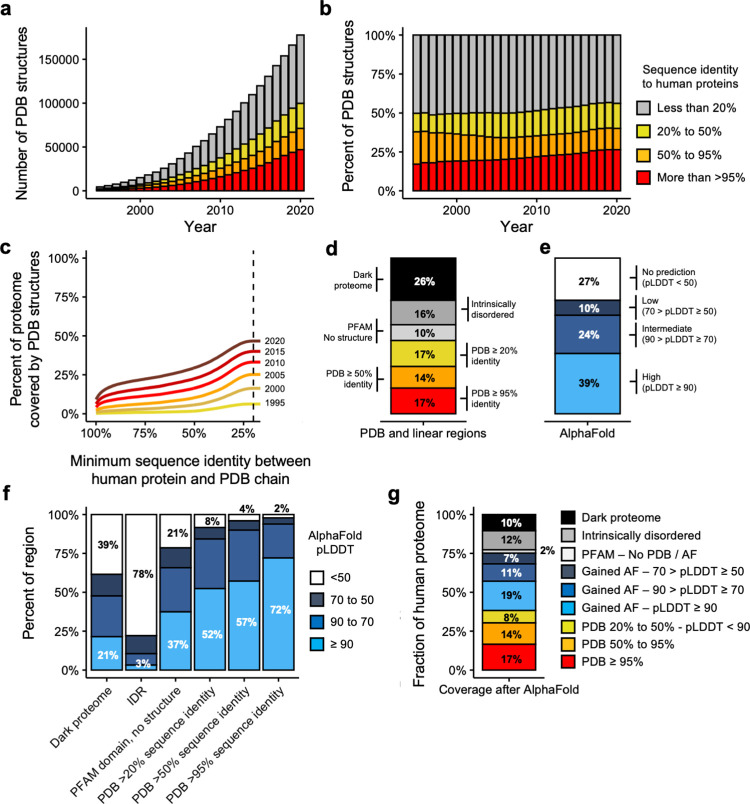
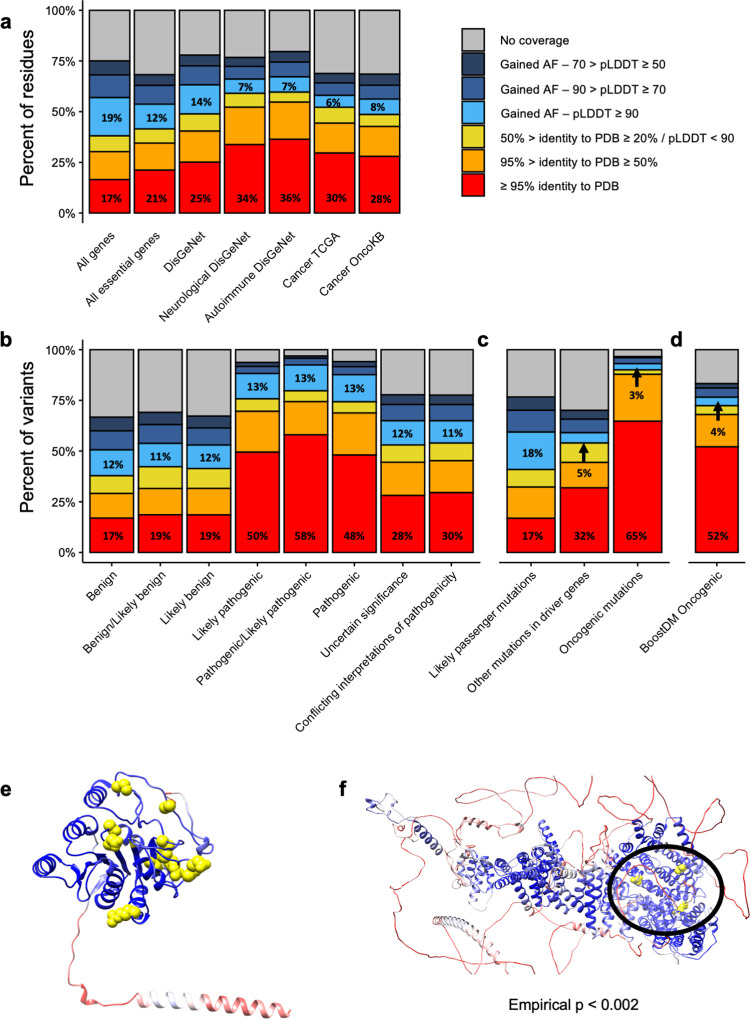
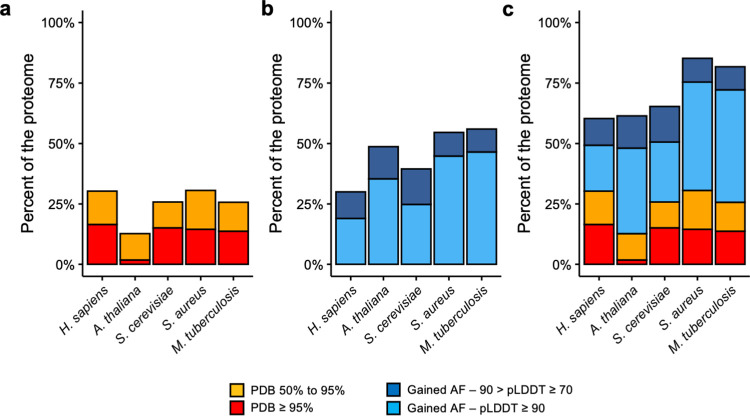
The protein structure field is experiencing a revolution. From the increased throughput of techniques to determine experimental structures, to developments such as cryo-EM that allow us to find the structures of large protein complexes or, more recently, the development of artificial intelligence tools, such as AlphaFold, that can predict with high accuracy the folding of proteins for which the availability of homology templates is limited. Here we quantify the effect of the recently released AlphaFold database of protein structural models in our knowledge on human proteins. Our results indicate that our current baseline for structural coverage of 48%, considering experimentally-derived or template-based homology models, elevates up to 76% when including AlphaFold predictions. At the same time the fraction of dark proteome is reduced from 26% to just 10% when AlphaFold models are considered. Furthermore, although the coverage of disease-associated genes and mutations was near complete before AlphaFold release (69% of Clinvar pathogenic mutations and 88% of oncogenic mutations), AlphaFold models still provide an additional coverage of 3% to 13% of these critically important sets of biomedical genes and mutations. Finally, we show how the contribution of AlphaFold models to the structural coverage of non-human organisms, including important pathogenic bacteria, is significantly larger than that of the human proteome. Overall, our results show that the sequence-structure gap of human proteins has almost disappeared, an outstanding success of direct consequences for the knowledge on the human genome and the derived medical applications.
Overview
The claims and statistics of this paper haven’t been checked yet.
Run the check — free, no account needed. It reads the open-access text and checks the sources it cites.
Integrity signals
Registry
Cites
Statistics
Figures
Verification
Claims the paper makes
The claims and statistics of this paper haven’t been checked yet.
Run the check — free, no account needed. It reads the open-access text and checks the sources it cites.
Claims other papers make about this one
Each is checked against this paper’s own text: does it say what the citing paper says it does?
In the citing paper
“after AlphaFold2, the structural coverage of the human proteome increased from 48% to 76% of the total residues).131”
From Advancing Targeted Protein Degradation via Multiomics Profiling and Artificial Intelligence (2023) · cites this paper as [131]
Self-check
Percentages, sums and reported differences re-computed from the paper’s own numbers.
The self-check needs the paper’s full text.
Citations
Cites
Basic local alignment search tool
Altschul, S. F., Gish, W., Miller, W., Myers, E. W., & Lipman, D. J. (1990) · Journal of Molecular Biology · doi:10.1006/jmbi.1990.9999 · Cited by 98,669
UCSF Chimera—A visualization system for exploratory research and analysis
Pettersen, E. F., Goddard, T. D., Huang, C. C., Couch, G. S., Greenblatt, D. M., Meng, E. C., & Ferrin, T. E. (2004) · Journal of Computational Chemistry · doi:10.1002/jcc.20084 · Cited by 46,047
Highly accurate protein structure prediction with AlphaFold
Jumper, J., Evans, R., Pritzel, A., Green, T., Figurnov, M., Ronneberger, O., Tunyasuvunakool, K., Bates, R., Žídek, A., Potapenko, A., et al. (2021) · Nature · doi:10.1038/s41586-021-03819-2 · Cited by 43,764
Berman, H. M. (2000) · Nucleic Acids Research · doi:10.1093/nar/28.1.235 · Cited by 40,196
Comparative Protein Modelling by Satisfaction of Spatial Restraints
Šali, A., & Blundell, T. L. (1993) · Journal of Molecular Biology · doi:10.1006/jmbi.1993.1626 · Cited by 12,977
Analysis of protein-coding genetic variation in 60,706 humans
Exome Aggregation Consortium, Lek, M., Karczewski, K. J., Minikel, E. V., Samocha, K. E., Banks, E., Fennell, T., O’Donnell-Luria, A. H., Ware, J. S., Hill, A. J., et al. (2016) · Nature · doi:10.1038/nature19057 · Cited by 9,587
The Ensembl Variant Effect Predictor
McLaren, W., Gil, L., Hunt, S. E., Riat, H. S., Ritchie, G. R. S., Thormann, A., Flicek, P., & Cunningham, F. (2016) · Genome Biology · doi:10.1186/s13059-016-0974-4 · Cited by 8,099
Pfam: The protein families database in 2021
Mistry, J., Chuguransky, S., Williams, L., Qureshi, M., Salazar, G. A., Sonnhammer, E. L. L., Tosatto, S. C. E., Paladin, L., Raj, S., Richardson, L. J., et al. (2021) · Nucleic Acids Research · doi:10.1093/nar/gkaa913 · Cited by 7,452
UniProt: the universal protein knowledgebase in 2021
The UniProt Consortium, Bateman, A., Martin, M.-J., Orchard, S., Magrane, M., Agivetova, R., Ahmad, S., Alpi, E., Bowler-Barnett, E. H., Britto, R., et al. (2021) · Nucleic Acids Research · doi:10.1093/nar/gkaa1100 · Cited by 6,372
Accurate prediction of protein structures and interactions using a 3-track network
Baek, M., DiMaio, F., Anishchenko, I., Dauparas, J., Ovchinnikov, S., Lee, G. R., Wang, J., Cong, Q., Kinch, L. N., Schaeffer, R. D., et al. (2021) · doi:10.1101/2021.06.14.448402 · Cited by 5,549
Protein complex prediction with AlphaFold-Multimer
Evans, R., O’Neill, M., Pritzel, A., Antropova, N., Senior, A., Green, T., Žídek, A., Bates, R., Blackwell, S., Yim, J., et al. (2021) · doi:10.1101/2021.10.04.463034 · Cited by 3,808
Molecular Docking: A Powerful Approach for Structure-Based Drug Discovery
Meng, X.-Y., Zhang, H.-X., Mezei, M., & Cui, M. (2011) · Current Computer Aided-Drug Design · doi:10.2174/157340911795677602 · Cited by 3,771
Predicting Functional Effect of Human Missense Mutations Using PolyPhen‐2
Adzhubei, I., Jordan, D. M., & Sunyaev, S. R. (2013) · Current Protocols in Human Genetics · doi:10.1002/0471142905.hg0720s76 · Cited by 3,705
Highly accurate protein structure prediction for the human proteome
Tunyasuvunakool, K., Adler, J., Wu, Z., Green, T., Zielinski, M., Žídek, A., Bridgland, A., Cowie, A., Meyer, C., Laydon, A., et al. (2021) · Nature · doi:10.1038/s41586-021-03828-1 · Cited by 3,025 · cited 4×
“We also extracted pLDDT values for each residue from the AlphaFold models, as these are stored as if they were the B-factor of the protein coordinates file [19,21].”
BackgroundMethodInfluentialA Method to Identify Protein Sequences That Fold into a Known Three-Dimensional Structure
Bowie, J. U., Lüthy, R., & Eisenberg, D. (1991) · Science · doi:10.1126/science.1853201 · Cited by 2,851
OncoKB: A Precision Oncology Knowledge Base
Chakravarty, D., Gao, J., Phillips, S. M., Kundra, R., Zhang, H., Wang, J., Rudolph, J. E., Yaeger, R. D., Soumerai, T. E., Nissan, M. H., et al. (2017) · JCO Precision Oncology · doi:10.1200/po.17.00011 · Cited by 2,783
The DisGeNET knowledge platform for disease genomics: 2019 update
Piñero, J., Ramírez-Anguita, J. M., Saüch-Pitarch, J., Ronzano, F., Centeno, E., Sanz, F., & Furlong, L. I. (2019) · Nucleic Acids Research · doi:10.1093/nar/gkz1021 · Cited by 2,639
Large-scale gene function analysis with the PANTHER classification system
Mi, H., Muruganujan, A., Casagrande, J. T., & Thomas, P. D. (2013) · Nature Protocols · doi:10.1038/nprot.2013.092 · Cited by 2,496
The relation between the divergence of sequence and structure in proteins.
Chothia, C., & Lesk, A. M. (1986) · The EMBO Journal · doi:10.1002/j.1460-2075.1986.tb04288.x · Cited by 2,458
Intrinsically disordered protein
Dunker, A. K., Lawson, J. D., Brown, C. J., Williams, R. M., Romero, P., Oh, J. S., Oldfield, C. J., Campen, A. M., Ratliff, C. M., Hipps, K. W., et al. (2001) · Journal of Molecular Graphics and Modelling · doi:10.1016/s1093-3263(00)00138-8 · Cited by 2,272
Comprehensive Characterization of Cancer Driver Genes and Mutations
Bailey, M. H., Tokheim, C., Porta-Pardo, E., Sengupta, S., Bertrand, D., Weerasinghe, A., Colaprico, A., Wendl, M. C., Kim, J., Reardon, B., et al. (2018) · Cell · doi:10.1016/j.cell.2018.02.060 · Cited by 2,256
Self-citationA Three-Dimensional Model of the Myoglobin Molecule Obtained by X-Ray Analysis
Kendrew, J. C., Bodo, G., Dintzis, H. M., Parrish, R. G., Wyckoff, H. W., & Phillips, D. C. (1958) · Nature · doi:10.1038/181662a0 · Cited by 1,671
Intrinsically Disordered Proteins
Uversky, V. N. (2013) · Elsevier eBooks · doi:10.1016/b978-0-12-374984-0.01698-3 · Cited by 1,646
Mészáros, B., Erdős, G., & Dosztányi, Z. (2018) · Nucleic Acids Research · doi:10.1093/nar/gky384 · Cited by 1,454
Howe, K. L., Achuthan, P., Allen, J. E., Allen, J., Álvarez-Jarreta, J., Amode, M., Armean, I., Azov, A., Bennett, R., Bhai, J., et al. (2020) · Nucleic Acids Res. · doi:10.1093/nar/gkaa942 · Cited by 1,355
A new approach to protein fold recognition
Jones, D. T., Taylort, W. R., & Thornton, J. M. (1992) · Nature · doi:10.1038/358086a0 · Cited by 1,221
ClinVar: improvements to accessing data
Landrum, M. J., Chitipiralla, S., Brown, G. R., Chen, C., Gu, B., Hart, J., Hoffman, D., Jang, W., Kaur, K., Liu, C., et al. (2020) · Nucleic Acids Research · doi:10.1093/nar/gkz972 · Cited by 994
Correlated mutations and residue contacts in proteins
Göbel, U., Sander, C., Schneider, R., & Valencia, A. (1994) · Proteins Structure Function and Bioinformatics · doi:10.1002/prot.340180402 · Cited by 863
Self-citationSNPs, protein structure, and disease
Wang, Z., & Moult, J. (2001) · Human Mutation · doi:10.1002/humu.22 · Cited by 726
A structural biology community assessment of AlphaFold2 applications
Akdel, M., Pires, D. E. V., Pardo, E. P., Jänes, J., Zalevsky, A. O., Mészáros, B., Bryant, P., Good, L. L., Laskowski, R. A., Pozzati, G., et al. (2022) · Nature Structural & Molecular Biology · doi:10.1038/s41594-022-00849-w · Cited by 675 · cited 2×
“The ranges are:>95%, which includes the real structure of the protein; 95–50%, which contains useful templates to study the impact of mutations [25]; and 50–20%, which contemplates structural coverage of distant related proteins assuming that structure is more conserved than sequence.”
BackgroundSelf-citationggplot2: Elegant Graphics for Data Analysis by WICKHAM, H.
Wilkinson, L. (2011) · Biometrics · doi:10.1111/j.1541-0420.2011.01616.x · Cited by 615
A large‐scale experiment to assess protein structure prediction methods
Moult, J., Pedersen, J. T., Judson, R., & Fidelis, K. (1995) · Proteins: Structure, Function, and Bioinformatics · doi:10.1002/prot.340230303 · Cited by 555
Comprehensive Characterization of Cancer Driver Genes and Mutations
Bailey, M. H., Tokheim, C., Porta-Pardo, E., Sengupta, S., Bertrand, D., Weerasinghe, A., Colaprico, A., Wendl, M. C., Kim, J., Reardon, B., et al. (2018) · Cell · doi:10.1016/j.cell.2018.07.034 · Cited by 552
Self-citationCritical assessment of methods of protein structure prediction (CASP)—Round XIII
Kryshtafovych, A., Schwede, T., Topf, M., Fidelis, K., & Moult, J. (2019) · Proteins: Structure, Function, and Bioinformatics · doi:10.1002/prot.25823 · Cited by 506
‘It will change everything’: DeepMind’s AI makes gigantic leap in solving protein structures
Callaway, E. (2020) · Nature · doi:10.1038/d41586-020-03348-4 · Cited by 499
Three-dimensional reconstruction of protein networks provides insight into human genetic disease
Wang, X., Wei, X., Thijssen, B., Das, J., Lipkin, S. M., & Yu, H. (2012) · Nature Biotechnology · doi:10.1038/nbt.2106 · Cited by 385
Computational Thermostabilization of an Enzyme
Korkegian, A., Black, M. E., Baker, D. A., & Stoddard, B. L. (2005) · Science · doi:10.1126/science.1107387 · Cited by 360
Critical assessment of protein intrinsic disorder prediction
Necci, M., Piovesan, D., Predictors, C., Hoque, M. T., Walsh, I., Iqbal, S., Vendruscolo, M., Sormanni, P., Wang, C., Raimondi, D., et al. (2021) · Nature Methods · doi:10.1038/s41592-021-01117-3 · Cited by 343
Topology fingerprint approach to the inverse protein folding problem
Godzik, A., Kolinski, A., & Skolnick, J. (1992) · Journal of Molecular Biology · doi:10.1016/0022-2836(92)90693-e · Cited by 339
Predicting active site residue annotations in the Pfam database
Mistry, J., Bateman, A. G., & FINN, R. (2007) · BMC Bioinformatics · doi:10.1186/1471-2105-8-298 · Cited by 299
Polymorphism of the PEMT gene and susceptibility to nonalcoholic fatty liver disease (NAFLD)
Song, J., Costa, K. A. D., Fischer, L. M., Kohlmeier, M., Kwock, L., Wang, S., & Zeisel, S. H. (2005) · The FASEB Journal · doi:10.1096/fj.04-3580com · Cited by 237
Unexpected features of the dark proteome
Perdigão, N., Heinrich, J., Stolte, C., Sabir, K. S., Buckley, M. J., Tabor, B., Signal, B., Gloss, B., Hammang, C. J., Rost, B., et al. (2015) · Proceedings of the National Academy of Sciences · doi:10.1073/pnas.1508380112 · Cited by 210
Accurate prediction of protein structures and interactions using a three-track neural network
Baek, M., DiMaio, F., Anishchenko, I. V., Dauparas, J., Ovchinnikov, S., Lee, G. R., Wang, J., Cong, Q., Kinch, L. N., Schaeffer, R. D., et al. (2022) · Yearbook of pediatric endocrinology · doi:10.1530/ey.19.15.15 · Cited by 199
Mattos‐Arruda, L. D., Vázquez, M., Finotello, F., Lepore, R., Porta, E., Hundal, J., Amengual-Rigo, P., Ng, C. K. Y., Valencia, A., Carrillo, J., et al. (2020) · Annals of Oncology · doi:10.1016/j.annonc.2020.05.008 · Cited by 166
Self-citationCHASMplus Reveals the Scope of Somatic Missense Mutations Driving Human Cancers
Tokheim, C. J., & Karchin, R. (2019) · Cell Systems · doi:10.1016/j.cels.2019.05.005 · Cited by 134
A Pan-Cancer Catalogue of Cancer Driver Protein Interaction Interfaces
Porta‐Pardo, E., García‐Alonso, L., Hrabe, T., Dopazo, J., & Godzik, A. (2015) · PLoS Computational Biology · doi:10.1371/journal.pcbi.1004518 · Cited by 127
Self-citationIn silico saturation mutagenesis of cancer genes
Muiños, F., Martínez-Jiménez, F., Pich, O., González-Pérez, A., & López-Bigas, N. (2021) · Nature · doi:10.1038/s41586-021-03771-1 · Cited by 125
Meyer, M. J., Lapcevic, R., Romero, A. E., Yoon, M., Das, J., Beltrán, J. F., Mort, M. E., Stenson, P. D., Cooper, D. N., Paccanaro, A., et al. (2016) · Human Mutation · doi:10.1002/humu.22963 · Cited by 123
Exome-Scale Discovery of Hotspot Mutation Regions in Human Cancer Using 3D Protein Structure
Tokheim, C. J., Bhattacharya, R., Niknafs, N., Gygax, D. M., Kim, R., Ryan, M. T., Masica, D. L., & Karchin, R. (2016) · Cancer Research · doi:10.1158/0008-5472.can-15-3190 · Cited by 123
A structural biology community assessment of AlphaFold 2 applications
Akdel, M., Pires, D. E. V., Porta Pardo, E., Jänes, J., Zalevsky, A. O., Mészáros, B., Bryant, P., Good, L. L., Laskowski, R. A., Pozzati, G., et al. (2021) · doi:10.1101/2021.09.26.461876 · Cited by 122
Self-citationDEGS1-associated aberrant sphingolipid metabolism impairs nervous system function in humans
Karsai, G., Kraft, F., Haag, N., Korenke, G. C., Hänisch, B., Othman, A., Suriyanarayanan, S., Steiner, R., Knopp, C., Mull, M., et al. (2019) · Journal of Clinical Investigation · doi:10.1172/jci124159 · Cited by 121
dSysMap: exploring the edgetic role of disease mutations
Mosca, R., Tenorio‐Laranga, J., Olivella, R., Alcalde, V., Ceol, A. G. M., Soler‐López, M., & Aloy, P. (2015) · Nature Methods · doi:10.1038/nmeth.3289 · Cited by 96
Loose ends: almost one in five human genes still have unresolved coding status
Abascal, F., Juan, D., Jungreis, I., Gómez, L. M., Rigau, M., Rodrı́guez, J. M., Vázquez, J., & Tress, M. L. (2018) · Nucleic Acids Research · doi:10.1093/nar/gky587 · Cited by 63
Structural coverage of the proteome for pharmaceutical applications
Somody, J. C., MacKinnon, S. S., & Windemuth, A. (2017) · Drug Discovery Today · doi:10.1016/j.drudis.2017.08.004 · Cited by 62
Xu, D. H., Jaroszewski, L., Li, Z., & Godzik, A. (2015) · Bioinformatics · doi:10.1093/bioinformatics/btv092 · Cited by 57
Comprehensive assessment of computational algorithms in predicting cancer driver mutations
Chen, H., Li, J., Wang, Y., Ng, P. K., Tsang, Y. H., Shaw, K. R. M., Mills, G. B., & Liang, H. (2020) · Genome biology · doi:10.1186/s13059-020-01954-z · Cited by 55
The Emerging Physiological Role of AGMO 10 Years after Its Gene Identification
Sailer, S., Keller, M. A., Werner, E. R., & Watschinger, K. (2021) · Life · doi:10.3390/life11020088 · Cited by 32
Insights into cancer severity from biomolecular interaction mechanisms
Raimondi, F., Singh, G., Betts, M. J., Apic, G., Vukotic, R., Andreoné, P., Stein, L. D., & Russell, R. B. (2016) · Scientific Reports · doi:10.1038/srep34490 · Cited by 18
CHASMplus reveals the scope of somatic missense mutations driving human cancersPreprint
Tokheim, C., & Karchin, R. (2018) · bioRxiv (Cold Spring Harbor Laboratory) · doi:10.1101/313296 · Cited by 14
Cited by
Sorted by citations
Dali server: structural unification of protein families
Holm, L. (2022) · Nucleic Acids Research · doi:10.1093/nar/gkac387 · Cited by 934
Terwilliger, T. C., Liebschner, D., Croll, T. I., Williams, C. J., McCoy, A. J., Poon, B. K., Afonine, P. V., Oeffner, R. D., Richardson, J. S., Read, R. J., et al. (2024) · Nature Methods · doi:10.1038/s41592-023-02087-4 · Cited by 411
Before and after AlphaFold2: An overview of protein structure prediction
Bertoline, L. M. F., Lima, A. N., Krieger, J. E., & Teixeira, S. K. (2023) · Frontiers in Bioinformatics · doi:10.3389/fbinf.2023.1120370 · Cited by 330
AlphaFold, Artificial Intelligence (AI), and Allostery
Nussinov, R., Zhang, M., Liu, Y., & Jang, H. (2022) · The Journal of Physical Chemistry B · doi:10.1021/acs.jpcb.2c04346 · Cited by 190
Intrinsic protein disorder and conditional folding in AlphaFoldDB
Piovesan, D., Monzon, A. M., & Tosatto, S. C. E. (2022) · Protein Science · doi:10.1002/pro.4466 · Cited by 160
Metadata
- Authors
- Porta-Pardo, E., Ruiz-Serra, V., Valentini, S., & Valencia, A.
- Affiliations
- University of Trento (IT)
- Institució Catalana de Recerca i Estudis Avançats (ES)
- Corresponding author
- Valencia, Alfonso
- Venue
- PLOS Computational Biology
- Publisher
- Public Library of Science (PLoS)
- Published
- 2022-01-24
- Volume
- 18
- Issue
- 1
- Pages
- e1009818
- ISSN
- 1553-734X (ISSN-L)
- 1553-7358
- PMC
- PMC8812986
- OpenAlex
- W4226027101
- Cited by
- 131
- References
- 59
- Citations by year
- 2026: 15 · 2025: 21 · 2024: 29 · 2023: 28 · 2022: 37
- FWCI
- 10.70
- Type
- journal article
- Language
- en
- Update notices
- new_version (2022-02-03)
- Open access
- gold
- doi.org
- Licence
- Locations
- PLoS Computational Biology (publishedVersion, cc-by)
- bioRxiv (Cold Spring Harbor Laboratory) (acceptedVersion, cc-by)
- PubMed Central (publishedVersion, cc-by)
- PubMed (publishedVersion)
- Iris (University of Trento) (submittedVersion, cc-by)
- Dipòsit Digital de Documents de la UAB (Universitat Autònoma de Barcelona) (submittedVersion, cc-by)
- DOAJ (DOAJ: Directory of Open Access Journals) (submittedVersion, cc-by-sa)
- UPCommons institutional repository (Universitat Politècnica de Catalunya) (submittedVersion, cc-by)
- Funders
- “la Caixa” Foundation (LCF/BQ/PI18/11630003)
- Spanish Ministry of Science (RYC2019-026415-I)
- Institució Catalana de Recerca i Estudis Avançats
- Topics
- Life Sciences › Biochemistry, Genetics and Molecular Biology › Molecular Biology › Protein Structure and Dynamics
- Life Sciences › Biochemistry, Genetics and Molecular Biology › Structural Biology › Enzyme Structure and Function
- Life Sciences › Biochemistry, Genetics and Molecular Biology › Molecular Biology › Machine Learning in Bioinformatics
- Keywords
- AlphaFold, protein structure prediction, structural coverage, human proteome, dark proteome, homology model, disease-associated mutations, oncogenic mutations, pathogenic bacteria, protein structure model
- MeSH terms
- Humans, Models, Molecular, Protein Folding, Proteome, Proteomics
About these checks
Registry, retraction, Cites and statistics results are computed, not judged, with one exception: a printed reference that no index lists is read once by a model before it counts as a citation error. Claims are extracted by a model and kept only when their quote appears verbatim in the text; each cited source is then checked, with a model’s help, for whether it says what the claim relies on. Those verdicts can be wrong — read the claim’s quote and the cited source before relying on one.
Statistics and arithmetic are recomputed, not judged.
Confidence bands are shown only for fields calibrated on our annotated test set. None is calibrated yet, so no band is shown.
What counts as a claim ›How we measure confidence ›How we check this ›
Are you an author, or do you see a problem with this page? Request a review
