

Why Most Published Research Findings Are False
Open accessThe DOI matches its Crossref record; 40 of the 40 references it cites were found in a registry or an index.
Abstract
There is increasing concern that most current published research findings are false. The probability that a research claim is true may depend on study power and bias, the number of other studies on the same question, and, importantly, the ratio of true to no relationships among the relationships probed in each scientific field. In this framework, a research finding is less likely to be true when the studies conducted in a field are smaller; when effect sizes are smaller; when there is a greater number and lesser preselection of tested relationships; where there is greater flexibility in designs, definitions, outcomes, and analytical modes; when there is greater financial and other interest and prejudice; and when more teams are involved in a scientific field in chase of statistical significance. Simulations show that for most study designs and settings, it is more likely for a research claim to be false than true. Moreover, for many current scientific fields, claimed research findings may often be simply accurate measures of the prevailing bias. In this essay, I discuss the implications of these problems for the conduct and interpretation of research.
Overview
The claims and statistics of this paper haven’t been checked yet.
Free: it reads the open-access text and checks the first 5 claims that cite a source we can check. Create a free account to check every claim.
Integrity signals
Registry
Cites
Statistics
Figures
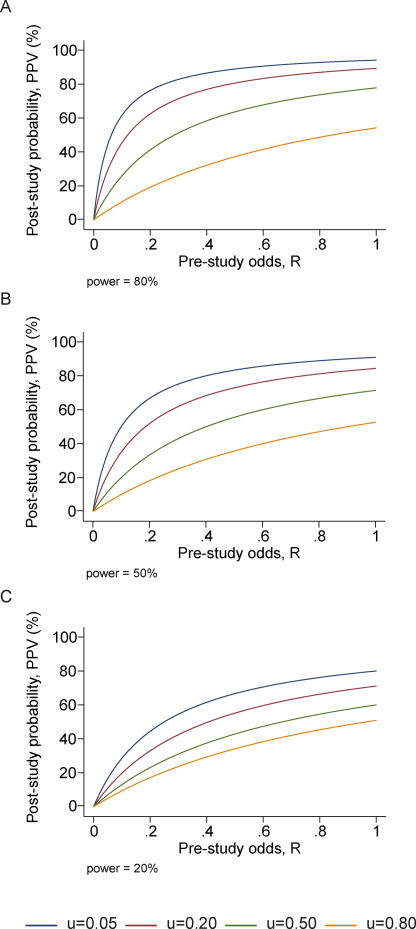
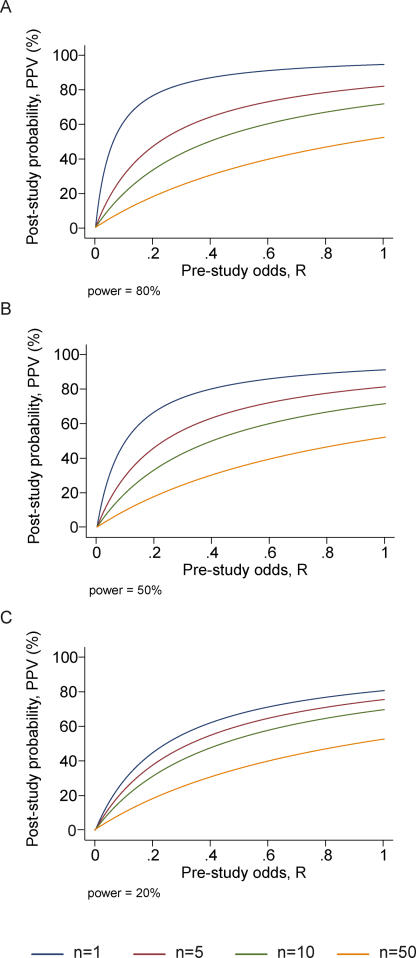
Verification
Claims the paper makes
The claims and statistics of this paper haven’t been checked yet.
Free: it reads the open-access text and checks the first 5 claims that cite a source we can check. Create a free account to check every claim.
Claims other papers make about this one
Each is checked against this paper’s own text: does it say what the citing paper says it does?
The source backs part of the claim, not all of it — or backs it for a different population, condition or comparison.
In the citing paper
“As noted, the pooled effect of risks and interventions trends towards the null result over time;189,190 the implication being that risks for which only a few studies have been done might have their effect overestimated compared with risks for which a large body of evidence exists.”
From A comparative risk assessment of burden of disease and injury attributable to 67 risk factors and risk factor clusters in 21 regions, 1990–2010: a systematic analysis for the Global Burden of Disease Study 2010 (2012) · cites this paper as [189]
Experimental — accuracy not yet measuredThe source backs part of the claim, not all of it — or backs it for a different population, condition or comparison.
In the citing paper
“Less clear, perhaps, is that low power can also increase the false discovery rate and the likelihood that reported effect sizes are inflated, due to their reduced ability to mute stochastic noise [13,63,64].”
From The natural selection of bad science (2016) · cites this paper as [13]
Experimental — accuracy not yet measuredThe source backs part of the claim, not all of it — or backs it for a different population, condition or comparison.
In the citing paper
“scholars have demonstrated that a large proportion of published articles contains flaws (Ioannidis 2005)”
From The ability of different peer review procedures to flag problematic publications (2019) · cites this paper as Ioannidis 2005
Experimental — accuracy not yet measuredThe source backs part of the claim, not all of it — or backs it for a different population, condition or comparison.
In the citing paper
“Furthermore, the publishing landscape in contemporary science rewards novel, positive findings over replications or negative results (Ioannidis 2005; Romero 2017).”
From The myth of the Bayesian brain (2025) · cites this paper as Ioannidis 2005
Experimental — accuracy not yet measuredThe source backs part of the claim, not all of it — or backs it for a different population, condition or comparison.
In the citing paper
“given the demonstrated association between small numbers and bias (Ioannidis 2005; Moore 2010; Nuesch 2009).”
From Psychological therapies for the management of chronic pain (excluding headache) in adults (2012) · cites this paper as Ioannidis 2005
Experimental — accuracy not yet measured
42 more claims about this paper
Create a free account to see every claim other papers make about this one.
Self-check
Percentages, sums and reported differences re-computed from the paper’s own numbers.
The self-check needs the paper’s full text.
Citations
Cites
Dermyshi, E., Wang, Y., Yan, C., Hong, W., Qiu, G., Gong, X., & Zhang, T. (2017) · Neonatology · doi:10.1159/000454668 · Cited by 24,451
Meta-analysis of Observational Studies in Epidemiology<SUBTITLE>A Proposal for Reporting</SUBTITLE>
Stroup, D. F. (2000) · JAMA · doi:10.1001/jama.283.15.2008 · Cited by 20,623
Golub, T. R., Slonim, D. K., Tamayo, P., Huard, C., Gaasenbeek, M., Mesirov, J. P., Coller, H., Loh, M. L., Downing, J. R., Caligiuri, M. A., et al. (1999) · Science · doi:10.1126/science.286.5439.531 · Cited by 11,516
Moher, D., Schulz, K. F., & Altman, D. G. (2001) · The Lancet · doi:10.1016/s0140-6736(00)04337-3 · Cited by 5,373
Moher, D., Cook, D. J., Eastwood, S., Olkin, I., Rennie, D., & Stroup, D. F. (1999) · The Lancet · doi:10.1016/s0140-6736(99)04149-5 · Cited by 4,826
Moher, D., Schulz, K. F., & Altman, D. G. (2001) · BMC Medical Research Methodology · doi:10.1186/1471-2288-1-2 · Cited by 2,755
Chan, A.-W., Hróbjartsson, A., Haahr, M. T., Gøtzsche, P. C., & Altman, D. G. (2004) · JAMA · doi:10.1001/jama.291.20.2457 · Cited by 1,845
Searching for genetic determinants in the new millennium
Risch, N. J. (2000) · Nature · doi:10.1038/35015718 · Cited by 1,839
Replication validity of genetic association studies
Ioannidis, J. P. A., Ntzani, E. E., Trikalinos, T. A., & Contopoulos-Ioannidis, D. G. (2001) · Nature Genetics · doi:10.1038/ng749 · Cited by 1,832
Self-citationWacholder, S., Chanock, S., Garcia-Closas, M., El ghormli, L., & Rothman, N. (2004) · JNCI: Journal of the National Cancer Institute · doi:10.1093/jnci/djh075 · Cited by 1,754
Cited by
Items 1,201–1,227 of 1,227
Computing Education Research Today
Fincher, S. A., Tenenberg, J., Dorn, B., Hundhausen, C., McCartney, R., & Murphy, L. (2019) · The Cambridge Handbook of Computing Education Research · doi:10.1017/9781108654555.003 · Cited by 7
Socioeconomic Determinants of Antimalarial Drug Use Behaviours: A Systematic Review
Anyanwu, P. E., & Fulton, J. (2016) · Journal of Community & Public Health Nursing · doi:10.4172/2471-9846.1000123 · Cited by 7
Use of Open Science Practices in Surgical Journals
Pathak, K., Marwaha, J. S., Chen, H. W., Krumholz, H. M., & Matthews, J. B. (2024) · JAMA Surgery · doi:10.1001/jamasurg.2023.5389 · Cited by 6
Assessing transparency practices in dental randomized controlled trials
Prado, M. C., Dotto, L., Agostini, B., & Sarkis-Onofre, R. (2024) · BMC Medical Research Methodology · doi:10.1186/s12874-024-02316-0 · Cited by 6
Scientific integrity and the market for lemons
Cottrell, R. C. (2014) · Research Ethics · doi:10.1177/1747016113494651 · Cited by 6
Tong, L., Corrigan, A., Kumar, N. R., Hallbrook, K., Orme, J., Wang, Y., & Zhou, H. (2022) · Scientific Reports · doi:10.1038/s41598-022-12099-3 · Cited by 6
Unveiling the ethical void: Bias in reference citations and its academic ramifications
Mattiazzi, A., & Vila-Petroff, M. (2024) · Current Research in Physiology · doi:10.1016/j.crphys.2024.100130 · Cited by 6
Chen, L., Benjamin, R., Guo, Y., Lai, A., & Heine, S. J. (2023) · Research Square · doi:10.21203/rs.3.rs-1254756/v1 · Cited by 5
The research we don’t need will persist until we dismantle the systems that sustain it
Schmidt, M., McDonald, J. K., & Moore, S. (2025) · Journal of Computing in Higher Education · doi:10.1007/s12528-025-09446-4 · Cited by 5
A Train Wreck by Any Other Name
Harris, C., Rohrer, D., & Pashler, H. (2021) · Psychological Inquiry · doi:10.1080/1047840x.2021.1889317 · Cited by 4
The positive effect of moral self-concept on fraudulent behavior and the need for moral cleansing
Keller, T., & Szakál, P. (2025) · Scientific Reports · doi:10.1038/s41598-025-16403-9 · Cited by 2
The Future of Pain Management and Research: A Dose of Fatalism May Be Good for One's Health
Fraser, J. L. (2019) · Pain Medicine · doi:10.1093/pm/pnz047 · Cited by 1
Mindfulness-Based Interventions
Bockstaele, B. V., Salemink, E., Ostafin, B. D., Meijer, & Bögels, S. M. (2015) · Clinical Psychology · doi:10.1002/9781394259229.ch19 · Cited by 1
Read the Paper, Write the Code: Agentic Reproduction of Social-Science Results
Kohler, B., Zollikofer, D., Einsiedler, J., Hoyle, A., & Ash, E. (2026) · arXiv · doi:10.48550/arxiv.2604.21965 · Cited by 1
A decision-oriented framework for genomic testing across the prostate cancer continuum
Cobran, E. K., Samadder, N. J., Schaid, D. J., Conti, D. V., Haiman, C., Vargas, L., Gionfriddo, M. R., & Tilburt, J. C. (2026) · Cancer Genetics · doi:10.1016/j.cancergen.2026.06.002 · Cited by 1
The Search for the First Americans: Science, Power, and Politics
Davis, R. (2021) · doi:10.38118/9780806175935 · Cited by 1
Is There a Research Design Role for Sensitivity Analysis (SA) in Archaeological Modeling?
Lovis, W. A. (2016) · Interdisciplinary Contributions to Archaeology · doi:10.1007/978-3-319-27833-9_2 · Cited by 1
Practical aspects of machine diagnostics accuracy
Orkisz, M. (2017) · 2017 IEEE 11th International Symposium on Diagnostics for Electrical Machines, Power Electronics and Drives (SDEMPED) · doi:10.1109/demped.2017.8062365 · Cited by 1
Quantifying the prevalence and impact of overreaching causal claims in social science
Isch, C., Dörr, T., Fasching, N., Jennings, G., & Watts, D. J. (2026) · Nature Human Behaviour · doi:10.1038/s41562-026-02553-x
From Data Islands to Knowledge Networks in Tribology: Understanding the Modern Data Architecture
Garabedian, N., & Tysoe, W. T. (2026) · Tribology Letters · doi:10.1007/s11249-026-02179-0
A feature and not a bug: Replication failures can lead to new biology
Marder, E. (2026) · Current Opinion in Neurobiology · doi:10.1016/j.conb.2026.103268
List, N. H., Gómez, S., Ibele, L. M., Curchod, B. F. E., & Avagliano, D. (2026) · Faraday Discussions · doi:10.1039/d6fd00102e
Preregistration of Studies with Existing Data
Mertens, G., & Krypotos, A.-M. (2022) · Integrity of Scientific Research · doi:10.1007/978-3-030-99680-2_36
Dead Science Walking: Publication Bias and the AI Scientist Pipeline
Chauhan, K. (2026) · arXiv · doi:10.48550/arxiv.2606.04220
Agentic AI Scientists Are Not Built For Autonomous Scientific Discovery
Bisht, H., Kumar, V., Jablonka, K. M., Mausam, & Krishnan, N. M. A. (2026) · arXiv · doi:10.48550/arxiv.2605.08956
Untitled work
Zhumadilova, K. (2026) · VTechWorks (Virginia Tech)
Metadata
- Authors
- Ioannidis, J. P. A.
- Affiliations
- University of Ioannina (GR)
- Corresponding author
- Ioannidis, John P. A.
- Venue
- PLoS Medicine
- Publisher
- Public Library of Science (PLoS)
- Published
- 2005-08-30
- Volume
- 2
- Issue
- 8
- Pages
- e124
- ISSN
- 1549-1277 (ISSN-L)
- 1549-1676
- PMC
- PMC1182327
- OpenAlex
- W2144981148
- Cited by
- 10,505
- References
- 40
- Citations by year
- 2026: 628 · 2025: 666 · 2024: 649 · 2023: 706 · 2022: 783 · 2021: 834 · 2020: 836 · 2019: 897 · 2018: 778 · 2017: 759 · 2016: 716 · 2015: 542 · 2014: 427 · 2013: 344 · 2012: 227
- FWCI
- 97.37
- Type
- journal article
- Language
- en
- Update notices
- correction (2022-08-25)
- Open access
- gold
- doi.org
- Locations
- PLoS Medicine (publishedVersion, cc-by)
- Europe PMC (PubMed Central) (publishedVersion, cc-by)
- PubMed Central (publishedVersion, cc-by)
- PubMed (publishedVersion)
- RePEc: Research Papers in Economics (submittedVersion, cc-by)
- DOAJ (DOAJ: Directory of Open Access Journals) (submittedVersion, cc-by-sa)
- Topics
- Social Sciences › Decision Sciences › Statistics, Probability and Uncertainty › Meta-analysis and systematic reviews
- Social Sciences › Library and Information Sciences › Academic Publishing and Open Access
- Social Sciences › Education › Academic integrity and plagiarism
- Keywords
- replication crisis, false positives, research credibility, statistical power, research bias, p-hacking, effect size, multiple comparisons, financial conflicts of interest, research misconduct, significance testing
- MeSH terms
- Data Interpretation, Statistical, Publishing, Research Design, Meta-Analysis as Topic, Reproducibility of Results, Bias, Likelihood Functions, Odds Ratio, Sample Size
About these checks
Registry, retraction, Cites and statistics results are computed, not judged, with one exception: a printed reference that no index lists is read once by a model before it counts as a citation error. Claims are extracted by a model and kept only when their quote appears verbatim in the text; each cited source is then checked, with a model’s help, for whether it says what the claim relies on. Those verdicts can be wrong — read the claim’s quote and the cited source before relying on one.
Statistics and arithmetic are recomputed, not judged.
Confidence bands are shown only for fields calibrated on our annotated test set. None is calibrated yet, so no band is shown.
What counts as a claim ›How we measure confidence ›How we check this ›
Are you an author, or do you see a problem with this page? Request a review
Data sources
Bibliographic data: Semantic Scholar, OpenAlex, Crossref.
Contains information from the Semantic Scholar Academic Graph Datasets, made available under the ODC Attribution License (ODC-BY 1.0).
Semantic Scholar’s data is described in: Kinney, R., et al. (2023). The Semantic Scholar Open Data Platform. arXiv:2301.10140.
