

Why Most Published Research Findings Are False
Open accessThe DOI matches its Crossref record; 40 of the 40 references it cites were found in a registry or an index.
Abstract
There is increasing concern that most current published research findings are false. The probability that a research claim is true may depend on study power and bias, the number of other studies on the same question, and, importantly, the ratio of true to no relationships among the relationships probed in each scientific field. In this framework, a research finding is less likely to be true when the studies conducted in a field are smaller; when effect sizes are smaller; when there is a greater number and lesser preselection of tested relationships; where there is greater flexibility in designs, definitions, outcomes, and analytical modes; when there is greater financial and other interest and prejudice; and when more teams are involved in a scientific field in chase of statistical significance. Simulations show that for most study designs and settings, it is more likely for a research claim to be false than true. Moreover, for many current scientific fields, claimed research findings may often be simply accurate measures of the prevailing bias. In this essay, I discuss the implications of these problems for the conduct and interpretation of research.
Overview
The claims and statistics of this paper haven’t been checked yet.
Free: it reads the open-access text and checks the first 5 claims that cite a source we can check. Create a free account to check every claim.
Integrity signals
Registry
Cites
Statistics
Figures
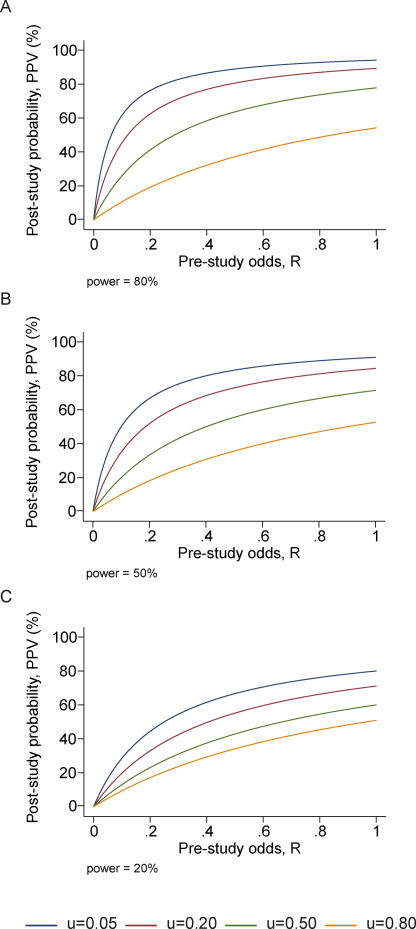
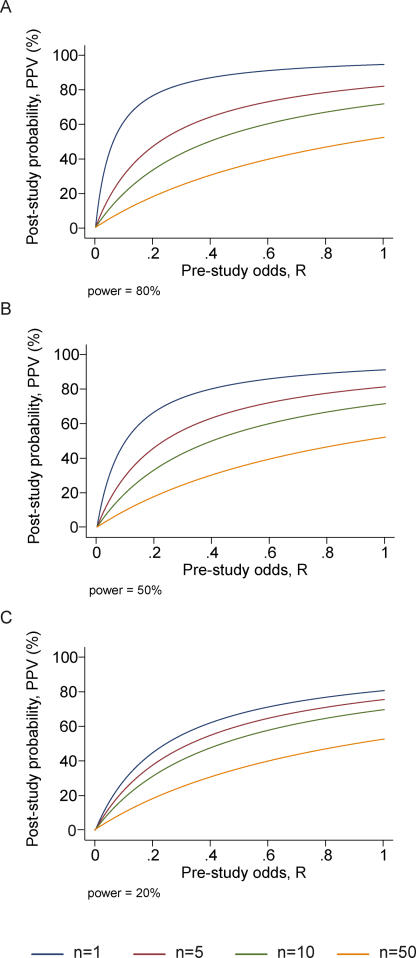
Verification
Claims the paper makes
The claims and statistics of this paper haven’t been checked yet.
Free: it reads the open-access text and checks the first 5 claims that cite a source we can check. Create a free account to check every claim.
Claims other papers make about this one
Each is checked against this paper’s own text: does it say what the citing paper says it does?
The source backs part of the claim, not all of it — or backs it for a different population, condition or comparison.
In the citing paper
“As noted, the pooled effect of risks and interventions trends towards the null result over time;189,190 the implication being that risks for which only a few studies have been done might have their effect overestimated compared with risks for which a large body of evidence exists.”
From A comparative risk assessment of burden of disease and injury attributable to 67 risk factors and risk factor clusters in 21 regions, 1990–2010: a systematic analysis for the Global Burden of Disease Study 2010 (2012) · cites this paper as [189]
Experimental — accuracy not yet measuredThe source backs part of the claim, not all of it — or backs it for a different population, condition or comparison.
In the citing paper
“Less clear, perhaps, is that low power can also increase the false discovery rate and the likelihood that reported effect sizes are inflated, due to their reduced ability to mute stochastic noise [13,63,64].”
From The natural selection of bad science (2016) · cites this paper as [13]
Experimental — accuracy not yet measuredThe source backs part of the claim, not all of it — or backs it for a different population, condition or comparison.
In the citing paper
“scholars have demonstrated that a large proportion of published articles contains flaws (Ioannidis 2005)”
From The ability of different peer review procedures to flag problematic publications (2019) · cites this paper as Ioannidis 2005
Experimental — accuracy not yet measuredThe source backs part of the claim, not all of it — or backs it for a different population, condition or comparison.
In the citing paper
“Furthermore, the publishing landscape in contemporary science rewards novel, positive findings over replications or negative results (Ioannidis 2005; Romero 2017).”
From The myth of the Bayesian brain (2025) · cites this paper as Ioannidis 2005
Experimental — accuracy not yet measuredThe source backs part of the claim, not all of it — or backs it for a different population, condition or comparison.
In the citing paper
“given the demonstrated association between small numbers and bias (Ioannidis 2005; Moore 2010; Nuesch 2009).”
From Psychological therapies for the management of chronic pain (excluding headache) in adults (2012) · cites this paper as Ioannidis 2005
Experimental — accuracy not yet measured
42 more claims about this paper
Create a free account to see every claim other papers make about this one.
Self-check
Percentages, sums and reported differences re-computed from the paper’s own numbers.
The self-check needs the paper’s full text.
Citations
Cites
Dermyshi, E., Wang, Y., Yan, C., Hong, W., Qiu, G., Gong, X., & Zhang, T. (2017) · Neonatology · doi:10.1159/000454668 · Cited by 24,451
Meta-analysis of Observational Studies in Epidemiology<SUBTITLE>A Proposal for Reporting</SUBTITLE>
Stroup, D. F. (2000) · JAMA · doi:10.1001/jama.283.15.2008 · Cited by 20,623
Golub, T. R., Slonim, D. K., Tamayo, P., Huard, C., Gaasenbeek, M., Mesirov, J. P., Coller, H., Loh, M. L., Downing, J. R., Caligiuri, M. A., et al. (1999) · Science · doi:10.1126/science.286.5439.531 · Cited by 11,516
Moher, D., Schulz, K. F., & Altman, D. G. (2001) · The Lancet · doi:10.1016/s0140-6736(00)04337-3 · Cited by 5,373
Moher, D., Cook, D. J., Eastwood, S., Olkin, I., Rennie, D., & Stroup, D. F. (1999) · The Lancet · doi:10.1016/s0140-6736(99)04149-5 · Cited by 4,826
Moher, D., Schulz, K. F., & Altman, D. G. (2001) · BMC Medical Research Methodology · doi:10.1186/1471-2288-1-2 · Cited by 2,755
Chan, A.-W., Hróbjartsson, A., Haahr, M. T., Gøtzsche, P. C., & Altman, D. G. (2004) · JAMA · doi:10.1001/jama.291.20.2457 · Cited by 1,845
Searching for genetic determinants in the new millennium
Risch, N. J. (2000) · Nature · doi:10.1038/35015718 · Cited by 1,839
Replication validity of genetic association studies
Ioannidis, J. P. A., Ntzani, E. E., Trikalinos, T. A., & Contopoulos-Ioannidis, D. G. (2001) · Nature Genetics · doi:10.1038/ng749 · Cited by 1,832
Self-citationWacholder, S., Chanock, S., Garcia-Closas, M., El ghormli, L., & Rothman, N. (2004) · JNCI: Journal of the National Cancer Institute · doi:10.1093/jnci/djh075 · Cited by 1,754
Cited by
phyloseq: An R Package for Reproducible Interactive Analysis and Graphics of Microbiome Census Data
McMurdie, P. J., & Holmes, S. (2013) · PLoS ONE · doi:10.1371/journal.pone.0061217 · Cited by 21,322
Lim, S. S., Vos, T., Flaxman, A. D., Danaei, G., Shibuya, K., Adair-Rohani, H., AlMazroa, M. A., Amann, M., Anderson, H. R., Andrews, K. G., et al. (2012) · The Lancet · doi:10.1016/s0140-6736(12)61766-8 · Cited by 11,805
Estimating the reproducibility of psychological science
Open Science Collaboration (2015) · Science · doi:10.1126/science.aac4716 · Cited by 8,515
Power failure: why small sample size undermines the reliability of neuroscience
Button, K. S., Ioannidis, J. P. A., Mokrysz, C., Nosek, B. A., Flint, J., Robinson, E. S. J., & Munafò, M. R. (2013) · Nature Reviews Neuroscience · doi:10.1038/nrn3475 · Cited by 7,641
Self-citationSimmons, J. P., Nelson, L. D., & Simonsohn, U. (2011) · Psychological Science · doi:10.1177/0956797611417632 · Cited by 6,567
The ethics of algorithms: Mapping the debate
Mittelstadt, B. D., Allo, P., Taddeo, M., Wachter, S., & Floridi, L. (2016) · Big Data & Society · doi:10.1177/2053951716679679 · Cited by 4,567
Large language models in medicine
Thirunavukarasu, A. J., Ting, D. S. J., Elangovan, K., Gutierrez, L., Tan, T. F., & Ting, D. S. W. (2023) · Nature Medicine · doi:10.1038/s41591-023-02448-8 · Cited by 3,944
Cluster failure: why fMRI inferences for spatial extent have inflated false-positive rates
Eklund, A., Nichols, T. E., & Knutsson, H. (2016) · Proceedings of the National Academy of Sciences · doi:10.1073/pnas.1602413113 · Cited by 3,487
A manifesto for reproducible science
Munafò, M. R., Nosek, B. A., Bishop, D. V. M., Button, K. S., Chambers, C. D., Percie du Sert, N., Simonsohn, U., Wagenmakers, E.-J., Ware, J. J., & Ioannidis, J. P. A. (2017) · Nature Human Behaviour · doi:10.1038/s41562-016-0021 · Cited by 3,397
Self-citationThe New Statistics: Why and How
Cumming, G. (2014) · Psychological Science · doi:10.1177/0956797613504966 · Cited by 3,200
Lefaucheur, J.-P., Aleman, A., Baeken, C., Benninger, D. H., Brunelin, J., Di Lazzaro, V., Filipović, S. R., Grefkes, C., Hasan, A., Hummel, F. C., et al. (2020) · Clinical Neurophysiology · doi:10.1016/j.clinph.2019.11.002 · Cited by 2,382
Measuring the Prevalence of Questionable Research Practices With Incentives for Truth Telling
John, L. K., Loewenstein, G., & Prelec, D. (2012) · Psychological Science · doi:10.1177/0956797611430953 · Cited by 2,239
… and the Cross-Section of Expected Returns
Harvey, C. R., Liu, Y., & Zhu, H. (2016) · Review of Financial Studies · doi:10.1093/rfs/hhv059 · Cited by 2,119
Benefits and limitations of genome-wide association studies
Tam, V., Patel, N., Turcotte, M., Bossé, Y., Paré, G., & Meyre, D. (2019) · Nature Reviews Genetics · doi:10.1038/s41576-019-0127-1 · Cited by 2,092
The preregistration revolution
Nosek, B. A., Ebersole, C. R., DeHaven, A. C., & Mellor, D. T. (2018) · Proceedings of the National Academy of Sciences · doi:10.1073/pnas.1708274114 · Cited by 1,998
Believe it or not: how much can we rely on published data on potential drug targets?
Prinz, F., Schlange, T., & Asadullah, K. (2011) · Nature Reviews Drug Discovery · doi:10.1038/nrd3439-c1 · Cited by 1,888
Trial sequential analysis may establish when firm evidence is reached in cumulative meta-analysis
Wetterslev, J., Thorlund, K., Brok, J., & Gluud, C. (2008) · Journal of Clinical Epidemiology · doi:10.1016/j.jclinepi.2007.03.013 · Cited by 1,881
GRADE guidelines: 5. Rating the quality of evidence—publication bias
Guyatt, G. H., Oxman, A. D., Montori, V., Vist, G., Kunz, R., Brozek, J., Alonso-Coello, P., Djulbegovic, B., Atkins, D., Falck-Ytter, Y., et al. (2011) · Journal of Clinical Epidemiology · doi:10.1016/j.jclinepi.2011.01.011 · Cited by 1,819
Evidence based medicine: a movement in crisis?
Greenhalgh, T., Howick, J., Maskrey, N., & for the Evidence Based Medicine Renaissance Group (2014) · BMJ · doi:10.1136/bmj.g3725 · Cited by 1,766
Why Propensity Scores Should Not Be Used for Matching
King, G., & Nielsen, R. (2019) · Political Analysis · doi:10.1017/pan.2019.11 · Cited by 1,706
iDEP: an integrated web application for differential expression and pathway analysis of RNA-Seq data
Ge, S. X., Son, E. W., & Yao, R. (2018) · BMC Bioinformatics · doi:10.1186/s12859-018-2486-6 · Cited by 1,661
Bayesian inference for psychology. Part I: Theoretical advantages and practical ramifications
Wagenmakers, E.-J., Marsman, M., Jamil, T., Ly, A., Verhagen, J., Love, J., Selker, R., Gronau, Q. F., Šmíra, M., Epskamp, S., et al. (2018) · Psychonomic Bulletin & Review · doi:10.3758/s13423-017-1343-3 · Cited by 1,627
Scientific method: Statistical errors
Nuzzo, R. (2014) · Nature · doi:10.1038/506150a · Cited by 1,536
Camerer, C. F., Dreber, A., Holzmeister, F., Ho, T.-H., Huber, J., Johannesson, M., Kirchler, M., Nave, G., Nosek, B. A., Pfeiffer, T., et al. (2018) · Nature Human Behaviour · doi:10.1038/s41562-018-0399-z · Cited by 1,521
Van Dam, N. T., van Vugt, M. K., Vago, D. R., Schmalzl, L., Saron, C. D., Olendzki, A., Meissner, T., Lazar, S. W., Kerr, C. E., Gorchov, J., et al. (2018) · Perspectives on Psychological Science · doi:10.1177/1745691617709589 · Cited by 1,506
Why Most Discovered True Associations Are Inflated
Ioannidis, J. P. A. (2008) · Epidemiology · doi:10.1097/ede.0b013e31818131e7 · Cited by 1,495
Self-citationPsychological therapies for the management of chronic pain (excluding headache) in adults
Williams, A. C. D. C., Eccleston, C., & Morley, S. (2012) · Cochrane Database of Systematic Reviews · doi:10.1002/14651858.cd007407.pub3 · Cited by 1,634
Automated Machine Learning: Methods, Systems, Challenges
(2019) · The Springer Series on Challenges in Machine Learning · doi:10.1007/978-3-030-05318-5 · Cited by 1,485
The Mass Production of Redundant, Misleading, and Conflicted Systematic Reviews and Meta‐analyses
IOANNIDIS, J. P. A. (2016) · The Milbank Quarterly · doi:10.1111/1468-0009.12210 · Cited by 1,483
Self-citationWhat is a pilot or feasibility study? A review of current practice and editorial policy
Arain, M., Campbell, M. J., Cooper, C. L., & Lancaster, G. A. (2010) · BMC Medical Research Methodology · doi:10.1186/1471-2288-10-67 · Cited by 1,483
Puzzlingly High Correlations in fMRI Studies of Emotion, Personality, and Social Cognition
Vul, E., Harris, C., Winkielman, P., & Pashler, H. (2009) · Perspectives on Psychological Science · doi:10.1111/j.1745-6924.2009.01125.x · Cited by 1,475
The reliability paradox: Why robust cognitive tasks do not produce reliable individual differences
Hedge, C., Powell, G., & Sumner, P. (2018) · Behavior Research Methods · doi:10.3758/s13428-017-0935-1 · Cited by 1,457
Scanning the horizon: towards transparent and reproducible neuroimaging research
Poldrack, R. A., Baker, C. I., Durnez, J., Gorgolewski, K. J., Matthews, P. M., Munafò, M. R., Nichols, T. E., Poline, J.-B., Vul, E., & Yarkoni, T. (2017) · Nature Reviews Neuroscience · doi:10.1038/nrn.2016.167 · Cited by 1,410
Evaluating replicability of laboratory experiments in economics
Camerer, C. F., Dreber, A., Forsell, E., Ho, T.-H., Huber, J., Johannesson, M., Kirchler, M., Almenberg, J., Altmejd, A., Chan, T., et al. (2016) · Science · doi:10.1126/science.aaf0918 · Cited by 1,314
The Extent and Consequences of P-Hacking in Science
Head, M. L., Holman, L., Lanfear, R., Kahn, A. T., & Jennions, M. D. (2015) · PLOS Biology · doi:10.1371/journal.pbio.1002106 · Cited by 1,388
Pashler, H., & Wagenmakers, E. (2012) · Perspectives on Psychological Science · doi:10.1177/1745691612465253 · Cited by 1,321
Nosek (2012) · doi:10.1177/1745691612459058 · Cited by 1,301
Misconduct accounts for the majority of retracted scientific publications
Fang, F. C., Steen, R. G., & Casadevall, A. (2012) · Proceedings of the National Academy of Sciences · doi:10.1073/pnas.1212247109 · Cited by 1,232
Citations, Citation Indicators, and Research Quality: An Overview of Basic Concepts and Theories
Aksnes, D. W., Langfeldt, L., & Wouters, P. (2019) · Sage Open · doi:10.1177/2158244019829575 · Cited by 1,257
Negative results are disappearing from most disciplines and countries
Fanelli, D. (2012) · Scientometrics · doi:10.1007/s11192-011-0494-7 · Cited by 1,248
Investigating Variation in Replicability: A “Many Labs” Replication Project
Klein, R. A., Ratliff, K. A., Vianello, M., Adams, R. B., Bahník, Š., Bernstein, M. J., Bocian, K., Brandt, M. J., Brooks, B., Brumbaugh, C. C., et al. (2014) · Social Psychology · doi:10.1027/1864-9335/a000178 · Cited by 1,208
Trial Sequential Analysis in systematic reviews with meta-analysis
Wetterslev, J., Jakobsen, J. C., & Gluud, C. (2017) · BMC Medical Research Methodology · doi:10.1186/s12874-017-0315-7 · Cited by 1,189
A call for transparent reporting to optimize the predictive value of preclinical research
Landis, S. C., Amara, S. G., Asadullah, K., Austin, C. P., Blumenstein, R., Bradley, E. W., Crystal, R. G., Darnell, R. B., Ferrante, R. J., Fillit, H., et al. (2012) · Nature · doi:10.1038/nature11556 · Cited by 1,196
Forstmeier, W., & Schielzeth, H. (2011) · Behavioral Ecology and Sociobiology · doi:10.1007/s00265-010-1038-5 · Cited by 1,120
Brok, J., Thorlund, K., Gluud, C., & Wetterslev, J. (2008) · Journal of Clinical Epidemiology · doi:10.1016/j.jclinepi.2007.10.007 · Cited by 1,113
Pun, B. T., Balas, M. C., Barnes-Daly, M. A., Thompson, J. L., Aldrich, J. M., Barr, J., Byrum, D., Carson, S. S., Devlin, J. W., Engel, H. J., et al. (2019) · Critical Care Medicine · doi:10.1097/ccm.0000000000003482 · Cited by 1,093
The use of google trends in health care research: a systematic review
Nuti, S. V., Wayda, B., Ranasinghe, I., Wang, S., Dreyer, R. P., Chen, S. I., & Murugiah, K. (2014) · PLoS ONE · doi:10.1371/journal.pone.0109583 · Cited by 1,086
Hou, K., Xue, C., & Zhang, L. (2020) · The Review of Financial Studies · doi:10.1093/rfs/hhy131 · Cited by 989
The appropriateness of asymmetry tests for publication bias in meta-analyses: A large survey
Ioannidis, J. P. A., & Trikalinos, T. A. (2007) · Canadian Medical Association Journal · doi:10.1503/cmaj.060410 · Cited by 1,052
Self-citationAllen, N. C., Bagade, S., McQueen, M. B., Ioannidis, J. P. A., Kavvoura, F. K., Khoury, M. J., Tanzi, R. E., & Bertram, L. (2008) · Nature Genetics · doi:10.1038/ng.171 · Cited by 1,054
Self-citationAn Agenda for Purely Confirmatory Research
Wagenmakers, E.-J., Wetzels, R., Borsboom, D., van der Maas, H. L. J., & Kievit, R. A. (2012) · Perspectives on Psychological Science · doi:10.1177/1745691612463078 · Cited by 1,042
Census and evaluation of p53 target genes
Fischer, M. (2017) · Oncogene · doi:10.1038/onc.2016.502 · Cited by 971
The druggable genome and support for target identification and validation in drug development
Finan, C., Gaulton, A., Kruger, F. A., Lumbers, R. T., Shah, T., Engmann, J., Galver, L., Kelley, R., Karlsson, A., Santos, R., et al. (2017) · Science Translational Medicine · doi:10.1126/scitranslmed.aag1166 · Cited by 1,026
Duncan, L. E., & Keller, M. C. (2011) · American Journal of Psychiatry · doi:10.1176/appi.ajp.2011.11020191 · Cited by 1,032
Progress in evidence-based medicine: a quarter century on
Djulbegovic, B., & Guyatt, G. H. (2017) · The Lancet · doi:10.1016/s0140-6736(16)31592-6 · Cited by 1,022
Using the Student's t-test with extremely small sample sizes
de Winter, J. C. F. (2013) · University of Massachusetts Amherst · doi:10.7275/e4r6-dj05 · Cited by 992
Lee, C. J., Sugimoto, C. R., Zhang, G., & Cronin, B. (2013) · Journal of the American Society for Information Science and Technology · doi:10.1002/asi.22784 · Cited by 1,000
Kapur, S., Phillips, A. G., & Insel, T. R. (2012) · Molecular Psychiatry · doi:10.1038/mp.2012.105 · Cited by 980
Machine Learning Approaches for Clinical Psychology and Psychiatry
Dwyer, D. B., Falkai, P., & Koutsouleris, N. (2018) · Annual Review of Clinical Psychology · doi:10.1146/annurev-clinpsy-032816-045037 · Cited by 966
Statistical Evidence in Experimental Psychology: An Empirical Comparison Using 855 t Tests
Wetzels, R., Matzke, D., Lee, M. D., Rouder, J. N., Iverson, G. J., & Wagenmakers, E.-J. (2011) · Perspectives on Psychological Science · doi:10.1177/1745691611406923 · Cited by 945
The natural selection of bad science
Smaldino, P. E., & McElreath, R. (2016) · Royal Society Open Science · doi:10.1098/rsos.160384 · Cited by 860
Brok, J., Thorlund, K., Wetterslev, J., & Gluud, C. (2009) · International Journal of Epidemiology · doi:10.1093/ije/dyn188 · Cited by 917
Papers and patents are becoming less disruptive over time
Park, M., Leahey, E., & Funk, R. J. (2023) · Nature · doi:10.1038/s41586-022-05543-x · Cited by 899
Cross-validation failure: Small sample sizes lead to large error bars
Varoquaux, G. (2018) · NeuroImage · doi:10.1016/j.neuroimage.2017.06.061 · Cited by 897
Brożek, J. L., Akl, E. A., Alonso‐Coello, P., Lang, D., Jaeschke, R., Williams, J. W., Phillips, B., Lelgemann, M., Lethaby, A., Bousquet, J., et al. (2009) · Allergy · doi:10.1111/j.1398-9995.2009.01973.x · Cited by 894
Moons, K. G. M., Kengne, A. P., Woodward, M., Royston, P., Vergouwe, Y., Altman, D. G., & Grobbee, D. E. (2012) · Heart · doi:10.1136/heartjnl-2011-301246 · Cited by 889
Huang, M., Liu, X., Zhou, Y., Summers, R. M., & Zhang, Z. (2019) · GigaScience · doi:10.1093/gigascience/giy154 · Cited by 855
Type 2 diabetes and cancer: umbrella review of meta-analyses of observational studies
Tsilidis, K. K., Kasimis, J. C., Lopez, D. S., Ntzani, E. E., & Ioannidis, J. P. A. (2015) · BMJ · doi:10.1136/bmj.g7607 · Cited by 860
Self-citationThe ENIGMA Consortium: large-scale collaborative analyses of neuroimaging and genetic data
the Alzheimer’s Disease Neuroimaging Initiative, E. C., Thompson, P. M., Stein, J. L., Medland, S. E., Hibar, D. P., Vasquez, A. A., Renteria, M. E., Toro, R., Jahanshad, N., Schumann, G., et al. (2014) · Brain Imaging and Behavior · doi:10.1007/s11682-013-9269-5 · Cited by 838
Can trial sequential monitoring boundaries reduce spurious inferences from meta-analyses?
Thorlund, K., Devereaux, P. J., Wetterslev, J., Guyatt, G., Ioannidis, J. P. A., Thabane, L., Gluud, L.-L., Als-Nielsen, B., & Gluud, C. (2009) · International Journal of Epidemiology · doi:10.1093/ije/dyn179 · Cited by 833
Self-citationThe Genetics of Alzheimer Disease: Back to the Future
Bertram, L., Lill, C. M., & Tanzi, R. E. (2010) · Neuron · doi:10.1016/j.neuron.2010.10.013 · Cited by 834
Saltelli, A., Aleksankina, K., Becker, W., Fennell, P., Ferretti, F., Holst, N., Li, S., & Wu, Q. (2019) · Environmental Modelling & Software · doi:10.1016/j.envsoft.2019.01.012 · Cited by 813
GWAS of 126,559 Individuals Identifies Genetic Variants Associated with Educational Attainment
Rietveld, C. A., Medland, S. E., Derringer, J., Yang, J., Esko, T., Martin, N. W., Westra, H.-J., Shakhbazov, K., Abdellaoui, A., Agrawal, A., et al. (2013) · Science · doi:10.1126/science.1235488 · Cited by 827
Recommendations for Increasing Replicability in Psychology
Asendorpf, J. B., Conner, M., De Fruyt, F., De Houwer, J., Denissen, J. J. A., Fiedler, K., Fiedler, S., Funder, D. C., Kliegl, R., Nosek, B. A., et al. (2013) · European Journal of Personality · doi:10.1002/per.1919 · Cited by 823
Statistical strategies for avoiding false discoveries in metabolomics and related experiments
Broadhurst, D. I., & Kell, D. B. (2007) · Metabolomics · doi:10.1007/s11306-006-0037-z · Cited by 817
Adiposity and cancer at major anatomical sites: umbrella review of the literature
Kyrgiou, M., Kalliala, I., Markozannes, G., Gunter, M. J., Paraskevaidis, E., Gabra, H., Martin-Hirsch, P., & Tsilidis, K. K. (2017) · BMJ · doi:10.1136/bmj.j477 · Cited by 803
The rules of the game called psychological science
Bakker, M., van Dijk, A., & Wicherts, J. M. (2012) · Perspectives on Psychological Science · doi:10.1177/1745691612459060 · Cited by 800
Abandon Statistical Significance
McShane, B. B., Gal, D., Gelman, A., Robert, C., & Tackett, J. L. (2019) · The American Statistician · doi:10.1080/00031305.2018.1527253 · Cited by 791
An investigation of the false discovery rate and the misinterpretation of p -values
Colquhoun, D. (2014) · Royal Society Open Science · doi:10.1098/rsos.140216 · Cited by 792
Schäfer, T., & Schwarz, M. A. (2019) · Frontiers in Psychology · doi:10.3389/fpsyg.2019.00813 · Cited by 774
Replicability, Robustness, and Reproducibility in Psychological Science
Nosek, B. A., Hardwicke, T. E., Moshontz, H., Allard, A., Corker, K. S., Dreber, A., Fidler, F., Hilgard, J., Kline Struhl, M., Nuijten, M. B., et al. (2022) · Annual Review of Psychology · doi:10.1146/annurev-psych-020821-114157 · Cited by 770
Szucs, D., & Ioannidis, J. P. A. (2017) · PLOS Biology · doi:10.1371/journal.pbio.2000797 · Cited by 761
Self-citationHow to Make More Published Research True
Ioannidis, J. P. A. (2014) · PLoS Medicine · doi:10.1371/journal.pmed.1001747 · Cited by 760
Self-citationWicherts, J. M., Veldkamp, C. L. S., Augusteijn, H. E. M., Bakker, M., van Aert, R. C. M., & van Assen, M. A. L. M. (2016) · Frontiers in Psychology · doi:10.3389/fpsyg.2016.01832 · Cited by 754
An exploratory test for an excess of significant findings
Ioannidis, J. P., & Trikalinos, T. A. (2007) · Clinical Trials · doi:10.1177/1740774507079441 · Cited by 751
Self-citationReplications in Psychology Research: How Often Do They Really Occur?
Makel, M. C., Plucker, J. A., & Hegarty, B. (2012) · Perspectives on Psychological Science · doi:10.1177/1745691612460688 · Cited by 750
Cognitive Enhancement: Methods, Ethics, Regulatory Challenges
Bostrom, N., & Sandberg, A. (2009) · Science and Engineering Ethics · doi:10.1007/s11948-009-9142-5 · Cited by 741
“Positive” results increase down the Hierarchy of the Sciences
Fanelli, D. (2010) · PLoS ONE · doi:10.1371/journal.pone.0010068 · Cited by 734
Social heuristics shape intuitive cooperation
Rand, D. G., Peysakhovich, A., Kraft-Todd, G. T., Newman, G. E., Wurzbacher, O., Nowak, M. A., & Greene, J. D. (2014) · Nature Communications · doi:10.1038/ncomms4677 · Cited by 720
Bayes factor design analysis: Planning for compelling evidence
Schönbrodt, F. D., & Wagenmakers, E.-J. (2018) · Psychonomic Bulletin & Review · doi:10.3758/s13423-017-1230-y · Cited by 729
Psychology, Science, and Knowledge Construction: Broadening Perspectives from the Replication Crisis
Shrout, P. E., & Rodgers, J. L. (2018) · Annual Review of Psychology · doi:10.1146/annurev-psych-122216-011845 · Cited by 725
Best practices in data analysis and sharing in neuroimaging using MRI
Nichols, T. E., Das, S., Eickhoff, S. B., Evans, A. C., Glatard, T., Hanke, M., Kriegeskorte, N., Milham, M. P., Poldrack, R. A., Poline, J.-B., et al. (2017) · Nature Neuroscience · doi:10.1038/nn.4500 · Cited by 714
the Genetic Factors for Osteoporosis (GEFOS) Consortium (2009) · Nature Genetics · doi:10.1038/ng.446 · Cited by 706
Self-citationJakobsen, J. C., Wetterslev, J., Winkel, P., Lange, T., & Gluud, C. (2014) · BMC Medical Research Methodology · doi:10.1186/1471-2288-14-120 · Cited by 704
Estimation of significance thresholds for genomewide association scans
Dudbridge, F., & Gusnanto, A. (2008) · Genetic Epidemiology · doi:10.1002/gepi.20297 · Cited by 703
Molendijk, M. L., Spinhoven, P., Polak, M., Bus, B. A. A., Penninx, B. W. J. H., & Elzinga, B. M. (2014) · Molecular Psychiatry · doi:10.1038/mp.2013.105 · Cited by 702
Yarkoni, T. (2022) · Behavioral and Brain Sciences · doi:10.1017/s0140525x20001685 · Cited by 701
Is the Replicability Crisis Overblown? Three Arguments Examined
Pashler, H., & Harris, C. R. (2012) · Perspectives on Psychological Science · doi:10.1177/1745691612463401 · Cited by 697
O'Dea, R. E., Lagisz, M., Jennions, M. D., Koricheva, J., Noble, D. W. A., Parker, T. H., Gurevitch, J., Page, M. J., Stewart, G., Moher, D., et al. (2021) · Biological Reviews · doi:10.1111/brv.12721 · Cited by 697
Interpretation of tests of heterogeneity and bias in meta-analysis
Ioannidis, J. P. A. (2008) · Journal of Evaluation in Clinical Practice · doi:10.1111/j.1365-2753.2008.00986.x · Cited by 696
Self-citation
Metadata
- Authors
- Ioannidis, J. P. A.
- Affiliations
- University of Ioannina (GR)
- Corresponding author
- Ioannidis, John P. A.
- Venue
- PLoS Medicine
- Publisher
- Public Library of Science (PLoS)
- Published
- 2005-08-30
- Volume
- 2
- Issue
- 8
- Pages
- e124
- ISSN
- 1549-1277 (ISSN-L)
- 1549-1676
- PMC
- PMC1182327
- OpenAlex
- W2144981148
- Cited by
- 10,505
- References
- 40
- Citations by year
- 2026: 628 · 2025: 666 · 2024: 649 · 2023: 706 · 2022: 783 · 2021: 834 · 2020: 836 · 2019: 897 · 2018: 778 · 2017: 759 · 2016: 716 · 2015: 542 · 2014: 427 · 2013: 344 · 2012: 227
- FWCI
- 97.37
- Type
- journal article
- Language
- en
- Update notices
- correction (2022-08-25)
- Open access
- gold
- doi.org
- Locations
- PLoS Medicine (publishedVersion, cc-by)
- Europe PMC (PubMed Central) (publishedVersion, cc-by)
- PubMed Central (publishedVersion, cc-by)
- PubMed (publishedVersion)
- RePEc: Research Papers in Economics (submittedVersion, cc-by)
- DOAJ (DOAJ: Directory of Open Access Journals) (submittedVersion, cc-by-sa)
- Topics
- Social Sciences › Decision Sciences › Statistics, Probability and Uncertainty › Meta-analysis and systematic reviews
- Social Sciences › Library and Information Sciences › Academic Publishing and Open Access
- Social Sciences › Education › Academic integrity and plagiarism
- Keywords
- replication crisis, false positives, research credibility, statistical power, research bias, p-hacking, effect size, multiple comparisons, financial conflicts of interest, research misconduct, significance testing
- MeSH terms
- Data Interpretation, Statistical, Publishing, Research Design, Meta-Analysis as Topic, Reproducibility of Results, Bias, Likelihood Functions, Odds Ratio, Sample Size
About these checks
Registry, retraction, Cites and statistics results are computed, not judged, with one exception: a printed reference that no index lists is read once by a model before it counts as a citation error. Claims are extracted by a model and kept only when their quote appears verbatim in the text; each cited source is then checked, with a model’s help, for whether it says what the claim relies on. Those verdicts can be wrong — read the claim’s quote and the cited source before relying on one.
Statistics and arithmetic are recomputed, not judged.
Confidence bands are shown only for fields calibrated on our annotated test set. None is calibrated yet, so no band is shown.
What counts as a claim ›How we measure confidence ›How we check this ›
Are you an author, or do you see a problem with this page? Request a review
Data sources
Bibliographic data: Semantic Scholar, OpenAlex, Crossref.
Contains information from the Semantic Scholar Academic Graph Datasets, made available under the ODC Attribution License (ODC-BY 1.0).
Semantic Scholar’s data is described in: Kinney, R., et al. (2023). The Semantic Scholar Open Data Platform. arXiv:2301.10140.
