

Why Most Published Research Findings Are False
Open accessThe DOI matches its Crossref record; 40 of the 40 references it cites were found in a registry or an index.
Abstract
There is increasing concern that most current published research findings are false. The probability that a research claim is true may depend on study power and bias, the number of other studies on the same question, and, importantly, the ratio of true to no relationships among the relationships probed in each scientific field. In this framework, a research finding is less likely to be true when the studies conducted in a field are smaller; when effect sizes are smaller; when there is a greater number and lesser preselection of tested relationships; where there is greater flexibility in designs, definitions, outcomes, and analytical modes; when there is greater financial and other interest and prejudice; and when more teams are involved in a scientific field in chase of statistical significance. Simulations show that for most study designs and settings, it is more likely for a research claim to be false than true. Moreover, for many current scientific fields, claimed research findings may often be simply accurate measures of the prevailing bias. In this essay, I discuss the implications of these problems for the conduct and interpretation of research.
Overview
The claims and statistics of this paper haven’t been checked yet.
Free: it reads the open-access text and checks the first 5 claims that cite a source we can check. Create a free account to check every claim.
Integrity signals
Registry
Cites
Statistics
Figures
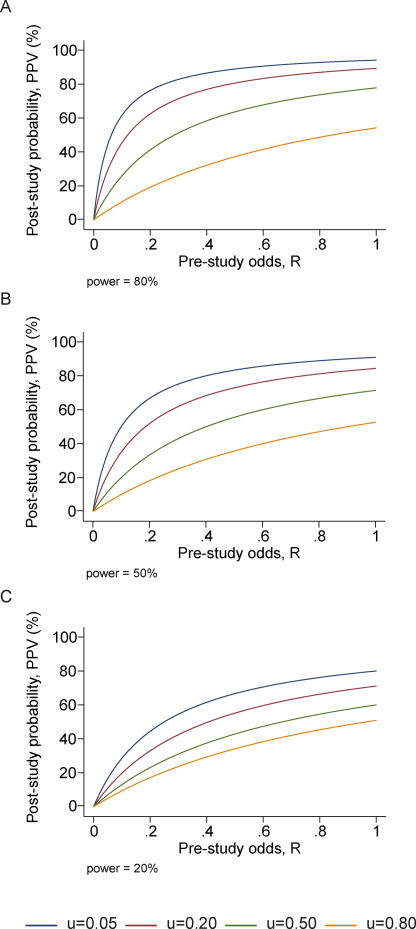
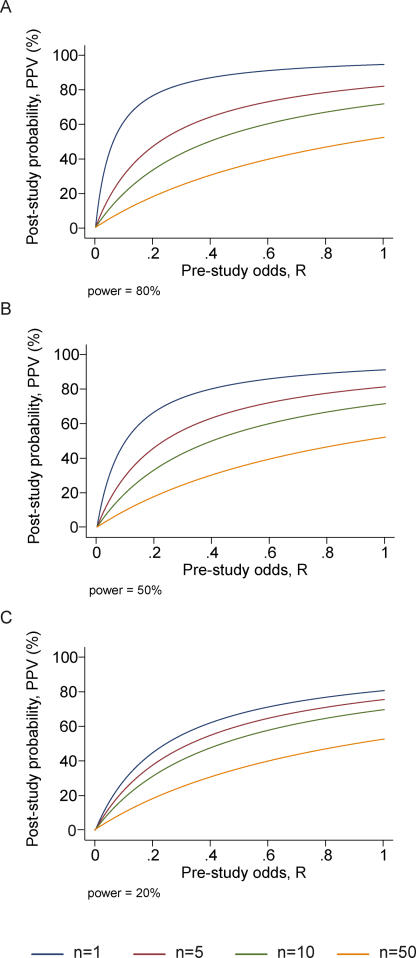
Verification
Claims the paper makes
The claims and statistics of this paper haven’t been checked yet.
Free: it reads the open-access text and checks the first 5 claims that cite a source we can check. Create a free account to check every claim.
Claims other papers make about this one
Each is checked against this paper’s own text: does it say what the citing paper says it does?
The source backs part of the claim, not all of it — or backs it for a different population, condition or comparison.
In the citing paper
“As noted, the pooled effect of risks and interventions trends towards the null result over time;189,190 the implication being that risks for which only a few studies have been done might have their effect overestimated compared with risks for which a large body of evidence exists.”
From A comparative risk assessment of burden of disease and injury attributable to 67 risk factors and risk factor clusters in 21 regions, 1990–2010: a systematic analysis for the Global Burden of Disease Study 2010 (2012) · cites this paper as [189]
Experimental — accuracy not yet measuredThe source backs part of the claim, not all of it — or backs it for a different population, condition or comparison.
In the citing paper
“Less clear, perhaps, is that low power can also increase the false discovery rate and the likelihood that reported effect sizes are inflated, due to their reduced ability to mute stochastic noise [13,63,64].”
From The natural selection of bad science (2016) · cites this paper as [13]
Experimental — accuracy not yet measuredThe source backs part of the claim, not all of it — or backs it for a different population, condition or comparison.
In the citing paper
“scholars have demonstrated that a large proportion of published articles contains flaws (Ioannidis 2005)”
From The ability of different peer review procedures to flag problematic publications (2019) · cites this paper as Ioannidis 2005
Experimental — accuracy not yet measuredThe source backs part of the claim, not all of it — or backs it for a different population, condition or comparison.
In the citing paper
“Furthermore, the publishing landscape in contemporary science rewards novel, positive findings over replications or negative results (Ioannidis 2005; Romero 2017).”
From The myth of the Bayesian brain (2025) · cites this paper as Ioannidis 2005
Experimental — accuracy not yet measuredThe source backs part of the claim, not all of it — or backs it for a different population, condition or comparison.
In the citing paper
“given the demonstrated association between small numbers and bias (Ioannidis 2005; Moore 2010; Nuesch 2009).”
From Psychological therapies for the management of chronic pain (excluding headache) in adults (2012) · cites this paper as Ioannidis 2005
Experimental — accuracy not yet measured
42 more claims about this paper
Create a free account to see every claim other papers make about this one.
Self-check
Percentages, sums and reported differences re-computed from the paper’s own numbers.
The self-check needs the paper’s full text.
Citations
Cites
Dermyshi, E., Wang, Y., Yan, C., Hong, W., Qiu, G., Gong, X., & Zhang, T. (2017) · Neonatology · doi:10.1159/000454668 · Cited by 24,451
Meta-analysis of Observational Studies in Epidemiology<SUBTITLE>A Proposal for Reporting</SUBTITLE>
Stroup, D. F. (2000) · JAMA · doi:10.1001/jama.283.15.2008 · Cited by 20,623
Golub, T. R., Slonim, D. K., Tamayo, P., Huard, C., Gaasenbeek, M., Mesirov, J. P., Coller, H., Loh, M. L., Downing, J. R., Caligiuri, M. A., et al. (1999) · Science · doi:10.1126/science.286.5439.531 · Cited by 11,516
Moher, D., Schulz, K. F., & Altman, D. G. (2001) · The Lancet · doi:10.1016/s0140-6736(00)04337-3 · Cited by 5,373
Moher, D., Cook, D. J., Eastwood, S., Olkin, I., Rennie, D., & Stroup, D. F. (1999) · The Lancet · doi:10.1016/s0140-6736(99)04149-5 · Cited by 4,826
Moher, D., Schulz, K. F., & Altman, D. G. (2001) · BMC Medical Research Methodology · doi:10.1186/1471-2288-1-2 · Cited by 2,755
Chan, A.-W., Hróbjartsson, A., Haahr, M. T., Gøtzsche, P. C., & Altman, D. G. (2004) · JAMA · doi:10.1001/jama.291.20.2457 · Cited by 1,845
Searching for genetic determinants in the new millennium
Risch, N. J. (2000) · Nature · doi:10.1038/35015718 · Cited by 1,839
Replication validity of genetic association studies
Ioannidis, J. P. A., Ntzani, E. E., Trikalinos, T. A., & Contopoulos-Ioannidis, D. G. (2001) · Nature Genetics · doi:10.1038/ng749 · Cited by 1,832
Self-citationWacholder, S., Chanock, S., Garcia-Closas, M., El ghormli, L., & Rothman, N. (2004) · JNCI: Journal of the National Cancer Institute · doi:10.1093/jnci/djh075 · Cited by 1,754
Cited by
Items 1,101–1,200 of 1,227
Maynard, R. A. (2006) · Journal of Policy Analysis and Management · doi:10.1002/pam.20169 · Cited by 47
Sundermann, B., Bode, J., Lueken, U., Westphal, D., Gerlach, A. L., Straube, B., Wittchen, H.-U., Ströhle, A., Wittmann, A., Konrad, C., et al. (2017) · Frontiers in Psychiatry · doi:10.3389/fpsyt.2017.00099 · Cited by 46
Synthetic biology: from hype to impact
Gardner, T. S. (2013) · Trends in biotechnology · doi:10.1016/j.tibtech.2013.01.018 · Cited by 46
Lumley, M. A., Keefe, F. J., Mosley-Williams, A., Rice, J. R., McKee, D., Waters, S. J., Partridge, R. T., Carty, J. N., Coltri, A. M., Kalaj, A., et al. (2014) · Journal of Consulting and Clinical Psychology · doi:10.1037/a0036958 · Cited by 41
A Framework for Improving the Quality of Research in the Biological Sciences
Casadevall, A., Ellis, L. M., Davies, E. W., McFall-Ngai, M., & Fang, F. C. (2016) · mBio · doi:10.1128/mbio.01256-16 · Cited by 46
Ramoni, D., Sgura, C., Liberale, L., Montecucco, F., Ioannidis, J. P. A., & Carbone, F. (2024) · European Journal of Internal Medicine · doi:10.1016/j.ejim.2024.07.012 · Cited by 46
Self-citationScott, A. J., Bisby, M. A., Heriseanu, A. I., Salameh, Y., Karin, E., Fogliati, R., Dudeney, J., Gandy, M., McLellan, L. F., Wootton, B., et al. (2023) · Clinical Psychology Review · doi:10.1016/j.cpr.2023.102353 · Cited by 45
Results Blind Science Publishing
Locascio, J. J. (2017) · Basic and Applied Social Psychology · doi:10.1080/01973533.2017.1336093 · Cited by 45
Brini, S., Brudasca, N. I., Hodkinson, A., Kaluzinska, K., Wach, A., Storman, D., Prokop-Dorner, A., Jemioło, P., & Bala, M. M. (2023) · Clinical Psychology Review · doi:10.1016/j.cpr.2022.102236 · Cited by 44
Publish and Who Should Perish: You or Science?
Kun, Á. (2018) · Publications · doi:10.3390/publications6020018 · Cited by 44
Loss, C. M., Melleu, F. F., Domingues, K., Lino-de-Oliveira, C., & Viola, G. G. (2021) · Frontiers in Behavioral Neuroscience · doi:10.3389/fnbeh.2021.763428 · Cited by 44
Gordon, M., Viganola, D., Dreber, A., Johannesson, M., & Pfeiffer, T. (2021) · PLOS ONE · doi:10.1371/journal.pone.0248780 · Cited by 44
Aligning physiology with psychology: Translational neuroscience in neuropsychiatric drug discovery
McArthur, R. A. (2017) · Neuroscience & Biobehavioral Reviews · doi:10.1016/j.neubiorev.2017.02.004 · Cited by 42
Rice, A. S. C., Morland, R., Huang, W., Currie, G. L., Sena, E. S., & Macleod, M. R. (2013) · Scandinavian Journal of Pain · doi:10.1016/j.sjpain.2013.02.002 · Cited by 42
Improving reproducibility in computational biology research
Papin, J. A., Mac Gabhann, F., Sauro, H. M., Nickerson, D., & Rampadarath, A. (2020) · PLOS Computational Biology · doi:10.1371/journal.pcbi.1007881 · Cited by 42
Bayesian Data Analysis in Empirical Software Engineering Research
Furia, C. A., Feldt, R., & Torkar, R. (2019) · IEEE Transactions on Software Engineering · doi:10.1109/tse.2019.2935974 · Cited by 42
Bogg, T., & Lasecki, L. (2015) · Frontiers in Psychology · doi:10.3389/fpsyg.2014.01589 · Cited by 41
Methods, transparency and reporting of clinical trials in orthodontics and periodontics
Papageorgiou, S. N., Antonoglou, G. N., Martin, C., & Eliades, T. (2019) · Journal of Orthodontics · doi:10.1177/1465312519842315 · Cited by 40
Affirmative citation bias in scientific myth debunking: A three-in-one case study
Letrud, K., & Hernes, S. (2019) · PLOS ONE · doi:10.1371/journal.pone.0222213 · Cited by 37
How to critically read ecological meta-analyses
Lortie, C. J., Stewart, G., Rothstein, H., & Lau, J. (2015) · Research Synthesis Methods · doi:10.1002/jrsm.1109 · Cited by 39
Acute alcohol response phenotype in heavy social drinkers is robust and reproducible
Roche, D. J. O., Palmeri, M. D., & King, A. C. (2014) · Alcoholism Clinical and Experimental Research · doi:10.1111/acer.12280 · Cited by 39
Single-case experimental research designs.
Kazdin, A. E. (2015) · Methodological issues and strategies in clinical research (4th ed.). · doi:10.1037/14805-029 · Cited by 39
Vink, M., & Vink-Niese, A. (2022) · Healthcare · doi:10.3390/healthcare10050898 · Cited by 38
Helske, J., Helske, S., Cooper, M., Ynnerman, A., & Besancon, L. (2021) · IEEE Transactions on Visualization and Computer Graphics · doi:10.1109/tvcg.2021.3073466 · Cited by 38
In medicine, how do we machine learn anything real?
Ghassemi, M., & Nsoesie, E. O. (2022) · Patterns · doi:10.1016/j.patter.2021.100392 · Cited by 37
Gnambs, T., Stasielowicz, L., Wolter, I., & Appel, M. (2020) · Psychology of Popular Media · doi:10.1037/ppm0000204 · Cited by 35
Dajani, D. R., Burrows, C. A., Odriozola, P., Baez, A., Nebel, M. B., Mostofsky, S. H., & Uddin, L. Q. (2019) · NeuroImage: Clinical · doi:10.1016/j.nicl.2019.101678 · Cited by 33
Sheikh, J., Allotey, J., Sobhy, S., Plana, M. N., Martinez-Barros, H., Naidu, H., Junaid, F., Sofat, R., Mol, B. W., Kenny, L. C., et al. (2025) · BMJ · doi:10.1136/bmj-2025-088141 · Cited by 33
Connectomic consistency: a systematic stability analysis of structural and functional connectivity
Osmanlıoğlu, Y., Alappatt, J. A., Parker, D., & Verma, R. (2020) · Journal of Neural Engineering · doi:10.1088/1741-2552/ab947b · Cited by 33
Neurobiological correlates of resilience during childhood and adolescence – A systematic review
Zhang, L., Rakesh, D., Cropley, V., & Whittle, S. (2023) · Clinical Psychology Review · doi:10.1016/j.cpr.2023.102333 · Cited by 33
(2018) · doi:10.1101/396317 · Cited by 33
Hanin, L. (2017) · BMC Medical Research Methodology · doi:10.1186/s12874-017-0399-0 · Cited by 32
Jaric, I., Voelkl, B., Clerc, M., Schmid, M. W., Novak, J., Rosso, M., Rufener, R., von Kortzfleisch, V. T., Richter, S. H., Buettner, M., et al. (2022) · PLoS Biology · doi:10.1371/journal.pbio.3001837 · Cited by 32
Decoding the Foodome: Molecular Networks Connecting Diet and Health
Menichetti, G., Barabási, A.-L., & Loscalzo, J. (2024) · Annual Review of Nutrition · doi:10.1146/annurev-nutr-062322-030557 · Cited by 32
A manifesto for a globally diverse, equitable, and inclusive open science
Ghai, S., Thériault, R., Forscher, P., Shoda, Y., Syed, M., Puthillam, A., Peng, H. C., Basnight-Brown, D., Majid, A., Azevedo, F., et al. (2025) · Communications Psychology · doi:10.1038/s44271-024-00179-1 · Cited by 32
Ortega, A., & Navarrete, G. (2017) · Bayesian Inference · doi:10.5772/intechopen.70230 · Cited by 31
Bioanalytical inaccuracy: A threat to the integrity and efficiency of research
Young, S. N., & Anderson, G. M. (2010) · Journal of Psychiatry and Neuroscience · doi:10.1503/jpn.090171 · Cited by 31
Ziegelmann, M. J., Trost, L. W., Russo, G. I., & Levine, L. A. (2020) · The Journal of Sexual Medicine · doi:10.1016/j.jsxm.2019.11.271 · Cited by 31
Black, B., Hollingsworth, A., Nunes, L., & Simon, K. (2022) · Journal of Public Economics · doi:10.1016/j.jpubeco.2022.104713 · Cited by 31
The conundrum of depression clinical trials: one size does not fit all
Khan, A., Mar, K. F., & Brown, W. A. (2018) · International Clinical Psychopharmacology · doi:10.1097/yic.0000000000000229 · Cited by 30
Prediction of robust scientific facts from literature
Belikov, A. V., Rzhetsky, A., & Evans, J. (2022) · Nature Machine Intelligence · doi:10.1038/s42256-022-00474-8 · Cited by 30
Circadian Polymorphisms in Night Owls, in Bipolars, and in Non-24-Hour Sleep Cycles
Kripke, D. F., Klimecki, W. T., Nievergelt, C. M., Rex, K. M., Murray, S. S., Shekhtman, T., Tranah, G. J., Loving, R. T., Lee, H.-J., Rhee, M. K., et al. (2014) · Psychiatry Investigation · doi:10.4306/pi.2014.11.4.345 · Cited by 30
Shinohara, K., Tajika, A., Imai, H., Takeshima, N., Hayasaka, Y., & Furukawa, T. A. (2015) · Acta Psychiatrica Scandinavica · doi:10.1111/acps.12502 · Cited by 29
Evaluating Registered Reports: A Naturalistic Comparative Study of Article Impact
Hopun, L. T., Singleton Thorn, F., Nosek, B. A., & Errington, T. M. (2017) · doi:10.31219/osf.io/5y8w7 · Cited by 29
Is Personality a Key Predictor of Missing Study Data? An Analysis From a Randomized Controlled Trial
Jerant, A., Chapman, B. P., Duberstein, P., & Franks, P. (2009) · The Annals of Family Medicine · doi:10.1370/afm.920 · Cited by 29
Hatch, S. G., Knopp, K., Le, Y., Allen, M. O. T., Rothman, K., Rhoades, G. K., & Doss, B. D. (2022) · Family Process · doi:10.1111/famp.12710 · Cited by 28
Does big data require a methodological change in medical research?
Caliebe, A., Leverkus, F., Antes, G., & Krawczak, M. (2019) · BMC Medical Research Methodology · doi:10.1186/s12874-019-0774-0 · Cited by 28
Church, K. W., & Kordoni, V. (2022) · Natural Language Engineering · doi:10.1017/s1351324922000043 · Cited by 28
Dudda, L., Kormann, E., Kozula, M., DeVito, N. J., Klebel, T., Dewi, A. P. M., Spijker, R., Stegeman, I., Van den Eynden, V., Ross-Hellauer, T., et al. (2025) · Royal Society Open Science · doi:10.1098/rsos.242057 · Cited by 28
Enhancing reproducibility: Failures from Reproducibility Initiatives underline core challenges
Mullane, K., & Williams, M. (2017) · Biochemical Pharmacology · doi:10.1016/j.bcp.2017.04.008 · Cited by 28
Jamal, M. S., Hurley, E. T., Asad, H., Asad, A., & Taneja, T. (2022) · Journal of Clinical Orthopaedics and Trauma · doi:10.1016/j.jcot.2021.101759 · Cited by 28
Validating Automatic Concept-Based Explanations for AI-Based Digital Histopathology
Sauter, D., Lodde, G., Nensa, F., Schadendorf, D., Livingstone, E., & Kukuk, M. (2022) · Sensors · doi:10.3390/s22145346 · Cited by 26
Menke, J., Eckmann, P., Ozyurt, I. B., Roelandse, M., Anderson, N., Grethe, J., Gamst, A., & Bandrowski, A. (2022) · Journal of Medical Internet Research · doi:10.2196/37324 · Cited by 25
Examining the predictive validity of NIH peer review scores
Lindner, M. D., & Nakamura, R. K. (2015) · PLOS ONE · doi:10.1371/journal.pone.0126938 · Cited by 24
An Experiment on Prediction Markets in Science
Almenberg, J., Kittlitz, K., & Pfeiffer, T. (2009) · PLoS ONE · doi:10.1371/journal.pone.0008500 · Cited by 24
Bais, B., Kamperman, A. M., Bijma, H. H., Hoogendijk, W. J., Souman, J. L., Knijff, E., & Lambregtse-van den Berg, M. P. (2020) · BMJ Open · doi:10.1136/bmjopen-2020-038030 · Cited by 24
Tak, L. M., Meijer, A., Manoharan, A., de Jonge, P., & Rosmalen, J. G. M. (2010) · Psychosomatic Medicine · doi:10.1097/psy.0b013e3181d714e1 · Cited by 23
How our approaches to assessing benefits and harms can be improved
Sena, E., & Currie, G. (2019) · Animal Welfare · doi:10.7120/09627286.28.1.107 · Cited by 23
Scientific rigor through videogames
Treuille, A., & Das, R. (2014) · Trends in Biochemical Sciences · doi:10.1016/j.tibs.2014.08.005 · Cited by 22
Maternal adiposity and perinatal and offspring outcomes: an umbrella review
Yang, Z., Feng, G., Gao, X., Yan, X., Li, Y., Wang, Y., Li, S., Jiang, Y., Zhao, S., Zhao, H., et al. (2024) · Nature Human Behaviour · doi:10.1038/s41562-024-01994-6 · Cited by 28
Essential guidelines for computational method benchmarking
Weber, L. M., Saelens, W., Cannoodt, R., Soneson, C., Hapfelmeier, A., Gardner, P. P., Boulesteix, A.-L., Saeys, Y., & Robinson, M. D. (2019) · Genome Biology · doi:10.1186/s13059-019-1738-8 · Cited by 21
McCrabb, S., Mooney, K., Wolfenden, L., Gonzalez, S., Ditton, E., Yoong, S., & Kypri, K. (2021) · PLOS ONE · doi:10.1371/journal.pone.0255704 · Cited by 21
Sundell, K., & Olsson, T. (2017) · Oxford Bibliographies in Social Work · doi:10.1093/obo/9780195389678-0254 · Cited by 21
Gandy, M., Woldhuis, T., Wu, W., Youssef, M., Bisby, M. A., Dear, B. F., Heriseanu, A. I., & Scott, A. J. (2024) · Psychological Medicine · doi:10.1017/s0033291724001995 · Cited by 20
Khan, K. S., Fawzy, M., & Chien, P. F. W. (2023) · International Journal of Gynecology & Obstetrics · doi:10.1002/ijgo.14837 · Cited by 20
A Replication of the Internal Validity Structure of Three Major Teaching Rating Scales
Peters, S. J., & Pereira, N. (2017) · Journal of Advanced Academics · doi:10.1177/1932202x17701940 · Cited by 20
Selective outcome reporting: telling and detecting true lies. The state of the science
Macura, A., Abraha, I., Kirkham, J., Gensini, G. F., Moja, L., & Iorio, A. (2010) · Internal and Emergency Medicine · doi:10.1007/s11739-010-0371-z · Cited by 19
Marcusson-Clavertz, D., Gušić, S., Bengtsson, H., Jacobsen, H., & Cardeña, E. (2017) · Attachment & Human Development · doi:10.1080/14616734.2016.1261914 · Cited by 19
Is biomedical research self-correcting? Modelling insights on the persistence of spurious science
Grimes, D. R. (2024) · Royal Society Open Science · doi:10.1098/rsos.231056 · Cited by 18
Schönenberger, C. M., Griessbach, A., Taji Heravi, A., Gryaznov, D., Gloy, V. L., Lohner, S., Klatte, K., Ghosh, N., Lee, H., Mansouri, A., et al. (2022) · Journal of Clinical Epidemiology · doi:10.1016/j.jclinepi.2022.05.014 · Cited by 17
Open Minded: Searching for Truth about the Unconscious Mind
Newell, B. R., & Shanks, D. R. (2023) · doi:10.7551/mitpress/14922.001.0001 · Cited by 17
Loth, E., & Evans, D. W. (2019) · WIREs Cognitive Science · doi:10.1002/wcs.1499 · Cited by 17
Borowiak, K., Schelinski, S., & von Kriegstein, K. (2018) · NeuroImage: Clinical · doi:10.1016/j.nicl.2018.09.019 · Cited by 17
Evidence‐Based Medicine and Primary Care: Keeping Up Is Hard to Do
Zipkin, D. A., Greenblatt, L., & Kushinka, J. T. (2012) · Mount Sinai Journal of Medicine: A Journal of Translational and Personalized Medicine · doi:10.1002/msj.21337 · Cited by 16
Universality and language specificity of brain Reading networks: A developmental perspective
Zhang, J., Chen, J., & Ding, G. (2024) · Developmental Science · doi:10.1111/desc.13379 · Cited by 16
Out of Control: How to Design Digital Placebos
Blease, C. (2023) · Current Treatment Options in Psychiatry · doi:10.1007/s40501-023-00290-w · Cited by 15
Optimizing Expectations via Mobile Apps: A New Approach for Examining and Enhancing Placebo Effects
Gruszka, P., Burger, C., & Jensen, M. P. (2019) · Frontiers in Psychiatry · doi:10.3389/fpsyt.2019.00365 · Cited by 15
Pianta, M. J., Makrai, E., Verspoor, K. M., Cohn, T. A., & Downie, L. E. (2018) · Journal of Clinical Epidemiology · doi:10.1016/j.jclinepi.2018.07.015 · Cited by 15
Better reporting for better research: a checklist for reproducibility
Kenall, A., Edmunds, S., Goodman, L., Bal, L., Flintoft, L., Shanahan, D. R., & Shipley, T. (2015) · GigaScience · doi:10.1186/s13742-015-0071-8 · Cited by 15
Bullock, G. S., Ward, P., Impellizzeri, F. M., Kluzek, S., Hughes, T., Hillman, C., Waterman, B. R., Danelson, K., Henry, K., Barr, E., et al. (2023) · Journal of Orthopaedic & Sports Physical Therapy · doi:10.2519/jospt.2023.12016 · Cited by 15
Addressing selective reporting of experiments through predefined exclusion criteria
Neves, K., & Amaral, O. B. (2020) · eLife · doi:10.7554/elife.56626 · Cited by 15
McGill, K., Sackley, C., Godwin, J., Gavaghan, D., Ali, M., Ballester, B. R., Brady, M. C., Brady, M. C., Ali, M., Ashburn, A., et al. (2022) · Journal of Stroke and Cerebrovascular Diseases · doi:10.1016/j.jstrokecerebrovasdis.2021.106229 · Cited by 14
A transcriptomics approach to expand therapeutic options and optimize clinical trials in oncology
Lazar, V., Zhang, B., Magidi, S., Le Tourneau, C., Raymond, E., Ducreux, M., Bresson, C., Raynaud, J., Wunder, F., Onn, A., et al. (2023) · Therapeutic Advances in Medical Oncology · doi:10.1177/17588359231156382 · Cited by 14
Assessing Open Science practices in physical activity behaviour change intervention evaluations
Norris, E., Sulevani, I., Finnerty, A. N., & Castro, O. (2022) · BMJ Open Sport & Exercise Medicine · doi:10.1136/bmjsem-2021-001282 · Cited by 14
Artificial Intelligence in Medicine: Validation and Study Design
Oakden-Rayner, L., & Palmer, L. J. (2019) · Artificial Intelligence in Medical Imaging · doi:10.1007/978-3-319-94878-2_8 · Cited by 14
Chen, L., Benjamin, R., Lai, A., & Heine, S. (2022) · doi:10.31234/osf.io/kuhy6 · Cited by 14
Drug Development in Endometriosis and Adenomyosis: It Takes More Than Just Good Science
Groothuis, P. G., & Guo, S.-W. (2018) · Reproductive Sciences · doi:10.1177/1933719118785767 · Cited by 13
Neglect of Multiplicity When Testing Families of Related Hypotheses*
Holland, B., fang, S. W., & Basu, S. (2009) · doi:10.2139/ssrn.1466343 · Cited by 13
Scientific impact and the quest for visibility
Madsen, R. R. (2019) · The FEBS Journal · doi:10.1111/febs.15043 · Cited by 12
The myth of the Bayesian brain
Mangalam, M. (2025) · European Journal of Applied Physiology · doi:10.1007/s00421-025-05855-6 · Cited by 14
“Choice-supportive bias” in science: Explanation and mitigation
Kafaee, M., Marhamati, H., & Gharibzadeh, S. (2021) · Accountability in Research · doi:10.1080/08989621.2021.1872377 · Cited by 12
Interpreting confidence intervals: A comment on Hoekstra, Morey, Rouder, and Wagenmakers (2014)
Miller, J., & Ulrich, R. (2016) · Psychonomic Bulletin & Review · doi:10.3758/s13423-015-0859-7 · Cited by 12
Mascaro, L., Drummond, S. P. A., Leota, J., Boardman, J. M., Hoffman, D., Rajaratnam, S. M. W., Aidman, E., & Facer-Childs, E. R. (2023) · Frontiers in Physiology · doi:10.3389/fphys.2023.1118822 · Cited by 10
A standardized framework to test event-based experiments
Lepauvre, A., Hirschhorn, R., Bendtz, K., Mudrik, L., & Melloni, L. (2024) · Behavior Research Methods · doi:10.3758/s13428-024-02508-y · Cited by 9
AI detecting AI in academic writing: Why most AI detector findings are false
Tsigaris, P., & Teixeira da Silva, J. A. (2026) · Next Research · doi:10.1016/j.nexres.2026.101396 · Cited by 11
Data sharing and transparency indicators in published RCTs in Oral Health between 2017 and 2023
Mikelis, F., Karamalaki, D., Mikeli, A., Tzanetakis, G. N., & Koletsi, D. (2024) · Journal of Dentistry · doi:10.1016/j.jdent.2024.105263 · Cited by 8
Common Flaws in Running Human Evaluation Experiments in NLP
Thomson, C., Reiter, E., & Belz, A. (2024) · Computational Linguistics · doi:10.1162/coli_a_00508 · Cited by 8
Designing optimal behavioral experiments using machine learning
Valentin, S., Kleinegesse, S., Bramley, N. R., Seriès, P., Gutmann, M. U., & Lucas, C. G. (2024) · eLife · doi:10.7554/elife.86224 · Cited by 8
Steen, R., & Hamer, R. (2014) · Publications · doi:10.3390/publications2010027 · Cited by 7
Medical misinformation in the era of Google: Computational approaches to a pervasive problem
Granter, S. R., & Papke, D. J. (2018) · Proceedings of the National Academy of Sciences · doi:10.1073/pnas.1808264115 · Cited by 7
Metadata
- Authors
- Ioannidis, J. P. A.
- Affiliations
- University of Ioannina (GR)
- Corresponding author
- Ioannidis, John P. A.
- Venue
- PLoS Medicine
- Publisher
- Public Library of Science (PLoS)
- Published
- 2005-08-30
- Volume
- 2
- Issue
- 8
- Pages
- e124
- ISSN
- 1549-1277 (ISSN-L)
- 1549-1676
- PMC
- PMC1182327
- OpenAlex
- W2144981148
- Cited by
- 10,505
- References
- 40
- Citations by year
- 2026: 628 · 2025: 666 · 2024: 649 · 2023: 706 · 2022: 783 · 2021: 834 · 2020: 836 · 2019: 897 · 2018: 778 · 2017: 759 · 2016: 716 · 2015: 542 · 2014: 427 · 2013: 344 · 2012: 227
- FWCI
- 97.37
- Type
- journal article
- Language
- en
- Update notices
- correction (2022-08-25)
- Open access
- gold
- doi.org
- Locations
- PLoS Medicine (publishedVersion, cc-by)
- Europe PMC (PubMed Central) (publishedVersion, cc-by)
- PubMed Central (publishedVersion, cc-by)
- PubMed (publishedVersion)
- RePEc: Research Papers in Economics (submittedVersion, cc-by)
- DOAJ (DOAJ: Directory of Open Access Journals) (submittedVersion, cc-by-sa)
- Topics
- Social Sciences › Decision Sciences › Statistics, Probability and Uncertainty › Meta-analysis and systematic reviews
- Social Sciences › Library and Information Sciences › Academic Publishing and Open Access
- Social Sciences › Education › Academic integrity and plagiarism
- Keywords
- replication crisis, false positives, research credibility, statistical power, research bias, p-hacking, effect size, multiple comparisons, financial conflicts of interest, research misconduct, significance testing
- MeSH terms
- Data Interpretation, Statistical, Publishing, Research Design, Meta-Analysis as Topic, Reproducibility of Results, Bias, Likelihood Functions, Odds Ratio, Sample Size
About these checks
Registry, retraction, Cites and statistics results are computed, not judged, with one exception: a printed reference that no index lists is read once by a model before it counts as a citation error. Claims are extracted by a model and kept only when their quote appears verbatim in the text; each cited source is then checked, with a model’s help, for whether it says what the claim relies on. Those verdicts can be wrong — read the claim’s quote and the cited source before relying on one.
Statistics and arithmetic are recomputed, not judged.
Confidence bands are shown only for fields calibrated on our annotated test set. None is calibrated yet, so no band is shown.
What counts as a claim ›How we measure confidence ›How we check this ›
Are you an author, or do you see a problem with this page? Request a review
Data sources
Bibliographic data: Semantic Scholar, OpenAlex, Crossref.
Contains information from the Semantic Scholar Academic Graph Datasets, made available under the ODC Attribution License (ODC-BY 1.0).
Semantic Scholar’s data is described in: Kinney, R., et al. (2023). The Semantic Scholar Open Data Platform. arXiv:2301.10140.
