

Why Most Published Research Findings Are False
Open accessThe DOI matches its Crossref record; 40 of the 40 references it cites were found in a registry or an index.
Abstract
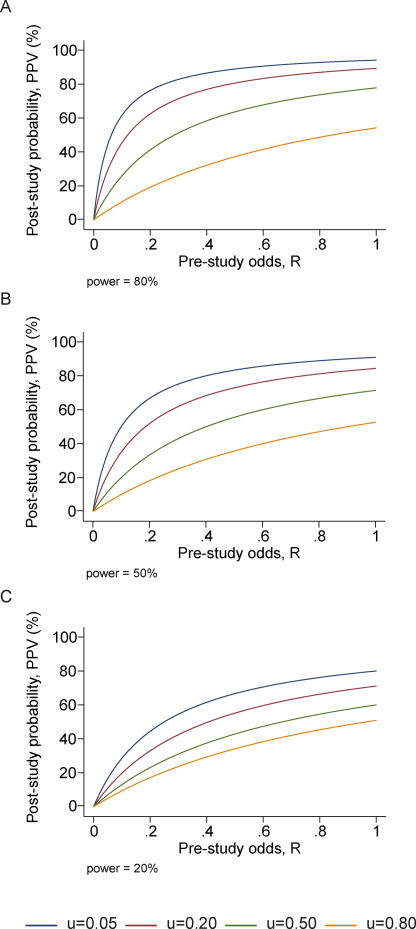
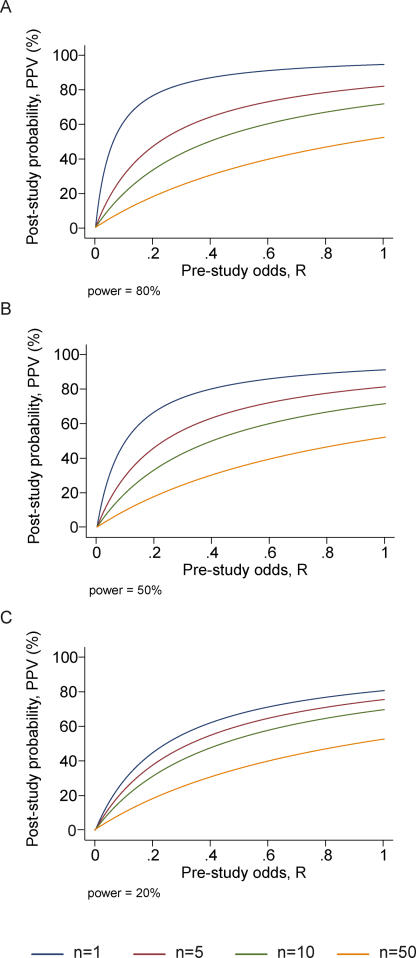
There is increasing concern that most current published research findings are false. The probability that a research claim is true may depend on study power and bias, the number of other studies on the same question, and, importantly, the ratio of true to no relationships among the relationships probed in each scientific field. In this framework, a research finding is less likely to be true when the studies conducted in a field are smaller; when effect sizes are smaller; when there is a greater number and lesser preselection of tested relationships; where there is greater flexibility in designs, definitions, outcomes, and analytical modes; when there is greater financial and other interest and prejudice; and when more teams are involved in a scientific field in chase of statistical significance. Simulations show that for most study designs and settings, it is more likely for a research claim to be false than true. Moreover, for many current scientific fields, claimed research findings may often be simply accurate measures of the prevailing bias. In this essay, I discuss the implications of these problems for the conduct and interpretation of research.
Overview
The claims and statistics of this paper haven’t been checked yet.
Free: it reads the open-access text and checks the first 5 claims that cite a source we can check. Create a free account to check every claim.
Integrity signals
Registry
Cites
Statistics
Figures
Verification
Claims the paper makes
The claims and statistics of this paper haven’t been checked yet.
Free: it reads the open-access text and checks the first 5 claims that cite a source we can check. Create a free account to check every claim.
Claims other papers make about this one
Each is checked against this paper’s own text: does it say what the citing paper says it does?
The source backs part of the claim, not all of it — or backs it for a different population, condition or comparison.
In the citing paper
“As noted, the pooled effect of risks and interventions trends towards the null result over time;189,190 the implication being that risks for which only a few studies have been done might have their effect overestimated compared with risks for which a large body of evidence exists.”
From A comparative risk assessment of burden of disease and injury attributable to 67 risk factors and risk factor clusters in 21 regions, 1990–2010: a systematic analysis for the Global Burden of Disease Study 2010 (2012) · cites this paper as [189]
Experimental — accuracy not yet measuredThe source backs part of the claim, not all of it — or backs it for a different population, condition or comparison.
In the citing paper
“Less clear, perhaps, is that low power can also increase the false discovery rate and the likelihood that reported effect sizes are inflated, due to their reduced ability to mute stochastic noise [13,63,64].”
From The natural selection of bad science (2016) · cites this paper as [13]
Experimental — accuracy not yet measuredThe source backs part of the claim, not all of it — or backs it for a different population, condition or comparison.
In the citing paper
“scholars have demonstrated that a large proportion of published articles contains flaws (Ioannidis 2005)”
From The ability of different peer review procedures to flag problematic publications (2019) · cites this paper as Ioannidis 2005
Experimental — accuracy not yet measuredThe source backs part of the claim, not all of it — or backs it for a different population, condition or comparison.
In the citing paper
“Furthermore, the publishing landscape in contemporary science rewards novel, positive findings over replications or negative results (Ioannidis 2005; Romero 2017).”
From The myth of the Bayesian brain (2025) · cites this paper as Ioannidis 2005
Experimental — accuracy not yet measuredThe source backs part of the claim, not all of it — or backs it for a different population, condition or comparison.
In the citing paper
“given the demonstrated association between small numbers and bias (Ioannidis 2005; Moore 2010; Nuesch 2009).”
From Psychological therapies for the management of chronic pain (excluding headache) in adults (2012) · cites this paper as Ioannidis 2005
Experimental — accuracy not yet measured
42 more claims about this paper
Create a free account to see every claim other papers make about this one.
Self-check
Percentages, sums and reported differences re-computed from the paper’s own numbers.
The self-check needs the paper’s full text.
Citations
Cites
Dermyshi, E., Wang, Y., Yan, C., Hong, W., Qiu, G., Gong, X., & Zhang, T. (2017) · Neonatology · doi:10.1159/000454668 · Cited by 24,451
Meta-analysis of Observational Studies in Epidemiology<SUBTITLE>A Proposal for Reporting</SUBTITLE>
Stroup, D. F. (2000) · JAMA · doi:10.1001/jama.283.15.2008 · Cited by 20,623
Golub, T. R., Slonim, D. K., Tamayo, P., Huard, C., Gaasenbeek, M., Mesirov, J. P., Coller, H., Loh, M. L., Downing, J. R., Caligiuri, M. A., et al. (1999) · Science · doi:10.1126/science.286.5439.531 · Cited by 11,516
Moher, D., Schulz, K. F., & Altman, D. G. (2001) · The Lancet · doi:10.1016/s0140-6736(00)04337-3 · Cited by 5,373
Moher, D., Cook, D. J., Eastwood, S., Olkin, I., Rennie, D., & Stroup, D. F. (1999) · The Lancet · doi:10.1016/s0140-6736(99)04149-5 · Cited by 4,826
Moher, D., Schulz, K. F., & Altman, D. G. (2001) · BMC Medical Research Methodology · doi:10.1186/1471-2288-1-2 · Cited by 2,755
Chan, A.-W., Hróbjartsson, A., Haahr, M. T., Gøtzsche, P. C., & Altman, D. G. (2004) · JAMA · doi:10.1001/jama.291.20.2457 · Cited by 1,845
Searching for genetic determinants in the new millennium
Risch, N. J. (2000) · Nature · doi:10.1038/35015718 · Cited by 1,839
Replication validity of genetic association studies
Ioannidis, J. P. A., Ntzani, E. E., Trikalinos, T. A., & Contopoulos-Ioannidis, D. G. (2001) · Nature Genetics · doi:10.1038/ng749 · Cited by 1,832
Self-citationWacholder, S., Chanock, S., Garcia-Closas, M., El ghormli, L., & Rothman, N. (2004) · JNCI: Journal of the National Cancer Institute · doi:10.1093/jnci/djh075 · Cited by 1,754
Cited by
Items 301–400 of 1,227
Hearing loss and falls: A systematic review and meta‐analysis
Jiam, N. T., Li, C., & Agrawal, Y. (2016) · The Laryngoscope · doi:10.1002/lary.25927 · Cited by 314
Citalopram versus other anti-depressive agents for depression
Cipriani, A., Purgato, M., Furukawa, T. A., Trespidi, C., Imperadore, G., Signoretti, A., Churchill, R., Watanabe, N., & Barbui, C. (2012) · Cochrane Database of Systematic Reviews · doi:10.1002/14651858.cd006534.pub2 · Cited by 311
Clinical applications of the functional connectome
Castellanos, F. X., Di Martino, A., Craddock, R. C., Mehta, A. D., & Milham, M. P. (2013) · NeuroImage · doi:10.1016/j.neuroimage.2013.04.083 · Cited by 312
OASIS: Online Application for the Survival Analysis of Lifespan Assays Performed in Aging Research
Yang, J.-S., Nam, H.-J., Seo, M., Han, S. K., Choi, Y., Nam, H. G., Lee, S.-J., & Kim, S. (2011) · PLoS ONE · doi:10.1371/journal.pone.0023525 · Cited by 311
Three simple rules to ensure reasonably credible subgroup analyses
Burke, J. F., Sussman, J. B., Kent, D. M., & Hayward, R. A. (2015) · BMJ · doi:10.1136/bmj.h5651 · Cited by 312
Neurofeedback with fMRI: A critical systematic review
Thibault, R. T., MacPherson, A., Lifshitz, M., Roth, R. R., & Raz, A. (2018) · NeuroImage · doi:10.1016/j.neuroimage.2017.12.071 · Cited by 312
Preregistering qualitative research
L. Haven, T., & Van Grootel, D. L. (2019) · Accountability in Research · doi:10.1080/08989621.2019.1580147 · Cited by 311
An open investigation of the reproducibility of cancer biology research
Errington, T. M., Iorns, E., Gunn, W., Tan, F. E., Lomax, J., & Nosek, B. A. (2014) · eLife · doi:10.7554/elife.04333 · Cited by 312
Reproducible Research Practices and Transparency across the Biomedical Literature
Iqbal, S. A., Wallach, J. D., Khoury, M. J., Schully, S. D., & Ioannidis, J. P. A. (2016) · PLOS Biology · doi:10.1371/journal.pbio.1002333 · Cited by 310
Self-citationDeterminants of overburdening among informal carers: a systematic review
Lindt, N., van Berkel, J., & Mulder, B. C. (2020) · BMC Geriatrics · doi:10.1186/s12877-020-01708-3 · Cited by 303
Challenges for assessing replicability in preclinical cancer biology
Errington, T. M., Denis, A., Perfito, N., Iorns, E., & Nosek, B. A. (2021) · eLife · doi:10.7554/elife.67995 · Cited by 267
The reusable holdout: Preserving validity in adaptive data analysis
Dwork, C., Feldman, V., Hardt, M., Pitassi, T., Reingold, O., & Roth, A. (2015) · Science · doi:10.1126/science.aaa9375 · Cited by 307
Elliott, M. L., Knodt, A. R., Cooke, M., Kim, M. J., Melzer, T. R., Keenan, R., Ireland, D., Ramrakha, S., Poulton, R., Caspi, A., et al. (2019) · NeuroImage · doi:10.1016/j.neuroimage.2019.01.068 · Cited by 304
O'Bryant, S. E., Mielke, M. M., Rissman, R. A., Lista, S., Vanderstichele, H., Zetterberg, H., Lewczuk, P., Posner, H., Hall, J., Johnson, L., et al. (2017) · Alzheimer's & Dementia · doi:10.1016/j.jalz.2016.09.014 · Cited by 303
Companion Animals and Child/Adolescent Development: A Systematic Review of the Evidence
Purewal, R., Christley, R., Kordas, K., Joinson, C., Meints, K., Gee, N., & Westgarth, C. (2017) · International Journal of Environmental Research and Public Health · doi:10.3390/ijerph14030234 · Cited by 302
Beattie, J. R., & Esmonde-White, F. W. L. (2021) · Applied Spectroscopy · doi:10.1177/0003702820987847 · Cited by 300
Loth, E., Charman, T., Mason, L., Tillmann, J., Jones, E. J. H., Wooldridge, C., Ahmad, J., Auyeung, B., Brogna, C., Ambrosino, S., et al. (2017) · Molecular Autism · doi:10.1186/s13229-017-0146-8 · Cited by 299
Epidemiology of basal cell carcinoma: scholarly review
Verkouteren, J. A. C., Ramdas, K. H. R., Wakkee, M., & Nijsten, T. (2017) · British Journal of Dermatology · doi:10.1111/bjd.15321 · Cited by 298
When Null Hypothesis Significance Testing Is Unsuitable for Research: A Reassessment
Szucs, D., & Ioannidis, J. P. A. (2017) · Frontiers in Human Neuroscience · doi:10.3389/fnhum.2017.00390 · Cited by 298
Self-citationHumphreys, M., Sanchez de la Sierra, R., & van der Windt, P. (2013) · Political Analysis · doi:10.1093/pan/mps021 · Cited by 298
Systems biology, metabolic modelling and metabolomics in drug discovery and development
Kell, D. B. (2006) · Drug Discovery Today · doi:10.1016/j.drudis.2006.10.004 · Cited by 297
Ten considerations for effectively managing the COVID-19 transition
Habersaat, K. B., Betsch, C., Danchin, M., Sunstein, C. R., Böhm, R., Falk, A., Brewer, N. T., Omer, S. B., Scherzer, M., Sah, S., et al. (2020) · Nature Human Behaviour · doi:10.1038/s41562-020-0906-x · Cited by 297
Ferguson, C. J. (2013) · Clinical Psychology Review · doi:10.1016/j.cpr.2012.11.002 · Cited by 295
Does Transcranial Direct Current Stimulation Improve Healthy Working Memory?: A Meta-analytic Review
Mancuso, L. E., Ilieva, I. P., Hamilton, R. H., & Farah, M. J. (2016) · Journal of Cognitive Neuroscience · doi:10.1162/jocn_a_00956 · Cited by 294
A multi-disciplinary perspective on emergent and future innovations in peer review
Tennant, J. P., Dugan, J. M., Graziotin, D., Jacques, D. C., Waldner, F., Mietchen, D., Elkhatib, Y., B. Collister, L., Pikas, C. K., Crick, T., et al. (2017) · F1000Research · doi:10.12688/f1000research.12037.1 · Cited by 289
Elhaik, E. (2022) · Scientific Reports · doi:10.1038/s41598-022-14395-4 · Cited by 293
Magezi, D. A. (2015) · Frontiers in Psychology · doi:10.3389/fpsyg.2015.00002 · Cited by 291
Replication in Genome-Wide Association Studies
Kraft, P., Zeggini, E., & Ioannidis, J. P. A. (2009) · Statistical Science · doi:10.1214/09-sts290 · Cited by 290
Self-citationO'Bryant, S. E., Gupta, V., Henriksen, K., Edwards, M., Jeromin, A., Lista, S., Bazenet, C., Soares, H., Lovestone, S., Hampel, H., et al. (2015) · Alzheimer's & Dementia · doi:10.1016/j.jalz.2014.08.099 · Cited by 290
The 3Rs in research: a contemporary approach to replacement, reduction and refinement
MacArthur Clark, J. (2018) · British Journal of Nutrition · doi:10.1017/s0007114517002227 · Cited by 290
Suicide behaviors during the COVID-19 pandemic: A meta-analysis of 54 studies
Dubé, J. P., Smith, M. M., Sherry, S. B., Hewitt, P. L., & Stewart, S. H. (2021) · Psychiatry Research · doi:10.1016/j.psychres.2021.113998 · Cited by 291
Toward Benchmarking in Catalysis Science: Best Practices, Challenges, and Opportunities
Bligaard, T., Bullock, R. M., Campbell, C. T., Chen, J. G., Gates, B. C., Gorte, R. J., Jones, C. W., Jones, W. D., Kitchin, J. R., & Scott, S. L. (2016) · ACS Catalysis · doi:10.1021/acscatal.6b00183 · Cited by 285
Toxicology and risk assessment of coumarin: Focus on human data
Abraham, K., Wöhrlin, F., Lindtner, O., Heinemeyer, G., & Lampen, A. (2010) · Molecular Nutrition & Food Research · doi:10.1002/mnfr.200900281 · Cited by 292
A SUPER Powerful Method for Genome Wide Association Study
Wang, Q., Tian, F., Pan, Y., Buckler, E. S., & Zhang, Z. (2014) · PLoS ONE · doi:10.1371/journal.pone.0107684 · Cited by 286
The Prevalence of Inappropriate Image Duplication in Biomedical Research Publications
Bik, E. M., Casadevall, A., & Fang, F. C. (2016) · mBio · doi:10.1128/mbio.00809-16 · Cited by 287
Chemistry Education Research—From Personal Empiricism to Evidence, Theory, and Informed Practice
Cooper, M. M., & Stowe, R. L. (2018) · Chemical Reviews · doi:10.1021/acs.chemrev.8b00020 · Cited by 279
A tutorial on Bayes Factor Design Analysis using an informed prior
Stefan, A. M., Gronau, Q. F., Schönbrodt, F. D., & Wagenmakers, E.-J. (2019) · Behavior Research Methods · doi:10.3758/s13428-018-01189-8 · Cited by 284
Meta-Analysis in Genome-Wide Association Studies
Zeggini, E., & Ioannidis, J. P. (2009) · Pharmacogenomics · doi:10.2217/14622416.10.2.191 · Cited by 283
Self-citationLeonti, M. (2011) · Journal of Ethnopharmacology · doi:10.1016/j.jep.2011.01.017 · Cited by 281
Rewarding Replications: A Sure and Simple Way to Improve Psychological Science
Koole, S. L., & Lakens, D. (2012) · Perspectives on Psychological Science · doi:10.1177/1745691612462586 · Cited by 281
The necessity, logic, and forms of replication
Bettis, R. A., Helfat, C. E., & Shaver, J. M. (2016) · Strategic Management Journal · doi:10.1002/smj.2580 · Cited by 280
Schloss, P. D. (2018) · mBio · doi:10.1128/mbio.00525-18 · Cited by 280
One Swallow Doesn't Make a Summer: New Evidence on Anchoring Effects
Maniadis, Z., Tufano, F., & List, J. A. (2014) · American Economic Review · doi:10.1257/aer.104.1.277 · Cited by 280
When Quality Beats Quantity: Decision Theory, Drug Discovery, and the Reproducibility Crisis
Scannell, J. W., & Bosley, J. (2016) · PLOS ONE · doi:10.1371/journal.pone.0147215 · Cited by 279
On-Line Analysis of Exhaled Breath: Focus Review
Bruderer, T., Gaisl, T., Gaugg, M. T., Nowak, N., Streckenbach, B., Müller, S., Moeller, A., Kohler, M., & Zenobi, R. (2019) · Chemical Reviews · doi:10.1021/acs.chemrev.9b00005 · Cited by 278
Dunn, W. B. (2008) · Physical Biology · doi:10.1088/1478-3975/5/1/011001 · Cited by 278
Most Reported Genetic Associations With General Intelligence Are Probably False Positives
Chabris, C. F., Hebert, B. M., Benjamin, D. J., Beauchamp, J., Cesarini, D., van der Loos, M., Johannesson, M., Magnusson, P. K. E., Lichtenstein, P., Atwood, C. S., et al. (2012) · Psychological Science · doi:10.1177/0956797611435528 · Cited by 278
The need to separate the wheat from the chaff in medical informatics
Cabitza, F., & Campagner, A. (2021) · International Journal of Medical Informatics · doi:10.1016/j.ijmedinf.2021.104510 · Cited by 276
Trikalinos, T. A., Salanti, G., Khoury, M. J., & Ioannidis, J. P. A. (2006) · American Journal of Epidemiology · doi:10.1093/aje/kwj046 · Cited by 278
Self-citationOn the limits of fitting complex models of population history to f-statistics
Maier, R., Flegontov, P., Flegontova, O., Işıldak, U., Changmai, P., & Reich, D. (2023) · eLife · doi:10.7554/elife.85492 · Cited by 270
Rezende, L. F. M. D., Sá, T. H. D., Markozannes, G., Rey-López, J. P., Lee, I.-M., Tsilidis, K. K., Ioannidis, J. P. A., & Eluf-Neto, J. (2018) · British Journal of Sports Medicine · doi:10.1136/bjsports-2017-098391 · Cited by 276
Self-citationThe influence of sampling design on tree‐ring‐based quantification of forest growth
Nehrbass‐Ahles, C., Babst, F., Klesse, S., Nötzli, M., Bouriaud, O., Neukom, R., Dobbertin, M., & Frank, D. (2014) · Global Change Biology · doi:10.1111/gcb.12599 · Cited by 276
Patel, C. J., Burford, B., & Ioannidis, J. P. A. (2015) · Journal of Clinical Epidemiology · doi:10.1016/j.jclinepi.2015.05.029 · Cited by 274
Self-citationOga-Baldwin, W. L. Q. (2019) · System · doi:10.1016/j.system.2019.102128 · Cited by 274
(2021) · Research Design in Clinical Psychology · doi:10.1017/9781108993647.010 · Cited by 276
Giner-Sorolla, R. (2012) · Perspectives on Psychological Science · doi:10.1177/1745691612457576 · Cited by 274
Reproducible Research in Computational Harmonic Analysis
Donoho, D. L., Maleki, A., Rahman, I. U., Shahram, M., & Stodden, V. (2009) · Computing in Science & Engineering · doi:10.1109/mcse.2009.15 · Cited by 274
Misrepresentation and distortion of research in biomedical literature
Boutron, I., & Ravaud, P. (2018) · Proceedings of the National Academy of Sciences · doi:10.1073/pnas.1710755115 · Cited by 273
Rich-Edwards, J. W., Kaiser, U. B., Chen, G. L., Manson, J. E., & Goldstein, J. M. (2018) · Endocrine Reviews · doi:10.1210/er.2017-00246 · Cited by 273
Metagenomics for pathogen detection in public health
Miller, R. R., Montoya, V., Gardy, J. L., Patrick, D. M., & Tang, P. (2013) · Genome Medicine · doi:10.1186/gm485 · Cited by 272
Testing the Waters: Behavior across Participant Pools
Snowberg, E., & Yariv, L. (2021) · American Economic Review · doi:10.1257/aer.20181065 · Cited by 273
On the External Validity of Social Preference Games: A Systematic Lab-Field Study
Galizzi, M. M., & Navarro-Martinez, D. (2019) · Management Science · doi:10.1287/mnsc.2017.2908 · Cited by 270
Crowdsourcing reproducible seizure forecasting in human and canine epilepsy
Brinkmann, B. H., Wagenaar, J., Abbot, D., Adkins, P., Bosshard, S. C., Chen, M., Tieng, Q. M., He, J., Muñoz-Almaraz, F. J., Botella-Rocamora, P., et al. (2016) · Brain · doi:10.1093/brain/aww045 · Cited by 272
Kim, J. Y., Son, M. J., Son, C. Y., Radua, J., Eisenhut, M., Gressier, F., Koyanagi, A., Carvalho, A. F., Stubbs, B., Solmi, M., et al. (2019) · The Lancet Psychiatry · doi:10.1016/s2215-0366(19)30181-6 · Cited by 271
Basic & Clinical Pharmacology & Toxicology Policy for Experimental and Clinical studies
Tveden‐Nyborg, P., Bergmann, T. K., & Lykkesfeldt, J. (2018) · Basic & Clinical Pharmacology & Toxicology · doi:10.1111/bcpt.13059 · Cited by 271
Is the insect apocalypse upon us? How to find out
Montgomery, G. A., Dunn, R. R., Fox, R., Jongejans, E., Leather, S. R., Saunders, M. E., Shortall, C. R., Tingley, M. W., & Wagner, D. L. (2020) · Biological Conservation · doi:10.1016/j.biocon.2019.108327 · Cited by 270
Comparing meta-analyses and preregistered multiple-laboratory replication projects
Kvarven, A., Strømland, E., & Johannesson, M. (2019) · Nature Human Behaviour · doi:10.1038/s41562-019-0787-z · Cited by 271
Wallach, J. D., Boyack, K. W., & Ioannidis, J. P. A. (2018) · PLOS Biology · doi:10.1371/journal.pbio.2006930 · Cited by 269
Self-citationSchmucker, C., Schell, L. K., Portalupi, S., Oeller, P., Cabrera, L., Bassler, D., Schwarzer, G., Scherer, R. W., Antes, G., von Elm, E., et al. (2014) · PLoS ONE · doi:10.1371/journal.pone.0114023 · Cited by 269
Marsden, E., Morgan‐Short, K., Thompson, S., & Abugaber, D. (2018) · Language Learning · doi:10.1111/lang.12286 · Cited by 268
Meaningful Mediation Analysis: Plausible Causal Inference and Informative Communication
Pieters, R. (2017) · Journal of Consumer Research · doi:10.1093/jcr/ucx081 · Cited by 266
Contract farming for improving smallholder incomes: What can we learn from effectiveness studies?
Ton, G., Vellema, W., Desiere, S., Weituschat, S., & D'Haese, M. (2018) · World Development · doi:10.1016/j.worlddev.2017.11.015 · Cited by 265
Lakens, D., & Evers, E. R. K. (2014) · Perspectives on Psychological Science · doi:10.1177/1745691614528520 · Cited by 266
Publication bias and the canonization of false facts
Nissen, S. B., Magidson, T., Gross, K., & Bergstrom, C. T. (2016) · eLife · doi:10.7554/elife.21451 · Cited by 266
What is wrong with evidence based policy, and how can it be improved?
Saltelli, A., & Giampietro, M. (2017) · Futures · doi:10.1016/j.futures.2016.11.012 · Cited by 264
Chapman, B. P., Roberts, B., & Duberstein, P. (2011) · Journal of Aging Research · doi:10.4061/2011/759170 · Cited by 283
Early androgen exposure and human gender development
Hines, M., Constantinescu, M., & Spencer, D. (2015) · Biology of Sex Differences · doi:10.1186/s13293-015-0022-1 · Cited by 263
Neuropsychological consequences of chronic opioid use: a quantitative review and meta-analysis.
Baldacchino, A., Balfour, D. J. K., Passetti, F., Humphris, G., & Matthews, K. (2012) · Neuroscience & Biobehavioral Reviews · doi:10.1016/j.neubiorev.2012.06.006 · Cited by 263
Statistical Rituals: The Replication Delusion and How We Got There
Gigerenzer, G. (2018) · Advances in Methods and Practices in Psychological Science · doi:10.1177/2515245918771329 · Cited by 263
Evidence of experimental bias in the life sciences: why we need blind data recording
Holman, L., Head, M. L., Lanfear, R., & Jennions, M. D. (2015) · PLOS Biology · doi:10.1371/journal.pbio.1002190 · Cited by 263
Reproducibility of preclinical animal research improves with heterogeneity of study samples
Voelkl, B., Vogt, L., Sena, E. S., & Würbel, H. (2018) · PLOS Biology · doi:10.1371/journal.pbio.2003693 · Cited by 262
Identification of new epilepsy treatments: Issues in preclinical methodology
Galanopoulou, A. S., Buckmaster, P. S., Staley, K. J., Moshé, S. L., Perucca, E., Engel, J., Löscher, W., Noebels, J. L., Pitkänen, A., Stables, J., et al. (2012) · Epilepsia · doi:10.1111/j.1528-1167.2011.03391.x · Cited by 261
Pharmacotherapy for Neuropathic Pain: A Review
Fornasari, D. (2017) · Pain and Therapy · doi:10.1007/s40122-017-0091-4 · Cited by 258
Kim, J. H., Kim, J. Y., Lee, J., Jeong, G. H., Lee, E., Lee, S., Lee, K. H., Kronbichler, A., Stubbs, B., Solmi, M., et al. (2020) · The Lancet Psychiatry · doi:10.1016/s2215-0366(20)30312-6 · Cited by 258
Prognostic Role of PIK3CA Mutation in Colorectal Cancer: Cohort Study and Literature Review
Liao, X., Morikawa, T., Lochhead, P., Imamura, Y., Kuchiba, A., Yamauchi, M., Nosho, K., Qian, Z. R., Nishihara, R., Meyerhardt, J. A., et al. (2012) · Clinical Cancer Research · doi:10.1158/1078-0432.ccr-11-2410 · Cited by 258
Body fluid biomarkers in multiple sclerosis
Comabella, M., & Montalban, X. (2014) · The Lancet Neurology · doi:10.1016/s1474-4422(13)70233-3 · Cited by 258
Gotfredsen, K., & Holm, B. (2000) · PubMed · Cited by 327
Considering aspects of the 3Rs principles within experimental animal biology
Sneddon, L. U., Halsey, L. G., & Bury, N. R. (2017) · Journal of Experimental Biology · doi:10.1242/jeb.147058 · Cited by 254
Inherited Retinal Degenerations: Current Landscape and Knowledge Gaps
Duncan, J. L., Pierce, E. A., Laster, A. M., Daiger, S. P., Birch, D. G., Ash, J. D., Iannaccone, A., Flannery, J. G., Sahel, J. A., Zack, D. J., et al. (2018) · Translational Vision Science & Technology · doi:10.1167/tvst.7.4.6 · Cited by 257
The reproducibility of research and the misinterpretation of p -values
Colquhoun, D. (2017) · Royal Society Open Science · doi:10.1098/rsos.171085 · Cited by 256
Mu suppression – A good measure of the human mirror neuron system?
Hobson, H. M., & Bishop, D. V. M. (2016) · Cortex · doi:10.1016/j.cortex.2016.03.019 · Cited by 256
Evans, J. A., & Foster, J. G. (2011) · Science · doi:10.1126/science.1201765 · Cited by 252
Llovera, G., Hofmann, K., Roth, S., Salas-Pérdomo, A., Ferrer-Ferrer, M., Perego, C., Zanier, E. R., Mamrak, U., Rex, A., Party, H., et al. (2015) · Science Translational Medicine · doi:10.1126/scitranslmed.aaa9853 · Cited by 253
Sexton, C. C., Notte, S. M., Maroulis, C., Dmochowski, R. R., Cardozo, L., Subramanian, D., & Coyne, K. S. (2011) · International Journal of Clinical Practice · doi:10.1111/j.1742-1241.2010.02626.x · Cited by 254
Shetty, S. A., Hugenholtz, F., Lahti, L., Smidt, H., & de Vos, W. M. (2017) · FEMS Microbiology Reviews · doi:10.1093/femsre/fuw045 · Cited by 255
False Alarms and Pseudo-Epidemics: The Limitations of Observational Epidemiology
Grimes, D. A., & Schulz, K. F. (2012) · Obstetrics & Gynecology · doi:10.1097/aog.0b013e31826af61a · Cited by 254
Disrupted intrinsic functional brain topology in patients with major depressive disorder
Yang, H., Chen, X., Chen, Z.-B., Li, L., Li, X.-Y., Castellanos, F. X., Bai, T.-J., Bo, Q.-J., Cao, J., Chang, Z.-K., et al. (2021) · Molecular Psychiatry · doi:10.1038/s41380-021-01247-2 · Cited by 251
Effectiveness of antidepressants: an evidence myth constructed from a thousand randomized trials?
Ioannidis, J. P. (2008) · Philosophy, Ethics, and Humanities in Medicine · doi:10.1186/1747-5341-3-14 · Cited by 253
Self-citationMolecular phenotyping of a UK population: defining the human serum metabolome
Dunn, W. B., Lin, W., Broadhurst, D., Begley, P., Brown, M., Zelena, E., Vaughan, A. A., Halsall, A., Harding, N., Knowles, J. D., et al. (2015) · Metabolomics · doi:10.1007/s11306-014-0707-1 · Cited by 253
Preserving Statistical Validity in Adaptive Data Analysis
Dwork, C., Feldman, V., Hardt, M., Pitassi, T., Reingold, O., & Roth, A. L. (2015) · Proceedings of the forty-seventh annual ACM symposium on Theory of Computing · doi:10.1145/2746539.2746580 · Cited by 248
Metadata
- Authors
- Ioannidis, J. P. A.
- Affiliations
- University of Ioannina (GR)
- Corresponding author
- Ioannidis, John P. A.
- Venue
- PLoS Medicine
- Publisher
- Public Library of Science (PLoS)
- Published
- 2005-08-30
- Volume
- 2
- Issue
- 8
- Pages
- e124
- ISSN
- 1549-1277 (ISSN-L)
- 1549-1676
- PMC
- PMC1182327
- OpenAlex
- W2144981148
- Cited by
- 10,505
- References
- 40
- Citations by year
- 2026: 628 · 2025: 666 · 2024: 649 · 2023: 706 · 2022: 783 · 2021: 834 · 2020: 836 · 2019: 897 · 2018: 778 · 2017: 759 · 2016: 716 · 2015: 542 · 2014: 427 · 2013: 344 · 2012: 227
- FWCI
- 97.37
- Type
- journal article
- Language
- en
- Update notices
- correction (2022-08-25)
- Open access
- gold
- doi.org
- Locations
- PLoS Medicine (publishedVersion, cc-by)
- Europe PMC (PubMed Central) (publishedVersion, cc-by)
- PubMed Central (publishedVersion, cc-by)
- PubMed (publishedVersion)
- RePEc: Research Papers in Economics (submittedVersion, cc-by)
- DOAJ (DOAJ: Directory of Open Access Journals) (submittedVersion, cc-by-sa)
- Topics
- Social Sciences › Decision Sciences › Statistics, Probability and Uncertainty › Meta-analysis and systematic reviews
- Social Sciences › Library and Information Sciences › Academic Publishing and Open Access
- Social Sciences › Education › Academic integrity and plagiarism
- Keywords
- replication crisis, false positives, research credibility, statistical power, research bias, p-hacking, effect size, multiple comparisons, financial conflicts of interest, research misconduct, significance testing
- MeSH terms
- Data Interpretation, Statistical, Publishing, Research Design, Meta-Analysis as Topic, Reproducibility of Results, Bias, Likelihood Functions, Odds Ratio, Sample Size
About these checks
Registry, retraction, Cites and statistics results are computed, not judged, with one exception: a printed reference that no index lists is read once by a model before it counts as a citation error. Claims are extracted by a model and kept only when their quote appears verbatim in the text; each cited source is then checked, with a model’s help, for whether it says what the claim relies on. Those verdicts can be wrong — read the claim’s quote and the cited source before relying on one.
Statistics and arithmetic are recomputed, not judged.
Confidence bands are shown only for fields calibrated on our annotated test set. None is calibrated yet, so no band is shown.
What counts as a claim ›How we measure confidence ›How we check this ›
Are you an author, or do you see a problem with this page? Request a review
Data sources
Bibliographic data: Semantic Scholar, OpenAlex, Crossref.
Contains information from the Semantic Scholar Academic Graph Datasets, made available under the ODC Attribution License (ODC-BY 1.0).
Semantic Scholar’s data is described in: Kinney, R., et al. (2023). The Semantic Scholar Open Data Platform. arXiv:2301.10140.
