

World Health Organization Global Estimates and Regional Comparisons of the Burden of Foodborne Disease in 2010
Open accessThe DOI matches its Crossref record; 38 of the 40 references it cites were found in a registry or an index; 6 of the 25 sources its claims cite were checked for support.
Abstract
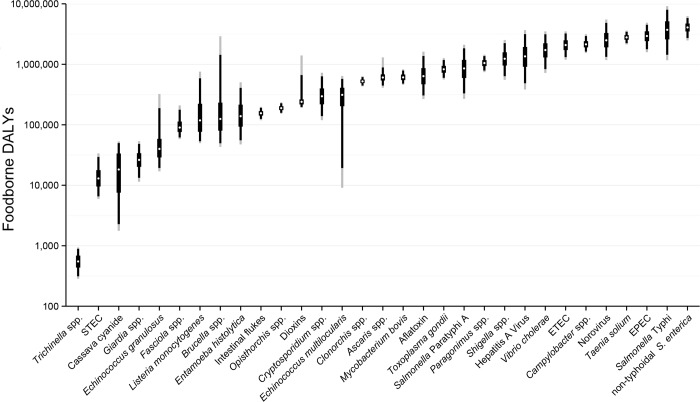
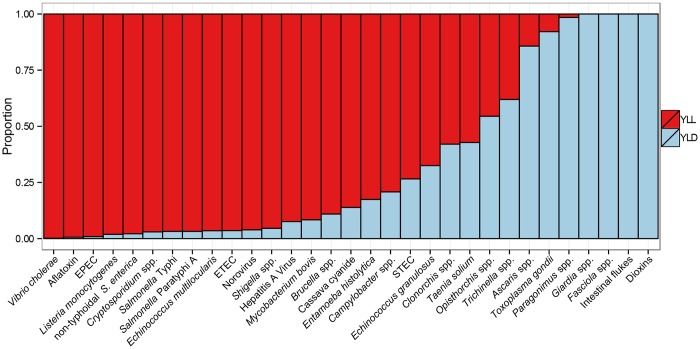
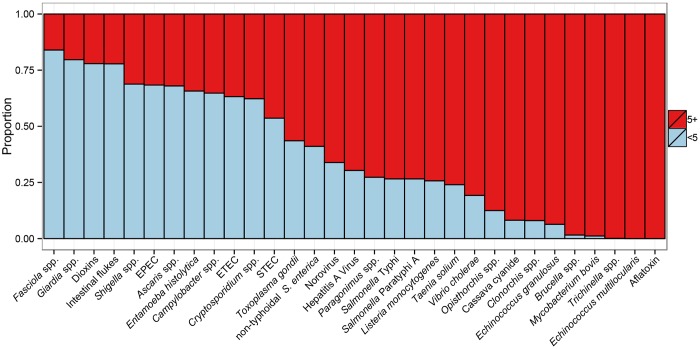
The global burden of foodborne disease caused by 31 hazards in 2010 was 33 million DALYs; children under five years old bore 40% of this burden.
Overview
CoChat Summary
## TL;DR
The WHO Foodborne Disease Burden Epidemiology Reference Group estimated that 31 foodborne hazards caused 600 million illnesses, 420,000 deaths, and 33 million DALYs worldwide in 2010. The burden was concentrated in low-income regions and in children under 5, with diarrheal disease agents—especially norovirus, Campylobacter spp., and non-typhoidal Salmonella enterica—accounting for most illness and death.
## Key findings
- Thirty-one hazards caused an estimated 600 million (95% UI 420–960 million) illnesses, 420,000 (95% UI 310,000–600,000) deaths, and 33 million (95% UI 25–46 million) DALYs in 2010.
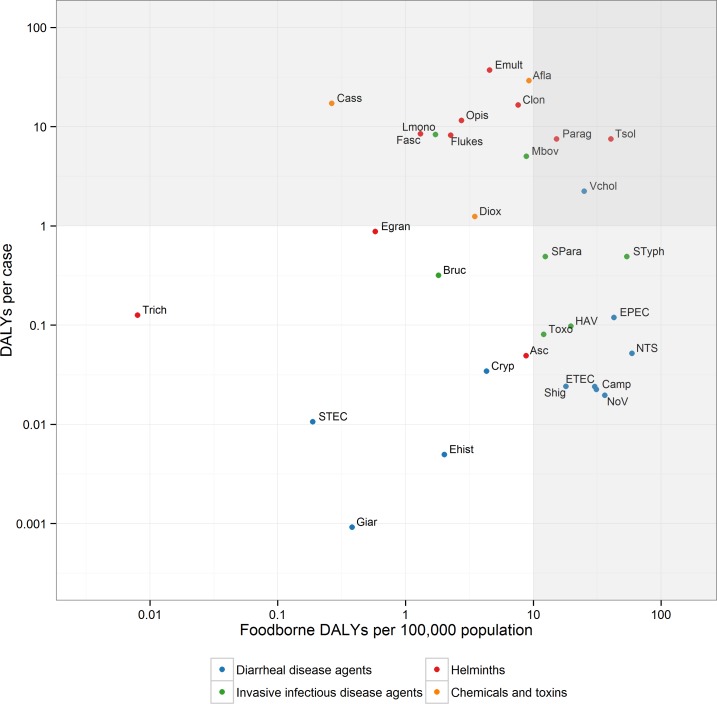
- Diarrheal disease agents accounted for 550 million illnesses and 230,000 deaths; the most frequent illness agents were norovirus (120 million cases) and Campylobacter spp. (96 million cases).
- Non-typhoidal Salmonella enterica caused 59,000 deaths and 4.0 million DALYs; other major death causes included Salmonella Typhi (52,000 deaths), Taenia solium (28,000), hepatitis A virus (28,000), and aflatoxin (20,000; 95% UI 8,000–51,000).
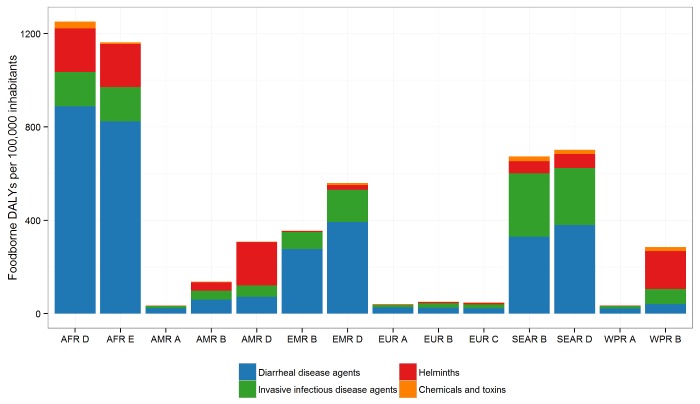
- 40% of the foodborne disease burden was borne by children under 5; the highest burden per 100,000 population was in AFR D (1,300 DALYs) and AFR E (1,200 DALYs), with SEAR B (690), SEAR D (710), and EMR D (570) also high.
## Methods
- The study was a WHO FERG global burden estimation using 31 selected foodborne hazards identified on the basis of high incidence/mortality and data availability.
- It estimated incidence, duration, mortality, YLLs, YLDs, and DALYs for 2010 using systematic reviews, other literature, surveillance data, and expert inputs; estimates were made at country level (194 countries) and then presented at subregional level because of uncertainty.
- For attribution, 12 hazards were judged 100% foodborne; for the other 19 hazards, the authors used structured expert elicitation (Cooke’s Classical Method) to estimate the foodborne fraction, and propagated uncertainty with Monte Carlo simulation in R.
## Limitations
- The paper states its estimates are limited by data gaps and attribution uncertainty; for most hazards, the 95% DALY uncertainty interval ranged from one-fourth to four times the median.
- The authors say the estimates are conservative (underestimates rather than overestimates) because they focused on a subset of more than 100 potential hazards, excluded some hazards or outcomes, and could not always include all relevant disease outcomes.
- They note that country-level estimates were not reliable enough to present, so results are shown at subregion level; this follows from the text and is not presented as a separate explicit limitation.
Model-written summary. Check it against the paper before relying on it.
Integrity signals
Registry
Cites
Statistics
Figures
Verification
Claims the paper makes
5 Valid · 5 Not valid · 16 Not checked · 102 Own results and interpretations
The cited sources that could be checked couldn’t confirm or dispute this claim.
In the paper
“Contaminants in food were not even included as risk factors in previous studies of the global burden of all diseases [3].”
§ World Health Organization Global Estimates and Regional Comparisons of the Burden of Foodborne Disease in 2010 > Introduction
What the sources say
- Could not verifycites [3] Lim SS, Vos T, Flaxman AD, Danaei G, Shibuya K, Adair-Rohani H, et al A comparative risk assessment of burden of disease and injury attributable to 67 risk factors and risk factor clusters in 21 regions, 1990–2010: a systematic analysis for the Global Burden of Disease Study 2010. Lancet. 2012; 380(9859): 2224– 60. 10.1016/S0140-6736(12)61766-8 23245609 PMC4156511 sourceExperimental — accuracy not yet measured
The Discussion describes dietary risk factors such as sodium intake and diets low in fruits or vegetables, but does not address contaminants in food. Searches for food contaminants, foodborne disease, and specific contaminants found no passage establishing whether previous global burden studies included them as risk factors. Page numbers were not available in our copy. (LLM, conf=0.73)
plain- Asserted: passes — The authors put it forward as true.
- Checkable: passes — It can be checked against evidence.
- Load-bearing: passes — The paper’s conclusions depend on it.
- Based: passes — The paper gives a reason why it holds.
- Could not verify
Every source the paper cites for this claim was checked and supports it.
In the paper
“Inclusion of these outcomes would likely considerably increase the burden of enteric infections [43].”
§ World Health Organization Global Estimates and Regional Comparisons of the Burden of Foodborne Disease in 2010 > Introduction > Limitations
What the sources say
- Supportedcites [43] Haagsma JA, Siersema PD, De Wit NJ, Havelaar AH. Disease burden of post-infectious irritable bowel syndrome in The Netherlands. Epidemiol Infect. 2010; 138: 1650– 6. 10.1017/S0950268810000531 20223049 source
The DISCUSSION of our copy states that the annual non-fatal burden of PI-IBS (over 2300 YLD) 'almost doubl[es] the total non-fatal burden of disease for the selected pathogens' and that ignoring PI-IBS in burden-of-disease studies results in an underestimation; it further concludes that including PI-IBS in estimates for the selected bacterial pathogens 'might still underestimate the burden of disease of foodborne disease'. The RESULTS quantify this (Salmonella +86%, Campylobacter +92%, Shigella +151% when PI-IBS is included), and the Abstract repeats the underestimation point, so the hedged claim that including functional bowel disorders would considerably increase the burden of enteric infections is stated by the source. The source's own scope is three bacterial pathogens in The Netherlands (with norovirus PI-IBS discussed as comparable to Campylobacter), which the citing sentence generalises to enteric infections, but the paper itself makes that extrapolation. (LLM, conf=0.85)
hedgedstates a possible cause- Asserted: passes — The authors put it forward as true.
- Checkable: passes — It can be checked against evidence.
- Load-bearing: unclear — It is unclear whether the paper’s conclusions depend on it.
- Based: passes — The paper gives a reason why it holds.
- Supported
A result the paper states — it cites no source for it, so there is none to check. The quote shows it is in the paper.
In the paper
“Foodborne diarrheal disease agents, particularly non-typhoidal Salmonella enterica, caused 230,000 (95% UI 160,000–320,000) deaths”
§ World Health Organization Global Estimates and Regional Comparisons of the Burden of Foodborne Disease in 2010 > Summary Points
plainstates a cause- Asserted: passes — The authors put it forward as true.
- Checkable: passes — It can be checked against evidence.
- Load-bearing: unclear — It is unclear whether the paper’s conclusions depend on it.
- Based: passes — The paper gives a reason why it holds.
A result the paper states — it cites no source for it, so there is none to check. The quote shows it is in the paper.
In the paper
“the burden of Opisthorchis spp. was concentrated in the SEAR B region”
§ World Health Organization Global Estimates and Regional Comparisons of the Burden of Foodborne Disease in 2010 > Summary Points
plainstates an association- Asserted: passes — The authors put it forward as true.
- Checkable: passes — It can be checked against evidence.
- Load-bearing: unclear — It is unclear whether the paper’s conclusions depend on it.
- Based: passes — The paper gives a reason why it holds.
A result the paper states — it cites no source for it, so there is none to check. The quote shows it is in the paper.
In the paper
“The burden of aflatoxin was high in the AFR D, Western Pacific (WPR) B and SEAR B subregions”
§ World Health Organization Global Estimates and Regional Comparisons of the Burden of Foodborne Disease in 2010 > Summary Points
plain- Asserted: passes — The authors put it forward as true.
- Checkable: passes — It can be checked against evidence.
- Load-bearing: unclear — It is unclear whether the paper’s conclusions depend on it.
- Based: passes — The paper gives a reason why it holds.
48 more claims
Create a free account to see all 128 claims and to verify the 5 references still open.
- Probably not a substantial claim. 63
- It may state two separate claims as one. 28
Claims other papers make about this one
Each is checked against this paper’s own text: does it say what the citing paper says it does?
The source backs part of the claim, not all of it — or backs it for a different population, condition or comparison.
In the citing paper
“The FERG found that hazards accounted for around 420,000 deaths in LMIC, imposing a burden of around 33 million DALY lost each year (Havelaar et al., 2015).”
From Burden of foodborne disease in low-income and middle-income countries and opportunities for scaling food safety interventions (2023) · cites this paper as Havelaar et al., 2015
Experimental — accuracy not yet measuredThe source backs part of the claim, not all of it — or backs it for a different population, condition or comparison.
In the citing paper
“Children aged under 5 years were disproportionately affected.This group makes up 9% of the world's population, yet they experience 38% of all FBD, represent 30% of deaths related to FBD, and bear 40% of global DALY lost from FBD (Havelaar et al., 2015).”
From Burden of foodborne disease in low-income and middle-income countries and opportunities for scaling food safety interventions (2023) · cites this paper as Havelaar et al., 2015
Experimental — accuracy not yet measuredThe cited source says what the claim attributes to it.
In the citing paper
“This paper, which represents the work of more than 60 experts over a period of 10 years, can be considered the most definitive and comprehensive guide to the health burden of FBD (Havelaar et al., 2015).”
From Burden of foodborne disease in low-income and middle-income countries and opportunities for scaling food safety interventions (2023) · cites this paper as Havelaar et al., 2015
The cited source says what the claim attributes to it.
In the citing paper
“Although LLMICs bear a high burden of foodborne disease [2]”
From Food Safety Knowledge, Attitude, and Practices (KAP) of Urban Consumers in Low-Income and Lower-Middle-Income Countries (LLMICs): A Scoping Review (2026) · cites this paper as [2]
Citations
Cites
R: A Language and Environment for Statistical Computing
R Core Team (2025) · doi:10.32614/r.manuals · Cited by 352,181
Lim, S. S., Vos, T., Flaxman, A. D., Danaei, G., Shibuya, K., Adair-Rohani, H., AlMazroa, M. A., Amann, M., Anderson, H. R., Andrews, K. G., et al. (2012) · The Lancet · doi:10.1016/s0140-6736(12)61766-8 · Cited by 11,805 · cited 1×
“Contaminants in food were not even included as risk factors in previous studies of the global burden of all diseases [3].”
BackgroundMurray, C. J. L., Vos, T., Lozano, R., Naghavi, M., Flaxman, A. D., Michaud, C., Ezzati, M., Shibuya, K., Salomon, J. A., Abdalla, S., et al. (2012) · The Lancet · doi:10.1016/s0140-6736(12)61689-4 · Cited by 8,888
Foodborne illness acquired in the United States—Major pathogens
Scallan, E., Hoekstra, R. M., Angulo, F. J., Tauxe, R. V., Widdowson, M.-A., Roy, S. L., Jones, J. L., & Griffin, P. M. (2011) · Emerging Infectious Diseases · doi:10.3201/eid1701.p11101 · Cited by 7,657 · cited 1×
“Several high-income countries have published national estimates of FBD. Estimates of food-related illnesses and deaths in the USA were reported in the late 1990s [28] and updated to cover the period 2000 – 2008 [29,30].”
BackgroundSelf-citationFood-Related Illness and Death in the United States
Mead, P. S., Slutsker, L., Dietz, V., McCaig, L. F., Bresee, J. S., Shapiro, C., Griffin, P. M., & Tauxe, R. V. (1999) · Emerging Infectious Diseases · doi:10.3201/eid0505.990502 · Cited by 7,235
Global mortality, disability, and the contribution of risk factors: Global Burden of Disease Study
Murray, C. J., & Lopez, A. D. (1997) · The Lancet · doi:10.1016/s0140-6736(96)07495-8 · Cited by 4,492 · cited 1×
“The DALY measure combines the years of life lost (YLL) due to premature death and the years lived with disability (YLD) from a disease or condition, for varying degrees of severity, making time the common metric for death and disability [20].”
BackgroundSelected major risk factors and global and regional burden of disease
Ezzati, M., Lopez, A. D., Rodgers, A., Vander Hoorn, S., & Murray, C. J. (2002) · The Lancet · doi:10.1016/s0140-6736(02)11403-6 · Cited by 3,594
Kirk, M. D., Pires, S. M., Black, R. E., Caipo, M., Crump, J. A., Devleesschauwer, B., Döpfer, D., Fazil, A., Fischer-Walker, C. L., Hald, T., et al. (2015) · PLoS Medicine · doi:10.1371/journal.pmed.1001921 · Cited by 1,625 · cited 2×
“Detailed descriptions of methods to estimate incidence and mortality of all 31 hazards can be found in papers in the collection on enteric diseases [11], parasitic diseases [18], and chemicals and toxins [19].”
BackgroundMethodSelf-citationSalomon, J. A., Vos, T., Hogan, D. R., Gagnon, M., Naghavi, M., Mokdad, A., Begum, N., Shah, R., Karyana, M., Kosen, S., et al. (2012) · The Lancet · doi:10.1016/s0140-6736(12)61680-8 · Cited by 1,322
Global burden of aflatoxin-induced hepatocellular carcinoma: A risk assessment
Liu, Y., & Wu, F. (2010) · Environmental Health Perspectives · doi:10.1289/ehp.0901388 · Cited by 1,224
Research works printed but not linked: 2
- Gibb H, Devleesschauwer B, Bolger PM, Bellinger D, Wu F, Ezendam J, et al WHO estimates of the global and regional burden from chemicals and toxins in food, 2010. F1000Research. In Press. PMC4755404 26918123
- Devleesschauwer B, Haagsma JA, Angulo FJ, Bellinger D, Cole D, Döpfer D, et al Methodological Framework for World Health Organization Estimates of the Global Burden of Foodborne Disease. PLoS ONE 10: e0142498 10.1371/journal.pone.0142498 PMC4668830 26633883 · DOI · Paper page
Cited by
Items 1,701–1,800 of 2,051
Abud, H. B. (2021) · Digital Library of Theses and Dissertations (Universidade de São Paulo) · doi:10.11606/d.10.2021.tde-16072021-114318
OCCURRENCE OF BRUCELLA IN MILK AND CREAM
EL-KHOLY, A. M., Meshref, A. M. S., HAMED, N. A., et al. (2017) · Assiut Veterinary Medical Journal/Maǧallaẗ Asyūṭ al-ṭibiyyaẗ al-baytariyyaẗ · doi:10.21608/avmj.2017.170951
Regional and Age Epidemiological Analysis of Hepatitis A Viral in China, 2004-2017Preprint
Xu, Y. J., Tang, R., & Li, W. (2021) · Research Square · doi:10.21203/rs.3.rs-864630/v1
Vilela, F. P. (2021) · Digital Library of Theses and Dissertations (Universidade de São Paulo) · doi:10.11606/d.60.2021.tde-29092021-082305
الفرضیات الجدلیة لکوفید-19 ما بین نظریة المؤآمرة والمقاربة الإیکولوجیة
رشاد, س. م. (2021) · The Journal of the Faculty of Economics and Political Science · doi:10.21608/jpsa.2021.199925
RNase III-mediated processing of a trans-acting bacterial sRNA and its cis-encoded antagonist
Svensson, S. L., & Sharma, C. M. (2021) · eLife · doi:10.7554/elife.69064
Подготовка будущего учителя к реализации гендерного подхода
Ринатовна, З. А., & Александровна, А. Л. (2013) · Филология и культура
Nghiên cứu một số đặc điểm bệnh lý lâm sàng bệnh sán lá gan nhỏ trên chó
Nguyễn, V. T., Nguyễn, Đ. T., Lê, Đ. Q., et al. (2021) · Can Tho University Journal of Science · doi:10.22144/ctu.jvn.2021.157
Superinfection of other hepatitis viruses on top of chronic hepatitis B: The more, the worse
Lin, C. (2021) · Advances in digestive medicine · doi:10.1002/aid2.13308
Survey of Hygiene Level by Indicator Bacteria in Some Cheese from Port-Said City
Osman, N., Dobara, M. A., El-Sayed, A., et al. (2022) · Alfarama Journal of Basic & Applied Sciences · doi:10.21608/ajbas.2022.110526.1081
“…to be harmful to humans, first: the human may ingest the pathogen itself through the contaminated food that is called (food infection), second: the human may ingest the poison produced by the pathogen itself that is called (food intoxication) also that is leading to Poisoning Syndrome [3].”
A quantitative risk metric to support individual sanitary measure reviews in international trade
Ebel, E. D., Kause, J. R., Williams, M. S., Schlosser, W. D., Defibaugh-Chávez, S., & Tameru, B. (2022) · International Journal of Food Microbiology · doi:10.1016/j.ijfoodmicro.2022.109616
Antimicrobial Resistance and Virulence Mechanisms
Oliveira, M. (2022) · MDPI eBooks · doi:10.3390/books978-3-0365-3905-8 · Cited by 1
Mohammed, A. S., Alla, A. B. A., Galander, A., et al. (2021) · F1000Research · doi:10.12688/f1000research.53682.2
Hu, K., Li, H., Zhang, J., Hu, Y., Chen, J., & Han, J. W. (2022) · Research Square · doi:10.21203/rs.3.rs-1542289/v1
World Bank East Asia and Pacific Economic Update, April 2019: Managing Headwinds
Bank, W. (2019) · World Bank, Washington, DC eBooks · doi:10.1596/978-1-4648-1412-9 · Cited by 8
McDermott, J. J. (2018) · Elsevier eBooks · doi:10.1016/b978-0-08-100596-5.21566-7
Trade-Offs and Synergies Between Food Quality, Nutrition, and Food Safety
Häsler, B. (2018) · Elsevier eBooks · doi:10.1016/b978-0-08-100596-5.21569-2
BIOFILMES DE Campylobacter spp
Buiatte, A. B. G., & Andrade, P. (2019) · Enciclopédia Biosfera · doi:10.18677/encibio_2019b8
Sripa, B., & Brindley, P. J. (2018) · Advances in Parasitology/Advances in parasitology · doi:10.1016/s0065-308x(18)30046-0
Sripa, B., & Brindley, P. J. (2018) · Advances in Parasitology/Advances in parasitology · doi:10.1016/s0065-308x(18)30069-1
Technological innovation, food safety and economic development in lower middle-income countries
Kariuki, S. W. (2020) · doi:10.18174/532210 · Cited by 1
Vuitton, D. A., Zhang, W., & Giraudoux, P. (2018) · Michigan State University eBooks · doi:10.14321/waterpathogens.39 · Cited by 2
O’Brien, S. J. (2020) · doi:10.1093/med/9780198746690.003.0313
Functional Transcriptomics for Bacterial Gene Detectives
Perez-Sepulveda, B. M., & Hinton, J. C. D. (2018) · ASM Press eBooks · doi:10.1128/9781683670247.ch32
Wilson, M. E. (2017) · Infectious diseases · doi:10.1002/9781119085751.ch29
Prevalence and risk factors of Salmonella Spp in ovine flocks in the central region of Algeria
Benzaouche, A., Dechicha, A. S., Abdelli, A., et al. (2021) · Veterinaria, Sarajevo · doi:10.51607/22331360.2021.70.3.281
Pathogenic Mechanisms of Bacterial Foodborne Pathogens
Garcia, M. A., & Haddad, N. (2022) · Wiley eBooks · doi:10.1002/9781119986980.ch4 · Cited by 2
Severity index for a national foodborne outbreak surveillance systemPreprint
Simpson, R., Sanchez, E., Sallade, L. E., Kulinkina, A. V., & Naumova, E. N. (2022) · Research Square · doi:10.21203/rs.3.rs-1720769/v1
Nfongeh, J. F., n, D. D. O., Akhaneregbe, P., et al. (2022) · Journal of Advances in Microbiology · doi:10.9734/jamb/2022/v22i930486
Yushina, Y. K., Zaiko, E. V., Grudistova, M. A., et al. (2022) · Theory and practice of meat processing · doi:10.21323/2414-438x-2022-7-2-125-130
Food Safety in the US: Regulation, Liability, and Tracing
Horeh, M. B. (2022) · doi:10.33915/etd.11396
Indrotristanto, N., Andarwulan, N., Fardiaz, D., et al. (2022) · SQUALEN Bulletin of Marine and Fisheries Postharvest and Biotechnology · doi:10.15578/squalen.636
“For example, disability-adjusted life years were available for mercury and cadmium (Havelaar et al., 2015), but this information was not available for histamine.”
MethodHygiene Assessment of Paper Currency and Fomites Handled by Food Vendors in Covenant University
Obinna, C. N., Somachi, Q. C., & Olushola, D. K.-A. (2022) · IOP Conference Series Earth and Environmental Science · doi:10.1088/1755-1315/1054/1/012005
Microbiological safety of meat | thermotolerant Campylobacter
Kroft, B., & Singh, M. (2022) · Elsevier eBooks · doi:10.1016/b978-0-323-85125-1.00080-6
Shaker, A. S., Marrez, D. A., Ali, M. A.-S., et al. (2022) · Research Square · doi:10.21203/rs.3.rs-2114203/v1
KURKUMİN TABANLI BİYOPOLİMER FİLMLERİN GÖRÜNÜR IŞIK ALTINDA GELİŞTİRİLMESİ
KİT, İ., & Kahyaoğlu, L. N. (2022) · GIDA / THE JOURNAL OF FOOD · doi:10.15237/gida.gd22079
Food Safety Cultures: A Study of Food Vendors in Abuja Municipal Area Council (AMAC), Nigeria
Okita, U. F., Amos, B., & Olokun, A. L. (2022) · Asian Food Science Journal · doi:10.9734/afsj/2022/v21i12602 · Cited by 1
Bacteriophage and Virus Engineering
Kumar, S., Pattnaik, R., Sahu, P. S., & Bhattacharya, B. (2022) · Springer eBooks · doi:10.1007/978-981-19-3979-2_6 · Cited by 1
Раимкулов, К. М. (2022) · Journal of Internal Medicine and Health Affairs · doi:10.58489/2836-2411/004
Carole, N. V. D., Yang, J. M., Yuan, X. H., Sun, J., Sun, X., & Ji, J. (2023) · Research Square · doi:10.21203/rs.3.rs-2609153/v1
Epidemiological Behavior of Diseases Transmitted by Food, in a Department of Colombia, 2012-2015
Osorio, B. P., Gómez, E. A. D. L. H., Peralta, G. P., et al. (2018) · Open Access Journal of Nursing · doi:10.22259/2639-1783.0102009
Chitosan nanoparticles as used against food pathogens
Hernández‐Patlan, D., Solís-Cruz, B., Hernández-Velasco, X., & Téllez‐Isaías, G. (2023) · Elsevier eBooks · doi:10.1016/b978-0-12-821663-7.00008-9 · Cited by 1
Hepatitis viral en atención primaria
Pol, S. (2023) · EMC - Tratado de Medicina · doi:10.1016/s1636-5410(23)47688-x
Is it food poisoning or allergy?
Anagnostou, A., & Abrams, E. M. (2023) · Annals of Allergy Asthma & Immunology · doi:10.1016/j.anai.2022.12.019
Optimization of Escherichia coli Bacteriophages Production
Kola, V. D. H. N., Srikanth, K., Pasha, S. M., et al. (2023) · Journal of Advances in Microbiology · doi:10.9734/jamb/2023/v23i4718
Meng, X. (2023) · Utrecht University Repository (Utrecht University) · doi:10.33540/1811
(2023) · Journal of Food Chemistry and Nanotechnology · doi:10.17756/jfcn.2023-149
Burden of Foodborne Diseases From Biological Hazards
Bari, C. D., & Devleesschauwer, B. (2023) · Elsevier eBooks · doi:10.1016/b978-0-12-822521-9.00221-5
Self-citationDefining Risk: Hepatitis A Virus in Philippine Shellfish (Oyster and Mussels)Preprint
Lopez, C. M., Barrios, E. B., Bullecer, E. R., Balolong, M. P., Tanay, D. D., Salem, A. M., Gosilatar, J. C., Lagazon, P. M., Dalmacio, L. M. M., & Rustia, A. S. (2023) · Research Square · doi:10.21203/rs.3.rs-2986597/v1
Epidemiological characteristics of acute hepatitis A, 2013–2016: a cross-sectional study in Morocco
Karami, A., Fihry, R. E., Haddaji, A., et al. (2023) · Scandinavian Journal of Infectious Diseases · doi:10.1080/23744235.2023.2228405
Phages and Their Derived Proteins as Promising Alternatives to Mitigate MDR Salmonellae
Sritha, K. S., & Bhat, S. G. (2023) · Springer eBooks · doi:10.1007/978-981-19-9279-7_36
Smithers, G. W., & Moy, G. G. (2023) · Elsevier eBooks · doi:10.1016/b978-0-12-822521-9.00259-8
Galanis, E., Goshtasebi, A., Hung, Y. W., Chan, J., Matsell, D. G., Chapman, K. M., Kaplan, G. G., Kaplan, D., Patrick, D., Zhang, B. Y., et al. (2023) · Relevé des maladies transmissibles au Canada · doi:10.14745/ccdr.v49i78a01f
Taddese, D., Abdurahaman, M., Debelo, M., et al. (2023) · Research Square · doi:10.21203/rs.3.rs-3268197/v1
Patógenos bacterianos caudadores de doenças veiculadas por alimentos
Gorodicht, M. A. D. M., & Kindlein, L. (2023) · Microbiologia · doi:10.4322/mp.978-65-84548-16-9.c2
Cassini, A. (2023) · Utrecht University Repository (Utrecht University) · doi:10.33540/1881
Chain, L. C. A., Snoek, H. M., Nassar, G., Raaijmakers, I., & Nombré, A. (2023) · doi:10.18174/638781
Chain, L. C. A., Snoek, H. M., Nassar, G., Raaijmakers, I., & Sidibé, A. (2023) · doi:10.18174/638782
Nanotechnology for bacteriophages, bacteriophages for nanotechnology
Raza, S., & Paczesny, J. (2023) · Royal Society of Chemistry eBooks · doi:10.1039/9781839169427-00243
Tracking Progress and Generating Accountability for Global Food System Commitments
Nordhagen, S., & Fanzo, J. (2023) · Oxford University Press eBooks · doi:10.1093/oso/9780198882121.003.0014 · Cited by 3
Utami, N. P., Setyawati, R., & Pratiwi, I. (2022) · Jurnal Pemberdayaan Publikasi Hasil Pengabdian Kepada Masyarakat · doi:10.12928/jpm.v6i3.5673
“The impact of foodborne illness is very large on socio-economic conditions in society because it causes losses such as decreased productivity of a person due to conditions of being unable to work due to illness or death [3].”
BackgroundIwuagwu, U. O., Nkwa, A. A., Nworuh, B. O., Iwuala, C. C., Innocent, D. C., Ikeanumba, M. O., & Mary, O. O. (2023) · Journal of Clinical Microbiology and Biochemical Technology · doi:10.17352/jcmbt.000053 · Cited by 2
Triwibowo, R., Yennie, Y., & Widianto, W. E. (2023) · E3S Web of Conferences · doi:10.1051/e3sconf/202344204003
Microbial inactivation by photodynamic treatment
do Prado‐Silva, L. (2020) · doi:10.47749/t/unicamp.2020.1170814
Maus, D., Putrianti, E. D., Hoffmann, T., Laue, M. M., Seeber, F., & Blume, M. (2026) · eLife · doi:10.1101/2023.11.23.568420 · Cited by 1
“Of all food-borne pathogens, T. gondii causes 20% of the total disease burden in Europe (Havelaar et al. 2015).”
Sebsibe, K. A., Mulugeta, Y., Legesse, T. G., et al. (2023) · Research Square · doi:10.21203/rs.3.rs-3653018/v1
Essential Oils: A Natural Weapon against Mycotoxins in Food
Tiwari, A., Parshant, & Shukla, R. (2023) · Springer eBooks · doi:10.1007/978-981-99-4370-8_6
Foodborne Diseases (Article Review)
(2023) · Academic International Journal of Medical Sciences · doi:10.59675/m135
“The global burden of FBD caused by the 31 hazards in 2010 was 33 million Disability Adjusted Life Years (DALYs); children under five years old bore 40% of this burden”[5].”
InfluentialLefsih, K., Cherfi, Y., Cherfi, N., et al. (2023) · The North African Journal of Food and Nutrition Research · doi:10.51745/najfnr.7.16.146-155
Kalule, J. B., Bester, L. A., Banda, D. L., et al. (2024) · SSRN Electronic Journal · doi:10.2139/ssrn.4687154
Mathematical Modeling of Norovirus Outbreaks: Assessing Intervention StrategiesPreprint
Ndendya, J. Z., David, J., Bahaye, D., et al. (2024) · Research Square · doi:10.21203/rs.3.rs-3856806/v1
Chen, C., & Wu, F. (2024) · PLOS Global Public Health · doi:10.1371/journal.pgph.0002761
Le, T. L. A., Ta, T. L., Dinh, T. M., Vũ, T. T., Pham, T. H. G., Bui, T. T. N., Pham, H. V., Nguyen, N. T., Trieu, P. L., Le, T. V. A., et al. (2024) · Problems of Particularly Dangerous Infections · doi:10.21055/0370-1069-2023-4-84-90 · Cited by 1
Gong, J., Zeng, X., Xu, J., et al. (2024) · Veterinary Sciences · doi:10.3390/vetsci11010046
“Non-typhoidal Salmonella enterica stands as a major global foodborne pathogen, causing approximately 78 million illnesses and 59,000 deaths annually [1–3].”
BackgroundPutra, I. G. A. U. S., Darwinata, A. E., Pinatih, K. J. P., & Fatmawati, N. N. D. (2022) · E-Jurnal Medika Udayana · doi:10.24843/mu.2022.v11.i06.p11
WarenstromInfo: a tool for the easy extraction and visualisation of trade flow data
Mesa-Varona, O., Plaza‐Rodríguez, C., Valentin, L., & Filter, M. (2024) · Research Ideas and Outcomes · doi:10.3897/rio.10.e112227
Carhuaricra, D. (2023) · Digital Library of Theses and Dissertations (Universidade de São Paulo) · doi:10.11606/d.95.2023.tde-07022024-204134
Balaguer, M. D. T. (2024) · Tesis Doctorals en Xarxa (Consorci de Serveis Universitaris de Catalunya) · doi:10.6035/14103.2024.458
Doan, N. K., Lại, Q. D., Le, T. K. P., et al. (2024) · Research Square · doi:10.21203/rs.3.rs-3922948/v1
Olsen, J. E., Frees, D., Kyvsgaard, N. C., & Barco, L. (2024) · Letters in Applied Microbiology · doi:10.1093/lambio/ovae015
BAKTERIOFAG DAN APLIKASI DALAM MENGENDALIKAN BAKTERI PATOGEN UNTUK MENINGKATKAN KEAMANAN PANGAN
Gaffar, A., & Suryani, E. M. (2023) · Jurnal BIOMA · doi:10.21009/bioma18(2).1 · Cited by 2
Saliha, S., Dawood, A. B., Asghar, H., et al. (2024) · Journal of Population Therapeutics and Clinical Pharmacology · doi:10.53555/jptcp.v31i4.5321
Global food crisis: current state of availability, safety and quality
Radovanović, R. М. (2020) · Edicija Održivi razvoj i upravljanje prirodnim resursima Republike Srpske. · doi:10.7251/eoru2002001r
Principles of Good Manufacturing Practices and Good Hygienic Practice in Food Processing
Radovanović, R. М. (2020) · Edicija Održivi razvoj i upravljanje prirodnim resursima Republike Srpske. · doi:10.7251/eoru2002061r · Cited by 3
Riaz, A., Asghar, K., Anjum, F., et al. (2024) · Bulletin of Business and Economics (BBE) · doi:10.61506/01.00231
Role of Probiotic Strains in Ensuring Food Safety
Kisa, J. (2024) · Journal of Food Sciences · doi:10.47941/jfs.1848
Burcham, Z. M., Tweedie, J. L., Farfán-García, A. E., et al. (2024) · bioRxiv (Cold Spring Harbor Laboratory) · doi:10.1101/2024.05.06.592725
Type of Resistant Microbes Responsible for Food Spoilage
Baksi, T. P. S. (2024) · International Journal of Science and Research (IJSR) · doi:10.21275/sr24423150433
Patógenos veiculados por alimentos em eventos de massa
Pedro, R. C. (2024) · Digital Library of Theses and Dissertations (Universidade de São Paulo) · doi:10.11606/d.10.2024.tde-24042024-154329
Mouloudi, I., Zitouni, N., Zerhouni, R., et al. (2024) · E3S Web of Conferences · doi:10.1051/e3sconf/202452702017
Masood, E., Hassanin, F., EL-Roos, N. A. A., & Sabeq, I. I. (2024) · Egyptian Journal of Veterinary Science · doi:10.21608/ejvs.2024.271738.1867 · Cited by 2
Delgado, J. L. B., Fuentes, J., Parraga, K., Fontenot, K. K., Adhikari, A., & Janes, M. E. (2024) · Revista Facultad Nacional de Agronomía Medellín · doi:10.15446/rfnam.v77n1.107310
Bringing Food Safety to the Shoppers
Nordhagen, S., Garsow, A. V., Swartz, H., Alhassan, M. M., & Isyaku, I. (2024) · doi:10.36072/wp.40
Jweer, I. M., & Al-Mahmood, O. A. (2024) · Journal of Applied Veterinary Sciences/Journal of Applied Veterinary Sciences · doi:10.21608/javs.2024.292677.1341
Metadata
- Authors
- Havelaar, A. H., Kirk, M. D., Torgerson, P. R., Gibb, H. J., Hald, T., Lake, R. J., Praet, N., Bellinger, D. C., de Silva, N. R., Gargouri, N., Speybroeck, N., Cawthorne, A., Mathers, C., Stein, C., Angulo, F. J., Devleesschauwer, B., & on behalf of World Health Organization Foodborne Disease Burden Epidemiology Reference Group
- Affiliations
- Utrecht University (NL)
- Australian National University (AU)
- University of Zurich (CH)
- Technical University of Denmark (DK)
- New Zealand Institute for Public Health and Forensic Science (NZ)
- Instituut voor Tropische Geneeskunde (BE)
- Boston Children's Hospital (US)
- UCLouvain (BE)
- World Health Organization (CH)
- Centers for Disease Control and Prevention (US)
- Ghent University (BE)
- Corresponding author
- Havelaar, Arie H.
- ORCID
- Venue
- PLoS Medicine
- Publisher
- Public Library of Science (PLoS)
- Published
- 2015-12-03
- Volume
- 12
- Issue
- 12
- Pages
- e1001923
- ISSN
- 1549-1277 (ISSN-L)
- 1549-1676
- PMC
- PMC4668832
- OpenAlex
- W2186140012
- Cited by
- 2,067
- References
- 40
- Citations by year
- 2026: 220 · 2025: 251 · 2024: 235 · 2023: 267 · 2022: 217 · 2021: 219 · 2020: 206 · 2019: 153 · 2018: 149 · 2017: 90 · 2016: 51 · 2015: 3
- FWCI
- 130.65
- Type
- journal article
- Language
- en
- Open access
- gold
- doi.org
- Licence
- Locations
- PLoS Medicine (publishedVersion, cc-by)
- Europe PMC (PubMed Central) (publishedVersion, cc-by)
- PubMed Central (publishedVersion, cc-by)
- PubMed (publishedVersion)
- EUR Research Repository (Erasmus University Rotterdam) (publishedVersion, cc-by)
- Zurich Open Repository and Archive (University of Zurich) (acceptedVersion, cc-by)
- ResearchOnline (Glasgow Caledonian University) (acceptedVersion, cc-by)
- Ghent University Academic Bibliography (Ghent University) (submittedVersion, other-oa)
- EUR Research Repository (Erasmus University Rotterdam) (submittedVersion, other-oa)
- CGSPace A Repository of Agricultural Research Outputs (Consultative Group for International Agricultural Research) (submittedVersion, other-oa)
- Digital Access to Libraries (submittedVersion, other-oa)
- DOAJ (DOAJ: Directory of Open Access Journals) (submittedVersion, cc-by-sa)
- Utrecht University Repository (Utrecht University) (submittedVersion, other-oa)
- ANU Open Research (Australian National University) (submittedVersion)
- Technical University of Denmark, DTU Orbit (Technical University of Denmark, DTU) (submittedVersion, cc-by)
- Bristol Research (University of Bristol) (submittedVersion, cc-by)
- Rivm (National Institute for Public Health and the Environment) (submittedVersion)
- Zurich Open Repository and Archive (University of Zurich) (submittedVersion, cc-by)
- Zurich Open Repository and Archive (University of Zurich)
- Funders
- World Health Organization
- University of Pittsburgh
- Institute for Health Metrics and Evaluation
- Topics
- Life Sciences › Agricultural and Biological Sciences › Food Science › Salmonella and Campylobacter epidemiology
- Life Sciences › Agricultural and Biological Sciences › Food Science › Food Safety and Hygiene
- Health Sciences › Medicine › Infectious Diseases › Viral gastroenteritis research and epidemiology
- Keywords
- food poisoning, disease burden, disability-adjusted life years, food safety hazards, diarrheal disease, norovirus, Campylobacter, non-typhoidal Salmonella, Salmonella typhi, Taenia solium, hepatitis A virus, parasitic helminths, child mortality, regional comparison, food safety policy
- MeSH terms
- Foodborne Diseases, Humans, Global Health, World Health Organization, Incidence, Prevalence, Cost of Illness, Quality-Adjusted Life Years
About these checks
Registry, retraction, Cites and statistics results are computed, not judged, with one exception: a printed reference that no index lists is read once by a model before it counts as a citation error. Claims are extracted by a model and kept only when their quote appears verbatim in the text; each cited source is then checked, with a model’s help, for whether it says what the claim relies on. Those verdicts can be wrong — read the claim’s quote and the cited source before relying on one.
The claim verdicts this report counts are experimental: their accuracy is not yet measured.
A language model drew the claims from the paper on 2026-10-10, under version 3 of the claim definition (model deepseek-v4.1-flash, prompt extract-v3).
A second model labelled each claim on 2026-10-10 (model jev-1.13-20260917, definition revision gold-guideline-v0.2).
Cited sources are checked with a language model’s help (gpt-6-sol and qwen3.8-omni-flash).
Statistics and arithmetic are recomputed, not judged.
Confidence bands are shown only for fields calibrated on our annotated test set. None is calibrated yet, so no band is shown.
What counts as a claim ›How we measure confidence ›How we check this ›
Are you an author, or do you see a problem with this page? Request a review
Data sources
Bibliographic data: Semantic Scholar, OpenAlex, Crossref.
Contains information from the Semantic Scholar Academic Graph Datasets, made available under the ODC Attribution License (ODC-BY 1.0).
Semantic Scholar’s data is described in: Kinney, R., et al. (2023). The Semantic Scholar Open Data Platform. arXiv:2301.10140.
