

How Many Scientists Fabricate and Falsify Research? A Systematic Review and Meta-Analysis of Survey Data
Open accessThe DOI matches its Crossref record; 66 of the 74 references it cites were found in a registry or an index; none of the 21 sources its claims cite is checked for support yet.
Abstract
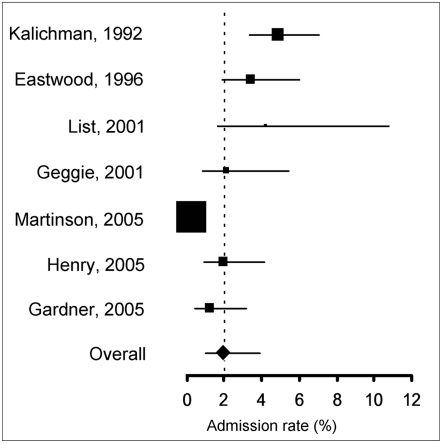
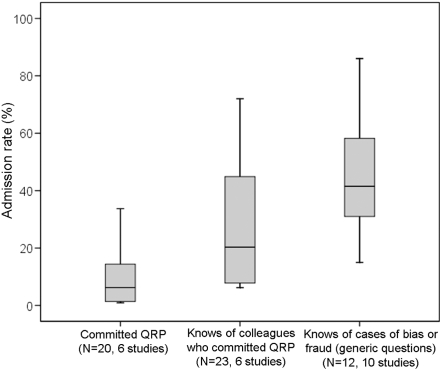
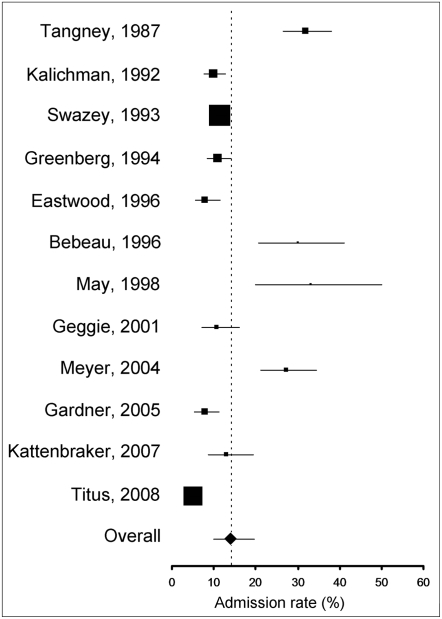
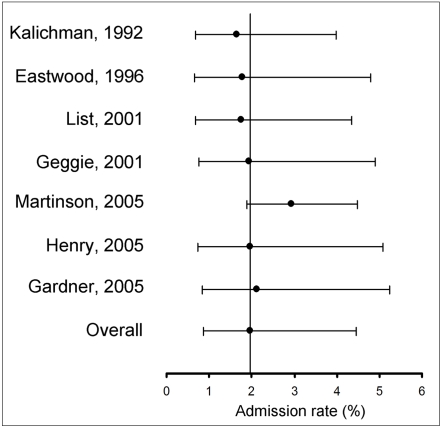
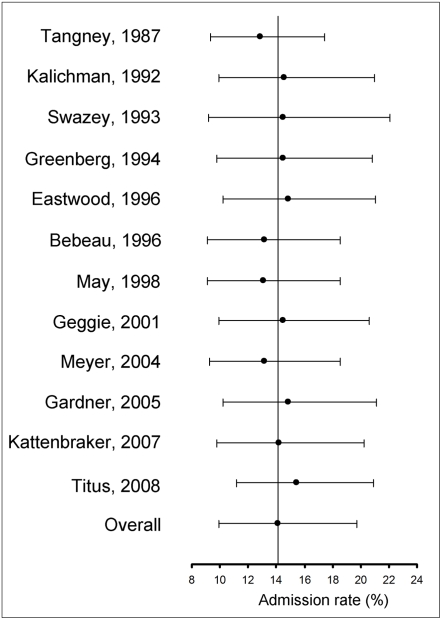
The frequency with which scientists fabricate and falsify data, or commit other forms of scientific misconduct is a matter of controversy. Many surveys have asked scientists directly whether they have committed or know of a colleague who committed research misconduct, but their results appeared difficult to compare and synthesize. This is the first meta-analysis of these surveys. To standardize outcomes, the number of respondents who recalled at least one incident of misconduct was calculated for each question, and the analysis was limited to behaviours that distort scientific knowledge: fabrication, falsification, "cooking" of data, etc... Survey questions on plagiarism and other forms of professional misconduct were excluded. The final sample consisted of 21 surveys that were included in the systematic review, and 18 in the meta-analysis. A pooled weighted average of 1.97% (N = 7, 95%CI: 0.86-4.45) of scientists admitted to have fabricated, falsified or modified data or results at least once--a serious form of misconduct by any standard--and up to 33.7% admitted other questionable research practices. In surveys asking about the behaviour of colleagues, admission rates were 14.12% (N = 12, 95% CI: 9.91-19.72) for falsification, and up to 72% for other questionable research practices. Meta-regression showed that self reports surveys, surveys using the words "falsification" or "fabrication", and mailed surveys yielded lower percentages of misconduct. When these factors were controlled for, misconduct was reported more frequently by medical/pharmacological researchers than others. Considering that these surveys ask sensitive questions and have other limitations, it appears likely that this is a conservative estimate of the true prevalence of scientific misconduct.
Overview
CoChat Summary
TL;DR
This systematic review and meta-analysis of survey data estimated that about 2% of scientists admitted to fabricating, falsifying, or modifying data or results at least once, while 14.12% reported knowing a colleague who did so. The paper argues these are conservative estimates and that methodological choices strongly shape the observed rates.
Key findings
- Across surveys explicitly asking whether scientists ever fabricated or falsified data or altered/modifed results, the pooled weighted estimate was 1.97% (95% CI 0.86–4.45; N = 7), with significant heterogeneity (Cochran’s Q = 61.7777, df = 6, P < 0.0001).
- When only questions explicitly using the words “fabrication” or “falsification” were included, the pooled estimate for self-reports was 1.06% (95% CI 0.31–3.51; N = 4).
- For reports about colleagues’ misconduct, the pooled weighted estimate was 14.12% (95% CI 9.91–19.72; N = 12); restricting to questions using “fabrication” or “falsification” gave 12.34% (95% CI 8.43–17.71; N = 11).
- Other questionable research practices were reported more often: up to 33.7% in self-reports and up to 72% when asking about colleagues.
Methods
- Systematic review and meta-analysis of quantitative surveys asking scientists whether they had committed or observed scientific misconduct in the past; plagiarism and other non-knowledge-distorting misconduct were excluded.
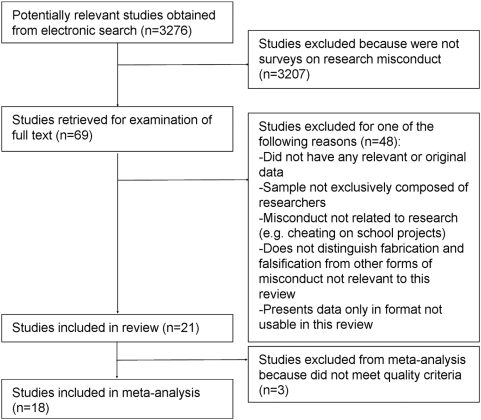
- Searches were run in the first two weeks of August 2008 across citation databases, journals, grey literature sources, and internet search engines; the final review included 21 studies, with 18 in the meta-analysis.
- Main analysis computed the proportion recalling at least one incident, logit-transformed and inverse-variance weighted in a random-effects meta-analysis; meta-regression tested methodological factors such as self vs. non-self reports, mailed vs. handed-out surveys, and use of the words “fabrication”/“falsification.”
Limitations
- The paper states that using the percentage of respondents recalling at least one incident is a rough measure of misconduct frequency; this can under- or overestimate prevalence depending on whether respondents committed multiple incidents or only one.
- The paper notes that non-response bias was recognized by most surveys as a limitation, and that the validity of self-reports may be affected by social expectations; the text also suggests self-reports likely underestimate misconduct.
- Evident from the text: the included studies were heterogeneous in methods and wording, and some outcomes were too diverse for meaningful meta-analysis, so only crude unweighted parameters were calculated for broader questionable research practices.
Model-written summary. Check it against the paper before relying on it.
Integrity signals
Registry
Cites
Statistics
Figures
Verification
Claims the paper makes
0 Valid · 0 Not valid · 14 Not checked · 61 Own results and interpretations
A result the paper reports from its own data — it cites no other source for it, so there is none to check. The quote shows it is in the paper.
In the paper
“When these factors were controlled for, misconduct was reported more frequently by medical/pharmacological researchers than others.”
§ How Many Scientists Fabricate and Falsify Research? A Systematic Review and Meta-Analysis of Survey Data > Abstract
plainstates an association- Asserted: passes — The authors put it forward as true.
- Checkable: passes — It can be checked against evidence.
- Load-bearing: passes — The paper’s conclusions depend on it.
- Based: passes — The paper gives a reason why it holds.
- Rests on 2 assumptions not shown here.
A result the paper reports from its own data — it cites no other source for it, so there is none to check. The quote shows it is in the paper.
In the paper
“A pooled weighted average of 1.97% (N = 7, 95%CI: 0.86–4.45) of scientists admitted to have fabricated, falsified or modified data or results at least once –a serious form of misconduct by any standard– and up to 33.7% admitted other questionable research practices.”
§ How Many Scientists Fabricate and Falsify Research? A Systematic Review and Meta-Analysis of Survey Data > Abstract
plainn = 7- Asserted: passes — The authors put it forward as true.
- Checkable: passes — It can be checked against evidence.
- Load-bearing: passes — The paper’s conclusions depend on it.
- Based: passes — The paper gives a reason why it holds.
- Rests on 2 assumptions not shown here.
A result the paper reports from its own data — it cites no other source for it, so there is none to check. The quote shows it is in the paper.
In the paper
“A pooled weighted average of 1.97% (N = 7, 95%CI: 0.86–4.45) of scientists admitted to have fabricated, falsified or modified data or results at least once –a serious form of misconduct by any standard– and up to 33.7% admitted other questionable research practices.”
§ How Many Scientists Fabricate and Falsify Research? A Systematic Review and Meta-Analysis of Survey Data > Abstract
plain- Asserted: passes — The authors put it forward as true.
- Checkable: passes — It can be checked against evidence.
- Load-bearing: passes — The paper’s conclusions depend on it.
- Based: passes — The paper gives a reason why it holds.
- Rests on 2 assumptions not shown here.
A result the paper reports from its own data — it cites no other source for it, so there is none to check. The quote shows it is in the paper.
In the paper
“In surveys asking about the behaviour of colleagues, admission rates were 14.12% (N = 12, 95% CI: 9.91–19.72) for falsification, and up to 72% for other questionable research practices.”
§ How Many Scientists Fabricate and Falsify Research? A Systematic Review and Meta-Analysis of Survey Data > Abstract
plainn = 12- Asserted: passes — The authors put it forward as true.
- Checkable: passes — It can be checked against evidence.
- Load-bearing: passes — The paper’s conclusions depend on it.
- Based: passes — The paper gives a reason why it holds.
- Rests on 2 assumptions not shown here.
A result the paper reports from its own data — it cites no other source for it, so there is none to check. The quote shows it is in the paper.
In the paper
“Meta-analysis yielded mean pooled estimates that are higher than most previous estimates.”
§ How Many Scientists Fabricate and Falsify Research? A Systematic Review and Meta-Analysis of Survey Data > Introduction
plain- Asserted: passes — The authors put it forward as true.
- Checkable: passes — It can be checked against evidence.
- Load-bearing: passes — The paper’s conclusions depend on it.
- Based: passes — The paper gives a reason why it holds.
- Rests on 2 assumptions not shown here.
31 more claims
Create a free account to see all 75 claims and to verify the 4 references still open.
- It may state two separate claims as one. 24
- Probably not a substantial claim. 25
Claims other papers make about this one
Each is checked against this paper’s own text: does it say what the citing paper says it does?
The cited source says what the claim attributes to it.
In the citing paper
“there are other more common sources of unreliability in the literature (41)(42)(43)(44)”
From Misconduct accounts for the majority of retracted scientific publications (2012) · cites this paper as [43]
The cited source says what the claim attributes to it.
In the citing paper
“The prevalence of researchers who have been involved in scientific misconduct is estimated to be around 2% [2]”
From Checklist to assess Trustworthiness in RAndomised Controlled Trials (TRACT checklist): concept proposal and pilot (2023) · cites this paper as [2]
The cited source says what the claim attributes to it.
In the citing paper
“This is how a small number of people 40 with flexible morals can pollute the scientific literature disproportionately.”
From Fraudulent studies are undermining the reliability of systematic reviews: on the prevalence of problematic images in preclinical depression studies (2025) · cites this paper as [40]
The cited source says what the claim attributes to it.
In the citing paper
“A meta-analysis by Fanelli, combining the results of 18 published surveys, found that 1.9% of researchers have admitted to modification, falsification, or fabrication of data (3).”
From The Prevalence of Inappropriate Image Duplication in Biomedical Research Publications (2016) · cites this paper as [3]
The cited source says what the claim attributes to it.
In the citing paper
“A systematic review and meta-analysis of survey data estimated that 1.97% of authors admitted to have fabricated, falsified, or modified data or results at least once and, in surveys asking about the behavior of colleagues, the admission rate was 14.12% for falsification [13].”
From No raw data, no science: another possible source of the reproducibility crisis (2020) · cites this paper as [13]
6 more claims about this paper
Create a free account to see every claim other papers make about this one.
Citations
Cites
(2000) · Cited by 9,198
The Sociology of Science: Theoretical and Empirical Investigations
Kaplan, N., Merton, R. K., & Storer, N. W. (1974) · Technology and Culture · doi:10.2307/3102264 · Cited by 4,005
The Normative Structure of Science
Merton, R. Κ. (1973) · Medical Entomology and Zoology · Cited by 2,315
The Hazards of Scoring the Quality of Clinical Trials for Meta-analysis
Jüni, P. (1999) · JAMA · doi:10.1001/jama.282.11.1054 · Cited by 1,981 · cited 1×
“All remaining papers were included, and were not graded on a quality scale, because the validity and use of quality measures in meta-analysis is controversial [21], [22].”
BackgroundScope and Impact of Financial Conflicts of Interest in Biomedical Research: A Systematic Review
Bekelman, J. E., Li, Y., & Gross, C. P. (2003) · JAMA · doi:10.1001/jama.289.4.454 · Cited by 1,816 · cited 1×
“This would support growing fears that the large financial interests that often drive medical research are severely biasing it [50], [51], [52].”
BackgroundTourangeau, R., & Smith, T. W. (1996) · Public Opinion Quarterly · doi:10.1086/297751 · Cited by 1,295 · cited 1×
“However, the accuracy of responses to sensitive questions is often independent of response rates, and depends strongly on respondents' perception of anonymity and confidentiality [43], [44].”
BackgroundA comparison of methods to detect publication bias in meta‐analysis
Macaskill, P., Walter, S. D., & Irwig, L. (2001) · Statistics in Medicine · doi:10.1002/sim.698 · Cited by 1,286 · cited 1×
“The popular funnel-plot-based methods to test for publication bias in meta-analysis are inappropriate and potentially misleading when the number of included studies is small and heterogeneity is large [25], [26].”
MethodMartinson, B. C., Anderson, M. S., & de Vries, R. (2005) · Nature · doi:10.1038/435737a · Cited by 1,096 · cited 9×
“All the above results were robust with respect to inclusion or exclusion of any particular study, with perhaps one exception: Martinson et al. (2005) [19], which is one of the largest and most frequently cited surveys on misconduct published to date.”
BackgroundMethodResultInfluentialAdjusting for publication bias in the presence of heterogeneity
Terrin, N., Schmid, C. H., Lau, J., & Olkin, I. (2003) · Statistics in Medicine · doi:10.1002/sim.1461 · Cited by 809 · cited 1×
“The popular funnel-plot-based methods to test for publication bias in meta-analysis are inappropriate and potentially misleading when the number of included studies is small and heterogeneity is large [25], [26].”
MethodIs Academic Medicine for Sale?
Angell, M. (2000) · New England Journal of Medicine · doi:10.1056/nejm200005183422009 · Cited by 582
Research works printed but not linked: 2
- Eastwood S Derish P Leash E Ordway S 1996 Ethical issues in biomedical research: perceptions and practices of postdoctoral research fellows responding to a survey. Science and Engineering Ethics 2 89 114 11657788 · DOI
- Kattenbraker MS 2007 Health education research and publication: ethical considerations and the response of health educators Carbondale Southern Illinois University.Doctoral dissertation
Cited by
Items 701–800 of 1,924
Wang, S., Xiaomei, Z., & Lin, D. (2022) · Computational Intelligence and Neuroscience · doi:10.1155/2022/7406716 · Cited by 22
Improving Science That Uses Code
Thimbleby, H. (2023) · The Computer Journal · doi:10.1093/comjnl/bxad067 · Cited by 19
Integridade científica e pesquisa em saúde no Brasil: revisão da literatura
Pádua, G. C. C., & Guilhem, D. (2015) · Revista Bioética · doi:10.1590/1983-80422015231053 · Cited by 28
“2013 [acesso 10 out 2014]; 2013;8(9):e73381.”
"Predatory Journals" or "Predatory Scholars?" The Essential Role of the Peer Review Process
Chirico, F. (2017) · The International Journal of Occupational and Environmental Medicine · doi:10.15171/ijoem.2017.1082 · Cited by 12
“7% admitted to other questionable research practices.(5) In a review, Ioannidis described key factors and some corollaries about the increasing concern that, in modern research, most claimed research findings are false.”
BackgroundSakaluk, J. K., & Graham, C. A. (2017) · The Journal of Sex Research · doi:10.1080/00224499.2017.1395387 · Cited by 13
“…verify one’s findings (Wicherts, Bakker, & Molenaar, 2011; Wicherts, Borsboom, Kats, & Molenaar, 2006), or engaging in flagrant data fabrication (Fanelli, 2009; Stapel, 2014) are all very different behaviors morally, but they share a practical consequence in rendering the scientific record…”
BackgroundHowitt, S. M., & Wilson, A. N. (2018) · Science Education · doi:10.1002/sce.21333 · Cited by 13
“While very few scientists are guilty of outright misconduct, many engage in what have been termed “questionable research practices” (Fanelli, 2009).”
BackgroundReporting in Experimental Philosophy: Current Standards and Recommendations for Future Practice
Polonioli, A., Vega‐Mendoza, M., Blankinship, B., & Carmel, D. (2018) · Review of Philosophy and Psychology · doi:10.1007/s13164-018-0414-3 · Cited by 12
“Individual misconduct or even outright fraud are known to occur, but are likely to be the exception rather than the rule and cannot account for the problem (Fanelli 2009).”
BackgroundNandra, R. S., Brockie, A., & Hussain, F. (2020) · EFORT Open Reviews · doi:10.1302/2058-5241.5.180051 · Cited by 18
Dishonest Conformity in Peer Review
Shibayama, S., & Baba, Y. (2015) · Prometheus · doi:10.1080/08109028.2015.1114745 · Cited by 18
“…and intellectual honesty therein are critical for the progress of science (Merton, 1973; Zuckerman, 1977), dishonesty has been commonly and increasingly observed in the forms of misconduct and other questionable practices (Martinson et al., 2005; Fanelli, 2009; Fang et al., 2012; Martin, 2013).”
InfluentialReplicability Crisis and Scientific Reforms: Overlooked Issues and Unmet Challenges
Andreoletti, M. (2020) · International Studies in the Philosophy of Science · doi:10.1080/02698595.2021.1943292 · Cited by 17
“These detrimental habits range from questionable practices, such as self-citation (Bartneck and Kokkelmans 2011), image duplication (Bik, Casadevall, and Fang 2016), running underpowered studies (Maxwell 2004), to actual frauds, such as data fabrication (Fanelli 2009).”
Backgroundvan de Schoot, R., Winter, S. D., Griffioen, E., Grimmelikhuijsen, S., Arts, I., Veen, D., Grandfield, E. M., & Tummers, L. G. (2021) · Frontiers in Psychology · doi:10.3389/fpsyg.2021.621547 · Cited by 17
“While a focus on innovation and knowledge production are essential to academic progress, it is equally important to convey and stimulate the use of the most appropriate research practices within the academic community (Martinson et al., 2005; Fanelli, 2009; Tijdink et al., 2014).”
BackgroundCombating scientific misconduct
(2010) · Nature Cell Biology · doi:10.1038/ncb0111-1 · Cited by 12
Exploring the bibliometric and semantic nature of negative results
Gumpenberger, C., Gorraiz, J. I., Wieland, M., Roche, I., Schiebel, E., Besagni, D., & François, C. (2012) · Scientometrics · doi:10.1007/s11192-012-0829-z · Cited by 14
“Data fabrication and falsification are probably rare, but other questionable research practices might be relatively common (Fanelli 2009).”
BackgroundA epidemia de más condutas na ciência: o fracasso do tratamento moralizador
de Oliveira, M. B. (2015) · Scientiae Studia · doi:10.1590/s1678-31662015000400007 · Cited by 21
The Replicability Crisis and Public Trust in Psychological SciencePreprint
Anvari, F., & Lakens, D. (2019) · doi:10.31234/osf.io/vtmpc · Cited by 12
A revised and expanded taxonomy for understanding heterogeneity in research and reporting practices.
Manapat, P. D., Anderson, S. F., & Edwards, M. C. (2022) · Psychological Methods · doi:10.1037/met0000488 · Cited by 11
Academic integrity among nursing students: A survey of knowledge and behavior
Nortes, I., Fierz, K., Goddiksen, M. P., & Johansen, M. W. (2023) · Nursing Ethics · doi:10.1177/09697330231200568 · Cited by 17
“The discrepancy between self-and external assessment is well known and reported by Fanelli, 13 for instance, or Anderson et. al (2007), as cited in Fanelli.”
Presence and consequences of positive words in scientific abstracts
Edlinger, M., Buchrieser, F., & Wood, G. M. D. O. (2023) · Scientometrics · doi:10.1007/s11192-023-04864-6 · Cited by 15
“In view of the literature suggesting that psychology is more exposed to those forces that create hype in science than “harder” sciences (Fanelli, 2009, 2010, 2012; Laws, 2013; Madden et al., 1995) the present results suggest that + jargon may represent a problem for the quality of scientific work.”
BackgroundInfluentialA dream EEG and mentation database
Wong, W., Herzog, R. A., Andrade, K. C., Andrillon, T., de Araújo, D. B., Arnulf, I., Ataei, S., Avvenuti, G., Baird, B., Bellesi, M., et al. (2025) · Nature Communications · doi:10.1038/s41467-025-61945-1 · Cited by 29
“While useful onits own, the databaseand preliminary results will serve asthemostpromisingstartingpointforfuturestudies,tobepublished as the registered report or registered analysis format 77 , which came about in response to the replicability crisis 78 – 81 .”
Scientific retraction: a synonym for pseudoscience?
Sheth, B. P., & Thaker, V. S. (2014) · Acta bioethica · doi:10.4067/s1726-569x2014000100010 · Cited by 15
“A meta-analysis of studies on scientific misconduct showed that on average, about 2 percent of scientists admitted to have fabricated, falsified or modified data or results at least once and up to one third admitted to a variety of other questionable research practices(11).”
BackgroundZhang, Q., & Fu, H. (2022) · Scientometrics · doi:10.1007/s11192-021-04252-y · Cited by 13
“…2020; Mardani et al., 2020; Were et al., 2020; Yi et al., 2019), these self‑report surveys might solely provide a conservative estimation of the emergences of scientific misconduct, considering the concealing to answering sensitive questions among interviewees and other limitations (Fanelli, 2009).”
BackgroundInfluentialHastings, R. C., Labib, K., Lechner, I. M., Bouter, L. M., Widdershoven, G. A. M., & Evans, N. (2022) · Science and Public Policy · doi:10.1093/scipol/scac067 · Cited by 20
Cao, Y., Jiang, Y., & Zhao, Y. (2023) · Frontiers in Research Metrics and Analytics · doi:10.3389/frma.2023.943228 · Cited by 17
“A comparative analysis of definitions of research misconduct in university policies Research misconduct is an important aspect of research integrity (Fanelli, 2009; Li, 2011; Bouter, 2015), and its definition is essential to RI management.”
BackgroundEvidence-based medicine – are we boiling the frog?
Muckart, D. J. J. (2013) · South African Medical Journal · doi:10.7196/samj.6805 · Cited by 14
Rational Choice and Moral Decision Making in Research
Gordon, A. M. (2014) · Ethics & Behavior · doi:10.1080/10508422.2013.830573 · Cited by 13
“A meta-analysis of the prevalence studies published to date found that between .3% and 4.9% of scientists have reportedly fabricated or falsified research data (Fanelli, 2009).”
BackgroundResultInfluentialRétractations pour erreur et pour fraude
Decullier, É., Samson, G., & Huot, L. (2012) · La Presse Médicale · doi:10.1016/j.lpm.2012.05.006 · Cited by 15
“Une revue de littérature a montré que 2 % des scientifiques rapportaient avoir fabriqué, falsifié ou manipulé des résultats au moins une fois et 33,7 % avoir eu d’autres pratiques non réglementaires [37].”
BackgroundThe Writing Style of Predatory Publishers
Markowitz, D. M., Powell, J. H., & Hancock, J. T. (2020) · ASEE Annual Conference & Exposition · doi:10.18260/1-2--23192 · Cited by 13
Sabotaging Another: Priming Competition Increases Cheating Behavior in Tournaments
Rigdon, M. L., & D’Esterre, A. P. (2017) · Southern Economic Journal · doi:10.1002/soej.12232 · Cited by 11
Responsible Conduct of Research (RCR): The Basic Tenet of the Chemical Sciences
DeShong, P. R. (2019) · Springer eBooks · doi:10.1007/978-3-319-76040-7_69-1 · Cited by 11
Shi, J., Zhang, X., Qian, S., Wei, S., Yan, K., Xu, M., Lai, H., & Tonetti, M. S. (2021) · Journal Of Clinical Periodontology · doi:10.1111/jcpe.13571 · Cited by 12
“Surveys have indicated that 2% of scientists admit having engaged in serious questionable practice and 14% report being aware of colleagues having engaged in such practices (Fanelli, 2009).”
BackgroundParlangeli, O., Palmitesta, P., Bracci, M., Marchigiani, E., Pomponio, I. D., & Guidi, S. (2022) · Science and Engineering Ethics · doi:10.1007/s11948-022-00362-9 · Cited by 17
“Therefore the condition of isolation experienced by academics, in addition to psychological symptoms, may also have consequences on the perception and enactment of behaviors that can be qualified as misconduct able to negatively affect research integrity (Bouter et al., 2016; Fanelli, 2009; Steneck, 2006) or unethical…”
BackgroundVindras, P., Desmurget, M., & Baraduc, P. (2012) · PLoS ONE · doi:10.1371/journal.pone.0039059 · Cited by 18
“Finally, we are not without hoping that making the UKS test available may abate the inclination to force significant average effects out by discarding individuals, multiple testing [36] or other questionable practices [37].”
BackgroundAlbers, S. (2013) · Journal of Business Economics · doi:10.1007/s11573-013-0675-3 · Cited by 14
Podder, A., Pandey, D., & Latha, N. (2016) · Biochimie · doi:10.1016/j.biochi.2016.01.011 · Cited by 14
Astronomy, topography and landscape at Akragas’ Valley of the Temples
Hannah, R., Magli, G., & Orlando, A. (2017) · Journal of Cultural Heritage · doi:10.1016/j.culher.2016.11.016 · Cited by 11
Citation bias in the literature on dietary trans fatty acids and serum cholesterol
Urlings, M. J. E., Duyx, B., Swaen, G. M. H., Bouter, L. M., & Zeegers, M. P. (2018) · Journal of Clinical Epidemiology · doi:10.1016/j.jclinepi.2018.10.008 · Cited by 12
Bruton, S. V., Brown, M., & Sacco, D. F. (2019) · Journal of Empirical Research on Human Research Ethics · doi:10.1177/1556264619894435 · Cited by 13
“Fanelli (2009) reports that almost 34% scientists surveyed admitted to using QRPs other than research misconduct, and in surveys about the behavior of colleagues up to 72% acknowledged QRP use.”
BackgroundDai, H., Young, H. P., Durant, T. J. S., Gong, G., Kang, M., Krumholz, H. M., Schulz, W. L., & Jiang, L. (2018) · arXiv (Cornell University) · doi:10.48550/arxiv.1807.03662 · Cited by 38
“Data manipulation, whether unintentional or due to scientific fraud [1-8], can be difficult to identify without a robust infrastructure for managing data assets.”
BackgroundDREAM: A Dream EEG and Mentation databasePreprint
Wong, W., Andrade, K. C., Andrillon, T., de Araújo, D. B., Arnulf, I., Avvenuti, G., Baird, B., Bellesi, M., Bergamo, D., Bernardi, G., et al. (2023) · doi:10.31234/osf.io/69e43 · Cited by 12
Schneider, J. W., Allum, N., Andersen, J. P., et al. (2023) · doi:10.31222/osf.io/r6j3z · Cited by 11
Autonomous artificial intelligence, scientific research, and human values
Resnik, D. B., Hosseini, M., & Hauswald, R. (2026) · AI and Ethics · doi:10.1007/s43681-025-00908-0 · Cited by 15
“…traditional peer review and 16Although surveys indicate that FFP is relatively rare in science, when it does occur it can be extremely damaging to science and society, because it can erode the public’s trust in science and lead to mistaken decisions or policies based on faulty data [33, 67].”
Integrity and Misconduct, Where Does Artificial Intelligence Lead?
Nicholas, D., Herman, E., Clark, D., Abrizah, A., Revez, J. M. R., Bravo, B. R., Świgoń, M., Xu, J., & Watkinson, A. (2025) · Learned Publishing · doi:10.1002/leap.2013 · Cited by 16
Wissenschaftliches Fehlverhalten – ein Problem in der deutschen Volkswirtschaftslehre?
Necker, S. (2012) · Perspektiven der Wirtschaftspolitik · doi:10.1111/j.1468-2516.2012.00396.x · Cited by 14
Mickel, A., & Byrd, N. (2021) · History of the Human Sciences · doi:10.1177/09526951211015855 · Cited by 13
Effects of Findings of Scientific Misconduct on Postdoctoral Trainees
Redman, B. K., & Merz, J. F. (2013) · AJOB Primary Research · doi:10.1080/21507716.2013.804010 · Cited by 10
“2006; Titus, Wells, and Rhoades 2008), though an estimated 2% of scientists admitting to falsification or fabrication may translate into thousands of questionable studies (Fanelli 2009).”
BackgroundVitenskapelig uredelighet – kunnskap, handlinger og holdninger hos doktorgradskandidater
Hofmann, B., & Holm, S. (2016) · Tidsskrift for Den norske legeforening · doi:10.4045/tidsskr.16.0149 · Cited by 10
Räsänen, L., & Moore, E. (2016) · Research Integrity and Peer Review · doi:10.1186/s41073-016-0020-9 · Cited by 22
“Plagiarism has been found to be common in master’s theses [5, 6], and questionable research practices are also common [1, 3, 7, 8].”
Fraude scientifique : une menace majeure pour la recherche médicale
Barde, F., Peiffer‐Smadja, N., & Blanchardière, A. D. L. (2020) · La Revue de Médecine Interne · doi:10.1016/j.revmed.2020.02.004 · Cited by 15
Accumulating Knowledge in the Organizational Sciences
Bosco, F. A. (2021) · Annual Review of Organizational Psychology and Organizational Behavior · doi:10.1146/annurev-orgpsych-012420-090657 · Cited by 14
Broad Medical Uncertainty and the ethical obligation for openness
Brown, R. C. H., de Barra, M., & Earp, B. D. (2022) · Synthese · doi:10.1007/s11229-022-03666-2 · Cited by 12
“A metaanalysis and systematic review of survey data found that 1.97% of scientists "admitted to have fabricated, falsified or modified data or results at least once”, whilst 14.12% said they had personal knowledge of a colleague doing so (Fanelli, 2009).”
BackgroundInfluentialHonorary authorship in health sciences: a protocol for a systematic review of survey research
Reynders, R. M., ter Riet, G., Girolamo, N. D., & Malički, M. (2022) · Systematic Reviews · doi:10.1186/s13643-022-01928-1 · Cited by 12
“This was found in metaanalyses of surveys on research integrity issues such as scientists admitting plagiarism [21] or having fabricated or falsified data [22].”
BackgroundKennedy, M., Deans, Z., Ampollini, I., Breit, E., Bucchi, M., Seppel, K., Vie, K. J., & ter Meulen, R. (2023) · Journal of Academic Ethics · doi:10.1007/s10805-022-09469-x · Cited by 13
“It should also be recognised that these findings are about the perceptions of researchers, research managers, research administrators and research governance advisors, and are not themselves evidence of particular phenomenon, which could be investigated using objective measures (Fanelli, 2009).”
BackgroundAn Integrative Qualitative Framework: Improving Research Through Strategic Mapping
Coker, D. C. (2023) · International Research in Education · doi:10.5296/ire.v11i1.20921 · Cited by 19
Mhaidli, A. H., & Roemmich, K. (2024) · CHI Conference Extended Abstracts on Human Factors in Computing Systems (CHI EA) · doi:10.1145/3613905.3644052 · Cited by 14
“…disingenuously, slightly skewing results to make data more impressive than it is or in order to fit a narrative that is more likely to get published (e.g., p-hacking [10], HARKing (hypothesizing after results are known) [29], cherry-picked literature reviews); and outright falsifying data [21].”
BackgroundContemplative Science: An Insider Prospectus
Britton, W. B., Brown, A.-C. H., Kaplan, C. T., Goldman, R. E., DeLuca, M., Rojiani, R., Reis, H. T., Xi, M., Chou, J. C., McKenna, F. F., et al. (2013) · New Directions for Teaching and Learning · doi:10.1002/tl.20051 · Cited by 19
“More than a third of scientists admit to “questionable research practices” that range from “failing to publish data that contradicts one’s previous research” to manipulating or falsifying data (Fanelli 2009, 5738).”
BackgroundExploring the awareness of research among registered massage therapists in Ontario
Baskwill, A., & Dore, K. L. (2015) · Journal of Complementary and Integrative Medicine · doi:10.1515/jcim-2015-0006 · Cited by 10
The risk of bias of animal experiments in implant dentistry: a methodological study
Faggion, C. M., Diaz, K. T., Aranda, L., Gabel, F., Listl, S., & Alarcón, M. A. (2016) · Clinical Oral Implants Research · doi:10.1111/clr.12852 · Cited by 10
“For example, this applies to scenarios of scientific misconduct of researchers, by fabricating or falsifying the data (Fanelli 2009), or to fraudulent behaviour throughout the peer-review process (Haug 2015).”
BackgroundTractenberg, R. E. (2016) · Law, governance and technology series · doi:10.1007/978-3-319-33525-4_16 · Cited by 9
Husemann, M., Rogers, R., Meyer, S. T., & Habel, J. C. (2017) · Humanities and Social Sciences Communications · doi:10.1057/palcomms.2017.32 · Cited by 14
Scherz, P. (2019) · Cambridge University Press eBooks · doi:10.1017/9781108593694 · Cited by 12
RAMP: Real-Time Anomaly Detection in Scientific Workflows
Herath, J. D., Bai, C., Yan, G., Yang, P., & Lu, S. (2019) · IEEE International Conference on Big Data (BigData) · doi:10.1109/bigdata47090.2019.9005653 · Cited by 14
“Although there have been various regulations to prevent or deter misconducts in scientific research, such misbehaviors are still not uncommon, according to a report in 2009 revealing that 2% of scientists surveyed had falsified, fabricated, or modified their research data [12].”
BackgroundThe use and abuse of meta‐analysis
Sotiriadis, A., Chatzakis, C., & Odibo, A. O. (2020) · Ultrasound in Obstetrics and Gynecology · doi:10.1002/uog.22060 · Cited by 9
Daraio, C. C., & Vaccari, A. (2020) · Scientometrics · doi:10.1007/s11192-020-03658-4 · Cited by 13
Launching Registered Report Replications in Computer Science Education Research
Brown, N. C. C., Marinus, E., & Cheuoua, A. H. (2022) · ACM Conference on International Computing Education Research (ICER) · doi:10.1145/3501385.3543971 · Cited by 10
“Some estimates of the prevalence of questionable research practices are as high as one-third of scientists [23] to over one half [32, 42] who engage in such practices (although see the Fiedler and Schwarz [24] rebuttal of John et al.”
BackgroundScientific Fraud, Publication Bias, and Honorary Authorship in Nuclear Medicine
Kwee, T. C., Almaghrabi, M. T., & Kwee, R. M. (2022) · Journal of Nuclear Medicine · doi:10.2967/jnumed.122.264679 · Cited by 13
Educating about biomedical research ethics
Stanković, B., & Stankovic, M. (2014) · Medicine Health Care and Philosophy · doi:10.1007/s11019-014-9561-1 · Cited by 12
“12 % for falsification, and up to 72 % for other questionable research practices (Shamoo and Resnik 2009; Fanelli 2009).”
BackgroundEthics in context: a scandal in academia
Heron, M. J., & Belford, P. H. (2014) · ACM SIGCAS Computers and Society · doi:10.1145/2656870.2656875 · Cited by 14
“Fanelli [15] however suggests that a touch under 2% of scientists admit to having ‘fabricated, falsified or modified data or results at least once’, with over a third admitting ‘other questionable research practices’.”
BackgroundAn offer you can refuse: The effect of transparency with endogenous conflict of interest
Kartal, M., & Tremewan, J. (2018) · Journal of Public Economics · doi:10.1016/j.jpubeco.2018.04.003 · Cited by 9
Research practices and assessment of research misconduct
Hartgerink, C. H. J., & Wicherts, J. M. (2016) · ScienceOpen Research · doi:10.14293/s2199-1006.1.sor-socsci.arysbi.v1 · Cited by 11
“Prevalence of research misconduct is of great interest and, as aforementioned, a meta-analysis in‐ dicated that around 2% of surveyed researchers admit to fabricating or falsifying research at least once (Fanelli, 2009).”
BackgroundInfluentialPublic trust doctrine, research and responsible wildlife management in South Africa
Blackmore, A. (2017) · Bothalia · doi:10.4102/abc.v47i1.2217 · Cited by 17
“org Open Access and consequently responsible wildlife management, is fundamentally vulnerable to ‘perverse research’ in which expedience, falsification, fabrication or misrepresentation of research data prevail (Clavero & Garcia-Berthou 2005; Fanelli 2009; Van Noorden 2011).”
BackgroundDecisions, Decisions, Decisions: An Ethnographic Study of Researcher Discretion in Practice
van Drimmelen, T., Slagboom, M. N., Reis, R., Bouter, L. M., & van der Steen, J. T. (2024) · Science and Engineering Ethics · doi:10.1007/s11948-024-00481-5 · Cited by 16
Mapping nine decades of research integrity studies (1935–2024): A scientometric analysis
Tang, G. (2025) · Accountability in Research · doi:10.1080/08989621.2025.2470860 · Cited by 16
“These included empirical studies on data fabrication among scientists (Fanelli 2009; Martinson, Anderson, and de Vries 2005), conceptual clarifications of research integrity (Steneck 2006), and investigations into retraction causes (Fang, Steen, and Casadevall 2012).”
Balanced examination of positive publication bias impact
Ramos, M. (2025) · Accountability in Research · doi:10.1080/08989621.2025.2538066 · Cited by 12
“An even better approach would be to build studies similar to Fanelli and Tregenza (2009) which found from a meta-analysis of surveys that 1.97% of scientists admit to fabricating or falsifying data or results.”
InfluentialJódar, L., & de la Poza, E. (2020) · Sustainability · doi:10.3390/su12156064 · Cited by 12
Data Reliability in a Citizen Science Protocol for Monitoring Stingless Bees Flight Activity
Leocadio, J. N., Ghilardi-Lopes, N. P., Koffler, S., Barbiéri, C., Francoy, T. M., Albertini, B. D. C., & Saraiva, A. M. (2021) · Insects · doi:10.3390/insects12090766 · Cited by 11
“Some questionable research practices, such as falsification (wilful or unintended distortion of data or results), can negatively impact research [45], so they must be seriously considered when resulting from citizen science practices.”
BackgroundA toolkit for open and pluralistic conservation science
Burgman, M. A., Chiaravalloti, R. M., Fidler, F. M., Huan, Y., McBride, M. F., Marcoci, A., Norman, J., Vercammen, A., Wintle, B. C., & Yu, Y. (2022) · Conservation Letters · doi:10.1111/conl.12919 · Cited by 12
“Unlike fraud, which is reassuringly rare (Fanelli, 2009), the prevalence and persistence of questionable practices, therefore, has potential to lead to poor decisions that precipitate unacceptable and avoidable impacts on biodiversity and social–ecological systems (for an example of a discussion of…”
BackgroundHow to combine rules and commitment in fostering research integrity?
Labib, K., Tijdink, J. K., Sijtsma, K., Bouter, L. M., Evans, N., & Widdershoven, G. A. M. (2023) · Accountability in Research · doi:10.1080/08989621.2023.2191192 · Cited by 17
“%) jeopardizes not only the quality, relevance, and validity of research findings, but also their trustworthiness (Fanelli 2009; Gopalakrishna et al. 2022; Xie, Wang, and Kong 2021).”
Prevalence of plagiarism in hijacked journals: A text similarity analysis
Abalkina, A. (2024) · Accountability in Research · doi:10.1080/08989621.2024.2387210 · Cited by 16
“Extensive literature exists on the topic of scientific misconduct and plagiarism in scientific papers (Almeida et al. 2016; Amos 2014; Fanelli and Tregenza 2009; Fang, Steen, and Casadevall 2012; Pupovac and Fanelli 2015; Resnik, Rasmussen, and Kissling 2015) and checks of text similarities in…”
A Survey of Researcher Perceptions of Replication in Geography
Kedron, P., Holler, J., & Bardin, S. (2024) · Annals of the American Association of Geographers · doi:10.1080/24694452.2024.2415695 · Cited by 10
“Wedeveloped the survey questions following a review of prior reproducibility surveys (e.g., Fanelli 2009; Baker 2016; Konkol, Kray, and Pfeiffer 2019) and our own reading of recurring issues in the reproducibility and replicability literature.”
Social-cognitive barriers to ethical authorship
Schoenherr, J. R. (2015) · Frontiers in Psychology · doi:10.3389/fpsyg.2015.00877 · Cited by 10
“In a review of studies of FFP, Steneck (2006) estimated that its occurrence rate fell within a range of 1.0 and 0.001% (for recent support, see Fanelli, 2009).”
BackgroundInfluentialLa restitution des savoirs, entre courtoisie, transfert de connaissances et geste politique
Piron, F. (2021) · SociologieS · doi:10.4000/sociologies.4728 · Cited by 9
We need more research on causes and consequences, as well as on solutions
Fanelli, D. (2014) · Addiction · doi:10.1111/add.12772 · Cited by 9
Self-citationThe perils of copy and paste: Plagiarism in scientific publishing
Horrom, T. A. (2012) · The Journal of Rehabilitation Research and Development · doi:10.1682/jrrd.2012.09.0165 · Cited by 11
“Fanelli reports that nearly 34 percent of scientists and doctors admitted to employing questionable research practices [5].”
Cross-Field Comparison of Ethics Education: Golden Rules and Particulars
Mulhearn, T. J., Watts, L. L., Torrence, B. S., Todd, E. M., Turner, M. R., Connelly, S., & Mumford, M. D. (2016) · Accountability in Research · doi:10.1080/08989621.2016.1274974 · Cited by 12
“Research misconduct, and its associated consequences, is a prevailing issue in all fields (Fanelli 2009).”
BackgroundWhy published research is untrustworthy
Lose, G., & Klarskov, N. (2017) · International Urogynecology Journal · doi:10.1007/s00192-017-3389-1 · Cited by 10
“This is a very serious challenge to the integrity and reputation of science in general [9].”
BackgroundCreating falseness—How to establish statistical evidence of the untrue
Lytsy, P. (2017) · Journal of Evaluation in Clinical Practice · doi:10.1111/jep.12823 · Cited by 9
Investigating components and causes of sabotage by academics using collective intelligence analysis
Wallace, E., Hogan, M., Noone, C., & Groarke, J. M. (2018) · Studies in Higher Education · doi:10.1080/03075079.2018.1477128 · Cited by 10
Li, D., & CORNELIS, G. C. (2018) · Accountability in Research · doi:10.1080/08989621.2018.1507824 · Cited by 9
“7% admitted other questionable research practices (Fanelli 2009).”
BackgroundLies, damned lies and epidemiology: why global health needs good epidemiological practice guidelines
Alba, S., & Mergenthaler, C. (2018) · BMJ Global Health · doi:10.1136/bmjgh-2018-001019 · Cited by 9
“into three categories: (1) ethical guidelines for research provided by international organisations(7); (2) guidelines for GEP laid out by international(8) and national epidemiological associations; and (3) academic guidelines for reporting epidemiological studies.”
BackgroundSimon, C. M., Beerman, R. W., Ariansen, J. L., Kessler, D., Sanchez, A. M., King, K., Sarzotti‐Kelsoe, M., Samsa, G. P., Bradley, A., Torres, L., et al. (2019) · Accountability in Research · doi:10.1080/08989621.2019.1621755 · Cited by 10
“RCR education is widely considered a means of addressing the potential for wrongdoing and noncompliance among research professionals facing the increasingly complex demands of contemporary scientific practice (Antes and DuBois 2014; Fanelli 2009).”
BackgroundValkenburg, G., Dix, G., Tijdink, J. K., & de Rijcke, S. (2020) · BMC Medical Ethics · doi:10.1186/s12910-020-00496-0 · Cited by 12
“Similarly, publication bias – that is, the tendency not to publish results of research if the results are “negative” in the sense that originally expected, positive, significant findings are not found [22, 23] – is generally agreed to be a bad thing and researchers should not allow themselves to be influenced by it; y…”
BackgroundThe Legal Consequences of Research Misconduct: False Investigators and Grant Proposals
Fong, E. A., Wilhite, A. W., Hickman, C., & Lee, Y. (2020) · The Journal of Law Medicine & Ethics · doi:10.1177/1073110520935347 · Cited by 12
Vie, K. J. (2020) · Life Sciences Society and Policy · doi:10.1186/s40504-020-00102-6 · Cited by 12
“…emerged as an academic field with the realization that researchers sometimes engage fraudulent practices (Steneck 2006) like falsifying and fabricating data (Fanelli 2009), along with other forms of misconduct often labeled questionable research practices in the literature (Shamoo and Resnik 2015).”
BackgroundResearch integrity awareness among biology students – Experience from the University of Belgrade
Zeljić, K. (2020) · Accountability in Research · doi:10.1080/08989621.2020.1843445 · Cited by 10
“Answers might have been influenced by social expectations to be honest and trustworthy (Fanelli 2009).”
BackgroundResultInfluentialAcademia’s Big Five: a normative taxonomy for the epistemic responsibilities of universities
Peels, R., van Woudenberg, R., de Ridder, J., & Bouter, L. M. (2019) · F1000Research · doi:10.12688/f1000research.19459.1 · Cited by 10
Journal editors and publishers’ legal obligations with respect to medical research misconduct
Holbeach, N., Freckelton, I. R., & Mol, B. W. (2022) · Research Ethics · doi:10.1177/17470161221147440 · Cited by 12
“Not all unethical and damaging practices in research are rightly considered misconduct; the related concepts of detrimental research practices (DRPs) and questionable research practices (QRPs) attempt to capture lesser but still serious departures from ethical research practice.”
BackgroundInfluentialNeoh, M. J. Y., Carollo, A., Lee, A., & Esposito, G. (2023) · Royal Society Open Science · doi:10.1098/rsos.230677 · Cited by 18
“Both the citing articles [40,44] discuss the prevalence of research misconduct, where Fanelli [40] conducted a meta-analysis indicated a pooled weighted average of 1.97% of scientists admitting to the fabrication, falsification and modification of data or results at least once.”
BackgroundInfluentialBouter, L. M. (2024) · BMJ · doi:10.1136/bmj.q1595 · Cited by 9
Machado, F. A., & Zaher, H. (2010) · Zoologia (Curitiba) · doi:10.1590/s1984-46702010000400002 · Cited by 10
Submitting a manuscript for peer review - integrity, integrity, integrity
Murphy, S. P., Bulman, C., Shariati, B., & Hausmann, L. (2013) · Journal of Neurochemistry · doi:10.1111/jnc.12644 · Cited by 9
“This was addressed in a systematic review by Fanelli (2009); the number is probably somewhere between 2- 14%, in that 2% of scientists admitted to have fabricated, falsified or modified data, but reported on 14% of their colleagues for doing the same.”
Metadata
- Authors
- Fanelli, D.
- Affiliations
- University of Edinburgh (GB)
- Corresponding author
- Fanelli, Daniele
- ORCID
- Fanelli, Daniele
- Venue
- PLoS ONE
- Publisher
- Public Library of Science (PLoS)
- Published
- 2009-05-29
- Volume
- 4
- Issue
- 5
- Pages
- e5738
- ISSN
- 1932-6203 (ISSN-L)
- PMC
- PMC2685008
- OpenAlex
- W2152243616
- Cited by
- 1,911
- References
- 74
- Citations by year
- 2026: 77 · 2025: 110 · 2024: 128 · 2023: 136 · 2022: 157 · 2021: 145 · 2020: 163 · 2019: 166 · 2018: 125 · 2017: 125 · 2016: 119 · 2015: 106 · 2014: 82 · 2013: 93 · 2012: 84
- FWCI
- 19.42
- Type
- journal article
- Language
- en
- Open access
- gold
- doi.org
- Locations
- PLoS ONE (publishedVersion, cc-by)
- PubMed Central (publishedVersion, cc-by)
- PubMed (publishedVersion)
- Edinburgh Research Explorer (University of Edinburgh) (acceptedVersion, public-domain)
- RePEc: Research Papers in Economics (submittedVersion)
- DOAJ (DOAJ: Directory of Open Access Journals) (submittedVersion, cc-by-sa)
- Figshare (submittedVersion, cc-by)
- DigitalGeorgetown (Georgetown University Library) (submittedVersion)
- Funders
- European Commission (221441)
- Economic and Social Research Council (ES/F028180/1)
- Topics
- Social Sciences › Education › Academic integrity and plagiarism
- Physical Sciences › Mathematics › Statistics and Probability › Benford’s Law and Fraud Detection
- Social Sciences › Library and Information Sciences › Academic Publishing and Open Access
- Keywords
- research misconduct, scientific fraud, data fabrication, data falsification, questionable research practices, self-report questionnaire
- MeSH terms
- Data Collection, Regression Analysis, Research Personnel, Scientific Misconduct, Ethics, Research
About these checks
Registry, retraction, Cites and statistics results are computed, not judged, with one exception: a printed reference that no index lists is read once by a model before it counts as a citation error. Claims are extracted by a model and kept only when their quote appears verbatim in the text; each cited source is then checked, with a model’s help, for whether it says what the claim relies on. Those verdicts can be wrong — read the claim’s quote and the cited source before relying on one.
A language model drew the claims from the paper on 2026-10-10, under version 3 of the claim definition (model deepseek-v4.1-flash, prompt extract-v3).
A second model labelled each claim on 2026-10-10 (model jev-1.13-20260917, definition revision gold-guideline-v0.2).
Statistics and arithmetic are recomputed, not judged.
Confidence bands are shown only for fields calibrated on our annotated test set. None is calibrated yet, so no band is shown.
What counts as a claim ›How we measure confidence ›How we check this ›
Are you an author, or do you see a problem with this page? Request a review
Data sources
Bibliographic data: Semantic Scholar, OpenAlex, Crossref.
Contains information from the Semantic Scholar Academic Graph Datasets, made available under the ODC Attribution License (ODC-BY 1.0).
Semantic Scholar’s data is described in: Kinney, R., et al. (2023). The Semantic Scholar Open Data Platform. arXiv:2301.10140.
