

Gut Microbiota in Human Adults with Type 2 Diabetes Differs from Non-Diabetic Adults
Open accessThe DOI matches its Crossref record; 38 of the 38 references it cites were found in a registry or an index.
Abstract
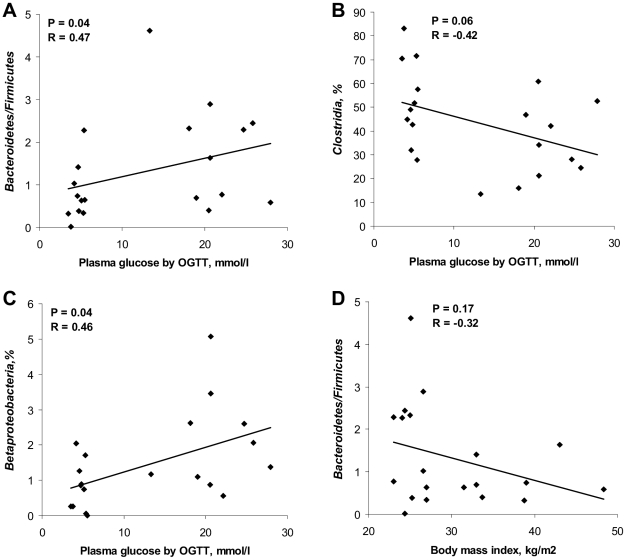
BACKGROUND: Recent evidence suggests that there is a link between metabolic diseases and bacterial populations in the gut. The aim of this study was to assess the differences between the composition of the intestinal microbiota in humans with type 2 diabetes and non-diabetic persons as control. METHODS AND FINDINGS: The study included 36 male adults with a broad range of age and body-mass indices (BMIs), among which 18 subjects were diagnosed with diabetes type 2. The fecal bacterial composition was investigated by real-time quantitative PCR (qPCR) and in a subgroup of subjects (N = 20) by tag-encoded amplicon pyrosequencing of the V4 region of the 16S rRNA gene. The proportions of phylum Firmicutes and class Clostridia were significantly reduced in the diabetic group compared to the control group (P = 0.03). Furthermore, the ratios of Bacteroidetes to Firmicutes as well as the ratios of Bacteroides-Prevotella group to C. coccoides-E. rectale group correlated positively and significantly with plasma glucose concentration (P = 0.04) but not with BMIs. Similarly, class Betaproteobacteria was highly enriched in diabetic compared to non-diabetic persons (P = 0.02) and positively correlated with plasma glucose (P = 0.04). CONCLUSIONS: The results of this study indicate that type 2 diabetes in humans is associated with compositional changes in intestinal microbiota. The level of glucose tolerance should be considered when linking microbiota with metabolic diseases such as obesity and developing strategies to control metabolic diseases by modifying the gut microbiota.
Overview
The claims and statistics of this paper haven’t been checked yet.
Free: it reads the open-access text and checks the first 5 claims that cite a source we can check. Create a free account to check every claim.
Integrity signals
Registry
Cites
Statistics
Figures
Verification
Claims the paper makes
The claims and statistics of this paper haven’t been checked yet.
Free: it reads the open-access text and checks the first 5 claims that cite a source we can check. Create a free account to check every claim.
Claims other papers make about this one
Each is checked against this paper’s own text: does it say what the citing paper says it does?
The source backs part of the claim, not all of it — or backs it for a different population, condition or comparison.
In the citing paper
“Compelling evidence have shown that the composition of the gut microbiota is altered in animal models of obesity and subjects with prediabetes or type 2 diabetes compared with controls (182–186).”
From The Role of Short-Chain Fatty Acids From Gut Microbiota in Gut-Brain Communication (2020) · cites this paper as [183]
Experimental — accuracy not yet measuredThe cited source says what the claim attributes to it.
In the citing paper
“Chronic autoimmune inflammatory diseases, including celiac disease,17 type 2 diabetes18 and obesity19 are associated with intestinal dysbiosis.”
From Probiotics and the gut microbiota in intestinal health and disease (2010) · cites this paper as [18]
In the citing paper
“Conversely, heterocyclic amines and glycan derived from red meat may promote inflammation in gut health due to higher concentration of Bacteroides and Fusobacterium and lower levels of Lactobacillus and Roseburia, which are also linked with lower anti-inflammatory responses and increased incidence of type 2 diabetes [191,192,193].”
From Impact of Protein Intake in Older Adults with Sarcopenia and Obesity: A Gut Microbiota Perspective (2020) · cites this paper as [191]
Self-check
Percentages, sums and reported differences re-computed from the paper’s own numbers.
The self-check needs the paper’s full text.
Citations
Cites
2 retracted
[RETRACTION]Translational research into gut microbiota: new horizons in obesity treatment
Tsukumo, D. M., Carvalho, B. M., Carvalho-Filho, M. A., & Saad, M. J. A. (2009) · Arquivos Brasileiros de Endocrinologia & Metabologia · doi:10.1590/s0004-27302009000200004 · Cited by 44
RetractedTranslational research into gut microbiota: new horizons in obesity treatment
Tsukumo, D. M. L., Carvalho, B. M., Filho, C., & Saad, M. J. A. (2013) · Arquivos Brasileiros de Endocrinologia & Metabologia · doi:10.1590/s0004-27302013000900014 · Cited by 17
RetractedAn obesity-associated gut microbiome with increased capacity for energy harvest
Turnbaugh, P. J., Ley, R. E., Mahowald, M. A., Magrini, V., Mardis, E. R., & Gordon, J. I. (2006) · Nature · doi:10.1038/nature05414 · Cited by 12,444 · cited 1×
“The differences in microbial composition were explained by an increased capacity of the obesity-associated microbiome to harvest energy from the diet [13].”
BackgroundA core gut microbiome in obese and lean twins
Turnbaugh, P. J., Hamady, M., Yatsunenko, T., Cantarel, B. L., Duncan, A., Ley, R. E., Sogin, M. L., Jones, W. J., Roe, B. A., Affourtit, J. P., et al. (2009) · Nature · doi:10.1038/nature07540 · Cited by 7,823
The gut microbiota as an environmental factor that regulates fat storage
Bäckhed, F., Ding, H., Wang, T., Hooper, L. V., Koh, G. Y., Nagy, A., Semenkovich, C. F., & Gordon, J. I. (2004) · Proceedings of the National Academy of Sciences · doi:10.1073/pnas.0407076101 · Cited by 6,245
Obesity alters gut microbial ecology
Ley, R. E., Bäckhed, F., Turnbaugh, P., Lozupone, C. A., Knight, R. D., & Gordon, J. I. (2005) · Proceedings of the National Academy of Sciences · doi:10.1073/pnas.0504978102 · Cited by 6,176
The Ribosomal Database Project: improved alignments and new tools for rRNA analysis
Cole, J. R., Wang, Q., Cardenas, E., Fish, J., Chai, B., Farris, R. J., Kulam-Syed-Mohideen, A. S., McGarrell, D. M., Marsh, T., Garrity, G. M., et al. (2009) · Nucleic Acids Research · doi:10.1093/nar/gkn879 · Cited by 4,762
Inflammation, stress, and diabetes
Wellen, K. E., & Hotamisligil, G. S. (2005) · Journal of Clinical Investigation · doi:10.1172/jci25102 · Cited by 4,143
Cani, P. D., Possemiers, S., Van de Wiele, T., Guiot, Y., Everard, A., Rottier, O., Geurts, L., Naslain, D., Neyrinck, A., Lambert, D. M., et al. (2009) · Gut · doi:10.1136/gut.2008.165886 · Cited by 2,518 · cited 2×
“For example, levels of Bifidobacterium significantly and positively correlated with improved glucose-tolerance and low-grade inflammation in prebiotic treated-mice [1,6].”
BackgroundMicrobiota and SCFA in lean and overweight healthy subjects
Schwiertz, A., Taras, D., Schäfer, K., Beijer, S., Bos, N. A., Donus, C., & Hardt, P. D. (2010) · Obesity · doi:10.1038/oby.2009.167 · Cited by 2,457
Cited by
Items 1,001–1,020 of 1,020
Engelstad, H. J., Barron, L., Moen, J., Wylie, T. N., Wylie, K., Rubin, D. C., Davidson, N., Cade, T. W., Warner, B. B., & Warner, B. W. (2018) · Journal of the American College of Surgeons · doi:10.1016/j.jamcollsurg.2018.07.657 · Cited by 49
Modulation of intestinal microbiota in mice by kefir administration
Kim, D.-H., Chon, J.-W., Kim, H., & Seo, K.-H. (2015) · Food Science and Biotechnology · doi:10.1007/s10068-015-0179-8 · Cited by 48
Alam, M., Alam, Q., Kamal, M., Abuzenadah, A., & Haque, A. (2014) · CNS & Neurological Disorders - Drug Targets · doi:10.2174/18715273113126660151 · Cited by 47
“[1] demonstrated that T2D is associated with compositional changes in the intestinal microbiota.”
BackgroundWhey Protein Reduces Early Life Weight Gain in Mice Fed a High-Fat Diet
Tranberg, B., Hellgren, L. I., Lykkesfeldt, J., Sejrsen, K., Jeamet, A., Rune, I., Ellekilde, M., Nielsen, D. S., & Hansen, A. K. (2013) · PLoS ONE · doi:10.1371/journal.pone.0071439 · Cited by 46
Self-citationThe Role of Microbiota in Cardiovascular Risk: Focus on Trimethylamine Oxide
Al-Rubaye, H., Perfetti, G., & Kaski, J.-C. (2019) · Current Problems in Cardiology · doi:10.1016/j.cpcardiol.2018.06.005 · Cited by 43
Gut-microbiota-on-a-chip: an enabling field for physiological research
Trujillo-de Santiago, G., Lobo-Zegers, M. J., Montes-Fonseca, S. L., Zhang, Y. S., & Alvarez, M. M. (2018) · Microphysiological Systems · doi:10.21037/mps.2018.09.01 · Cited by 43
“Alteration in the normal human microbiota, referred to as dysbiosis (5,8,9), has been associated with many diseases (5) and syndromes, such as diabetes (10-12), autoimmune diseases (13-15), allergies (8,16,17), inflammatory bowel disease (9,18,19), obesity (20-22), metabolic syndrome (23), hepatic inflammatory”
BackgroundDietary Fibers and Cardiometabolic Diseases
Riccioni, G., Sblendorio, V., Gemello, E., Di Bello, B., Scotti, L., Cusenza, S., & D’Orazio, N. (2012) · International Journal of Molecular Sciences · doi:10.3390/ijms13021524 · Cited by 41
“considered while linking microbiota with obesity and other metabolic diseases in humans [79–81].”
BackgroundGut mechanisms linking intestinal sweet sensing to glycemic control
Kreuch, D., Keating, D. J., Wu, T., Horowitz, M., Rayner, C. K., & Young, R. L. (2018) · Frontiers in Endocrinology · doi:10.3389/fendo.2018.00741 · Cited by 40
“The composition of the gut microbiome of individuals with type 2 diabetes differs from that of non-diabetic individuals, in its relative and BMI-independent decrease in abundance of species from the Clostridium phylum (113, 114).”
BackgroundYang, S., Li, D., Yu, Z., Li, Y., & Wu, M. (2021) · Frontiers in Pharmacology · doi:10.3389/fphar.2021.709629 · Cited by 40
“In recent years, many studies have found that changes in gut microbiota profiles in adults are associated with T2D, and differences in gut microbiota structure and composition between normal and T2D patients were observed, which may be therapeutic targets for BBR (Larsen et al., 2010; Doumatey et al., 2020).”
BackgroundTsigalou, C., Paraschaki, A., Karvelas, A., Kantartzi, K., Gagali, K., Tsairidis, D., & Bezirtzoglou, E. (2021) · Metabolism Open · doi:10.1016/j.metop.2021.100081 · Cited by 40
“A high Firmicutes/Bacteroidetes ratio is related to many disorders, such as type 2 diabetes [52] and obesity [53] and is commonly associated with the western diet.”
BackgroundDash, N. R., & Al Bataineh, M. T. (2021) · Diabetes & Metabolism Journal · doi:10.4093/dmj.2019.0202 · Cited by 37
“Alteration in gut microbiome composition commonly referred as dysbiosis and its consequential functional disturbances attributed to pathogenesis, insulin resistance and treatment response in diabetic individuals [2,3].”
BackgroundWang, X., Juan, Q.-F., He, Y.-W., Zhuang, L., Fang, Y.-Y., & Wang, Y.-H. (2017) · Journal of Pediatric Endocrinology and Metabolism · doi:10.1515/jpem-2016-0230 · Cited by 37
“One of the possible mechanisms by which this effect occurs is through the impact of probiotics on changing intestinal microbiota [8, 43].”
BackgroundCatumbela, C. S. G., Giridharan, V. V., Barichello, T., & Morales, R. (2023) · Translational Neurodegeneration · doi:10.1186/s40035-023-00369-7 · Cited by 37
“Notably, many disease conditions are associated with altered F/B ratios, including obesity [123], type-2 diabetes [124], and dementia [125].”
BackgroundKong, S. Y., Tran, H. Q., Gewirtz, A. T., McKeown-Eyssen, G., Fedirko, V., Romieu, I., Tjønneland, A., Olsen, A., Overvad, K., Boutron-Ruault, M.-C., et al. (2016) · Cancer Epidemiology, Biomarkers & Prevention · doi:10.1158/1055-9965.epi-15-0798 · Cited by 34
Gut microbiome response to short‐term dietary interventions in reactive hypoglycemia subjects
Quercia, S., Turroni, S., Fiori, J., Soverini, M., Rampelli, S., Biagi, E., Castagnetti, A., Consolandi, C., Severgnini, M., Pianesi, M., et al. (2017) · Diabetes/Metabolism Research and Reviews · doi:10.1002/dmrr.2927 · Cited by 27
Guo, X., Tang, P., Hou, C., Chong, L., Zhang, X., Liu, P., Chen, L., Liu, Y., Zhang, L., & Li, R. (2022) · Frontiers in Microbiology · doi:10.3389/fmicb.2022.875101 · Cited by 19
Guild-based approach for mitigating information loss and distortion issues in microbiome analysis
Zhao, L., Wu, G., & Zhao, N. (2024) · Journal of Clinical Investigation · doi:10.1172/jci185395 · Cited by 9
“This issue is exemplified by the phylum Firmicutes, which has been linked to both an increase and a decrease in prevalence of type 2 diabetes across different studies (4, 5).”
Finamore, A., Peluso, I., & Serafini, M. (2016) · Probiotics, Prebiotics, and Synbiotics · doi:10.1016/b978-0-12-802189-7.00041-1 · Cited by 4
The Sweet Side of Constipation: Colonic Motor Dysfunction in Diabetes Mellitus
De Fano, M., Baluganti, S., Manco, M., Porcellati, F., Fanelli, C. G., & Bassotti, G. (2025) · Nutrients · doi:10.3390/nu17193038 · Cited by 4
The Microbiome, Metabolism, and Networks in Precision Nutrition
Mensah, G. E., Maseng, M. G., Allard, S., & Gilbert, J. A. (2024) · Precision Nutrition · doi:10.1016/b978-0-443-15315-0.00011-0 · Cited by 2
Metadata
- Authors
- Larsen, N., Vogensen, F. K., van den Berg, F. W. J., Nielsen, D. S., Andreasen, A. S., Pedersen, B. K., Al-Soud, W. A., Sørensen, S. J., Hansen, L. H., & Jakobsen, M.
- Affiliations
- University of Copenhagen (DK)
- Rigshospitalet (DK)
- Corresponding author
- Larsen, Nadja
- ORCID
- Venue
- PLoS ONE
- Publisher
- Public Library of Science (PLoS)
- Published
- 2010-02-05
- Volume
- 5
- Issue
- 2
- Pages
- e9085
- ISSN
- 1932-6203 (ISSN-L)
- PMC
- PMC2816710
- OpenAlex
- W2135989088
- Cited by
- 2,952
- References
- 38
- Citations by year
- 2026: 90 · 2025: 168 · 2024: 217 · 2023: 199 · 2022: 296 · 2021: 331 · 2020: 294 · 2019: 264 · 2018: 191 · 2017: 158 · 2016: 174 · 2015: 150 · 2014: 134 · 2013: 115 · 2012: 83
- FWCI
- 36.90
- Type
- journal article
- Language
- en
- Open access
- gold
- doi.org
- Locations
- PLoS ONE (publishedVersion, cc-by)
- PubMed Central (publishedVersion, cc-by)
- PubMed (publishedVersion)
- Research at the University of Copenhagen (University of Copenhagen) (publishedVersion, other-oa)
- DOAJ (DOAJ: Directory of Open Access Journals) (submittedVersion, cc-by-sa)
- Figshare (submittedVersion, cc-by)
- Funders
- Ministeriet for Fø devarer, Landbrug og Fiskeri
- Topics
- Life Sciences › Biochemistry, Genetics and Molecular Biology › Molecular Biology › Gut microbiota and health
- Health Sciences › Dentistry › Periodontics › Oral microbiology and periodontitis research
- Health Sciences › Medicine › Endocrinology, Diabetes and Metabolism › Adipokines, Inflammation, and Metabolic Diseases
- Keywords
- type 2 diabetes, gut microbiota, Firmicutes, Bacteroidetes, Betaproteobacteria, plasma glucose, glucose tolerance, obesity, metabolic disorders, 16S rRNA gene
- MeSH terms
- Adult, Aged, Bacteria, Diabetes Mellitus, Type 2, DNA, Bacterial, Feces, Humans, Intestines, Male, Middle Aged, RNA, Ribosomal, 16S, Colony Count, Microbial, Body Mass Index, Sequence Analysis, DNA
About these checks
Registry, retraction, Cites and statistics results are computed, not judged, with one exception: a printed reference that no index lists is read once by a model before it counts as a citation error. Claims are extracted by a model and kept only when their quote appears verbatim in the text; each cited source is then checked, with a model’s help, for whether it says what the claim relies on. Those verdicts can be wrong — read the claim’s quote and the cited source before relying on one.
Statistics and arithmetic are recomputed, not judged.
Confidence bands are shown only for fields calibrated on our annotated test set. None is calibrated yet, so no band is shown.
What counts as a claim ›How we measure confidence ›How we check this ›
Are you an author, or do you see a problem with this page? Request a review
Data sources
Bibliographic data: Semantic Scholar, OpenAlex, Crossref.
Contains information from the Semantic Scholar Academic Graph Datasets, made available under the ODC Attribution License (ODC-BY 1.0).
Semantic Scholar’s data is described in: Kinney, R., et al. (2023). The Semantic Scholar Open Data Platform. arXiv:2301.10140.
